Get in Touch with Didi Land

Cafes With Playgrounds: Layout Models, Safety, and Revenue Trade-Offs

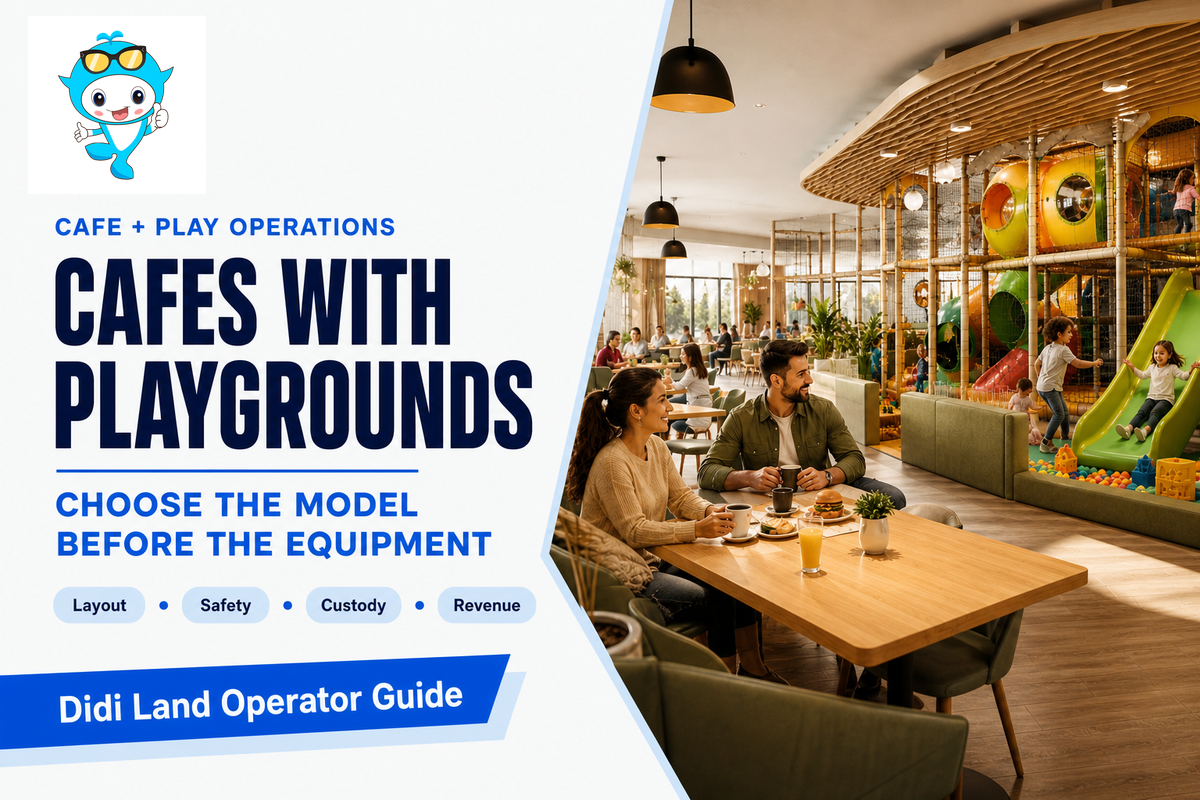
U.S. operator planning guide
Cafes with playgrounds are cafes that pair food or drink service with a child play offer, but in practice the phrase may mean a coffee shop with a small free corner, a paid indoor playroom, a cafe that shares a building with a playground, or a full stay-and-play venue with reservations, parties and classes. The staffing, cleaning, accessibility, licensing and revenue requirements of such models will vary greatly.
Families describe the same concept in everyday words, and each cluster points to a different job: a latte, tea, a cuppa, a tasty cup, comfy seats, a place to relax, meet and sip, grown-up conversation and joyful couch time describe the adult’s break; indoor play, kids play, an indoor playground, an indoor play area, a kids area, a toy corner, a fort, sensory play, creativity, imagination and curiosity describe the play offer; a cupcake, ice cream by the scoop, a bakery, delicious food, a yummy menu, baristas and the selection describe the café; weekly events, board games and kid-friendly activities, kid’s or kids’ activities that entertain and engage small kids, little ones, littles and a toddler describe programming; and a favorite location with parking downtown, drink and coffee spots around town, a playgrounds cafe with grab-and-go coffee, a cozy indoor and an outdoor space, a patio, outdoor seating, a hip atmosphere, Instagram appeal, a village where parents connect, a nursery corner and a perk for members describe access and mood. Parents may also ask where to enjoy a welcome spot and explore a menu. Those phrases describe discovery language, but not a safety standard or a demand forecast.
This guide is intended for U.S. cafe owners, founders, architects, and procurement teams currently evaluating models prior to locking a floor plan or requesting a playground quote. This operator audit isn’t legal advice. This isn’t a guarantee that a specific layout will be profitable. The useful step is to name the people who own each promise in the play area, then make the layout, the space, supporting evidence, and the economics agree.
1. Start with the job, not the equipment
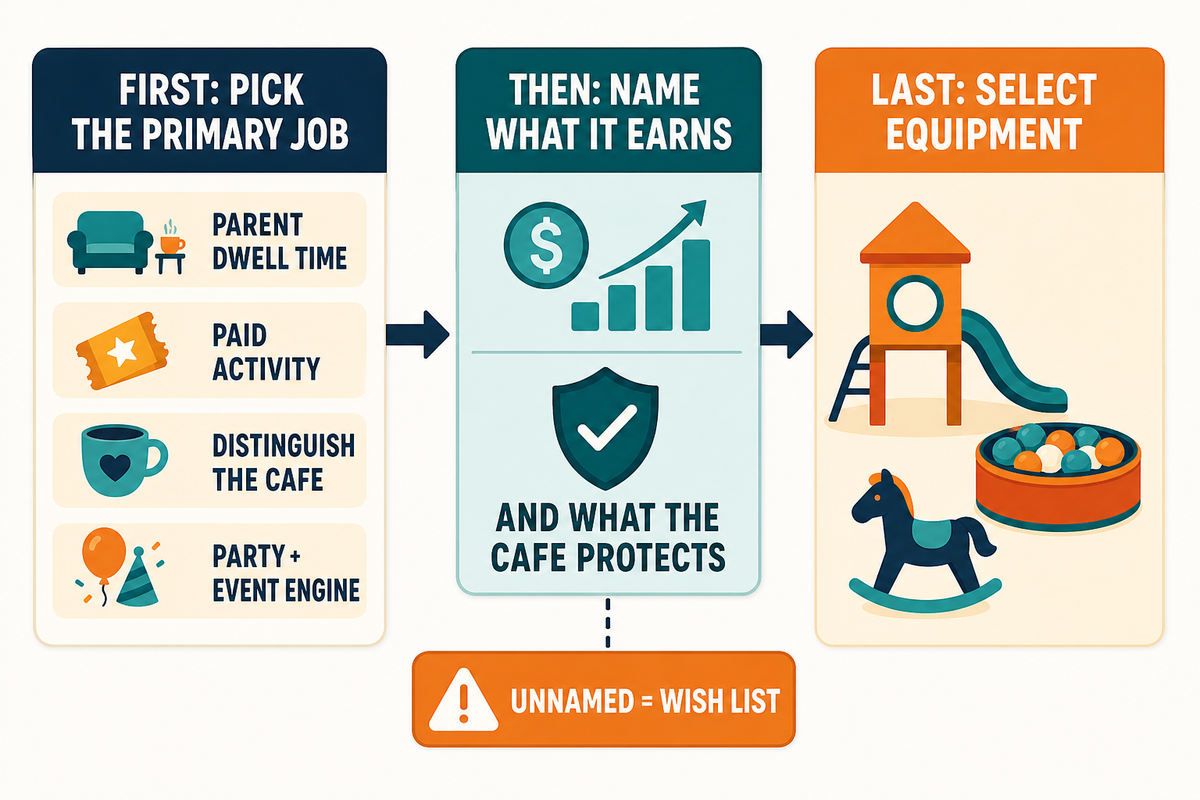
A play area has four possible jobs: add to a parent’s dwell time, be a paid activity, distinguish the cafe, or run a party and event engine. Pick the primary job before selecting slides, soft modules, gates or seating. A free space that will sell tickets later has a model conflict; a paid playroom that has been designed as a decorative amenity has an operational conflict.
Fill in the blanks: “The play area earns its keep by ______, while the cafe protects ______.” The first blank could be food contribution, the selling of tickets, memberships or reserved events. The second could be table turnover, an undisturbed coffee experience or a family visit of a predictable nature. If the team fails to fill both blanks, the layout is still a wish list.
2 – Four-Model Matrix: The Trade-Offs
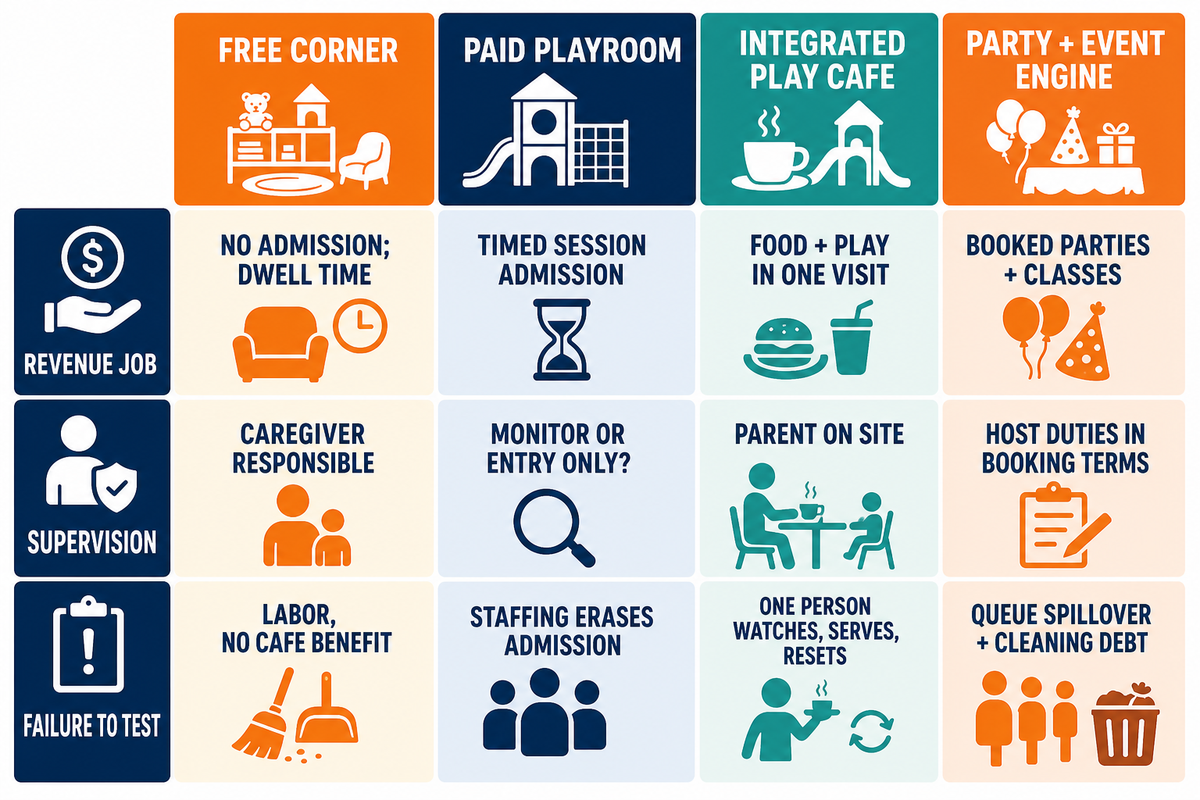
The Four-Model Trade-Off Matrix below is the central buyer asset on this page. It’s a comparison framework rather than a statement that every venue fits only one row. A venue may start out as a free corner and later add paid sessions, but custody, route and cleaning should be reassessed when the offer is changed.
| Model | Access and revenue job | Supervision posture | Layout priorities | Failure mode to test |
|---|---|---|---|---|
| Free corner | No separate admission; supports dwell time and family choice. | Parent or caregiver remains responsible; staff run the cafe, not a drop-off service. | Small, visible, easy to close and clean; no conflict with queue, restrooms or exits. | The “free” amenity consumes labor and blocks circulation without producing a measurable cafe benefit. |
| Paid playroom | Admission or timed session is the primary play-area line. | Define whether staff monitor activity or merely control entry. Do not imply custody unless the operation is built and licensed for it. | Check-in, wristband or reservation flow, shoe and stroller storage, age cohorts, cleaning reset. | Admission is collected, but check-in, cleaning closures and staffing erase the contribution. |
| Integrated play cafe | Food and play are sold as one visit or bundled experience. | Parent remains on site; staff coordinate food, reservations and play rules. | Dining sightlines, food-safe separation, accessible route continuity, acoustics and a clear answer to “who watches?” | A single employee is expected to watch play, run the counter and reset tables during one service window. |
| Party and event engine | Booked birthdays, classes, memberships or private sessions carry the play promise. | Event host duties, guest ratios and any custody language are explicit in the booking terms. | Party room, storage, timed turnover, guest arrival, food delivery and emergency egress. | Peak events work on paper but create queue spillover, cleaning debt or an unusable cafe during setup. |
Use the promise row, the one customers will actually buy, instead of the supplier’s equipment package. An example at a venue includes reservations, play sessions, cafe services, classes, parties, and gift cards. An example like this doesn’t set a market-wide revenue mix. The same advice applies to consumer listicles that combine a toy nook and a full playground in the same search.
3. Free corner: the low-price model with a real labor cost
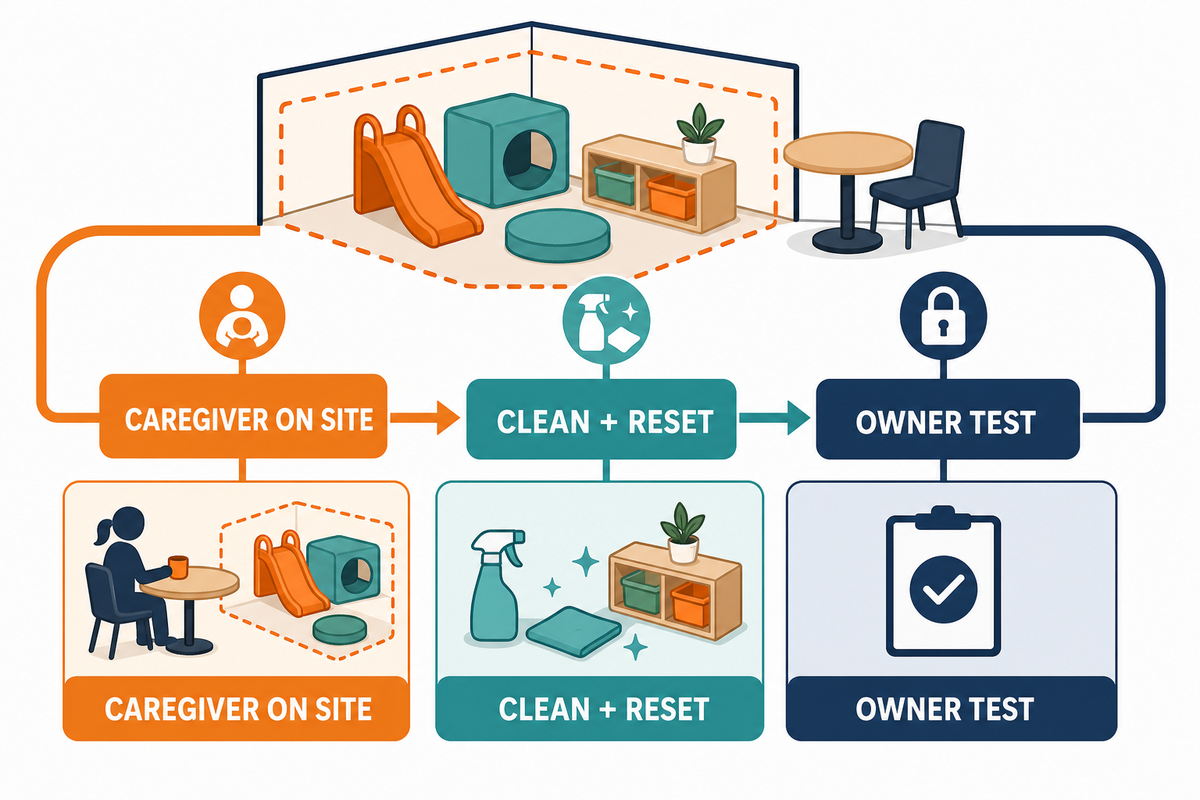
A free corner may be the right answer if the cafe service is to make a family visit easier as opposed to providing a second activity. Keep the promise narrow: a small, contained area where children can occupy themselves while a caregiver is responsible. Use washable, replaceable items, a visible boundary, and a closing procedure. Don’t call it child care, and don’t allow the “free” label to conceal the labor to inspect, wipe, restock, and close.
Before approving the corner, test the design with data from the owner: family tickets or orders with the amenity open, cleaning minutes per service, closure minutes, complaints, and obstructed paths. This isn’t to find a universal conversion range. It’s to see if the amenity is of sufficient help to the cafe service to justify the recurring work.
For broader design questions, see Didi Land’s play cafe design guide; this guide stays with the model decision and the responsibility boundary.
4. Paid playroom: admission creates a control system
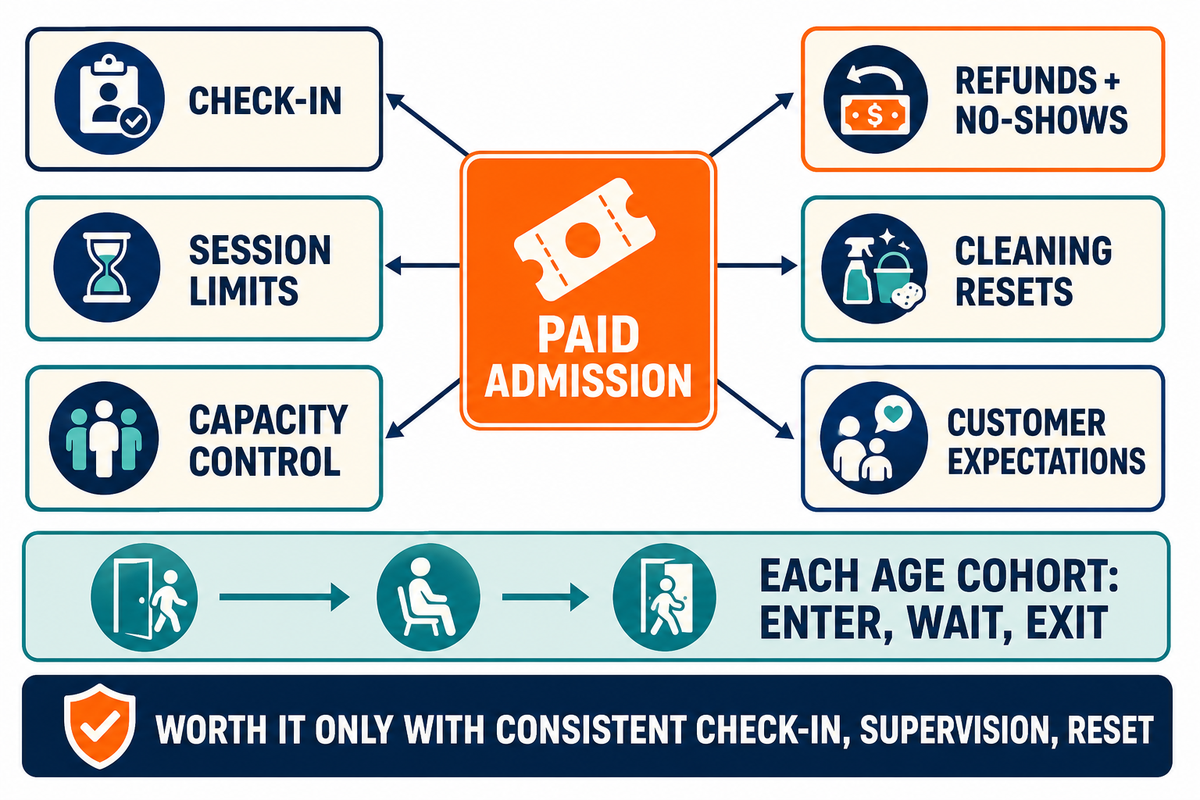
Paid play isn’t just a free corner with a price tag. A price creates obligations like check-ins, session limits, capacity control, refunds, no-shows, cleaning resets, and customer expectations. You decide if the room is a timed attraction, a membership perk, a service with a reservation, or an add-on to an event. Each selection alters the route test and the staffing plan.
Plan age separation or cohorting deliberately, because the Access Board guide says play areas designed for different age groups should be considered separately. Equipment, supervision, and movement patterns decide how that split works on the floor. You can’t consider a toddler area, climbing route, and party area as the same undifferentiated capacity number. Ask the designer where each of the cohorts enters, exits, waits, stores shoes, and meets a caregiver.
For detailed seating and zoning, the existing playroom cafe layout guide should be used. This guide handles the trade-off decision. Paid access is only appealing to an operator if they can deliver a consistent check-in, supervision, and reset process.
5. Integrated play cafe: one visit, multiple handoffs
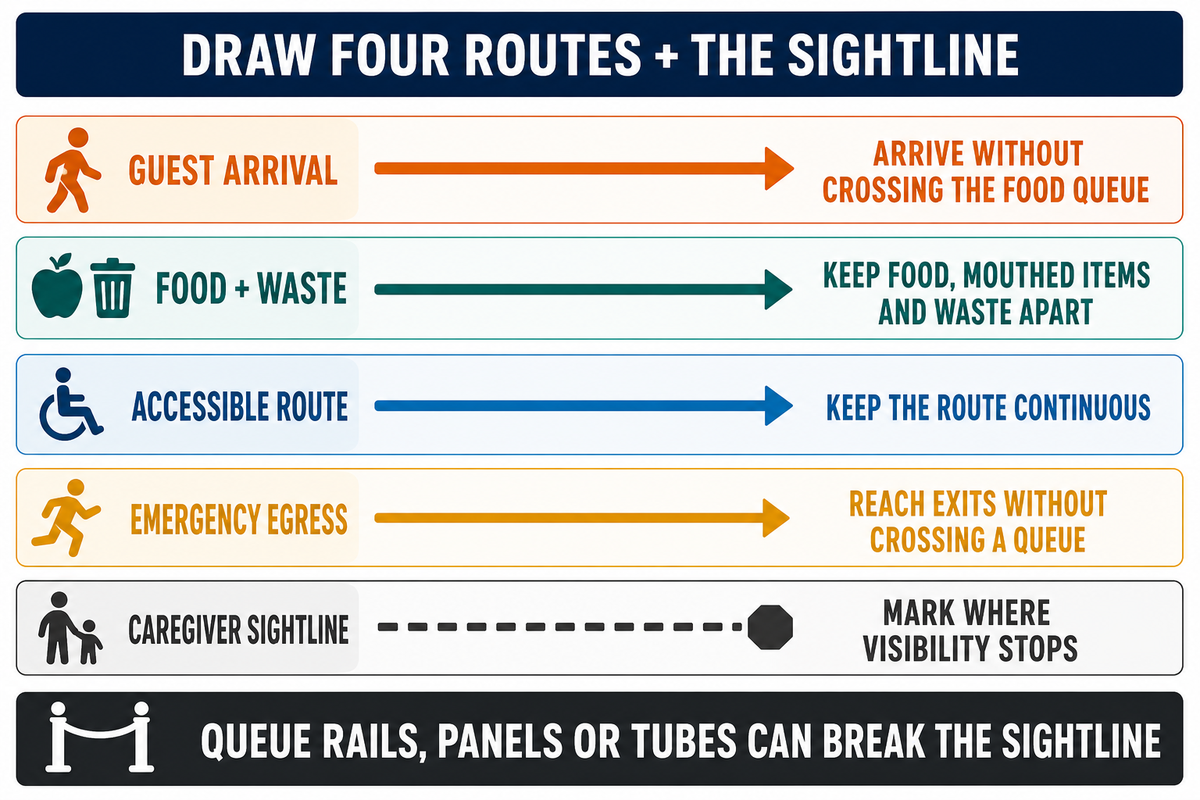
The integrated model is user-friendly to customers and complex to operators. An order is placed by a parent, a child enters play, food is delivered, a restroom route is maintained, and staff field questions regarding the rules. The layout should let those handoffs happen while keeping an employee from becoming the unforeseen connector between incompatible tasks.
Draw four routes on the plan: guest arrival, food and waste, accessible circulation, and emergency egress. Then draw the supervision line: caregiver visibility and where that visibility stops. The plan fails if the cafe sells a clear sightline but the promise is made to be untrue due to queue rails, acoustic panels, tubes, etc.
Food rules remain local. The FDA Food Code is a model offered for adoption by jurisdictions, so the operator still needs the applicable health department and food-service interpretation. Keep play surfaces, mouthed items, waste handling and food preparation responsibilities explicit rather than assuming a single “family friendly” certification covers them. Restaurant-led operators can compare this model with the restaurant indoor play-area guide and Didi Land’s restaurant and hotel play-area solutions.
6. Party and event engine: the peak-day model
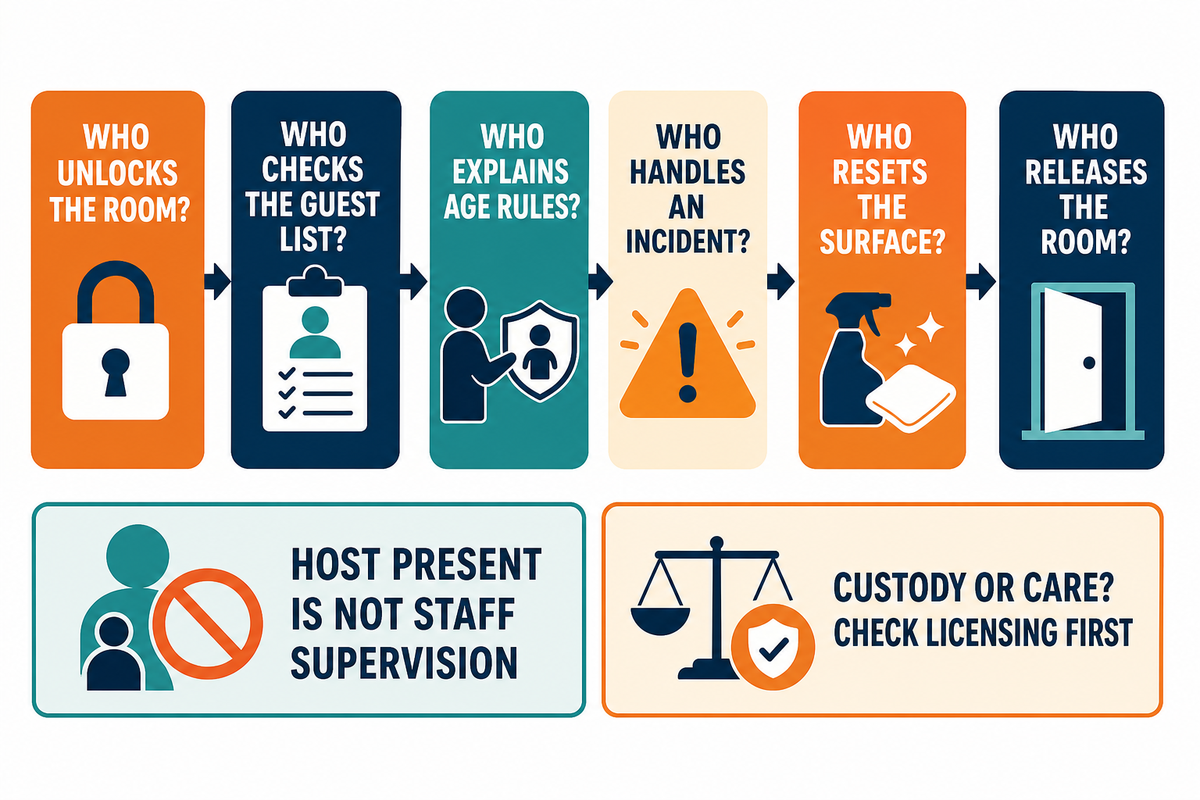
Parties, classes and private sessions can help sell the play area as a product. They also concentrate risk. Everything from arrival to departure happens rapidly and includes gifts, coats, food, cake and cleanup. Design the event flow even if the cafe is quiet on most normal weekdays.
To request a turnover script is to ask “who unlocks the room, who checks the guest list, who explains age restrictions, who handles an incident, who resets the surface and who releases the room back to general use?” If the answer is “the cafe team,” then which other services and activities are disrupted, and what labor cost is the revenue plan carrying?
A party model should also have a well-defined contract boundary. “A host is present” shouldn’t be taken to mean “staff will supervise children.” If the venue accepts custody or advertises care, pause the sales copy and consult the local licensing office, the insurer and the authority having jurisdiction to determine what the promise triggers.
7. Safety ownership is a multi-authority evidence job
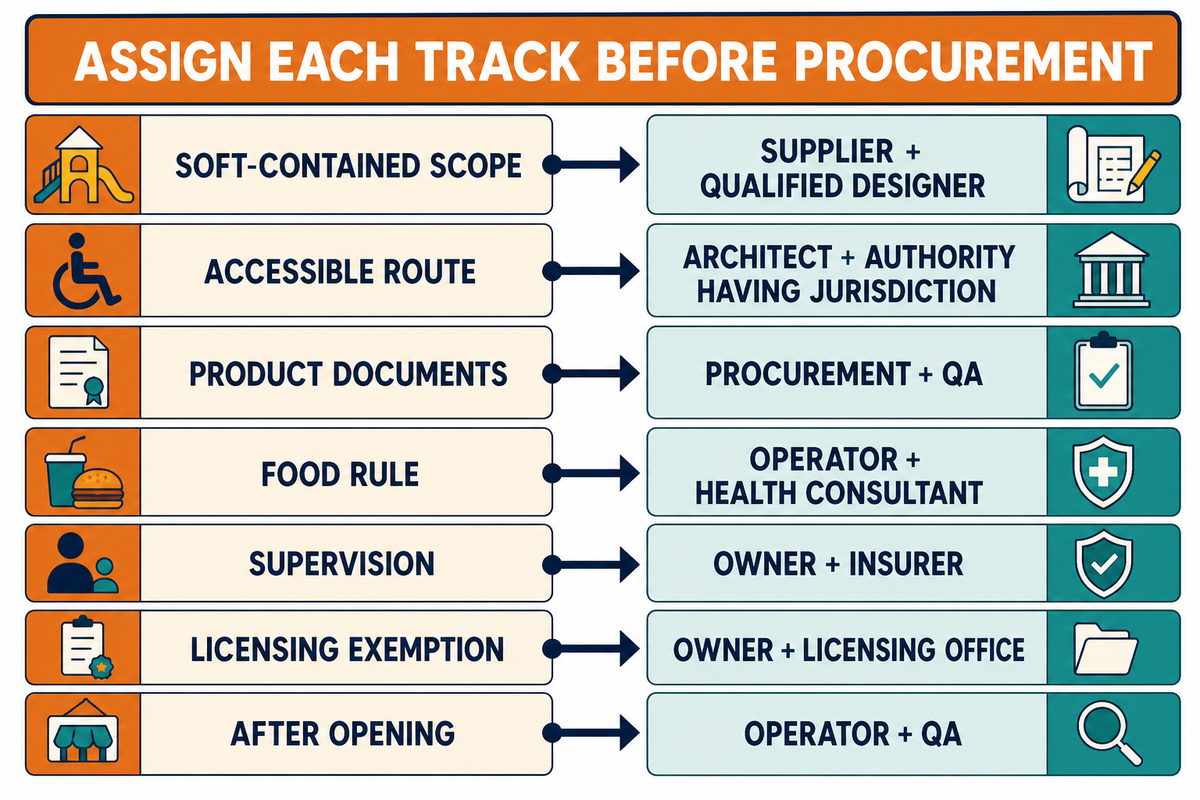
Safety isn’t an addendum to a supplier quote. Prior to procurement, assign ownership to each of the evidence tracks:
| Question | Evidence to request | Primary reviewer | What it does not prove |
|---|---|---|---|
| Is the equipment soft-contained? | Product description, intended use, equipment family and standard scope. | Procurement + architect | It does not prove the whole venue is compliant. |
| Does ASTM F1918 apply? | Current edition, scope, exclusions and product mapping. | Supplier + qualified designer | It does not replace local building, fire or accessibility review. |
| Does ASTM F1487 apply? | Outdoor or conventional public-use equipment scope and edition. | Architect + procurement | It does not govern soft-contained play or an independent shade structure by default. |
| What is the route obligation? | Accessible-route drawing, component schedule, surfaces and age-area analysis. | Architect + authority having jurisdiction | One accessible entry point does not prove every route or component decision. |
| What product documents exist? | Test report or certificate identifier, product, intended use, standard claimed, exclusions and issuer. | Procurement + QA | CPSC says there is no specific playground-equipment certification requirement, but products considered children’s products or children’s toys would require a CPC. |
| What food rule applies? | Local health-department interpretation, plan review and food-contact cleaning procedure. | Operator + health consultant | The FDA Food Code model page is not a local permit. |
| Who supervises? | House rules, staff duties, incident path and customer-facing custody language. | Owner + insurer | “Parent supervised” does not authorize staff custody or erase operator duties. |
| Could an exemption apply? | Written local licensing analysis and the facts that make it apply. | Owner + licensing office | One state’s exemption is not a U.S. rule. |
| What changes with age cohorts? | Age/size groups, component routes, surfaces, barriers and supervision plan. | Architect + operator | A single posted age range does not validate every mixed-use area. |
| What happens after opening? | Inspection, cleaning, closure, replacement and training records. | Operator + QA | A handover packet is not evidence that the operating system is being followed. |
The U.S. Access Board guide is very useful because it expands the “route” beyond the “entrance.” It discusses routes that connect play components, the coverage for components that are at ground and elevated levels, compliant surfaces and separate consideration for different age-group play areas. All of these should be treated and reviewed as design inputs in the context of the project and shouldn’t be reduced to an ‘ADA Compliant’ stamp.
“Soft contained play structures must provide at least one entry point on an accessible route when three or fewer entry points are provided. If four or more entry points are provided, at least two entry points must be located on an accessible route.”
8. The custody and licensing fork
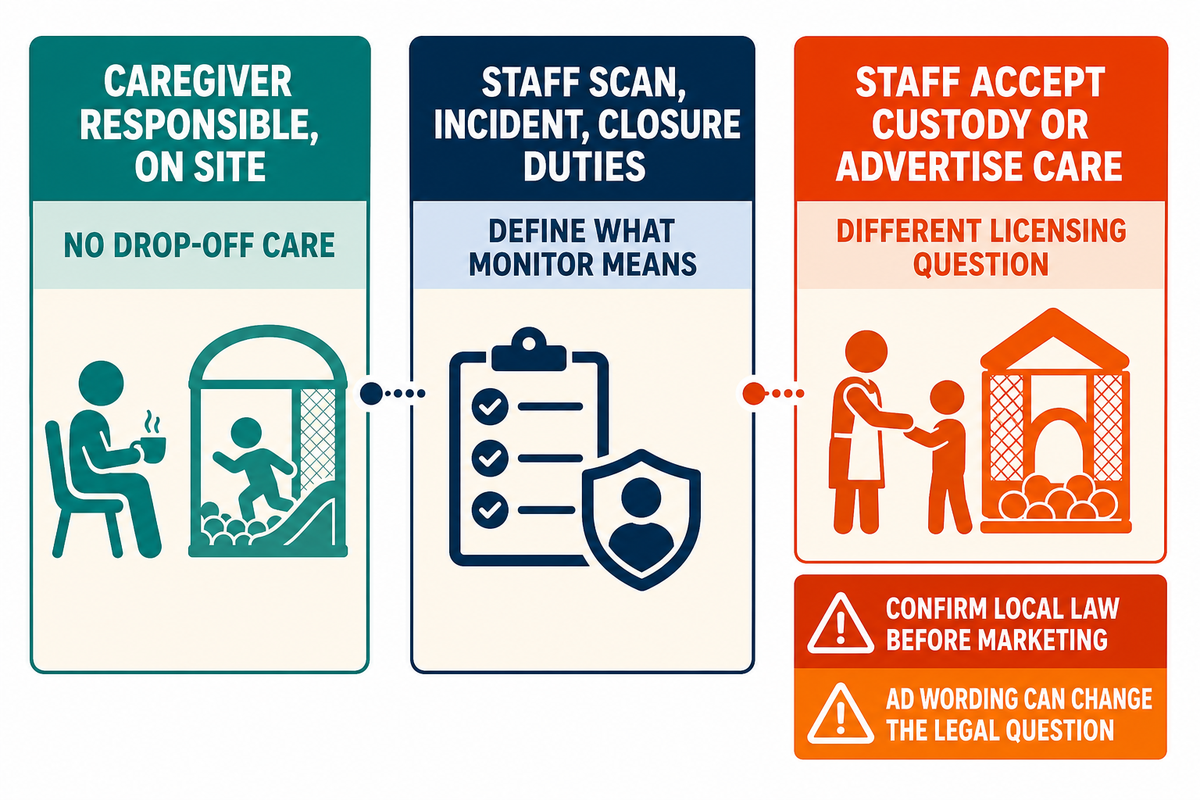
Write the supervision posture in three separate lines:
- Caregiver is responsible and on site. Staff manage compliance with the entry rules and respond to the hazards, but the venue doesn’t offer drop off care.
- Staff have defined scan, incident, and closure duties. The customer facing copy must define what “monitor” means.
- Staff accept custody or advertise care. This is a different operating and licensing question. Confirm the local law applies before marketing or offering care.
Texas shows why a local check is needed. A Texas Health and Human Services handbook revision, effective July 1, 2025, cites a parents-on-premises exemption which has conditions such as no child care advertising, a parent attending or engaging in an activity nearby, contactability, a maximum of 4.5 hours per day and 12 hours per week, with a narrow exception. That’s a Texas example and not a national safe harbor. To get clarification, contact the licensing office at the jurisdiction of interest and share the facts and wording with them.
Enter that answer in the project record before selecting gates, wristbands, staff uniforms, or a “drop your child and relax” ad. The ad can change the legal and insurance discussion before equipment is even changed.
9. The Route + Custody Overlay Worksheet
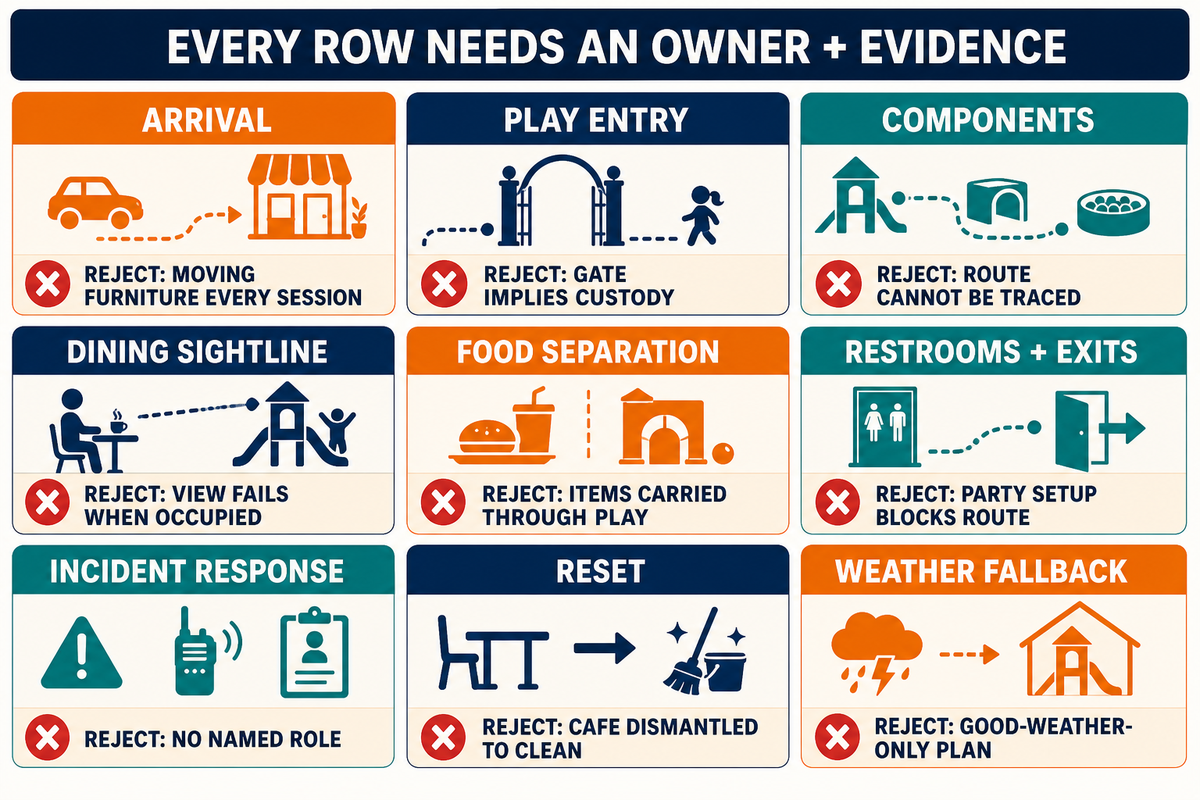
This worksheet should be used in a design review. A row isn’t complete until an owner is named, along with a piece of evidence.
| Overlay | Ask on the drawing | Owner-input answer | Reject gate |
|---|---|---|---|
| Arrival | Can a stroller, wheelchair or party group arrive without crossing the food queue? | Draw the route and the peak arrival condition. | Reject if arrival depends on moving furniture every session. |
| Play entry | What is the access-control step and who explains the rule? | Entry method, age cohort and staff role. | Reject if a gate implies custody that the contract does not support. |
| Components | Which play components are on the accessible route and which age group uses them? | Component schedule and route mark-up. | Reject a design that counts the entrance but cannot trace the component route. |
| Dining sightline | Can the caregiver see the child from the promised seating area? | Seat, eye-line and obstruction test. | Reject a “visible play” promise that fails when occupied. |
| Food separation | Where do food, mouthed items, waste and cleaning supplies cross? | Storage and clean/dirty workflow. | Reject if the only solution is a staff member carrying items through play. |
| Restrooms and exits | Can a child and caregiver reach restrooms and exits without crossing a queue? | Route continuity and emergency review. | Reject if a party setup blocks a required route. |
| Incident response | Who notices, who responds and who records an incident? | Named role and escalation path. | Reject if “someone on the floor” is the only answer. |
| Reset | Where are spare parts, closed bins and cleaning tools stored? | Reset time, storage and closure trigger. | Reject if cleaning requires dismantling the cafe each time. |
| Weather fallback | If outdoor play closes, what paid or free offer remains? | Fallback schedule and contribution assumption. | Reject a revenue plan that has only a good-weather case. |
10. Cleaning, maintenance and heat are operating variables
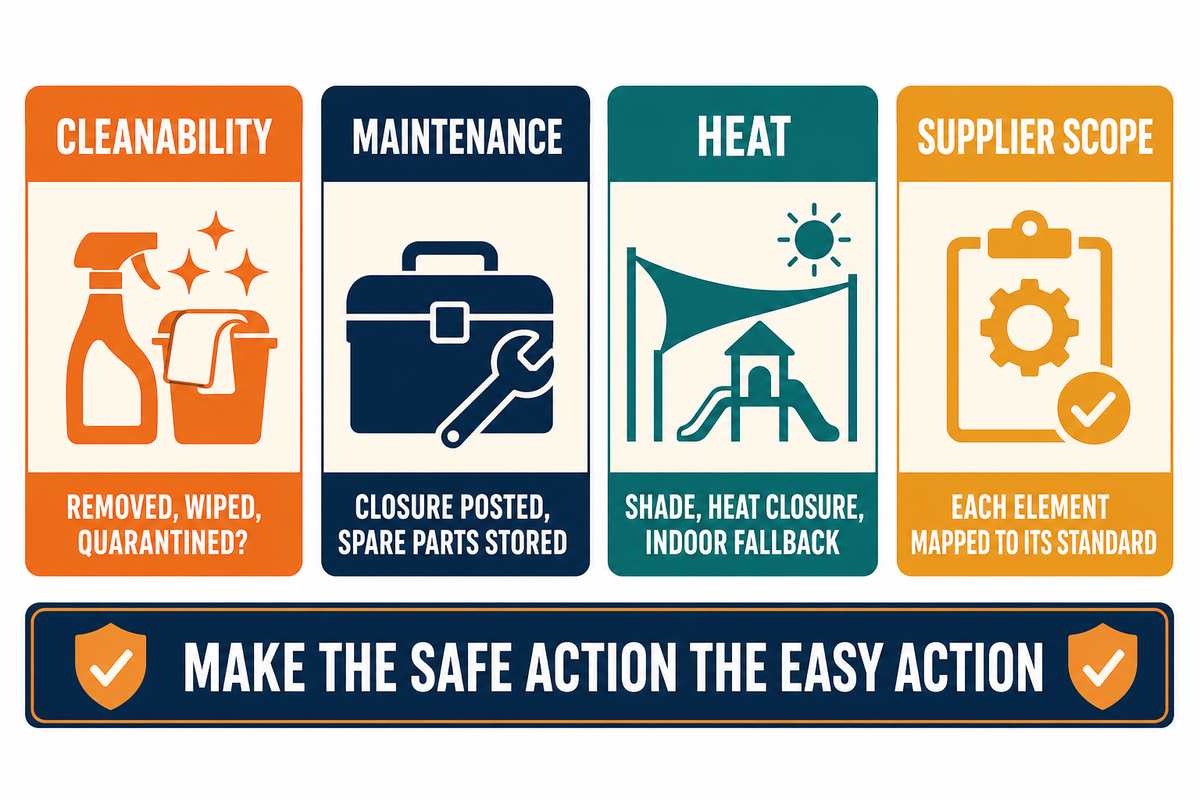
Cleanability should be addressed in the layout brief. One operator’s cleaning account describes a rotating supply of mouthed toys, distributed supplies, checklists, storage, and even work outside of normal operating hours. Request the actual reset path. What’s removed? What’s wiped? What’s quarantined? How is a closure posted? And where are the replacement parts? The plan should make the safe action the easy action.
Outdoor play introduces elements of weather and surface exposure. A 2023 PubMed-indexed observational study in school parks found children’s moderate-to-vigorous activity declined as temperature rose, with a steeper decline at and above 33°C (91°F); the park with the most tree canopy recorded 6.0 percentage points more time in moderate-to-vigorous activity in that study. Since this study was conducted in school parks, not cafes, this shouldn’t be a demand or revenue justification, but rather a reason to study shade, heat closure and indoor fallback.
For equipment scope, maintain the family split: ASTM F1487-25 is listed for public-use playground equipment and does not include soft-contained play and independent shade structures; ASTM F1918-21 is the soft-contained reference used in this review. Request the supplier to map each element to its standard instead of writing “ASTM certified playground” on a purchase order.
11. The Revenue-Responsibility Switch
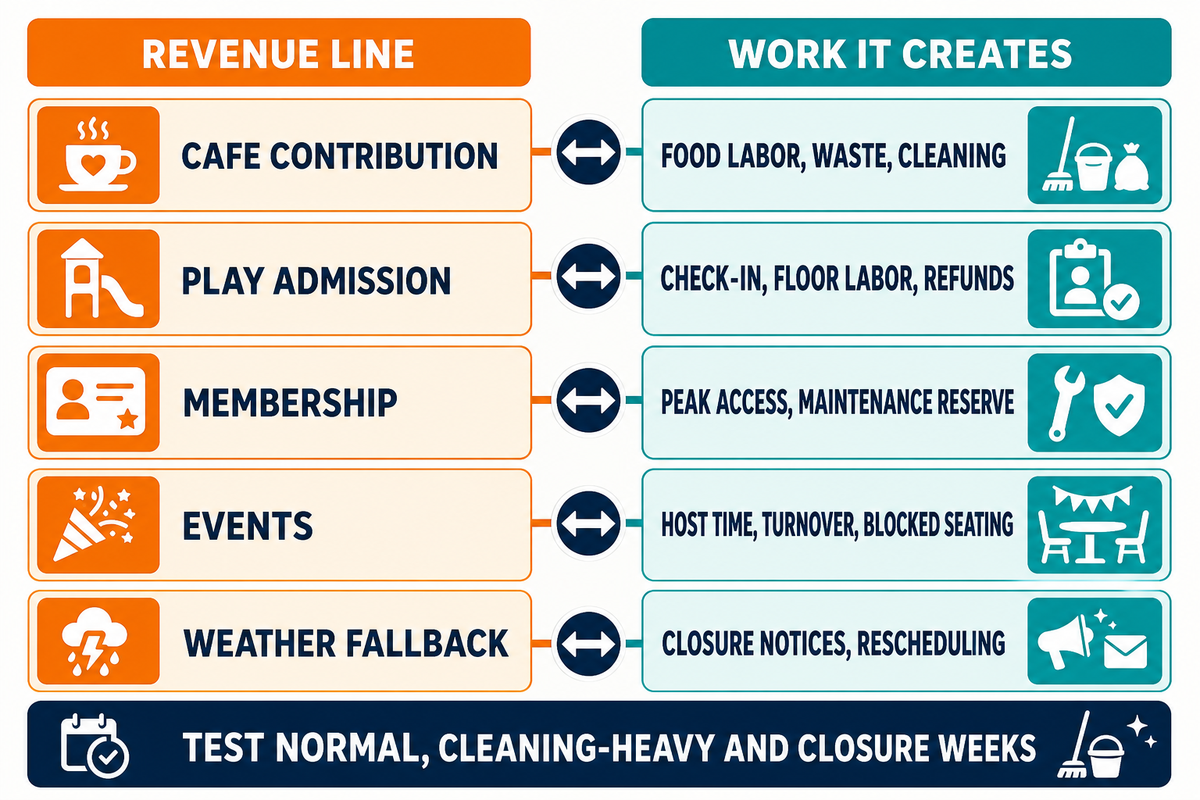
Revenue is useful only if the operating responsibility is associated with it. Use the worksheet provided below with your estimates for price, attendance, labor and closure. It’s deliberately formula-based because a generic margin or payback would be misleading. Didi Land’s play cafe design guide gives typical footprint and payback ranges as a starting reference; this worksheet ties each revenue line to the responsibility it creates, so replace those ranges with your own inputs.
Owner-input scenario worksheet
| Line | Owner input | Subtract or add | Decision question |
|---|---|---|---|
| Cafe contribution | Orders attributable to family visits × contribution per order | Food labor, waste and incremental cleaning | Does the amenity improve the cafe job after its work is counted? |
| Play admission | Paid sessions × realized price | Check-in, floor labor, refunds and cleaning closures | Can the team deliver the promised session without borrowing cafe labor? |
| Membership | Active members × realized monthly contribution | Peak access, maintenance reserve and service workload | What happens when members arrive together? |
| Events | Booked events × contribution per event | Host time, turnover, food handling and blocked general seating | Does the peak-day plan still protect ordinary customers? |
| Weather fallback | Fallback offer contribution | Closure communication and rescheduling cost | What remains sellable when outdoor play is closed? |
Thought leadership in the industry is directionally helpful here since it tends to get operators thinking beyond top-line to food cost, attraction contribution, inventory, scheduling and cross-training. This isn’t a cafe-specific benchmark. Run at least three scenarios: a normal operating week, a cleaning-intensive week, and a closure week or week with event spillover. Don’t adopt the operating model if one unsupported assumption accounts for the entire decision.
12 – Five-Gate Model Selector
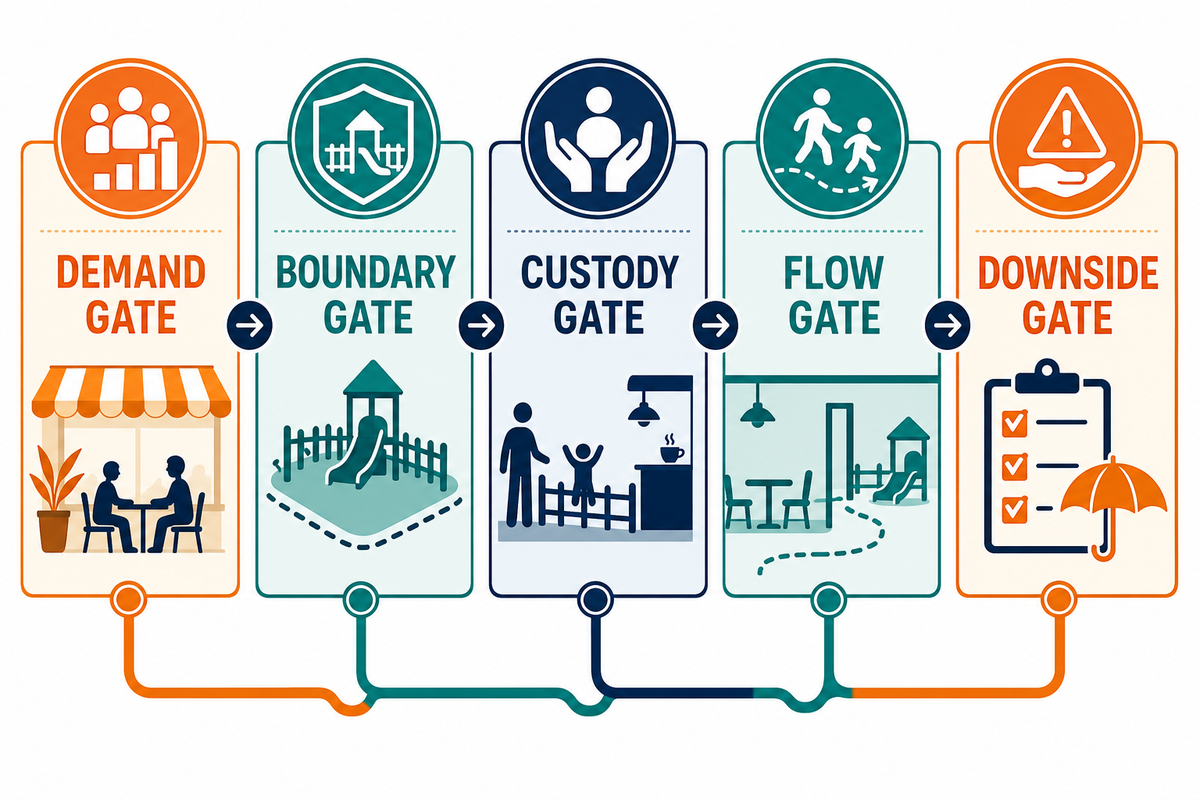
Use these gates in this specific order. A “no” isn’t a failure. It indicates which model to reject prior to procurement.
Keep the evidence attached to its scope: ASTM F1918-21 and F1487-25 are different families; the Access Board guide discusses at least 50% of elevated components on an accessible route in its applicable framework; the Texas example uses 4.5 hours per day and 12 hours per week; the heat study reports a threshold at 33°C and a 6.0 percentage-point canopy difference. These figures are bounded by their sources and aren’t design benchmarks.
| Anchor | Recorded value | How to use it |
|---|---|---|
| Soft-contained scope example | 2 years to 12 years | Use the standard’s scope as a product-mapping prompt, not an attendance promise. |
| Soft-contained entry example | Three or fewer entry points: at least one on an accessible route; four or more: at least two | Check the applicable accessible-entry provision, then trace the full route. |
| Elevated component example | 50% | Confirm the applicable route requirement with the project reviewer. |
| Texas example | 4.5 hours per day; 12 hours per week | Texas-only licensing example; never copy it as a national rule. |
| Heat study context | 33°C; 6.0 percentage points | Use for a weather-closure question, not a cafe forecast. |
| Owner planning input | 1 hour, 2 hours or 3 hours | Enter the observed reset time after a real shift; the blank is not a benchmark. |
| Owner planning input | 4 hours, 5 hours or 6 hours | Compare a normal session with a cleaning-heavy session. |
| Owner planning input | 1 day, 2 days or 7 days | Record replacement, closure or rescheduling lead time. |
| Evidence review cadence | 90 days or 180 days | Set a re-check date for standards, licenses and supplier documents. |
| Scenario sensitivity | 0%, 25%, 50%, 75% or 100% | Stress-test attendance or weather availability without calling it market data. |
- Demand gate: Can the team name the customer job and the evidence that will be used to measure it?
- Boundary gate: Have equipment scope, accessibility, food, building/fire and local licensing been allocated to named reviewers?
- Custody gate: Does the customer-facing language reflect the actual caregiver, staff-monitoring or custody posture?
- Flow gate: Are arrival, food, accessible routes, age cohorts, restrooms, exits and reset operations integrated?
- Downside gate: Does the owner-input scenario hold in the extreme conditions of weather closure, cleaning-intensive and peak event operations?
If the answer fails at Gate 2 or 3, don’t make up for it with more equipment. If it fails at Gate 4, redraw the route before dealing with colors. If it fails at Gate 5, reduce the scope or adjust the model rather than inserting a universal revenue justification.
13. What to send a playground supplier
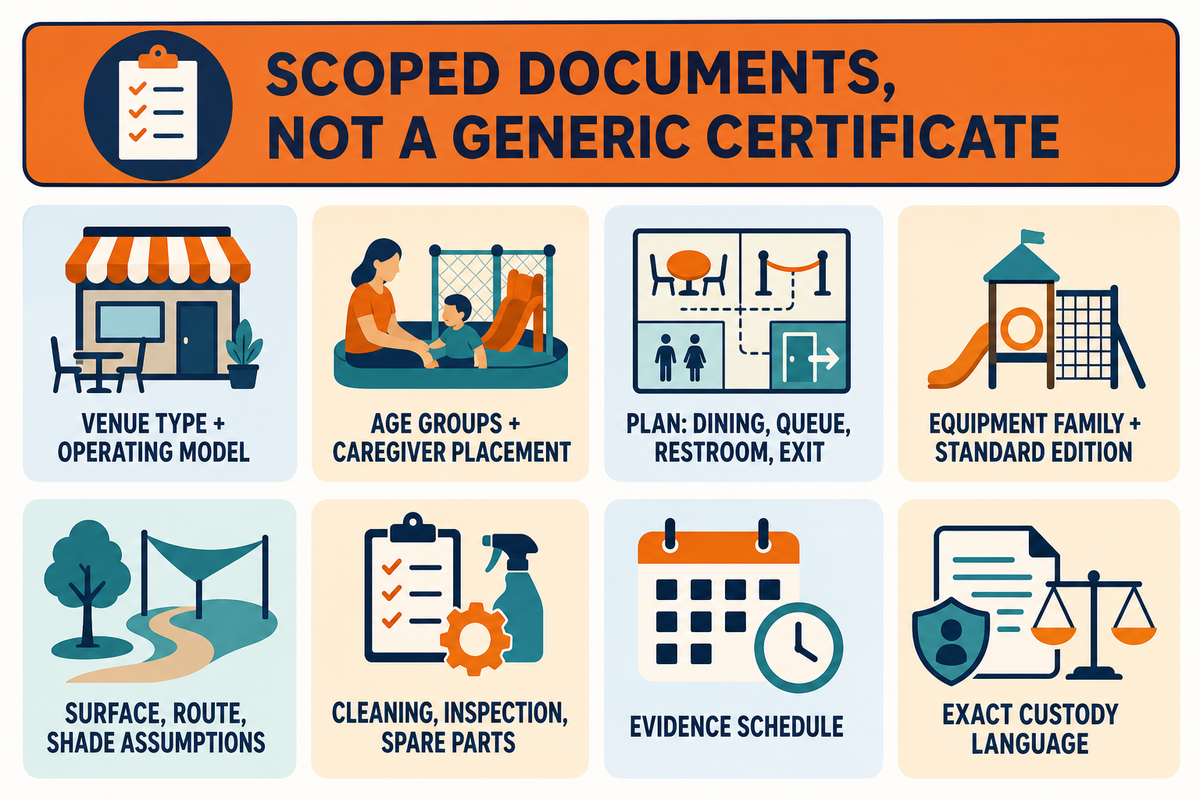
A useful brief is detailed enough to be checked and modest enough not to invent compliance. It should provide:
- venue type, target U.S. jurisdictions and primary operating model;
- desired age and size groups, separation and caregiver placement;
- available plan with dining, queue, restroom, exit, storage and service routes;
- soft-contained versus conventional equipment family and the standard edition or scope being claimed;
- surface, route, component, and shade assumptions requiring architect or authority review;
- cleaning, inspection, closure, spare-part and replacement workflow;
- evidence schedule: product, intended use, claimed standard, report identifier, exclusions, issuer, and reviewer;
- the precise supervision and custody language to use on the website, in the booking flow and in the house rules.
CPSC business guidance is a helpful guardrail: there’s no single standalone federal certification of playground-equipment that resolves all product issues. Products considered children’s products or children’s toys would require a Children’s Product Certificate (CPC), and other children’s-product, toy, and attachment requirements may also apply. When seeking scoped documents, don’t request a generic “certificate.” For Didi Land capability and equipment-selection questions, continue to the cafes with soft play equipment guide and the indoor playground design and layout guide. Once the brief is complete, compare it with Didi Land’s commercial soft play equipment range, or send the brief to Didi Land for an equipment proposal.
14. FAQ
Are cafes with playgrounds profitable?
A cafe with a playground can be profitable, but the result depends on the model, local demand, labor, cleaning, rent, pricing and the promise made to caregivers. Use the Revenue-Responsibility Switch with your own inputs; don’t import a generic margin or payback period. A free corner may support food sales, while a paid room may carry admission but also carry check-in and reset labor.
What is the best layout for a cafe with a playground?
The most suitable layout preserves the selected operating job and keeps food, accessible routes, restrooms, exits, age cohorts and supervision legible. A party engine requires timed arrival, storage and turnover space, and differing controls will be needed for a free corner and paid playrooms.
Does parent supervision remove the need for safety planning?
No. It defines one of the supervision postures. Equipment, routes, inspections and clearly defined rules still fall to the operator. Parent supervision tells everyone who watches a child at a given moment, but it doesn’t inspect equipment, keep an accessible route clear, reset surfaces after a spill or decide when a zone must close, so each of those tasks still needs a named staff duty, written into the house rules and the opening checklist before the first family arrives.
Do I need ASTM F1918 or ASTM F1487?
The right standard depends on the equipment family and how it will be used. F1918-21 is the soft-contained reference provided; F1487-25 pertains to a different public use playground scope. Contact the supplier and the qualified designer and ask them to map each component, edition, exclusion, and the local review owner rather than requesting one overall certificate.
Is one accessible entry enough?
Not necessarily. Trace the route to components, surfaces, and age areas on the actual project drawing, and have the qualified designer mark the connections. For soft contained play structures, the U.S. Access Board guide calls for at least one entry point on an accessible route with three or fewer entry points and at least two with four or more, and the drawing still has to show how ground-level and elevated components and any separate age areas are reached.
Can I advertise a cafe play area as child care?
Do not assume that wording is harmless. Local licensing analysis can be impacted by advertising, caregiver proximity, contactability, time limits and staff custody. Get the jurisdiction-specific answer before publishing the promise. Have the insurer and licensing office review the exact customer-facing language.
15. The practical conclusion
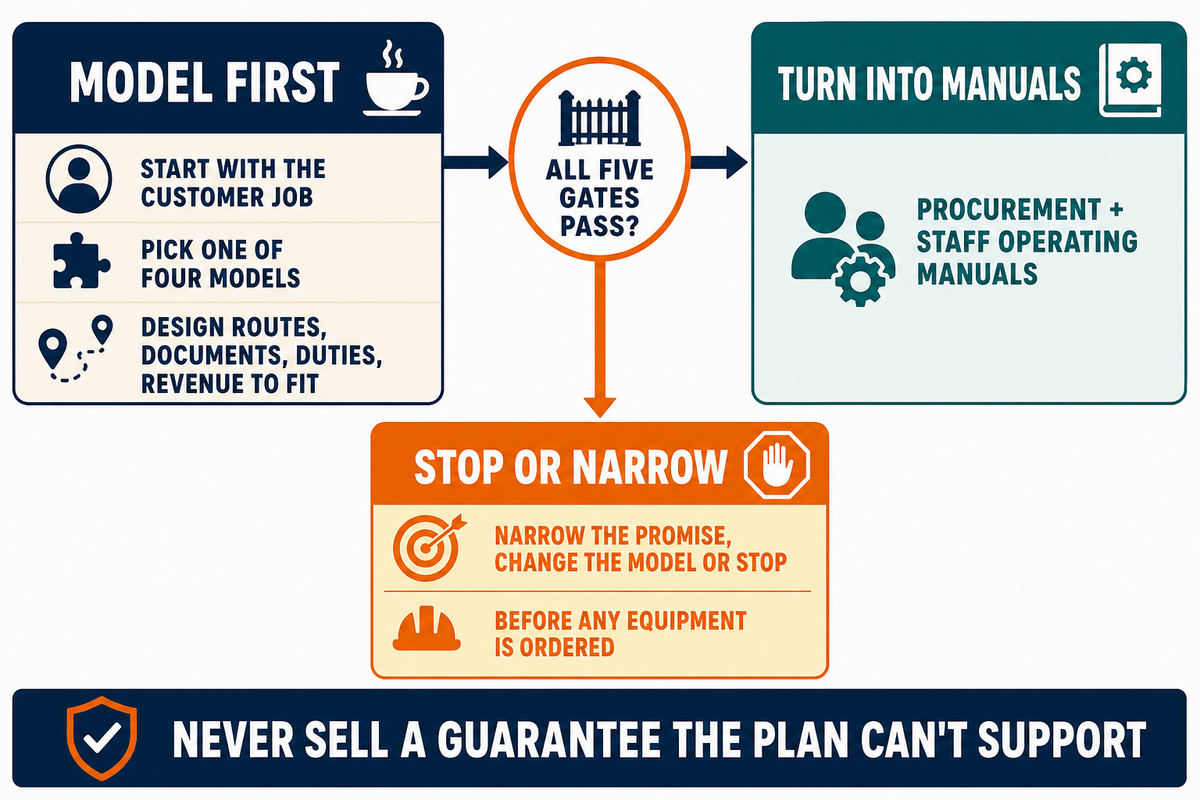
Start with the customer job, then select one of the four operating models. Once that’s done, design every component to support that choice, including routes, documents, staff duties and revenue lines. The costliest mistake isn’t choosing the wrong color or slide. It’s selling a supervision or revenue guarantee that the plan, team and evidence aren’t able to support.
Once the five gates are crossed, turn the worksheets into procurement and staff operating manuals. If any gate fails, narrow the promise, change the model or stop the project before any equipment is ordered. That level of discipline is what differentiates an Internet search phrase, cafes with playgrounds, from a buildable, reviewable operating decision.
References & Sources
- ASTM F1918-21: soft-contained play scope and exclusions.
- ASTM F1487-25: public use playground equipment scope and exclusions.
- U.S. Access Board: Chapter 10, Play Areas: routes, components, surfaces and age-area considerations.
- CPSC: Playground Equipment business guidance: certification and product duty boundary.
- CPSC: Public Playground Safety Checklist: inspection prompts and recurring hazards.
- FDA Food Code 2022: model-code adoption boundary.
- Texas Health and Human Services: Exemption Categories: a Texas-specific example that isn’t a general rule.
- PubMed 36640783: bounded school-park heat and activity observations.
- IAAPA operator thought leadership: contribution and cost of operations.
- Playgrounds Cafe: the venue’s own website, used only as an independent example of model structure; not a Didi Land project or benchmark.
SYS.00 // E-E-A-T Disclosure
Why I Write This
As the CEO and Co-Founder of a specialized manufacturing facility, my objective is to provide unvarnished, factory-direct technical insights into commercial indoor playground engineering, safety compliance, and project planning. I aim to bridge the information gap for global buyers seeking reliable structural and material data, ensuring you make informed, ROI-driven decisions without the marketing fluff.
About My Business
Guangzhou Didi Land Amusement Equipment Co., Ltd. (Brand: Didi Land) is a commercial indoor playground equipment manufacturer founded in 2014. Operating from Panyu, Guangzhou, China, we engineer, produce, and export commercial-grade play structures to over 40 countries worldwide. Our production lines strictly adhere to international safety frameworks, ensuring durability and safety for high-traffic environments.
Our Services
We provide end-to-end B2B commercial solutions: from custom 3D spatial design and OEM manufacturing to worldwide export logistics and compliance testing. Our focus is on empowering Family Entertainment Centers (FECs), shopping malls, kindergartens, and hospitality venues with reliable, high-capacity play infrastructure.
DATA_MATRIX // MANUFACTURER_PROFILE
Name:
Cherry
Role:
CEO & Co-Founder
Brand Name:
Didi Land
Company:
Guangzhou Didi Land Amusement Equipment Co., Ltd.
Location:
Guangzhou, Panyu, China
Founded:
2014
Products:
Indoor Playground Equipment, Soft Play Equipment, Themed Playground Design, FEC Play Zones, Trampoline Modules, Ninja / Obstacle Course Modules
Email:
conglizhang1@gmail.com
Phone:
+86 199 2587 9517
Website:
didiplayarea.com
COMPLIANCE & STANDARDS:
ASTM F1487 · ASTM F1918 · EN 1176 · CPSIA · CE · ISO 9001 · IPEMA
Contact Factory Direct
ASTM F1487 · ASTM F1918 · EN 1176 · CPSIA · CE · ISO 9001 · IPEMA
![Custom Dinosaur Playground Equipment [Design Guide]](https://didiplayarea.com/wp-content/uploads/2026/09/custom-dinosaur-playground-equipment-r2-featured-1-768x512.png)
![Custom Dinosaur Playground Equipment [Design Guide]](https://didiplayarea.com/wp-content/uploads/2026/09/custom-dinosaur-playground-equipment-r2-featured-1-150x150.png)