Get in Touch with Didi Land

Cafes With Soft Play: Equipment for Spaces Under 100 to Over 500 m²

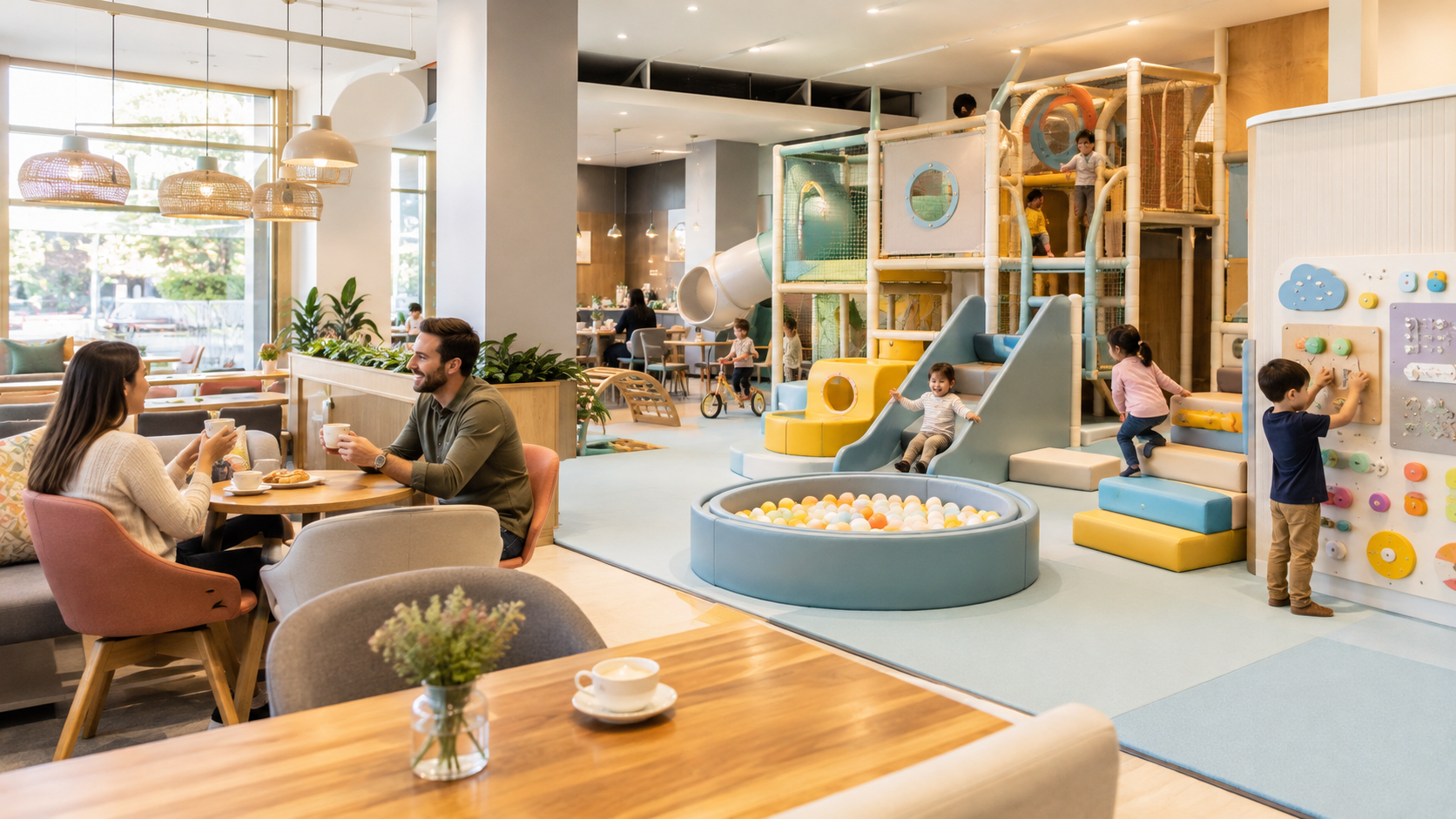
Cafes with soft play—also known as cafes with indoor playgrounds—combine a parent-friendly café with a safe indoor play space for children. By generating revenue from admissions, food and drinks, memberships, birthday parties and private events, a well-planned play cafe can offer strong profit potential.
However, performance depends on matching the playground size and play cafe equipment to the available floor area, target age group and operating model. This guide compares equipment packages for venues under 100 m², from 100–500 m² and over 500 m²—from compact toddler soft play and sensory panels to multi-level structures, role-play zones and dedicated party areas.
What Are Cafes With Soft Play and Why Are They Growing?
A play cafe combines a parent-friendly café with a safe indoor play space for children. While parents have coffee, socialize, relax or work nearby, children can take part in physical, sensory and imaginative play. Compared with ordinary cafes with an indoor play area, a purpose-built play cafe treats the playground as a core part of the customer experience rather than providing only a few toys.
This model works for both parents and children:
- Parents can take a break while continuing to supervise their children.
- Children have a weather-independent place to play and interact.
- Longer family visits can support additional food and drink purchases.
- Regular sessions can help the café build a community of repeat customers.
Indoor cafes with play areas are especially suitable for neighborhood and community locations. Soft play is quieter and requires less space than a large family entertainment center, making it easier to combine with café seating and food service.
Are Play Cafes Profitable? Business Potential of Cafes with Indoor Play Areas
Play cafes can be profitable when several revenue streams support the same venue:
- Admissions generate income from single visits or timed sessions.
- Memberships encourage repeat visits and provide more predictable revenue.
- Café sales increase the value of each family visit.
- Birthday parties create higher-value weekend bookings.
- Private events help monetize off-peak hours or exclusive venue use.
This diversified model reflects how the wider attractions industry evaluates venue performance. IAAPA examines admissions, guest spending, staffing, revenue and operating expenses as separate performance factors rather than treating ticket sales as the only source of income.
There is no universal profit margin for play cafes. Results depend on rent, staffing, pricing, food and beverage performance, playground size and equipment investment. The following sections compare equipment packages for play cafes under 100 m², from 100–500 m² and over 500 m².
Comparing Indoor Play Cafe Equipment by Venue Size
The right equipment package depends on the total venue size, the percentage allocated to play, and the age groups the business plans to serve. A compact neighborhood café may focus on toddlers, while a larger venue can support more age zones, activities, and event space. The table below provides a practical starting point rather than a fixed layout.
| Venue size | Recommended ages | Suggested play cafe equipment | Suitable business model |
|---|---|---|---|
| Under 100 m² | 0–5 years | Soft climbers, mini slide, compact ball pit, sensory panels, and padded flooring | Neighborhood play café or café kids’ corner |
| 100–500 m² | 0–10 years | Multi-level soft play, separate toddler zone, ball pit, role-play stations, and flexible party area | Standard full-service play café |
| Over 500 m² | 0–14 years | Large multi-level structures, multiple age zones, mini play town, interactive attractions, and dedicated party rooms | Large commercial play café or FEC-style venue |
These packages provide a starting point rather than a fixed layout. Columns, ceiling height, café seating, kitchen requirements, emergency routes and local capacity rules can significantly change the area available for play.
For more detailed space planning, see the Playroom Cafe Layout Guide.
Equipment for Small Cafes with Soft Play (Up to 100 m²)
For a play cafe under 100 m², the equipment should provide enough play value while preserving space for seating, food service, circulation and daily operations. Compact, low-height equipment is generally best suited to children aged 0–5, following the same space-efficient approach used in children’s play areas at some family-oriented KFC.
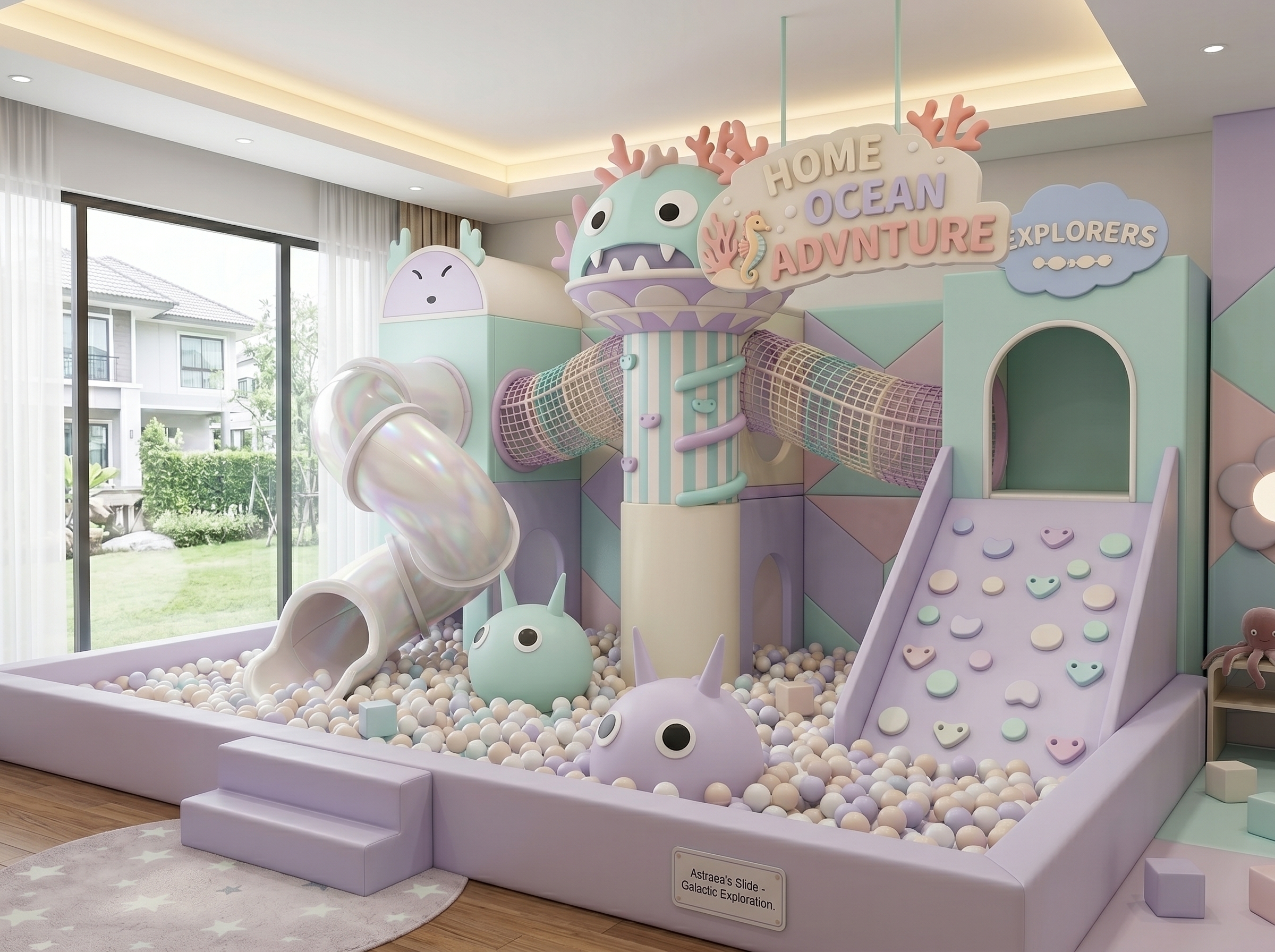
Recommended Solution: Toddler Soft Playhouse
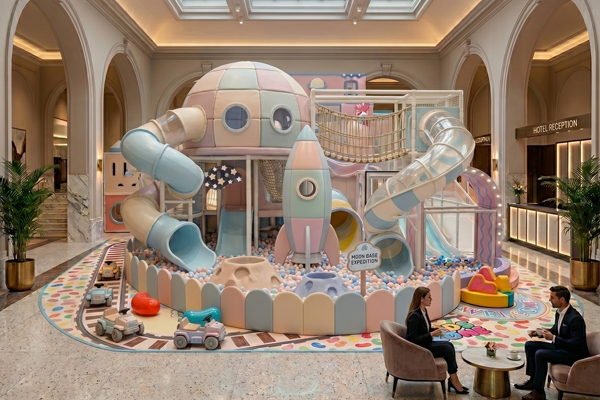
- Equipment footprint: 15–50 m²
- Recommended ages: 1–4 years
- Main features: Sensory wall panels, soft climbing blocks and a small enclosed playhouse
- Suitable venues: Play cafes, restaurant kids’ corners, hotel lobbies and kindergarten classrooms
- Safety standard: ASTM F1918 for soft contained play equipment
The compact footprint leaves more room for café seating while creating a dedicated toddler attraction that parents can supervise easily.
Get an Equipment Plan for a Play Cafe Under 100 m²
Equipment for a 100–500 m² Play Cafe
A play cafe between 100 and 500 m² can accommodate a larger anchor attraction, broader age coverage and separate seating or party areas. In this size range, cafes with indoor playgrounds typically feature multi-level structures.
Multi-level equipment makes better use of vertical space and follows the same attraction-led approach commonly used in family restaurants and shopping mall play zones.
Recommended Solution: Indoor Jungle Gym System
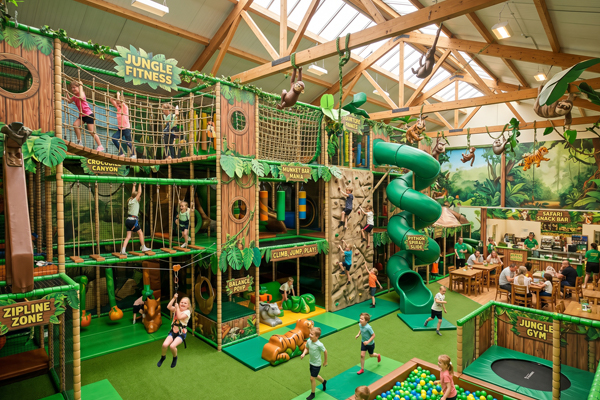
- Equipment footprint: 100–500 m²
- Recommended ages: 4–12 years
- Main features: Three-level structure with multiple climbing activities
- Frame: Galvanized steel
- Suitable venues: Standard play cafes, family restaurants, shopping malls and commercial indoor playgrounds
- Project experience: Supplied to 23 of DIDI’s 40+ export markets
The Indoor Jungle Gym System can serve as the venue’s main attraction. Its modular configuration should be scaled according to the actual play area remaining after café seating, food service, party space and circulation are allocated.
Get an Equipment Plan for a 100–500 m² Play Cafe
Equipment for a Play Cafe Over 500 m²
A play cafe over 500 m² can serve several age groups and combine food service with multiple entertainment zones. At this scale, the venue usually operates more like a family entertainment center, with equipment selected according to visitor capacity, revenue per square metre and repeat-visit potential.
Recommended Solution: Modular FEC Zones
- Equipment footprint: 500–3,000 m²
- Recommended ages: 2–14 years
- Main attractions: Trampoline zones, ninja obstacle courses and soft play
- Age zoning: Toddler, younger children and older children
- Suitable venues: Large play cafes, family entertainment centers and shopping mall playgrounds
Combining several attractions allows the venue to serve the whole family. Toddler soft play provides a safer area for younger children, while trampoline and ninja zones give older children more active challenges. Modular zones also make it easier to add party rooms, café seating and new attractions as the business expands.
Get a Custom FEC Layout for a Play Cafe Over 500 m²
Which Equipment Works Best in Cafes With Soft Play?
The best equipment should attract children without creating excessive noise, staffing requirements or maintenance work.
| Equipment | Recommendation | Why |
|---|---|---|
| Soft play | High | Safe, relatively quiet and suitable for younger children |
| Role play | High | Encourages longer visits and repeat play |
| Sensory play | High | Requires little floor space and is easy to add or update |
| Ball pit | Medium–high | Visually attractive and popular, but requires frequent cleaning |
| Large trampoline | Low for most play cafes | Requires greater ceiling height, supervision and safety management |
| Ninja course | Low for most play cafes | Better suited to large venues and FEC-style operations |
Large trampolines and ninja courses become more practical in venues over 500 m², where separate activity zones and additional supervision can be provided.
What to Check Before Buying Play Cafe Equipment?
Play cafe equipment for sale may look similar in product photos, but the final value depends on design, materials, cleaning access, shipping, installation and after-sales support. When comparing kids cafe equipment suppliers, check how the equipment will work in daily operation—not only how it looks in a rendering.
Before paying a deposit:
- Check whether parents and staff can see children clearly from the main seating area.
- Ask how enclosed platforms, ball pits and floor gaps will be cleaned.
- Confirm that slides, climbing heights and activities match the target age group.
- Request safety documents for the specific equipment and destination market.
- Find out which covers, balls, nets and fittings will wear first.
- Confirm how quickly replacement parts can be supplied.
- Check whether the quotation includes freight, import costs and installation.
- Confirm who will install the equipment and what site preparation is required.
- Read the warranty to see whether it covers parts, labour and international shipping.
- Request material samples or color references before approving custom branding.
Why Choose DIDI for Play Cafe Equipment?
DIDI supports play cafe owners from the first floor-plan review through design, manufacturing, delivery, installation and after-sales service.
Instead of asking buyers to fit a standard equipment set into their venue, DIDI develops the solution around the available space, target ages, café operation and investment plan.
Before Ordering: Custom Planning and Theme Design
Send DIDI your floor plan, ceiling height, target age groups, preferred theme and budget. The design team can then:
- Plan the play zone around seating, columns and circulation routes
- Recommend equipment according to the available space and age range
- Create custom colors, graphics and branded play elements
- Develop jungle, space, ocean, candy or fully bespoke themes
- Provide a 3D rendering before the design enters production
- Prepare a clearer quotation based on the approved equipment layout
This process allows buyers to see how the finished play area will look and make changes before manufacturing begins.
During Production: Export Experience and Quality Control
DIDI was established in 2014 and has exported equipment to more than 40 countries, with international orders accounting for 90% of its sales.
The company’s stated compliance capabilities include:
- ASTM F1487 for commercial playground structures
- ASTM F1918 for soft contained play equipment
- EN 1176 certification for relevant European projects
- IPEMA membership
- Documentation prepared according to the equipment type and destination market
Production checks cover the frame, surface materials and pre-assembly stages, with photo updates available before shipment. Buyers can also select FOB, CIF or DDP shipping, depending on whether they want to manage freight themselves or receive a more complete delivery service.
After Delivery: Installation and Ongoing Support
DIDI can provide overseas installation or detailed drawings and technical guidance for a local installation team. After the play area opens, buyers have access to:
- 24/7 online technical support
- A 12-month warranty on structural components and attached electrical systems
- Long-term availability of replacement parts
- Support for maintenance, repairs and future equipment additions
- Modular expansion when the café adds new activities or age zones
This end-to-end support helps play cafe owners avoid coordinating separate designers, equipment factories, freight companies and installation consultants.
CTA: Get a Custom Play Cafe Design and Quote
FAQ
How much space do I need for a play cafe?
A compact toddler play area may require only 15–50 m² of dedicated play space, while a full play cafe needs additional room for seating, food service, circulation, storage and parties. Start with the total floor plan rather than selecting equipment based only on the advertised footprint.
How much does play cafe equipment cost?
The cost depends on the equipment footprint, structure type, theme, materials, destination standards, shipping and installation. A supplier will need your floor plan, ceiling height, target ages and destination country before preparing an accurate quotation.
Can I add a soft play area to an existing café?
Yes, provided the venue has enough room for safe circulation, parent sightlines and emergency access without disrupting café service. Columns, ceiling height, entrances and seating capacity should be reviewed before equipment is selected.
What information is needed for a custom equipment plan?
Send the supplier your dimensioned floor plan, ceiling height, destination country, target age groups, budget, preferred theme and expected opening date. Café seating, kitchen and party-room requirements should also be marked on the plan.
Can play cafe equipment match my brand or theme?
Yes. Colors, graphics, wall panels and play structures can be customized around the café’s identity. DIDI offers jungle, space, ocean, candy and bespoke themes, with a 3D concept available before production.
Which safety documents should I request?
The required documents depend on the equipment type and destination market. Ask the supplier to identify the applicable standards and provide documents for the specific equipment being purchased—not just a general company certificate.
How long does design, production and delivery take?
Standard equipment generally takes less time than a fully customized theme. DIDI’s published workflow lists approximately 4–6 weeks for catalog production, 8–10 weeks for standard themed projects and 12–16 weeks for bespoke OEM projects, excluding international shipping and installation. Confirm the schedule before placing the order.
Does DIDI provide overseas installation?
DIDI can either arrange overseas installation or provide installation drawings and technical guidance for a qualified local team. Buyers should confirm installation responsibilities, travel costs and site preparation in the quotation.
SYS.00 // E-E-A-T Disclosure
Why I Write This
As the CEO and Co-Founder of a specialized manufacturing facility, my objective is to provide unvarnished, factory-direct technical insights into commercial indoor playground engineering, safety compliance, and project planning. I aim to bridge the information gap for global buyers seeking reliable structural and material data, ensuring you make informed, ROI-driven decisions without the marketing fluff.
About My Business
Guangzhou Didi Land Amusement Equipment Co., Ltd. (Brand: Didi Land) is a commercial indoor playground equipment manufacturer founded in 2014. Operating from Panyu, Guangzhou, China, we engineer, produce, and export commercial-grade play structures to over 40 countries worldwide. Our production lines strictly adhere to international safety frameworks, ensuring durability and safety for high-traffic environments.
Our Services
We provide end-to-end B2B commercial solutions: from custom 3D spatial design and OEM manufacturing to worldwide export logistics and compliance testing. Our focus is on empowering Family Entertainment Centers (FECs), shopping malls, kindergartens, and hospitality venues with reliable, high-capacity play infrastructure.
DATA_MATRIX // MANUFACTURER_PROFILE
Name:
Cherry
Role:
CEO & Co-Founder
Brand Name:
Didi Land
Company:
Guangzhou Didi Land Amusement Equipment Co., Ltd.
Location:
Guangzhou, Panyu, China
Founded:
2014
Products:
Indoor Playground Equipment, Soft Play Equipment, Themed Playground Design, FEC Play Zones, Trampoline Modules, Ninja / Obstacle Course Modules
Email:
conglizhang1@gmail.com
Phone:
+86 199 2587 9517
Website:
didiplayarea.com
COMPLIANCE & STANDARDS:
ASTM F1487 · ASTM F1918 · EN 1176 · CPSIA · CE · ISO 9001 · IPEMA
Contact Factory Direct
ASTM F1487 · ASTM F1918 · EN 1176 · CPSIA · CE · ISO 9001 · IPEMA
![Custom Dinosaur Playground Equipment [Design Guide]](https://didiplayarea.com/wp-content/uploads/2026/09/custom-dinosaur-playground-equipment-r2-featured-1-768x512.png)
![Custom Dinosaur Playground Equipment [Design Guide]](https://didiplayarea.com/wp-content/uploads/2026/09/custom-dinosaur-playground-equipment-r2-featured-1-150x150.png)