
Get in Touch with Didi Land


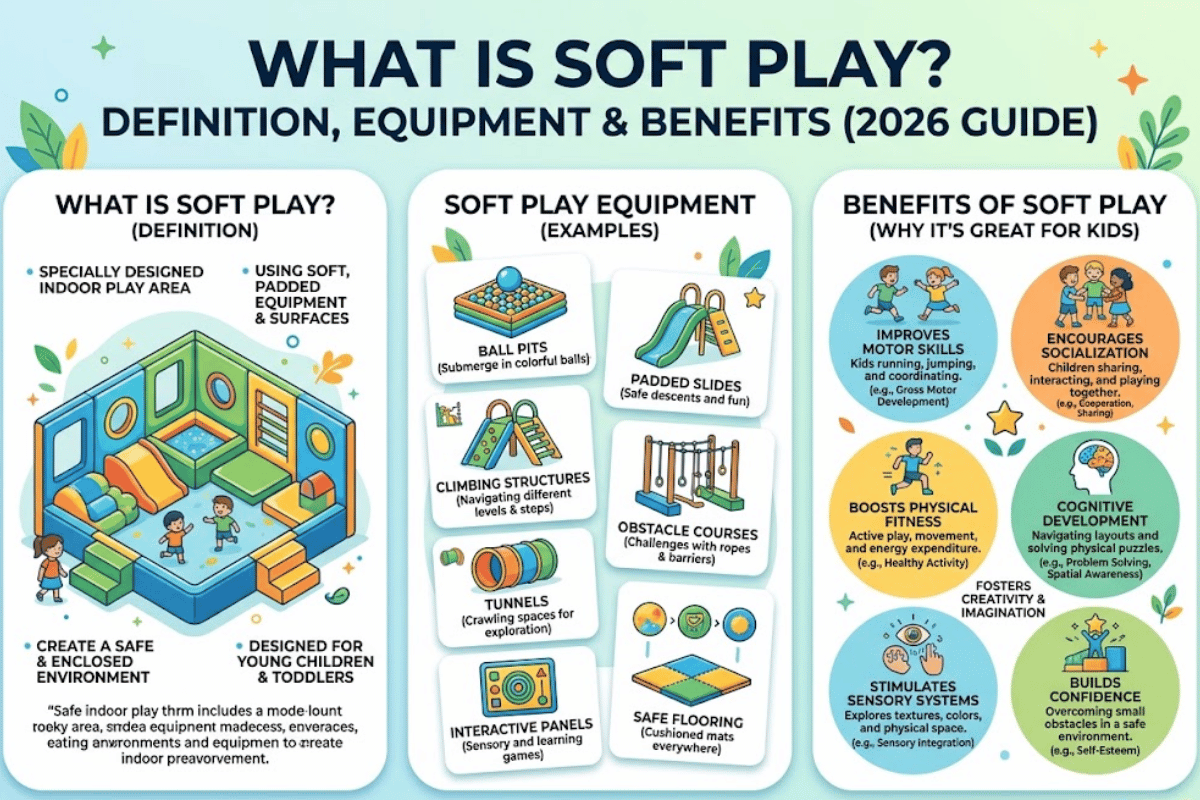
In simple terms, soft play is an indoor facility for children where the floor, walls and play equipment are protected with foam padding, making climbing, jumping and falling much safer than in normal outdoor play areas. This guide is about the children’s-equipment sense of the word and not the associated music-band, poker-game or lifestyle definitions that sometimes come up in the Google search listings.
Whether you’re a parent having trouble navigating your local play centre, or a venue operator decided between soft play and an outdoor play area for a toddler restaurant, here is the low down on what soft play is, what it contains, what age groups it caters for, what regulations it adheres to and how much it costs to put in place.
Soft Play at a Glance
| Definition | Padded indoor children’s play environment |
| Typical age range | 0–12 years (sweet spot 1–6) |
| Core equipment | Foam blocks · ball pits · padded slides · climbing frames · sensory pods |
| Common venues | FECs · kindergartens · restaurants · shopping malls · hotels · standalone centres |
| Key safety standards | ASTM F1487-21 · ASTM F1292-22 · EN 1176-1 · AS 4685 · IPEMA-certified components |
| Commercial install (typical range) | ~$10–30/sq ft (entry tier) to $50–100+/sq ft (premium custom) |
What Does “Soft Play” Actually Mean?
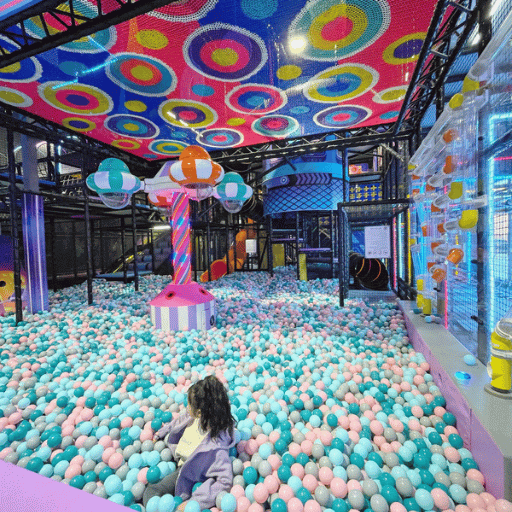
Soft play covers child-centred play areas that are carefully enclosed and restricted indoor areas that are equipped with padded walls, soft play frames, various shapes and sizes of padded and foam playing mats, and other aesthetically pleasing soft play equipment. This all enables children to participate in enjoyable, active, informal, unbridled movement-based soft play activities that are considered to be low injury. As defined by the Cambridge English Dictionary, soft play involves “activities for small children in an indoor area with play equipment made from soft materials”.
A soft play area usually offers an evocative mixture of climbing nets and foam structures, encapsulating a ball pit, a number of slides, sensory walls, a network of adventure tunnels and foam climbing frames within a mesh fencing.
Most adults have experienced soft play in a traditional commercial soft play centre (which are called soft play centres in the UK and indoor play centres or play places in the US). Operators of these centres differentiate soft play from normal indoor entertainment by the fact that all climbable surfaces have been designed around fall, friction and material safety from conception — rather than being added in as an afterthought.
What does soft play mean in the UK vs the US?
The use of the term “soft play” is more prevalent in the UK and Commonwealth markets (UK, Ireland, Australia, New Zealand, some parts of Asia), where it can be thought of as interchangeable with the terms for the actual equipment or for the dedicated premises in which it is used. Elsewhere in the world (Canada, Continental Europe, South America, the Middle East and Africa) other terms (see below) are in more general usage to describe the same kind of environment. “Soft play equipment” is the most commonly used B2B term by manufacturers and architects.
What’s Inside a Soft Play Area? The 4-Layer Anatomy
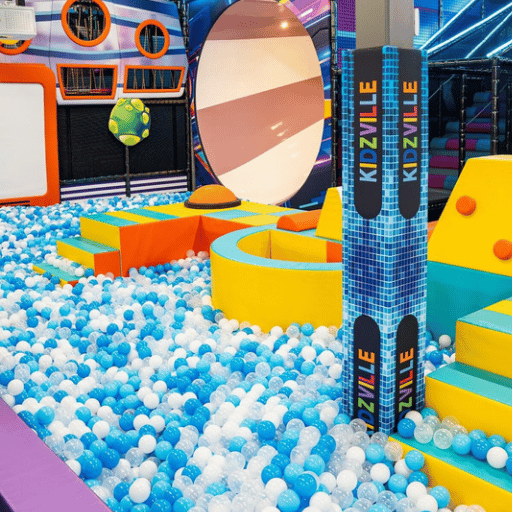
It’s easier to conceptualise a soft play area as four physical tiers, each constructed for a specific purpose. This isn’t just a marketing gimmick-it is the actual framework offered by soft play designers and safety inspectors when checking a build.
📐 Engineering Note — The 4-Layer Anatomy
- Impact absorbing pad for the foundation. Single surface flooring designed to reduce falls. When used in a certified installation, this layer is rated to ASTM F1292 parameters (HIC and Gmax limits, see below safety sec.).
- Soft climbing modules. The protruding foam-padded geometry consists of foam blocks, padded ramps, soft climbing frames, tunnels, and foam-padded climbing modules in which children ascend, jump, and crawl through. Covered with fire retardant vinyl coated polyester.
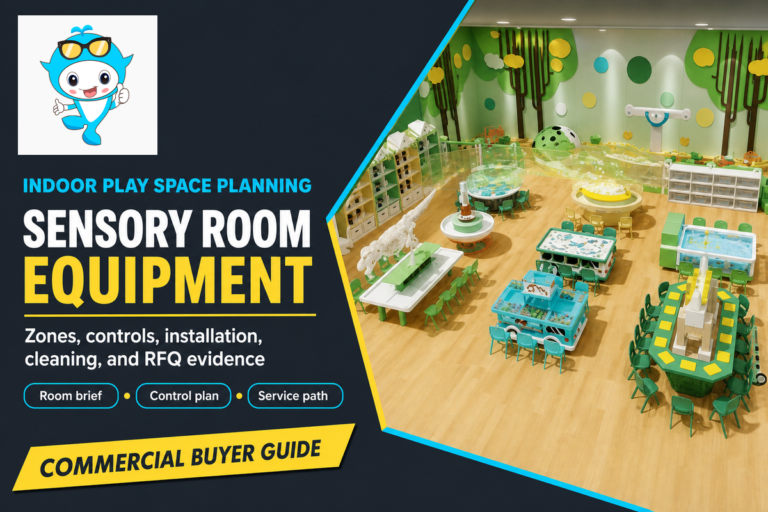
- Specialized sensory environments. Ball pits, sensory walls (textures, lights, sounds), shape-and-mirror panels, and theme rooms. These are designed to stimulate children’s visual, tactile, and auditory senses, rather than provide raw-motor excercise.
- Enclosure boundaries. Cushioned border barriers, netting, and opening/closing portals that guarantee children cannot leave the play envelope and create a visual separation from the surrounding caf or supervisory areas.
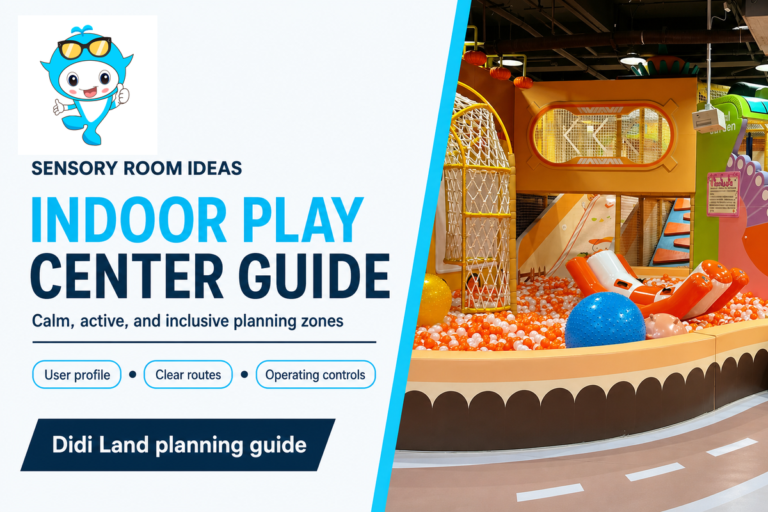
Indoor play areas can combine foam climbing blocks, padded play sets, ball pits, multi-level play structures, and themed furniture or structures.
What Age Is Soft Play For?
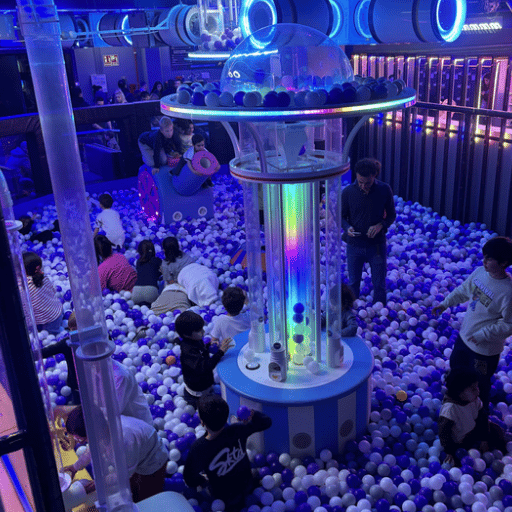
Typical age range for soft play runs from about 6 months old to about 12 years old. Equipment, impact-abatement regions, and detailed supervision criteria vary sharply across that range. An effective way to select correctly is to follow the two ASTM standard ages that regulate publicly accessible indoor play areas in the United States.
| Age tier | Equipment fit | Standard reference |
|---|---|---|
| 6–23 months (crawlers / early walkers) | Sensory pods, low foam blocks, baby ball pits, mirrored panels. No fall heights above ~600 mm. | ASTM F2373 (toddler-specific) |
| 2–5 years (preschool) | Multi-level structures, padded slides, larger ball pits, themed scenes, soft climbing frames. | ASTM F1487-21 (lower tier) |
| 5–12 years (school age) | Larger climbing systems, multi-storey structures, interactive walls, gross-motor elements. | ASTM F1487-21 (upper tier) |
In America’s Consumer Product Safety Commission (in its Public Playground Safety Handbook), it states that even when children of different ages occupy a single play area, their equipment levels should be visually separated by using distinct zones. A design which includes a dedicated grade-prep/toddler zone, as happens in many kindergarten-grade indoor play structures, ensures the equipment falls within a single age tier’s height and gap criteria rather than averaging across several.
Is soft play good for toddlers?
Like many other facility types, soft play centers can provide a safer climbing and landing environment for many children than a standard-fall outdoor playground or hard-floor home. One exception is zone-appropriate dimensions; an age-inappropriate zone leaves toddler parents fretting about escalated fall heights and entrapment/collision dangers.
What is soft play for babies?
“Baby soft play” typically describes dedicated zones or segments of time created for nonwalking infants and very early walkers, generally 0-18 months old. Equipment is usually biased toward low stimulation (sensory pods, low foam shapes, baby-only ball pits) by restricting shape and ball size within the space (appropriate for an infant’s range of grasping), enforced visitation rules, and specialised supervision.
How Soft Play Supports Child Development
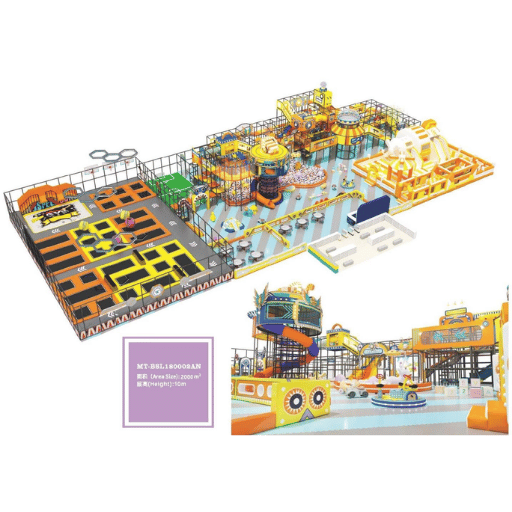
Soft-play areas can include padded equipment and activities that support active play. Select equipment and supervision arrangements appropriate to the children using the space.
Motor development
Scooting around, climbing on foam islands, crawling through tunnels- all involve activity that uses almost all of the large muscles (legs, torso, arms). A cushioned consequence guarantees children will explore the raw-motor movements that are inhibited by fall-impact.
Cognitive & problem-solving
Design elements such as ascending the towers, queuing up a ramp, and manipulating interactive sensory panels build spatial management, analysis, and decision-making skills.
Social-emotional
Most centers combine children from diverse families. Navigating the shared equipment, queuing at slide points, and moving about in a crowded environment all develop social skills and interchild rapport
Sensory stimulation
Bright colours, varied textures, light-and-sound features, and tunnels can create different sensory experiences. Consider the needs of children who may prefer a quieter setting.
None of these goals are, in principle, exclusive to the soft surface of a soft play environment-it is the outdoor space that supports many of them too-but the environment created by soft play (a segregated area in which the risk is in the children’s hands and not in the terrain) pushes the parent’s anxiety threshold a little further, offering a taste of safety that in practice lets children do (and know they can do) more than they could elsewhere.
Safety, Hygiene & Standards
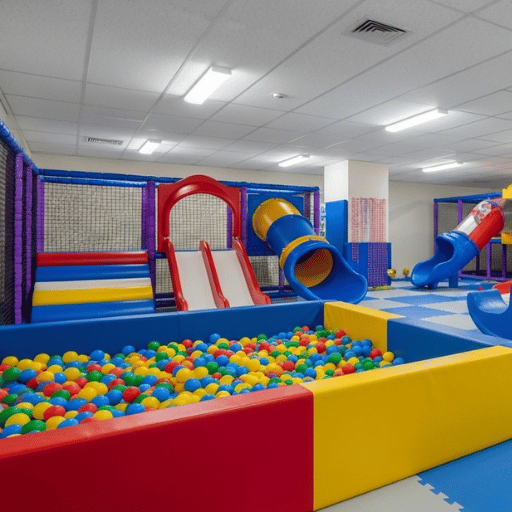
Being soft and feeling safe isn’t in the foam itself; it is in the equipment (which is impact dampening and age banded), the surfacing (which won’t collapse beneath a fall) and the construction (which has been certified without catching on fire). Three standards regulations bodies tell us how this can be measured.
📐 Engineering Note — Impact attenuation thresholds
ASTM F1292-22 stipulates the two physical parameters that any playground safety surface in the US is judged against: peak deceleration measured in the lab (Gmax 200) and Head Injury Criterion (HIC 1000) over the equipment’s rated fall height. Both factors must be below the limit – a surface that pass one but not the other is not certified – and both factors are strongly related to foam properties measured in the lab. Europe’s standard (EN 1177) is based on the same physical concepts (Critical Fall Height) but is used alongside a standard (EN 1176-1) for the equipment above; lab results for indoor play surfacings are published in the CPSC’s Surfacing Materials test data for indoor play areas.
Confirm the requirements that apply to the equipment, intended users, and installation with the relevant qualified professional or testing body before making compliance claims.
European install guidelines normally cite EN 1176-1 (equipment specifications), EN 1176-10 (secure, fully-enclosed apparatuses) and for the electic world of down-under, AS 4685 in Australia. Manufacturers that are reputable and experienced will provide you with an ASTM and EN 1176 compliance checker mapped to your target export market.
Do soft play centres clean their equipment?
There are few complaints so regularly cited by parents as hygiene regarding childcare play environments, which is fair as foam surfaces and balls in crowded ball-pits will be dirty in the hands of most children very quickly. Industry veterans note the key indicators for a well-managed centre are (1) an easy-to-understand publicly-stated cleaning schedule, (2) program end-of-day deep-cleaning policies (UV light treatment with disinfectant spray), (3) antimicrobial vinyl covers on padded surfaces, and (4) the regular moving and washing of inside balls. Centres that inform customers when they deep-clean regularly retain a higher rate of repeat customers.
What safety standards apply to soft play?
The key document for indoor play safety in any US installation is ASTM F1487-21 (equipment), ASTM F1292 (impact attenuation), and IPEMA’s certification programs. In the European setting it is EN 1176-1 (equipment), EN 1176-10 (secure fully-enclosded apparatuses), and EN 1177 (impact attenuation). The key figure – the one to always remember first, HIC 1,000 and Gmax 200 at the rated fall height- applies equivalently across all four standards bodies because the biomechanics of a head injury remain the same across the world.
Where You’ll Find Soft Play (Venue Types)
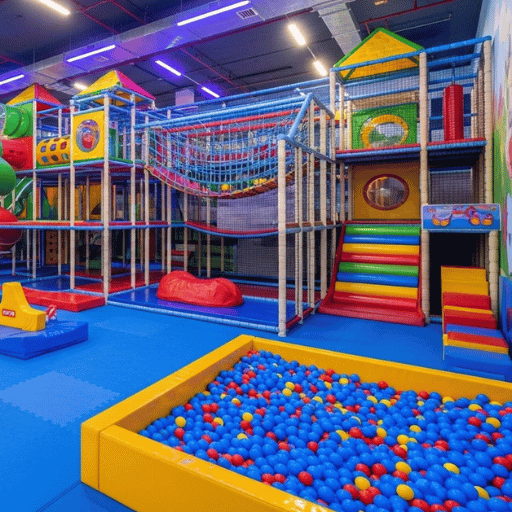
Soft play has ceased to be a children’s centres-only service innovation. It has been elevated into high-volume attraction status across five different types of venue, each with their own delivery volume and operation logic.
- ✔
Family Entertainment Centres (FECs). Dedicated commercial venues, often 5,000–30,000+ sq ft, combining soft play with arcade, food & beverage, and party rooms. See soft play for family entertainment centers.
- ✔
Kindergartens, daycares, preschools. Single-age-tier installs, typically 200–1,500 sq ft, sized for the room and the child-to-staff ratio of the centre.
- ✔
Restaurants, hotels, cafés. Smaller corner installs (100–800 sq ft) attached to dining areas to keep families on-site longer. See soft play installations in restaurants and hotels.
- ✔
Shopping malls. Mid-size structures (1,000–5,000 sq ft) at concourse level, often free-to-use, sponsored by the mall as a footfall driver.
- ✔
Tourist attractions, museums, transit stations. Themed installs that double as imaginative anchors for the surrounding venue (think space-themed structures at science centres or character-themed structures at family destinations).
Soft Play vs Traditional Playgrounds: A 6-Factor Decision Matrix

But soft play and traditional outdoor playgrounds are giving companies and parents different flavours of healthy active fun. This set of user scenarios presents a version of a structured decision tree that both need-states find a reliable way through when choosing between the two.
| Factor | Soft play (indoor) | Traditional playground (outdoor) |
|---|---|---|
| Surface & fall protection | Continuous foam pad, certified to HIC ≤ 1,000 / Gmax ≤ 200 | Loose-fill or rubber tiles; performance varies by upkeep |
| Weather independence | 365 days a year, climate-controlled | Weather- and season-dependent |
| Best-fit age range | Strongest for 0–6; usable to 12 with right structure | Strongest for 5–12; toddler zones often less inclusive |
| Supervision requirement | Mostly visual from a seated café/lobby; gates and netting contain the play envelope | Active line-of-sight supervision over a much larger area |
| Capital cost | ~$10–30/sq ft entry, $50–100+/sq ft premium custom | Highly variable; equipment + groundwork can match or exceed soft play |
| Sensory stimulation density | High — designed-in by panels, themes, lighting | Lower equipment-driven density; richer ambient stimulation (nature, weather) |
Honest version: outdoor play wins for fresh air and ambient soundscape, but soft has weather-independence and density of age-specific equipment going for it; outdoor wins on accessibility and cost per hour played. For operators making an economic choice – really a question of how much weather-independent time they need to support their hypothesis. For equivalence counts in installing soft play, see the part of an indoor jungle gym equipment set that most resembles your total thing.
For Venue Operators: Buying Soft Play Equipment

If you run a kindergarten, an FEC, a café, a hotel or a mall and you are assessing soft play as an attraction or a food prospecting investment, the three availability-payoff questions are the cost, the certification, and the specification. These questions are covered with useful practical definitions here; subsequent design configuration questions are best addressed by your chosen soft play manufacturer.
How much does commercial soft play equipment cost?
Commercial soft play features a price range that is driven by its footprint. Soft play industry vendors presently estimate their turnkey commercial packages as between US$10-30 per sq ft (based on a straight-forward foam-based layout, low ceiling room, and stock colours), US$30-60 per sq ft (complex multi-level volume filled out with custom paints and theming), and US$50-100+ per sq ft (full themed sky-high multi-storey build out). This is a starting point with wide variation that depends on the theming complexity, ceiling height, and the geographic area of installation. Before inviting quotes, a good starting estimate is to plug your venue parameters into an indoor playground cost calculator.
📐 Engineering Note — Material specs to ask for at quote stage
| Foam | CMHR (Combustion Modified High Resilience) polyurethane, ≥ 35 kg/m³ density for high-traffic structures. |
| Skin | Vinyl-coated polyester, 1000-denier or higher; antimicrobial coating recommended for shared-use centres. |
| Fire retardancy | BS 5852 (UK Crib 5) or ASTM E84 Class A flame-spread classification. |
| Equipment certification | ASTM F1487-21 (US) or EN 1176-1 (EU), with IPEMA or TÜV third-party certificate where available. |
| Surface | ASTM F1292-22 (US) or EN 1177 (EU) compliant, rated to the highest fall height in the structure. |
The three certification requests you should make of any commercial soft play supplier are: an equipment-specification compliance statement, a surface impact-attenuation test report, and a fire-retardancy certificate matching your local building code. To see what a configured commercial install looks like across price tiers, browse Didi’s commercial soft play sets and configurations, or, if you are working to a specific brand identity, the themed indoor playground designs that pair sensory pods with a unifying narrative.
The Soft Play Industry in 2026: What’s Changing
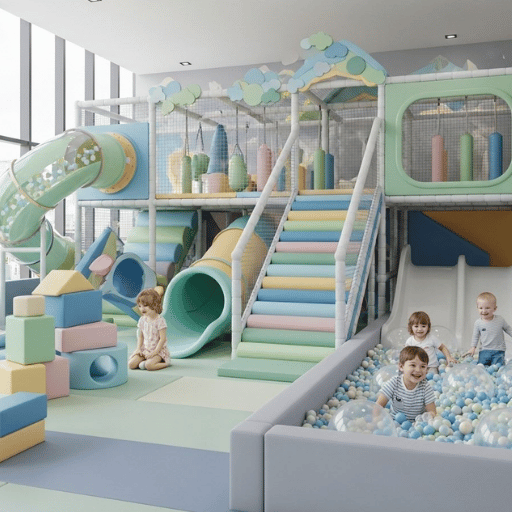
Soft play is no longer a niche indoor attraction. The 2025 IAAPA Entertainment Center Benchmark Report states that family entertainment centres— the venue group most synonymous with a commercial soft play installation—are at the heart of a market GM Insights valued at $28.2 billion in 2023, or approximately $34.4 billion in 2025 according to Future Market Insights, with a 10-12% compounding annual growth rate over the next ten years. There are clear signs of technological and design trends within this growth.
Edutainment rather than mere play. Our category has moved from ball-pit-and-slide design toward sensory-interfaced and education-focused designs. Traditional attractions are specified with interactive scenery conducive to a theme, with places to rest for sensory-overloaded children: changes in both parental expectation and profit-margin pressure dictate differentiated experiences.
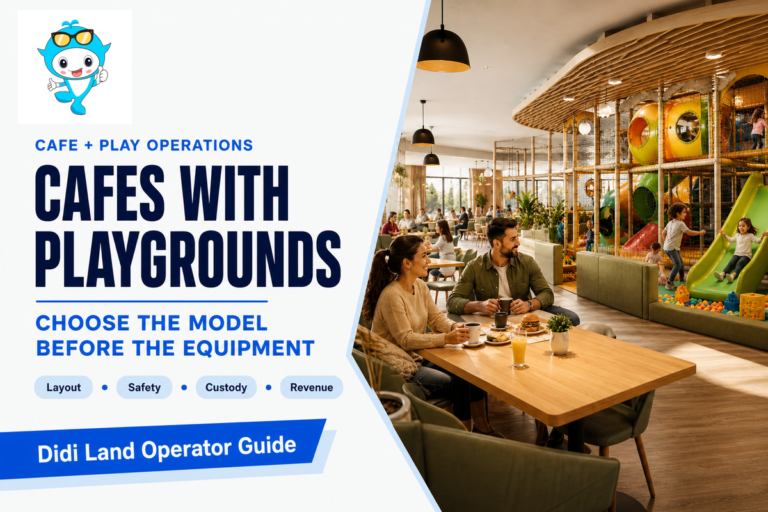
Hybrid play-café venues. Among 2026’s most-discussed targets is hybrid play-and-café formats: 800-2,500 ft2 play areas attached to an attractive restaurant, with parent dwell-time and bar-top margins providing for better income than admission-only facilities.
Playing consistently in standards. ASTM F1487 reached its revision level in 2021, and ASTM F1292 made the same in 2022, while EN 1176 remains the European authority for new-build projects; products certified to a single region are thought to be more difficult to export, and to get a project, specifiers now want proof of dual or triple certification for every cited standard (US + EU + AU/NZ), and it is a line-item expectation on RFQs in 2026.
Historian voices have pointed out that the commercial scaling of what we call “soft play” grew at McDonald’s PlayPlace, Wacky Warehouse, and Chuck E. Cheese from the 1980s—the form being embraced by fast-food chains—long before a benign standalone structure was possible. Category has been transformed since, yet the value proposition remains unchanged: active indoor entertainment safe from falls.
Frequently Asked Questions
Q: What is the meaning of soft play?
View Answer
Soft play is an indoor environment for children in which heavy foam padding covers all surfaces and equipment so that children can climb, jump, or fall from many different heights at far less risk of injury than an untreated surface such as tarmac or outdoor play area. The term is used in the United Kingdom and Commonwealth; the United States refers to the environment as an “indoor playground” or a “play place.” Typical features include ball pools, foam slides, and foam climbing equipment and walls.
Q: What age is soft play for?
View Answer
Soft play equipment is placed almost exclusively in spaces designed for children through age twelve. Its primary age target appears to be one through six. To better cater for separate age groups, standards establish two targeted age ranges: ASTM F2373 for 6 -23-month-olds, and ASTM F1487 for 2-12-year-olds. Where space is limited and more than one age range is targeted, outcome spaces should separate, for example with visual barriers so that equipment has the appropriate fall height for young and older children.
Q: Are soft play centres clean?
View Answer
A well-managed centre (and a lot of the ones that take home-educated children are run really efficiently. They publish their cleaning rota and have a daily, rigorous deep-clean also often with antimicrobial vinyl skins on padded modules, and day-to-day washing of the ball-pit balls (to take an example). Hygiene is one of the most-mentioned worries parents mention when talking about indoor play and well-handling of this issue seems to correlate with actually getting repeat business than poorly-handled.
If a centre refuses to publish its cleaning protocol that too is useful data.
Q: What’s the difference between soft play and a traditional playground?
View Answer
PlaygroundThe classic “playground” is an outdoor setting with metal or wood structures and a safety surface of rubber tiles, sand, or wood chips. Soft play is an indoor setting with the play surface and equipment itself made of foam padding that satisfies dual ASTM F1292 limits for impact attenuation (HIC 1,000 and Gmax 200). Outdoor play areas advantage per dollar for fresh air, ambient stimulation, and high capacity; soft play advantge for weather independence, fall consequence, and age convenience density.
Q: How much does it cost to install soft play equipment?
View Answer
Industry-vendor estimates for commercial installs commonly fall around $10-30 per square foot at the entry tier, $30-60 per square foot for mid-tier, and $50-100+ per square foot for premium custom builds with multi-storey or fully-themed structures. Final pricing depends on theming complexity, ceiling height, country of installation, and the specific certifications required. Request a copy of the equipment specification sheet, surfacing test report, and fire-retardancy certificate, with any price indication.
Q: What is soft play called in America?
View Answer
In the US, the best way to label this physical setting would be an “indoor playground”, “play place” or, simply, “play space”. To the trade, the B2B term for the manufacturer and architect, is “soft play equipment”. Although the phrase “soft play” and its shortened form “soft” is also seen in the US more frequently than before (for example, by the parent groups and friends I met and online on social media), it is not yet as commonly utilized as it is in the UK.
Q: What did soft play used to be called — and why does that name keep coming up?
View Answer
Two separate responses almost always arise to this question… First, the children’s-equipment industry does not have one consolidated overarching name – the format reached commercial public consciousness during the 1980s via fast-food outlets (such as McDonald’s PlayPlace, Whacky Warehouse and Chuck E. Cheese) and was subsequently formalised into purpose-designed centres.
Second, ‘Soft Play’ is also the new name of a UK punk band previously calling itself Slaves – the search result for ‘soft play’ being a band-related item is the identifying factor here,not one’s current knowledge; in this guidescriptive context, it is the schools-based children’s-play meaning that is sought.
Q: Is soft play suitable for adults?
View Answer
Standard commercial soft play equipment is engineered and certified against ASTM F1487/F2373 weight and impact-attenuation limits for users through roughly age 12, not adult body weight or impact force. A small number of venues run scheduled “adult soft play” or “adult ball pit” sessions on reinforced, higher-load-rated equipment during off-peak hours — this is a separate product spec, not standard children’s soft play used past its rated capacity. Ask your manufacturer for the equipment’s certified maximum user weight before running any adult session.
Q: What do Americans call soft play?
In the United States, the same category of equipment is usually called an “indoor playground” or a “play place” rather than “soft play” — the term “soft play” itself is British and Commonwealth usage.
Both terms describe the same padded, foam-covered indoor play environment for children. “Soft play” is the standard term in the UK, Ireland, Australia, and much of the Commonwealth; American parents and venue operators searching for the same thing typically use “indoor playground,” “play place,” or “kids play area.” If you’re sourcing equipment internationally, expect suppliers and standards documents to mix both terms interchangeably.
Q: What does “soft play” mean in Spanish (que significa soft play)?
“Soft play” is commonly used as an English loanword in Spanish-language markets; the closest native translations are “area de juegos blandos” or “zona de juegos suaves.”
In commercial and marketing contexts across Spain and Latin America, venue operators and equipment suppliers frequently keep the English term “soft play” untranslated, the same way many industry terms cross language borders in B2B trade. When a literal Spanish description is needed, “area de juegos blandos” (soft play area) or “zona de juegos suaves” (soft/gentle play zone) both convey the same padded, foam-covered indoor play concept.
About This Soft Play Guide
This guide was researched simultaneously for two groups: parents seeking to understand what their child does at a soft play centre, and venue operators assessing a commercial soft play install for an FEC, kindergarten, restaurant, or mall. The standards numbers, age tiers, and materials specs are derived from public ASTM, EN and CPSC sources merged from three different industry-vendor articles. Cost ranges are industry-vendor estimates, not quotes – real commercial pricing varies by your venue, theming and installation country.
Related Articles
- Indoor playground equipment buyer’s guide — the parent product family soft play sits inside
- Soft play sets for commercial use — complete configurations across small/medium/large footprints
- Soft play layout fit calculator — quick footprint check for your venue
- Soft play maintenance load planner — predict cleaning + spare-parts cycles by daily visitor count
References & Sources
- Public Playground Safety Handbook — U.S. Consumer Product Safety Commission
- Surfacing Materials for Indoor Play Areas: Impact Attenuation Test Data — U.S. Consumer Product Safety Commission
- ASTM F1292-22 Standard Specification for Impact Attenuation of Surfacing Materials — ASTM International
- ASTM F1487-21: Public Playground Equipment Standard — ANSI Blog
- IPEMA Certification Program — International Play Equipment Manufacturers Association
- 2025 IAAPA Entertainment Center Benchmark Report — International Association of Amusement Parks and Attractions
- “Soft play” dictionary entry — Cambridge English Dictionary
![Custom Dinosaur Playground Equipment [Design Guide]](https://didiplayarea.com/wp-content/uploads/2026/09/custom-dinosaur-playground-equipment-r2-featured-1-768x512.png)
![Custom Dinosaur Playground Equipment [Design Guide]](https://didiplayarea.com/wp-content/uploads/2026/09/custom-dinosaur-playground-equipment-r2-featured-1-150x150.png)