Get in Touch with Didi Land


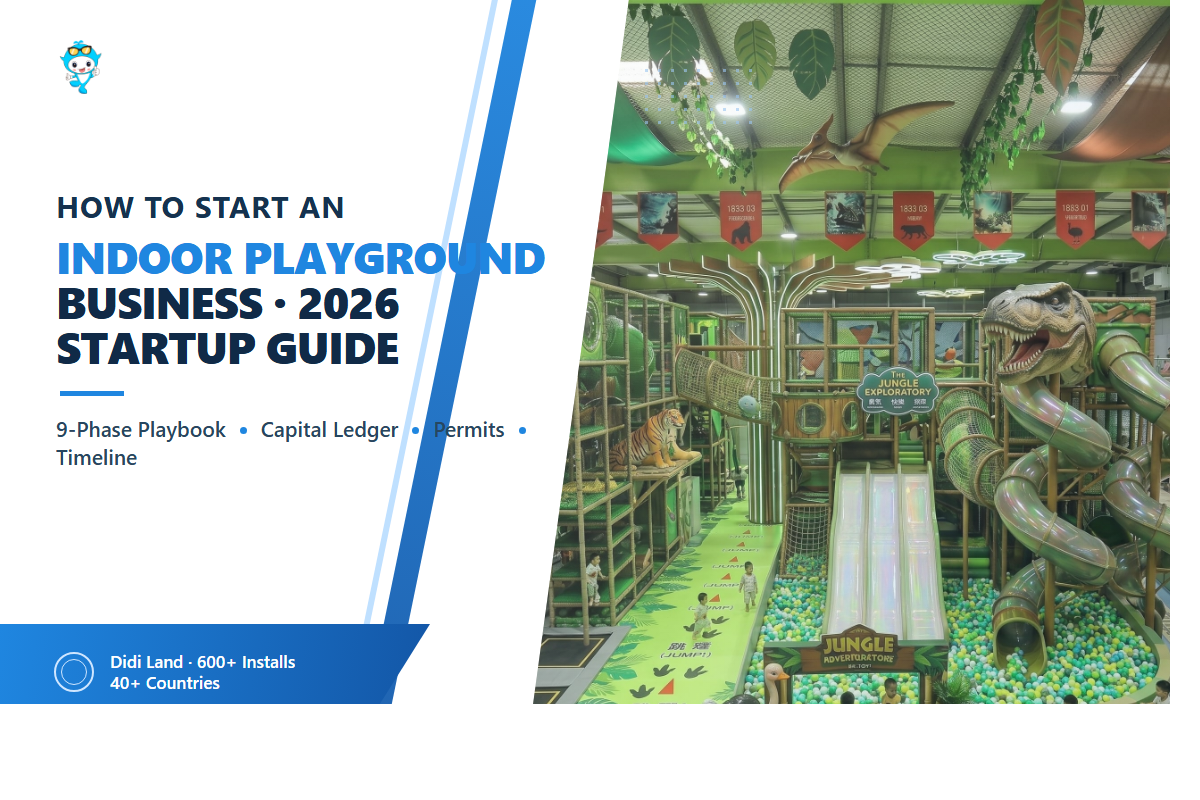
An indoor playground business is a commercial indoor play space where families pay for open play, birthday parties, and memberships. Learning how to start an indoor playground business comes down to nine right-then-left decisions: choose the business model that your local market can absorb on a Tuesday, budget the real startup costs accurately, clear the permit and safety inspections that are the keys to opening, and get your equipment on site before the lease comes due. This guide leads you through every step using 2026 numbers, the safety-enforcement paperwork that inspectors really care about, and a phase-to-opening timeline most other guides omit.
Sequence matters because the global family entertainment center market, set to grow from $34.57 billion in 2026 to $47.93 billion by 2031 at a 6.75% compound annual growth rate, isn’t the obstacle; the market is weatherproof and steady. Most new facilities that struggle missed the same early step: they failed to account for the cost and time needed for site selection, cash reserves, or equipment acquisition and installation. This often proves disastrous once a lease is signed.
$50K–$1M+
Startup cost, micro play-café to full FEC
3,000–10,000 sq ft
Typical footprint band
15–18 ft
Clear height for a 3-level structure
3–9 months
Lease signed to grand opening
What It Takes to Start an Indoor Playground Business (2026 Snapshot)
A commercial indoor play center is a safe, indoor play space, often designed for ages 1-12, where customers pay admission fees for open play sessions. It typically supplements this revenue with fees from birthday parties, memberships, and sales from an on-site café. Success hinges on identifying an ideal location, securing adequate funding, obtaining a certificate of occupancy along with safety certifications for the equipment, and staffing the business with well-trained personnel to oversee the children’s activities.
Families increasingly seek weather-proof indoor entertainment, and the indoor playground industry is growing fast: the indoor playground market now spans several models, from a small indoor play area to a professional indoor playground built for ages 1-12. Choosing the right type of indoor playground, and treating it as a real type of business rather than a hobby, is the first fork. These nine phases outline the correct sequence to follow for a successful launch.
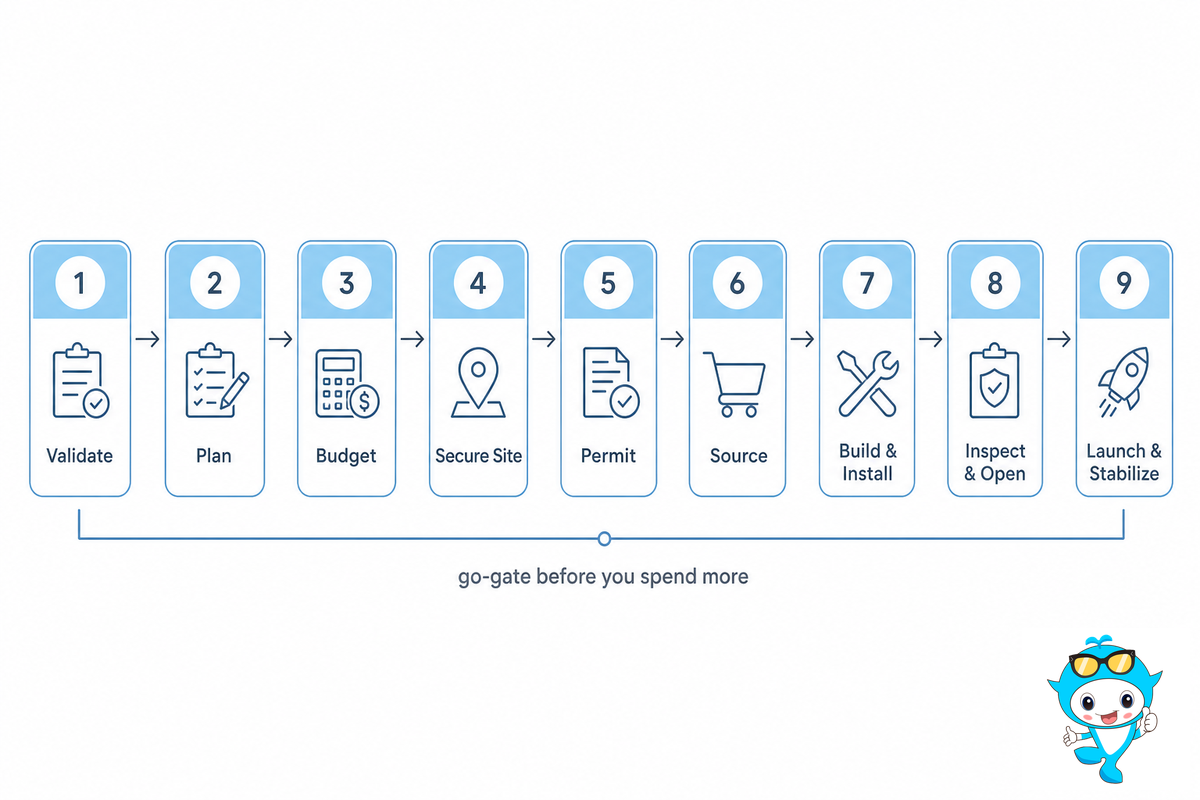
Below is the complete lifecycle of launching an indoor play space, from the initial idea to opening day. Consider each “go-gate” a milestone that you must reach before moving to the next phase and investing further resources.
| Phase | What happens | Typical duration | Go-gate before you spend more |
|---|---|---|---|
| 1. Validate | Demand check + model choice | 2–4 weeks | Enough under-12 families in a 15–20 min drive |
| 2. Plan | Business plan + financial model | 2–4 weeks | Break-even math works at 40% capacity |
| 3. Budget | Line-item capital ledger + funding | 2–3 weeks | Funding covers build-out + 3 months reserve |
| 4. Secure site | Lease with the right clear height + zoning | 3–6 weeks | Zoning allows assembly/recreation use |
| 5. Permit | Licenses, building/fire/health filings | 4–10 weeks | Plans approved for permit issue |
| 6. Source | Order equipment (production + freight) | 4–14 weeks | Compliance certificates confirmed in writing |
| 7. Build & install | Fit-out, flooring, equipment install | 3–6 weeks | Installed to spec, ready for inspection |
| 8. Inspect & open | Certificate of occupancy + staff training | 1–3 weeks | Certificate of occupancy issued |
| 9. Launch & stabilize | Grand opening + membership presale | Months 1–6 | Weekday utilization plan is live |
The Indoor Playground Launch Process in 9 Phases. Several of these phases may be executed simultaneously (e.g., obtaining permits and manufacturing equipment) allowing for a quicker opening process that can be completed in 3-9 months rather than by summing the individual durations.
Step 1: Validate Demand and Choose Your Business Model
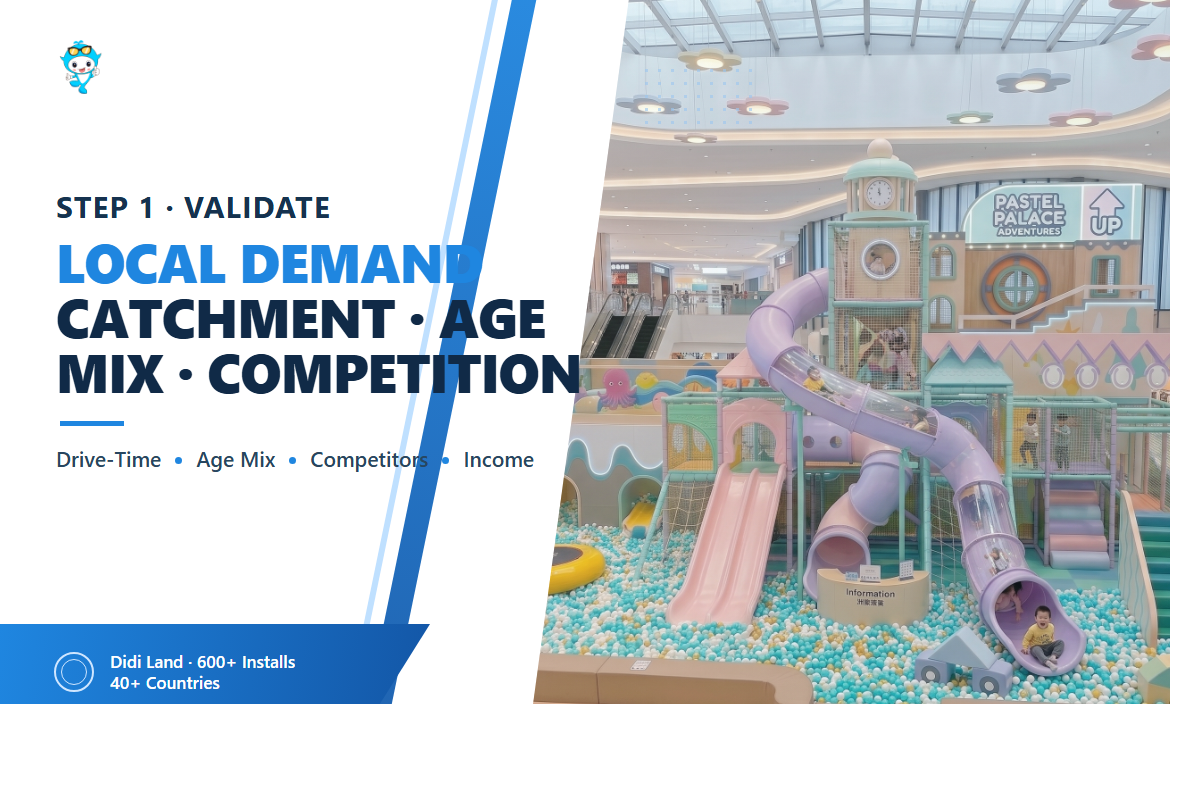
The first step to opening any indoor playground is confirming two key aspects of your market: the density of families with young children within a reasonable driving distance, and the best business model to meet their needs. Families typically won’t travel more than 15-20 minutes for a visit to a play space. To determine how many such families are in your target area, analyze population figures within a drive-time radius, rather than a general city census. Then, physically visit every direct competitor within that radius. Seeing how busy the nearest play center is on a Saturday afternoon can be a more insightful metric than any market report.
Thorough market research helps you pinpoint your target audience and gauge real demand for indoor play in your area. Opening an indoor play center specifically designed for toddlers, for instance, is very different from creating an adventure play zone for older children. Narrow down your target market by age group: toddlers (ages approximately 1-3), the core group (ages 4-8), and pre-teens (ages 9-12). Research US Census data for your drive-time radius to determine the prevalence of these age groups before tailoring your facility and programming to their specific interests.
Choosing among the four main types of indoor play center models significantly impacts start-up costs and all later decisions, from the required capital to staffing levels and permit applications. For a first-time business owner, selecting the right indoor playground model is less about the best playground on paper and more about which one your local audience will fill. Deciding which business model to adopt sets the stage for your entire venture.
| Model | Footprint | Startup band | Best when |
|---|---|---|---|
| Play café / micro soft play | 2,500–5,000 sq ft | $50,000–$150,000 | Toddler-heavy area, lean first venture |
| Indoor playground center | 5,000–10,000 sq ft | $150,000–$400,000 | Ages 1–12, party-driven revenue |
| Family entertainment center | 10,000+ sq ft | $650,000–$1,000,000+ | Dense market, multiple attractions |
| Franchise | Varies by brand | Brand fee + build-out | You want a proven playbook over control |
A word about the most common first mistake: going for the busiest, most expensive spot. Your best location isn’t always the busiest one. A neighborhood center packed with young families usually trumps a high-rent mall space loaded with heavy but wrong-demographic foot traffic. Density of your actual customer base beats sheer footfall.
“It is expensive to run and not much of a profit margin, if any… you will get sick a lot until your immune system stabilizes.” — an operator on Reddit’s r/smallbusiness, on the unglamorous reality of the first year
Can I start an indoor playground with no experience?
Yes, many owners do. Those who succeed either apprentice with a seasoned operator, hire a manager who knows the venue business, or lean on the manufacturer’s design support. What trips up first-timers isn’t a thin résumé — it’s underestimating working capital and empty weekdays.
Step 2: Write the Indoor Playground Business Plan
Your business plan accomplishes two things: it proves the viability of the business to yourself, the owner, and to lenders. Lenders don’t care how cool the slides are; they want to see financial ratios. Structure your business plan around eight essential components: executive summary, market analysis, business model, facility and equipment plan, staffing, marketing, financial projections, and risk management. You don’t need deep business experience to create a business plan; a simple indoor playground business plan template covers all eight sections. What matters is the mindset: starting a business like this is a long-term business, not a season. Set clear business goals, back them with a solid business plan, and give your new business a realistic marketing plan plus numbers a lender can believe. For the facility-and-equipment portion, indoor playground project planning from Dreamland Plus provides a supplier discussion route; a proposed layout or quotation does not establish the venue's financial viability.
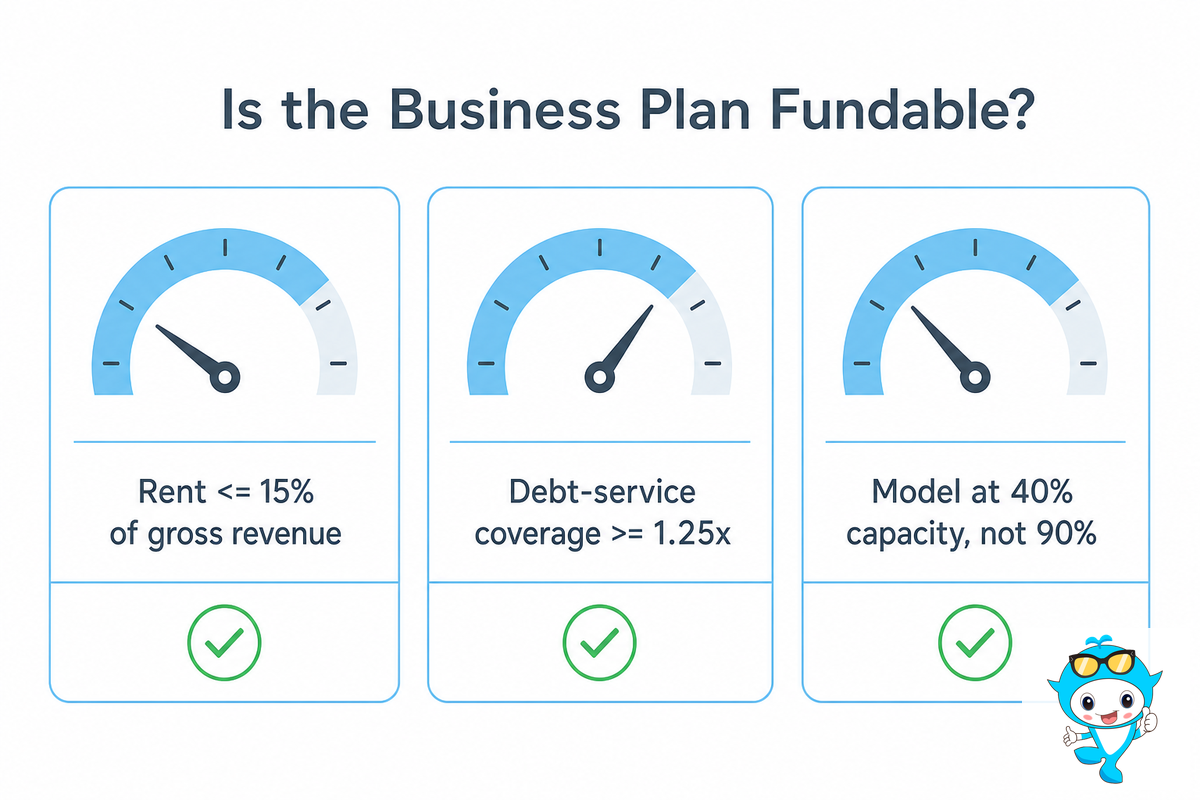
Three numbers decide whether your business plan is fundable: rent can’t exceed 15% of projected gross revenues, the debt-service-coverage ratio must be at least 1.25x, and the business needs to be modelled at a realistic 40% capacity rather than an overly optimistic 90%. If a plan only works when a facility is packed, any bank will view it as a red flag.
The fundable business-plan build order:
- Prove local demand with drive-time demographics and a competitor gap.
- Lock the model and footprint from Step 1 so costs are concrete.
- Build the capital ledger (Step 3) and a month-by-month cash-flow model.
- Stress-test at 40% capacity, then add a 3-month working-capital reserve.
- Write the executive summary last, as a one-page distillation of the numbers.
How do I write a business plan for an indoor playground?
Begin with your financial model, and then build out from there. Your starting budget and realistic revenue projections need to be the foundation; they’re, in essence, the basis for all other sections – location, staffing, marketing – and must align with those figures. To go deeper into the return on investment calculation behind your revenue forecasts, consult our detailed breakdown of indoor playground ROI and then summarize the conclusions rather than include the entire computation.
Step 3: Budget Your Startup Costs (Pre-Opening Capital Ledger)
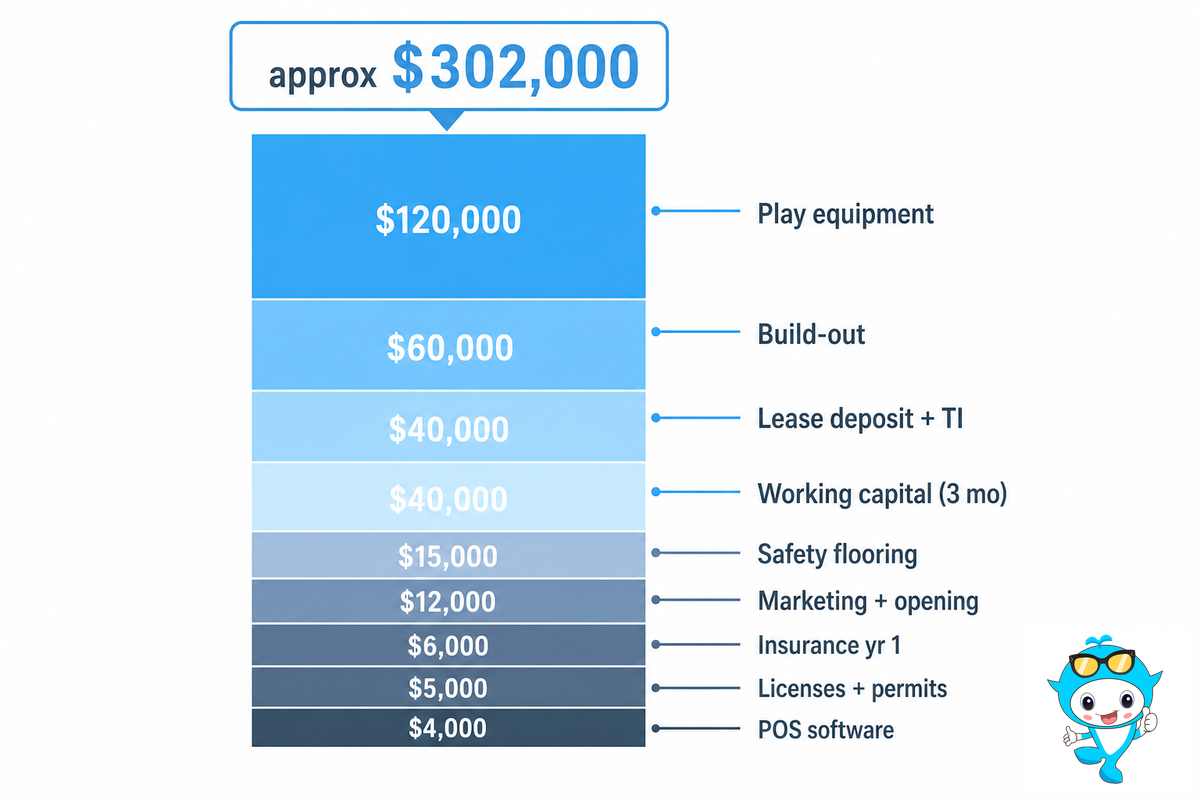
Total startup costs for an indoor playground range from about $50,000 for a modest play cafe to upwards of $1,000,000 for a large family entertainment center, depending mainly on footprint and the complexity of the equipment. A reasonable rule of thumb for the total fit-out is $15 to $40 per square foot. Beware of overspending on hardware; experienced operators allocate 40-50% of their space to the play structure and reserve the rest for seating, party areas, and other amenities that drive cash flow. Your indoor playground cost up front decides how fast it becomes a profitable business: a lean play café reaches breakeven sooner than a large center, but a well-run mid-size build is often the most profitable indoor play format and a steady source of income, so model profitable play conservatively.
This ledger lists estimated costs for a mid-size, 5,000 sq ft center. Each figure corresponds to one of the source ranges listed earlier; tailor each line item to match your specific price point.
| Capital line item | Illustrative amount (5,000 sq ft) | Notes |
|---|---|---|
| Lease deposit + tenant improvement | $40,000 | First/last month + security + build-ready |
| Play equipment | $120,000 | 30–50% of budget; ~$80–150 per sq m of play area |
| Safety surfacing / flooring | $15,000 | Often quoted separately, ~$10–40 per sq m |
| Build-out (HVAC, electrical, restrooms) | $60,000 | Get three contractor quotes |
| Insurance (year 1) | $6,000 | $2,000–$10,000+; a trampoline zone roughly doubles it |
| Licenses + permits | $5,000 | Business, occupancy, fire, health |
| Booking / point-of-sale software | $4,000 | Setup + first-year subscription |
| Marketing + grand opening | $12,000 | Pre-launch email list + launch event |
| Working capital (3 months) | $40,000 | Payroll + rent while you ramp up |
| Total | ≈ $302,000 | Lands inside the $150K–$400K mid-tier band |
Worked total: add the nine lines and a 5,000 sq ft center lands near $302,000 — squarely inside the $150,000 to $400,000 mid-tier band, with the largest single bite (play equipment) at roughly 40% of the build. For a tighter budget, see the tier-by-tier cost tier calculator.
Can I start an indoor playground with a small budget?
Yes — entry level is about $50,000 for a 2,500 sq ft play café with a lean equipment package. The trick is floor-space discipline: one good play structure, a coffee bar, and a party room still tap all three revenue streams.
Step 4: Secure Your Location and Lease
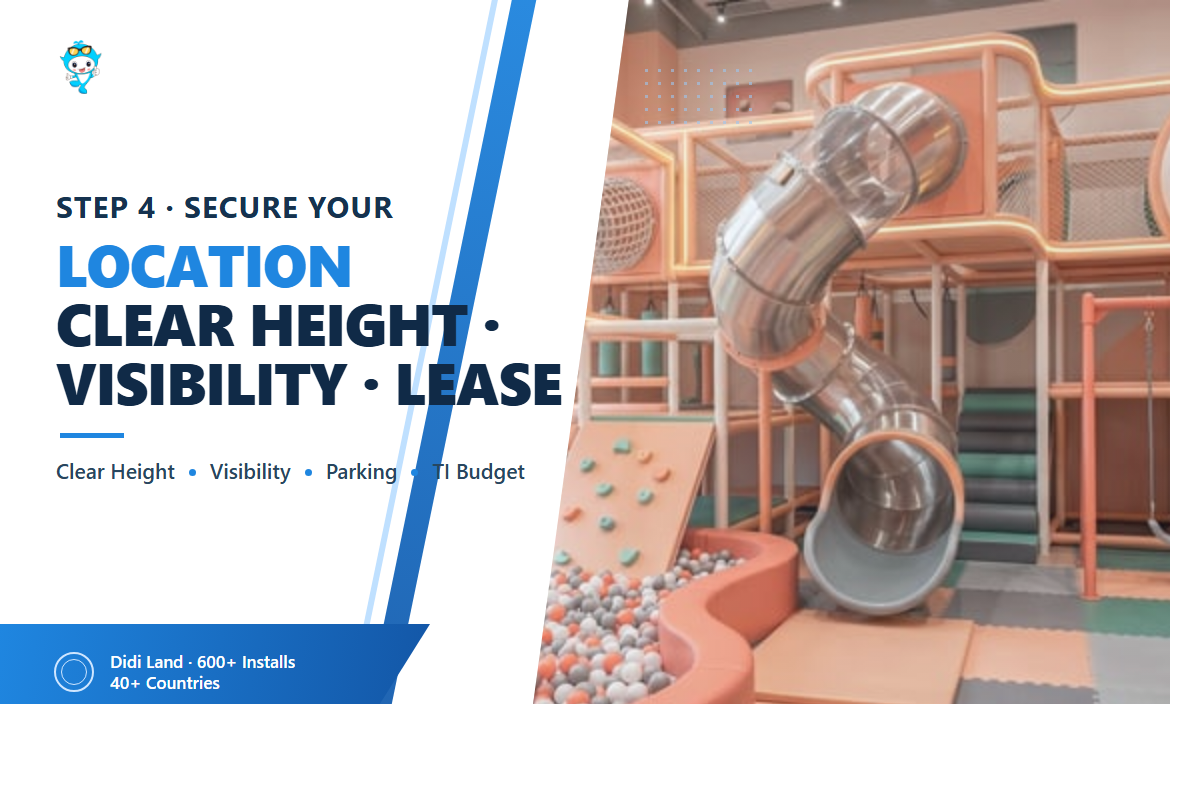
Location and lease agreements can make or break a business. Expect between 3,000 and 10,000 sq ft, depending on your tier, and always confirm this often-overlooked specification first: clear height. This refers to the space from floor to lowest overhead obstruction, whether that’s sprinklers, duct work or lights, not the roof height. A standard three-story play structure typically needs 15 to 18 feet of clear height. Anything less will relegate you to toddler equipment, and prematurely cap your income.
Technical Note: You’ll also need room above the structure for the fall zone and any nets, so check exact clearance with your equipment manufacturer when you sign, as it can differ from architectural drawing height. Zoning will need to accommodate assembly or recreational facilities; be sure to verify the need for ample parking, which could be anywhere from 50 to 80 spots for a 100-child facility, particularly on busy weekends; and you’ll want a tenant improvement allowance. Typically this is between $20 and $40 per sq ft for a retail space. For room layout, work from a proven floor plan layout and the manufacturer’s footprint sizing guidance.
How much space do I need for an indoor playground?
Plan at least 2,500-3,000 sq ft for a toddler café, 5,000-10,000 sq ft for a center serving ages 1-12, and 10,000+ sq ft for a family entertainment center. Whatever the size, keep 50% to 60% for seating, party rooms, and walking space so the room never feels claustrophobic.
Step 5: Licenses, Permits, Insurance and Safety Compliance (Permit-to-Open Passport)
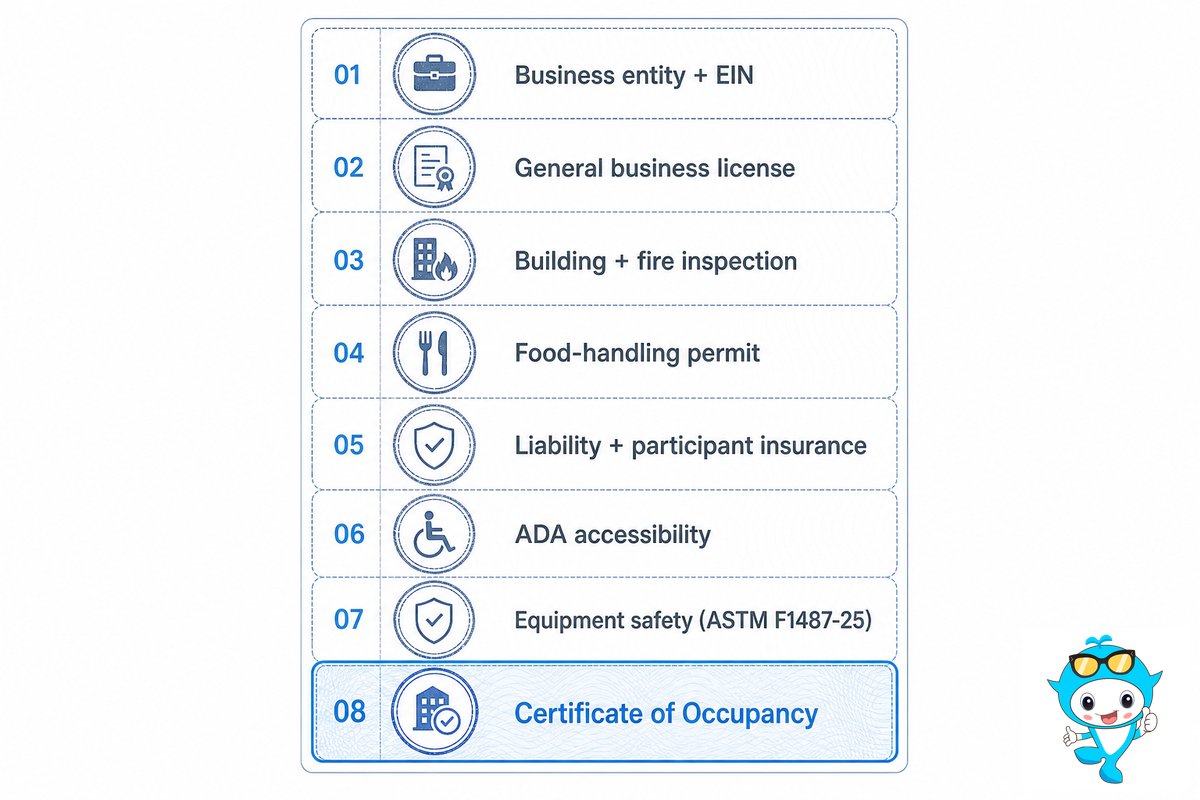
This is often the biggest obstacle to getting up and running, and it’s one many how-to guides fail to address properly. There isn’t typically a “playground license.” Rather, it involves obtaining several separate approvals. Most U.S. cities won’t issue a certificate of occupancy until all of your building, fire and safety inspections have passed, and it’s during this process that equipment certification comes into play as a critical requirement, not an option. Think of these required documents as stamps in a passport: you can’t go through the door until every single one has been approved.
| Passport stamp | What it is | Who issues / verifies it |
|---|---|---|
| Business entity + EIN | LLC or corporation + federal tax ID | State + IRS |
| General business license | Local permit to operate | City / county clerk |
| Certificate of occupancy | Confirms the space meets code for its use | Building department, after final inspection |
| Building + fire inspection | Egress, occupancy load, fire systems | Fire marshal / building inspector |
| Food-handling permit (if café) | Health approval for food service | Local health department |
| Liability + participant insurance | General + on-equipment “participant” cover | Amusement-rated insurer |
| ADA accessibility | Accessible routes + play-component access, a federal public-accommodation duty | Designed into build-out; checked at plan review |
| Equipment safety compliance | ASTM F1487-25, F1918, F1292 surfacing; EN 1176 / IPEMA; CPSIA 16 CFR 1303 for materials | Manufacturer certificates (TÜV/SGS), checked at inspection |
Two things will impact compliance for 2026: first, ASTM F1487 was revised to the F1487-25 edition which further tightened the standards for public-use play equipment (ages 2 to 12). Ensure that any equipment you procure is certified to the current edition; an outdated certificate can delay inspection. Second, in 2025, the U.S. Consumer Product Safety Commission issued updates to its Public Playground Safety Handbook, noting changes around signage and labeling, hazard awareness for supervision, and impact attenuation. For a side-by-side of the major playground safety standards, see the ASTM / EN 1176 compliance checker.
There are two easy-to-overlook obligations that are costly to fix after the fact: one, the Americans with Disabilities Act – a public play space is a public accommodation, and needs to accommodate visitors with disabilities through accessible routes and accessible play components (this will influence layout and total usable capacity, so design this in at build-out stage, not post-inspection), and two, drop-off child care – if you’re planning to have parents leave the premise while children are playing, your business could be regulated as child care (many jurisdictions have parent-accompanied thresholds below which these rules apply), triggering state licensing, staffing and background checks – check both with your building and child care agencies before final design plans.
What permits are needed for an indoor playground?
At a minimum: a registered business with an EIN, a local business license, a certificate of occupancy, passed building and fire inspections, and amusement-rated liability insurance. Add a food permit if you serve food, and expect the certificate of occupancy to land last, so work your timeline backward from it.
Step 6: Source and Install Your Equipment (Build-vs-Buy-vs-Brand)
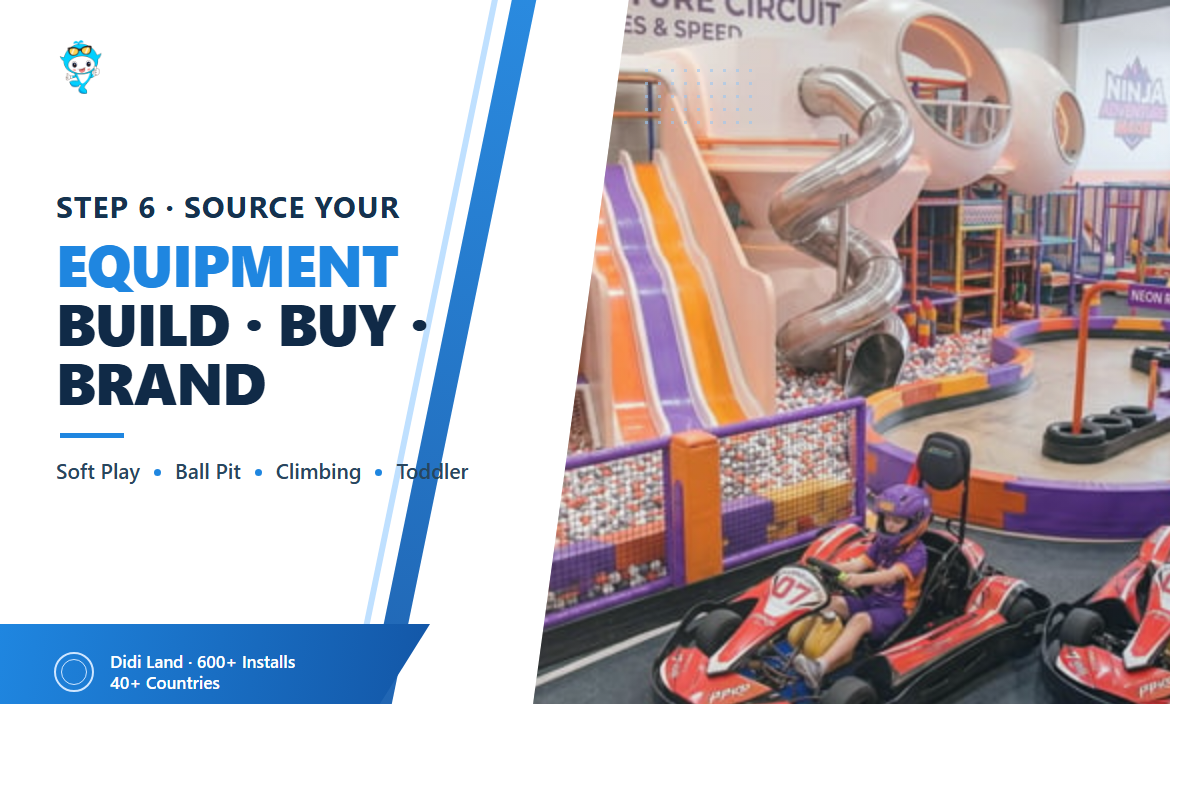
Because equipment is your largest asset and also the item with the longest lead time, the sourcing process warrants its own framework. You can source equipment three ways: manufacturer direct offers customization and best price, but will require the most management; a domestic distributor will be able to deliver faster, but will charge a markup; a franchised or branded model will offer you a packaged solution and ongoing support for fees and less flexibility.
| Route | Cost | Control | Speed / support |
|---|---|---|---|
| Buy — manufacturer-direct | Lowest (no middleman) | Full custom design + layout | Production + freight lead time; you coordinate |
| Buy — domestic distributor | Higher (markup) | Catalog options | Faster local delivery + hand-holding |
| Brand — franchise | Fees + build-out | Lowest (brand rules) | Turnkey playbook + training |
Regardless of the approach you choose, invest in commercial-grade equipment built for a professional playground – residential kit won’t hold up or pass inspection in a high-volume indoor environment, and it may not meet federal CPSIA material limits (16 CFR 1303) for children’s products, whether you brand the space an indoor playground or play space. Consider balancing high-throughput equipment, such as slides, with high-dwell-time activities, such as a ball pit or sensory play area. Calculate play package cost by footprint: an approximate 500 sq ft soft play zone may cost between $8,000 and $25,000, while modular playground sets can expand infinitely depending on space and design. Add a line item of 10 to 20 percent of the total equipment cost for playground installation. Building an indoor playground is a project-managed job: run your indoor playground project like any construction job, with installation scheduled after inspection, and if you are fitting out an existing indoor space, confirm the structure fits before you order.
A good starting point to make choices about the mix is to evaluate each piece of equipment based on its business value and how it fits your customer profile. Make these selections match the age groups that you finalized in Step 1, and strive for balance between high-throughput and high-dwell-time activities.
| Equipment type | Best age band | Play value | Footprint |
|---|---|---|---|
| Multi-level soft play structure | 3–12 | Core climb-and-slide anchor | Large |
| Toddler soft zone | 1–3 | Ground-level sensory play | Small–medium |
| Ball pit | 1–8 | High dwell time, absorbs crowds | Small–medium |
| Tube and wave slides | 3–12 | High throughput, short engagement | Medium (vertical) |
| Spiral or drop slide | 5–12 | Thrill and photo draw | Large |
| Climbing or spider tower | 5–12 | Vertical challenge for older kids | Small footprint |
| Ninja or obstacle course | 6–12 | Active challenge, repeat draw | Medium–large |
| Trampoline zone | 5–12 | High energy; raises insurance cost | Medium |
| Interactive projection games | 4–12 | Tech “wow” that drives parties | Medium |
| Role-play / imaginative area | 2–7 | Quiet imaginative play | Small |
A reasonable split would be 80% of your equipment budget to active play (running, sliding, climbing) and 20% to interactive “wow” pieces that are camera-friendly and sell parties.
Regarding lead time, which is the number that kills opening dates, factor the entire chain into your timeline, not just the install week. Our own experience supplying commercial indoor playground equipment to over 40 countries suggests that custom manufacturing takes between 4 to 16 weeks, and you add another several weeks for shipping and customs before installation begins. Get delivery terms in writing, since the specifics of FOB, CIF, or DDP affect who owns the shipping risk. Verify your minimum order quantity, and ask to have your ASTM, EN 1176, and TÜV/SGS certifications shipped with the order for your review. For the structures themselves, explore modular play structures and soft play equipment by age group.
RFQ checklist — copy these into your equipment quote request:
| Parameter | Recommended range | Why it matters | How to verify |
|---|---|---|---|
| Clear height needed | 15–18 ft for 3 levels | Fits your lease, sets structure size | Supplier drawing vs. site survey |
| Safety certification | ASTM F1487-25, EN 1176, IPEMA | Required to pass inspection | TÜV/SGS certificate for this batch |
| Materials compliance | CPSIA 16 CFR 1303 (lead/phthalates) | Children’s-product law | Third-party test report |
| Production lead time | 4–16 weeks custom | Drives your opening date | Written production schedule |
| Delivery terms | FOB / CIF / DDP stated | Sets who owns freight risk | Incoterm on the quote |
| Install responsibility | 10–20% of equipment cost | Avoids a surprise line item | Scope + crew in contract |
Step 7: Plan Your Revenue Streams and Pricing
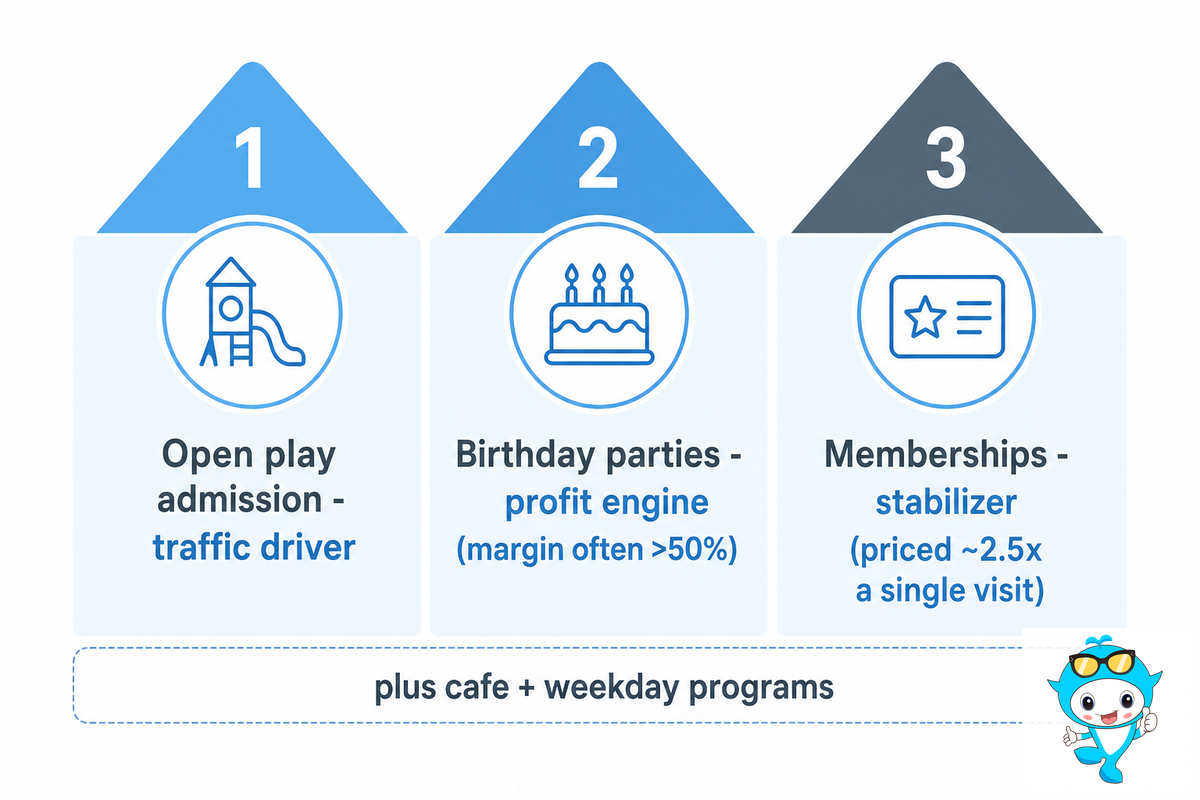
Don’t rely on just one revenue stream for income. Successful indoor playgrounds are based on a three-pronged approach: volume from open play, profit from birthday parties, and stability from memberships. Open play fills the building, but margins are small and traffic can be unpredictable. Most of your open play income will come between Friday and Sunday, a weekend skew visible in U.S. Census amusement-industry data (NAICS 713120).
| Revenue stream | Role | Pricing logic |
|---|---|---|
| Open play admission | Traffic driver | Per-child entry; time limits on busy weekends |
| Birthday parties | Profit engine | Tiered packages; margin often above 50% |
| Memberships | Stabilizer | Monthly, priced near 2.5x a single visit |
| Café / concessions | Dwell-time spend | Coffee for parents, snacks for kids |
| Weekday programs / classes | Fills dead hours | Toddler mornings, sensory hours, camps |
Birthday parties offer significant profitability; the service provides a space and time at a premium, the income is booked in advance, ensuring cash flow, and the margins can exceed 50% once you factor in upselling on food and additional services. Memberships, priced around 2.5 times a single entrance, turn slow months into recurring income. You can gain extra profit from “breakage,” which refers to members who pay for but don’t use memberships frequently. It’s essential to program your weekdays, especially because you still pay for that time, even if it’s slow.
How much do indoor playground owners make?
Indoor playground annual income depends on size, location, and how well you fill weekday hours — so keep projections realistic rather than chasing the headline figures some vendors quote. See our full analysis of whether indoor playgrounds are profitable for the income, expense, and break-even math.
Step 8: Operations, Staffing, Software and Grand Opening
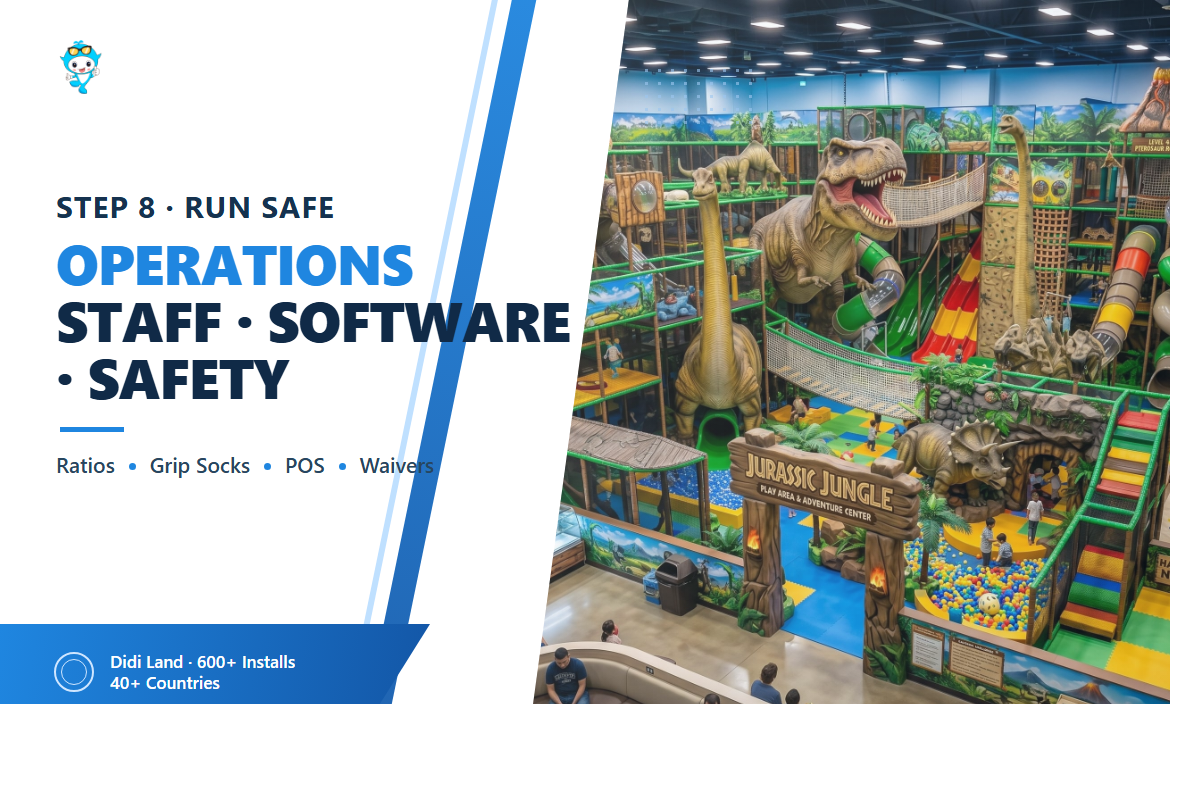
Opening an indoor playground is only the beginning; running an indoor playground well is what matters. Most challenges of running an indoor playground are operational: set business hours that match family routines, and program indoor playground activities that give members a reason to return. Primarily, an indoor playground business is a safety-first operation before it’s an entertainment center. Your staffing ratio on the floor should resemble that of lifeguards: generally, you’ll need one certified monitor for every 20-40 kids playing, and this number can increase to one per 10 kids in higher-risk areas. Always check your insurer’s recommendations. Every child must sign a waiver and wear grip socks before entry. Your staff must be trained in basic first aid and CPR and have a procedure for handling missing children.
Run everything on a single software stack handling online booking, digital waivers, memberships and POS – it simultaneously reduces liability (searchable waivers) and captures membership breakage that buffers cash flow. Maintain a daily inspection log (nets, bolts, pads), with a schedule of cleaning – it’s your legal due diligence evidence if a claim is ever made.
Never open an empty room. Marketing starts on lease day, with a “coming soon” banner including a QR code to build an email list of 1,000-plus parents before you even cut the ribbon. Stage a “soft opening” for local parent influencers to garner social shares, pre-sell founding memberships and then throw the big, public launch party. Free-play day passes, party-planning tips, or a “site-fit” questionnaire convert curious visitors into full-fledged members down the line. Promote your playground year-round, not just at launch: opening an indoor playground business is day one, not the finish line. To open your indoor playground successfully, launch an indoor playground your market can fill on weekdays, then treat growing your business as a program of steady reinvestment. Operators who blend indoor playgrounds and family entertainment under one roof, and keep promoting after the ribbon is cut, build a strong indoor playground business that lasts.
The Order-to-Grand-Opening Timeline and 2026 Outlook
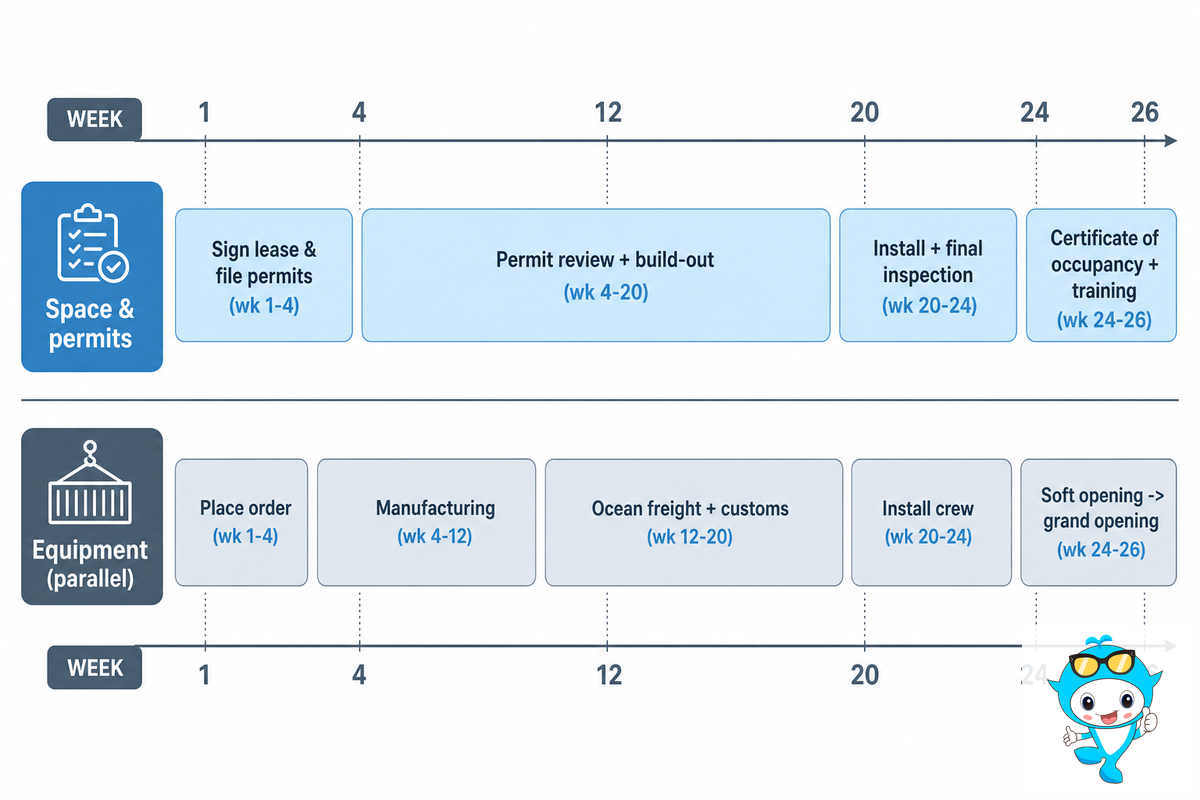
Put everything on a calendar, and the critical path is clear: Permitting and equipment production are two long poles that run in parallel. Here’s a typical 12- to 26-week timeline to launch a midsize center:
| Weeks | Track A — space & permits | Track B — equipment (parallel) |
|---|---|---|
| 1–4 | Sign lease, finalize design, file permits | Approve layout, place equipment order |
| 4–12 | Permit review, start build-out | Manufacturing (4–16 wk) |
| 12–20 | Build-out, flooring, systems | Ocean freight + customs clearance |
| 20–24 | Equipment install + final inspection | Install crew on site |
| 24–26 | Certificate of occupancy, staff training | Soft opening → grand opening |
Your single most important action step: order equipment the same week you sign the lease, because production plus freight represent the longest lead times and delays will cost you valuable holiday and summer season opportunities.
For 2026, the outlook is less about total market size than about a split in how people enter. Growth is real — the global family entertainment center market is forecast to rise from USD 34.57 billion in 2026 to USD 47.93 billion by 2031 — but the load-bearing shift for a new owner is the bifurcation of entry models. A lean play-café now opens for roughly $50,000 to $150,000, while a full family entertainment center still starts well above $450,000. That gap changes your first decision: rather than asking “how big can I go,” ask which model your market can fill on a weekday — and let that answer set the budget, the space, and the equipment order that follow. That the attractions association IAAPA now runs dedicated family-entertainment-center summits is a sign the segment is maturing and worth entering deliberately.
The bottom line
Starting an indoor playground business is a sequencing problem, not a slide-picking one. Validate demand and pick a model your market fills on weekdays, budget a real capital ledger with a three-month reserve, treat the certificate of occupancy and equipment safety certificates as the gate that lets you open, and place your equipment order the week you sign the lease so production and permitting run in parallel. Do that and a 3-to-9-month path to opening is realistic.
Frequently Asked Questions
How much does it cost to start an indoor playground?
Total startup cost runs from about $50,000 for a small 2,500 sq ft play café to over $1,000,000 for a large family entertainment center, with a mid-size 5,000 sq ft center commonly landing between $150,000 and $400,000. A useful turnkey benchmark is $15 to $40 per square foot for the complete fit-out. Play equipment is the biggest single line at roughly 30% to 50% of the budget. Always add a three-month operating reserve on top of the build cost.
How many staff do I need to run an indoor playground?
Plan on one trained floor monitor for every 20 to 40 children at play, tightening to one per 10 in higher-risk zones like trampolines, plus front-desk and party staff on weekend shifts. Every monitor should hold current first aid and CPR training, and your insurer may set stricter ratios, so confirm before you finalize the staffing budget.
Do I need special insurance for an indoor playground?
Yes. You need amusement-rated general liability plus participant coverage for injuries on the equipment, which standard retail policies exclude. Budget about $2,000 to $10,000 or more for year one, and expect a trampoline zone to roughly double the premium. Insurers also want signed waivers and a daily equipment inspection log. Get quotes from an insurer who actually writes play centers before you sign the lease, since a generalist agent can leave gaps you only discover after an incident.
Is an indoor playground profitable?
Yes, but there are slim margins and the weekday usage will determine whether you can make it work. Your best bets are birthday parties and memberships, not open play. See our full analysis of indoor playground ROI for the figures.
What is the best location for an indoor playground?
A neighborhood center dense with young families usually beats a high-rent mall with heavy but wrong-demographic foot traffic. Before signing, confirm at least 15 feet of true clear height, zoning that allows recreation use, and enough parking to absorb weekend birthday-party peaks.
Is it better to buy an indoor playground franchise or go independent?
Franchise-versus-independent comes down to whether you value a proven playbook and dedicated support over greater control and margin. A franchise gives you brand recognition, an established design, and formal training in return for upfront and royalty fees — the main indoor playground franchise cost — plus restrictions on how you operate.
Going independent — generally sourcing equipment directly from the manufacturer — costs less, allows space and pricing customization, but requires you to carry the project management, marketing and operational expertise. If the local market has no established player first time owners should consider independents with institutional equipment manufacturer support for the best value; where you’ll be competing with an industry leader, a franchise can speed up your learning curve.
How long does it take to open an indoor playground?
Allow 3 to 9 months between signing your lease and opening the doors with the equipment order and permitting taking up the longest amount of time. An equipment order delay is the common reason for not opening on your intended date.
Related Articles
- Are Indoor Playgrounds Profitable? The Real ROI Math
- Indoor Playground Design and Floor Plan Layout
- Playground Safety Standards Compared: ASTM, EN 1176 and More
- Soft Play Equipment by Age Zone
References & Sources
- Write Your Business Plan — U.S. Small Business Administration
- Calculate Your Startup Costs — U.S. Small Business Administration
- Pick Your Business Location — U.S. Small Business Administration
- Plan Your Business — U.S. Small Business Administration
- QuickFacts Demographic Data — U.S. Census Bureau
- NAICS 713120 Industry Classification — U.S. Census Bureau
- Public Playground Safety Handbook (2025 Update) — U.S. Consumer Product Safety Commission
- 16 CFR Part 1303, Ban of Lead-Containing Paint — U.S. Code of Federal Regulations
- First Aid Resources — Occupational Safety and Health Administration
- Permitting and Licensing Guide — City of Paducah, Kentucky
- ASTM Publishes Revised Playground Equipment Safety Specification (F1487-25) — SGS SafeGuardS
- Family Entertainment Centers — IAAPA
- Global Family Entertainment Center Market Report — Mordor Intelligence
Reviewed by the Didi Land technical team. Figures are based on market data collected for 2026 and are meant to illustrate broad ranges; please verify exact costs, clearances, and permitting specifics with your local agencies and the manufacturer’s representative.
![Custom Dinosaur Playground Equipment [Design Guide]](https://didiplayarea.com/wp-content/uploads/2026/09/custom-dinosaur-playground-equipment-r2-featured-1-768x512.png)
![Custom Dinosaur Playground Equipment [Design Guide]](https://didiplayarea.com/wp-content/uploads/2026/09/custom-dinosaur-playground-equipment-r2-featured-1-150x150.png)