Get in Touch with Didi Land

Indoor Play Structures: Custom Commercial Playground Equipment for FEC, Malls & Kindergartens
Engineered for the venues your competitors won’t customize for – and certified to standards your insurer actually checks.
Get Free 2D/3D Design + 24h Quote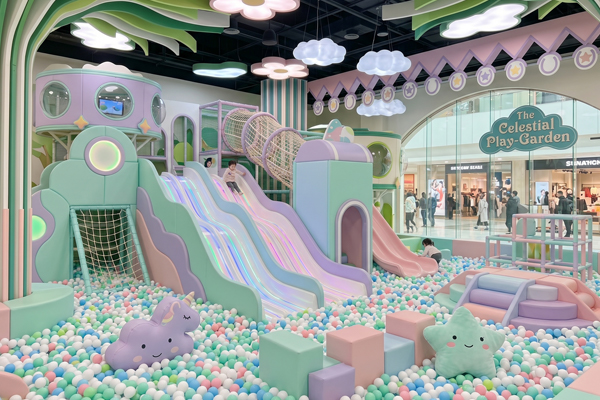
Solution Summary
7
product series across 6 venue types
30+
countries with active installations
600+
commercial projects delivered
ASTM F1487 + EN 1176
full sub-standard compliance
3-year
extended warranty (2× industry baseline)
24-hour
quote turnaround on full venue specs
Why High-Performing FEC Operators Move Beyond Off-the-Shelf Play Equipment— for Investors, Engineers & Procurement
Indoor play structures are custom-fabricated commercial playground systems engineered for high-traffic venues — shopping malls, family entertainment centers, kindergartens, restaurants, hotels, and community spaces. Unlike home indoor play equipment (covered by ASTM F1148), commercial indoor play structures must meet ASTM F1487-21 and EN 1176-1/-2/-3 sub-standards before any reputable insurer will underwrite the venue.

Public Record Realities
Pain is well-documented in the public record. The U.S. Consumer Product Safety Commission attributes over 200,000 annual emergency-room visits to public-playground injuries — three out of four caused by falls. When a 4-year-old comes off an active play slide onto under-rated surfacing, the question isn’t whether the operator gets sued — it’s whether the equipment certification documentation and safety standards records survive the deposition.
Root Causes
Root cause runs deeper than “cheap equipment.” Three structural failures keep recurring across the venues we re-fit:
Off-shelf systems sized for warehouse showrooms, not your venue — modular kits don’t accommodate column grids, low ceilings, or non-rectangular footprints, so installers improvise on-site and void the certification chain.
Documentation gaps at customs and insurance — “ASTM certified” without specifying F1487 vs F1148 (home use) gets equipment held at port or excluded from the policy.
Slow service-response on warranty claims — when a child gets injured, operators need replacement parts in days, not the 8-12 weeks reported on Reddit by buyers who sourced through generic Alibaba listings.
Didi addresses these three root causes through three core commitments: every project ships with full ASTM F1487 + EN 1176 records traceable to the test report, custom design accommodates your venue’s actual floor plan within 35-50 production days, and a 3-year extended warranty backs every installation across 30+ countries.
“We expected maybe a few hundred dollars for slides, soft mats, climbing blocks. But most of the stuff we’re seeing from official suppliers — it’s a different category entirely.”
That shock isn’t a pricing problem; it’s a category problem. Commercial-grade indoor play equipment lives in a different specification universe than the home playsets sold at Target. We’ll quantify exactly what that difference costs you, what it returns, and how to scope it for your venue size — starting with the product matrix below.
Didi Indoor Play Structures — 7-Series for 6 Venue Types
Didi builds seven distinct product series, each calibrated for different age ranges, footprint profiles, and use cases.
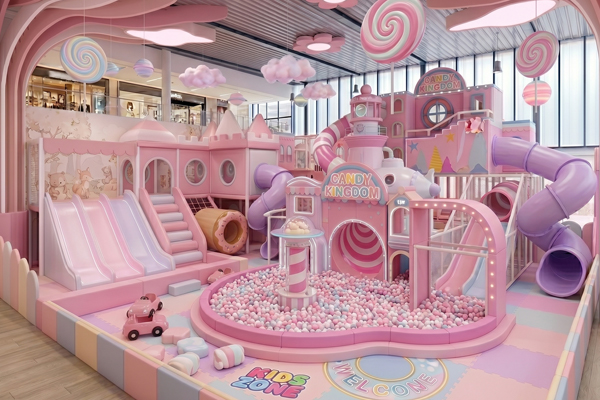
Themed Indoor Playground
Custom-themed multi-level indoor playground equipment (jungle, ocean, space, candy-land themes) with integrated slides, ball pits, and climbing nets that drive imaginative play. The flagship series for FEC operators and shopping-mall anchor tenants serving children’s play areas.
Footprint: 150-1,000 m²
Ages: 3-12
Series tier: Premium
Ages: 3-12
Series tier: Premium
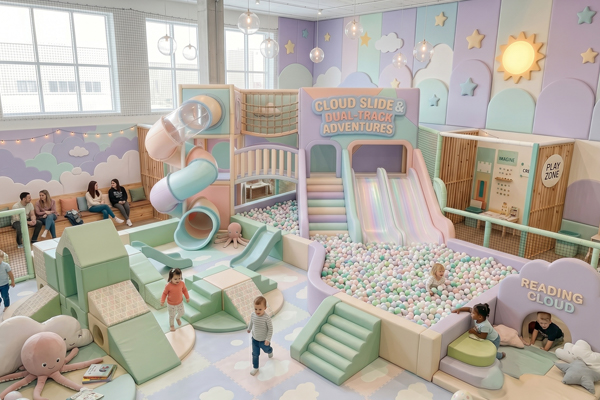
Toddler Soft Play Equipment
Foam-block soft play equipment (high-density EVA) with rounded geometry and short fall heights. Engineered for sensory development and ages 6 months to 4 years, where impact attenuation matters more than spectacle.
Footprint: 30-150 m²
Ages: 0.5-4
Series tier: Standard
Ages: 0.5-4
Series tier: Standard
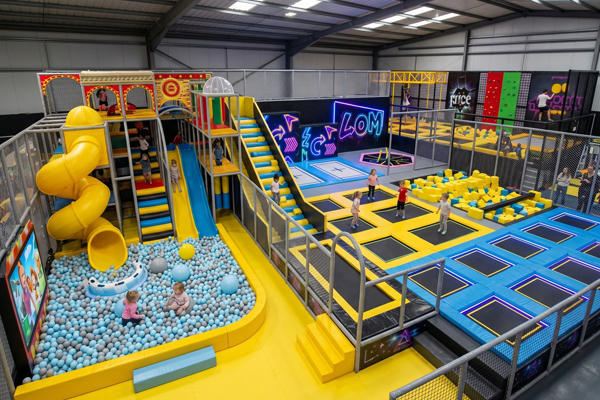
Trampoline Park
Connected-trampoline attraction systems with foam pits, dodgeball courts, and dunk lanes. Built around steel-frame construction with replaceable spring beds engineered for high-wear, high-traffic environments.
Footprint: 300-2,000 m²
Ages: 5-adult
Series tier: Premium
Ages: 5-adult
Series tier: Premium

Ninja Warrior Course
Modular obstacle course systems (warped walls, salmon ladders, balance beams, climber routes) sized for both kids’ courses and adult fitness conversions. Sells well into FEC + gym hybrid models as a flagship attraction.
Footprint: 200-800 m²
Ages: 6-adult
Series tier: Premium
Ages: 6-adult
Series tier: Premium
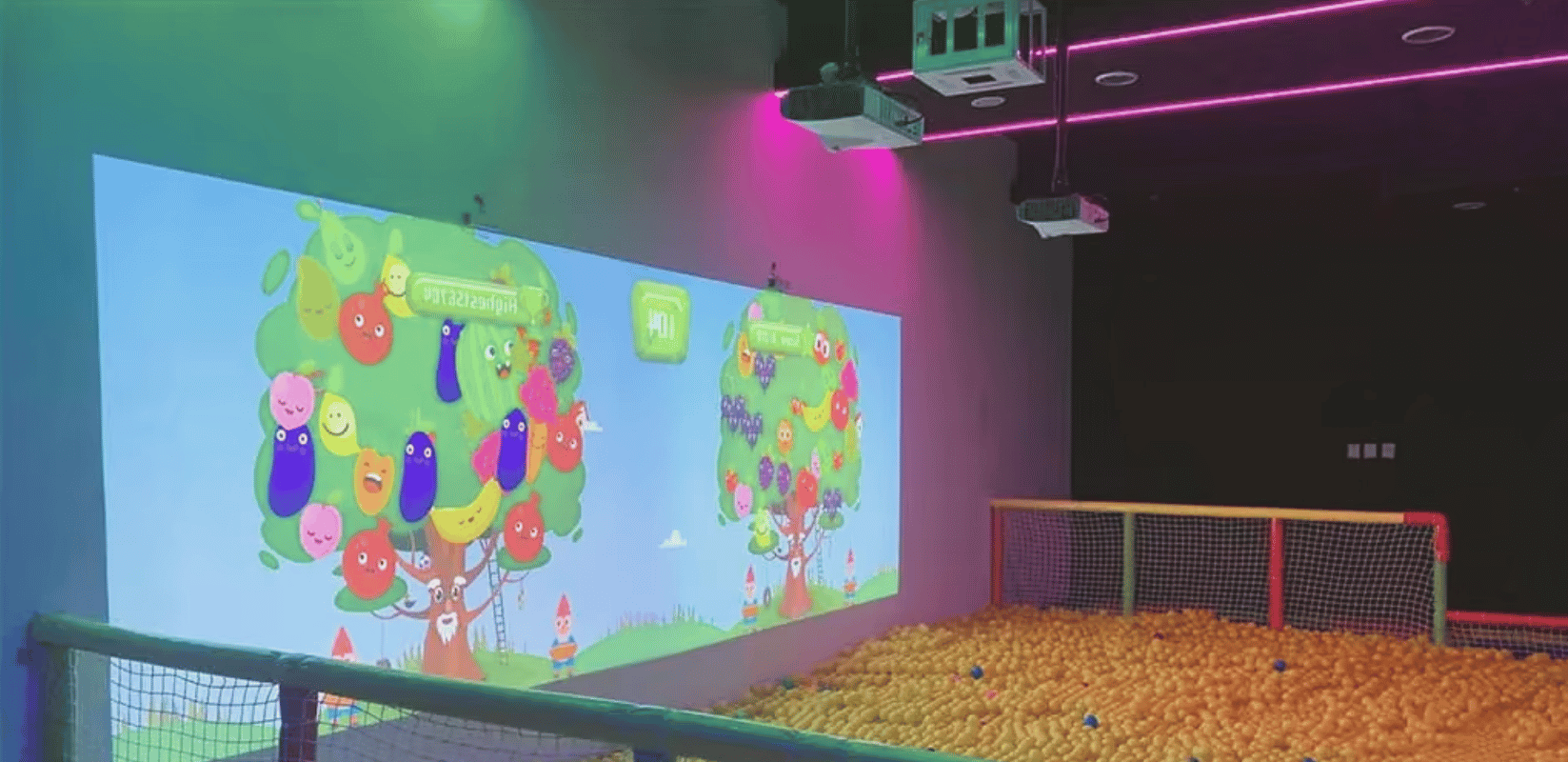
Interactive Projection Playground
Floor- and wall-projected interactive games (think AR-style movement-tracked content). Sells into newer FEC formats and education centers wanting tech differentiation.
Footprint: 50-300 m²
Ages: 3-12
Series tier: Tech-Forward
Ages: 3-12
Series tier: Tech-Forward

Kids’ Arcade & Naughty Castle
Pre-engineered castle structures with arcade-game integration, party rooms, and birthday-event modules. Unit-economics workhorse for revenue-per-square-foot operators.
Footprint: 100-400 m²
Ages: 3-10
Series tier: Standard
Ages: 3-10
Series tier: Standard
7×6 Decision Matrix — Match Series to Venue Type
Every venue type has different anchor tenants, traffic patterns, and revenue models. Below, you’ll find the recommended footprint and configuration tier for each combination, drawn from 600+ Didi installations across 30+ countries.
| Series \ Venue | Mall | FEC | Kindergarten | Restaurant | Hotel | Community |
|---|---|---|---|---|---|---|
| Themed Playground | 200-500 m² Premium | 400-1000 m² Flagship | 80-150 m² Lite | 50-100 m² Compact | 150-300 m² Standard | 200-400 m² Standard |
| Toddler Soft Play | 40-80 m² Lite | 50-100 m² Standard | 60-150 m² Flagship | 30-60 m² Compact | 40-80 m² Lite | 80-120 m² Standard |
| Trampoline Park | 500-1200 m² Premium | 800-2000 m² Flagship | Not recommended | Not recommended | 300-600 m² Premium | 400-800 m² Standard |
| Ninja Warrior | 200-400 m² Standard | 400-800 m² Premium | Not recommended | Not recommended | 150-300 m² Lite | 250-500 m² Standard |
| Interactive Projection | 80-200 m² Tech-Forward | 150-300 m² Tech-Forward | 50-100 m² Lite | 40-80 m² Compact | 60-150 m² Standard | 100-200 m² Standard |
| Kids’ Arcade | 150-300 m² Standard | 200-400 m² Premium | Not recommended | 80-150 m² Lite | 100-200 m² Lite | 150-300 m² Standard |
| Naughty Castle | 100-250 m² Standard | 150-350 m² Standard | 100-200 m² Lite | 60-120 m² Compact | 80-150 m² Lite | 150-300 m² Standard |
Custom vs Modular vs Off-the-Shelf — Performance Comparison— for Engineers, Investors & Procurement
Three procurement paths exist for commercial indoor playground equipment, and they sit at different points on the cost-flexibility-compliance triangle. The comparison below uses concrete numbers – lead-time days, warranty months, certification scope – instead of abstract “high/medium/low” judgments that don’t help you build a budget for indoor playground equipment procurement.
Dimension |
Custom (Didi) |
Modular Kits |
Off-the-Shelf |
|---|---|---|---|
Production lead time |
35-50 days | 60-90 days (plus customization) | In stock; ships in 1-2 weeks |
Quote turnaround |
24 hours from venue specs | 5-10 business days | Same-day catalog price |
Minimum order |
1 venue (any size) | 5+ units typical | 1 unit, but no integration |
Customization scope |
Theme + layout + components + colors | Layout reconfiguration only | None — fixed configuration |
Compliance certification |
ASTM F1487 + EN 1176-1/-2/-3 + EN 1177 (surfacing) | ASTM F1487 only (in most cases) | Often only ASTM F1148 (home use) — not legal for commercial venues |
Warranty |
3 years extended | 1 year standard | 90 days, generally |
ROI horizon (FEC operating model) |
18-24 months | 24-36 months (longer setup, lower flexibility) | Limited resale; insurance and compliance gaps |
Refurbishment / expansion path |
Modular components engineered for component-level swap | Original supplier only | Replace entire unit |
Off-shelf is the trap most first-time FEC operators stumble into: a $40,000 “indoor playground” sourced from a consumer playground catalog turns out to be ASTM F1148 (home use only). When the insurer asks for the F1487 certificate, the operator either pays for re-certification (often impossible because the original engineering doesn’t meet F1487 use-zone or fall-height requirements) or replaces the equipment entirely. The “cheap” path lands at the cost of the custom path, plus six months lost.
Custom and modular both clear the F1487 bar. Remaining choice depends on whether your venue layout needs accommodation (custom) or fits the catalog grid (modular). For 80% of mall and FEC sites we’ve worked on, custom is required because column grids and ceiling heights don’t match catalog assumptions.
Customer Outcomes: 600+ Projects Across 30+ Countries — Concept to Completion
Twelve years of in-house manufacturing facility operations, 600+ delivered projects, and an average annual growth rate above 20% don’t translate automatically into your business outcomes — but they do translate into installation patterns we can show you. Below are three case studies (anonymized where the operator requested confidentiality) drawn from the FEC, mall, and education segments.
Case 1 — FEC Operator, Eastern European Market (Poland)
Operator transitioned from a competitor’s modular system that had aged out of warranty. Footprint accommodation required custom column-grid integration and a non-rectangular layout for the Trampoline Park section. Production cycle: 42 days. Foot traffic +35% YoY post-rebrand
Case 2 — Shopping Mall Anchor, Mexican Market
Mall management wanted a play area that anchored family weekend visits and supported the food-court adjacency. Custom theming matched the mall’s regional identity. Production cycle: 38 days. Average dwell-time +52 minutes per family visit
Case 3 — Kindergarten Network, Sri Lankan Market
Education-network operator standardized on Didi across six locations to harmonize EN 1176-1 and EN 1176-3 test reports for regulator audits. Custom palette matched the network’s visual identity. Zero safety incidents across 18 months of operation
Cost Tier Framework — Indoor Play Structures Budget by Venue Size
Industry sources estimate 2026 turnkey indoor playground budgets at $15-40 per square foot, with three discrete venue tiers driving most procurement decisions.
Tier 1 — Compact (Play Café / Restaurant Play Area)
$50,000 – $150,000
2,500-5,000 sq ft (≈230-465 m²) · Toddler-focused or single-series · Faster setup, lower revenue ceiling
Tier 2 — Standard Commercial FEC
$150,000 – $400,000
5,000-10,000 sq ft (≈465-930 m²) · Multi-series mix · Industry baseline for mid-market FEC operators
Tier 3 — Flagship FEC / Mall Anchor
$400,000 – $1,000,000+
10,000+ sq ft (≈930+ m²) · Full themed build with multiple revenue streams · Highest ROI ceiling and longest planning cycle
ROI context: Industry guides cite an 18-24 month payback for well-managed indoor playgrounds, with annualized returns of 30-40% for operators who layer birthday parties (60-80% margin ) and food service onto base ticket revenue. Ticket-only operating models extend payback toward 36 months.
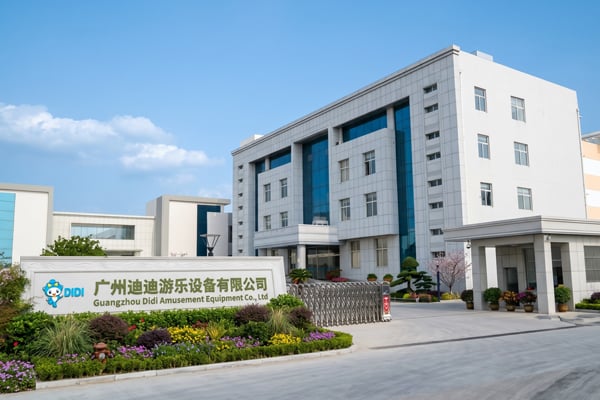
“I started this brand because I watched too many investors lose money to playground equipment that arrived late, broke early, and couldn’t get serviced when it mattered. After 15 years in this industry, I’ve stopped accepting ‘good enough.’ Every Didi project is engineered the way I’d build for my own venue.”
Certifications & Compliance — ASTM F1487, EN 1176, TÜV, ISO 9001
Compliance documentation isn’t paperwork — it’s the difference between an insurance policy that pays and one that doesn’t, and between equipment that clears customs and equipment that sits at the port. Every Didi indoor play structure ships with the full sub-standard documentation chain, traceable to the test report. Certification marks below are not a generic “certified” claim — each links to the specific scope and the issuing body.
ASTM F1487-21
Public-use playground equipment (commercial venues, ages 2-12)
EN 1176-1
General safety + structural integrity, fall-zone geometry
EN 1176-2
Swings — dynamic load testing, free-space zones
EN 1176-3
Slides — chute profile, exit landing area
EN 1177
Impact-attenuating surfacing & Critical Fall Height test
TÜV
Mechanical safety testing aligned with DIN EN 1176-1
RoHS 2011/65/EU
Hazardous-substance restrictions for plastic and metal components
CE Marking
EU market conformity (mandatory for European installations)
ISO 9001:2015
Manufacturing quality management system
Why ASTM F1487 — and not F1148 — matters for your venue safety standards
ASTM publishes two playground equipment specifications. F1487 covers public-use commercial venues (malls, FECs, kindergartens, restaurants); F1148 covers home use only. They differ on fall heights, use-zone geometry, structural-load multipliers, and entrapment dimensions. If your equipment is certified to F1148 and installed commercially, the certification is not legally portable to your insurance policy.
For U.S. municipal procurement, IPEMA (International Play Equipment Manufacturers Association) acts as the third-party certifier — IPEMA-certified equipment is built to and tested against ASTM F1487, so the same engineering chain that earns IPEMA marks satisfies most U.S. RFQ language. European venues require CE marking with EN 1176 + EN 1177 test reports; both standard frameworks are honored on Didi installations.
Procurement Guide — Cost Tiers, Lead Times, In-House Manufacturing & Global Installation
— for Procurement & Investors
Procurement decisions on indoor play structures fail in predictable places — most often the gap between catalog price and total landed cost.
Quote turnaround
Initial 24-hour quote on full venue specs (footprint, age range, theme direction, budget tier). Engineering refinement: 5 business days post-deposit.
Production cycle
35-50 days from approved engineering drawings to factory shipping. Compares to 60-90 days for modular-kit suppliers running customization workflows.
Global installation
Active installation networks across 30+ countries — France, Germany, Mexico, Poland, Sri Lanka, India, South Africa, Malaysia, and growing. Local-language project management for major markets.
Pricing factors framework
Pricing scales with footprint, theme complexity, component mix, certification scope, and shipping destination. Detailed quotes ship within 24 hours of full venue spec submission. Contact for venue quote.
9-Station In-House Manufacturing Map
Turnkey isn’t a marketing claim if you can name the production stations. Every Didi indoor play structure passes through nine in-house manufacturing operations before it reaches the QC bay — no outsourced assembly, no import-and-rebrand. This is the tangible evidence behind the 35-50 day lead time and the 3-year warranty:
01
Laser tube cutting
02
Tube saw & fabrication
03
Punching
04
Drilling
05
Tube bending
06
Press brake forming
07
MIG / TIG / CO₂ welding
08
Robotic welding cells
09
Grinding & polishing
The same in-house design team handles every project from concept-to-completion: industrial designers, structural engineers, and QC technicians work in the same building, which is why a Didi indoor playground manufacturer relationship looks different from a broker-style sourcing arrangement.
FAQ — Real Questions from Park Investors & Operators
Industry guides estimate $15-40 per square foot for turnkey commercial indoor playground builds. Three discrete venue tiers drive most procurement decisions: a compact play-café build at 2,500-5,000 sq ft falls in the $50,000-$150,000 range; a standard commercial FEC at 5,000-10,000 sq ft runs $150,000-$400,000; and a flagship FEC or mall-anchor venue at 10,000+ sq ft sits at $400,000-$1,000,000+. Final pricing scales with theme complexity, component mix (themed vs soft play vs trampoline), certification scope (ASTM-only vs ASTM + EN), and shipping destination. Soft costs — insurance, marketing, contingency reserves — add another $50,000-$150,000 on top of the equipment line. Didi delivers full venue quotes within 24 hours of receiving your specifications.
The two product categories live under separate ASTM standards. Commercial indoor play structures must meet ASTM F1487-21 (public-use venues, ages 2-12); home equipment falls under ASTM F1148. F1487 specifies tighter fall-zone geometry, higher structural-load multipliers, and entrapment-dimension limits that home equipment isn’t engineered for. Installing F1148 equipment in a commercial venue voids the operator’s insurance in nearly every case.
Didi production cycle runs 35-50 days from approved engineering drawings to factory shipping. Add roughly 25-45 days for ocean freight to U.S. or European destinations and 5-10 days for on-site installation. Modular-kit suppliers running customization workflows usually need 60-90 production days before shipping.
Yes. Every commercial-venue installation ships with full ASTM F1487-21 test reports, EN 1176-1/-2/-3 and EN 1177 compliance records, plus IPEMA-aligned engineering records for U.S. RFQs.
Yes. Custom design accommodates column grids, irregular floor plans, low-ceiling constraints (down to roughly 2.8 m for toddler structures), and curved walls. Modular kits can’t — that’s the central trade-off between the two procurement paths. Submit your floor plan with the quote request and our engineering team returns layout options within 5 business days.
Toddler Soft Play covers ages 6 months to 4 years. Themed Playground and Kids’ Arcade target ages 3-12. Trampoline Park, Ninja Warrior Course, and Interactive Projection extend to teens and adults. Mixing series in one venue gives you the broadest age coverage — a common specification for FEC anchor builds.
Active installation networks operate across 30+ countries, including the U.S., Canada, France, Germany, Mexico, Poland, Sri Lanka, India, South Africa, Malaysia, and Australia. For destinations outside the active network, Didi coordinates with the operator’s preferred local contractor and supplies the installation manual + remote engineering support.
3-year extended warranty covers structural components, hardware, and workmanship — roughly twice the 12-month industry baseline. After-sales support runs 24/7 across multiple time zones with replacement-part inventories held for the most common SKUs. Service-response targets are 48 hours for parts dispatch and 5-7 days for on-site service in active-network countries.
Every structural assembly passes through documented weld inspection, load-test sampling per ASTM F1487 protocols, and dimensional verification before crating. Test records ship with the equipment alongside the compliance records, so insurance underwriters can trace each major load-bearing component to its inspection record.
Often yes — depending on the original supplier’s structural geometry and certification basis. Refurbishment projects normally replace high-wear components (slides, climbing nets, foam pads, ball-pit balls) and add new themed sections without rebuilding the structural core. Submit photos and the original engineering drawings with the quote request for a refurbishment scoping.
![Custom Dinosaur Playground Equipment [Design Guide]](https://didiplayarea.com/wp-content/uploads/2026/09/custom-dinosaur-playground-equipment-r2-featured-1-150x150.png)