Get in Touch with Didi Land



Soft play centre vs indoor playground is the question every commercial operator asks himself before signing a lease, drawing plans, or wiring the deposit to an equipment vendor. They look alike from the curb. However they are not. They target different ages, sit beneath different ASTM standards, require different square footage, and yield different revenue mixes. Pick the wrong one and your $80,000 buildout finances a half-empty venue on weekday mornings.This commentary compares both at the level an operator actually needs: square footage, capital expenditure, age targets and their primary/secondary bands, the ASTM standards covered by number, and the revenue mix that determines if the project makes it through the first 3 years. The data draws on the CPSC Public Playground Safety Handbook (2025 issue), current ASTM standards, 2025 industry pricing, and operator-side financials that competitor pieces tend to omit.
Quick Specs: Soft Play Centre vs Indoor Playground
| Dimension | Soft Play Centre | Indoor Playground |
|---|---|---|
| Primary age | 6 months to 5 years | 3 to 12 years (sometimes 14) |
| Footprint | 1,000–3,000 sq ft typical | 3,000–8,000+ sq ft typical |
| Equipment cost | $9–$13 / sq ft (EXW supplier) | $13–$20 / sq ft custom multi-level |
| All-in CapEx (turn-key) | $43k – $85k | $85k – $188k+ |
| Lead ASTM standard | ASTM F1918-21 (soft contained play) | ASTM F1487-21 (public-use playground) |
| Vertical complexity | Single floor, padded | Multi-level structure |
| Revenue mix (typical) | 40–50% F&B, 25–30% play, 25–30% parties | 50–60% admission, 20–25% parties, 15–25% F&B |
| Best venue match | Cafés, hotels, community centres, kindergartens | FECs, malls, standalone destinations |
Cost data noted are based on 2025 supplier pricing (EXW China) from helmamusements 2025 industry data. The US/EU installed costs tend to be 2-3 times this baseline once freight, customs, installation labor, and surfacing is factored in.
Soft Play Centre vs Indoor Playground at a Glance

A soft play centre and indoor playground both operate within an indoor climate-controlled environment. Both compete with domestic playgrounds and outdoor facilities using the same customer wallet. The differences key to operator planning lie beneath the surface: target demographics, what model the equipment is built to, the responsible standards by number, and how the revenue plays out at month end.
The heuristic: a soft play centre comprises a single level padded play zone for little kids – 6-month-olds through pre-school age – where business sits on coffee sales and high throughput for birthday parties. An indoor playground comprises a multi-tiered play structure for 3-12year-olds – for whom dwell-time and premium ticket pricing drive the economics. The Quick Specs table above summarises the 7 dimensions that influence project types. The remaining commentary describes why these matter and how the decision switches depending on venue, footprint, and revenue plans.
What Is a Soft Play Centre?
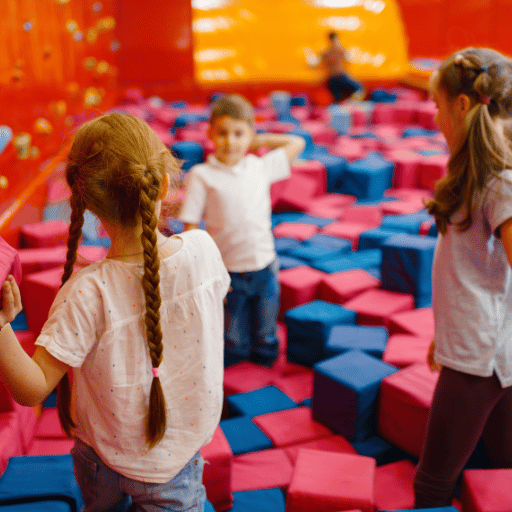
A soft play centre is a fully padded, single-tier play environment built for babies and pre-school age children (around 6 months to 5 years). Its defining feature: everything the kids climb on is a padded surface, whether a ball pond, obstacle pieces, foam wall padding, even parts of the play structure. Surfaces are engineered to safely absorb toddler falls while practicing motor skills they have yet to master. The lead standard is ASTM F1918-21, Standard Safety Performance Specification for Soft Contained Play Equipment.
What Is Soft Play Equipment?
Soft play equipment refers to the modular cushioned elements that occupy the space – foam shapes, padded climbers, ramps, tunnels, ball pits, and themed sculpture bits. Most products use EVA foam cores, overlaid in vinyl or PU-coated fabric and supported on a low-rise or sit-on padded floor. With all surfaces padded and all edges rounded, the centre supports the imaginative, unstructured play a toddler needs for early social interaction and gross-motor practice without the supervision burden of a multi-level structure. Operators sourcing these components typically buy in pre-engineered soft play equipment configurations matched to age band and footprint, then add themed pieces — see complete soft play sets for category breakdowns.
What defines a soft play centre is what the parent does while their child is playing- they sit nearby, often with a coffee or a snack, often within line of sight of the play area. This factor explains the soft play centre’s narrow commercial ubiquity: soft play centres appear inside cafés, hotels, kindergartens, and community venues — the venue host already serves the supervising adult, and the play area extends dwell time without adding kitchen complexity.
What Is an Indoor Playground?

An indoor playground is a publicly-available play structure for older children- generally 3 to 12-years old with some configurations reaching to teen heights- established indoors to negate weather variables. While outdoor play is at the mercy of sustained rain or extreme heat, an indoor playground functions 365 days in a climate-conditioned play space, which is one reason the format continues to proliferate in several markets. The lead standard is ASTM F1487-21, Standard Consumer Safety Performance Specification for Playground Equipment for Public Use.
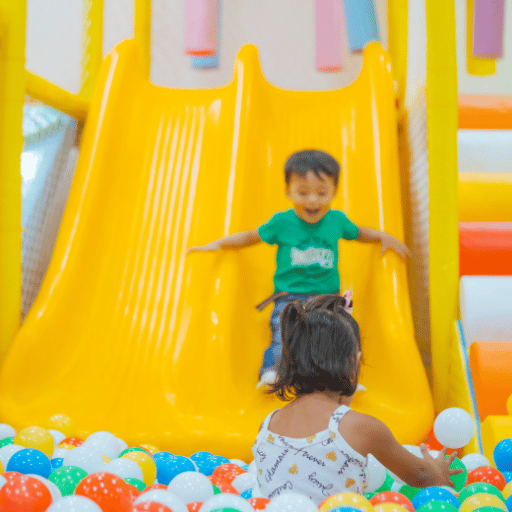
In terms of physical configuration, an indoor playground is a multi-level marvel. A mid-sized structure typically stacks two or three play decks that are linked by climbing walls, tube slides, padded ramps, and bridge elements, with a ball pit landing zone at one or two slide exits and a fenced-off toddler space at the lowest level. Operators source these as indoor playground equipment lines built for a site-specific design, with the central spine commonly derived from multi-level indoor play structures.
Two pragmatic implications flow here. First, the configuration represents significantly more vertical complexity than soft play, driving engineering, safety net specification, and fall-zone design (discussed in H2-6). Second, operating economics are distinct: larger footprint, bigger structure, higher admission fee, higher inspection requirement.
Age Targeting — Where the Two Diverge Most
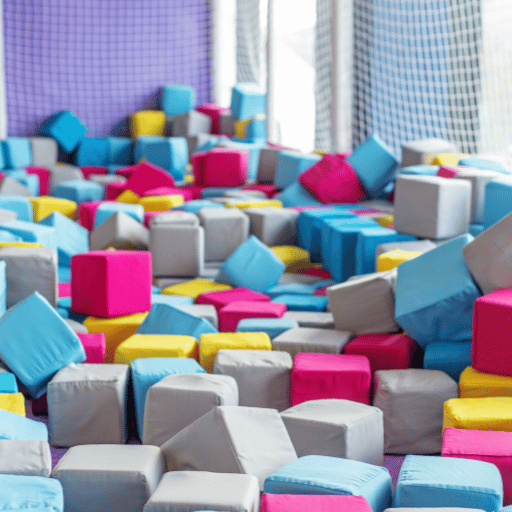
Age targeting is the variable most often under-targeted, because it sounds easy (“kids’ play, yes?”) and is not. Each type of facility overlaps the other across critically significant magnitudes, and overlap is the arena in which most planning misses arise. Below, a four-band comparison of both facility types, with primary and secondary suitability inferred from ASTM standards and industry consensus.
| Age Band | Soft Play Centre | Indoor Playground | Why It Matters |
|---|---|---|---|
| 0–2 yrs | PRIMARY | NOT A FIT | Pre-walking and unsteady walkers need full padding, no ladder rungs |
| 2–5 yrs | PRIMARY | SECONDARY (toddler zone only) | Toddler develops balance + early social skills via cooperative play |
| 5–8 yrs | SECONDARY | PRIMARY | Older kids need climbing complexity, height, physical activity |
| 8–12 yrs | NOT A FIT | PRIMARY | Tweens need vertical challenge — multi-level indoor jungle gyms hold their attention |
What age are soft play centres for?
Soft play centres are built for the 6 months through 5 years crowd. The padded environs of a soft play centre are designed for the age range with a window where a baby is learning gross motor – pulling up, walking, climbing, jumping etc – and when tumbles are frequent and should require little more than a Band-Aid. Some centres push the upper limit to 7, extending the softness with the addition of a small wall climber or ball-pit-and-slide conglomerate for the 5-7 crowd, but the structure gets too soft and the occupant too bored past that point. Children in the 0-2 band best benefit from soft play because foam-floored environs allow the toddler to indulge in the fun of crawling and pull-up balancing while imagining that of climbing while the dynamic if messy 0-3 space of a multi-level indoor playground can’t allow.
Which one is safer for toddlers?
For children under 5, a Soft Play centre is meaningfully safer than an indoor playground for one reason: the maximum fall height. ASTM F1918 regulates critical fall heights for low-impact soft dense play equipment with surface impact attenuation measured throughout the whole play environment. Indoor playground structures under ASTM F1487 can reach platform heights of over 8 feet, which is the ultimate height this regulation aims to cover. A toddler running a 7-foot-tall tube slide is doing an activity the regulation permits but did not optimise for – the structure was designed for the kiddies with the dexterity to use it.
Footprint, CapEx & Build Time — Side-by-Side Numbers
Economics creep seems to be the only thing that can be higher than say, a 13.5 foot tall ball pit. Equipment costs make up the lion’s share of the conversation and take a large chunk out of the establishment’s cash flows, but they’re one data point in a broader set. The total initial investment for either facility is the sum of equipment, initial retrofit, security deposit, business licence, marketing campaign and working capital. These statements derive from 2025 industry estimates for facilities designed around the leading age-by-dimension standards, with project execution by a manufacturer’s installation crew on factory EN price.
| Cost Line | Soft Play (small, ~1,600 sq ft) | Indoor PG (medium, ~3,800 sq ft) | Indoor PG (large, ~8,600 sq ft) |
|---|---|---|---|
| Equipment (EXW) | $18,000 | $43,750 | $108,000 |
| Renovation / fit-out | $5,000 | $10,000 | $25,000 |
| Rent deposit + prepay | $12,000 | $20,000 | $40,000 |
| Staffing + OPEX buffer | $5,000 | $8,000 | $10,000 |
| Marketing + licensing | $3,000 | $4,000 | $5,000 |
| Estimated total | ~$43,000 | ~$85,000 | ~$188,000 |
Source: 2025 supplier pricing per industry cost analysis. Pricing is EXW China supplier-side; landed and installed cost in the US, UK, and EU typically runs 2-3× this baseline once freight, customs duty, install labour, and impact-attenuating surfacing are added.
📐 Engineering Note
ASTM F1487-21 fall-zone criteria impose a 6-foot safe use zone around high platform structures (above 30 inches). On a 3,000 sq ft footprint with a multi-level indoor playground, this results in 18% of the total voided space being impact-attenuated safety zone instead of active play area. Soft play centres get this overhead for free because almost their entire room is a safe use zone- the entire place is a safe use zone.
Safety, Risks & Compliance — ASTM F1918 vs F1487 (and EN 1176)
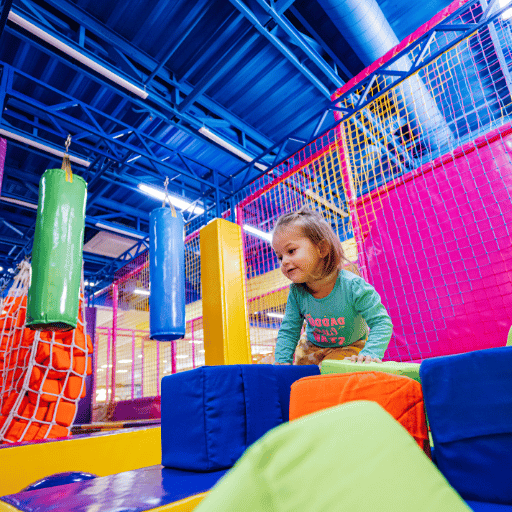
Safety standards drive the largest insurance check operators sign, so this is where ambiguity is most expensive. Two ASTM standards cover the vast majority of commercial indoor playground and other play equipment in the US and Canada, and they apply to different things.
| Standard | Scope | Key Requirements |
|---|---|---|
| ASTM F1918-21 | Soft Contained Play Equipment | Padded surfaces throughout; impact attenuation tested across the entire play area; age range typically 6 mo–12 yr but optimised for under 5 |
| ASTM F1487-21 | Public-Use Playground Equipment | Critical fall heights specified by equipment type; protective surfacing required when fall height exceeds 18 in; age groups 2–5 (preschool) and 5–12 (school-age) |
| ASTM F1148 | Home Playground Equipment | Residential-only; not applicable to commercial venues |
| EN 1176 / EN 1177 | European playground + impact surfacing | Required for export to EU/UK markets; impact attenuation expressed as HIC and gmax under EN 1177 |
What are the risks in soft play areas?
The nine risk sources that show up overwhelmingly more in soft contained play (CPSC and ASTM data): first, hygiene – ball pits and padded play zones penetrate body fluids which require proven cleaning procedures (1-minute wipe each day, deep-clean weekly); second, age-mixing – when a late 2 / early 3-year old puffs about in a soft play pod designed for under- 2s, the heavier, speedier user can tump over the toddler, and nearly every incident tells us age-mixing is usually the proximate cause of toddler injuries; third, supervision gaps – the parent who finds the venue ‘totally safe’ watches less attentively and collisions between children spike.
For indoor playgrounds, the risk picture changes: equipment is taller, children older and speedier, and the risk of falling from a platform becomes the foremost concern. Per the CPSC Public Playground Safety Handbook (2025), “Equipment having a fall height of 18 inches or less is not required to have protective surfacing; however, no equipment should be placed over concrete, asphalt, stone, or other hard surfaces.” That 18-inch fall height — drawn from the CPSC Public Playground Safety Handbook (2025) — is the key: a soft zone operates underneath it almost everywhere; an indoor playground operates well above it on most platforms and slide exits.
How “Critical Height” occurs (“The fall height below which a life-threatening head injury would not be expected to occur”) influences every flooring and platform decision.
Operators exporting abroad should seek to verify their equipment bears an IPEMA certification mark, which offers third-party verification of meeting standards and is increasingly specified in commercial venue lease covenants and insurance policies.
Equipment & Components — Bill of Materials Compared
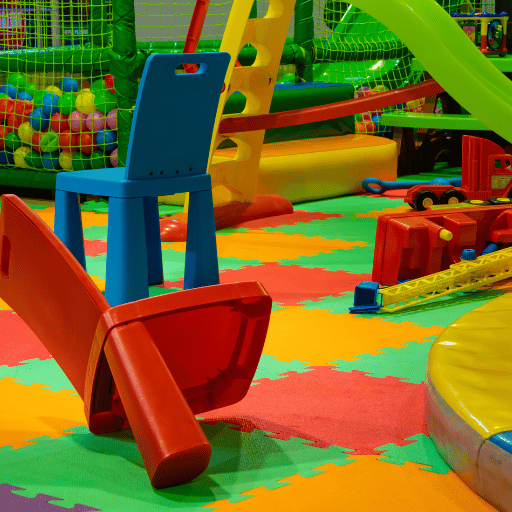
What is inside each is not just a matter of size; soft contained areas tend to have a different range of materials, a different turn-over time, and a different maintenance schedule than indoor areas. Operators framing procurement RFPs need to specify a parts list; not just features.
| Component | Soft Play | Indoor Playground |
|---|---|---|
| Frame | Low-rise wood or steel; padded throughout | Galvanised steel multi-level frame, structural inspection required annually |
| Soft surfaces | EVA foam blocks, vinyl-coated fabric, ball pits, soft slides | EVA flooring at fall zones; tube slides; rope bridges; ball-pit landing pad |
| Climbing elements | Soft climbing blocks, low-rise stairs — see soft play climbing equipment | Climbing nets, cargo netting, vertical climbers, rope tubes |
| Themed pieces | Foam sculptures, themed cushion blocks, sensory walls | Themed slides, interactive panels, projection games, LED slides |
| Typical lifespan | 5–7 years with annual fabric refresh | 10–12 years structural; nets / soft components replaced every 3–5 years |
| Maintenance cycle | Daily cleaning; weekly deep clean; quarterly fabric inspection | Daily cleaning; monthly structural check; annual professional inspection |
Tied most directly to the risk profile, is the cleaning cycle- the line toward which operators most often tend to underestimate budget. The operating protocols for a soft play centre with a ball pit are pretty much the same as any childcare facility: documented daily cleaning with deep-clean weekly. A comparable indoor playground needs more people-hours but covers a smaller proportion of total surface area, because most platforms are hard plastic and simple to wipe clean.
Revenue Model — How Each Makes Money

From the operator’s perspective, the biggest difference in revenue mix is the ratio of admission to food & beverage to party packages. This outcome is only learned by iteration because facility is ultimately determined by the age-bands, dwell-time, and captiveness of the adult customer.
Industry data from UK soft play operators break out this way: c40-50% from F&B, 25-30% from pay-and-play admission, 25-30% from birthday parties. F&B is the single largest line. The justification is dwell time. A parent watching a 3 year old in a padded soft play centre stays for 90-120 minutes per visit and in that window they buy coffee and lunch, snacks, and often a second cup when their charge refuses to leave the premises. Play admission in this model is fundamentally the acquisition cost of the F&B customer.
Conversely, indoor playgrounds invert this. The single largest line item is play admission, accounting for 50-60% of revenue, both parties at 20-25% and F&B between 15-25% depending on whether the operator includes a meaningful café offer, with children aged 5-12 stay for 60-90 minutes of high-energy play and adults less captive (twice the age, half the energy and more independent). Party rooms become a significant profit centre because all other things being equal birthday packages sell at $250-$500 per booking with at least a high-offpeak weekend booking rate.
“Whilst percentages will vary from centre to centre, broadly, 40–50% of revenue comes from the refreshments, 25–30% comes from each of pay and play and parties.”
Break-even timing follows a similar pattern. Industry benchmarks for mid-size indoor playgrounds (~3,800 sq ft) report a 6-12 month payback in well-located, high-traffic venues; soft play centres in this size class can break even in 8-14 months when F&B is well executed. Larger formats with CapEx over $800k report break-even timeframes of 30-38 months in published financial models. The lesson for the operator is uncomfortable: the size of the project matters less than the F&B execution.
Venue Fit — Mall, FEC, Hotel, Kindergarten, Restaurant
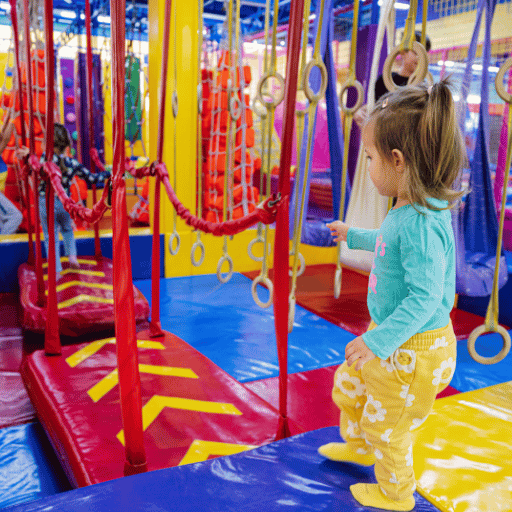
A single host venue can succeed wildly in one environment and fall on its face in another. The below matrix maps five common host venues to the recommended facility type, with supporting rationale and maximum recommended footprint.
| Venue | Recommended | Footprint Guidance | Why |
|---|---|---|---|
| Shopping mall (anchor) | Indoor playground | 4,000–8,000 sq ft | High foot traffic; 5–12 age band aligns with school-age mall visitor base |
| Family entertainment centre | Indoor playground (+ soft play zone) | 5,000–10,000 sq ft | Hybrid model captures full age range; trampoline + soft play attach common since 2023 |
| Restaurant / hotel | Soft play centre | 800–2,000 sq ft | F&B is already the host’s revenue engine; soft play extends dwell time without adding kitchen complexity |
| Kindergarten / daycare | Soft play centre | 600–1,500 sq ft | Age band matches; ASTM F1918 compliance maps to most preschool licensing requirements |
| Standalone (community) | Either, depends on weekday plan | 2,500–6,000 sq ft | Hardest economics — needs strong weekday pre-school program OR weekend party throughput |
Operators considering venues for a specific industry vertical can review indoor playground equipment by industry vertical and the dedicated pages for hotel and restaurant playground installations, which detail the floor plan, footprint and revenue plan by venue category.
Decision Framework — A Five-Question Filter
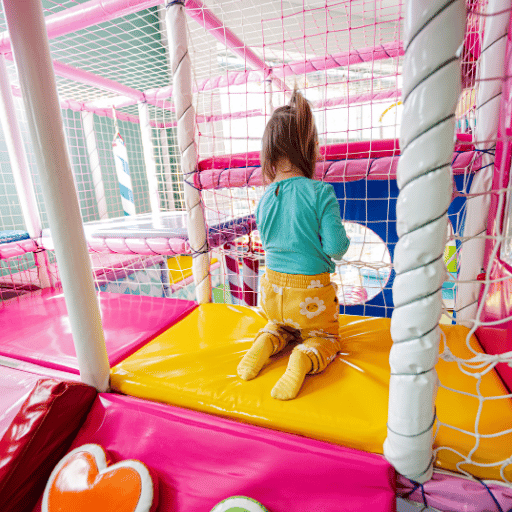
To get to a definitive answer fastest, run five questions in order, stop at the first which yields a definitive response, and escalate to a hybrid only when the initial binary is genuinely conclusive.
The 5-Question Decision Filter
- Audience? Café / hotel / kindergarten → soft play centre. Mall / FEC / stand-alone → indoor playground.
- Footprint — below 2,000 sq ft → soft play; above 4,000 sq ft → indoor playground; in the intervening range, move on to question 3.
- Source of revenue — F&B is your engine → soft play. Admissions + parties → indoor playground.
- Dominant age in catchment — under 5 → soft play; 5–12 → indoor playground; mixed with strong toddler share → hybrid.
- CapEx you can deploy? $40–90k → soft play (small). $85–200k → indoor playground (medium-to-large). Below $40k → reconsider scope.
The 60/40 Rule for 2026 Operator Decisions: approximately 60% of operators evaluating in 2026 should consider a hybrid format — soft play zone built into an indoor playground, or indoor playground zone integrated into a café-attached soft play centre — as category convergence (FEC consolidation, café-attach expansion, adult-specific variants) makes specialty-play harder to sustain. The remaining 40% should commit to a single format because their catchment area or venue context is unambiguous.
2026 Industry Outlook — Where the Category Is Going

North America’s indoor amusement centre market is expected to grow at a 10.3% CAGR from 2026 through 2033 according to Grandview Research, while the broader global Family/Indoor Entertainment Centers sector is forecast to grow from US$31.25B in 2024 to US$68.76B by 2030 at a 14.3% CAGR. Four trends are reshaping how operators should plan in 2026:
Café-attached soft play is the fastest-growing format. Play industry consultants equating the domain through 2026 observe that F&B venues with integrated soft play areas outperform freestanding play centres on per-square-foot revenue, the reason being that the F&B holds the parent’s money for the whole duration of the visit.
This note on F&B revenue share further confirms the venue-fit advice for hotels and hospitality restaurants.
Adult-inclusive concepts are emerging from a prolonged long tail of search demand. Google Trends shows consistent searches on a 3,600/month average for “indoor playgrounds for adults” with countless long-tail variants (“adult soft play centre”, “adult soft play area near me”) forming a discoverable cluster. While there isn’t at present one or more commercial pilot deployments to analyze, operators with under-capacity on weekdays (Tuesday-Thursday mornings, the dead zones for kids) ought to appraise adult evening soft play sessions as a marginal revenue category.
FEC consolidation is becoming the default in mall-anchor formats. Standalone “indoor playground only” or “trampoline only” venues are losing share to multi-format FECs that bundle three or four attractions under one ticket. For 2026 operators planning a venue larger than 6,000 sq ft, the strategic question is no longer “soft play or indoor playground” but “what hybrid mix maximises shoulder-day utilisation.” Themed indoor playground design within these hybrids — see indoor playground themes and custom design — has become a differentiator that helps the venue avoid commodity competition.
Standards are stable through 2026. ASTM F1487 and F1918 are both at their 2021 revisions with no announced 2026 amendments. The 2025 CPSC handbook revision consolidates existing content without proposing new requirements. Operators planning a build cycle into 2026 can proceed with confidence: equipment specified to current standards will not require re-certification mid-project.
Frequently Asked Questions
Q: What age are soft play centres for?
View Answer
Soft play centres are built primarily for children from 6 months through 5 years of age. Some extend to 7 with additional climbing elements for older toddlers, but past age 7 most children find the padded environment too tame. The 0–2 age band benefits most because every surface protects pre-walking exploration.
Q: What are the three types of playgrounds?
View Answer
Commercial play falls into three categories: (1) traditional outdoor playgrounds covered by ASTM F1487, weather-exposed equipment for ages 2–12; (2) indoor playgrounds — climate-controlled multi-level structures under the same ASTM F1487 standard; (3) soft contained play areas under ASTM F1918, padded throughout for under-5s. A fourth, ASTM F1148, covers home playgrounds and does not apply to commercial venues.
Q: Are indoor playgrounds profitable for restaurants and hotels?
View Answer
For all food and beverage led venues—which is all restaurants and hotels—a soft play is a more lucrative proposition than a full internal play. F and B is all ready the host venue’s profit machine and a soft play simply encourages a longer stay without increasing the number of trips in and out of the kitchen. The amortisation of an 800–1500sq ft soft play will usually be returned through an uplift in F and B within 12–18 months.
Q: Can I run a soft play centre AND an indoor playground in the same space?
View Answer
Yes, and this is also tending to become the standard for venues over 4,000 sq ft. by using a hybrid model, where a soft play area is provided for under-5s next to a multi level indoor playground for older children, providing for the whole age range on one ticket. Both areas will need to meet their own standards (ASTM respectively) and be signposted appropriately.
Q: Which is safer overall — soft play centre or indoor playground?
View Answer
For under-5s, a soft play centre is meaningfully safer because every surface is padded and fall heights stay below 18 inches — the threshold the CPSC handbook identifies as no-protective-surfacing-required. For 5–12 year-olds, an ASTM F1487 indoor playground is appropriate and safe; protective surfacing handles the higher fall heights. The wrong fit is the actual risk driver — a 3-year-old on a 7-foot tube slide, or an 8-year-old throwing weight around in a soft play zone.
Planning a Venue? Match the Format to the Numbers.
Didi Land manufactures both ASTM-compliant indoor playgrounds and soft play centres for operators in 40+ countries. Talk through your footprint, age catchment, and venue plan with our project team.
About This Comparison Guide
The Didi Land engineering team prepared this soft play centre vs indoor playground report drawing on twelve years of dual ASTM/EN compliant manufacturing across 40+ export markets. Cost data reflects 2025 supplier pricing benchmarks; standards references are current as of the 2021 ASTM revisions and the 2025 CPSC handbook update. Operators planning a project can use the layout fit calculator and the indoor playground ROI payback calculator linked below as a starting point for site-specific numbers.
References & Sources
- Public Playground Safety Handbook (2025 edition) — U.S. Consumer Product Safety Commission
- ASTM F1487-21 Standard Consumer Safety Performance Specification for Playground Equipment for Public Use — ASTM International
- ASTM F1918-21 Standard Safety Performance Specification for Soft Contained Play Equipment — ASTM International
- ASTM Playground Standards Overview — American National Standards Institute (ANSI)
- North America Indoor Amusement Center Market Outlook 2026–2033 — Grandview Research
![Custom Dinosaur Playground Equipment [Design Guide]](https://didiplayarea.com/wp-content/uploads/2026/09/custom-dinosaur-playground-equipment-r2-featured-1-768x512.png)

![Custom Dinosaur Playground Equipment [Design Guide]](https://didiplayarea.com/wp-content/uploads/2026/09/custom-dinosaur-playground-equipment-r2-featured-1-150x150.png)