Get in Touch with Didi Land

Indoor Playground Equipment: 2026 Spec & Cert Audit Guide

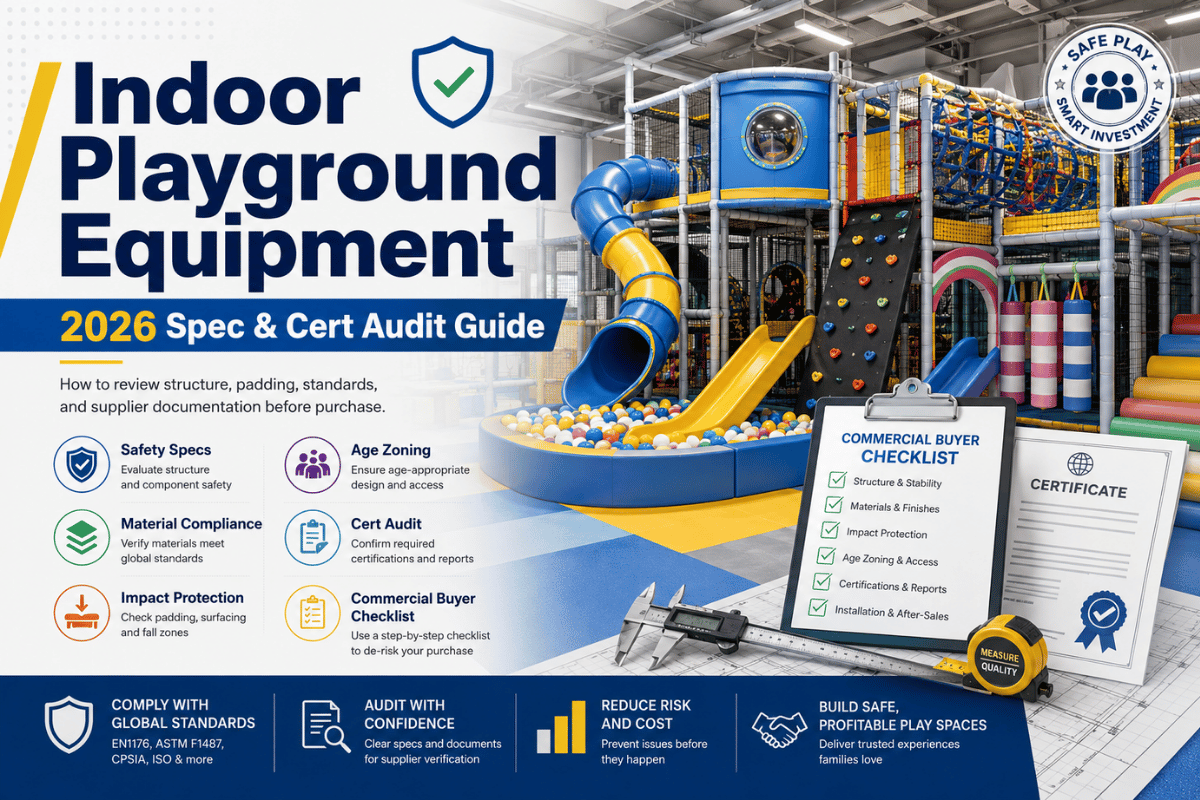
Purchasing indoor playground equipment is not even a furniture purchase. It is a five- to seven-figure capital decision that runs for ten years, has to be inspected by code officials, and lives or dies on the mill certificates that no one reads. A commercial indoor playground equipment order that pencils out at $90,000 FOB China can land closer to $135,000 once duty, install supervision, and year-one wear items hit the books. Operators who walk away whole are the ones who treat this like procurement engineering, not catalog shopping. This guide shows you the operator’s audit framework: a 7-number mill cert checklist, the EN 1176 vs ASTM F1487 vs AS 4685 standard decoder, a 6-line hidden-cost decoder, an 8-facility equipment mix matrix, a 10-year total-cost-of-ownership map, and the 8 factory red flags that predict an 18-month failure. Every framework in here is named, numbered, and built to be challenged across the quote table.
Quick Specs Card — What Commercial Indoor Playground Equipment Actually Means in 2026
- Steel: 48 mm 2.0-2.5 mm wall hot-galvanized (residential is ³0-³8 mm 1.2-1.5 mm)
- Soft cover EVA foam: 60-80 kg/m density commercial floor (residential drifts 30-50 kg/m)
- PVC fabric: 1100 GSM / 1000 Denier (residential 600-800 GSM)
- Fasteners: 8.8 grade or higher, anti-loosening washers
- Fire rating: EN 13501-1 Class B-s1,d0 (low smoke / no flaming drops)
- Ball pit migration: EN 71-3 compliant heavy metals limits
How this guide expects to rank: the top 10 results for “indoor playground equipment” are 100% commercial product and distributor pages — zero blog content. This article is supporting material for the indoor playground equipment manufacturer pillar and is built to win long-tail technical queries (“mill cert audit”, “EN 1176 vs ASTM F1487”, “factory red flags”), AI-engine citation, and topical authority — not to displace product pages on the head term.
What “Indoor Playground Equipment” Really Means in 2026 (Commercial Definition, Not Costway)
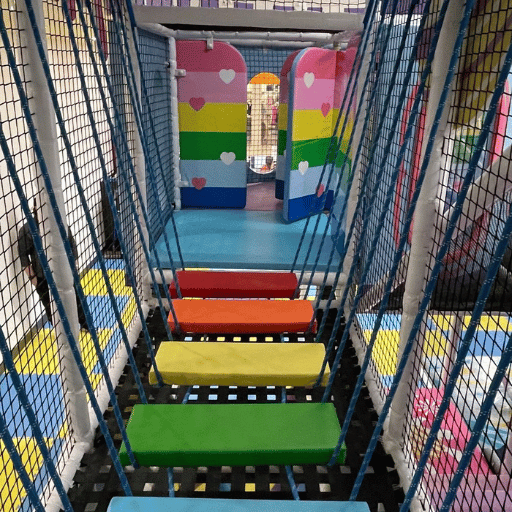
The phrase indoor playground equipment covers everything from a $300 Costway home jungle gym to a $360,000 turnkey 8,000 m family entertainment center attraction. Commercial-grade equipment is built around three non-negotiables that residential products miss out: year-round duty cycle, customizable configurations sized to the venue, and certified materials sized to the public accessibility traffic loads. Under the US Consumer Product Safety Commission, public playground equipment exists in a very different regulatory universe than “home playground equipment intended for indoor use” – which the CPSC categorizes as a children’s toy, not a public play structure (CPSC FAQ).
In practice, the commercial indoor floor is not a logo on a brochure. It is a specification you can verify with a caliper, a scale, and a fire-rating PDF. Side by side, the two grades break down so buyers can disqualify residential SKUs that get re-listed as “commercial” on B2B marketplaces.
| Spec dimension | Commercial floor (2026) | Residential ceiling |
|---|---|---|
| Steel pipe OD × wall | Ø48 mm × 2.0–2.5 mm | Ø30–38 mm × 1.2–1.5 mm |
| EVA foam density | 60–80 kg/m³ | 30–50 kg/m³ |
| PVC coated fabric | 1100 GSM / 1000 Denier | 600–800 GSM |
| Fastener grade | ISO 8.8 with anti-loosening | Generic zinc, no grade stamp |
| Fire rating | EN 13501-1 B-s1,d0 | Typically untested |
| Daily duty cycle | 250–750 children/day, year-round | Family-only, intermittent |
| Modular customization | Fully customizable in 0.5 m increments | Fixed SKUs only |
If a quote does not specify a steel wall in millimeters, or an EVA density in kg/m, the seller is hiding the floor. That is the first audit flag. Below, the 7-Number Mill Cert Audit turns this into a fixed checklist your purchasing team can run against any PDF the factory presents.
Material Spec Audit — 7 Numbers Buyers Must Verify in Mill Certificates (The 7-Number Mill Cert Audit)
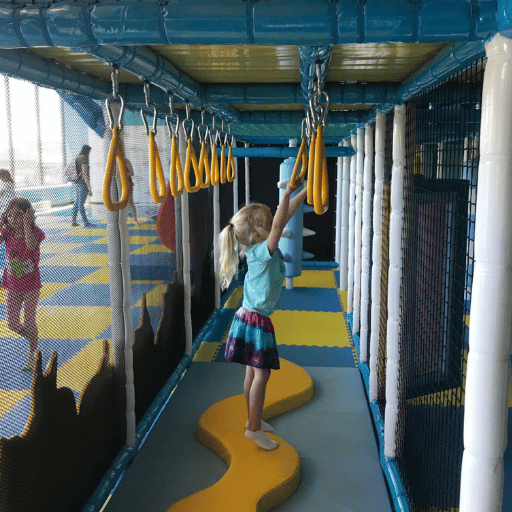
Most Chinese commercial indoor playground equipment manufacturers will email a mill test certificate on demand. A certificate is not the audit – the seven numbers on it are. Operators who lock these dimensions down on paper before the deposit wire stop the most common 18-month failure mode: post-deposit spec drift, where the 2.0 mm wall pipe quoted at FOB shows up at install as 1.6 mm because no one verified the cert PDF against the actual delivery.
Built from the spec floor that EN 13501-1, EN 71-3, and ASTM F1918 each anchor, the 7-Number Mill Cert Audit is intrinsically brand-neutral. We pilfered it from the cert stack our engineering team in Guangzhou dispatches with every Didi Land container, but this construct is brand-neutral:
| # | Spec number to verify | Commercial floor | Verification method (no lab needed) |
|---|---|---|---|
| 1 | Steel pipe OD × wall (mm) | Ø48 × 2.0–2.5 | Digital caliper across the cut edge; cross-check 3 random pipes per pallet |
| 2 | EVA foam density (kg/m³) | 60–80 floor; 100–150 high-traffic | Cut a 10 cm cube, weigh in grams ÷ 1000; cert PDF must state density not “premium grade” |
| 3 | PVC fabric weight (GSM) | ≥ 1100 GSM, 1000 Denier | Manufacturer batch number on cert + per-roll test report; refuse “marketing weight” |
| 4 | Fastener grade (ISO 898-1) | 8.8 grade or higher, head stamp visible | Look at the bolt head — the digits “8.8” should be embossed; no stamp = no grade |
| 5 | Fire rating (EN 13501-1) | Class B-s1,d0 minimum | Demand the lab test report number; cross-check with the testing body’s database |
| 6 | Heavy-metal migration (EN 71-3) | Pb < 90 ppm, Cd < 75 ppm, Hg < 60 ppm | Lab spec sheet for ball pit balls and PVC coating; demand batch traceability |
| 7 | Galvanizing thickness (µm) | ≥ 60 µm hot-dip zinc | Magnetic thickness gauge ($40 tool); scrape one pipe at random |
💡 Pro Tip — 3 verification techniques without a lab:
- Caliper sweep: Take a digital caliper to install day and measure 3 random pipes per pallet. For a Ø48 mm OD pipe with a claimed 2.0 mm wall, the caliper should read ID 44.0 mm ± 0.2; if you get 44.8 mm, the wall is actually 1.6 mm.
- Cube weight: Cut a 10 cm (4 in.) cube of soft-cover EVA, weigh it. At 60 kg (132 lb.) per meter, the cube should weigh 60 g (2.1 oz). Skipped this and got 38 g (1.3 oz.)? You buy residential foam.
- Batch traceback: Every commercial-grade spec cert lists a batch number. Ask for two pieces from different batches and check the numbers match the factory log.
📐 Engineering Note — Steel wall caliper procedure: Place the caliper jaws across the cut end of the pipe at the 12 o’clock and 6 o’clock positions, then 3 o’clock and 9 o’clock. Average the two readings to defeat oval deformation. Wall thickness = (OD − ID) / 2. A 2.0 mm wall Ø48 mm pipe should yield ID 44.0 mm. Any pipe reading ID > 44.5 mm at any axis fails the cert.
The 7-Number audit is a fixed-list verification construct – the most valuable is the kind your operations manager can run in twenty minutes at the loading dock. It doesn’t replace third-party certification; it prevents your supplier from sending a different SKU than the one you paid for. Commercial-grade is a build-to specification, not a marketing word.
Safety Certification Deep Dive — What EN 1176, ASTM F1487, and AS 4685 Actually Test
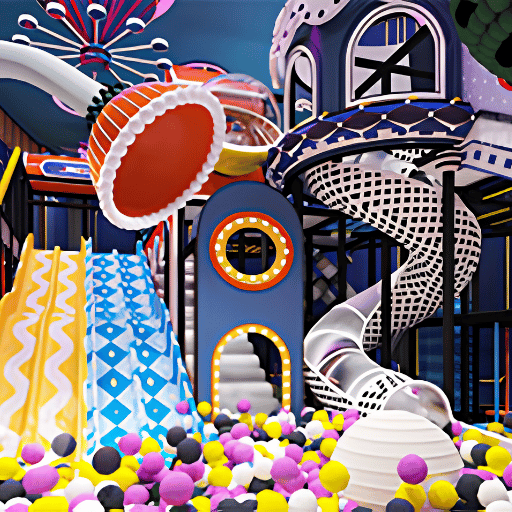
The certification landscape changed substantially in 2025. ASTM F1487-25 – the revised consumer safety performance spec for public-use playground equipment – was published by ASTM International in June 2025, omitting the F1487-21 edition that most current buyer guides still reference. The standard is available from ASTM (store.astm.org/f1487-25.html; the industry coverage of the revision is succinctly encapsulated in the SGS testing body’s bulletin (SGS, June 2025.)The CPSC issued the first significant update to its Public Playground Safety Handbook in fifteen years in July 2025 (CPSC 2025 Handbook). And unnoticed, EN 1176-10:2023 Fully Enclosed Play Equipment – the dedicated EN subpart for indoor enclosed installations – was issued in 2023 but very few make it into supplier documents. If your supplier cites “EN 1176” without referencing a part and a year, they are referencing a pre-2023 document.
| Standard | Region enforced | Scope | Latest edition | Common fail mode |
|---|---|---|---|---|
| EN 1176-1:2018+A1:2024 | EU, EEA | General safety standards + test methods for public play equipment | 2024 amendment to 2017 base | Free-fall height > 3 m without impact-attenuating surface |
| EN 1176-10:2023 | EU, EEA | Fully enclosed indoor play equipment (the indoor-specific subpart) | 2023 (new) | Entrapment dimensions inside enclosed tunnels |
| ASTM F1487-25 | U.S. (CPSC-referenced) | Consumer safety performance specification for public-use playground equipment | June 2025 revision | Impact attenuation HIC > 1000 on surfacing |
| AS 4685.1:2021 | Australia, NZ | Playground equipment and surfacing — MOD of EN 1176-1:2017 | 2021 (current) | Cordage entanglement gaps 5–25 mm |
| ASTM F1918 | U.S. (commercial soft contained play) | Soft contained play structures — the U.S. analog to EN 1176-10 | Periodic revision | Foam migration outside contained zone |
📐 Engineering Note — CE marking is not EN 1176. The CPSC primary source is unambiguous: “There is no specific certification requirement for playground equipment” at the U.S. federal level (CPSC business guidance). State-level contracts — Maine’s DAFS spec, for example, requires “playground equipment according to ASTM F1487” — impose the standard at the procurement layer (Maine state spec PDF). In the EU, the CE conformity declaration covers a directive family; EN 1176 testing is a separate, voluntary process that requires a third-party test report. Suppliers offering a CE certificate without an EN 1176 test report number are selling you a declaration, not a safety test result.
What is the difference between EN 1176 and ASTM F1487?
EN 1176-1 sets general safety metrics and test protocols for public play gear across the European Union and EEA; the 2018 standard was modified in 2024 (EN 1176-1:2018+A1:2024). ASTM F1487-25, issued June 2025, is the U.S. consumer safety performance standard adopted by the CPSC and used in state and municipal contracts. These two standards share ground on impact attenuation, entrapment, and free-fall height but employ different test geometries and load mass variables. EN uses a 50 kg torso form; ASTM uses a similar but non-identical anthropometric mass. A product certified to one is not automatically compliant with the other — buyers working across EU and U.S. markets should demand both test reports, not a marketing posture that one substitutes for the other.
Equipment Mix Decision Matrix — 8 Venue Scenarios from $5K to $500K (The 8-Venue Equipment Mix Decision Matrix)
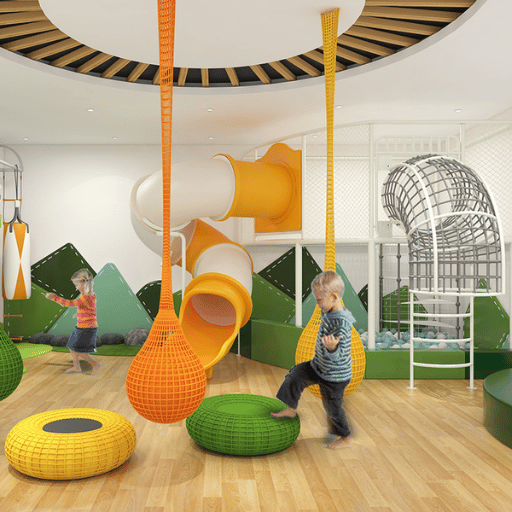
An indoor playground equipment investment tier depends on the typology of the venue, not the catalog. Even a 30 m hotel kids corner requires different equipment, certs, and lead times than a 1,500 m mixed-use flagship. Below, the 8-Venue Decision Matrix outlines the realistic operator scenarios our team has quoted across 40+ countries, mapping to an actionable equipment mix, cert demand, lead time, and a year-one wear-item budget.
| Venue scenario | Recommended mix | Equipment $ (USD) | Lead time | Cert required | Wear-item Y1 budget |
|---|---|---|---|---|---|
| Hotel kids corner 30 m² | Toddler soft play + 1 climber + ball pit pocket | $5,000–$8,000 | 30 days | EN 71-3, EN 13501-1 | $500 (ball replenish) |
| Restaurant play area 50 m² | Modular soft play + 1 slide + 1 indoor jungle gym | $8,000–$15,000 | 35 days | EN 1176-10:2023, EN 71-3 | $700 (foam covers) |
| Daycare 80 m² | Toddler + themed soft play + sensory wall | $15,000–$25,000 | 40 days | EN 1176-10, ASTM F1918, EN 71-3 | $1,200 |
| Kindergarten 200 m² | 2-level climber + playhouse + soft play island | $25,000–$50,000 | 45 days | EN 1176-1+A1:2024, EN 1176-10:2023 | $2,500 |
| Mid-FEC 300 m² | 3-level indoor play structures + ball pit pool + soft obstacle course | $50,000–$120,000 | 50 days | EN 1176-10:2023, ASTM F1487-25, ASTM F1918 | $5,000 |
| Large FEC 600 m² | 5-level structure + slide tower + trampoline pocket + climbing wall | $120,000–$250,000 | 55 days | Full EN/ASTM stack + EN 13501-1 | $9,000 |
| Flagship 1,000 m² | Multi-zone customize: imaginative theme + role-play + sports zone | $250,000–$400,000 | 60 days | Full stack + bespoke fire engineering | $14,000 |
| Mixed-use 1,500 m²+ | Bespoke 8-zone family entertainment center with branded IP overlay | $400,000–$500,000+ | 75 days | Full stack + ADA + insurance review | $20,000+ |
The single biggest mistake employers make on this matrix: cut the cert demand down to reflect a smaller budget. Even a 30 m hotel kids corner is subject to the same EN 71-3 heavy-metal migration limits as the 1,500 m flagship — they just have a different investment band. An indoor toddler ball pit in a $5,000 hotel install fails inspection the same way it would in a $400,000 flagship — just with smaller numbers.
For employers who want to skip the spreadsheet, see our indoor jungle gym structures, indoor playground slides, indoor play structures modular soft play, and toddler indoor playground product lines.
Try the Equipment Selector tool →
For an enterprise-grade commercial indoor playground equipment decision matrix, our pillar page expands on this with a full-stack indoor playground equipment for sale catalog filter.
Hidden Cost Decoder — 6 Line Items Buyers Always Miss (The 6-Item Hidden Cost Decoder)
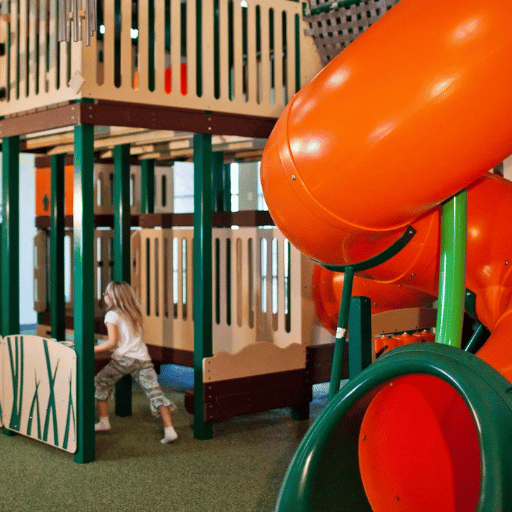
The headline equipment price isn’t necessarily the entire invoice. Based on the deals our team has executed, the all-in cost is 30-60% over the FOB equipment quote. Below, the 6-Item Hidden Cost Decoder provides a condition-to-recommendation framework that lets operators forecast the extra spend before they wire the deposit.
| # | Hidden cost line | USD range | When billed | How to negotiate |
|---|---|---|---|---|
| 1 | DDP customs & duty (region-dependent) | $4,000–$12,000 per 40 ft container | At port arrival, before release | Lock DDP terms upfront; demand harmonized code declaration |
| 2 | Spare parts 24-month policy hold | $1,500–$6,000 reserve fund | Year 1–2 wear cycles | Negotiate written pricing hold; include in PO not afterwards |
| 3 | English-speaking install supervisor | $200–$500/day × 7–14 days | Per install milestone | Demand quote line item; refuse “we will send someone” |
| 4 | Electrical add-ons (interactive zones) | $2,500–$15,000 | Pre-install site prep | Get electrical schematic from supplier 30 days pre-arrival |
| 5 | Freight surcharges (region-specific) | $800–$3,000 above base ocean freight | Booking confirmation | Track BAF/CAF/PSS surcharges; book Q1 not Q4 |
| 6 | Install crew labor (local-rate) | $3,000–$18,000 (size-dependent) | During installation | Request itemized labor breakdown by trade |
Industry operators often report that DDP customs charges can double the FOB invoice on unprepared shipments — verbally agreed upon spare parts pricing disappears by year 2 unless written into the PO. Trade-press operator buying guides published in Athletic Business and Recreation Management make the same point: understanding indoor playground equipment cost components on the front end fosters predictable project outcomes and underscoping maintenance and replacement parts up front is the leading mistake in public recreation centers (Athletic Business).
Transparency note — we publish DDP bands by region. Our team holds DDP pricing bands by destination region (North America $4–7K, EU $6–9K, Middle East $8–12K, Latin America $5–8K per 40 ft) so operators can pre-budget. If a supplier refuses to commit a DDP range in writing during the quote phase, treat that as Red Flag #4 in the next section.
For employers considering financing and post-install operations, our indoor playground equipment quote page expands on this with payment terms (30% deposit / 70% pre-shipment via T/T, L/C, or Alibaba Trade Assurance) linked to milestone delivery photos.
Total Cost of Ownership — 10-Year Lifecycle by Component (The 10-Year TCO Lifecycle Components Map)
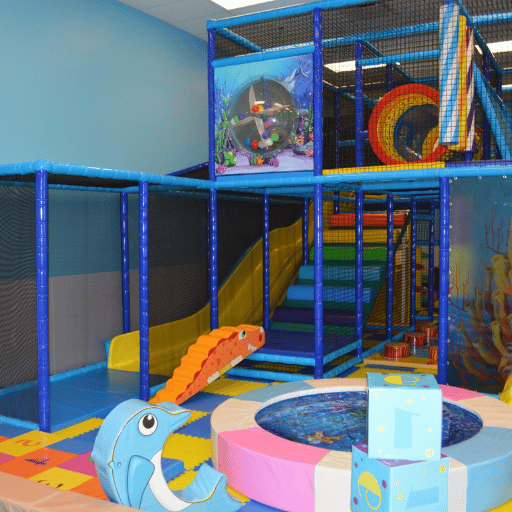
An indoor playground business that gets the 10-year TCO right avoids the capex shock most FEC operators experience between year 3 and year 5. Built around the year-round, high-traffic duty cycle that commercial venues carry, the 10-Year TCO Lifecycle Components Map breaks down the asset by component, replacement interval, and annual maintenance budget formula — based around the year-round, high-traffic duty cycle that commercial venues carry.
| Component | Service life | Replacement cost band | Annual maintenance formula | Notes |
|---|---|---|---|---|
| Hot-galvanized steel frame | 8–12 years | 40–55% of original FOB | 2% of asset value / yr | Durability assumes EN 13501-1 fire rating maintained |
| EVA + PVC soft cover | 36–60 months | $15–$45 per m² replaced | 8% of cover value / yr | Accelerates above 500 children/day duty cycle |
| Wear items (climb grips, ropes, sliders) | 12–24 months | $300–$1,800 per zone | 15% of wear-item bucket / yr | Driven by motor skills use pattern intensity |
| Fasteners (8.8 grade) | Annual torque check | $0.30–$1.20 per fastener | $200–$600 / yr labor | Schedule pre-peak season inspection |
| Ball pit balls (EN 71-3) | 24 months | $0.18–$0.42 each × pool volume | 50% pool replenish / yr | Lost ball rate proportional to entry point count |
📐 Engineering Note — Annual fastener torque check procedure: Walk the install with a torque wrench set to the spec sheet’s documented torque value (typically 22–28 Nm for 8.8 grade M8). Re-torque any fastener that turns more than 30° on the wrench. Schedule the check pre-peak season (early Q2 for U.S. summer venues; late Q3 for Asian winter venues). Operators who skip this inspection have a 3× higher fastener loosening incident rate by year 4 — the leading wear failure mode after soft-cover wear.
For more detailed field protocols, see our indoor playground maintenance guide for operators sister article that walks through the weekly, monthly, and annual inspection cycle in checklist format including warranty coordination procedures when wear exceeds expectation.
Factory Audit Red Flags — 8 Signals That Predict 18-Month Failures (The 8-Signal Factory Audit Red Flag Framework)
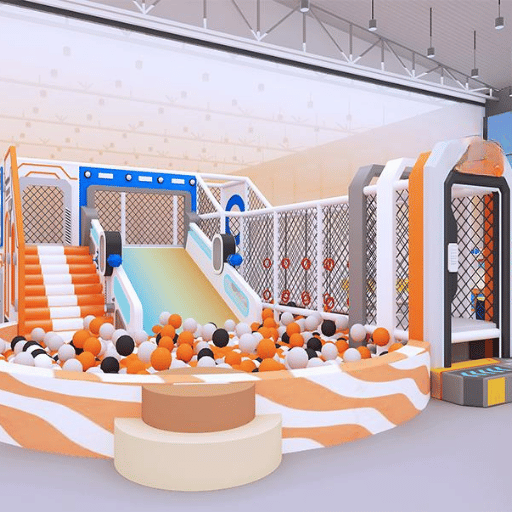
Auditing a Chinese commercial playground supply remotely is a video-and-document exercise. Below, the 8-Signal Factory Audit Red Flag Framework maps scenario-to-criterion built from the failure modes our team and our peers have encountered during hundreds of evaluations of suppliers. Industry practitioners reliably report that the failure mode itself tends to manifest around 18 months into the warranty – after which the supplier has already moved on to their next account.
| # | Red flag signal | Why it predicts failure | Audit ask |
|---|---|---|---|
| 1 | No downloadable mill cert PDF on first request | Reputable factory keeps PDFs at hand — reluctance signals fabrication | Email request — should arrive in 24h |
| 2 | “ASTM-certified” claim with no test report number | Certificate without traceable number is decoration not quality and safety evidence | Demand lab report ID + testing body |
| 3 | No English-language maintenance manual sample | Indicates first export deal — expect knowledge gaps in post-sale support | Request manual PDF sample pre-deposit |
| 4 | Spare-parts pricing not held in writing | Year-2 cost surprise locked in unless committed pre-deposit | PO line item for 24-month pricing hold |
| 5 | “We use the same spec as XYZ” with no own spec sheet | Spec mimicry signals no in-house engineering — supplier is broker | Demand factory-issued cert with own logo |
| 6 | Single email contact line, no WhatsApp/Mandarin desk | Indicates single-person operation — risk of communication blackout | Request 2 named contacts + voice channel |
| 7 | No production photos at 50% / 90% milestones | No production transparency = no QC checkpoint visibility | Make milestone photo a PO release condition |
| 8 | No English-speaking installer supervisor option | Install-phase issues become irreversible if site team cannot communicate | Quote line item for supervisor day rate |
⚠ Warning — The most common scam pattern. The single most common supplier failure is post-deposit spec drift: the 2.0 mm wall pipe quoted in the FOB invoice gets replaced with 1.6 mm pipe at production, the EVA foam density drops from 60 kg/m³ to 38 kg/m³, or the EN 13501-1 fire rating gets dropped silently from B-s1,d0 to a non-certified material. The 7-Number Mill Cert Audit (H2-2) is your defensive instrument; this 8-Signal Framework is your selection filter. A supplier passing 8/8 signals at the quote phase is dramatically less likely to attempt spec drift at production.
“For Didi Land soft contained play equipment, the 2.0-2.5 mm wall 48 mm pipe is the structural floor band we set. Anything below that is broken – creates a wobble at the third platform tier under constant traffic load – we observed 18-month failure rates climbing exponentially once wall thickness drops to 1.6 mm. The single best sensory upgrade per dollar was two steps of EVA density – from 60 to 80 kg/m – in impact zones where sensory needs users land most often.”
— Engineering Team, Didi Land Guangzhou Factory
Field articles in commercial trade press crystallize the procurement pattern further: rough welds and inconsistent padding thickness are both common failure signals from suppliers selling “ASTM-certified” without test number, and operators commonly note the top mistake is labeling on the certificate without the underlying test report ID (TGS factory audit guide).
2026 Market Outlook — Why CAGR 6–7% Won’t Save Bad Procurement
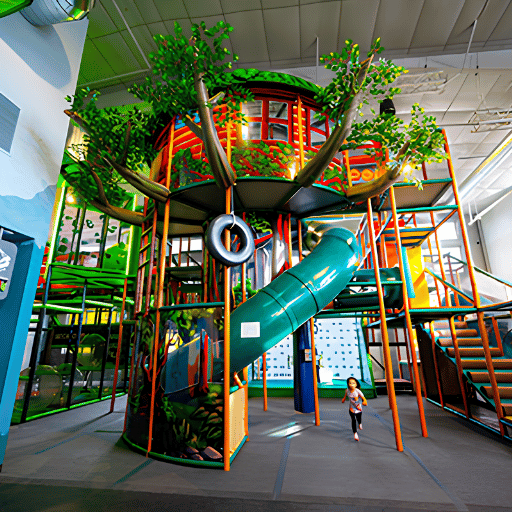
The macro tailwind is undeniable but does not absolve weak procurement. Cross-source triangulation from five market research providers puts the indoor children playground equipment market in a 5-9% CAGR band – Business Research Insights’sprojections are for a $7.3B 2026 growing to $11.91B by 2035 at a 6% CAGR (Business Research Insights); congregational LinkedIn industry analysis pegs consensus at 7-9%; Congruence Market Insights places the narrower commercial subset at 6.2% CAGR ($1.25B in 2025 to $2.02B in 2033); Dataintelo’s inclusive playground subset shows 6.6% CAGR ($6.8B in 2025 to $12.1B in 2034). MetaStat Insight’s broader playground equipment category projects 5.2% CAGR to $14.5B by 2031.
| Outlook signal | Source tier | Implication |
|---|---|---|
| Indoor children equipment $7.3B 2026 → $11.91B 2035, CAGR 6% | Tier 3 market research | Order in Q1 to lock 2026 spec pricing |
| FEC concentration driving 7–12% segment growth | Tier 3–4 industry analysis | Operator scale tipping toward mid-FEC 300–600 m² |
| Eco-friendly recycled HDPE / 85%+ recycled content emerging | Tier 4 industry trade | 2026 spec sheets should request HDPE content disclosure |
| Modular customization replacing fixed-SKU sales | Tier 4 industry trade | Negotiate 0.5 m incremental sizing not catalog SKUs |
| CPSC 2025 + ASTM F1487-25 + EN 1176-10:2023 active updates | Tier 1 government / standards body | Suppliers citing pre-2023 standards fail freshness audit |
💡 Pro Tip — 2026 ordering window timing. Lock indoor playground business equipment specs and pricing before Q3 ordering season opens. Suppliers reset pricing books in Q3 (typically September) and lead times stretch from 35–45 days to 55–75 days as factory capacity fills. A Q1–Q2 PO with a Q4 delivery date gets you 2026 pricing on 2027 standards-compliance equipment — the best of both windows. Market trends are tailwinds; bad procurement timing is a self-inflicted wound.
Frequently Asked Questions
What is the difference between commercial and residential indoor playground equipment?
Commercial indoor playground equipment uses 48 mm hot-galvanized steel with a 2.0-2.5 mm wall, EVA foam at 60-80 kg/m density, PVC fabric at 1100 GSM / 1000 Denier, and ISO 8.8 grade fasteners – designed to withstand 250-750 children/day year-round duty cycles. Residential equipment uses thinner wall- thickness (1.2-1.5 mm), lower-density foam (30-50 kg/m), and lighter fabric (600-800 GSM) suitable for occasional family use only. The commercial spec floor is verifiable via a digital caliper, a scale, and fire-rating PDF.
How do I verify a mill test certificate from a Chinese manufacturer is authentic?
Run the 7-Number Mill Cert Audit: dig the calipers out and check 3 random pipes per pallet for wall thickness, weigh a 10 cm EVA foam cube for density, demand the PVC fabric batch number and per-roll test report, check the bolt head for the 8.8 grade stamp, request the EN 13501-1 lab report number for fire rating, demand the EN 71-3 heavy-metal migration spec sheet, and check the hot-dip galvanizing uniform thickness with a magnetic gauge. A factory that cannot dump all seven artifacts within 48 hours is acting as a Red Flag #1.
What questions should I ask during a factory video audit?
Take a walk through the 8-Signal Red Flag Framework on video: get factory to bring up a recent PDF mill cert live on screen; get numbers on ASTM or EN test report and look up in testing agency database; get up a sample maintenance manual in English; demand a 24 months written spare-parts pricing hold; get up their own spec sheet—”it’s the same as XYZ”—not; confirm 2 contact persons by WhatsApp; take 50% and 90% production photos as PO release condition, find out day rate of English speaking installer supervisor, itemize.
How much should I budget for spare parts in years 2 through 5?
Spare parts: all follow 10-Year TCO Lifecycle Components Map. EVA & PVC soft covers replacements at 36-60 months at $15-$45 per m replaced-say 8% of the original cover value / yr. Wear items-climb grips, ropes, sliders replacements at 12-24 months at $300-$1,800 / zone cash flow at something like 15% of the wear-item bucket / yr.
Fasteners should be torque checked annually at $200-$600 /yr labor. Ball pit balls replacements at 24 months-cash flow budget 50% in-pool re-supply per year. For a typical 300 m² mid-FEC at $80,000 equipment value, that’s roughly $5,000 in year 1 climbing to $8,500 by year 5 as cover replacement cycles begin.
Lock supplier spare-parts pricing into the original PO once the deposit is paid, there is no room to negotiate afterwards.
Does CE marking replace the need for EN 1176 testing?
No. CE is a self-declaration of compliance to EU directives not a safety testing. Testing to EN 1176 is a separate optional test with a test report issued to a third-party with a traceable number.
Demand both.
Why We Publish These Audit Criteria
The 7-Number Mill Cert Audit, 8-Venue Decision Matrix, 6-Item Hidden Cost Decoder, 10-Year TCO Lifecycle Components Map, and 8-Signal Factory Audit Red Flag Framework are our procurement playbook–the same checklists our Engineering and Sales teams in Guangzhou give to operators in 40+ countries. Putting them out there keeps our own standards high, and makes it hard for any supplier (us included) to ship less than the spec floor. If you like a side-by-side quote audit in parallel to this framework, our team will run the 7-Number Audit in parallel to any other PDF on request.
Request Side-by-Side Quote Comparison →
Related Articles
- Indoor Playground ROI: Payback Period and Operator Returns
- Indoor Playground Franchise vs Independent: Cost Decision
- Soft Play Centre vs Indoor Playground: Format Compare
- Indoor Playground Maintenance Guide for Operators
References
- CPSC, “Public Playground Safety Handbook 2025” (July 2025) — cpsc.gov
- Federal Register, “Notice of Availability: Public Playground Safety Handbook Update” (August 2025) — federalregister.gov
- SGS, “ASTM Publishes Revised Consumer Safety Performance Specification F1487-25” (June 2025) — sgs.com
- CEN, “EN 1176-10:2023 Playground Equipment — Fully Enclosed Play Equipment” — standards.iteh.ai
- Standards Australia, “AS 4685.1:2021 Playground Equipment and Surfacing, Part 1” — standards.org.au
- ANSI Blog, “ASTM F1487-21 Playground Equipment for Public Use Standard” — blog.ansi.org
- Business Research Insights, “Indoor Children Playground Equipment Market 2026-2035” — businessresearchinsights.com
- Congruence Market Insights, “Commercial Playground Equipment Market Forecast 2033” — congruencemarketinsights.com
- Athletic Business, “Better Up-Front Understanding of Costs Can Lead to Desired Project Outcome” — athletic business.com
Author byline: Didi Land — commercial indoor playground equipment manufacturer based in Guangzhou, China since 2014. Exporting to 40+ countries with 90%+ output going overseas; AS 4685.1:2021, EN 1176-1:2017, ASTM F381, CE, and ISO 9001:2015 certifications on file.
SYS.00 // E-E-A-T Disclosure
Why I Write This
As the CEO and Co-Founder of a specialized manufacturing facility, my objective is to provide unvarnished, factory-direct technical insights into commercial indoor playground engineering, safety compliance, and project planning. I aim to bridge the information gap for global buyers seeking reliable structural and material data, ensuring you make informed, ROI-driven decisions without the marketing fluff.
About My Business
Guangzhou Didi Land Amusement Equipment Co., Ltd. (Brand: Didi Land) is a commercial indoor playground equipment manufacturer founded in 2014. Operating from Panyu, Guangzhou, China, we engineer, produce, and export commercial-grade play structures to over 40 countries worldwide. Our production lines strictly adhere to international safety frameworks, ensuring durability and safety for high-traffic environments.
Our Services
We provide end-to-end B2B commercial solutions: from custom 3D spatial design and OEM manufacturing to worldwide export logistics and compliance testing. Our focus is on empowering Family Entertainment Centers (FECs), shopping malls, kindergartens, and hospitality venues with reliable, high-capacity play infrastructure.
DATA_MATRIX // MANUFACTURER_PROFILE
Name:
Cherry
Role:
CEO & Co-Founder
Brand Name:
Didi Land
Company:
Guangzhou Didi Land Amusement Equipment Co., Ltd.
Location:
Guangzhou, Panyu, China
Founded:
2014
Products:
Indoor Playground Equipment, Soft Play Equipment, Themed Playground Design, FEC Play Zones, Trampoline Modules, Ninja / Obstacle Course Modules
Email:
conglizhang1@gmail.com
Phone:
+86 199 2587 9517
Website:
didiplayarea.com
COMPLIANCE & STANDARDS:
ASTM F1487 · ASTM F1918 · EN 1176 · CPSIA · CE · ISO 9001 · IPEMA
Contact Factory Direct
ASTM F1487 · ASTM F1918 · EN 1176 · CPSIA · CE · ISO 9001 · IPEMA


![Custom Dinosaur Playground Equipment [Design Guide]](https://didiplayarea.com/wp-content/uploads/2026/09/custom-dinosaur-playground-equipment-r2-featured-1-150x150.png)