Get in Touch with Didi Land


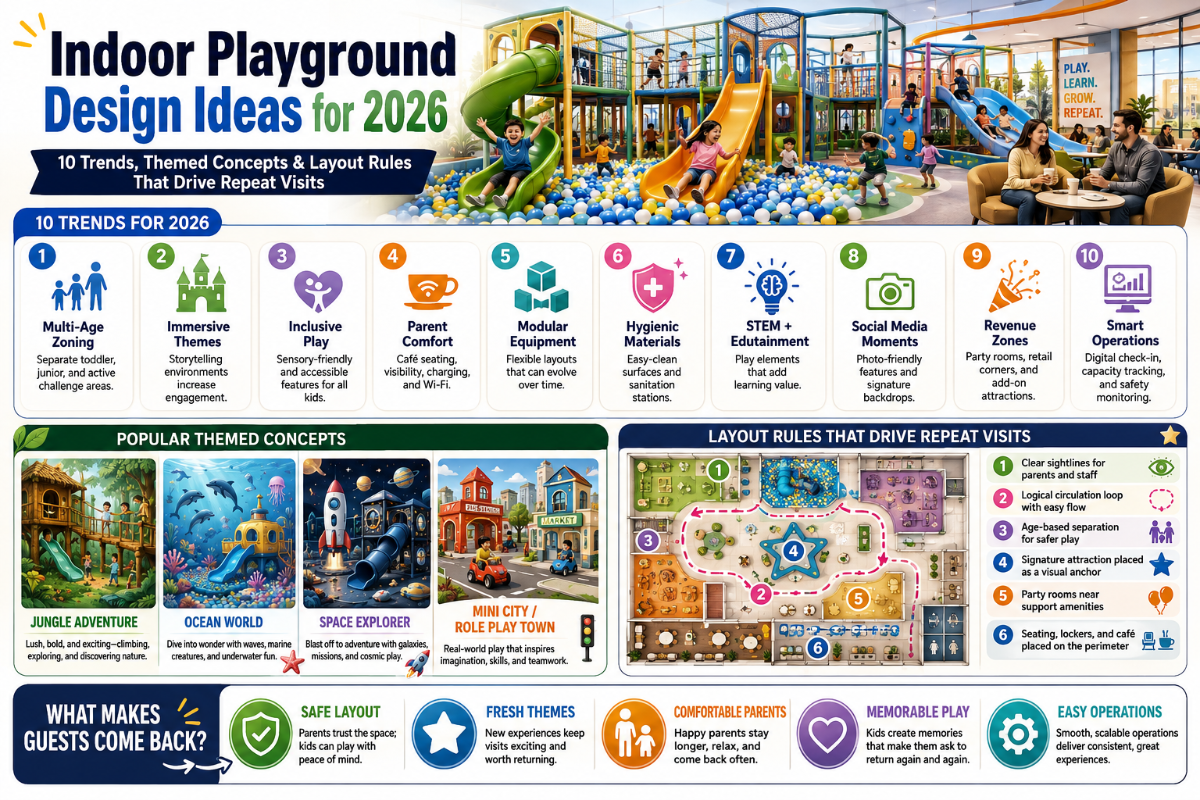
A B2B operator-focused guide to indoor playground design ideas 2026 — covering trends, themed concepts, the play café shift, sightline engineering, inclusive design, materials, equipment mix, segment-specific layouts, and ASTM F1918 / EN 1176 compliance. For FEC owners, kindergarten administrators, mall developers, and restaurant/hospitality operators planning a build or refresh.
Quick Specs: 2026 Indoor Playground Design At a Glance
| US indoor play centers market (2026) | ~$1.0 billion |
| Global FEC market 2026 → 2035 | $0.66B → $1.51B (9.7% CAGR) |
| Typical FEC revenue mix (2025) | Admissions 40% / Attractions 19% / F&B 16% / Parties 14% |
| Required US standard | ASTM F1918-21 (Soft Contained Play, ages 2–12) |
| Required EU standard | EN 1176-10:2023 (Fully Enclosed) + EN 1176-11 (Spatial Network) |
| Realistic equipment lifespan | 8–15 years with quality materials and routine maintenance |
Why 2026 Indoor Playground Design Looks Different

Indoor playground design ideas 2026 are not a re-skin of 2024 modules. Three pressures rewrote the brief: post-pandemic dwell-time economics, where parents now see a visit as a 90–120 minute “third place” rather than a 30-minute drop-in; market saturation (US indoor play centers near $1.0 billion in 2026 with new venues opening every month) per IBISWorld industry analysis; and a generational change in parent expectations — Millennial and Gen Z buyers screen venues by peer-validated photos before they set foot.
What this looks like to operators: visual layout pre-sells the venue before a parent picks up the phone. An uncohesive plastic 2018-era playground loses to a 2026 build with a single overarching theme, adult-oriented seating, and clear sightlines, even with fewer pieces of equipment.
Sections below work through the design choices that actually move the needle — trends, themed concepts, the play café shift, sightline engineering, inclusive design, materials, equipment mix, segment-specific layouts, and the ASTM and EN compliance standards that govern the build.
The 7 Indoor Playground Design Trends Defining 2026
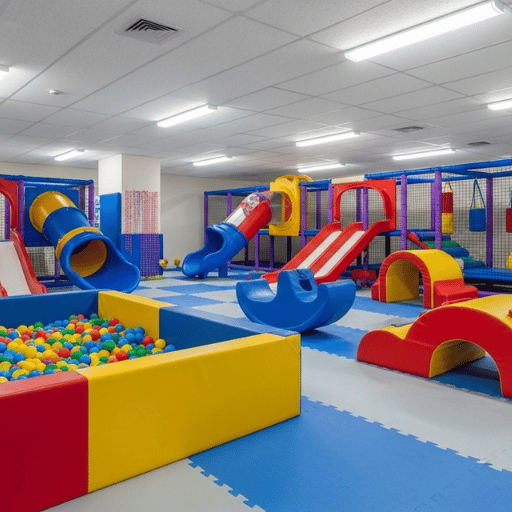
Below is a filtered trend list: every entry has both a market signal (rising search interest, named in two or more 2026 industry trend reports) and an implementation note an operator can act on. Glossy “the industry is evolving” claims are out.
- Immersive themed environments. Multi-zone “world” theming (space, ocean, mini-town, jungle) replaces single-room play. Implementation: each zone needs one hero feature so zones feel different rather than re-skinned.
- Multi-sensory zones. Textured walls, musical floors, calming light corners. Implementation: dedicate 80–120 sq ft for a low-stimulation zone separated from active play by a visual buffer.
- Hybrid play café integration. F&B is now a design driver, not a cost center — see Section 4 below for the layout impact.
- Inclusive and sensory-friendly design. Universal design has moved from “differentiator” to “filter” — families with neurodiverse children, mobility-aid users, and tired caregivers walk out of venues that feel chaotic.
- Biophilic materials and earth-tone palettes. Real wood, sage and terracotta tones, plants. Rainbow plastic looks read as dated to 2026 parents.
- Mixed-age and intergenerational layouts. Designing the indoor playground equipment mix to age with the child (toddler through age 9–10) reduces the family churn that hits venues capped at 0–5.
- Smart-tech interactive zones. Projection-based interactive walls, motion-sensing floors, leaderboard climbing walls. Tech that enhances movement, not replaces it — borrowing the layered-attraction logic of a theme park without the theme park footprint.
What are the key trends in indoor children’s play park for 2026?
Indoor children’s play park trends for 2026 cluster around three themes: experience (immersive worlds, story-driven zones, shareable photo points), parent infrastructure (sightlines, seating, café integration, in-play-area ordering), and inclusion (sensory rooms, quiet hours, universal access). Across IAAPA-tracked operators and 2026 trend reports, these three buckets show up consistently. The operators who treat them as a coordinated package — not a checklist of features — see longer dwell times and stronger membership conversion.
💡 Pro Tip
Pick two or three trends to commit to deeply rather than touching all seven shallowly. A venue with a confident multi-sensory + biophilic + play café story beats a venue that has a token sample of every 2026 trend.
8 Themed Indoor Playground Concepts That Drive Repeat Visits
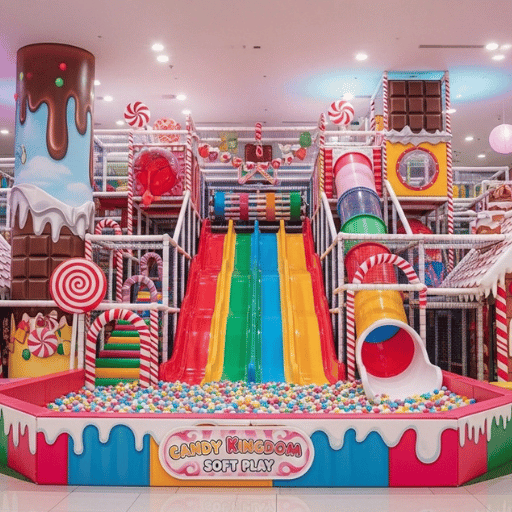
Themed indoor playground concepts work because they give parents a story to share and kids a world to explore zone-to-zone. Eight concepts below are the ones that show up most often in 2026 industry coverage and photo-driven social discovery, each one mapped to the segments where it actually fits.
| Theme | Best Age Fit | Best Segment Fit | Differentiation Move |
|---|---|---|---|
| Immersive World Zones (space, ocean theme, jungle) | 3–10 | FEC, mall, large kindergarten | One hero feature per zone (anchor structure photographs as the hero shot) |
| Role-play mini town | 2–6 | Play café, kindergarten, small FEC | 6–12 micro-rooms with prop storage that supports a 5-minute reset |
| Pirate ship | 3–9 | FEC, restaurant outpost | Multi-level deck doubles as a sightline anchor (parents see the whole ship) |
| Space-themed playground | 4–10 | FEC, mall | Pair with parent café lounge (galaxy + low-stim seating) |
| Nature / forest | 0–6 | Kindergarten, hotel, play café | Real wood and live planting cues — beats printed graphics |
| Ninja / obstacle adventure | 6–12 | FEC, mall | Achievement loop: timing leaderboard + tiered routes by height |
| Sensory-friendly | All ages | Kindergarten, kindergarten-adjacent FEC | Dedicated quiet room ≥80 sq ft + scheduled low-stim hours |
| Hybrid soft-play + trampoline | 2–12 | Large FEC | Strict zoning: toddler softplay never shares walls with trampoline |
How do you avoid “generic role play” that looks like every other venue?
Generic role-play areas fail because they decorate the walls but stop there. The fix is to build the theme into the operations, not just the graphics. Three moves separate a memorable role-play space from forgettable shelf-and-prop versions: first, a unique room lineup (the sixth and seventh rooms — a vet clinic plus a postal office, say — are where a town starts to feel real, not the obvious supermarket-and-doctor pair). Second, prop storage designed for a five-minute reset between sessions, so the space looks fresh on every visit. Third, story-based wayfinding — small signs that move the child through the town in a narrative arc, rather than dumping them in the middle. Industry practitioners report that venues which invest in those three moves see noticeably higher repeat visits and review-mention rates than venues with the same square footage but identical “town in a box” packages.
The Play Café Model: When F&B Becomes a Design Driver
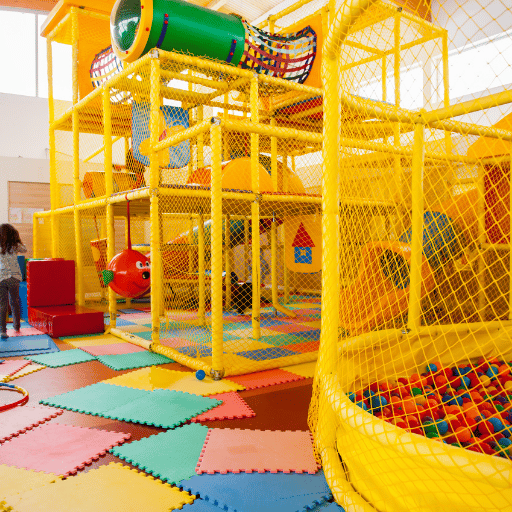
Play café is the most-discussed 2026 design shift. Three independent industry trend reports for 2026 named F&B-integrated indoor playgrounds as a primary driver of repeat-visit economics. Reason is in the revenue mix: across IAAPA-tracked family entertainment centers in 2025, food and beverage represented 16% of revenue, with admissions at 40%, attractions and rides at 19%, and birthday parties at 14%, according to data tracked by the IAAPA. F&B is the highest-margin line in that mix, and it requires almost no incremental floor area when the design is right.
“You can’t out-market a bad layout. Cafés that perform are integrated into the flow of the space, staffed and trained so ordering doesn’t feel disruptive, and woven into party upgrades, event add-ons, and membership perks. That’s where the compounding effect happens.”
— Michele Caruana, Play Cafe Academy founder, in her 2026 indoor playground trend analysis
One design rule operators most often skip: a play café isn’t a coffee counter that happens to face a play area. It’s three coordinated zones — fast play, sightline-controlled café seating, and a quiet “eat and decompress” booth row — separated by visual buffers that let parents glance up from a coffee and see their child without standing.
📐 Engineering Note
Sightline rule for café-integrated design: keep café seating no more than 30 ft (9 m) from the toddler-zone perimeter, with no fixed obstruction taller than 48 in (1.2 m) between adult eye level (seated, ~46 in / 1.17 m) and the play surface. Beyond 30 ft, parents physically stand up to check, which kills dwell time in 30–45 minute increments. Below 30 ft, they stay seated, which is where the F&B revenue compounds.
Floor Plan & Sightline Engineering: The 5-Zone Sightline Rule
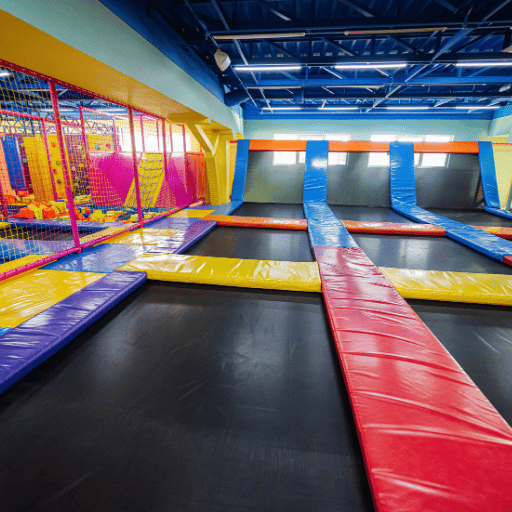
Every credible indoor playground floor plan for 2026 sorts the footprint into five functional zones, each with its own sightline target. Treat this as the layout backbone — every other decision (theme, palette, equipment mix) sits on top of it. We call it the 5-Zone Sightline Rule because the sightline distance (not the square footage) is what determines whether the venue feels safe, social, and supervisable.
| Zone | Function | Target Sightline (Adult Seated) | Sizing Guide |
|---|---|---|---|
| 1. Active Play | Climbing, slides, soft play, ball pit | ≤ 40 ft (12 m) from primary seating | 35–45% of total floor area |
| 2. Toddler / 0–4 | Foam blocks, low climbers, sensory wall | ≤ 25 ft (7.6 m) from caregiver seating | 15–20% of total floor area |
| 3. Quiet / Sensory | Decompression room, dim lighting | Visual barrier from active zone | ≥ 80 sq ft (~7.5 m²) minimum |
| 4. Café / F&B | Counter, seating with sightlines | ≤ 30 ft (9 m) to active & toddler zones | 10–15% of total floor area |
| 5. Entry & Circulation | Reception, stroller park, restrooms | ≥ 6 ft (1.8 m) clear circulation aisles | 10–15% of total floor area |
One avoidable mistake: overcrowding the active zone past 50% of total floor area. Field practitioners report that this consistently shows up in operator regret stories — the venue feels packed even at half capacity because circulation aisles get squeezed below the 6 ft minimum that ASTM and ADA-aligned local building codes effectively require. Industry guides cite that accessible restrooms and comfortable adult infrastructure can lift dwell time by up to 48% versus venues that treat these as afterthoughts based on industry practitioner data.
⚠️ Common Mistake
Designing the active zone first and squeezing the toddler zone into “what’s left.” Reverse the order. Define the toddler sightline first (≤ 25 ft to caregiver), then build active play around it. Toddler zones carry the strictest supervision constraint and the least flexibility — let them pick the floor’s anchor.
Inclusive & Sensory-Friendly Design Principles
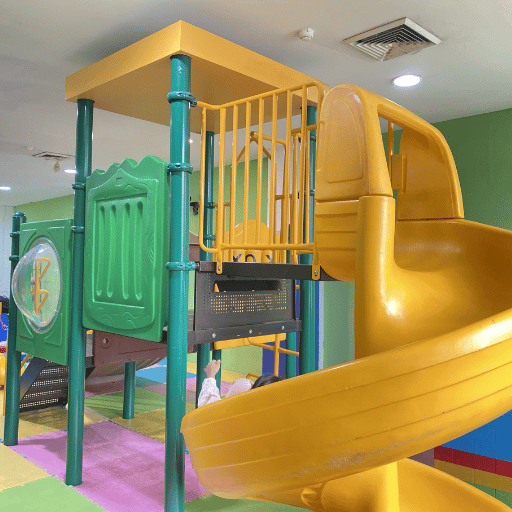
Inclusive playground design crossed the line in 2026 — it stopped being a marketing differentiator and started being a filter. Families with neurodiverse children, mobility-aid users, and tired caregivers screen out venues that feel chaotic before they book. The Inclusive Playground Equipment market is projected to grow at a 5.3% CAGR from 2025–2032, faster than the overall indoor children’s playground equipment market at 6.2% CAGR — reflecting operators catching up to demand they previously ignored.
Inclusive design is not the same as ADA compliance. ADA is a legal floor (entry width, restroom access, accessible play components). Inclusive design adds the experiential layer: predictable wayfinding, sensory-friendly lighting, reduced acoustic load, and zoning that lets a family choose stimulation level. Both matter; one without the other looks performative.
- ✔
Quiet / sensory room ≥ 80 sq ft — dimmed lighting, weighted blankets, tactile wall, visual buffer from active play.
- ✔
Acoustic treatment — ceiling baffles or fabric panels in active zone to drop ambient SPL by 5–8 dB.
- ✔
Scheduled low-stim hours — at least 2 hours per week with reduced music, dimmed lights, and capped capacity.
- ✔
Texture diversity in toddler zone (smooth vinyl, knit fabric, ribbed foam) for sensory regulation, not just visual variety.
- ✔
Predictable wayfinding — entry → coat / stroller → check-in → play, with each step visible from the previous one.
Modern Color Palettes & Materials That Don’t Look Dated
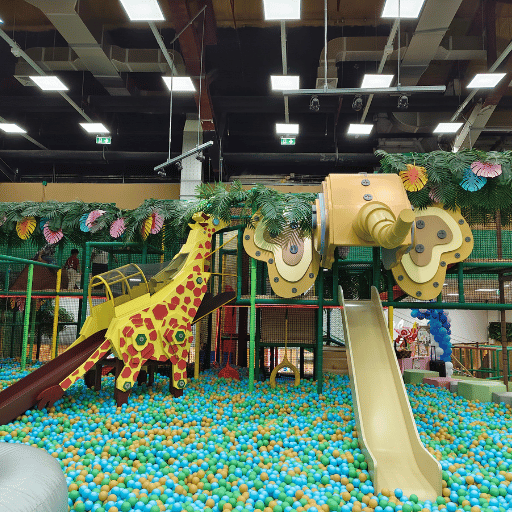
That “primary-color rainbow” palette which defined 2010s indoor playgrounds now reads as dated to 2026 parents browsing photos before they book. Two palette families dominate the modern indoor playground design conversation: biophilic earth (sage green, terracotta, oak, cream) and muted pastel macaron (dusty rose, butter yellow, pale teal, soft black accents). Both photograph cleanly across phone cameras and read as “premium” without using gold or chrome accents that age in 18 months.
✔ Biophilic Earth Palette
Sage green (#9CAF88), terracotta (#C97B5A), oak wood, cream (#F4EFE8). Pairs with real wood structures and live planting. Best for: kindergarten, hotel lobby playground, nature-themed FEC.
✔ Muted Macaron Palette
Dusty rose, butter yellow, pale teal, charcoal accents. Pairs with white-painted soft play and acrylic see-through panels. Best for: play café, mall, premium FEC.
On materials, three durability tiers separate venues that look fresh at year five from venues that look tired at year three: HDPE panels and powder-coated steel hold color through UV and cleaning chemicals; engineered closed-cell foam keeps shape under daily compression; reinforced vinyl on contact surfaces stays cleanable. Together these specs — all written into ASTM F1918 — drive the realistic 8–15 year lifespan that quality indoor playground equipment targets, versus the 3–5 years that low-cost imports typically deliver.
Equipment Mix by Age Band: Toddler → School-Age → Mixed-Age Strategies
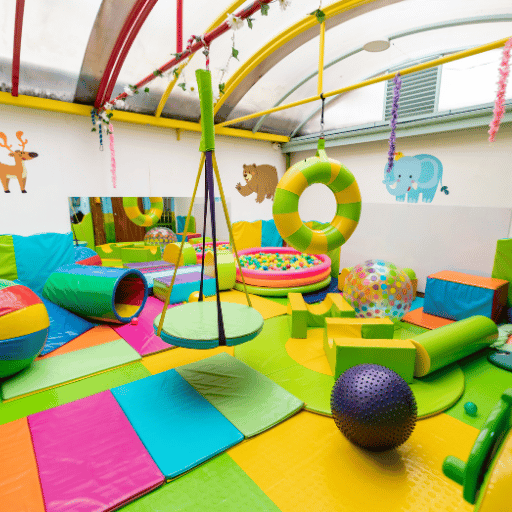
Indoor playground equipment 2026 selections succeed or fail by age fit. Below is a matrix that maps the most-installed equipment categories against four practical age bands used by EN 1176-10 and ASTM F1918 — standards that govern fall-zone, opening-size, and entrapment specifications by child age.
| Equipment | 0–2 | 3–5 | 6–8 | 9–12 |
|---|---|---|---|---|
| Soft foam blocks | Core | Supporting | — | — |
| Ball pit | Supervised only | Core | Core | Supporting |
| Slides & ball pits combo | Toddler-height only | Core | Core | Core |
| Climbing wall (low height) | — | Core | Core | Supporting |
| Climbing frames (full) | — | — | Core | Core |
| Trampoline (court-style) | — | Mini, sup. | Core | Core |
| Balance beams | Floor-level | Core | Core | Supporting |
| Dodgeball (foam) | — | — | Core | Core |
| Role-play mini rooms | — | Core | Core | Supporting |
Which indoor playground themes work best for toddlers (0–4)?
Toddler play patterns shape the answer: low chaos (lots of small stations rather than one big route), softer visuals (matte tones beat saturated primaries), and operator-friendly reset cycles. Three themes consistently rank highest for the 0–4 band: role-play mini-town (many small toddler play stations spread the children out, reducing collisions), nature/forest (calmer color palette helps regulate younger children’s stimulation), and a calm play café format with curated toy stations. The common pattern is low active-play intensity paired with high parent visibility — toddlers stay engaged longer, parents stay seated, repeat visits compound. Adventure, ninja, and trampoline themes underperform for this age band; they are designed for the 6–12 achievement loop.
Mixed-age design is where most layouts fail. The discipline is strict zone separation: toddler equipment never shares a wall with active-play equipment, and circulation between zones routes children through the supervisor station. Soft play equipment rated for the 0–4 band uses different fall-zone specifications than equipment rated for 5–12, and ASTM F1918 treats them as different installations even when they sit in the same room.
Designing for Your Segment: FEC vs Kindergarten vs Mall vs Restaurant
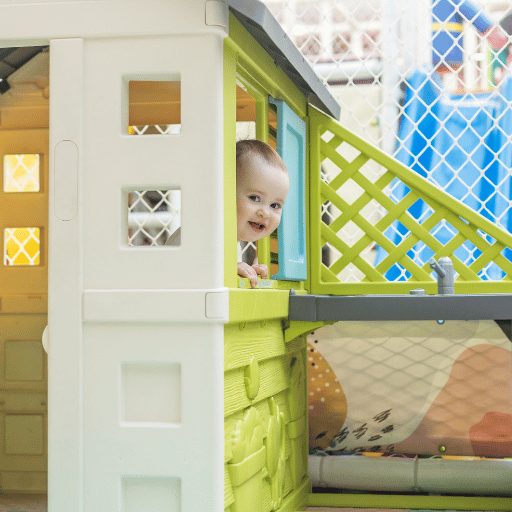
“Indoor playground design” is not a single brief — same equipment laid out for an FEC versus a kindergarten versus a hotel lobby produces three different outcomes because the success metrics differ. Below is a matrix that sorts the four most common operator segments against design priorities that move the needle for each.
| Design Priority | FEC | Kindergarten | Mall | Restaurant / Hotel |
|---|---|---|---|---|
| Primary success metric | Repeat visits / membership | Standards compliance + dev. fit | Dwell time → adjacent retail | Sightlines → adult dwell + F&B |
| Typical footprint | 3,000–10,000 sq ft | 800–2,500 sq ft | 1,500–4,000 sq ft | 300–1,200 sq ft |
| Age range targeted | 2–12 (mixed-age) | 3–6 (single-band) | 2–10 | 2–8 |
| F&B integration | Core (16% revenue) | None | Adjacent food court | Built-in (parents already eating) |
| Theme intensity | High (immersive) | Calm (educational) | Medium (matches mall) | Light (extends brand) |
| Critical compliance | ASTM F1918 + insurance | F1918 + state childcare regs | F1918 + mall fire egress | F1918 + local health code |
FEC operators planning a 2026 build should anchor the design around FEC indoor playground design priorities — repeat visits, F&B integration, and mixed-age layouts. Kindergarten administrators looking at a refresh should start with kindergarten indoor playground design guidance, where developmental fit and standards compliance lead. Mall developers should prioritize shopping mall playground integration with food court adjacency and stroller traffic flow. Hotels and restaurants typically need a tighter restaurant and hotel playground footprint with sightlines as the primary design constraint, since adult dwell time over a meal drives the entire ROI.
Safety Compliance: ASTM F1918, EN 1176, IPEMA & 2026 Updates
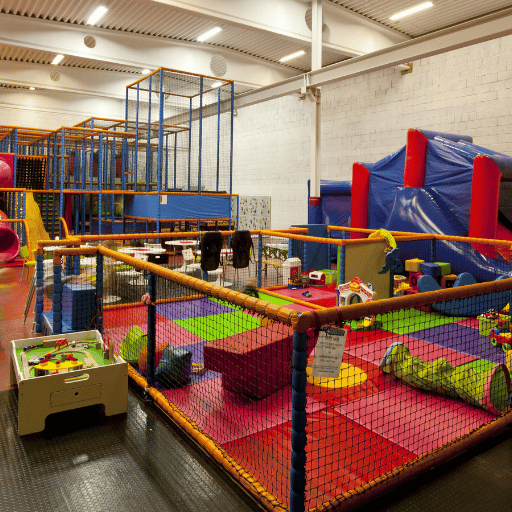
Indoor playground safety standards 2026 cluster around three reference frameworks: ASTM F1918-21 in North America (the current revision, published 2021), EN 1176-10:2023 and EN 1176-11 in Europe, and IPEMA third-party certification that overlays the ASTM standard. AS 4685 covers Australia. Each standard governs a slightly different scope, and a venue exporting equipment internationally has to clear all of them.
| Standard | Region | Scope | Age Range |
|---|---|---|---|
| ASTM F1918-21 | United States | Soft contained play equipment | 2–12 |
| ASTM F1487 | United States | Public outdoor playground (different scope) | 2–12 |
| EN 1176-10:2023 | Europe | Fully enclosed play equipment | Up to 14 |
| EN 1176-11 | Europe | Spatial network play equipment | Up to 14 |
| AS 4685 | Australia / NZ | Playground equipment safety | Varies by part |
| IPEMA certification | United States | Third-party verification of ASTM compliance | Per ASTM scope |
Three compliance gaps show up most often in 2026: cross-border buyers ordering ASTM-only equipment for an EU venue (or vice versa); installers skipping the third-party IPEMA verification step that most US insurers now expect for commercial venues; and retrofit projects assuming the original 2015-era ASTM revision is still current (it is not — F1918-21 supersedes earlier revisions, with updated impact-attenuation and entrapment language). Reference the published standards directly: ASTM F1918-21, EN 1176-10:2023, and the IPEMA certification program.
⚠️ Important
Manufacturer claims of “ASTM compliant” without IPEMA certification are not the same as IPEMA-verified. For a US commercial venue, request the IPEMA certificate number and confirm it on the IPEMA database before signing a purchase order. Same logic applies to EN 1176 in Europe — ask for the test-house notification document, not a self-declaration.
Industry Outlook: What’s Changing in 2027 and Beyond
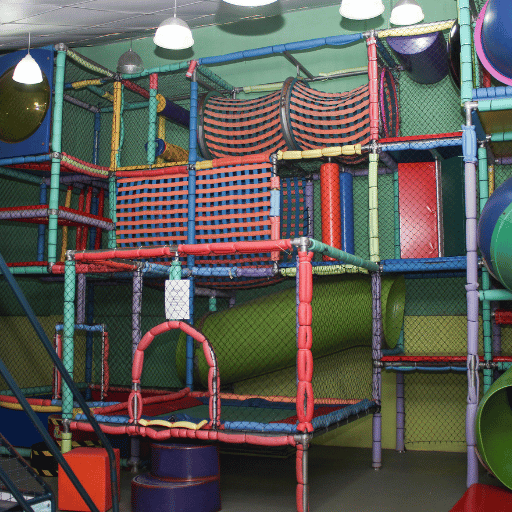
Looking past 2026, four shifts are already visible in the IBISWorld and IAAPA forward indicators that operators planning a new build should design for, not retrofit later. The market context — global FEC industry projected to grow from $0.66 billion in 2026 to $1.51 billion by 2035 (9.7% CAGR) per industry forecasts — means new entrants are still flowing in, and 2027 venues will compete against the 2026 cohort for the same families.
First, AR/VR projection-based interactive zones move from “novelty premium feature” to expected mid-tier feature. Operators who frame the cabling and ceiling-mount points for projector arrays during the 2026 build avoid a wall-tear-out in 2028. Second, sustainability is shifting from a marketing claim to a procurement requirement — recycled HDPE, FSC-certified wood, low-VOC adhesives. Specifications written into 2026 procurement docs will age better than ones written without sustainability clauses. Third, mixed-age and intergenerational layouts continue to expand the addressable family — venues capping at age 5 are losing the school-age share to venues that age with the child. Fourth, sensor-driven capacity management (Bluetooth wristbands or cameras feeding live capacity dashboards) is moving from amusement parks down into FECs, replacing the timed-session band-aid that most 2024-era venues still use.
If you are starting a 2026 build, the practical takeaway is to plan for these four shifts as conduit, not as features — leave ceiling raceways, structural anchor points, and electrical capacity for projector arrays and sensor networks even if the budget for the actual hardware is two years out.
FAQ
Q: What indoor playground theme gets the best reviews in 2026?
View Answer
No single theme wins reviews — winning venues are those whose theme supports clean, calm, well-zoned operations. Across 2026 trend coverage, role-play mini towns, immersive world zones, and play café formats consistently lead. Pattern: themes that make supervision and reset easier produce stronger reviews than themes that look impressive but operate badly.
Q: Which theme works best for a play café model?
View Answer
Calm themes with strong sightlines outperform high-energy themes for the play café format. Nature, role-play, and Montessori-style play café themes pair best with seated parent dwell time and coffee revenue. Trampoline parks and ninja themes compete with the café for attention and noise — they fit a separate-zone FEC, not a play café.
Q: What’s the difference between ASTM F1918 and ASTM F1487?
View Answer
ASTM F1918-21 covers indoor soft contained play equipment (the typical commercial indoor playground). ASTM F1487 covers public outdoor playground equipment. They share fall-zone and entrapment principles but differ on materials, surfacing, and impact-attenuation testing. An indoor venue’s installation is governed by F1918, not F1487.
Q: Which indoor playground design ideas work for very small spaces under 2,000 sq ft?
View Answer
Under 2,000 sq ft, build vertically and pick one strong hero feature rather than spreading thin. A single tall multi-level soft play structure plus a tight role-play corner plus a parent café zone of 6–8 seats outperforms a footprint that tries to include trampoline, ball pit, climbing wall, and adventure all in 1,500 sq ft.
Q: How long does an indoor playground design and build project typically take?
View Answer
Custom indoor playground design and build projects typically run 12–20 weeks from signed concept to installed equipment, with 4–6 weeks for design and 6–10 weeks for manufacturing and shipping (longer for international export). Compliance verification (IPEMA or EN test-house) adds another 2–3 weeks if not started in parallel with manufacturing.
Q: What’s a good repeat-visit benchmark for a 2026 indoor playground?
View Answer
IAAPA-tracked operators typically report monthly repeat-visit rates between 35% and 55% for membership-based FECs, with lower rates for one-off pay-per-visit venues. Biggest single lift in repeat visits comes from F&B integration and parent-comfort infrastructure rather than from adding more equipment.
Q: How is inclusive design different from ADA compliance?
View Answer
ADA compliance is the legal floor (entry width, restroom access, accessible play components per the 2010 ADA Standards). Inclusive design adds the experience layer: predictable wayfinding, sensory-friendly lighting, acoustic moderation, scheduled low-stim hours, and zoning that lets a family choose the stimulation level. Both matter; ADA without inclusive design feels performative, and inclusive design without ADA is illegal in commercial venues.
Q: Should I design for AR/VR integration even if I’m not using it yet?
View Answer
Yes for the conduit, no for the hardware. Frame your 2026 build with ceiling-mount anchor points, electrical capacity, and overhead raceways suitable for projector arrays and sensor networks. Hardware itself can wait until 2027–2028 when content libraries mature. Retrofitting structure later costs 4–6× the cost of designing it in.
Plan Your 2026 Indoor Playground Build
Custom indoor playground design and ASTM F1918 / EN 1176-10 compliant manufacturing — for FECs, kindergartens, malls, restaurants, and hotels across 40+ countries.
About This Analysis
This 2026 indoor playground design ideas guide synthesizes published industry data from IAAPA, IBISWorld, and 2026 trend coverage with the ASTM F1918-21 and EN 1176-10:2023 standards as the compliance backbone. The design priorities — sightline distances, zone sizing, age-band equipment matrices — are drawn from published industry practitioner guidance and the standards themselves; specific sightline distances vary by venue acoustics, ceiling height, and column placement, so use these values as planning anchors and verify against your floor plan with a qualified playground designer or compliance auditor.
References & Sources
- ASTM F1918-21 Standard Safety Performance Specification for Soft Contained Play Equipment — ASTM International
- EN 1176-10:2023 Playground Safety – Fully Enclosed Play Equipment — European Committee for Standardization (CEN)
- IPEMA Third-Party Playground Equipment Certification Program — International Play Equipment Manufacturers Association
- State of the Global Attractions Industry — International Association of Amusement Parks and Attractions (IAAPA)
- 2025 IAAPA Benchmark Series – Entertainment Centers — IAAPA Research
- Indoor Play Centers in the US Industry Analysis — IBISWorld
- Family Entertainment Centers Market Size 2026 → 2035 Forecast — Business Research Insights
Related Articles
- Indoor Playground Equipment Catalog — All Categories
- Custom Indoor Playground Themes & Design Services
- Indoor Jungle Gym Structures for Mixed-Age Layouts
- Indoor Play Structures: Multi-Level Soft Contained Play
- Soft Play Sets for Toddler & 0–4 Age Bands
- Indoor Playground Design for Family Entertainment Centers


![Custom Dinosaur Playground Equipment [Design Guide]](https://didiplayarea.com/wp-content/uploads/2026/09/custom-dinosaur-playground-equipment-r2-featured-1-150x150.png)