Get in Touch with Didi Land


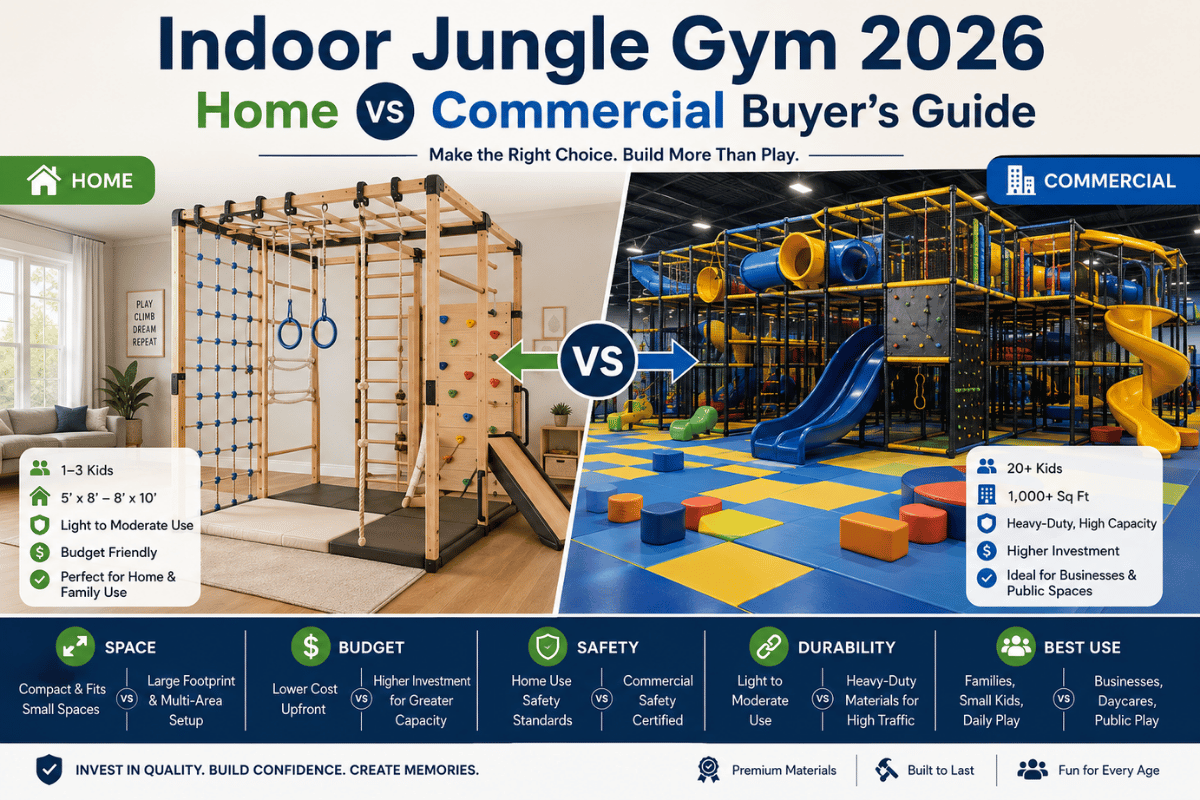
If you are shopping for an indoor jungle gym, you have probably noticed two completely different markets selling under the same label: $349 wooden Pikler-style climbers shipping from Amazon, and $80,000 modular jungle gym installations going into shopping mall corners. Both call themselves “indoor jungle gym,” and both are correct — but the gap between them is where most buyers waste money. This guide walks through the five-tier spectrum, the ASTM F1487 vs F1918 compliance distinction that even most manufacturer pages skip, and the cost-and-payback math venue operators actually use. The data comes from 23 countries of commercial indoor jungle gym deployments, public ASTM standards, and industry market reports published in 2024-2026.
Quick Specs
| Cost tier | $349 (home toy) → $1M+ (large FEC build) |
| Footprint | 15 m² (toddler corner) → 3,000 m² (FEC build) |
| Age | 6 months (Pikler triangle) → 12 years (commercial multi-climb) |
| Material | Solid wood (home) / Galvanized steel + HDPE polymer (commercial) |
| Standard | ASTM F1487-25 + F1918 + F1292 + EN 1176-1 + IPEMA + CPSIA |
| Lead time | 4-6 weeks (catalog) → 12-16 weeks (bespoke OEM) |
| Warranty | 12 months structural + lifetime parts (commercial tier) |
What Is an Indoor Jungle Gym? Home Toy vs Commercial Venue Definition
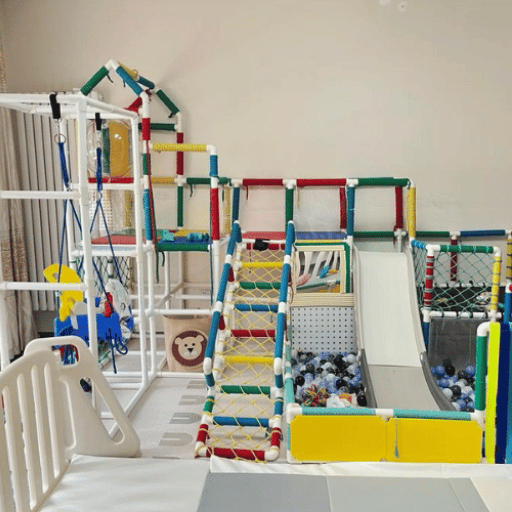
An indoor jungle gym — sometimes called a play gym, an indoor jungle gym for kids, or a climbing structure depending on the catalog — is an enclosed climbing system designed for active play in protected indoor spaces. Three buying contexts dominate the search: parents who want their toddler off the furniture during cold months, daycare directors specifying age-appropriate gross motor equipment, and family entertainment center operators sourcing a 1,500 m² modular bay.
The differentiator is not what the equipment looks like — every tier has slides, climbers, and rope nets — but what it has to withstand. A home indoor jungle gym handles one or two siblings using it intermittently across two to four years. A commercial installation in a busy mall corner sees 800+ kids on a Saturday and must remain inspection-ready for seven to ten years. Material grade, applicable safety standards, warranty depth, and after-sales infrastructure follow that load profile.
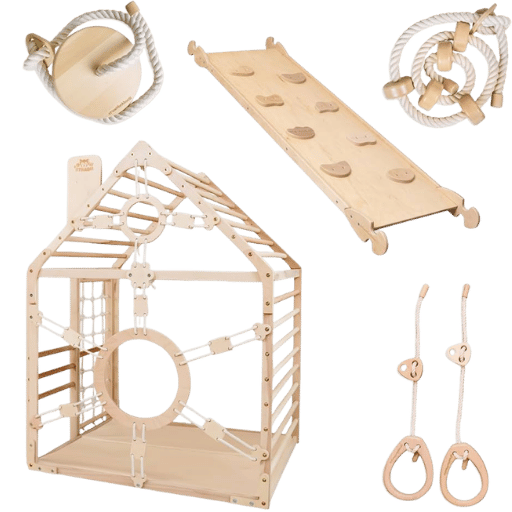
For buyers sourcing for a venue with paying users (mall, daycare, hotel lobby, restaurant kids zone, FEC), the search shortcuts: skip the wooden home toys entirely and start with manufacturers who can ship ASTM F1487-25 and F1918 documentation in the binder. For buyers sourcing for a single household, the cost ladder starts around $349 for an entry-level wooden Pikler-style set and climbs to about $2,400 for a wall-mounted modular climbing system. Middle ground is rarely a good buy: a $700 wooden home gym does not have commercial-tier compliance, but a $25,000 modular commercial unit is overkill for a playroom.
The 5-Tier Home-to-Commercial Spectrum Ladder — From $349 Wooden Toy to $1M+ FEC Installation
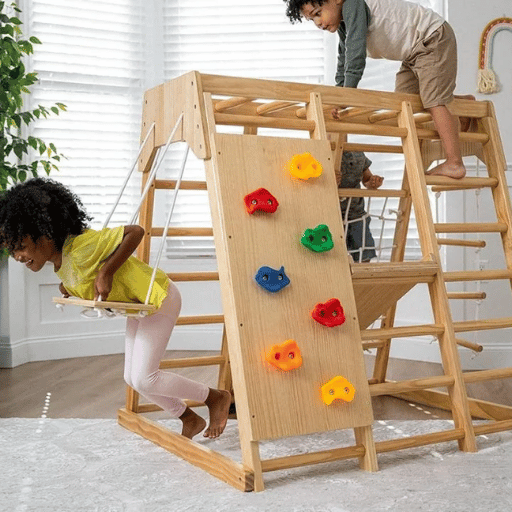
Once a buyer locates themselves on the spectrum, most other questions answer themselves. The table below maps the actual five tiers in the indoor jungle gym category, with footprint, cost, applicable safety standard, and typical buyer. Prices reflect 2024-2025 market data for the lower three tiers (verified against retail listings) and the upper two tiers (compiled from commercial supplier disclosures and Didi Land 23-country export pricing).
| Tier | Example | Footprint | Cost | Applicable Standard | Typical Buyer |
|---|---|---|---|---|---|
| 1 — Home Wooden | Pikler triangle, 6-in-1 climber | 3-5 m² | $349-$770 | None (toy regulation only) | 1-2 child household |
| 2 — Tension-Mount Home | Wall-mounted climbing gym | 5-8 m² | $850-$1,500 | Voluntary CPSIA | Apartment / dedicated playroom |
| 3 — Home Modular Premium | 9-in-1 modular climbing set | 6-12 m² | $1,500-$2,500 | CPSIA + voluntary impact testing | High-activity toddler at home |
| 4 — Light Commercial | 100-300 m² installation | 100-300 m² | $25,000-$80,000 | ASTM F1487-25 + F1918 + IPEMA | Daycare / Hotel lobby / Restaurant |
| 5 — FEC Commercial | Modular FEC build with trampoline bay | 500-3,000 m² | $80,000-$1,000,000+ | F1487-25 + F1918 + F2970 + F1292 + EN 1176 | Mall + FEC + Theme Park operator |
Two boundaries on this ladder catch most buyers off guard. The Tier 3-to-Tier 4 jump (around $2,500 to $25,000) is not gradual. Below the commercial threshold, manufacturers cannot afford the CPSC Public Playground Safety Handbook (July 2025 update) documentation and IPEMA third-party audit costs. — there is no $5,000 to $10,000 middle tier that gives buyers “lightly commercial” equipment. Below $25,000, manufacturers cannot afford to run the ASTM third-party testing, IPEMA certification audit, and binder-grade documentation that venue operators need for insurance and inspection. Above $25,000, those costs are bundled into every installation. The Tier 4-to-Tier 5 jump scales with footprint rather than per-square-meter cost — large FEC builds get cheaper per m² as bays are repeated, but the absolute total still climbs because the buyer is sourcing trampoline, ninja course, and toddler soft play modules together rather than just a jungle gym.
If a quote arrives between $5,000 and $20,000 for “commercial” indoor jungle gym equipment, that is the warning sign. Either the standards are not real, the warranty is limited to materials excluding labor, or the supplier is reselling tier-3 home equipment with marketing claims attached.
Sizing Your Indoor Jungle Gym — Age, Venue, and Real Footprint Numbers
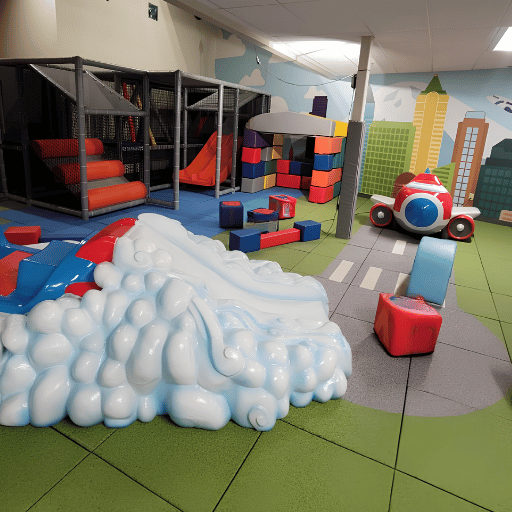
Footprint planning trips up most first-time venue buyers because they treat the equipment as the whole footprint, forgetting the use zone clearance that ASTM F1487-25 requires around any climbing structure. The standard specifies a minimum 1.83 m (6 ft) clear zone in every direction around equipment greater than 0.61 m (2 ft) in deck height. A “200 m² jungle gym” needs closer to 280 m² of leased floor when use zones are honored.
| Use Case | Age | Equipment Footprint | Use Zone Add-on |
|---|---|---|---|
| Toddler home corner | 1-3 yr | 15-50 m² | ~1.0 m (relaxed home tolerance) |
| Hotel lobby kids zone | 3-10 yr | 20-100 m² | 1.83 m (ASTM F1487-25) |
| Kindergarten / daycare | 2-5 yr | 30-150 m² | 1.83 m + EN 1176-1 inspection lanes |
| Restaurant kids zone | 3-10 yr | 20-100 m² | 1.83 m |
| Mall corner | 3-12 yr | 200-500 m² | 1.83 m + traffic flow margin |
| FEC build | 2-14 yr | 500-3,000 m² | Zone-by-zone planning per age tier |
How Much Space Do I Need for an Indoor Jungle Gym?
The shortest workable footprint that lets the equipment do its job in a paying-venue context is 30 m². Anything smaller and the use zones overlap with table seating, host stations, or traffic flow, which fails inspection and creates concentrated wear on equipment edges. A 30 m² kindergarten installation typically accommodates a single mid-size modular indoor play structure with one climbing zone and one slide, sized for 2-5 year olds. Going up to 80-100 m² adds a second age tier (5-10 yr) and a ball pit; 200 m² unlocks mall-tier multi-level climbing towers; 500 m²+ enables FEC zoning by age. For the home buyer, the answer is simpler: a tension-mount system needs about a 2.4 m ceiling and 5 m² of floor; a free-standing modular set wants 6-12 m² of dedicated playroom space with a 2.1 m soft mat under the highest climb point.
📐 Engineering Note
ASTM F1292-18 sets G-max ≤200 and HIC <1000 as the impact attenuation thresholds for safety surfacing under the use zone. The catch documented by the National Program for Playground Safety is that in-situ field testing of installed structures 9 to 12 ft high shows about a 9% G-max increase and up to 36% HIC variance vs lab certification — meaning lab-passing equipment can still fail post-install field tests. Ask suppliers for in-situ certification, not just lab certificates.
The Indoor Jungle Gym Safety Standard Decision Tree — F1487 vs F1918 vs EN 1176
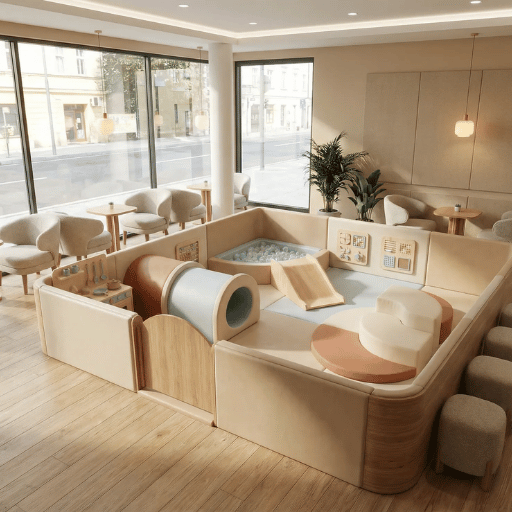
One compliance shortcut trips up so many buyers that the manufacturers who skip it do so deliberately to lower their quote. ASTM F1487-25 is the US/Canada benchmark for public playground equipment frames, climbing structures, and slides — what most manufacturers cite when they say “ASTM compliant.” But ASTM F1918 is a separate standard governing soft contained play equipment — the ball pits, foam structures, padded climbers, and enclosed crawl tubes that get embedded in commercial jungle gyms. F1487 alone does not cover soft-contained zones. Industry compliance analysts have flagged this as one of the most common manufacturer gaps: a venue passes inspection under F1487 for the climbing frame but has no certification on the soft play module right next to it.
The decision tree below walks any commercial buyer to the correct standard stack in five branches:
- Is the installation in the US or Canada? → ASTM F1487-25 required for any climbing structure with deck height > 0.61 m, plus CPSC public playground guidance updated July 2025.
- Does the installation include soft-contained zones (ball pit, foam structures, padded crawl tubes)? → ASTM F1918 required separately, layered on top of F1487. If your supplier cannot produce F1918 documentation for these zones, the soft play is uncertified regardless of frame-level F1487 status.
- Are parts in contact with children under 12 years? → CPSIA 16 CFR 1303 (lead) and 1307 (phthalates) tested at the component level before assembly.
- Is the installation in an EU member state? → EN 1176-1:2017+A1:2024 required, plus EN 1176-2 through -11 for specific equipment types.
- Is the installation in DACH market (DE, AT, CH)? → GS-EN1176 supplement (TÜV mark) on top of EN 1176-1; buyers in these markets routinely require the GS document specifically.
The reverse is the more dangerous trap: assuming F1487 covers everything. It does not. A daycare director who sources a $40,000 modular climbing structure with F1487-25 documentation and a $15,000 ball pit on the same purchase order should ask for F1918 paperwork on the ball pit specifically. If the supplier hesitates, the soft contained play module is not certified — and an injury in that zone carries different liability than a frame-related injury.
Cost & ROI — Home Tier vs Commercial Tier 5-Year Total Cost of Ownership
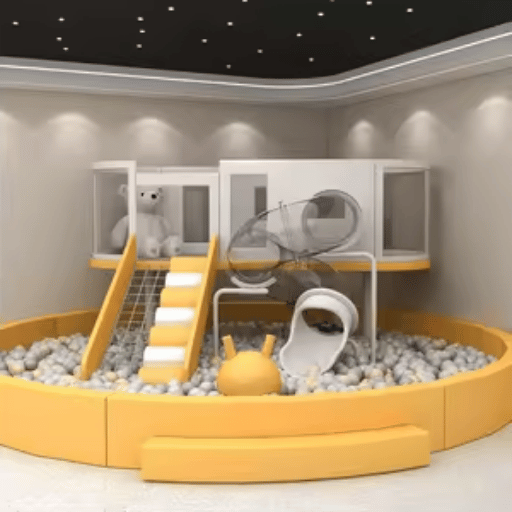
Quoted equipment price is the first number a buyer sees, and the misleading one. The five-year total cost of ownership for an indoor jungle gym installation runs 25-40% higher than the equipment quote alone when honestly accounted across four cost categories that rarely show up on the line item. The home tier is cleaner — buyers pay quoted price plus shipping, end of story. Commercial tier is where surprises live.
4-Category Indoor Jungle Gym Hidden Cost Map
| Category | Typical Hidden Amount | What It Covers |
|---|---|---|
| Compliance documentation | $500-$3,000 | Mill Test Certificate, ASTM cert pack, customs documents, IPEMA audit |
| Shipping surcharges | 20-30% of FOB price | Container demurrage, inland transport, last-mile delivery, customs broker |
| Site preparation | $1,000-$10,000 | Floor reinforcement, anchoring hardware, electrical for lighting, impact surfacing |
| Maintenance reserves | $1,000-$3,000 per year | Quarterly inspection sign-off, worn-part replacement, recertification documents |
The category that surprises mall-corner buyers most is shipping surcharges. A FOB-Guangzhou quote for a $50,000 modular system can land at $63,000-$65,000 by the time the container arrives at a US destination port and gets trucked to the install site — and that is before customs clearance fees. The buyers who avoid this either accept a higher CIF (port-of-destination) or DDP (door-to-door) quote up front, or build a 25% contingency line into the procurement budget.
For ROI, the headline figure venue operators chase is the 3-to-6 month payback period cited by larger operators. One 1,000 sqm operator reported a 3.1-month payback with $9.7M annual revenue and $1.9M net profit. Reality for smaller mall corners and daycare additions is more nuanced. Field operators observe that payback depends on party pricing — typical birthday party packages run around $425 per event, and weekend party revenue is the dominant profit driver. Open play volume alone rarely makes the math work for installations under 300 m².
Cost-Per-Climbing-Module ROI Threshold Rule
Payback breakeven for a mall-corner indoor jungle gym within a 12-month period occurs when the equation below is true in aggregate:
(Daily ticket volume × $5 average revenue per kid × 30) + (Weekend party count × $425) > (Capex ÷ 3) per month
The 1/3-of-capex monthly threshold accounts for site rent, staffing, insurance, utility, and maintenance reserves. If projected operations cannot clear this hurdle, the installation needs to be either re-scoped smaller (cutting capex) or larger (adding party-capable capacity).
Lead Time, Shipping & Installation — What Venue Buyers Need to Plan
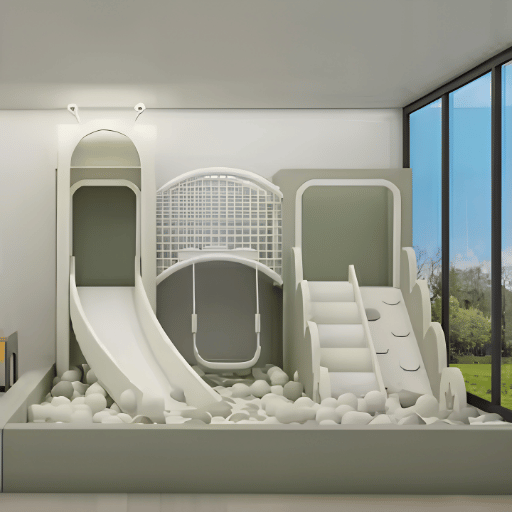
The order-to-grand-opening timeline rarely matches the manufacturing quote. Catalog orders for express SKUs ship from the factory in 4-6 weeks, but the full pipeline including international transit, customs clearance per US CPSIA tracking-label requirements, and on-site installation runs longer. The table below maps the three lead-time tiers Didi Land uses across 40+ export countries, including the indoor jungle gym category specifically.
| Order Type | Manufacturing | + Sea Freight | + Installation | Total |
|---|---|---|---|---|
| Express catalog | 4-6 weeks | 3-6 weeks | 3-7 days | 8-13 weeks |
| Standard custom theme | 8-10 weeks | 3-6 weeks | 3-7 days | 12-17 weeks |
| Bespoke OEM | 12-16 weeks | 3-6 weeks | 3-7 days | 16-23 weeks |
The shipping term choice is where venue buyers either lock in cost certainty or take on hidden exposure. FOB Guangzhou hands the container to the buyer at the Chinese port — the buyer pays ocean freight, insurance, destination port handling, customs, and last-mile delivery separately. CIF (cost-insurance-freight) to destination port bundles ocean transport but stops at the foreign port. DDP (delivered duty paid) is the highest sticker price but the most predictable — the supplier handles freight, customs clearance, and last-mile delivery to the install site door. Mall-corner installations on tight grand-opening deadlines almost always benefit from DDP because a single customs delay can cost a tenant more in lease overhead than the DDP premium itself.
📐 Engineering Note
QC milestone documentation is the single most-ignored quality control mechanism. A factory-direct supplier should issue photo reports at three gates: frame inspection (post-welding), surface inspection (post-coating), and assembly inspection (pre-packing). If the supplier cannot produce these three photo reports for your specific order number, the equipment may have skipped intermediate QC checks — request the gate reports before container loading.
7 Common Indoor Jungle Gym Buying Mistakes — What Mall Investors and Daycare Directors Learn the Hard Way
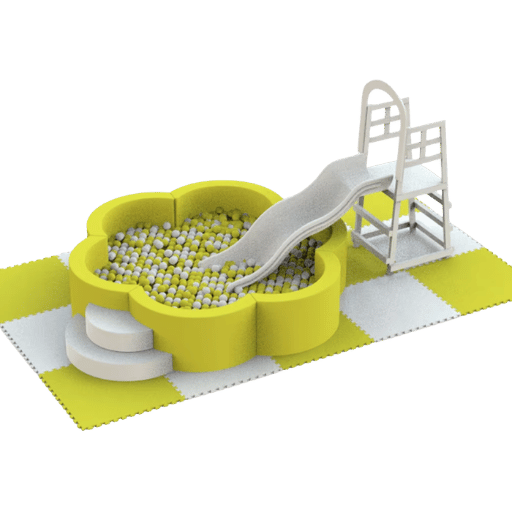
Patterns repeat across the buyer-feedback loop, and after enough installations the same seven mistakes show up regardless of country, venue type, or budget. The seven below come from industry design analyses and the Didi Land first-party customer feedback record across 23 countries of indoor jungle gym deployments.
- Buying F1487-only when the venue has a soft-contained play zone. The most common compliance gap. F1918 is a separate standard for ball pits, foam structures, and padded crawl tubes. A purchase order that lists only F1487-25 documentation leaves the soft play module uncertified.
- Accepting an FOB-only quote without modeling shipping surcharges. Ocean freight, demurrage, inland transit, and last-mile delivery typically add 20-30% to the FOB number. Either get a CIF or DDP quote, or budget 25% contingency.
- Specifying tube wall thickness that fails commercial traffic. Galvanized steel tube wall thinner than the minimum thickness for commercial use leads to the 12-18 month crack patterns observed across budget supplier installations. Mill Test Certificates document the actual thickness — ask for them.
- Generic kit purchasing without footprint customization. An off-the-shelf 350 m² jungle gym kit will not fit a 200 m² mall corner without expensive on-site modification. Custom OEM lead times exist for a reason. Provide the floor plan before the quote.
- Ignoring use zone clearance. The ASTM F1487-25 1.83 m clearance around equipment is non-negotiable for inspection. Crowding tables, host stations, or traffic flow into the use zone fails CPSC inspection and concentrates wear on the equipment edges.
- Skipping in-situ certification. Lab-certified equipment can still fail field tests post-installation. The National Program for Playground Safety documented a 36% HIC variance between lab and in-situ tests on 9-12 ft structures. Request post-install in-situ certification, not just factory paperwork.
- Underestimating maintenance reserves. Quarterly inspection sign-offs, worn-part replacement, and recertification documents cost about $1,000-$3,000 annually for a Tier 4 installation. Operators who treat maintenance as a one-time purchase end up deferring inspections and accumulating compliance debt.
3-Venue Field Case Studies — Mall, Daycare, and FEC Real Installations
Didi Land has shipped indoor jungle gym installations to 23 of the 40+ countries it exports to, with three of the most-instructive deployments summarized below. These are real installations with documented footprint, age range, theme integration, and outcome data — each conforming to its host market’s playground equipment standard (CPSC handbook for US, EN 1176-1 for EU, or IAAPA-tracked alternates for other regions).
Case 1: Malaysian Shopping Mall
Scope: 800 m² Jungle Theme installation
Age: 3-12 years
Year: 2024
A mid-priced mall corner upgrade in a tropical climate. The buyer required Jungle Theme decoration consistent with two adjacent tenant kiosks. Material specifications were upgraded for elevated humidity and tropical UV exposure, with the use zone planned around mall foot traffic peaks of 800+ kids on Saturday afternoons.
Case 2: French Kindergarten
Scope: 80 m² toddler soft play
Age: 2-5 years
Year: 2024
An EN 1176-1:2017+A1:2024 compliant installation for a daycare center in greater Paris. French parents requested chemical substance verification on all soft play components per CPSIA-equivalent EU regulations. Documentation pack included EN 1176-1 certification, REACH compliance for foam materials, and TÜV-equivalent third-party testing.
Case 3: Mexican FEC
Scope: 1,500 m² modular FEC
Mix: Trampoline + ninja course + soft play including indoor jungle gym zone
Year: 2025
A capital-city family entertainment center serving three demographic-specific zones (toddlers, 6-10 year, 10-14 year). Indoor jungle gym module sized for 6-10 year tier with adjacent obstacle course capacity for older kids. Projected operations targeted approximately $120,000 monthly revenue across ticket sales and birthday party packages.
“When I founded Didi Land in 2014, I had spent two years studying why so many indoor playground installations failed within 18 months. Wall thickness on galvanized tube was too thin, foam density on soft play was borderline, and after-sales kept buyers waiting for months. Every indoor jungle gym shipment leaving Guangzhou now gets my final sign-off before container loading.”
— Cherry, CEO & Co-Founder, Guangzhou Didi Land Amusement Equipment Co., Ltd.
2026 Industry Outlook — Where Indoor Jungle Gyms Are Heading
The indoor playground equipment market is projected to grow from $4.8 billion in 2025 to $9.2 billion by 2034 at a 7.5% CAGR — well above the broader recreational equipment baseline. Three specific signals shape what buyers should plan for in 2026.
First, the Family Entertainment Center segment is driving this significant growth, with market researchers anticipating a CAGR of 10.2% through 2033, starting from a 2024 market size of $34.6 billion. This aligns with Didi Land’s order schedule between 2024 and 2025, where obstacle course and climbing wall modules combined with indoor jungle gyms have proven to be the most rapidly expanding configuration—operators that combine these three modules appeal to all age groups from a single capital expenditure.
Second, the July 2025 CPSC Public Playground Safety Handbook update brought enhanced clearance and crush-zone guidance, and equipment installed before the update may need re-validation against ASTM F1487-25 to remain inspection-ready. Mall and daycare operators with installations from 2022-2024 should request re-inspection documentation from their supplier in the first half of 2026 to avoid compliance gaps surfacing at lease renewals.
Third, themed playground structures continue to elicit a 15-35% price premium above their unthemed equivalents. With the Adult Entertainment Center segment growing at a pace exceeding the neighboring recreational activities sector, tailored jungle gym structures (space, ocean, jungle, sweet treats) seem to amortize their premium investment within their opening season through parent word-of-mouth. Developers planning 2026 construction should consider theme design as an income capital investment rather than simply as a cosmetic element. Also, if project owners are budgeting for a Q3 2026 grand opening, buying lead-time should begin by Q1 2026, seeing as bespoke OEM projects require 16-23 weeks lead time.
FAQ — Indoor Jungle Gym Buyer Questions Answered
Q: Is an indoor jungle gym worth it?
View Answer
For an active toddler or preschooler, a $349-$2,500 home indoor jungle gym typically becomes a favorite daily-use toy for two to four years before the child outgrows it — a worthwhile and reliably fun investment compared to weekly trampoline park visits. For a commercial venue operator, the answer hinges on party pricing and capacity utilization: mall corners and daycares routinely recover their $25,000-$80,000 investment within 12-24 months when weekend party programs are part of the operating model. Open-play-only operations rarely pencil out below 300 m².
Q: How much does it cost to have an indoor playground?
View Answer
Total cost spans five tiers depending on use case. Home wooden Pikler-style climbers start at $349 and reach about $770. Tension-mount and modular premium home systems run $850-$2,500. Light commercial installations for daycares, hotels, and restaurants cost $25,000-$80,000 for 100-300 m². Full FEC builds with multiple modules range $80,000 to $1 million-plus depending on footprint. Add 25% contingency for the four hidden cost categories (compliance documentation, shipping surcharges, site preparation, maintenance reserves) when budgeting commercial installations.
Q: Are Montessori jungle gyms safe?
View Answer
Montessori-style climbers — Pikler triangles, climbing arches, and modular wooden play sets — are designed for ages 6 months to 5 years and meet CPSIA voluntary testing for lead and phthalates. Safety in practice depends on three things: a soft landing mat at least 2.1 m wide under the highest climb point, supervision for children under 3, and confirming the manufacturer publishes the maximum age and weight rating before purchase. Falls happen even with proper setup, so paired flooring (foam tiles or area rugs over a hard surface) is non-negotiable.
Q: What’s the difference between commercial and home indoor jungle gym?
View Answer
Commercial indoor jungle gym equipment is engineered for continuous high-traffic use — mall installations routinely see 800+ kids on a Saturday. Material grade reflects this: galvanized steel frame at minimum commercial wall thickness, HDPE polymer panels at premium grade, and impact surfacing tested to ASTM F1292-18 G-max ≤200. Standards stack includes ASTM F1487-25 for the frame, F1918 for soft contained play modules, IPEMA third-party certification, and EN 1176-1 for European installations. Home equipment skips the third-party certification, ships with consumer-grade plywood or solid wood, and carries a 1-2 year warranty rather than the 12-month plus lifetime parts coverage typical of commercial installations. Durability ratings reflect this: commercial 7-10 years before major refurbishment, home 2-4 years before children outgrow.
Q: Are there jungle gyms for adults?
View Answer
Adult-rated climbing structures exist in the parkour gym and ninja warrior training studio category, but these are not classified as indoor jungle gyms — different ASTM standards, higher load ratings, and adult-specific use zone planning apply.
Get a Free Indoor Jungle Gym Quote →
About This Indoor Jungle Gym Buying Guide
This guide combines public ASTM and EN standards documentation with 23-country indoor jungle gym deployment data from Didi Land’s 2014-2025 manufacturing record. Cost figures reflect 2024-2025 market data verified against retail listings and commercial supplier disclosures; pricing fluctuates with shipping rates and material costs, so request current quotes for any specific procurement. Compliance summaries are correct as of the July 2025 CPSC handbook update; venue operators with installations from 2022-2024 should request re-inspection documentation from their supplier in the first half of 2026.
References & Sources
- ASTM F1487-25 Standard Consumer Safety Performance Specification for Playground Equipment for Public Use — ASTM International
- ASTM F1918 Standard Safety Performance Specification for Soft Contained Play Equipment — ASTM International
- ASTM F1292-18 Standard Specification for Impact Attenuation of Surfacing — ASTM International
- CPSC Public Playground Safety Handbook (July 2025 Update) — U.S. Consumer Product Safety Commission
- CPSC Public Playground Surfacing Guide — U.S. Consumer Product Safety Commission
- EN 1176-1:2017+A1:2024 Playground Equipment and Surfacing — European Committee for Standardization (CEN)
- National Program for Playground Safety — Surfacing Sampling Presentation to ASTM F08 — National Program for Playground Safety
- Indoor Playground Equipment Market Report 2025-2034 — DataIntelo
- Family Entertainment Centers Market Forecast 2025-2033 — MarketDataForecast
- IAAPA Marketplace — Indoor Playground Equipment Suppliers — International Association of Amusement Parks and Attractions
Related Articles
- Indoor Playground ROI: Is It Worth the Investment in 2026? — Full ROI calculation for mall, FEC, and daycare operators
- The Indoor Playground Maintenance Guide for Operators — Cleaning, inspection, and compliance documentation
- Indoor Playground Franchise vs. Independent: 2026 Cost, Profit, and Risk Breakdown — For investors choosing operating models
- Soft Play Centre vs Indoor Playground: How Operators Choose — Comparison for daycare and FEC operators
- Indoor Jungle Gym Product Page — Didi Land Indoor Jungle Gym System specifications, 100-500 m² footprint
- Indoor Playground Themes & Custom Design — Jungle, Space, Ocean, Candy theme integration
![Custom Dinosaur Playground Equipment [Design Guide]](https://didiplayarea.com/wp-content/uploads/2026/09/custom-dinosaur-playground-equipment-r2-featured-1-150x150.png)