Get in Touch with Didi Land


![Sustainable Indoor Playground Material Certification [2026]](https://didiplayarea.com/wp-content/uploads/2026/07/sustainable-materials-certification-en1176-astm-as4685-featured.png)
Quick Specs: Sustainable Material Certification Stack
| Governing safety standards | EN 1176-1:2017+A1:2023 (EU), ASTM F1918-21 (US, soft-contained), AS 4685.1:2021 (AU, general playground) |
| Material/chemical limit | CPSIA phthalates ≤ 0.1% (1,000 ppm), 8 named phthalates, 16 CFR part 1307 |
| Common eco-labels | FSC (wood), Greenguard Gold (VOC/emissions), REACH (EU chemicals), RoHS (electrical components only), Cradle to Cradle (circularity) |
| Typical sustainable materials | Recycled HDPE panels, recycled-content steel, EVA/closed-cell foam, water-based low-VOC coatings |
| Certification issuer | ASTM/EN/AS write the standard; third-party bodies (IPEMA, TÜV, SGS) test and certify products against it |
Sustainable eco friendly material certification is verification that indoor playground materials meet both a safety standard (EN 1176, ASTM F1918, or AS 4685) and a separate sustainability requirement, such as recycled content, FSC-certified wood, or low-VOC coatings. It covers two separate questions any buyer needs to answer before signing off on an RFQ: is the structure safe, and does it use actual sustainable materials? If you hold an EN 1176 or ASTM F1918 certificate for your soft-contained play structure, it means you passed the impact-attenuation, entrapment, and structural tests of a compliant product, but it tells you nothing about the percentage of recycled plastic, FSC-certified wood, or low-VOC coating used in that product. Sustainability requires a separate document, such as a material test report, a recycled-content declaration, or a third-party eco-label. This guide covers which market applies which international safety standard to your materials, how eco-labels map to specific material categories, and how to identify authentic certification versus a marketing claim.
TL;DR, Key Facts
- Safety certification and material sustainability are two different documents. A supplier can have one without the other.
- ASTM F1918-21 (not F1487, not F1148) governs soft-contained indoor play equipment in the US; F1487 is for outdoor public playgrounds.
- AS 4685.1:2021 is a modified adoption of EN 1176-1:2017, although Australian indoor, contained play areas do use a different standard – AS 3533.4.2-2013.
- Only a part that has an electronic component needs to comply with RoHS – pure structural plastic, foam or steel is excluded.
- No US federal agency promulgates a single binding playground certification. ASTM consensus standards are voluntary, though a number of states incorporate them into regulation by reference.
Why Material Certification Matters Before You Sign an Indoor Playground RFQ
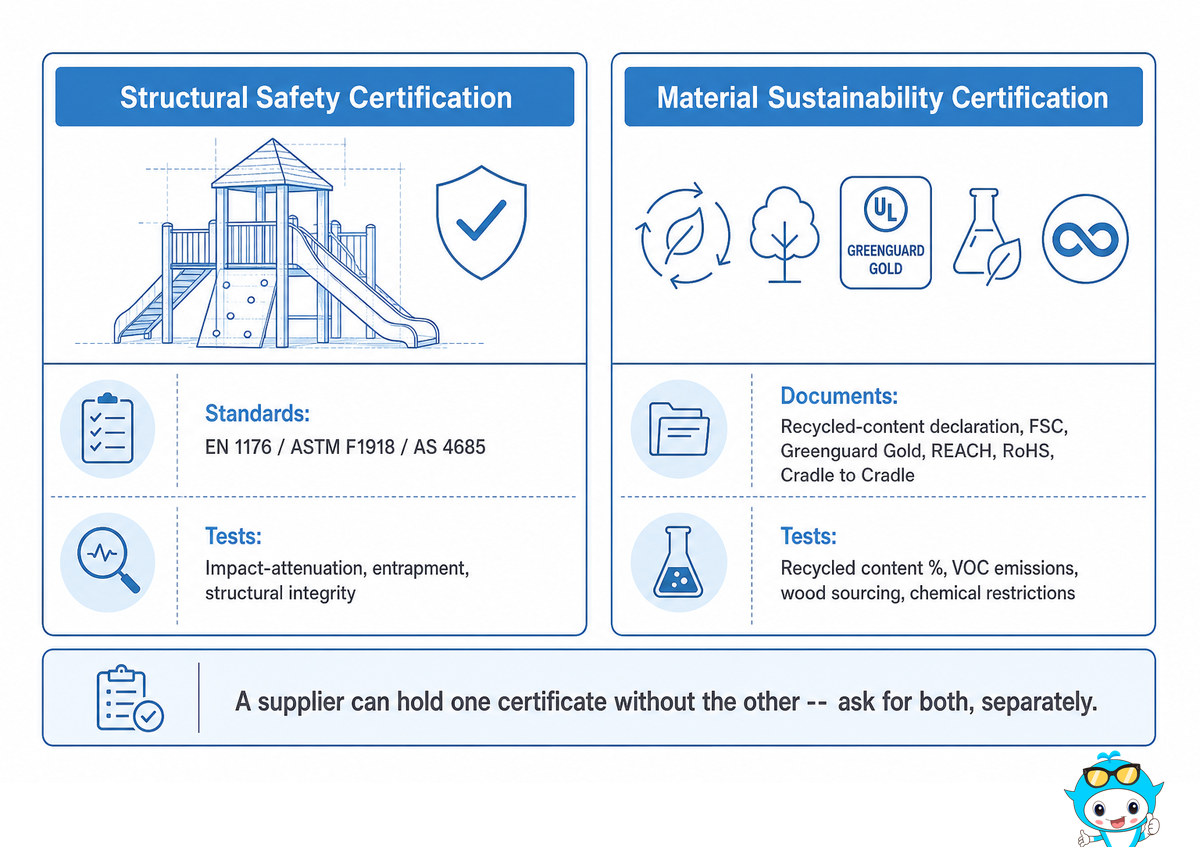
Structural and impact-attenuation certification (EN 1176, astm F1918, AS 4685) tests whether a slide traps fingers or a fall surface absorbs enough impact energy — it does not test recycled content, chemical offgassing, or wood sourcing. If your RFQ for a new eco friendly indoor playground just says “must be certified,” define which of the two you mean, or vendors will default to the cheaper report: the safety report.
2
separate document types (safety vs. material)
0.1%
CPSIA phthalate limit (1,000 ppm)
3
governing standards to check by market (EN 1176, ASTM F1918, AS 4685)
💡 Pro Tip
If your RFQ mentions “certified materials,” add this one line: “please supply the material-specific test report or eco-label certificate separately from the structural safety report.” That one sentence slams shut the back door that most suppliers use.
Across the indoor playground industry — and the broader commercial playground equipment market it sits inside — buyers evaluating playground solutions for a new commercial indoor playground increasingly expect both quality materials and quality equipment, with safety and quality treated as a single procurement line rather than two afterthoughts. Product safety and quality expectations, baseline safety requirements, and any strict safety standards a venue’s insurer demands all belong on the same RFQ page, not scattered across separate emails.
Which Standard Actually Governs Your Materials, EN 1176 vs ASTM F1918 vs AS 4685
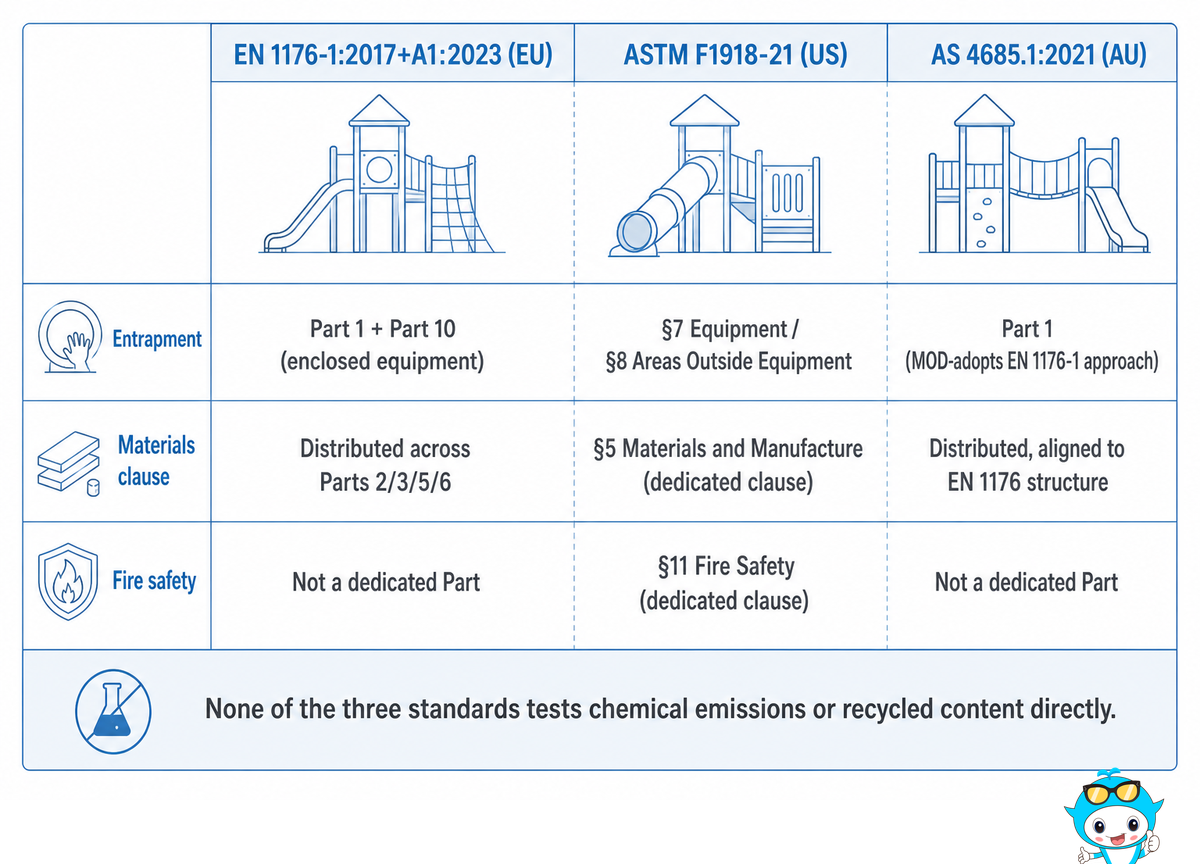
Soft-contained play equipment is governed by astm F1918-21 in the US, while EN 1176-1:2017+A1:2023 governs the same category across the EU (fully enclosed play equipment comes under Part 10 of this EN standard). In Australia, AS 4685.1:2021 governs general playground equipment. Each tests common impact-attenuation, structural-integrity, entrapment, and flammability hazards, but the reports aren’t a “one-size-fits-all” purchase.
| Test category | EN 1176 (EU) | ASTM F1918 (US) | AS 4685 (AU) |
|---|---|---|---|
| Impact attenuation | EN 1177 (companion surfacing standard) | §6 Performance Requirements | Covered under AS 4685.1 general safety req. |
| Entrapment (head/finger/limb) | Part 1 general + Part 10 (enclosed equipment) | §7 Equipment / §8 Areas Outside Equipment | Part 1 (MOD-adopts EN 1176-1 approach) |
| Materials & manufacture | Distributed across relevant Parts (2/3/5/6) | §5 Materials and Manufacture (dedicated clause) | Distributed, aligned to EN 1176 structure |
| Flammability / fire safety | Not a dedicated Part — addressed via material req. | §11 Fire Safety (dedicated clause) | Not a dedicated Part |
| Chemical / VOC emission | Outside scope — covered by REACH separately | Outside scope — covered by CPSIA separately | Outside scope — covered by state EPA rules |
| Limitations / not covered | Outdoor + indoor structures only, not “contained play facility” operational rules | Explicitly excludes public/home playground equipment, sports equipment, amusement rides | Does not govern indoor “contained play facilities” — see note below |
None of the three standards actually tests for chemical emissions or recycled content, although the eco-label decoder below should do that. Remember not to interpret any one row above as an equivalent for the exact text of the purchased standard, and not to look for a matching number for a specific row in this table that correlates to a particular row of text on the purchased standard.
What Is the Difference Between ASTM F1487 and ASTM F1918?
ASTM F1487 governs outdoor public playground equipment in schools, parks, and childcare centers. ASTM F1918 governs soft-contained play equipment in indoor family entertainment centers — ball pits, foam climbers, and similar structures — and explicitly excludes outdoor public playground equipment, home equipment, and amusement rides. If you’re buying indoor soft-contained equipment, ask for F1918, not F1487. IPEMA certifies products against these standards; ASTM authors them but doesn’t test or certify.
📐 Engineering Note
Within the Materials and Manufacture section of astm F1918-21-Section 5-it calls for the use of HDPE panels and powder-coated steel in order to resist staining and color fade through exposure to cleaning chemicals, and for the use of closed-cell foam which maintains its shape when repeatedly compressed-these are the basic minimum requirements for how the equipment is designed to hold up to daily commercial use. Didi Land’s soft-contained lines use galvanized steel over 3.34 in. in diameter, which has been tested for fatigue resistance according to EN 1176, high-density foam impact wrap with 72mm of density and rotomolded HDPE and LLDPE for the slide and tube panels. For the slide the test parameters are additionally cross-referenced to the specific testing guidelines outlined in EN 1176-3:2017.
AS 4685.1:2021 is considered a modified adoption of EN 1176-1:2017 “EN 1176-1:2017, MOD.” This makes the European-Australian discrepancy primarily mechanical in nature and smaller than the European-US one where astm F1918 is an independently drafted and structured standard, which means its clause numbering doesn’t correlate with the EU standards.
Bottom line here: make sure you’re specifying the correct standard based on the equipment type you’re working with, F1918 for indoor soft-contained equipment, F1487 for outdoor public playground equipment, not both. You’ll also want to confirm the material clause (Section 5 for the US standard) as a separate question from the impact-safety clause, which sits under another section entirely, because they answer very different buyer questions.
Buyers researching international standards for indoor playground equipment safety will find that international safety standards vary by market: the European safety standard track runs through EN 1176, the Australia safety standards track runs through AS 4685 and AS 3533.4.2, and North American buyers may also encounter the Canadian Standards Association framework referenced alongside ASTM. Local safety authorities and the International Organization for Standardization both shape how technical standards and performance standards for indoor playground safety end up enforced, and compliance with ASTM alone does not guarantee recognized safety in every export market — closing that exact standards for playground equipment gap is what the Standards Translator above is for.
Material-by-Material: What’s Actually Sustainable in Soft Play and Structural Components
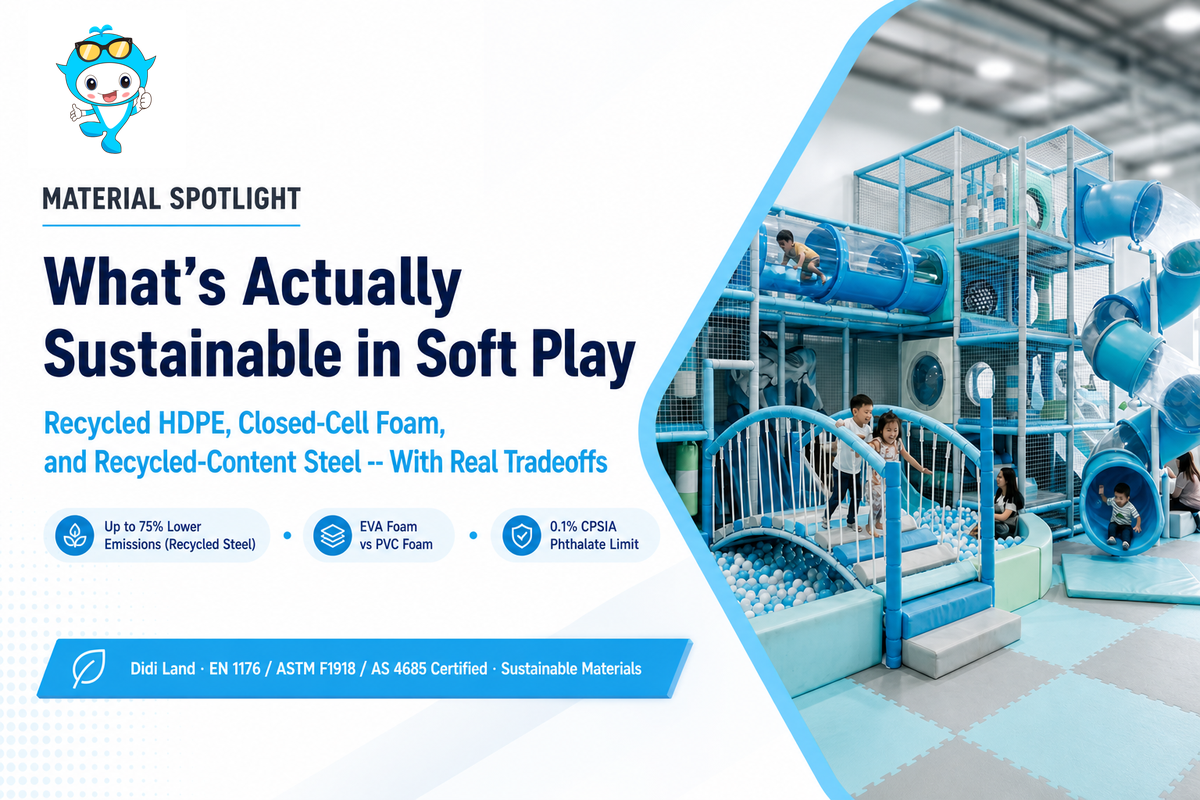
Four material areas in indoor playground equipment carry the bulk of any potential environmental footprint, structural steel, impact foam, slide/tube panels, and coatings, and each has alternatives with documented sustainable benefits and associated tradeoffs.
Closed-cell EVA foam
- Retains shape under repeated compression (matches ASTM F1918 §5 intent)
- Lower off-gassing profile than flexible PVC foam
- Costs more per unit volume than PVC foam
- Harder to source in custom densities at scale
Flexible PVC foam
- Lower unit cost, widely available
- Requires phthalate-free formulation to meet CPSIA 0.1%/1,000 ppm limit
- Historically associated with higher VOC off-gassing if uncontrolled
- Still dominant in budget-tier equipment
Although adoption of recycled materials in some areas of indoor playground equipment is widespread, the use of recycled content varies by material type. Recycled-plastic structural components are not a novel concept for playground equipment either — patent literature describing a playground structural member built from recycled plastic shows the manufacturing approach has an established engineering record, separate from any individual supplier’s marketing claim. For instance, EcoPlay Structures uses 100% recycled HDPE for its decks and roofs and has, since 2005, reclaimed more than 18 million milk jugs for its structures. Additionally, KOMPAN has an entirely new line of CircularHDPE panels launching in 2024 that use 95% recycled materials from consumer waste with claims of reducing the environmental impact by up to 82% per kilogram (CO2e/kg) in comparison to virgin materials. Please note that this data has been provided by manufacturers and should be viewed as anecdotal information and not an absolute guarantee.
Recycled-content steel
- American Iron and Steel Institute: recycled steel use can cut emissions up to 75% versus virgin steel
- No strength/fatigue-testing tradeoff — recycled steel meets the same mill-cert specs as virgin steel
- Powder-coat adhesion identical to virgin-steel substrate
- Supply availability varies by region and mill
Virgin steel
- Guaranteed consistent mill-cert traceability
- Higher embodied-carbon footprint per AISI’s own comparison
- No sustainability paper-trail advantage for RFQs with green-procurement scoring
- Often the default unless a buyer specifically asks for recycled content
The certification part of indoor playground equipment is also illustrated by Didi Land’s own certified lines. Its Indoor Play Structures 7-series product line comes with certification for astm f1487-21, EN 1176-1/-2/-3, EN 1177, TÜV, ISO 9001, and RoHS. Didi Land’s certified Toddler Indoor playground line includes EN 1176-10:2023, AS 4685.1:2021, astm F2373, and astm F1292. Keep in mind that RoHS applies to products that independently qualify as electrical or electronic equipment under the directive’s own functional test (equipment “dependent on electric currents…to work properly”). A play structure that doesn’t itself need electricity to function, such as a slide, foam block, or steel frame, generally falls outside that test, though an embedded electronic component (an interactive panel, sensor, or lighting module) may still be assessed against RoHS on its own. Therefore, when you see “RoHS-compliant” cited as a material standard, confirm which specific components the declaration actually covers rather than assuming it blankets the entire structure.
⚠️ Important
Recycled content alone does not earn a safety pass. The EPA, in particular, has noted that recycled tire crumb rubber can contain residual heavy metals and other organic compounds, and playground-specific exposure-risk assessment work in that material class is still ongoing. Material sourcing and chemical-safety testing are distinct issues, be sure to ask for both and don’t take one for the other.
Sustainable-material sourcing has to hold up against the same physical parameters the safety standards test, not just the chemical ones. For instance, Didi Land’s toddler line products cover ages 6 months to 5 years, with component weight capacity of 50 kg to 100 kg. Its slide product line spans a fall height range of 1.2 m to 5.0 m, and is suited for children ages 2 years to 12 years.
Yet the coatings and recycled-content panels must pass slide-specific structural testing under EN 1176-3:2017, as well as withstand a typical 3 years to 10 years warranty period at these load capacities and fall height standards. Lead time is normally 25 days to 60 days on configurations in the toddler line, thus leaving the customer ample opportunity to request an individual material test report before order processing continues. Consult our indoor playground equipment Toddler guide for detailed information regarding the full certification stack or, for information on astm f1487-25 and slide EN 1176-3:2017 specific test results for our indoor playground slide product line, consult that specific data sheet.
Material safety considerations shape equipment design across playground designs and playground structures alike — from the moving parts on climbing equipment to the safety and environmental profile of sensory play panels in a kids play space. Whether you’re installing indoor playgrounds fresh or retrofitting outdoor playgrounds into an indoor footprint, the playground installation crew needs the same material test report before signing off, regardless of which piece of equipment they’re bolting down.
Eco-Certification Decoder: FSC, Greenguard, REACH/RoHS, and Cradle to Cradle
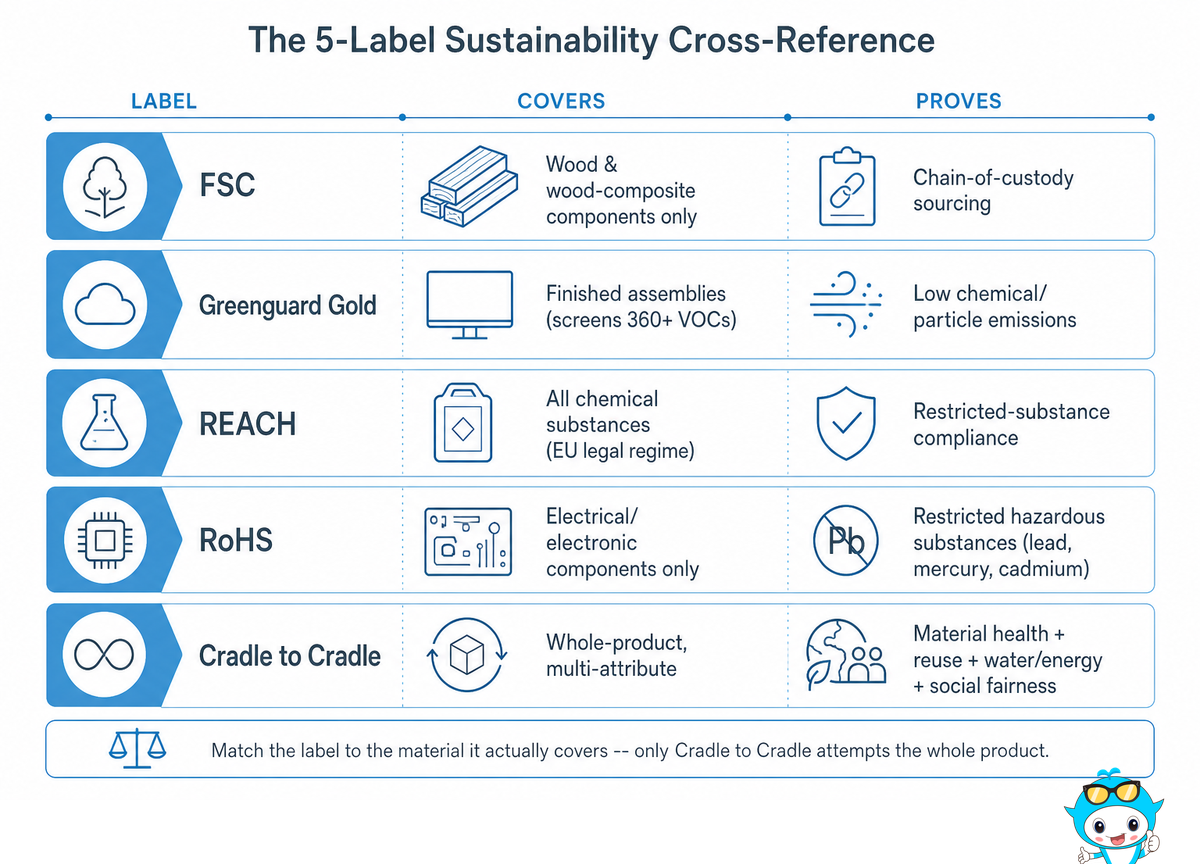
Five eco-labels dominate playground material sustainability claims, and each certifies a material type through its own distinct verification method, treating them like generic “green” icons on a spec sheet is how a real certification most often gets mistaken for a marketing statement. The RoHS Directive and the CPSIA phthalate rule are the two most commonly confused with a general eco-label, when they’re actually specific chemical-restriction laws.
| Label | Material category it covers | What it actually proves | How to verify |
|---|---|---|---|
| FSC (Forest Stewardship Council) | Wood and wood-composite components only | Chain-of-custody: timber sourced from responsibly managed forests, tracked through the supply chain | Request the FSC chain-of-custody certificate number, verify on FSC’s public database |
| Greenguard Gold | Finished assemblies (screens >360 individual VOCs) | Low chemical/particle emissions; stricter formaldehyde and TVOC caps than standard Greenguard, accepted for school/healthcare use | Request the UL Greenguard certificate ID and product-level scope (not just company-level) |
| REACH | All chemical substances used in manufacture (EU legal regime, not a voluntary label) | Restricted-substance compliance, including phthalate limits, under EU chemical law | Request the supplier’s REACH compliance declaration referencing the specific substance list checked |
| RoHS | Electrical/electronic components only — sensors, lighting, interactive panels | Restricted hazardous substances (lead, mercury, cadmium, etc.) in electrical parts specifically | Confirm which specific components the RoHS declaration covers — it does not extend to bulk structural plastic or steel |
| Cradle to Cradle (C2C) | Whole-product, multi-attribute program (material health + reuse + water/energy + social fairness) | Broadest and most rigorous of the five — a full circular-design assessment, not a single-issue label | Request the C2C certificate level (Bronze through Platinum) and product scope from the certifying body |
What Is Appropriate Playground Surfacing Material?
Appropriate playground surfacing material combines an impact-attenuation rating tested to EN 1177 or the comparable US/AU method with a documented chemical-safety profile, rubber, engineered wood fiber, and poured-in-place surfacing all belong to different testing categories and can’t inherit safety from the structure above them. Recycled content in surfacing reduces tire waste but doesn’t by itself establish chemical safety, request the surfacing-specific test report separately.
Industry buy-in shows that this trend makes sense: per an independent furniture-certification guide, Crate & Kids is working to have 60% of its furniture FSC-certified by 2027, and Max & Lily is aiming for 100% Greenguard certification by the same year. These are real certification commitments, not marketing claims from self-published copy. Certifications typically remain active for 1 year to 3 years, and need to undergo retesting after they expire.
Key takeaway: Match the label to the material it actually covers before accepting it as proof, only FSC addresses wood, only RoHS addresses electrical/electronic components, and only Cradle to Cradle attempts to address the whole product.
Equivalence Testing: Does an EN 1176 Certificate Cover You for a US or Australian Buyer?
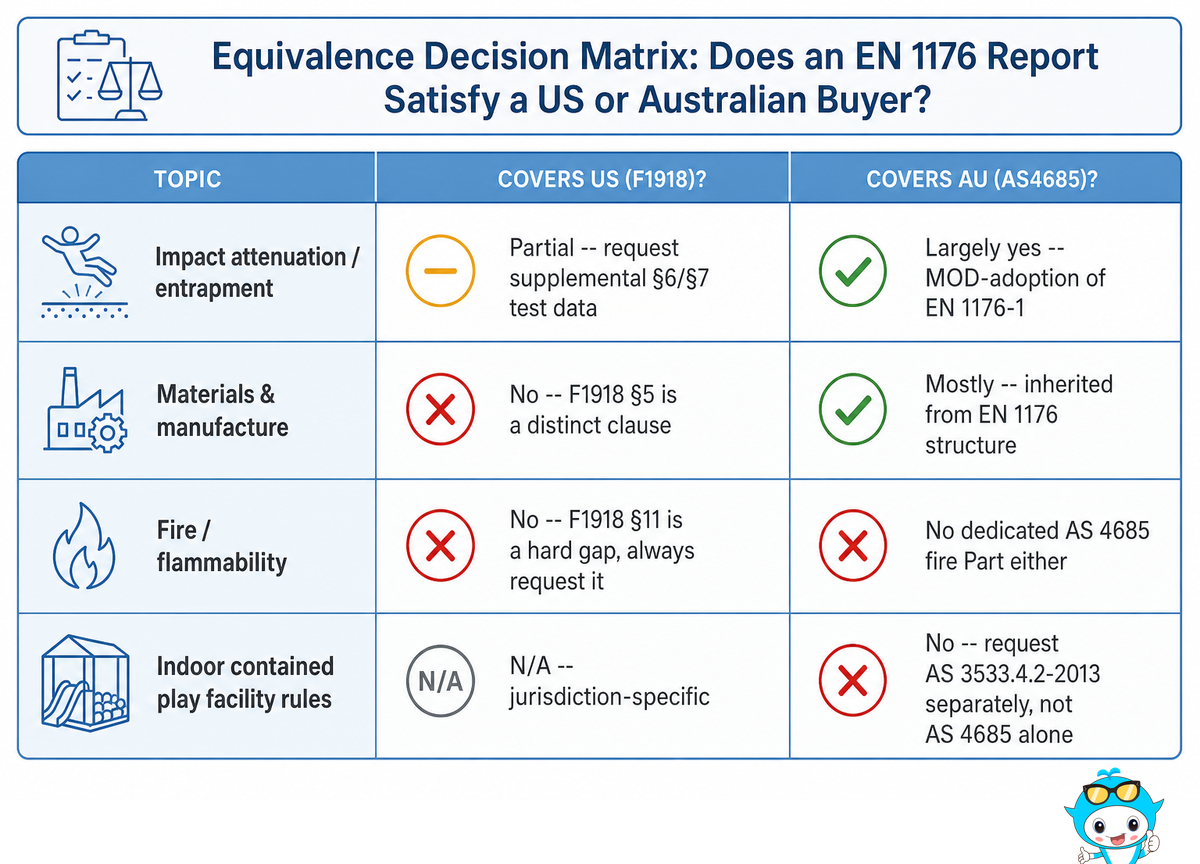
EN 1176 certification alone does not automatically satisfy US or Australian buyers — legality differs across all three standards, even though testing philosophies overlap. AS 4685.1:2021’s MOD-adoption of EN 1176-1:2017 narrows the EU-to-Australia gap to a minor degree, while astm F1918’s independent clause structure means the EU-to-US gap usually requires separate testing. For a full standards comparison, see ANSI’s overview of ASTM playground standards.
| Test category | Covers US (ASTM F1918)? | Covers AU (AS 4685)? | Gap / action needed |
|---|---|---|---|
| Impact attenuation / entrapment | Partial — methodology overlaps but F1918 uses its own clause structure | Largely yes — AS 4685.1 is a MOD-adoption of EN 1176-1 | US: request supplemental F1918 §6/§7 test data. AU: minor delta only. |
| Materials & manufacture | No — F1918 §5 is a distinct dedicated clause | Mostly — inherited from EN 1176 structure | US: always request F1918 §5-specific material data separately. |
| Fire/flammability | No — EN 1176 has no dedicated fire Part; F1918 §11 does | No dedicated AS 4685 fire Part either | US: F1918 §11 fire-safety data is a hard gap, always request it. |
| Indoor “contained play facility” operational rules | N/A (facility rules are jurisdiction-specific in the US) | No — AS 4685 does not govern this category | AU: request AS 3533.4.2-2013 compliance (used with AS 3533 Parts 1-2) for enclosed indoor play facilities specifically — not AS 4685 alone. |
The last entry may be confusing at first glance: while most customers reference and most suppliers highlight AS 4685, Australia’s indoor “contained play facility” classification – those commercial soft-play interiors exactly as described here – are regulated by AS 3533.4.2-2013 (used with AS 3533 Parts 1 and 2) instead of only AS 4685. Be sure to ask both if ordering for an indoor facility in Australia.
Three compliance omissions commonly occur in 2026 international orders: customers order astm only products for a European venue or vice versa, installers fail to seek external third-party IPEMA verification and renovation projects are based on an outdated pre-2021 standards revision. Double-check the edition before ordering closes two of these gaps.
Our guide on playground safety standards for each export market can provide a detailed explanation of required and voluntary enforcement standards for various nations and highlight the updates from the astm f1487-25 revision for sites that include indoor soft-contained units in addition to outdoor play equipment.
Main lesson: a certificate from one country doesn’t automatically apply to others; request standards for the target market, and specifically for Australian indoor installations, be sure to ask for AS 3533.4.2 along with AS 4685.
Is ASTM Certification Mandatory, and How Do You Verify a Sustainability Claim Is Real?
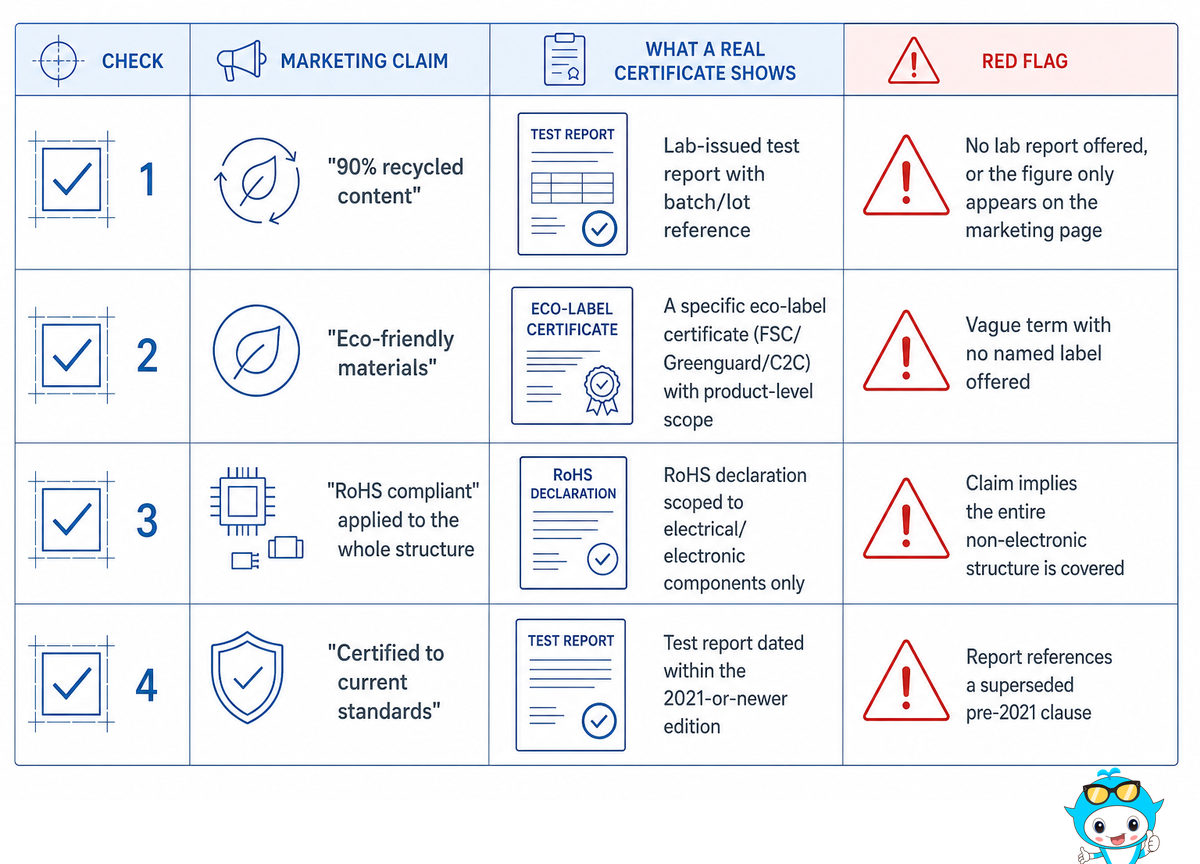
No federal law requires astm certification for indoor playground equipment in the US — the CPSC treats these consensus standards as voluntary. Several states, however, reference the standard in their own regulatory code, and most liability insurers demand certification regardless of federal mandates. “Mandatory” and “insurable” are not the same threshold; a supplier presenting ASTM as universally mandatory is glossing over that distinction.
“Direct verification should confirm factory ownership, request named-standard compliance documentation, and check real project references before committing capital, many suppliers obtain testing reports from independent inspection agencies specifically to demonstrate the equipment has actually been tested, not just designed, against the standard they cite.”
Industry sourcing guidance, family entertainment center supplier verification practice
Is ASTM Certification Mandatory for Indoor Playground Equipment in the United States?
No US federal entity imposes mandatory astm certification requirements on indoor playground equipment. According to the CPSC, this equipment category does not have a specific certification requirement, and the applicable ASTM F15.29 subcommittee standards remain voluntary documents which certify the equipment is safe rather than bestow a formal operational license. In practice, “voluntary” seldom equates to “optional”; insurers, franchise contracts, and building permit departments frequently insist upon it even in the absence of any statutory mandate.
| Claim category | Marketing claim | What a real certificate shows | How to verify | Red flag |
|---|---|---|---|---|
| Recycled content | “90% recycled content” | A lab-issued recycled-content test report with batch/lot reference | Ask for the third-party lab name and report number, not just a supplier-stated percentage | No lab report offered, or the figure only appears on the marketing page |
| Cert program misuse | “ISO 9001 certified” used as a sustainability signal | A quality-management-system certificate — has nothing to do with material sustainability | Check what the ISO cert actually scopes (quality management, not environmental) | Cert is real but is being cited to answer a different question |
| Vague label | “Eco-friendly materials” | A specific eco-label certificate (FSC/Greenguard/C2C) with product-level scope | Request certificate ID + expiry date + which specific components it covers | Vague term with no named label or verification path offered |
| Component scope | “RoHS compliant” applied to the whole structure | RoHS declaration scoped to the actual electrical/electronic components only | Ask which specific parts the declaration covers | Claim implies the entire non-electronic structure is covered |
| Program tier | “Greenguard certified” without naming the tier | A dated certificate specifying Greenguard or Greenguard Gold, the stricter tier | Ask which tier and the VOC-count screened, not just the brand name | Certificate tier omitted, or a decade-old certificate reused |
| Expired document | “Certified to current standards” | A test report dated within the current standard edition (2021 or newer) | Check the edition year printed on the report itself | Report references a superseded pre-2021 clause number |
| Company-level vs. product-level | “Our factory is certified” | A product-specific certificate naming the exact SKU tested | Ask whether the certificate covers the facility or the specific product line you’re ordering | Only a facility-level ISO/QMS certificate is offered, no product-level report |
| Self-declaration | Supplier-authored “compliance statement” PDF | An independent third-party lab report with a checkable certificate ID | Search the certificate number on the issuing body’s public database | Document is on supplier letterhead with no external registry reference |
| Limitations / Not sufficient alone | Even a genuine certificate only covers the specific material batch and scope tested — it doesn’t retroactively cover a different production run, and it should be dated within the current standard edition. | |||
Note: We deliberately avoided the term “mill cert audit” to avoid confusion, as this terminology is used in a different Didi Land document. Refer to our soft play equipment safety standards guide for structural-certification vetting criteria, and the 2026 CPSC e-filing import certification requirement for details on what’s required at the US border irrespective of the voluntary standard aspect mentioned previously.
Main lesson: a certificate’s utility is determined by its coverage scope-verify what was evaluated, who issued it, and if the information addresses your safety or sustainability concerns or neither.
RFQ-Ready: What to Put in Your Spec Sheet
Getting a supplier to answer both halves of the certification question fastest means being very explicit about both halves in your RFQ. Most vendors will give you just what you asked for, and no more, an RFQ that just asks for “certified” is a one-document answer. Budget 2 weeks to 4 weeks of additional schedule lead time for your supplier to get material-specific reports (if not already on hand), on top of your usual 25 days to 60 days production lead time. Allow an extra 5 days to 10 days in case an equipment re-test against the current edition standard is necessary. Before finalizing the line item, confirm the exact standard document and edition against the primary source (for example, the ASTM F1918-21 standard text itself) rather than relying on a supplier’s paraphrase of it.
RFQ checklist — copy these lines into your quote request:
| Parameter | Recommended range / ask | Why it matters | How to verify |
|---|---|---|---|
| Structural safety standard | F1918-21 (US) / EN 1176-1:2017+A1:2023 (EU) / AS 4685.1:2021 + AS 3533.4.2 (AU indoor) | Confirms the correct standard for equipment type and destination market | Request the dated test report, not a generic compliance statement |
| Material certification (separate line) | Recycled-content %, FSC/Greenguard/C2C certificate ID | Closes the safety-vs-sustainability document gap | Ask for lab report + certificate ID, not a marketing PDF |
| Chemical safety (phthalates/VOC) | CPSIA ≤ 0.1% (1,000 ppm), Greenguard Gold if applicable | Required for accessible components on any children’s play product | Third-party phthalate/VOC test report with batch reference |
| Third-party certifying body | IPEMA / TÜV / SGS named explicitly | Confirms an independent body tested the product, not just the supplier’s self-declaration | Cross-check the certificate number on the issuing body’s public database |
| Standard edition/date | 2021 or newer for all three standards | Standards revise; a pre-2021 report may reference a superseded clause | Check the edition year printed on the test report itself |
If you’re looking for broader spec-audit tools that go beyond materials (e.g., tolerances, warranties, factory inspections), consider our indoor playground equipment buyer’s spec audit guide and indoor playground equipment supplier evaluation guide for inspecting the vendor behind the certificate.
Bottom line: Split “certified” into “structural safety” and “material sustainability,” and identify the specific standard/label, on two separate RFQ line items. Regular safety inspections after installation matter as much as the initial paperwork — a document proving equipment that meets the standard on day one doesn’t guarantee child safety five years later without an ongoing inspection schedule.
Outlook: Why Recycled-Content and Low-VOC Requirements Are Showing Up in More RFQs
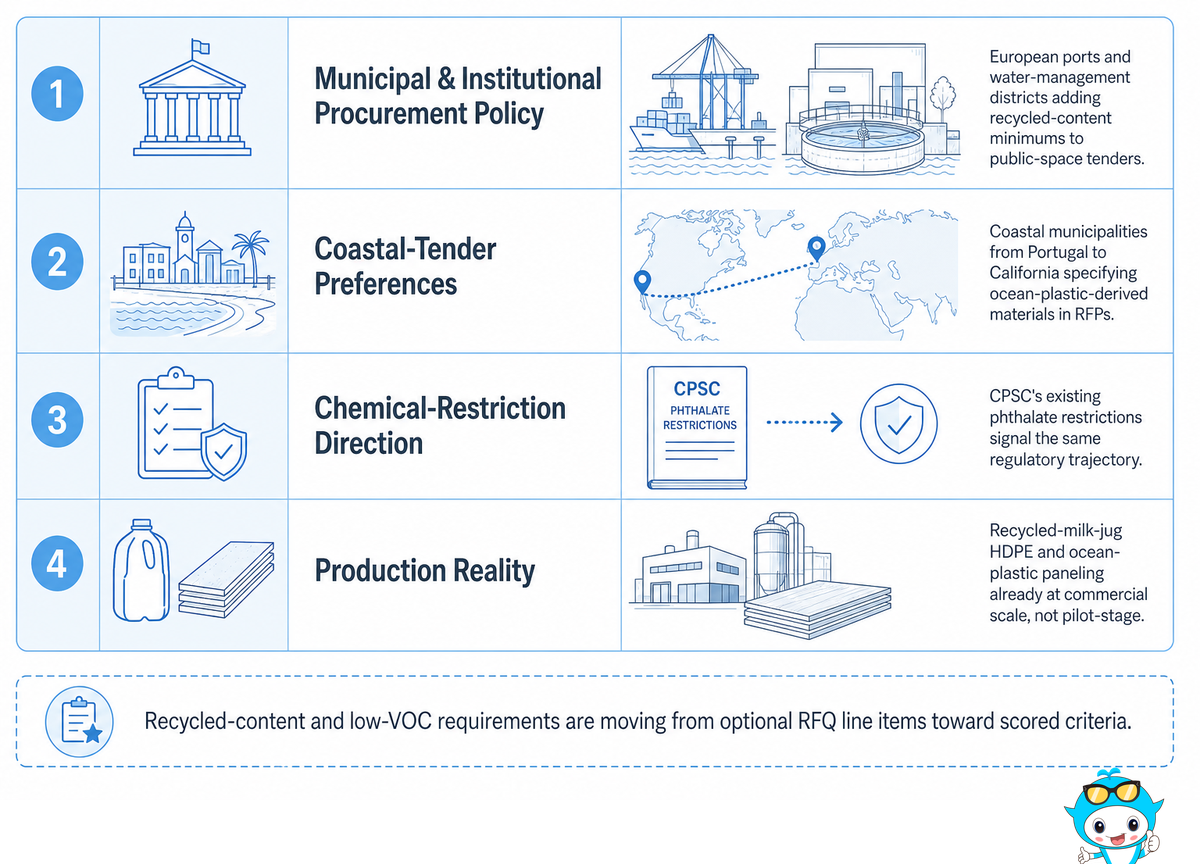
Much of the demand for recycled content in playground RFQs isn’t driven by market hype, but by municipal and institutional procurement policy. European ports and water-management districts are increasingly including recycled-content minimums in their public-space tenders, while many coastal municipalities (from Portugal to California) are specifying materials derived from ocean plastics in their RFPs. (Market context only: an estimate based on input from a market aggregator; we haven’t verified against any official government gazette. Treat as background context.)
In terms of technology, it’s already a reality at commercial scale. Some manufacturers are producing recycled-milk-jug HDPE, ocean-plastic-derived paneling, and textile-waste-derived posts (not as pilots). For planning in a 2026-27 cycle, we’d expect “recycled content %” and “low-VOC coating” to evolve from optional RFQ line items to evaluated scoring factors, particularly for buyers influenced by green procurement policy (e.g., municipal governments, FECs) — the same regulatory direction already visible in the CPSC’s phthalate restrictions for children’s products.
Key takeaway
Recycled-content and low-VOC requirements in playground RFQs trace back to real municipal green-procurement policy and coastal-tender preferences, not a marketing fad — buyers who ask suppliers for the material certificate now, rather than assuming it later, are ahead of where scored RFQ criteria are heading.
Frequently Asked Questions
Q: Does ASTM itself issue the certificate?
No. ASTM authors and publishes the standard document itself, but a separate accredited third-party body — such as IPEMA, TÜV, or SGS — actually tests and certifies individual products against it.
ASTM International is the author (and reviser) of the F15.29 standard; it does not conduct product testing or issue product-level certifications. The primary third-party program associated with playground equipment is IPEMA (International Play Equipment Manufacturers Association), though more general test houses like SGS and TÜV also perform independent evaluations. When a supplier claims that their equipment is “ASTM certified,” ask which of the third parties issued the test report and if the certificate can be viewed on their website (not just accepted at face value).
Q: What is the best non-toxic material for playgrounds?
No single material is universally “best” — the safest choice is whichever material has a current, product-specific chemical-safety test report matching CPSIA phthalate limits and, ideally, Greenguard Gold VOC screening.
Buyers searching for the best non toxic material for playgrounds should know that HDPE, powder-coated steel, and closed-cell EVA foam can all be made with very low toxicity, but a phthalate-free PVC foam could achieve the same 0.1% (1,000 ppm) CPSIA threshold as EVA — material name alone doesn’t seal the deal. Your order should require the specific test report, linked to the actual batch and production run, not just a claim about the material class in general.
Q: What playground surfacing meets CPSC safety standards?
Rubber, engineered wood fiber, and poured-in-place surfacing can all meet CPSC guidance when independently tested for impact attenuation and chemical safety, the material category alone doesn’t determine compliance.
CPSC publishes public playground safety guidance regarding surfacing impact-attenuation, but there is no overarching certification for a surfacing type as a whole, and no single answer to what is the safest surface to use under playground equipment across every venue. Ask for the impact-attenuation test report that covers the specific depth and fall-height rating of the surfacing (often citing astm F1292, HIC under 1000) and a separate chemical-safety test report for the surfacing material, since recycled content and chemical safety are tested and reported separately, and one does not take the place of the other.
Q: How much does ASTM certification cost for an indoor playground?
Cost varies by product line and testing scope, budget for both the ASTM standard document purchase and the separate third-party lab testing/certification fee, which is the larger of the two costs.
A standard document itself (e.g., F1918-21) can be obtained from the astm store for a nominal, flat fee; the higher, variable cost comes from third-party lab testing and the associated certification (often through a lab holding TÜV, SGS, or IPEMA accreditation), driven by product complexity and SKUs. Suppliers who already possess valid certification typically will not pass a per-order charge along to customers.
Q: Is rubber sheet eco-friendly for playgrounds?
Recycled-rubber sheet surfacing reduces tire waste, but “eco-friendly” still requires a separate chemical-safety test, recycled tire crumb can carry trace metals and organic compounds that a recycled-content claim alone doesn’t rule out.
Short answer to is rubber sheet eco friendly for playgrounds: partly. Recycled tire material offers a tangible landfill-diversion benefit, the EPA has flagged that tire crumb may contain trace metals and organic chemicals, and playground-specific exposure-risk assessment in that category is still ongoing. Again, request the chemical-safety report separately from the recycled-content claim.
Q: Can one ASTM report cover every product from a supplier?
No. A certification report covers only the specific product, material batch, and test scope actually evaluated — it does not automatically extend to every other SKU a supplier manufactures, even from the same product line.
Ask whether your exact SKU matches the certificate.
Q: What permits are needed for an indoor playground?
Permit requirements vary by jurisdiction, but usually include a building/occupancy permit, fire-code sign-off, and equipment compliance paperwork your local inspector can review against a recognized standard.
Many fire inspectors request proof of the equipment’s compliance with fire safety standards (astm F1918 §11 outlines the standards for soft-contained indoor equipment); check with your local building official, as the equipment certification does not supersede the permitting process.
Q: What is ASTM’s history?
ASTM International began in 1898 as a materials-testing organization and has since grown into one of the world’s largest voluntary standards-development bodies, with its F15.29 subcommittee specifically responsible for playground equipment standards.
Both astm F1487 (outdoor) and F1918 (soft-contained indoor) are maintained and updated through the F15.29 subcommittee using a consensus process, which is why the term “voluntary consensus standard” is technically accurate (even though in practice compliance may be effectively mandated by certain states or insurance providers).
About This Guide’s Sourcing
Didi Land builds indoor playground equipment that is certified to ASTM standards, as well as the European and Australian equivalents, for customers in over 40 countries. The discrepancy between the requirements for safety and sustainability on real RFQs comes up frequently enough for us that we thought we’d lay it out clearly.
The material details in this guide (foam thickness, steel tube diameter, and HDPE panel specification) are derived from the certification of our current line of soft-contained and toddler play structures, cross-checked against the public scope of the applicable standards, rather than being written from memory. Reviewed by the Didi Land technical team.
References & Sources
- ASTM F1918-21 Standard Safety Performance Specification for Soft Contained Play Equipment ASTM International
- Phthalates FAQ U.S. Consumer Product Safety Commission
- Prohibition of Children’s Toys and Child Care Articles Containing Specified Phthalates Federal Register
- BS EN 1176-1:2017+A1:2023 Playground Equipment and Surfacing EN Standard / European standards catalog
- AS 4685.1:2021 Playground Equipment and Surfacing, Part 1 ANSI Webstore (Standards Australia)
- Summary of Differences Between AS 4685 and EN 1176 Play Australia
- AS 4685 Part 1-6 (2021) Update for Playground Equipment and Surfacing Playground Safety Inspectors Australia
- ASTM Standards Safety Guidelines International Association of Amusement Parks and Attractions (IAAPA)
- RoHS Directive European Commission
Related Articles
- Soft Play Equipment Safety Standards structural certification and supplier vetting
- Indoor Playground Equipment Buyer’s Spec Audit Guide full RFQ and factory-verification framework