
Get in Touch with Didi Land



CPSC eFiling is the United States Consumer Product Safety Commission’s requirement that importers of regulated consumer products electronically submit Certificate of Compliance data to the United States Customs and Border Protection agency at the time of entry. It becomes mandatory on July 8, 2026, for anyone who imports commercial playground and soft play equipment for FEC, mall, and daycare operators into the United States. Below is an explanation of exactly what changes, which of the seven required data elements you should collect, and one common misunderstanding regarding an exemption that doesn’t really exist.
Quick Specs
| Mandatory eFiling begins | July 8, 2026 (most imports) |
| Foreign Trade Zone (FTZ) entries | January 8, 2027 |
| Certificate types affected | Children’s Product Certificate (CPC), General Certificate of Conformity (GCC) |
| Filing system | CBP’s Automated Commercial Environment (ACE) |
| Shipment-value exemption | None — applies regardless of value |
| Legal basis | 16 CFR Part 1110 (amended), Federal Register 2025-01-08 |
What Is the CPSC eFiling Mandate
CPSC eFiling — short for electronic filing — means importers must electronically report Certificate of Compliance data to CBP when a shipment arrives in the United States, rather than merely keeping certificates on file. CPSC approved the Final Rule under an amended 16 CFR Part 1110, published in the Federal Register on January 8, 2025.
That publication date gave most importers 18 months of runway before the July 8, 2026 mandatory-eFiling date, and 24 months for shipments routed through a Foreign Trade Zone.
The change effectively reverses the Consumer Product Safety Improvement Act’s old “keep it in a drawer” certificate model — data now has to move with the shipment itself, submitted through CBP’s Automated Commercial Environment (ACE).
Interest in this precise phrase has seen an increase over the last 6 months – take a look at the Industry Outlook below for an example – which indicates the trade is just starting to wake up to how imminent the deadline is.
Getting this wrong is not a paperwork inconvenience: CPSC’s enforcement approach ties incomplete or missing certificate data directly to shipment delay and a higher inspection risk, and the requirement applies even to a shipment under the $800 de minimis threshold most importers assume is exempt (see No De Minimis Exemption below). For a buyer whose supplier is already engineered to test-and-certify workflows — ASTM F1487- or EN 1176-certified shops, for instance — this is a structural shift in where the same data ends up, not a new testing obligation.
Children’s Product Certificate (CPC) Requirements for Playground & Toy Equipment
The critical distinction that most compliance guides miss: CPSC has never published a named-product list that says “indoor playground equipment” or “soft play equipment.” Getting to a CPC requirement takes two steps, not one — and conflating them is the single easiest way to misjudge your own product line.
Step one: the Consumer Product Safety Improvement Act classifies any consumer product designed or intended primarily for children 12 years of age and younger as a “children’s product.” Indoor playgrounds, soft play sets, and toddler climbing structures clear this bar easily. Step two, and the one guides tend to skip: per CPSC’s own CPC FAQ, “children’s products subject to a children’s product safety rule require testing and certification” — classification alone is not enough. The product also has to be covered by a specific rule from CPSC’s own list of rules requiring third-party testing. In practice, indoor playground and soft play equipment typically clears step two through one or more of the general children’s-product safety rules (small parts, sharp points and edges, lead content, and flammability among them). It also has to meet whichever structural standard — ASTM F1487 or ASTM F1918 — a given piece of equipment is built to. The honest answer for any specific SKU is still “confirm which named rule applies with your supplier or a compliance specialist,” not “children’s product, therefore certificate.”
This underlying CPC requirement is precisely what makes commercial soft play equipment fall under eFiling once a certificate is actually required. Equipment designated for general use by adults, such as certain trampoline park elements advertised as fitness devices, sits in a different bucket. It might instead need a General Certificate of Conformity (GCC), which carries the same eFiling obligation.
| Attribute | Children’s Product Certificate (CPC) | General Certificate of Conformity (GCC) |
|---|---|---|
| Governed product type | Children’s products (age 12 and under) | General-use consumer products |
| Statutory basis | Consumer Product Safety Improvement Act, children’s-product provisions | Consumer Product Safety Act, general certification provisions |
| Testing requirement | Third-party accredited lab testing required | Manufacturer’s own reasonable testing program (third-party optional unless a specific rule requires it) |
| eFiling requirement | Mandatory from July 8, 2026 | Mandatory from July 8, 2026 |
| De minimis shipment exemption | None | None |
| Typical indoor playground / soft play fit | Most commercial units — structural standard plus general children’s-product safety rules | Adult-use elements marketed as fitness devices only |
| Filing pathway options | Full or Reference PGA Message Set | Full or Reference PGA Message Set |
| Foreign Trade Zone deadline | January 8, 2027 | January 8, 2027 |
💡 Pro Tip
Manufacturers that already conduct tests in accordance with ASTM F1487 (public playground equipment) or ASTM F1918 (soft contained play equipment) on their indoor playground equipment certified to ASTM and EN 1176 will already possess the bulk of the data needed for a CPC, including test dates, laboratory results, and relevant regulations. This eFiling change is entirely about data submission, not about new testing obligations.
How CPSC eFiling Actually Works: Full vs. Reference PGA Message Sets
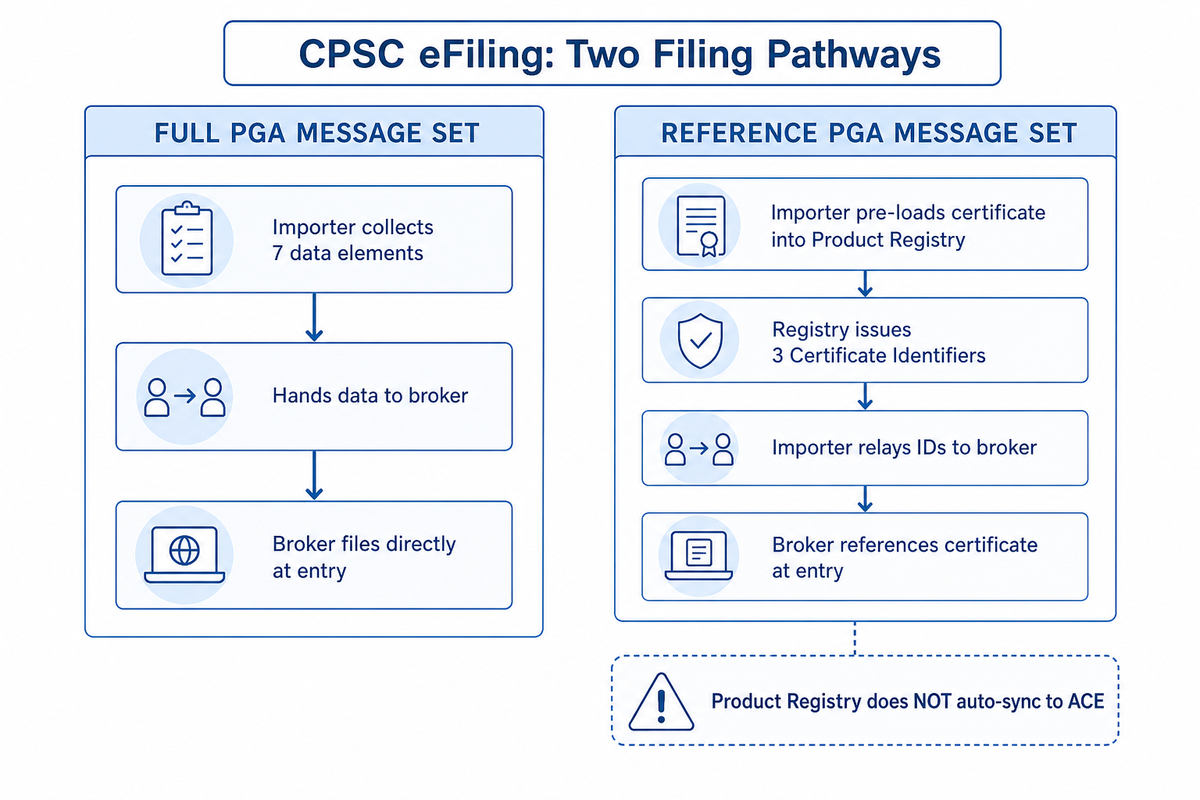

Importers can submit their certificate data to CBP’s ACE system using one of two methods, depending largely on the frequency with which they import the same products.
| Pathway | How it works | Best for |
|---|---|---|
| Full PGA Message Set | Importer hands the broker all 7 required data elements for each shipment; broker files them directly at entry | One-off or infrequent imports |
| Reference PGA Message Set | Importer pre-loads certificate data into the CPSC Product Registry once, then gives the broker only 3 Certificate Identifiers (Certifier ID, Product ID, Version ID) to file per shipment | Repeat importers of the same equipment models — most commercial playground buyers |
There’s one thing about filing for the first time that may come as a shock: the CPSC Product Registry isn’t in direct communication with CBP’s ACE. It’s a self-contained database. When you fill out a certificate in the Registry, you still need to take those three Certificate Identifiers and communicate them to your broker to be entered into the Reference PGA Message Set.
“It’s a pretty user friendly portal but it relies on the importer to maintain the database & provide the cert #s for eventual transmission.”
— licensed customs broker, r/CustomsBroker discussion thread
What does this mean in practice: A broker’s job isn’t as broad as most importers seem to believe. Your broker sends in the data that you provide them, and doesn’t check to ensure that the certificate that you’re submitting is valid or complete. That’s the importer’s responsibility.
The 7 Required Data Elements (What Your Manufacturer Should Already Provide)
Whatever route you take, CPSC stipulates the same seven fields of data for every product certificate. That’s distinct from, but easy to confuse with, the export-market AS 4685 vs. EN 1176 vs. ASTM F1487 standards comparison your supplier should also walk you through. Much of this eFiling data will likely already exist within the supplier’s own compliance documentation; if it does not, that raises questions about the supplier’s product compliance, not just about the paperwork.
Hand this checklist to your broker or supplier before your next shipment:
| Data element | Who typically has it | Why it matters | How to verify |
|---|---|---|---|
| Product ID (GTIN, SKU, UPC, model, serial, registered, or alternate ID) | Importer / manufacturer | Uniquely identifies the certified product to CPSC | Confirm ID type matches one of CPSC’s 7 accepted formats |
| Applicable CPSC rules / citation codes | Manufacturer’s test lab | Lists which safety standards the product was tested against (e.g. ASTM F1487, ASTM F1918) | Cross-check against the test report’s cited standard numbers |
| Date and place of manufacture | Manufacturer | Ties the certificate to a specific production run | Match against production/shipping records |
| Date and place of testing | Third-party testing lab | Confirms testing happened before the shipment, not after | Check the test report’s issue date |
| Testing laboratory identification | Manufacturer / test lab | CPSC can trace results back to an accredited, named lab | Confirm lab accreditation (CPSC-accepted lab list) |
| Certifying party contact information | Importer of record or domestic manufacturer | Legal point of accountability for the certification | Verify contact is current and reachable |
| Records custodian / point of contact | Importer | Who CPSC contacts if they need supporting test records | Confirm this person can actually produce records on request |
| Certificate type declared (CPC or GCC) | Manufacturer / compliance team | Tells CBP which statutory basis the certificate is filed under | Confirm children’s-product items use CPC, general-use items use GCC |
| Testing exclusions applied, if any | Manufacturer’s test lab | CPSC requires exclusions to be listed on the filing, not inferred from the test report alone | Ask the lab directly whether any exclusion codes apply to this SKU |
Exclusions introduce another complexity; as of July 8, 2026, the updated Part 1110 demands listing of the testing exclusions applied to the certificate – meaning if some items in the product portfolio are tested against an exclusion instead of the full standard, it should be mentioned in the filing and not inferred.
No De Minimis Exemption: The Myth That Costs Importers
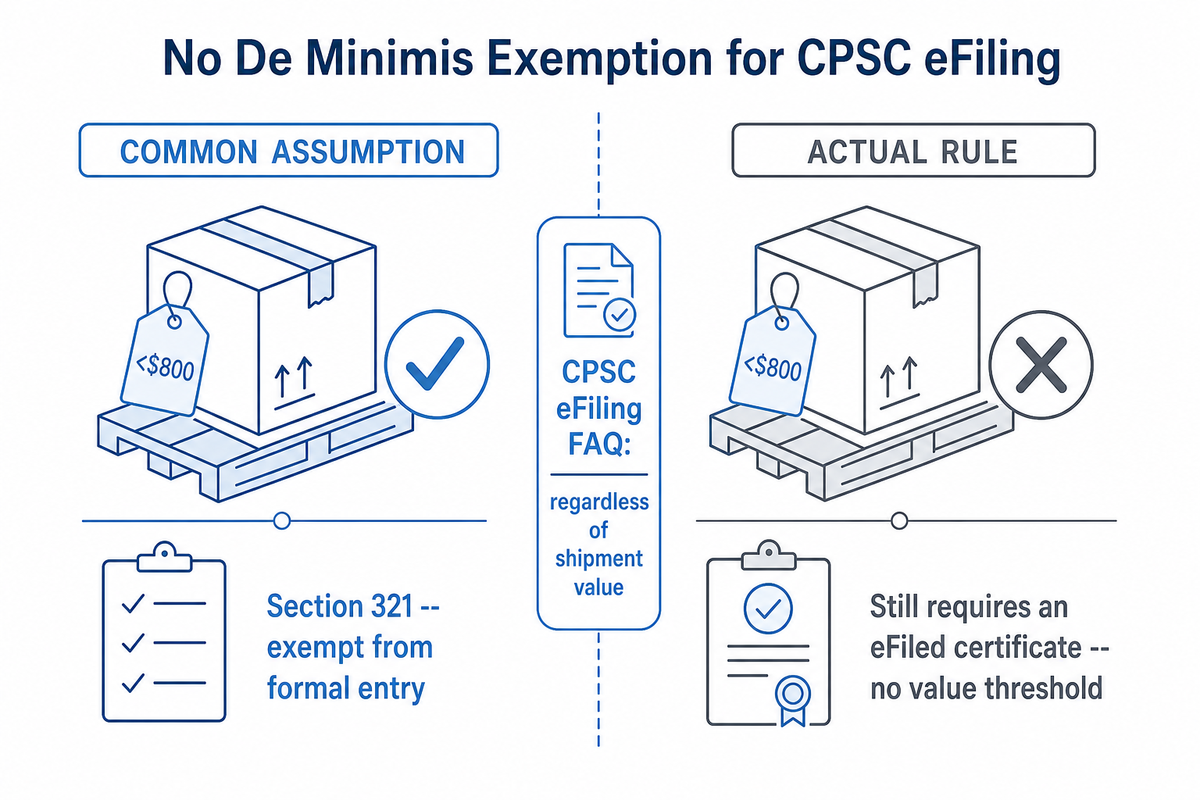

If you’re an importer who has ever shipped small, low-value spare parts, samples, or trial orders, then you’re familiar with Section 321 – the part of the U.S. Customs code which exempts shipments up to $800 in value from much of the formal entry process. It’s a fair leap to assume the same logic applies here, too.
It doesn’t.
⚠️ Important
CPSC states this directly in its own eFiling FAQ: “Any product requiring certification must have an eFiled certificate, regardless of the value of the imported shipment. There is no Section 321 (also known as de minimis) shipment exemption for eFiling.” A second, independent compliance resource confirms the same reading of the rule, for the same reason: exempting low-value shipments would unfairly let cross-border sellers dodge a requirement that bulk importers still have to meet.
As a purchaser of playground or soft play equipment, this will have more relevance to a sample order or trial shipment prior to a full container load – just the kind of small value, early stage in the relationship type of shipment you would expect to start with a new supplier. Believing it to be ‘too small to eFile’ is just the single most common interpretation of the rule.
Timeline by Entry Type: July 8, 2026 vs. January 8, 2027 (FTZ)
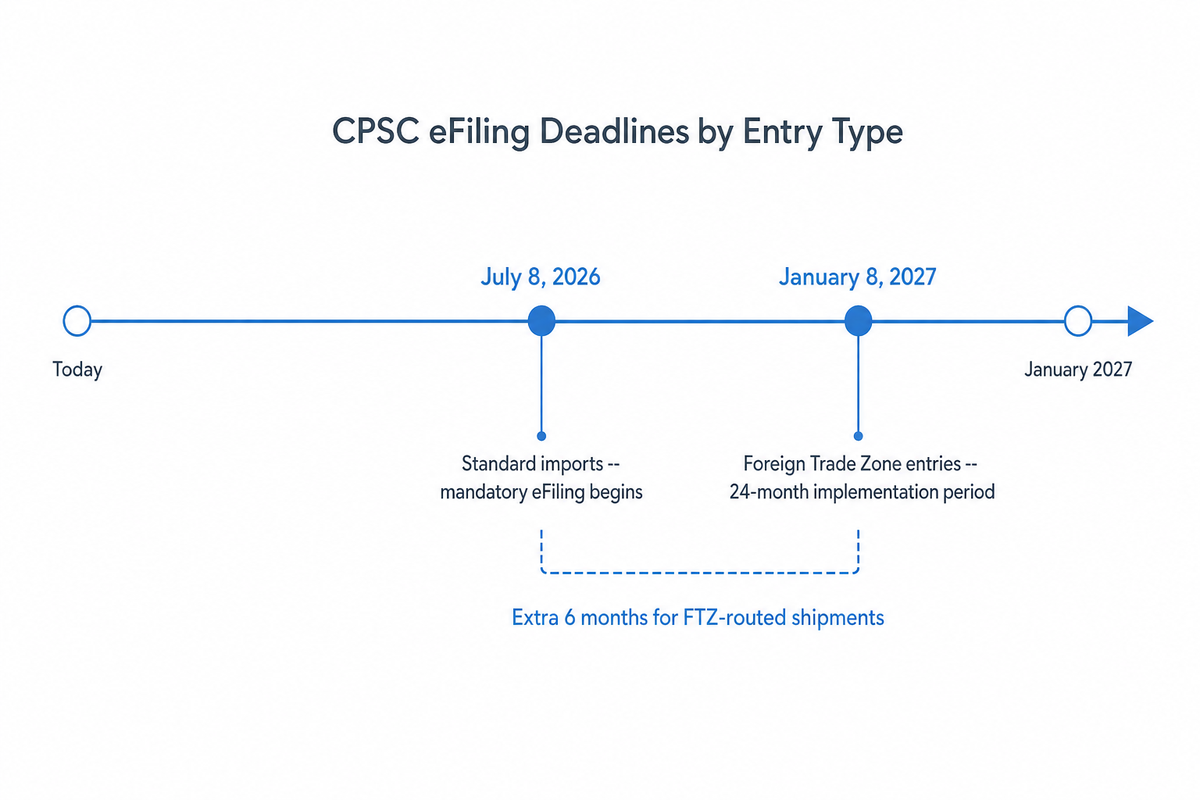

Only one date is relevant to most importers. But if your supply chain goes through a Foreign Trade Zone at any point, two dates need careful monitoring.
| Entry type | Effective date | Notes |
|---|---|---|
| Standard consumption entry | July 8, 2026 | Applies to most imported consumer products subject to CPSC certification |
| Foreign Trade Zone (FTZ) withdrawal for consumption/warehousing | January 8, 2027 | 24 months implementation period; ACE already supports the CPSC message set on type 06 consumption entries from an FTZ, including weekly entry submissions |
This is not a question CPSC has yet to answer — the later FTZ date is settled as part of the Final Rule, with its own dedicated guidance document. FTZ routing simply grants an additional 6 months of runway, not an exemption.
Importer vs. Customs Broker: Who Does What
eFiling changes who owns the ball, catching many importers by surprise. It’s the importer of record, not the broker, who is on the hook for certificate accuracy and for maintaining the Product Registry data. Brokers have a narrower job: pushing into ACE whatever data their client gives them.
A broker cannot independently verify whether your certificate is correct. Legal and compliance teams should expect a shift from intermittent document review to ongoing data governance — keeping the manufacturer-to-Product-Registry data stream accurate shipment after shipment, not just a year-end checklist item.
Enforcement Reality: What Happens If You Don’t Comply
Instinct says a missing or incorrect eFiling means “CBP refuses entry” outright. CPSC’s own FAQ document is more measured than that — at least initially.
What CPSC says will happen (near-term)
- ACE sends warning messages for missing data, not automatic rejection
- CPSC doesn’t currently intend to request CBP deny entry solely for an eFiling gap
Real consequences that still apply
- CPSC can still request CBP seizure of non-compliant products through separate enforcement channels
- Certificate data adjusts an entry’s risk score — incomplete filings mean more holds and inspections on future shipments, not fewer
In practice, that doesn’t mean your shipment is automatically refused, but it adds up. Every incomplete filing incrementally increases your importer risk, leading to more of your shipments being flagged for manual examination. That’s the opposite of the streamlined, accelerated customs entry that clean eFilings facilitate.
Industry Outlook: Why Search Interest Just Spiked 25x
Search traffic for this exact topic spiked from about 140-210 a month in mid-2025 to 3,600 last month — roughly a 2,471% increase over 6 months — a structural climb, not a seasonal one, that tracks almost exactly with how close the July 8 deadline has gotten. This is not manufactured urgency.
CPSC and Intertek jointly ran a webinar on the topic featuring CPSC’s own eFiling Program Specialist, and the Toy Association is actively warning members that “time is running out.” A federal regulator, a major testing lab, and the largest U.S. toy trade association all running parallel outreach on the same compressed timeline is a reliable signal: the deadline is real, and the trade is still catching up.
In fact, the urgency for playground and soft play equipment buyers across FEC, mall, kindergarten, and hospitality venues occurs earlier, in the upstream effort required to gather a supplier’s product-specific test results, laboratory name and applicable standard data — a process that usually takes much longer than most importers assume, especially with numerous SKUs across many factories. Most trade advice around the new rule strongly discourages delaying the process until June 2026.
Frequently Asked Questions
Q: Does eFiling apply to resold or overstock playground equipment?
Yes — eFiling applies to any regulated, finished consumer product subject to a CPSC rule, ban, or standard, regardless of whether it is new, resold, or overstock inventory.
Note that CPSC explicitly states that both resold and overstock products that are already in the marketplace must be imported in compliance with the same testing and certification requirements as products intended for initial sale. In short, if your liquidating playground equipment previously required a CPC or GCC upon initial importation, then it is still subject to those requirements for eFiling.
Q: Is there an option to bulk upload product certificate data into the Product Registry?
Yes — importers managing multiple SKUs can bulk upload certificate data via a CSV file or through direct API integration, instead of entering each product into the Product Registry manually one at a time.
The CPSC eFiling Document Library includes an API Specifications and CSV Bulk Upload Template document, the latter of which is a more realistic option for playground and soft play equipment importers with multiple SKUs spread across numerous factories, or sourcing different slide types, climbing structures and soft play set styles from a single supplier. Once past the test run for a single shipment, you will likely be using one of these options to handle all subsequent orders.
Q: Do the eFiling requirements apply to Section 321 (de minimis) shipments?
No exemption exists — any product requiring certification must have an eFiled certificate regardless of shipment value, including low-value Section 321 shipments and sample orders.
That is important enough that it is repeated, and it is probably the most misunderstood part of the rule: there is no minimum dollar value below which eFiling no longer applies. A $200 shipment of a certified product in sample quantity is under exactly the same eFiling requirement as a full container.
Q: What are the acceptable Product ID types for eFiling?
Seven alphanumeric ID types are accepted for identifying a certified product: GTIN, SKU, UPC, Model Number, Serial Number, Registered Number, or a catch-all Alternate ID.
Whichever option you chose, CPSC encourages including at least one of your identifiers that is present on the packaging, packing list, or invoice of the product, so that the field inspector has an unmistakable way of identifying the product in hand and correlating it to the submitted certificate.
Q: Does the CPSC Product Registry automatically communicate with CBP’s ACE system?
No — the Product Registry is a stand-alone repository and does not sync automatically with ACE; the importer must manually relay the Certificate Identifiers to their broker.
This is where the disconnect usually happens for new filers. Once the certificate has been entered into the Product Registry, it’s only half of the battle — you need to make sure you give your broker the Certifier ID, Product ID, and Version ID so they can pull the right certificate in the Reference PGA Message Set when the product enters the country.
Q: Who do I contact for CPSC eFiling support?
CPSC’s dedicated eFiling support team can be reached directly at eFilingSupport@cpsc.gov for questions about the Product Registry, certificate data, or the ACE filing process itself.
For product-specific questions, CPSC also runs a Regulatory Robot tool and a Small Business Ombudsman team — useful if you don’t have in-house compliance staff.
Q: Are there exemptions beyond the no-de-minimis rule?
Yes — a few narrow exclusions still apply: used products manufactured before the applicable CPSC rule took effect, and noncommercial consumer-to-consumer transfers such as personal gifts.
If a used piece of equipment was manufactured before the effective date of the CPSC rule that would otherwise require a certificate, no certificate — and therefore no eFiling — is required for it. Separately, eFiling does not apply to noncommercial transactions between two consumers outside a normal sale (a gift or transfer of personal effects, for example). Neither exclusion is likely to apply to a commercial import of new playground or soft play equipment, but they matter if you are ever sourcing used equipment or handling a non-sale transfer.
Why We Publish Our Standards, Pricing, and Lead Times
As a manufacturer that already certifies its indoor playground and soft play equipment to ASTM F1487, ASTM F1918, EN 1176, and AS 4685, most of the data this eFiling rule now requires — test dates, testing labs, applicable standards — is data we generate as a normal part of production, not a new compliance burden.
After 12 years of production experience from a 12,000 m² factory base, with a self-reported export ratio of roughly 90% to buyers across 40+ countries, this is the same documentation trail our own export shipments already carry.
We wrote this guide because we saw the same seven data elements explained by law firms and testing labs, but never from the manufacturer’s side of the supply chain, where a buyer can see what their supplier should already provide. Reviewed by the Guangzhou Didi Land Amusement Equipment Co., Ltd. technical team.
References & Sources
- eFiling Frequently Asked Questions (FAQ) — U.S. Consumer Product Safety Commission
- Children’s Product Certificate (CPC) FAQ — U.S. Consumer Product Safety Commission
- Certificates of Compliance — Final Rule — Federal Register
- eFiling — CPSC’s Modern Approach for Filing Certificate Data — U.S. Consumer Product Safety Commission
- Which Products Require CPSC eFiling? — Compliance Gate
- CPSC eFiling — Intertek
![Custom Dinosaur Playground Equipment [Design Guide]](https://didiplayarea.com/wp-content/uploads/2026/09/custom-dinosaur-playground-equipment-r2-featured-1-768x512.png)

![Custom Dinosaur Playground Equipment [Design Guide]](https://didiplayarea.com/wp-content/uploads/2026/09/custom-dinosaur-playground-equipment-r2-featured-1-150x150.png)