Get in Touch with Didi Land


Quick Specs
| Factory-direct lead time | 25-60 days production, roughly 55-60 days signed-quote-to-handover with sea freight |
| Trading company / distributor lead time | 4-8 weeks for catalog or semi-custom builds, 90-150+ days for fully bespoke structures |
| Minimum order quantity | 1 project / 1 set is standard at factory-direct lines |
| Certifications to request | ASTM F1487-25, ASTM F1918-21 (soft-contained), EN 1176 family, CE, ISO 9001:2015 |
| Typical payment terms | 30% T/T deposit + 70% before dispatch, or L/C |
| Shipping terms | FOB origin port (default), EXW and DDP available on request |
Indoor playground equipment suppliers are the factory-direct manufacturers, trading companies, distributors, and online marketplaces that design, produce, or resell commercial-grade indoor play structures. They break into four channels – each with a different lead time, minimum order quantity, and level of certification transparency. This guide walks commercial buyers – family entertainment center operators, daycare and school procurement teams, mall and hospitality developers – through how to identify which type of company they’re actually talking to, how to vet that company before wiring a deposit, and how to run a complete request for quote from first brief to signed contract.
Indoor playground equipment suppliers split into four channels – factory-direct manufacturers, trading companies, local distributors, and online marketplaces – each with different lead times (roughly 25 to 150+ days), minimum order quantities, and certification transparency that directly affect your total project cost and risk.
Key Takeaways
- Buying direct from a factory isn’t automatically cheaper – a trading company’s markup sometimes buys real risk reduction (inspection, language support, smaller batch flexibility) that’s worth paying for.
- Most factory-direct manufacturers accept a minimum order of one project. Bulk minimums are the exception once you’re buying custom structures rather than off-the-shelf parts.
- ASTM F1487-25, published in mid-2025, is the current U.S. public-playground standard – several supplier sites and even recent buying guides still cite the older F1487-21.
- One “ASTM certified” claim rarely covers a whole venue. F1487 explicitly excludes soft-contained play equipment (that needs F1918-21 instead), and neither standard is a government-mandated certification – they’re voluntary specifications your insurer and venue will still expect you to meet.
- Lead times for indoor playground equipment span roughly 4 weeks for semi-custom catalog builds up to 150+ days for fully bespoke structural work – a flat “90-150 day” figure some manufacturers quote for their own category isn’t universal.
What “Indoor Playground Equipment Supplier” Actually Means
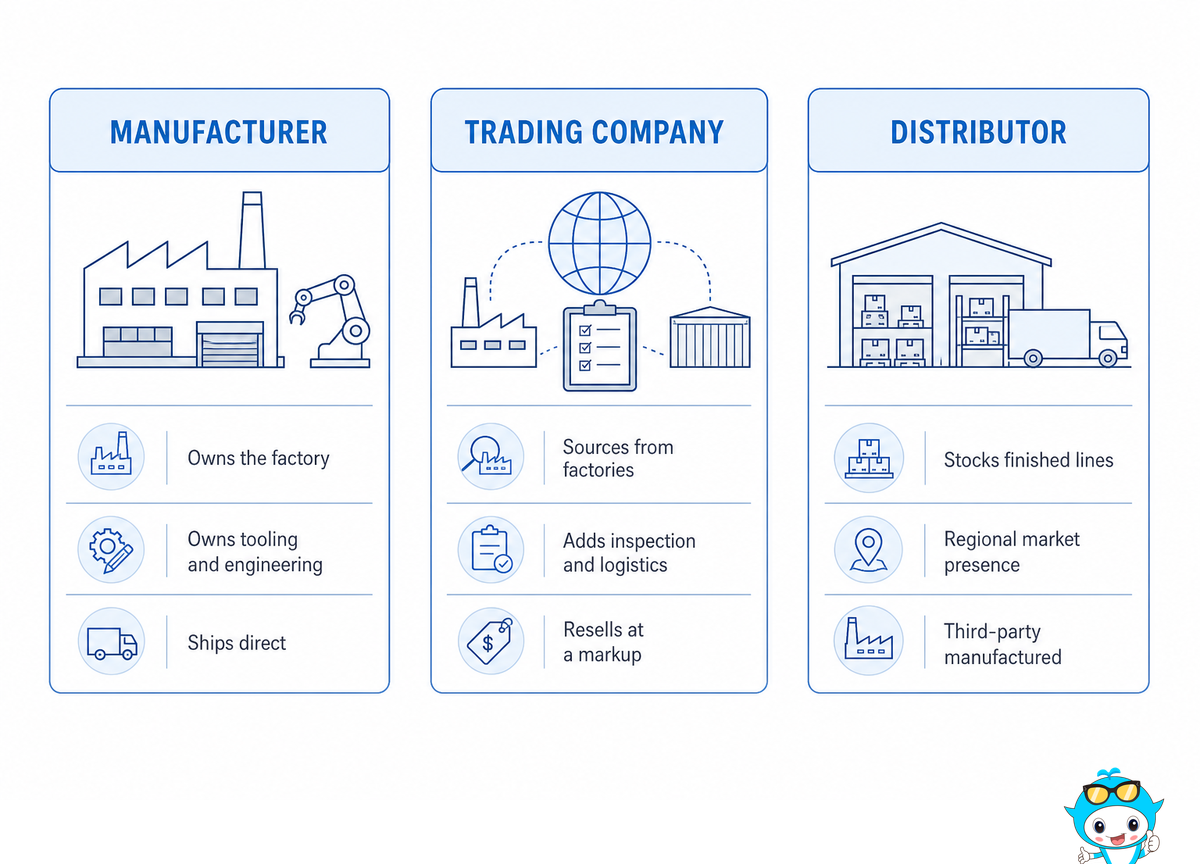
An indoor playground equipment supplier is any company that designs, manufactures, imports, or resells commercial-grade play structures within the scope of what the CPSC defines as playground equipment – but that single label hides three very different business models, and mixing them up is the first mistake most first-time buyers make.
A manufacturer owns the factory, engineering staff, and tooling that physically build the equipment – buyers often just call this an indoor playground manufacturer relationship. Guangzhou-based dreamlandplayground.com is a public example: it sells directly, without a separate importer or reseller layer, and quotes its own production timelines. A trading company doesn’t own a factory; it sources from one or more manufacturers, adds inspection, consolidation, and language/logistics support, and resells at a markup. A distributor stocks or represents finished lines from other manufacturers in a specific region – indoorplaygroundsinternational.com’s own catalog, for instance, is built almost entirely around third-party manufactured product lines rather than an in-house factory.
Why does this distinction matter in the real world? Your contract, your warranty claim, and your certificate chain of custody all run to whoever actually issued them – if a distributor resells a manufacturer’s equipment and it fails a safety inspection, you need to know whose documentation you’re actually holding. Later sections go deeper into the contracting specifics that separate a direct factory relationship from a distributor relationship – see the full OEM-vs-distributor breakdown.
Most full-service suppliers offer a similar core menu: soft play playground structures, climbing structure and climber modules, obstacle course elements, and swing and slide combinations. Sensory play zones suit young children, and interactive or superhero-themed play systems are increasingly common alongside traditional indoor playset designs. Custom play experiences and playground attractions built around a theme add real complexity to a quote, so confirm whether trampoline park or outdoor play components are in-house capability or a subcontracted add-on for a given commercial playground equipment supplier.
The Four Supplier Channels Compared
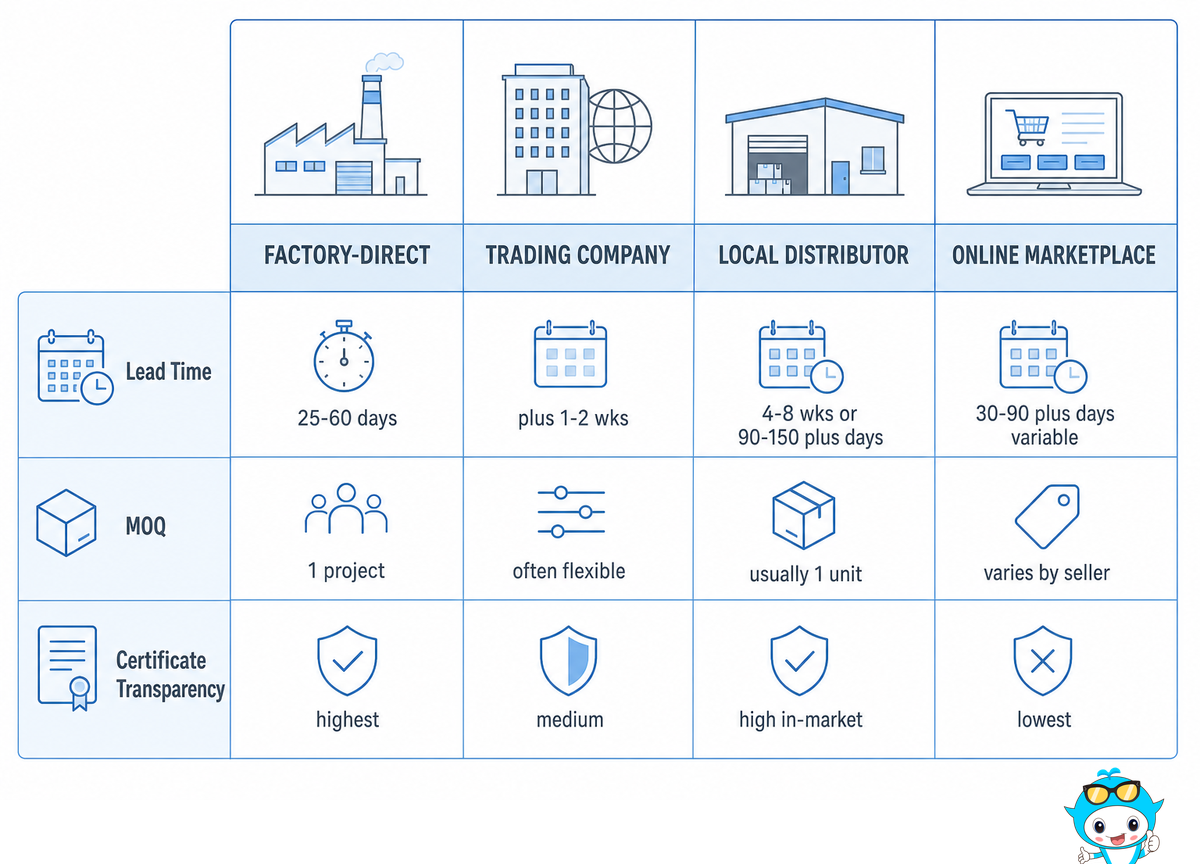
There are four basic ways you can source a commercial indoor playground equipment product: through an online B2B Marketplace, a manufacturer OEM directly from the factory, a trading company, or through a regional/local distributor. Each channel is better suited for a particular project based on level of customization desired, budgetary limitations, and the buyer’s willingness to take on some sourcing risk – and “certificate transparency” in the table below means how directly you can trace a component back to the specific CPSC-defined equipment category it’s supposed to meet. Below is a factory-direct-sourced data comparison, with lead time ranges verified through a US supplier with an established, verifiable public reputation for order times, so this data doesn’t represent the exaggerated claims of a single manufacturer.
The 4-Channel Supplier Comparison Matrix
Lead time, MOQ, and certification transparency are the metrics that separate the four channels by overall project risk.
| Supplier Type | Factory-Direct | Trading Company | Local Distributor | Online Marketplace |
|---|---|---|---|---|
| Lead time | 25-60 days production; ~55-60 days to handover | Similar window + 1-2 weeks coordination | 4-8 wks catalog; 90-150+ days bespoke | Highly variable, 30-90+ days |
| Minimum order quantity | 1 project / 1 set typical | Often flexible, sometimes lower | Usually 1 unit, catalog pricing | Varies by seller, sometimes bulk orders only |
| Certificate transparency | Highest — direct access to test reports | Medium — depends on factory sharing | Generally high for in-market compliance | Lowest, hardest to verify remotely |
| Customization depth | Highest — full custom design/tooling | High, limited by source factory’s range | Limited — mostly catalog variants | Seller-dependent, often lowest |
| Typical payment terms | 30% deposit / 70% before dispatch | Similar, sometimes staged differently | Often invoice/net terms in-market | Platform-dependent, less standardized |
| Who holds the warranty | The manufacturer directly | Trading company, backed by factory | Distributor, may be shorter than factory term | Seller — verify before ordering |
| In-market compliance help | Buyer usually self-manages | Sometimes included | Usually included (their core value) | Rarely included |
| Best for | Deep custom builds, direct factory relationship | Buyers wanting inspection + logistics handled | Fast in-market delivery, local accountability | Quick price comparison across many sellers |
| Not suitable for | Buyers with no cross-border logistics capacity | Buyers who need to audit the factory directly | Deep custom theming beyond catalog range | First-time buyers skipping the vetting checklist |
Be careful to read the small print on any supplier website or brochure – there are at least two pitfalls to watch for. For example, when a manufacturer OEM states its own in-house order times as shorter than its competing lead times of 90 to 150 days for another channel, that comparison is generally not with industry averages, but with its own in-house figures. Another published US supplier’s site claims its lead times are 4-6 weeks for catalog and semi-custom builds, and 6-8 weeks for fully custom designs, significantly lower than the manufacturer OEM average of 90-150 days for what it characterizes as “competitors”. Unless the lead time is specifically stated in writing for your precise configuration and size, take the number with a grain of salt.
One more common trap worth flagging: the notion that the cheapest price automatically equals the lowest cost for you. A leading global cross-border sourcing firm observes, “while it may be the most cost effective, it doesn’t mean that it’s the lowest cost.” In the same vein, a soft play supplier advises clients to be cautious if they receive a very low quote. While a manufacturer trading company might add some markup, that premium can include benefits such as inspections, better communication, and more flexibility in order sizes, all of which a direct relationship with the manufacturer OEM doesn’t inherently offer; take total landed costs and risks into account, not just unit price.
Where Commercial Buyers Actually Find Suppliers
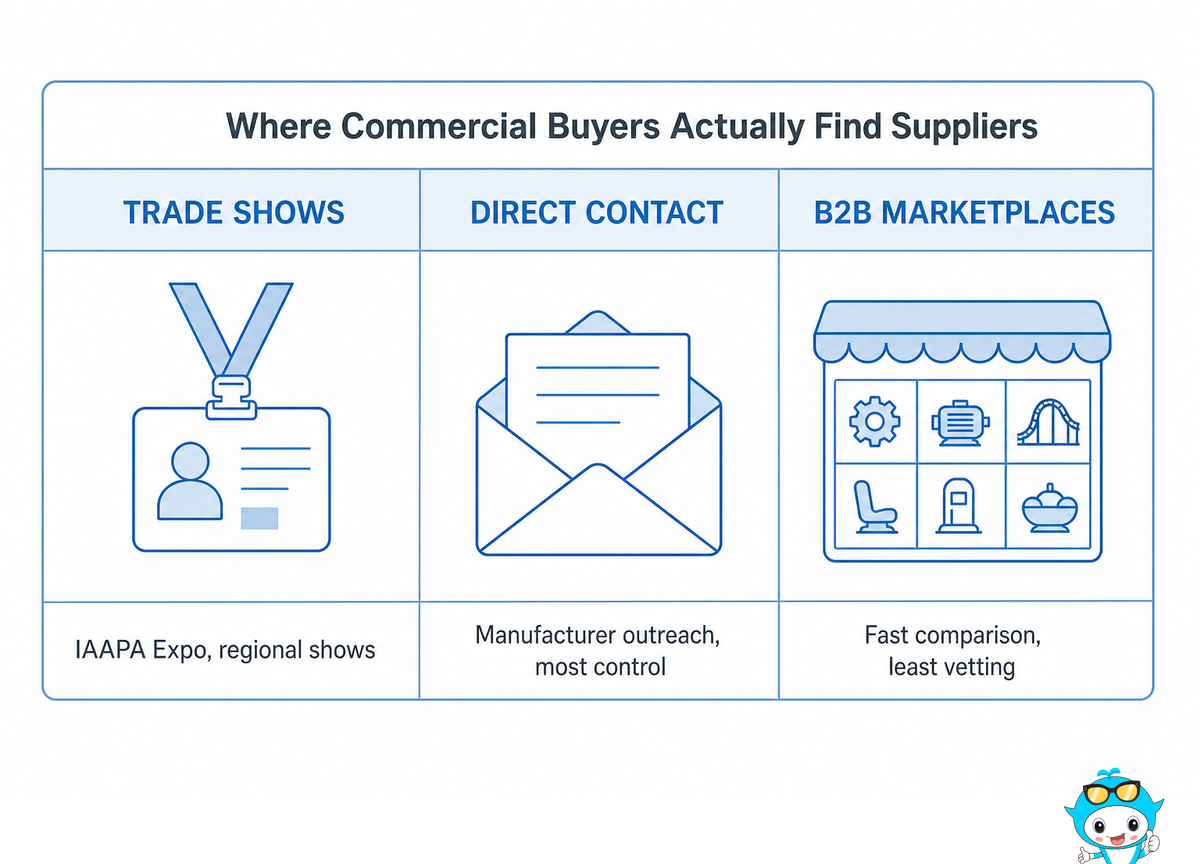
If you’re a new buyer for indoor playground equipment, the vast majority of your actual purchasing will happen in one of three avenues: trade shows, manufacturer direct contact, and B2B marketplaces. IAAPA Expo, run by the International Association of Amusement Parks and Attractions, is still the largest single meeting place for family entertainment center buyers to interact with manufacturers and distributors, complemented by various regional shows held by trade organizations.
The International Play Equipment Manufacturers Association (IPEMA) has a referral and certification program that buyers can use to cross-reference potential suppliers against the official roster of current members, independent of the CPSC’s own equipment-category guidance a buyer should separately check.
Direct communication (emailing or calling manufacturers who have product pages that reflect your facility type) gives you the most control but requires the most time because you’re doing your own price and value comparisons, not just clicking through filtered results on a marketplace. Online marketplaces enable you to scroll through dozens of possibilities in a single afternoon-that’s how most buyers use them, from a small business owner researching online and finding multiple B2B marketplaces with modular playgrounds, even if safety and installation were his primary criteria, to a parent whose top priorities for their child’s school project were safety and easy installation over price. Regardless of the entry point, the same vetting steps discussed in the next section apply.
Demand exists outside major metropolitan areas: daycare centers, restaurants, and family entertainment centers throughout the U.S., Canada, and abroad purchase indoor play equipment for projects anywhere from a single indoor playset to a full indoor playground business launch, through the channels above. If you need an indoor or outdoor park build – or both – verify upfront that a single supplier is equipped to handle the full scope; typically, an indoor/outdoor hybrid project means you’ll be coordinating two different specialty fields through one sales contact. Some suppliers that target the high-energy family entertainment center market don’t carry the smaller indoor playhouses or more laid-back play spaces often preferred by daycare facilities and food-service businesses, so ensure you select your purchasing channel based on your actual facility needs.
Search patterns for this topic vary by region and intent, and it’s worth knowing what each one usually means. Someone searching “indoor playground equipment suppliers near California” or “indoor playground equipment suppliers near Texas” is typically looking for a channel with local installation reach, not necessarily a local factory — most of the equipment itself still ships from a handful of manufacturing hubs regardless of where the buyer is based. A broader “indoor playground equipment suppliers USA” search usually signals a first pass at the market before narrowing to a channel, and “indoor playground equipment suppliers wholesale” almost always maps to the online-marketplace channel described above rather than the factory-direct or distributor paths. Similarly, “best indoor playground equipment suppliers,” “used indoor playground equipment suppliers,” and “commercial indoor playground equipment for sale” are three different questions wearing similar phrasing — a ranked-company answer, a secondhand-equipment question this guide doesn’t cover, and a pure product-catalog search, respectively. If you landed here searching one of those, the four-channel framework above is still the right starting point before you narrow to a specific company.
Red Flags to Check Before You Pay a Deposit
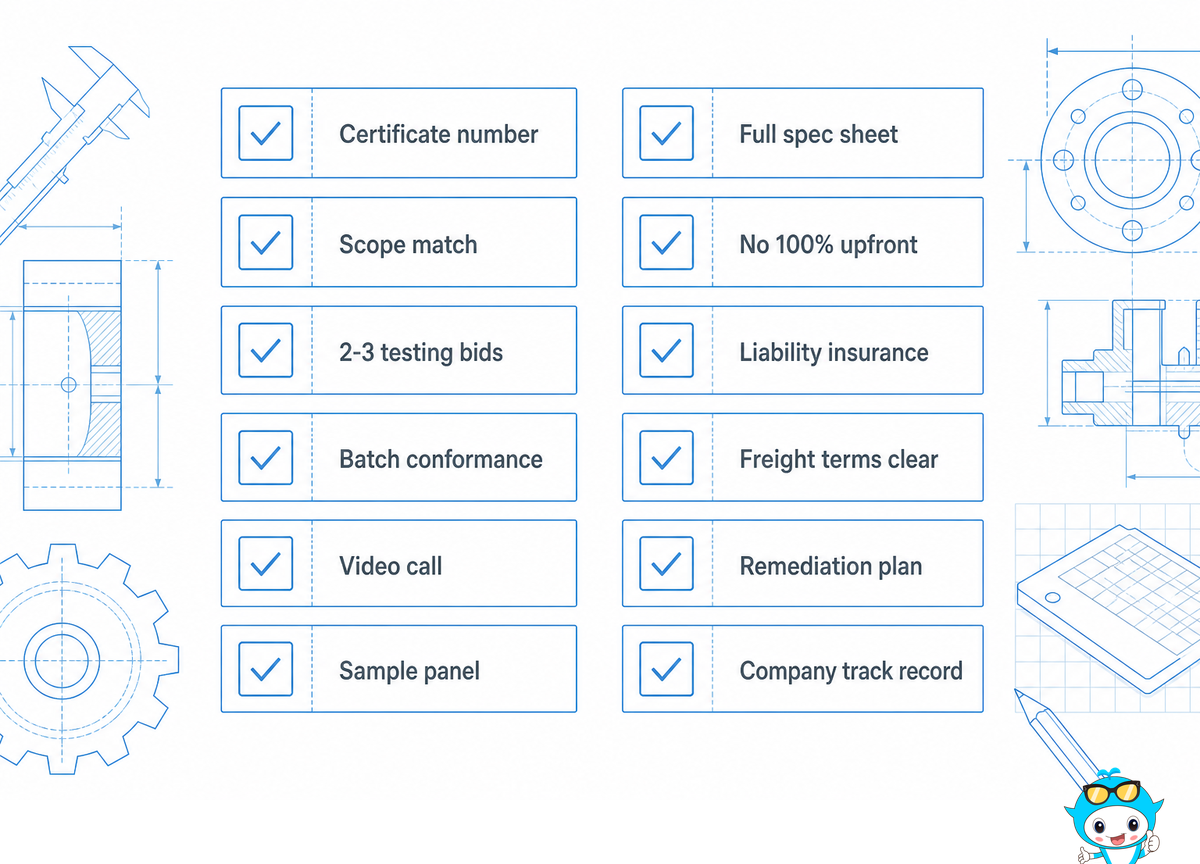
Thirteen simple checks, each doable in under an hour, separate a reputable indoor playground equipment vendor from one that will steal your deposit. On third-party testing lab selection specifically, the U.S. Consumer Product Safety Commission is surprisingly detailed, even for it, in explaining the kind of bad behavior to look out for: buyers should obtain 2-3 detailed testing bids (rather than a flat price, to catch misrepresentations), confirm the tester knows exactly what each test means, and guard against the supplier providing an exceptionally high-quality “golden sample” to testing but then producing and shipping out lower-quality materials to actual buyers. This isn’t an abstract possibility – it’s a known, pervasive issue with its own federal government guidance to deter it.
The 13-Point Pre-Deposit Vetting Checklist
Thirteen checks conducted prior to the transfer of any deposit separate a documented and verifiable indoor playground equipment supply relationship from a blind guess.
- Ask for the exact certificate number, not just a logo, and check it against the standard’s stated scope (see “Certifications” section, below).
- Confirm that the certification covers your product-e.g., F1487-25 (for static public-use equipment) won’t cover soft-contained modules, and vice versa.
- Get 2-3 line-item third-party testing estimates instead of one all-inclusive price, as per the CPSC’s own guidance on this practice.
- Contractually demand ongoing batch conformance-not just a one-off “golden sample” test.
- Request a live video call to see the actual production floor, not stock photography from a catalog.
- Ask for a sample panel or swatch, particularly if custom color or thematic work is involved, prior to committing to a full structure.
- Require a full spec sheet, not just a product description; dimensions, load capacity, materials and age bands should all be clearly defined.
- Any demand for 100% upfront payment should be considered an automatic rejection-standard has milestone payments (see “pricing” section, below).
- Ask who will provide the installed structure’s liability insurance, and ensure this is documented in writing prior to installation starting.
- Check that freight terms (e.g., FOB, EXW, DDP) are clearly included in the price, and that it’s not a generic “shipping extra” item.
- Get a written remediation plan in case a component fails inspection upon arrival.
- Verify the company’s experience (years in business, project count) by looking for independent reviews or a presence at industry trade shows.
- Ask how individual crates, cartons, and hardware bags will be coded and cross-referenced to the installation drawings before anything ships-unlabeled or mismatched packaging is a common, avoidable reason a project loses days once equipment reaches your venue.
A supplier’s refusal to meet even one of these requirements-e.g., a declined video call, lack of itemized costs, or insistence on full payment up front-is itself the biggest red flag.
The RFQ-to-Contract Process, Step by Step
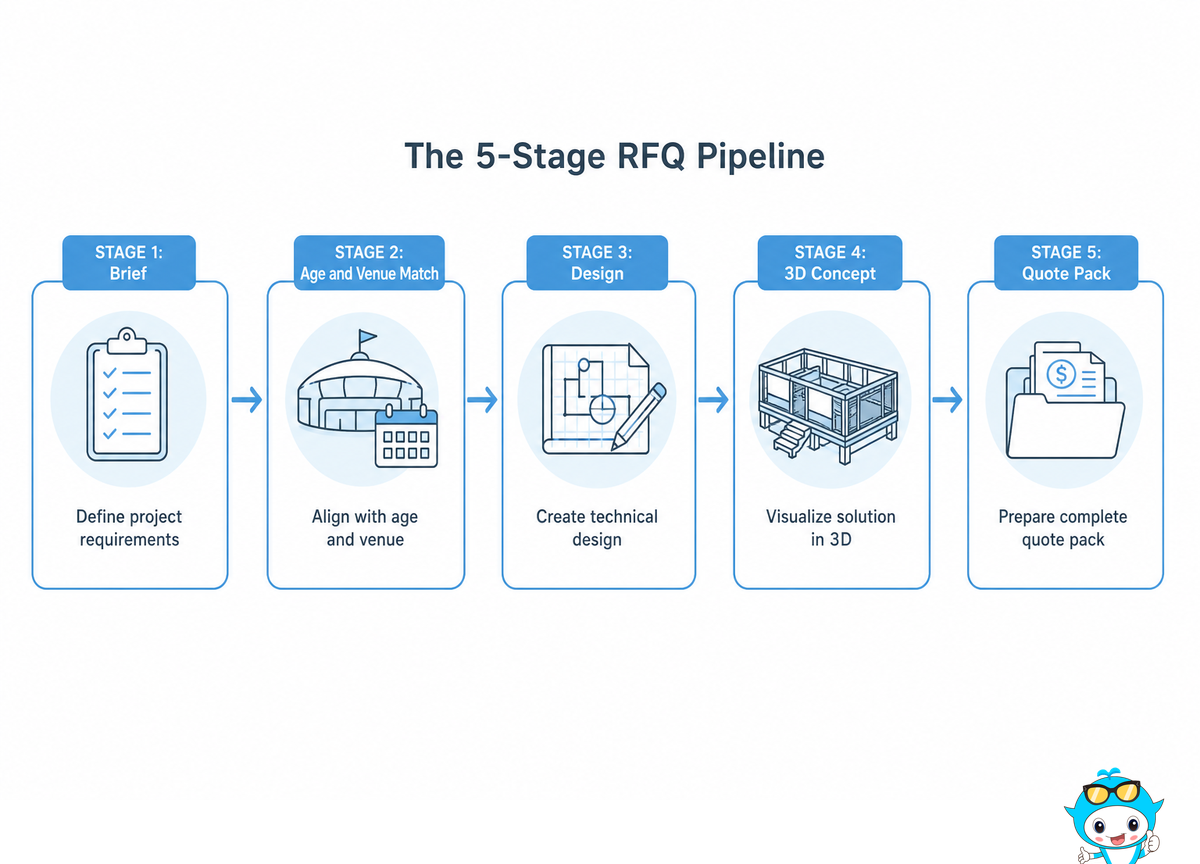
The 5-Stage RFQ Pipeline
Five distinct stages carry the indoor playground equipment RFQ process from an initial blank site brief to a signed contract, and omitting any of the first three is among the most frequent causes of initial errors. Stage 1 is the brief itself, outlining your available space, ceiling height, target age demographic, and type of venue (FEC, mall, daycare, restaurant, etc.). Stage 2 translates this into an appropriate age-and-venue category-a 2-5 age band’s equipment requires different construction than a mixed-age 2-12 configuration, since the applicable ASTM equipment specification itself is scoped by age band and containment type, not just venue. Stage 3 is design, focusing on thematic elements and the design color palette, any logos, or special branded modules. Stage 4 usually generates a 3D design concept, enabling a review of traffic flow and visibility prior to manufacture. Stage 5, the final one, delivers the complete quote packet, itemized pricing, an estimated production and delivery timeframe, and the certifications discussed above.
Speaking your suppliers’ lingo in your RFQ makes a big difference because they’ll be able to respond much faster and more accurately to an RFQ that’s already written using standard industry terms rather than generic descriptions. You can simply cut and paste the checklist below into an RFQ document:
RFQ checklist — copy these into your quote request:
| Parameter | Recommended range | Why it matters | How to verify |
|---|---|---|---|
| Footprint | 15-500 sqm depending on structure type | Drives every other spec — a mis-sized brief produces a mis-sized quote | Measure floor-to-floor, not just wall-to-wall |
| Ceiling clearance | 10-12 ft minimum; 14-16 ft for tall slide structures | Undersized clearance forces a redesign after quoting | Measure to the lowest HVAC duct or light fixture, not the ceiling deck |
| Age band | Toddler (6mo-5yr) vs mixed (2-12yr) | Changes which ASTM/EN standard applies and which fall-protection rules govern the build | State your actual visitor mix, not an aspirational range |
| Budget band | See pricing tiers below | Lets the supplier propose the right tier instead of over- or under-quoting | Give a real range, not a single number you’re not committed to |
| Required certs | ASTM F1487-25 / F1918-21, EN 1176 family, or destination-market equivalent | Determines which markets and insurers will accept the finished install | Match to your installation country, not the supplier’s home market |
Pricing, MOQ, and Payment Terms Explained
Pricing for indoor playground equipment varies widely by product and by venue size, and first-time buyers’ most common mistake is to compare an “empty shell” unit price to other quotes without first ascertaining what, if anything, is included. I’ve seen multiple third-party cost-per-square-foot studies from across the industry that arrive at a general benchmark rather than an exact quote. They suggest that turnkey commercial indoor playground builds are in the $15-40 per square foot neighborhood, with the equipment element of those alone comprising roughly 40-50% of the total cost. Think of this as a guideline to get a feel for a quote, not as a substitute for your own itemized proposal. The range for published tiered pricing across product lines is in sync: small indoor jungle gym structures (15-30 sqm) generally come in around $8,000-$18,000; standard, middle-tier installations (50-150 sqm) are in the $20,000-$60,000 price range; and larger multi-level builds (200-500 sqm) can reach up into the $80,000-$200,000+ price category. Similarly, for the toddler-focused soft play installations, price estimates range from $5,000 for small day care footprints up to $300,000+ for flagship mall installation sites.
| Product line | Compact / entry tier | Standard tier | Premium / flagship tier |
|---|---|---|---|
| Indoor jungle gym | $8,000-$18,000 (15-30 sqm) | $20,000-$60,000 (50-150 sqm) | $80,000-$200,000+ (200-500 sqm, multi-story) |
| Toddler playground | $5,000-$25,000 (daycare/restaurant) | $25,000-$80,000 (mall/FEC) | $80,000-$300,000+ (flagship) |
| Full play structures (by venue size) | $50,000-$150,000 (2,500-5,000 sqft) | $150,000-$400,000 (5,000-10,000 sqft) | $400,000-$1,000,000+ (10,000+ sqft) |
The MOQ Myth
A single-project custom build virtually never incurs a bulk order minimum on a true factory-direct line.
Plenty of new buyers assume that any kind of custom equipment requires a minimum order, like in the apparel or promotional products industries. In the vast majority of cases on factory-direct indoor playground equipment lines, the minimum order quantity (MOQ) is typically one project or one set. So you’re not obliged to buy ten custom designs to purchase a single structure. No clear industry-wide bulk MOQ exists for standard product types, however, so if a generic supplier quote includes a minimum, treat it as a claim that requires individual supplier validation as opposed to a standard. It’s important to understand if their minimums simply are an internal production batch-size convention and not actually an inflated pricing scheme on their part for a single-project custom build.
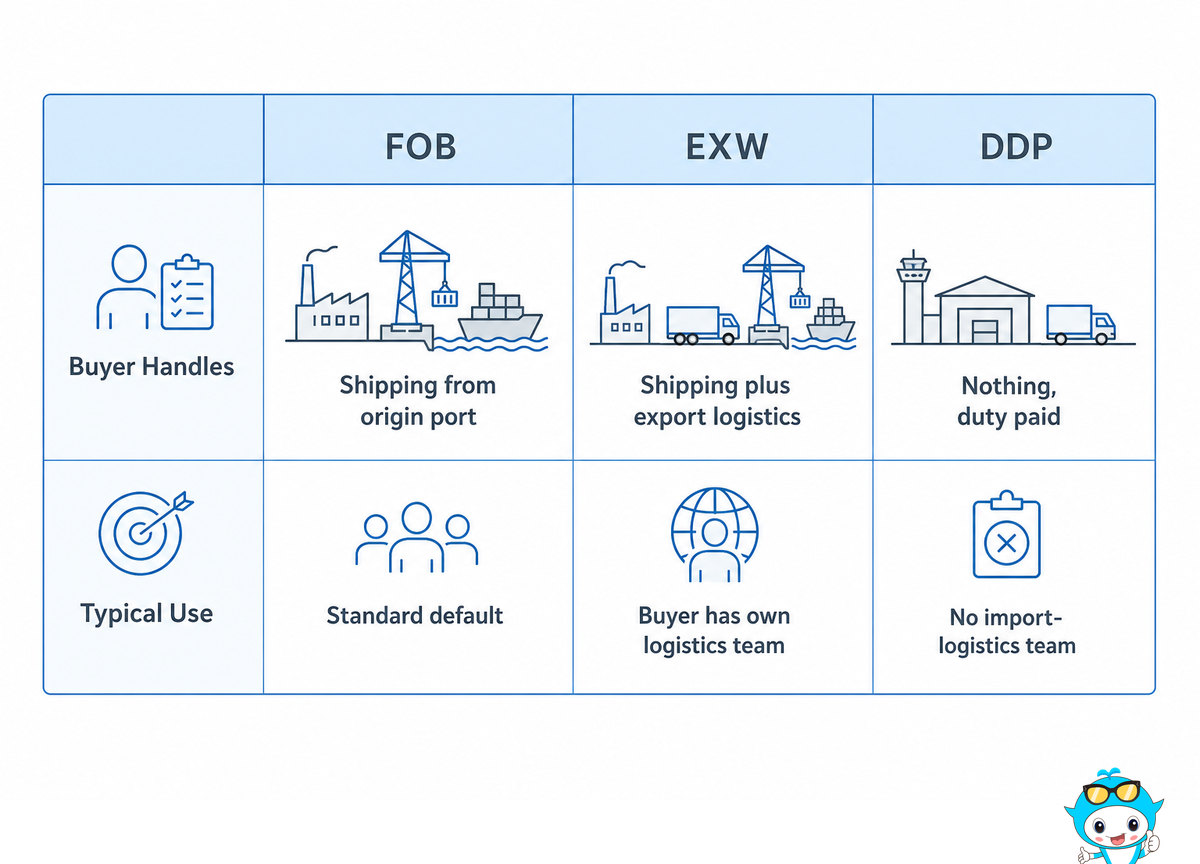
When purchasing in bulk for international trade, payment structures can differ quite widely, but a popular payment arrangement is that of China manufacturers of this sort, as well as Didi Land’s own published payment terms. They include ordering a deposit which would then be sent to the seller via telegraphic transfer at the confirmation of order. Payment of the remaining balance follows at a much later stage – prior to shipment. Use a 30%/70% split of order deposit and balance as a general guide – you’ll need to establish the actual terms per each order and seller you’ll be engaging with as terms vary per order size and client relationship, and in some cases a letter of credit will be an option to ensure secure payment. Any upfront payment requirement should be noted in red flag status (as per section above) as an upfront payment of the whole amount of an order should be an automatic red flag. Shipping terms are an element that affects the landed cost of a product – the U.S. Department of Commerce’s own trade-finance guidance covers the same deposit/balance and Incoterms logic in a broader export context. FOB (free on board) from the original shipping port is standard, and it signifies that you’ll need to handle shipping costs from this point on. EXW (ex works) means you’re also handling additional logistics, while DDP (delivered duty paid) passes the maximum logistics to the seller, and if you don’t have an import-logistics team, it’s an option, though it usually increases unit cost. Review the full indoor playground equipment product line for Didi Land’s latest published product category pricing levels.
Certifications and Standards You Should Actually Ask For
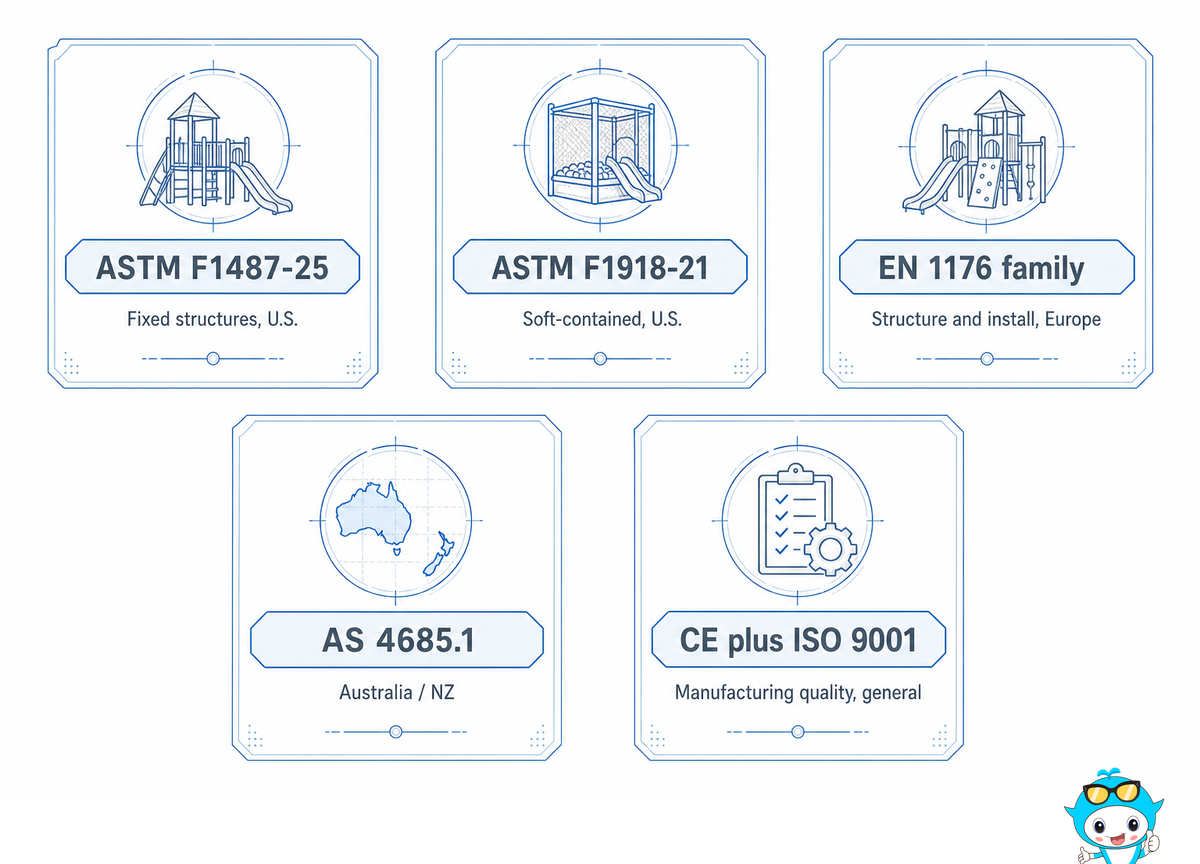
Certification requirements for commercial indoor playground equipment are more fragmented than most buyers expect, and a commonly-misconstrued belief is that “ASTM certified” means the same for everything. When reviewing supplier documentation on certifications, be mindful that there are two distinct ASTM specifications: one is for home playground equipment, and the other for public use. The U.S. Consumer Product Safety Commission (CPSC) specifies that there is not a single certification required for playground equipment as a whole. In other words, conforming to ASTM is a voluntary, consensus process that the market – such as venues, procurement specialists, and insurance providers – has established, and it’s not an actual certification that CPSC enforces or issues. ASTM F1487 remains the most widely referenced playground safety standard across North America, though Canadian buyers should still confirm any provincial add-on requirements.
A very common error even for savvy buyers to fall into is conflating ASTM F1487-25 (the current 2025 publication) which is only for fixed public-use structures, with ASTM F1918-21. F1918-21 specifies soft-contained play equipment, a distinct class of playground equipment (e.g. foam/net modules in ball pits or toddler zones). Note: fixed public use structures are not addressed in F1918-21. A facility is likely to have a mix of equipment types, thus you will have to evaluate and verify if each piece of equipment conforms to the appropriate standard.
✔ Standards Actually Worth Verifying
- ASTM F1487-25 – fixed public-use playground equipment (U.S., current mid-2025).
- ASTM F1918-21 – soft-contained play equipment (U.S., distinct from F1487).
- EN 1176 family (various parts, -1 through -10) – structure and installation standards, Europe.
- AS 4685.1:2021, Australia/NZ, modified adoption of EN 1176-1
- CE Marking + ISO 9001:2015 – general manufacturing quality standards, not safety-performance verification.
⚠ Common Misreadings
- Assuming F1487 covers soft-contained equipment (it explicitly excludes it)
- Claiming voluntary ASTM conformance as legally mandated certification.
- Reference to F1487-21 rather than F1487-25 (current mid-2025).
- One Certificate to Rule Them All in a Mixed-equipment Venue
There’s one additional compliance layer that falls outside of any equipment safety certification altogether: ADA requirements for commercial and government buildings’ indoor play areas and the U.S. Access Board guidance for accessible entry points to soft-contained play structures. This is a facility-design responsibility rather than a vendor’s equipment certificate issue and this guide won’t seek to go into detail on it, but you should factor it in as a real and separate line item. For the complete rundown on AS 4685, EN 1176, and F1487 by market, check out the complete safety standards comparison.
“Buyers lose money on indoor playground equipment less often because a supplier lied to them, and more often because nobody explained what the certificate they were shown actually covers, or what a 30% deposit is supposed to protect against.”
Didi Land technical team, on why sourcing literacy matters as much as picking the right supplier
Common Mistakes First-Time Buyers Make
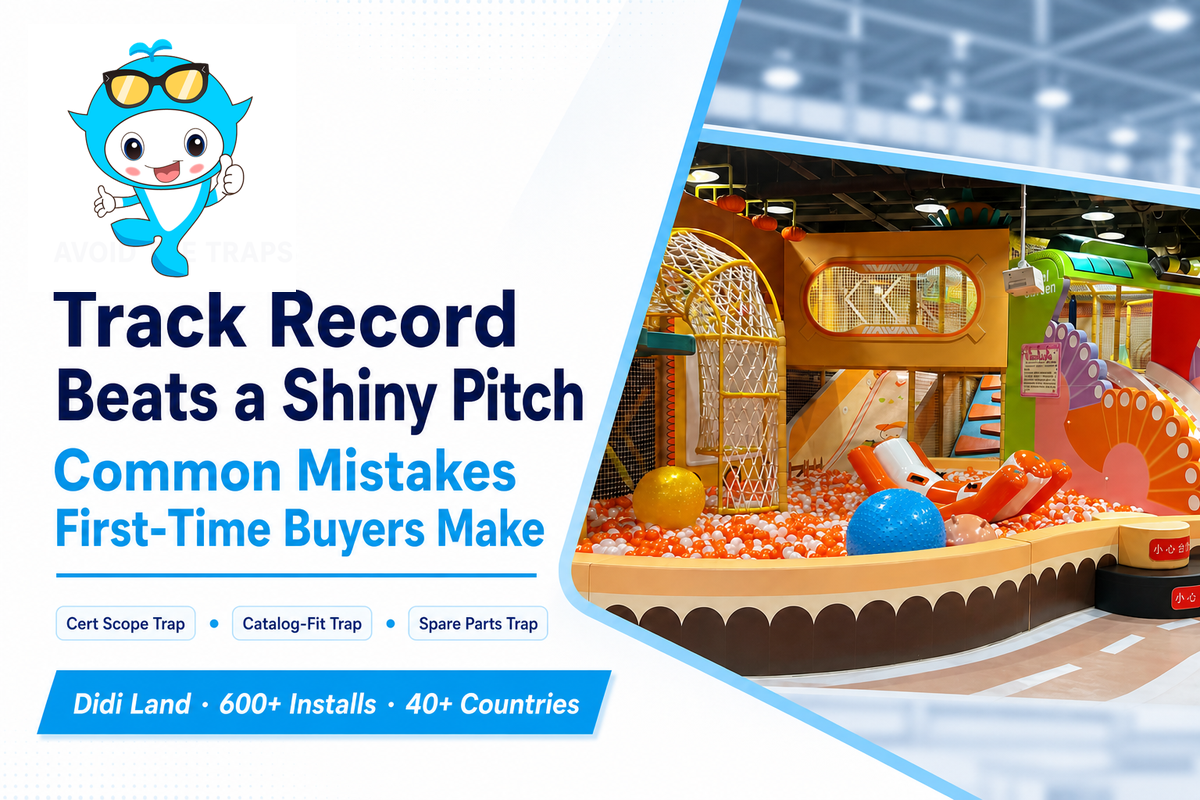
First-time buyers of indoor playground equipment typically make the same three mistakes, all of which could be avoided for the cost of information rather than currency. Mistake number one is the certification scope trap previously discussed, where buyers assume that a single ASTM or EN certificate covers an entire mixed-equipment facility-when, per the CPSC’s own scope guidance, a fixed structure, a soft-contained module, and a toddler-specific part may each be covered by a different standards scope. This is a fairly simple fix: in writing, ask which specific standard applies to which specific component before you sign.
Mistake number two is the off-the-shelf catalog trap, where you choose your equipment from your supplier’s standards catalog without relating it back to the physical geometry of your venue. Your actual ceiling height, column placement, and floor load rating can differ enough from the generic 5,000-square-foot box that catalog structure was sized for that the component literally doesn’t fit your venue. This is one of the most common reasons projects go through multiple RFQs, adding weeks onto a timeline that should have been set by the first round of quotes.
Mistake number three is the no-spare-parts-plan trap: where you purchase equipment without understanding what happens if a net tears, a foam panel wears thin, or a mechanical part breaks eighteen months into operation. Ask upfront about spare parts availability on the model you’re purchasing, and get clear estimates on reorder lead times. If your supplier can’t readily provide you with this information during the quoting phase, it’s unlikely they’ll do much better once you actually need it.
Long-term value favors a durable, high-quality indoor structure genuinely customized to your space and reliably supported by readily available parts, over a shiny pitch backed by vague claims with no real customer references behind it. Only buy indoor playground equipment after confirming the vendor’s underlying commercial indoor play track record – not before.
Industry Outlook: Why Sourcing Literacy Matters More in 2026
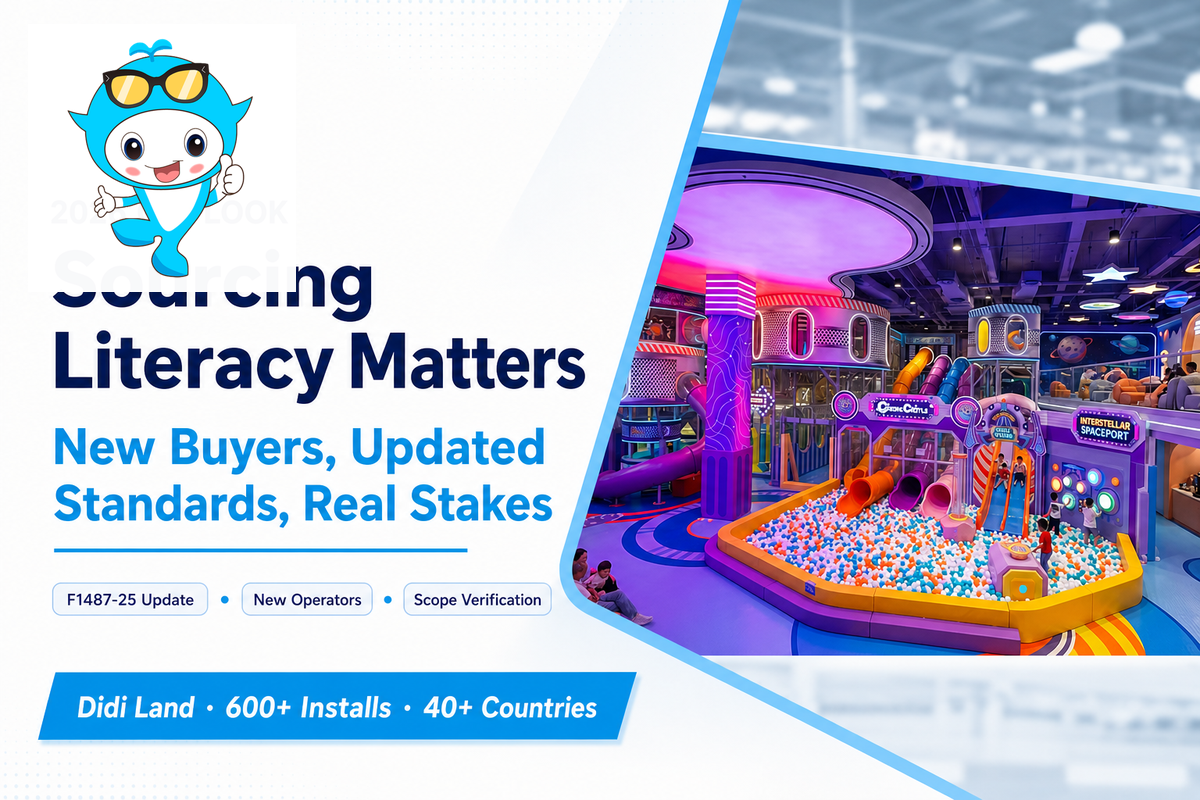
The U.S. Consumer Product Safety Commission issued a Public Playground Safety Handbook update in July 2025 and ASTM published an updated F1487-25 standard earlier that year-the first substantive revision to the core U.S. public-playground standard in years, following a 37-response public comment period. This is a concrete, dated regulatory event, not a vague assertion that the industry is evolving, and it means that buyers relying on outdated buying guides or supplier pages referencing F1487-21 are using out-of-date scope language at a moment when new, first-time, non-specialist buyers are flooding the market.
That last point-the trend of new, first-time operators-is the more substantial driver to act on, alongside the basic appeal of a year-round, weather-independent indoor venue that keeps pulling new entrants into the category. Market size estimates for family entertainment centers and indoor play differ dramatically by market research firm and definition-the published figures span roughly $28 billion to over $50 billion globally, since each research house scopes the market differently, and at least one other market-research firm’s narrower “commercial playground equipment” segment alone-excluding the broader family-entertainment-center venue category entirely-is sized closer to $1.25 billion for 2025, which only underscores how much a headline number depends on what’s actually being counted – don’t treat any single number as a precise indicator. What’s more reliably observable, though, is the demand trend behind those estimates: a constant stream of new, first-time operators-hospitality and restaurant groups buying play areas, small day-care chains expanding, first-time FEC startups-are now engaged in procurement decisions for the first time and likely lack internal engineering or compliance expertise. If you’re planning a 2026 build, then factor real time into your timeline for the scope verification and certification checks outlined in this guide, beyond the simple choice of equipment. Failure to do so means those new buyers will be caught flat-footed by a five-year-old standard revision.
Key takeaway
The 2025 ASTM F1487-25 and CPSC Handbook update is a material, dated compliance event; verify that the current revision, and not the 2021 version, is cited on any supplier information or buyer’s guide you’re reviewing before using it.
Ready to source your indoor playground solution? Put that factory-direct quote next to another one.
Frequently Asked Questions
Q: How do I choose an indoor playground equipment supplier?
Identify which channel you’re actually dealing with, verify certificate scope against your specific equipment types, and run the 13-point vetting checklist before paying any deposit.
The first step is to understand where the company sits: are they a factory-direct manufacturer, a trading company, a distributor, or a marketplace seller (see the four-channel chart above)-because that’s the entity to whom your contract and warranty belong. Second, make sure that the scope of their ASTM or EN certificate aligns with your specific equipment: a certificate for fixed structure won’t cover a soft-contained module. Finally, walk through the full verification process (estimate itemized testing, video call, sample request, payment terms), and then send your deposit.
Q: What certifications should I look for when buying commercial indoor playground equipment?
Request ASTM F1487-25 for fixed public-use structures, ASTM F1918-21 for soft-contained equipment, and the EN 1176 family or AS 4685.1 for European or Australia/NZ installations.
These are voluntary consensus standards, not a single, government-mandated certification; so, the pertinent question is less “are you certified?” and more “which standard, which version, and what is its exact scope, does it include this specific item?” Request a certificate number and look for a recent revision date; F1487-25 supersedes F1487-21 and is the most current revision as of mid-2025. ISO 9001:2015 and CE markings primarily indicate quality control systems, not the specific safety performance of your equipment.
Q: What’s the typical lead time for commercial indoor playground equipment?
Factory-direct production typically runs 25-60 days, catalog or semi-custom builds from established suppliers ship in about 4-8 weeks, and fully bespoke structural work can take 90-150+ days.
Exact figure depends on level of customization and shipping method. Basic catalogue builds and only slightly customized variants come fastest, fully custom-built structures with proprietary molds and fabrication process come last, and sea freight adds an additional 25-40 days to the timeline above. Don’t settle for a range on a supplier’s marketing page – ask for a written quote and guarantee tied to your specification.
Q: Is it cheaper to buy factory-direct instead of through a distributor or trading company?
Not always, factory-direct usually removes a markup layer, but a trading company or distributor’s added services (inspection, language support, in-market compliance help) can be worth paying for depending on your team’s own logistics experience.
The cheapest offer and the total-cost offer aren’t necessarily the same-this is a consistent warning from several independent industry players. Make sure you’re comparing total landed cost, not just the price of an individual item-factor in freight charges, costs of inspections, and the value of having someone on the ground who’s available to process warranty claims. Buyers with in-house logistics and quality-control can save significant money by sourcing factory-direct because they eliminate markup fees and deal directly with those manufacturing their build products. Buyers without this infrastructure might spend more in the long run dealing with the factory directly than by using an intermediary company. This is because you’ll have to invest a lot of your own time and money into monitoring the production, sourcing a third-party inspection, and addressing time-zone and language barriers, all of which would be handled by an intermediary as part of their margin. You need to assess your team’s availability honestly to determine if you’ll actually save money by working directly with a factory.
Q: What’s the minimum order quantity (MOQ) for custom indoor playground equipment?
One project or one set is the standard minimum order quantity on true factory-direct indoor playground equipment lines – bulk minimums are the exception for custom commercial structures, not the rule, and a quote requiring more should be questioned.
Ask why if a supplier quotes higher.
Q: What payment terms are normal for international playground equipment orders?
A 30% deposit by telegraphic transfer at order confirmation with the remaining 70% due before dispatch is the most common structure, with letters of credit available for buyers who want bank-mediated security.
The 30%/70% split above is the industry average, and a 100% upfront payment demand is a massive red flag from the vetting checklist above. It’s possible to get additional security from Sinosure by qualifying for payment protection with certain factories if you’re already a proven buyer. You’ll want to ensure you understand your shipping terms-FOB, EXW, and DDP-because these greatly affect your total cost and how much responsibility you’ll have over logistics.
About This Sourcing Guide
The analysis in this report draws from both Didi Land’s internal supplier benchmarking data and independently sourced pricing data. We reference current primary sources from CPSC and ASTM that were included in the July 2025 Playground Safety Handbook and use cost benchmarks sourced from multiple independent industry sources as opposed to those provided by a single company for sales positioning. If any specific data-such as a competitor’s average turnaround time or a bulk minimum quantity threshold-could not be independently confirmed, this is noted as opposed to presenting assumptions as facts. Didi Land technical team reviewed the content.
References & Sources
- Public Playground Safety Handbook (2025 edition) U.S. Consumer Product Safety Commission
- Notice of Availability: Public Playground Safety Handbook Update Federal Register
- Playground Equipment Business Guidance U.S. Consumer Product Safety Commission
- Selecting a Third-Party Laboratory FAQ U.S. Consumer Product Safety Commission
- ASTM F1918-21 Standard ASTM International
- IPEMA Certification Training International Play Equipment Manufacturers Association
- ASTM F1487 Public Playground Equipment Standard Explainer American National Standards Institute
- ASTM Publishes Revised Consumer Safety Performance Specification for Playground Equipment SGS
- What Just Changed? A Look at the New July 2025 CPSC Playground Safety Updates Playground Professionals
Related Articles
- Top Indoor Playground Equipment Manufacturers a ranked comparison of named manufacturers, if you’ve already narrowed down to the factory-direct channel
- Buyer’s Spec Audit Guide how to verify a supplier’s specs once equipment actually arrives
- Indoor Playground ROI the revenue and payback math once your equipment is installed
- Are Indoor Playgrounds Profitable? a quantitative break-even and sensitivity model for first-time operators
![Custom Dinosaur Playground Equipment [Design Guide]](https://didiplayarea.com/wp-content/uploads/2026/09/custom-dinosaur-playground-equipment-r2-featured-1-768x512.png)
![Custom Dinosaur Playground Equipment [Design Guide]](https://didiplayarea.com/wp-content/uploads/2026/09/custom-dinosaur-playground-equipment-r2-featured-1-150x150.png)