Get in Touch with Didi Land


Trampoline park equipment offers commercial jumping courts, protective systems, and optional attractions. Begin with the court assembly and zone matching. Consider the costs of the equipment you choose. A basket of trampolines, pads, and games becomes a functional venue only when access, supervision, maintenance, and replacement parts are planned together.
A low price per square meter can hide a smaller equipment footprint, or the costs for installation, which are charged separately. A colorful rendering can hide an awkward landing exit. This guide breaks down those buying decisions, with a zone matrix, a padding interface map and a quote comparison you can use before committing to a layout.
Trampoline park equipment includes frames, jumping beds, suspension, pads, containment and access systems. Add attractions only after matching their operating requirements to the venue. Compare quotes using the same layout, equipment area and delivery scope.
Quick planning reference
| Commercial court reference | ASTM F2970-25 |
| International park reference | ISO 23659:2022 |
| Padding purchase basis | Configured coverage, attachments and interfaces |
| Equipment price basis | Named layout, stated area and written inclusions |
Key points
- A quoted pad thickness describes one component; protection also involves its coverage and attachment.
- Foam pits and airbags need different cleaning, inspection and service arrangements.
- Equipment, building renovation and opening reserves belong in separate budget lines.
- Replacement-part identification should be agreed before opening.
What Trampoline Park Equipment Includes
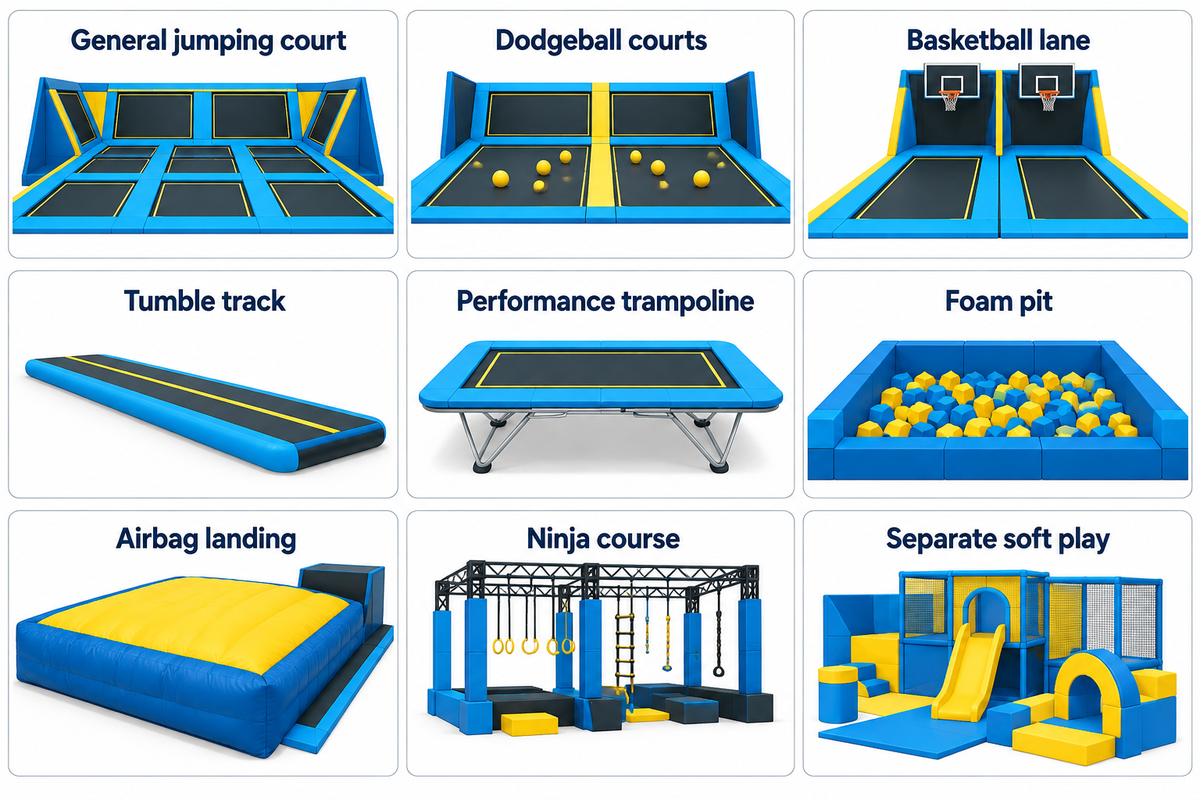
A commercial trampoline court must include load bearing frames, jumping beds and suspension elements. Protective padding and containment systems complete the court. Optional attractions change what visitors do and what staff must manage. Build the core court specification first, then add activities that fit the proposed users, sightlines, staffing and maintenance access.
How is trampoline park equipment built?
Commercial trampoline equipment is assembled as a designed system: steel frames support the beds, springs or other suspension connect the jumping surfaces, and pads cover the specified structural and suspension areas. Nets and access control complete the system. The equipment must be integrated with the systems of the building to which it’s fitted.
Manufacturer details illustrate how systems differ. Weiroo lists 80 × 80 mm galvanized frames with 3.0 mm walls, plus 180 mm standard or 260 mm pro springs in its published equipment configurations. Compatible geometry, connections and the configured performance matter when replacing a mat or spring; a similar-looking part isn’t an interchangeable part.
| Equipment type | Play function | Supporting provision | Operating decision |
|---|---|---|---|
| General jumping court | Open bouncing | Beds, pads, perimeter containment | Preserve attendant sightlines across the court |
| Dodgeball courts | Organized team games | Game separation, balls and entry control | Plan game turnover without crossing active beds |
| Basketball lane | Jumping toward a basketball hoop | Approach, landing and retrieval arrangements | Keep waiting visitors outside the active lane |
| Tumble track | Sequential movement along a lane | Clear run and controlled end zone | Separate entry from the previous user’s exit |
| Performance trampoline | More demanding jumping activity | Activity-specific design and operating rules | Match admission and supervision to the activity |
| Foam pit | Landing into loose foam cubes | Designed pit structure and specified fill | Allow access for block removal and inspection |
| Airbag landing | Landing onto a configured inflatable system | Specified support and operating equipment | Provide service access and the prescribed exit route |
| Ninja course | Obstacle-based adventure play | Obstacle supports and landing provisions | Manage its queue and supervision separately |
| Separate soft play | Non-trampoline indoor play | Age-appropriate play structures and circulation | Separate toddler play from active jumping routes |
Climbing walls, spider walls and ninja warrior courses are different types of equipment, even when they appear in the same entertainment center. Their supporting structures and their operating instructions need a place of their own in the equipment schedule. The broader family entertainment center equipment guide covers attraction mixes beyond the trampoline zone.
Safety Pads, Nets and the Interfaces Between Them
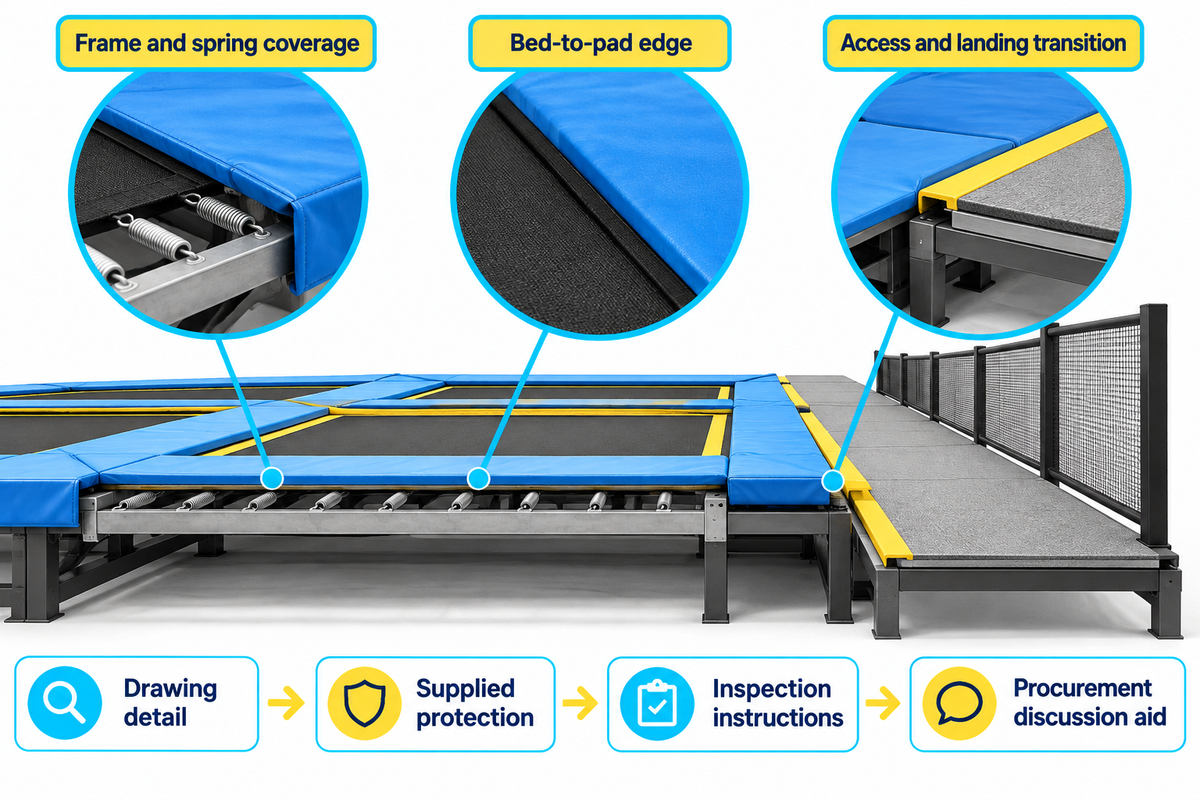
Safety pads cover designated frame and suspension areas, while nets help separate and contain activity. Padding as part of a court installation requires attention to coverage, attachment, bed edges and transition access. Thicker foam samples alone don’t resolve those interfaces, especially where users step between a walkway and a jumping surface.
For commercial courts, ASTM F2970-25 addresses design through operation, inspection and maintenance. ISO 23659:2022 addresses trampoline parks and their components, including landing areas such as airbags and foam pits. Home consumer trampolines have a different reference, ASTM F381-24. The home trampoline spec is not a valid basis for procurement of a commercial court.
“The standard’s existence alone will not prevent injuries.”
Use the 3-Interface Padding Map
The 3-Interface Padding Map is a way to mark a layout before a supplier review. Mark frame and spring coverage. Trace bed-to-pad edges and mark all accesses and landings. For each marked location, connect the drawing detail to the supplied protection and the inspection instructions. The map organizes the buying conversation; a qualified designer and inspector evaluate the actual system.
| Interface | What belongs together | What the buyer needs |
|---|---|---|
| Frame and suspension coverage | Structural edges, springs and specified protective pads | Coverage drawing, pad identification and attachment detail |
| Bed-to-pad edge | Moving bed, adjacent pad and fastening system | Configured edge detail and condition checks |
| Access and landing transition | Walkway, court entry or attraction landing/exit | Transition detail, user route and inspection access |
Distinguish cover thickness from foam thickness. Angel’s product description lists a 0.45 mm PVC pad cover; Weiroo lists 80 mm EPE padding. Numbers refer to different layers. None is a universal pad requirement. The useful comparison names the cover, foam, finished dimensions, method of attachment and exact location in the court.
Consider a bed replacement refurbishment where old pads are retained. The purchase manager sees an opportunity to lower initial cost. The maintenance manager sees a connection problem: a replacement bed can change the relationship between its edge and the existing protection. Treat the bed, adjacent padding and fasteners as one replacement package in the supplier discussion. The impacted area must remain closed off until the correct components are installed and the required checks are completed. An unaltered color scheme says nothing about whether the new assembly is in accordance with the approved design. Record replacement identifiers on the location drawing to help support the next purchase with the correct components.
Trampoline Zones, Soft Play and Venue Fit
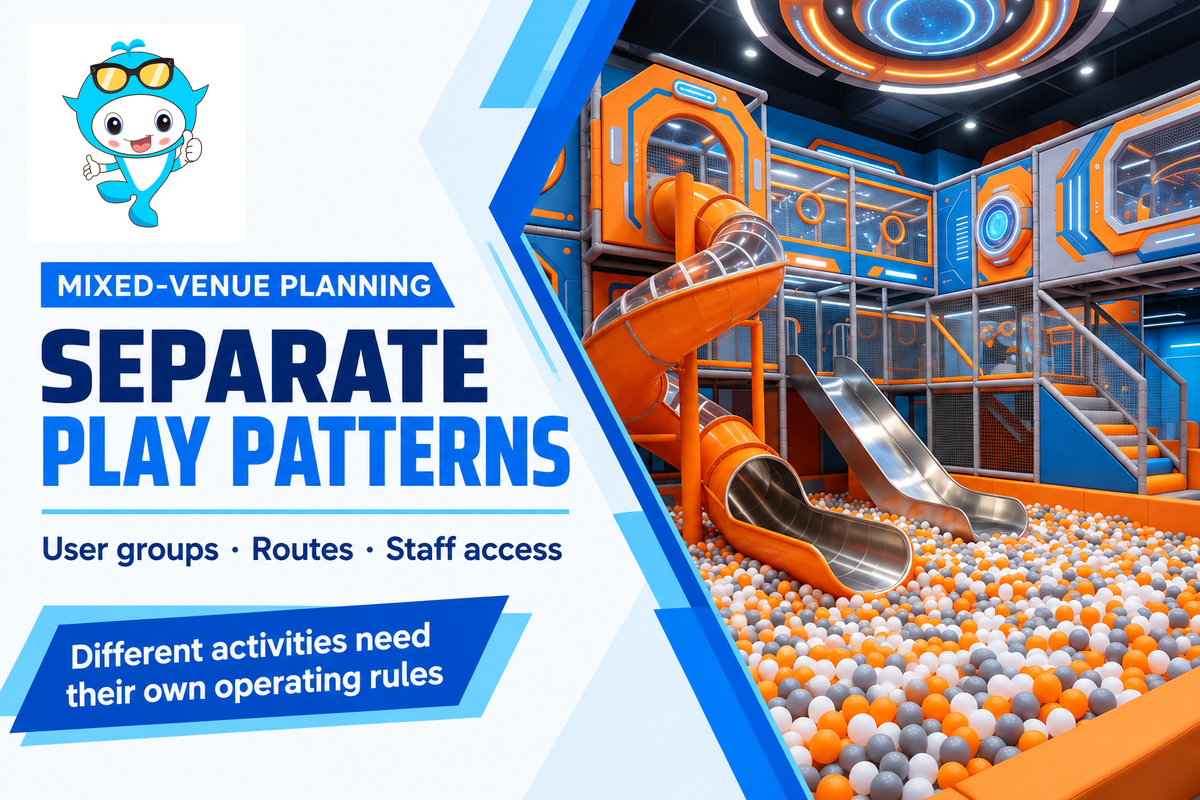
Choose the attraction mix around the intended visitors, usable building geometry and the staff who will operate each zone. Clear ceiling height, columns, entrances and service access constrain the park layout. Separate soft play can serve a different activity group, but its entrances and circulation should avoid active trampoline routes.
The American Academy of Orthopaedic Surgeons recommends against use of a trampoline for children less than six years of age. It shouldn’t be assumed that a kids indoor trampoline park is adequate for children less than six years of age. Plan a separate non-trampoline play area for younger visitors rather than treating a kids indoor trampoline park as suitable for every child. Medical advice, manufacturer’s age label and the admissions policy of a venue have different purposes.
When considering a mall unit, a family entertainment operator may want both a jumping court and a younger-child indoor playground. A good first plan has the family entrance leading to the shared reception, which then splits to controlled access to the activities. Parents can reach the soft play without walking across a dodgeball queue. The staff has a view to the jumping court without a blockage from a tall play structure. If the available unit can’t support those routes, reduce the attraction mix before shrinking the access space. The leasing decision should be based on a measured column grid and services, rather than relying on a rectangle labeled the total building floor area.
For an existing commercial indoor playground, a modular addition may be easier to phase than a complete rebuild, but it still changes queues and staff coverage. For example, Weiroo markets 100-500 m² modular additions distinct from their 800-3,000+ m² venue tier. A compact indoor trampoline park may still require construction and a separate operating strategy.
For a hypothetical 500 m² expansion, assume the equipment occupies 500 m² inside a 750 m² leased unit. The remaining space must accommodate reception, circulation, services and other planned uses. Freeze the equipped space before approaching a supplier for an offer. A supplier providing pricing for the full leased space is using a different denominator. We follow the same equipment footprint in the cost comparison and supplier brief.
To maximize space, remove attractions that duplicate the same activity before reducing circulation or maintenance access. A narrow service route can force adjacent equipment to close whenever a replacement component is moved through it.
Activity specific rules for eligibility are still needed for the play equipment sold for people of all ages. Ball pits and toddler play have different use patterns from performance beds. The soft play equipment range can be considered for the non-trampoline portion of a mixed venue.
Foam Pits, Airbags and Other Trampoline Attractions
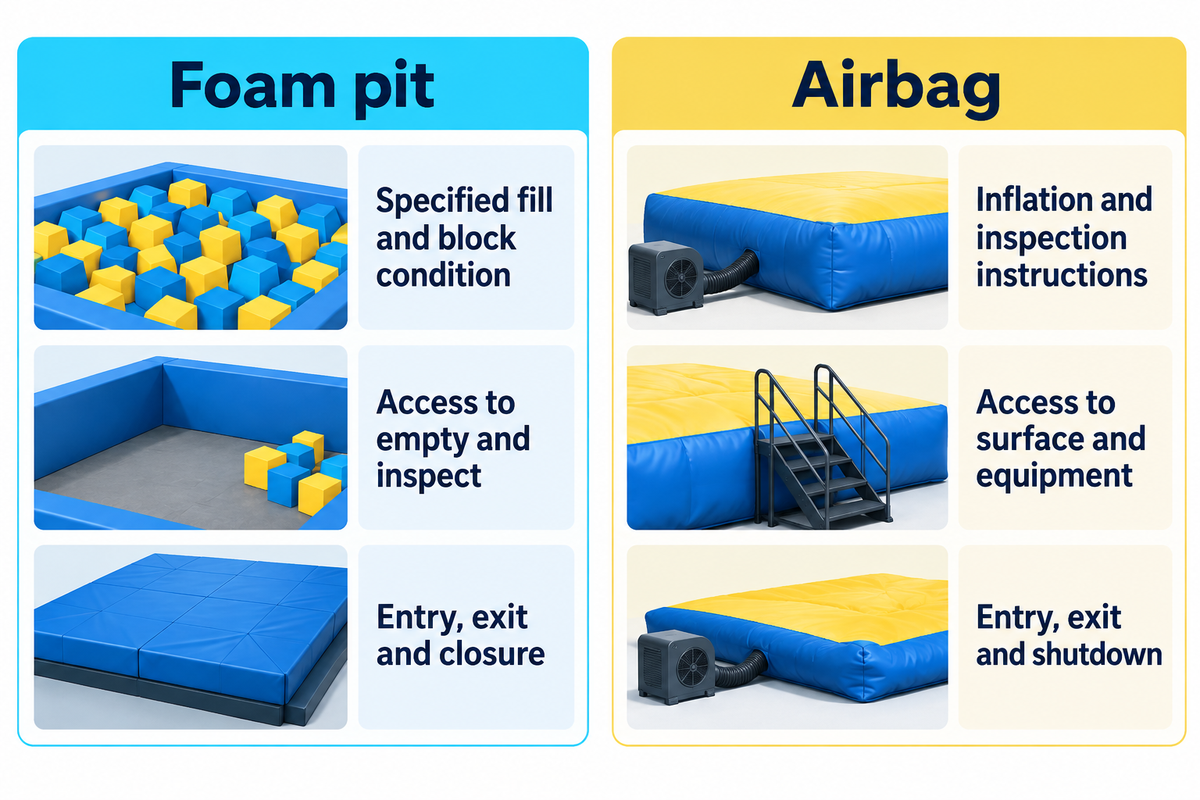
Foam pits and airbags are configured landing attractions with different support systems, cleaning tasks and exit arrangements. Pick the landing attraction based on the activity and plan. While doing so, consider risk controls and maintenance access. Loose foam and an inflatable surface each require more than an attractive picture in a proposal.
Risk varies by activity. A 2024 study by Teague and colleagues analyzed operator records from 18 parks in Australia and the Middle East during the period of 2017 to 2019. Against an overall 1.14 injuries per 1000 jumper hours, rates were highest for high-performance jumping (2.11/1000 jumper hours) and the combined inflatable-bag-or-foam-pit category (1.91/1000 jumper hours). As the landing types were combined, the study cannot rank airbags against foam pits. The historical data shouldn’t be used to predict the current US venue conditions.
A 2022 laboratory study of head-first foam-pit entry found injury reference thresholds exceeded in tested 1.5 m falls across three pit constructions. An adult test dummy, limited testing, and laboratory pit dimensions constrain the finding. There was no airbag comparison. One author disclosed founding Mr Trampoline and a possible benefit from publication. The implication for the trade is to examine the complete landing design, and make sure that unauthorized head-first entries are prevented, rather than evaluating the attraction based on perceived foam depth.
Foam pit operating plan
- Maintain the specified fill and block condition.
- Provide access to empty and inspect the pit.
- Define entry, exit and closure procedures.
Airbag operating plan
- Follow the configured inflation and inspection instructions.
- Provide access to the surface and operating equipment.
- Define entry, exit and shutdown procedures.
ELI Play’s maintenance guidance describes removing all foam blocks for thorough cleaning and inspecting the exposed pit. Big Airbag describes replaceable top sheets in their system. Removable elements in the system affect service access, shut downs and planning. A venue should determine where removed elements or replacement materials will go, before approving a drawing.
Trampoline Park Equipment Costs: Compare the Same Scope
Weiroo publishes $80–$150/m² for a heavy-duty layout; Akrobat’s page lists €150/m² in one section and €350/m² in another, leaving its advertised starting price unclear.
Price checks for the Akrobat starting price and Weiroo range were conducted on November 3, 2026. These published prices are subject to change. An area rate requires a denominator: the equipped activity footprint, the entire leased unit, and the area of a multi-level play structure are different quantities.
Use the supplier’s packing list to build the freight allowance in a shipment quotation, and identify the origin and named destination of the shipment. Also, include the agreed responsibility for import handling, local delivery and unloading. Price the installation from a separate work scope covering crew, travel, accommodation, tools, local labor and site preparation. Taking this approach gives your budget project-specific amounts, as opposed to applying a percent to the equipment price.
Costs associated with construction, as in the example of the Texas project (TABS2026013038), provide a basis for comparison of construction costs, separately from equipment costs. Texas project TABS2026013038 records a $1.2 million renovation estimate for a 31,512 ft² Altitude Trampoline Park project, including demolition and tenant up-fit. This filed estimate, however, is an example of a construction scope cost, as opposed to a trampoline equipment price or the final project cost.
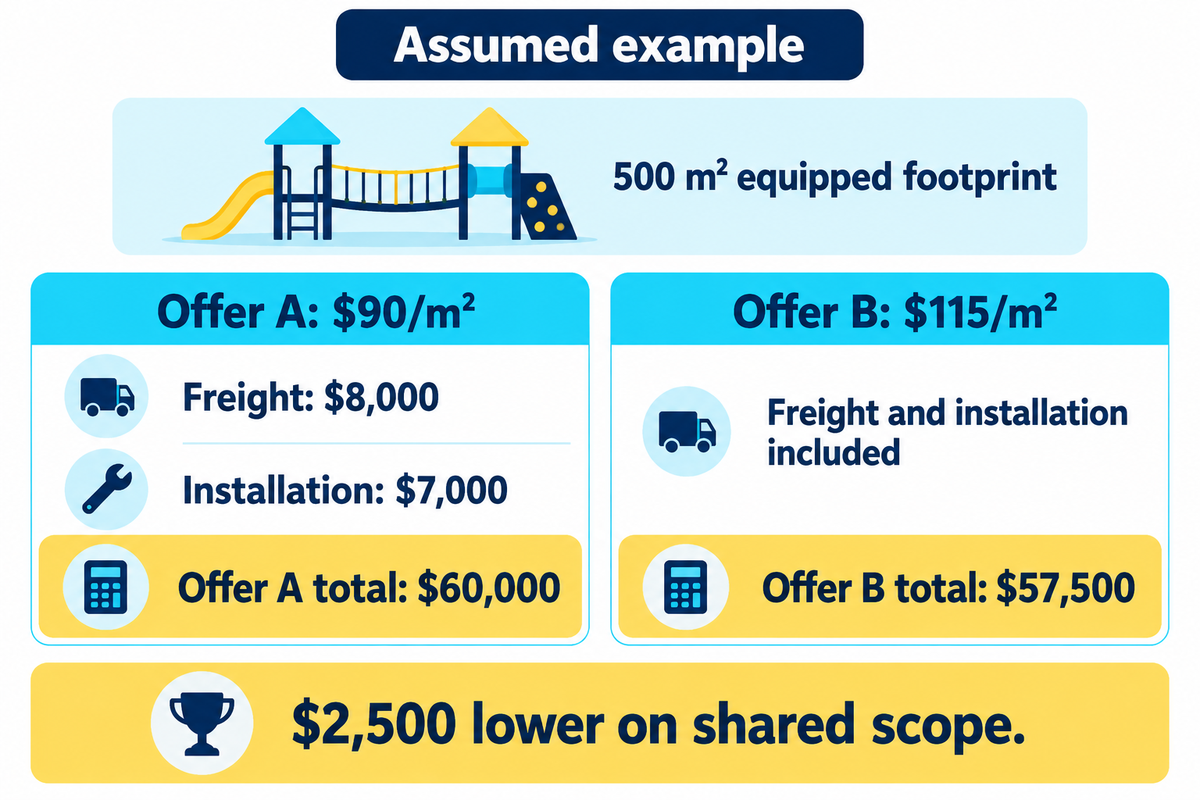
Worked example: 500 m² expansion. Assume Offer A is $90/m² and excludes $8,000 freight and $7,000 installation. Offer B is $115/m² and includes both items. Offer A totals 500 × $90 + $8,000 + $7,000 = $60,000. Offer B totals 500 × $115 = $57,500. The higher advertised area rate is $2,500 lower on that shared scope. Duties, local building work and other exclusions still need their own lines in both offers.
The owner may prefer A’s initial $45,000 equipment figure, while the finance function compares the $60,000 delivered-and-installed subtotal. Operations may then find that one offer includes identifiable opening spares and training while the other leaves those tasks unpriced. It’s important to document these distinctions prior to selecting a supplier. Don’t assign an implicit value of zero to an unexplained line.
Operating costs should be separated from this purchase total. Maintenance consumables, replacement components and special service and attraction downtime continue after opening. A plan to keep customers coming back also requires staffing and ongoing maintenance of the play experience. Funding the full venue and planning for revenue should be in the trampoline park startup cost guide.
Equipment Suppliers: A Practical Comparison Checklist
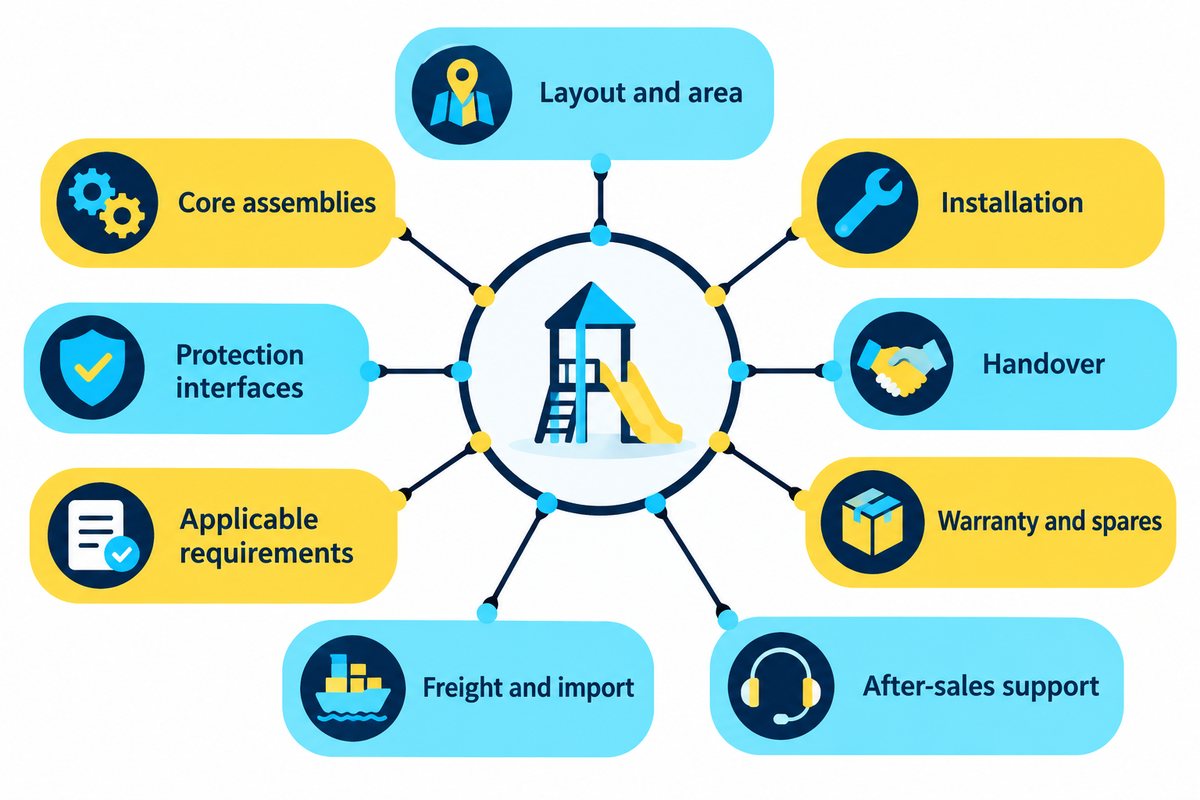
Compare equipment suppliers against the same written brief, with each inclusion, exclusion and responsibility visible. The most relevant supplier response shows how layout connects to an itemized list of equipment, project evidence, and work to be done for installation and replacement. A catalogue’s latest designs should lead to a buildable proposal with named deliverables and owners.
Where can you buy trampoline park equipment?
You can buy through equipment manufacturers, specialist park integrators or regional distributors. A factory-direct order can place more coordination on the buyer, while a local integrator may bundle site work and installation services. Look past the sales description and compare written responsibilities. The trampoline park manufacturers list is another route to a short list.
Manufacturer examples discussed here include Weiroo’s commercial court systems, Akrobat’s custom equipment and Angel’s listed trampoline products. Didi Land also provides design and manufacturing services for integrated play equipment. Use the same attraction schedule to request proposals from the manufacturers that serve your project location; assess their actual proposal and service arrangements before selecting one.
Include the following nine points in your request for proposal to all suppliers. Give each supplier the measured building plan and intended user groups and attraction schedule.
In the 500 m² expansion, include both the 500 m² equipped footprint and 750 m² leased area on the brief and label them differently. Each offer should identify the drawing revision and state the priced area. An apparent price reduction obtained by removing the landing zone is a change in equipment package and should be treated separately.
| Comparison line | Response to request | Who needs the answer |
|---|---|---|
| Layout and area | Drawing revision, attraction count and priced m² definition | Owner and designer |
| Core assemblies | Itemized frames, beds, suspension, pads and nets | Procurement |
| Protection interfaces | Coverage, connections, transitions and inspection access | Designer and inspector |
| Applicable requirements | Named standards/editions and project-relevant evidence | Project team and local authority |
| Freight and import | Delivery term, destination, packing, unloading and charge allocation | Finance and logistics |
| Installation | Crew, travel, tools, site preparation and professional installation scope | Site manager |
| Handover | Required checks, manuals, staff training and acceptance responsibilities | Operations |
| Warranty and spares | Covered parts, exclusions, claim procedure and replacement identifiers | Maintenance and procurement |
| After-sales support | Response route, installation guidance and specialist service arrangements | Park manager |
Manufacturers offer custom equipment and turnkey solutions with different boundaries. A high-quality proposal defines “turnkey” work. Reliable after-sales support has a contact route and agreed replacement process. Define “top-quality trampoline equipment” in the contract through named components, applicable requirements and handover deliverables.
Didi Land’s design and manufacturing services include design, manufacturing, logistics, installation and after-sales. For a combined indoor playground and trampoline project, the indoor playground equipment solution is the place to discuss a custom configuration.
Inspection, Maintenance and Replacement Parts
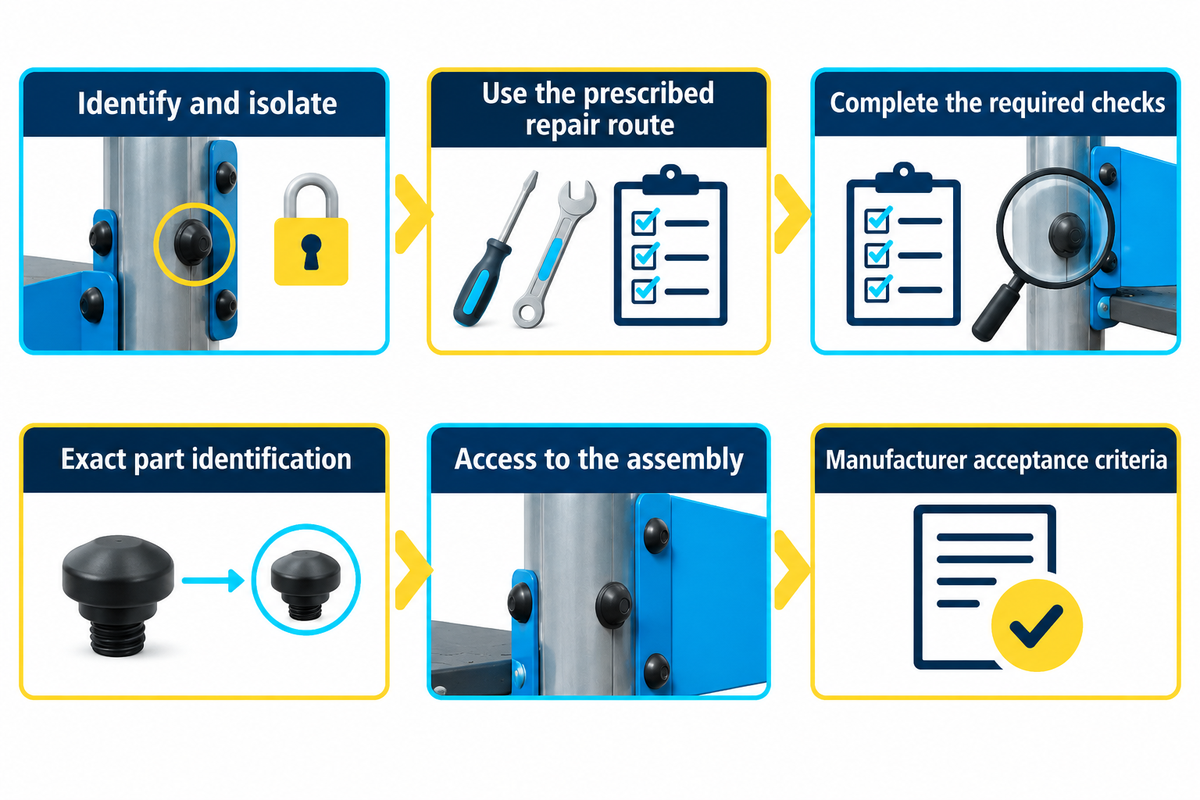
Maintenance starts with the installed system’s instructions, pre-opening checks and recorded component condition. Durable equipment still needs attention to beds, suspension, padding and nets. For durability, track the inspection record and take action to rectify outstanding conditions. Keep the service contact and identifier for a damaged piece of equipment, and isolate and replace it in accordance with the procedure.
How often should trampoline beds be replaced?
There is no single calendar replacement interval for all trampoline park beds; replace them when the manufacturer’s acceptance criteria or service limit requires replacement, or inspection identifies damage that makes continued use unacceptable. Every trampoline park needs the supplied bed’s checks, closure criteria and authorized replacement procedure in its operating manual.
ELI Play states that prior to opening, beds, springs, and protective coverings should be checked as well as exits and access under the structure. It also includes cleaning advice. Nanplay’s spare-parts guide cautions against using a fixed replacement interval and part identification by appearance. Part numbers, dimensions and connections are practical details to prioritize in a commercial grade purchasing brief.
- Identify and isolate — record the affected location and close the attraction when its condition requires it.
- Use the prescribed repair route — match the exact part and assign the work to authorized staff or a qualified technician.
- Complete the required checks — document the work and required inspection before reopening.
For trampoline park owners, the hidden bottleneck is often access to the job. A spare stored on site is useful only when staff can identify it, and the qualified person can access the assembly. Protective structures, storage racks, and adjacent attractions can obstruct that route. Include service access in the final layout, especially for high traffic venues where closures affect neighboring zones. Wider inspection records are covered in the indoor playground maintenance guide.
What Is Changing in Commercial Trampoline Equipment
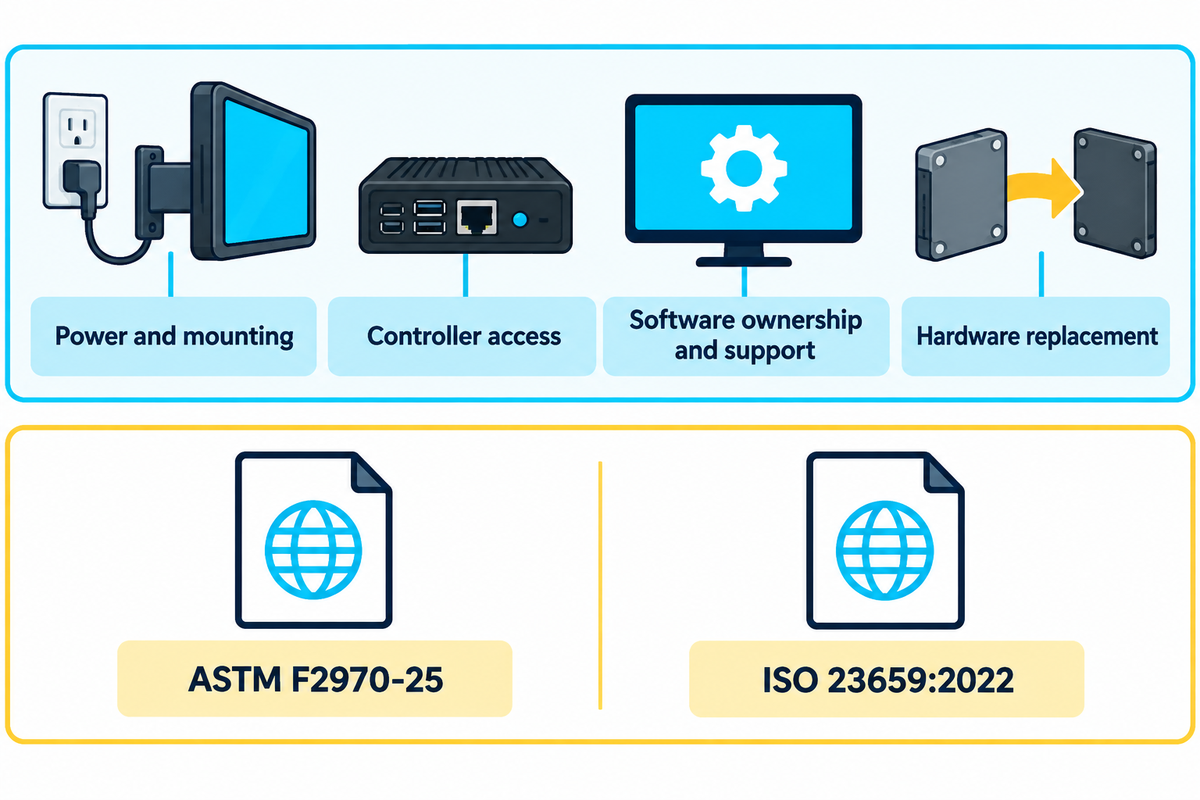
Commercial equipment purchasing can involve coordinating physical attractions with operating technology, while keeping the standards reference current. Equipment purchases bring questions of service and integration. Treat electronics and software as maintainable parts of the proposed play experience, with their own installation and support responsibilities.
Global Fun Sports describes a Dynamic Floor using a projector and motion sensor along with timed Ninja Tag obstacle courses. These are concrete attraction options for family entertainment centers. They add a different maintenance task from replacing a foam cover. A failed sensor, an unavailable game license or an inaccessible projector can stop the activity while its structure remains intact.
For a commercial trampoline park including digital games, the power supply, mounting, location of the controller, ownership and support for the software, as well as replacement of the hardware, should be addressed in the brief. A game aimed at repeat visits also needs an operator who can reset it and explain its rules. Adding electronics to make your trampoline attraction more varied shouldn’t obstruct attendant sightlines or the landing route.
Edition control is the other practical change. ASTM’s catalog identifies F2970-25 as active, with a February 3, 2026 update. ISO identifies ISO 23659:2022 as current following confirmation in 2024. For a new purchase, the technical schedule should name the relevant safety standards and editions, with evidence for the actual configured equipment. Local building, fire and approval requirements still need their own project workstream.
Custom trampoline parks can combine jumping with other activities, but quality standards need to follow each equipment family. Climbing walls and ninja warrior attractions each retain their own technical and operating requirements. Park owners gain a more manageable installation when the supplier schedule separates court hardware, landing systems and digital equipment instead of lumping them under an unqualified promise of safe and enjoyable play.
Frequently Asked Questions
What is trampoline park equipment?
Trampoline park equipment is the engineered jumping system and associated attractions used in a commercial venue. Its core includes frames, jumping beds, suspension components, padding, containment and access arrangements. Basketball lanes, dodgeball courts, landing attractions and ninja courses are additions. Compare the complete configured system, including its operating instructions, rather than buying disconnected components.
Can trampoline park equipment be customized?
Yes. Commercial equipment can be configured around a venue’s layout, attraction mix and theme through the manufacturer’s design process. Customization starts with measured building information and proposed user groups. Suppliers then develop the equipment layout and supporting details. Color choices come after the activity routes, access arrangements and operating requirements have been resolved.
Can home trampolines be used in a commercial park?
No. Specify equipment designed and manufactured for the proposed commercial use. A home trampoline and commercial court have different design and operating contexts, even when their dimensions look similar. ASTM F381 addresses consumer equipment, while F2970 addresses commercial or institutional courts. Procurement must cover the complete installed system, instructions and applicable project requirements.
Does an equipment quote cover the whole venue?
Only if its written scope lists every item the venue needs; anything not listed is excluded. Separate equipment from freight, import charges, unloading, assembly, building work and operating reserves. Compare omissions before comparing totals. A factory price and an opening-ready venue budget cover different work and responsibilities.
Is owning a trampoline park profitable?
A trampoline park can be profitable when earned revenue covers rent, staffing, insurance, maintenance, replacement spending and the other costs of the business. Equipment price alone gives no payback period. Build the business case around local demand and conservative attendance, then stress-test lower revenue and attraction closures. For the equipment purchase, compare equivalent offers and service requirements. Keep the full venue forecast separate from the purchase comparison so an inexpensive equipment package doesn’t hide an underfunded opening.
Are airbags always better than foam pits?
No. Select the complete landing installation for the intended activity, risk controls and operating plan. Compare inspection needs, cleaning workload, exit procedure and replacement access. Airbags and foam pits both need activity-specific operating controls; neither surface makes prohibited head-first entry safe.
How long does trampoline park installation take?
Weiroo publishes assembly estimates of 30–60 days for its main-venue tier and 10–20 days for modular additions. Build the actual programme around building readiness, access, unloading, crew responsibilities, assembly, inspections and training. Production and transport come on separate milestones. The opening date also needs the project’s required approvals and handover, so a quoted assembly duration should sit inside the full schedule rather than replace it.
Turn your layout into a comparable equipment brief
Bring the measured plan, proposed user groups and preferred attractions to Didi Land. We can discuss the equipment mix and project services, while the checklist above keeps scope, installation and replacement support visible. Start with the building and operating constraints before choosing a theme or adding more attractions.
The Interface map supports procurement discussions. Equipment design, installation, inspection, and operation require qualified local professionals.
References & Sources
- ASTM International, F2970-25, commercial and institutional trampoline courts
- International Organization for Standardization, ISO 23659:2022
- ASTM International, F381-24, consumer trampolines
- American Academy of Orthopaedic Surgeons, Trampoline Injury Prevention
- Teague et al., Trampoline Park Injury Trends, Pediatrics, 2024
- Neck Loads During Head-First Entries into Trampoline Dismount Foam Pits, 2022
- Texas Department of Licensing and Regulation, Project TABS2026013038