Get in Touch with Didi Land

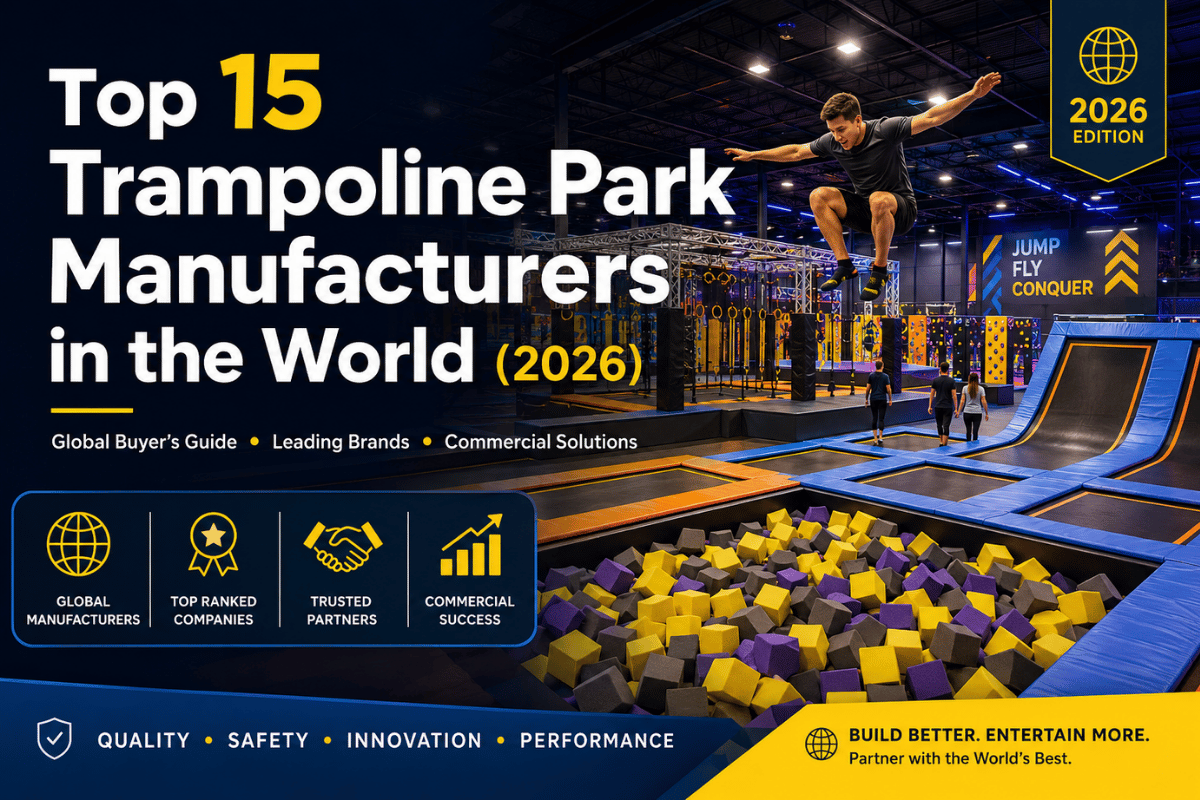
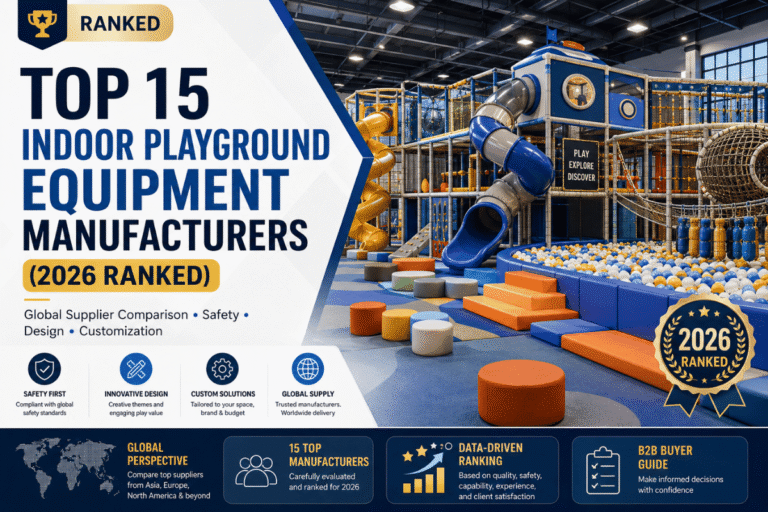
Who you partner with as a world-leading trampoline park manufacturer affects everything that comes after the purchase order-the safety standard for your court, the number of weeks until your grand opening, or if a cracked bounce mat means a quick messenger pigeon or a 2-month container wait. In this guide, we break down 15 of the leading trampoline park manufacturers and suppliers in China, Europe, and North America-the companies that actually build indoor trampoline park courts and attractions-including verified founding year, product scope, and honest assessment of strengths & shortcomings.
Important: This is an unranked list of manufacturers.
Quick Specs: This Buyer’s Guide at a Glance
| Manufacturers profiled | 15 (across 3 continents) |
| Origin split | China 9 · Europe 3 (DE / SI / NL) · North America 3 (US / US / Canada) |
| Founding range | 1958 – 2017 |
| Key standard for courts | ASTM F2970-25 (US) · EN-ISO 23659:2022 (EU/intl) |
| Equipment market | ~$2.8B (2025), projected ~$5.9B by 2034 (CAGR ~8.6%, Dataintelo) |
How to Read This List: 5 Types of Trampoline Park Manufacturer
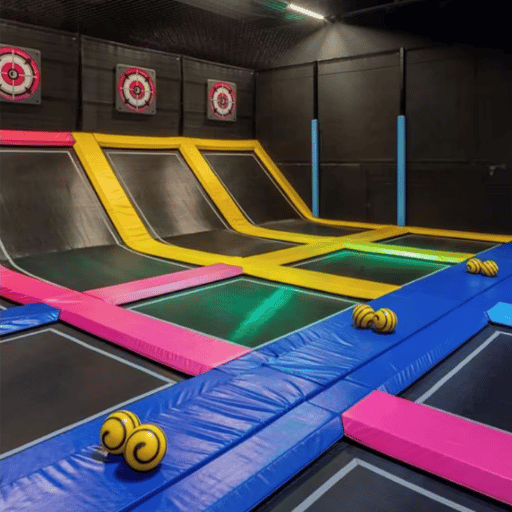
We categorize these suppliers into 5 “archetypes”: the label “trampoline park manufacturer” is a catch-all. It covers companies specialized for all of the following:
The 5 Trampoline Park Manufacturer Archetypes
- Olympic / competition trampolines, beds, & performance bounce – precision-engineered to maximize athletic performance — the focus of dedicated patents such as US7331903B2 (Eurotramp, MaxAir)
- European indoor park providers – “made in Europe” trampling park modules, often for mid-premium market. (Akrobat, ELI Play)
- North American Turnkeybuilders-design-build partners that combine trampoline products with other attractions like ninja or climbing walls. (Fun Spot, Iplayco)
- China FEC Factories-large factory-direct suppliers of full trampolne park buildouts including soft play, ninja, & themed elements. (Didi Land, Funlandia, Cheer Amusement, Liben, Dreamland)
- Trampoline-Only OEMs-companies that specialize in the sale of beds, springs, or court kits, often with custom labeling. (Domijump)
Beyond the Archetype: A 4-Quadrnt Trampoline Park Sourcing Map-The “What” & “Where”: A simplified sourcing strategy can divide trampoline parks into a spectrum of choices by asking a two questions: How many attractions will you install? and Where was the equipment built? This provides 4 basic sourcing archetypes.
| Full-turnkey builder (design → install) | Component / specialist supplier | |
|---|---|---|
| Premium European / North American | Fun Spot, Iplayco, ELI Play, Akrobat | Eurotramp, MaxAir |
| China factory-direct | Didi Land, Funlandia, Cheer, Liben, Dreamland, Pokiddo, Angel, Woozone | Domijump |
💡 Key takeaway
Think quadrant not brand when selecting your manufacturer. A single court often does not need a turnkey supplier and a 30000 sqft FEC will not succeed by outsourcing components.
The 15 Trampoline Park Manufacturers at a Glance
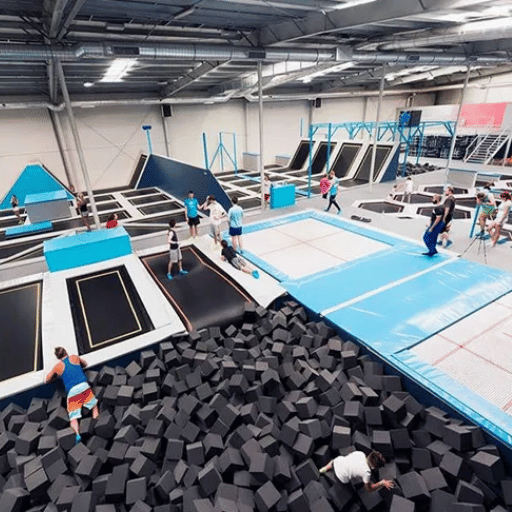
Founding years and headquarters below have been verified against respective corporate website or credible secondary sources in May 2026, and each maker is noted against the trampoline-park standard EN-ISO 23659:2022 where it builds to one. Website information listed in plain text (no outbound links provided) encompass trampoline park supplier organizations, spanning indoor trampoline and adventure park designers and builders to accessory manufacturers. We did not estimate any founding years.
| Manufacturer | Founded | HQ | Type | Website |
|---|---|---|---|---|
| 1. Didi Land | 2014 | Guangzhou, China | China full-FEC factory | didiplayarea.com |
| 2. Eurotramp | 1958 | Weilheim/Teck, Germany | Competition / Olympic | eurotramp.com |
| 3. Akrobat | 2003 | Slovenia | European park specialist | akrobat.com |
| 4. ELI Play | 2007 | Boxtel, Netherlands | European turnkey | eliplay.com |
| 5. Dreamland Playground | Not disclosed | Zhejiang, China | China turnkey | dreamland playground.com |
| 6. Funlandia | 2007 | Shanghai, China | China design-led FEC | funlandia.com |
| 7. Cheer Amusement | 1994 | Nanjing, China | China legacy FEC | cheer amusement.com |
| 8. Liben Group | 2011 | Wenzhou, China | China large factory | liben group.com |
| 9. Pokiddo | 2017 | Wenzhou, China | China factory + franchise | pokiddo.com |
| 10. Angel Playground | c. 2013 | Wenzhou, China | China export-focused | angel playground.com |
| 11. Fun Spot Manufacturing | 1969 | Hartwell, Georgia, USA | US turnkey builder | funspot.com |
| 12. Iplayco (Int’l Play Co.) | 1999 | Langley, BC, Canada | N. American FEC maker | iplayco.com |
| 13. MaxAir Trampolines | 2010 | Grand Rapids, MI, USA | Performance specialist | maxair trampolines.com |
| 14. Domijump | 2005 | Shaoxing, China | Trampoline-only OEM | domijump.com |
| 15. Woozone | 2016 | Wenzhou, China | China factory-direct | woozone play.com |
1. Didi Land
Founded: 2014 · HQ: Guangzhou, China · Website: didiplayarea.com
Didi Land -Founded in China following a two-year stint of documented incidents surrounding poor quality of imported trampolines: cracked mats, shipping delays and unlisted charges. Now a founder-driven factory-direct manufacturer with close to 90 percent of their trampoline park modules exported globally across over 40 nations, Didi Land partners with entertainment centers by supplying a vast array of custom play equipment, which can include foam-pit landing zones and custom safety net systems. They supplement their trampolines with ninja & obstacle courses, climbing structures, soft play components, and complete facilitythemed construction. All trampoline structures within their modular designs adhere to ASTM F2970 and ASTM F381 standards.
“Since beginning Didi Land we found many challenges with locally purchased trampolines that were prone to breakage, arrive late and hide expenses. We developed a team that sources best value & finest quality components from world wide and manufacture for our customers, “ says Deng.
✔ Advantages
- Broad compliance stack incl. trampoline-specific ASTM F2970 / F381 plus ASTM F1487, EN 1176 and IPEMA for the wider build
- Full custom OEM from a 15 m² toddler corner to a 3,000 m² FEC
- Transparent FOB / CIF / DDP pricing — landed-cost terms stated up front
- Founder reviews every shipment; 12-month warranty plus lifetime parts and 24/7 multi-timezone support
⚠ Considerations
- Trampolines ship inside integrated FEC packages, so a buyer wanting only a FIG-grade competition rig may also weigh a pure trampoline specialist
- Bespoke OEM runs 8–16 weeks (express catalogue items 4–6 weeks), so large custom courts need lead-time planning
2. Eurotramp
Founded: 1958 · HQ: Weilheim/Teck, Germany · Website: eurotramp.com
A German, family-run, premium maker – this is a competition-quality brand that serves at the Olympics, World Championships, and as the world-class standard of reference. If your priority is bounce quality and extreme durability rather than theming – you are talking Eurotramp.
Key Offerings: Olympic/Competition Trampolines, Club/Playground Trampolines, Minitramps, Professional Trampoline Park Systems.
Upsides: Unmatched engineering heritage, industry leading durability, ‘Made in Germany,’ ISO 14001 certified.
Downsides: Premium pricing and among the higher priced of these listings, trampolines are the core not the theme (no FEC softplay, etc.), long European freight and leads times to markets far afield.
3. Akrobat
Founded: 2003 · HQ: Slovenia · Website: akrobat.com
A European manufacturer with a specialty in trampoline equipment; 8,000 trampolines every year, all produced in Europe, providing complete parks to 40+ countries. This manufacturer is also the one most often ranked for “trampoline park manufacturer” on European search platforms.
Key Offerings: Professional, In-ground and Competition trampolines, as well as park attractions (foam pit, parkour, runway, zipline).
Upsides: European build quality below top-tier German product, excellent trampoline specialist knowledge, excellent export coverage, affordable if European quality required but can’t reach top tier Germany.
Downsides: narrower focus and design portfolio than a “full”FEC provider, less brand presence in regions outside Europe, English support/some products less consistent.
4. ELI Play
Founded: 2007 · HQ: Boxtel, Netherlands · Website: eliplay.com
This Dutch company (part of the ABO Group) works as a turnkey specialist that offers everything from design, through manufacturing to full installation of trampolines parks, indoor play areas and sport courts. Eli Play traces its history to softplay/cleaning in the 1990s, but the manufacturing entity started in 2007.
Key Offerings: Trampoline Parks, Soft Play & Indoor Playgrounds, Ninja & Interactive Arenas, Sports Courts.
Upsides: European production and design, Turnkey delivery is a strength, Backed by a larger group for stability.
Downsides: Premium pricing relative to a Chinese factory-direct option, European focused lead times and logistics outside the continent.
5. Dreamland Playground
Founded: Undisclosed (manufacturing parent: Zhejiang ZhongSheng Amusement Equipment) Location: Zhejiang, China Website: dreamlandplayground.com
A turnkey trampoline park manufacturer from China which has an unusually complete certification for both the North American and European markets, serving clients across 50+ countries. Their project library and blog are also well-ranked, a frequent starting point for many potential clients.
Key Offerings: Trampoline parks and attractions (donut slide, battle beam, foam pit),indoor/outdoor playgrounds,ninja courses, softplay structures.
Upsides: Full certifications for NA and EU regions, full project planning and ROI analysis for turnkey projects, strong export experience.
Downsides: Unclear founding year and corporate history, a HK sales entity masks the factory itself, remote support in distant markets.
6. Funlandia
Founded: 2007 Location: Shanghai, China (factory in Suzhou) Website: funlandia.com
This Shanghai-based giant provides a design-led manufacturing solution for large-scale family entertainment centers. They have a significant number of projects to their name (3,000+) and an in-house design studio which helps them stand apart from simple manufacturers.
Key Offerings: Trampoline Parks, Ninja & Rope Courses, Indoor Playgrounds & Soft Play – presented as a fully integrated design/manufacture/build service.
Upsides: High capacity and design focus, a complete turnkey offering, excellent ASTM and EN standards compliance.
Downsides: Higher end pricing for Chinese market, lead times and shipping costs ex-China, trampolines fall under their broader ‘adventure play’ category instead of a trampoline-specific focus.
7. Cheer Amusement
Founded: 1994 · HQ: Nanjing, China · Website: cheeramusement.com
Chinese Manufacturer/Exporters
With around three decades of experience and over 100,000m² of manufacturing, this is one of the most seasoned Chinese play equipment companies. The lengthy service life itself is significant, as many factories have come and gone in single product generations.
Key offerings: Trampoline parks, foam pit and climbing wall activities, dodgeball courts, indoor play areas, soft play structures, and custom theme development.
Why they shine: Extensive operating history, considerable production capacity, complete turnkey solutions inclusive of interactive systems.
Weaknesses: Positioned on the higher end of the price scale for Chinese suppliers; potentially longer production and shipping time lines from China; perhaps better known within the industry than to general consumers.
8. Liben Group
Founded: 2011 · HQ: Wenzhou, China · Website: libengroup.com
This is a substantial manufacturer based directly out of the Wenzhou industrial area, renowned for play equipment production. They have a large volume of projects spanning more than 80 countries. They’re useful as a resource, even for those looking elsewhere, because they share remarkably candid buying guides about the true landed costs involved in import.
Key offerings: Indoor playgrounds, trampoline parks, soft play zones, and outdoor play apparatus, delivered in turnkey packages.
Why they shine: Exceptionally large manufacturing capability and volume, very wide product range, attractive factory-direct pricing, vast experience with exports.
Weaknesses: With such high production volume, design refinements can be less advanced compared to more specialized boutiques; quality standards can differ depending on product line; after-sales support might be less responsive for remote clients.
9. Pokiddo
Founded: 2017 · HQ: Wenzhou, China · Website: pokiddo.com
A rapidly growing maker and franchisor of trampoline parks and indoor adventure spaces, they boast over 800 installation sites globally and hold trademarks in 54 countries. Unusually active in standards development for a relatively new firm.
Key offerings: Trampoline parks, indoor adventure/sports centres, and full turnkey packages that include staff training and guidance.
Why they shine: Specific trampoline certifications (ASTM F2970, EN-ISO 23659) plus noted collaboration with TV Rheinland; complete turnkey solutions and strong support make them a great fit for novice operators.
Weaknesses: A younger brand (formed in 2017); their franchise model may not appeal to clients only interested in procuring equipment; lengthy production and shipping times from China are a factor.
10. Angel Playground
Formed: Around 2013 (with some sources suggesting a slightly earlier origin; the company’s official website does not specify a founding year) Located: Wenzhou, China Website: angelplayground.com
This is an export-oriented Chinese manufacturer primarily targeting the US market, with around 70% of its sales going to American clients. They specialize in commercial play equipment for ages 2-12 and are notable for offering trampoline parks alongside their standard playground range.
Key offerings: Commercial indoor playground structures, trampoline parks, ninja and parkour courses, and soft play equipment.
Why they shine: Extensive compliance certifications, including specialized trampoline standards (ASTM F2970, F381, TV-EN 1176, EN-ISO 23659); strong experience and a solid presence in the US market; competitive pricing due to factory-direct model.
Weaknesses: Corporate history lacks clarity and appears inconsistent across various sources; a mid-tier player in terms of brand recognition; quality can vary between product lines; distant clients may find after-sales support limited.
11. Fun Spot Manufacturing
Formed: 1969 (over 40 years of experience) Located: Hartwell, Georgia, USA Website: funspot.com
A well-established US firm known for designing and constructing custom trampoline parks, indoor play facilities, and FECs. They have a portfolio of over 800 completed projects and collaborate with a network of other attraction partners.
Key offerings: Custom, handcrafted trampoline parks and other FEC attractions, with integration of partner solutions for interactive experiences and climbing.
Why they shine: Decades of US-based design and build experience; a full, end-to-end design and build process; extensive network of partner attractions; support services available in the US.
Weaknesses: US-focused operations mean higher costs and potentially longer timelines for international clients; price points are much higher than those of Chinese factory-direct manufacturers; primarily operate as a builder/integrator rather than an OEM of low-cost equipment.
12. Iplayco (International Play Company)
Formed: 1999 Located: Langley, British Columbia, Canada Website: iplayco.com
Canadian manufacturer of custom-themed indoor play and FEC equipment installed in more than 70 countries. Part of its portfolio also include trampoline and attraction modules. A sensible Western alternative if you value good quality English-language project management.
Primary products: custom themed indoor play structures, trampoline and attraction modules, complete FEC solutions.
Strengths: NA based manufacturer with excellent custom theme and design work; 25+ years of experience; large global install base; solid and well-structured project management.
Weaknesses: High prices compared to Chinese factories; trampolines are one component of many services, not a specific specialty; Freight and longer lead time for non NA based customers.
13. MaxAir Trampolines
Founded: 2010 Headquarters: Grand Rapids, Michigan, USA Website: maxairtrampolines.com
US manufacturer of custom made, high-performance hand-woven trampolines that are favoured by professionals and training centers. The American answer to Eurotramp.
Primary products: above-ground, below-ground, training and park trampolines, residential trampolines, competition trampolines with high-rebound bounce beds.
Strengths: Excellent bounce quality; Made in the USA with high quality hand weaving; Used and approved by stunt and sports professionals; Very flexible with custom builds.
Weaknesses: Focus is on trampoline or bounce bed only; no complete park design services (i.e., foam pits, netting, fun attractions); relatively small team; Higher prices.
14. Domijump
Founded: 2005 Headquarters: Shaoxing, Zhejiang, China Website: domijump.com
Family run business focusing purely on trampolines. Works on OEM/private label manufacturing for circa 25 European companies, exporting into 79 countries. Cost effective for courts, mats and pure trampoline sales.
Primary products: trampolines in a range of round sizes from 1m to 4.8m; trampoline park court systems; predominantly OEM for other brands.
Strengths: Genuine trampolines-only expertise; Significant experience OEM/private labeling for European clients; Great price on trampoline specific solutions.
Weaknesses: Specialty focus does not lend itself to whole venue fit-outs, soft-play and themed elements; Relatively small operation, possibly not the best choice for huge turnkey projects.
15. Woozone
Founded: 2016 · HQ: Wenzhou, China · Website: woozoneplay.com
Small Wenzhou manufacturer for both indoor and outdoor soft-play attractions, as well as trampolines. Offer full turnkey solutions and are an option for smaller projects and budgets.
Primary products: indoor soft-play equipment, outdoor play structures, trampoline parks.
Strengths: Flexible with small orders and customisation requests; Cost effective pricing; Good and responsive service from a small team.
Weaknesses: Small size and capacity is better for small and medium-scale projects; Not always transparent about documentation and certification.
How to Choose the Right Trampoline Park Manufacturer
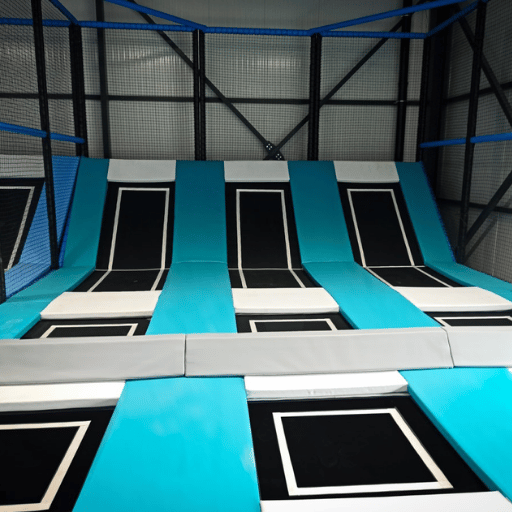
A good shortlist to look at will typically consist of three or four potential suppliers, and there will be about seven checks you need to perform. Go down these seven checkpoints before you even consider the quoted price – cheap today often costs more after the container finally arrives at customs.
How do you choose a trampoline park manufacturer?
Work down these checks in order; the first (certification) a simple pass or fail, followed by reputation and pricing clarity, and then operational points which affect whether or not your park stays up and running cost effectively.A supplier may look good but if they can’t name an edition of ASTM F2970 then you know that should ring an alarm bell.
- 1. Certification that is trampoline-specific, rather than general playground certification, such as ASTM F2970 (check which addition required in your country) or EN-ISO 23659:2022.
- 2. Reputation to back up claims; specifically, check that they can provide a project count you can use to verify, with possible customer references nearby your location.
- 3. Pricing transparency; ensure that you receive a complete price including shipping and duty, such as a full FOB, CIF, or DDP quote, so the price you see at the start is the final number on the first invoice.
- 4. Lead time- a written manufacturing-and-shipping window with milestone photos.
- 5. Warranty and parts- structural warranty+long-term guaranteed spare parts stock.
- 6. Customizable scope- truly OEM overall if it is customized to your floor plan, theme.
- 7. Installing and after-sales- on-site installation or detailed diagrams, plus after-sales support hot-line (Vietnamese time zone).
In the end, the primary framing mistake a buyer commits if choosing the biggest brand is thinking it must be right. Volume factory may not be excellent fit for boutique themed venue; excellence trampoline factory exceeds a budget round-court. Find the archetype match for the job.
✔ China factory-direct — where it wins
- Lowest equipment cost per square metre
- Widest one-stop range (trampoline + soft play + ninja + theming)
- Deep customization and full turnkey packages
⚠ Western premium — where it wins
- Opening-date certainty — no trans-ocean customs risk
- Same-time-zone engineering support and faster spare parts
- Documentation aligned to local inspection from day one
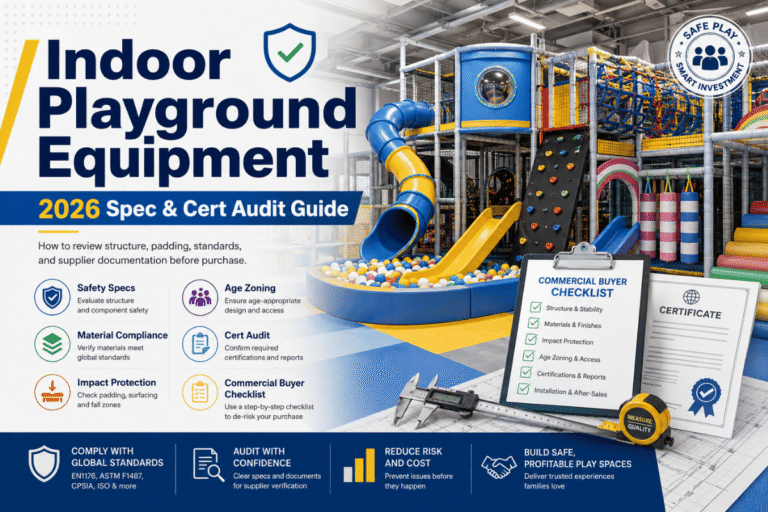
Certifications That Separate Real Manufacturers From Resellers
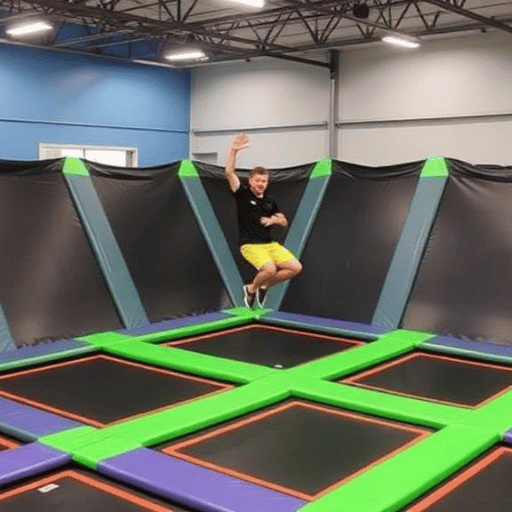
Certification would be the easiest way to tell a manufacturer apart from a reseller. However, we found multiple governing bodies certifying the same court type, as well as a long list of building substance and integration standards.
What is ASTM F2970 and why does it matter?
ASTM F2970, one of the key international safety standards for the sector, is the US consensus safety guideline for designing, manufacturing, installing, using, maintaining, inspecting and modifying commercial trampoline courts. The current active F2970-25 supercedes recent F2970-22, -20, -17, -15 & -13 versions. The ISO shared standard counterpart is EN-ISO 23659:2022. If your vendor claims court built to these standards, it has removed the basic safety hurdle; if it cannot inform you which standard, it has not. Top-shelf court hardware is where we find normalization, not separation.
Two caveats, both neglected by most seller sites. First, ASTM F2970-25 is most recent US version, Michigan enforced ASTM F2970-13. Know which your local inspector expects before signatures. Second, EN ISO 23659 is explicit about building, fire, planning, outdoor parks, chemical composition, non-trampoline activities, and worker safety standards not being covered by the certification, so a compliant court does not imply the rest of the park is compliant. Parkour, climbing, and food access and eatery facilities need their own compliance scheme.
📐 Engineering Note
Commercial grade trampoline hardware differs sharply from backyard sets: thicker galvanized steel pipes, replaceable performance air-beds and springs (or a string-bed arrangement), engineered fall zones with foam-pit or airbag landings. ASTM F2970-25 describes full court manufacturing requirements, but actual equipment certification does not guarantee operational safety. The US Consumer Product Safety Commission study points to linked under-6 injuries, flips and double-bounce issues as concerns that depend on the supervision plan. One park monitor may be responsible for 30+ jumpers, with little gymnastics background. Manufacturers own the build, operators own the staffing, training and insurance.
Beyond these court standards, ask your manufacturer about certifications, such as EN 1176 (European playground standard), IPEMA (third-party U.S. certification), CPSIA (U.S. safety regulations limiting lead and phthalates in materials), NFPA 701 (flammability of soft materials) and TV testing. The good news: peer-reviewed research in Pediatrics demonstrated a reduction of around 0.72% per month in trampoline-park injury rates from 2017 to 2019 as both standards and supervision improved, proving that compliance is beneficial.
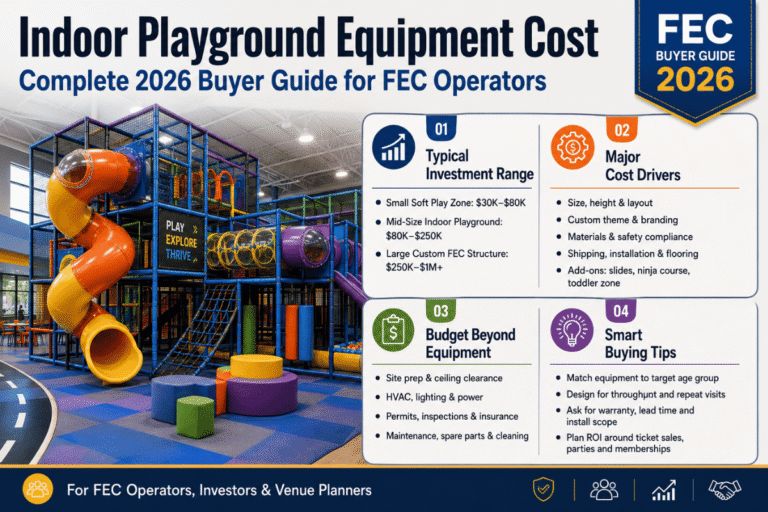
What a Trampoline Park Build Costs (and What the Manufacturer Controls)
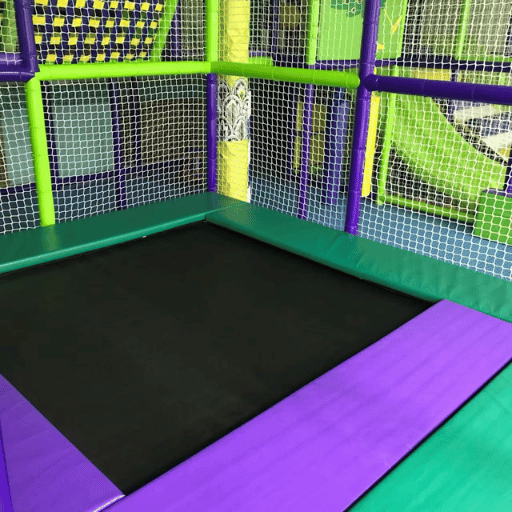
A trampoline-park development requires cooperation from multiple budget entities. A manufacturer controls some of these budget line items, but only some. Know what belongs in which control to negotiate reasonably.
How much does it cost to build a trampoline park?
The total cost of a trampoline park hinges on floor area, the types of equipment used (foam pits, ninja courses, rock climbing, etc.), netted and padded areas, installation costs, and delivery charges. Equipment manufacturers have command of specifications, packaging, documents, and shipping; but no control over your lease agreement or property purchase, construction permits, or financing and insurance needs. Franchise-disclosure rules from the U.S. FTC, 16 CFR Part 436, provide a well-ordered format for initial investments, categorizing them precisely by those areas. Take this as your hint that the cost quote from your equipment maker is one item among many.
If purchasing equipment from overseas, the quoted invoice is only one piece of the financial puzzle; actual delivered cost may be significantly higher. Buyer’s guides for Chinese imports often place final delivered costs anywhere from 25% to 45% above the first invoice total-these are supplier estimates, so don’t accept them at face value without your own due diligence. For a U.S.-based import, government duties include a 0.3464% Merchandise Processing Fee (subject to a floor of $33.58, or a ceiling of $651.50 in FY2026), a 0.125% Harbor Maintenance Fee for ocean freight, and a duty based on import classification. Gymnastics and athletics items fall under HTS category 9506.91.00, which has a standard rate of 4.6%; some items are also subject to Section 301 duties based on country of origin. Additional costs for freight and insurance add up, and many trampoline-park operators in small-business forums report annual insurance premiums can climb as high as 6-7% of their gross sales-a figure highly dependent on claims history and location.
Industry Outlook: A Growing, Seasonal Sourcing Market
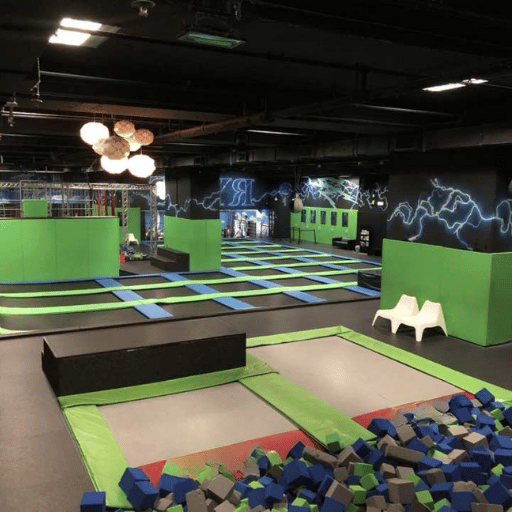
While analysts differ on the speed of its growth, the market for trampoline park equipment is undeniably expanding. Dataintelo estimates the market size to be approximately $2.8 billion in 2025 and projected to reach about $5.9 billion by 2034, growing at an average annual rate of around 8.6%. Other research firms predict a CAGR anywhere between 5.5% and nearly 17%, depending on how “park” versus “equipment” are defined. Focus on the direction as a constant and consider the growth rate as a range.
Looking to the future of play, digital scores, interactive trampolines, and mixed-reality walls are moving from novelty toward industry standard on the product side, with several manufacturers on our list already integrating these features. From a standards perspective, the new ASTM F2970-25 standard will be a critical factor for anyone planning a trampoline park in 2026, given the trampoline-park hazards that US safety regulators at the CPSC continue to track. When you inquire with manufacturers, always specify that you require compliance with the most current standards, and confirm which regulations are applicable in your specific jurisdiction.
A word on timing from our search data: Interest in sourcing leads and parts related to “trampoline park manufacturers” spikes during the 3rd and 4th quarters with a significant peak in September and October. When considering whether to engage, get a jump on those early autumn ordering cycles to ensure lead times are competitive and top manufacturers offer their full attention, not a triage of frantic calls and emails.
“The price on the pro forma invoice is what you expect.
A real trampoline park manufacturer shows its stripes three years down the line – if the inspection sticker is intact and readable, if the after-sales team is available on the phone when you call, and if the final landed cost is within 5% of your quote. We state FOB, CIF, and DDP prices on our pro forma and provide exactly these cost estimates so you have no surprises.”
Frequently Asked Questions
Who are the best trampoline park manufacturers in the world?
View Answer
There is no single best — it depends on your project. For competition-grade bounce, Eurotramp (Germany) and MaxAir (USA) lead. For European-made turnkey parks, Akrobat and ELI Play. For full family-entertainment-center builds at factory-direct pricing, Chinese manufacturers such as Didi Land, Funlandia, Cheer Amusement, Liben Group, and Dreamland are the practical single-source partners, while Fun Spot and Iplayco serve that role in North America. Match the manufacturer’s archetype to the scale and budget of your build rather than chasing the largest name.
How much does trampoline park equipment cost to buy and install?
View Answer
Equipment cost scales with floor area, attraction mix, and finish, and the landed total is well above the equipment quote for imported gear. For US imports, government fees include a 0.3464% Merchandise Processing Fee, a 0.125% Harbor Maintenance Fee, and a tariff duty (4.6% general under HTS 9506.91.00), plus freight, insurance, and installation. Chinese-supplier buying guides commonly report final costs 25–45% above the first quote. Ask every shortlisted manufacturer for an FOB, CIF, and DDP breakdown so you compare landed costs, not invoices.
What safety certifications should commercial trampoline park equipment have?
View Answer
The courts themselves should be built to ASTM F2970 (current edition F2970-25) in the US or EN-ISO 23659:2022 internationally. Surrounding equipment may also need EN 1176, IPEMA certification, CPSIA limits, and NFPA 701 flammability ratings, with TÜV testing common in Europe. Two cautions: confirm which ASTM edition your local jurisdiction enforces, since some reference older versions, and remember that EN-ISO 23659 excludes building, fire, and non-trampoline attractions — those need separate compliance.
Why are Chinese trampoline park manufacturers cheaper than European or US ones?
View Answer
Lower labour and material costs and large factory scale make the first invoice cheaper — but “cheaper to buy” is not always “cheaper to own.” Sourcing analyses note the lowest price does not always translate to the best value: import duties, customs fees, ocean freight, and the cost of a delayed opening or slow trans-continental spare parts can erode the gap. The right comparison is total landed cost plus opening-date certainty, not the headline equipment price.
What’s the difference between a manufacturer, a supplier, and a builder?
View Answer
A manufacturer makes the equipment in its own factory; an equipment supplier may resell high-quality equipment made by others; a builder designs and installs the finished park, sometimes sourcing equipment from several makers. Many companies do all three, but ask directly — a true manufacturer can show you its production facility.
How long does it take to manufacture and install a trampoline park?
View Answer
Custom builds typically run 8–16 weeks to manufacture, plus ocean freight of several weeks for imports and a few days to a couple of weeks on site. Stock catalogue items ship faster. Always get the window in writing with QC milestones.
Who is the largest trampoline park company?
View Answer
By number of operating venues, brands like Urban Air and Sky Zone are the largest park operators — which is different from the manufacturers that build the equipment. This guide ranks manufacturers and suppliers, not the chains that run the parks.
Planning a trampoline park or FEC build?
Request your no-obligation 3D layout design and a firm all-inclusive FOB/CIF/DDP landed cost for any product on our site.
Get a Free 3D Design + Quote →
Or connect with Didi Land for a chat about trampoline park- and fec-mixed-use layouts.
About This Buyer’s Guide
This list was compiled and vetted by Didi Land, trampoline park equipment, indoor playground, and FEC manufacturers. Thus we are first-an insider’s perspective, written with the intent to guide and inform rather than to sell. Each manufacturer’s listing details (founded year, headquarters location, and product range) are cross-referenced and validated through online searches of the company’s own website or recognized secondary resources (May 2026); cost-related and safety standard information (including ASTM F2970-25, CPSC, etc.) is obtained from authoritative third-party organizations.
When a manufacturer’s founding date could not be verified, the absence of such information is indicated.
Reviewed and approved by the Didi Land engineering department according to standards F2970-25 (ASTM) and EN-ISO 23659:2022.
References & Sources
- ASTM F2970 Standard Practice for Trampoline Courts — ASTM International
- EN-ISO 23659:2022 — Trampoline parks safety requirements — International Organization for Standardization
- Trampoline-related injury epidemiology — U.S. National Library of Medicine (PMC)
- Trampoline Park Injury Trends — American Academy of Pediatrics, Pediatrics
- Hazard report estimates of trampoline injuries (NEISS) — U.S. Consumer Product Safety Commission
- Merchandise Processing Fee — U.S. Customs and Border Protection
- HTS heading 9506.91.00 duty rate — U.S. International Trade Commission
- 16 CFR Part 436 Franchise Rule (initial investment categories) — U.S. Government (eCFR)
- Industry association resources — IAAPA (Global Association for the Attractions Industry)