
Get in Touch with Didi Land



Great ocean theme playground design ideas do more than paint a jungle gym blue — they turn a play area into a coral reef a toddler can crawl through, a shipwreck older children can climb, and a story families come back to visit. This guide covers the design principles, marine elements, color palettes, age zoning and layout logic that separate a genuinely immersive ocean-themed playground from a themed playground that is really just stickers on standard equipment.
Ocean Design at a Glance
| Best age span | 1–12, split into 3 zones (toddler reef, mid coral, older pirate cove) |
| Core palette | Deep blue → aqua → white foam, with coral/sand accents |
| Signature elements | Submarine climber, coral reef, shark/wave slide, treasure ball pit |
| Footprint tiers | 30–100 m² corner · 100–300 m² zone · 300 m²+ flagship |
| Non-negotiable | Safety-integrated theming (CPSC / EN 1176 / ASTM), not decoration |
What Makes an Ocean Theme Playground Actually Work? 5 Design Principles

An ocean theme playground should let children play in the sea, not on it.
The distinction between a genuinely engaging experience and just another coloured jungle gym hinges on 5 Key Design Factors (or, if you like, the 5-Layer Ocean Immersion Test). Test every proposal or design spec against these criteria.
The 5-Layer Ocean Immersion Test
- 3D Immersion: kids should climb on, and inside of, sculpted reefs, submarines, and sea creatures – not on flat pictures of them.
- Age-Zoned Scale: height, complexity and challenge scaled for all ages from tot to tween.
- Narrative Journey: create a story arc (a lighthouse, a shipwreck, open ocean, hidden treasure!) to encourage repeated visits.
- Sensory Layering: include texture, sound, and movement along with colour for a more engaging experience.
- Safety-Integrated Theming: sharks, coral and everything else pass stringent safety testing to ensure they won’t harm the kids using the play equipment.
Why is theming important beyond looks?
This isn’t just about aesthetics – themed playgrounds provide one of the most powerful solutions to the modern problem of children’s excessive screen time. With the average child between the ages of 0-8 clocking in about 2.5 hours a day on screens and teens spending over 7.5 hours, getting kids active outdoors is a critical issue. Public health guidance from the U.S. Department of Health and Human Services puts the target at 60 minutes of activity a day – a fantastic ocean-themed playground can make this feel less like exercise and more like an underwater adventure.
Physical challenges such as scaling a coral reef, balancing on an octopus carousel, or sliding down a giant wave build children’s motor skills, balance, coordination, and spatial awareness – all of which are linked to improved performance in the classroom. So, you have the WHAT (kids climb and spin on ocean-themed play equipment), the WHY (motor and vestibular development), and the SO WHAT (an ocean-themed play area that keeps them coming back for more).
“Many clients make the mistake of considering ‘theme’ as an aesthetic finish rather than a fundamental structural element.
A truly authentic ocean playground is conceived as a sculptural piece first, a decorative finish second. If the coral reef is just a climber with a coat of blue paint, its immersive story is lost to children after their first visit.”
💡 Pro Tip
When evaluating playground designs or supplier proposals, always request 3D element renderings. A legitimate ocean theme manufacturer will show you detailed sculpting and geometric forms; a decorator will likely show you a colour swatch against a catalog page.
9 Ocean Theme Playground Design Ideas, Element by Element

A diverse ensemble of marine life forms the bedrock of any exceptional ocean theme playground. Below is a shortlist of nine elements that effectively establish the underwater ambiance. Select a combination of four to six, as utilizing all nine is often unnecessary and can lead to an overly cluttered space.
| Element | Play value | Age band |
|---|---|---|
| 1. Submarine tube climber | Imaginative play + climbing; periscope & porthole details | 4–12 |
| 2. Coral reef soft climber | Toddler soft play, low falls, sculpted texture | 2–6 |
| 3. Shark-jaw / wave-form slide | Thrill + “surfing the waves” narrative | 5–12 |
| 4. Octopus carousel / spinner | Vestibular (spin) play, cooperative | 3–8 |
| 5. Lighthouse tower | Photo-zone centerpiece; fall-height design focus | 4–12 |
| 6. Treasure-cove ball pit | Sensory immersion; social play | 2–8 |
| 7. Jellyfish sensory ceiling | Light & sensory layering overhead | All ages |
| 8. Dolphin spring rider | Toddler motion play, balance | 2–6 |
| 9. Whale-tail crawl tunnel | Crawling, gross-motor, hide-and-seek | 1–4 |
You can see the mix: Some are purely climbers, others are slides, others are motion play like seesaws and springers, and others – the jellyfish ceiling, the ball pits – are simply for layered sensory experience. If you want your ocean theme to grow into a pirate cove for older kids, a pirate ship is the natural bridge element. If you’re compiling a catalog of products for commercial use, our custom ocean theme indoor playground equipment page details 14 engineered marine elements with corresponding safety clause references.
Ocean Color Palettes, Materials & Lighting That Sell the Illusion

This is where most ocean theme playground design ideas go wrong – and where you can win. Other people will tell you to “use blues and greens.” That’s not a color palette; it’s an admission of defeat. A convincing ocean environment relies on a three-tiered color scheme with well-chosen materials and lighting. Here are three palettes that can work:
| Palette | Color story | Best for |
|---|---|---|
| Open Ocean | Deep navy → cyan → white foam crests | Older-child zones, submarine/deep-sea narratives |
| Coral Reef | Teal + coral + sand + a sunshine-yellow accent | Toddler reef zones, daycare, high-energy spaces |
| Sunset Harbor | Amber/orange + violet + navy horizon | Photo-zones, lighthouse centerpieces, hotels |
A good practical example: using a bright cyan primary (roughly #00D8FF) with one warm accent color, such as a rich treasure gold (#FFD848), instantly gives you an “ocean + adventure” feel without the murky color mash-up that makes many themed spaces seem disorganized. Select one dominant blue, a complementary aqua, and one warm accent – then use those colors throughout every component to create a unified experience.
Color only works when the materials carry it. In soft-play indoor construction, the core materials are EVA foam for sculpted soft play elements, durable PVC tarpaulin for the upholstery and design fabric, and tough rotomolded polyethylene for rigid items such as slides. Proper material density and finishing will ensure that your coral reef elements retain their coral-like appearance for years.
📐 Engineering Note
Ensure your EVA foam is 60–80 kg/m³ in density for soft sculptures intended for sitting and climbing (too soft will sag and never return to shape, too firm feels more like furniture). Opt for UV-resistant colorants on anything exposed to sunlight and request indoor fire rating certification (such as Euroclass B-s1,d0 to EN 13501-1). Design jellyfish and reef lighting to use safe, sealed low-voltage LEDs – never exposed mains electricity in wet zones.
Designing for Every Age: Toddler Reef vs Mid Coral vs Pirate Cove

One of the most frequent design flaws in themed indoor play is imposing the same ocean on all age groups – the same slide size, the same ball-pit depth, the same play structure height. Toddlers get overwhelmed; older children get bored. The solution: structure the ocean theme in three distinct age zones that share a color scheme and narrative, but differ in scale and difficulty.
How do you choose ocean-themed elements for different age groups?
Age, not aesthetic. If ages are 1-4 (a “toddler reef”), keep it low and soft: turtle soft play, whale tail crawl tunnel, dolphin spring riders. Falls should be small, every corner foamed. Age 3-8 (“mid-coral” zone) gets moderate climbing: octopus carousel, treasure-cove ball pit. Age 5-12 (“older pirate cove”) uses higher elements: submarine climber, shark-jaw slide, lighthouse tower, with some perceived risk intended. Maintain a consistent blue palette and characters for one, unified ocean experience, whether 2 and 9 years old attend or just a 3-year-old.
Decision Framework: Age Band → Zone Design
- For a venue targeting pre-5, think Toddler Reef – soft coral climbers, crawl tunnels, shallow falls, and excellent sight lines.
- To accommodate the entire 2-12 age range, integrate all three zones on a shared color palette, placing the Toddler Reef adjacent to entry/seating areas.
- Where the clientele are mostly ages 6-12, start with the Pirate Cove and open ocean features – submarine, shark slide, and lighthouse – but tuck in a tiny reef for younger siblings.
One simple scenario demonstrates the value of zones: a 60 m2 reef in a food court: Modular coral climber, 3 turtle sculptures, 6 starfish cushions, ceiling-set jellyfish drop. In a mall’s blue, the toddlers stay put while parents eat and hang around longer. It’s commercially successful because it was built for one specific age group that patronized the venue.
Building the Story: Turn Elements Into an Ocean Journey

Scattered nautical bits won’t cut it; the story will. The most effective ocean playgrounds lead kids on an imaginative voyage. It’s a narrative that no competitor offers, making first-time visits the beginning of a habitual journey.
It’s a classic arc: climb out of a lighthouse, descend a coral climber, traverse an octopus garden, and burst up in a treasure-cove ball pit. Kids can rerun the journey with new challenges or sequences. Seasonal character swaps, themed additions, and even repainted zones can sustain freshness for years. Pirate-ship imaginary play can support the cognitive and social language development cited by education and pediatric researchers.
💡 Pro Tip
Integrate theme elements with the flow. A painted “ocean current,” bubble trail or rope “tide line” gives children cues on how to progress, preventing bottlenecks on the slide.
Ocean Design Ideas by Space: From a 30 m² Corner to a Flagship
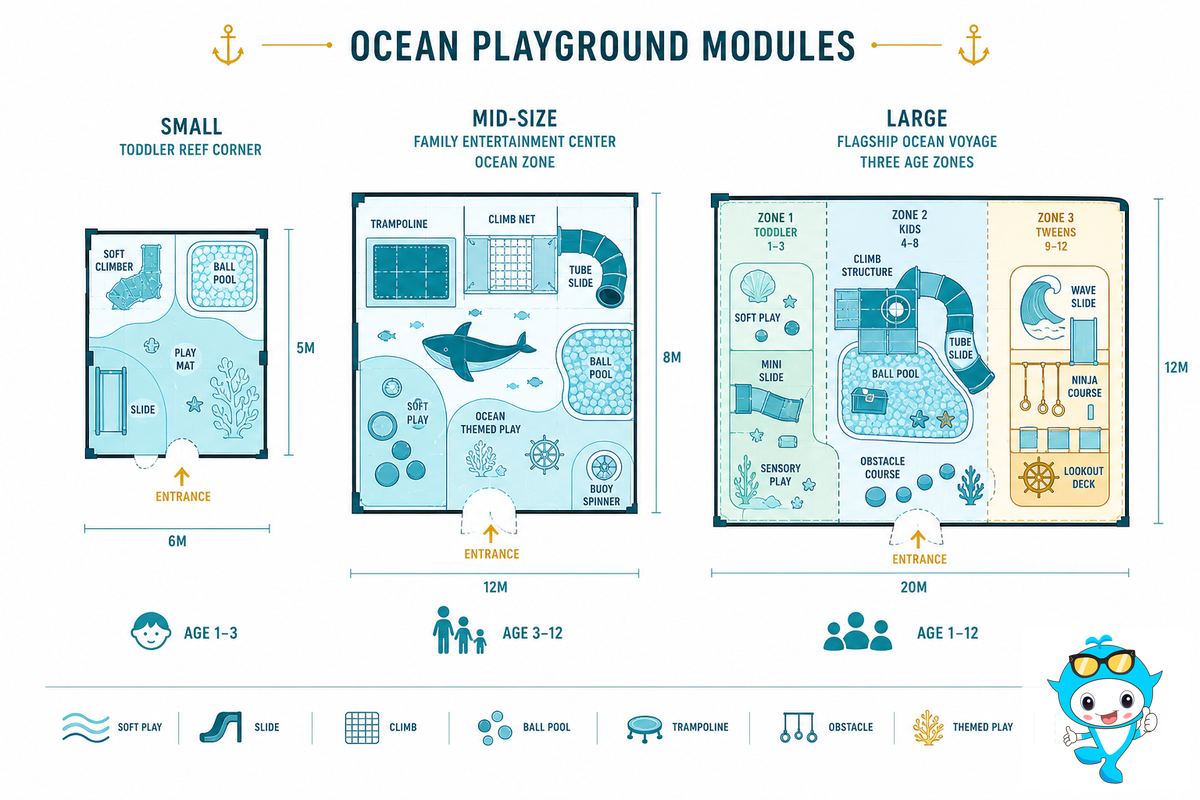
Whether they’re compact or extensive, great ocean theme playgrounds can be adjusted for space size. Layout logic varies with site size and how you scale the elements. Here’s how one theme works across three space scales.
| Footprint | Design focus | Recommended element set |
|---|---|---|
| 30–100 m² (Toddler Reef Corner) | One anchor + soft play; parent sightlines | Coral reef climber + turtle soft play + starfish cushions + jellyfish ceiling |
| 100–300 m² (Mid FEC Ocean Zone) | Centerpiece + circulation loop | Lighthouse tower + octopus carousel + shark slide + treasure ball pit + dolphin riders |
| 300 m²+ (Flagship Ocean Voyage) | 3 age zones + narrative journey + F&B adjacency | Submarine + pirate ship crossover + multi-level reef + full sensory ceiling |
No matter the size, three layout rules hold: place your youngest kids closest to the seating and entrance, keep clear lines of sight so one adult can supervise a wide age range of children, and give the central photo-op zone enough space for an impressive, memorable scene. We dig deeper in our indoor playground floor plan templates, and if you are serious about ROI, it’s a good idea to see whether indoor playgrounds are profitable.
Sensory, Educational & Inclusive Ocean Design
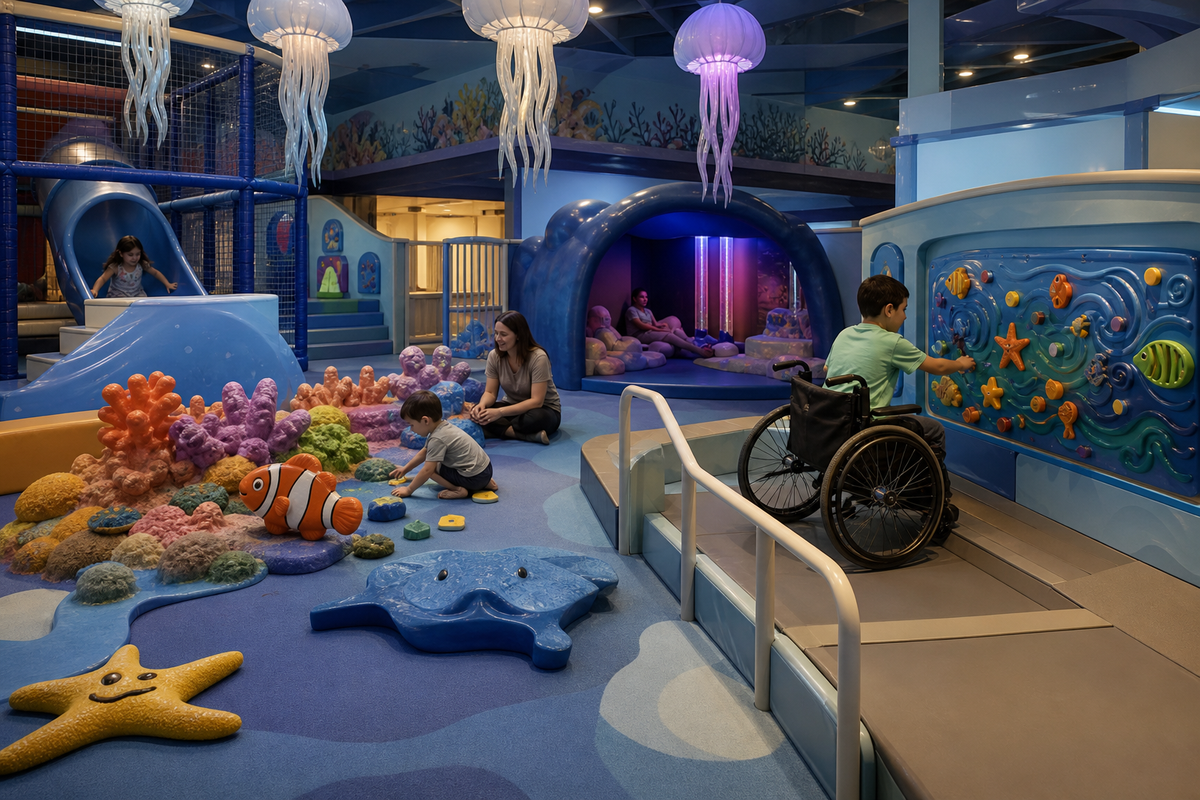
The ocean is a goldmine for two things competitors often miss: education and inclusivity. Beyond just aesthetics, the marine world offers unique opportunities to engage kids of all ages, learning and exploring with tactile experiences and natural wonders.
Educationally, this means you can incorporate everything from learning panels explaining the life cycles of sea turtles, observation deck views of coastlines from a lighthouse, and treasure coves designed for imaginative counting games, all while fostering language development. Learning can become seamlessly integrated into open-ended, cooperative play using the principles of Reggio Emilia and Montessori philosophies.
On the inclusivity side, take design seriously by adhering to accessibility standards, not just buzzwords. Play-area accessibility guidelines require access to all elements for kids aged two and up, both at ground level and elevated positions, with research indicating that inclusive playgrounds provide the most benefit when accessibility and sensory elements are an integral part of the design, not an add-on. Features such as ground-level reef sections, pirate ship transfer points, and calm sensory areas cater to the diverse needs of neurodiverse children, making your ocean playground welcoming for everyone. The International Play Association (IPA USA) offers resources for deeper exploration into inclusive play practices.
Indoor vs Outdoor & Ocean Water-Play Ideas

Where the ocean playground lives determines how you design your ocean play space. For indoor spaces, use soft, padded elements like EVA sculptures, ball pits, and cushioned climbing structures with carefully controlled lighting to achieve an authentic under-the-sea atmosphere that is difficult to replicate outdoors. An outdoor playground, on the other hand, utilizes durable rotomolded and steel structures engineered to withstand the elements while meeting higher safety standards.
Then there’s the actual water. True splash-pad water features involve different construction and maintenance requirements, which is why many operators opt for the “water play without water” approach of mimicking the feeling of the sea in landlocked indoor settings, without the need for water. This can involve utilizing wave-shaped slides, bubble panels, and blue light effects. Due to the stark differences in material and fall protection between indoor soft play and outdoor structures, familiarize yourself with the relevant playground safety standards — AS 4685 vs EN 1176 vs ASTM F1487 in our guide.
4 Ocean Theme Design Mistakes to Avoid
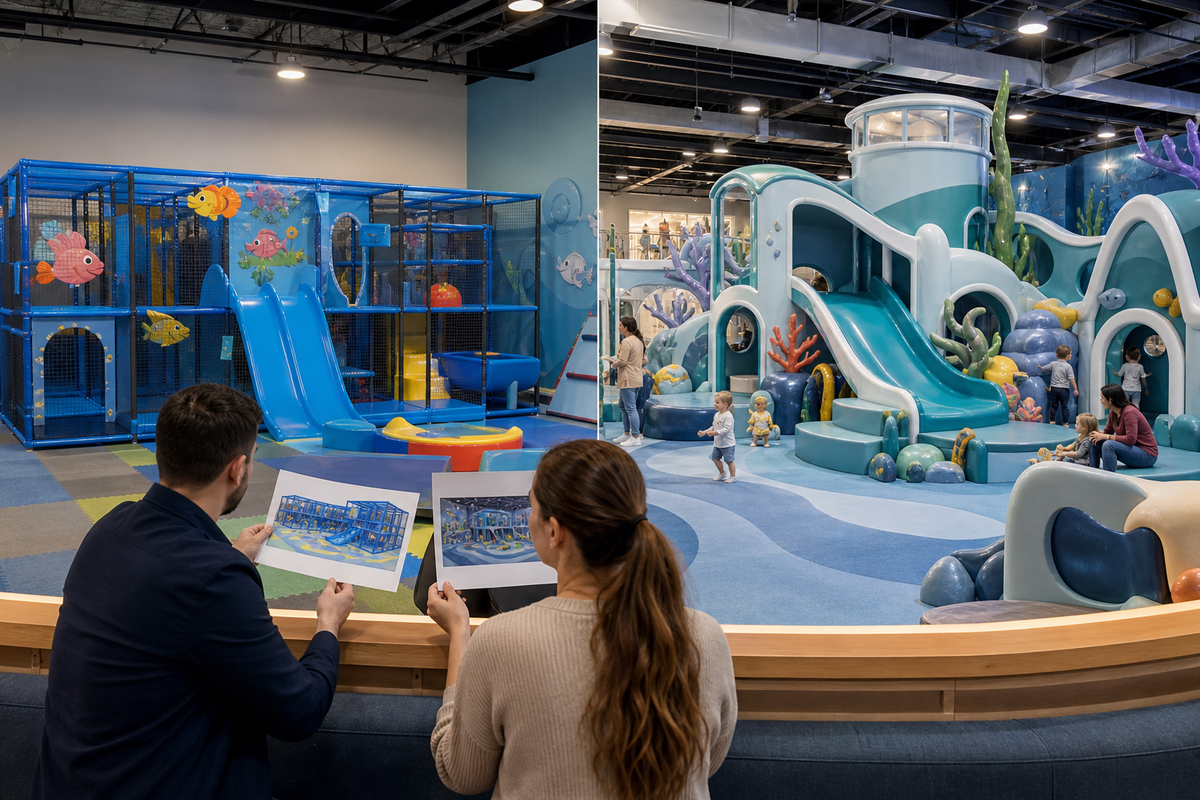
Here are four design fails which we keep seeing on projects inspired by the ocean, or sea-themed designs. Each is a design choice and not a budget constraint, so they can and should be prevented before anything goes to production.
⚠️ Mistake 1 — Theme as paint and stickers
Your average blue painted jungle gym with a few plastic fish is not an ocean theme. Demand 3D sculptures of sea creatures that kids can climb up on, hide behind, etc., and ask for renders before producing anything.
⚠️ Mistake 2 — Theme that fights safety
Shark teeth, starfish points and anchor edges are photographable but do not stand up to impact and entrapment testing. A reputable manufacturer of playground equipment can identify where every component relates to EN 1176 or ASTM F1918 clauses rather than placing a generic logo in a marketing brochure.
⚠️ Mistake 3 — One scale for every age
Forcing one single ocean onto little kids and 12-year-olds terrifies the little ones and bores the big ones. Zone it on a shared palette across the toddler reef, mid coral and pirate cove.
⚠️ Mistake 4 — No narrative
Elements placed at random with no storyline mean children explore once and never come back. Design a journey and plan seasonal refreshes so the ocean stays fresh into year four and beyond.
Ocean Playground Design Trends for 2026

There’s a big growth in themed play, and it pays to be sure of your direction of travel, otherwise your design will look dated within five years. Globally, the indoor amusement center market was about USD 54.7 billion in 2025, projected to reach USD 58.8 billion by 2026 and USD 121.5 billion by 2033, at a compound annual growth rate of 10.9%. It is themed and immersive environments that are commanding an increasing amount of that expenditure.
Three design trends stand out for 2026. First, inclusive and universal design is shifting from nice-to-have to baseline expectation — reinforced by the Access Board guidelines above, so plan ground-level accessible ocean elements from day one. Second, sensory-rich immersion is deepening, with projection, interactive light and sound layered over physical sculpture rather than just brighter paint. Third, sustainable, durable materials and designed-in refresh cycles are replacing rip-and-replace, because operators have learned that themed novelty measurably fades around year three to four. Remember, too, that the U.S. CPSC updated its Public Playground Safety Handbook in 2025 — design against the current edition, not a decade-old copy.
The ocean theme installations Didi Land has been exporting to over 40 countries since 2014 make this particularly evident in landlocked parks and urban locations, where “bring the sea inland” ocean themes are reliably outperforming a nondescript play structure on repeat visits. If you’re thinking about a 2026 build, be sure to include space for accessibility and budget for a refresh kit – trying to retrofit this is significantly more expensive.
FAQ: Ocean Theme Playground Design
What is the best age range for an ocean theme playground?
View Answer
This ocean theme translates well for a wide age range from 1 to 12 by breaking it into 3 zones: toddler reef (1-4) that is flat and soft, mid coral (3-8) that allows a moderate amount of climbing and spinning, and older pirate cove (5-12) with tall climbing structure and a slide. This scheme works because it features one palette and set of characters throughout.
What colors work best for an ocean theme playground?
View Answer
Use one dominant blue, one aqua or teal support color, and one warm accent such as coral or gold. Repeating that trio across floors, nets, panels, and soft sculptures keeps the sea-world readable.
Can an ocean theme fit a small indoor space?
View Answer
Indeed. A toddler reef section (30-100 m2) can succeed with a central focus (a modular coral reef climbing frame), a few soft sea animals, a floor of sea cushions, and a ceiling installation resembling a jellyfish for overhead sensory play. Small ocean zones are increasingly popular in malls, childcare facilities, hotels, and restaurants’ family-oriented sections.
Ocean vs pirate vs jungle — which playground theme is best?
View Answer
There is no universally optimal theme; it depends on your target audience, climate, space size, and the story you want families to remember. Ocean themes and pirate themes are naturally linked because a pirate’s lair can sit inside a larger sea adventure, so many businesses combine them. Jungle and nature themes work well for venues built around greenery, animal life, or outdoor discovery. The ocean theme has a clear advantage in inland malls, hotels, restaurants, and family entertainment centers where a “water play experience without water” feels novel, photogenic, and easier to maintain than a real splash zone.
How do you make an ocean theme playground safe for toddlers?
View Answer
Use age-specific components like a sea-turtle soft play area, starfish cushions, or a whale-tail crawl tunnel, specifically designed and rigorously tested to comply with the toddler clauses of EN 1176 and the soft-contained play standard ASTM F1918. Round off any thematic corners (e.g., shark’s teeth, anchors), prevent head, neck, and finger entanglements, and adhere to CPSC spacing guidelines to ensure falls occur in safe, padded zones.
Do ocean theme playgrounds need refreshing over time?
View Answer
Yes, themed novelty tends to wane in about three to four years as frequent visitors exhaust the original narrative. Plan for refreshes at the design stage: swap out decals and soft-play covers, update the color scheme, and add two or three new thematic elements to prolong the perception of novelty for up to seven or eight years without altering the structural components.
Ready to Design Your Ocean?
Bring your floor plan, the mix of ages of your intended users, and your space size, and Didi Land will transform your ocean theme playground ideas into a free 3D concept with all elements complying with the EN 1176 and ASTM safety regulations.
Why We Wrote This Guide
Since 2014, Didi Land has been creating and manufacturing customized ocean-themed indoor playground equipment, delivering it to over 40 countries for use in malls, family entertainment centers, daycare facilities, and hotels. The design principles, age zoning strategies, and material considerations mentioned above stem from our extensive installation history, and when a claim is dependent on the specifics of your venue, we explicitly state it, because the only way to provide an accurate answer to the question, “What will work for my space?” is by first reviewing your floor plan.
Related Articles
- Indoor Playground Floor Plans: 12 Layout Templates — plan circulation and zoning for your ocean build
- AS 4685 vs EN 1176 vs ASTM F1487 — which playground safety standard your market needs
- Ocean Theme Indoor Playground Equipment — the full 14-element marine catalog and 6-step design process
- How to Start an Indoor Playground Business — a step-by-step 2026 startup guide
References & Sources
- Public Playground Safety Handbook (2025) — U.S. Consumer Product Safety Commission
- Chapter 10: Play Areas — ADA Accessibility Guidelines — U.S. Access Board
- Physical Activity Guidelines for Americans, 2nd Edition — U.S. Department of Health and Human Services
- Children’s Usage of Inclusive Playgrounds: A Naturalistic Study — U.S. National Institutes of Health (PMC)
- Inclusive Playground Resources — International Play Association (IPA USA)
- Indoor Amusement Center Market Size Report 2026–2033 — Grand View Research
![Custom Dinosaur Playground Equipment [Design Guide]](https://didiplayarea.com/wp-content/uploads/2026/09/custom-dinosaur-playground-equipment-r2-featured-1-768x512.png)
![Custom Dinosaur Playground Equipment [Design Guide]](https://didiplayarea.com/wp-content/uploads/2026/09/custom-dinosaur-playground-equipment-r2-featured-1-150x150.png)