Get in Touch with Didi Land


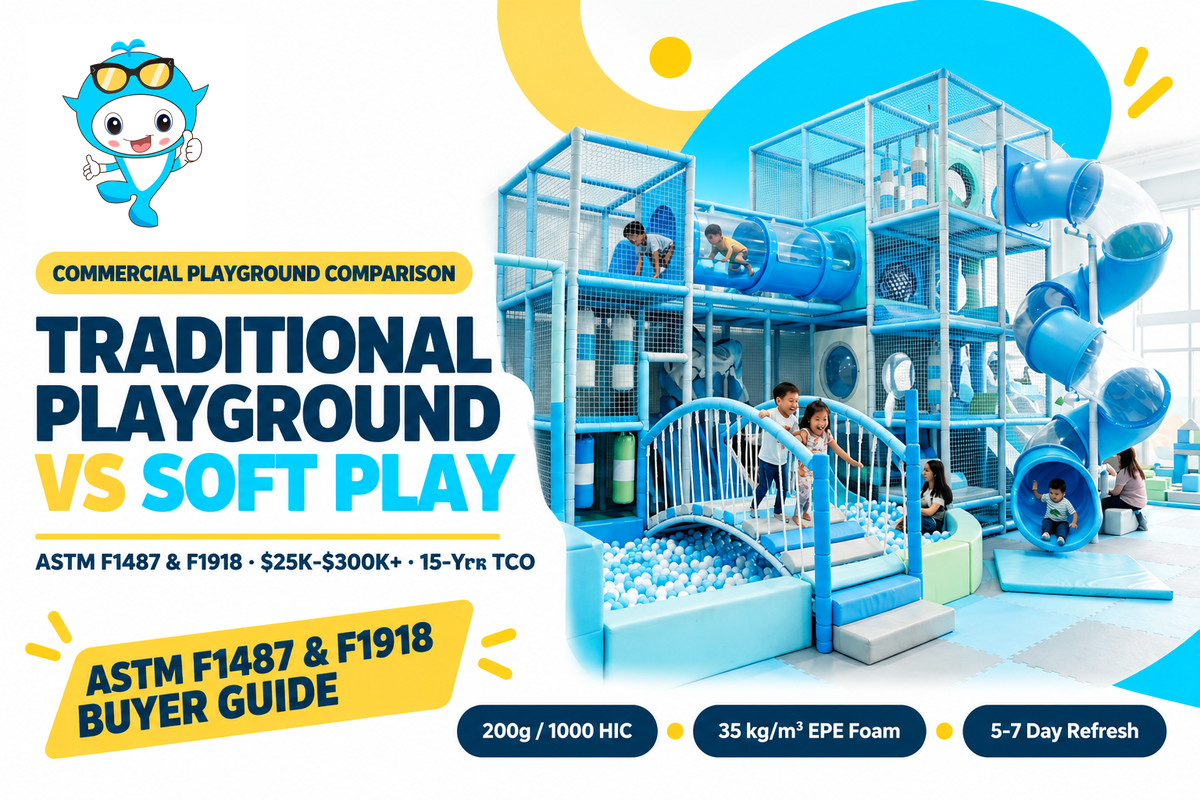
A traditional playground uses rigid steel posts, elevated decks, rotomolded plastic slides, and open swings anchored into outdoor ground. Contained soft play includes modular steel frames covered with high-density foams and a vinyl cover and enclosed in a space that is climate-controlled. Adventure Turf’s 1,000-square-foot surfacing comparison shows wood chips add $31,000 in avoidable expenses over 15 years compared with poured-in-place rubber. Facility planners must match each play area to their target age groups, ceiling height, and maintenance budget.
Direct Answer: The ANSI ASTM playground overview states that ASTM F1487-21 (public outdoor) and ASTM F1918-21 (soft contained play) both cover ages 2 to 12 (5th to 95th percentile). Playworld’s commercial cost guide puts small outdoor projects at $25,000 to $75,000 and large destination parks at $150,000 to $250,000+. Meanwhile, Didi Land’s commercial indoor benchmarks start at $25,000 for mall-kiosk soft play sets and reach $300,000+ for 1,000+ m² family centers.
Key Engineering Specifications at a Glance
- According to ANSI’s ASTM standards summary, ASTM F1487-21 governs public outdoor playground equipment for ages 2 to 12. ASTM F1918-21 governs soft contained play equipment.
- The 2025 CPSC Handbook notice (90 FR 38959) updates ASTM F1487 and ASTM F1292 alignment and retains strict rules regarding low partially bounded gaps.
- In Playworld’s commercial cost breakdown, equipment makes up 40% to 50% of the budget and installation takes 25% to 35%. Unitary safety surfacing and interlocking tiles typically add up to $35 per square foot, while loose-fill engineered wood fiber starts at $3.50 to $5.50 per square foot.
- Adventure Turf’s 1,000-square-foot surfacing study lists engineered wood fiber at $3.50 to $5.50 per square foot upfront. Poured-in-place rubber ranges from $13 to $18 per square foot.
- DIDI Land uses high-density EPE foam in their soft play cores which they fabricate over heavy-duty galvanized steel framing. BS 5852 PU leather coated cores help units maintain their shape and provide a fire-blocking barrier throughout 12 to 14 hour operations.
What Is a Traditional Playground? Post-and-Platform Playground Structures vs. Contained Soft Play
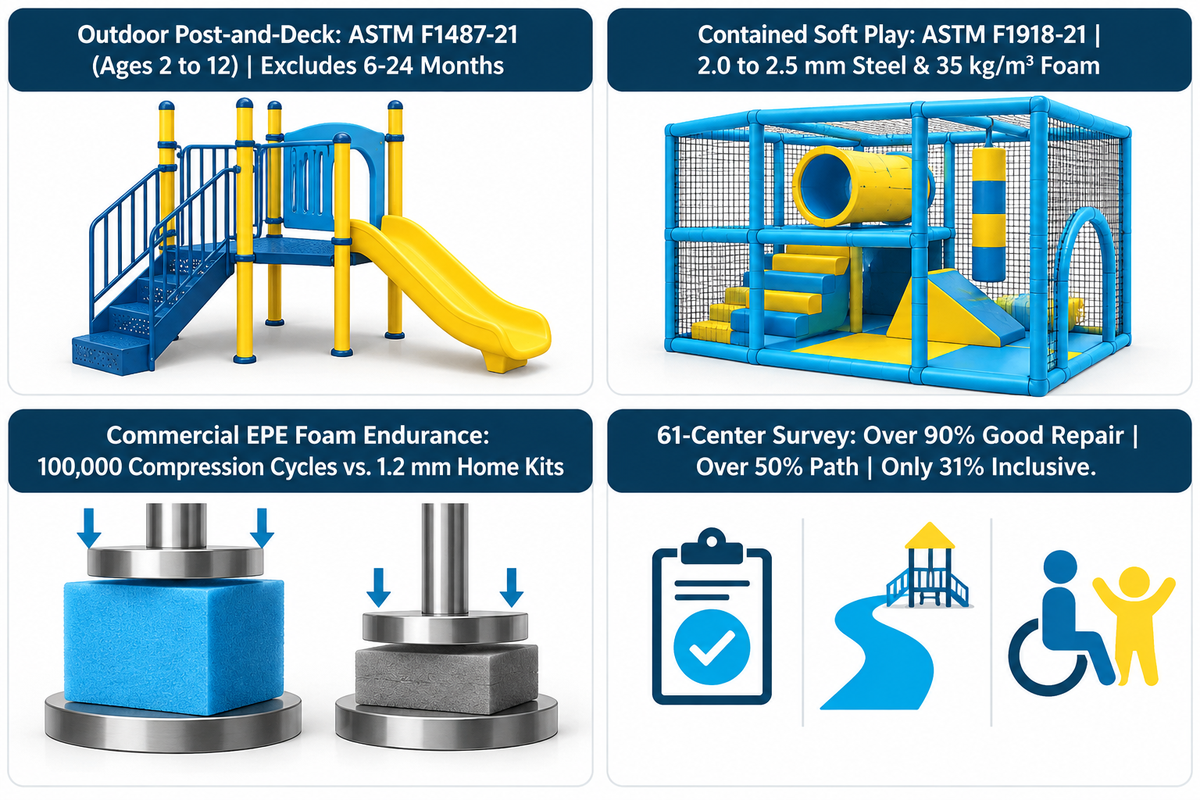
ANSI’s ASTM F1487-21 summary defines public outdoor playground structures for ages 2 to 12. It excludes children aged 6 to 24 months and soft contained play. Conversely, commercial soft play equipment systems follow ASTM F1918-21 for containment. Didi Land builds those indoor structures with 2.0 to 2.5 mm hot-dip galvanized steel, 35 kg/m³ EPE foam, and BS 5852 fire-rated PU leather. In a classic outdoor play structure, vertical posts support elevated steel decks. Those decks connect a slide, a climber, monkey bars, and an adjacent swing bay. Because outdoor hardware uses unpadded metal and rotomolded plastic, safety depends on shock-absorbing ground cover across the fall zone.
All elevated decks in an indoor contained zone are enclosed with padded tubes and safety netting. Didi Land’s soft play page says that commercial EPE foam bounces back in seconds after 100,000 compression cycles. By comparison, residential home-grade sets use sub-20 kg/m³ sponge and 1.2 mm electro-galvanized tubing built for 2 to 3 children over 2-hour windows. Commercial foam and vinyl padding shift impact protection directly onto the frame itself.
An empirical survey of 61 early childhood centers, summarized by the Children & Nature Network (Olsen & Smith, 2017) , tested whether their outdoor play yards were accessible to all children. Over 90% of surveyed traditional structures were in good physical repair, and over 50% had an accessible path to the boundary. Yet only 31% had playgrounds inclusively designed for children of all abilities. Closing that gap requires pairing fixed climbers with ground-level tactile and modular zones during school play.
Did Playgrounds Exist in the 1800s, and How Did Classic Post-and-Deck Equipment Evolve?
Public playgrounds emerged in the late 1800s as German sand gardens before evolving into early-20th-century galvanized steel pipe gymnasiums. Municipal playgrounds of that era used steel, wood, and paving to build youth stamina. Per Wearthy’s guide across 200+ playground projects, the mid-century parks’ standard became the four S’s: swing, slide, seesaw and sandpit.
Over recent decades, CPSC guidelines and ASTM standards replaced bare steel over asphalt with modular post-and-platform jungle gyms. Planners also added impact-rated surfacing beneath every fall zone. Today, buyers weigh those fixed outdoor frames against modular indoor foam zones and nature-inspired landscapes to match specific child development goals.
Commercial Playgrounds Compared: Outdoor Play vs. Indoor Soft Play Equipment Across 10 Dimensions
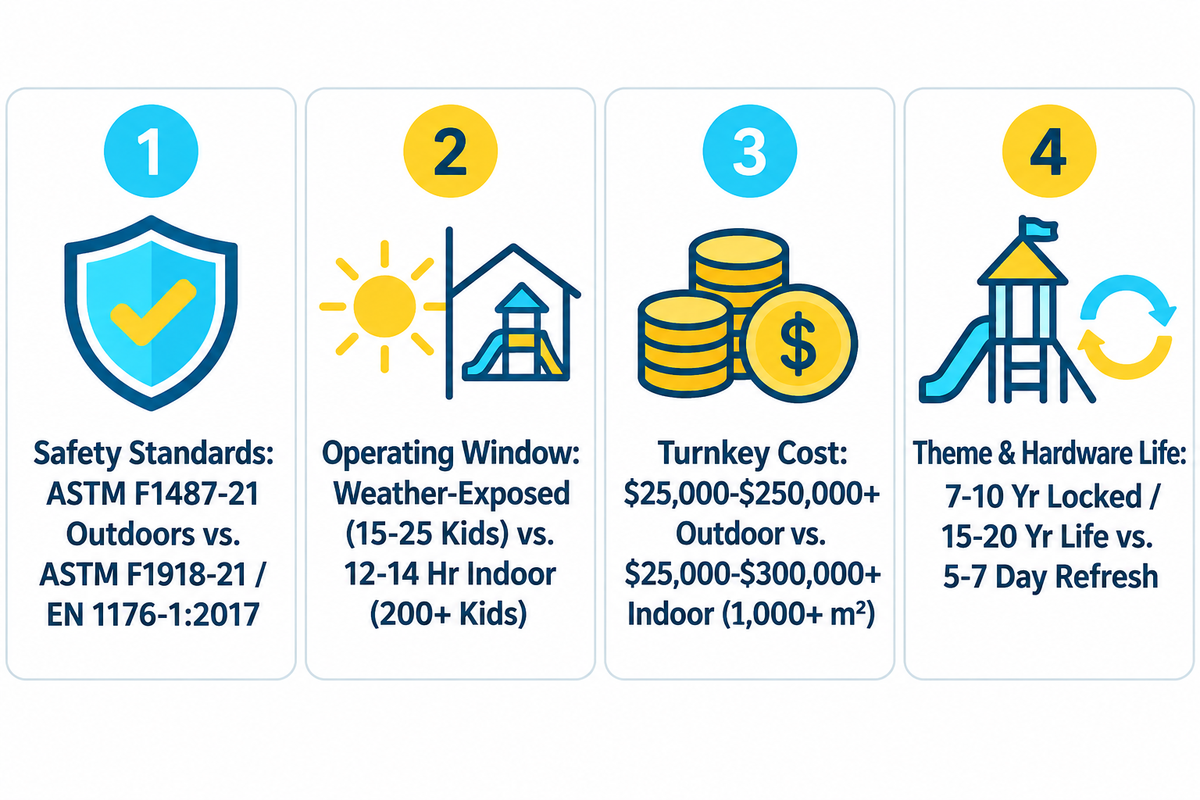
Didi Land’s commercial soft play specifications reveal modular indoor play systems from 6 sq.m to over 60 sq.m, with ball pits of 1.2 m to 4.3 m in diameter. Didi Land’s climbing equipment guide reveals that hard-plastic outdoor equipment locks operators into one theme for a period of 7 to 10 years. One cracked rigid slide module can mean an 8-week lead time for ocean freight. Modular soft play climbing systems allow for full theme redesigns in 5 to 7 days without structural replacements.
As Go Play Systems notes, outdoor structures excel at gross-motor challenges for school-age youth. Soft play maximizes toddler and preschool safety inside compact rooms. When operators compare custom commercial indoor playground equipment with outdoor catalog rigs, climate control and spare-part modularity protect daily foot traffic. Use our Post-and-Deck vs. Contained Soft Play 10-Dimension Selector below to benchmark both formats across commercial playgrounds.
| Engineering / Commercial Dimension | Outdoor Traditional Playground (Post-and-Deck) | Indoor Contained Soft Play Equipment | Published Benchmark & Source Attribution |
|---|---|---|---|
| 1. Governing Safety Standard | ASTM F1487-21 / CPSC Publication 325 (July 2025) | ASTM F1918-21 / EN 1176-1:2017 / AS 4685.1 | ANSI ASTM overview & Didi Land certification stack |
| 2. Target User Age Scope | 5th percentile 2-year-old to 95th percentile 12-year-old | Ages 2–12 (ASTM F1918-21); dedicated 6–23 mo toddler zones | ASTM F1487-21 excludes 6 to 24 months (ANSI / ASTM) |
| 3. Impact Attenuation Threshold | 200g maximum impact and 1000 HIC under critical fall height | EPE foam core + impact-rated surface tested to ASTM F1292 | ASTM F1487-21 / ASTM F1292 family (Didi Land / ANSI) |
| 4. Adjacent Feature Separation | 9-foot separation statement between features; perimeter use zone | 36–48 inches parent supervision corridors; 20 cm wall offset | ANSI blog 9-ft note & Didi Land spatial planning guide |
| 5. Typical Venue Footprint Range | 1,000 sq ft surfacing baseline to 15,000 sq ft park | 10–25 m² (restaurant/daycare), 30–80 m² (mall), 300–500 m² (center) | Adventure Turf (1,000 sq ft), PMC9602768 (15,000 sq ft), Didi Land |
| 6. Daily Operating Window & Traffic | Outdoor weather-exposed; 15 to 25 children on small builds | 12–14 hour daily indoor operation; 200+ children-per-day durability | Playworld (15–25 kids small park) & Didi Land (200+ kids/day) |
| 7. Installed Turnkey Cost Range | $25,000–$75,000 (small) to $150,000–$250,000+ (large park) | $25,000 (compact mall kiosk) to $300,000+ (1,000+ m² FEC build) | Playworld cost guide & Didi Land published indoor price range |
| 8. Surfacing Upfront Cost per Sq Ft | $3.5–$5.5 EWF vs. $13–$18 PIP rubber upfront (Adventure Turf); $15–$35/sq ft installed range (Playworld) | 3 cm mat thickness with 2 cm edge transition integrated in kit | Playworld ($15–$35/sq ft), Adventure Turf, Didi Land foam guide |
| 9. Theme Refresh & Lifecycle Span | 7–10 years locked theme; 15–20 years heavy-duty hardware life | 5–7 days modular theme refresh without structural replacement | Didi Land climbing guide (7–10 yrs / 5–7 days) & Playworld (15–20 yrs) |
| 10. Spare-Part & Delivery Lead Time | 8-week ocean freight wait on a single cracked rigid slide | 30–45 days standard PO (45–60 days custom) + 25–40 days sea | Didi Land climbing & soft play shipping specifications |
Before finalizing a plan for outdoor structures only, commercial operators must consider seasonal weather exposure. An outdoor play environment has to contend with all the elements. An uncovered outdoor play environment faces rain, summer heat, and winter ice, whereas an indoor room runs 12 to 14 hours a day. Having an indoor play zone and an outdoor play yard gives you the ability to provide active play as well as daily physical activity.
Developmental and Sensory Play Value: Safety Rules and Why Seesaws Left the Traditional Playground
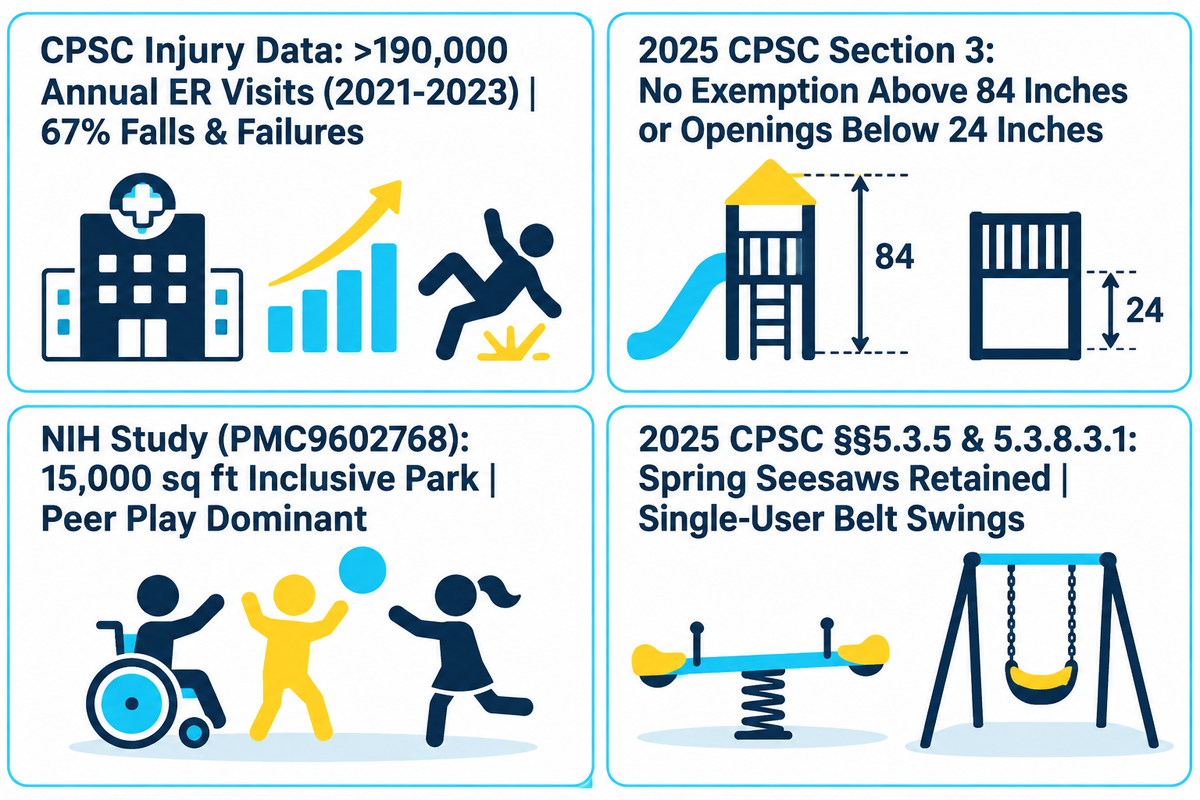
In the Federal Register 90 FR 38959, CPSC confirmed more than 190,000 annual emergency room visits due to playground accidents (2021-2023). Didi Land’s safety summary also cites a CPSC NEISS 2008–2010 baseline of 218,851 annual emergency-department-treated injuries, with falls and equipment failure together accounting for 67% of those incidents. In the 2025 Handbook update, CPSC declined to exempt equipment above 84 inches. It also declined to exempt partially bounded openings below 24 inches from section 3 rules.
“Since 2010, ASTM has published new and revised public playground standards. The 2025 Handbook includes changes from the 2024 draft Handbook, and additional revisions in response to public comments on the NOA.”
Balancing playground safety with rich developmental challenge necessitates combining gross-motor climbing with tactile and vestibular input. The National Institutes of Health (PMC9602768) published a peer-reviewed study on children’s play on a 15,000-square-foot inclusive playground. The park added sensory panels and tactile objects that provide imagination and creative thinking, slides, swings and monkey bars. Peer play became the most dominant form of social interaction across the park’s different sections. Areas equipped with multi-sensory apparatus build motor skills and healthy risk-taking, and improve developmental benefits for the development of children.
Why Do Playgrounds Not Have Seesaws Anymore, and What Replaced Them?
Traditional pivot-fulcrum plank seesaws have been removed from public playgrounds because sudden dismounts from the seesaw drop the opposite rider onto hard ground and crush limbs under the board. Replacing plank seesaws with spring-centered seesaws, speed-governed spinners and padded soft play equipment is common in modern parks. In the 2025 notice in the Federal Register (90 FR 38959) Section 5.3.5, the CPSC retained spring-centered seesaws.
In the same 2025 notice, the CPSC rejected proposals to allow multi-user belt swings under section 5.3.8.3.1. The CPSC also ruled that belt seats can safely accommodate only a single user. Replacing vintage merry-go-round units and open-spoked steel carousels with speed-governed flush whirlers is also common in modern parks. Refer to our article on commercial spinning playground equipment and ASTM clearance rules to learn more about speed governors. When purchasing playground equipment, buyers should demand IPEMA-certified moving apparatus so that uncertified equipment doesn’t lead to a municipal liability exclusion.
Impact Surfacing and Adventure Playground Alternatives: The 9-Row Format & Surfacing Matrix
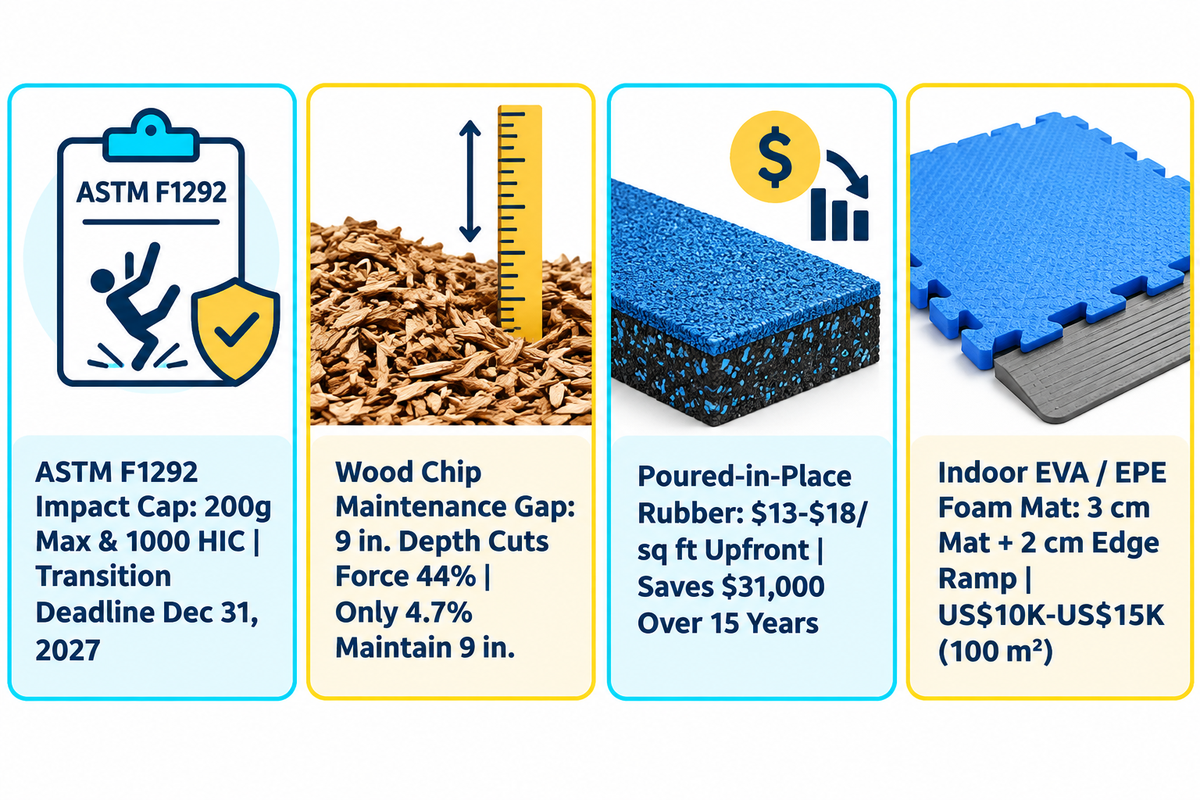
As documented on Didi Land’s climbing page, ASTM F1487-21 mandates 200g maximum impact and 1000 HIC under the critical fall height via ASTM F1292. IPEMA’s certification page notes that ASTM F3351 was merged into ASTM F1292-26 in September 2026 with a December 31, 2027 transition deadline. As Playground Professionals explains in its July 2025 CPSC Handbook review, Publication 325 expands guidance comparing loose-fill wood mulch against engineered unitary surfacing.
There is a serious compliance gap with regard to loose-fill wood chips, as mentioned in some field maintenance data. As cited in playground surfacing discussions, field inspection data indicated that maintaining a 9 inch depth of wood chips reduces playground fall impact forces by 44%. However, only 4.7% of playgrounds maintain a depth of 9 inches when loose-fill is not raked. Wheelchair accessibility across the ground surface must also comply with ASTM F1951-21; see our analysis of ADA playground accessibility standards and surfacing costs. Use our 9-Row Playground Format & Surfacing Architecture Matrix to compare five play formats and four surfacing systems.
| Format / Surfacing Row | Core Materials & Structure | Governing Standard & Fall Rating | Published Cost Benchmark | Maintenance & Lifecycle Tradeoff |
|---|---|---|---|---|
| 1. Traditional Post-and-Platform | Stainless/galvanized steel posts, decks, plastic slides, swings | ASTM F1487-21 (5th percentile 2-yr to 95th percentile 12-yr) | $25,000–$75,000 (small) / $150K–$250K+ (large, Playworld) | 15 to 20 years commercial hardware life (Playworld) |
| 2. Contained Indoor Soft Play | 2.0–2.5 mm steel pipe, 35 kg/m³ EPE foam, BS 5852 PU cover | ASTM F1918-21 / EN 1176-1:2017 (Ages 2–12) | $25,000 (mall kiosk) to $300,000+ (1,000+ m² FEC, Didi Land) | 100,000+ foam compression cycles; 5–7 day theme refresh |
| 3. Inclusive Multi-Ability Playground | Ramped decks (≥25% when ≥20 elevated components), sensory zones | ADA Chapter 10 (≥50% accessible route) + ASTM F1951-21 | $150,000–$250,000+ destination park range (Playworld) | 15,000 sq ft park studied in PMC9602768 drove high peer play |
| 4. Adventure / Loose-Parts Playground | Timber, ropes, crates, tires, movable loose parts | Site-specific risk management; supervised loose-parts play | Site-specific staffing and material budget | Requires trained playworkers to manage loose-parts hazards |
| 5. Natural Landscape Playground | Logs, boulders, earth mounds, plants, sand (Park N Play / Wearthy) | ASTM F1487 / F1292 fall attenuation applies to play structures | Custom landscape grading and drainage quotation | High organic aesthetic; requires timber and drainage upkeep |
| 6. Poured-in-Place (PIP) Rubber Surface | Unitary poured elastomeric rubber layer | ASTM F1292-22 (200g / 1000 HIC) + ASTM F1951-21 | $13–$18/sq ft upfront ($15/sq ft example = $15,000 / 1,000 sq ft) | Saves $31,000 in avoidable expenses over 15 years vs. EWF |
| 7. Engineered Wood Fiber (EWF) Mulch | Loose-fill wood fiber (9 inches maintained depth; 44% force cut) | ASTM F2075 + ASTM F1292-22 + CPSC Publication 325 | $3.5–$5.5/sq ft upfront ($4.50/sq ft example = $4,500 / 1,000 sq ft) | Only 4.7% maintain 9 inches without constant raking labor |
| 8. Interlocking Pocket-and-Receptacle Tiles | Base tiles with pockets sealing loose fill under upper resilient layer | ASTM F1292-22 / ASTM F1951-21 (patented example: US9896808B2) | $15–$35/sq ft overall commercial surfacing range (Playworld) | Seals loose fill inside tile pockets to prevent kick-out |
| 9. Indoor EVA / EPE Foam Mat System | 3 cm mat thickness with 2 cm edge transition ramp (Didi Land) | ASTM F1918-21 / BS 5852 fire-retardant cover | US$10K–US$15K equipment-only for 100 m² standalone indoor zone | Zero sub-base excavation; installs directly over level concrete |
What Are the Different Types of Playgrounds Beyond Traditional Post-and-Deck Structures?
Beyond traditional post-and-deck structures, commercial planners choose among adventure playgrounds, natural playgrounds, inclusive playgrounds, themed indoor soft play centers, and outdoor fitness parks. As Park N Play Design explains, a natural playground uses natural elements such as logs, a climbing boulder, and plants within natural landscapes to support natural play. Meanwhile, an adventure playground (historically called junk playgrounds in post-war Europe) supplies loose parts like timber, tires, and ropes. Trained playworkers supervise those yards so kids can reshape their own style of play and build confidence.
Commercial Playground Equipment Cost Breakdown and 5-Year Total Cost of Ownership
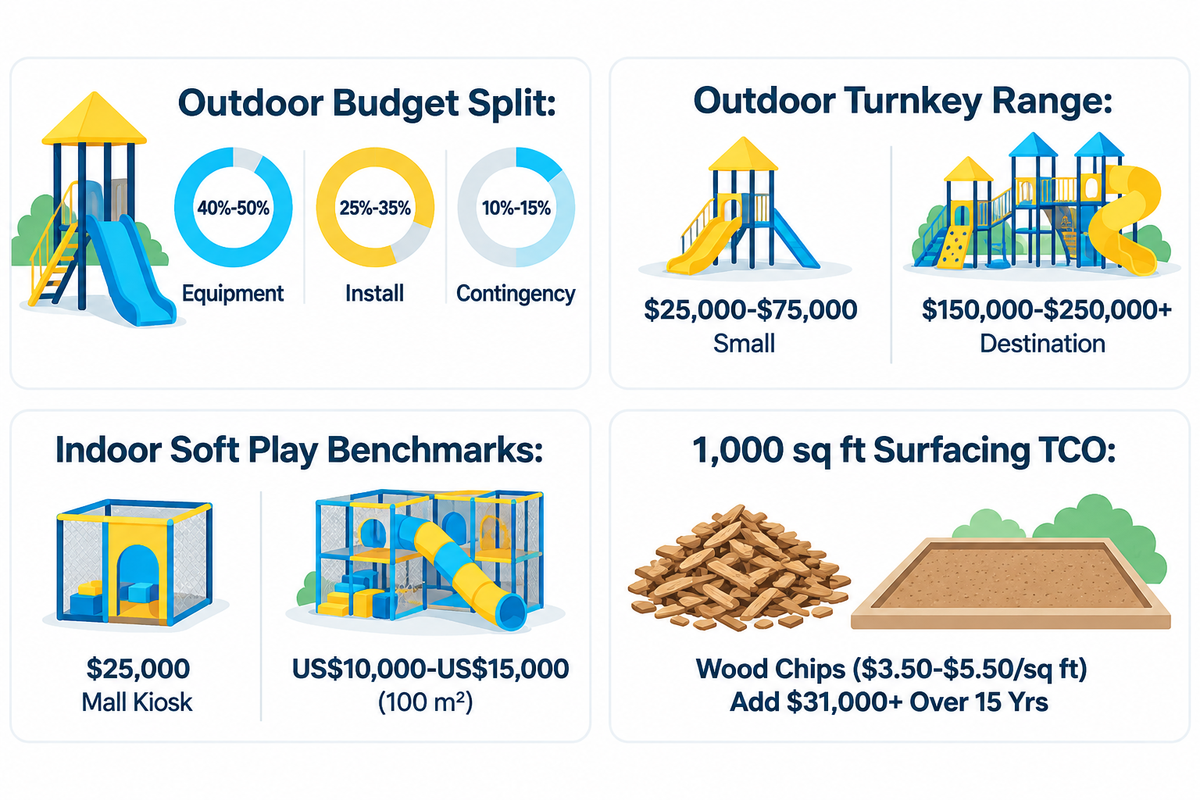
Playworld’s commercial playground cost guide reports that smaller playgrounds for daycares or churches serving 15 to 25 children run $25,000 to $75,000. Larger destination playgrounds for city parks range from $150,000 to $250,000 or more. Equipment makes up 40% to 50% of the playground budget, while professional installation accounts for 25% to 35% of playground costs. Safety surfacing and installation cost $15 to $35 per square foot or more, and Playworld recommends a 10% to 15% contingency buffer. A committee that budgets only for catalog playsystems faces a funding gap once installation and surfacing bids arrive.
How Much Does a Commercial Playground Cost Installed Once Surfacing and Site Work Are Added?
Adding installation (25% to 35%), safety surfacing ($15 to $35/sq ft), and a 10% to 15% contingency buffer doubles hardware-only quotes. Total turnkey budgets run $25,000 to $75,000 for small sites and $150,000 to $250,000+ for destination parks (Playworld). Playworld’s published $25,000 to $250,000+ project ranges are U.S. dollar example benchmarks as of January 2026 rather than site-specific contractor quotes. For indoor projects, Didi Land’s 5-year TCO and pricing guide reports that compact mall-kiosk soft play sets start at $25,000. Equipment-only packages for a 100 m² standalone indoor space run US$10,000 to US$15,000. On a 1,000-square-foot school playground, Adventure Turf’s study compares wood chips ($3.50 to $5.50/sq ft upfront) against poured-in-place rubber ($13 to $18/sq ft). Wood chips add $31,000+ in avoidable raking and top-up costs over 15 years.
| Cost Category / Lifecycle Line Item | Outdoor Loose-Fill Wood Chips (Adventure Turf / Playworld) | Outdoor Poured-in-Place Rubber (Adventure Turf / Playworld) | Indoor Contained Soft Play (Didi Land Published Specs) |
|---|---|---|---|
| Turnkey Project Benchmark Range | $25,000–$75,000 (small) / $150K–$250K+ (large, Playworld) | $25,000–$75,000 (small) / $150K–$250K+ (large, Playworld) | $25,000 (mall kiosk) to $300,000+ (1,000+ m² FEC) |
| Equipment Share of Total Budget | 40% to 50% of playground budget (Playworld) | 40% to 50% of playground budget (Playworld) | US$10K–US$15K equipment-only for 100 m² standalone site |
| Installation & Contingency Share | 25%–35% installation + 10%–15% contingency (Playworld) | 25%–35% installation + 10%–15% contingency (Playworld) | Video-guided self-install or on-site supervision (>200 m²) |
| Surfacing Upfront Price per Sq Ft | $3.5–$5.5/sq ft ($4.50/sq ft example on 1,000 sq ft) | $13–$18/sq ft ($15/sq ft example on 1,000 sq ft) | 3 cm floor mat + 2 cm edge transition included |
| 5-Year Theme Refresh & Downtime | Locked into one theme for 7–10 years (Didi Land) | Locked into one theme for 7–10 years (Didi Land) | 5–7 days modular skin refresh without structural rebuild |
| Spare-Part Replacement Lead Time | 8-week ocean freight wait on cracked rigid slide | 8-week ocean freight wait on cracked rigid slide | 30–45 days standard PO plus sea freight; modular unit-level swap |
| 15-Year Surfacing Cost Impact (1,000 sq ft) | Adds $31,000+ in avoidable raking & top-up expenses | Avoids wood-chip raking & top-up costs over 15 years (Adventure Turf) | No outdoor wood-chip replenishment or winter salting |
Play Space Allocation and Use-Zone Clearances: The 6-Foot Perimeter Use-Zone Penalty Rule
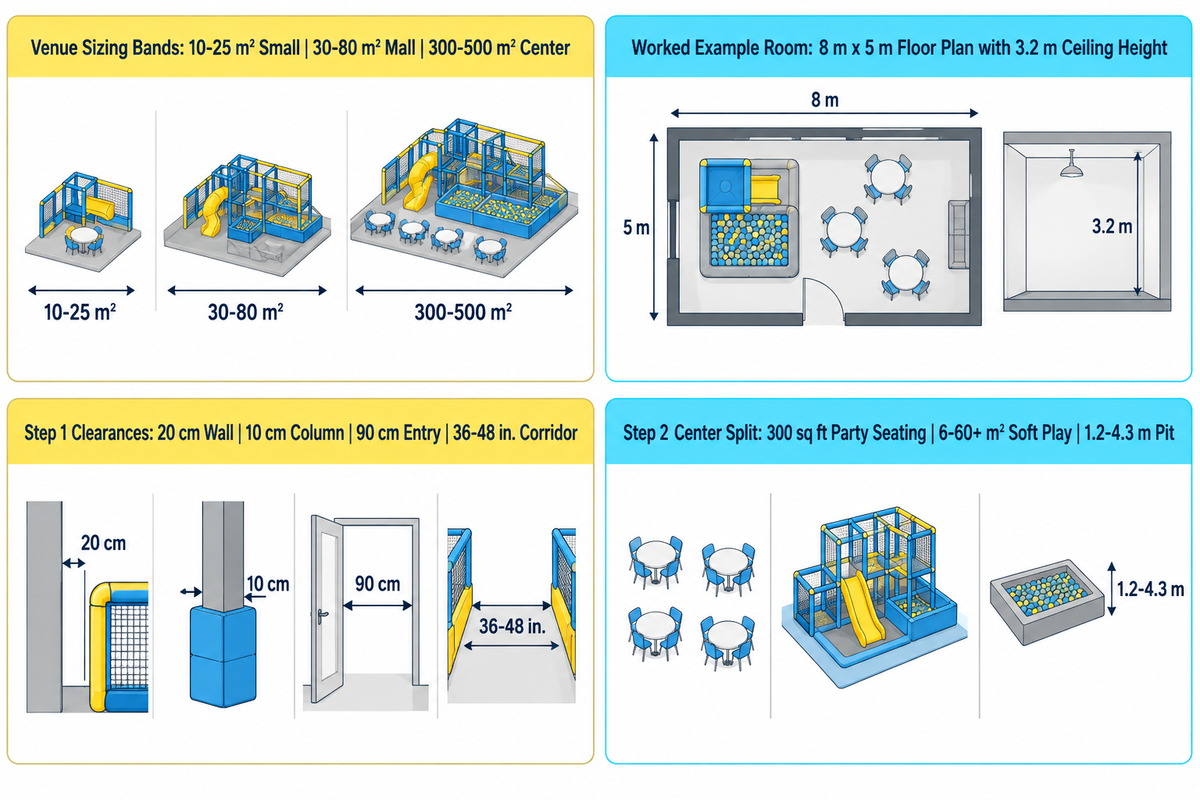
The commercial venue sizing guide by Didi Land shows that small (restaurant or day care) zones are 10 to 25 m², and medium (shopping) mall zones are 30 to 80 m². Isolated indoor soft play centers, to operate commercially, require 300 to 500 m², 36 to 48 inches for parent supervision corridors, and 300 sq ft for a birthday party room. That indoor allocation does not include the 9-foot separation between adjacent outdoor features noted on the ANSI ASTM standards page. Indoor contained soft play layout avoids the need for perimeter fall zones, as the frame is netted.
We refer to this spatial constraint as the “6-Foot Perimeter Use-Zone Penalty Rule.” Below is a detailed example using the measurements published for Didi Land’s rooms and corridors.
Worked Example: Sizing an Indoor Soft Play Room vs. Outdoor Feature Separation
- Premise and inputs: Let’s consider an operator with a medium commercial room in Didi Land’s 30 to 80 m² shopping-mall activation band. They evaluate an 8 m length by 5 m width floor plan with a 3.2 m ceiling height (Didi Land foam play layout reference).
- Step 1 (Wall Offset & Entry Corridors): Apply Didi Land’s 20 cm wall offset, 10 cm column clearance, 90 cm entry width, and 120 cm staff path. That layout preserves a 36 to 48 inch parent supervision corridor. No 9-foot outdoor inter-structure fall buffer is needed along netted walls.
- Step 2 (Play Zone & Party Allocation): Within a large 300 to 500 m² standalone center, setting aside 300 sq ft for birthday party seating still leaves the main play area open. Operators can comfortably fit a modular 6 to 60+ m² soft play set and a 1.2 m to 4.3 m ball pit.
- Scope boundary (what this result is not): Our geometric footprint example calculates equipment and separation zones only, excluding municipal property setbacks, fire-egress corridors, and civil stormwater drainage.
When planning facilities for older kids beyond age 12, where ASTM F1487 scope ends, operators should consider designing age 13+ teenage playground and parkour zones. Adding outdoor fitness rigs keeps teenagers from crowding school-age decks.
Outdoor Playground Structures vs. Soft Play Materials: Steel, Timber, PVC Vinyl, and Maintenance
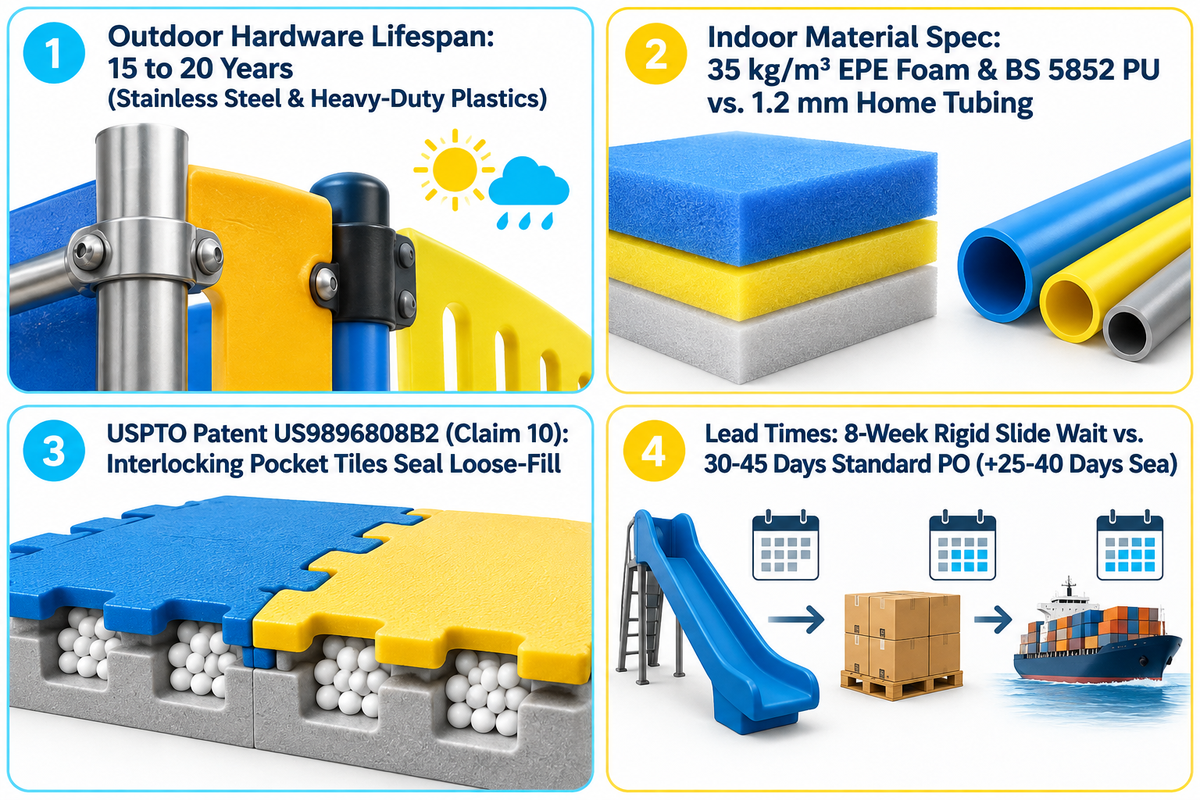
Playworld’s equipment quality guide notes commercial-grade outdoor stainless steel and heavy-duty plastics equipment lasts 15 to 20 years or more. For indoor venues, Didi Land specifies 35 kg/m³ EPE foam, heavy-gauge galvanized steel pipe, and BS 5852 fire-rated PU leather. Cheap residential kits often use thinner 1.2 mm electro-galvanized tubes and low-density sponge that flattens quickly.
Outdoor equipment requires maintenance to combat UV degradation, rust on fasteners, and displacement of loose-fill in drop zones. To stop loose-fill migration under slides and swings, USPTO Patent US9896808B2 (Claim 10) discloses interlocking safety tiles with pockets. A resilient layer poured-in-place over the tile seals the loose-fill. On the structural side, Didi Land’s climbing page notes that a cracked rigid slide can require an 8-week ocean freight wait. Catalogue soft play sets ship 30 to 45 days after purchase order (45 to 60 days for custom 3D layouts, plus 25 to 40 days by sea).
Indoors, maintenance shifts from raking mulch to surface hygiene inside themed playgrounds. Per commercial ball pit washing and disinfecting schedules, crews also clean and sanitize high-touch equipment and PU leather covers to maintain the areas for toddlers.
Inclusive Playground Design, Hybrid Inclusive Play Space Trends, and Supplier RFQ Checklist
Per the U.S. Access Board’s ADA Chapter 10 Guide, at least 50 percent of elevated play components must be on an accessible route. Play areas with 20 or more elevated components must include ramps to connect at least 25 percent of the components. Play areas with less than 20 elevated components may use a transfer system to connect at least 50 percent of the components. Transfer seats sit 11 to 24 inches high with a 14 by 24 inch platform. Driven by the 2025 CPSC Handbook update and year-round operating demands, private schools, churches, and family venues are pairing outdoor climbers with indoor soft play rooms.
When a private school or community center evaluates church and community indoor playground room planning, inclusivity and accessibility rules must be followed under the Americans with Disabilities Act (ADA). An inclusive playground must provide ground-level and elevated activities that address the unique needs of children with different abilities across different age groups.
Are Inclusive or Traditional Playgrounds Better for Multi-Age Community and Commercial Venues?
Hybrid and inclusive playgrounds outperform single-format traditional playgrounds in multi-age venues. They combine ASTM F1487 gross-motor climbers for 5 to 12 year-olds with ADA Chapter 10 accessible routes and cushioned ASTM F1918 soft play zones for younger children. In the NIH observational study PMC9602768, the researchers noted that child-to-child peer interaction was the dominant activity across all observed zones of the inclusive park. Creating inclusive play areas that are truly inclusive and accessible ensures siblings of all ages play together safely.
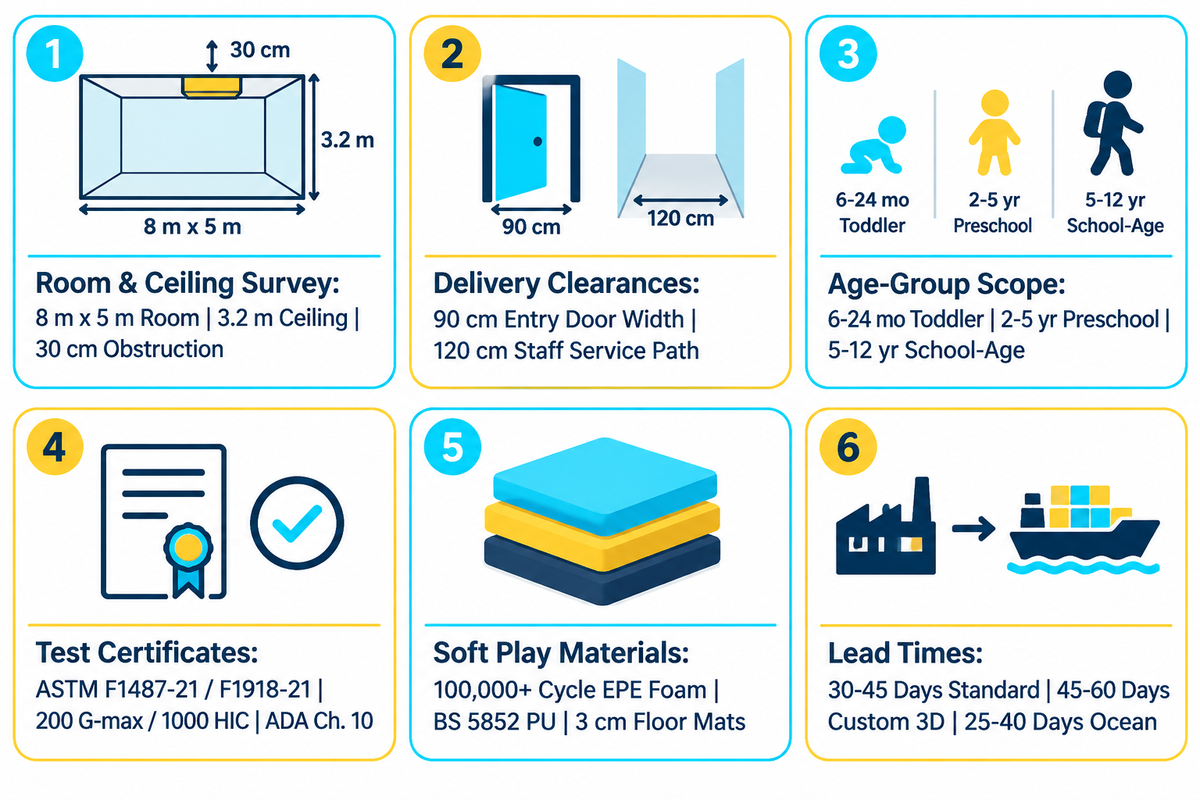
As observed on Didi Land’s page on foam play engineering, the most common blunder when contacting a playground equipment supplier is requesting a quote with only a picture as a reference. Working with only a picture neglects several other important considerations like the dimensions of the room, where doors and columns are located, and the height of the ceiling. Use the 6-point verification checklist below before issuing your purchase order.
Commercial Playground & Soft Play Supplier RFQ Checklist (6 Mandatory Inputs)
- Provide the measured dimensions of the room or parcel, location of structural columns, and the clear height of the ceiling (such as Didi Land’s 8 m x 5 m room with a 3.2 m ceiling and a 30 cm obstruction note).
- Measure the width of the entry door (e.g. 90 cm) and staff service path clearance (e.g. 120 cm) so that modular climbers and steel tubes can be delivered without having to remove walls.
- Select whether the zone serves 6 to 24 month infants in a dedicated toddler zone, or 2 to 5 year preschoolers or 5 to 12 year school-age youth under ASTM F1487-21 or ASTM F1918-21.
- Require written test certificates for ASTM F1487-21 and the 2025 CPSC Handbook outdoors, or ASTM F1918-21 and EN 1176-1:2017 indoors. Also verify ASTM F1292-22 surfacing (maximum 200 G-max / 1000 HIC) and ADA Chapter 10 compliance.
- For indoor soft play, require commercial-density EPE foam (100,000+ cycles) and BS 5852 fire-rated PU leather. Pair those pads with hot-dip galvanized steel framing and 3 cm floor mats.
- Confirm production lead times of 30 to 45 days for standard sets or 45 to 60 days for custom 3D layouts. Add 25-40 days for ocean freight.
Buyer Takeaway & Engineering Scope
Choose outdoor post-and-platform traditional playground with unitary poured-in-place rubber if you have the land and budget ($25,000 to $250,000+ per Playworld) for school-age gross-motor play. Choose contained indoor soft play (or indoor-outdoor hybrid) when you need 12-14 hour daily weatherproof operation, a 5-7 day modular theme refresh, and padded toddler safety.
Scope Note: Turnkey ocean freight, civil excavation, and custom 3D layout quotes depend on your room CAD plan, ceiling height, and destination port.
Planning a Commercial Indoor Soft Play Area or Hybrid Playground?
Send your room dimensions, ceiling height, column layout and target age group to Guangzhou Didi Land Amusement Equipment Co., Ltd. (Didi Land) for a custom 2D/3D layout and quote built to EN 1176, ASTM and BS 5852 commercial standards.
Frequently Asked Questions
Are traditional playgrounds safe for toddlers under age 3, or should venues use a separate soft play zone?
Toddlers under age 3 should use a separate contained soft play zone or dedicated low-deck area.
Post-and-platform structures have elevated decks and unpadded steel posts which create a risk of injury from falling for infants and toddlers. As ANSI’s summary of ASTM F1487-21 confirms, public playground equipment excludes children 6 to 24 months. Commercial establishments must provide a separate contained soft play zone with padded foam blocks and 3 cm floor mats.
Should traditional playgrounds be covered with a shade structure to prevent hot slide burns in summer?
Yes, installing overhead UV shade sails or canopy roofs prevents severe contact burns on exposed slides and decks.
Bare metal slides and dark-colored rotomolded plastic absorb the sun’s heat and retain it, and when combined with dark rubber surfacing, create playground surfaces that quickly burn young skin. Playworld’s commercial planning guide lists shade structures among key site amenities alongside benches and picnic tables. CPSC Publication 325 also advises shading bare metal slides, orienting slide beds away from afternoon sun, or choosing indoor climate-controlled soft play rooms in hot regions.
What is the difference between a natural playground and a standard post-and-platform playground?
A natural playground uses logs, boulders, and plants, whereas a traditional playground uses manufactured steel and plastic rigs.
Park N Play Design states a post-and-platform playground includes manufactured equipment consisting of galvanized steel posts, elevated decks, plastic slides, and belt swings over an impact pit. By contrast, a natural playground uses elements from the natural environment such as logs, boulders, and plants for play. Both formats must still adhere to ASTM F1292-22 fall-attenuation and head-entrapment safety rules.
How long does commercial outdoor playground equipment last compared with indoor soft play padding?
Commercial outdoor steel and plastic last 15 to 20 years, while indoor soft play refreshes themes in 5 to 7 days.
Playworld states that commercial grade stainless steel and heavy duty plastics can last 15-20 years outdoors. Indoors, Didi Land’s hot dipped galvanized steel frames, can support modular vinyl and foam climbers that refresh in 5-7 days.
Can a school, church, or family venue install commercial soft play equipment outdoors under a covered patio?
Soft play requires a fully enclosed, dry interior space rather than an open-sided outdoor patio.
Commercial soft play equipment (built with expanded polyethylene foam cores, stitched PU leather covers, and interlocking floor mats) is engineered for enclosed indoor rooms under ASTM F1918-21 and EN 1176. It is primarily designed for use in enclosed rooms and facilities that are subject to the requirements of the ASTM F1918-21 and EN 1176. Outdoor, open-sided patios subject to weather conditions (i.e., wind-driven rain, UV light, and dust) can accelerate the deterioration of the stitched seams and the core of the soft play equipment. Moisture that is trapped in the core of the soft play equipment can create a moldy and musty odor and further degrade the seams. In order to prevent this, facilities should seal the open side patios, use outdoor-rated ASTM F1487-21 climbers, and install unitary rubber surfacing.
What documents should you request from a playground equipment supplier before final handover?
Request ASTM F1487 or F1918 compliance certificates, ASTM F1292 HIC/G-max surfacing reports, BS 5852 fire logs, and CAD drawings.
Before final handover, third-party ASTM F1487-21 or ASTM F1918-21 certificates of compliance and ASTM F1292-22 surfacing test reports (200g and 1000 HIC) must be provided. Also, collect BS 5852 fire-retardant cover certificates, 2D/3D CAD drawings and maintenance manuals.
References & Sources
- Notice of Availability: Public Playground Safety Handbook Update (90 FR 38959, August 13, 2025) U.S. Consumer Product Safety Commission (CPSC)
- Guide to the ADA Accessibility Standards, Chapter 10: Play Areas U.S. Access Board
- ASTM Playground Safety Standards Overview (F1487-21, F1292-22, F1918-21, F1951-21) American National Standards Institute (ANSI)
- Naturalistic Observation of Children’s Play on Inclusive vs. Traditional Playgrounds (PMC9602768) National Institutes of Health (NIH) / PubMed Central
- Traditional Playgrounds Continue to Be the Norm for Young Children’s Outdoor Play Spaces (Olsen & Smith Survey) Children & Nature Network Research Library
- US Patent US9896808B2: Safety Surface with Engineered Shock-Absorbing Base United States Patent and Trademark Office (USPTO) / Google Patents
Reviewed by the Guangzhou Didi Land Amusement Equipment Co., Ltd. (Didi Land) technical engineering team.