Get in Touch with Didi Land


Updated November 2026
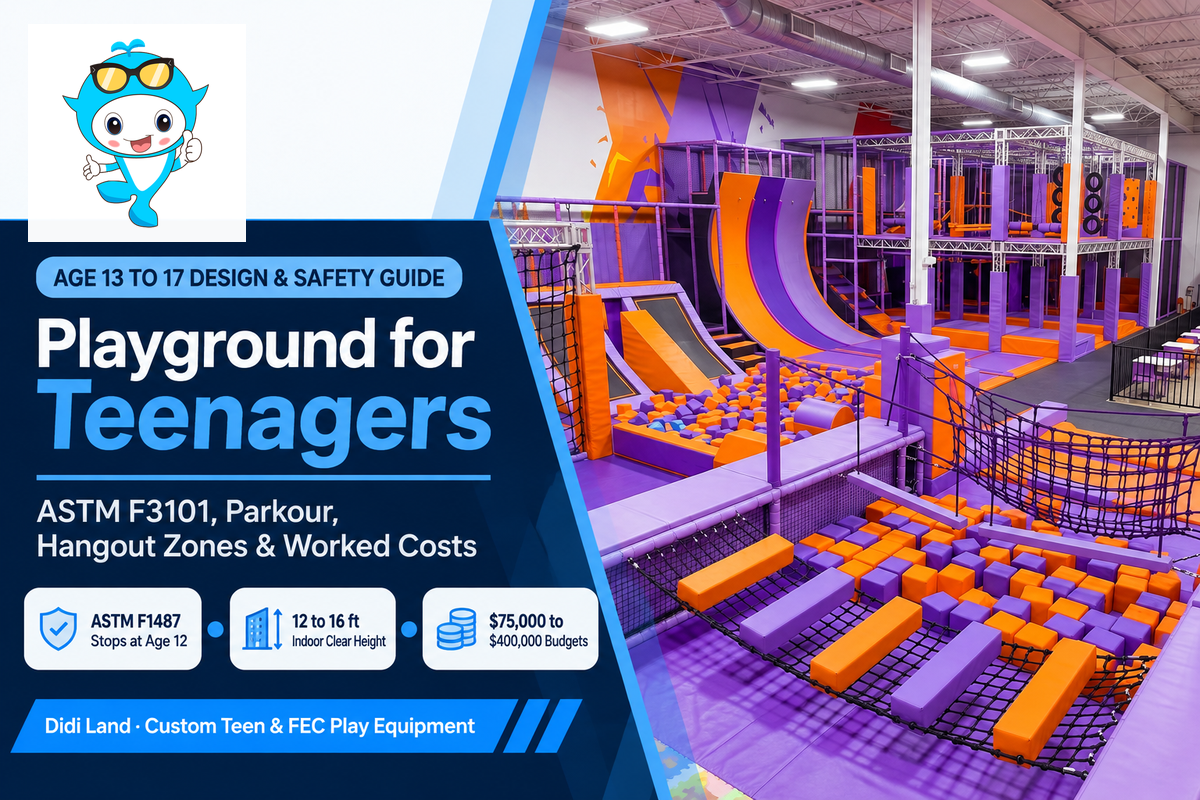
Building a successful playground for teenagers requires advancing beyond colossal toddler post-and-platform playsets. According to ANSI’s summary of ASTM F1487-21, that public playground standard covers users from the 5th percentile 2-year-old to the 95th percentile 12-year-old. Users aged 13 to 17 require structures engineered for teen body sizes, dynamic loads and group occupancy. Outdoor and indoor designs pair apparatus-specific standards and stamped structural review with ASTM F1292 impact surfacing and shaded hangout seating. Indoor dynamic zones allow 40 to 50 sq ft per user across the usable 60% to 70% of floor area (3 sqm per user at peak load). Accessible plans incorporate 60-inch-wide routes (in play areas of at least 1,000 sq ft) and 30 by 48-inch clear floor spaces at exercise equipment.
Public outdoor recreation supply lags far behind teen demand. In Recreation Management’s June 2026 survey, 23% of park agencies primarily reach children ages 4 to 12. Only 1.8% of respondents primarily serve teens. Even so, teen programs jumped from No. 3 in 2025 to the No. 1 planned addition in 2026.
Age 12
95th-percentile ceiling in ASTM F1487 & F1918
1.8% vs 23%
Respondents primarily serving teens vs park ages 4–12
82.1% Lower
Observed teen female presence in NYC playground zones
$75k–$400k
U.S. outdoor RFP to medium indoor startup range
Why Kids Leave Traditional Playgrounds Around Ages 9 to 12
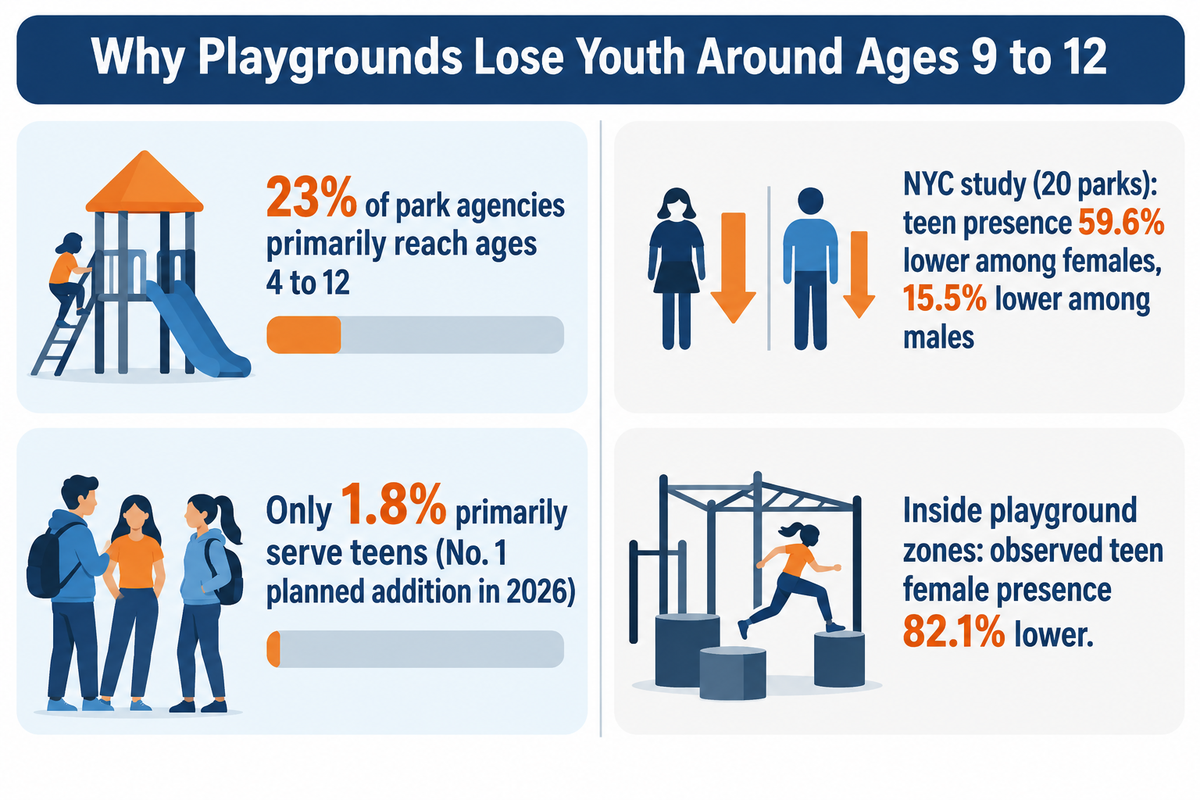
Conventional post-and-platform playsets lose appeal around ages 9 to 12 as individual interests, body sizes and social behaviors diverge. That supply gap in public recreation programs starts right on the childhood playground deck. Because ASTM F1487 stops at that pre-teen anthropometric boundary, elementary-scale decks and slides offer limited physical challenge for growing youth. Preteens seek peer independence, skill advancement and unscripted hangout space.
There are distinct differences in age and gender in public park zones. A New York City park study on PubMed Central logged 9,963 scans across 20 low-income parks. Observers counted 16,602 children aged 5 to 10 and 11,269 teenagers aged 11 and older. Observed teen presence was 59.6% lower among females and 15.5% lower among males compared with the 5-to-10 age group. Inside playground zones specifically, observed female presence was 82.1% lower.
That New York count compared separate 5 to 10 and 11 and older age groups during a single summer. Park-related activities and neighborhood demographics also influenced turnout. While younger children (ages 5 to 10) play on compact climbers, tweens and teens (ages 11 and older) look for unscripted group seating.
At What Age Do Kids Lose Interest in Playgrounds?
Traditional playgrounds (post-and-platform play structures) see declining use by ages 9 to 12, though individual timing varies. One-season park counts compare age groups at one point in time, rather than tracking a group through adolescence. Adding social seating and climbing walls alongside structured court games helps increase the overall appeal of outdoor parks.
Blaming phone screens alone misses the equipment gap. Low beams, narrow tube slides and short climbers mean there’s little room for older youth to progress. Installing playground equipment for older kids dedicated to 13-17 year olds brings youth back into public parks and campus courtyards.
Navigating the Age 13+ Compliance Shift Beyond ASTM F1487
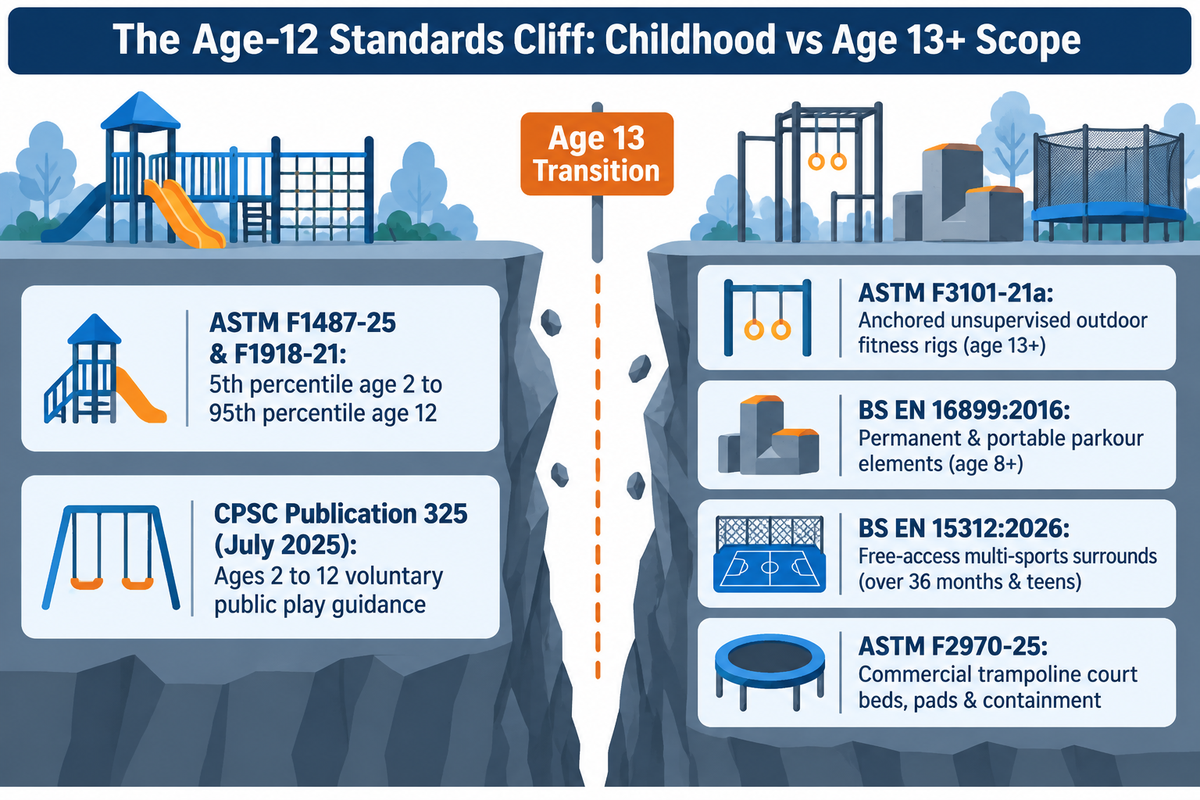
Once users turn 13, no single U.S. playground standard governs an entire youth site. ASTM published ASTM F1487-25 in 2025 to supersede ASTM F1487-21 for public outdoor play, and both editions stop at the same pre-teen user ceiling alongside indoor standard ASTM F1918-21. ASTM F3101-21a covers permanently anchored outdoor fitness equipment for unsupervised use at age 13 and older. BS EN 16899:2016 addresses parkour equipment, and BS EN 15312:2026 addresses free-access multi-sports surrounds. New public procurements specify ASTM F1487-25 for child zones while matching each 13+ apparatus to its dedicated standard.
This regulatory handoff is what we call The Age-12 Standards Cliff. Buyers assume that one indoor soft-play certificate or fitness label covers the entire teen layout. According to ASTM F3101-21a’s official scope, this specification applies to permanently anchored unsupervised outdoor fitness units for ages 13 and up. Clause 1.2.1 excludes the design of the adjacent facility or grounds.
Indoor play planners face the same age ceiling. Under ASTM F1918-21 §1.2, soft contained play covers only that pre-teen childhood user range from age two through twelve. Clause 1.3 excludes sports equipment, amusement rides, and standalone fitness units. On the other hand, the U.S. CPSC Public Playground Safety Handbook (Publication 325) (revised in July 2025 for the first time since 2010) is a voluntary federal guideline rather than mandatory law.
| Standard / Document | Covered User Age | Equipment Scope | Key Boundary or Exclusion |
|---|---|---|---|
| ASTM F1487-25 (supersedes F1487-21) | 5th percentile age 2 to 95th percentile age 12 | Public outdoor playground equipment | Stops at age 12; excludes site furnishings outside use zones |
| ASTM WK98041 (Feb 2026) | Proposed revision to published ASTM F1487-25 (ages 2 to 12) | Non-overlapping use and clearance zones | Proposed F15.29 slope-tolerance clarification work item |
| CPSC Publication 325 (July 2025) | Ages 2 to 12 public play guidance | Public surfacing, openings, composite frames | Voluntary guideline; composite structures considered as a whole |
| ASTM F3101-21a | Age 13 and older | Anchored unsupervised outdoor fitness rigs | Apparatus only (§1.2.1); excludes site or grounds layout |
| ASTM F1918-21 | 5th percentile age 2 to 95th percentile age 12 | Indoor soft contained commercial structures | Caps at age 12 (§1.2); excludes sports gear and rides |
| ASTM F2970-25 | Institutional and commercial patrons | Commercial trampoline court beds and pads | Covers court frames, beds, padding, and containment |
| BS EN 16899:2016 | Users starting from age 8 and up | Permanent and portable parkour elements | User-determined movement; excludes organized coaching |
| BS EN 15312:2026 (Mar 25, 2026) | Children over 36 months and teenagers | Free-access unsupervised multi-sports surrounds | Replaces 2007+A1:2010; excludes ground surfacing |
| ISO 24665:2022 & TR 24666:2022 | All public play and youth recreation zones | Inspector competence and probe data | Reference framework rather than one global code |
Technical committees continue refining zone tolerances for the 2-to-12 range as well. On February 5, 2026, ASTM Subcommittee F15.29 initiated Work Item WK98041 as a proposed revision to published ASTM F1487-25 regarding maximum slope limits in non-overlapping use and clearance zones. Buyers comparing regional rules can review our commercial playground safety standards comparison alongside project-specific structural engineering checks.
High-Challenge Equipment Compared: Parkour, Calisthenics, Climbing Nets, and Ninja Zones
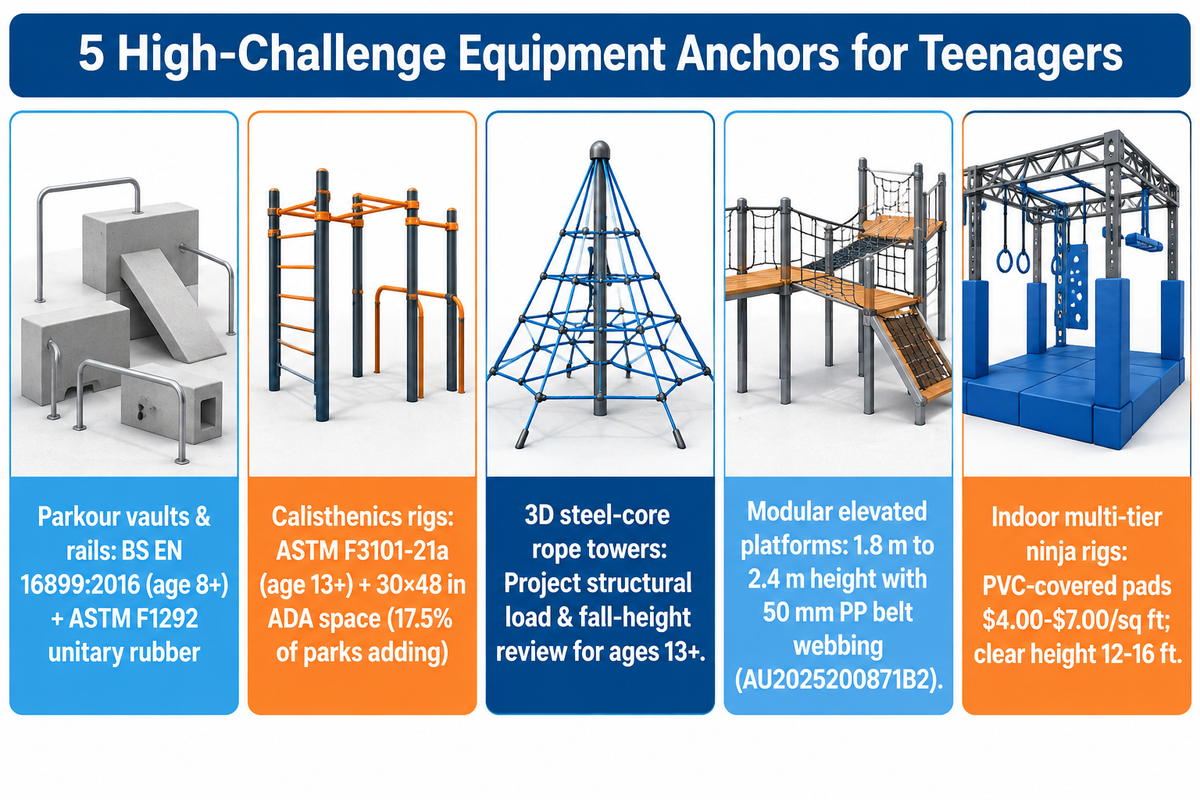
Fun and challenging equipment for teens replaces single-route slides with open skill progression across five anchors: parkour vaults, calisthenics rigs, 3D steel-core rope towers, low bouldering walls, and ninja obstacle lanes. Each apparatus category pairs project-specific structural engineering checks with distinct clearance zones. According to Recreation Management’s 2026 survey, 17.5% of feature-adding park agencies plan outdoor fitness equipment or fitness trails.
European parkour standards codify self-directed movement directly. BSI’s BS EN 16899:2016 parkour standard (published January 31, 2017) was primarily aimed at users 8 years and older. It acknowledges that parkour movement is self-directed by users through controlled physical exertion over fixed and portable structures. Angled takeoff blocks and precision rails enable novices to learn low step-vaults and advanced teens to link longer transfers.
Adult landing forces separate institutional commercial playground equipment from residential backyard gym equipment. Granted patent AU2025200871B2 (Systems IP Pty Ltd) describes modular elevated platforms set about 1.8 m to 2.4 m above the ground and reinforced with 50 mm wide PP belt webbing. High schools are also installing dedicated obstacle courses. Recreation Management’s teen ninja report profiles Valencia High School in Los Lunas, New Mexico, where an outdoor ninja course hosts physical education classes and student workouts.
| Attraction Category | Applicable Standard / Review | Core Physical Appeal | Surfacing & Staffing | When It Does Not Fit |
|---|---|---|---|---|
| Parkour vault blocks & rails | BS EN 16899:2016 (age 8+) | Self-directed vaults, balance, and agility | ASTM F1292 unitary rubber matched to fall height; unstaffed | Loose wood chips that shift under jump takeoffs |
| Calisthenics & pull-up bars | ASTM F3101-21a (age 13+) | Bodyweight workout sets and street fitness | Unitary surfacing + 30×48 in ADA clear floor space; unstaffed | Sites without nearby benches for social rest |
| 3D steel-core rope towers | ASTM F1487-25 (ages 2–12); project structural load, fall-height, use-zone & entrapment safety review for ages 13+ | High route choice and group perch hangout | ASTM F1292 surfacing rated at or above equipment fall height | Tiny pocket lots unable to fit perimeter fall zones |
| Low bouldering walls | Applicable climbing-wall safety specs & structural review | Lateral climbing traverses for mixed skill | Impact-tested climbing mat or unitary surface matched to fall height | Unshaded walls where resin holds overheat in summer |
| Outdoor campus ninja lanes | ASTM F3101-21a where unsupervised 13+ fitness; custom obstacle review otherwise | Timed grip, monkey bars, and ring swings | Impact-rated unitary rubber matched to obstacle fall height | Shared yards where unsupervised 5-year-olds run across |
| Indoor multi-tier ninja rigs | Project structural calculations, building code & attraction safety review | Vertical climbs, warped walls, stunt airbags | Didi Land lists PVC-covered pads at $4.00–$7.00/sq ft; pads & airbags matched to landing paths; staffed | Low retail bays under 12–16 ft clear ceiling height |
| Commercial trampoline courts | ASTM F2970-25 | Aerial rebound, mini dunk lanes, dodgeball | Court spring pads and safety nets; staffed lanes | Unfenced municipal parks without controlled check-in |
| Sociable basket & group swings | Design for intended users, combined occupancy, suspension & impact areas | Face-to-face motion and group conversation | ASTM F1292 pad across full swing movement and impact area | Narrow paths where swing arcs cross foot traffic |
| Open MUGA ball courts | BS EN 15312:2026 | 3×3 basketball, futsal, handball, rebound play | Asphalt or polymeric sport court; unstaffed | Single-exit high cages that deter teenage girls |
Staffing and landing pads separate unstaffed outdoor fitness options from indoor supervised rigs. Unstaffed public parks favor welded pull-up bars, parallel dip bars, and steel-core rope climbers. Heavy-wall steel tubing is used to prevent flex during controlled group activities. Those layouts connect obstacle and fitness play spaces for older users without staff belay gear.
Designing Social Hangout Zones and Girl-Friendly Public Spaces
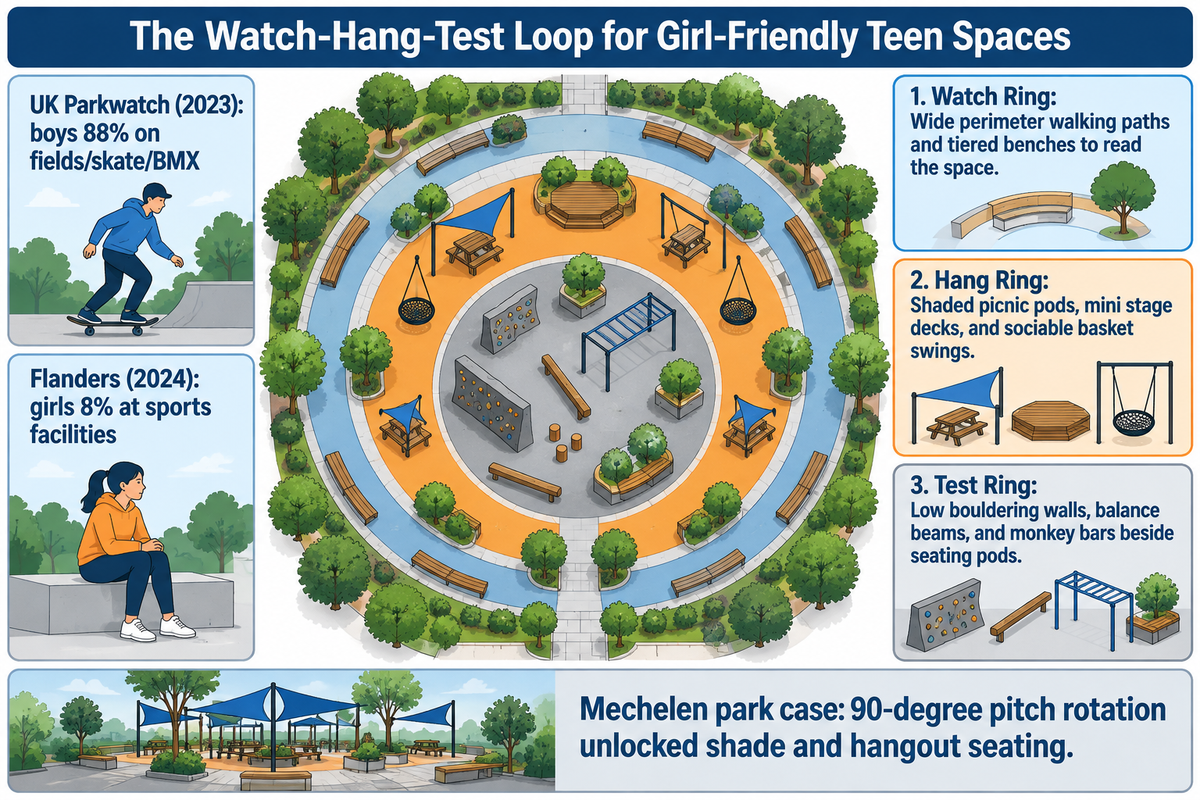
Effective playground designs for the adolescent population won’t be successful with fenced ball cages or deep skate bowls alone. UK Parkwatch (2023) reported boys as 88% of teenagers observed on soccer fields, skateparks, and BMX tracks, while a 2024 Flanders survey recorded girls as just 8% of sports-facility users. Keeping teenage girls engaged means providing spaces with several exits, circular seating, shade, lighting, and group swings free from ball traffic.
In West Yorkshire photo-elicitation workshops with 50 teenage girl participants aged 13 to 18, girls prioritized feelings of safety, open sightlines, and social seating over enclosed multi-use games cages dominated by older boys.
Summary of findings from University of Leeds / White Rose Research Online (50 participants aged 13–18)
European park counts show how quickly sport-only layouts lose girls past age 11. As reported by Architektura & Biznes, a 2024 study in Flanders and Brussels recorded 4,626 children aged 3 to 14 (including 3,200 playing outdoors) and found girls dropped to 27% among 12-to-14-year-olds. At sports facilities, girls accounted for just 8% of observed users.
In order to implement lessons from the Green Flag Award teenage girls guide (based on the experiences of over 350 girls and women), we organize youth zones based on The Watch–Hang–Test Loop:
- 1. Watch Ring: Wide perimeter walking paths and tiered benches let hesitant teens read the social atmosphere before entering.
- 2. Hang Ring: Shaded picnic pods, mini stage decks, and sociable basket swings create inclusive places to talk and creative ideas for group hangouts.
- 3. Test Ring: Low bouldering walls, balance beams, and monkey bars sit beside seating pods instead of a spotlighted center court.
How Can Parks Keep Teenage Girls Engaged After Age 11?
To engage teenage girls age 11 and above, Parks and Recreation Departments need to create safe spaces, break up court monopolies, and provide hangout areas and shade to socialize.
A good example of such a layout is ‘t Hofke park in Mechelen, Belgium. The designers of this facility rotated the main soccer field by 90 degrees. This reduced ball-player conflict zones and provided space for shade and hangout seating.
Indoor Playground for Teenagers: Multi-Level Adventure, Ninja, and FEC Attractions
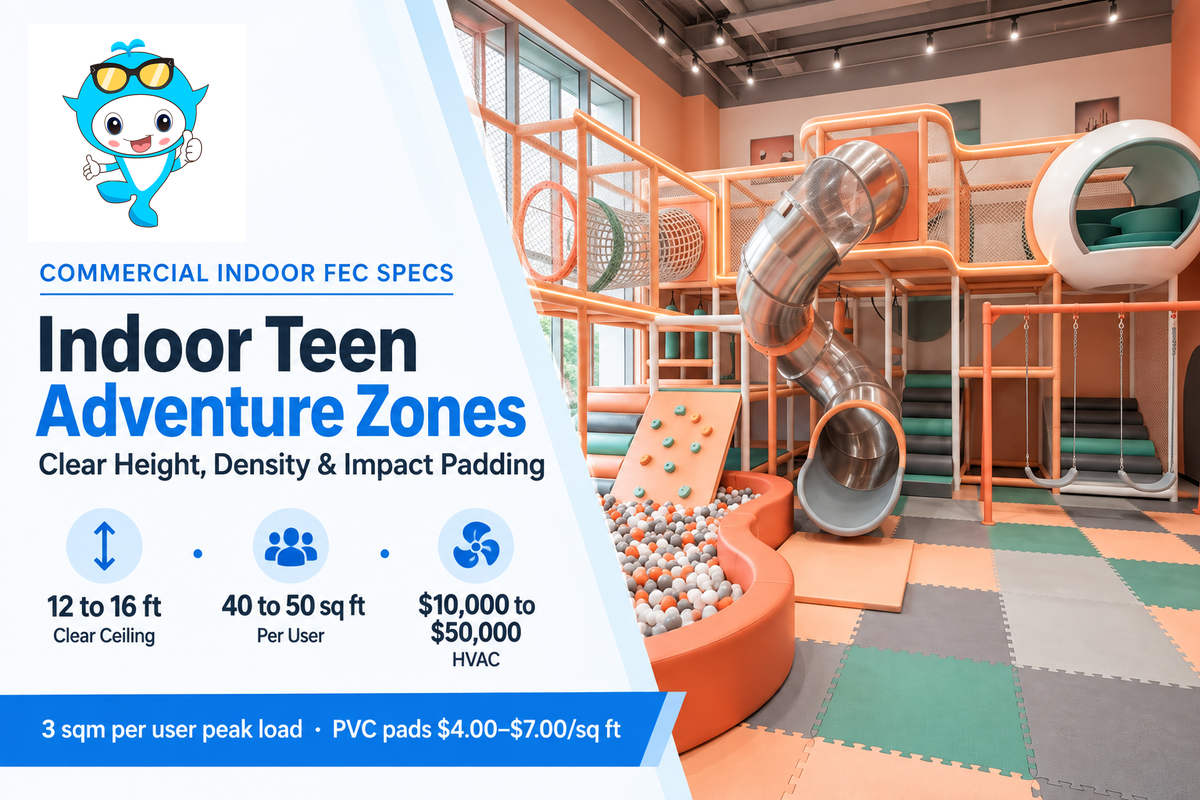
A profitable indoor playground for teenagers separates youth attractions visually and structurally from toddler soft play. ASTM F1918-21 covers soft contained play only up to that pre-teen childhood ceiling. ASTM F2970-25 addresses commercial trampoline courts. Multi-tier teen ninja courses, warped walls and drop slides require apparatus-specific standards and stamped engineering reviews for structural loads and potential entrapments. Didi Land uses 3 sqm of active play area per user as a peak occupancy benchmark. Dedicated hangout seating and clear circulation paths reduce floor conflicts inside indoor facilities as well.
Malls and entertainment centers lose older kids and teens when an attraction resembles a nursery playpen. Acoustic baffles, a darker industrial palette, and zoned wristbands give 13-17 year olds a distinct club feel. Operators ordering custom indoor adventure equipment for family entertainment centers anchor teen zones with repeatable competition: dual ninja courses, stunt air bags, climbing walls, and high rope bridges.
Building shell limits shape every attraction layout. Didi Land’s indoor layout guide requires 12 to 16 feet of clear ceiling height for multi-level structures. Dynamic climbing and slide zones need 40 to 50 sq ft per user across the usable 60% to 70% of gross floor area. Didi Land’s startup guide lists EVA foam mats at $1.50 to $3.00 per sq ft and commercial PVC-covered padding at $4.00 to $7.00 per sq ft. Didi Land notes that price gap reflects critical fall-height performance rather than surface aesthetics. Operators also budget $10,000 to $50,000 for HVAC upgrades serving 50 to 200 active users. Teams planning teen-ready indoor play zones in shopping malls verify clear height below sprinklers and ducts before signing a commercial lease.
Site Zoning, School Campuses, and Multi-Use Games Areas (MUGA)
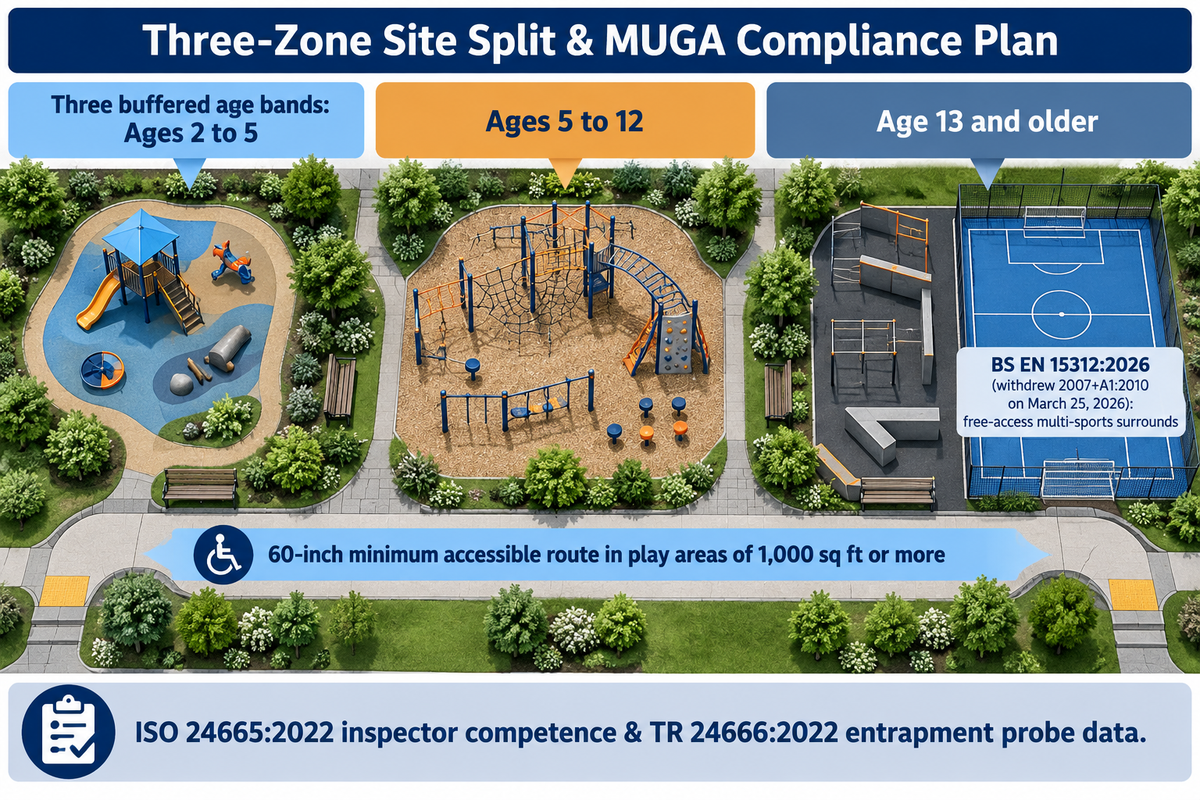
Compliant site planning separates age bands 2 to 5, 5 to 12, and 13 and older, connected via a 60-inch minimum accessible route in play areas of 1,000 square feet or more. Permanent Multi-Use Games Areas (MUGAs) should use open sightlines and ball-stop screens in accordance with BS EN 15312:2026.
Locating a fast parkour lane or 3×3 basketball court next to preschool swings causes stray ball conflicts and complaints from parents. Shaded benches and planted berms, along with clearly defined primary pathways, help separate elementary school play areas from teen equipment. Middle school campuses apply a similar three-zone split during recess breaks. Teachers and parents are able to see the park courtyards from perimeter sidewalks. Indoor and hybrid operators are able to test floor splits early with an interactive layout zone allocation calculator and a multi-age playground zoning and traffic flow layout.
On March 25, 2026, BSI withdrew BS EN 15312:2007+A1:2010 in favor of BS EN 15312:2026. According to BSI, BS EN 15312:2026 specifies requirements for permanently installed, free-access unsupervised multi-sports equipment for outdoor training, recreation, and education. It can incorporate basketball, futsal, football, handball, tennis, and volleyball equipment while excluding the ground surface. For middle school and municipal crews, Playground Professionals’ international standards brief highlights ISO 24665:2022 for inspector competence and TR 24666:2022 for entrapment probe data.
Timed Courses and Interactive Tech Features: Practical Selection Criteria
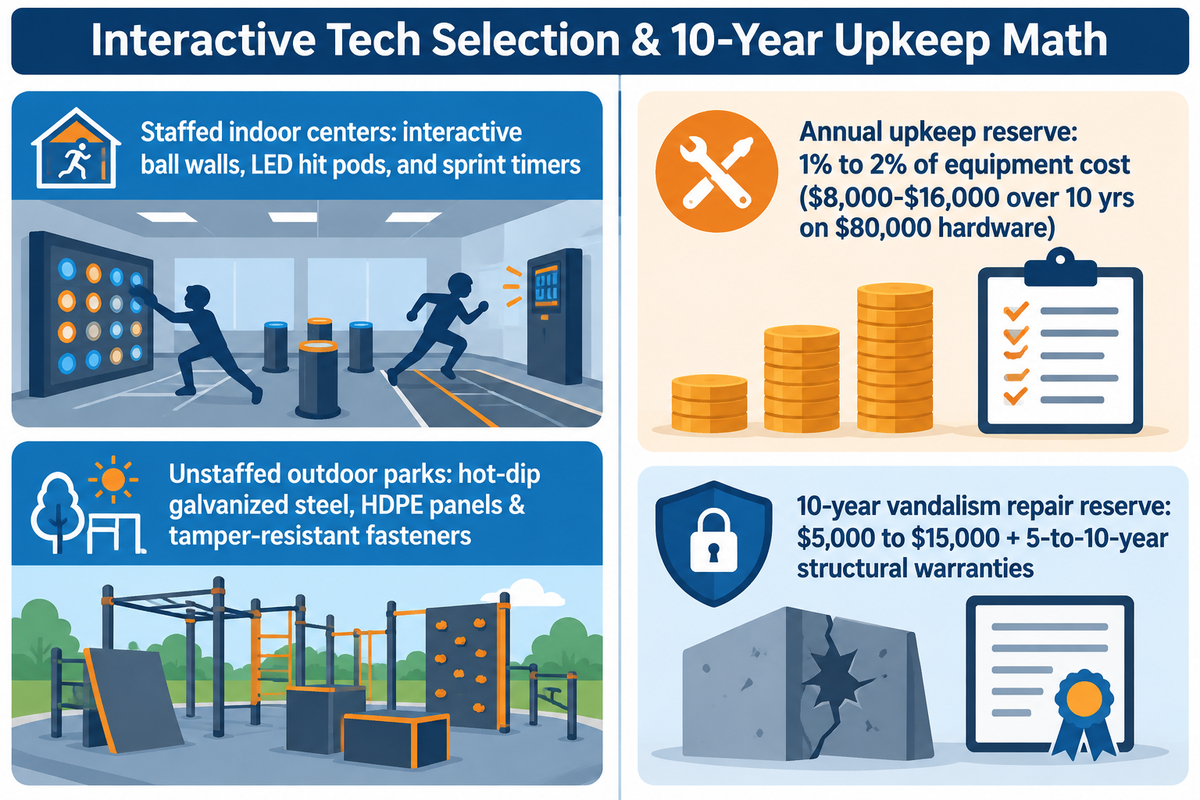
Several interactive installations boost repeat play inside staffed indoor centers. These include interactive ball walls, LED hit pods, and sprint timers. Mechanical weatherproof units are widely used for unstaffed outdoor parks to gain steady uptime. Fixed workout stations installed alongside sprint timers in unstaffed parks follow ASTM outdoor fitness equipment specifications for permanently anchored unsupervised units. Municipal crews weigh ongoing inspector competence and hardware maintenance when selecting outdoor training electronics. External electronic units need weatherproof housings and replaceable power modules. Buyers confirm spare boards and replacement modules before purchase.
Moisture ingress and drained batteries can cause electronics to fail, and discontinued proprietary circuit boards can halt repairs. Outdoor Workout Supply advises reserving 1% to 2% of equipment cost each year for routine inspections and minor upkeep. On the $160,000 worked 12-station build with $80,000 in equipment, 1% to 2% of equipment cost equals $8,000 to $16,000 over 10 years, plus $5,000 to $15,000 for vandalism repairs. Commercial outdoor fitness equipment often carries 5-to-10-year structural warranties. Hot-dip galvanizing protects steel from corrosion, while proper choice of section size and anchor footings can help resist repeated dynamic loads.
Material choices also align with public sustainability tenders. Rhino Play’s early-2026 UK installation report suggests that recycled plastic playground equipment was a major seller in 2026. Considerations for the environment are turning into baseline public procurement requirements. Structural HDPE panels and galvanized steel posts used with tamper-resistant fasteners support year-round operation.
Impact Surfacing, Fall Zones, and High-Traffic Inspection Priorities
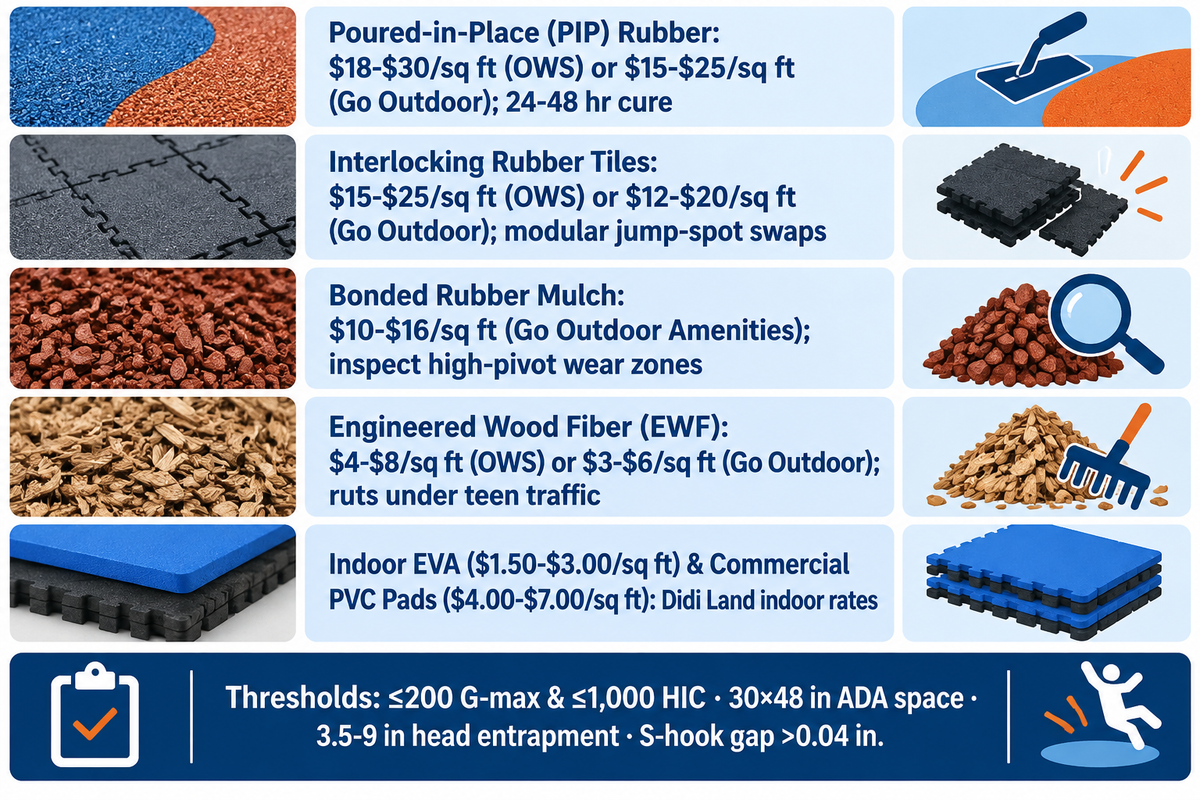
Teenager landing forces scatter loose wood chips quickly. Ground material choices carry equal weight in public procurement for year-round outdoor operation. Unitary poured-in-place (PIP) rubber ($18 to $30 per sq ft in Outdoor Workout Supply’s fitness guide) and interlocking rubber tiles ($15 to $25 per sq ft) hold firm under jump takeoffs. Under the updated 2025 CPSC handbook’s voluntary guidance, connected composite structures are evaluated as an integrated system for fall-height rules, while ASTM F1292 impact surfacing must protect each component’s specific fall height and required use zone.
Federal CPSC safety briefs note that over 190,000 emergency-room playground injuries occur annually nationwide. Playground Professionals’ CPSC handbook update brief clarifies critical height definitions, while Go Outdoor Amenities notes that all surfacing must meet ASTM F1292 impact-attenuation standards based on equipment fall height. Access Board field guidance reports maximum allowable standard thresholds of 200 G-max and 1,000 Head Injury Criterion (HIC). Strict hazard guidelines must be followed for partially bounded openings less than 24 inches.
Unitary rubber eliminates daily raking, yet field performance still requires scheduled inspection. In the U.S. Access Board’s longitudinal play-surface study of roughly 35 playground sites, PIP rubber needed the fewest maintenance instances. Even so, running-slope, cross-slope, level-change, or opening deficiencies began to emerge 24 to 36 months after installation across PIP, rubber tile, and hybrid surfaces. Under 2010 ADA Standards §1004.1 and §236.1, at least one machine per exercise type needs a 30-by-48-inch (§305) clear floor space for transfer or seated wheelchair use.
| Surface System | Published Unit Rate | Wheelchair & ADA Profile | Maintenance & Field Reality |
|---|---|---|---|
| Poured-in-Place (PIP) Rubber | $18–$30/sq ft (OWS fitness); $15–$25/sq ft (Go Outdoor) | Continuous firm route; 60 in width at ≥1,000 sq ft | 24–48 hr cure under suitable weather/system specs (Go Outdoor); defects can emerge at 24–36 mo |
| Interlocking Rubber Tiles | $15–$25/sq ft (OWS); $12–$20/sq ft (Go Outdoor) | Firm modular surface; needs tight seam tolerances | Modular tile swaps under jump spots; defects can appear at 24–36 mo |
| Bonded Rubber Mulch | $10–$16/sq ft (Go Outdoor Amenities) | Unitary bonded layer; verify slope transitions | Mid-tier upfront cost; inspect high-pivot landing wear zones |
| Engineered Wood Fiber (EWF) | $4–$8/sq ft (OWS fitness); $3–$6/sq ft (Go Outdoor) | Meets ASTM F1292 and ASTM F2075 fresh; ruts under teen traffic | Ready after raking; containment borders + replenish whenever landing depth thins |
| Indoor EVA / Commercial PVC Pads | $1.50–$3.00/sq ft (EVA); $4.00–$7.00/sq ft (PVC) | Dry indoor transitions; bevel entry edges | Didi Land reference rates; impact protection varies with foam core & testing |
Teenager weight and torque loads must be checked during routine hardware inspections. Oxmaint Maintenance notes any opening between 3.5 and 9 inches creates a head-entrapment zone. Swing S-hook gaps > 0.04 in require closing or replacement. Go Outdoor Amenities lists general EWF at $3 to $6 per sq ft with containment borders and annual top-offs. High-traffic landing zones require immediate replenishment of displaced fiber, especially when the safety depth is compromised. In Go Outdoor Amenities’ workflow, PIP rubber, at $15 to $25 per sq ft, cures in 24 to 48 hours over concrete, asphalt, or compacted stone, under suitable weather.
Commercial Teen Playground Budgets, Footprint Sizing, and Worked Cost Example
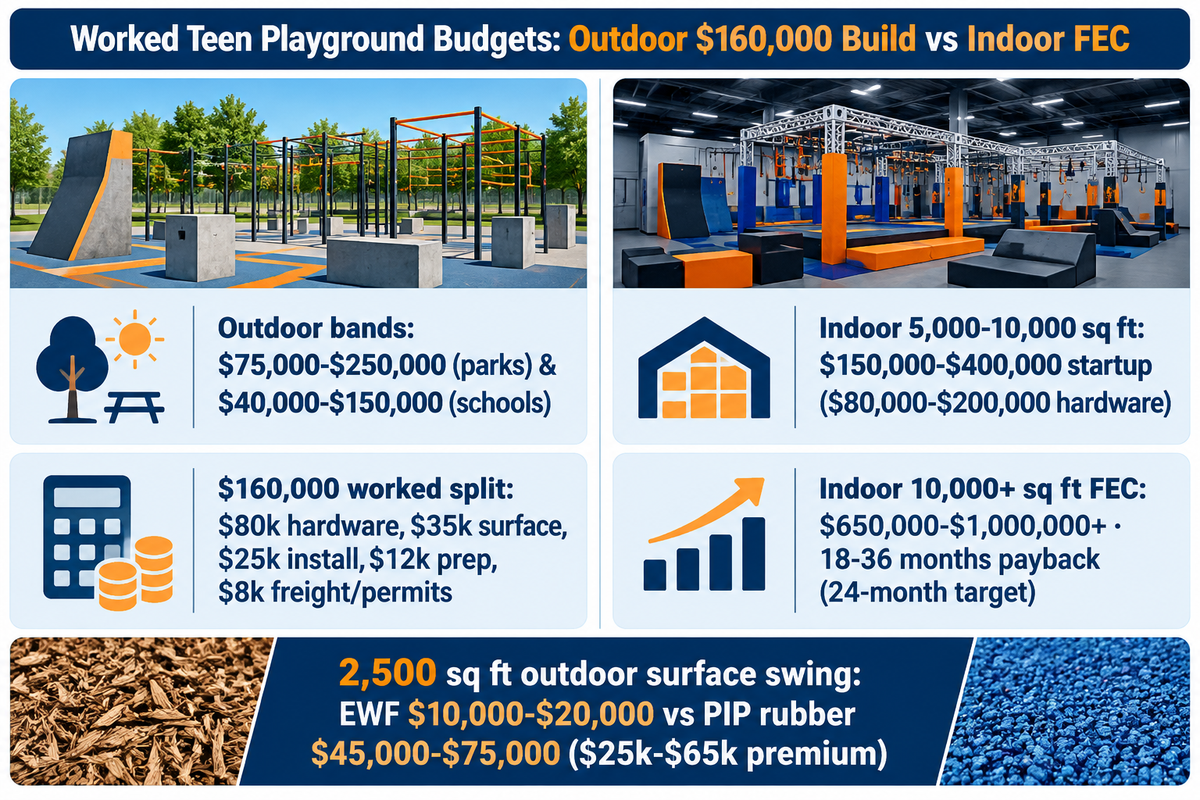
Outdoor Workout Supply’s U.S. cost guide places public outdoor fitness budgets at $75,000 to $250,000 for park departments and $40,000 to $150,000 for schools. Those estimates do not include major earthwork, lighting and/or restrooms. Safety surfacing choices over compacted stone or concrete slabs drive a substantial share of total capital. Didi Land’s 2026 startup guide places 5,000-to-10,000-square-foot indoor venues at $150,000 to $400,000 in startup capital, including $80,000 to $200,000 for play equipment. That budget excludes the building shell, fire-sprinkler upgrades, 3-to-6-month lease deposits, and $3,000 to $7,000 in lease legal review.
Treat teen-zone budgets separately from park-wide municipal capital total expenditures. Recreation Management’s 2026 survey reports median park facility construction spending reached $2.58 million, up 33% from $1.94 million in 2025. That park-wide figure covers buildings, athletic fields, lighting, and utilities across entire properties. Within a standalone youth zone, play or fitness hardware accounts for 30% to 50% of project spend, while surfacing, site prep, freight, and installation make up the remainder.
How Much Does It Cost to Build a Commercial Teen Playground?
A medium 12-station outdoor youth fitness build totals $160,000 in Outdoor Workout Supply’s worked benchmark (excluding major earthwork, park lighting, and restrooms). That total splits into $80,000 for equipment, $35,000 for surfacing, $25,000 for installation, $12,000 for site prep, and $8,000 for freight and permits. Commercial indoor builds of 5,000 to 10,000 sq ft run $150,000 to $400,000 before building-shell and sprinkler work, while 10,000+ sq ft family entertainment centers reach $650,000 to $1,000,000+.
Surfacing creates the widest upfront cost swing on a 2,500-square-foot outdoor safety footprint. At $4 to $8 per sq ft installed, EWF totals $10,000 to $20,000. At $18 to $30 per sq ft installed, PIP rubber totals $45,000 to $75,000. Across those quoted ranges, the PIP premium over EWF spans $25,000 to $65,000. PIP eliminates wood-fiber top-offs and supports continuous wheelchair travel when slopes, transitions, and seams meet accessibility standards. Indoor investors can model ticket, party, and membership payback in our indoor playground investment and return modeling.
| Budget Line / Metric | Outdoor 12-Station Youth Zone (U.S. Example) | Indoor Commercial Teen Zone (5,000–10,000 sq ft) |
|---|---|---|
| Typical Project / Startup Band | $75,000–$250,000 (parks); $40,000–$150,000 (schools) | $150,000–$400,000 startup ($650,000–$1,000,000+ at 10,000+ sq ft) |
| Core Play / Fitness Hardware | $80,000 (50% of $160,000 worked build) | $80,000–$200,000 (30–50% of total startup capital) |
| Safety Surfacing Allocation | $35,000 (22% of $160,000 worked build) | $1.50–$3.00/sq ft EVA or $4.00–$7.00/sq ft PVC-covered padding |
| Worked 2,500 sq ft Surface Math | $10,000–$20,000 (EWF $4–$8) vs $45,000–$75,000 (PIP $18–$30) | $3,750–$7,500 (EVA) vs $10,000–$17,500 (PVC-covered) |
| Shipping & Certified Installation | $25,000 install (15.6%) + $8,000 freight/permits (5.0% of $160,000 build) | 15–25% of equipment cost (40-ft ocean containers) |
| Site Prep / Building HVAC | $12,000 grading and sub-base drainage (7.5% of $160,000 build) | $10,000–$50,000 for commercial HVAC capacity upgrades |
| On-Site Installation Schedule | 1–3 weeks (small/medium); 4–8 weeks (large/multi-site) | 30–45 days modular order; custom starts after slab, sprinklers & shipping |
| 10-Year Upkeep / Payback | Routine hardware upkeep at 1–2% of equipment cost/yr ($8,000–$16,000 on $80,000 over 10 years) + $5,000–$15,000 vandalism; surfacing & contingency extra | Didi Land guide cites 18–36 months payback (24-month target) from net cash flow |
| Excluded Site Expenses | Major earthwork, lighting, restrooms ($2.58 million median park capex) | Building shell, sprinklers, 3–6 month rent deposit, $3,000–$7,000 legal |
Specifying Custom Teen Play Equipment: The Supplier RFQ Handoff
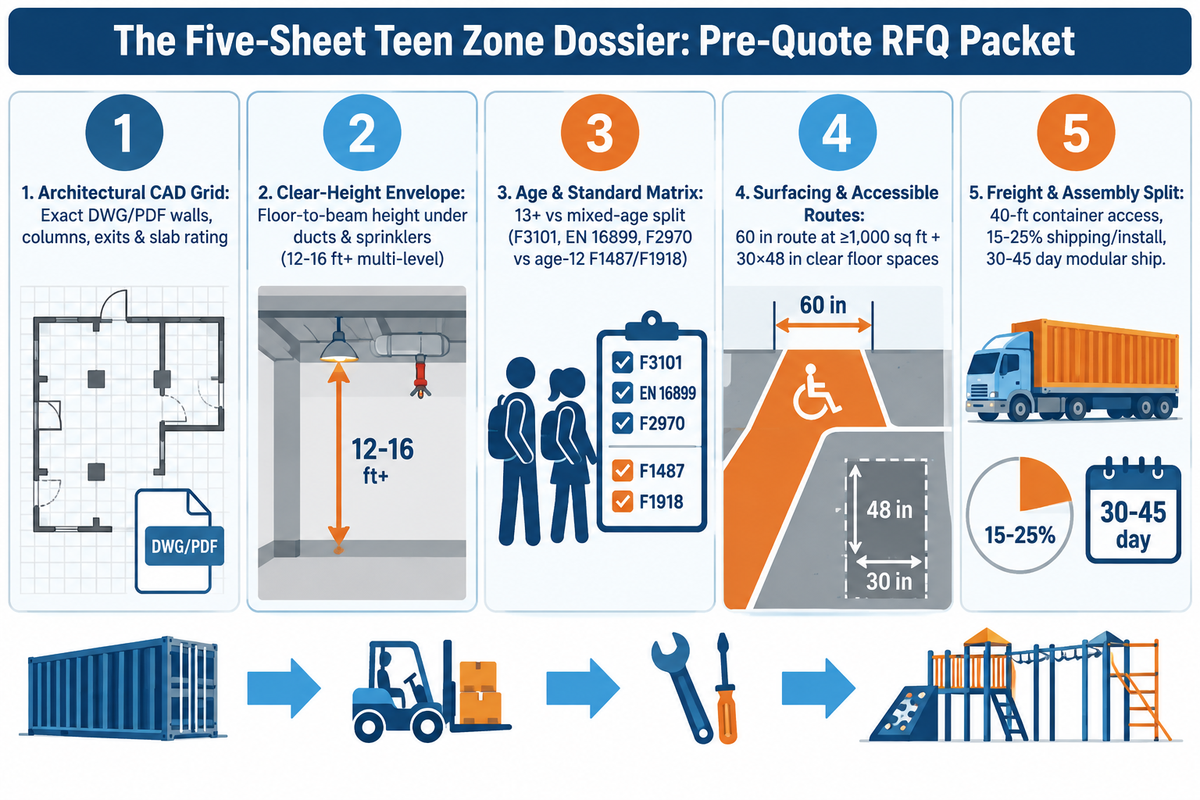
Procurement breaks into two distinct channels of suppliers. Public parks typically analyze standardized outdoor parkour, rope and workout packages from commercial vendors like Playworld, Playground Centre, and Outdoor Workout Supply. Malls and entertainment centers commission site-specific steel-frame adventure zones from custom indoor manufacturers like Didi Land and Soft Play. Sending in five technical sheets up front prevents incompatible quotes and costly structural redesigns.
Outdoor Workout Supply notes that small to medium outdoor fitness installations take 1 to 3 weeks once materials arrive under normal site conditions. Larger or multi-site projects take 4 to 8 weeks. Under BS EN 16899:2016 (summarized in standards catalog iTeh), parkour movement is personally determined by users through controlled physical exertion across permanently installed and portable structures. On the indoor side, Didi Land notes that standard modular soft-play orders ship in 30 to 45 days. Custom multi-level steel structures ship in 40-foot ocean containers. Comparing children’s commercial structures certified to ASTM F1487-25 (superseding F1487-21 in 2025 for ages 2 to 12), EN 1176, or AS 4685.1 against uncertified soft play, Didi Land’s guide cites a 15% to 25% higher upfront equipment cost. That children’s soft-play comparison does not set a uniform rate across 13+ teen standards such as ASTM F3101-21a, BS EN 16899:2016, or ASTM F2970-25. Certification documents identify the assessed equipment and standard. Weld logs, load calculations, flame-test sheets, and spare fasteners are included when specified by contract.
Compile The Five-Sheet Teen Zone Dossier below before requesting 3D proposals. Custom multi-tier ninja trusses, aerial rope towers, and container freight are priced directly from your architectural CAD column grids, clear heights, and your target standards mix.
| Dossier Sheet | Required Technical Input | Why Factories Need It Before Quoting |
|---|---|---|
| 1. Architectural CAD Grid | Exact DWG/PDF walls, columns, exits, slab rating | Keeps steel uprights clear of columns and fire doors |
| 2. Clear-Height Envelope | Floor-to-beam height under ducts, sprinklers, lights (12–16 ft+ multi-level) | Sets deck tiers, ninja truss height, and slide drops |
| 3. Age & Standard Matrix | 13+ vs mixed-age split (F3101, EN 16899, F2970) | Stops age-12 F1487/F1918 templates on teen zones |
| 4. Surfacing & Accessible Routes | Surface type, applicable route width (60 in at ≥1,000 sq ft), and 30×48 in clear floor spaces at exercise equipment | Defines accessible circulation, impact surfacing, and drainage requirements |
| 5. Freight & Assembly Split | 40-ft container access, local crew, spare-part kit | Separates ex-works hardware from 15–25% shipping and install cost |
Operators wishing to open an indoor ninja or climbing/mixed-age youth venue are encouraged to make use of our custom 3D playground design and factory engineering workflow to submit CAD drawings and clear height for engineering layout.
Frequently Asked Questions
Q: Do they make playgrounds for adults and older teens?
Yes, commercial manufacturers build dedicated parkour blocks, calisthenics rigs, steel-core rope climbers, and multi-lane ninja obstacle courses engineered for older kids and adults.
Instead of scaling up toddler slides, teen and adult zones apply apparatus-specific standards. Common examples include ASTM F3101-21a for unsupervised outdoor fitness rigs, BS EN 16899:2016 for parkour elements, and ASTM F2970-25 for commercial trampoline courts.
Q: Are 13-year-olds allowed on public playgrounds?
Yes, if local park rules and posted municipal signs permit them; no U.S. federal law bans 13-year-olds or older teenagers from entering public playgrounds.
ASTM F1487-25 (which superseded F1487-21 in 2025) sizes conventional public playground equipment only up to that pre-teen childhood age ceiling. Many cities post age-2-to-12 signs on child playsets while adding adjacent 13+ fitness rigs, BS EN 15312:2026 courts, and shaded hangout seating.
Q: What safety surfacing works best for a teen parkour or fitness area?
Poured-in-place rubber ($18 to $30 per sq ft in Outdoor Workout Supply’s fitness guide) paired with modular rubber tiles ($15 to $25 per sq ft) resists displacement under teen jump takeoffs better than loose fill.
Engineered wood fiber costs less upfront ($4 to $8 per sq ft) yet scatters under heavy sprinting and needs prompt replenishment whenever landing zones thin out. Surfacing must carry an ASTM F1292 critical fall height rating meeting each component’s fall height across its use zone, even when composite structures are evaluated together.
Q: What ceiling height does an indoor teen zone need?
Multi-level commercial indoor play structures require a clear overhead span of at least 12 to 16 feet below HVAC ducts, structural beams, and fire sprinklers, according to Didi Land’s indoor layout guide.
Two-tier ninja trusses, warped walls, drop slides, and ASTM F2970-25 trampoline courts demand taller clearance envelopes above top platforms and bounce beds. Operators verify slab-to-obstruction height before signing a commercial lease.
Q: How do public parks reduce vandalism in unsupervised youth spaces?
Open street sightlines, warm perimeter lighting, hot-dip galvanized steel posts, steel-core climbing ropes, and tamper-resistant fasteners deter damage in unstaffed public youth zones.
Providing dedicated shaded hangout seating and sociable basket swings also builds teen ownership over the space. Budgeting an annual inspection and minor hardware reserve of 1% to 2% of equipment value keeps loose bolts and worn grips from escalating.
Q: Can one park safely accommodate both toddlers and teenagers?
Yes, parks accommodate both age groups by separating ages 2 to 5, ages 5 to 12, and ages 13 and older into distinct, buffered activity zones.
Shaded benches, 60-inch accessible paths (required in play areas of 1,000 sq ft or larger), and planted buffers help separate teen circulation and multi-sport ball play from toddler swing routes and reduce conflicts between users.
References & Sources
- ASTM F1487-21: Public Playground Equipment Standard American National Standards Institute (ANSI)
- 2026 State of the Industry: Parks & Recreation Trends Recreation Management
- Park Use Preferences and Physical Activity Among Ethnic Minority Children and Teenagers in Low-Income Communities in New York City (PMC6814698) National Library of Medicine / National Institutes of Health (NIH)
- ASTM F3101-21a: Standard Specification for Unsupervised Public Use Outdoor Fitness Equipment ASTM International
- ASTM F1918-21: Standard Safety Performance Specification for Soft Contained Play Equipment ASTM International
- Public Playground Safety Handbook (Publication 325) U.S. Consumer Product Safety Commission (CPSC)
- Work Item WK98041: Maximum Slope Clarification in ASTM F1487-25 ASTM International Subcommittee F15.29
- BS EN 16899:2016 Parkour Equipment Safety Requirements and Test Methods British Standards Institution (BSI)
- Patent AU2025200871B2: Modular Play Structure Google Patents (Assignee: Systems IP Pty Ltd)
- Older Kids Need Play, Too: 7 Ways Ninja Courses Help Teens Recreation Management
- What Do Teenage Girls Like and Dislike About Park Play Spaces and MUGAs White Rose Research Online (University of Leeds)
- Where Do Girls Disappear? Public Spaces for Teenage Girls and Young Women Architektura & Biznes
- Creating Welcoming Parks for Teenage Girls Green Flag Award
- BS EN 15312:2007+A1:2010 / BS EN 15312:2026 Free-Access Multi-Sports Equipment Safety Requirements British Standards Institution (BSI)
- International Playground Safety Standards Overview (ISO 24665 & TR 24666) Playground Professionals
- What Just Changed: July 2025 CPSC Playground Safety Updates Playground Professionals
- Guide to the ADA Accessibility Standards: Ground Surfaces in Play Areas U.S. Access Board
- 2010 ADA Standards Chapter 10: Recreation Facilities (§1004 Exercise Machines and Equipment) U.S. Access Board
Editorial & Engineering Note: Published scope clauses from ASTM International, the U.S. CPSC, the U.S. Access Board, and BSI are paired here with peer-reviewed park observation studies and 2026 U.S./commercial budget data. Project teams pair these specifications with Certified Playground Safety Inspector (CPSI) field sign-off and local fire and building approvals. Reviewed by the Didi Land technical team.