Get in Touch with Didi Land


Adult playgrounds are recreational facilities and large scale play structures designed for adult body size and group interaction. Contemporary operators build them four ways: competitive socializing bars, indoor obstacle courses, 21+ evening family centers and outdoor fitness centers. Standard United States children’s playground specifications stop at age 12. Venues serving adults require custom structural engineering and design, wider clearances and strict floor zoning.
Adult playgrounds combine oversized physical games, modular climbing courses, giant dry slides, and social lounges tailored for grownups. ASTM F1487-25 and ASTM F1918-21 cover ages 2 through 12 only. Adult play venues therefore need custom load calculations, taller deck clearances, and separated beverage zones.
Key planning essentials for visitors and venue operators
- Four active venue formats span social game bars, indoor slide and ninja parks, hybrid evening centers, and outdoor fitness parks.
- United States public and soft-contained play standards stop at age 12, so adult structures need project-specific structural calculations.
- Full indoor playground startups span $75,000 to $1 million or more as reported by WellnessLiving across floor area and custom framing.
- Secure personal-item storage and separated drink zones reduce loose-item and spill hazards. Bumblebee Play Cafe requires adults and children to wear socks in its play area. Digital waivers record participants’ acknowledgment of risks.
What Are Adult Playgrounds and What Indoor Play Places Exist for Grown-Ups?
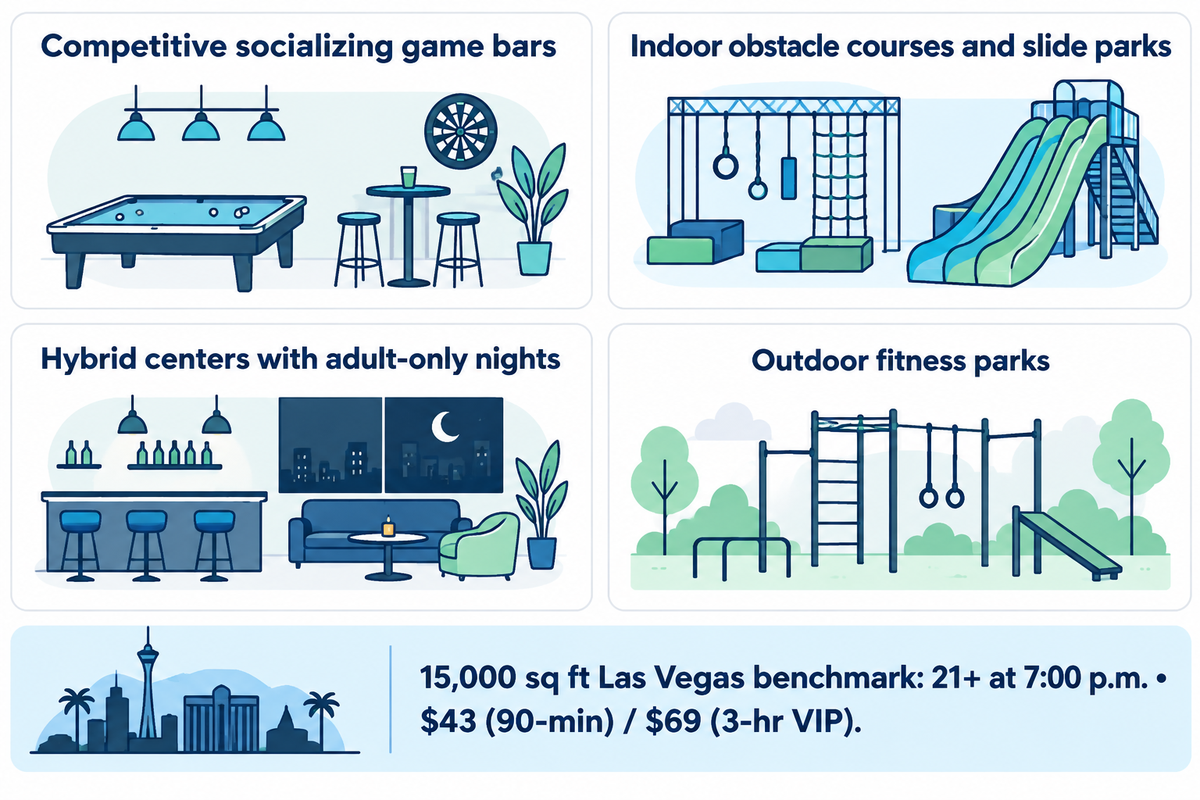
Adult playgrounds are entertainment spaces built around adult height, weight, and social play rather than child supervision. There are four options for visitors. Competitive socializing game bars run by operators are popular. Other options include indoor obstacle courses and slide parks, hybrid centers with adult-only nights, and outdoor fitness parks.
Grownups looking to wake up their inner child no longer have to squeeze into toddler-sized plastic tubes. Across popular locations in the United States, hospitality brands pair physical play with group socializing. Guests can laugh, climb, and move like a kid again. On the Las Vegas Strip, Play Playground’s 15,000-square-foot venue runs oversized physical games without virtual reality headsets. Daytime hours include family-friendly weekend brunch, while entry shifts to 21 and over at 7:00 p.m. Published Las Vegas ticketing starts at $43 for an approximately 90-minute Play Pass and $69 for a 3-hour VIP pass.
Industry trade reporting is tracking steady growth in adult-centered active venues. A Funworld report on adult-centered Entertainment Centers shows that competitive socializing blends sports challenges and lounge hospitality. Corporate teams and friend groups, especially, appreciate the opportunity to gather and socialize. A neighborhood arcade bar usually has only upright video cabinets. Physical adult venues feature guests climbing through mazes, sliding down dry slides, or navigating through obstacle courses.
Comparing Local Adult Fun Formats by Location and Floor Footprint
Local markets support different spatial formats based on climate, ceiling height and evening foot traffic. The 2.7-acre Lawn On D event space in Boston runs an outdoor seasonal format. It features illuminated solar powered hoop swings and lawn games. It draws large crowds during the warm months. Mountain resort towns take a different outdoor approach. Steep summer slopes become an adventure paradise with 3,000-foot alpine slides and 100-foot-tall zip lines.
Indoor venues are engineered to account for ceiling clearances, column grids, and floor slab connections, whereas outdoor alpine slides and zip lines are engineered to account for terrain foundations, cable anchors, and wind or snow loads. U.S. Consumer Product Safety Commission guidance on public playground equipment states that voluntary standards for public playground equipment address children’s play areas. Schools, parks, restaurants, and child care are all encompassed in that children’s play scope. Scaling indoor climbing decks, crawl tunnels and slides for full grown adults moves a project into custom commercial structural design. Offering high capacity attractions provides something for everyone across daytime teens and adult groups in the evenings.
7 High-Throughput Attractions for an Adult Indoor Playground
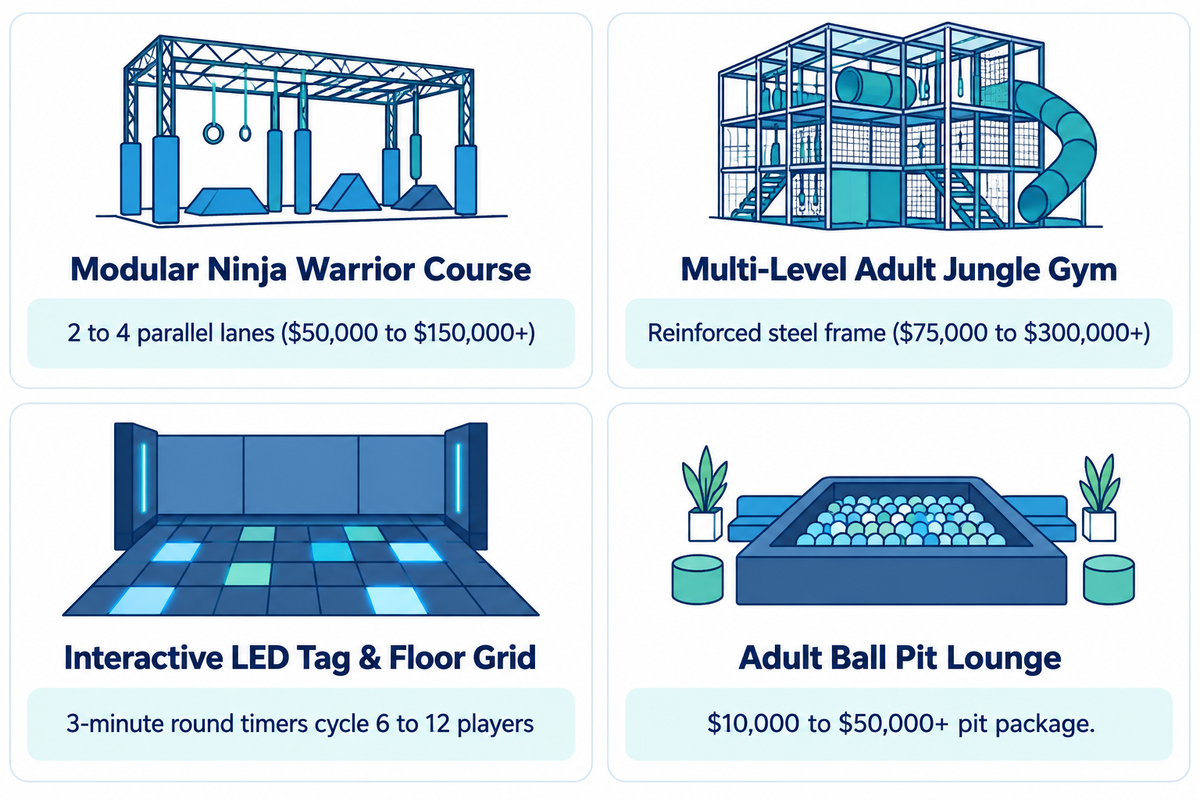
Seven indoor attraction formats anchor an adult indoor playground, with guest flow shaped by layout and lane dispatch. Operators can combine modular ninja courses, giant dry slides, and multi-level adult jungle gyms and interactive LED tag arenas. Other options include indoor high ropes courses and air or trampoline courts, as well as adult ball pit lounges. The seven-attraction lineup completes an adult indoor adventure park offering.
Key considerations for adults include physical activity levels and fast lane reset frequency. There are repeated complaints in reviews on Reddit about broken mechanical games and slow single player queues that quickly ruin a 90 minute window. High throughput floors use multiple lanes with quick reset digital stations so that 100 or more guests stay actively participating.
| Indoor Attraction | Primary Format Category | Typical Scale or Sourced Benchmark | Guest Flow & Operational Rule |
|---|---|---|---|
| 1. Modular Ninja Warrior Course | Timed indoor obstacle rig | 2 to 4 parallel lanes; $50,000 to $150,000+ reported by WellnessLiving | Hold next runner until preceding climber clears shared obstacle and landing mat |
| 2. Giant Dry Launch & Spiral Slides | Gravity slide attraction | Multi-story indoor decks with extended runout chutes | Single-rider dispatch; staff monitors top entry and bottom exit |
| 3. Multi-Level Adult Jungle Gym | Soft-contained climbing maze | Reinforced steel frame; $75,000 to $300,000+ reported by WellnessLiving | Expanded headroom and wide crawl passages for adult shoulders |
| 4. Interactive LED Tag & Floor Grid | Gamified digital-physical arena | Compact modular room with RFID scoreboards | Automated 3-minute round timers cycle groups of 6 to 12 players |
| 5. Indoor High Ropes & Zip Course | Belayed overhead adventure | 23-foot to 34-foot vertical climbing clearance | Full-body belay belt check and dedicated staff supervision |
| 6. Commercial Trampoline & Air Court | Rebound sportainment zone | Multi-bed court with 16-foot jump tower option | Operator grip-sock and single-jumper rules; court beds follow ASTM F2970-25 |
| 7. Adult Ball Pit Lounge | Social photo & immersion zone | $10,000 to $50,000+ pit package reported by WellnessLiving | Empty pockets, locked phones, and zero glass or drinks inside pit |
Pairing commercial soft play sets with steel-framed obstacle lanes serves athletic climbers and casual social groups together. Deep immersion zones built with commercial ball pit equipment also draw group photos when backed by automated ball washers. Companion social zones often add a 9-hole indoor mini golf course and compact bumper cars next to main climbing decks. Outdoor municipal parks take a separate approach, pairing 500-pound-rated swings (reported by Playground Professionals) with ASTM F3101 workout trail stations. Indoors, soft punch and kick target walls absorb overflow crowds and create a lot of fun between heavy climbing rounds.
Which adult playground attractions generate the highest repeat visits?
Timed ninja obstacle courses, interactive LED floor games, and multi-hole mini golf or arcade games support repeat group visits by giving players measurable scores to beat. Digital RFID scoreboards and changeable obstacle routes encourage local leagues to return regularly. Static photo props usually draw one-time tourist visits instead.
Gravity slides also need adult braking geometry rather than scaled-up toddler chutes. A peer-reviewed pediatric study of 12,686 slide injuries examined tibia fractures in children aged 5 and under when riding on an adult’s lap. Combined rider mass increased friction when a child’s foot caught the slide wall. An official CPSC warning on adult and teenage slide hazards likewise documented severe neck injuries from abrupt stopping on short child slides. Mixed-age venues therefore ban lap sliding, and adult dry slides require extended deceleration chutes verified by the manufacturer.
Example: Imagine a 1,500 square foot zone with a two-lane obstacle course and a pair of stainless steel dry slides. If we assume that on average one adult clears each obstacle lane every 90 seconds we get 80 obstacle runs per hour. If we assume that on average one rider clears each chute every 45 seconds we get 160 slide runs per hour. Assuming four combined runs per guest, that layout cycles 50 to 60 adults per hour. To manage this level of guest traffic safely requires that the framing for the elements be engineered for adult dynamic loads.
Structural Safety Rules and Load Engineering for Adult Playgrounds
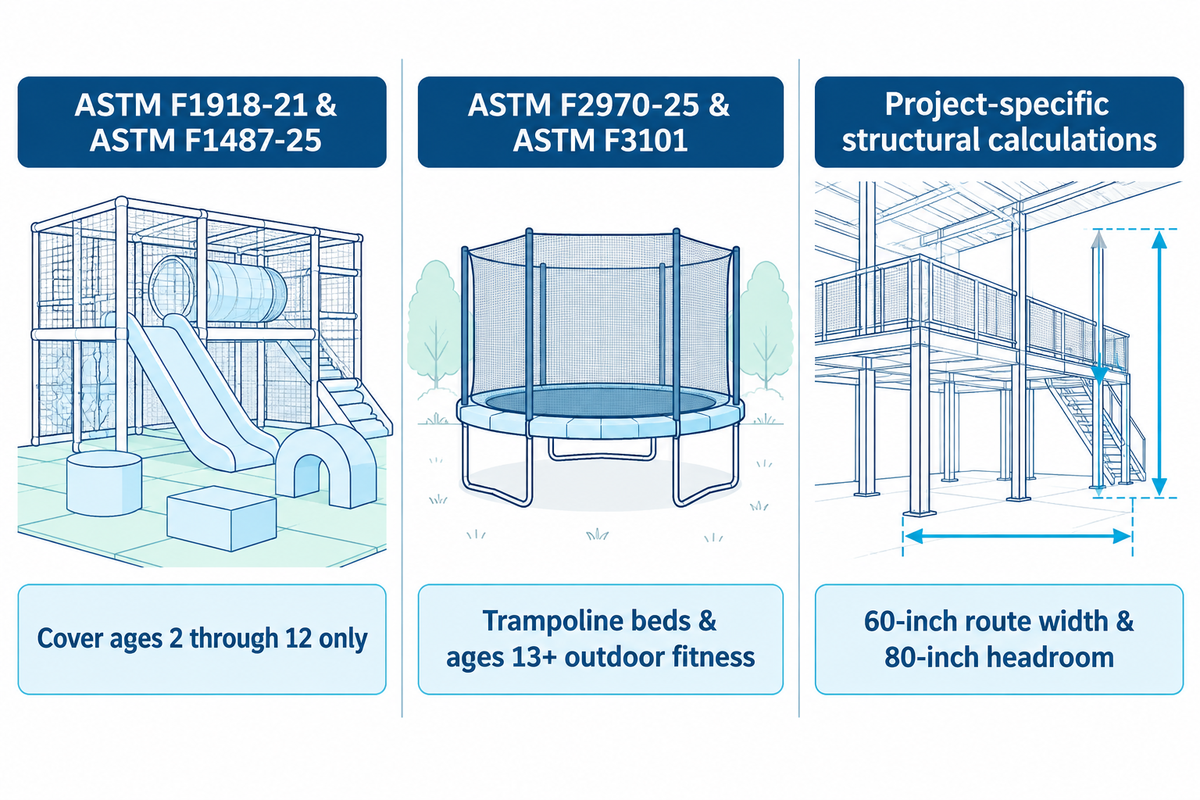
An adult playground demands custom structural load calculations because standard United States children’s playground specifications stop at age 12. Manufacturers employ upgraded wall thicknesses of galvanized steel pipe, increase crawl clearances for adult shoulders, and use multi-density impact foam. Local commercial building codes govern the final structural sign-off.
High hourly guest flow places continuous dynamic stress on elevated decks, joints, and anchors. Buyers sometimes assume that a children’s indoor play certificate covers grownup private events. In fact, no single federal law or universal ASTM standard covers indoor adult soft-play structures. The SGS technical bulletin on the June 2025 ASTM F1487-25 revision confirms a 2-through-12 age scope. That specification spans from the 5th percentile 2-year-old to the 95th percentile 12-year-old. Soft-contained play systems and fitness rigs for ages 13 and older sit outside F1487-25.
What weight limit and ASTM standards apply to adult playground equipment?
Custom indoor adult playground equipment doesn’t have a universal federal weight cap. Stamped manufacturer’s engineering calculations determine project-specific per-user and platform live-load limits in accordance with local building codes. ASTM F1918-21 and ASTM F1487-25 cover ages 2 through 12 only, ASTM F2970-25 covers commercial trampoline beds, and ASTM F3101 covers outdoor fitness equipment for ages 13-plus.
Many individual hardware components are able to sustain high static loads; however, child clearances still can injure adults. Trade reporting from Playground Professionals on age and weight restrictions noted that in the commercial swing industry, each swing is rated conservatively at 500 pounds. Age labels reflect the intended user’s body size, physical ability, development and play behavior. Hence, high static load capacity alone doesn’t qualify a child product as appropriate for adults. Even children’s modular frame designs, such as the assembly in patent AU2025200871B2 for elevated playground platforms, spread load across upright poles and horizontal crossbars around a flexible platform, whereas adult commercial structures require heavy-gauge steel framing.
The Adult Play Venue Load & Revenue Matrix
Looking at child-rated equipment and systems engineered for adults shows why child-sized clearances and light foam padding fail in accommodating adult body dimensions and dynamic impact loads.
| Engineering or Operating Parameter | Children’s Soft Play (Ages 2 to 12) | Adult / 21+ Hybrid Venue | Design Decision Changed |
|---|---|---|---|
| 1. Primary ASTM Safety Standard | ASTM F1918-21 (indoor) & ASTM F1487-25 (public) | No single adult soft-play ASTM; F2970-25 for trampoline beds & F3101 for 13+ outdoor fitness | Require project-specific structural calculations & local building code sign-off |
| 2. Product & Fire Safety Scope | CPSC notes possible 16 C.F.R. Part 1250 toy-rule coverage for qualifying toy attachments | Building occupancy and fire-safety codes apply to both children’s and adult venues | Verify flame-retardant PVC covering test reports and powder-coat paint durability separately |
| 3. ADA Accessibility Scope | Children’s play areas: accessible routes serve at least 50% of elevated play components per U.S. Access Board Chapter 10 | Dedicated adult venues: general ADA Title III accessible routes apply, plus Section 236.1 for exercise machines | In covered children’s play areas, plan ground routes for 60-inch width (subject to exceptions) and 80-inch headroom |
| 4. Elevated Framing & Connections | User scope covers 5th percentile 2-year-old to 95th percentile 12-year-old | Heavy-gauge galvanized uprights & reinforced peripheral deck beams | Specify custom span, connection, and dynamic load ratings for simultaneous adult users |
| 5. Passage & Crawl Clearances | Compact crawl tubes sized for child body dimensions | Expanded walk-through passages & emergency staff extraction access | Eliminate tight crawl bottlenecks where grownups can twist knees or stall |
| 6. Slide Chute & Runout Design | Short stopping zones calibrated for child mass | Extended deceleration chutes & strict single-rider spacing | Prevent foot catching and abrupt stopping impacts at slide exits |
| 7. Impact Padding & Surfacing | Surfacing calibrated for child fall heights and weights | Engineered impact padding verified for adult drop heights and compression | Request impact-attenuation test data rather than relying on foam thickness alone |
| 8. Primary Ticket Window | Open-play admission ($15 visit example reported by WellnessLiving) | Timed session passes ($43 for ~90 min or $69 for 3-hr VIP at Play Playground Las Vegas) | Shift from unpaced open entry to capacity-controlled session blocks |
| 9. Peak Utilization & Spend Mix | Weekend daytime & children’s birthday packages | Thursday through Sunday evening groups, corporate events, and bar lounges | Add evening sound zoning and separated food and drink seating |
Choosing the right padding density and thickness of cushioning materials is just as important as the choice of steel pipe thickness. Low-density sponge mats compress over time with continual use of adult heels. Specifying custom foam play modules with dense impact cushioning and outer durable vinyl covers protects landing zones. Clear engineering specs then assist investors in understanding the equipment cost and correlating it to the right business model.
Adult Indoor Playground vs. Family Entertainment Center and Trampoline Park
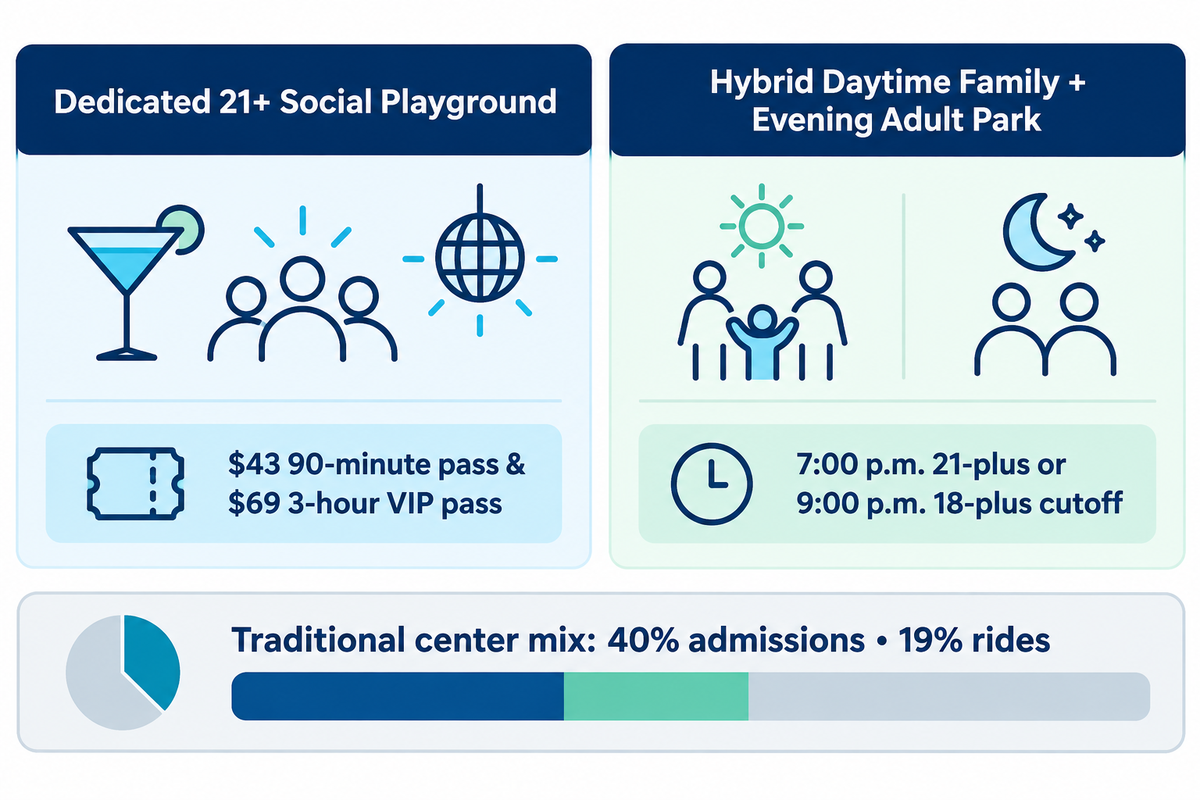
At dedicated adult social playgrounds, timed passes (e.g. Play Playground Las Vegas’s $43 90-minute pass and $69 3-hour VIP pass) are offered with craft drinks and corporate buyouts. Family entertainment centers and trampoline parks attract daytime weekday youth traffic. Hybrid venues like Play Playground Las Vegas offer daytime family brunch then switch to 21+ at 7:00 p.m.
Adding reinforced steel framing and impact surfacing bumps up first costs. Operators are choosing a schedule that maximizes the monetization of leased square footage across the week. For investors, a dedicated 21+ social playground is compared to a hybrid family center or trampoline park. While benchmarking industry competitors, no published reports show side-by-side total revenue for the three formats.
Dedicated 21+ Social Playground
- Evening ticket tiers (such as $43 to $69 passes reported by Play Playground Las Vegas) pair with signature cocktail and beer sales.
- Corporate party and private event space bookings concentrate on Thursday and Friday nights.
- Lower weekday daytime traffic outside busy tourist entertainment districts.
Hybrid Daytime Family + Evening Adult Park
- Daytime family tickets and weekend brunch traffic help contribute toward base rent and morning payroll.
- Scheduled evening cutoffs (such as 7:00 p.m. 21-plus at Play Playground Las Vegas or 9:00 p.m. 18-plus at Topgolf Glasgow) open the floor to grownup groups.
- Daytime children’s play areas trigger ADA Section 240.1 accessibility and child sanitation standards.
Revenue mix varies substantially by format. A secondary industry summary from VenueSumo citing family entertainment benchmark figures reports that admissions generate roughly 40 percent of traditional family-center revenue, with rides and attractions contributing another 19 percent. Adult social venues aim to expand food and beverage share by pairing active games with a lively restaurant lounge. Perimeter game lounges frequently add classic arcade games, pinball machines, and a golf simulator for casual groups. A live DJ sets an energetic weekend atmosphere for groups lingering after a 90-minute play session. Guests order pizza, grill platters, delicious snack boards, and full dinner menus alongside group passes.
Accessibility requirements depend on facility use, equipment type, and whether children’s play areas are present. Under the U.S. Access Board guide to ADA Chapter 10 Play Areas, Section 240.1 applies to play areas designed and constructed for children ages 2 and up, subject to stated exceptions such as amusement attractions. At least 50 percent of elevated play components must sit on an accessible route in covered children’s play areas. A dedicated 21-plus venue without children’s play areas follows general ADA Title III public accommodation route rules instead, while exercise machines follow Section 236.1. Investors comparing operating models can read our adult indoor playground business guide alongside the selection matrix below.
4-Stage Adult Playground Venue & Equipment Selection Matrix
| Selection Stage | Social Bar-Playground | Ninja & Slide Action Park | Hybrid Family + Adult Night Center |
|---|---|---|---|
| Stage 1: Target Location & Menu | Urban nightlife district; full cocktail, beer & dinner menu | Suburban retail box; hydration & quick cafe snack counter | Suburban lifestyle center; family pizza cafe plus evening bar service |
| Stage 2: Structural & ADA Scope | Custom adult structural calcs + general ADA Title III routes | ASTM F2970-25 trampoline beds + custom ninja/slide engineering | Dual compliance: child ASTM/ADA Section 240.1 + adult load framing |
| Stage 3: Core Attraction Mix | Oversized group games, LED floor tag, mini golf & ball pit | Multi-lane ninja rig, giant dry slides, high ropes & air court | Reinforced multi-level jungle gym, twin slides & interactive arcade |
| Stage 4: Staffing & Risk Control | ID check at door, locker check, and bar-zone separation | Belay/lane marshals, grip socks, and clear-lane dispatch | Scheduled evening transition sweep, sanitation reset, and wristband age gating |
Clear floor rules are necessary for every commercial format that targets the grown up active audience, and especially necessary when drinks are sold in the evenings.
Guest Safety Rules, Waiver Protocols, and Alcohol Service Controls
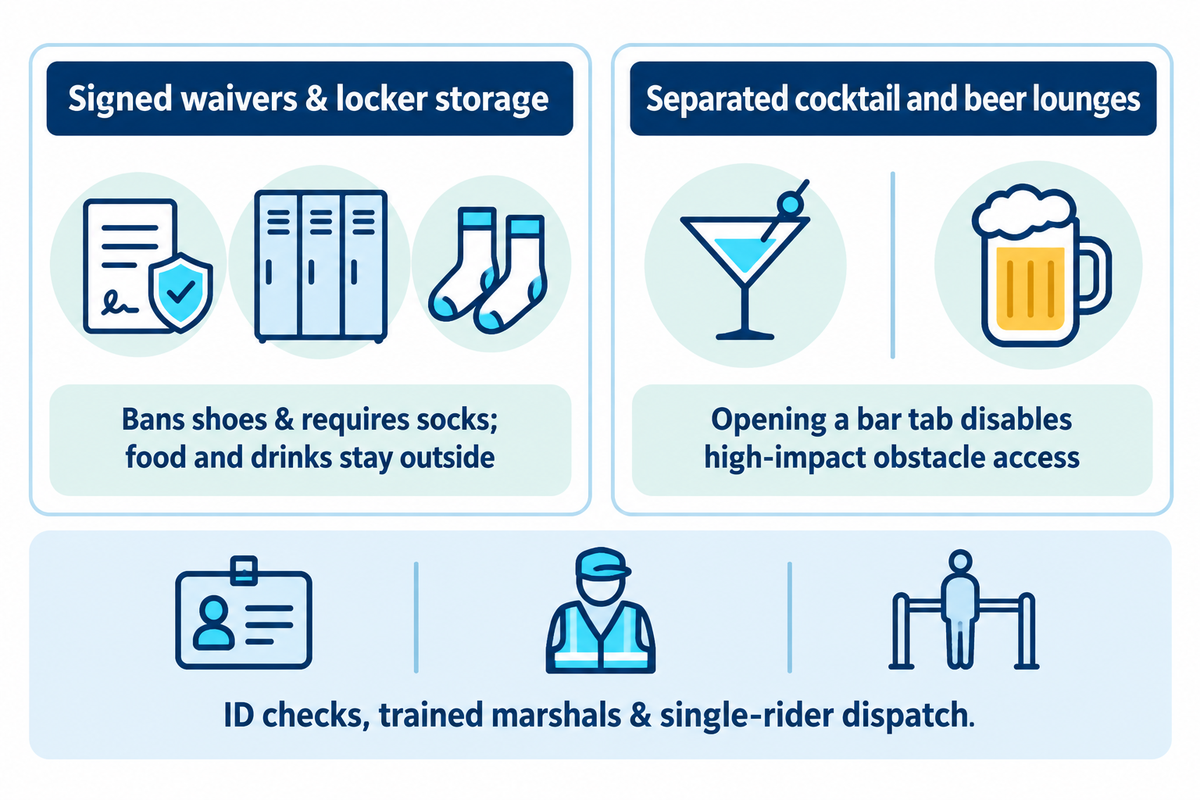
Operators at commercial adult playgrounds integrate signed waivers into their risk acknowledgment and floor policy enforcement. Staff enforce locker policy, sock policy, lane marshaling, pre-opening inspections, and single-rider dispatch.
Competitive adults create fall and collision risks by sprinting through mazes of upper levels. Baseline defense involves structured hardware and surfacing checks. U.S. Consumer Product Safety Commission playground safety guidance directs operators to safety checklists, covering containment netting, floor surfacing, and walkways.
“Check the safety netting for tears or frays.”
Entry screening reduces loose-object drops and surface contamination before guests climb. Signed waivers document participant assumption of risk rather than preventing physical injury on their own. Individual operators pair waivers with footwear and pocket rules: for example, BumbleBee Play Cafe’s commercial liability waiver bans shoes and requires socks for all adults and children in the play area, while food and drinks stay outside. Immersive climbing venues profiled by IAAPA Funworld, such as the Doloris art maze, require locker storage so phones and watches can’t drop from upper bridges. Routine maintenance guidance in CPSC’s public playground safety checklists and an industry post-mortem on indoor playground failures warns that weak maintenance planning, worn surfacing, and poor floor visibility undermine long-term safety.
How do adult playgrounds manage alcohol service and physical obstacle zones?
Adult playgrounds are designed to manage alcohol risks by locating craft cocktails and beer lounges outside climbing structures and play mats. In a system which integrates bar tabs with access permissions for high impact obstacles, opening a bar tab would disable that guest’s access to the high impact zone.
ID checks, trained marshals, and immediate removal of visibly impaired guests are mandatory safety controls. RFID drink lockout wristbands are optional tools offered by bar software. Arcade cabinets and fenced games (like a quick basketball game of horse in a netted bay) remain separated from dining walkways and high-fall structures. High ropes, trampolines, and giant slides are behind staffed entry gates. Even with an optional bar software workflow that blocks re-entry after a purchase, marshals must monitor guest conduct because a bar tab never measures what a guest consumed prior to arriving at the establishment. Staffing marshals, lockers, and heavy-gauge structures shapes the total capital budget.
Commercial Adult Playground Equipment Costs and Budget Breakdown
Opening a commercial indoor playground costs between $75,000 and $1 million or more in total startup capital as reported by WellnessLiving. Published equipment ranges span $75,000 to $300,000-plus for multi-level commercial structures and $50,000 to $150,000-plus for ninja courses, before renovations, freight, permits, and working capital.
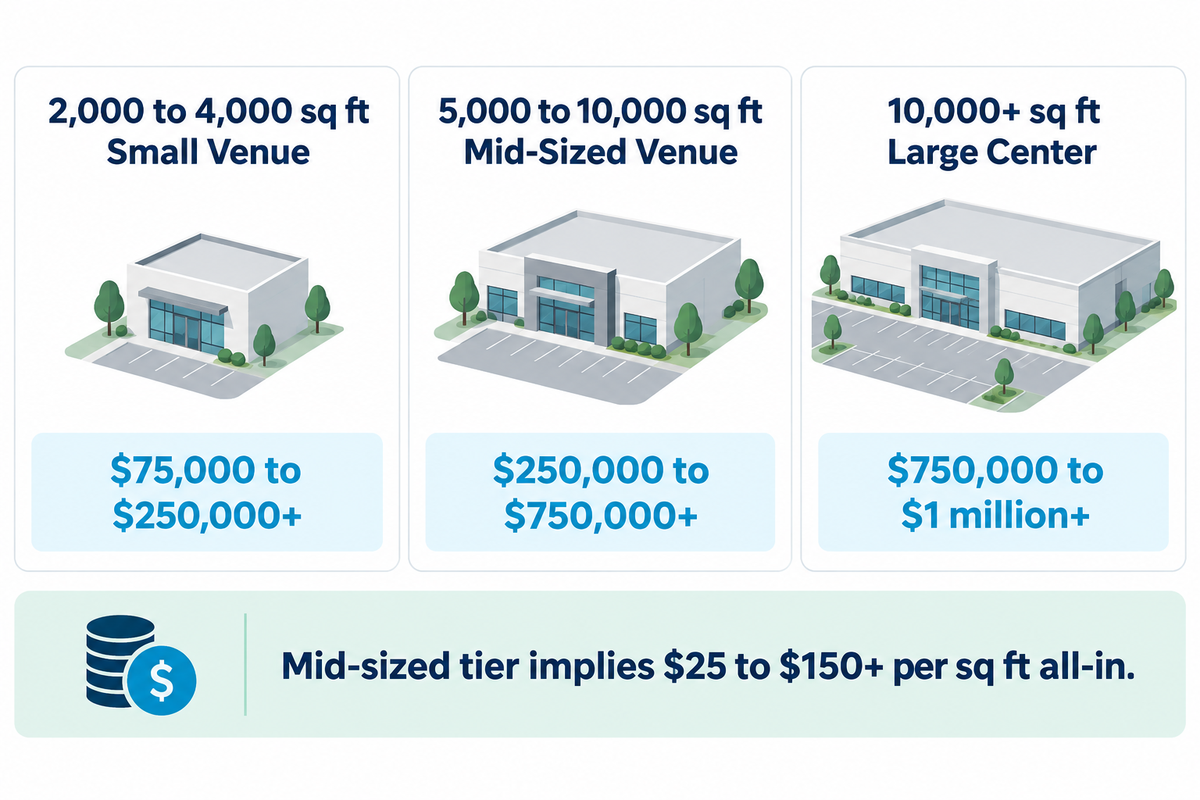
When searching for equipment online, commercial-grade indoor activity equipment is often listed with residential backyard swing sets. Home swing sets cost a fraction of a commercial steel-framed maze and are exempt from commercial occupancy rules. For commercial projects, WellnessLiving’s 2026 commercial playground cost guide puts small 2,000-to-4,000-square-foot startups at $75,000 to $250,000-plus. Mid-sized 5,000-to-10,000-square-foot builds run $250,000 to $750,000-plus, and large 10,000-plus-square-foot centers reach $750,000 to $1 million-plus.
How much does commercial adult playground equipment cost per square foot?
Published industry guides don’t report a fixed per-square-foot installed equipment rate for adult playgrounds, so manufacturers quote per-square-foot pricing from measured CAD floor plans. Across full startups, WellnessLiving’s mid-sized tier ($250,000 to $750,000-plus for 5,000 to 10,000 square feet) implies $25 to $150-plus per square foot all-in. Commercial equipment packages alone span $20,000 to $500,000-plus.
Why don’t manufacturers provide flat per-square-foot catalog prices for grown-up structures? Two 8,000-square-foot buildings can have a vast difference in the vertical tonnage of steel, slide height, and floor slab anchoring. The SGS bulletin on ASTM F1487-25 structural and enclosed-slide updates indicates that public playground rules stop at age 12, meaning adult decks and lateral-load frames require custom engineering. Buyers can compare component categories in our indoor playground equipment cost guide and WellnessLiving’s published commercial cost breakdown, below.
| Commercial Cost Category | Published Range (USD) | Adult Venue Scope & Key Cost Drivers |
|---|---|---|
| 1. Small Modular Play Structure | $20,000 to $60,000 (reported by WellnessLiving) | Compact starter climbing zone; adult use requires verifying clearance and load specs |
| 2. Multi-Level Commercial Structure | $75,000 to $300,000+ (reported by WellnessLiving) | Multi-tier steel framing, elevated decks, and spiral or launch dry slides |
| 3. Modular Ninja Obstacle Course | $50,000 to $150,000+ (reported by WellnessLiving) | Overhead truss framing, timed obstacle lanes, and impact landing mats |
| 4. Ball Pit Installation | $10,000 to $50,000+ (reported by WellnessLiving) | Containment walls, pit balls, and mechanical ball-washing sanitation equipment |
| 5. Custom Themed Play Structure | $100,000 to $500,000+ (reported by WellnessLiving) | Bespoke architectural theming, custom fabrication, and multi-attraction integration |
| 6. Facility Renovations & Buildout | $25,000 to $300,000+ (reported by WellnessLiving) | HVAC, restrooms, lighting, sprinklers; empty warehouses run $80,000 to $150,000 before equipment |
| 7. Lease Deposit | $5,000 to $50,000+ (reported by WellnessLiving) | Upfront security deposit varies by commercial entertainment district and shell size |
| 8. Permits, Inspections & Insurance | $1,000 to $20,000+ permits; $2,000 to $15,000+ annual insurance (reported by WellnessLiving) | Municipal building approvals often take 60 to 120 days; active adult venues need specialty liability review |
| 9. Launch Marketing & Venue Software | $2,000 to $25,000+ marketing; $69 to $500+/mo software (reported by WellnessLiving) | Pre-opening group sales, ticketing, waiver collection, and 3 to 6 months of working capital |
Worked per-square-foot startup check
Take WellnessLiving’s mid-sized 5,000-to-10,000-square-foot benchmark of $250,000 to $750,000-plus in total startup capital. Dividing $250,000 across 10,000 square feet equals $25 per square foot, while $250,000 across 5,000 square feet equals $50 per square foot. At the upper bound, $750,000 across 5,000 square feet reaches $150 per square foot, so project teams must price shell buildout and vertical steel density from your exact floor plan.
Protecting that budget starts before signing a lease, as roof trusses and column spacing impact which attractions will fit indoors.
Space Planning, Ceiling Height, and Zoning for Adult Play Areas
Space planning for adult play areas requires verification of clear ceiling height, structural column grids, acoustic separation, and applicable ADA route rules, all before signing a lease. Dedicated adult venues, in general, observe the ADA Title III route dimensions, while hybrid facilities with children’s play areas typically require ground play routes of 60 inches (subject to exceptions) with 80 inches of headroom.
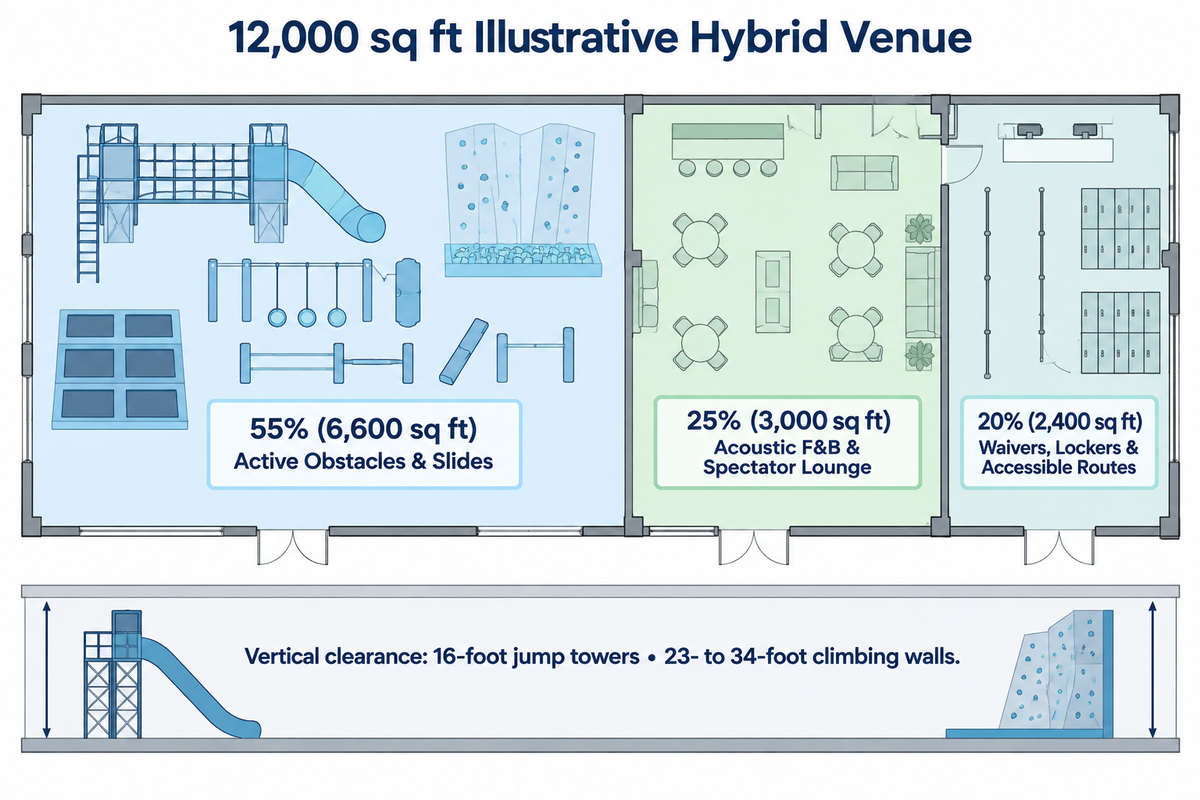
Leasing a low-ceiling retail unit is one of the most difficult mistakes a venue operator can make. Indoor adult play areas require unobstructed vertical clearance below the lowest sprinkler head or air duct, and clearance above the play area for barrier containment, and adult standing height. Some indoor play parks have 16-foot jump towers, while others have 23- to 34-foot climbing walls. Single-level social game bars fit within standard retail space, after verification of utilities.
Circulation and accessibility standards at the ground level vary by user group. Hybrid venues with children’s play areas must use the U.S. Access Board’s ADA Chapter 10 Play Areas Guide. Typically, ground-level accessible routes within a covered play area require a 60” clear width (permitted narrowings may occur in smaller play areas) and 80” of vertical headroom. Per section 206.2.17.2, a covered, soft-contained play structure with three or fewer entries must have at least one accessible entry, and a play structure with four or more entries must have at least two. The planning guidance provided by Playground Professionals on multigenerational play layouts also includes recommended buffer zones and clear sightlines. Operators looking for design ideas may find our 2026 indoor playground design ideas useful.
Example: A hypothetical 12,000-square-foot hybrid adult venue can test floor allocation across three functional zones. Active obstacle lanes, slides, and fall buffers can occupy approximately 55 percent (6,600 square feet) of the floor. Another 25 percent (3,000 square feet) of the floor can house an acoustically buffered food and beverage lounge and spectator lounge, which allows safety briefings to stay audible. The rest of the space (20 percent, or 2,400 square feet) can house waiver and locker stations as well as compliant accessible circulation corridors. A measured building shell feeds directly into your manufacturer engineering inquiry.
How to Specify Custom Adult Jungle Gyms with an Equipment Manufacturer
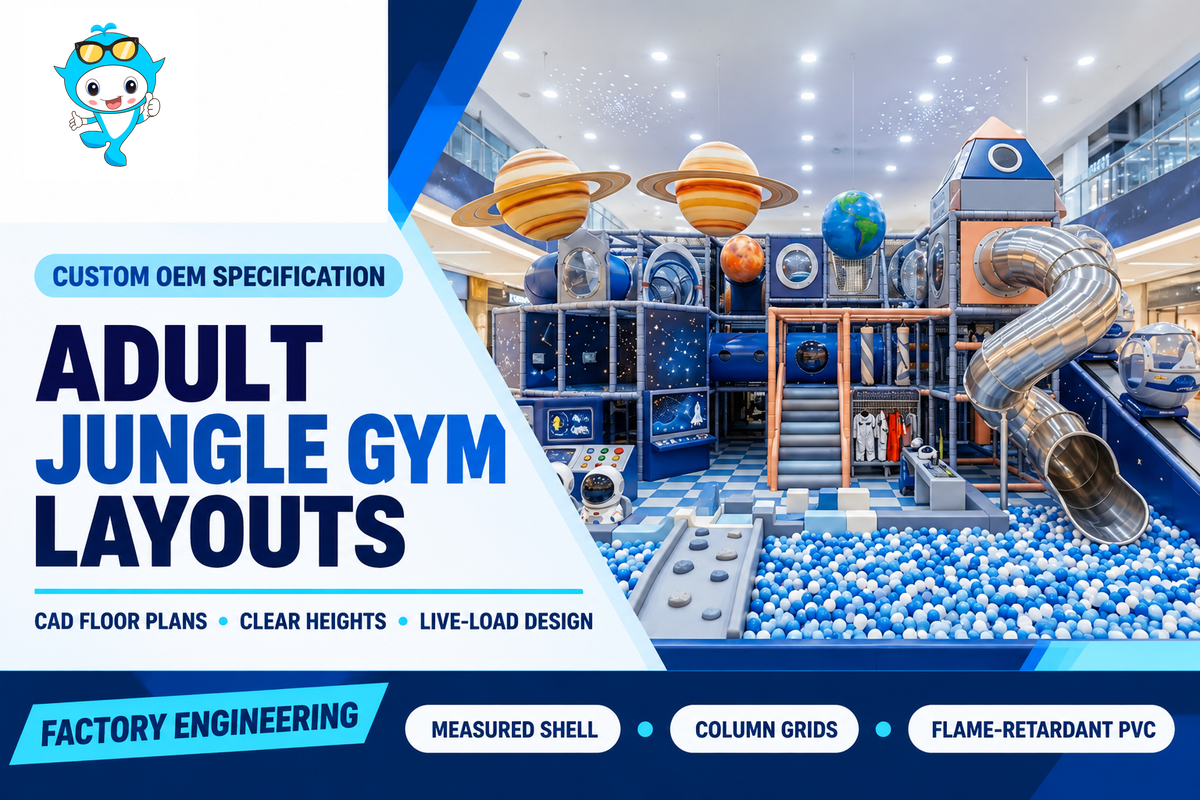
There’s no public registry certifying adult soft-play manufacturers under one federal standard. When commercial buyers seek out indoor playground manufacturers, they request project-specific adult structural load calculations and CAD layouts. Guangzhou Didi Land Amusement Equipment Co., Ltd. (Didi Land) manufactures custom-made commercial indoor playground and soft-play equipment, and provides layout design and installation services.
Don’t order off the shelf toddler modules for a teen or adult venue without stating adult load requirements. Qualified engineering teams evaluate post spacing, crossbar bracing and peripheral deck framing around your column grid and simultaneous adult user targets. Structural framing principles are illustrated in playground frame patent AU2025200871B2.
Guangzhou Didi Land Amusement Equipment Co., Ltd. manufactures commercial indoor playground equipment and soft play sets, as well as foam play modules and ball pit zones. They also provide themed playground design and layout services. Buyers planning for adult-accessible or hybrid structures should provide five project inputs during quotation to ensure the engineering scope includes adult structural design.
- Include a measured CAD floor plan showing wall lengths, structural column positions, fire exits, and unloading door widths.
- Record exact clear vertical height from the finished slab to the lowest HVAC duct, lighting truss, or fire sprinkler head.
- Define guest age policies, peak simultaneous adult climbers, and required per-user and platform live-load targets.
- List preferred attraction modules, slide exit runout space, ball pits, and physical barriers separating drink lounges.
- Specify local building code submittal needs, flame-retardant covering test reports, freight terms, and installation supervision.
Are you ready to see if your building shell can support a custom indoor play layout? You can send your floor plan and request a custom project quote from Didi Land to review clearances, scopes and pricing.
Frequently Asked Questions
Are there indoor playgrounds for adults?
Yes, dedicated adult indoor playgrounds and adults-only evening play parks operate across major cities.
Visitors can book competitive socializing bars with oversized group games (such as Play Playground on the Las Vegas Strip, which switches to 21-plus entry at 7:00 p.m.), indoor ninja and dry-slide parks, or hybrid entertainment centers running scheduled evening adult sessions. Many commercial operators use timed session passes, signed risk waivers, sock policies, and separated drink lounges.
Can adults play on standard children’s indoor playground equipment?
No, adults should not climb or slide actively on structures engineered strictly for ages 2 through 12.
United States specifications ASTM F1487-25 and ASTM F1918-21 limit their user scope to children aged 2 through 12. Child-sized crawl clearances, short slide stopping zones, and child-calibrated impact surfacing create entrapment, joint-twisting, and bottoming-out hazards for grownups unless custom adult structural and surfacing engineering is specified.
Are adult indoor playgrounds profitable as a commercial business?
Well-zoned adult venues can build viable margins when operators balance timed session passes, group corporate buyouts, and evening food and beverage sales against lease and staffing costs.
Pure 21-plus venues target higher weekend evening check averages and private events, though weekday mornings often stay slow. Suburban operators frequently combine daytime family play with scheduled evening adult sessions so leased square footage generates admissions across more hours of the week.
What should guests wear to an adult indoor playground?
Wear comfortable athletic clothing that covers knees and elbows, plus clean socks or grip socks as required by the venue.
Store phones, keys, watches, and loose jewelry inside lockers before entering climbing or pit zones.
What ceiling height is needed for a commercial adult jungle gym or ropes course?
Clear ceiling height must exceed the attraction’s structural height enough to accommodate standing adult stature, top containment barriers, overhead utilities, and manufacturer-specified safety clearances.
Active parks installing 16-foot jump towers or 23-foot to 34-foot climbing and high-ropes elements require high-bay commercial or warehouse shells rather than low-ceiling storefront units. Single-level interactive LED game rooms, arcade bars, and indoor mini golf lounges can fit standard commercial retail ceilings once ductwork, lighting trusses, and fire sprinklers are measured. Always measure usable vertical clearance from the finished floor slab to the lowest overhead obstruction, and verify top-hood and exit-runout dimensions on your manufacturer’s CAD elevation drawings.
Do outdoor adult fitness playgrounds require impact surfacing?
Yes, elevated outdoor fitness stations where teenagers and adults climb or hang require tested impact-attenuating surfacing.
ASTM F3101 addresses outdoor fitness equipment for ages 13-plus; surfacing systems must meet impact-attenuation performance criteria for the equipment’s fall height.
How often should commercial adult ball pits and foam pits be sanitized?
High-traffic commercial venues inspect pits daily, spot-clean spills immediately, and schedule mechanical ball-washing cycles based on weekly guest volume and local health rules.
Entry screening reduces contamination before guests step inside. Operators commonly ban street shoes, require socks, enforce empty pockets, and keep all food and beverages outside play barriers. Automated ball-washing machines vacuum pit balls through water-and-sanitizing scrubbers and air-dry them in batches. For padded surfaces, operators should follow the vinyl and foam manufacturer’s approved cleaning agents so daily disinfection does not degrade seam tape, flame-retardant coatings, or impact-cushioning cores.
About this Guide: Guangzhou Didi Land Amusement Equipment Co., Ltd. manufactures custom-made commercial indoor playground equipment. Other areas, such as structural engineering stamps, accessibility (ADA) reviews, liquor licensing, and insurance, should be addressed by qualified local professionals for your project address.
References & Sources
- Playground Equipment Business Guidance and Safety Checklists, U.S. Consumer Product Safety Commission.
- Safety Warning on Slide Stopping Hazards for Adults and Teenagers, U.S. Consumer Product Safety Commission.
- Guide to the ADA Accessibility Standards, Chapter 10: Play Areas, U.S. Access Board.
- Epidemiology and Mechanisms of Pediatric and Lap-Riding Playground Slide Injuries, National Library of Medicine (PMC5893512).
- SafeGuardS 090/25: ASTM Publishes Revised Specification F1487-25 for Public Playground Equipment, SGS.
- Modular Playground Apparatus and Elevated Weight-Bearing Platform Frame (AU2025200871B2), Google Patents.
- All Grown Up: The Rise of Adult-Focused Family Entertainment Centers, IAAPA Funworld.