Get in Touch with Didi Land


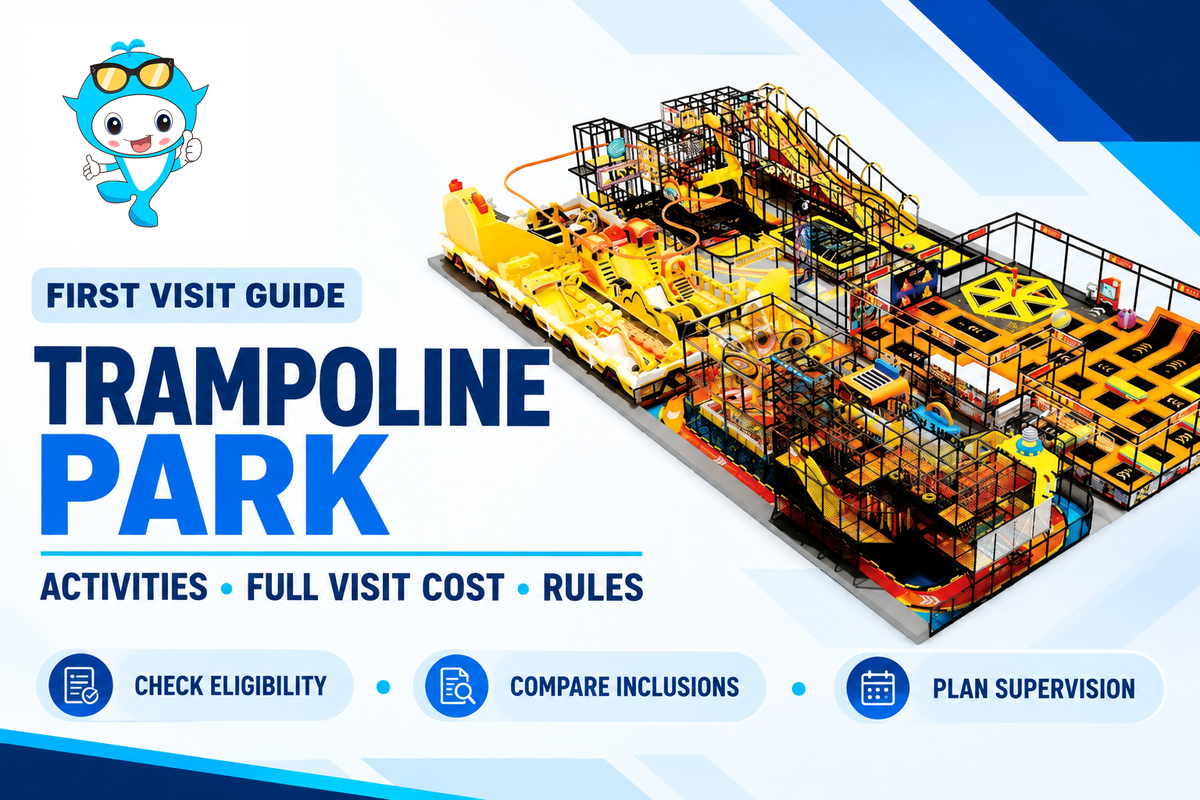
A trampoline park is an indoor recreation center made up of connected jumping courts. Other centers may also offer dodgeball, basketball courts, or adventure activities, but a ticket doesn’t always give access to all attractions. For a first visit, match the activities to your group, compare the full price and read the rules at the specific location.
Updated October 2026
Information presented in this guide will vary for a spectator, a jumping participant and a birthday organizer. This guide separates admission rules from medical advice and uses local tickets to illustrate how costs add up. Equipment sold by Didi Land is commercial-grade recreational equipment. Examples of facilities described in this guide are not Didi-operated parks.
What Is a Trampoline Park?
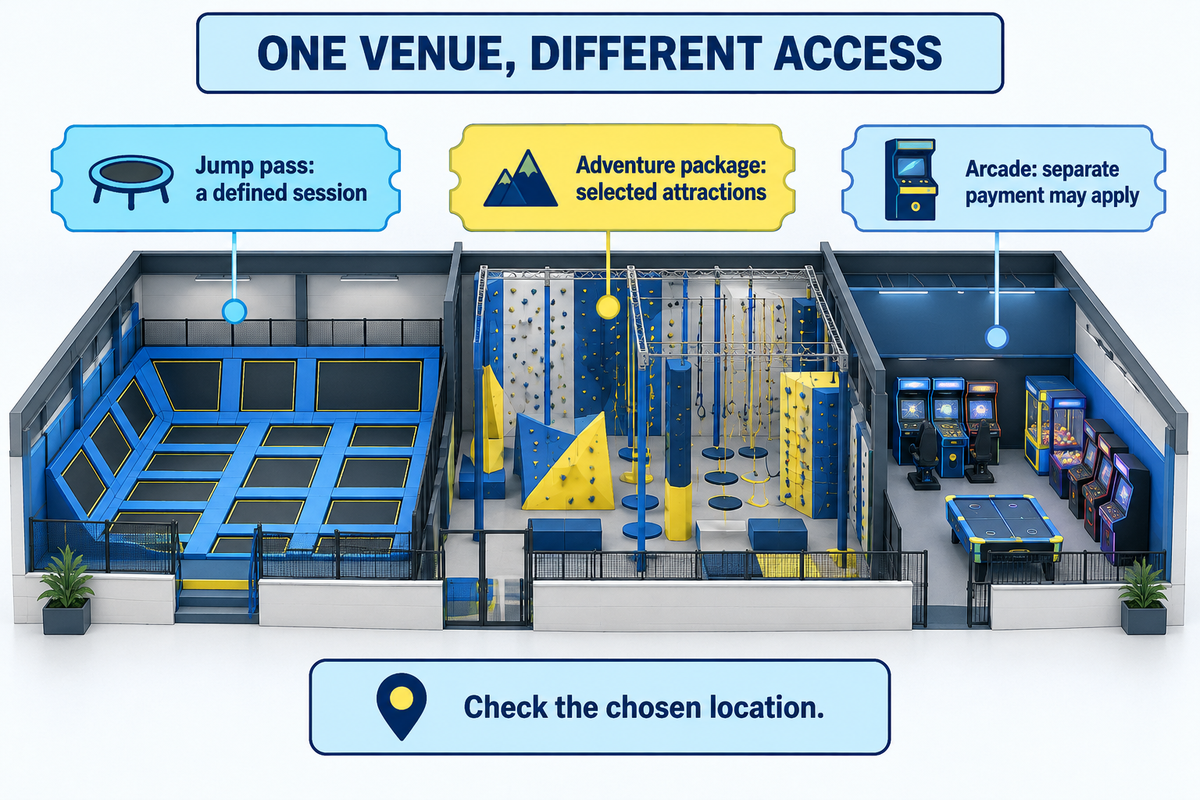
A trampoline park combines commercial trampoline courts with supervised recreation and, sometimes, separate attractions. Open jumping is the basic activity: visitors bounce on designated beds within the court. Other experiences (games, rides, activities and climbing) may also be available, but their access may be restricted and admission may be charged.
This can be confusing. A timed jump pass buys a defined session, while an adventure package may provide access to a selected group of attractions. An arcade can sit in the same building yet require a separate payment.
For example, if you’re primarily going for the ninja course, you’ll want to pick a pass that includes that course. Going with the cheaper trampoline-only option doesn’t achieve the same thing. The public scope of ASTM F2970-25 also distinguishes trampoline courts from attractions that do not incorporate a trampoline bed. One building can contain several equipment categories.
Indoor Trampoline Attractions and Adventure Activities
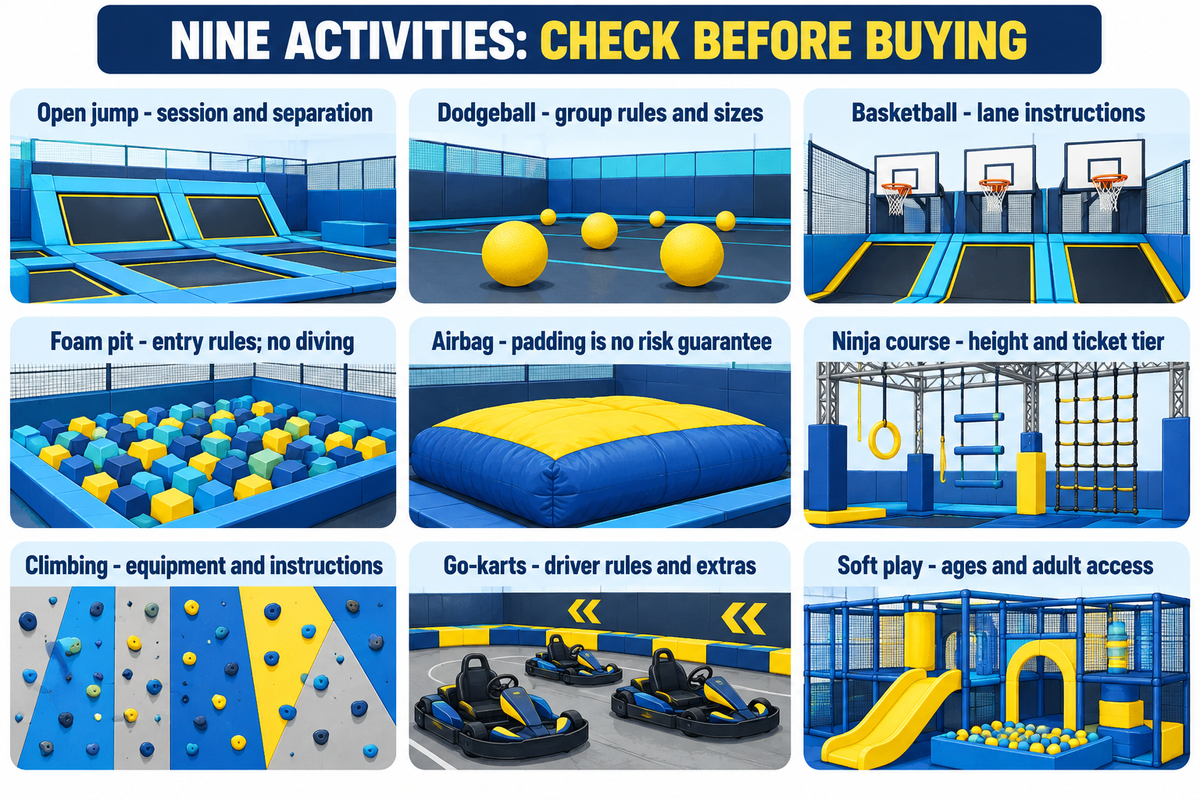
Choose an indoor trampoline venue by its actual activities, then check who can use them. Ground-based play and obstacle courses demand different movement skills. An adventure park may contain different activities, but neither its name nor its largest ticket package guarantees every activity is suitable for everyone in the group.
| Activity | What visitors do | Before buying |
|---|---|---|
| Open jump | Bounce on designated trampoline beds | Check session length and court separation |
| Dodgeball | Play a court game with other jumpers | Check group rules and participant sizes |
| Basketball lane | Jump toward a hoop in a designated lane | Follow lane instructions; do not hang on equipment |
| Foam pit | Enter a landing area from its designated approach | Follow the entry rules; no diving |
| Airbag landing | Use an inflatable landing surface | Check instructions; padding is not a risk guarantee |
| Ninja course | Move through balance, grip and obstacle challenges | Check height limits and the included ticket tier |
| Climbing attraction | Climb a wall or purpose-built structure | Check attraction-specific equipment and instructions |
| Go-karts | Drive on a separate track | Check driver eligibility and whether rides cost extra |
| Soft play | Explore padded blocks, tunnels and play structures | Check the intended ages and supervising-adult access |
Activity descriptions combine and summarize the Sky Zone, Urban Air, and Get Air pages.
Just because a landing site is soft doesn’t mean there won’t be injuries from attempting a stunt. A 2024 study of trampoline park injuries found different injury rates across activities, including high-performance jumping and foam-pit or airbag areas. It used earlier Australian and Middle Eastern records, so its findings cannot rank today’s US branches.
A mixed attraction venue can provide separate climbing activities for active visitors who want to climb and low-level exploration activities for family members who prefer them. Ground-based soft play climbing equipment and soft play ball pits belong to a different equipment category from trampoline landing pits. They still require appropriate age limits and supervision.
Children under six should avoid trampoline jumping and use age-appropriate ground-based play instead. Groups comparing a jump park with an adventure park should compare session length and included activities: Urban Air Houston Heights, for example, sells all-day access in attraction tiers.
Choosing a Park for Kids, Teens, and Adults
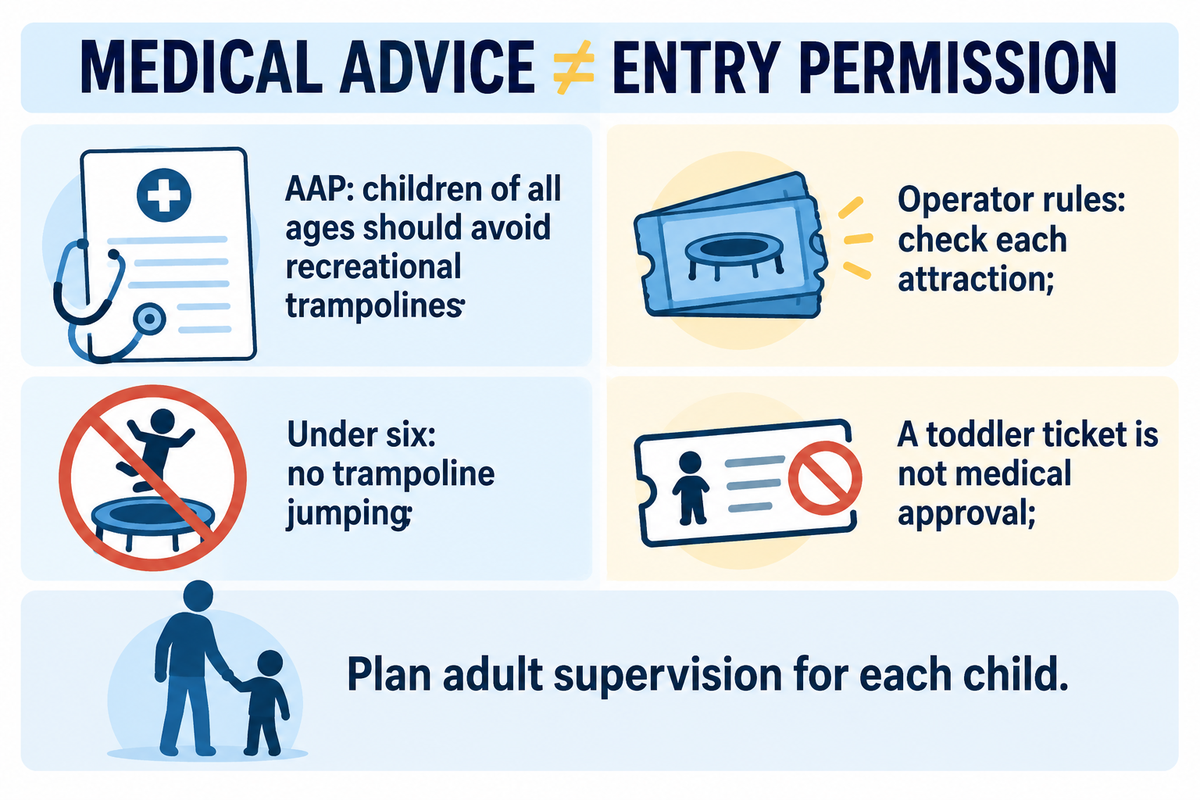
Plan a mixed-age visit around each person’s activity eligibility and supervision needs. Separate checks are required for medical advice, admission to the venue and access to the attraction. A toddler ticket does not establish that trampoline jumping is recommended for that child, or that an older sibling can supervise them.
The American Academy of Pediatrics’ trampoline guidance recommends that children of all ages avoid recreational trampolines, distinguishing specialized coached settings. Its harm-reduction advice for families who nevertheless choose jumping is not an endorsement of the activity.
Do Trampoline Parks Have an Age Limit?
Trampoline parks set their own admission and activity restrictions, so there’s no single age limit for all trampoline parks. Some separate trampoline attractions based on age and size. Medical advice is different: both pediatric and orthopedic guidance advise against trampoline use by children younger than six.
Sky Zone’s general FAQ says various age groups are welcome, but there may be restrictions for certain attractions. It also says children under 13 must not be left unattended. Get Air’s general rules place children under 46 inches in Little Air, with stated access to single-lane foam pits. The commercial rules say where children can enter; they don’t override medical advice. Hitting six doesn’t make jumping safe.
Do Trampoline Parks Have Weight Limits?
Some trampoline attractions may have equipment-specific weight limits and a single number shouldn’t be applied to the entire park. Read the posted limit for the court, climbing system, or ride you want to use. A general admission ticket doesn’t remove those restrictions and height eligibility doesn’t mean weight eligibility.
An adult planning to join a child should identify the actual activity before paying. A climbing attraction and an open trampoline court may have different operating requirements. The Playground Professionals safety overview emphasizes posted and enforced weight limits. It doesn’t give a universal maximum. Don’t substitute a number from another park’s page.
Consider a family with a three-year-old and a twelve-year-old. A separate, age-appropriate non-trampoline play area gives the younger child a different activity while the older child follows the chosen activity’s rules. The adults still need a supervision plan; splitting the children across distant zones can make this harder. Indoor family fun shouldn’t require everyone to buy the same pass.
Trampoline Park Prices: Compare the Full Visit
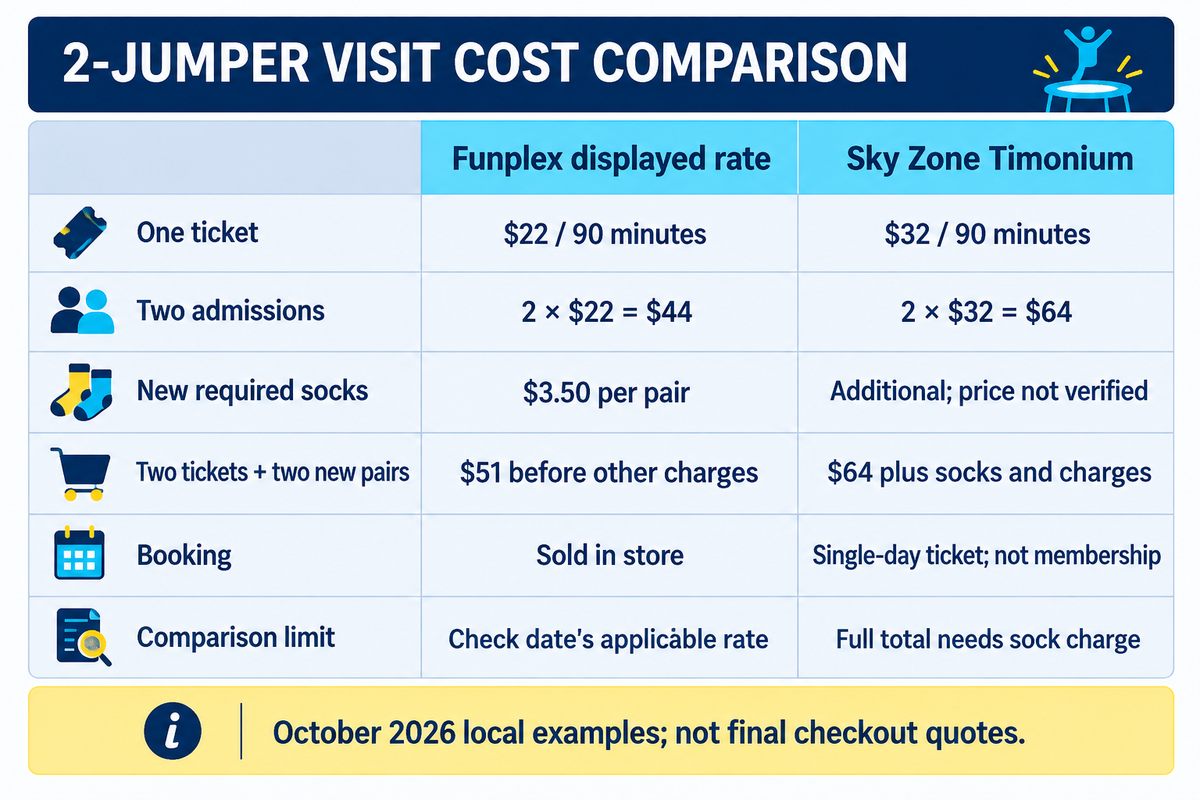
Compare the same jump duration and attraction access before comparing prices. For a group, include the required socks, participating adult tickets, booking fees and taxes. Separate food, arcade spending and other optional purchases. A monthly membership price also needs its contract terms; it isn’t the price of one visit.
| Cost item | Funplex displayed rate | Sky Zone Timonium |
|---|---|---|
| One general-admission ticket | $22 for 90 minutes | $32 for 90 minutes |
| Two admissions | 2 × $22 = $44 | 2 × $32 = $64 |
| New required socks | $3.50 per pair | Required; sock costs are additional to the admission subtotal |
| Two admissions plus two new pairs | $51 before unspecified tax or charges | $64 plus socks and any other charges |
| Booking detail | Admission sold in store | Single-day ticket, separate from membership |
| Comparison limit | Check the date’s applicable rate | Complete total requires the sock charge |
The displayed $22 Funplex rate is used here as a calculation example, not as a specific, dated ticket quote. These are local examples, not a national price range.
If the displayed Funplex rate is valid on your visit date, two first-time jumpers needing socks would budget 2 x ($22 + $3.50) = $51 before any additional charges. If approved socks are owned, remove that purchase only after checking the venue’s reuse policy. Don’t enter a zero for an unknown sock fee in a competing offer.
Parent access requires separate attention. The FAQ for Nova Nashua states that parents that simply supervise don’t need a ticket. Participating parents do. A parent deciding to bounce changes the booking. The best comparison uses the same number of participants, the same duration and the same intended activities.
Safety Rules Before You Jump
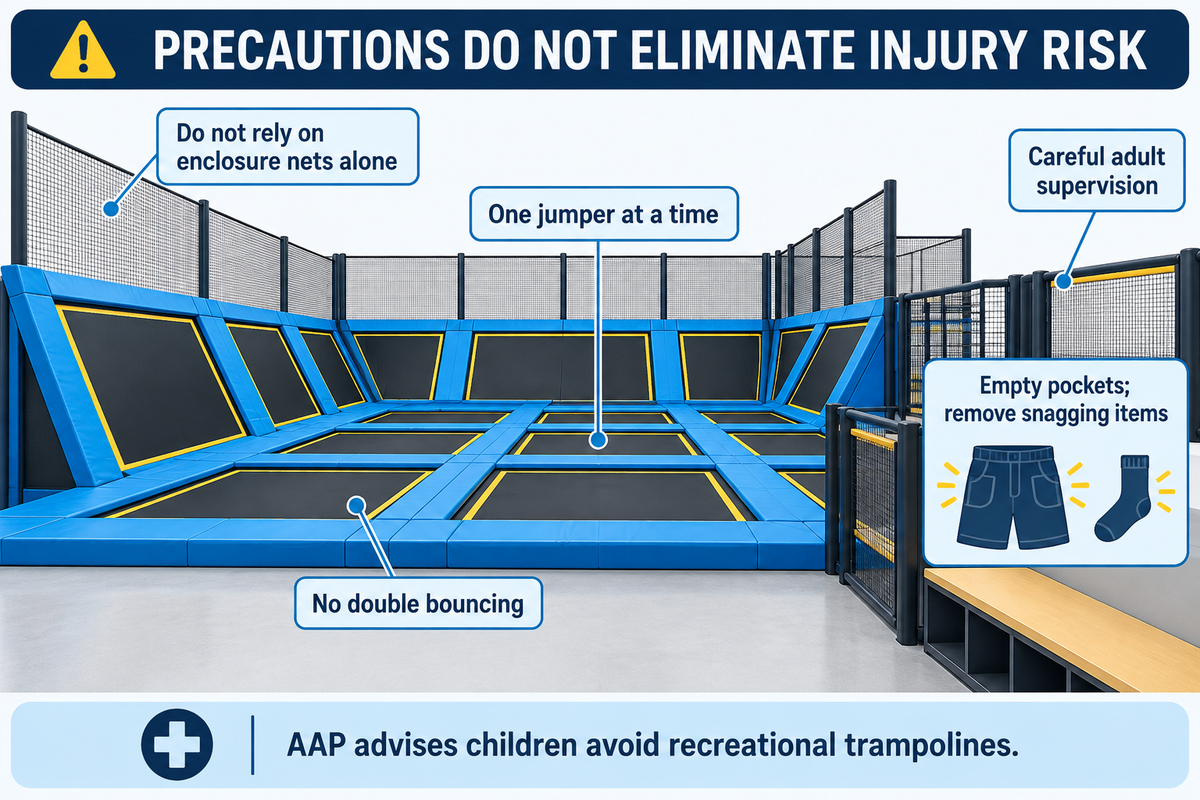
Follow the posted instructions for each attraction, keep only one jumper on a trampoline at a time and avoid double bouncing. Empty your pockets, remove items that may catch and stay within your abilities. Padding, grip socks, a signed waiver and staff presence don’t eliminate the risk of injury.
The American Academy of Orthopaedic Surgeons recommends careful adult supervision and warns against relying on enclosure nets alone. Get Air separately prohibits double bouncing and diving into foam pits. Choosing a padded surface doesn’t eliminate the risk of a dangerous maneuver.
Norton Children’s injury guidance describes fractures associated with double bouncing, particularly when children of different sizes share a trampoline. For a first time session, more height isn’t a useful goal.
Are Trampoline Parks Safe for Toddlers?
Jumping on a trampoline isn’t recommended for toddlers, and the American Academy of Pediatrics and the American Academy of Orthopaedic Surgeons recommend against use of trampolines for children under six. Even if a facility offers toddler sessions, that doesn’t make it safe. Quieter sessions don’t address the medical issues regarding jumping.
Select an appropriate non-trampoline activity with adult supervision and appropriate equipment for the child. Being soft doesn’t mean an inflatable bounce house is any safer. In fact, orthopedic physicians have also described similar types and causes of injuries in bounce houses and trampoline jumping. A play area also needs a practical exit when a child is tired, upset or no longer following directions.
Injury statistics need care, too. The 2024 study in Pediatrics reviewed 18 parks based on 2017-2019 records and ticket-derived exposure. Medical records and operator logs weren’t compared, and time spent on different activities was estimated. The number of injured visitors and injuries per jumping hour address different questions, and neither is a personal guarantee for your visit.
Sky Zone, Urban Air, and Get Air: Location Matters
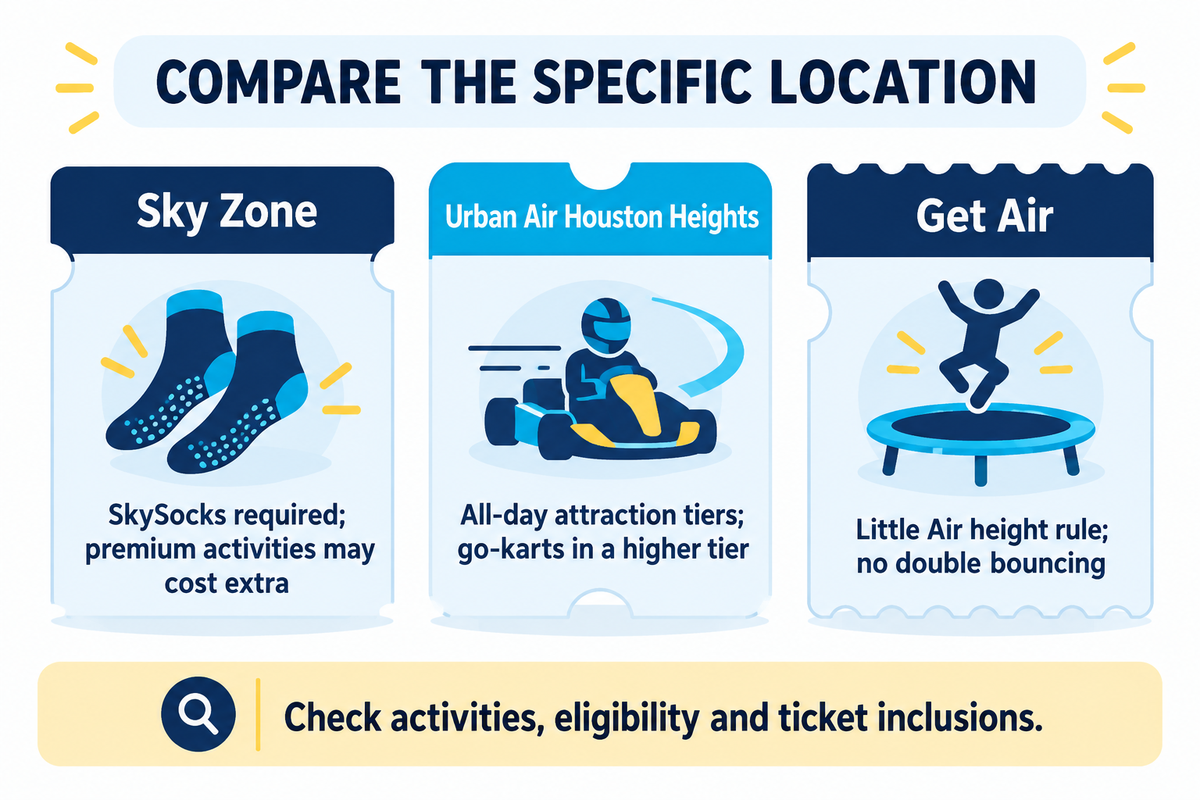
Compare the specific Sky Zone, Urban Air or Get Air location you plan to visit. It’s important to identify the differences in offered activities, inclusions and restrictions for participants, and what’s included in the ticket.
- Sky Zone’s general FAQ identifies premium activities that may cost extra and requires SkySocks. Compare this to the regular rule list and pass list for the location you plan to visit.
- Urban Air Houston Heights has an all-day model with varying tiers of attractions. Go-karts appear in a higher tier, so buying entry is not enough to establish ride access.
- Get Air has a stated height restriction for Little Air. Double bouncing is also not allowed. Use the ticket page for the actual booking.
For groups of adults that want to climb and try the ninja course, compare the inclusions first. For a family whose main goal is open jumping, a wider package may buy activities they won’t use. An invitation to “fly” is marketing language, not an approval to do flips or to ignore staff’s instructions.
Birthday Parties and How Parks Work
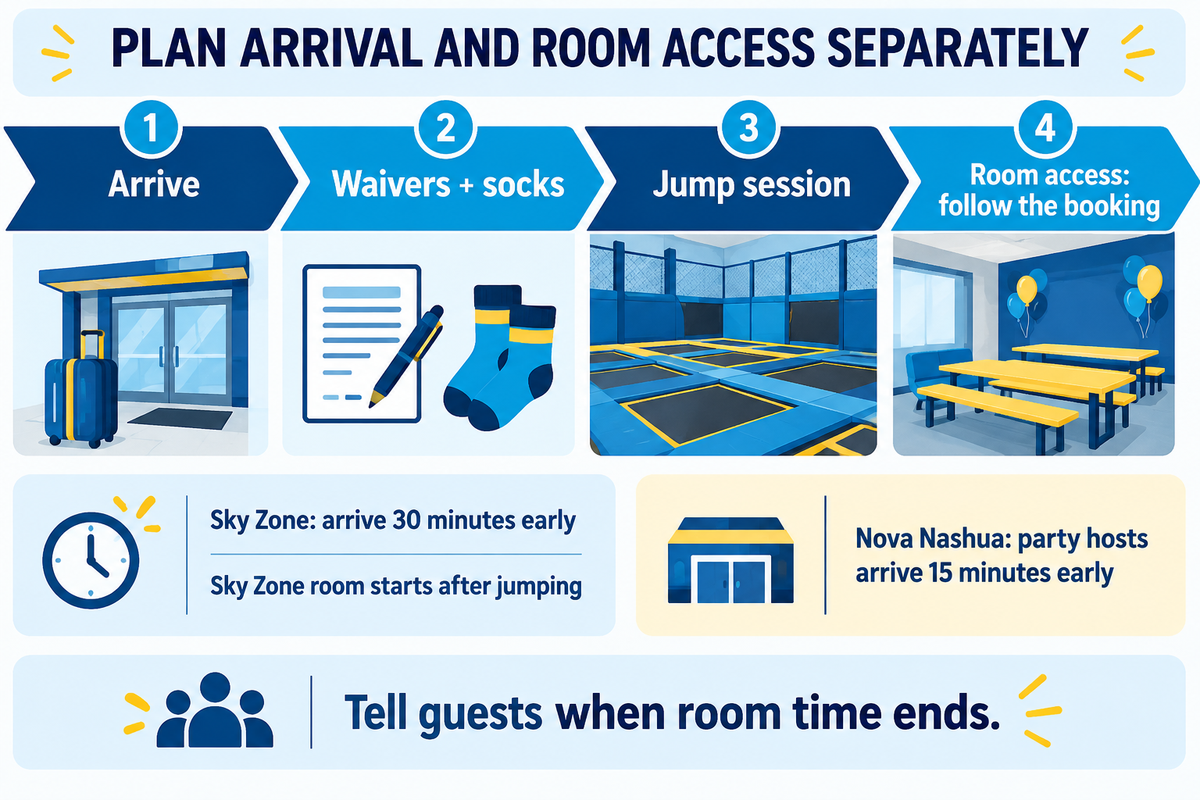
Birthday parties should be scheduled around arrivals, check-ins, activity time, food time and the end of room access. Participating adults should be included in the total count as well. The party host shouldn’t be mistaken for court supervision. A package described as a party doesn’t mean the room will be available throughout the jump session.
Sky Zone’s general FAQ suggests arriving 30 minutes early and explains that the party room becomes available after jumping. Nova Nashua asks party hosts to arrive 15 minutes early. When writing invitations, reference the actual booking time; these aren’t interchangeable.
“Give them the schedule, and let them know when their room time ends.”
Barry Zelickson, owner of Next Exit Entertainment, in IAAPA’s party-operations discussion
Guests who arrive at the jump-session start may still need waivers and socks before joining the group. Identify the adult picking up each child and tell them where to take the child’s belongings and food. Tell the adults which park team member to contact for group questions if the host isn’t available.
Planning a Trampoline Venue or a Separate Soft Play Zone
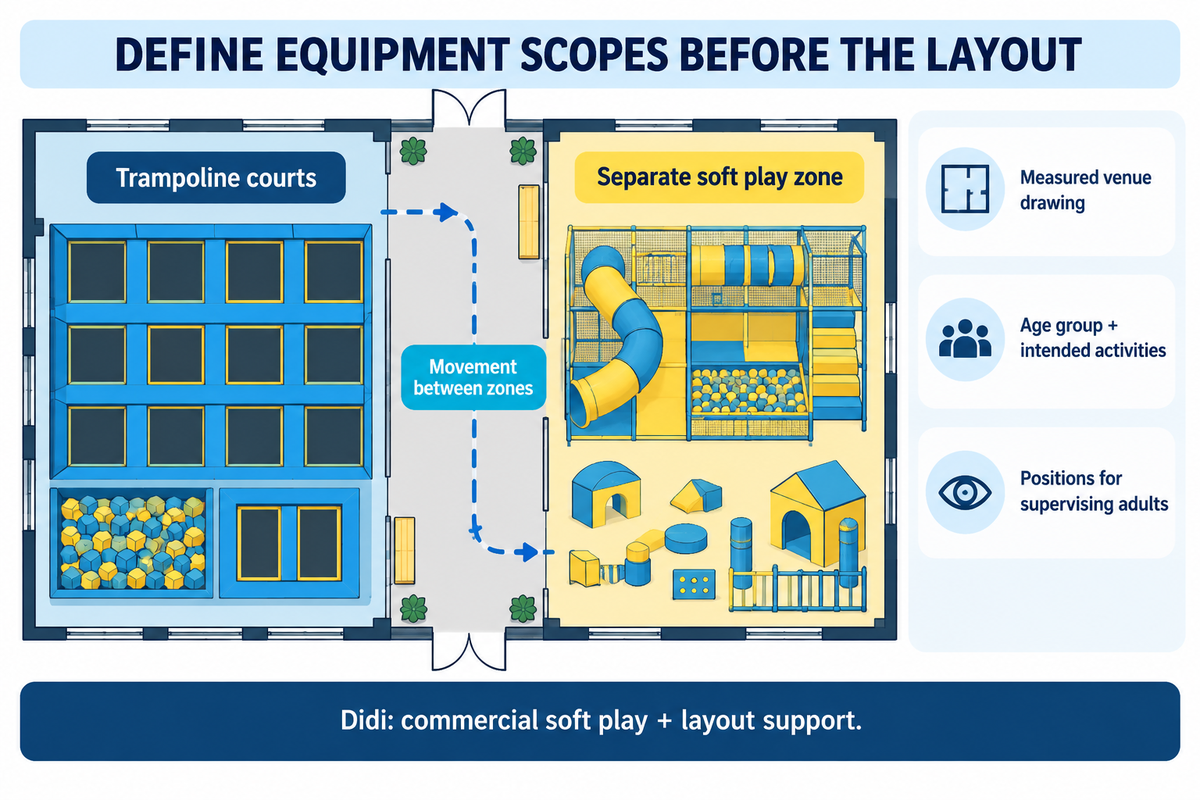
A venue owner should define trampoline courts and non-trampoline play as separate equipment scopes before requesting a layout. Describe the expected users, movement between different zones, the position of supervising adults and measured dimensions of the space. The equipment brief should outline how the choices have been made; a floor area quote alone doesn’t explain how the entire venue will function.
IAAPA’s Hupalupa venue case describes bookings for both trampoline and soft play activities and digital maintenance tracking. It is one operator’s example, not a Didi installation or a universal business model. For your own idea, work through the indoor playground layout before deciding on a decorative theme.
Didi Land’s published commercial soft play sets include padded play elements and custom layout support. For a separate young child zone, send a measured drawing of the space, the age group and activities offered. For the jumping-court area, our trampoline park manufacturers guide covers the selection of suppliers separately.
Discuss a separate soft play zone
Frequently Asked Questions
Do Trampoline Parks Give You Socks?
Required socks may be included in a package or sold separately.
Sky Zone requires its branded SkySocks and allows reuse when they remain in good condition. Nova’s FAQ includes jump socks in party packages. For an ordinary visit, check the ticket inclusions before assuming socks are free. A pair bought elsewhere may not meet the chosen park’s policy, even when both pairs have grip soles.
Do Trampoline Parks Have Food?
Some do.
Sky Zone’s general FAQ describes food and snacks, with outside-food restrictions and party-related exceptions. Check the local menu and booking terms if your group needs a meal. A party package’s food allowance may differ from ordinary admission, and a snack counter doesn’t establish an allergy-safe kitchen. Discuss dietary needs directly with the venue before making arrangements.
Do Trampoline Parks Have Memberships?
Many operators sell memberships, but the included visits, attractions and contract terms belong to the specific offer.
Compare the total commitment with how often you expect to return. Sky Zone Timonium offers memberships with a minimum term and sells single-day tickets separately. Read renewal, cancellation and visit restrictions before treating the monthly headline price as the cost of one afternoon. Include socks and any excluded activities in that comparison.
Are Trampoline Parks for Adults?
Adults can participate where the venue and activity rules allow.
Check equipment restrictions before buying, and distinguish a participating-adult ticket from admission for someone who only watches.
Do Trampoline Parks Sanitize?
Choose a venue with a published cleaning policy and procedures for visibly soiled shared equipment; cleaning practices are venue-specific, and admission doesn’t guarantee a germ-free environment.
A tidy reception area can’t establish the condition of every attraction. If something needs attention, report it before using that area. Cleaning also addresses a different issue from jumping injuries: it doesn’t replace court rules, equipment checks or adult supervision. Bring the same attention to hand hygiene and shared surfaces that you would to other indoor play settings.
Do Trampoline Parks Have Adult Nights?
Choose an explicitly adults-only event on the local events calendar; an evening session or glow event isn’t necessarily adults-only.
Use the advertised age rules when organizing an adult group.
Which Trampoline Park Has Go Karts?
Urban Air Houston Heights lists go-karts among its attractions, with access tied to the ticket tier.
Check the specific location’s attraction list, driver restrictions and pass inclusions before booking. For a group, confirm that each intended driver meets the conditions; a package upgrade can’t remove an attraction’s eligibility rules. Keep any ride upgrade separate from the base jumping price when comparing the visit cost.
How This Visit Guide Was Prepared
Didi Land supplies commercial indoor playground and soft play equipment. This trampoline park guide combines published operator information with medical guidance and industry sources; it doesn’t report a hands-on venue inspection. The price comparison uses dated local examples, while the equipment discussion concerns a separate soft play scope. Medical recommendations are attributed to their original organizations.
References & Sources
- Trampolines: What You Need to Know American Academy of Pediatrics.
- Trampoline Injury Prevention American Academy of Orthopaedic Surgeons.
- Trampoline Park Injury Trends Pediatrics, 2024; historical study population and limitations apply.
- ASTM F2970-25 public scope ASTM International.
- FEC Triage Essentials IAAPA.
- Trampoline park injury guidance Norton Children’s.
- Trampoline park safety overview Playground Professionals.
- Hupalupa venue case IAAPA.