Get in Touch with Didi Land


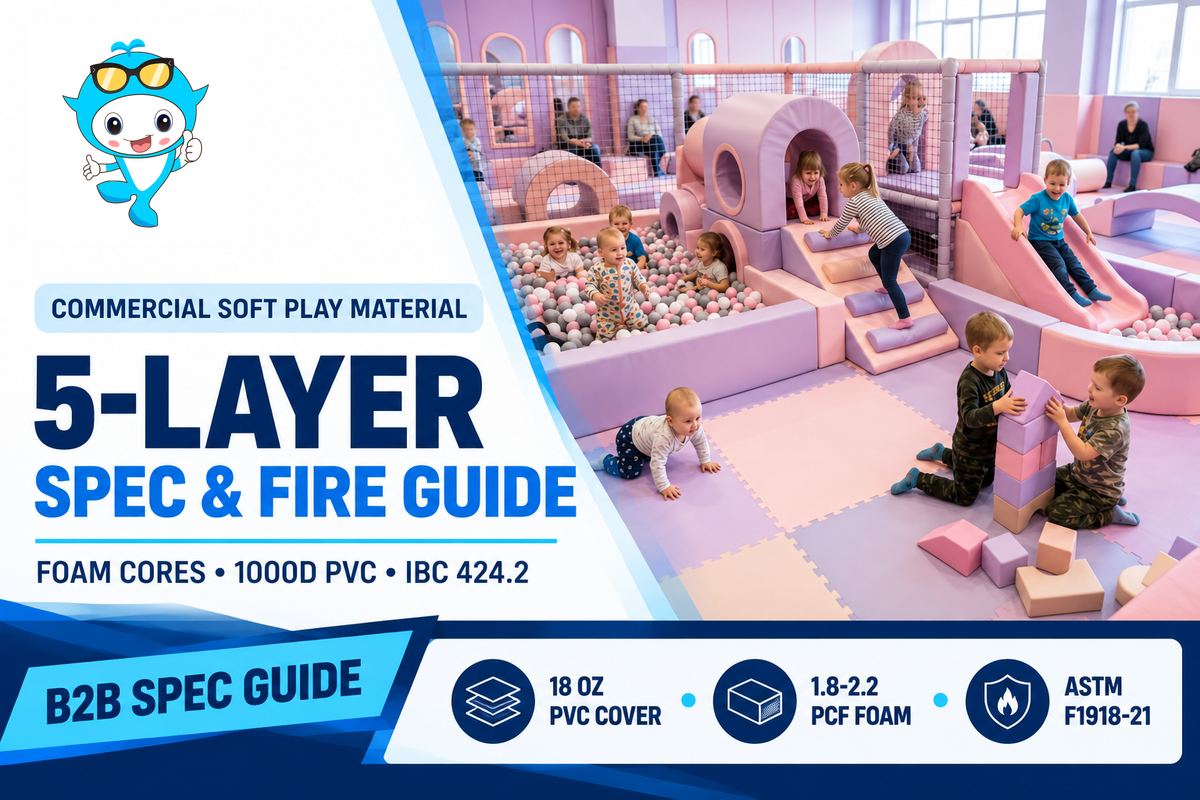
Commercial soft play material pairs 18 oz (0.55 mm, ~610 gsm) 1000D PVC tarpaulin per LY Trustlink with 1.8 to 2.2 pcf High Comfort polyurethane foam per PFA. That foam range equals 29 to 35 kg/m³. Inside every commercial assembly, five layers work together: steel and wood framing, cushioning foam cores, coated covers, containment mesh, and rigid plastics.
Buyers comparing quotes for an indoor playground, daycare room, or family entertainment play center rarely fail on color themes. Projects lose money when short-lived residential fabrics get substituted for heavy-duty commercial assemblies. Guangzhou Didi Land Amusement Equipment Co., Ltd. (Didi Land) was established in 2014 and operates a 12,000 sqm factory serving 40+ countries. Through our custom foam play equipment division, engineers lock every polymer grade and fire standard into a pre-production Bill of Materials.
What Is Soft Play Material Called and What Are the 5 Layers Inside Commercial Structures?
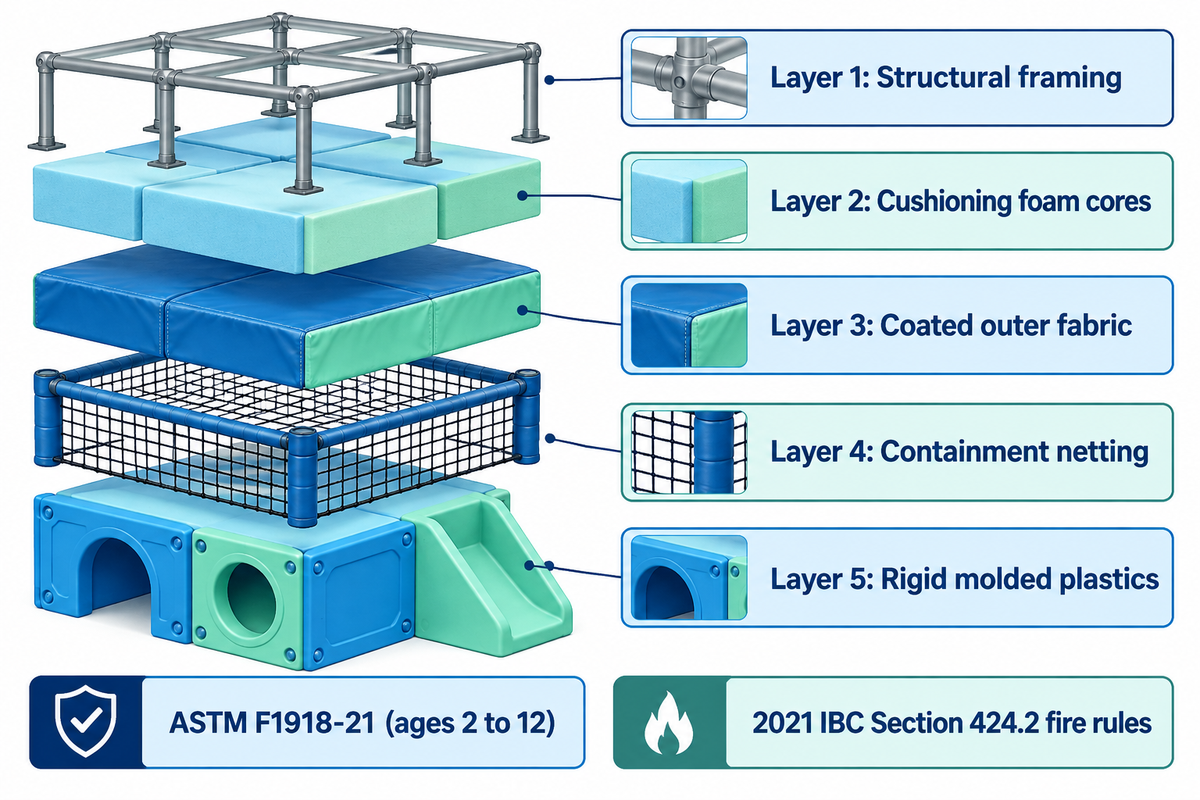
Commercial soft play material falls under ASTM F1918-21 for Soft Contained Play Equipment serving ages 2 to 12. Meanwhile, 2021 IBC Section 424.2 determines the performance of play structures regarding fire. Five distinct layers build every commercial structure: structural framing, cushioning foam cores, coated outer fabric, containment netting, and rigid molded plastics.
Supplier catalogs often compress all five layers into vague phrases like “high-density foam and eco-friendly leather”. That shorthand omits the foam grade, fabric weight, and fire rating needed for an indoor play environment to pass fire review. Under 2021 IBC Section 424, play-structure fire rules apply above 10 ft high or 150 sq ft, and Section 424.2(10) adds Table 803.13 finish limits over 600 sq ft (56 m²). New operators can review what soft play systems include before auditing submittals for commercial soft play equipment.
| Play Structure Component | Structural Layer (of 5) | Primary Polymer or Substrate | Governing Test or Code Basis (per 2021 IBC 424.2 / PFA / CPSC) |
|---|---|---|---|
| 1. Soft Play Climbers & Wedges | Cushioning Foam Core + Coated Outer Fabric | Open-cell polyurethane or crosslinked polyethylene foam inside commercial PVC vinyl | ASTM D3574 IFD (PFA), UL 1975 or NFPA 289 foam core, & NFPA 701 Test Method 1 or 2 cover |
| 2. Post Padding Sleeves | Cushioning Foam Core | Closed-cell foam plastics (pipe foam) wrapped in flame-retardant film or vinyl | UL 1975 or NFPA 289 (≤100 kW heat release, 20 kW source per IBC 424.2) |
| 3. Floor Impact Play Mats | Cushioning Foam Core + Coated Outer Fabric | Closed-cell EVA or crosslinked polyethylene tiles and unitary cushioned mats | ASTM F1292 impact attenuation & ASTM E648 or NFPA 253 Class I floor finish (IBC 424.2) |
| 4. Elevated Platform Decks | Structural Framing + Cushioning Foam Core | Fire-retardant-treated wood deck topped with foam and reinforced PVC cover | 2021 IBC Section 2303.2 wood & EN 1176 load calculation |
| 5. Perimeter Safety Netting | Containment Netting | High-tenacity woven polyester or nylon mesh suspended from top frame rails | NFPA 701 flame propagation (IBC 424.2) & ASTM F1918 opening geometry |
| 6. Spiral & Wave Slides | Rigid Molded Plastics | Rotational-molded polyethylene tubes, slides, windows, and junction panels | ASTM E1354 (≤400 kW/m² peak heat release at 50 kW/m², 6 mm per IBC 424.2) |
| 7. Ball Pit Balls | Rigid Molded Plastics | Crush-resistant hollow polyethylene balls inside a padded soft play ball pit | UL 1975 or NFPA 289 (≤100 kW in 36 × 36 × 21 in. mesh box per IBC 424.2) |
| 8. Structural Uprights & Clamps | Structural Framing | Galvanized steel tubing, corner posts, and concealed metal clamp connectors | ASTM F1487 / EN 1176 Factory Acceptance Test load verification |
| 9. Seams, Flaps & Zippers | Coated Outer Fabric | Heat-welded or quadruple-stitched seams with concealed zipper pockets | CPSC 16 C.F.R. Part 1307 (≤0.1% for each of 8 phthalates on accessible parts) |
How Does Commercial Soft Play Material Differ From Home Foam Climbing Blocks?
Commercial soft play material typically uses 18 oz (0.55 mm, ~610 gsm) 1000D PVC tarpaulin. Residential play sets use under-500 gsm fabric or stitched 420D to 600D nylon covers lasting 6 to 18 months.
Household foam climbing blocks for toddlers are built for one or two children in a dry living room. In a busy preschool or play cafe, dozens of children jump on soft foam climbing blocks during active play while staff sanitize surfaces between sessions. Retail baby playroom sets rely on exposed zippers, and stitched needle holes wick spilled juice into the foam core. Once trapped moisture reaches untreated open-cell foam, sour odors force operators to replace the module early.
What is the best soft play equipment for home use?
For private home playrooms, the best soft play sets pair open-cell High Comfort polyurethane foam blocks with wipe-clean phthalate-free vinyl covers on a compact crawl activity playset. Look for tucked zipper garages and third-party CPSC 16 C.F.R. Part 1307 chemical compliance.
When building a dry residential playroom, home buyers don’t need IBC Section 424 fire submittals or galvanized steel framing. However, household sets don’t have public-assembly fire certification or commercial seam welding, so operators must never move the sets into a commercial daycare or ticketed venue.
Core Cushioning Foams Compared: Closed-Cell EPE and XPE vs. Open-Cell Polyurethane and EVA
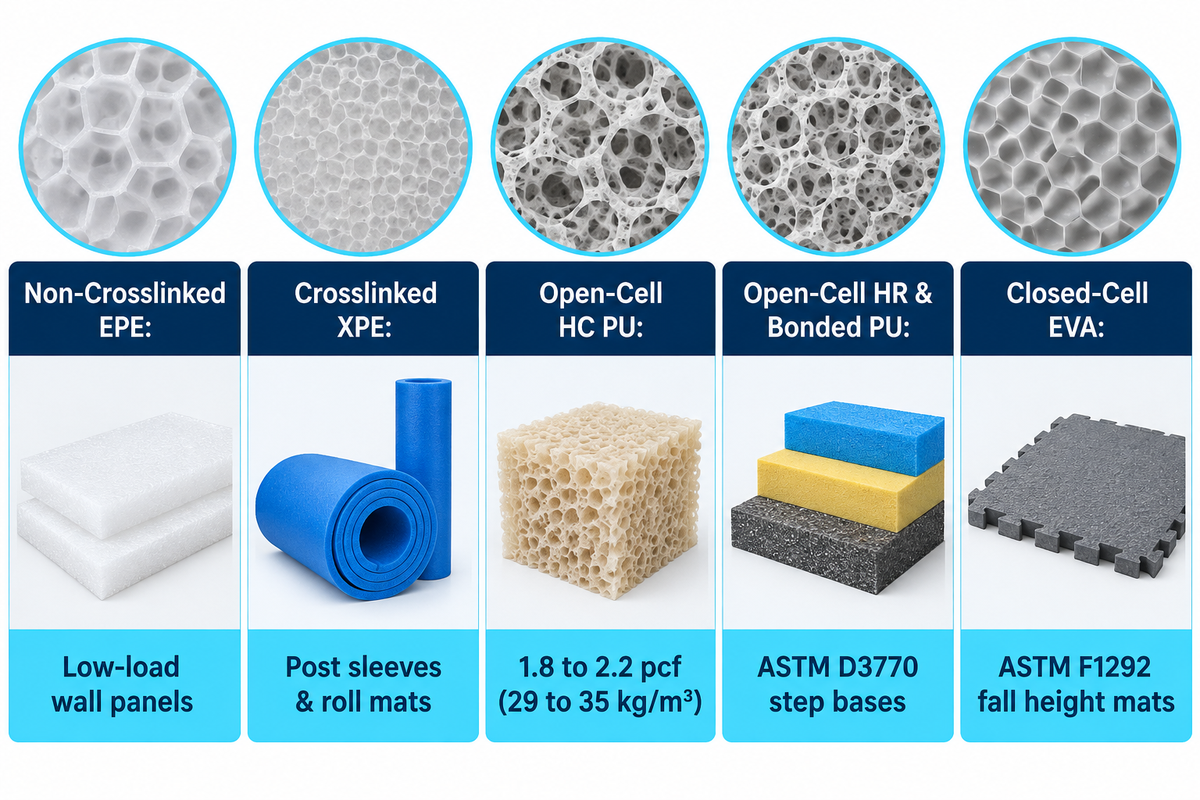
Choose closed cell cross-linked polyethylene (XPE) or EVA for moisture-exposed post sleeves and floor play mats. For deep blocks specify open cell High Comfort (HC) Polyurethane foam (1.8 to 2.2 pcf per the Polyurethane Foam Association glossary). Use ASTM D3770 High Resilience (HR) or bonded foam on heavy step bases.
Closed-cell foams resemble closed, sealed, tight bubbles like bubble wrap. Open-cell foams are like kitchen sponges, where air is moved through a structure made of connected struts. Buyers often hesitate to pay extra for XPE or resilient polyurethane when low-cost non-crosslinked EPE feels firm in a sample box. However, polymer density is independent of firmness as defined in the PFA glossary.
According to CPSC statistics cited by Playground Professionals, falls to the surface account for nearly 70 percent of playground injuries. Zone-matched polymers protect young knees for both soft play equipment for toddlers and modular climbers. Matching soft play floor mat thickness to critical fall height under ASTM F1292 protects elevated landings.
| Foam Polymer | Cell Structure | Water Resistance | Published Benchmark / Test Basis | Best Play Zone & Operating Limit |
|---|---|---|---|---|
| Non-Crosslinked EPE (Expanded Polyethylene) | Closed-cell | High (non-wicking) | UL 1975 / NFPA 289 (IBC 424.2 when flame-rated) | Low-load wall panels; highest permanent compression set on stairs |
| Crosslinked XPE (Crosslinked Polyethylene) | Fine closed-cell | High (impermeable) | Chemically or irradiation-linked polyethylene network | Post padding sleeves, roll mats, and ball pit borders |
| Open-Cell High Comfort (HC) Polyurethane | Open-cell | Low (needs sealed PVC skin) | 1.8–2.2 pcf (29–35 kg/m³) HC FPF & ASTM D3574 (PFA glossary) | Soft play climbing blocks, rockers, and crawl shapes |
| Open-Cell High Resilience (HR) & Bonded PU | Open-cell / bonded chips | Low (needs sealed PVC skin) | ASTM D3770 HR FPF & PFA Bonded FPF base layer | Heavy adult-walkable step bases; bonded chip foam feels stiff alone |
| Closed-Cell EVA (Ethylene-Vinyl Acetate) | Closed-cell | High (washable surface) | ASTM E648 Class I (IBC 424.2) & ASTM F1292 fall rating | Toddler crawl activity mats; puzzle-tile seams trap dirt |
WORKED EXAMPLE: Play Foam Climbing Blocks: Mass and Firmness Foam Core Check
Assumed inputs: One rectangular step block measures 1.0 m x 0.5 m x 0.4 m (volume = 0.20 m³). Conversion factor: 1 pcf = 16.02 kg/m³.
Per the Polyurethane Foam Association glossary, High Comfort (HC) polyurethane runs 1.8 to 2.2 pcf (28.8 to 35.2 kg/m³). Multiplying by 0.20 m³ gives a bare core mass of 5.76 kg to 7.04 kg. Substituting PFA Supersoft 7-to-10-pound IFD fiber-feel foam lets toddlers bottom out inside identical vinyl covers. Under ASTM D3574 per PFA, laboratory IFD presses a 50-sq-in circular foot 25% and 65% into a 4-in-thick, 15-in-square sample. The 65%-to-25% IFD ratio sets the support factor resisting bottoming out.
Why Does Non-Crosslinked EPE Foam Flatten Faster Than XPE or High-Density PU Foam?
Non-crosslinked EPE foam flattens faster due to the absence of chemical crosslinks between polymer chains in the gas-filled polyethylene cells. As a result, cell walls permanently collapse with each repeated compression set (compression loss), causing a permanent deformation, or loss, of thickness. This can occur from repeated step compression, especially by adults and older children.
Chemically crosslinked XPE links polyethylene chains into a three-dimensional network that lets the foam regain its shape after a heavy load. High Resilience polyurethane foam (defined under ASTM D3770 in the PFA glossary) has random open-cell struts that provide greater support factors than traditional slabstock. Pull batch ASTM D3574 compression-set sheets from the foam mill. Pair a bonded base of foam with an HC, HR, or XPE top layer on foam blocks.
Outer Cover Fabrics: Knife-Coated PVC Vinyl Tarpaulin vs. PU Vegan Leather
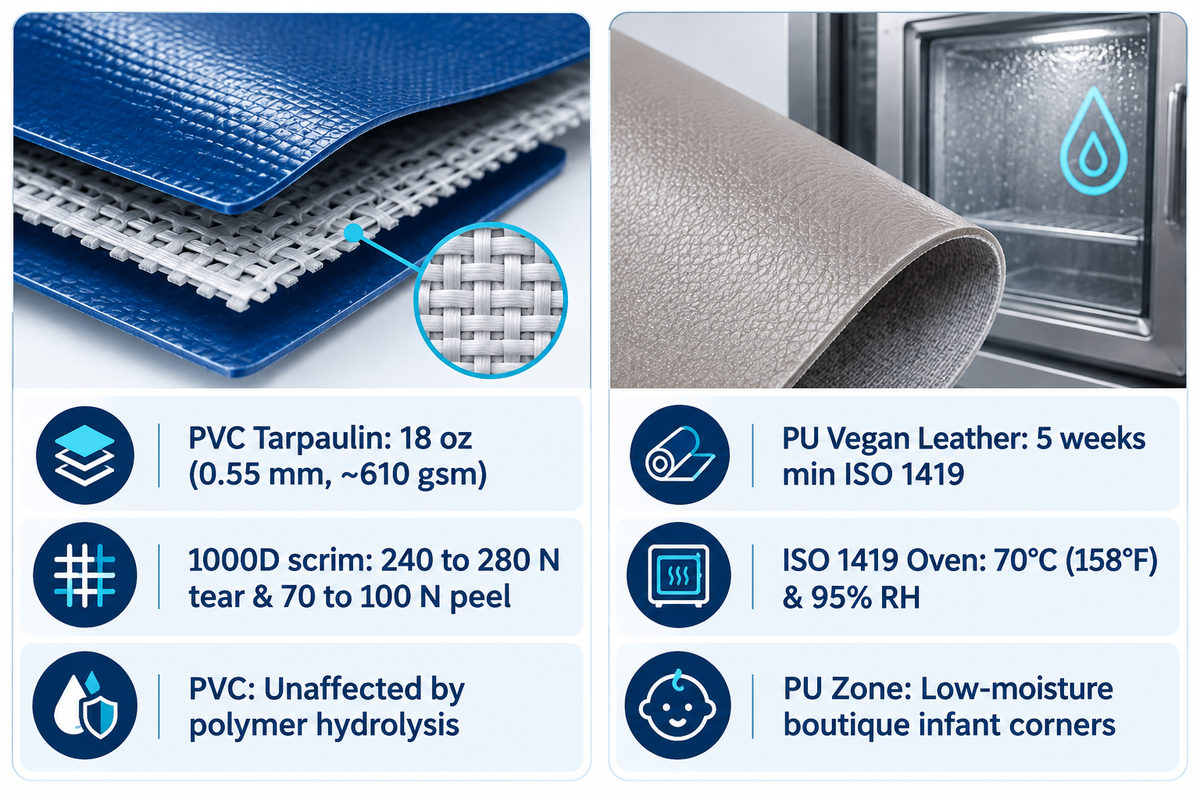
For daily-sanitized commercial climbing zones, specify 18 oz (0.55 mm, ~610 gsm) PVC tarpaulin over a 1000D 23×23 polyester scrim per LY Trustlink’s commercial baseline. Reserve polycarbonate- or polyether-grade PU vegan leather passing at least 5 weeks of ISO 1419 hydrolysis testing per the Association for Contract Textiles for low-moisture boutique infant corners.
“When a polyurethane coated fabric fails due to hydrolysis, the film of the material can crack, flake off or delaminate.”
Play cafe owners and daycare directors love the warm, matte hand of pastel PU leather on a soft play set for toddlers. Yet polymer chemistry favors easy-clean vinyl in wet or heavily disinfected rooms. As the Association for Contract Textiles notes, PVC-based fabrics are unaffected by polymer hydrolysis. LY Trustlink’s data shows commercial 0.55 mm PVC tarpaulin laminates a 1000D polyester scrim between two PVC coats. That build delivers 1,500 to 4,500 N/5cm tensile strength, 240 to 280 N tear strength, and 70 to 100 N DIN 53357 peel adhesion. Note that thickness (mm) and mass (gsm) differ: filler-heavy thin-scrim vinyl can match commercial mass while tearing easily.
| Specification Property | Commercial PVC Tarpaulin (LY Trustlink Baseline) | Contract PU Coated Fabric (ACT Guidelines) |
|---|---|---|
| Typical Thickness & Mass | 0.55 mm / ~610 gsm (light 0.45 mm / ~510 gsm; heavy 20–30 oz at 0.60–0.90 mm) | Lighter upholstery skin on knit or woven backing (varies by mill) |
| Load-Bearing Scrim | 1000D woven polyester scrim, 23×23 yarns per inch baseline | Soft textile backing prioritized for stretch and hand feel |
| Hydrolysis Susceptibility | Not susceptible to polyurethane hydrolysis (per ACT) | Tested at 70°C & ≥95% RH under ISO 1419 (5-week min per ACT) |
| Primary Chemical Risk | Plasticizer migration and stiffening if harsh cleaners sit un-rinsed | Surface flaking and delamination from excess sanitizers or polyester-PU resin |
| Seam Construction | High-frequency heat-welded or quadruple-stitched stress seams | Sewn upholstery seams (cannot be RF-welded like PVC tarpaulin) |
When Does PU Vegan Leather Peel in Daily-Sanitized Daycare and Play Cafe Zones?
PU vegan leather peels earliest in humid rooms or toddler activity play zones wiped several times daily with harsh disinfectants. Polyester based polyurethane resins delaminate far faster than polyether or polycarbonate based polyurethane resins.
Per the Association for Contract Textiles, ISO 1419 (Tropical Test Method C) holds coated fabrics in an oven at 70°C (158°F) and ≥95% relative humidity. Technicians inspect specimens weekly against a 5-week minimum. High-humidity rooms and harsh sanitizers accelerate wear beyond oven conditions. Infant and toddler operators should specify PVC covers in wet zones, or pair PU with cleaners passing ACT Test Method 1-2020.
Structural Skeleton, Post Padding, Containment Netting, and Rigid Slide Plastics
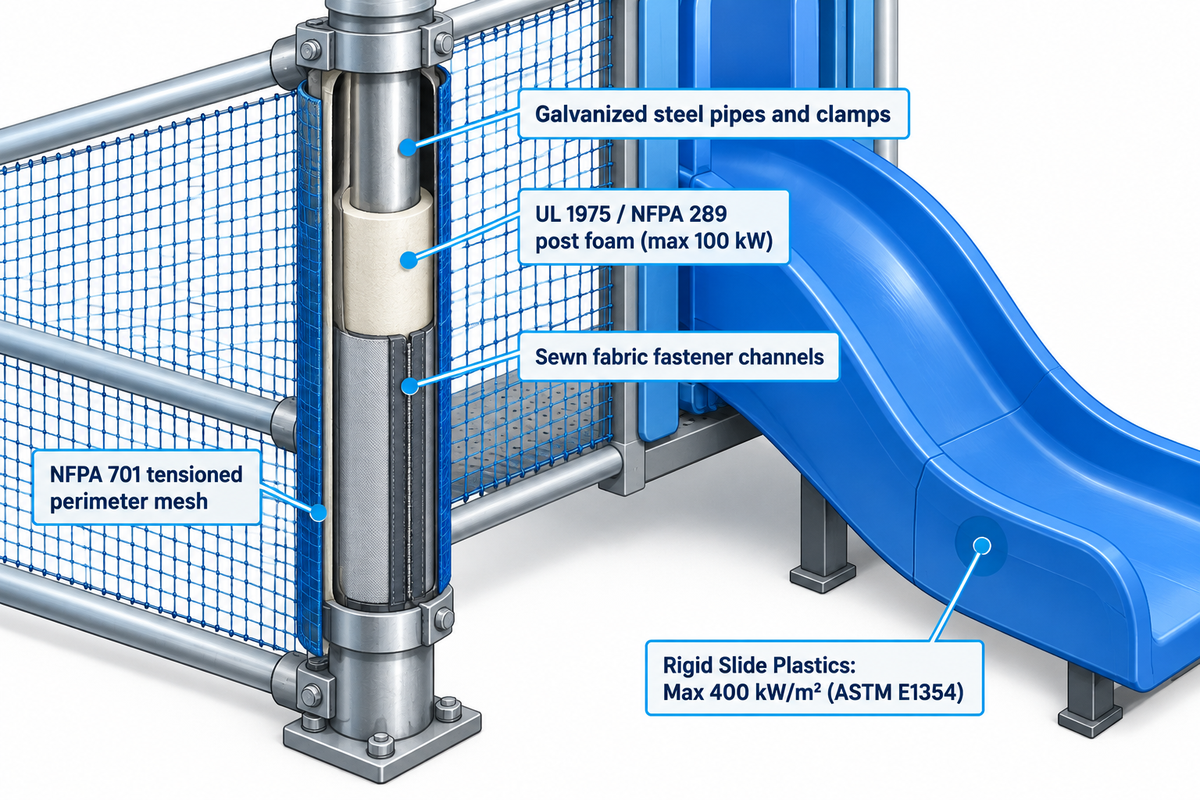
Under 2021 IBC Section 424.2, multi-level commercial play frames combine galvanized steel posts, Section 2303.2 fire-retardant wood decks, and UL 1975 or NFPA 289 post foam (≤100 kW). NFPA 701 mesh encloses open bays, while rigid slide plastics stay at or below 400 kW/m² under ASTM E1354.
As Recreation Management reports, play towers that stood 8 to 12 ft tall ten years ago now reach 20 to 30 ft. Protecting climbers at height relies on our four-part engineering checklist, the 4-Layer Containment Envelope framework. The first layer is formed by galvanized steel pipes and clamps. The second layer is closed-cell post-padding pipe foam. Sewn fabric fastener channels and tensioned perimeter mesh complete layers three and four. That concealed-rail geometry mirrors Graco’s playard U.S. Patent US9414694B2, which discloses four corner posts and top rails tucked inside sewn fabric tunnels alongside breathable mesh side walls.
Under 2021 IBC Section 424.2(6) and 424.2(7), molded slides, crawl tubes, and panels are tested per ASTM E1354 at 50 kW/m² heat flux and 6 mm thickness. Hollow balls in a foam ball pit or ball pit for toddlers must pass UL 1975 or NFPA 289 (20 kW source). Laboratories hold those balls inside a 36 × 36 × 21 in. (914 × 914 × 533 mm) galvanized wire mesh box. Indoor vinyl and foam degrade rapidly on outdoor playgrounds unless engineered for outdoor play under UV and frost. Keep that climate limit in mind when comparing traditional playground frames versus indoor soft play.
How Do You Choose Between Foam Cores and Wood-Backed Cores Inside Soft Play Modules?
Use 100% all-foam cores for movable floor blocks, rockers, and toddler soft play obstacles that children lift or tumble against. For fixed elevated decks, wall panels, and bolted stair ramps, specify fire-retardant wood-backed cores (IBC Section 2303.2).
All-foam modules eliminate hard internal edges when toddlers tip play blocks over during gross motor play. Fixed bridges, soft tunnel entries, and ramps inside foam play structures support adult attendants during rescues and nightly cleaning, so anchoring wood-backed decks to steel rails prevents platform sag. Where tight access limits delivery, such as rooftop school sites using a 6-by-6-ft elevator cited in Recreation Management, sculpted structural foam mounds fit cleanly.
Commercial Soft Play Material Specification Benchmarks by Venue Traffic Tier
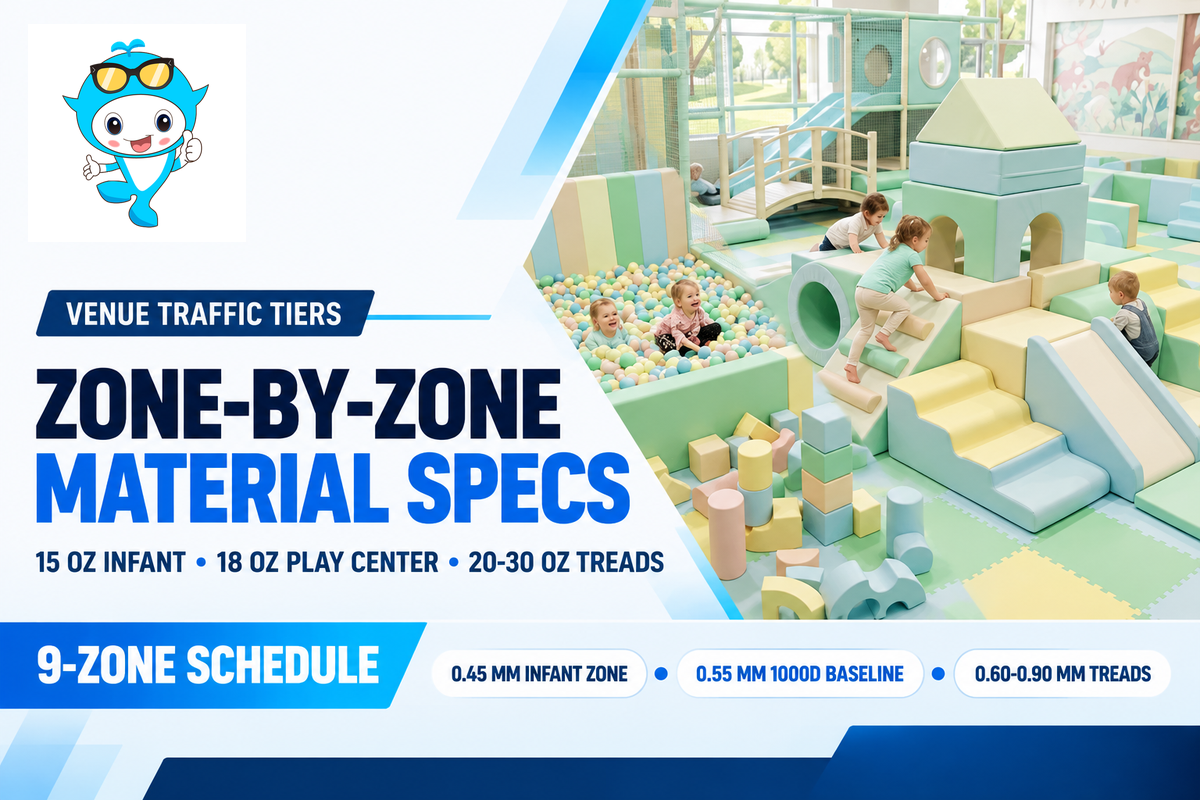
Match material grades to venue traffic per LY Trustlink and PFA tiers. Use light 15 oz (0.45 mm, ~510 gsm) PVC only in supervised infant corners. Specify 0.55 mm 1000D PVC with 1.8–2.2 pcf High Comfort polyurethane or XPE foam in standard play centers, and 20–30 oz (0.60–0.90 mm) PVC on heavy obstacle treads.
Different zones inside one play space wear out at very different speeds because entry steps take far heavier abrasion than upper panels. Start from 30 mm ground-level mats and 1.8–2.2 pcf High Comfort foam in the 9-Zone Soft Play Material Specification Schedule for modular commercial soft play sets, then scale thickness to deck fall height and fire review. Before bulk production, Didi Land’s foam play specification guide advises inspecting a 10 cm × 10 cm cover swatch and a 30 cm × 30 cm foam pad sample. Store spare PVC rolls indoors above 4°C per LY Trustlink.
| Venue Zone | Recommended Core Substrate | Outer Cover / Surface Spec | Operating Boundary |
|---|---|---|---|
| 1. Infant Sensory Crawl Corner | 1.8–2.2 pcf (29–35 kg/m³) High Comfort (HC) polyurethane (PFA) | 0.45–0.55 mm phthalate-free PVC or 5-wk ISO 1419 PU (ACT) | Socks-only baby play; rinse cleaner residue completely |
| 2. Play Cafe & Early Learning Climber | HC or HR polyurethane core + FR wood base on fixed ramps | 0.55 mm (~610 gsm) 1000D 23×23 PVC tarpaulin | Keep room above 4°C (PVC stiffens below ~4°C per LY Trustlink) |
| 3. Mobile Party Rental Soft Play Set | Lightweight closed-cell XPE + HC polyurethane | 0.55 mm 1000D 23×23 PVC, heat-welded or reinforced seams | Dry transport storage; under-500 gsm tears in transit |
| 4. FEC Multi-Level Contained Frame | Galvanized steel frame + IBC 2303.2 FR wood decks | 18–20 oz (0.55–0.60 mm) NFPA 701 PVC | Triggers 2021 IBC Section 424 fire rules above 10 ft high or 150 sq ft, plus Table 803.13 over 600 sq ft |
| 5. High-Traffic Stair & Ramp Treads | Bonded polyurethane base + resilient top cushion | 20–30 oz (0.60–0.90 mm) heavy-duty textured PVC | Not suitable for non-crosslinked EPE cores |
| 6. Structural Upright Post Sleeves | Closed-cell XPE / pipe foam (UL 1975 / NFPA 289 per IBC 424.2) | NFPA 701 flame-retardant PVC sleeve or coating | Inspect concealed zip ties or wrap seams weekly |
| 7. Ball Pit Walls & Pool Balls | Wood-backed or thick XPE padded border walls | 0.55 mm PVC walls + UL 1975 / NFPA 289 balls (IBC 424.2) | Requires mechanical ball-washer hygiene schedule |
| 8. Slide Run-Out & Fall Zones | Multi-layer shock-absorbing foam or unitary surfacing | ASTM E648 Class I floor (10–15 yr unitary life per Playground Professionals) | Depth must match structure critical fall height (ASTM F1292) |
| 9. Unstaffed Mall / Concourse Sculptures | Molded structural foam core (zero loose pieces) | Jointless TPU or hard elastomeric coating | Higher upfront tooling cost than sewn PVC blocks |
Fire Ratings, Mechanical Safety Standards, and Chemical Limits (US, EU, and UK)
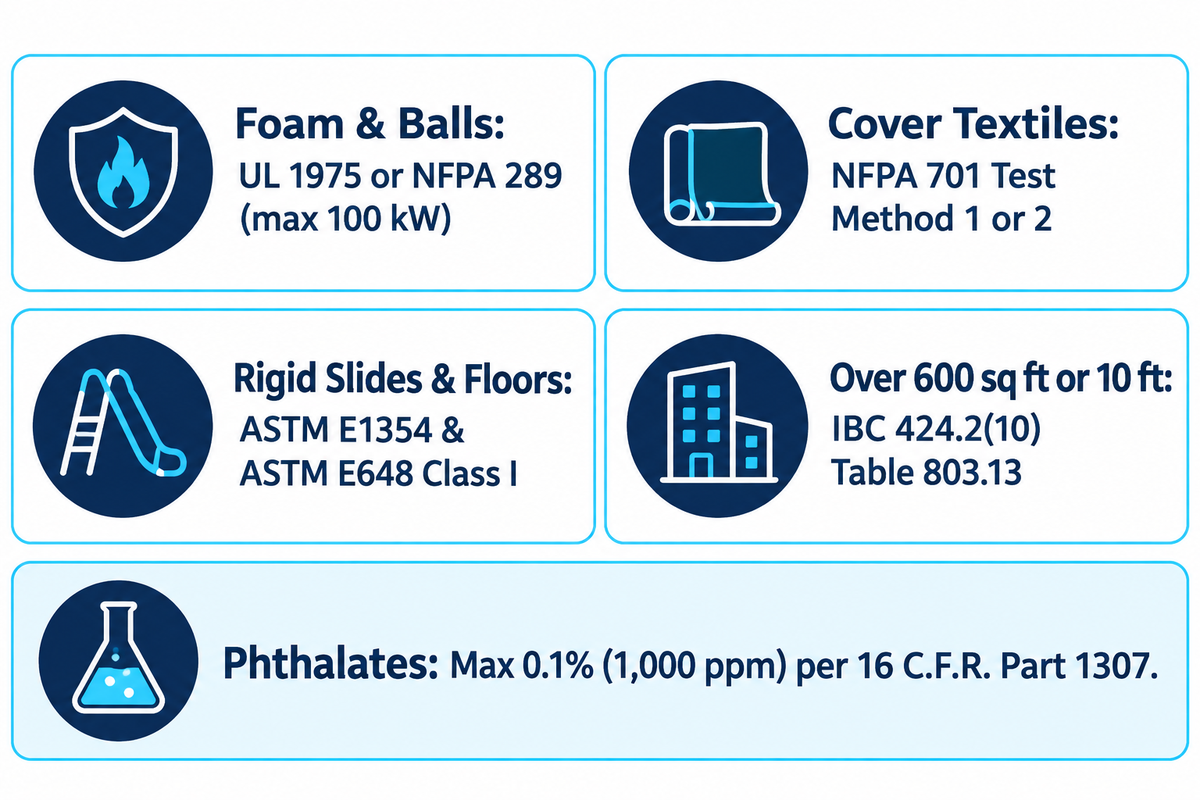
Commercial indoor soft play structures follow ASTM F1918-21 (US ages 2 to 12), EN 1176 (EU and UK), and 2021 IBC Section 424.2 fire testing. Accessible plasticized vinyl also falls under CPSC 16 C.F.R. Part 1307, capping each of eight ortho-phthalates at 0.1% (1,000 ppm).
“Any children’s toy or child care article, as defined at 16 C.F.R. § 1307.2, that contains concentrations of more than 0.1 % (1000 ppm) of the following phthalates in an accessible component part is prohibited”
One expensive mistake stalls occupancy approvals throughout the United States. Operators often hand a fire marshal an ASTM F963-23 toy certificate (mandatory for consumer toys made after April 20, 2024). Official CPSC Toy Safety Business Guidance explicitly excludes playground equipment from 16 C.F.R. Part 1250 and ASTM F963. However, CPSC’s phthalates guidance creates an important statutory split under CPSIA Section 108. Accessible vinyl on kids soft play modules for children ages 12 and under must still meet the 0.1% (1,000 ppm) limit of each of the eight ortho-phthalates via CPSC-CH-C1001-09.4. Separate CPSIA rules cap substrate lead, while 16 C.F.R. 16 C.F.R. Part 1303 covers painted surface coatings.
A standalone NFPA 701 fabric swatch sheet covers only one part of 2021 IBC Section 424.2. Building officials check five separate fire criteria across indoor soft play equipment and kids play structures. Foam plastics and balls require UL 1975 or NFPA 289 (≤100 kW), while cover textiles require NFPA 701 Test Method 1 or 2. Rigid slides require ASTM E1354 (≤400 kW/m²), and floor coverings require ASTM E648 or NFPA 253 Class I. Once a soft play area exceeds 600 sq ft or 10 ft high, IBC Section 424.2(10) requires Table 803.13 flame-spread compliance (with NFPA 286 permitted for Class A ASTM E84 or UL 723). European and UK venues pair EN 1176 with EN 13501-1 or BS 5852 fire rules and EN 71-3 / REACH chemistry; see our soft play equipment safety standards guide.
Daily Disinfection, Plasticizer Loss, and Material Maintenance Rules That Prevent Early Failure
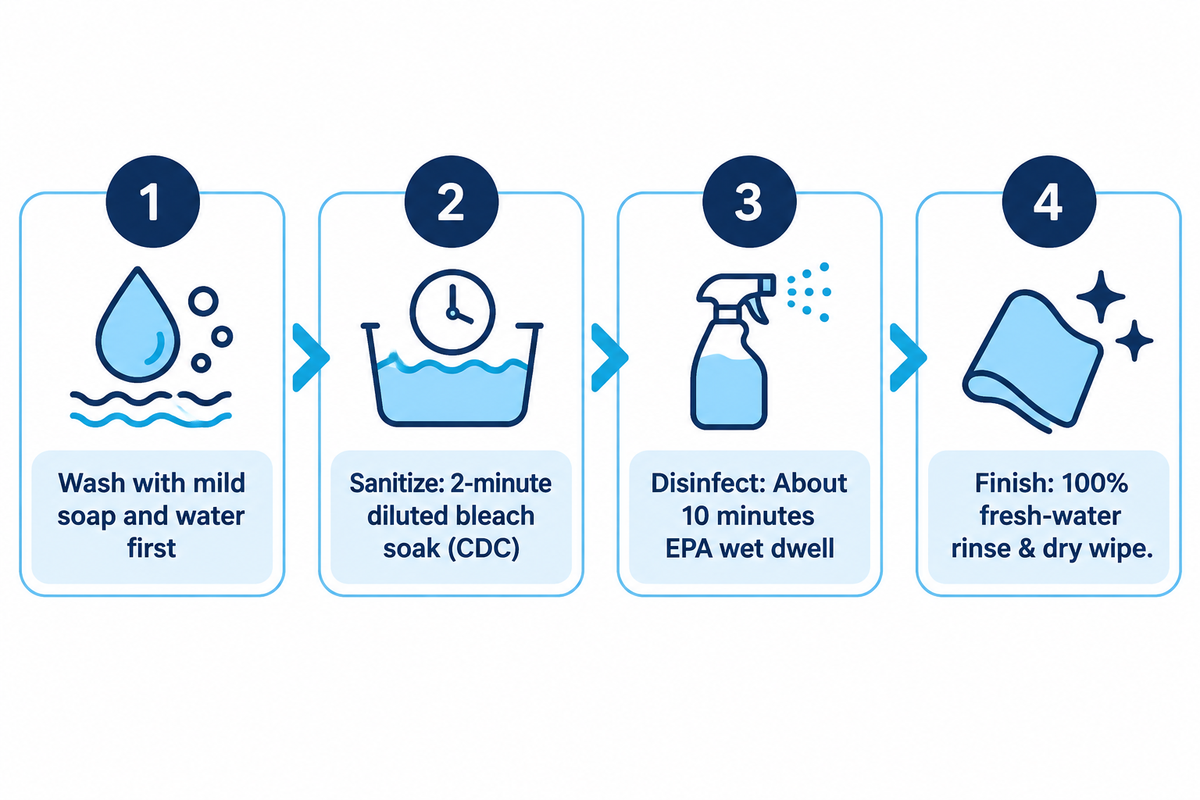
Wash PVC and PU surfaces with mild soap and water to begin. Apply an EPA-registered disinfectant or diluted bleach (1 tablespoon unscented bleach per gallon of water per CDC guidance) for its full contact time (about 10 minutes per Utah State University Extension). Finish PVC covers with a 100% fresh-water rinse and dry cloth wipe.
Spraying disinfectant straight onto sticky play blocks ruins both hygiene and cover longevity. CDC early care cleaning guidance notes that surface grime shields germs, requiring soap-and-water washing first, a 2-minute soak when sanitizing with diluted bleach, and 20-second handwashing afterward. Utah State University Extension adds that homemade DIY sprays aren’t always as effective as commercial EPA-controlled disinfectants, which typically need about 10 minutes of wet dwell time.
Skipping the fresh water rinse rots vinyl covers from the inside out. Blockhouse’s contract vinyl bulletin warns never to exceed a 10% bleach-to-90%-water ratio and always to rinse with 100% fresh water. Dried chemical residues trigger plasticizer migration and warranty-voiding cracks. Build this wash-dwell-rinse routine into your indoor playground maintenance schedule across all soft play products. Apply the same freshwater rinse to every crawl activity play set and foam block play zone. When sewing replacement covers, CPSC 16 C.F.R. Part 1109 allows certifying manufacturers and importers to rely on third-party component-part test certificates from vinyl and foam mills.
Soft Play Material Cost Drivers, Replacement Part Pricing, Factory MOQs, and BOM Verification
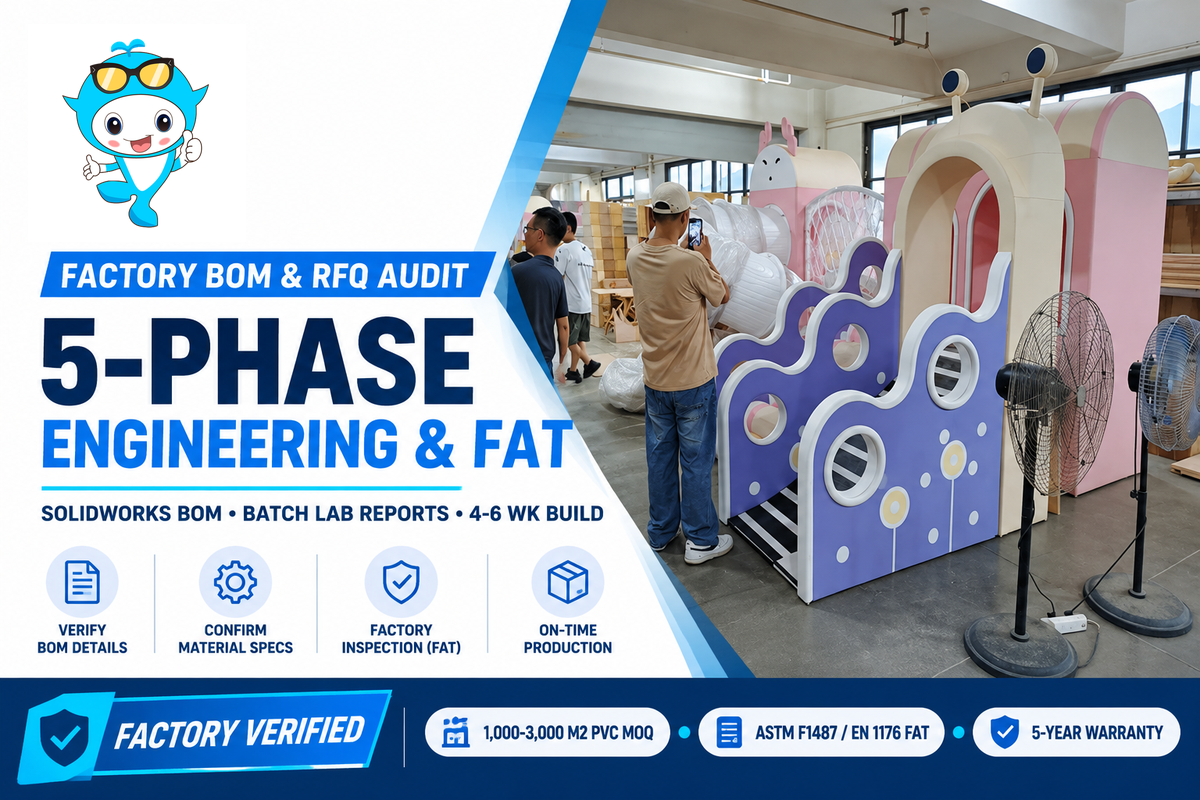
Per LY Trustlink’s factory roll data, commercial PVC tarpaulin carries 1,000 to 3,000 m² MOQs and 7-to-40-day lead times. Upgrading from 15 oz to 18 oz adds $180 per unit and cuts annual repairs from 12–16 down to 3–5 per 10 units. Custom sewn replacement pads and turnkey commercial playgrounds require a floor-plan BOM quote.
Procurement teams lose budget control when comparing bare retail catalog blocks for toddlers, soft blocks, rockers, and themed play sets against engineered public-assembly builds. Floor geometries, code-required column wraps, and variations in fire codes of the destination building impact material take-offs, which causes systems to be priced after engineers’ drawings are finalized.
This walkthrough with Didi Land’s 5-phase engineering process details material specification. Phase 1 provides a locked concept brief in 5 working days. Phase 2 produces AutoCAD layouts plus a 60-to-90-second 4K Lumion video in 2 weeks (up to 3 free revisions). Phase 3 finishes SolidWorks structural drawings, EN 1176 load calculations, and a complete Bill of Materials in 2 weeks (with 1 free revision). Phase 4 runs 4 to 6 weeks of factory production with an ASTM F1487 / EN 1176 Factory Acceptance Test report. Phase 5 includes 1 to 2 weeks of on-site installation (with crew arrival within 14 days of dock-load) and 5-year warranty registration.
How Should FEC Buyers Verify Certified Commercial Soft-Contained Play Manufacturers?
Vet commercial manufacturers by locking an itemized SolidWorks Bill of Materials before paying a production deposit. Verify third-party CPSC-accepted or EN lab report numbers with the batch of the foam and vinyl, and check the pre-shipment Factory Acceptance Test load videos.
Global customers evaluate commercial soft play equipment manufacturers such as Didi Land along with export producers such as Dreamland Playground and Globalltoy. The same benchmark comparison is applicable to both early learning centers and family entertainment centers. Ensure that your suppliers have in-house laser tube cutting, robotic welding, and upholstery lines. This way, you can trace the steel gauge, foam and vinyl batches. Lock these six specification items into your purchase contract before fabrication begins.
Commercial Soft Play BOM & Lab-Report RFQ Verification Checklist
- Specify 0.55 mm (~610 gsm) minimum PVC weight over a 1000D 23×23 scrim per LY Trustlink. Attach ≥240 N tear, 70–100 N DIN 53357 peel, and NFPA 701 reports.
- Schedule crosslinked XPE, 1.8–2.2 pcf High Comfort polyurethane (per PFA), or bonded step-base foam by zone. Include ASTM D3574 IFD and IBC 424.2 UL 1975 pipe-foam reports.
- Attach third-party lab certificates under CPSC 16 C.F.R. Part 1307 (via CPSC-CH-C1001-09.4) and EN 71-3. Include CPSIA substrate lead and Part 1303 surface-coating reports.
- Require IBC Section 424.2 fire reports covering ASTM E1354 on rigid slides and UL 1975 on ball-pit balls. Add ASTM E648 Class I and ASTM F1292 reports for floor mats.
- Approve a physical 10 cm × 10 cm vinyl swatch and 30 cm × 30 cm foam pad per Didi Land’s sample protocol. Inspect concealed zipper pockets and heat-welded seams.
- Associate milestone payments with the Phase 3 SolidWorks Bill of Materials and EN 1176 / ASTM F1918 load calculations. Require the Phase 4 ASTM F1487 / EN 1176 Factory Acceptance Test report prior to shipping.
2026 Soft Play Material Shifts: Phthalate-Free Coatings, Sculpted Foam, and Compliance Filing
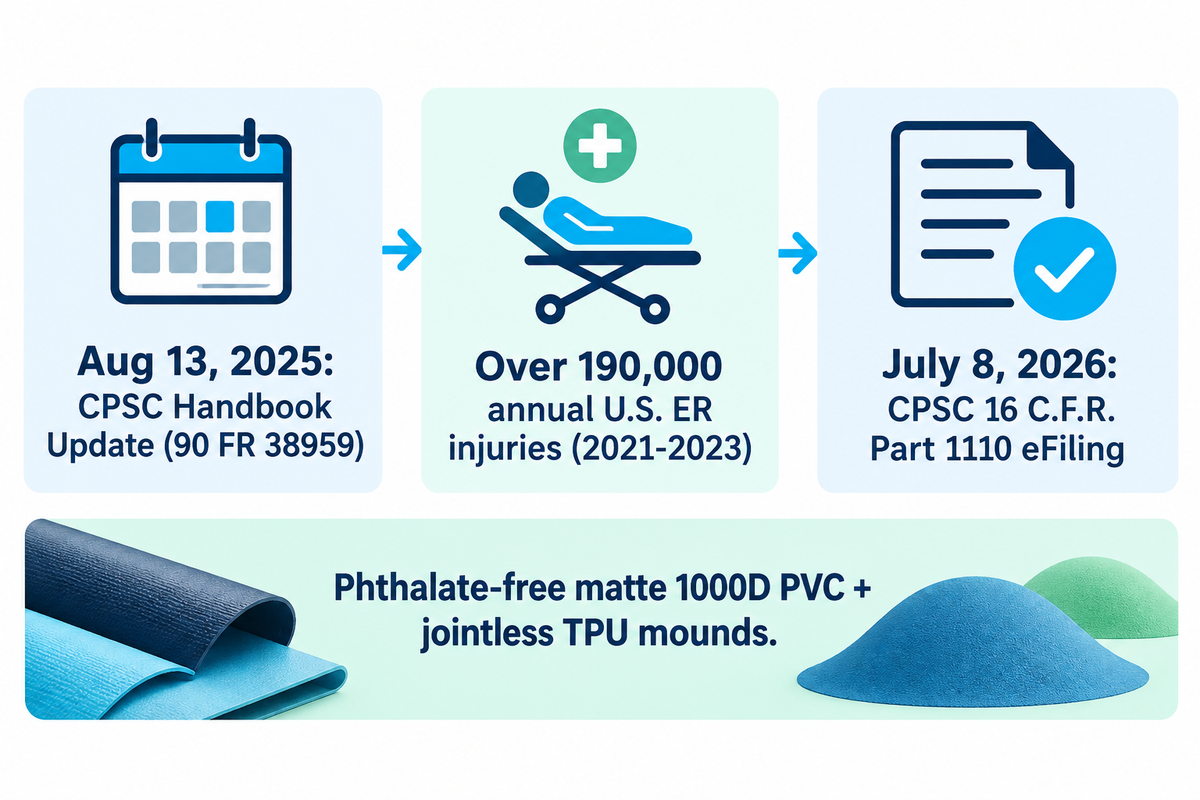
There are two federal milestones that reshape the procurement of commercial soft play materials through 2026. The first is the August 13, 2025 CPSC Public Playground Safety Handbook update (90 FR 38959). The second is mandated electronic filing of certificates (eFiling) with the CPSC, which takes effect July 8, 2026, for regulated imported children’s products.
In accordance with the CPSC Children’s Product Certificate eFiling rules (16 C.F.R. Part 1110), as of July 8, 2026, importers will be required to electronically file seven certificate fields. This rule pertains to retail level products, such as a soft climber for infants, foam climbing toys for toddlers, and climb and crawl activity play kits. Meanwhile, the August 13, 2025 Federal Register Handbook Notice identifies more than 190,000 annual U.S. playground emergency room injuries (2021-2023) and assigns play structures one critical fall height from the highest deck. The notice also eliminates the standalone ASTM F3351 reference because that method is being folded into ASTM F1292.
In colorful soft play zones, operators pair phthalate-free matte 1000D PVC with jointless TPU over sculpted foam mounds. Because jointless TPU leaves no exposed stitch seams, this combination helps achieve inclusive gross motor development in unstaffed concourses. Is your floor plan ready? Take a look at Didi Land’s high-quality soft play equipment and send us your dimensions for a Phase 1 concept brief and BOM schedule.
Frequently Asked Questions
Can I build my own commercial soft play area using upholstery foam and marine vinyl?
For a private home playroom, parents can slice High Comfort polyurethane foam with an electric foam blade, wrap edges in batting, and zip blocks into sewn phthalate-free vinyl covers. For a commercial venue, no: DIY furniture foam and standard marine vinyl rarely pass public-assembly inspections. Household foam lacks UL 1975 or NFPA 289 heat-release reports, and retail marine vinyl lacks project-matched NFPA 701 textile certificates alongside ASTM F1918-21 or EN 1176 entrapment verification.
Why is commercial soft play equipment much more expensive than retail foam play sets?
Commercial soft play equipment costs more because it incorporates galvanized steel framing with IBC Section 2303.2 fire-retardant wood decks and crosslinked XPE or resilient polyurethane cores. Outer skins use Heavy Scrim reinforced PVC tarpaulins. Pricing also funds engineering, SolidWorks structural load calculations, third-party fire and chemical migration lab testing, and pre-shipment Factory Acceptance Testing.
What safety and fire test records do operators need for soft play materials?
Operators need ASTM F1918-21 (US) or EN 1176 (EU) mechanical records alongside ASTM F1292 floor impact reports. Under 2021 IBC Section 424.2, fire submittals include UL 1975 or NFPA 289 (≤100 kW) on pipe foam and balls, NFPA 701 covers, ASTM E1354 (≤400 kW/m²) rigid plastics, and ASTM E648 Class I flooring. Structures over 600 sq ft or 10 ft also require Table 803.13 finish ratings (ASTM E84 or NFPA 286), alongside CPSC 16 C.F.R. Part 1307 phthalate reports.
Are PVC soft play covers phthalate-free and safe for infants who mouth surfaces?
Commercial PVC covers suit mouthing zones only when made with non-phthalate plasticizers. Batch reports must verify CPSC 16 C.F.R. Part 1307 (≤0.1%, or 1,000 ppm, for each of eight ortho-phthalates via CPSC-CH-C1001-09.4) and EN 71-3 heavy-metal limits for infant and toddler safe materials.
How thick should EVA or XPE floor mats be under commercial soft play climbers?
In ground-level infant crawl zones with zero elevated decks, Didi Land’s planning benchmarks start with a 3 cm (30 mm) thick cushioned XPE or EVA floor mat with beveled edges. Under elevated climbers, mat thickness must meet ASTM F1292 impact attenuation at the structure’s critical fall height. Based on the August 2025 edition of the CPSC’s Public Playground Safety Handbook, a composite play structure provides one critical fall height, which is measured from the highest play deck. High-deck landing zones therefore require lab-certified multi-layer crosslinked foam or unitary safety surfacing (10-to-15-year service life per Playground Professionals). That floor system must also hold a Class I fire rating under ASTM E648 or NFPA 253 per 2021 IBC Section 424.2.
Can torn commercial PVC soft play vinyl be patched on-site, or must the cover be replaced?
Small punctures on flat commercial PVC panels can be sealed in minutes with a vinyl patch kit to keep moisture out of the foam core. Brittle panels that crack and expose the foam are a different case, as are damaged panels in mouthing zones. Those require a factory cover replacement which must also have an NFPA 701 certificate.
References & Sources
- 2021 International Building Code (IBC) Section 424.2: Children’s Play Structures, Materials International Code Council (ICC)
- Glossary of Flexible Polyurethane Foam Terms Polyurethane Foam Association (PFA)
- Making Playground Surfacing Safe for Kids Playground Professionals
- Hydrolysis: What You Need to Know Association for Contract Textiles (ACT)
- Higher Ground: Playground Design Trends Recreation Management
- US9414694B2: Child Containment System with Multiple Infant Support Modes United States Patent and Trademark Office (via Google Patents)
- Phthalates Business Guidance and Frequently Asked Questions (16 C.F.R. Part 1307 & Part 1109) U.S. Consumer Product Safety Commission (CPSC)
- Toy Safety Business Guidance (16 C.F.R. Part 1250 / ASTM F963) U.S. Consumer Product Safety Commission (CPSC)
- How To Clean and Disinfect Early Care and Education Settings Centers for Disease Control and Prevention (CDC)
- Disinfecting or Sanitizing? Here Are 5 Smart Cleaning Facts You Might Not Know Utah State University Extension
- Children’s Product Certificate (CPC) and Mandatory eFiling Guidance (16 C.F.R. Part 1110) U.S. Consumer Product Safety Commission (CPSC)
- Notice of Availability: Public Playground Safety Handbook Update (90 FR 38959, Aug. 13, 2025) Federal Register / U.S. Consumer Product Safety Commission
Scope & Verification Note: Polymer densities, fabric strengths, and fire thresholds synthesize 2021 IBC Section 424.2, CPSC regulations, PFA and ACT guides, and Didi Land schedules as of November 2026. Local Authority Having Jurisdiction rules govern final occupancy approval. The Guangzhou Didi Land Amusement Equipment Co. Ltd. technical team reviewed this document.