Get in Touch with Didi Land

How Does School Recess Help Reduce Chronic Stress Levels? Why Kids Need Daily Recess in Elementary Schools

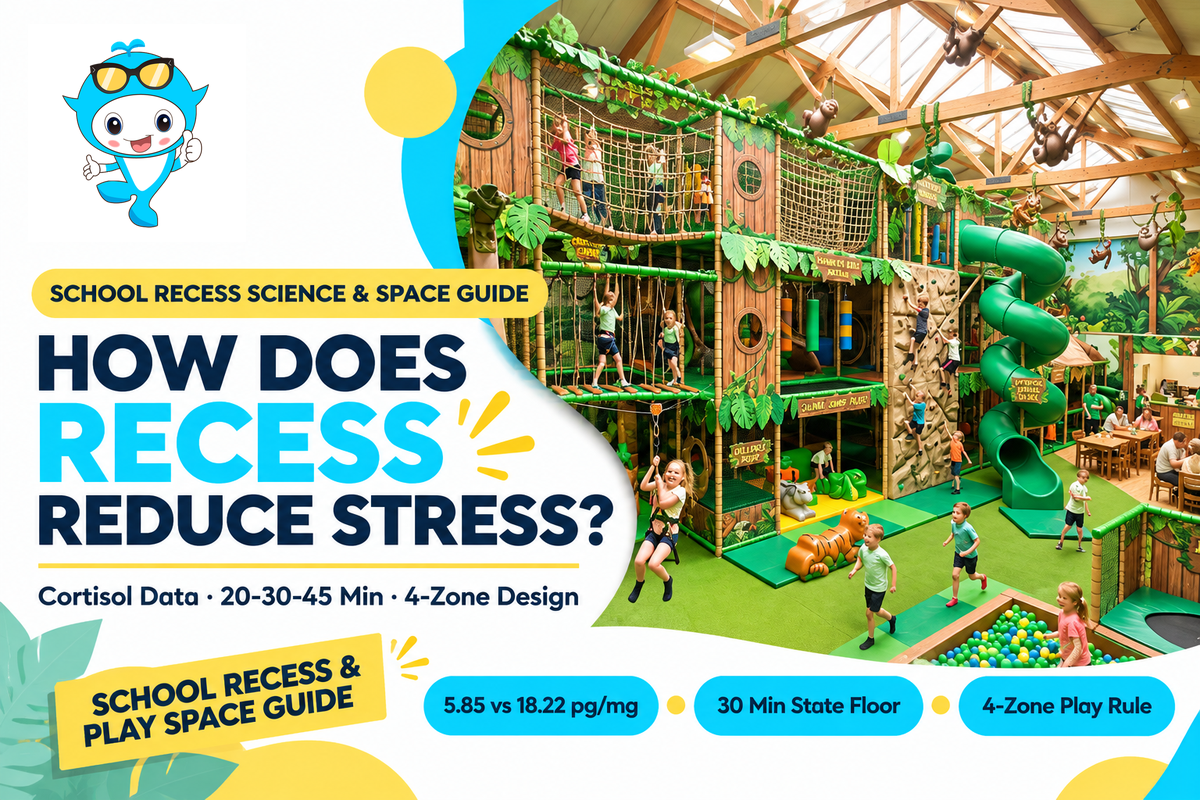
How does recess reduce stress for children and adolescents during a demanding school day? Unstructured recess time combines physical activity, outdoor breaks, and peer play to interrupt classroom strain. In a 2025 quasi-experimental study of 130 fourth graders (Rhea et al., NIH PMC12293798), students with 45 minutes of daily outdoor recess plus 15 minutes of character education averaged 5.85 pg/mg hair cortisol. Control schools with 30 minutes of recess averaged 18.22 pg/mg.
The measured level of 5.85 pg/mg is below the pre-COVID benchmark of 7.5 pg/mg and reflects stress exposure over three months. Protecting recess opportunities supports the mental health of students, and aids children’s physical growth and mental resilience of students. Play enhances students’ mental health, and aids their focus and concentration. Below we cover policy benchmarks, biological pathways, school budget, and school design.
💡 Key Findings at a Glance
- In the 2025 study, fourth graders in the extended-recess group had average hair cortisol levels of 5.85 pg/mg, compared with 18.22 pg/mg in standard-schedule control schools (NIH PMC12293798).
- The CDC and SHAPE America recommend at least 20 minutes of daily recess. Washington (RCW 28A.230.295) and California (SB 291) require 30 minutes on qualifying elementary school days.
- The American Academy of Pediatrics (AAP via HealthyChildren.org) advises schools never to withhold recess for incomplete work or routine discipline.
- Active climbing zones, separate from seating, can alleviate crowding on school playgrounds. Rainy days can increase classroom noise. Separating active climbing zones from seating can alleviate both of these issues.
How Does School Recess Help Reduce Stress? The 3-Pathway Cortisol & Nervous-System Reset Model
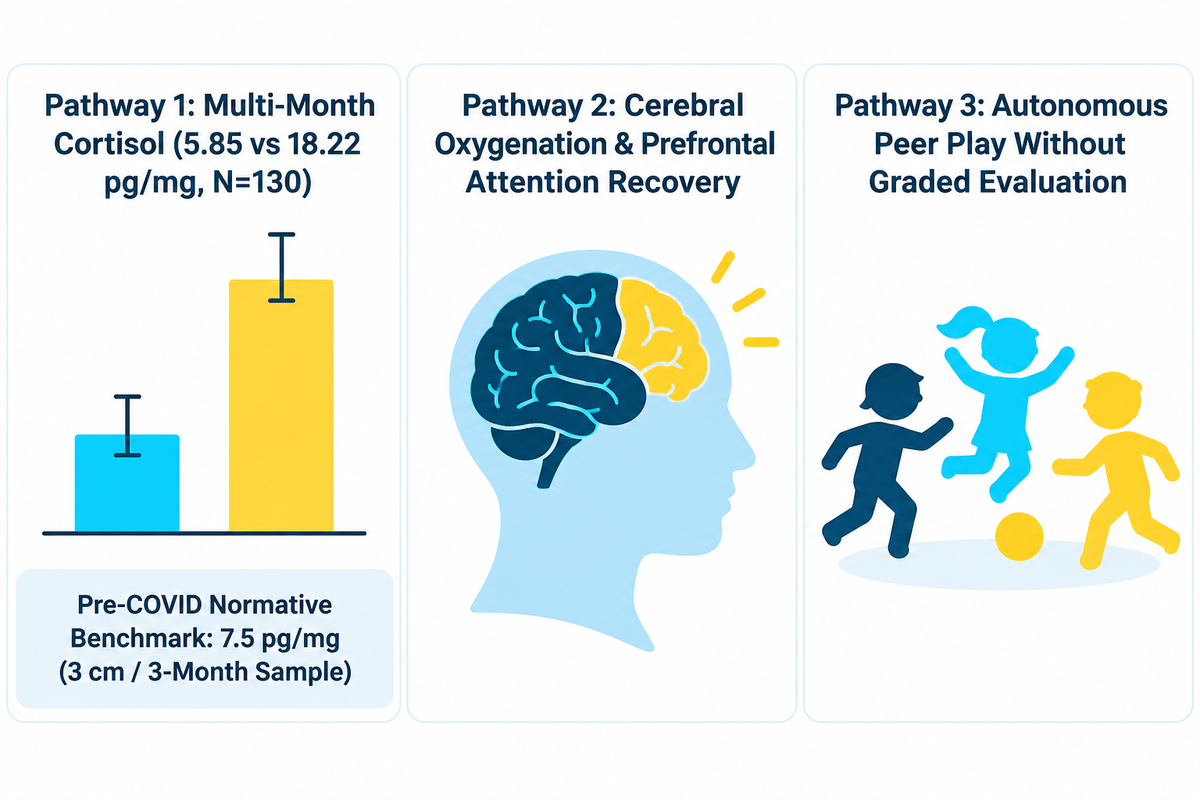
School recess helps reduce stress through three connected pathways in our 3-Pathway Cortisol & Nervous-System Reset Model: physical movement, cognitive rest, and autonomous peer play. Research shows that recess is essential, because continuous classroom time keeps kids under constant evaluation. Offering recess throughout the school day breaks that strain, before chronic stress in children builds into mental health disorders.
Each pathway works on a distinct biological timeline:
- Pathway 1 covers multi-month cortisol exposure. In the 2025 Texas Christian University study of 130 fourth-grade elementary students (Rhea et al., PMC12293798), researchers tested 3 cm hair samples covering roughly three months. The extended-recess group averaged 5.85 pg/mg (SD = 6.26), roughly 68% lower than the 18.22 pg/mg control mean. This difference is a strong group association, not an isolated causal effect of extra recess. The study used a single fall sampling point, combined extra recess with character education, and lacked socioeconomic controls.
- Pathway 2 focuses on cerebral oxygenation and attention recovery. Physical activities like running and climbing increase blood flow and oxygen to the brain. Taking a break from seated activities provides a pause in prolonged concentration. After breaks during the school day, students are ready to engage with classroom instruction.
- Unlike graded physical education, unstructured free play lets children choose their own games and social pace. As noted by St. Luke’s Penn Foundation, unstructured and informal peer-play helps build friendship and school-related anxieties ease.
“Recess represents an essential, scheduled break from rigorous cognitive tasks. It permits students the opportunity to play, imagine, think, and move.”
American Academy of Pediatrics (AAP), The Crucial Role of Recess in School (HealthyChildren.org)
How Does Having Recess in School Help Students Regulate Cortisol and Adrenaline?
Having recess in school can ease perceived stress by providing voluntary movement, social interaction, and a break from classroom demands. Play time can temporarily increase adrenaline, but consistently taking active breaks throughout the day supports better stress hormone management. Classroom evaluation can cause students to become defensive, alert, and on edge. Without it, students are able to rest and give themselves a break.
Teachers should differentiate between a student’s immediate mood and stress hormone management. Occasional gym classes cannot replace daily breaks throughout the day.
Core Benefits of Recess: How Recess Supports Executive Function, Social Skills, and Academic Performance
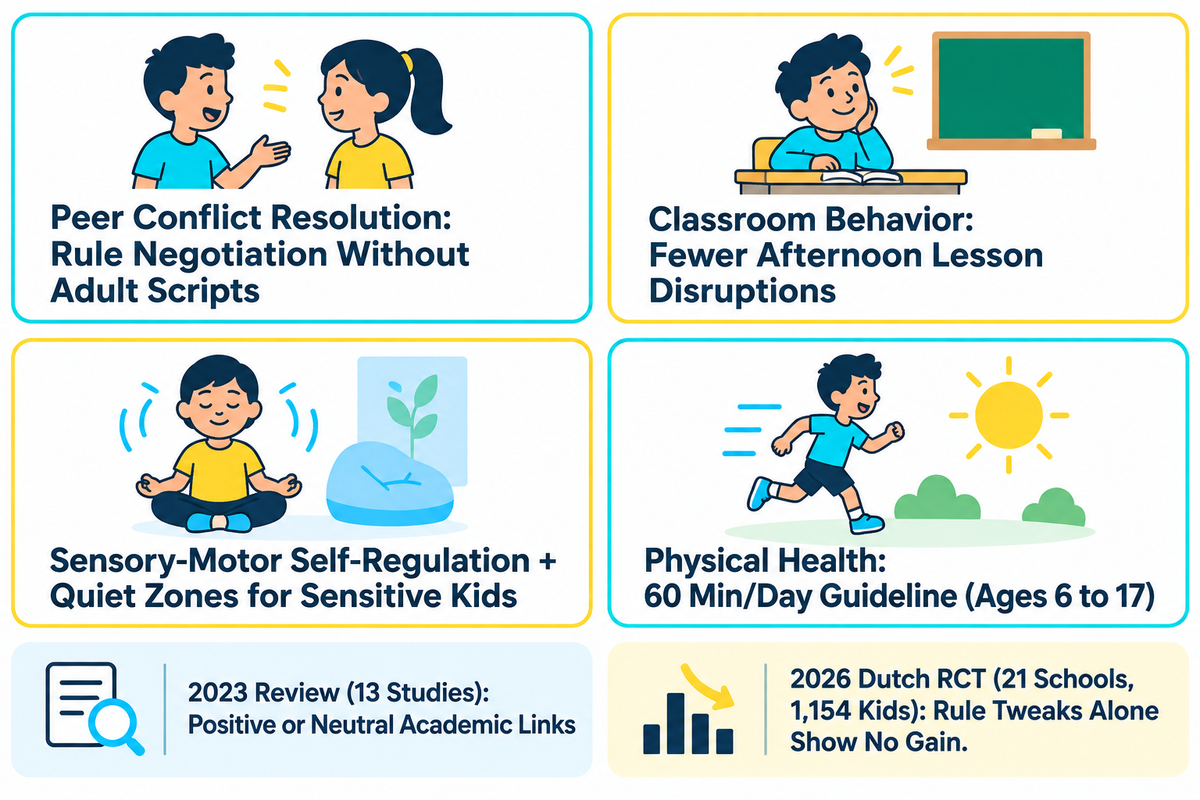
The core benefits of recess reach beyond stress relief: recess supports executive function, social skills, physical health, and academic performance from kindergarten through 12th grade. Recess also supports positive social behavior, health and development while managing anxiety and depression risks with the help of time in school. Federal guidelines note that children between the ages of 6 and 17 need at least 60 minutes of physical activity each day.
Research has shown that students who receive regular physical activity breaks focus better during lessons. A 2023 systematic review of 13 studies (Howie et al., NIH PMC10664954) points to positive or neutral associations of recess and academic outcomes. While observational reviews cannot guarantee identical test-score gains in every bell schedule, cutting recess for extra worksheets increases cognitive fatigue.
One 2026 randomized controlled trial in 21 Dutch primary schools covering 1,154 children (Brocken et al., PubMed 42437659) evaluated a one-year recess modification. There was no significant intervention effect on overall physical activity or on social-emotional functioning, compared to the standard recess. Playground rules modification has not been shown here to bring changes in mental and physical health. Meaningful outcomes for children depend on trained supervision, and attention to daily needs and the design of the space.
Students engage in four developmental areas when given time during the day for unstructured free play:
- Peer conflict resolution skills increase as children negotiate game rules and settle minor disputes without adult scripts.
- Better classroom behavior often follows active breaks, which reduces disruptive behavior during afternoon lessons.
- Sensory-motor activities such as swinging and climbing help kids self-regulate. However, sensory-sensitive kids still need areas where they can be quiet. See our guide on vestibular and proprioceptive sensory play activities for early learners for more information.
- Physical development improves as active play counters sedentary habits and lowers long-term metabolic health risks.
Why Is It Important to Reduce Stress During the Elementary School Day?
Reducing stress during the elementary school day protects working memory, emotional control, and children’s mental health. It can also negatively impact the mental health of students. When stress and anxiety in children continue over multiple lessons, students shift their attention to defend themselves rather than focusing as children learn. Scheduled breaks interrupt that cycle before mental fatigue disrupts the classroom.
Across the U.S., pediatricians report growing rates of depression and anxiety among school-age youth. Children today have less unstructured outdoor time than prior generations, and recess has declined under testing pressure. Protecting daily time to play helps ensure that students take frequent breaks, regardless of family commitments, and after school sports.
How Long Should Recess Be to Lower Stress? The 20-30-45 Minute Recess Dose-Response Matrix
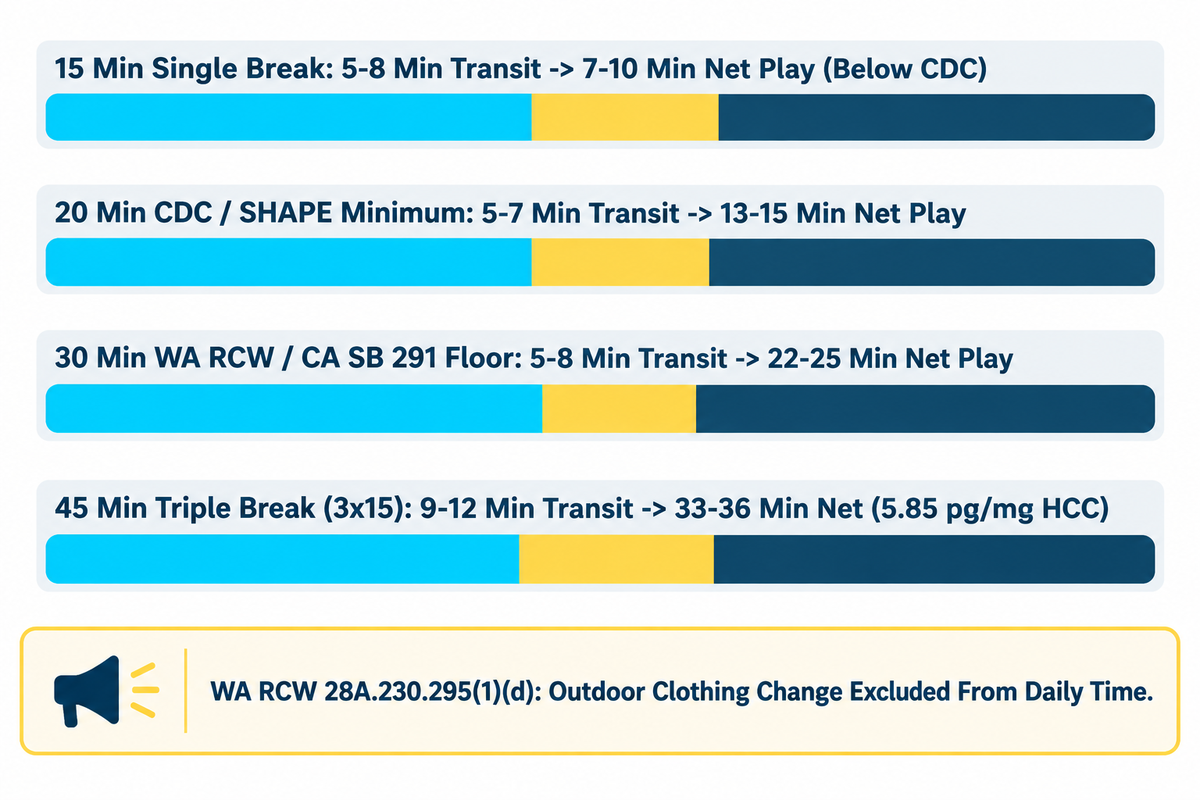
The CDC and SHAPE America recommend at least 20 minutes of daily recess for elementary schools, while state laws in Washington (RCW 28A.230.295) and California (SB 291) require 30 minutes on qualifying school days. Separately, the 2025 quasi-experimental study (PMC12293798) observed lower hair cortisol in schools scheduling three 15-minute breaks.
Keep one evidence boundary in mind. The 2023 systematic review (PMC10664954) observed that quantitative studies didn’t explicitly assess a dose-response curve across recess durations. Therefore, our 20-30-45 Minute Recess Dose-Response Matrix compares policy recommendations, legal minimums, and observational study schedules side by side rather than presenting them as a single clinical dose-response trial. Transit time is also important. Washington RCW 28A.230.295(1)(d) states that time spent changing outdoor clothes shouldn’t count toward the daily requirement. Thus, schools need to factor in transit time when planning for outdoor play.
| Schedule Model | Gross Time / Day | Est. Transition Loss | Time Available for Recess | Policy / Evidence Anchor | Practical Scheduling Impact |
|---|---|---|---|---|---|
| Single Short Break | 15 min (1×15) | 5–8 min | 7–10 min | Below CDC guideline | Leaves minimal time for peer game setup or tension release. |
| CDC / SHAPE Guideline | 20 min (1×20) | 5–7 min | 13–15 min | CDC & SHAPE America minimum | National baseline guideline; afternoon fatigue can still build in K–2. |
| Early-Release Floor | 15 min (half day) | 4–6 min | 9–11 min | California SB 291 early-release rule | Preserves a brief movement break on shortened school days. |
| Single 30-Minute Scheduled Block | 30 min (1×30) | 5–8 min | 22–25 min | WA RCW 28A.230.295 / CA SB 291 | Budget 35–38 gross minutes if excluded outdoor changing time applies. |
| Split Dual Break | 30 min (2×15) | 8–10 min total | 20–22 min | AAP multiple-break recommendation | Interrupts both morning and afternoon classroom attention drop-offs. |
| Pre-Lunch Recess Block | 25–30 min pre-meal | 5–6 min | 19–25 min | CDC / Action for Healthy Kids | Supports calmer cafeteria transitions and smoother afternoon entry. |
| Triple-Break Cortisol Schedule | 45 min (3×15) | 9–12 min total | 33–36 min | NIH PMC12293798 (5.85 pg/mg HCC) | Observed alongside ~68% lower hair cortisol vs. 30-min control schools. |
| Four-Break Multi-Period Model | 60 min (4×15) | 12–16 min total | 44–48 min | LiiNK Project K–2 protocol | Provides scheduled movement opportunities toward the 60-min daily target. |
| Rainy-Day Indoor Motor Block | 20–30 min indoor | 3–5 min | 15–27 min | Dedicated soft-play / gym zone | Preserves active movement when weather closes outdoor yards. |
How Many Minutes of Daily Outdoor Recess Do Elementary Students Need to Lower Chronic Stress?
The CDC and SHAPE America recommend at least 20 minutes of recess each day, and Washington and California statutes set a 30-minute elementary benchmark on qualifying days. The 2025 quasi-experimental study (PMC12293798) associated three daily 15-minute outdoor recess breaks combined with character education with lower three-month hair cortisol.
Age level also shapes scheduling. Younger students (K-2) have more difficulty sustaining attention and benefit from more frequent, shorter breaks. Students in grades 3-5 often need one longer midday break for cooperative games, followed by a shorter break in the afternoon to reset. Counting net play time outside hallway transit keeps schedules honest.
Outdoor Recess vs. Indoor Recess Play Zones and Brain Breaks: 9-Row Recess Format & Sensory Matrix
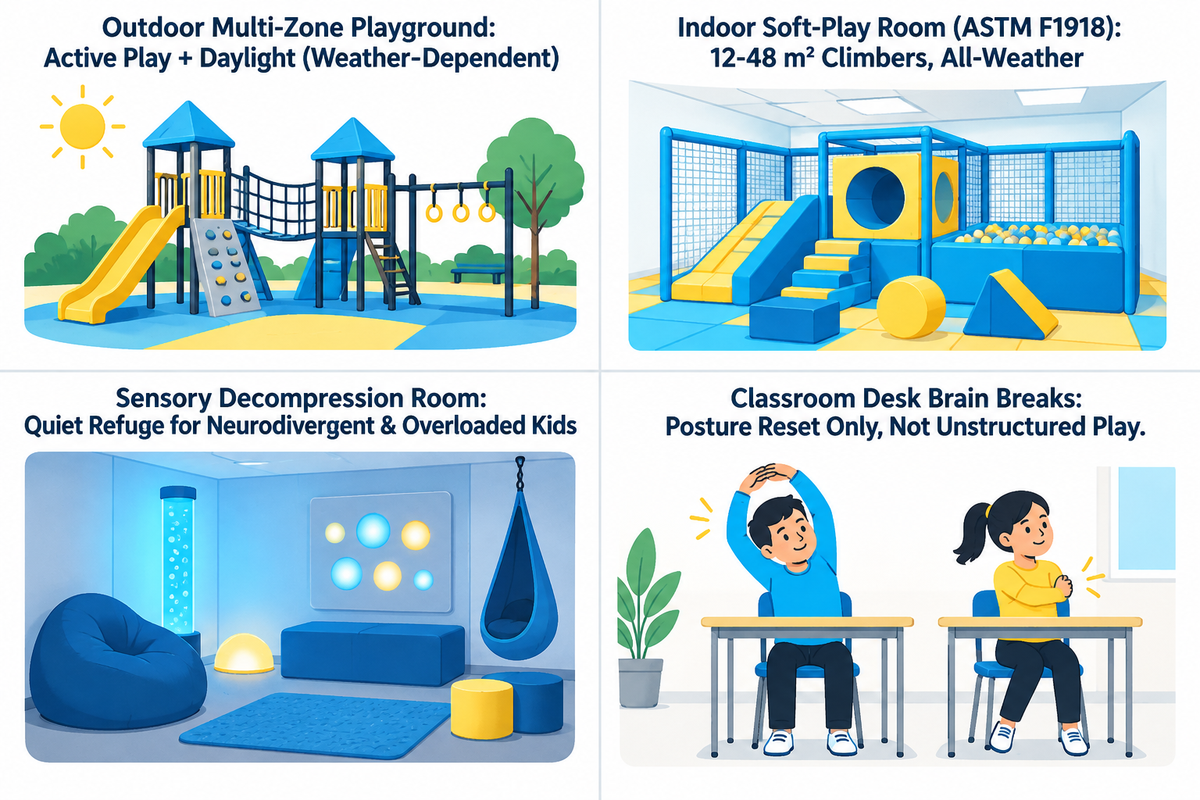
Outdoor recess pairs active movement with natural daylight and open space, while dedicated indoor play rooms sustain movement during rain, cold, or extreme heat. Direct clinical trials comparing every indoor and outdoor format head-to-head remain limited. However, educator reports and health agencies consistently prefer active play zones over passive classroom screen time.
Parents and schools should not confuse physical education, classroom brain breaks, and recess. Physical education classes develop graded motor skills. Brief classroom breaks reset posture without offering autonomous peer play. True recess allows students to choose movement or rest. When outdoor areas are closed due to weather, purpose built commercial indoor playgrounds for schools and school sensory room and vestibular equipment ideas allow students to move and provide calming activities instead of trapping a class beside their desks.
In the 9-Row Recess Format & Sensory Decompression Matrix, evaluate nine school play and break formats:
| Recess / Break Format | Primary Play Function | Sensory Input Profile | Weather Availability | Best Grade Levels | Key Operational Limitation |
|---|---|---|---|---|---|
| 1. Outdoor Multi-Zone Playground | Active movement + daylight + peer play | Vestibular, proprioceptive, visual | Weather-dependent | Pre-K to Grade 5 | Closed during heavy rain, ice, or heat advisories. |
| 2. Green Schoolyard & Nature Play | Visual rest + low-noise exploration | Tactile, daylight, low echo | Weather-dependent | Pre-K to Grade 8 | Requires ongoing landscaping and drainage upkeep. |
| 3. Outdoor Loose-Parts & Game Court | Cooperative games + peer negotiation | Proprioceptive, social-auditory | Weather-dependent | Grades 1–6 | Needs painted boundaries to prevent ball-game sprawl. |
| 4. Contained Indoor Soft-Play Room (ASTM F1918) | Indoor gross-motor climbing & crawling | Padded climbing, proprioceptive | All-weather indoor | Pre-K to Grade 4 | Didi Land lists 12–48 m² modular climber footprints; acoustic treatment can cut echo. |
| 5. Sensory Decompression Room | Quiet refuge for sensory overload | Controlled vestibular, deep pressure | All-weather indoor | K–12 (including neurodivergent) | Serves small rotating groups rather than an entire grade at once. |
| 6. Gymnasium Modular Soft Obstacle Course | High-energy aerobic movement indoors | Gross-motor, balance, climbing | All-weather indoor | Grades K–5 | Competes with PE gym blocks; hard walls amplify noise. |
| 7. Hallway Sensory Motor Path | Brief proprioceptive reset between tasks | Hopping, wall push-ups, balance | All-weather indoor | Grades K–3 | Short individual pass; cannot replace peer recess breaks. |
| 8. Structured Coach-Led Recess Games | Inclusive entry + fewer rule disputes | Aerobic + guided social cues | Outdoor or gym | Grades 1–5 | Needs trained staff or volunteers; offers less free choice. |
| 9. Classroom Desk Brain Breaks | Short posture and circulation reset | Stretching, breathing, light motion | All-weather indoor | Grades K–12 | Teacher-led micro-break; does not replace unstructured play. |
Why Students Still Get Overstimulated at Recess: Crowding, Sensory Overload, and Withholding Policies
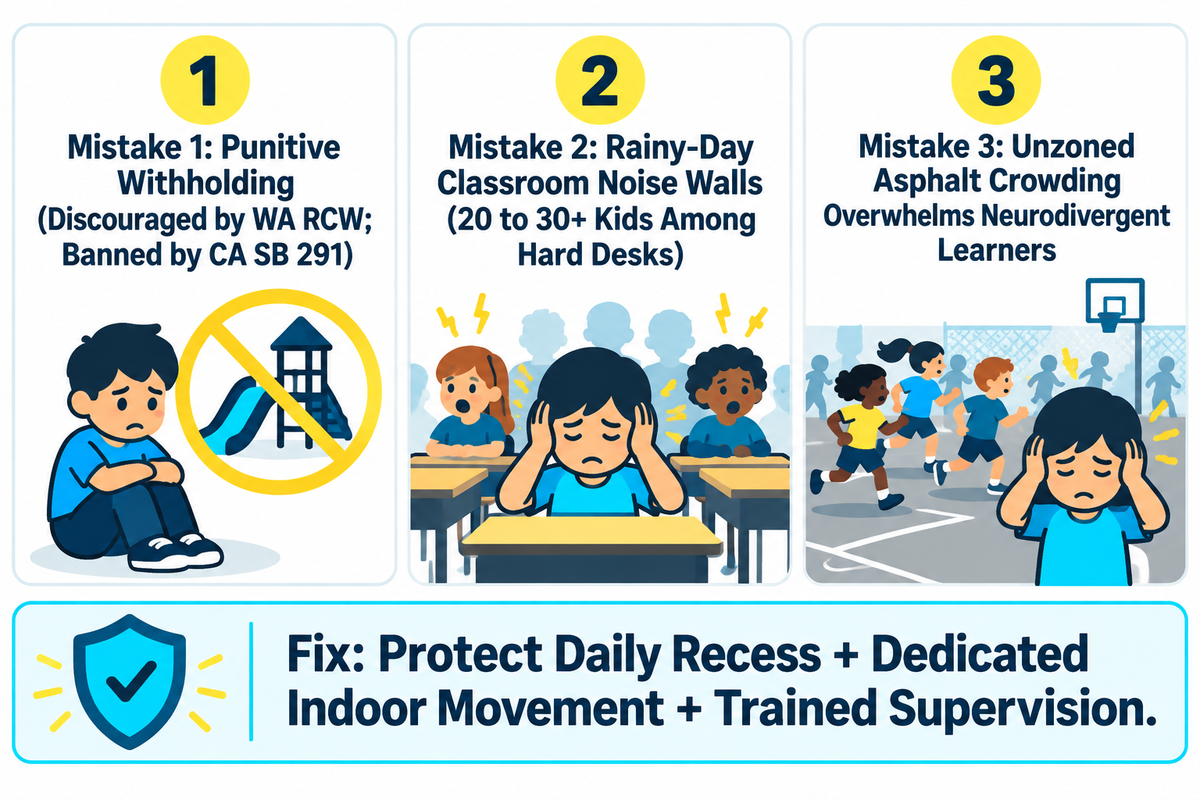
Recess can raise stress instead of lowering it when schools trap full classes inside noisy rooms during rain, pack students onto unzoned asphalt, or withhold recess as punishment. Unstructured free play supports calm only when play spaces and supervision protect both energetic movers and sensory-sensitive children.
Three operational mistakes tend to turn recess into a stress trigger.
- Punitive recess withholding remains widespread. Some schools still allow teachers to withhold recess for kids who misbehave or fail to complete classroom work (HealthyChildren.org / AAP). State laws now push back in distinct ways. Washington (RCW 28A.230.295) strongly discourages withholding recess for discipline or unfinished work. California SB 291 goes further and prohibits staff from withholding recess for disciplinary reasons unless a student’s participation poses an immediate threat to physical safety.
- Classrooms can be challenging during inclement weather. Educator threads on r/Teachers report that confining 20 to 30+ children among hard desks creates intense sound buildup and bottled-up energy. Teachers often adjust lighting, play soothing music, and use quiet activities to address the issues. Many schools don’t have dedicated indoor movement spaces, leaving teachers with few resources to help students with the sensory symptoms.
- Unzoned asphalt crowding overwhelms anxious and neurodivergent learners. When fast ball games collide with quieter play, collision anxiety rises quickly. General recess reviews such as PMC10664954 exclude autism-only cohorts. Schools serving neurodivergent children should consult occupational therapists and apply autism-inclusive indoor playground sensory zoning principles with trained staff or volunteers.
What Are Some Common Mental Health Challenges Faced by 6-to-12-Year-Olds When Recess Is Withheld?
Between ages 6 and 12, losing recess increases anxiety and tension in the classroom and disrupts self control.
For kids dealing with anxiety, ADHD, or social isolation, losing recess as a public punishment can add feelings of shame on top of academic pressure. Having recess monitored by trained staff who help isolated kids join games also improves peer belonging.
Designing Stress-Reducing School Recess Spaces: The 4-Zone Active-to-Calming Recess Space Allocation Rule
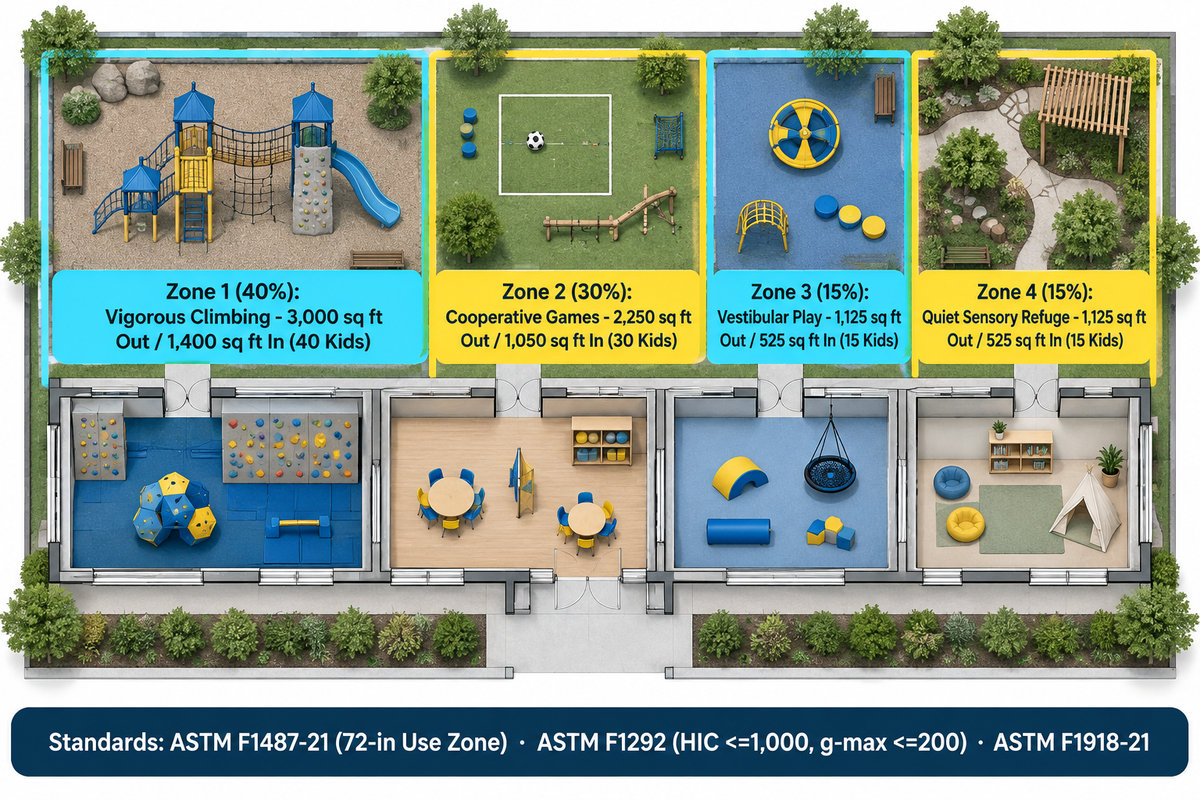
Our illustrative 4-Zone Active-to-Calming Recess Space Allocation Rule shows how schools can separate high-energy runners from students who are overwhelmed. This planning framework shows how to divide a play space into four areas: vigorous climbing, cooperative courts, vestibular regulation, and quiet sensory refuge. Schools should consider the example area shares provided below as a starting point, and not as a mandatory requirement.
Safety standards set clear engineering boundaries that govern injury protection rather than clinical stress reduction. For stationary outdoor public playground equipment, ASTM F1487-21 specifies a minimum 72-inch (6 ft / 1.83 m) unobstructed perimeter use zone. Under ASTM F1292, impact-attenuating surfacing must achieve an HIC no greater than 1,000 and a g-max no greater than 200 in specified impact tests at the applicable fall height. Interlocking 12×12 in to 48×48 in elastomeric shock-absorbing base tiles (USPTO Patent US9896808B2) help keep surfacing depth stable under heavy school foot traffic.
For indoor soft-contained play structures, ASTM F1918-21 addresses injury-risk reduction for that specific equipment category. Didi Land’s modular commercial soft play equipment systems publish a 35 kg/m³ EPE foam core, 0.55 mm BS 5852 fire-retardant PVC/PU cover, and 2.0–2.5 mm hot-dip galvanized steel frame. Modular climbing sets span 12–48 m² and foam play corners span 4–20 m².
📐 Illustrative Worked Example, 100-Student Recess Cohort Space Budget:
Assumed inputs: 100 elementary students sharing one recess period; sample planning density of 75 sq ft (7.0 m²) per student outdoors (7,500 sq ft yard) and 35 sq ft (3.3 m²) per student indoors (3,500 sq ft multipurpose room). Area shares (40% / 30% / 15% / 15%) are illustrative planning ratios and do not replace site-specific ASTM F1487 fall-zone or local fire-egress calculations. For circulation details, see our guide on planning a multi-zone children’s indoor play area layout.
| Functional Zone (4-Zone Rule) | Sample Share | Outdoor Yard (7,500 sq ft) | Indoor Room (3,500 sq ft) | Sample Load | Equipment & Clearance Focus |
|---|---|---|---|---|---|
| Zone 1: Vigorous Gross-Motor & Climbing | 40% | 3,000 sq ft (279 m²) | 1,400 sq ft (130 m²) | 40 students | Post-and-deck climbers (72-in ASTM F1487-21 use zone) or ASTM F1918-21 soft climber. |
| Zone 2: Cooperative Games & Loose Parts | 30% | 2,250 sq ft (209 m²) | 1,050 sq ft (98 m²) | 30 students | Four-square courts, 4–20 m² foam building sets, painted court boundaries. |
| Zone 3: Vestibular & Proprioceptive Play | 15% | 1,125 sq ft (105 m²) | 525 sq ft (49 m²) | 15 students | Inclusive spinners, balance beams, swings with verified fall clearances, soft rockers. |
| Zone 4: Quiet Sensory Decompression | 15% | 1,125 sq ft (105 m²) | 525 sq ft (49 m²) | 15 students | Shaded benches, tactile panels, and quiet seating with clear supervisor sightlines. |
School Playground and Indoor Recess Soft-Play Equipment Cost Breakdown (5-Year TCO Guide)
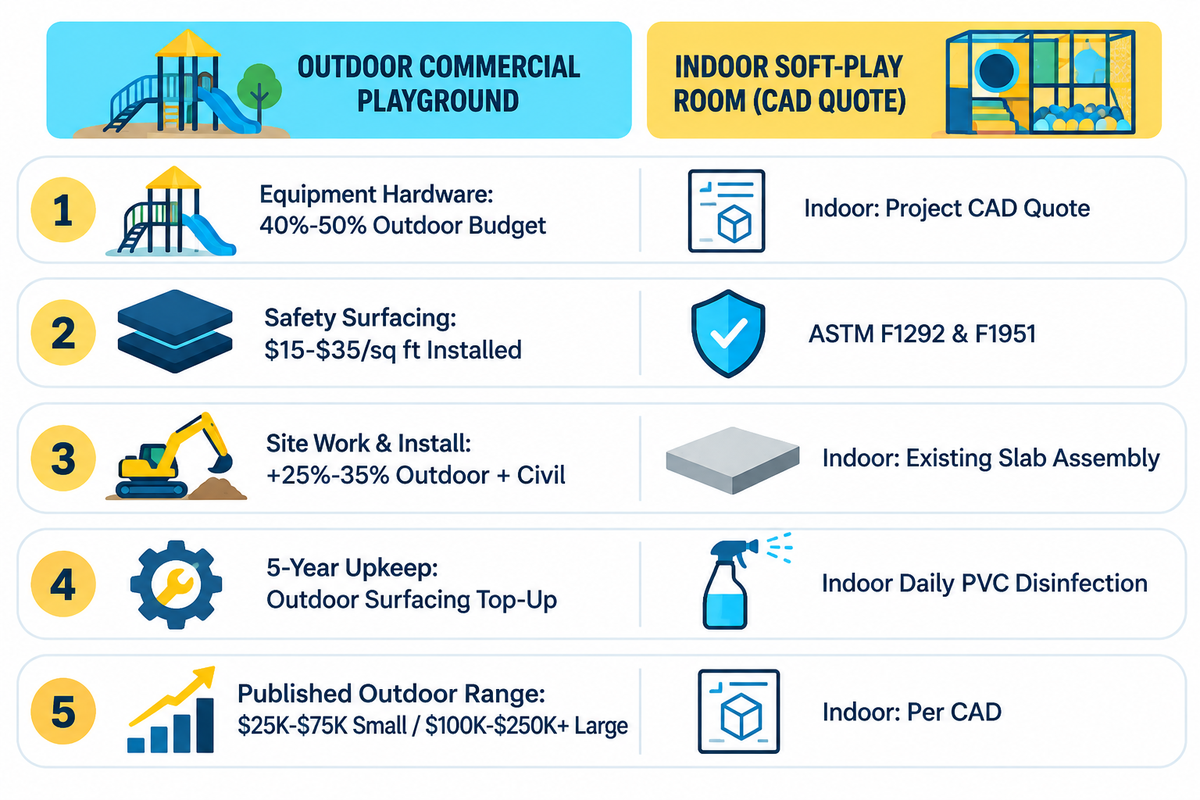
According to Playworld’s commercial playground cost guide, smaller commercial outdoor playgrounds typically cost $25,000 to $75,000, while larger community or school installations reach $100,000 to $250,000+. Equipment hardware represents 40% to 50% of an outdoor budget. Professional installation adds 25% to 35% of equipment cost, and safety surfacing plus installation runs $15 to $35 per square foot.
School boards often miscalculate total budgets by looking at catalog equipment prices alone. Outdoor yards require grading, drainage, concrete footings, and ongoing surfacing care. Indoor soft-play rooms avoid civil excavation and frost footings. Instead, indoor operating costs center on daily PVC disinfection and cover inspection, making flame-retardant PVC vinyl and EPE foam core material specifications essential for long-term durability. Because indoor room pricing depends heavily on ceiling height, custom modules, and local freight, schools should request itemized project quotes rather than relying on generic per-square-foot guesses.
| 5-Year Cost Category | Outdoor School Playground Benchmark (Playworld) | Indoor Soft-Play & Sensory Room | Verification & Compliance Note |
|---|---|---|---|
| Play Equipment Hardware | 40%–50% of total project budget | Request project-specific quote | Driven by age tiers, climbing height, and custom sensory panels. |
| Impact Safety Surfacing | $15–$35/sq ft installed (Playworld) | Request project-specific quote | Accessible routes must satisfy ADA slope and width rules and ASTM F1951; impact safety surfacing must satisfy ASTM F1292. |
| Site Work & Installation | 25%–35% of equipment cost + civil work | Indoor assembly on existing slab | Outdoor projects add grading, drainage, and concrete footings. |
| 5-Year Upkeep & Sanitation | Surfacing top-up & hardware checks | Daily PVC cleaning & pad inspection | Unitary rubber reduces raking labor compared with loose-fill mulch. |
| Published Project Range | $25,000–$75,000 (small) / $100,000–$250,000+ (large) | Quoted per CAD room drawings | Always request itemized hardware, surfacing, freight, and installation lines. |
How Much Does Commercial School Playground or Indoor Recess Soft-Play Equipment Cost Installed?
Commercial outdoor school playgrounds range from $25,000 to $75,000 for smaller setups and $100,000 to $250,000+ for large campuses, with safety surfacing priced at $15 to $35 per square foot (Playworld). Custom indoor school soft-play rooms are priced per CAD layout because ceiling clearance, module density, and shipping distance vary widely.
Projects can be phased over two fiscal years when school budgets are tight. Year 1 funds a compliant outdoor climber or a compact indoor rainy-day soft-play area. Year 2 adds shaded quiet seating and vestibular sensory elements. Not all school projects are created equal, so itemized quotes help identify costs associated with transporting, and/or preparing the site for the project.
2025–2026 State Recess Mandates, Inclusive Sensory Play Trends, and School Equipment Supplier RFQ Checklist
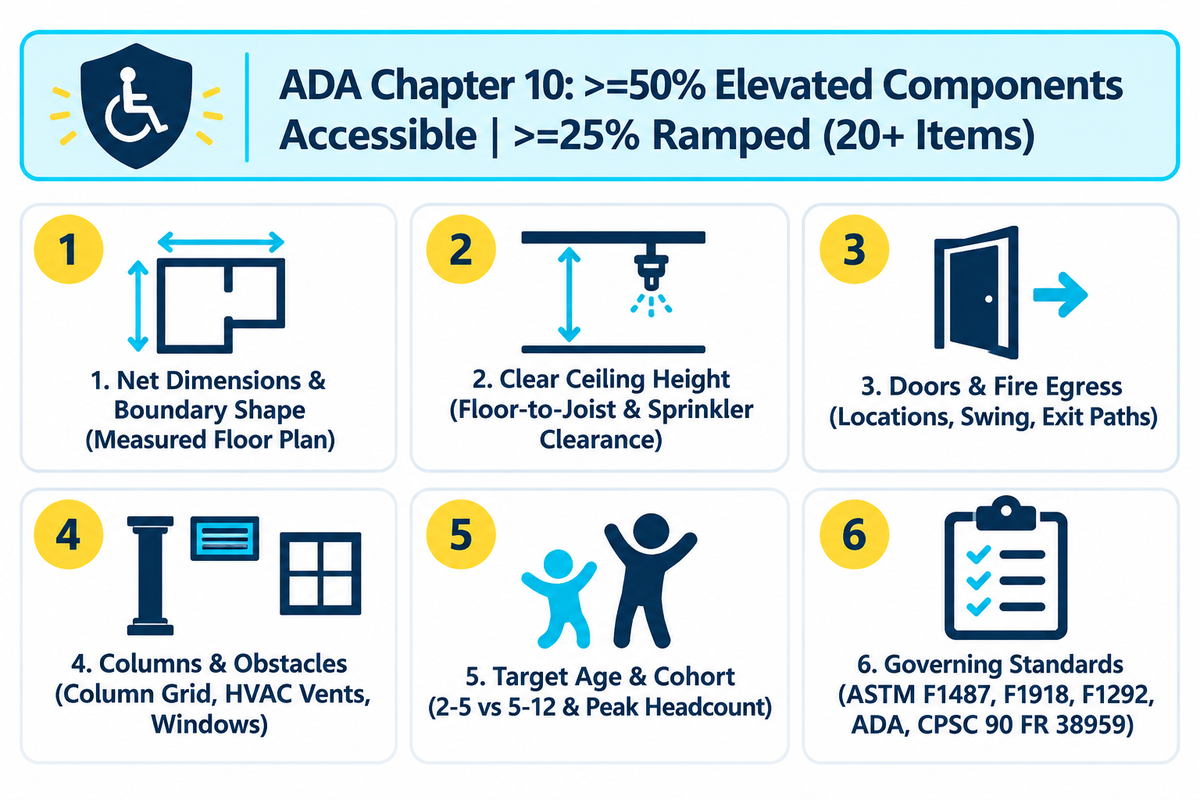
Recent state recess laws, ADA Chapter 10 accessibility standards, and extreme weather days are pushing U.S. districts to upgrade play capacity. Beginning in 2024–25, Washington (RCW 28A.230.295) mandates 30 minutes of daily recess for K-5 students and elementary 6th graders on school days over 5 hours. California SB 291 requires 30 minutes on regular days and bans disciplinary withholding except for immediate physical safety threats. Meanwhile, the U.S. Access Board ADA Chapter 10 Guide requires at least 50% of elevated play components on an accessible route, with ramps connecting at least 25% when 20 or more elevated components exist.
School facility planners should match the supplier channel to the play environment as follows:
- Outdoor steel and plastic structure manufacturers (like Landscape Structures, GameTime, Kompan, Playworld and Miracle Recreation) sell permanent outdoor playground structures from their school catalogs to regional dealers. These projects rely on local civil contractors and poured-in-place surfacing aligned with applicable ASTM F1487 rules and the July 2025 update to the CPSC Public Playground Safety Handbook (90 FR 38959).
- Indoor soft play structure manufacturers (like Didi Land, Soft Play, and iPlayCO) construct all-weather, indoor play structures for facilities. Other design constraints (like room columns and ceiling heights) help determine the final configuration of indoor play structures. Soft-contained play equipment follows ASTM F1918-21, while separate room acoustics, fire codes, and sensory furniture require local facility review.
Prior to requesting proposals from suppliers, prepare six facility inputs so engineers can develop 2D CAD zoning and 3D layouts suited to the space.
| RFQ Input # | Required Facility Specification | Why Suppliers Need It |
|---|---|---|
| 1. Net Dimensions & Boundary Shape | Measured floor plan with walls and perimeter | Sizes the 4-zone layout; actual equipment use zones require full boundary and obstacle drawings. |
| 2. Clear Ceiling Height | Floor-to-joist and sprinkler clearance | Sets single-level toddler soft play versus multi-tier indoor climbing structures. |
| 3. Doors & Fire Egress | Doorway locations, swing direction, exit paths | Keeps play modules clear of emergency evacuation corridors. |
| 4. Columns & Obstacles | Structural column grid, HVAC vents, windows | Guides padded column wraps and unobstructed supervisor sightlines. |
| 5. Target Age & Cohort | Age bands (2–5 vs. 5–12) & peak headcount | Matches platform barrier heights, sensory zones, and simultaneous capacity. |
| 6. Governing Standards | Applicable editions of ASTM F1487, F1918, F1292, and ADA | For play areas with 20+ elevated components, ramps connect ≥25%; Didi Land reports BS 5852 PVC/PU covers separately. |
Schools interested in an all-weather indoor recess space can use the six room inputs above to request a 2D CAD indoor recess layout and ASTM equipment quote from Didi Land , with the layout customized for the room they are planning. Our engineering team can provide you with a custom zoning plan, materials specification, and a shipment estimate.
Frequently Asked Questions
How can daily school recess help students be less anxious about school?
Daily recess can help students with anxiety by providing an outlet to release physical tension, helping them regain attention, and supporting them in building and strengthening friendships. Supportive and positive peer interactions help students feel less anxious and more prepared to take on the challenges of upper level academics.
How can parents and schools help children with mental health through unstructured play breaks?
Parents and schools can support children’s mental health by protecting daily unstructured recess and refusing to withhold breaks for children who don’t finish their classwork or who engage in minor classroom misbehavior. Active play equipment can be paired with quiet sensory seating to allow children to choose how to decompress. Using consistent movement routines to regulate emotions helps kids develop and strengthen emotional regulation skills across all settings.
How does sport reduce stress compared with unstructured free-play recess at school?
While the stress-reducing benefits of aerobic exercise and social connections found in team sports help ease anxiety, the adult help and evaluation of performance can bring back anxiety for children. Free-play recess removes competition and grading. This allows students to self-regulate and choose the intensity of movement and social peer groups. Students are also free from worrying about making mistakes.
Is balancing academic work and school stressful without scheduled movement breaks?
Yes. Prolonged, uninterrupted seated work leads to rapid inattention and irritability.
How can elementary schools provide stress-reducing recess on rainy, freezing, or extreme-heat days?
Elementary schools can protect active recess during severe weather by scheduling rotating grade blocks in a gymnasium obstacle zone or a dedicated modular indoor soft-play room instead of showing passive movies in the classroom. Energetic students and sensory-sensitive students can each use their preferred physical outlets: climbing and seating. Planning ahead for extreme weather allows schools to protect scheduled active movement, physical activity and play during the school day.
What layout inputs should a school prepare before requesting a custom play area quote?
Provide the following six inputs for each requested facility: floor or yard dimensions, clear ceiling height, entry and emergency exit locations, structural column positions, target student ages and peak cohort headcount, and applicable ASTM standards and ADA requirements.
References & Sources
- RHEA, D. J., KIRBY, K., CHEEK, D., ZHANG, Y., & WEBB, G. K. (2025). The Impact of Recess on Chronic Stress Levels in Elementary School Children. Children, 12(7), 865. National Institutes of Health (NIH PMC12293798).
-
Why School Recess Is Important for Kids of All Ages: AAP Policy Explained. HealthyChildren.org.
- Howie, E.K., et al (2023). A Systematic Review of the Impact of School Recess on Academic, Behavioral, and Social-Emotional Outcomes. National Institutes of Health (NIH PMC10664954).
- Washington State Legislature. RCW 28A.230.295: Daily Recess (Effective 2024–25 School Year).
- U.S. Access Board. Chapter 10 of Guide to the ADA Accessibility Standards.
- U.S. Consumer Product Safety Commission (CPSC). Notice of Availability: Public Playground Safety Handbook Update (90 FR 38959). Federal Register, August 13, 2025.
- Action for Healthy Kids. (2011, October). Active Outdoor Recess: School Zoning and Supervision Strategies.
Transparency & Editorial Note: This guide combines peer-reviewed pediatric literature, U.S. state recess laws, ADA Chapter 10 accessibility rules, and published commercial playground cost benchmarks. There are standards to protect children’s physical safety (ASTM F1487-21, ASTM F1918-21, ASTM F1292) but not necessarily mental health.
Author & Technical Review: This document was reviewed by the technical team at Guangzhou Didi Land Amusement Equipment Co. Ltd.
SYS.00 // E-E-A-T Disclosure
Why I Write This
As the CEO and Co-Founder of a specialized manufacturing facility, my objective is to provide unvarnished, factory-direct technical insights into commercial indoor playground engineering, safety compliance, and project planning. I aim to bridge the information gap for global buyers seeking reliable structural and material data, ensuring you make informed, ROI-driven decisions without the marketing fluff.
About My Business
Guangzhou Didi Land Amusement Equipment Co., Ltd. (Brand: Didi Land) is a commercial indoor playground equipment manufacturer founded in 2014. Operating from Panyu, Guangzhou, China, we engineer, produce, and export commercial-grade play structures to over 40 countries worldwide. Our production lines strictly adhere to international safety frameworks, ensuring durability and safety for high-traffic environments.
Our Services
We provide end-to-end B2B commercial solutions: from custom 3D spatial design and OEM manufacturing to worldwide export logistics and compliance testing. Our focus is on empowering Family Entertainment Centers (FECs), shopping malls, kindergartens, and hospitality venues with reliable, high-capacity play infrastructure.
DATA_MATRIX // MANUFACTURER_PROFILE
Name:
Cherry
Role:
CEO & Co-Founder
Brand Name:
Didi Land
Company:
Guangzhou Didi Land Amusement Equipment Co., Ltd.
Location:
Guangzhou, Panyu, China
Founded:
2014
Products:
Indoor Playground Equipment, Soft Play Equipment, Themed Playground Design, FEC Play Zones, Trampoline Modules, Ninja / Obstacle Course Modules
Email:
conglizhang1@gmail.com
Phone:
+86 199 2587 9517
Website:
didiplayarea.com
COMPLIANCE & STANDARDS:
ASTM F1487 · ASTM F1918 · EN 1176 · CPSIA · CE · ISO 9001 · IPEMA
Contact Factory Direct
Related Posts
Trending now