Get in Touch with Didi Land


![Childrens Indoor Play Area Planning [Guide]](https://didiplayarea.com/wp-content/uploads/2026/08/childrens-indoor-play-area-featured.png)
A childrens indoor play area is an indoor play space designed for kids’ active, social, or imaginative play, but for investors it is also a site-planning, equipment, safety-document, and revenue decision. Parents search for places to take children on rainy days; owners must translate that demand into a floor plan, quote package, staff route, and local review path before buying equipment.
This guide is written for operators, mall teams, family entertainment centers, kindergartens, hotels, restaurants, and investors comparing indoor playground equipment. It doesn’t replace a local architect, fire official, insurer, landlord, or code reviewer. It gives the equipment-planning lens those parties will expect you to have ready.
Key takeaway
Investors should classify the equipment, map child-parent-staff flow, and separate supplier documents from local approval before asking for the final quote. That sequence prevents a play area from becoming a beautiful 3D design that fails rent, staffing, supervision, or review.
What Does “Childrens Indoor Play Area” Mean for an Investor?
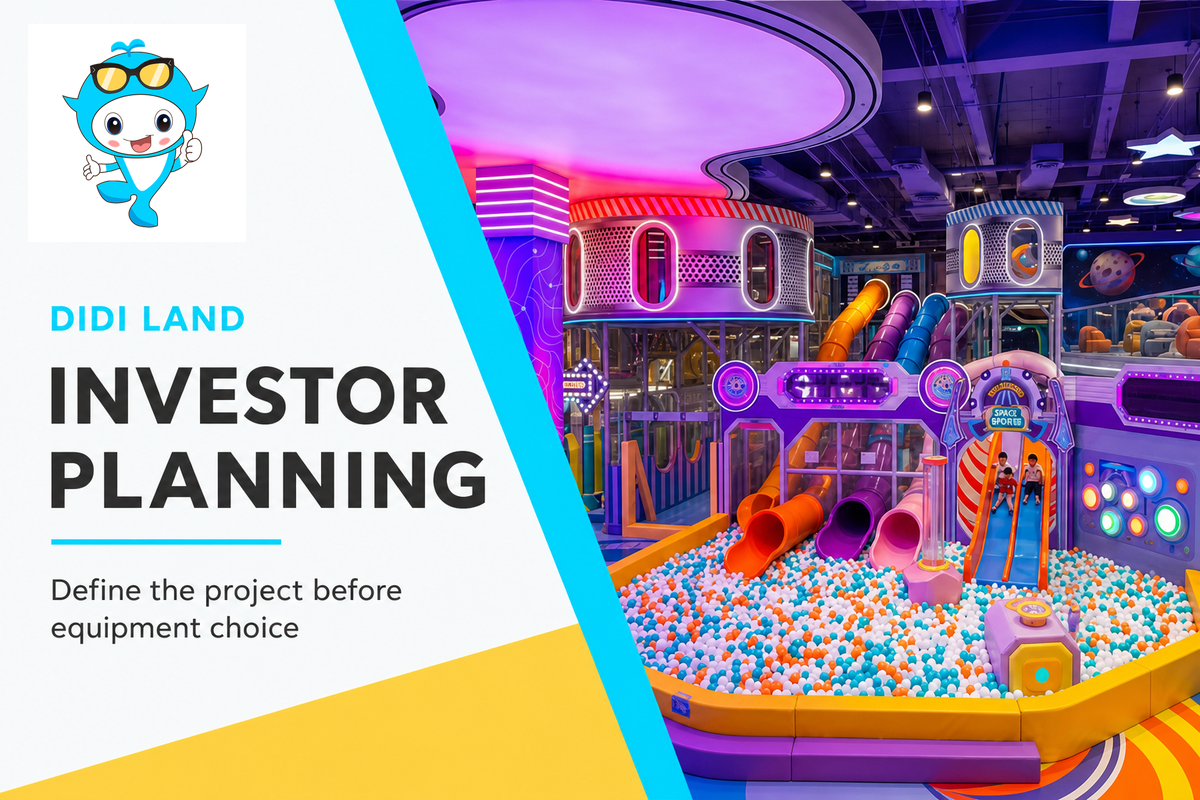
For an investor, a childrens indoor play area is any indoor space planned for children’s active, social, or imaginative play, but the business model changes the meaning. Even a 40 m² restaurant corner, a school activity room, a shopping mall traffic driver, and a ticketed indoor playground carry different equipment and review needs.
The exact search result set for this keyword is local and parent-facing. That matters. Parents may describe the need as a place for little ones to play; buyers have to translate that language into venue rules: who pays, who supervises, how long children stay, how parents move, and which documents the site will need. If the article simply copied local directory pages, it wouldn’t help a buyer choose equipment.
| Searcher sees | Investor must define | Equipment consequence |
|---|---|---|
| Indoor play place for kids | Ticketed attraction or free amenity | Entry control, shoe area, payment path, party support |
| Soft play area | Age range and speed limit | Padding, low climbing, sightlines, document scope |
| Indoor playground | Core play structure and support rooms | Ceiling height, netting, slides, queue control, staff route |
Your first useful brief is one page: site size, ceiling height, age groups, expected peak load, venue type, target opening date, and country. Without those facts, a supplier can send attractive images but can’t price the real play system.
In that brief, write floor area as a number such as 40 m², 150 m², 600 m², or 1,200 m² instead of “small” or “large.” Write age groups as 6-23 months, 2-5 years, and 5-12 years when they apply; the equipment category changes the evidence request. Adjacent searches such as childrens indoor playground, indoor playground area, and indoor playground with slides are useful demand language, but the investor still has to turn them into equipment, flow, and review decisions.
Use official business-planning sources as a floor, not a price promise. The SBA Plan Your Business guide is a useful checkpoint for market test, budget, operating model, and risk assumptions before equipment spend.
| Parent/search language | Investor translation | Brief field to write |
|---|---|---|
| best indoor, best indoor play, best for kids, perfect for families | A preference signal, not a design standard. | Venue purpose, target age, and proof of demand. |
| indoor play areas for kids, indoor places, indoor play space, indoor activities, rain or shine, space is designed | A weather-proof use case that still needs a layout. | Floor area, entrance path, and parent waiting plan. |
| play gym, play park, fun park, fun center, largest indoor | A format label that can hide very different scopes. | Ticket model, support rooms, and 150 m², 600 m², or 1,200 m² scale note. |
| kids ages, kids ages 5, kids ages 6, children ages, kids of all ages, designed for kids ages | Age language that must become equipment boundaries. | 6-23 months, 2-5 years, 5-12 years, and supervision split. |
| area for younger kids, separate toddler area, area for infants, kids of all abilities | A lower-speed and accessibility planning request. | Toddler edge, accessible route, padding, and parent reach. |
| open play, playtime, kids can play, keep your kids busy, kids busy, kids need, social skills | A dwell-time promise that needs operating support. | Session length, staff route, cleaning interval, and repeat-visit plan. |
| safe and engaging, clean and safe, easy to keep an eye, parents and caregivers | A supervision and trust requirement, not a slogan. | Sightline map, inspection list, cleaning access, and document scope. |
| ropes course, zip line, climbing gym, ninja warrior, ninja course, climb and swing | Higher-motion attractions that change staffing and flow. | Landing zones, staff watch point, queue route, and age boundary. |
| trampoline park, indoor trampoline, foam pits, kids can jump, dodgeball, grip socks are required | Motion-play demand with policy, cleaning, and footwear rules. | Participation rules, shoe or sock policy, and inspection frequency. |
| arcade games, laser tag, lego, bounce house, water play | Add-on attractions that may need separate utilities or staffing. | Power, storage, cleaning, staffing, and maintenance ownership. |
| party venue, family fun, food and drinks, ice cream shop, free wi-fi, available for purchase | Secondary revenue and parent comfort language. | Party-room target, cafe sightline, seating, and purchase path. |
| unlimited fun, kids love, active kids, fun playing, entertainment center offers | Marketing language that must be supported by operations. | Rotation plan, cleaning plan, maintenance reserve, and staff handoff. |
Match the Play Area Type to the Venue and Revenue Model
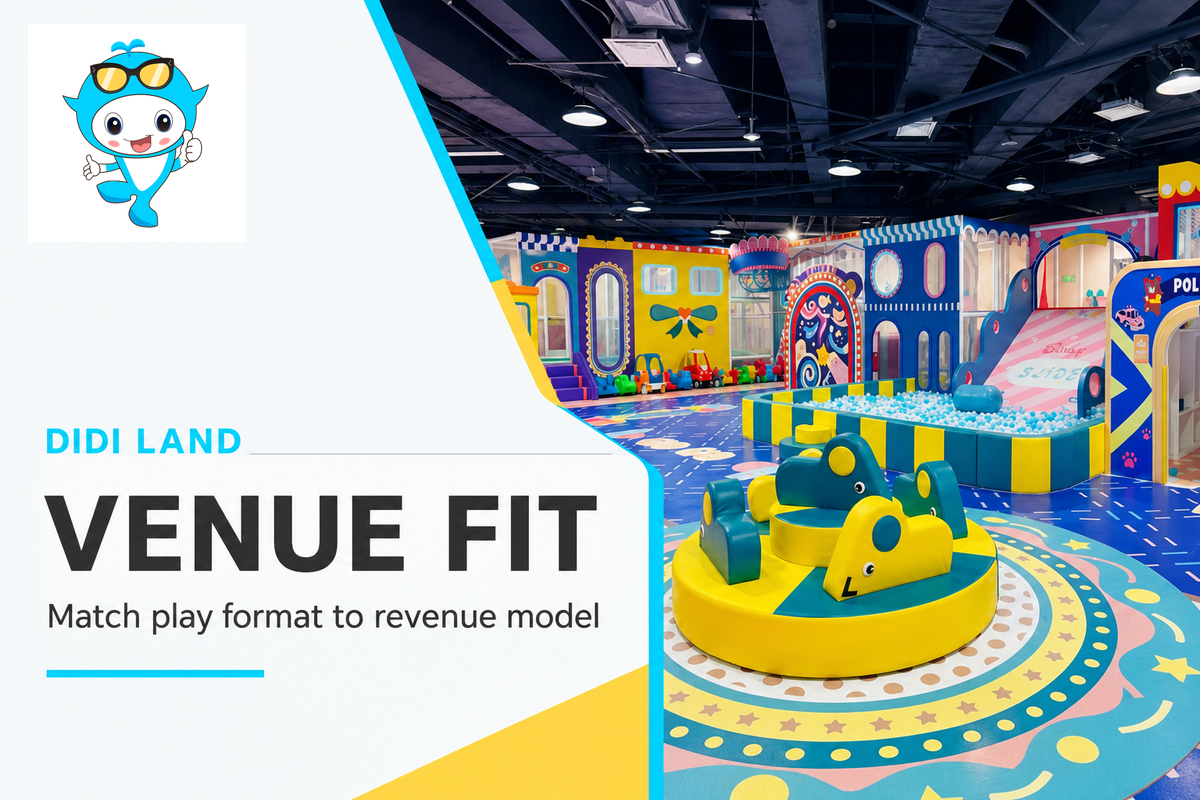
Venue type changes the equipment plan because each site earns value in a different way. Family entertainment centers need dwell time and repeat visits. Mall teams need foot traffic and parent comfort. Kindergartens need supervised, lower-speed play. Hotels and restaurants need compact family support that doesn’t disrupt the main business.
Use the revenue model before the theme. Theme is visible, but revenue decides space allocation. Party rooms, shoe storage, parent seating, stroller parking, cafe sightlines, and staff cleaning routes often earn or protect more money than one extra slide.
| Venue | Revenue job | Planning priority | Didi internal link |
|---|---|---|---|
| Family entertainment center | Tickets, parties, repeat visits | Core structure, party flow, durable high-use zones | family entertainment center play area |
| Shopping mall | Foot traffic and dwell time | Visibility, parent seating, entrance control | shopping mall indoor play area |
| Kindergarten or early education | Program value and activity quality | Age fit, cleaning access, teacher sightlines | kindergarten indoor play area |
| Restaurant or hotel | Family retention and comfort | Compact soft play, noise control, safe visibility | restaurant and hotel play area |
Ticket-revenue venues can justify larger structures, party support, and motion play. When play is an amenity, the safer choice is often fewer attractions, clearer sightlines, and a layout that keeps staff from leaving the main service area.
Build the 6-Zone Investor Fit Grid
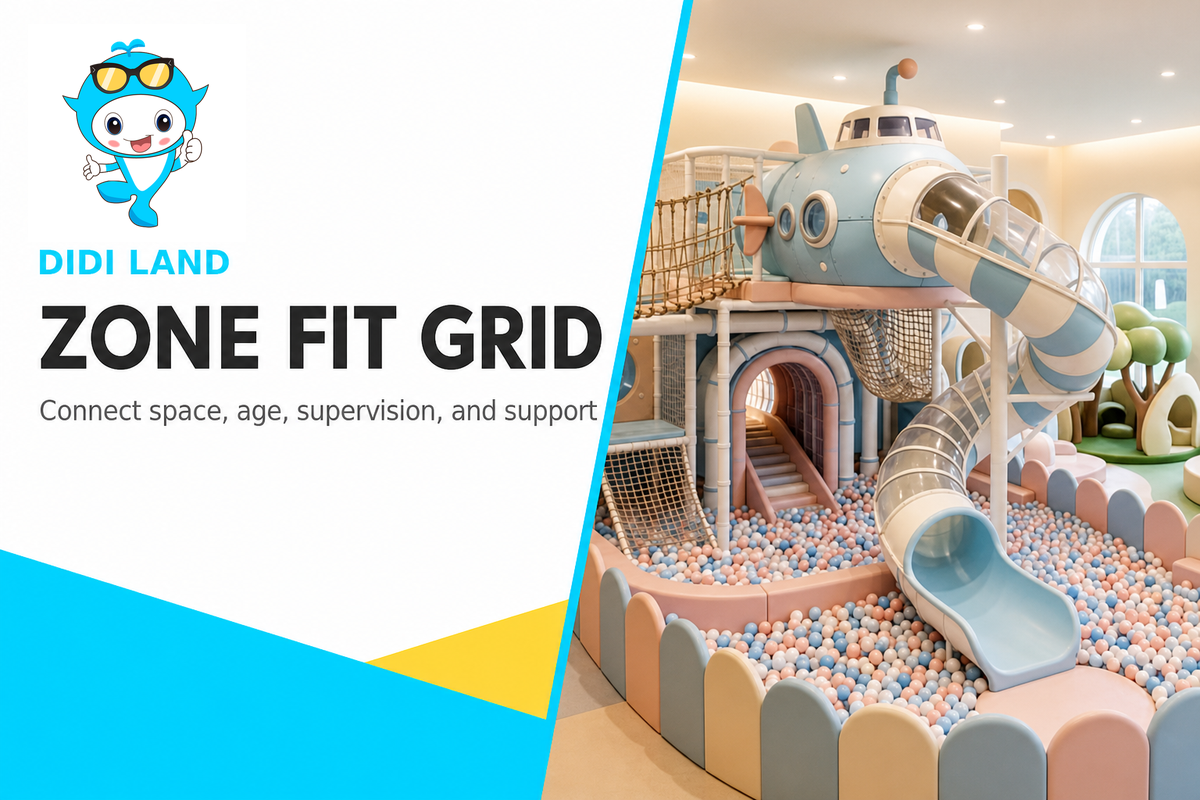
The 6-Zone Investor Fit Grid is not a floor-plan template. Didi Land already has a layout-focused guide; this framework scores whether each zone earns its space for the investor. Each zone should exist because it supports revenue, supervision, age fit, parent comfort, or staff work.
| Fit signal | Best use | Evidence to ask for | Investor risk if ignored |
|---|---|---|---|
| Entrance control | Tickets, shoes, wristbands, stroller edge | Entry width, queue plan, staff sightline | Lost revenue or crowding at peak hours |
| Young-child fit | Lower-speed play, small climbing, parent proximity | Age category, padding, access control | Older-child collision and parent complaints |
| Core structure | Slides, tunnels, bridges, ball pit, climbing | Ceiling height, netting, structural layout | Low play value or review delays |
| Motion play | Trampoline, obstacle course, climbing wall, active path | Speed boundary and landing zones | Queue conflicts and supervision gaps |
| Role-play or sensory value | Pretend play, train table, sensory-friendly sessions | Cleaning, quiet edge, age signal | Short dwell time for younger kids |
| Parent revenue support | Seating, party rooms, coffee bar, viewing points | Sightline map and staff route | Parents leave early or block staff flow |
The grid prevents a common mistake: using every square meter for equipment. More equipment can reduce value when it narrows walkways, blocks sightlines, or makes cleaning difficult. Better design uses indoor play structures where they improve the operating model, not just where there is empty floor.
Classify Toddler, Soft-Contained, and Mixed-Age Equipment Before Zoning
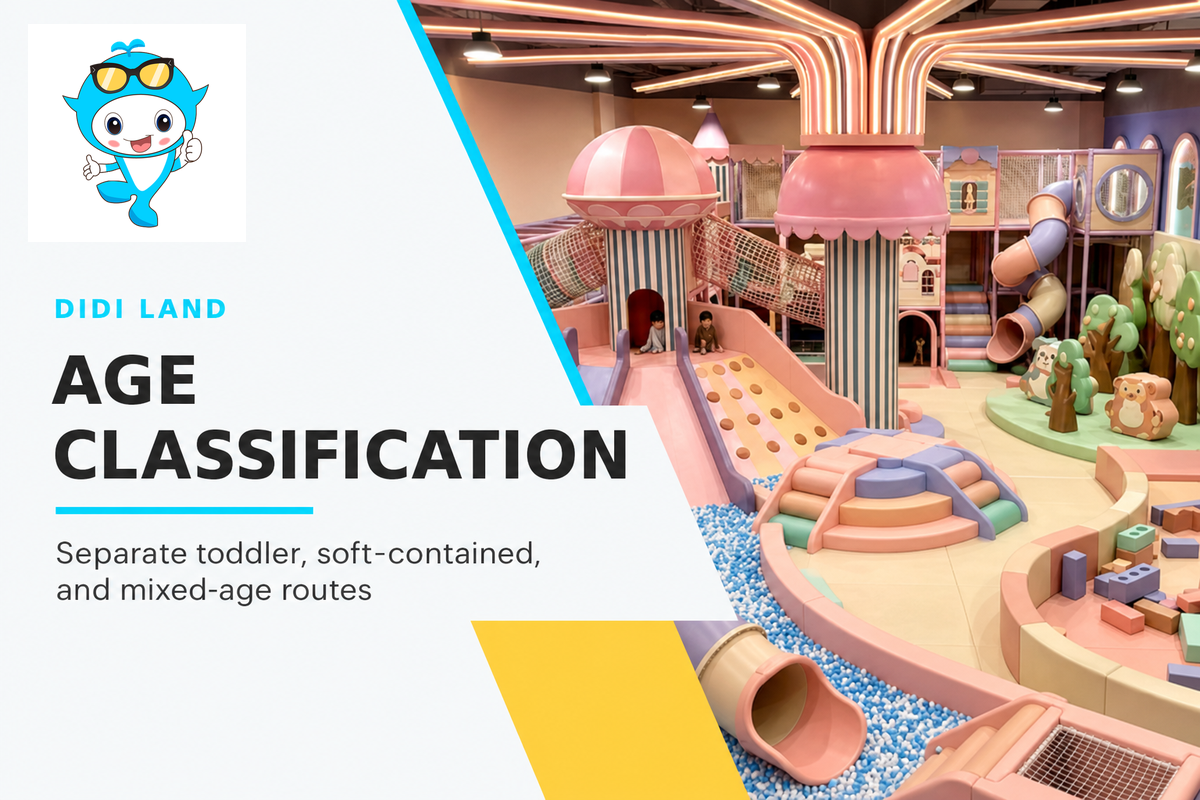
Age zoning starts with equipment classification. “Toddler area” isn’t precise enough for a quote or document request. Buyers should separate public-use equipment for children 6 through 23 months, soft-contained play equipment within ASTM F1918-21’s stated scope for users from the 5th-percentile 2-year-old through the 95th-percentile 12-year-old, and any site-specific mixed-age route that still needs local review before asking whether a design is safe.
CPSC’s current business guidance separates home playground equipment from public-use playground equipment and points manufacturers and importers toward public playground guidance, checklists, and applicable children’s-product duties. For investors, that supports a document review path, not a blanket site-approval shortcut.
U.S. Consumer Product Safety Commission business guidance
That CPSC distinction is the reason a buyer should avoid one-size-fits-all compliance language. Standards, handbooks, and official guidance help define evidence, but they don’t settle every site issue.
| Category | Useful age boundary | Evidence source | RFQ instruction |
|---|---|---|---|
| Public-use equipment for very young children | 6-23 months | ASTM F2373-24 | Ask whether the proposed pieces are for this age group and public-use setting. |
| Toddler edge inside a mixed-age site | 6 months-2 years, separated from faster routes | CPSC under-2 page plus local reviewer | Mark toddler entry, parent reach, padding, and staff sightline as separate RFQ line items. |
| Soft-contained play equipment | Public ASTM page references 2-12 user range by percentile | ASTM F1918-21 | Ask for F1918 scope documents only for soft-contained equipment. |
| Preschool soft play route | 2-5 years with lower speed and short climbing | F1918 scope if soft-contained; local review still applies | Quote lower-height modules, padding, and cleaning access apart from the core structure. |
| School-age soft-contained route | 5-12 years in the user-range conversation | ASTM F1918-21 | Confirm slide exits, netting, bridge routes, and staff inspection access. |
| Public playground-style equipment | Intended use controls; children 12 years or younger may trigger children’s-product duties | CPSC playground equipment guidance | Check local jurisdiction, insurer, and adopted standards before opening. |
| Accessible ground-level play components | 2 years and older where play-area accessibility rules apply | Access Board play areas | Show accessible routes and components on the same layout, not in a separate corner. |
| Compact amenity play corner | Example brief: 40 m² with parent sightline | Site brief plus Didi custom planning | Keep scope narrow; request compact soft-play modules, noise limits, and cleaning access. |
| Large ticketed indoor playground | Example brief: 600 m² or 1,200 m² with several zones | Site brief plus Didi custom planning | Price core structure, party room, entry, staff route, and installation role separately. |
| Supplier production and support check | 30-45 days lead-time context and 24/7 online support | Didi first-party pages reviewed in this workflow | Confirm lead-time wording, spare parts contact, and document list before deposit. |
Accessible planning is not a corner. For covered play areas, the ADA or ABA Standards set accessible-route and component-count requirements, while the Access Board guide explains how to apply them. The guide also supports integrated ground-level play components rather than clustering them in one isolated location. Put that requirement into the first layout conversation, not as a late correction after equipment has been selected.
For a small soft play equipment zone, ask how the manufacturer separates lower-speed play from the core structure and motion play. For a larger mixed-age site, ask how the plan prevents older children from cutting through younger-child areas during peak traffic.
Use the 3-Flow Play-Area Bottleneck Map Before Buying Equipment
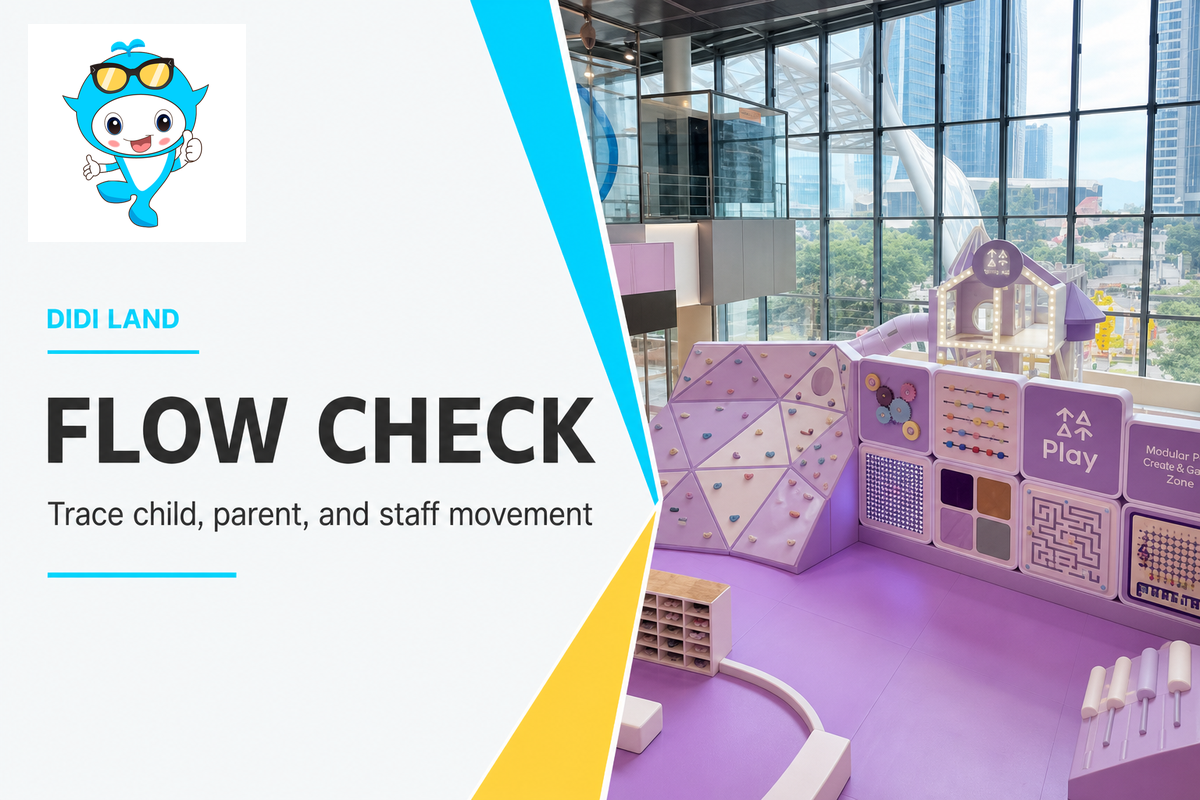
The 3-Flow Play-Area Bottleneck Map checks three routes before the equipment order: child flow, parent flow, and staff flow. If any route conflicts with another, the buyer should fix the plan before the 3D design is approved, even in a 40 m² amenity corner where one blocked path can affect the whole room.
| Flow | Trace on the floor plan | Bottleneck question | Fix before order |
|---|---|---|---|
| Child flow | Entrance, active path, slide exit, ball pit, toddler edge | Do older children cross the toddler area? | Add buffer, one-way path, or separate entry. |
| Parent flow | Reception, seating, party room, cafe, toilets, stroller edge | Can parents watch without blocking staff? | Move seating to sightlines, not passageways. |
| Staff flow | Check-in, cleaning, first aid, storage, party reset, emergency path | Can staff reach trouble spots quickly? | Keep service doors and inspection routes clear. |
This map is where many proposals become smaller but stronger. One venue may earn more from a clean parent view, faster party reset, and easier staff access than from filling every open meter with a jungle gym. For custom planning, use Didi Land’s custom indoor playground design process after the bottlenecks are marked.
Estimate Cost, Payback Pressure, and Secondary Revenue
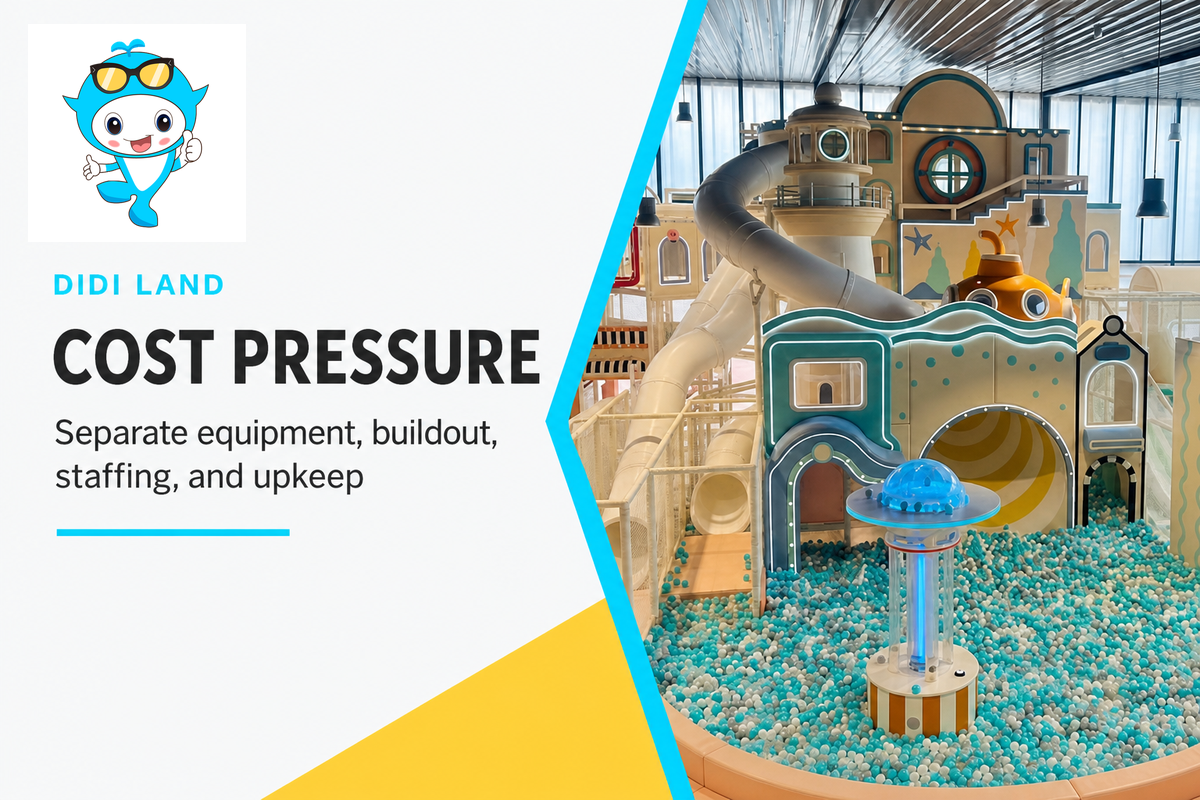
Indoor playground profitability is not an equipment feature. It is a math problem across rent, buildout, equipment, freight, installation, staffing, cleaning, insurance, parties, memberships, food, maintenance, and repeat visits. Use a worksheet before chasing the lowest equipment quote, because a 150 m² play cafe and a 1,200 m² ticketed venue carry different payback pressure.
Payback Pressure Worksheet — copy these fields into your planning file:
| Field | Enter before quote | Why it matters | How to verify |
|---|---|---|---|
| Opening cost | Equipment, buildout, freight, installation, review fees | Shows capital need beyond the play structure. | Quote, contractor scope, local reviewer comments |
| Monthly fixed cost | Rent, salaries, utilities, insurance, maintenance | Sets the break-even pressure. | Lease draft, payroll plan, utility estimate |
| Revenue streams | Tickets, parties, memberships, food, private hire | Prevents a one-line ticket-price model. | Local demand test and operating calendar |
| Peak capacity | Visitors per session and staff coverage | Connects layout to revenue and safety. | Floor plan, staff route, queue simulation |
Didi Land has an indoor playground payback calculator page, but this article treats it as a planning CTA only. Firecrawl Agent couldn’t verify every input or output in the tool, so the safer advice is to prepare your own numbers and then use a calculator for a project-specific estimate.
Finance reviewers will usually ask for the assumption behind each number. Write the rent source, staffing schedule, ticket assumption, party-room target, cleaning cost, and maintenance reserve beside the worksheet. If one assumption has no source yet, mark it as a test item for the landlord, local operator, or opening consultant instead of letting it hide inside the equipment budget. This makes the quote easier to defend during lease or capital approval.
How much does an indoor play area cost? Usable answers start with scope, not a universal price. Compact soft play areas, indoor play cafe corners, and two-story play structures don’t belong in one price class. Ask for a quote only after size, age, theme, support rooms, document needs, and installation role are clear.
Request Materials and Safety Documents Without Treating Them as Site Approval
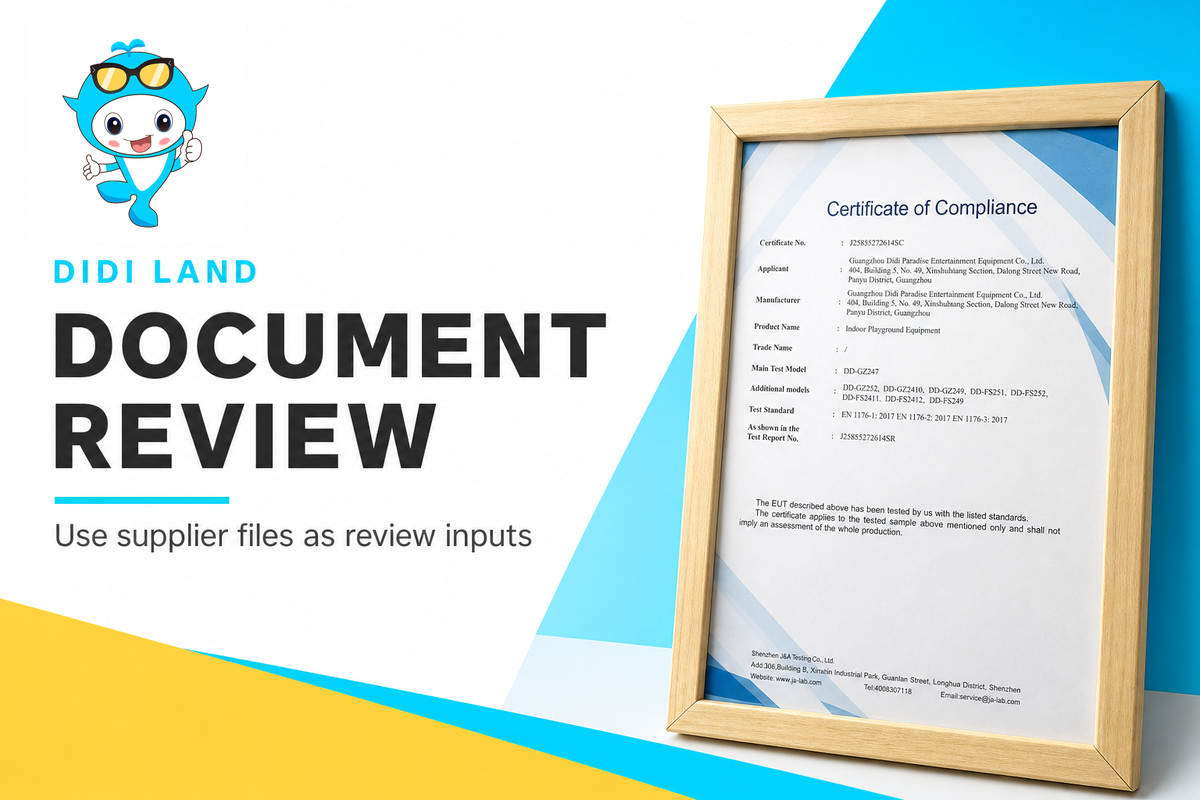
Supplier document packages support review; they are not the same as site approval. For a U.S. project, the buyer still needs the authority having jurisdiction or code official to confirm the adopted code edition, venue classification, permit, inspection, and occupancy requirements. Treat landlord, insurer, architect, and fire-review requests as separate project-file inputs rather than code claims unless your local documents require them.
| Item | Supplier can provide | Local review may still require | Buyer action |
|---|---|---|---|
| Standards references | ASTM, EN, CE, material or test document list | Accepted edition and local applicability | Compare documents with official source pages. |
| Materials | Steel, foam, PVC, netting, padding, fastener specs | Fire behavior, surface, cleaning, landlord rules | Ask what each document proves and what it does not prove. |
| Installation | Assembly drawings, anchoring notes, support guidance | Building, fire, egress, sprinkler, or special-use review | Send layout to local reviewer before deposit where needed. |
| Operation | Cleaning, inspection, maintenance, spare parts support | Staff training, incident plan, insurance conditions | Assign owner, manager, and staff responsibilities before opening. |
Didi Land’s ASTM and EN 1176 compliance checker can help organize a first document request, but it is not the final authority. Use it to prepare a better question list for the manufacturer and local reviewer.
Choose a Manufacturer That Can Customize and Support the Site
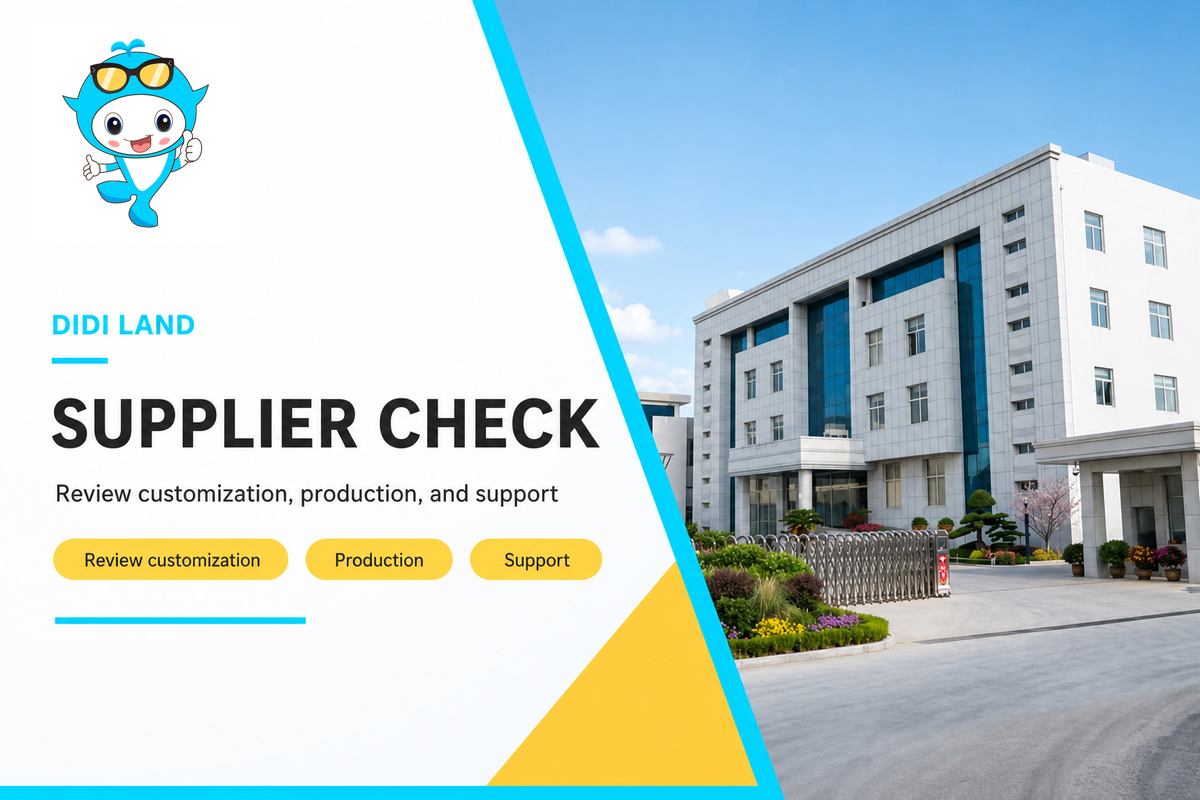
Manufacturer comparisons should test more than the first price. Investors need design fit, production control, material clarity, shipping scope, installation support, staff handoff, spare parts, and response speed. Weak after-sales support can turn a good opening month into a maintenance problem.
Keep the document question inside supplier selection. The CPSC playground equipment guidance points manufacturers and importers toward public-playground resources and applicable children’s-product duties, so compare suppliers by document clarity as well as design style.
Do
- Ask for a floor-plan-based design, not only catalog images.
- Request material and standard references by equipment category.
- Confirm production lead-time language in writing.
- Define spare parts and support contacts before shipment.
Don’t
- Accept a generic safe-for-children claim.
- Compare quotes without freight, installation, and document scope.
- Treat a calculator as a fixed payback promise.
- Claim local approval before the local review is complete.
Didi Land states that it manufactures customizable indoor children’s playground equipment, was established in 2014, and uses 40+ countries export wording. Its supplied company profile also uses export-share and growth wording; treat those as self-reported company signals, not audited metrics or project-specific guarantees. The same profile lists laser tube cutting machines, tube saws, punching machines, drilling equipment, tube benders, press brakes, MIG/TIG/CO2 welders, robotic welding equipment, and grinding and polishing equipment. Ask which machines, materials, and inspection documents apply to your quoted components. This workflow found first-party page statements for 24/7 support and 30-45 day lead-time context. Warranty wording should be checked on the current product page and quote because first-party pages can use product-specific warranty language.
What do you need to start an indoor playground? You need a suitable site, business model, local approval path, age and capacity plan, equipment layout, safety document checklist, buildout budget, installation plan, staffing plan, cleaning plan, and supplier support. For the equipment proposal, send floor plan, ceiling height, country, target ages, theme, expected capacity, opening date, and budget range. For an equipment-and-layout enquiry, indoor playground planning from Dreamland Plus can be assessed against that brief, while financial assumptions and local approvals remain separate project decisions.
RFQ Shortlist for Didi Land
Use this list before requesting a 3D design or final quote.
- Site size, ceiling height, and column positions.
- Venue type: FEC, mall, kindergarten, restaurant, hotel, or community space.
- Target age groups and whether 6-23 month equipment is included.
- Expected peak visitor load and parent seating needs.
- Desired theme, budget range, country, and opening timeline.
- Document list needed for local review.
What Is Changing in Indoor Play and Family Entertainment Centers?
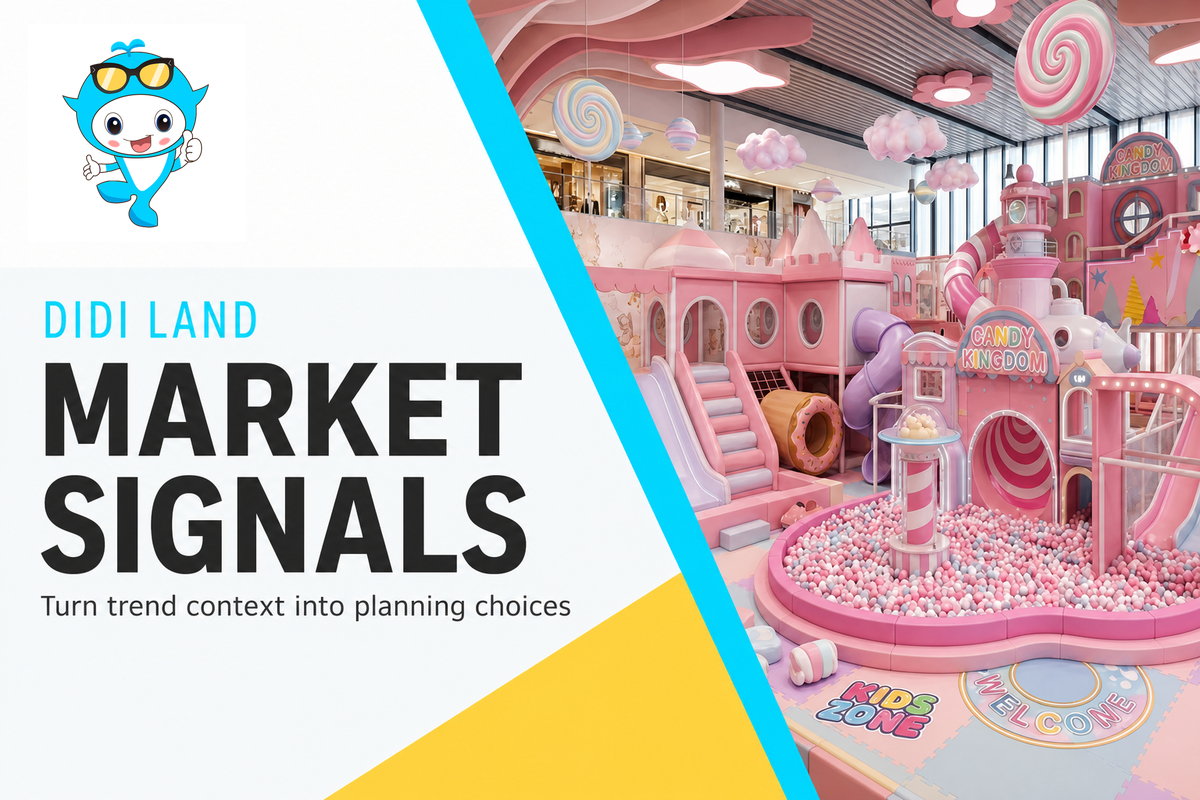
The useful trend is not simply that indoor amusement is growing. The useful trend is that investors have to defend the project against higher rent, staffing pressure, repeat-visit fatigue, local review, and parent expectations. Weather-proof play, party revenue, sensory-friendly sessions, and mixed-age family visits all matter only when the floor plan can carry them.
Commercial market reports in this research pass pointed to growth in indoor amusement and family entertainment center categories, while DataForSEO showed recent demand signals for indoor playground and family entertainment center terms. Those signals should push investors toward better proof, not bigger promises.
For planning discipline, pair demand signals with the SBA Plan Your Business guide: test customer segments, revenue streams, staffing assumptions, and funding before treating family fun demand as a guaranteed opening result.
| Planning signal | Buyer implication | Action before deposit |
|---|---|---|
| Repeat visits | Single-use novelty fades. | Add role-play, sensory, party, or rotation value. |
| Mixed-age visits | One route rarely fits all children. | Separate speed, height, and supervision zones. |
| Interactive fun | Screens or immersive attractions add upkeep. | Check maintenance, staff skill, and age fit first. |
| Review pressure | Documents may not equal site approval. | Start local authority and insurer review early. |
Strong indoor play area plans are boring in the right places: clear routes, clear age boundaries, clear documents, and clear support responsibilities. That is what lets the exciting parts, like slides, obstacle courses, playhouses, ball pits, and birthday parties, work without creating operating drag.
FAQ
How much does an indoor play area cost?
Cost depends on site size, equipment mix, theme detail, safety documents, freight, installation support, local buildout work, and whether the project is a 40 m² play corner or a larger ticketed venue.
Small soft play corners and full commercial indoor playgrounds should not be compared as one price class. Before quoting, prepare floor plan, ceiling height, age range, target capacity, country, budget range, and opening timeline. The quote should also separate equipment, freight, installation role, local review work, and support rooms, because those lines create different cash needs before opening.
What do you need to start an indoor playground?
You need a suitable site, business model, local approval path, age and capacity plan, equipment layout, safety documents, budget, staff plan, cleaning plan, and supplier support.
For equipment design, send the manufacturer floor plan, ceiling height, target age groups, preferred theme, expected visitor capacity, buyer country, opening date, and budget range. Keep a second file for the landlord, insurer, architect, and local reviewer, because supplier material lists and standard references help review but do not replace site approval.
Is owning an indoor playground profitable?
Profit depends on rent, demand, ticket price, birthday parties, memberships, food, staff cost, maintenance, insurance, repeat visits, and whether parents and caregivers stay long enough to buy secondary services.
Equipment is only one part of the model. Buyers should test payback pressure before deposit by separating opening cost, monthly operating cost, and secondary revenue, then use a calculator or advisor for project-specific numbers. Party-room targets, cleaning hours, membership retention, peak-session limits, and parent dwell time can change the result more than one extra play feature.
What equipment belongs in a childrens indoor play area?
Common equipment includes soft play sets, slides, climbing structures, ball pits, role-play zones, toddler modules, parent seating support, and optional motion attractions such as ropes course, zip line, or ninja course when the venue can supervise them.
Match the equipment mix to age range, floor area, ceiling height, supervision, revenue model, and local review path.
How do you make an indoor play area safer for toddlers?
Start by defining the age group, because 6-23 month public-use equipment, a separate toddler area, and soft-contained equipment follow different evidence paths and should not share one mixed-age route.
Then separate speed, height, entries, padding, supervision, cleaning, and document review instead of relying on a generic safe-for-toddlers label.
Should a mall, school, or hotel use the same indoor playground design?
No. A mall, school, hotel, and restaurant use indoor play for different business jobs, so the same indoor playground design can miss traffic, teacher supervision, room-service, or family retention needs.
A mall usually needs traffic attraction and parent dwell time. A kindergarten needs lower-speed activity and teacher supervision. A hotel or restaurant often needs compact family support that does not overwhelm the main business.
About This Planning Guide
This article uses public official sources, Firecrawl-scraped first-party Didi Land pages, DataForSEO intent evidence, and NEURONwriter term benchmarks to help investors plan a childrens indoor play area. Didi Land manufactures customizable indoor playground equipment, but this article keeps standards, site approval, and payback claims within the evidence checked during this workflow.
References & Sources
- ASTM F1918-21 ASTM International
- ASTM F2373-24 ASTM International
- Playground Equipment Business Guidance U.S. Consumer Product Safety Commission
- Playground Equipment for Children Under 2 Years of Age U.S. Consumer Product Safety Commission
- Chapter 10: Play Areas U.S. Access Board
- Plan Your Business U.S. Small Business Administration
- 2021 IBC Section 424 Play Structures International Code Council
- 2021 IBC Section 411 Special Amusement Buildings International Code Council
![Custom Dinosaur Playground Equipment [Design Guide]](https://didiplayarea.com/wp-content/uploads/2026/09/custom-dinosaur-playground-equipment-r2-featured-1-768x512.png)
![Custom Dinosaur Playground Equipment [Design Guide]](https://didiplayarea.com/wp-content/uploads/2026/09/custom-dinosaur-playground-equipment-r2-featured-1-150x150.png)