Get in Touch with Didi Land


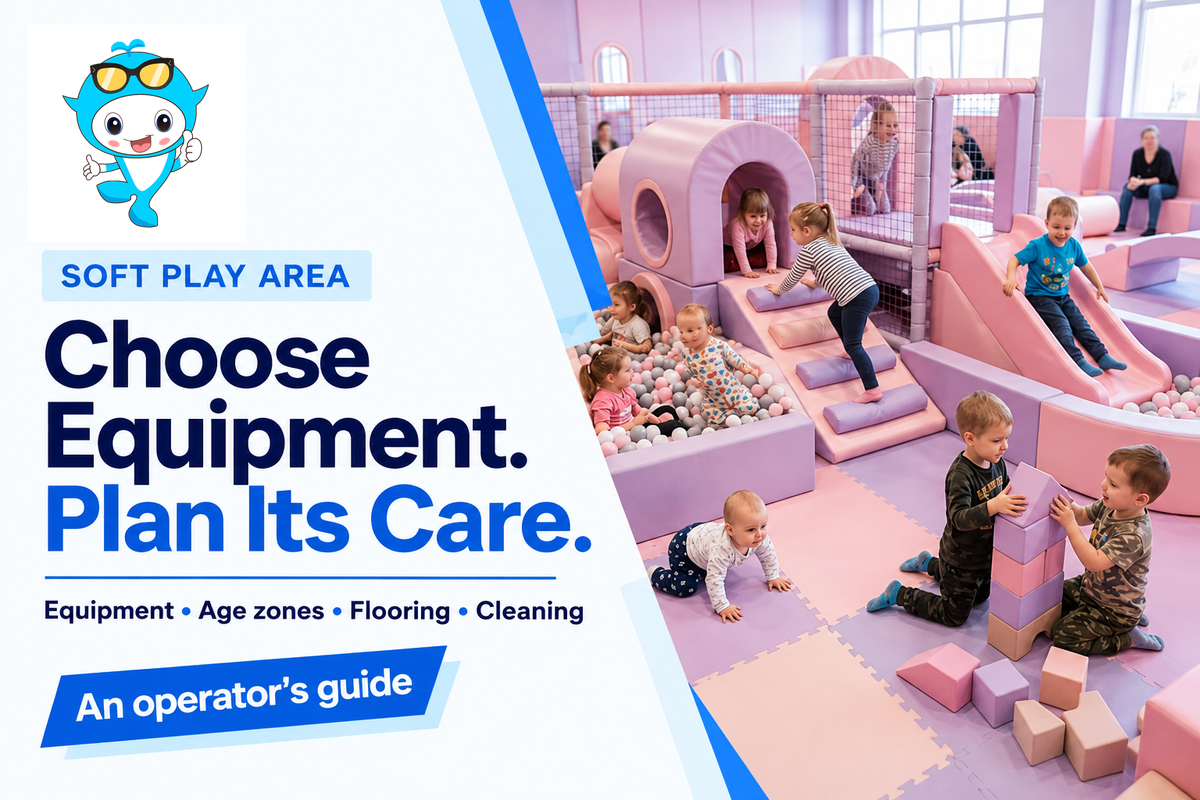
A soft play area comprises a range of padded products for crawling, climbing and other balancing and imaginative activities. The use of an indoor space begins with the clientele who will use it. In addition to appropriate equipment, potential conflicts between activities need to be identified and separated. An indoor space requires a well defined floor system and operational instructions for staff to perform routine cleaning of the equipment.
For a play center, nursery, hotel or family venue, buying more equipment is rarely the whole answer. The purchase of additional pieces to meet the demands of increased usage must be planned for. This guide helps operators assess the equipment choices available and plan their daily care. For suggestions on product configurations, refer to Didi Land’s commercial soft play equipment and for measurement, installation and opening of space, refer to the separate soft play equipment set up guide.
Start with four decisions
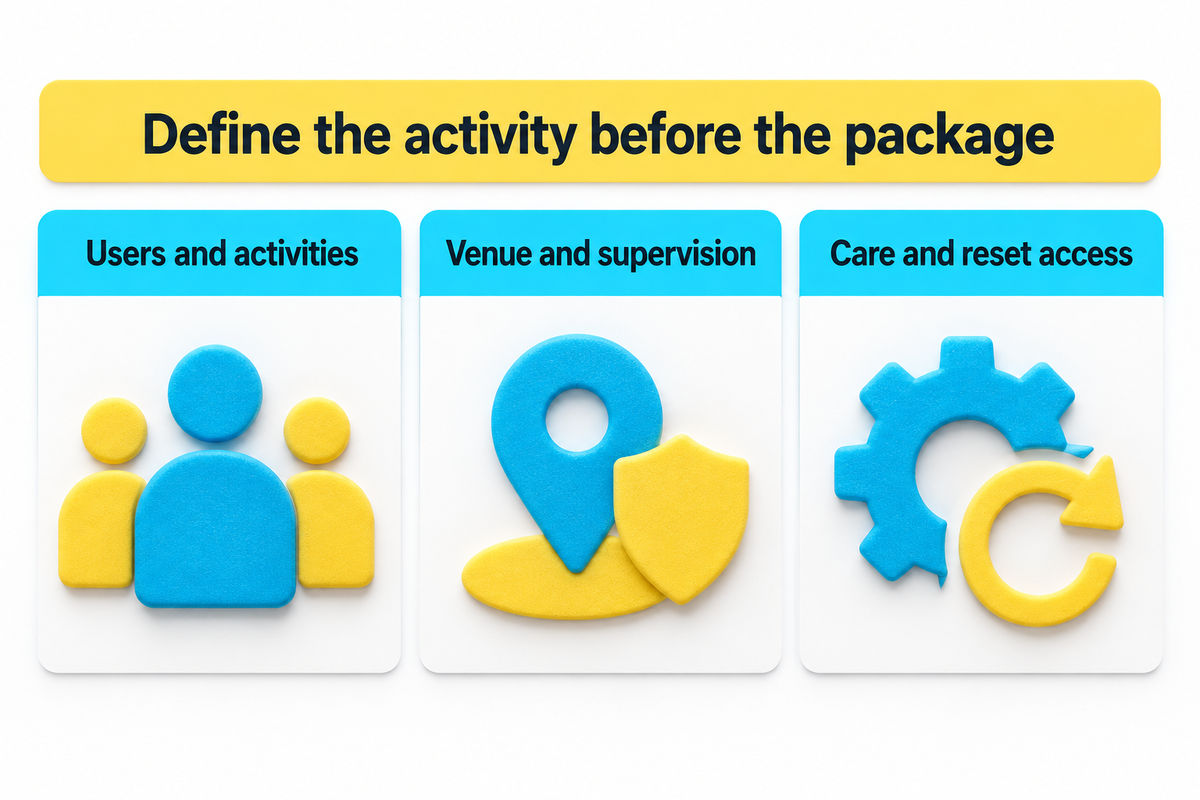
- What will children do: crawl, step, balance, build or climb?
- Which intended users can use each piece and each route?
- What floor performance and access does the activity require?
- Who will clean, inspect and reset it before the next session?
What Is a Soft Play Area?
A soft play area is an indoor play space built around padded activity equipment, usually including foam shapes, ramps, tunnels, slides and ball pools. It can be a small floor-level toddler area or part of a larger indoor playground space.
Loose foam blocks and a fully enclosed play structure are discrete purchases. A trampoline, inflatable bounce house or outdoor play installation introduces other activities and operating requirements. Compare the actual equipment category before considering size and/or cost.
For example, ASTM F1918-21 covers soft-contained play equipment, and therefore excludes others, including home playgrounds and toys. Its stated user range does not define a universal age recommendation for all soft play equipment. A baby’s play corner needs appropriate equipment and instruction.
Before finalizing a purchase, prepare an operating brief detailing expected users, their activities, the venue type, supervision arrangements and the reset window. A quiet indoor play area for little ones has different requirements from a busy venue hosting birthday parties. The operating brief stops a product photo becoming the entire purchase specification.
Soft Play Equipment List: What Each Item Adds
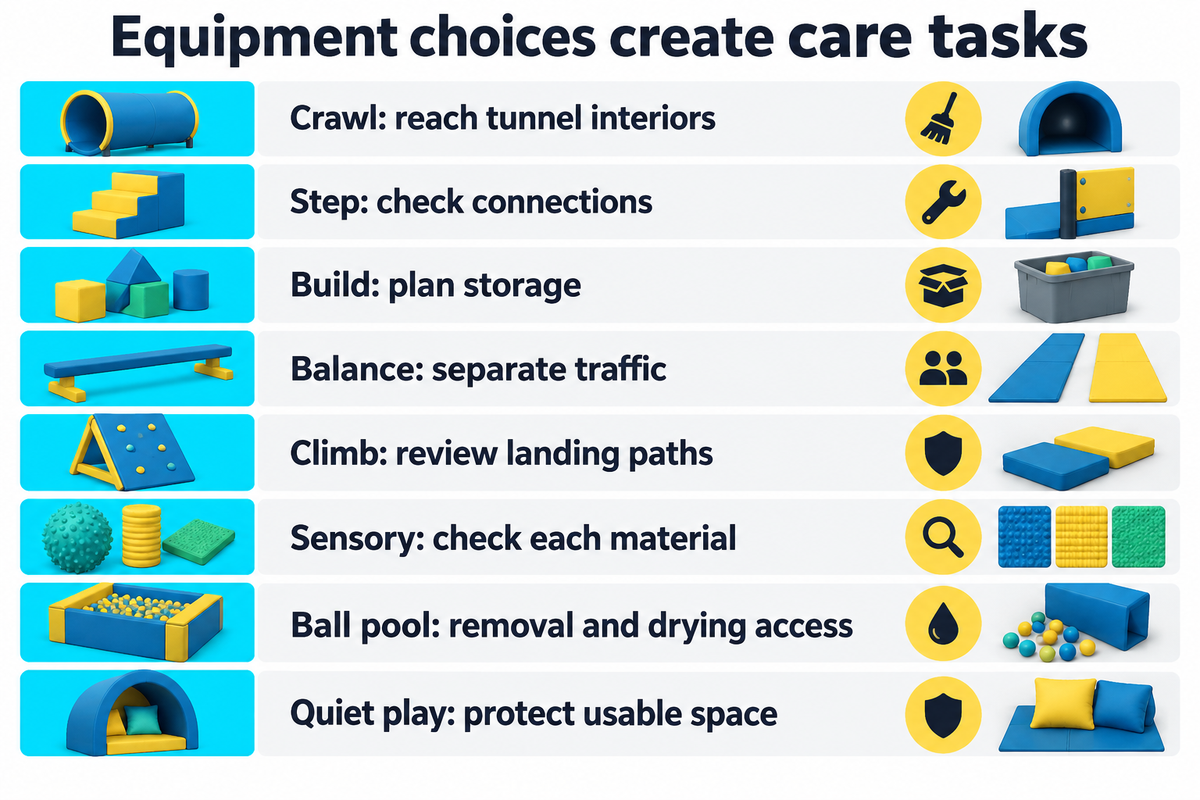
Build a list of equipment based on the types of play rather than the number of pieces. A starting variety of foam pieces could include blocks, steps, ramps and tunnels. Other climbing and sliding equipment can be added if it fits the space and care requirements of the venue.
The Equipment and Cleaning Workload Map below shows the operating impact of each equipment purchase, along with the ongoing labor and storage burden on the owner. Procurement chooses the equipment; the shift team needs access to care for it.
For an indoor play place including birthdays, free play and a separate climbing area, a useful floor plan needs to accommodate staff access and changing activities, as well as the equipment footprint, rather than simply show how many pieces of equipment fit.
| Play function | Equipment to consider | Selection and care consequence |
|---|---|---|
| Crawl and explore | Low wedges, floor-level shapes and crawl tunnels | Choose the intended-user rating; staff need access to tunnel interiors and contact surfaces. |
| Step and descend | Foam steps and ramps | Use the approved arrangement and inspect connections and contact points during reset. |
| Build and rearrange | Foam play equipment, including large building shapes | Plan a storage position and a repeatable starting arrangement instead of leaving pieces in circulation routes. |
| Balance and follow a path | Age-rated balance pieces and stepping shapes | Match the challenge to intended users and keep the activity clear of unrelated traffic. |
| Climb and slide | Soft play climbing equipment and suitable slides | Review access, landing paths, visibility and the specified floor system together. |
| Play pretend and explore textures | A suitable playhouse, activity panels or sensory pieces | Check the intended users and the cleaning instructions for each material and attached component. |
| Explore a ball pool | Soft play ball pits | Include entry control, ball removal, base cleaning, drying and storage access in the decision. |
| Pause or choose quieter play | A quieter floor-level activity choice, outside fast movement | Keep it visible and usable; avoid turning the quieter space into overflow storage. |
The Didi Land website has a ball pit page showing ball removal and cleaning as part of the configuration. This is useful before making a purchase to show how staff reach pools accessible from one side, and how to incorporate a pool that’s built under a play structure. Compare the service route alongside the play experience.
Michele Caruana, Play Cafe Academy founder, writes in her 2026 play-cafe design commentary: “More stuff doesn’t equal more value if the space feels overwhelming, disjointed, or generic.”
What does the new piece add that the existing mix cannot provide? A second similar climber may be less useful than a different activity or a workable cleaning route.
Start with modules that provide different activities and don’t try to fill all the gaps with playspace pieces. When the same modules go to party rentals, include transport cleaning, dry storage and inspection in the operating instructions.
Age Zones: Match Equipment to the Children Using It
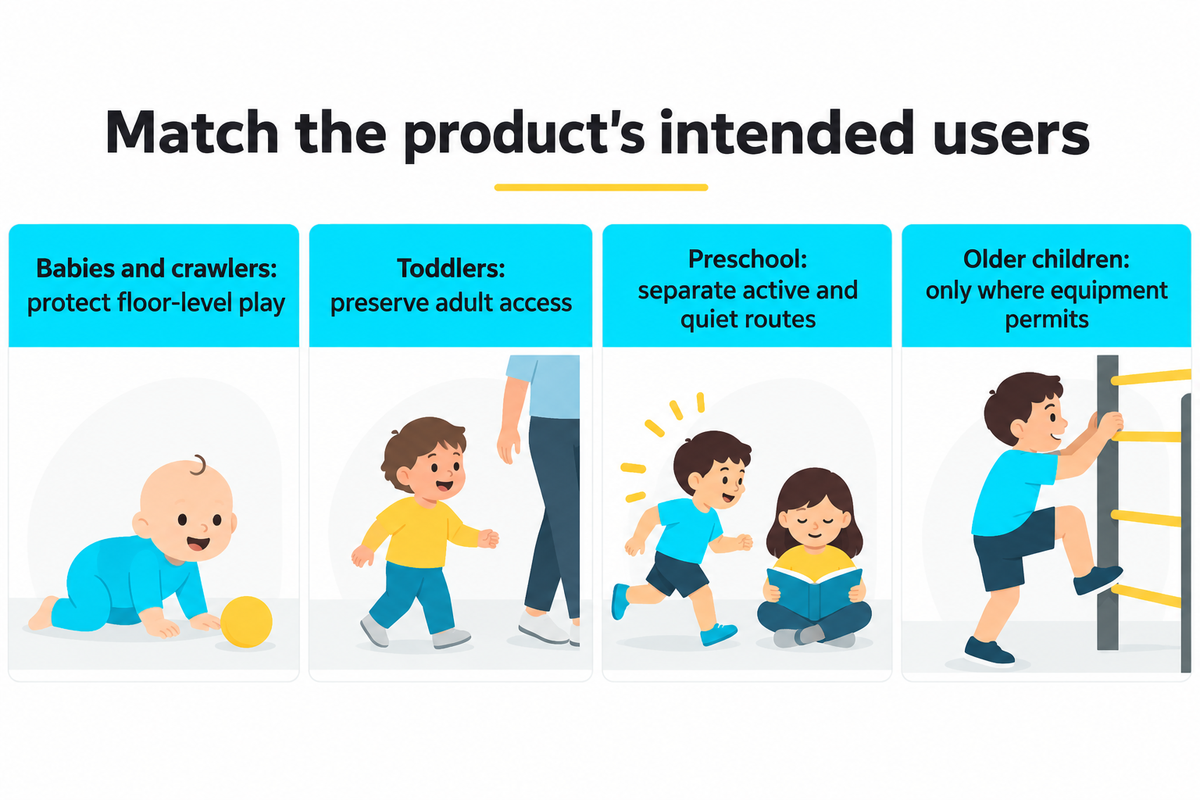
Organize age zones according to the equipment’s intended users, their movement and their size. A crawler needs a different zone than a confident climber. Use the actual age, size and ability limits for a product, and then separate activities that bring fast-moving children into slower, floor-level play.
| Planning group | Activity emphasis | Main layout question |
|---|---|---|
| Babies and crawlers | Suitable floor-level exploration and caregiver interaction | Can older children cross this space on the way to another attraction? |
| Toddlers and early walkers | Suitable stepping, crawling, building and low-level play | Can adults see the activity and reach a child without crossing a landing path? |
| Preschool children | Product-rated balance, pretend play and an obstacle course | Do routes separate active movement from quieter play? |
| Older children, where the equipment permits | A challenge suited to the specified user range | Can big kids enter the toddler area or collide with children at exits? |
The CPSC soft-contained play checklist focuses on size differences and collision paths. It advises keeping older, larger kids out of toddler areas and preventing children from lingering at slide exits or at the base of climbing equipment in ball pools. A padded surface doesn’t prevent a traffic conflict.
Can babies use a soft play area?
Babies can use equipment specifically intended for their stage and allowed by its instructions, with appropriate caregiver supervision. Choose a separate baby zone rather than a general climbing structure. The equipment rating, the child’s abilities and movement in that area matter more than the facility’s broad age label.
A clear zone rule can help staff explain that children can play safely with equipment that suits them. The operating team needs a practical method to prevent older kids from crossing into a slower toddler activity. Keep the caregiver seating area connected visually to play, while adhering to the venue’s supervision and access arrangements.
For a larger play park, check that bigger kids can reach popular activities without cutting through the space reserved for the littlest ones. Provide a sensory-friendly choice such as a quieter activity and ask caregivers what helps the children they’re accompanying. Children aged within a product’s stated range can still vary in size and ability. Plan activities and supervision based on variation in size and ability.
Add participation options for kids of all abilities to the design brief. Refer to the soft-contained structures in the U.S. Access Board play-area guidance for specific design requirements. Address access issues with the actual installation. Don’t assume addressing a soft surface or wide opening resolves all issues.
Soft Play Flooring: Match the System to the Activity
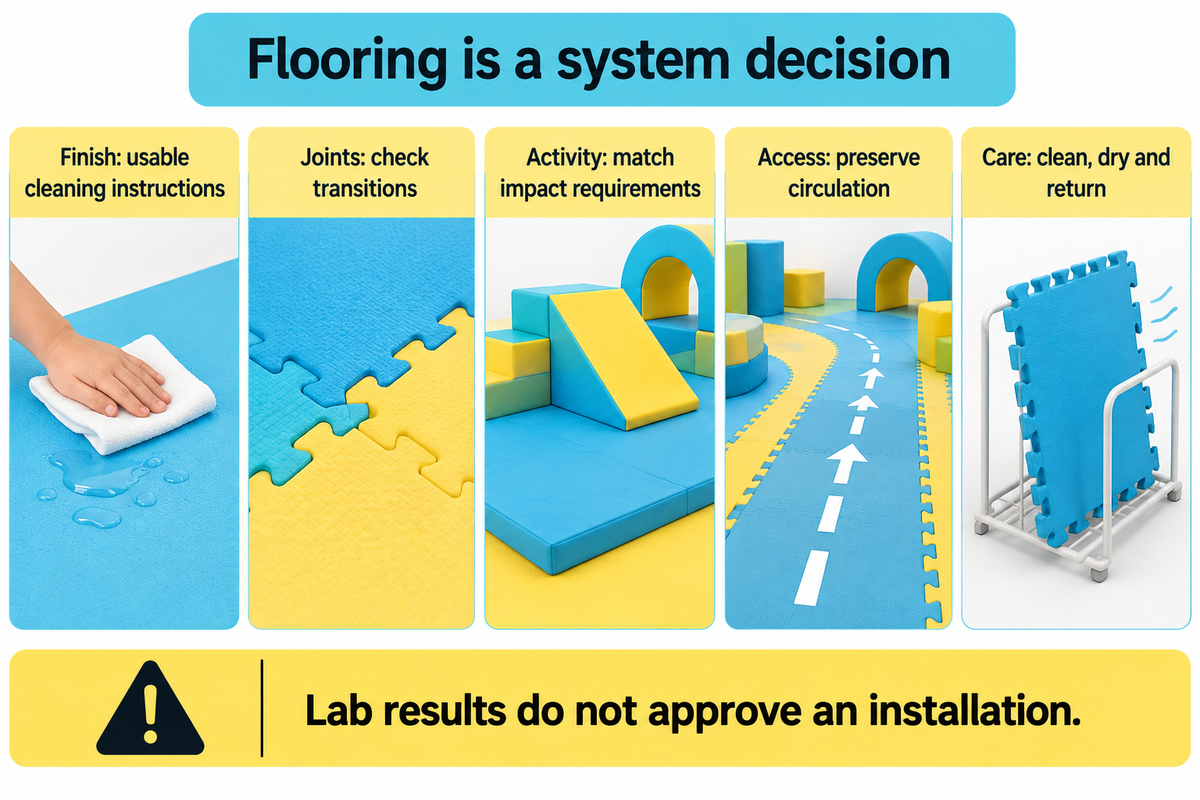
Select flooring for activity, equipment and installation. Assess how staff will clean and maintain the flooring. Stable joints, wipeable surfaces, impact absorption and circulation address other issues. The right choice for the intended use is a documented system, not a thickness chosen solely because it feels soft.
What are soft play areas made of?
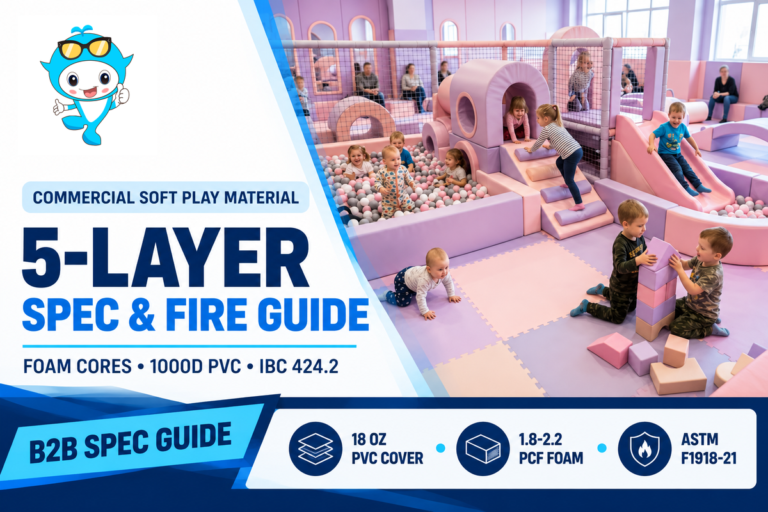
Care requirements and performance of various components of soft play equipment should be reviewed. The equipment may include foam cores, protective covers, support structures and separate floor materials. The support structures may require maintenance while the cover and/or floor may be wiped. In order to address maintenance, review the actual equipment specification. A cover doesn’t always indicate the condition of the underlying foam. A foam specification doesn’t always describe the floor.
For routine wiping, compare the accessible cover surfaces, seams and joints of candidate mats. A floor with reachable surfaces and an approved cleaning method gives staff a clearer task than one with inaccessible gaps; assess cleaning convenience alongside the required impact performance. Ask what evidence relates to the complete surfacing arrangement, including the substrate and relevant joints or transitions. ASTM F1292-26’s public scope describes laboratory impact testing and explains that laboratory results do not account for important factors affecting installed surfacing. Keep the test’s scope and the installation’s ongoing condition together.
- Finish: choose a material with usable, product-specific cleaning instructions.
- Joints and edges: check how the specified system stays in position and how staff inspect transitions.
- Activity: match the floor to the equipment and its intended use, including applicable impact requirements.
- Access: preserve the circulation and maneuvering space required for the installation.
- Care: plan how components can be cleaned, dried and returned to position.
Consult the instructions of the designer and manufacturer for this project. Keep damaged or displaced sections out of use until assessed and corrected as per the venue’s procedure. Footwear rules, including any grippy socks policy, are a separate operating choice. They don’t provide a floor-system test result.
Soft Play Cleaning Plan: Tasks, Triggers, and Owners
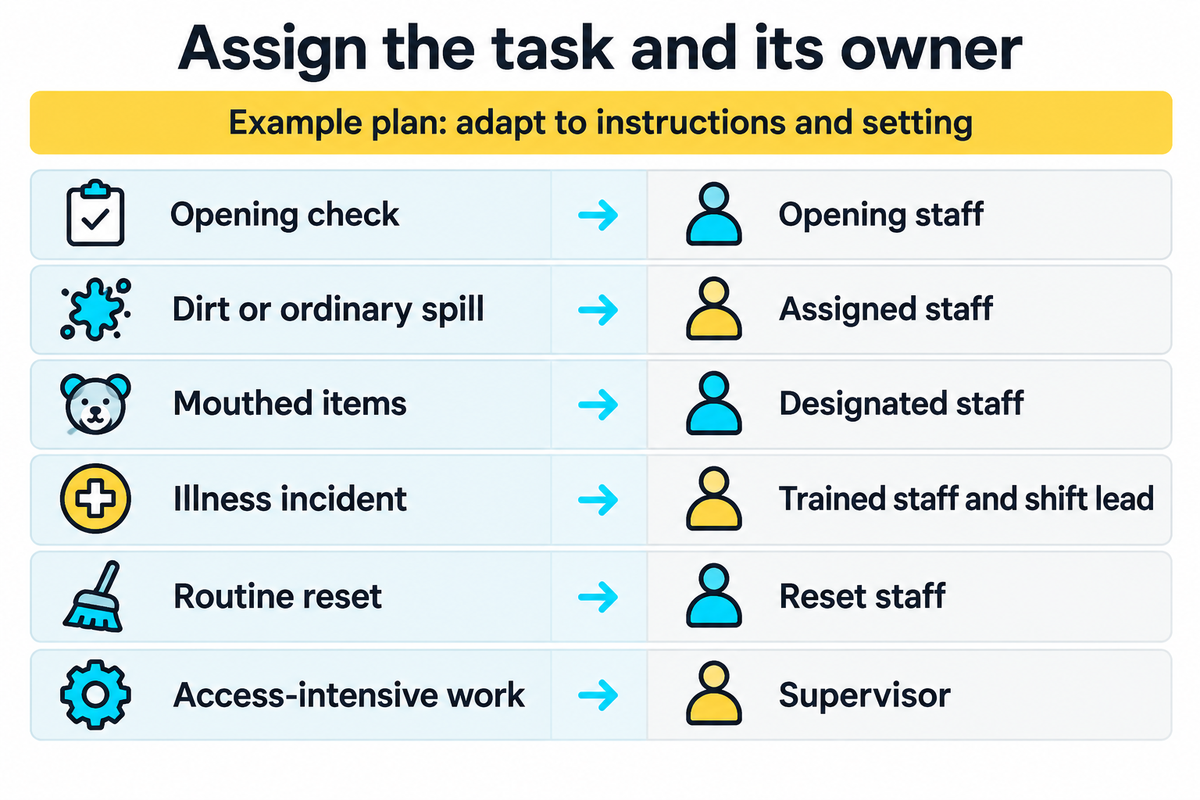
A cleaning plan names the item, the reason for work, the approved method and the person responsible. Regular cleaning of ordinary dirt from surfaces is different from sanitizing or disinfecting and removing uncommon contamination. Use the equipment instructions along with the product label.
How are soft play areas cleaned?
Follow the product and equipment instructions to clean the surfaces, carry out any required sanitizing or disinfecting, allow the required contact time, and complete any required rinsing and drying before returning the item to use. Keep a record of unfinished work.
CDC community-facility guidance indicates that surfaces should be cleaned prior to sanitizing and disinfecting. Its early-care and education guidance mentions particular tasks to include treatment of items that come in contact with children’s mouths. The guidance should be applied to the location; a nursery and a community facility may not have the same requirements.
The schedule that’s shown below is an example of an operating plan. Adjust it to reflect the actual guidance and instructions, use, local needs and contamination events. It doesn’t replace the venue’s incident response procedure.
A venue with daily open play and private birthday parties may require different reset windows during the same day, especially if the team needs to move equipment or open up a ball pool for access before completing the scheduled work. Access-intensive tasks should be scheduled outside of open play hours when the affected zone can’t be left available. Separate cleaning work from active playtime.
| Task or trigger | Work to assign | Owner and completion record |
|---|---|---|
| Opening check | Check that prior work is complete, surfaces are ready and items are in their approved arrangement. | Opening staff record unresolved items before opening the affected zone. |
| Visible dirt or an ordinary spill | Keep children clear of the work and use the approved surface-cleaning method. | Assigned staff record the affected item and completion. |
| Mouthed toys or components | Remove for the treatment appropriate to the item and setting. | Designated staff track removal, required treatment and return. |
| Illness or bodily-fluid contamination | Keep the affected area unavailable and activate the venue’s specific incident procedure. | Trained staff and the shift lead document the response and reopening decision. |
| Planned routine reset | Complete the item-specific surface tasks and restore the approved arrangement. | Reset staff record the zone, tasks and outstanding work. |
| Scheduled access-intensive work | Allow for ball removal, bases, undersides, seams and other areas identified in the care plan. | The supervisor schedules access, staffing, storage and return-to-use checks. |
When disinfection is necessary, EPA guidance explains label contact time and use directions. The surface must remain visibly wet for the amount of time specified, and this may require more than one application. Pick a product with the appropriate use and situation, within the equipment’s material limits. Keep all chemicals secured and appropriately handled.
Create a unique procedure for abnormal contamination. For example, the CDC has specific guidance for cleaning and disinfecting after vomiting or diarrhea. Train staff to use the appropriate procedure instead of instructing them to create a more concentrated solution or use the same chemical recipe to clean everything.
Daily Soft Play Checks Beyond Cleaning
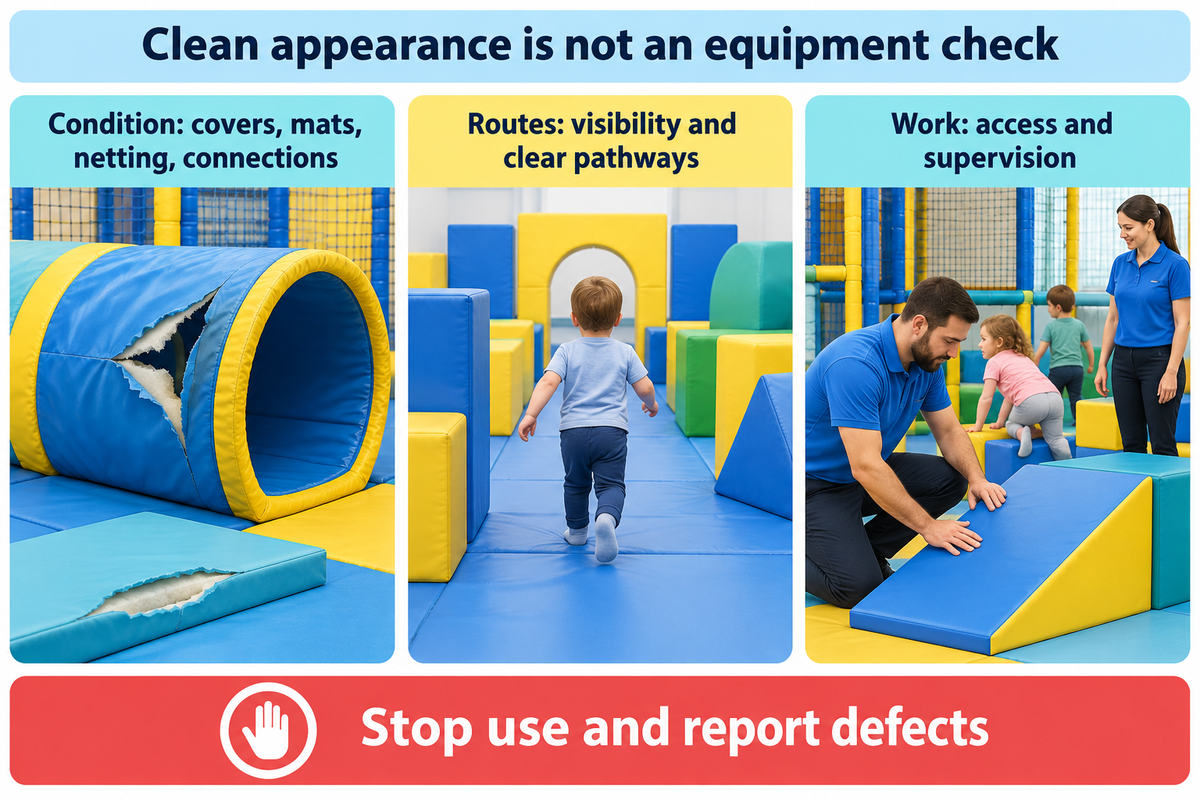
When assessing the equipment, check for displaced mats, damaged covers, torn netting and loose connections and ensure there are no obstructions to the view of the equipment, and there are no blockages to pathways for equipment use. Assign a clear stop-use and report procedure so that equipment that appears clean isn’t returned to service if it still has an equipment defect.
Walk the play zones from a child’s perspective and from an adult’s. Is it possible to reach a child without crossing a slide exit? Have pieces from a net or post become dislodged? Have loose pieces migrated into circulation space? Are barriers and gates in approved conditions? The questions regarding the torn netting and collision paths in the CPSC checklist are practical operating concerns.
Describe storage and the venue’s emergency procedures in the equipment list. Pieces stored should fit the designated storage arrangement and leave required routes available. Plan assistance for children who require help to leave during an emergency. Fire and evacuation requirements need project-specific treatment; they’re separate from an everyday cleaning schedule.
For private parties followed by open play, name who checks the changeover. A team member cleaning a tunnel may not be able to watch all the other activities. Schedule the work around the supervision arrangement of the venue. Keep a repair referral open until the person responsible for it documents the closure.
Cleaning Workload: Estimate the Time Before Adding Equipment
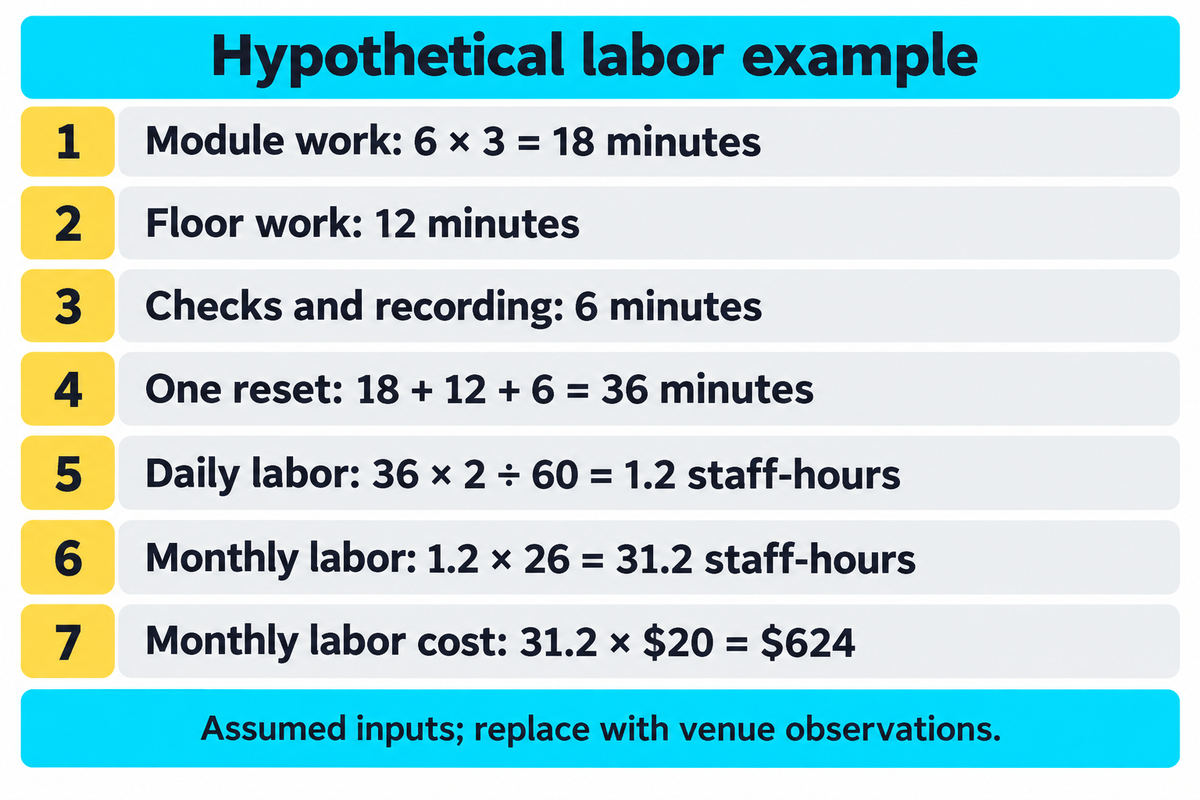
Estimate the routine labor required for the tasks the staff has to perform and separately plan the elapsed contact and drying times required by the method. Include time to remove, move and check equipment and return it to its proper place. Trial the routine with actual products and layout to determine staffing requirements.
Hypothetical example: Let’s say a reset takes six modules to complete (each module takes three minutes) plus twelve minutes of floor work and six minutes of checks and recording. Assume two resets per day, twenty-six operating days per month and a loaded labor cost of $20 per hour. These are illustrative examples and not measured Didi Land cleaning rates or a recommended schedule.
| Calculation | Illustrative result |
|---|---|
| Module work: 6 × 3 minutes | 18 minutes |
| Floor work | 12 minutes |
| Checks and recording | 6 minutes |
| One reset: 18 + 12 + 6 | 36 minutes |
| Daily routine labor: 36 × 2 ÷ 60 | 1.2 staff-hours |
| Monthly routine labor: 1.2 × 26 | 31.2 staff-hours |
| Monthly routine labor cost: 31.2 × $20 | $624 |
The model captures routine activities and tasks. Incorporate access intensive tasks, response activities and other work, and supplies, separately. Wet contact time or drying time can impact when a zone is available for the next activity even if a worker isn’t continually touching that zone. Adjust staffing based on actual zone use and task records of a shift rather than membership totals.
For affordability, compare two equipment mixes against the same task list. If an optional ball pool adds removal and storage work, include those tasks before choosing it over open-ended foam shapes. Replace the example inputs with observed times from your venue, and don’t treat the illustration as a quotation. If finance tracks cost per child, use actual attendance figures with these operating costs; that accounting measure doesn’t establish safe occupancy.
Choose Equipment With a Plan for Its Daily Use
Choose the activity mix and intended user group first, then review equipment, flooring, access and care as one operating plan. Keep the equipment list short enough to explain the purpose for each item. An assigned care task and a clear purpose ease the comparison process for the owner and operating team.
Prepare your supplier with a room drawing and a list of intended user groups, activity priorities and service-access questions. Didi Land’s foam-play page includes a project module system consisting of blocks, climbers, mats and ball-pit edges. The company describes its design, production, installation and aftercare services in its Company Introduction. Use the equipment page to discuss equipment configurations, and use this guide to prepare an operating brief for that discussion.
Discuss Your Soft Play Equipment Plan
Frequently Asked Questions
What is a soft play area?
A soft play area is a space with padded equipment for activities such as crawling, climbing, balancing and pretend play.
Its size and format vary from a small toddler corner to a contained structure. Check the intended users and instructions for the actual equipment; the general name doesn’t define every product’s requirements. An operator can combine activities in one room while keeping the intended users, routes and care tasks clear for each component. Start the equipment list with those activities rather than a fixed piece count.
Can torn soft play covers stay in use?
Remove the affected item from use and follow the manufacturer’s assessment and repair process before returning it.
A wipe-down doesn’t repair a tear or resolve exposed foam. Record the defect, identify the person arranging repair and keep the item separate from available equipment until the issue has been addressed. Tell the shift lead where it’s stored and which play activity is unavailable. Where a damaged component belongs to a larger structure, follow the applicable stop-use procedure for the affected equipment or zone.
Are soft play areas full of germs?
They can carry germs: CDC guidance notes that high-touch surfaces, including toys, are generally more likely to have germs on them, so shared surfaces need a suitable hygiene routine.
Plan the tasks for the actual items and setting, follow the relevant instructions, and give illness or bodily-fluid incidents a separate response. Keep affected items unavailable during treatment and record their return only after the applicable process is complete. Give staff a way to flag an unfinished task at shift handover so the next team can finish it before children use the item again.
Is a ball pit essential?
No; a ball pit is an optional activity, not what defines soft play.
Compare its play purpose with the space, removal, cleaning, drying and storage tasks it adds. Foam shapes, tunnels or suitable activity pieces may better fit a small venue.
Can an operator use one cleaning product on every component?
Use one product across components only when its label and each component’s instructions permit that use.
Covers, floor finishes, balls, printed panels and electronic elements can have different care requirements. Build the item list first, then record the approved method for each. The product’s directions govern its use conditions; the equipment instructions govern material limits. Where the two don’t fit, resolve the method with suppliers rather than improvising a mixture or extending a recipe from another material.
Does soft flooring make every activity suitable?
No; flooring is one part of an activity-specific equipment and operating system.
Match the equipment’s intended users, arrangement, circulation and relevant performance evidence. Inspect it: a padded surface doesn’t remove collision risks at slide exits or compensate for an unsuitable activity.
How much do soft play areas cost?
A WellnessLiving cost guide estimates equipment at $8,000 to $25,000 for a toddler soft play area and $75,000 to $300,000+ for a multi-level commercial structure; flooring, delivery, installation and site work add to that upfront budget, and recurring operating tasks are budgeted separately.
The total depends on the configuration and venue. Compare quotations against the same scope, and measure routine labor with the actual layout and products. For a broader opening budget and project sequence, use the linked setup guide, then obtain a quotation for the selected equipment and destination.
References & Sources
- ASTM F1918-21: Soft Contained Play Equipment official public scope and catalog status.
- Soft Contained Play Equipment Safety Checklist U.S. Consumer Product Safety Commission.
- Play Areas: Guide to the ADA Accessibility Standards U.S. Access Board.
- ASTM F1292-26: Playground Surfacing Laboratory Impact Attenuation official public scope.
- When and How to Clean and Disinfect a Facility CDC.
- Cleaning and Disinfecting Early Care and Education Settings CDC.
- Selected EPA-Registered Disinfectants label directions and contact time.
- How to Prevent Norovirus CDC; incident-specific guidance.
About This Equipment and Operations Guide
Written by CYH for Didi Land. This guide connects soft play equipment choices, age zones, flooring questions and cleaning work for venue operators. Public supplier pages inform product examples; official sources inform the stated safety and hygiene boundaries. The labor example uses assumed inputs, and project-specific equipment instructions and applicable local requirements still need to be addressed in the venue’s plan.