Get in Touch with Didi Land


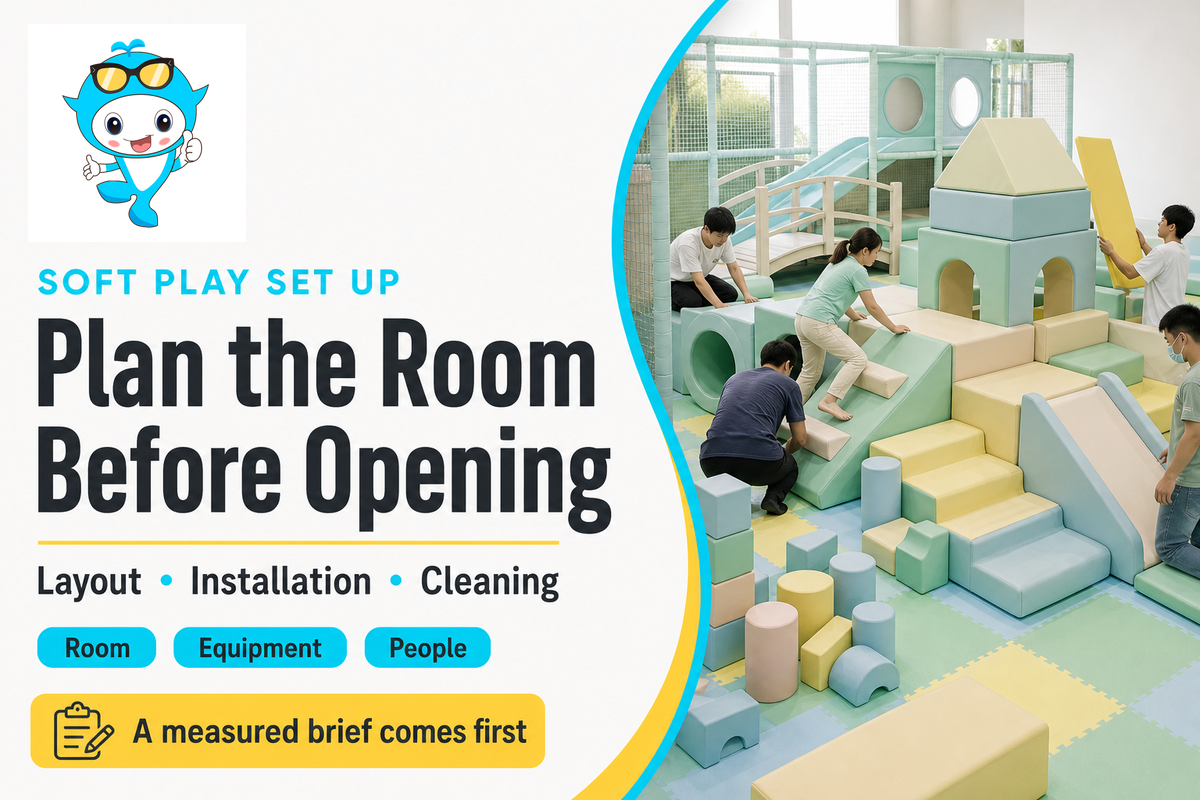
A commercial soft play set up begins with a measured room and a clear operating brief. Select the equipment format, check the space around it, agree on the installation scope, then prepare the people and records to open. Buying foam is one task in that sequence.
This reference is for operator planners considering an indoor location including a play café, hotel, restaurant, or daycare. It separates portable sets from fixed equipment, and takes the work through layout, budgeting, and cleaning. Start with Didi Land soft play equipment to identify potential equipment families. Use the following checks to transform the selected equipment to a workable plan.
Key takeaway
Approve the room, equipment, operating routes and handover responsibilities together. An equipment rectangle that fits on a drawing can still leave an unusable delivery route, blocked cleaning access or an unresolved opening requirement.
Choose the Right Soft Play Setup for Your Business
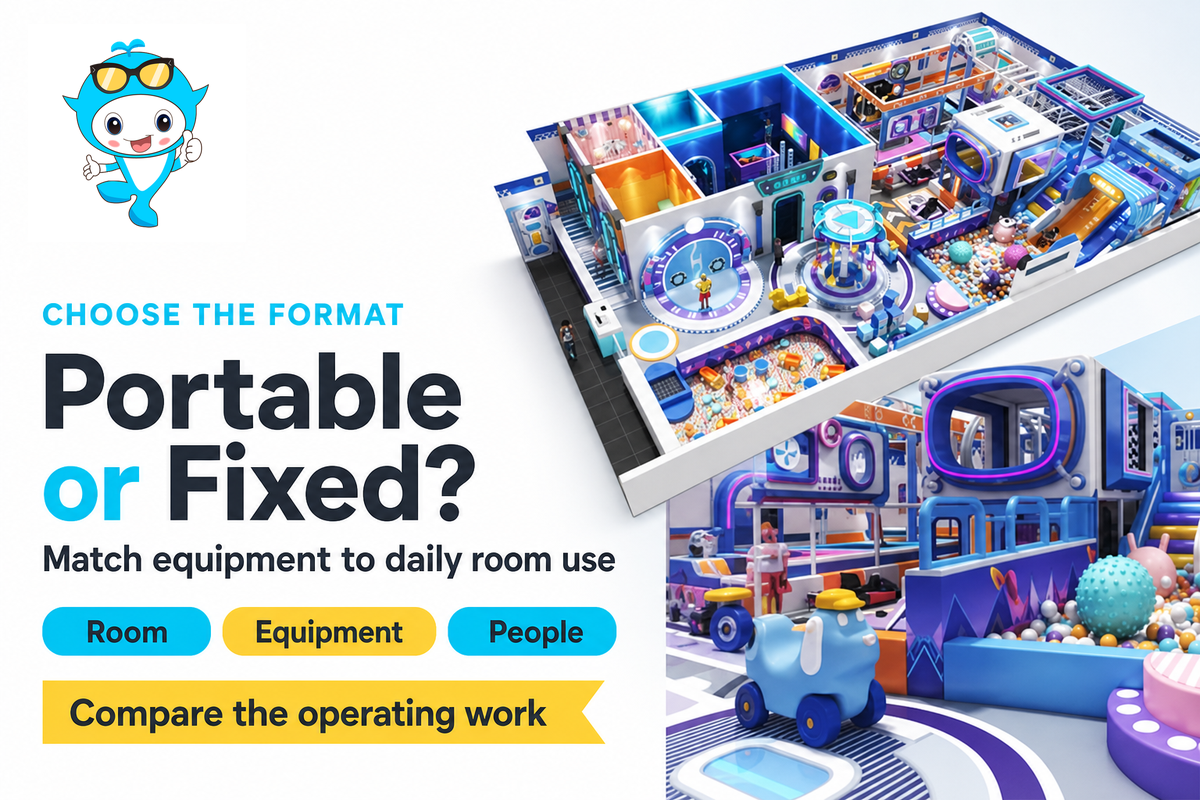
Plan the indoor play area around its actual operating use. A toddler playground with loose soft play toys needs a different reset routine from a fixed soft play playground. When speaking to a supplier for advice, describe the product and the user.
Choose a portable set when the venue needs regular removal, storage or relocation. Pick a fixed, soft-contained structure when the play environment is to be left assembled. A hybrid setup needs directions for both: the permanent structure has its own set of instructions, while loose pieces need a plan for a repeatable placement and a reset routine.
In the purchasing brief, separate loose foam toys from fixed, soft-contained systems. In ASTM F1918-21, the focus is on soft-contained play equipment. Foam toys and fixed frames can appear in the same catalog and require different installations and operating instructions. Determine the intended users and context for each product family.
Portable Foam Sets vs Fixed Soft-Contained Structures
A small slide and a set of steps can be incorporated in different ways in different activities. Flexibility creates work for the user at every changeover. A fixed frame can eliminate some user routine repositioning, but assembly must be such that access for inspection and cleaning isn’t blocked. Compare both the operation and purchase.
| Decision | Portable foam set | Fixed structure |
|---|---|---|
| Room use | May share space with other activities | Reserves an agreed equipment envelope |
| Placement | Repeat a documented arrangement | Follow the approved assembly drawing |
| Storage | Plan a separate storage location | Plan spares and removable-part storage |
| Reset work | Assign moving and checking tasks | Assign opening and between-session checks |
| Cleaning | Reach every piece and its underside | Reach internal surfaces and service points |
| Delivery | Confirm packed dimensions and lifting needs | Confirm the full unloading and assembly route |
| Relocation | Check transport and repeated handling limits | Obtain a supplier relocation plan |
| Users | Use the specific product’s restrictions | Use the specific system’s restrictions |
| Acceptance | Agree on placement and operating checks | Agree on installation and site review records |
A restaurant that clears its activity room for a private function may use a portable toddler play arrangement. Staff would need to store the arrangement and be able to reconstruct it to lay out the space for the next function. If staff leaves the pieces in a corridor, then it defeats the benefit of a portable space-saving arrangement. This is a planning situation, not a recorded Didi project.
Describe the play experience you wish to offer to get started. One versatile room may be configured to encourage imagination using loose blocks in one use and to host a guided activity in another. Determine who moves the pieces and checks the reset. An adventure theme alone can’t address the operating questions.
Write the activity brief in observable terms. If motor skills are a goal, identify the balancing or crawling activity you want to provide. If creativity matters, give children choices about how to arrange the suitable loose parts. Encourage exploration within the approved arrangement and provide a clear route back to the supervising adult. A child’s first visit is a good example to trace arrival, shoe storage, play, and toilet access and departure.
How to build a soft play centre?
Establish a soft play center by negotiating a venue brief, confirming the use with the appropriate local authorities and coordinating the building works with the positioning of the equipment. Then agree on supply, assembly, inspection and operating responsibilities before committing to an opening date. The wider indoor playground business startup guide covers the business planning process around the physical project.
Measure the Room and Plan the Play Zones
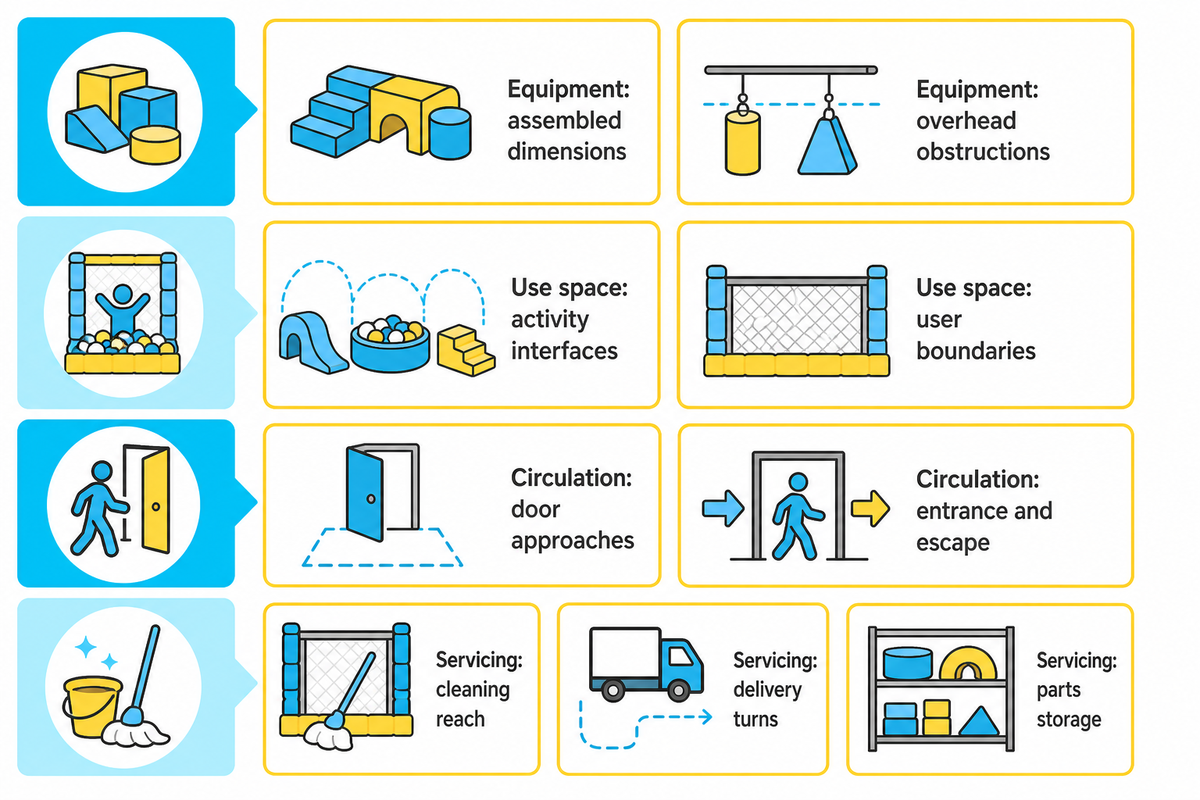
Measure the usable room, the height of the lowest obstructions and the delivery route to decide on the final equipment arrangement. Put doors and columns and fixed services on the same drawing as the play zones. The drawing should show how children enter, where adults supervise and how staff reach the equipment for cleaning and maintenance.
Create a plan where staff can observe how children engage with the interactive activity provided. A themed castle entrance shouldn’t restrict the line of sight from the seat. Show furniture on the drawing, including the route between reception and children’s activity space.
The 4-Layer Room-to-Opening Map
The 4-Layer Room-to-Opening Map separates equipment, use space, circulation and servicing on a single, dimensioned drawing.
Instead of hiding everything in one shaded rectangle, identify layers. Equipment specific requirements are provided by the supplier. Competent designers at the venue address the building and access requirements, in collaboration with the authorities. Specific provisions in the U.S. Access Board’s play-area guide address soft-contained structures, therefore, general open playground dimensions shouldn’t be transferred without reviewing their scope.
| Layer | Record | Who resolves it | Review evidence |
|---|---|---|---|
| Equipment | Length, width and assembled height | Supplier designer | Revision-controlled equipment drawing |
| Equipment | Columns and lowest overhead obstructions | Venue surveyor and supplier | Measured sections and photographs |
| Use space | Entry, exit and activity interfaces | Supplier and project reviewer | Equipment-specific instructions |
| Use space | Toddler and older-user boundaries | Operator and supplier | Intended-user and supervision plan |
| Circulation | Door openings, swings and approach space | Building designer | Dimensioned access drawing |
| Circulation | Public entrance and escape routes | Venue and relevant authority | Reviewed building and emergency plan |
| Servicing | Cleaning reach and ball-removal route | Operator and supplier | Demonstrated cleaning method |
| Servicing | Packed delivery dimensions and turns | Logistics lead and installer | Delivery-access check |
| Servicing | Storage and replacement-part access | Operator and maintenance lead | Storage plan and parts register |
Consider a second case: a hotel has enough floor area for a climber, but the packaged component can’t be turned through the service entry. The relevant measure is the tightest turn on the route, not the width of the room. Request a packing list prior to booking delivery. For module specific sizing, refer to the commercial soft play climber dimensions guide.
Position supervision at a realistic adult eye level and check the lines of sight into tunnels, behind barriers and toward slide exits. A theme can excite a child upon arrival. However, a tall decorative panel can also screen an activity. Resolve physical relationships before approving art work.
Specify Soft Play Equipment and Flooring as a Working System
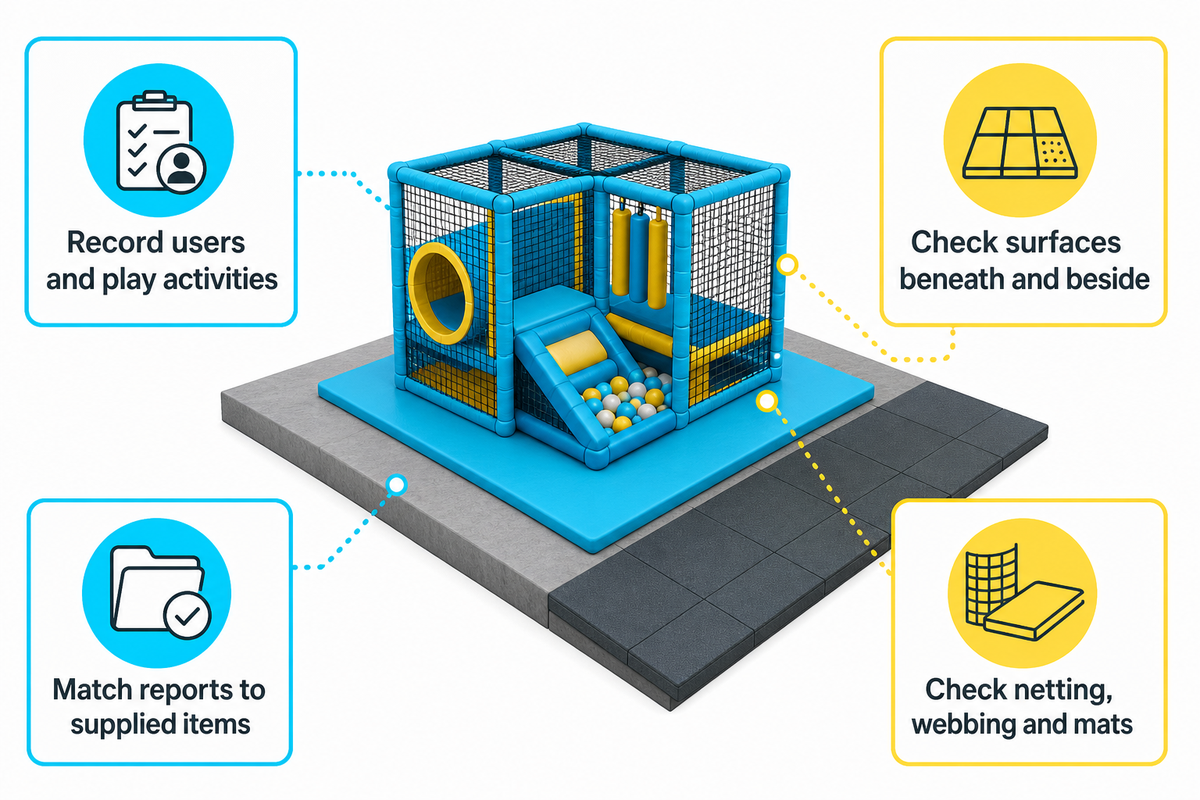
Ask how the equipment is designed to deal with repeated handling. Discuss durability regarding replaceable covers, accessible connections, care requirements and ‘high-quality materials’.
Indicate the equipment and floor as one intended configuration. Record users, play activities, dimensions of components, how components are attached and the surfaces beneath or beside each activity. State what support is needed to validate the arrangement. Foam density, cover thickness or a material report can describe a component; none alone resolves every question about the assembled venue.
Torn netting, damaged webbing, and torn surfacing and mats outside the equipment that aren’t tightly placed together are all concerns listed in the U.S. Consumer Product Safety Commission’s soft-contained checklist. Also listed is the concern of children lingering in slide-exit areas. These are good operating checks, not a substitute for installation acceptance.
Connect the intended action of each module to the adjacent arrangement: where children climb, where they come down, and where another child might wait. A ball pool adjacent to a slide requires attention, especially to the exit interaction, even if the other modules look suitable. Review the configuration and access for cleaning the ball pit, while the layout can be changed.
Request the covering’s care instructions, the proposed floor build-up and the relevant test scope. Compare a report’s product identification to the item being supplied. If the report describes a different surface or configuration, ask what additional evidence supports the proposed one. The soft play floor-mat guide can help organize flooring questions; obtain project-specific recommendations before ordering.
A daycare selecting sensory play toys and a commercial play café buying a fixed obstacle structure may need different product and operating documents. Don’t add outdoor equipment or a home-grade toy to the indoor list simply because it matches the color palette. Use the soft play sets guide to compare the component mix, then ask the supplier to confirm suitability for the actual setting.
Build an Installed-Cost Budget
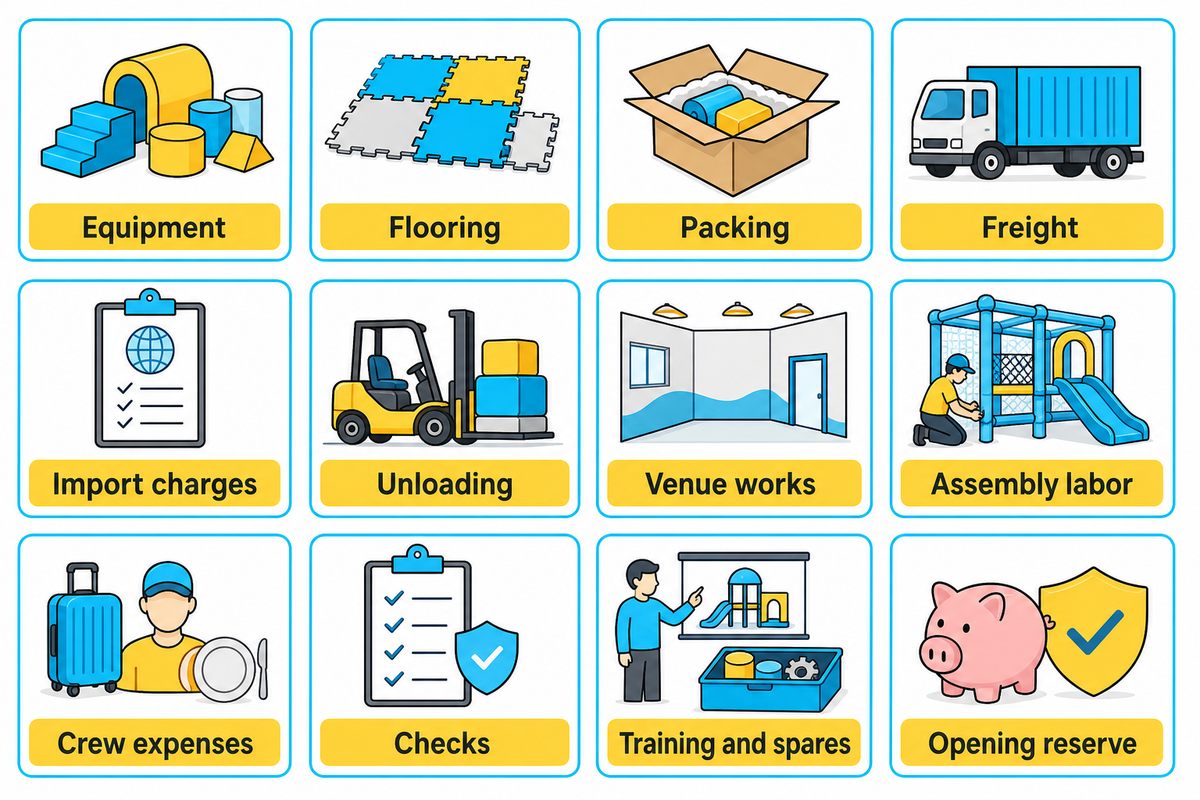
Build the budget around the work needed to reach opening, rather than an equipment-only total. Separate the costs for goods, transport and distribution, preparation of the venue, assembly and handover. Give every unresolved cost item an owner and a budget. This helps compare two quotations even when suppliers use different descriptions for their service packages.
Decide if birthday parties use the public play space or if a separate space is available. This determines how much space staff need to leave for circulation. A visually appealing space may still require staff to reset it in order to remain profitable.
How much is a soft play setup?
A soft play setup is priced based on the cost of the equipment, delivery, site preparation, assembly and opening tasks. A package and a commercial structure of that scope and scale are different. A headline price, in this case, won’t suffice. Have the supplier submit an itemized quote, against the same room drawing, destination and installation brief, to assess suitability.
| Cost line | Question to put in the quotation | Owner to name |
|---|---|---|
| Equipment | Which modules and drawing revision? | Supplier |
| Flooring | Which materials, area and edge details? | Supplier or local contractor |
| Packing | Which packing and handling requirements? | Supplier |
| Freight | Which destination and delivery term? | Logistics lead |
| Import charges | Who confirms duties and local charges? | Importer or customs adviser |
| Unloading | Who supplies labor and lifting equipment? | Venue or logistics lead |
| Venue works | Which building and service tasks are separate? | Building contractor |
| Assembly labor | On-site crew or remote guidance? | Installer |
| Crew expenses | Who covers travel and accommodation? | Contracting parties |
| Checks | Which reviews and inspections are included? | Project lead |
| Training and spares | Which instruction, records and parts? | Supplier and operator |
| Opening reserve | What remains unpriced or unresolved? | Operator |
Example: a hypothetical budget contains $12,000 for equipment, $1,800 freight, $2,200 venue work, $1,500 assembly, $500 checks and $300 opening supplies. The subtotal is $18,300. A planning reserve of 10% adds $1,830, giving $20,130. These invented inputs demonstrate the calculation; they aren’t a Didi quotation, a market range or a recommended reserve for every project.
Separate the physical project budget from rent, insurance, payroll and working capital. The U.S. Small Business Administration startup-cost guide separates one-time expenses from monthly expenses. Keep equipment purchases and ongoing staffing, rent and utilities visible as separate budget lines. An equipment invoice won’t tell you if the business has working capital to run the project after its completion.
Prepare the Site and Run the Installation
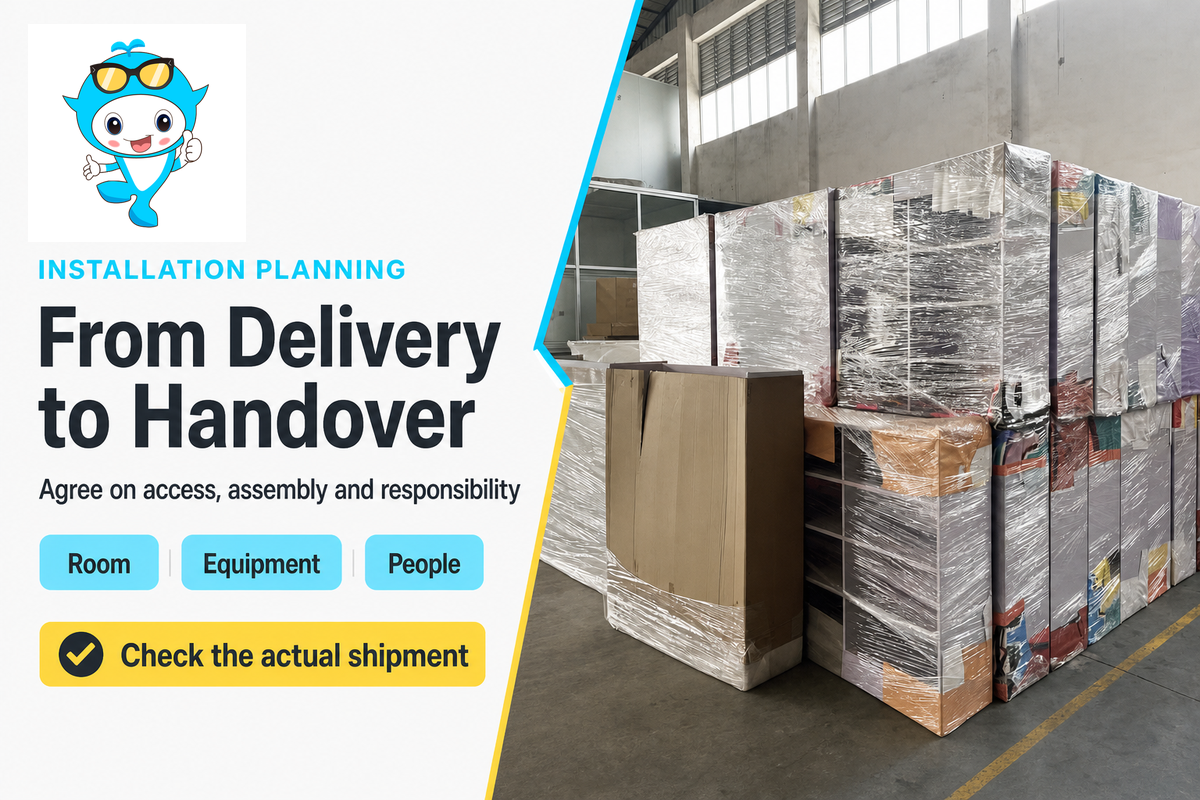
Prepare the venue against the approved drawing and the installer’s written requirements before the equipment arrives. Sequence the activities of construction, floor prep and deliveries, and equipment assembly. Confirm who can authorize a change if the actual room doesn’t match the drawing. There should be flexibility with the opening date to allow for final correction and handover.
Here’s a real world example showing the significance of the survey. House of Play writes in its Kidz#1 case study about teaming up with architects and contractors to work around limited ceiling height and a shallow pit. The vendor mentions adjusting the heights of individual play levels and adding access ramps. This is House of Play’s project description, not a Didi installation or independent verification of a general design rule.
- Confirm the revision. Match the component list and site drawing before dispatch.
- Release the room. Check the agreed building works, services and substrate condition.
- Receive the shipment. Check packages and record visible damage or missing items.
- Mark the arrangement. Check entrances, activity interfaces and service routes in the room.
- Assemble to instructions. Use the agreed installer and record approved changes.
- Close the outstanding work. Complete checks, cleaning and training before public use.
Leave an expansion option on the drawing if you want to expand later. Confirm how future deliveries and assemblies would be done, without assuming that spare floor area is an ideal equipment location.
It is a good idea to walk the room before attempting to attract bookings. Discover an awkward turn or hidden exit that can be addressed during that rehearsal and the arrangement can still be changed. An exciting environment needs a usable entrance, clear operating rules and staff who know when to close an activity. Advertising endless play is less valuable than stating what activities are available and how long the session will be.
Find the handoff that can delay opening
The hidden bottleneck is usually a task between two contracts. During the same time frame a supplier may provide remote assembly help and the operator expects an onsite crew. A building contractor may finish a surface before the installer agrees how the equipment fits onto it. Put those boundaries in a short responsibility register.
| Handoff | Evidence before proceeding | Person accountable |
|---|---|---|
| Survey to layout | Dimensions and obstructions checked | Venue project lead |
| Layout to production | Approved revision and module list | Buyer and supplier |
| Building to equipment | Agreed site-readiness items completed | Contractor and installer |
| Delivery to assembly | Access, unloading and storage confirmed | Logistics lead |
| Assembly to operation | Outstanding issues resolved and records handed over | Installer and operator |
Check building and fire review early. A June 2026 Tucson municipal plan review explicitly requested information about proposed play structures and related building-code matters. That record demonstrates an actual local review, not a worldwide approval procedure or evidence that the project passed. Ask the relevant authority what your venue must submit.
Agree on Acceptance Evidence Before Opening
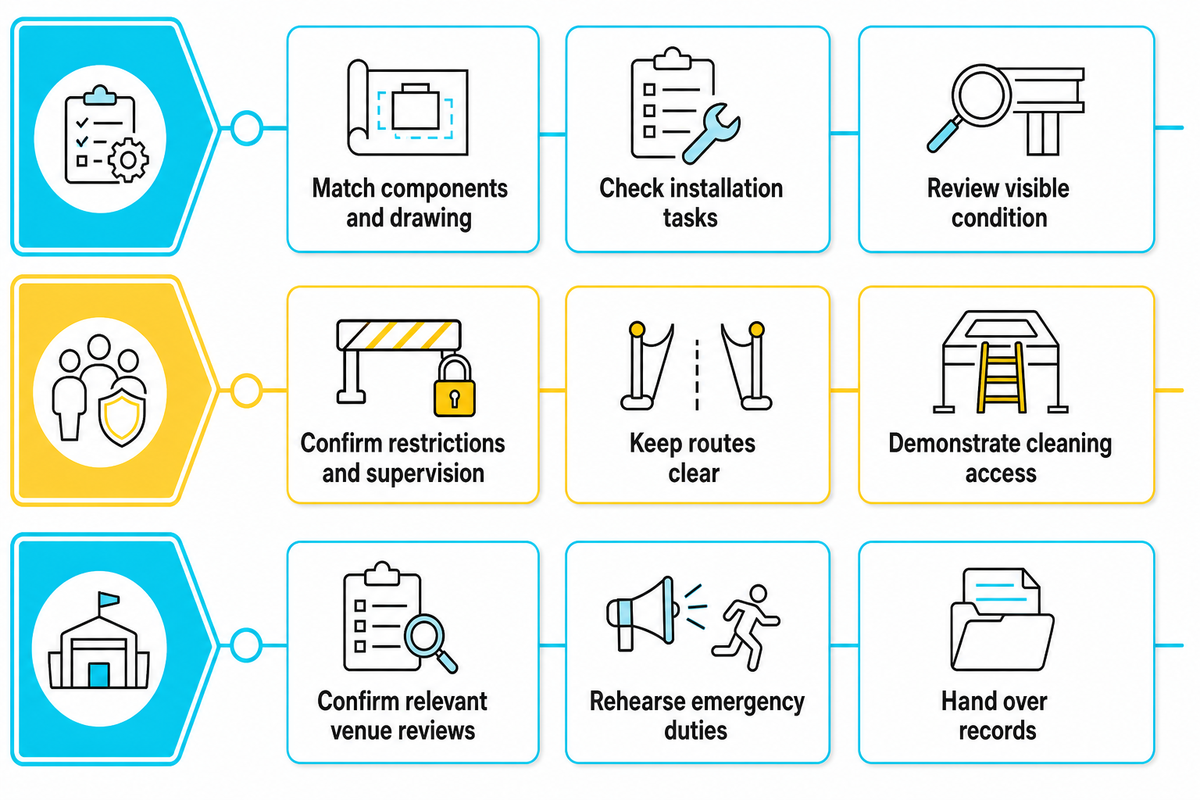
Agreement on acceptance evidence should occur before payment for final completion of the project. Review relevant equipment documents and close remaining venue requirements. Name the person responsible for each acceptance item. Supplier documents and equipment checks and permission to operate a venue address different queries.
As checked in October 2026, ASTM’s public page lists F1918-21 as Active. Its separate WK94592 work item proposes changes to the title, product definition and text references. A proposal is not a published replacement edition. BSI’s BS EN 1176-10:2023 listing concerns fully enclosed play equipment. Confirm the appropriate edition and local requirements for the particular project; the names are not interchangeable approval stamps.
Use this checklist in the room with the operator and installer.
- Match the actual components and approved drawing revision.
- Check documented installation tasks and unresolved changes.
- Review netting, webbing, padding, floor edges and visible damage.
- Confirm posted use restrictions and supervision positions.
- Keep entrances, slide exits and required routes clear.
- Demonstrate staff access for cleaning and replacement parts.
- Confirm applicable building, fire and accessibility reviews.
- Rehearse the emergency plan and explain staff duties.
- Hand over instructions, parts contacts and inspection records.
Include the stored arrangement in the fire review. The Scottish Government’s existing-premises guidance specifically discusses cellular foam and soft-play environments. Its scope is Scottish existing non-residential premises; don’t copy its ratings into a global purchasing specification. Bring the actual materials and storage proposal to the competent person reviewing your venue.
The same guidance’s escape-planning chapter discusses adults trying to reach children against the direction of escape. Rehearse how staff communicate and assist visitors under the venue’s plan. A parent’s normal supervision position and the emergency procedure must work together.
Don’t open a zone with unresolved damage or outstanding approvals. Mark who can close a defect and who authorizes reopening. Use the indoor playground standards guide as a starting list of questions, with the project’s current primary documents controlling the answer.
Plan Cleaning, Reset and First-Week Checks
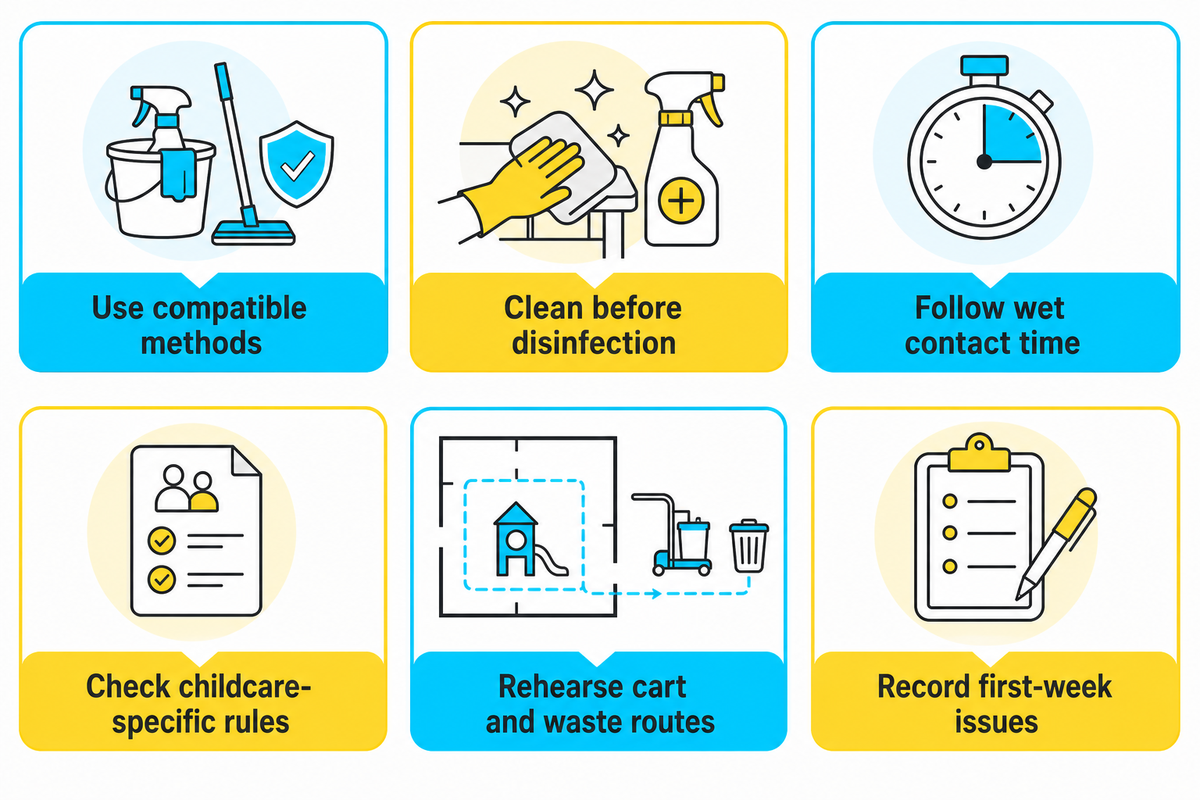
Plan the cleaning route before the room opens. Staff need to reach contact surfaces, remove debris and handle balls or removable parts without blocking the venue’s required routes. Write down the product-compatible cleaning method, the responsible person and the conditions for returning equipment to use. Note that cleaning, sanitizing and disinfecting are distinct processes.
CDC guidance for community facilities calls for cleaning before disinfection, a product suitable for the surface and the label’s wet contact time. It also identifies settings where specific cleaning rules apply. A quick spray-and-wipe routine can miss the required contact time, while an unsuitable chemical can damage a cover or seam.
“The surface should stay wet during the entire contact time to make sure germs are killed.”
For a daycare, consult the separate CDC early-care cleaning guidance. It covers sanitizing appropriate mouth-contact items and allowing them to dry completely. That doesn’t authorize boiling or steaming a foam assembly. Follow the item manufacturer’s method and the applicable setting-specific rules.
The CDC early-care infection-prevention guidance also addresses ventilation and planning an area for an ill child with continued adult supervision. These are useful reminders that a childcare opening plan extends beyond wiping equipment. They aren’t presented here as identical legal duties for every restaurant or hotel playroom.
Scenario three shows how a play café closes one zone for cleaning, and keeps the other open. Walk through the planned cleaning cart and waste-removal route before offering this option. If staff are required to cross active play with dirty parts, rethink the plan or block off a larger zone. Store chemicals securely out of children’s reach.
Keep an opening, between-session, and closing task list. The first week, note where pieces move, which seams collect debris, and which surfaces the staff struggle to reach. Assign each of these issues to a person, and set a due date. Check changes before the next session.
An equipment register need not be complex. IAAPA’s report on Hupalupa describes digitally registered attractions used to track maintenance requests and spare-part needs. A smaller operator can employ a similar idea of recording with numbered entries and a maintenance log. They shouldn’t assume that the use of software automatically makes a safe venue.
Request a Comparable Quote and Handover Pack
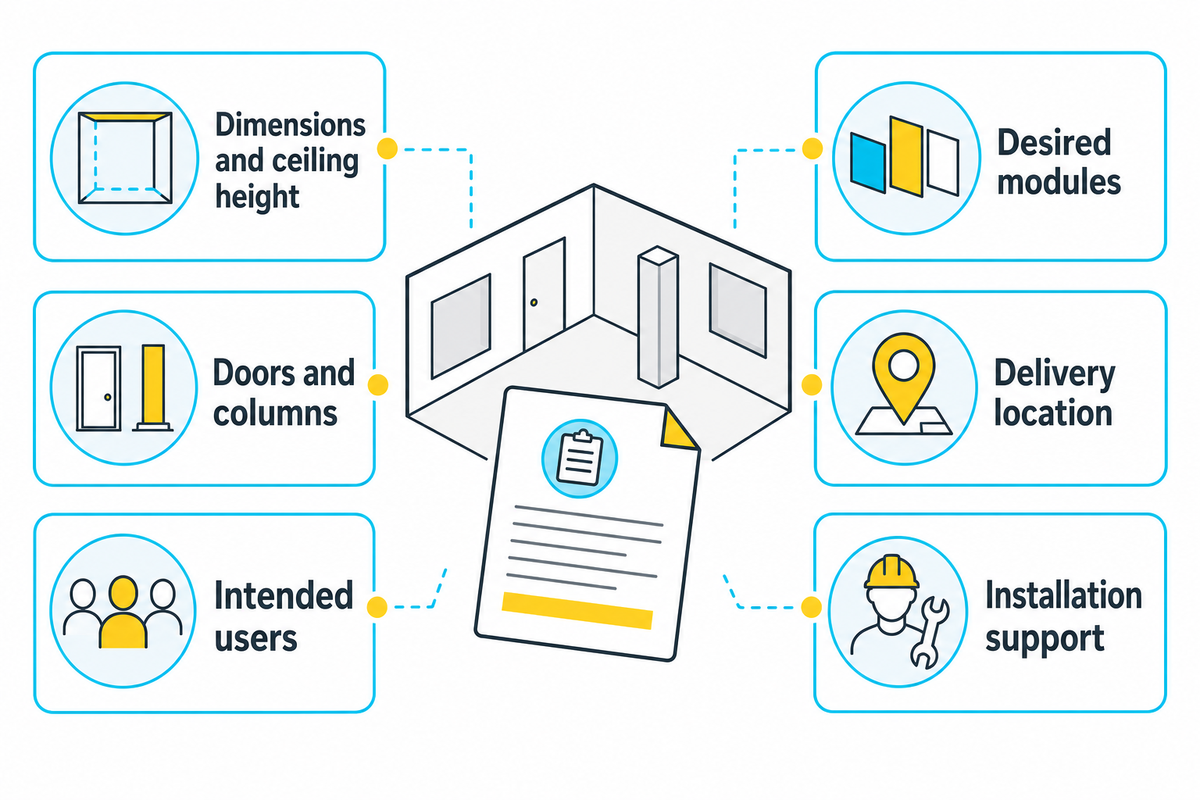
Send every supplier a single, consistent brief containing the measured space, the intended user, the format of the equipment, the location and the division of installation work. Ask each supplier to identify the drawing revision, inclusions and exclusions in their response. Carry the same information in the handover package. This will ensure the operator’s instruction package is for the actual piece of equipment provided.
Didi Land’s foam-play page asks for dimensions, ceiling height, doors and columns, target users, desired modules and installation responsibility. Use those fields to prepare the request. The company’s About Us page describes its design-to-aftercare service process; confirm the scope promised for your own project in the quotation.
Give procurement the inclusion grid. Give the installer the current drawing. Give the operator the cleaning and maintenance records. The solution is practical if all three users can work with it, without guessing who owns the remaining work.
Translate the sales brief into tasks that the team can test. The main activity, supervision position and cleaning route of a thoughtfully designed room should be shown on the drawing. Find out which activity encourages active play and how staff will manage the little ones waiting in the area. Don’t expect a new attraction to boost revenue without testing admissions, staffing and reset assumptions in the business plan.
Preparing a commercial soft play area? Send your measured sketch, room photos and intended users to Didi Land. Include the delivery location and the installation support you need.
Frequently Asked Questions
What age is soft play suitable for?
Soft play suitability depends on the specific product, its intended users and the venue’s supervision arrangements.
Ask for the age and size restrictions attached to the actual modules being supplied. A standard’s stated user range does not automatically apply to every foam toy, portable package or enclosed structure. Separate toddler and older-user activities where the approved arrangement calls for it, and make the posted rules consistent with staff training. Avoid choosing solely from product photographs.
Can you provide me with a business plan for opening an indoor playground?
An indoor playground business plan needs local demand, premises, operating costs and revenue assumptions as well as an equipment plan.
The layout and inclusion grid here supply the physical-project section of that plan. Add locally checked rent, staffing, insurance, permissions and working-capital needs. Test admission and party assumptions against your market rather than treating a supplier’s equipment total as a complete startup budget. Use the linked startup guide to organize the wider investigation before making financial commitments.
What are some ideas for equipment for a school playground?
A school equipment brief should start with the setting, intended users and learning or play activities.
For an indoor room, discuss suitable climbing, balancing, imaginative play and sensory activities with the supplier and school team. Check access, supervision, storage and cleaning before choosing the mix. Outdoor playground equipment requires a separate suitability review; an indoor foam set should not be assumed weather-resistant. Match every selection to the school’s operating conditions and the applicable product requirements.
Can staff assemble the equipment themselves?
Staff assembly is appropriate only when the supplier’s instructions and the project’s agreed requirements allow it.
Confirm the required competence, tools, checks and responsibility in writing. Remote guidance does not automatically mean that any employee can install a fixed structure.
How should I schedule cleaning before launch?
A launch cleaning schedule should assign tasks, compatible products, access arrangements and return-to-use checks before visitors arrive.
Begin with the supplier’s instructions for each covering, removable component and floor surface. List routine contact points, visible-soiling responses and tasks that require closing a zone. Leave enough time for the chosen process, including any labeled contact time and necessary drying. Decide where staff put removed balls, dirty items, waste and cleaning tools so that clean and dirty work do not cross. For childcare, apply the relevant setting-specific sanitation and illness procedures as well. Trial the schedule with the actual staff, record how long the tasks take and correct inaccessible areas. Keep chemicals out of children’s reach and update the plan when equipment or session patterns change.
References & Sources
- F1918-21: Standard Safety Performance Specification for Soft Contained Play Equipment — ASTM International, public scope.
- Chapter 10: Play Areas — U.S. Access Board.
- Soft Contained Play Equipment Safety Checklist — U.S. Consumer Product Safety Commission.
- Permit TC-COM-0526-00791, commercial review — City of Tucson, June 2026; project-specific record.
- WK94592: Revision of F1918-21 — ASTM International, proposed work item.
- BS EN 1176-10:2023 project listing — British Standards Institution.
- Chapter 5: Reducing the Likelihood of Fire — Scottish Government, existing non-residential premises guidance.
- Chapter 7: Provision and Use of Means of Escape — Scottish Government.
- When and How to Clean and Disinfect a Facility — Centers for Disease Control and Prevention, 2024.
- How to Clean and Disinfect Early Care and Education Settings — Centers for Disease Control and Prevention, 2024.
- Protecting Against Infections in Early Care and Education Programs — Centers for Disease Control and Prevention, updated September 2026.
- FEC of the Year: Creating Joy and Hope in Türkiye — IAAPA, reporting on Hupalupa.