
Get in Touch with Didi Land

Soft Play Sets: 2026 Commercial Buyer’s Guide (Safety + ROI)

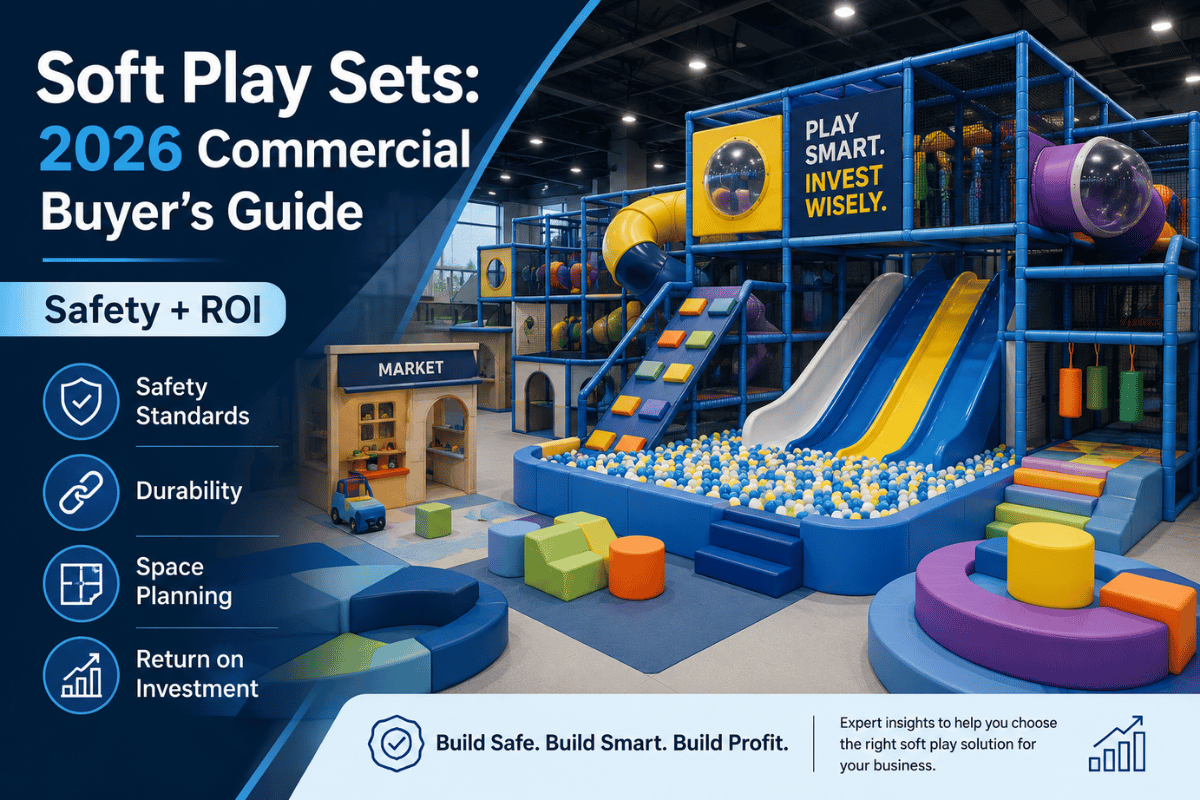
Didi Land has manufactured commercial play structures since 2014 and shipped into more than 40 countries, so the matrices below reflect deployment data, not catalog marketing.
Quick Specs: Commercial Soft Play Sets at a Glance
- Typical footprint: 40-300+ sqm (430-3,200+ sqft)
- Module count per set: 4 (entry) → 12-17+ (premium)
- Price range (commercial): $2,000 – $35,000+ depending on tier
- Age range: 6 months – 8 years (most sets) / specialty: 0-2 toddler-only
- Compliance baseline: ASTM F1487-21 + ASTM F1918 (SCPE) + EN 1176 (EU) + CPSIA Title VIII (lead/phthalates)
- Expected lifespan: 5-7 years light use, 3-4 years heavy daily commercial use
- Lead time (manufacturer-direct): 30-90 days production + 30-45 days shipping
What Counts as a “Soft Play Set” (and What Doesn’t)
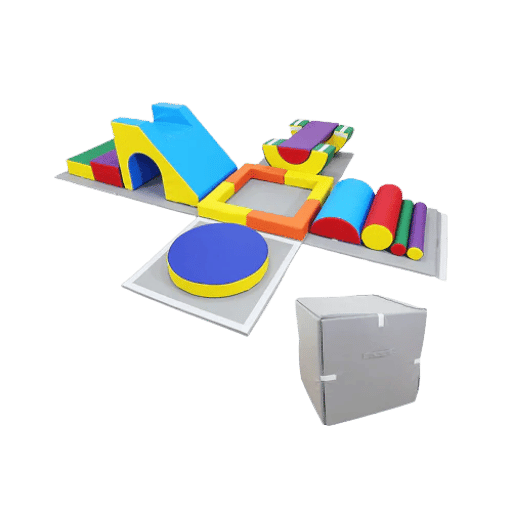
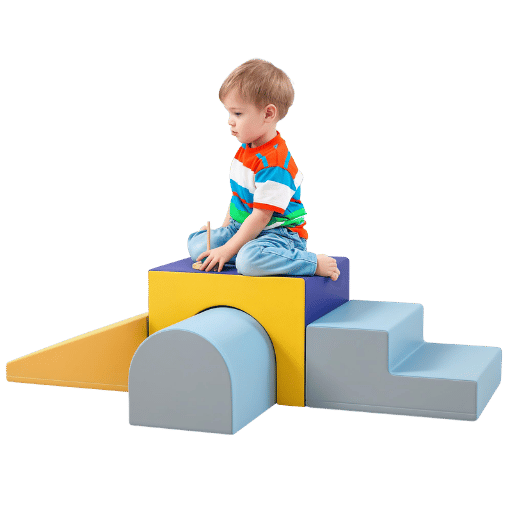
A soft play set is a package-up of foam-padded play modules – common shapes are slides, climbing blocks, tunnels, and a ball pit – intended for children 6 months to around 8 years to climb, crawl, jump, and tumble without harm. The key distinction is that nearly every touch contact surface is soft, every edge is rounded, and the whole system is designed to cushion impacts rather than redirect them.
Three characteristics differ a commercial soft play set from the loose foam mats, single ball pit, or hard plastic commercial soft play equipment you may already have:
- Soft surfaces predominate. This is “soft play” if more than 80% of contact surfaces are PU- or PVC-covered foam. An individual foam mat isn’t a set, a PVC-fascia climber isn’t a set either.
- Multiple modules interact synergistically. This is “soft play” if a set has at least 4 module types and a circulation plan (through climb slide land), not a heap of foam drops in a corner.
- Age specific dimensions are well defined. Commercial sets specify a singular cohort (toddler 0-2, preschool 2-5, school-age 5-8) at appropriate height and grip spacing (ASTM F1487-21) table reference.
| Product Category | Material softness | Modular | Age range | Counts as Soft Play Set? |
|---|---|---|---|---|
| Soft Play Set (commercial) | ≥80% foam-padded | 4+ modules | defined cohort | ✅ Yes |
| Hard plastic play structure | <20% padding | single fixed unit | often 2-12 | ❌ No (hard play) |
| Standalone ball pit | soft inside | 1 module | 2-6 | ❌ No (component, not set) |
| Foam play mat | 100% foam | no circulation | 0-3 | ❌ No (surface only) |
This distinction matters because liability insurers, daycare licensing agencies, and parents treat them differently. A 17-piece commercial soft play set rated to ASTM F1918 carries a different risk profile and a different premium than the same square footage filled with loose foam blocks.
4-Tier Footprint Matrix — Choose Soft Play Sets by Venue Size and Budget
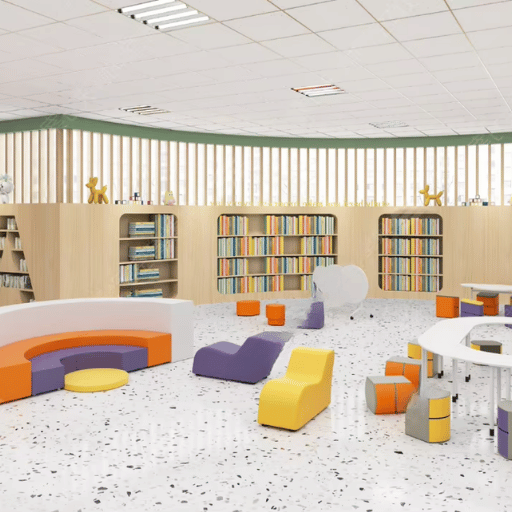
The first thing to notice when shopping for soft play sets is not module count or theme, but the square footage you have on hand and the per- square meter budget you can justify to your CFO or spouse. We call this the 4-Tier Footprint Matrixand it is the first decision engine we hand to buyers walking into a Didi Land showroom or calling our sales team.
| Tier | Footprint | Budget (USD, set only) | Modules | Age cohort | Typical buyer |
|---|---|---|---|---|---|
| Tier 1 — Compact | 40-80 sqm | $2,000 – $5,000 | 4-6 | 0-3 toddler-focused | In-home daycare, small kindergarten, hotel kids’ corner, restaurant amenity |
| Tier 2 — Standard | 80-150 sqm | $5,000 – $12,000 | 7-10 | 0-5 mixed | Licensed daycare center, kindergarten classroom, mid-size pop-up |
| Tier 3 — Premium | 150-300 sqm | $12,000 – $35,000 | 11-14 | 2-8 multi-age | Family entertainment center, indoor playground, mall anchor |
| Tier 4 — Custom | 300+ sqm | $35,000 – $150,000+ | 15+ | all cohorts | Themed FEC, edutainment park, themed hospitality (cruise / resort) |
Some notes on use of this matrix. First, the budget column reflects equipment only, and does not include the rubber safety surfacing, installation labor, or freight that typically brings the equipment budget ($5,000 to $15,000 in a mid-size install). Second, climbing a tier does not usually directly translate to doubling your number of modules; instead it generally entails adding in-specialty modules like sensory panels or themed props rather than more of the same. If your plan calls for right in-between two tiers, pick the one below it – you will find it more affordable to buy a lower-tier PVC pipe crawl and spend your free capital on higher-grade foam density than on more modules – see the next section to see why.
For larger venues with mixed-themed needs, visualize indoor playground theme options almost identically to the base soft play set; theming and additional modules can be delivered as a single turnkey solution.
8-Component Modular Library That Makes Up a Commercial Soft Play Set
Scan three manufacturer programs and you’ll see hundreds of SKUs, but almost all of them boil down to eight component archetypes. The 8-Component Modular library below is the core planning lexicon we use internally to design custom sets for customers, and the same lexicon can help you read one quotation against another.
| # | Component Type | Material category | Typical dimensions | Weight | Best age | Relevant standard |
|---|---|---|---|---|---|---|
| 1 | Foam blocks (cubes, wedges, cylinders) | HR EPE + PVC cover | 30-120 cm / side | 2-15 kg each | 0-5 | ASTM F1918 |
| 2 | Ball pit (round / square) | PE balls + PU pit shell | 120-300 cm wide, 40-60 cm deep | 15-60 kg + balls | 1-7 | ASTM F1918 + CPSIA balls |
| 3 | Slide (straight / wavy / spiral) | PE / fiberglass | deck 60-180 cm high | 8-40 kg | 2-8 | ASTM F1487 slide geometry |
| 4 | Climber (steps, wavy ramp, rocking) | HR EPE core + PU cover | step height 15-30 cm | 5-20 kg | 1-6 | ASTM F1487 fall height |
| 5 | Tunnel (straight / curved) | flexible PU fabric + foam ring | 100-300 cm long, ø 50-80 cm | 5-15 kg | 1-7 | EN 1176 tunnel section |
| 6 | Soft wall (perimeter pad) | HR EPE panels + PVC cover | 120 × 60 × 5-10 cm panels | 3-8 kg/panel | all | EN 1176 impact attenuation |
| 7 | Sensory panel (mirror / fiber-optic / texture) | acrylic mirror + textile | 60 × 60 – 120 × 120 cm | 2-12 kg | 0-8 (incl. special needs) | CPSIA + ADA |
| 8 | Themed prop (boat, train, castle face) | brand-custom EPE + PU laminate | 100-250 cm long | 5-30 kg | 2-8 | brand-specific |
Components 1-4 are the must-haves; without them a configuration is not really a set but a corner of accessories. Components 5-8 are the differentiators — they let the same Tier 2 budget land as either a generic daycare corner or a destination-worthy mall pop-up. The dimensions and weight ranges above reflect brand-typical figures from Didi Land production and cross-checked against published competitor SKUs rather than an industry-wide standard, because foam-density and panel-thickness specifications are not codified across the industry the way slide geometry is in ASTM F1918 SCPE provisions.
What Is the Difference Between Commercial and Residential Soft Play Sets?
A residential soft play set sells on Amazon for $300-$1,000, weighs under 15 kg, uses 30-50 kg/m³ EPE foam, and carries a CPSIA toy certification. A commercial soft play set in the same module count costs $2,000-$8,000, uses denser high-resilience foam, has commercial-grade PU-coated covers stitched to closer tolerances, and carries ASTM F1918 plus often IPEMA certification. The physical resemblance is the trap; the durability gap under daily public use is the reason daycare licensing agencies routinely fail home-grade sets during inspection. If you are buying for a venue that will see more than a few visitors per week, the home-grade option is not a budget-friendly choice but a future replacement cost in disguise.
5 Safety Standards Commercial Soft Play Sets Must Meet
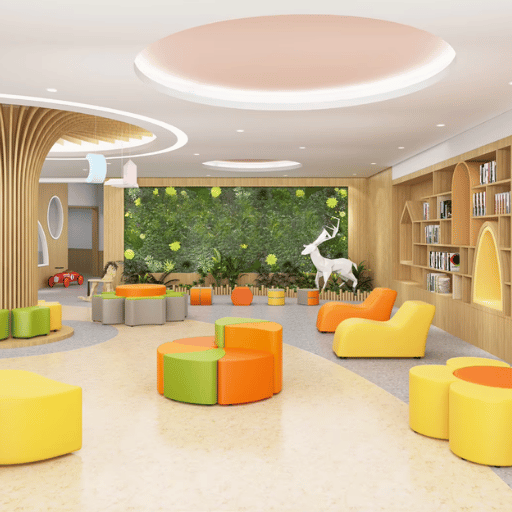
Five performance standards regulate the commercial soft play category in the markets Didi Land ships into; the firstthreeare American, the fourth is European, and the fifth is a federal toys safety act that applies across US borders to any product that finds its way into a home with a child under 12 (nomatter where it was made).
| Standard | Scope | Key test items | Mandatory or voluntary | Region |
|---|---|---|---|---|
| ASTM F1487-21 | Public-use playground equipment for ages 2-12 | Use zone, fall height, entrapment, accessibility | Voluntary consensus standard (referenced by many state codes) | USA |
| ASTM F1918 | Soft Contained Play Equipment (SCPE) specifically | Impact attenuation, entrapment, foam density consistency | Voluntary | USA |
| ASTM F2373 | Public-use play equipment for ages 6 months to under 2 years | Toddler anthropometrics, small-parts, climb height limits | Voluntary | USA |
| EN 1176-1:2017 | Playground equipment general safety | Impact attenuation, fall height, finger / head entrapment | Mandatory where adopted as national standard | EU + many global markets |
| CPSIA Title VIII (2008+) | Children’s products lead + phthalates | ≤90 ppm lead in paint, ≤100 ppm lead in substrate, ≤0.1% phthalates | Mandatory (federal law) | USA |
📐 Engineering Note. ASTM F1918 is the standard that specifically covers soft play sets (it explicitly names “soft contained play equipment”), but F1487 is the broader playground standard most often cited in state day-care licensing rules and insurance underwriting. Ask your supplier which specific clauses of F1487 and F1918 their set was tested against; “ASTM compliant” without a clause reference is a marketing claim, not a compliance claim.
IPEMA certification, which you often see on competitor product pages, is a voluntary third-party certification program that audits whether a product actually meets the ASTM standards it claims to meet — useful, but it is the certification of a standard, not a standard itself. For European-market buyers, GS-EN1176 (TÜV-issued GS mark on EN 1176 compliance) is the equivalent peace-of-mind layer. Didi Land sets are produced against the ASTM F1487/F1918 + EN 1176 + IPEMA matrix and CPSIA-tested for the US toddler and preschool cohort. More on Didi Land manufacturer compliance →
Soft Play Set Price Reality Grid — 3 Tiers × 5 Drivers
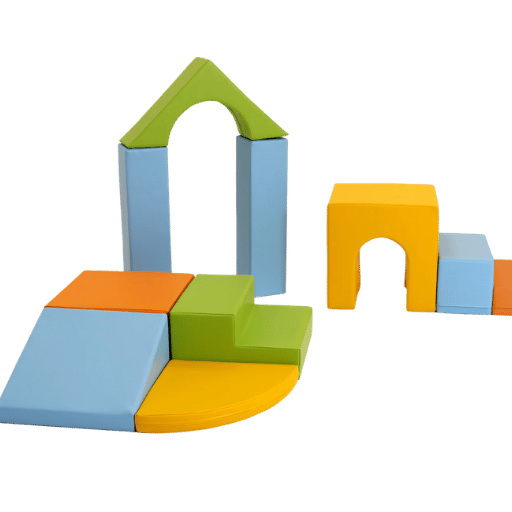
Most first-time buyers come into the conversation with a $500 to $1,000 expectation, because that is what a 17-piece soft play set costs on a consumer marketplace. The commercial reality is three to fifteen times higher, and the gap is not greed — it is the difference between a product designed for an only child to use for an hour a day versus one designed for 60 children to use for eight hours a day for five years. The Soft Play Set Price Reality Grid below maps the three commercial tiers against the five drivers that actually move price.
| Driver | Entry Tier $2K-$5K | Standard Tier $5K-$12K | Premium Tier $12K-$35K+ |
|---|---|---|---|
| Foam density | standard EPE | high-resilience EPE | HR EPE + reinforced core, ASTM F1918 impact-tested batch |
| Cover grade | 0.5 mm PVC | 0.7 mm PU leather | 1.0 mm reinforced PU + double-stitched seams |
| Module count | 4-6 pieces | 7-10 pieces | 11-17+ pieces with specialty modules |
| Customization | stock colors only | color picker + logo placement | full theme, custom mold, brand IP integration |
| Warranty depth | 6-12 months | 12-24 months + parts | 24-36 months + on-site service + lifetime parts |
The 5 drivers are not frills they are 5 variations. A Standard Tier 40-50 module set (roughly equivalent to entry tier foam density) will photograph all day looking identical but will settle and lose impact attenuation in 18 months of daily use, at which point your insurer can declare it “non-compliant” and you’re still inspecting your original ASTM tag. This is the most common hidden cost we see daycare operators struggle with in year 2.
For total project budgeting, add roughly $5,000 to $15,000 to the equipment line for a mid-size install covering rubber safety surfacing, freight, installation labor, and licensing inspection fees in the United States per the Koala Playground 2026 cost guide. Larger Premium-tier installations (300+ sqm) often crack $50,000 to $150,000+ for the full turnkey, per published 2025 industry cost breakdowns.
Contrarian observation. The “buy used” instinct that guides buying used office furniture or restaurant equipment is the single largest ROI drain in soft play. Impact absorption is lost invisibly with foam compression; covers may pass visual inspection even while their seams internally are failing. A used Standard Tier set at 40% normal purchase price requires another 60%+ of new foam cores, in all probability, within 12 months, plus the insurance re-certification you’d have avoided.
“The mistake most first time buyers make is approaching the entry tier as a ‘starter’ purchase. It isn’t it’s a different cohort. If your venue plans for more than 100 children per week skip the entry tier entirely and start at standard.”
– Cherry, CEO, Didi Land (12 years manufacturing commercial play equipment, 40+ country deployments)
5-Scenario Buyer Fit Map — Daycare / FEC / Hotel / Mall / Kindergarten
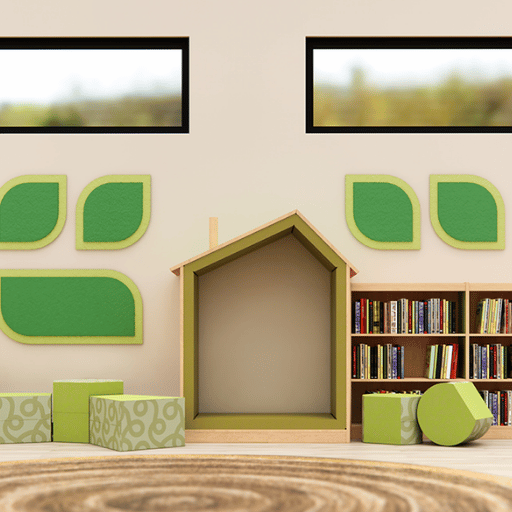
The Tier matrix shows which budget range you need to shop. The 5-Scenario Buyer Fit Map indicates which module configuration within that range. From our 40+ country deployment data, about 60% of mass market commercial soft play goes into daycare and preschool environments, 25% into FEC’s and 15% into commercial food service venues:
| Scenario | Recommended Tier | Module priorities | Budget realistic | Compliance focus |
|---|---|---|---|---|
| Daycare (40-100 children) | Tier 2 | foam blocks + ball pit + low slide + soft wall | $6,000-$10,000 | ASTM F2373 (under-2) + F1487 + state daycare code |
| Family Entertainment Center | Tier 3 – 4 | multi-level climbers + slides + themed prop + ball pit + sensory panel | $15,000-$80,000 | ASTM F1487 + F1918 + commercial insurance review |
| Hotel amenity (kids’ lounge) | Tier 1 – 2 | themed prop + foam blocks + sensory panel (low noise priority) | $3,000-$8,000 | CPSIA + fire-retardant cover (NFPA 701) |
| Mall pop-up / kids’ zone | Tier 2 – 3 | themed prop + photo-friendly modules + tunnel + ball pit | $8,000-$20,000 | ASTM F1487 + mall lease compliance + flame retardant |
| Kindergarten classroom | Tier 1 – 2 | soft blocks + low climber + sensory panel + tunnel | $2,500-$7,000 | CPSIA + state preschool code + ADA accessible path |
Here are a few anchor examples from actual deployments. A licensed daycare Cebu, Philippines numbering 60 under 5 children outfitted their 110 m2 hall with a Tier 2 8 module set sporting a couple of foam climbers, 2 m ball pit, low slide and 4 soft wall panels for a delivered cost of about $7,800, and passed their state licensing inspection the first time. Now an anchor example of course would be the 280 m2 mall pop-up Dubai sporting a Tier 3 13 module themed set with a Bedouin-tent theme prop, duel slides, fiber optic sensory panel, 2 ball pits and 3 climbers delivered at a comparative cost of about $22,000 plus another $9,000 in themed installation and flooring. The module mix in the sets is what ultimately determines the cost none of it is budget.
For mall and FEC operators, consider browsing themed deployments such as ocean theme soft play designs, space theme commercial sets, or jungle theme inclusive design as a complement to the base soft play set; theming is usually the differentiator that drives mall foot traffic in year one.
Soft Play 90-Day Care Cycle — Cleaning, Inspection, Replacement
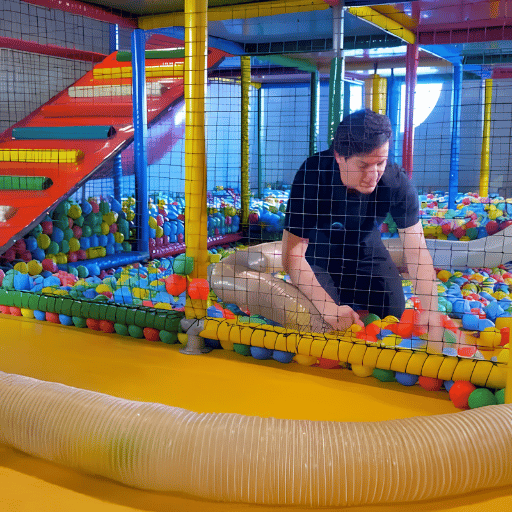
Commercial soft play sets are advertised with a 5-7 year usable life, but daycare operators consistently see that figure drop to 3-4 years under heavy daily use unless a structured care routine is in place, with hidden internal damage (compressed foam cores, seam failures) frequently flagged by industry surveys such as SIOTO’s common soft play hazards review and Little People’s Cove used-equipment risk analysis. The Soft Play 90-Day Care Cycle below is the maintenance cadence we hand to every Didi Land customer at delivery. It is built from four frequencies and ends with five replacement signals you should know how to read.
| Frequency | Tasks | Tools needed |
|---|---|---|
| Daily (before opening) | Wipe all touch surfaces with EPA-registered disinfectant; visually scan for tears; remove debris from ball pit | Microfiber cloth, EPA disinfectant spray, ball pit scoop |
| Weekly | Deep-clean ball pit balls (hand or commercial ball washer); inspect seams of each module; vacuum sensory panels | Ball washer, seam checklist, soft-bristle vacuum head |
| Monthly | Pressure-test foam blocks (drop-bounce test, finger-press depth); check zipper/Velcro closures; rotate modules by 90 degrees to even wear | Inspection log, replacement zipper kit |
| Quarterly (90 days) | Photo-log every module; deep clean covers per manufacturer specs; verify impact attenuation by drop-test sample; check warranty status | Camera, manufacturer cleaning guide, drop-test ball (1 kg) |
Replacement signals- the moment to escalate from clean to replace- generally appear in this order:
- Foam compression. Push a thumb into the center of a foam block; if it leaves a depression that takes more than 5 seconds to rebound that module is below original impact attenuation and is a replacement candidate.
- Cover seam separation. A 2cm seam gap is retrievable, but a 10cm gap exposing foam must be a safety concern and the module should be taken out of service immediately.
- Color fading at touch zones. Fading itself is cosmetic, but uneven fading may signal UV degradation of the cover PU layer; if you can scrape PU flakes with a fingernail than the cover is failing.
- Internal odors that survive cleaning. If a foam block retains odors after a thorough deep cleaning then the foam core has absorbed a contaminant that the surface cleaning cannot reach. Replace.
- Standards revision. If ASTM F1487 or EN 1176 is revised and your set was certified to a superseded edition, your insurer may require recertification or replacement.
Having a documented 90-day care log is also valuable when your licensing evaluation arises or you have to submit a warranty claim- most state daycare codes require proof of routine maintenance, and “we clean it every day” is not the answer that will hold up.
2026 Trends — Sensory-Inclusive, Modular Sourcing, Themed, Eco-PVC
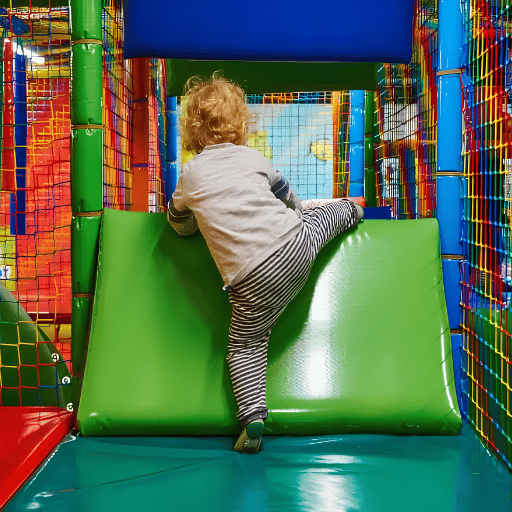
The four trends shaping soft play set buying in 2026 are plain to see in the market research, keyword search behavior, and in what manufacturers of soft play expect in their inbound RFQs. None of them is this year’s best-kept secret; all are expressed in a demand signal you can rely on and a proactive measure for attendees planning a 2026 installation.
- Sensory-inclusive design takes share from generic. Demand for ADA-accessible and sensory-friendly modules (fiber-optic panels, calming sensory dens, weighted soft furniture) is growing faster than the general indoor play equipment market. The global indoor playground equipment market is projected to grow at roughly 7.5% CAGR through 2034 per Dataintelo’s 2034 market projection, but sensory-focused subcategories are outpacing the average. Action: if your venue includes any therapy, special education, or inclusive recreation programming, allocate 15-20% of the set budget to specialty sensory modules.
- Modular sourcing replaces full-set procurement. Operators no longer order one 12-module set; they order four base modules now and three more in six months as cash flow allows. Look for suppliers who price modules individually and lock the unit price for 12 months. Action: ask for a 12-month module unit pricing sheet, not a single project quote.
- Themed sets carry brand premium. A generic Tier 2 set commands a Tier 2 price; the same modules in a themed format (jungle, ocean, space) command a 10-25% premium and often justify it through higher per-visit revenue at FECs and mall venues. Action: if you are an FEC or mall operator, default to themed; the payback is shorter than the price uplift.
- Eco-PVC and phthalate-free alternatives are becoming RFP requirements. Procurement teams at municipal kindergartens, educational chains, and European mall operators are starting to require phthalate-free certification beyond CPSIA’s 0.1% baseline. Action: ask for the third-party phthalate test report (not just the CPSIA general conformity certificate), and confirm cover material is REACH-compliant if shipping to EU markets.
A trend that should not be over-rotated: pure customization-as-a-service. Searching for “customizable soft play” has remained approximately flat for last six months despite “marketing” on catalog towards the contrary, and mainstream demand for customization growth is happening mostly in the themed, inclusive segments above, and not in the stand-alone custom programs.
If you are targeting a Q2 or Q3 2026 install, then Place ordered for modular themed by early Q2. Peak season production capacity in most respected Chinese manufacturer are booked 90 days in advance and themed sets require an extra 30-45 days for drawings approval and custom mold tooling.
FAQ
What is the difference between a soft play set and an indoor playground?
A soft play set is a themed package a bundle of foam-padded modules (usually 4-17 pieces) meant for one contained area(usually sub-300 sqm) and an indoor playground is a venue with foam-padded modules, hard play structures, trampolines, arcade areas, themed environments; you-00a0, soft play sets are component category and indoor playgrounds are venue category.
How much does a commercial soft play set cost in the United States?
3 tiers of commercial soft play sets in 2026, Entry Tier: 4-6 modules, 40-80 sqm, $2,000-$5,000 ex-works, Standard Tier: 7-10 modules 80-150 sqm, $5,000-$12,000, Premium Tier: 11-17+ modules 150-300 sqm, $12,000-$35,000+. Add $5,000-$15,000 roughly to each number for rubber safety surfacing/ shipping/installation labor/ licensing inspection- this are the costs that catch manufacturers by surprise and few industry quotes just the equipment line. Larger turnkey projects 300+ sqm: $50,000-$150,000+.
Are soft play sets safe for toddlers under 2 years old?
Yes, where the set is explicitly rated to ASTM F2373 (the US public-use play equipment standard for ages 6 months to under 2. Toddler-rated sets have shallower climb heights (under 60 cm), no entrapment gaps between 89-230mm, and softer foam densities scaled for low-mass falls. A set marketed solely to ASTM F1487 (ages 2-12) is actually a different product, and may create entrapment or climb height hazards for children under-2 in the case of a non-compliant set. Always confirm which ASTM clauses the set was tested to with the manufacturer.
How long does a commercial soft play set last with daily use?
5-7 years for documented at least weekly 90-day care (cleaning) interval, Standard or Premium tier equipment; 3-4 years for Entry tier under heavy daily use or whenever care is neglected. Repurposing schedules are set by foam compression and cover resilience rather than date of manufacture.
Can soft play sets be customized to match a brand theme or franchise style?
Yes. Customization pathways generally run three tiers deep. First-tier customization is in color selection (stock palette or color picker), usually included in Standard tier with no surcharge. Second-tier customization is in graphic and logo application (silkscreen or heat-transfer on cover panels), typically priced at $200-$800 depending on how many, what placement. Third-tier customization is in the full visual theming with custom mold, themed props, franchise IP commercialization; the production element of this third layer is in the $3,000-Luvol feed away design and mold publication at a retail premium price, adding 30-45 days to the mold publication and design approval schedule. Franchisee clients typically start with a third-layer firstsite set and a second-layer quantity rollout set.
SYS.00 // E-E-A-T Disclosure
Why I Write This
As the CEO and Co-Founder of a specialized manufacturing facility, my objective is to provide unvarnished, factory-direct technical insights into commercial indoor playground engineering, safety compliance, and project planning. I aim to bridge the information gap for global buyers seeking reliable structural and material data, ensuring you make informed, ROI-driven decisions without the marketing fluff.
About My Business
Guangzhou Didi Land Amusement Equipment Co., Ltd. (Brand: Didi Land) is a commercial indoor playground equipment manufacturer founded in 2014. Operating from Panyu, Guangzhou, China, we engineer, produce, and export commercial-grade play structures to over 40 countries worldwide. Our production lines strictly adhere to international safety frameworks, ensuring durability and safety for high-traffic environments.
Our Services
We provide end-to-end B2B commercial solutions: from custom 3D spatial design and OEM manufacturing to worldwide export logistics and compliance testing. Our focus is on empowering Family Entertainment Centers (FECs), shopping malls, kindergartens, and hospitality venues with reliable, high-capacity play infrastructure.
DATA_MATRIX // MANUFACTURER_PROFILE
Name:
Cherry
Role:
CEO & Co-Founder
Brand Name:
Didi Land
Company:
Guangzhou Didi Land Amusement Equipment Co., Ltd.
Location:
Guangzhou, Panyu, China
Founded:
2014
Products:
Indoor Playground Equipment, Soft Play Equipment, Themed Playground Design, FEC Play Zones, Trampoline Modules, Ninja / Obstacle Course Modules
Email:
conglizhang1@gmail.com
Phone:
+86 199 2587 9517
Website:
didiplayarea.com
COMPLIANCE & STANDARDS:
ASTM F1487 · ASTM F1918 · EN 1176 · CPSIA · CE · ISO 9001 · IPEMA
Contact Factory Direct
ASTM F1487 · ASTM F1918 · EN 1176 · CPSIA · CE · ISO 9001 · IPEMA
![Custom Dinosaur Playground Equipment [Design Guide]](https://didiplayarea.com/wp-content/uploads/2026/09/custom-dinosaur-playground-equipment-r2-featured-1-150x150.png)