Get in Touch with Didi Land

Indoor Playground Insurance Cost: Coverage Types, Premium Drivers, and a Quote Checklist

U.S. business planning guide
October 2026
BY CYH
Indoor playground insurance cost starts with the activities a policy accepts, then the price of covering them. Insureon publishes monthly averages of $45 for general liability, $83 for a business owner’s policy and $54 for workers’ compensation. Those separate policy figures help frame a discussion; your venue needs a quote for its actual operations.
A business owner shopping for a lease must know what can open, what the landlord needs, and how much cash to set aside. The correct order is to determine the required coverage, evaluate terms that meet requirements, and then set a budget for the payment schedule. Didi Land supplies equipment information; insurance advice belongs with a licensed insurance broker or agent.
How Much Does Indoor Playground Insurance Cost?
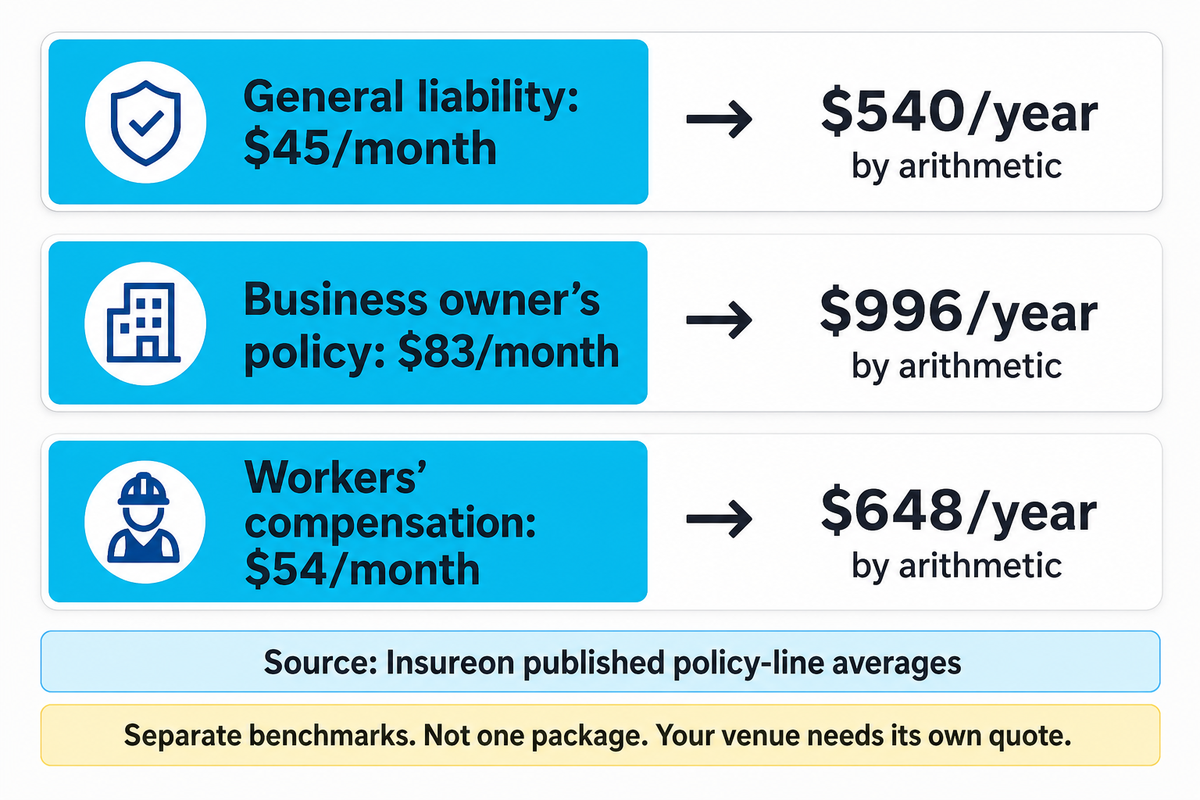
For a starting comparison, Insureon’s published averages are $45 a month for general liability, $83 for a business owner’s policy and $54 for workers’ compensation. An indoor play center’s complete insurance costs require a venue-specific quote. The three figures describe different policy choices and must not be treated as one ready-made package.
| Policy benchmark | Published monthly average | Monthly figure × 12 |
|---|---|---|
| General liability | $45 | $540 |
| Business owner’s policy | $83 | $996 |
| Workers’ compensation | $54 | $648 |
The monthly rates are from Insureon’s indoor playground insurance page; the annual rates are simply multiplication. Treat these as the provider’s policy-line benchmarks, rather than a playground-only survey or a guaranteed annual contract. In the end, what matters most is what a quoted insurance policy for your venue says.
A business owner’s policy, commonly called a BOP, combines coverages. New York’s Department of Financial Services explains that package policies combine insurance lines, while some risks need separate policies. Adding a general liability premium to a BOP that already includes general liability, for example, accounts for that protection twice. Operators who need general liability should first identify whether their proposed package already includes it.
The right indoor playground insurance may be initiated with a submitted attraction list. To find the best fit, compare the right insurance for those activities before price. Well-matched insurance may cover losses sustained, subject to terms. An inexpensive premium for the wrong operation leaves the central purchasing problem unsolved.
How much does $1,000,000 general liability insurance cost?
A $1,000,000 liability limit does not determine a single premium. It states a limit of coverage, and the price is reflective of the insured’s activity, exposure and the terms of the contract. For comparison, one may also include participant coverage, attraction exclusions and deductibles. A soft-play and a trampoline quote, for example, may have the same headline limit, but insure different operations.
Budget starting point: use a written quote naming your activities and premises. A $45 monthly benchmark annualizes to $540, but buying the cheapest policy line alone does not establish a complete opening budget.
Which Insurance Coverage Does an Indoor Play Center Need?
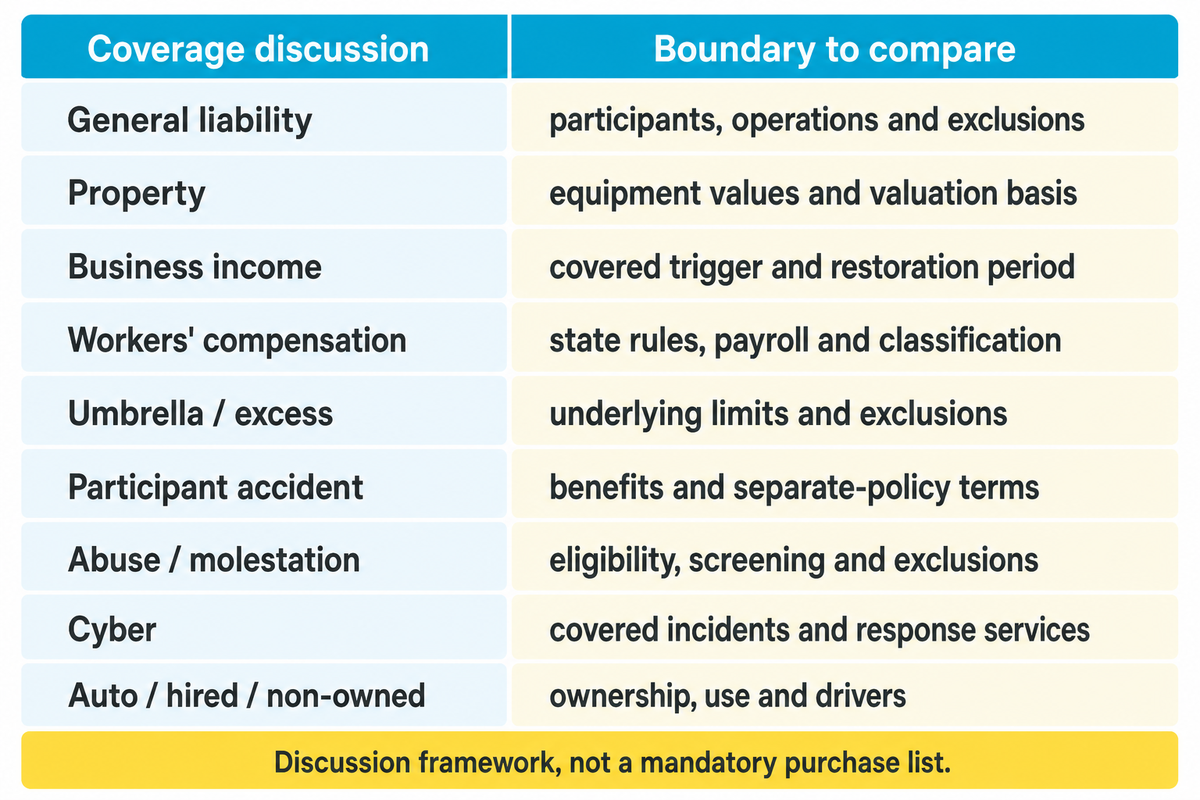
Indoor playground insurance coverage typically starts with third party liability and protection for business property, with employee injury covered separately. Business income, participant accident and other covers address different exposures. While some of these may be combined in insurance products, the name of the policy does not necessarily reflect what the operator is covered for.
“Texas doesn’t require most private employers to have workers’ compensation.”
This illustrates that “all play centers must buy every policy” is a very poor rule. There may be other government contracts and agreements that create additional insurance requirements. The National Association of Insurance Commissioners also explains that a BOP typically leaves out workers’ compensation and commercial auto insurance.
| Coverage discussion | Exposure to describe | Boundary to compare |
|---|---|---|
| General liability insurance | Guest bodily injury or third-party property damage | Participants, insured operations and exclusions |
| Commercial property insurance | Owned play equipment, furnishings and insured improvements | Scheduled values, covered causes and valuation basis |
| Business income / extra expense | Lost income and extra operating expense after an insured interruption | Covered trigger, waiting period and restoration period |
| Workers’ compensation insurance | Employee work-related injury or illness | State rules, payroll and worker classifications |
| Umbrella or excess liability | Limits above specified underlying liability policies | Required underlying limits and excluded activities |
| Participant accident medical | Medical benefits for qualifying participant accidents | Benefit limits, eligibility and separate-policy terms |
| Abuse or molestation coverage | Allegations involving staff or supervised activities | Availability, screening conditions and exclusions |
| Cyber insurance | Booking, payment or customer-data incidents | Covered events, controls and response services |
| Commercial / hired and non-owned auto | Business vehicle use, deliveries or off-site work | Vehicle ownership, permitted use and insured drivers |
Philadelphia Insurance Companies (PHLY) refers to participant accident as a separate policy in its family entertainment center product. Participant legal liability is listed separately. Medical benefits for an accident and liability protection against a negligence claim are different insurance needs.
Business insurance for play centers can provide coverage for multiple activities and exposures, including liability and property, without requiring all risks to be combined in a single policy. Multiple insurance policies can be renewed on the same date, even if they cover different types of losses. General liability insurance protects your business against covered third-party claims within its contract; employee injury requires separate consideration.
What kind of insurance do you need for an indoor playground?
Begin with general liability for the stated activity, protection of property owned and workers’ compensation as required. Also include coverage for other risks the venue has, such as participant accidents, supervised programs, or online bookings. A cafe, drop-off service, or mobile party business should be listed as part of the main business as an extra service, rather than assumed part of the normal admission.
Coverage takeaway: Nine rows are a discussion framework, not nine required purchases. For a two-policy package, identify which rows each policy addresses before requesting a third policy.
Why Similar Playgrounds Receive Different Premiums
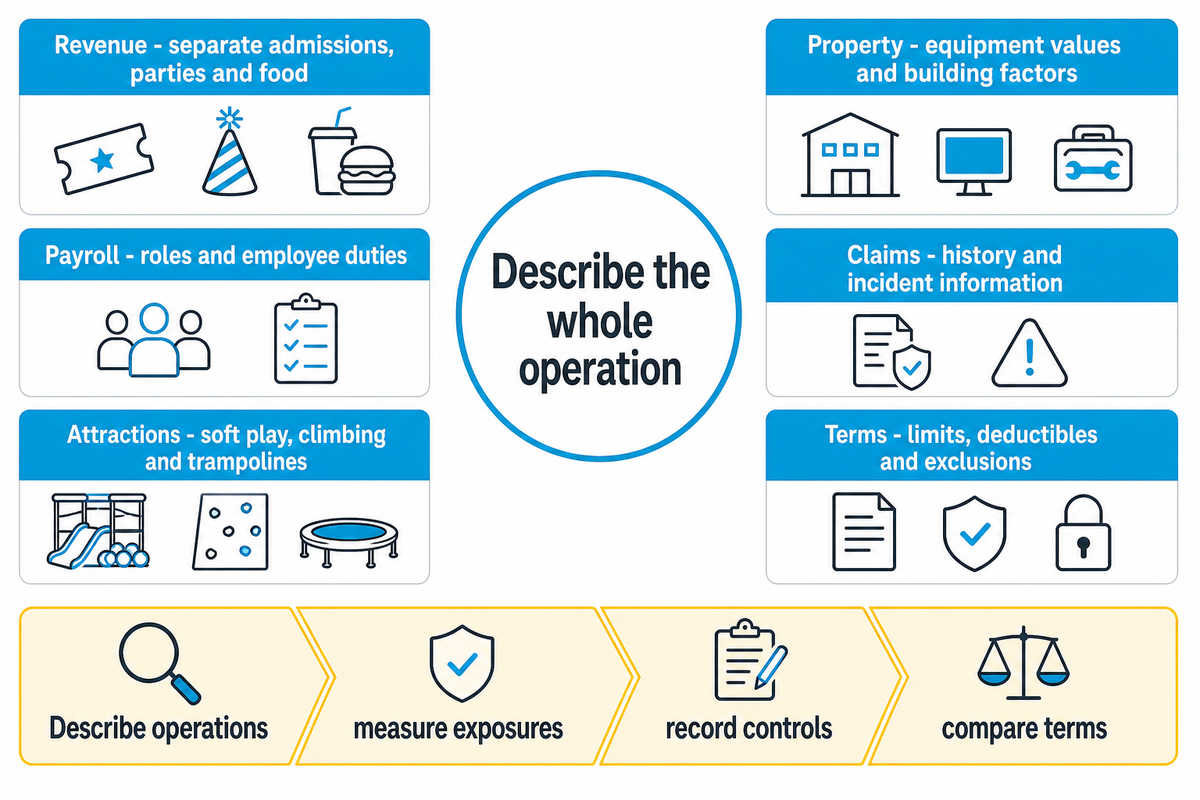
Insurance providers assess more than floor area. Revenue, payroll, attraction mix, equipment values, location, claims history, and chosen policy terms can affect indoor playground insurance premiums. Two similar sized premises can result in different terms. The Insurer needs a consistent description of the business activities, who supervises them, and the assets the business owns.
The California Department of Insurance’s commercial guide explains that general liability rating exposures may use square footage, payroll or gross sales, depending on classification. A universal price per square foot would not consider the differences in rating. Property rate also considers construction and other elements of the building and protection from loss.
What changes indoor play center insurance costs?
Operating an indoor playground offers several possible revenue streams: admissions, birthday catering and drop-off sessions in the example below. Running an indoor playground means describing those services, injury risks and their supervision arrangements to the broker. The risks associated with indoor playgrounds also include liability risks arising from supervision and services, rather than equipment alone.
Example: an owner plans a 4,000-square-foot indoor play space with parent-supervised admission. Before opening, the plan expands to birthday catering and drop-off sessions. The landlord sees the same premises; the insurance company receives a different operating risk. The useful submission separates admission revenue, party revenue, food service and supervision arrangements. It also identifies planned staffing and employee duties. Without factual updates to the original quote, comparing the expanded business to the original provides a false price comparison. The owner should settle the accepted operations before committing the new activities to customers, even if the equipment footprint stays at 4,000 square feet.
- Describe the operation. Separate admissions, parties, food, supervision and off-site services.
- Measure the exposures. Supply consistent floor area, revenue, payroll and equipment values.
- Record controls. Attach staff training, inspection and incident procedures.
- Compare the returned terms. Read classification, limits and exclusions before comparing price.
Safety measures and regular equipment inspections belong in risk management. They help an underwriter understand the play environment; a fixed discount requires an actual quoted credit.
Before looking at deductible options, make sure you have equivalent coverage. Reducing the scope of a policy can reduce your indoor playground premium, but also leaves more risk with the business. The objective is to reduce indoor playground expenditures while covering the risks the operation requires.
Exposure takeaway: when looking at insurance for a 4,000 square foot facility, you’ll want to shop based on projected revenue, activity, and staffing.
Soft Play, Cafes and Trampolines: Match the Policy to the Floor
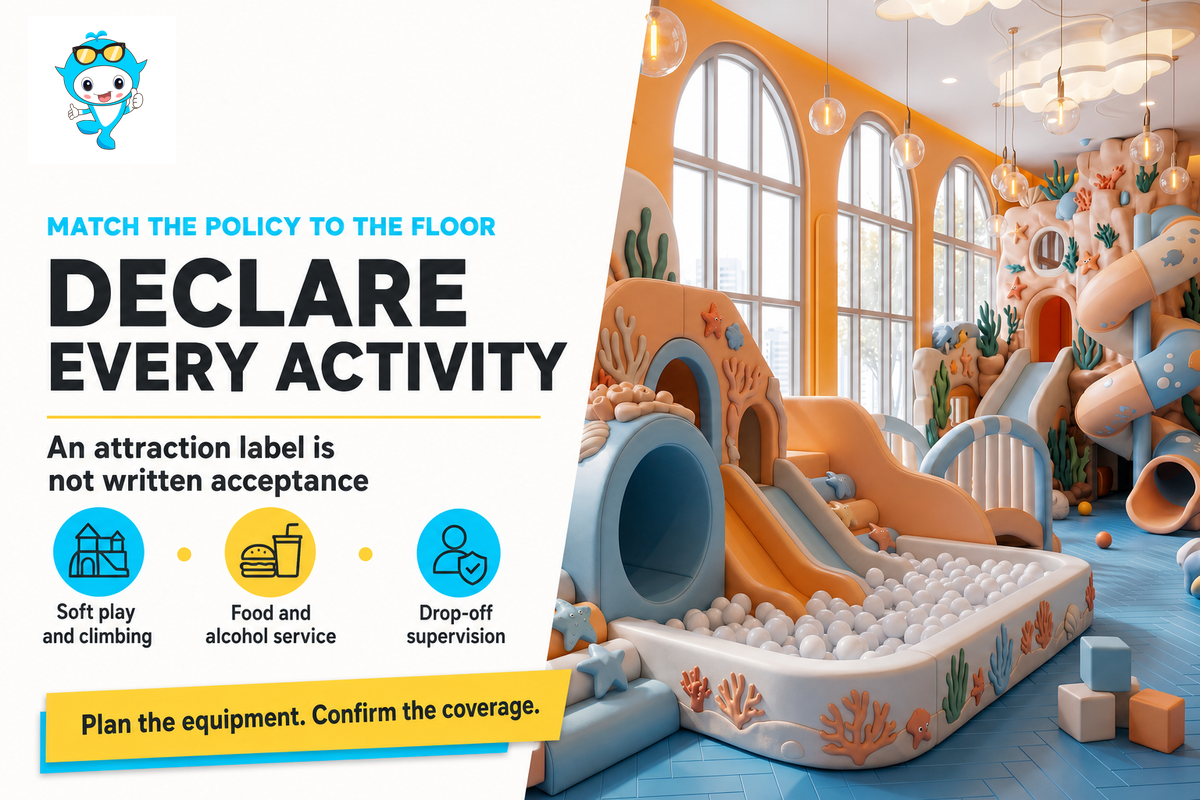
Match insurance coverage for indoor playgrounds to each attraction and service and then compare prices. Soft play, a climbing wall, an inflatable, or a trampoline present different underwriting questions. A policy describing a play area may still contain activity exclusions. Admission charges and the legal classification of the equipment can impact requirements.
SECURA’s family entertainment center page lists several activity types and directs operators to discuss additional operations with an independent agent. Its stated territory is 13 states. A product page offering center insurance is therefore a lead for an appropriate market, rather than automatic acceptance everywhere.
Example: A play cafe purchases some soft play equipment and then adds a climbing wall to attract older children. The manager notices another play structure and the broker is seeking the wall’s configuration, the user age range and supervision requirements. An old Reddit operator discussion describes the challenges in obtaining coverage for a venue with climbing and small trampolines. That anonymous experience is a purchasing problem, not a rate survey. For the play cafe, the concern is more about if the new attraction is accepted in writing prior to installation, not if similar type competition has insurance.
State lines matter. Chapter 546 of the Florida Statutes requires applicable amusement rides and attractions to maintain a minimum liability insurance of $1 million per occurrence or a like-amount surety bond. Section 546.006’s nonmechanized-playground exemption has an admission-fee exception, alongside separate institutional exemptions. This is a classification issue in the state of Florida, not a nationwide indoor-playground minimum.
Food preparation, alcohol service and drop-off care should each have their own line in the business description. Coverage for sensory play may be described by the activity or service and the term itself does not determine the coverage. Selecting equipment and describing the whole business are connected decisions.
An indoor playground offers children an environment to play, but an insurance submission should name its actual attractions. For a safer environment for children, describe operating rules and supervision for each declared attraction. Parents expect a fun and safe visit, while indoor playgrounds face specific supervision questions around play structures like slides: who supervises, and how are incidents recorded? Indoor soft play still requires an operational description.
Activity Takeaway: Record every service and attraction that produces revenue. $1 million example from Florida shows why legal limit and a premium are separate numbers; the classification that applies comes prior to insurance price.
Compare Quotes with the Same-Coverage Quote Bridge
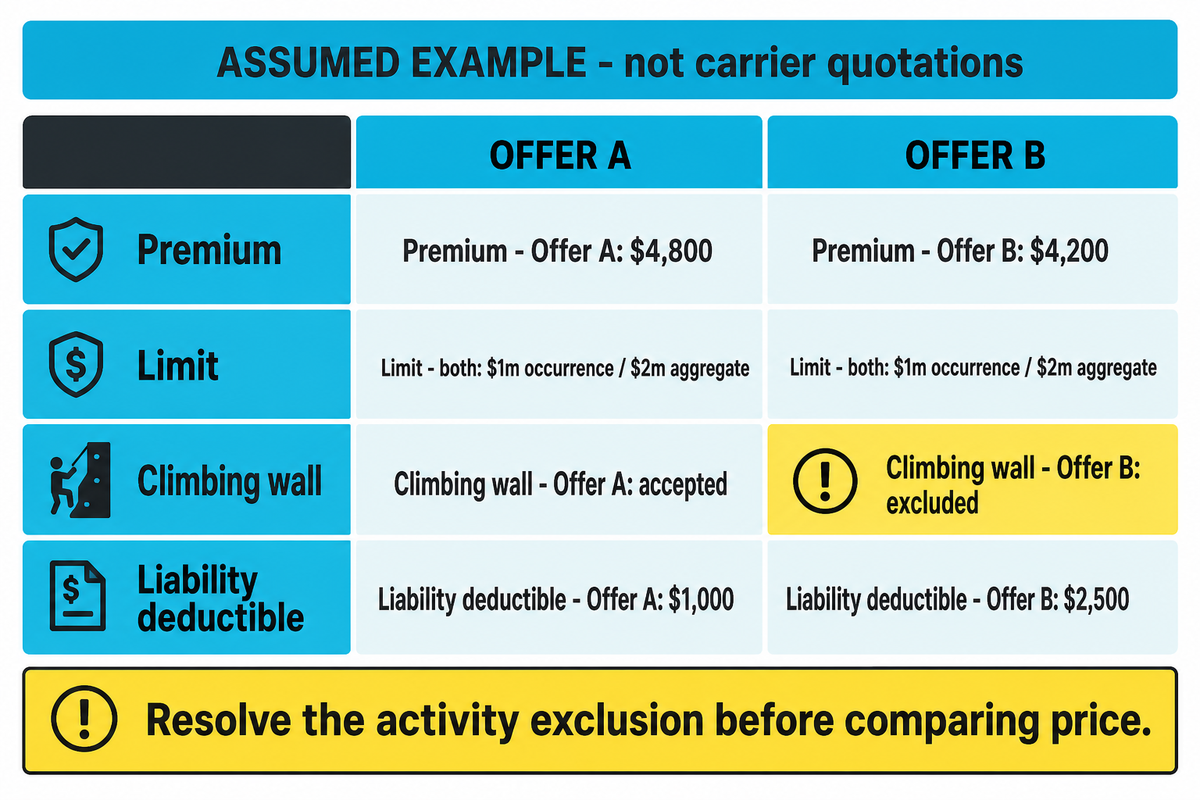
First align insured activities, limits, deductibles, exclusions, values of property and payment terms. An annual premium that is lower is useful only if it meets the same business needs. Unresolved differences should be listed separately. This way an owner would be able to differentiate a real saving from protection that has been removed.
Same-Coverage Quote Bridge
The “Same Coverage Quote Bridge” places two quotes next to each other for the same operating reality and separates price differences from coverage differences.
EXAMPLE: The offers below are assumed to cover one indoor playground business. The $600 lower headline premium offered by Offer B cannot be considered a savings with the unresolved climbing-wall exclusion. The comparison is a reusable method, not a scoring system for an insurance provider.
| Comparison field | Assumed Offer A | Assumed Offer B | Decision |
|---|---|---|---|
| Annual package premium | $4,800 | $4,200 | Hold price comparison until scope matches |
| Liability limit | $1m occurrence / $2m aggregate | $1m occurrence / $2m aggregate | Headline limits match |
| Declared climbing wall | Accepted in written terms | Excluded | Coverage mismatch; obtain revised terms |
| Liability deductible | $1,000 | $2,500 | Different retained cash exposure |
| Equipment value basis | Replacement cost | Actual cash value | Compare a matched valuation basis |
| Business income | Specified covered trigger and limit | Not included | Missing protection requires separate decision |
| Participant accident | Separate quote supplied | Not quoted | Do not confuse it with liability |
| Abuse / molestation | Separate endorsement terms supplied | Excluded | Resolve against supervision model |
| Insurer market status | Agent supplies status and applicable protections | Not yet supplied | Resolve before binding |
| Fees and installments | Full annual payment schedule supplied | Monthly figure only | Obtain total payable over the term |
For market status, distinguish the brokerage or agency from the insurer taking the risk. Texas DOI’s surplus-lines guide states that approved surplus-lines companies are different from Texas-licensed companies and do not belong to a guaranty association. That jurisdiction-specific protection difference, along with limits and exclusions, should be explained without inferring that every surplus-lines placement is unsuitable.
Coverage is defined with the contract provided by the insurer and confirmed in its endorsements. Learn the difference between retaining a larger deductible and removing a covered activity before accepting a lower offer. Providing this information is essential to protect your business when arranging coverage for its actual services.
Insurance Broker vs. Insurance Company: What’s the Difference?
An insurance company underwrites the risk and issues the policy. A broker assists in the placement of coverage. An agent acts within the limits of his/her appointment. An experienced insurance advisor should explain which markets were approached and which terms were offered. The authorizations of the insurer and the intermediary are separate.
Quote takeaway: $4,200 and $4,800 are not comparable offers when one excludes the climbing wall. Resolve the differences in activity, retention, and valuation to see which offer is better.
Budget the Annual Cash Cost, Not Just the Monthly Premium
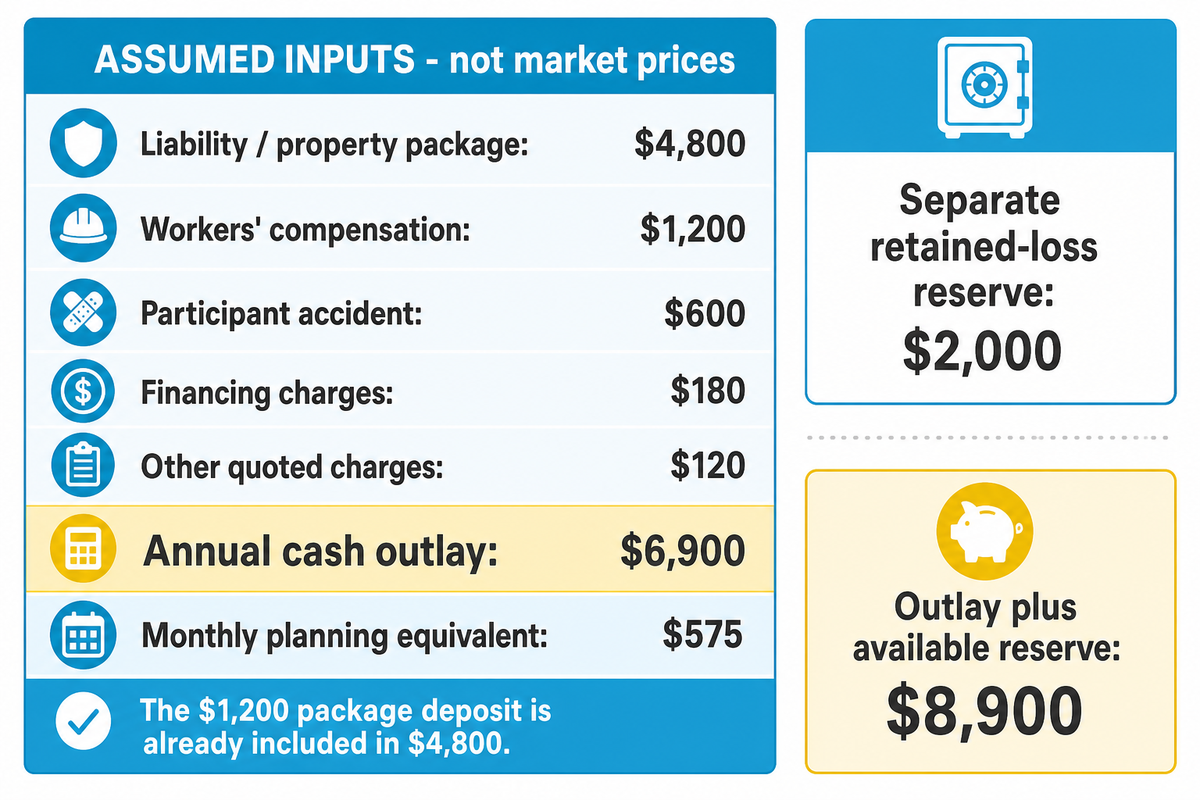
A cash budget for the year incorporates the premiums purchased and the applicable charges and adjustments included in the policy. Maintain a deductible or retained loss reserve in a separate liquidity line. A deposit that forms part of the annual premium is charged once; financing charges are charged outside the premium.
The Maryland Insurance Administration distinguishes installment plans from financing plans offered by premium finance companies. Some payment options increase cost; a monthly number alone does not represent the total payable.
Compare payment options by asking: how much does it cost over the full policy term? Insurance can help pay covered losses, but borrowing to pay the premium creates its own payment schedule.
Assumed inputs: an owner receives a $4,800 annual liability/property package, a separate $1,200 workers’ compensation quote and a $600 participant accident quote. Financing charges are $180 and other applicable quoted charges are $120. The owner also chooses to hold $2,000 for retained losses. The package’s $1,200 deposit is part of its $4,800 premium, leaving $3,600 of that principal to pay later.
| Cash item | Assumed annual amount | Budget treatment |
|---|---|---|
| Liability / property package | $4,800 | Includes its deposit; no extra GL added |
| Workers’ compensation | $1,200 | Separate premium |
| Participant accident | $600 | Separate premium |
| Financing charges | $180 | Added payment cost |
| Other applicable quoted charges | $120 | Added once |
| Total annual cash outlay | $6,900 | $4,800 + $1,200 + $600 + $180 + $120 |
| Monthly planning equivalent | $575 | $6,900 ÷ 12; not a payment schedule |
| Retained-loss reserve | $2,000 | Separate available liquidity |
| Outlay plus reserve availability | $8,900 | $6,900 + $2,000; reserve is not premium |
Hypothetically speaking, maintaining all annual inputs constant for five years means $6,900 X 5 = $34,500 cash outlay. Maintaining the original $2,000 reserve makes the combined outlay and held liquidity $36,500 if the reserve is never drawn. Actual claims, revenue, payroll and renewals can change the situation; policy audits can also generate additional premium or refunds.
Keep the recurring insurance budget apart from the indoor playground equipment cost budget. The first budget pays for a policy term; the second budget pays for the play structures and other opening investments.
Finance takeaway: in this example, annual payments total $6,900 and the separate reserve is $2,000. Calling the combined $8,900 “insurance premium” would overstate the premium and obscure the cash that is still available to cover retained losses.
Equipment and Safety Documents That Strengthen a Submission
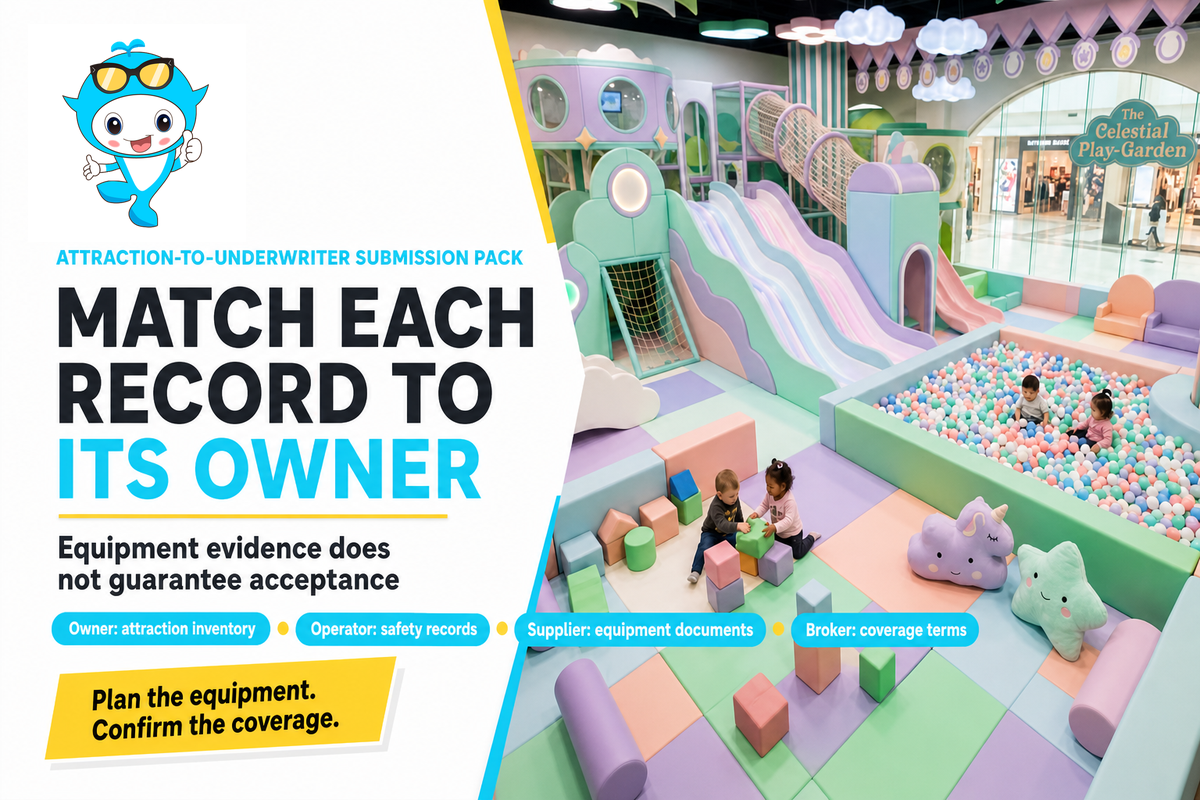
Each item submitted for equipment should relate an insured attraction to its identity and use, along with its operating records and instructions and evidence of safety. Manufacturers’ and suppliers’ documents describe the equipment, and operators’ documents describe its use. If regulated facilities require insurance-party inspection, that evidence is a separate document. A complete file makes the risk evident, without guaranteeing an underwriting decision or discount.
Attraction-to-Underwriter Submission Pack
The Attraction-to-Underwriter Submission Pack relates each attraction to equipment identity and use, as well as supporting documents and unresolved insurance requirements.
PHLY’s proposal requirements provide a practical starting point: a signed application, current loss runs plus four prior years, photographs, financial information, safety rules, applicable waivers and contracts, participant accident evidence and an emergency evacuation plan. A new business would be able to state that it has no prior operations and provide the required business plan.
- Owner / procurement: attraction inventory, equipment values, purchase scope and a custom playground layout showing how the operating areas fit together.
- Operations / safety lead: user rules, staff training, supervision, incident reporting and equipment maintenance records.
- Supplier: product identity, installation and maintenance instructions, and reports tied to the actual equipment configuration.
- Broker: accepted activities, proposed insurer, policy wording issued for review and any required inspection evidence.
According to ASTM, F1918-21 is active for soft contained play equipment. Keep the standard designation and report scope with the equipment it pertains to. The ANSI catalog provides more information about the standard. A generic standard is not a certification for all items in a play center.
For certain amusement ride submissions in Texas a policy schedule with the names and serial numbers of the rides and an inspection certificate from the insurer or its contractor is required. Supplier drawings will not replace the insurance party certificate for the equipment in this regulated category.
For a planned indoor playground equipment order, Didi Land can discuss equipment and design documentation. Keep broader indoor playground safety standards work connected to the installed configuration and the operator’s procedures.
Use those records to create a safer environment through inspection and maintenance. Safe play staff should enforce rules during actual visits. Protect your business by keeping the documented equipment, operating practices and declared insurance risk in line with the venue.
Documentation takeaway: PHLY’s current-period-plus-four-years request is a carrier-specific example. When responding to documentation requests, the company should match each record to its owner, and keep the equipment reports, endorsements and acceptance and any required insurance company inspection reports separately.
Before You Bind, Renew or Add an Attraction
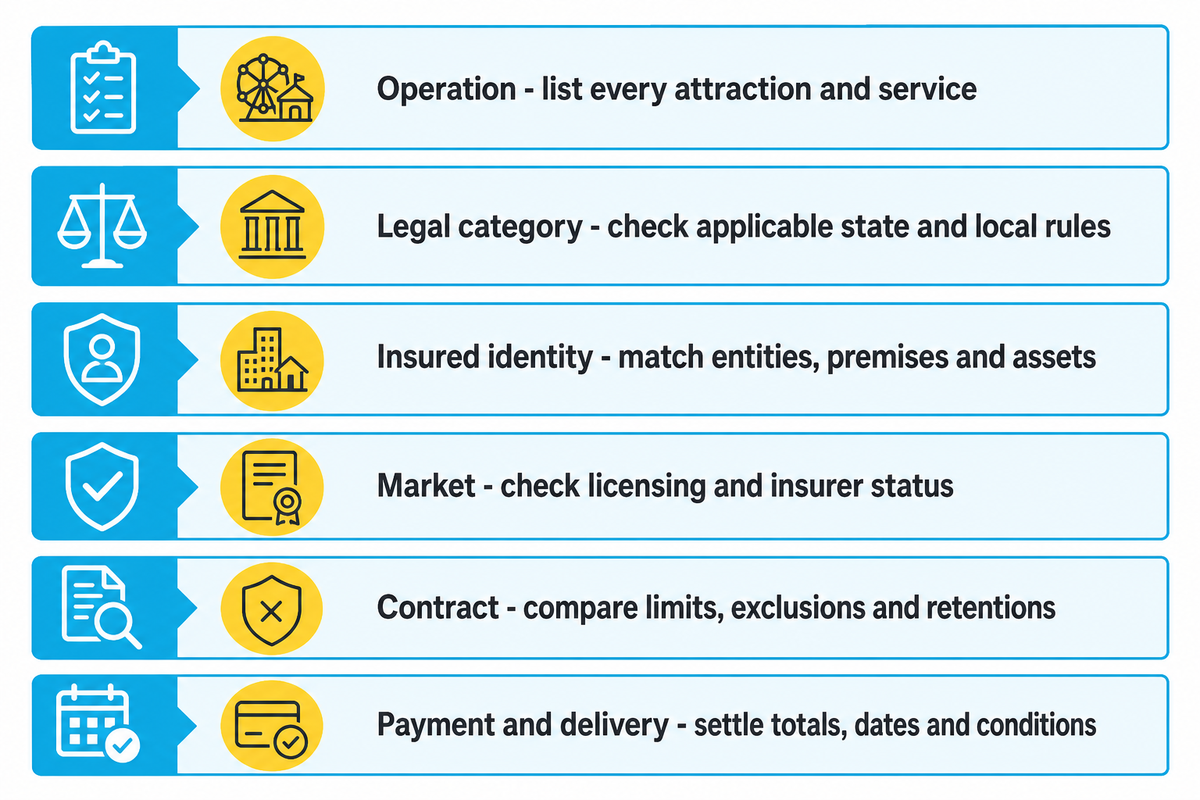
Prior to renewing or binding insurance, clarify the activities of the venue, address applicable legal and lease requirements, and reconcile named insureds and outstanding quote differences. The addition of an attraction warrants a description of the operation and written insurance terms. The opening decision should be based on accepted coverage and completed documentation rather than a verbal estimate and/or insurance certificate.
A certificate of insurance is proof the insurer can provide to a landlord to show that insurance exists. The terms and conditions of the policy dictate the insurance coverage. Leases can impose obligations on an owner that are greater than the insurance coverage. An owner should provide the broker with the actual lease wording in advance of signing or opening to address any discrepancies.
- Confirm the operation: list soft play, trampolines, climbing, food, sensory play, drop-off care and mobile activities separately.
- Confirm the legal category: identify applicable state and local requirements, including admission-fee and equipment classifications.
- Confirm who and what is insured: match legal entities, premises, attractions, additional insured endorsements and asset ownership.
- Confirm the market: check intermediary licensing, insurer authorization and relevant guaranty-association protection.
- Confirm the contract: compare participant terms, exclusions, limits, retentions, valuation and business interruption coverage.
- Confirm payment and delivery: reconcile annual totals, financing terms, effective date and every outstanding condition before treating coverage as bound.
At renewal, send changes in payroll, revenue, equipment and services together with the claims information the insurer requests. Keep dated versions of the submission and written responses. The operator adding a new service should be able to trace the new service from the description of the business to the renewed policy language.
The review agenda in the California commercial insurance guide helps the owner compare policy limits, rating exposures, business classifications, endorsements, and exclusions before the effective date.
Key takeaway
A usable insurance budget joins accepted activities, matching policy terms and the full annual payment amount. Keep the retained-loss reserve separate, and settle attraction changes before selling the new experience.
Planning the equipment behind your insurance submission?
Bring your layout, attraction list and documentation requirements to Didi Land’s equipment team. Coordinate the coverage decision with your licensed insurance professional.
FAQ
How much does indoor playground insurance cost per year?
Use the total on an annual venue-specific quote for your budget.
Annual cost and policy scope
Multiply a monthly benchmark by twelve only to compare its stated period. Insureon’s $45 general liability example becomes $540 by that arithmetic, while its $83 BOP example becomes $996. Neither amount establishes your full insurance program. Include the separate policies purchased and applicable charges, avoid counting liability twice, and hold retained-loss cash outside the premium total.
Does indoor playground insurance cost more when I add trampolines?
Adding trampolines calls for a new underwriting review; a price increase is not automatic.
Attraction changes and coverage
The insurer may offer different terms, require additional information or decline the activity. Describe the actual trampoline configuration, supervision and participant use alongside the rest of the venue. Obtain the returned coverage terms before opening the attraction. An existing soft-play policy or a general center insurance label should not be treated as advance acceptance of an added service.
What insurance companies are best for indoor sensory play areas?
Choose a market that accepts your specific sensory-play operation and supervision model.
Finding a suitable insurance market
Compare accepted activities, participant wording, employee cover, exclusions and available limits before ranking insurance companies by price. PHLY and SECURA publish family-entertainment offerings, but those pages do not establish suitability for every sensory facility. Medical, therapeutic or drop-off services need a clear description of the work. Use a licensed intermediary familiar with the actual business and its state.
Does a waiver replace indoor playground liability insurance?
No. A waiver and liability insurance perform different jobs.
Waivers and risk management
A waiver’s legal effect varies with state law and the circumstances. It does not purchase defense or indemnity from an insurer. Have local counsel address the document and keep its use consistent with the policy’s conditions and your supervision procedures.
How much does a commercial indoor playground cost apart from insurance?
Build a separate opening budget for equipment, premises and working capital.
Separating opening and recurring costs
Equipment design and purchase, freight, installation, fit-out, permits, deposits and staffing are different budget lines. Their amounts follow the actual layout, local premises and supplier scope. Start with an itemized equipment proposal and contractor estimates, then add recurring rent, labor and insurance. Keeping those schedules separate makes it easier to see which costs occur before opening and which recur during operation. Obtain an itemized scope for delivery and installation as well as the equipment itself, so a capital-cost comparison includes the same responsibilities on each offer.
Can I use a per-square-foot rate for my insurance budget?
Use floor area as an exposure input, not a universal premium formula.
Area and premium rating
California’s regulator explains that liability classification can use area, payroll or sales. Attractions and policy terms also matter. Keep square footage consistent across submissions, then compare actual annual quotes for the same operation. Matching area alone does not match the insured activities.
Can the landlord’s insurance protect my equipment and business income?
Arrange protection for your own assets and income rather than assuming the building policy includes them.
Tenant property and income
A landlord’s building interest differs from the operator’s equipment, improvements and income exposure. Review who owns each asset and what the lease requires. A tenant’s policy should identify the property and valuation basis being insured, while business interruption insurance needs its own covered trigger, limit and conditions. A landlord asking to be an additional insured does not by itself arrange those protections for the tenant. Keep a written asset schedule with ownership and declared values, and reconcile the lease terms with the insurance proposal before the business takes possession.
References & Sources
- Small Business Insurance — New York State Department of Financial Services.
- Small Business Insurance — National Association of Insurance Commissioners.
- Workers’ Compensation Insurance Guide — Texas Department of Insurance.
- Commercial Insurance Guide — California Department of Insurance.
- 2026 Florida Statutes, Chapter 546 — Florida Senate.
- Surplus Lines Insurance — Texas Department of Insurance.
- Premium Finance — Maryland Insurance Administration.
- ASTM F1918-21: Soft Contained Play Equipment — ASTM International, public catalog scope.
- ASTM F1918-21 Catalog and Revision Lineage — American National Standards Institute.
- Amusement Ride Requirements and Questions — Texas Department of Insurance.
Carrier and broker product statements are attributed through the inline links. Policy terms, local law and the actual operation govern the insurance decision.
SYS.00 // E-E-A-T Disclosure
Why I Write This
As the CEO and Co-Founder of a specialized manufacturing facility, my objective is to provide unvarnished, factory-direct technical insights into commercial indoor playground engineering, safety compliance, and project planning. I aim to bridge the information gap for global buyers seeking reliable structural and material data, ensuring you make informed, ROI-driven decisions without the marketing fluff.
About My Business
Guangzhou Didi Land Amusement Equipment Co., Ltd. (Brand: Didi Land) is a commercial indoor playground equipment manufacturer founded in 2014. Operating from Panyu, Guangzhou, China, we engineer, produce, and export commercial-grade play structures to over 40 countries worldwide. Our production lines strictly adhere to international safety frameworks, ensuring durability and safety for high-traffic environments.
Our Services
We provide end-to-end B2B commercial solutions: from custom 3D spatial design and OEM manufacturing to worldwide export logistics and compliance testing. Our focus is on empowering Family Entertainment Centers (FECs), shopping malls, kindergartens, and hospitality venues with reliable, high-capacity play infrastructure.
DATA_MATRIX // MANUFACTURER_PROFILE
Name:
Cherry
Role:
CEO & Co-Founder
Brand Name:
Didi Land
Company:
Guangzhou Didi Land Amusement Equipment Co., Ltd.
Location:
Guangzhou, Panyu, China
Founded:
2014
Products:
Indoor Playground Equipment, Soft Play Equipment, Themed Playground Design, FEC Play Zones, Trampoline Modules, Ninja / Obstacle Course Modules
Email:
conglizhang1@gmail.com
Phone:
+86 199 2587 9517
Website:
didiplayarea.com
COMPLIANCE & STANDARDS:
ASTM F1487 · ASTM F1918 · EN 1176 · CPSIA · CE · ISO 9001 · IPEMA
Contact Factory Direct
ASTM F1487 · ASTM F1918 · EN 1176 · CPSIA · CE · ISO 9001 · IPEMA
Related Posts
Trending now