Get in Touch with Didi Land


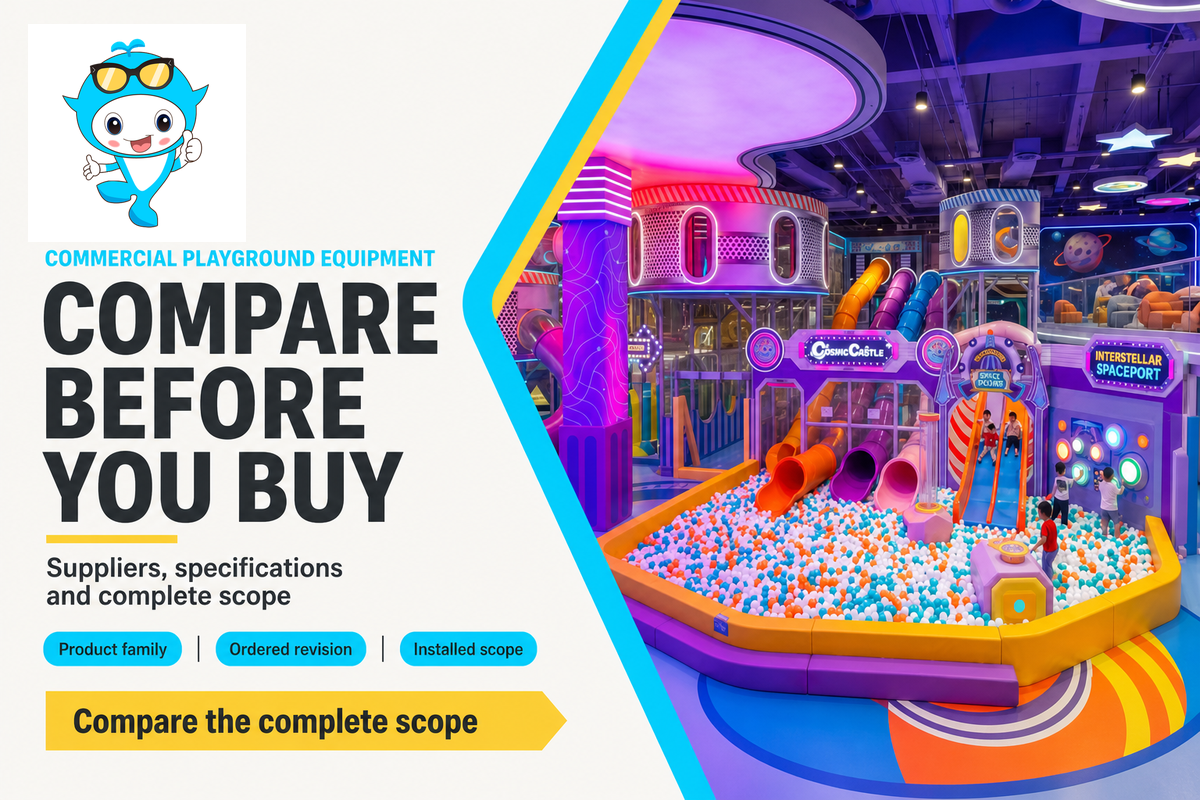
Commercial playground equipment for sale should be judged against the same venue drawing and installation scope. A lower equipment price can leave your project with more work to buy. Begin with the equipment category and then compare specifications, supplier responsibilities and costs to reach opening day.
Updated October 2026
Quick buying specifications
- Project: commercial play for an identified venue and age group.
- Drawing: equipment dimensions, required use zones, circulation and site interfaces.
- Evidence: named model, ordered revision, applicable standard and report scope.
- Price basis: equipment plus delivery, site work, surfacing, installation and handover.
- After opening: identified replacement parts, maintenance instructions and written warranty terms.
Commercial playground equipment for sale is ready to compare when each offer identifies its intended use, ordered configuration and complete delivery scope. Resolve missing work before choosing the lowest total.
Key buying points
- A commercial label doesn’t select the right equipment category.
- Product certification, surfacing performance and site accessibility are separate questions.
- Unpriced exclusions consume the apparent saving on a cheaper offer.
- Delivery is one milestone; installation and acceptance still need owners.
Identify the equipment category before comparing offers
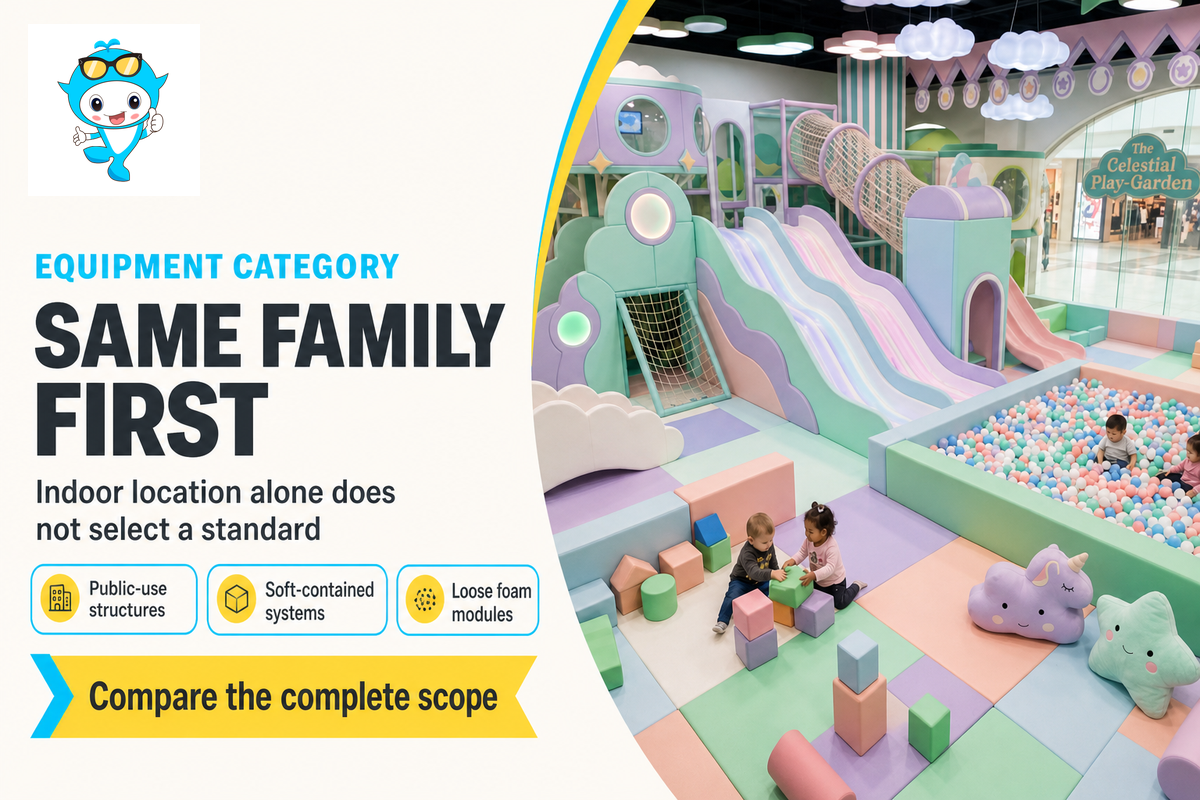
Commercial playsets should be shortlisted if the intended use for the equipment matches the project. Public-use structures, soft-contained systems and loose foam modules solve different layout problems. Indoor location alone does not select a standard. A buyer comparing a school playground with a soft play business first needs to differentiate equipment categories and check installation requirements.
The Consumer Product Safety Commission equipment guidance differentiates home and public use equipment. Parks, daycares, a place of worship and homeowners associations can have different operating needs even when the photograph shows a similar slide. Heavy use, supervision and access belong in the brief, along with the product description.
| Equipment family | Typical purchase decision | Specification to resolve |
|---|---|---|
| Public-use play structures | Commercial playground equipment for parks or schools | Age range, use zones and installation |
| Soft-contained play systems | Enclosed commercial indoor play | Complete system layout and access |
| Loose foam play modules | Reconfigurable low-level activities | Module sizes, intended ages and placement |
| Soft play sets | Grouped steps, ramps and tunnels | Included pieces and finished layout |
| Ball pit installations | Contained activity area | Containment, entry and cleaning access |
| Climbing playground equipment | Climber or net climbers for a named user group | Interfaces, fall conditions and access |
| Themed playground structures | Ship playground or other custom appearance | Theme changes versus functional configuration |
| Independent play components | Balance beam, swing or spiral slide | Component layout and surrounding surface |
| Residential playground playsets | Private residential play | Home-use instructions and site suitability |
Didi Land’s commercial indoor playground equipment can be the base equipment for an indoor venue. Its soft play sets and separate foam modules give buyers different configuration options. Outdoor play and a custom playground indoors should not share an undifferentiated specification sheet.
Selection Rule: compare offers within the same product family before evaluating material thickness or price.
Match commercial playground specifications to your venue
A usable playground design describes the equipment’s envelope, the space needed around it, and the routes people take through the venue. Note that dimensions must have units and a drawing reference. Inclusive play relies on an incorporated site layout. An accessible component is useful only when the intended users can reach and use it.
For active play in a commercial space, state the activities and supervision arrangement together. Compare playground solutions against that operating brief. A problem-solving activity is placed on the list when it’s appropriate to the venue.
How do I choose the right play equipment for my project?
Choose the product family and age group first, then select a layout that best matches the measured venue with required clearances and access routes. Activities should align to the operating plan. A compact foam zone and an enclosed multi-level structure may both be contained in the same floor space, but they require different installation work and cleaning access.
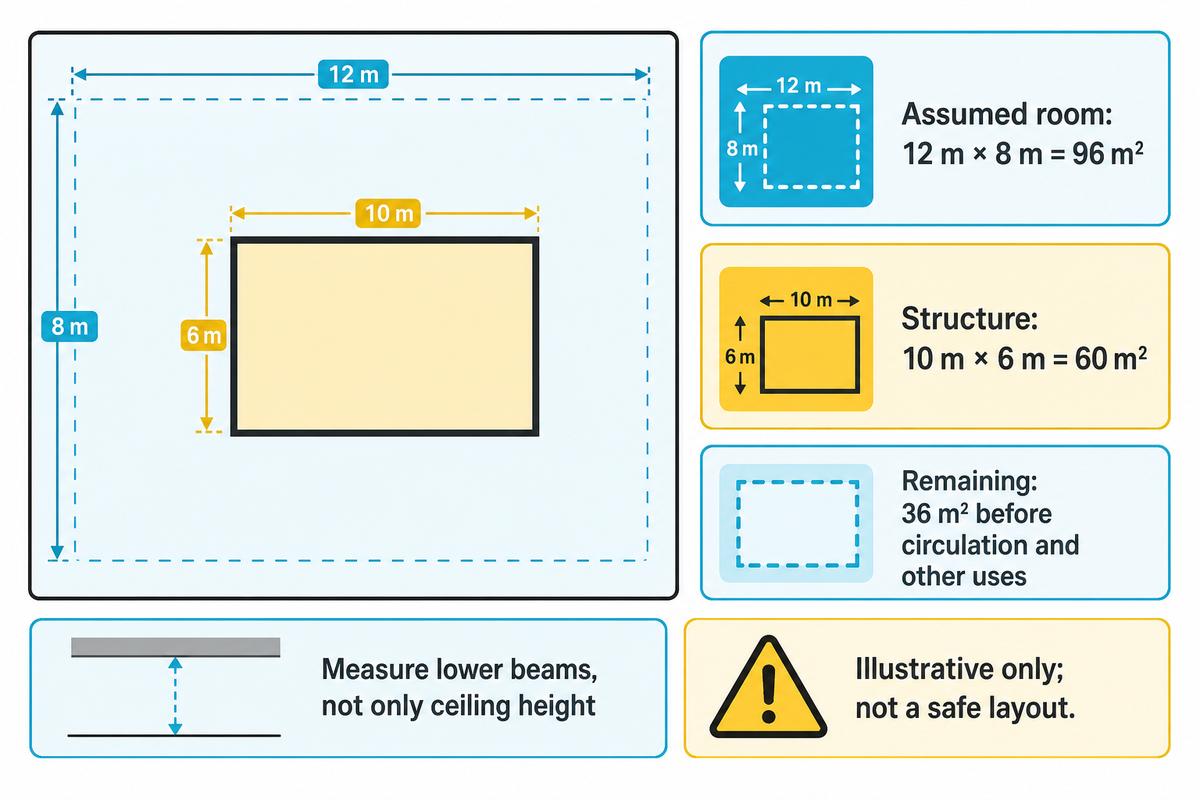
Consider an assumed 12 m × 8 m room, or 96 m². A proposed 10 m × 6 m structure occupies 60 m², leaving 36 m² before considering circulation, columns or other uses. The remaining area of 36 m² would need to be further reduced to account for circulation space and other design considerations before a safe layout could be determined. If the measured 3.2 m ceiling includes a lower beam, the drawing needs that beam elevation as well as the room height. Owners and landlords may restrict anchoring. The owner needs a layout the installation lead can build; finance needs to know whether access or structural work has entered the price. A smaller configuration can be the better purchase when it avoids a site alteration that the larger offer omitted.
The US Access Board’s play area guide discusses connected accessible routes and staged development. Under 2010 accessibility standards 240.1.1, each completed addition must be considered with the entire play area. Expanding an existing playground therefore needs a whole-area layout, not just a drawing of the new section.
Specification rows should identify age range, installed dimensions in mm or m, overall height, access openings, foundation or floor interface, and the basis for any stated user capacity. Durable materials are important, but leaving a material name or brand answers none of those questions. Use the venue-specific buying checklist to prepare the site information without turning supplier comparison into a design exercise.
Verify supplier evidence for the exact configuration
Supplier evidence should include the model and configuration purchased, including the drawing revision and the scope of tests or certifications. Equipment, protective surfacing and accessibility each have a different purpose. The practical comparison is whether the ordered design has a coherent set of applicable requirements, rather than which supplier displays more logos.
What safety standards should commercial-grade play equipment meet?
Public-use Equipment and Soft-contained play systems have different standards routes. ASTM F1487-25 addresses public playground Equipment, and ASTM F1918-21 addresses soft-contained play equipment. Both published scopes describe users within a 2 to 12-year age range. The specification depends on the equipment, the project requirements and the applicable jurisdiction; an indoor project doesn’t mean everything is soft-contained.
ASTM’s public-use specification and soft-contained specification provide distinct equipment definitions. For US projects, children’s-product requirements can also apply. CPSC explains that products classified as children’s products or toys require the applicable Children’s Product Certificate. A voluntary equipment standard and a regulatory obligation should be recorded separately.
“The requirements for playground equipment depend on whether it is intended for use at a home or at a public playground.”
Drawing-to-Report Crosswalk
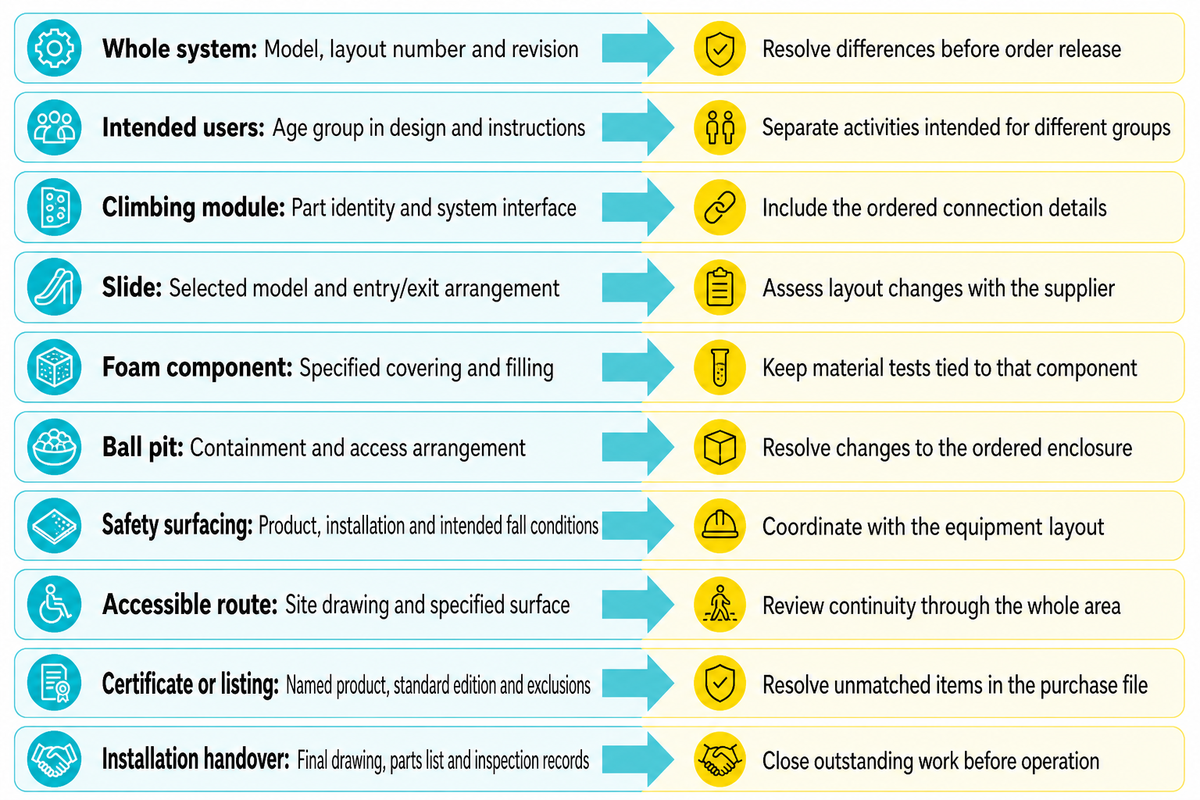
A Drawing-to-Report Crosswalk relates each requested item to its design revision, supporting evidence and outstanding configuration changes.
| Ordered item | Match across documents | Release decision |
|---|---|---|
| Whole system | Model, layout number and revision | Resolve differences before order release |
| Intended users | Age group in design and instructions | Separate activities intended for different groups |
| Climbing module | Part identity and system interface | Include the ordered connection details |
| Slide | Selected model and entry/exit arrangement | Assess layout changes with the supplier |
| Foam component | Specified covering and filling | Keep material tests tied to that component |
| Ball pit | Containment and access arrangement | Resolve changes to the ordered enclosure |
| Safety surfacing | Product, installation and intended fall conditions | Coordinate with the equipment layout |
| Accessible route | Site drawing and specified surface | Review continuity through the whole area |
| Certificate or listing | Named product, standard edition and exclusions | Resolve unmatched items in the purchase file |
| Installation handover | Final drawing, parts list and inspection records | Close outstanding work before operation |
Distinguishing between product certification and association membership is demonstrated through IPEMA’s certification programs. A material test, a product listing and an installed-system inspection each answer a different question. For example, changes to a design (e.g. a layout, slide or enclosure) made after the reviewed design create a design change that needs to be resolved with the responsible supplier. Keep the original version and its replacement together so the installation team works from the ordered revision.
Engineering Note: both the standard edition specified for the order and any edition incorporated by the applicable accessibility requirements must be retained. The newest publication does not automatically replace a version cited in a regulation.
Compare playground suppliers by scope and responsibility
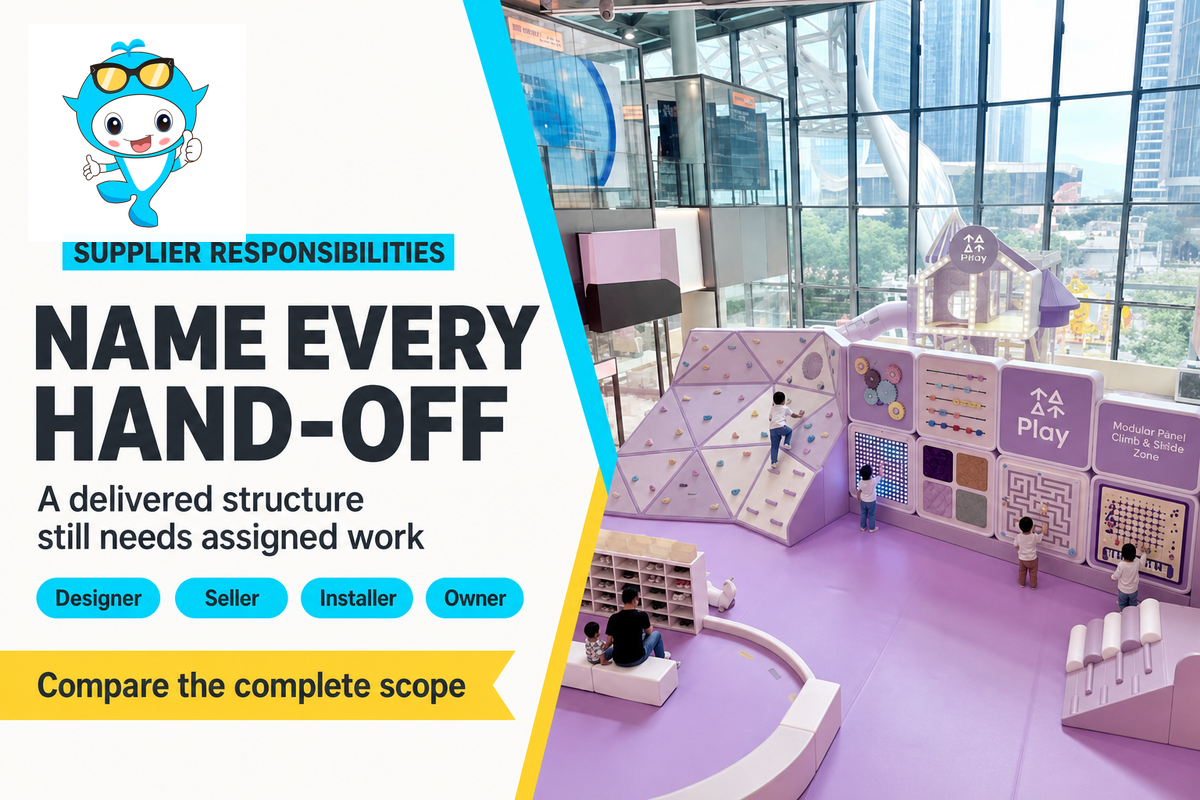
Comparing Playground equipment manufacturers, dealers and installation contractors shows that work determines the differences. A supplier can perform different tasks or subcontract different work, but each purchase has to name an owner for every hand-off. Geography, company size and a promise of the highest quality materials do not allocate those responsibilities.
The detailed explanation of a practical handover given by Playground Professionals’ installation-manual guidance includes a job number, part drawings, delivery checks and part numbers. These details connect the sale to installation and future repairs. A team of experts is useful when buyers know who answers a layout question and who authorises a change on site.
- Designer: owns the approved layout and changes to play space.
- Seller: owns the supplied bill of materials, packing list and commercial terms.
- Installer: owns assembly against the agreed drawings and site interfaces.
- Owner: owns the operating plan and ongoing inspection arrangements.
When opening a childcare venue, an operator may contract a dealer for installation services to assemble equipment while sourcing a different contractor for the floor. Leaving the interface unnamed creates a scheduling window: the assembly crew may arrive while the floor is still not finished. The comparison should assign that interface before deposits are committed. A promised free consultation has little value if the resulting quote still leaves the same task unassigned.
Compare the complete price, not the advertised playset
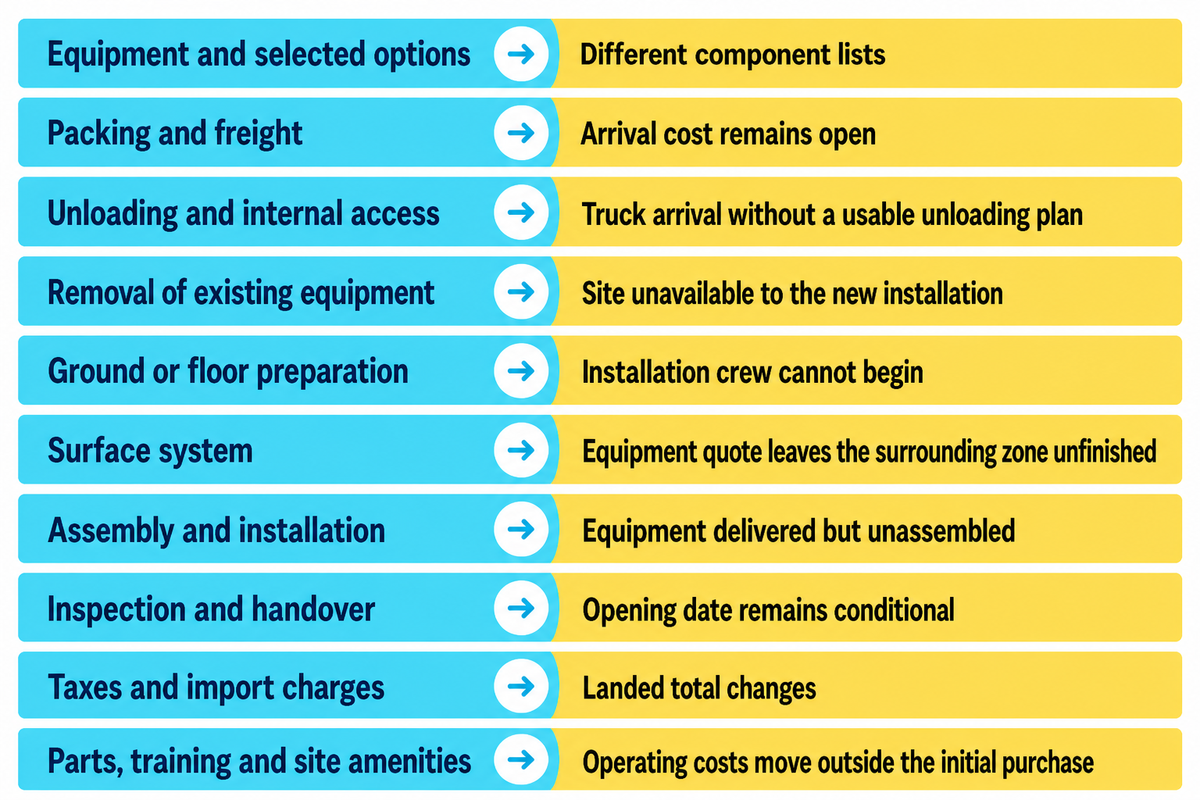
A playground budget includes all the work packages agreed to by both parties for the same end-state scope. Equipment-only rates and installed offers are to be placed in different columns until the missing work is priced. Mark a line as included, priced separately or unresolved. An unresolved amount is to be considered open; placing a zero creates a false price advantage.
How much does commercial playground equipment typically cost?
Instead of using a universal price range for playsets, use a project-specific supplied-and-installed price. One documented US procurement example is Outagamie County’s 2026 PP PG26 award, which was $230,000 for equipment provision, installation and turf surfacing. That combination project amount defines its scope; it isn’t the price for a single element, structure or an indoor venue quote.
Outagamie’s published award shows why an installed project needs a scope definition. Newport’s September 2025 invitation, for approximately 2,000 square feet, separately requested equipment, installation, engineered wood fibre and curbs. Installation included site preparation, utility locating and dirt removal if needed. These are purchasing examples, not cost-per-area benchmarks.
| Cost line | Offer A / Offer B entry | Consequence of omission |
|---|---|---|
| Equipment and selected options | Included / priced / unresolved | Different component lists |
| Packing and freight | Delivery destination and amount | Arrival cost remains open |
| Unloading and internal access | Equipment and crew responsibility | Truck arrival without a usable unloading plan |
| Removal of existing equipment | Removal and disposal scope | Site unavailable to the new installation |
| Ground or floor preparation | Substrate and foundation work | Installation crew cannot begin |
| Surface system | Material, area and installation | Equipment quote leaves the surrounding zone unfinished |
| Assembly and installation | Labour, travel and tools | Equipment delivered but unassembled |
| Inspection and handover | Inspection scope and records | Opening date remains conditional |
| Taxes and import charges | Named tax basis and delivery terms | Landed total changes |
| Parts, training and site amenities | Selected support package | Operating costs move outside the initial purchase |
For finance, it’s the remaining commitment that matters most, not the headline discount. For the installation lead, it’s the work package that releases the next task. A supplier offering an in-stock structure can still leave a longer path to opening, if site work hasn’t been scheduled.
New vs. used playground equipment: calculate the remaining saving
Used equipment can be evaluated if the identity and condition of the equipment can be determined, along with the availability of replacement parts and the equipment’s relocation scope. A new piece of equipment provides an alternative path to purchase with its own delivery and installation commitments. Equal outcomes should be compared before a discount percentage is applied to an existing structure.
The CPSC’s online resale guidance puts recall status before cosmetic condition. Selling a recalled product is prohibited; resale is permitted after the remedy in the public recall notice has been applied. Keep the equipment identity and remedy record with the purchase file.
A real relocation can still be substantial work. Conroe’s October 6, 2025 recommendation memo listed $11,600 for disassembly/removal and $15,100 for assembly/installation in a $42,575 recommended package. The package also includes surfacing-related work, border and hardware. These are project-specific bid figures, not a current relocation tariff or evidence of final expenditure.
Unpriced-Scope Breakpoint
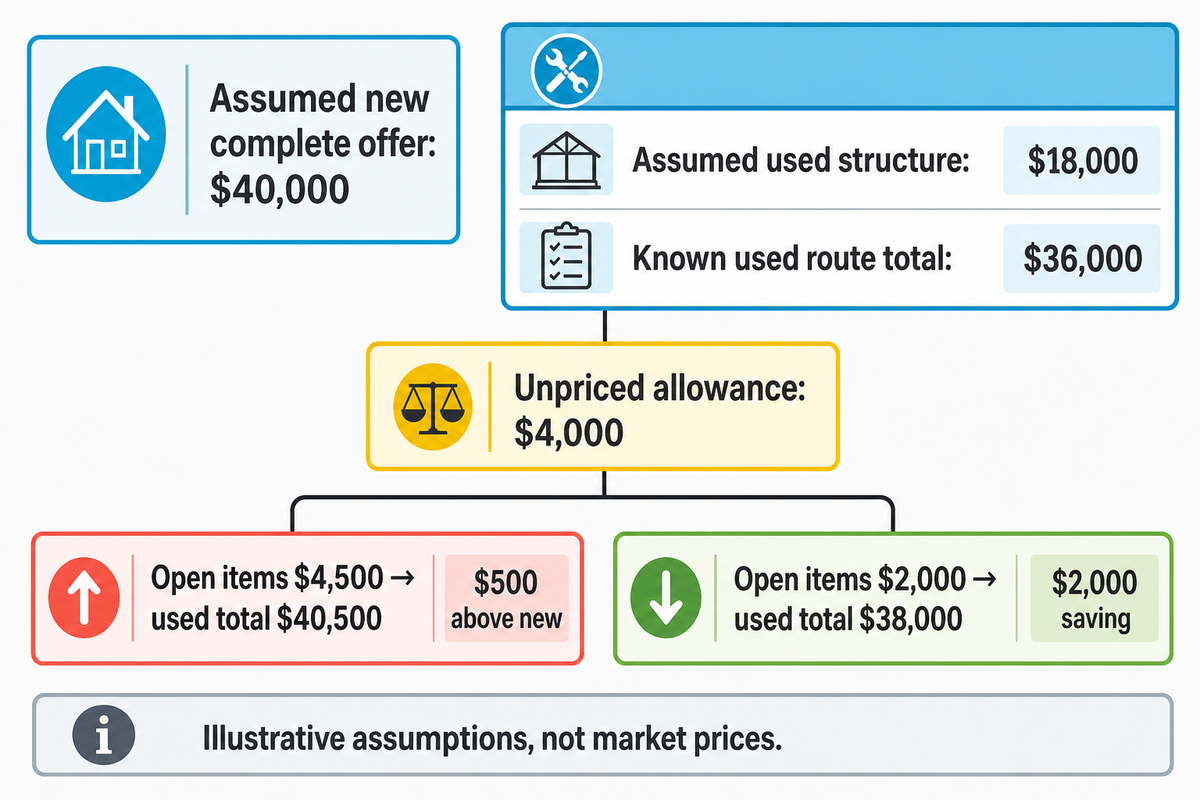
The complete alternative price minus the known costs is the Unpriced Scope Breakpoint.
Assumed inputs: an owner compares a $40,000 complete new offer with a used structure costing $18,000. Known removal costs $4,000, freight $3,000, installation $6,000 and matching site work $5,000. Known used cost is $18,000 + $4,000 + $3,000 + $6,000 + $5,000 = $36,000. The allowance left is $40,000 − $36,000 = $4,000. If replacement parts and inspection add $4,500, the used route reaches $40,500, or $500 above the new alternative. If those open items cost $2,000, it reaches $38,000 and retains a $2,000 advantage. Finance can see the decision threshold without pretending the missing prices are zero.
New: advantages and limits
- Known ordered configuration.
- Defined supply and support terms.
- Still needs a complete site-work price.
Used: advantages and limits
- Opportunity to reuse suitable equipment.
- Potential purchase-price saving.
- Removal, parts and reassembly need pricing.
Agree delivery, installation and acceptance before dispatch
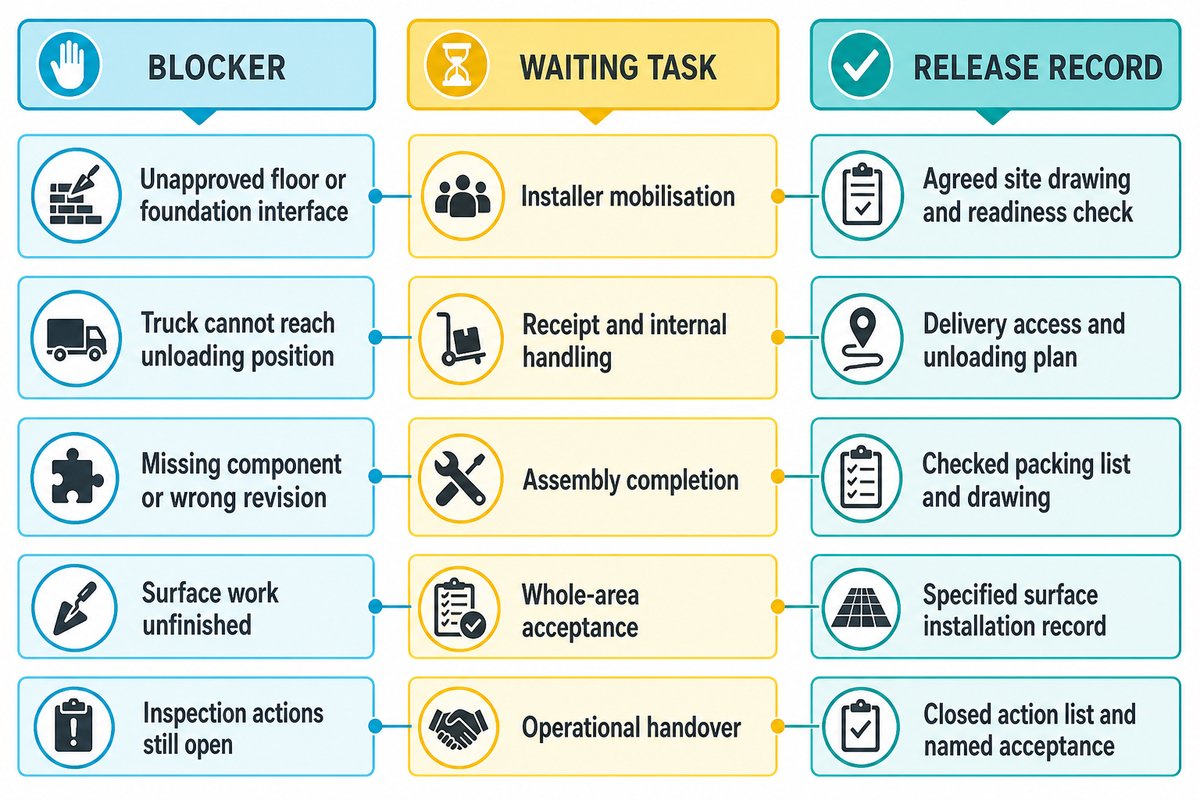
An opening plan shows a schedule of completed tasks. The opening plan has several dependencies. Site readiness releases delivery and unloading. Complete components release assembly. Completing the installation and the agreed inspection releases handover. When comparing suppliers, an owner should assign responsibility for each of these dependencies.
Playground Professionals’ project guide integrates design, construction and maintenance. The installation-manual guidance also calls for delivery checks and component-specific instructions. It’s better to find a missing part during unloading than to discover a gap after the crew has assembled everything around it.
| Hidden bottleneck | Task waiting behind it | Handover record |
|---|---|---|
| Unapproved floor or foundation interface | Installer mobilisation | Agreed site drawing and readiness check |
| Truck cannot reach unloading position | Receipt and internal handling | Delivery access and unloading plan |
| Missing component or wrong revision | Assembly completion | Checked packing list and drawing |
| Surface work unfinished | Whole-area acceptance | Specified surface installation record |
| Inspection actions still open | Operational handover | Closed action list and named acceptance |
In a hypothetical opening plan, where 5 working days are allotted for assembly and 2 working days for handover, the absence of a component due 3 working days after the crew’s arrival consumes the installation window. Unless the schedule of component shipment and crew arrival also changes, a quicker shipment does not recover the time lost due to the missing component. The buyer’s useful question is which completed task releases the next crew.
Compare replacement parts and warranty support
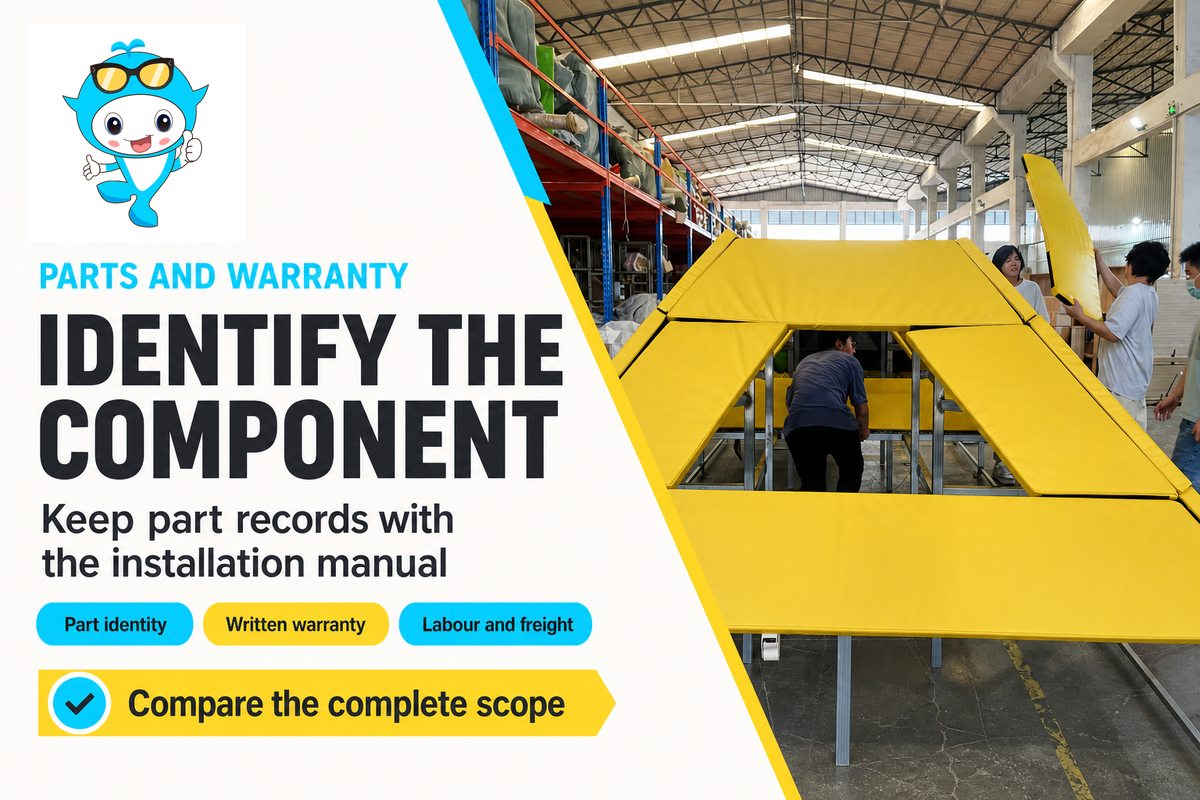
A warranty comparison also highlights what’s covered versus what’s excluded, labor and freight responsibility, and maintenance conditions. Long-lasting operation also needs identifiable replacement parts. A long warranty period shouldn’t be substituted for a maintenance plan or an assumed service life.
The maintenance kit guidance in Playground Professionals suggests that component orders be traced to the job number and component description. Keep that info with the installation manual. For a worn covering or damaged connection, an identifiable component saves the operator from having to rebuild order history from photos.
The descriptions industry-leading warranties and safety and quality are useful only when the purchase names what happens after a failure. Compare the replacement route for a wear item separately from a structural claim. Durable materials can reduce a specific wear problem, but they don’t eliminate the need for cleaning, inspection or maintenance work.
Quote request: send one comparable scope to every supplier
- Provide the measured venue drawing, intended ages and selected product family.
- Ask for the ordered model, layout revision, bill of materials and applicable evidence.
- Confirm included work, priced exclusions, delivery terms and open amounts.
- Verify installation responsibilities, acceptance records and the route for design changes.
- Request part numbers, replacement availability and written labour/freight warranty terms.
Didi Land describes custom design and installation support in its company and project workflow. Send the venue drawing with the existing quote so the sales discussion can address configuration and scope in the same discussion. A customizable appearance should still leave the functional layout and parts list clearly identified.
Industry Outlook: update procurement documents for current guidance
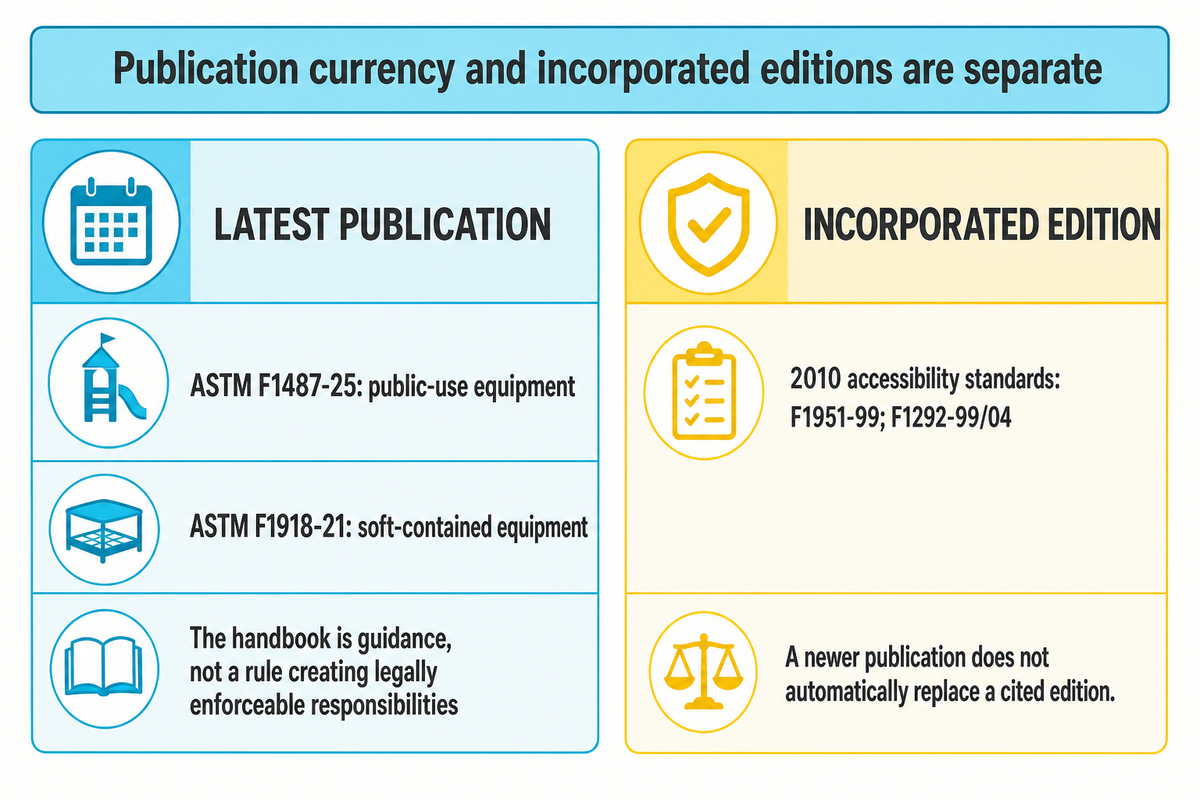
Current procurement documents should separate the latest playground guidance from the requirements that apply to the project. The 2025 CPSC handbook update and ASTM F1487-25 provide buyers an opportunity to revisit a previously issued specification. A change to a new publication date or a changed design does not automatically fulfill the obligations for a specific site.
The August 13, 2025 Federal Register notice describes the final handbook updates which include signage, suspended components, and other equipment and changes to the handbook. The notice states that the handbook is guidance rather than a rule creating legally enforceable responsibilities. The update allows the buyer to assess the scope of equipment inspection and/or maintenance without citing every recommendation as the law.
There should be separate fields for publication currency and incorporated editions. The 2010 accessibility standards cite ASTM F1951-99 for accessible surfaces and F1292-99/04 for impact attenuation. A supplier may be working with more recent test publications while a contract or applicable requirement refers to a particular edition. Keeping both references visible means that relevant documentation is not rejected solely because it is older.
For inclusive playgrounds, separate the connected accessible route from the appeal of individual features. Children of all abilities require usable activities, while the owner requires a maintainable site. Rubber mulch, engineered wood fibre and other surface systems have different installation and maintenance issues; the Access Board’s play-surface guide includes maintenance as part of continuing access. The surface choice is to be made in the equipment comparison before the budget is committed.
For a 2026 purchase, replace a generic promise to meet the highest safety standards with the named requirements, equipment category and ordered revision. New commercial equipment needs a traceable handover. The client can support the power of play while making a disciplined purchase: select activities for the ages and abilities, then fund the site conditions that make the activities usable.
Frequently asked questions
Can I buy commercial playground equipment?
Yes. Owners and organisations can purchase through manufacturers or dealers that supply their intended project.
The purchase should begin with a venue and operating brief. Daycares, schools and HOAs don’t need identical configurations, even when their budgets are similar. Give each supplier the same measured layout and user group, then compare the complete equipment, installation and support scope. Commercial-grade is a starting description; the ordered model and project responsibilities make the offer comparable.
What is the difference between commercial and residential playground equipment?
The main distinction is intended use, with specifications and instructions selected for that use.
A residential playset is specified for its home-use setting. Commercial playgrounds serve an identified public or business context, which changes the design brief and documentation route. Product category, surfacing and installation still need attention in both settings. A heavier-looking frame isn’t a substitute for intended-use instructions. Select equipment for the venue rather than assuming a commercial label makes every product suitable for a home.
Do you sell commercial playground equipment parts?
Contact Didi Land with the model, order details and photographs to identify the replacement you need.
The enquiry should include the part’s location in the structure and any number on the original component list. A replacement covering, connection or complete module can require different information. Match dimensions and attachment details to the existing system before accepting a substitute. The written offer should identify the supplied part, quantity and delivery commitment; don’t assume that every discontinued or third-party component is available from stock.
The playground is for my home; can I purchase your products?
Send Didi Land the home-use brief so the proposed product can be matched to that setting.
A private room, garden or shared residential facility can require a different specification route. State the intended users and site arrangement before selecting a commercial system from photographs.
How long is outdoor play equipment expected to last?
Plan service life by component condition, inspection findings and the manufacturer’s replacement criteria.
A fixed lifespan for all outdoor playground equipment would overlook exposure, usage and maintenance. Coatings, moving joints, timber, plastic components and protective surfaces don’t necessarily age at the same rate. A structure may need an individual part replaced while other components remain serviceable. Record inspections and repairs against the installed model so the owner can decide whether a replacement is available and suitable. Warranty duration answers a different question: it describes the supplier’s contractual remedy under stated conditions. It doesn’t set the date when an installation must be retired. At a school or community site, planned maintenance and an identifiable parts route give the operator a more useful basis for renewal decisions than a generic years-of-life promise.
Where can I purchase commercial-grade playground equipment?
Choose a manufacturer or authorised dealer that can define the equipment and project responsibilities in writing.
For indoor projects, Didi Land can discuss its product families against your venue drawing. Compare the bill of materials and installation scope alongside price. The best playground proposal is the one that fits the intended operation and resolves the work needed to open.
Key takeaway
Release the purchase when category, configuration and complete scope agree. In the assumed comparison, only $4,000 remains for unresolved work before the used offer loses its price advantage.
Request a comparable indoor equipment quote
Send your venue drawing, intended age group and the quote you want to compare. Didi Land can discuss the suitable product family, ordered configuration and supply scope.
Buying-method note: Public procurement examples are attributed to their projects. The new-versus-used calculation uses stated assumptions. Equipment selection and site design depend on the requirements of the intended installation.
References & Sources
- Playground Equipment business guidance US Consumer Product Safety Commission.
- Play Areas US Access Board.
- 2010 ADA Standards, 105.2.3 and 240.1.1 US Access Board.
- F1487-25 public-use equipment specification ASTM International.
- F1918-21 soft-contained equipment specification ASTM International.
- Product Certification Programmes International Play Equipment Manufacturers Association.
- Installation Manual Playground Professionals.
- 2026 Playground Equipment and Turf Surfacing, PP PG26 Outagamie County.
- 2025 Playground Equipment bid City of Newport.
- Buying and Selling Products Online US Consumer Product Safety Commission.
- October 6, 2025 Playground Relocation Recommendation City of Conroe.
- Guide to Getting a New Playground Playground Professionals.
- Maintenance Kits Playground Professionals.
- 2025 Public Playground Safety Handbook Update US Consumer Product Safety Commission.
- Play Surfaces US Access Board.