
Get in Touch with Didi Land


![Sensory Play for Infants: Safe Materials [Guide]](https://didiplayarea.com/wp-content/uploads/2026/10/sensory-play-for-infants-featured.png)
By GW · Updated October 2026
Sensory play for infants is responsive exploration with an adult and the right kinds of everyday activities. Often, a familiar face, quiet voice or intact baby book can be enough. When selecting materials for play, one needs to be able to answer the who, what, where, when, how, and why about inspecting, cleaning, and putting in use each item.
Quick answer
Age-appropriate, intact materials can be used for awake, closely adult-supervised play. Keep loose, small parts and water beads away from infants. Make sure that adults can see and reach the baby before adding equipment, and request documentation for the product and its intended use. Just because something is soft, does not make it appropriate for infants.
This guide isn’t to be used to develop a sensory-integration therapy plan. It doesn’t cover use of equipment for premature infants or infants with special medical needs, nor for children undergoing therapy. For those situations, the treating team should be consulted. Didi Land equipment services do not establish clinical expertise or approval for a particular infant activity.
What Does Sensory Play for Infants Involve?
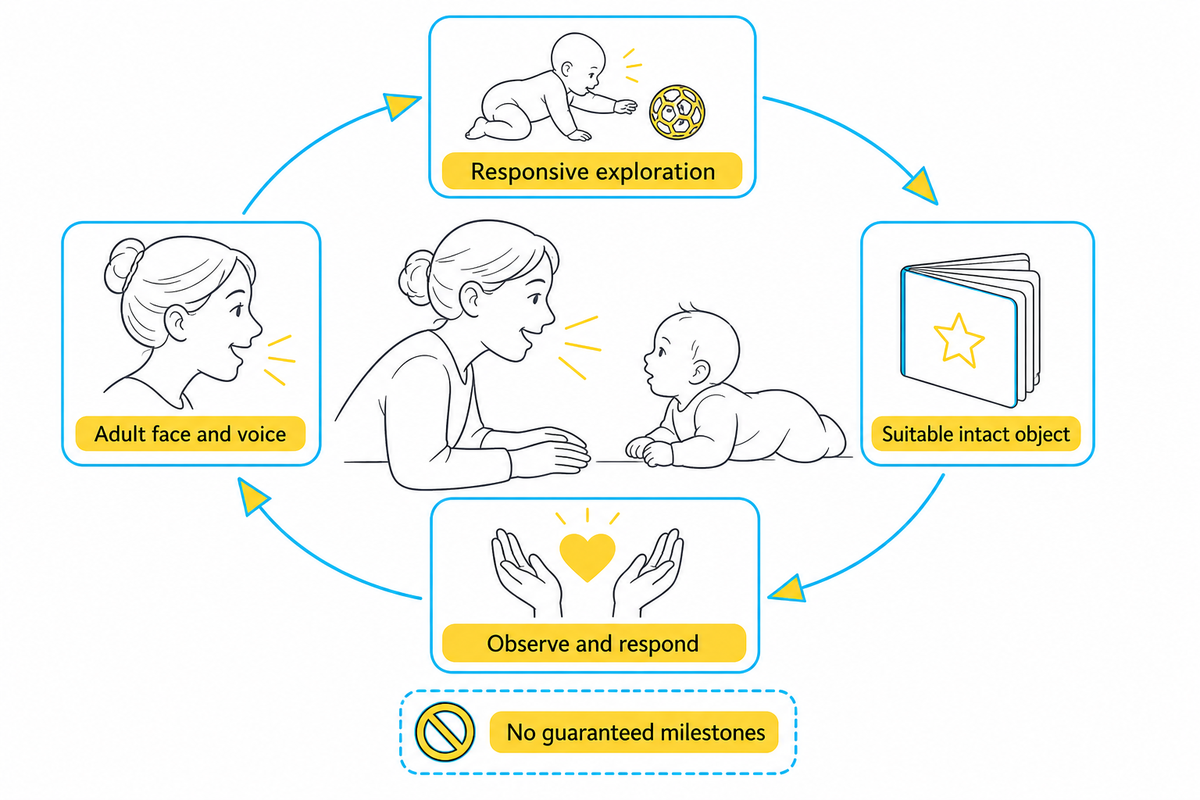
Sensory play means responsive exploration through experiences such as touch, sight and sound. An adult can interact with an infant and then change the activity to match the infant’s level of responsiveness. Equipment can help with this. A busy collection of lights, sounds and textures isn’t a necessity for play involving sight and hearing.
Interactions are how babies learn about the world, for example, the look on an adult’s face, the sound of an adult’s voice, and the feel of an appropriate toy. In each of these interactions, babies have an opportunity to explore the world, and an adult can respond immediately in a way that helps babies with play and learning. The official page for the Head Start young-infant safety guide focuses on safe materials and responsive care because infants explore objects with their mouths, creating a choking risk from loose small parts. Suggestions in the guide don’t guarantee a particular outcome from the use of a sensory kit.
Descriptions of the benefits of sensory play mention the sensory development, gross motor skills, fine motor skills and future learning. Improving motor skills is often discussed, but the kit supplier cannot guarantee motor skills or developmental milestones. Achievement of a motor skill cannot be guaranteed by buying a game.
Definitions of product terms are in what soft play equipment means. A sensory room equipment brief supports a different user group and a different purpose. Its equipment should not be transferred into an infant area by name only.
Practical boundary
Choose an activity that makes room for adult response. A baby who disengages does not need more sensory input to finish a planned sequence.
Start Newborn Sensory Activities With Caregiver Contact
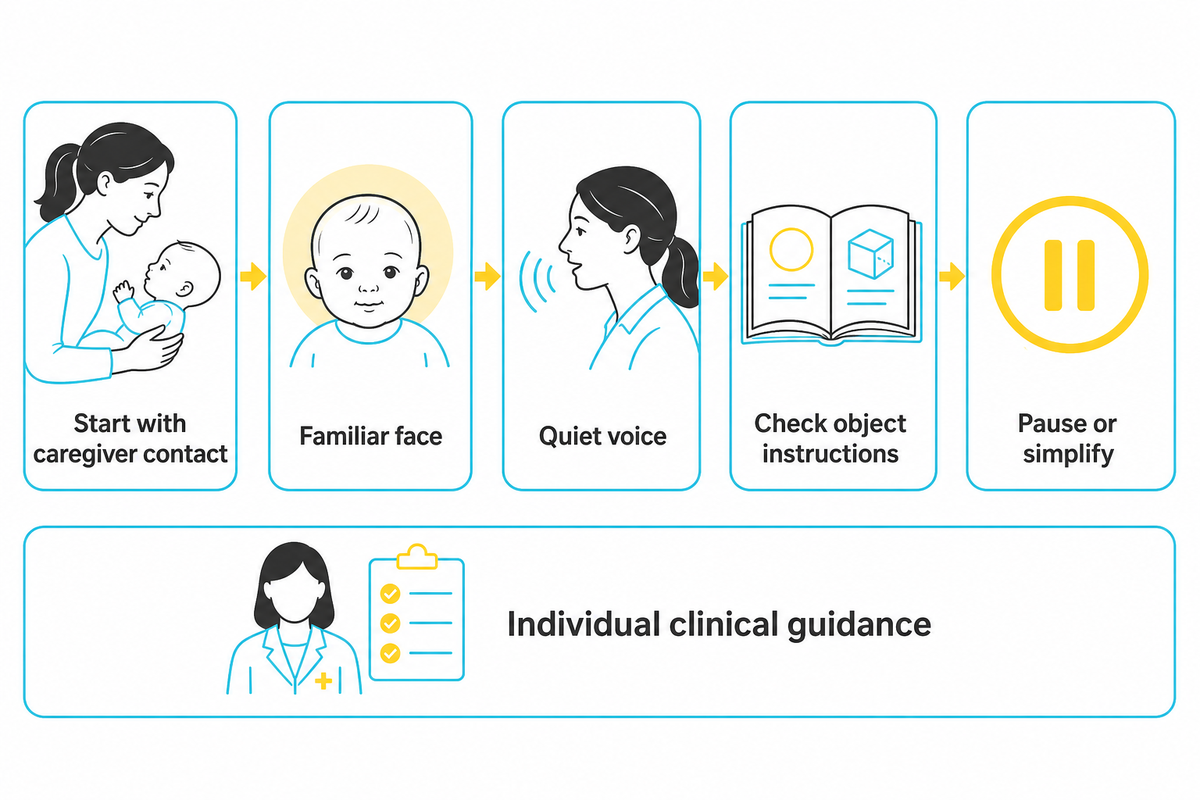
The play of a newborn should start with caregiver contact and simple, age-appropriate interaction. Early sensory experiences can involve a quiet voice and a familiar face without loose materials. Play should be individualized for a comfortable, awake baby, and the activity should stop or simplify in line with individual care advice when the child is no longer interested.
What sensory toys does a newborn actually need?
You don’t need to start your collection with an assortment of options for your newborn. A baby can take part through gentle interactions with a person. Begin with an adult face and voice. Add a baby-related item only when it is intact, intended for the baby, and its instructions fit the child’s abilities.
For a visual, you can use high-contrast images in an appropriate baby book as something to look at. Simple activities can help a baby engage their senses without forcing different senses into one session. For a newborn, it is best to use a simple approach without forcing all the senses into one interaction. For younger babies, use an easy sensory experience that an adult can adapt immediately. Items intended for “babies and children” need a specific age and use statement before they are treated as suitable.
The official PubMed page for the September 2026 Cochrane review of multisensory stimulation in preterm infants reports limited, low- to very-low-certainty clinical evidence. That population and intervention differ from everyday play. Don’t convert general activity ideas, including sensory play ideas, into a treatment protocol, a stimulation dose or a developmental promise, because clinical uncertainty creates a risk of overclaiming.
Buying objection
An activity collection pack grouped based on age as newborn or 3-4 months, does not always ensure the activities are appropriate for the baby. Requests for a clear list of items and their instructions should be made prior to accepting a prepackaged collection.
Choose Baby Sensory Toys by Contact and Construction
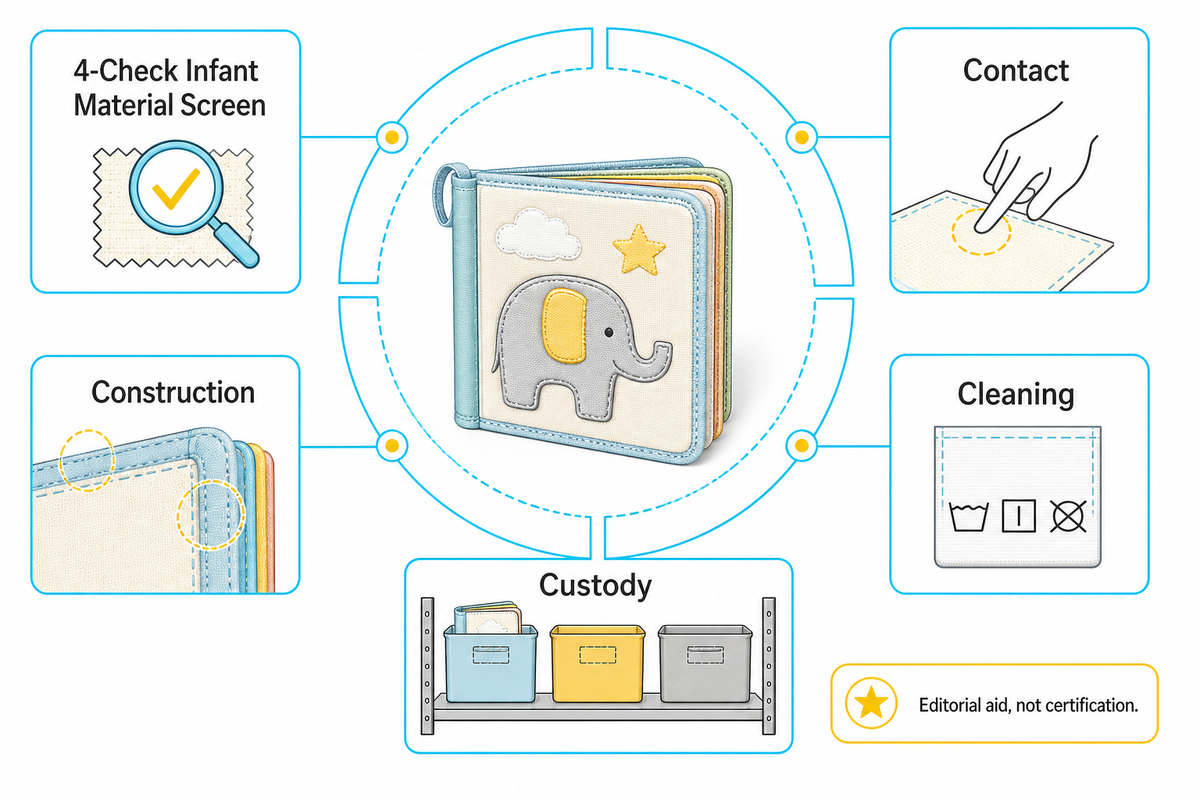
Toys designed for baby sensory should be evaluated for age appropriateness, and to check if they’ve small parts or a construction that could put the baby at risk. A description of the materials used should not be seen as a substitute for age suitability, physical-hazard checks or product-specific instructions.
4-Check Infant Material Screen
Always check the construction, contact, cleaning and custody of a toy before allowing your infant to play with it.
This screen is an aid to editorial decisions based on public guidelines. It isn’t a test, certification, or clinical assessment. Contact refers to how the object will be touched or mouthed by the baby. A “touch and feel” book requires construction checks before it’s presented to the baby’s tactile sense of touch. Construction checks assess what could become accessible. Cleaning assesses care instructions and whether they work for operations. Custody identifies who removes used or damaged stock.
The toys section of AAP toy-buying guidance covers age-appropriateness and securing seams; it describes the dangers of loose pellets, batteries, magnets and other small objects. The CPSC small-parts guidance identifies breakaway parts created or discovered during test procedures. Some product families have separate requirements, and passing one size check does not settle all potential hazards.
| Material family | Possible role | Required check | Limitations / Not suitable for |
|---|---|---|---|
| Baby fabric book | Secure, washable texture pages | Age label; sewn features; care method | Loose threads, ribbons or exposed fill |
| Large grasping toy | Simple hand-held exploration | Exact model; intact parts; age-appropriate use | Detachable pieces or unknown origin |
| Purpose-made rattle | Adult-supported sound and grasping | Secure enclosure; gentle sound; age label | Cracked shell or escaping contents |
| Baby-safe mirror | Adult presents an intact image surface | Maker’s infant use; secure fixing; edges | Glass, breakage or unstable mounting |
| Flat play mat | Awake floor-level play | Intended use; stable placement; cleanability | Used as bedding or a sleep product |
| Covered soft-play module | Only after model-specific suitability review | Intended age/use; seams; inaccessible fill | Generic softness offered as suitability proof |
| Baby play gym | Only within maker’s use limits | Assembly; attachments; developmental restrictions | Dangling cords or use beyond restrictions |
| Homemade sensory bags/bottles | Leave out of a shared infant brief | No validated containment/cleaning evidence supplied | Water beads, baby oil, leaking closures |
| Loose sensory-bin fillers | Leave out of infant floor play | Simplify to an intact age-appropriate object | Rice, beads, pom poms or small loose parts |
Material screen: original editorial synthesis of AAP, Head Start and CPSC guidance. “Possible role” is conditional; no listed material or commercial model is certified by this table.
Imagine a shared play room with a washable fabric book and a homemade glitter bottle. The book has an infant age statement, a washing label, and sewn features, which staff can examine. The bottle, made with a glued lid and unknown contents, has no care instructions. Apply the same screen to both: assess possible contact, accessible parts, cleaning route and the person responsible for removal. The bottle is out of scope because the required information is unknown. The book is a candidate after the same review. Colorful pictures and low prices didn’t answer the questions either.
Set Up an Infant Play Mat for Awake Floor Play
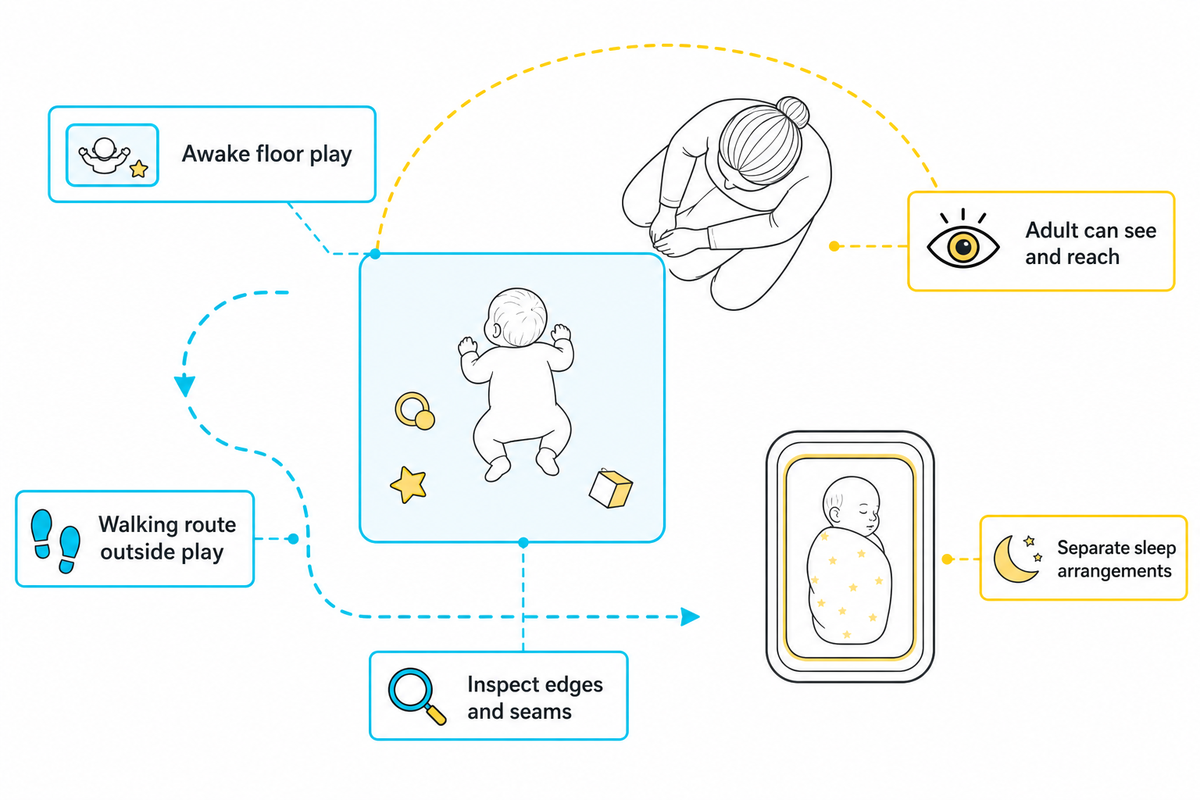
A play mat should provide a clutter-free area for awake, closely supervised floor play within the manufacturer’s intended use. Place the mat so an adult can see and reach the child playing on the mat. Keep extraneous movement and stored items out of the play area. Review the actual product before use.
Rather than scattering samples of different products around the baby, put different textures in an intact, age-appropriate object. A padded product can still be damaged, have exposed foam, or serve a function that differs from the room’s intended use. The product’s edges, seams and overall condition need to be examined.
The Head Start home-visitor guide for young infants recommends that “tummy-time” space be separated from walking traffic and older children. This principle could be used when positioning an activity area on the floor. The guide doesn’t suggest a standard mat thickness, foam density or floor plan dimension.
Play mats must not be used to put infants to sleep. Follow AAP safe-sleep guidance and use the venue’s appropriate sleep arrangements. A product marketed as a body support or lounger needs its own classification review, even if the cover of the product looks like a play mat.
Selection decision
If the supplier offers only “extra soft,” keep the item unapproved. Ask for its intended use, product identity, care sheet and applicable evidence.
What to Leave Out of an Infant Sensory Bin
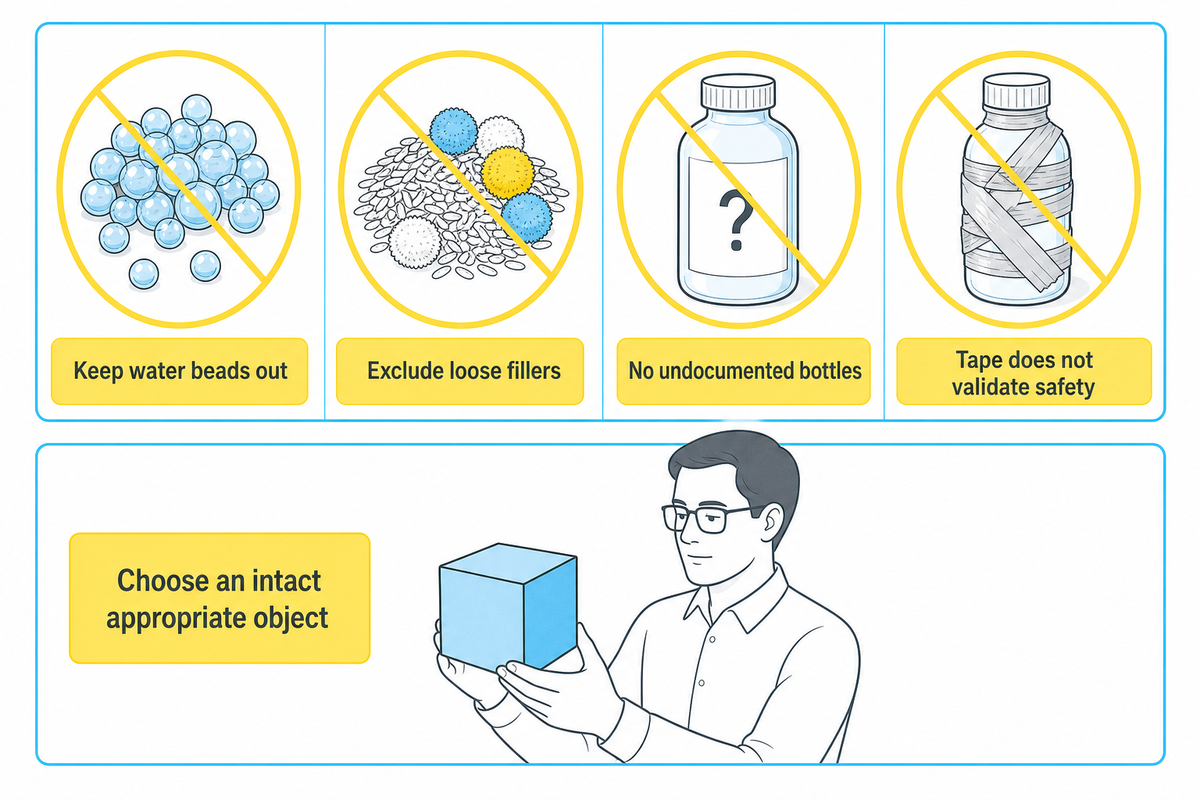
Simplify sensory play to caregiver interaction and intact, age-appropriate items, keeping loose fillers and undocumented sensory bottles outside this infant floor-play brief and selecting an object intended for the baby instead. This should take priority over attempts to secure potentially hazardous materials inside a bag.
Keep water beads out of infant play areas, including sensory bags and bottles. Water beads should be removed from all environments with infants and toddlers. The CPSC Water Beads Information Center states water beads shouldn’t be used in childcare centers, camps and schools.
“Remove water beads from any area where young children may be present.”
“Taste safe” doesn’t establish age appropriateness or eliminate physical hazards. Rice, small pasta shapes, pom poms, and beads aren’t default options for infant bins. Play dough, finger paint, an ice cube and water play raise separate questions about the child, ingredients, supervision and cleaning. This shared-space brief excludes loose fillers instead of offering food or craft recipes.
In general, ideas that call for scoop and pour activities with a spoon or scoop assume skills beyond simply picking up an object. Keep formats for older children separate; sensory play for preschoolers has a different target audience. Babies and toddlers shouldn’t automatically use the same materials.
Common misconception
Sealing a sensory bag or bottle with tape does not validate containment, construction or hygiene. Baby oil and water beads are still excluded content for this brief.
Plan Infant Play Space Around the Adult
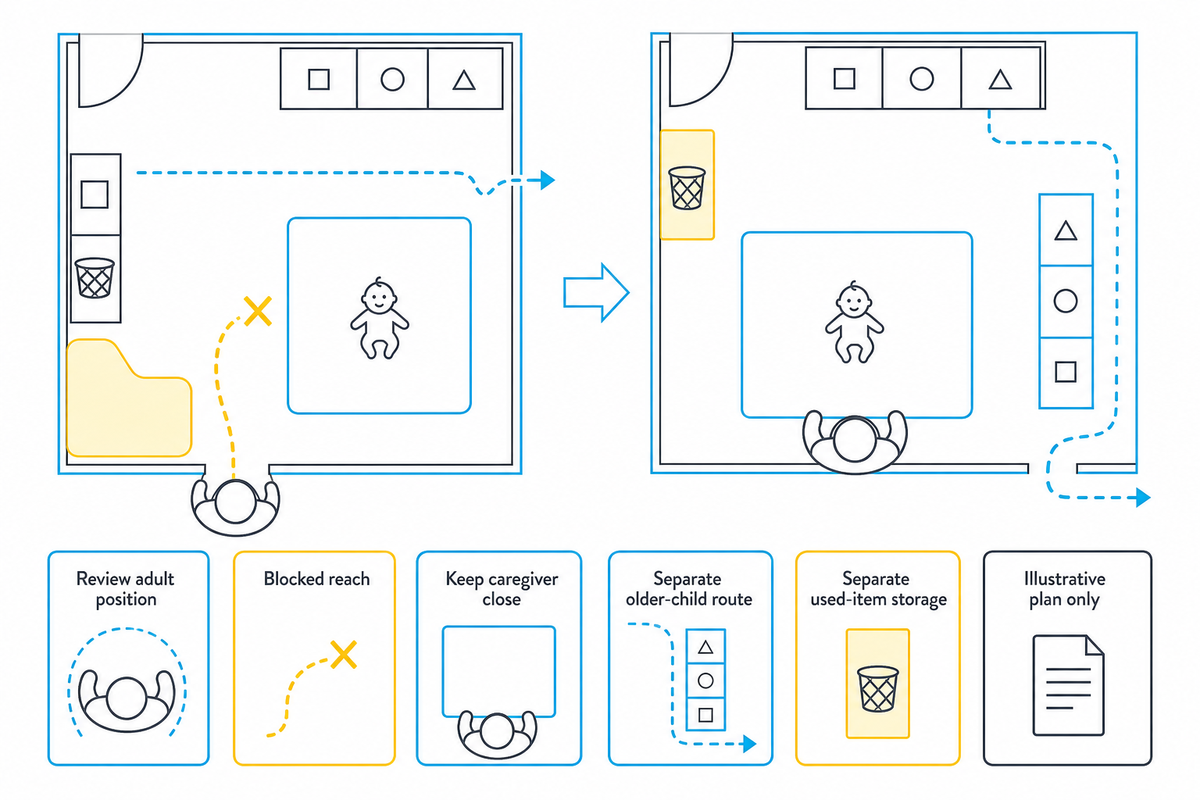
An infant play space should permit the adult in charge to see, reach and respond to the baby, without having to work around equipment. Position and move the adult first; then place only equipment the adult is able to manage; used equipment, and older-child activities should be placed outside the infant play area.
Active supervision suggests an adult is positioned where they can see the child and the environment can be quickly assessed. In a shared space, the proposed arrangement should be tested with the actual caregiver position, storage and cleaning handoff. A clear view of an infant from a doorway doesn’t indicate an adult is positioned where they can see and reach all infants.
Visualize a floor mat placed by an operator next to a preschool activity shelf. The sketch appears to show an open plan, but older children cross the edge of the mat to collect tools. The caregiver seated on the other side would need to go around a soft module to reach the infant. The plan shows how the older-child route is moved, the caregiver position is kept close, and loose items are stored elsewhere. Check the revised arrangement during normal arrival and departure times. This is an illustrative floor plan decision, not a report of Didi’s installation or a measured staffing model. Local operating and access requirements still need a separate review.
Use whole infant-zone layout planning for the broader floor, route, and opening acceptance brief. The content of this article focuses on what’s in this zone. Neither of the guides sets a particular staffing ratio, or implies a substitute for on-site professional judgment.
Procurement boundary
An open layout may leave reach or cleaning problems. Hold equipment selection until the placement of adults and material storage routes work together.
Handle Tummy Time Toys Without Turning Play Into Sleep
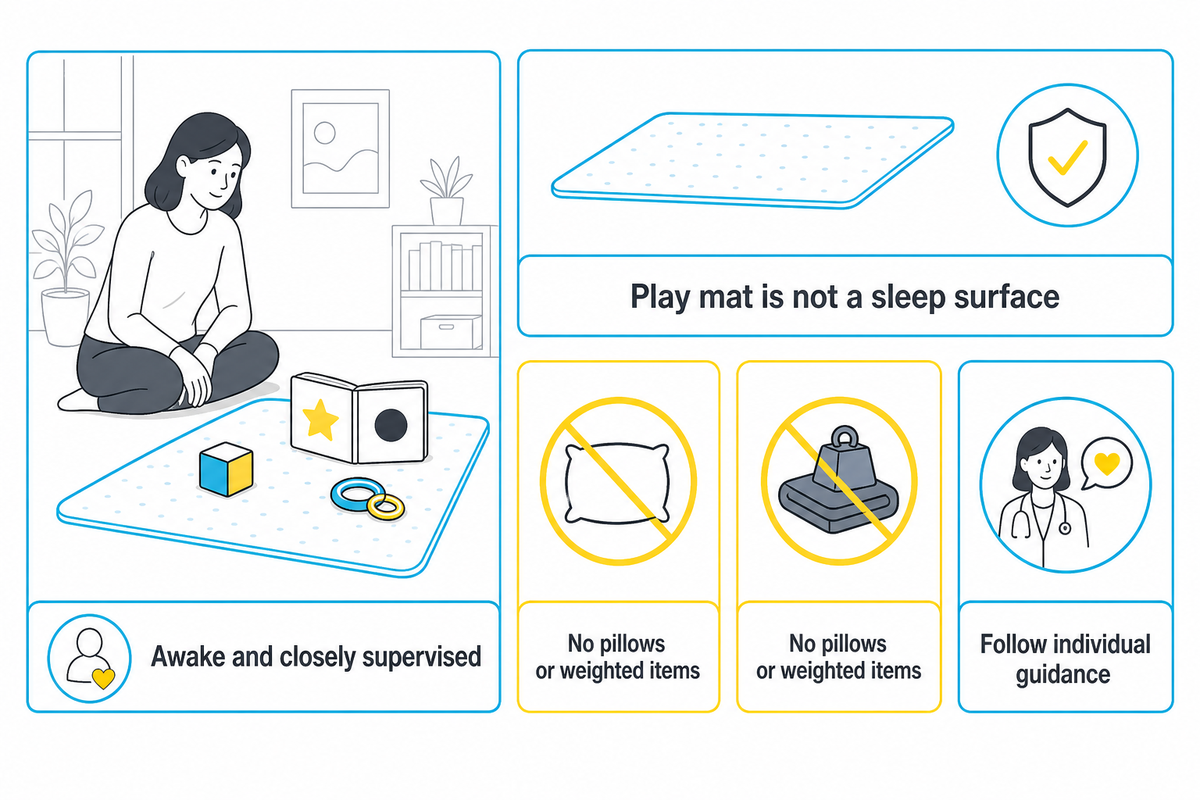
The play area is for adult-supervised, awake babies. The play mat isn’t a sleeping surface. Only suitable objects should be provided in the adult-managed play area, and each baby’s individual guidance should be followed. Treat sleeping as a separate activity with appropriate arrangements, while keeping the baby’s face and breathing space clear.
Awake, adult-supervised tummy time separates from the practice of sleeping on the back, as per AAP Back to Sleep, Tummy to Play guidance. Other appropriate items (e.g. a book, rattle) can be used to support interaction if their intended use fits. A pillow, weighted item or loose blanket should not be added to make a sensory session more elaborate.
Can you do too much sensory play with a newborn?
There are no prescribed session lengths in this guide. Instead, adults should pay attention to engagement and comfort levels. Tummy time has separate pediatric advice; an infant equipment page or general sensory-play routine should not be used as a substitute. Sensory stimulation shouldn’t leave the adult responsible for the stimulation unable to quickly respond to the infant.
If an infant has medical or developmental needs, ask the treating team about appropriate activities and positioning. The infant may need a break from sensory when they turn away, fuss or lose interest, rather than merely because other children are participating or transitioning. The venue should document who ends the session and handles the transition, rather than posting a daily sensory dose.
Sensory activities described as movement and balance aren’t a reason to introduce deep pressure activities, swinging or spinning for infants.
Clean Shared Sensory Materials Before Reuse
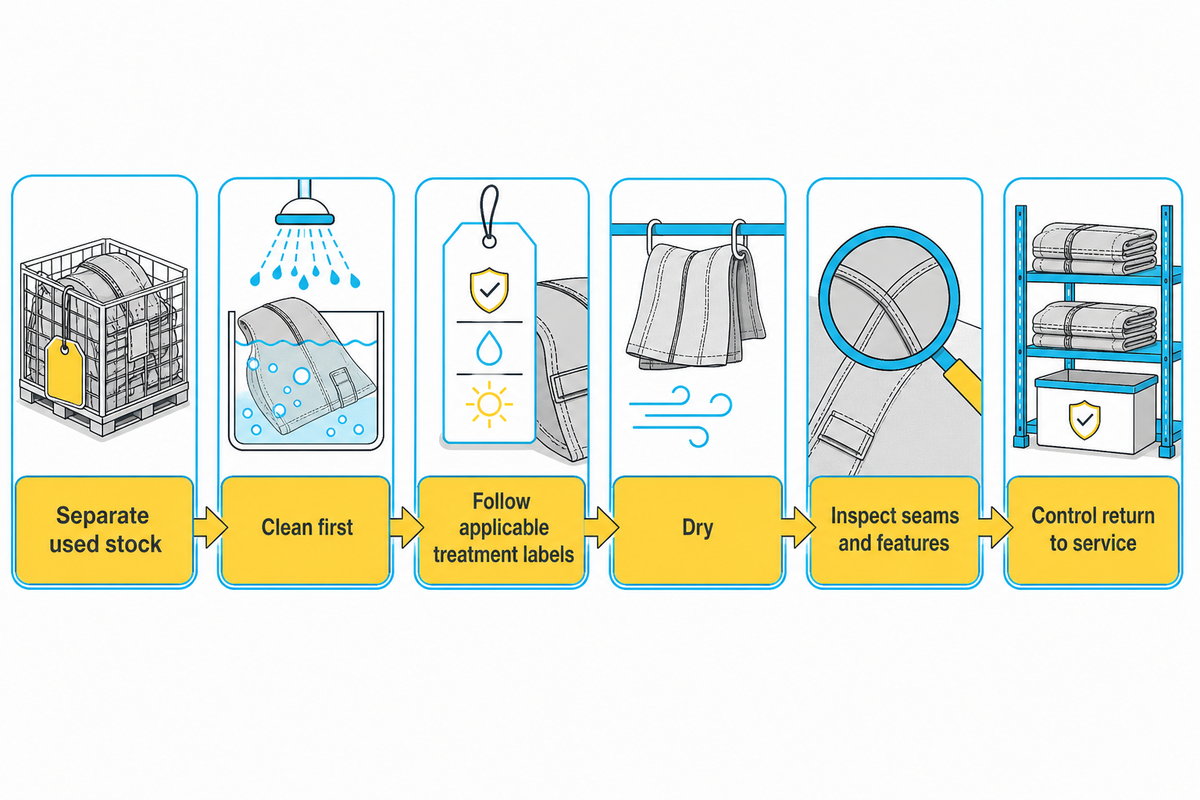
Clean shared play items before sanitizing or disinfecting them; follow the item’s manufacturer instructions and the instructions on the cleaning-product label. Keep used items separate from ready-to-use items until the applicable care process is complete; a quick wipe does not establish readiness.
CDC’s April 2024 early-care hygiene guidance distinguishes dirt removal from sanitizing and disinfecting. It includes toys among items infants and children use. Appropriate care depends on the material, its maker’s directions and the chemical or treatment selected. Contact time, rinsing and drying can’t be replaced by a universal upholstery recipe.
CDC’s official page recommends cleaning before sanitizing because cleaning removes dirt and germs; this care process addresses the risk of germ spread.
Suppose a staff member receives a mouthed fabric book as a new infant arrives. The book doesn’t return to the ready shelf after a quick surface wipe. Set the book aside in the used-item area. Check washing instructions, and follow care instructions to wash the book. Offer another clean and inspected book for the infant if suitable and available. Once the first book is dry, inspect seams and features before returning it to service. If there’s damage to a seam or a missing care label, don’t place the book back in service. Custody and care of items are linked decisions; however, this example does not claim a measured infection reduction or prescribe a chemical concentration.
When selecting an item, make sure staff can inspect and care for it reliably. If a cover cannot tolerate the required care process, use another documented item for that child or restrict its use rather than improvise. Link the item care process to the larger indoor-playground maintenance routine.
Release check
Ready stock means that items are clean, appropriately treated, dry and intact. A named person must control the return to service; a dry surface does not mean the process was performed.
Write a Material Brief Before Buying Baby Soft Play
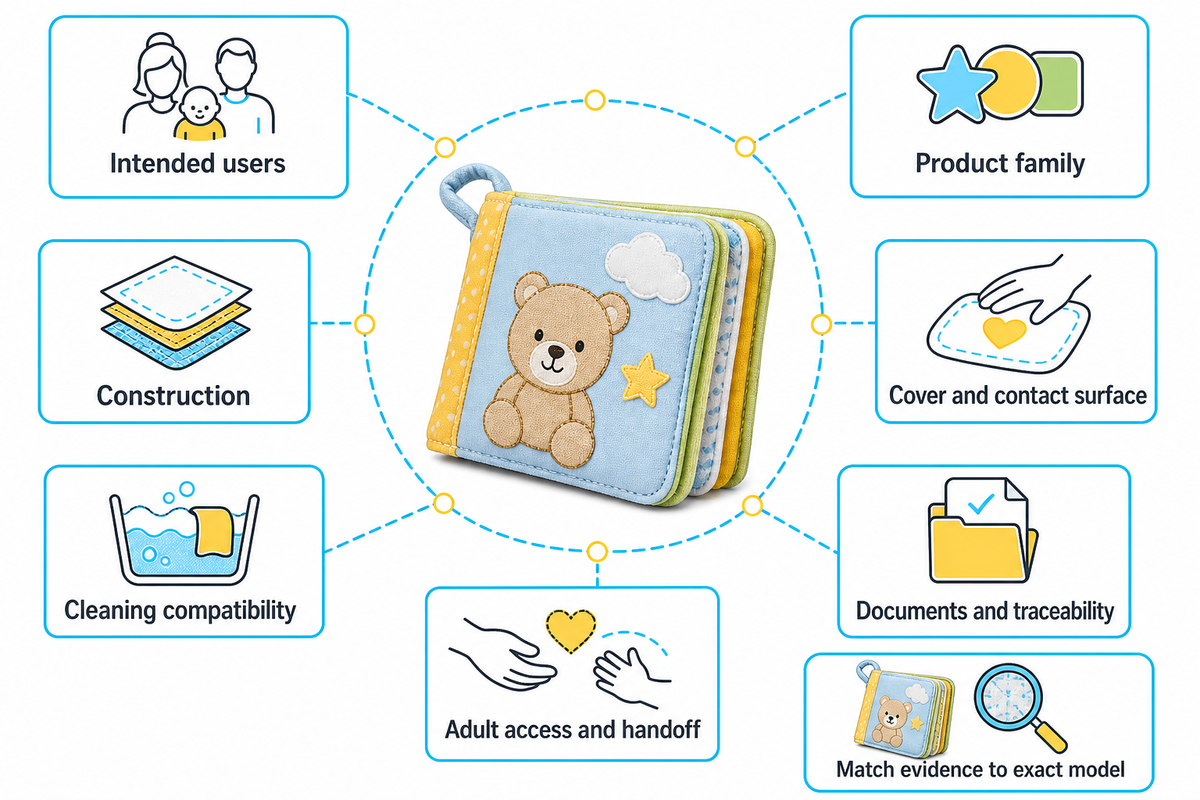
A baby soft-play brief should identify the exact product, intended users and intended use before comparing costs and certificates. Staff members should identify the applicable requirements for a product, then compare documents to the model that is being offered. Separate ordinary toys, public-use equipment, soft-contained equipment, and equipment meant to support an infant’s body.
ASTM F2373-24 covers specified public-use play equipment for children from 6 through 23 months; its public scope excludes soft-contained play equipment. That is the ASTM publisher’s public scope, not evidence that a supplier’s foam module complies.
ASTM F1918-21 addresses soft-contained play equipment for users aged 2 to 12 years; that scope does not establish suitability for infants. The public F1918-21 listing specifies the fifth-percentile two-year-old through the ninety-fifth-percentile twelve-year-old. Keep the product class and user range together.
CPSC’s guidance on infant support cushions raises another classification question. Qualifying products made after May 5, 2025 fall under 16 CFR part 1243. Design, marketing and intended body support matter, with stated exclusions. Not every flat mat or foam object would be classified because of its sales name.
| Use or product | Published scope / boundary | Buyer action | Limitations / Not suitable for |
|---|---|---|---|
| Ordinary caregiver interaction | No equipment standard certifies an interaction | Follow infant cues and any individual care plan | Marketed as clinical treatment |
| Hand-held baby toy | CPSC small-parts rules include under-3 products | Age label and applicable exact-model product evidence | One cylinder check called full approval |
| Fabric sensory book | Product family affects applicable rules | Secure construction, age suitability and washing | Small-parts exemptions called risk-free |
| Rattle | May have separate product requirements | Confirm product classification and applicable testing | Toy-category assumption without documents |
| Public-use play equipment | ASTM F2373-24: 6 through 23 months | Read publisher scope and exact product evidence | Soft-contained equipment falls outside that scope |
| Soft-contained play equipment | ASTM F1918-21: 2 to 12 years, stated percentiles | Compare intended users with publisher scope | That range offered as infant approval |
| Infant support cushion | 16 CFR part 1243; qualifying intended body support | Manufacturer/importer classification and documents | All foam automatically treated as one category |
| Plain floor play mat | Classification follows design, marketing and use | Review actual product, rather than its sales name | Cushion/sleep suitability inferred from flatness |
| Water-bead toy | New manufacture requirements after March 12, 2026 | Record scope; exclude from this infant material brief | Rule compliance treated as infant activity approval |
Scope matrix: original synthesis of the linked CPSC guidance and ASTM public listings, checked October 2026. Numerical ranges are attributed public-scope facts from single publisher sources, not product acceptance values or a complete compliance checklist.
Engineering note: verify the category first
There are no set rules for foam thickness, hardness, permissible gaps, or staff ratio here. Requests for applicable, exact-model testing and construction details should be made. A hand-pressure test or an ASTM number should not be accepted in lieu of applicable exact-model evidence.
When not to buy a ready-made infant sensory kit
Hold the purchase if the seller cannot identify the contents, intended age, instructions or care method. An appealing “easy sensory play” bundle can include toys, crafts and tools for older children. Larger parts can still contain small, hidden hazards in filling, cords or closures. It’s important to request an itemized list, instead of accepting a broad safety claim.
A certificate without model identity, test scope and applicable intended use leaves numerous questions. This same rule is true for replacement covers or modules. Similar appearance does not show that the evidence covers the changed construction.
Copy these questions when requesting from a supplier. Compare the described models for the ‘soft play’ equipment to the ‘play equipment buyer’s checklist’.
| Parameter | Recommended range | Why it matters | How to verify |
|---|---|---|---|
| Intended users | State ages and observed abilities; no generic infant range | Prevents mixed-age assumptions | Model instructions and explicit intended-use statement |
| Product family | Identify toy, mat, module or qualifying support cushion | Rules depend on use and construction | Written classification and applicable requirements |
| Construction | No accessible loose fill or detachable hazards | Infants explore with their mouths | Exact-model testing and routine inspection instructions |
| Cover and contact surface | Record actual materials and seams; no universal thickness supplied | A cover failure changes exposure | Material specification and construction documentation |
| Cleaning compatibility | Use maker-approved methods and product-label directions | A damaged cover or wet item should not return to play | Care sheet, chemical compatibility and drying procedure |
| Documents and traceability | Match model, manufacturer and production identity | A generic certificate may concern another product | Applicable test reports/certificates and identifiers |
| Adult access and handoff | Keep infant visible/reachable; define used-item custody | Layout and operations affect exposure | Floor-plan review and written staff procedure |
Didi Land’s company profile describes design, manufacturing, logistics, installation and after-sales. Use this context to brief them precisely. The profile doesn’t show a clinical credential, approve the product for infants, or provide a certificate for the product in question.
What the 2026 Water-Bead Rules Mean for Infant Play
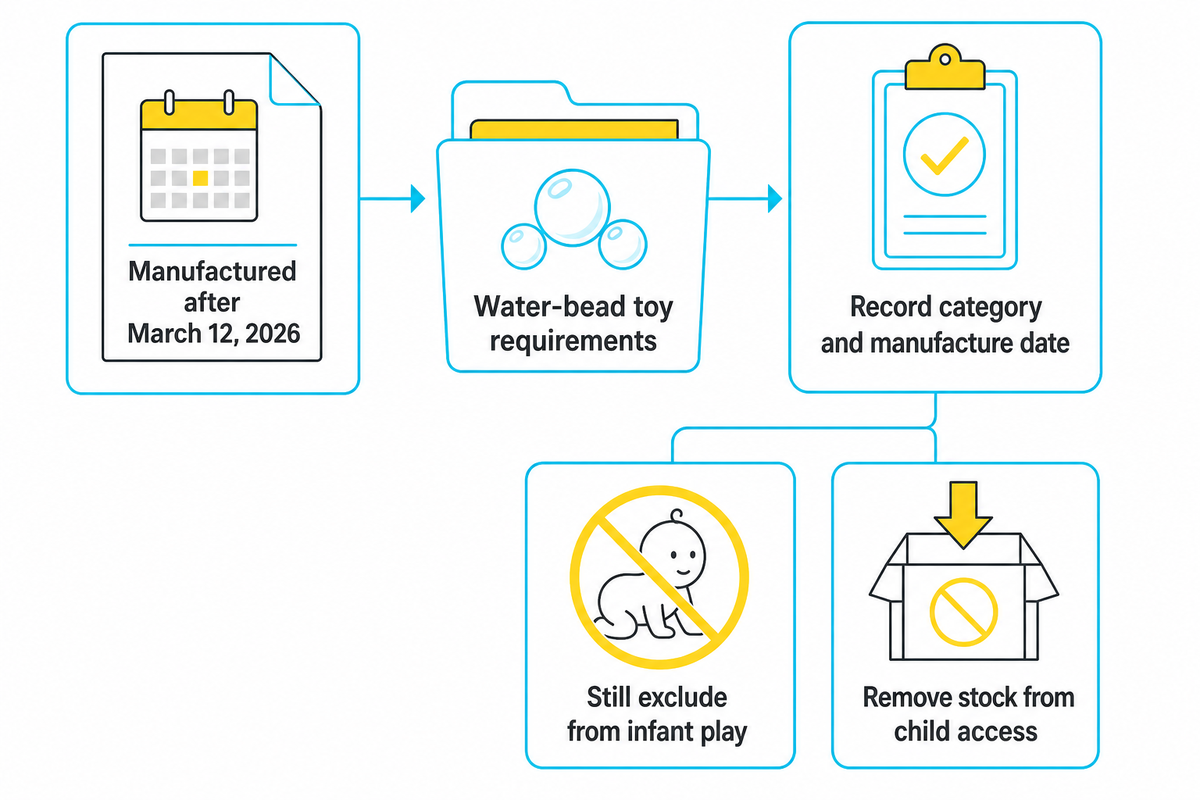
The 2026 federal product standard changes water-bead product requirements, but this infant material brief still excludes water beads. The new standard doesn’t turn a hazardous activity into an infant recommendation. Keep scope, date of production and continuing consumer advice together when reviewing a supplier’s claims, or replacing existing stock.
The new U.S. requirements for water-bead toys apply to products manufactured after March 12, 2026. As per the March 2026 CPSC standard release, requirements include expansion size, limits on acrylamide, warnings and testing. Water beads that are not marketed as children’s toys may fall outside the requirements; however, that does not make them appropriate in child spaces.
When recording product information, the purchasing team should identify the product category and manufacture information, and ensure water beads are not listed as infant items. The new rule shouldn’t re-open a previously rejected homemade bottle or bag. Remove any remaining stock from areas where infants may come in contact with it, including neighboring activity storage areas.
Innovation requires a specific use case and supporting evidence. The new coating or sealed container, for example, doesn’t mean the item is suitable for infants. Avoid market forecasts, especially when making a case to not screen a material. The positive forecast doesn’t indicate that a product is appropriate for infants, and that product can’t be concluded to be safe for infants.
For sensory activities for babies, the better sensory play may be the simpler one. Adult interaction and a suitable, intact object may be fun and engaging without inviting infants into a toddler sensory messy activity with loose ingredients. Older children may participate in imaginative play and cause and effect activities that may be fun and engaging, but any messy activity needs its own age and material brief.
Review procurement sheets and staff instructions during a 2026 update. Replace “sensory-safe” marketing shorthand with the actual intended-use limits, care procedure and responsible handoff. In this way, you provide the buyer with an actionable decision without informing them that the regulation endorses a complete venue.
Frequently Asked Questions
What is sensory play for babies?
Sensory play for babies is responsive exploration through experiences such as touch, sight and sound, with a caregiver observing the baby’s response and adjusting age-appropriate interaction accordingly.
Sensory play for babies is responsive exploration through experiences such as touch, sight and sound. An adult’s face and voice, or a suitable intact baby book, can be enough. Equipment is optional, and a busy environment isn’t a goal. Choose age-appropriate interactions, watch the baby’s response and simplify or stop when engagement changes. Ordinary play doesn’t diagnose a sensory condition or replace a clinical care plan.
What are some sensory activities for babies?
Simple sensory activities for babies include caregiver talking or singing and exploring an intact, age-appropriate object, with the adult watching and able to reach the baby throughout awake floor play.
Sensory activities include a caregiver talking or singing to the baby and exploring an intact, age-appropriate object together. Check the object’s instructions and the baby’s abilities before the baby uses it. Keep close supervision when an awake baby is doing floor play. Activities may use a secure, appropriate object, and a caregiver should be able to see and reach the baby at all times. Different textures should be offered only within an intact, age-appropriate object. Water beads and poorly documented homemade containers should also be removed. Activities designed for older children need a separate review.
What are some ideas for sensory play with newborns?
Newborn sensory play can begin with a familiar caregiver’s face and quiet voice, using one simple interaction at a time while observing comfort and engagement rather than following a fixed activity schedule.
Newborn sensory play can begin with a familiar caregiver’s face and quiet voice. You don’t need any special sensory bins. Offer one simple interaction at a time, and keep the baby comfortable. Observe the little one’s engagement, rather than sticking to a schedule. If you’re introducing an object, confirm it’s age-appropriate, intact, and has instructions. Premature babies and infants with special medical needs, in particular, need individualized guidance from their treating team rather than using an online, generalized activity schedule.
Do babies under 6 months need a sensory bin?
Babies under 6 months do not need a special sensory bin, because caregiver interaction and an appropriate intact object can offer exploration without introducing loose fillers into the infant play area.
Sensory play for infants under 6 months does not need a special sensory bin. A caregiver’s face and voice along with a suitable intact object and an uncluttered space can provide sensory experiences without loose fillers.
What’s the difference between sensory play and tummy time?
Sensory play describes exploration through the senses; tummy time is an awake, closely supervised activity with its own pediatric guidance, and a sensory play mat is not an appropriate sleep surface.
Sensory play describes exploration through the senses; tummy time is an awake activity that’s closely supervised. The sensory mat isn’t an appropriate surface for sleep.
How long should a sensory play session be for a 0-6 month old?
Sensory play has no universal session length in this material-selection guide, so caregivers should observe the baby’s comfort and response and follow individualized clinical advice when medical or developmental needs apply.
No session length is prescribed for sensory play in this material-selection guide. The guide does not promise a developmental benefit; engage the baby and use their comfort level rather than a timer to guide the activity. Turning away, fussing or losing interest may mean that a break or simpler activity is needed. You do not need to cycle through every sense or finish the activity. Tummy time has separate pediatric guidance, and general sensory play is not a substitute for it. Play must be closely supervised and may not be done while baby is sleeping. Separate sleeping arrangements must be provided. Medical and/or developmental concerns should be addressed by the infant’s treating team. In a shared care or service environment, document who ends the session, who removes the used materials and who handles the handoff. This provides team members a defined task without announcing a daily dose of sensory.
Send a material brief before choosing equipment
Initially, address the proposed age range, use, and access of the adults. Also address the cleaning process. Ask Didi Land to identify potential products and provide exact-model documentation for review.
References & Sources
- Head Start: young-infant safety and materials
- Head Start: young-infant home-visitor developmental guide
- AAP: How to Buy Safe Toys
- AAP: How to Keep Your Sleeping Baby Safe
- AAP: Back to Sleep, Tummy to Play
- Cochrane 2026 preterm multisensory-stimulation review: public abstract
- CPSC: Small Parts for Toys and Children’s Products
- CPSC: Water Beads Information Center
- CDC: How to Clean and Disinfect Early Care and Education Settings
- ASTM F2373-24: public scope
- ASTM F1918-21: public scope
- CPSC: Infant Support Cushions Business Guidance
- CPSC: March 2026 Water Beads Safety Standard release
Public sources checked October 2026. The material screen and illustrative scenarios are editorial synthesis. No first-hand infant testing, clinical credential or Didi Land product certification is claimed. Standard summaries use public scope pages.

![Custom Dinosaur Playground Equipment [Design Guide]](https://didiplayarea.com/wp-content/uploads/2026/09/custom-dinosaur-playground-equipment-r2-featured-1-150x150.png)

![Sensory Play for Infants: Safe Materials [Guide]](https://didiplayarea.com/wp-content/uploads/2026/10/sensory-play-for-infants-featured-150x150.png)