Get in Touch with Didi Land


Updated July 2026.
Commercial indoor playground equipment is play structure equipment designed and certified for continuous, heavy traffic public use indoors- not the same product set offered for private backyard or living room use for one family. ASTM International’s own definition of public-use (ASTM F1487-25, June 2025) describes this equipment as made for play areas of schools, parks, child-care centers, institutions and multi-family dwellings.
That distinction- commercial/public use versus private/residential use- is what sets apart a different tier of certification, material requirements and liability exposures for the buyer. Guangzhou Didi Land Amusement Equipment Co., Ltd. makes its commercial category equipment atop a six-standard compliance stack- ASTM F1487-25, ASTM F1918, EN 1176-1, IPEMA, CPSIA and GS-EN1176- what has proven to work in the field after 600+ installations and in 40+ countries since 2014. It’s the framework we used to understand what “commercial-grade” actually means in the current export market, what fall under that category, what puts it in that category and how to identify reliable commercial-grade vendors in the future.
Quick Specs
| Category | Public-use / commercial indoor play equipment (ASTM F1487-25 scope) |
| Core certifications | ASTM F1487, ASTM F1918, EN 1176-1, IPEMA, CPSIA 16 CFR 1307 |
| Typical frame steel gauge | 14-18 gauge tubing (cross-referenced across 4 independent suppliers) |
| Ceiling clearance | 10-12 ft general structures; 14-16 ft where slides are included |
| Typical lifespan | 15-20+ years for steel structures; shorter for foam-based soft play |
What Is Commercial Indoor Playground Equipment?
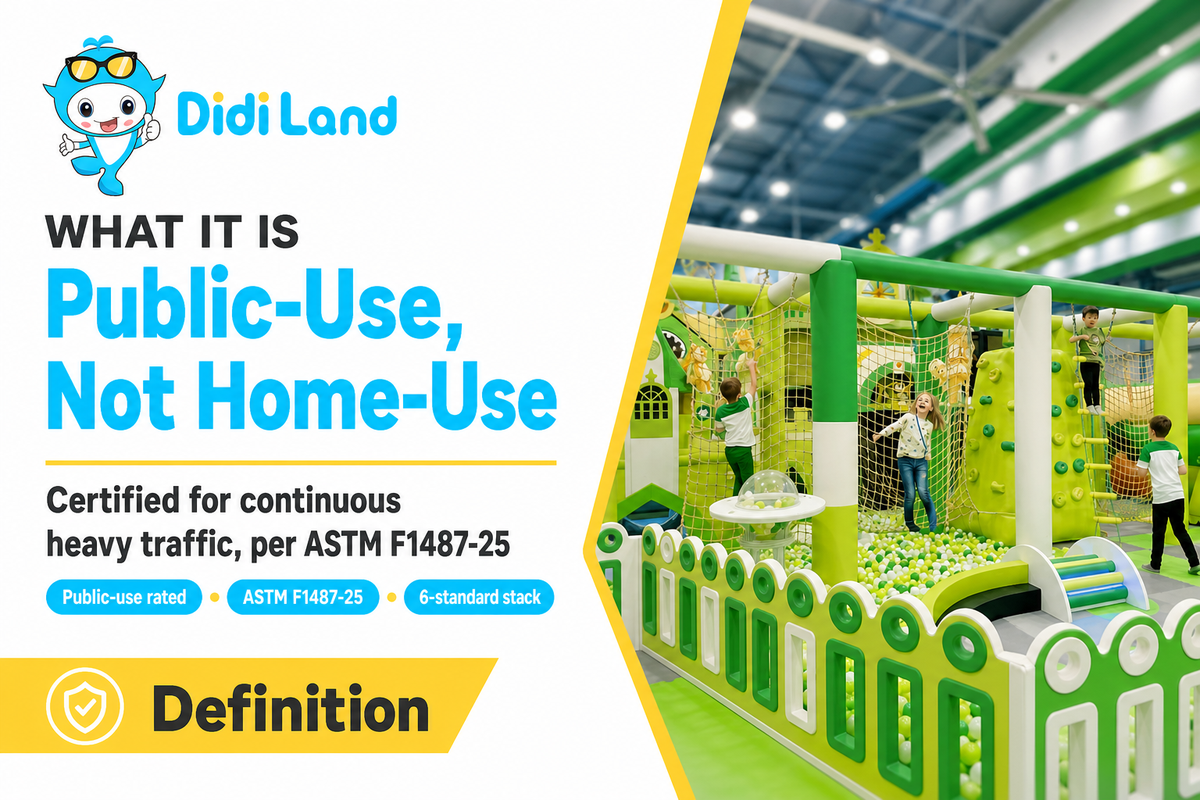
The plain-language version: its play equipment designed and tested to support dozens of children every day, year after year- under a regime of testing that considers public liability, not quick sedate playset home performance. That’s the difference between a $20,000-plus commercial soft play structure and a $300 backyard climbing set shot from a photo.
Malls, family entertainment centers, kindergartens, daycares and hotels know them under this same commercial definition, even when they’re multi-tiered and multi-format. The CPSC’s own Public Playground Safety Handbook draws this exact line between public-use and home-use equipment, and that distinction- not the price tag alone- is what a liability insurer checks first.
Commercial equipment is also a, by definition, a modular category not one product. A single indoor footprint often combines climbers, ball pits, trampoline modules, obstacle courses, slides and soft play sets- each with their own certification needs- in one footprint, to use Section 3 below. A proposal for indoor play structures from Toplay should likewise identify each included play category and the project-specific documentation, rather than treating a mixed venue as one undifferentiated product.
The risk that trips up first-time buyers: a vendor quote that lists “commercial indoor play area equipment” (sometimes called industrial playground equipment in supplier catalogs) without breaking out which certification applies to which module inside that footprint. An operator who signs off on a single blanket “ASTM certified” line item, only to find during an insurance walkthrough that the ball pit and the climbing structure needed two different standards, has bought the label but not the paperwork behind it- a gap in the records, not a gap in equipment quality. Didi Land engineers to this exact distinction, because after 600+ installations across 40+ countries, a missing certificate is the single most common finding in a post-install audit- in practice, this is the application detail that separates a compliant install from an uninsurable one.
Commercial vs. Residential Indoor Playground Equipment: What’s Actually Different
What is the difference between home indoor play equipment and commercial indoor play equipment?
View Answer
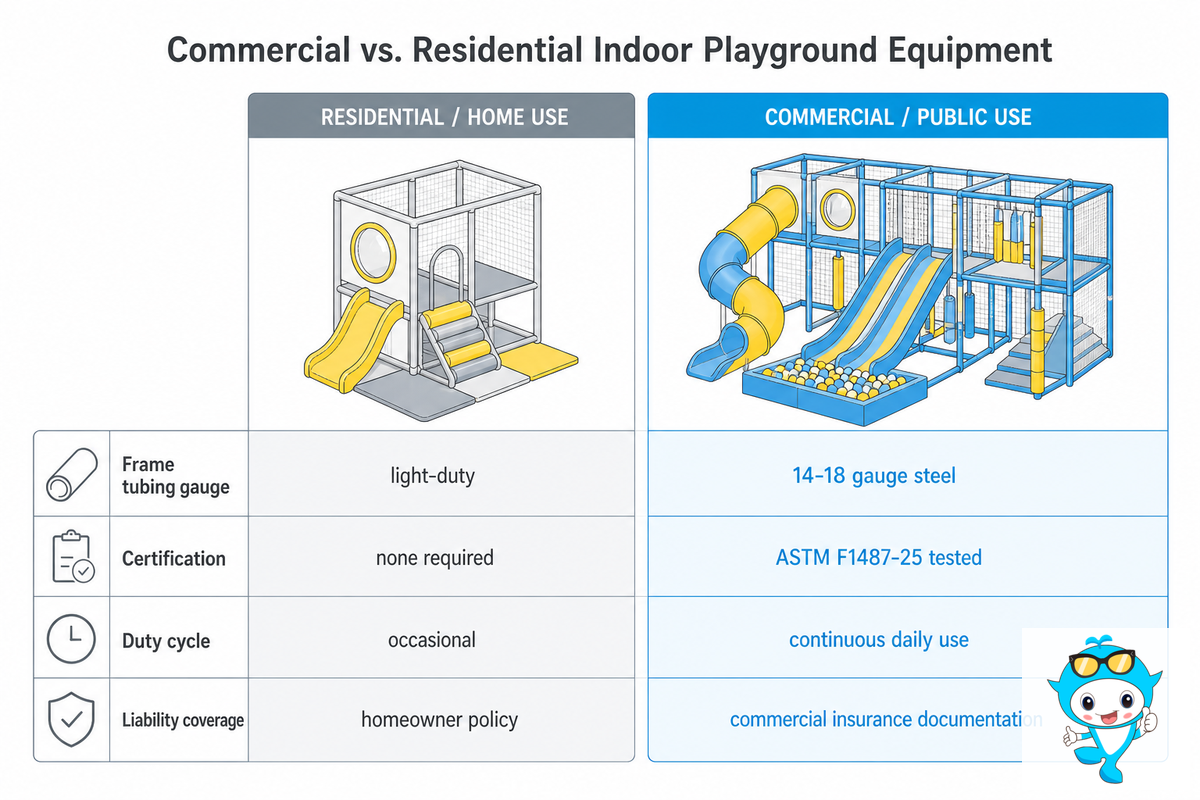
The key difference is not looks- it is in the certification stack, its duty-cycle spec and the material grade behind the product. Home indoor play equipment is intended for occasional use by one or two children and is normally rated and tested to consumer toy standards (ASTM F963) if it is tested at all, per the CPSC’s own mandatory standards list. commercial playground equipment – including any indoor play structure sold into a public space- is designed and certified (ASTM F1487, ASTM F1918, EN 1176-1, IPEMA) for continuous, day-in/day-out multi-child use, and it has a paper trail- test reports, compliance certificates, insurance-ready documents-that home equipment simply does not.
That test gap become clear in tangible, verifyable evidence:
| Dimension | Commercial-Grade | Home/Residential-Grade |
|---|---|---|
| Primary certification | ASTM F1487 / F1918, EN 1176-1 | Often ASTM F963 (toy standard) or untested |
| Third-party cert body | IPEMA-certified independent lab test | Rarely third-party tested |
| Frame steel gauge | 14-18 gauge tubing | Lighter gauge or non-steel frame |
| Soft play ceiling clearance | 8-10 ft minimum | Varies, no minimum spec |
| Duty-cycle rating | Continuous, multi-child, all-day | Intermittent, 1-2 children |
| Typical lifespan | 15-20+ years (steel structures) | 2-5 years typical |
| Warranty structure | Structural warranty + documented terms | Limited or none |
| Insurance/liability documentation | Required by most commercial insurers | Not applicable |
| Typical buyer | Mall, FEC, kindergarten, hotel operator | Individual household |
⚠️ Important
An Outdoor “Heavy Duty” rating does not always carry over to indoor commercial certification. Indoor commercial standards are for foam density, sanitation-surface requirements and continuous indoor-traffic load. Outdoor “heavy-duty” is for weatherproofing and UV exposure, completely different certification pathways, and a vendor quoting “heavy duty” with no reference to ASTM F1487/F1918 or IPEMA has no idea what is even being referenced.
Types of Commercial Indoor Playground Equipment
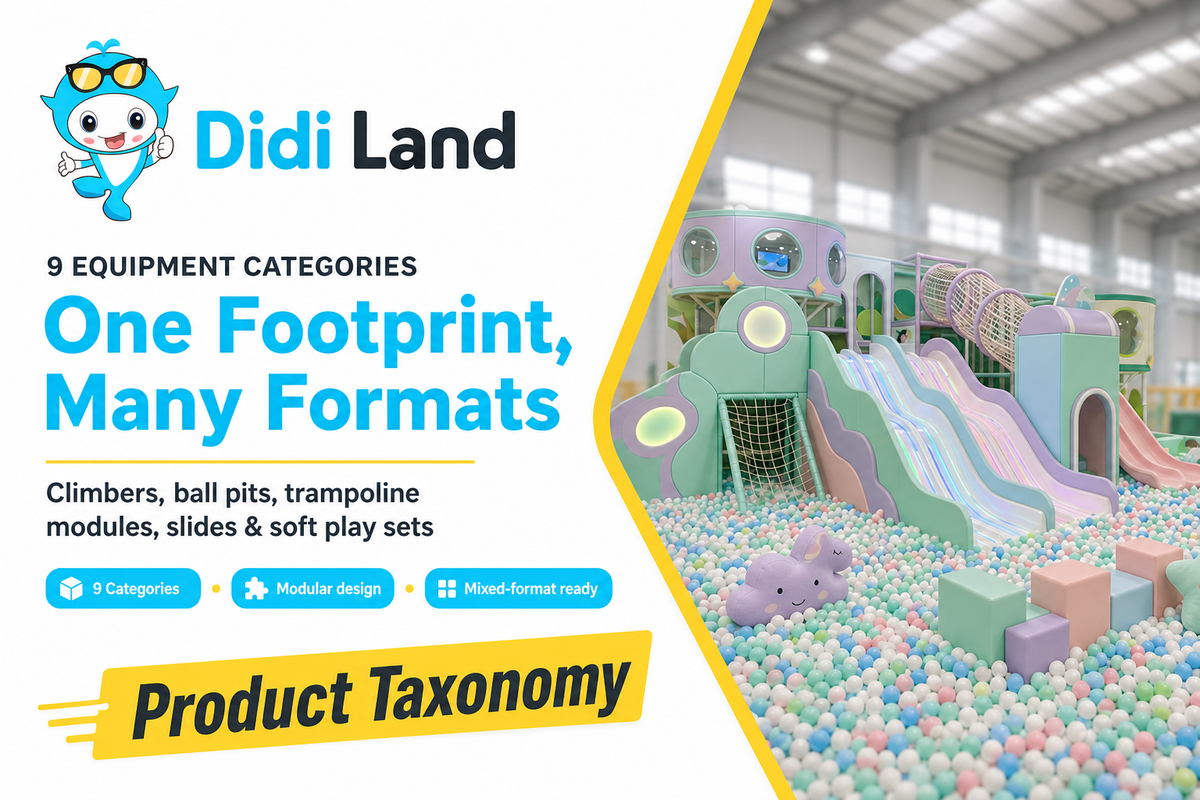
What is indoor play equipment and what age range is it designed for?
Show Answer
Indoor play equipment are in the modular category, and age range is more about sub-category:Soft play sets and sensory elements typically have a age range from toddler-through-early-childhood,or six months to six years; Steel-framed climbing structures, obstacle courses, and trampoline units typically range from age 2 to 12. Many indoor venues will accommodate both age bands in the same floor space and try not to limit age bands with specific product selections.
| Type | Typical Age Range | Primary Certification |
|---|---|---|
| Soft play sets | 6 mo-6 yr | ASTM F1918 |
| Ball pits | 6 mo-8 yr | ASTM F1918, CPSIA |
| Trampoline modules | 4-14 yr | ASTM F2970 |
| Indoor jungle gym / climbing structures | 2-12 yr | ASTM F1487, EN 1176-1 |
| Slides | 2-12 yr | ASTM F1487 (incl. F1487-25 enclosed-slide clause) |
| Obstacle / ninja courses | 5-14 yr | ASTM F1487, F1292 (surfacing) |
| Themed play structures | 2-12 yr | ASTM F1487, F1918 (mixed elements) |
| Sensory / inclusive elements | All ages | ASTM F1487, ADA-informed design |
| Interactive / gamified attractions | 4-14 yr | ASTM F1487 (structural base) |
A common mistake at this stage is buying by theme first and category second. Consider a hotel lobby operator who falls in love with a themed climbing tower, then discovers it needs the same F1487 structural clearance as a full mall installation and ends up redesigning the footprint mid-project. Confirm the category and its certification before the theme is chosen, not after. Didi Land resolves this risk by mapping every themed build against one of these 9 categories first, because the certification requirement is set by category, not by the theme wrapped around it- a distinction confirmed across 40+ countries of export compliance.
What Makes Equipment “Commercial-Grade”? Materials & Durability Engineering
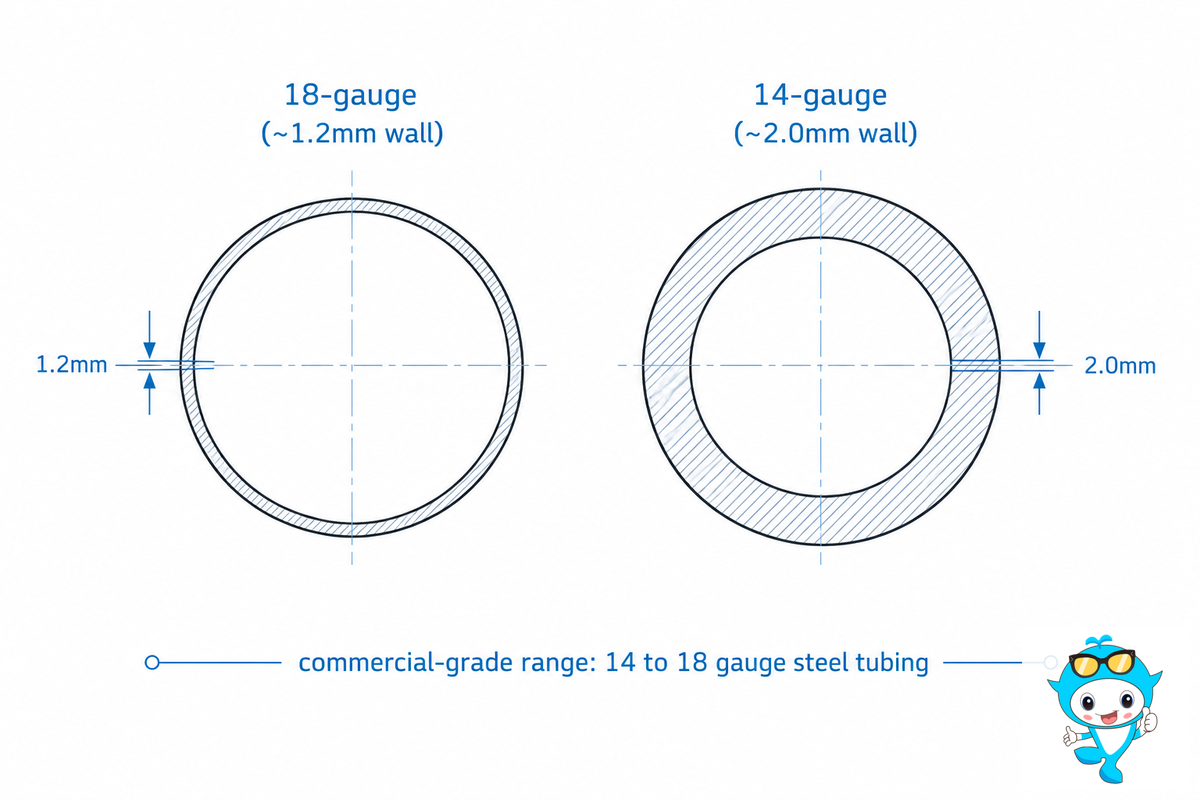
Most commercial frames have an industry-accepted tubing range from 14- to 18-gauge steel tubing that is documented with numerous tubing manufacturers and industry sourcing guide. Heavy duty outdoors rating typically does not certify a product under the ASTM standards, since this tubing gauge and wall thickness are what’s actually required for repeated, constant loads without joints that deform, crack or fail.
The key here is to ask the vendor for tube gauge and wall thickness specification, not for a marketing “heavy-duty” claim, as a lighter 18-gauge tube (roughly 1.2mm) and a heavier 14-gauge tube (roughly 2.0mm) vary in wall thickness by almost double.
📐 Engineering Note
Independent tubing manufacturers document commercial playground frame tubing from 1.2 to 2.0mm (.047 to .079 inch) wall thickness, which have a minimum yield strength around 50 ksi and tensile strength around 55 ksi. In some instances, a tubing manufacturer has referenced the heavier .188 inch (4.8mm) wall tubing(roughly 7- gauge)as the ” heavy-duty” option in exercise and fitness tubing, which gives a reasonable marker as an over or under quoted price based on that.
Soft play components rely on a second material system entirely: high-density EVA or PU foamcore surrounded by antibacterial, wipeable vinyl skins. Unlike steel tubing, which uses gauge as its measure of commercial duty, soft play material specifications use foam density and the flame retardancy of the vinyl cover (which must meet NFPA 701 on the fabric itself), as soft play requires constant sanitization. Request that the vendor supply a soft play foam density specification sheet- “high density foam” doesn’t cut it, and confirm the vinyl skin meets the CPSC’s lead and phthalate limits before it ships.
Certifications & Safety Standards That Qualify Equipment as “Commercial”
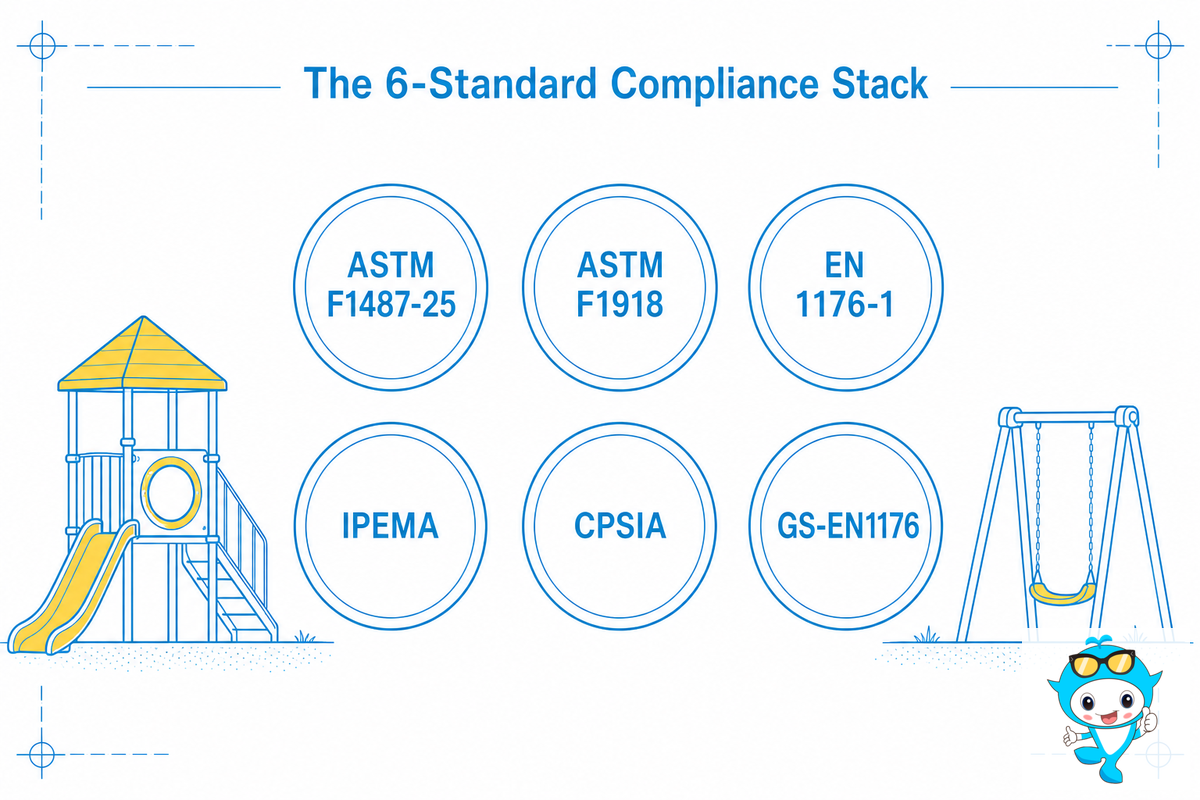
Simply naming an ASTM standard is not a certification; that must be achieved through an accredited test laboratory. As of June 2025,ASTM’s subcommittee F15.29 released ASTM F1487-25, which includes, for the first time, a formal definition and additional requirements for “fully enclosed structures” and for fully enclosed tube slides. That standard will be of much greater consequence for indoor facilities than outdoor, where play structure are rarely completely enclosed. A vendor that continues to reference ASTM F1487-21 and does not mention the fully-enclosed structure requirement has not kept pace with the most current standard.
- ASTM F1487-25 – a standard for public-use / structural play equipment. Make sure your supplier lists the -25 version, not an older one.
- ASTM F1918 – standard for soft-contained play equipment (ball pits, foam play structures).
- EN 1176-1 – the required certification for equipment to be exported into the EU.
- IPEMA third-party certification – means an outside, independent lab (not the manufacturer) has tested the equipment and certified it meets the relevant ASTM standard.
- CPSIA 16 CFR Part 1307 – US consumer safety rule on the limits of lead and phthalates in plastic or vinyl items, enforced by the U.S. Consumer Product Safety Commission (CPSC).
- CSA Z614 – the Canadian equivalent standard for public-use / structural equipment, necessary for Canada-bound gear.
We’re deliberately sticking to the differences that define commercial-grade play equipment versus consumer-grade equipment here-not how to choose the best certification standard for your target country (e.g. AS 4685 vs. EN 1176 vs. ASTM F1487); we’ve covered that elsewhere in our playground safety standards comparison guide.
How to Verify a Supplier’s Commercial-Grade Claims
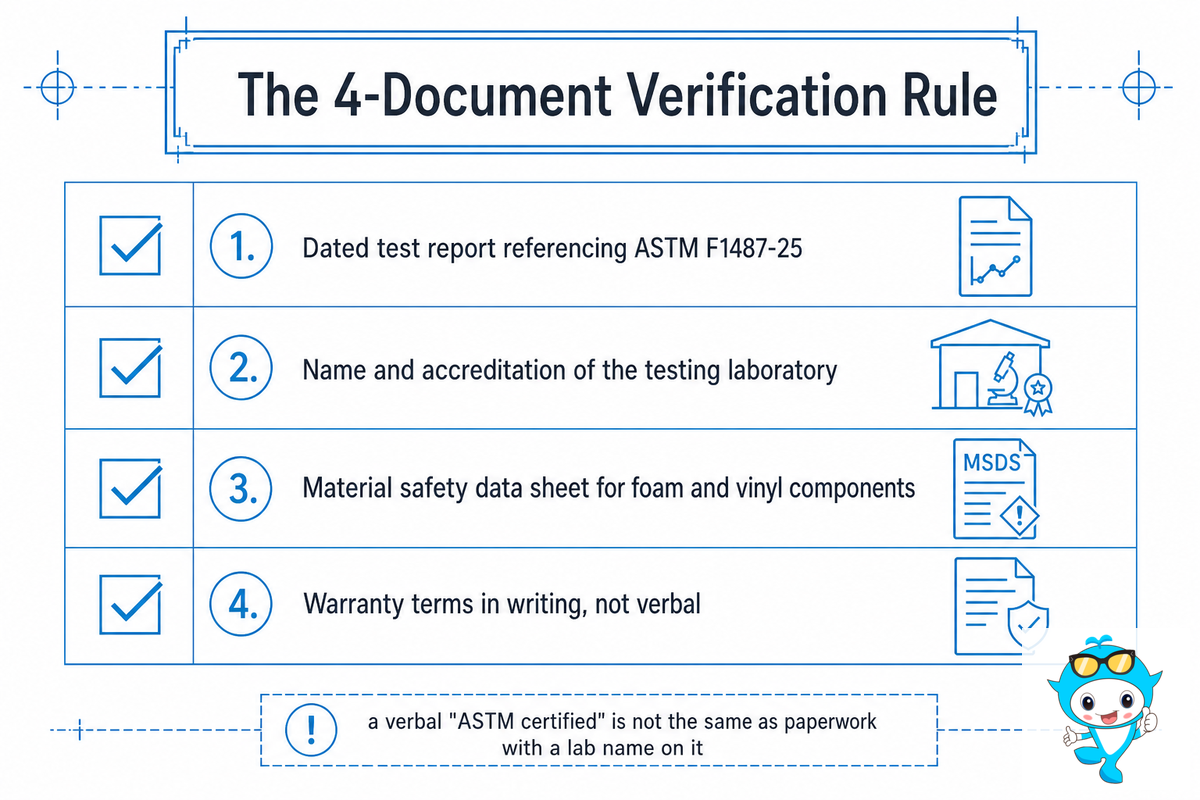
The Sturdy-Looking Trap: even a product that appears structurally over-engineered in photos can have issues on paper because critical features-tube gauge, foam density, certification date, and the name of the testing laboratory-are never shown in a photograph. One industry supplier states, “A common mistake for new buyers is getting a quote with the correct safety standards but no documented playground certification.”
We ensure that we don’t make this mistake by following what we call the 4-Document Verification Rule before we agree to sign:
- An IPEMA or third-party lab certificate identifying the certifying body (not just “ASTM certified”).
- Confirmation of the ASTM F1487 version on the certificate (F1487-25 vs. a prior edition).
- A spec sheet with the tube gauge and foam density clearly indicated-a “heavy duty” claim isn’t enough.
- A readily insurable records package suitable for filing by your carrier (most commercial insurers require documentation of compliance with ASTM F1487 and CPSC Public Playground Safety Handbook standards to issue coverage).
For our in-depth process covering mill certifications, hidden costs, and factory red flags-see our indoor playground equipment buyer’s spec-audit guide.
“We ask every commercial buyer the same question before we quote: what does your insurer actually require on file? Most operators find out the hard way, after a claim, that a verbal ‘ASTM certified’ from a vendor is not the same thing as a dated F1487-25 test report with the lab’s name on it. We build the documentation package before the equipment ships, not after someone asks for it.”
– Didi Land Engineering Team, Guangzhou compliance review
Commercial Equipment Needs Vary by Venue, Where to Go Next
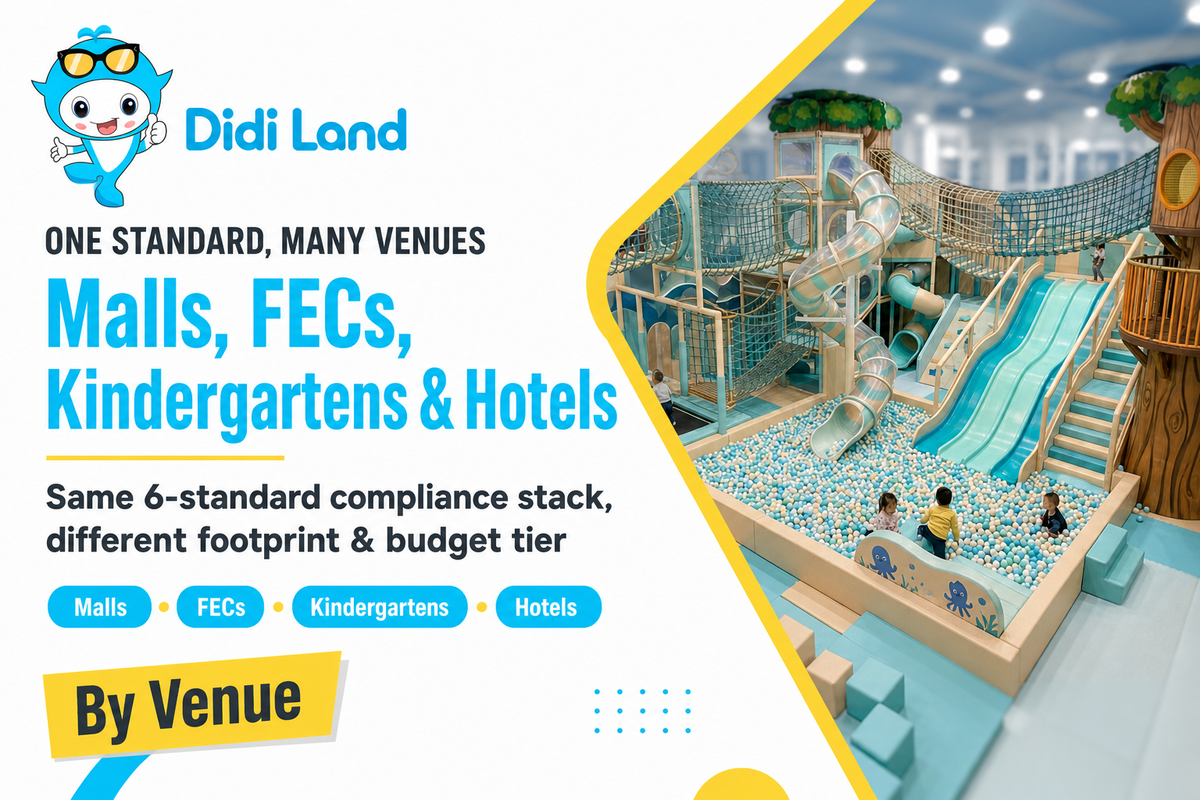
The above certifications and material grading apply universally regardless of the specific venue or usage (e.g., a shopping mall, a family entertainment center, a preschool or hotel lobby). However, venue type influences space requirements, upfront cost, and compliance prioritization-for instance, an 800-child-capacity space in a mall requires different considerations than a 30 m² classroom installation-and custom manufacturing lead times can range from 28 to 112 days depending on complexity. Put simply, a kindergarten director and a mall leasing manager asking for “commercial indoor playground equipment” are describing two very different capex tiers and compliance packages, even though the underlying certification stack is identical- a mismatch that shows up most often when a buyer reuses a mall-scale quote template for a 30 m² classroom install and pays for capacity they will never need. Didi Land resolves this in the design brief because the same six-standard compliance stack applies across all venue applications- in practice, the difference is in footprint and budget tier, not in the certification risk. Learn more about space considerations, cost ranges,ROI windows, and regulatory stacks by venue in our guide to commercial indoor playground equipment by industry.
New vs. Used/Refurbished Commercial Equipment: What to Know
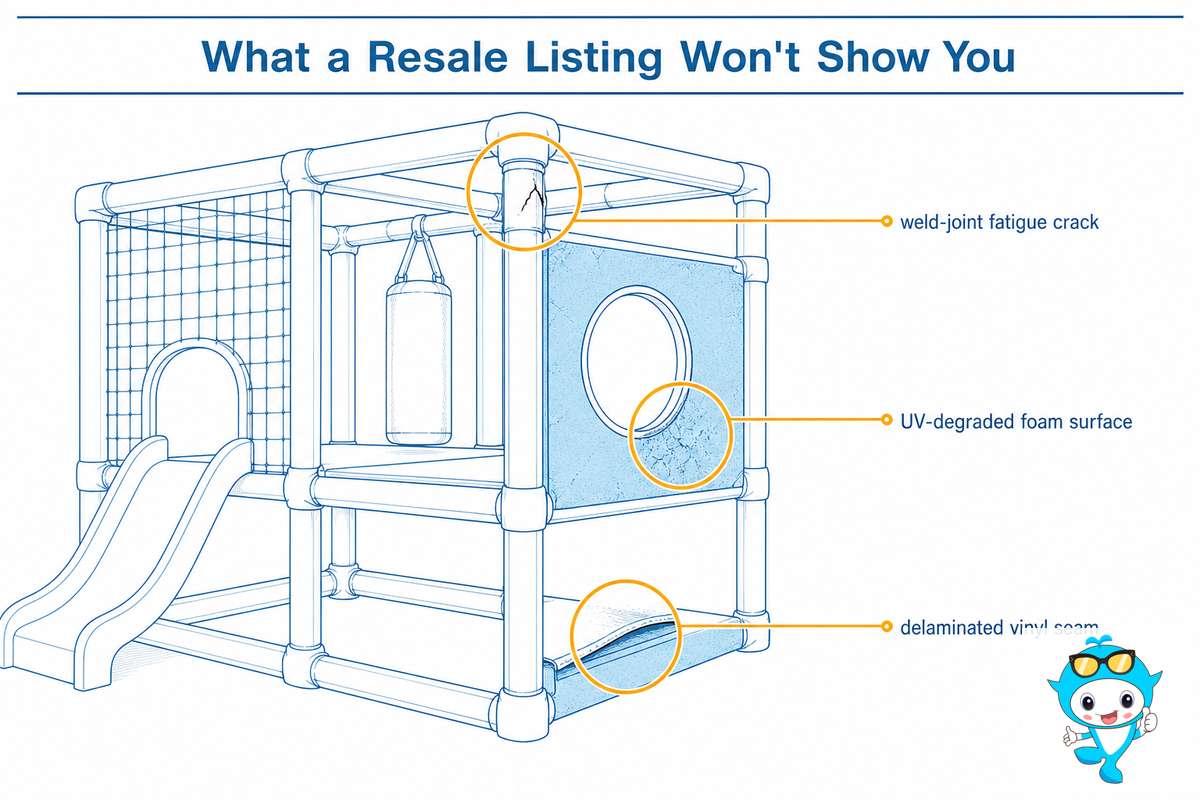
buying used or refurbished may seem like a good way to lower the upfront number, but three issues come with the deal that are absent from a quote for new: Original certification docs typically aren’t transferrable in a resale; wear that may not be obvious in pictures like fatigue at weld points, foam that’s broken down by UV rays, or delaminated vinyl are almost never disclosed; and any structural warranty will likely be voided in a second transaction. The core issue is a misconception that’s all too common in the commercial playground space: A playground is a “one-time purchase” rather than an “ongoing asset.” This thinking causes people to forgo the re-certification inspection the CPSC handbook recommends on pre-owned equipment.
If the unit otherwise fit your space and budget, don’t wait until after the equipment is delivered to confirm original date of manufacture and what re-certification requirements the manufacturer has. A typical new unit is covered by a structural warranty running 12 months to lifetime, so any used unit that’s been installed more than 12-24 months has already lost the bulk of its protective coverage window. Buyers browsing used commercial playground equipment or commercial indoor playground equipment for sale listings should treat a missing certification date as a hard pass, not a negotiating point; the same caution applies to indoor playground equipment wholesale lots, where recertification paperwork rarely travels with a bulk purchase. Didi Land will not resell equipment without a fresh recertification path, because the risk of an undisclosed structural problem after years of use is exactly the gap that voids an insurance claim.
Industry Outlook, What’s Changing for Commercial Indoor Play Buyers (2026)
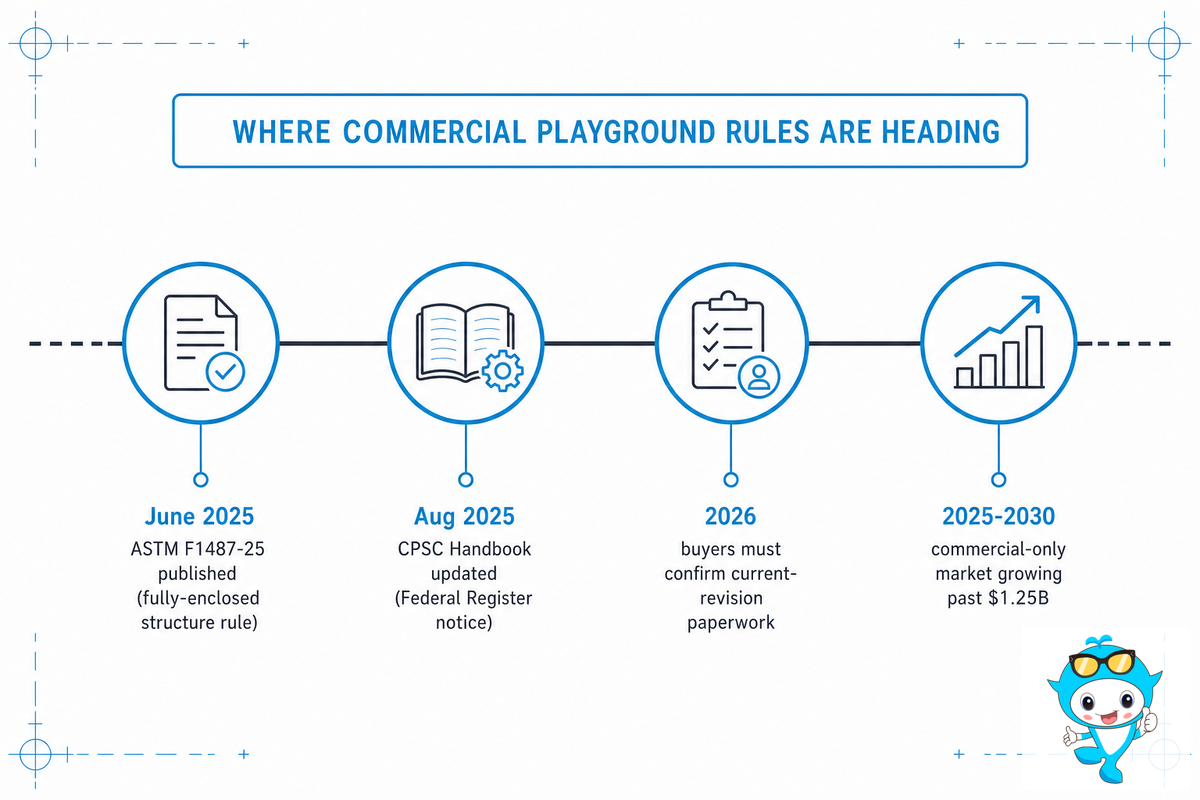
From a buyer-of-2026 perspective, the number-one driver isn’t size of the market, but rather regulations. A June 2025 revision of the standard, F1487-25, marks the first time that there are explicit requirements for “fully enclosed structures” and “fully enclosed tube slides,” categories to which most indoor commercial equipment belongs as a larger share of the overall marketplace than outdoor playgrounds. On the U.S. federal level, the CPSC also updated its official Public Playground Safety Handbook in August 2025 with a Federal Register notice. What this means for a buyer this year: make sure your quoted equipment is specifically certified to ASTM F1487-25 and not an earlier iteration. Any supplier using paperwork from a previous standard for fully enclosed structures should be using an outdated guideline. The buyers most exposed here are the ones re-ordering from a supplier they used two or three years ago without asking whether the certification paperwork was refreshed against the new revision- that recert gap is exactly what an insurer’s post-incident audit will flag first. Didi Land tracks this exposure closely, because a client re-ordering after even one year needs the updated F1487-25 test report, not the certificate that shipped with their original order.
It’s an expanding sector, as a quick glance at market data suggests-multiple independent market-research reports project commercial-only playground markets to rise to at least $1.25 billion in 2025 at a compound annual growth rate near 5%, while overall markets are already in the multi-billion dollar range and growing into the early 2030s. Nevertheless, size of market shouldn’t be your decision driver, the 2025 certification update matters more.
Frequently Asked Questions
Q: Does commercial indoor playground equipment need to meet national or international safety standards?
View Answer
It can be. For public-use venues, equipment is required to meet applicable structural standards (e.g., F1487-25 in the US, EN 1176-1 in Europe, CSA Z614 in Canada) along with various safety regulations concerning material contents. Most property insurers will require that paperwork, not a mere assurance of a compliant installation, before they’ll agree to cover the equipment with an insurance policy- the risk of a hidden gap between what a vendor claims and what was actually tested is exactly what underwriters are checking for.
Q: How much does commercial indoor playground equipment cost?
Show Answer
Published market pricing runs roughly $15 to $35 per square foot for base equipment, with full compact installs starting around $6,000-$20,000 and larger multi-element builds running well into six figures, depending on footprint and theme complexity. More detail on a line-item cost breakdown-including installation, shipping, maintenance, and the equipment itself-can be found in our indoor playground equipment cost guide.
Q: How much space do I need for commercial indoor play equipment?
View Answer
Commercial spaces usually require a minimum ceiling clearance of 10-12 feet, or 14-16 feet for buildings with higher walls designed to accommodate slides. Soft play systems require a slightly smaller ceiling space of 8-10 feet but typically have a lower weight capacity and shorter service life than steel structures. The physical footprint itself varies from less than 100 m² for a small preschool install to 1,000+ m² for a large-scale family entertainment center; check out our floor plan and layout guide for planning templates.
Q: Can commercial indoor play equipment support children with sensory processing needs?
Show Answer
Yes. Sensory and inclusive elements (calming panels, texture surfaces, ramped access) are now a standard commercial category, not an aftermarket add-on.
Q: How long does it take to get a design or plan for commercial indoor playground equipment?
View Answer
Usually, the first concept design will take between 3-5 working days from when footprint/age range and theme direction are given, with the 3D render following a couple of days later – 7-10 working days. Please note, that manufacturing times start when approved from the design phase and generally run 28-42 days for a standard catalog build and 56-112 days for a bespoke fully custom build.
Q: Is used or refurbished commercial indoor playground equipment a good option?
Show Answer
It may make sense for a budget-buyer if three issues can be resolved: Are original certification papers transferred to you?
Will the structural warranty transfer to you, and if it’s still in force?
Does the manufacturer perform an inspection for re-certification?
If you don’t know any of the three answers, that seemingly great bargain will never be insurable.
References & Sources
- CPSC Regulations, Mandatory Standards and Bans – U.S. Consumer Product Safety Commission
- Notice of Availability: Public Playground Safety Handbook Update – Federal Register, August 2025
- ASTM Publishes Revised Consumer Safety Performance Specification (F1487-25) – SGS SafeGuardS, June 2025
- A History of IPEMA – Playground Professionals
- The Daily Dozen: A 12-Point Playground Safety Checklist – National Recreation and Park Association
The Team Behind This Report
Based on our experience building out the Didi Land’s own stack to enable 600+ commercial installs in 40+ countries from 2014 onward and cross-reference with public documents for astm/CPSC, as well as the technical specification data published by 4 separate steel-tubing manufacturers (and not just what their marketing materials say). Technical review by the Didi Land technical team.
Related Articles
- What Is Soft Play? – definitions, equipment, and age ranges
- Top 15 Indoor Playground Equipment Manufacturers (2026) – supplier comparison
![Custom Dinosaur Playground Equipment [Design Guide]](https://didiplayarea.com/wp-content/uploads/2026/09/custom-dinosaur-playground-equipment-r2-featured-1-768x512.png)
![Custom Dinosaur Playground Equipment [Design Guide]](https://didiplayarea.com/wp-content/uploads/2026/09/custom-dinosaur-playground-equipment-r2-featured-1-150x150.png)