Fale com a Didi Land


Atualizado em julho de 2026.
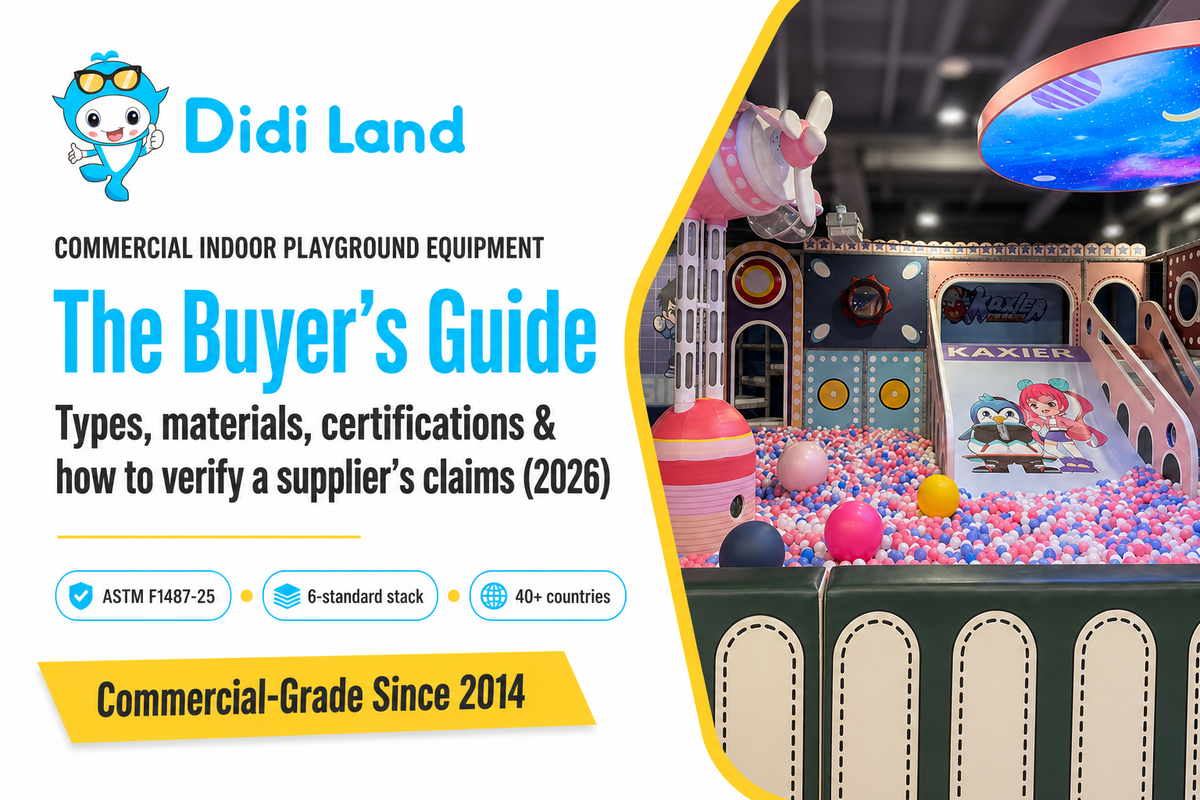
Os equipamentos para parques infantis interiores para uso comercial são estruturas lúdicas concebidas e certificadas para uma utilização pública contínua e intensiva em espaços interiores — não são o mesmo conjunto de produtos destinado ao uso privado no quintal ou na sala de uma única família. A própria definição de utilização pública da ASTM International (ASTM F1487-25, junho de 2025) descreve estes equipamentos como destinados às áreas de jogos de escolas, parques, creches, instituições e edifícios de habitação multifamiliar.
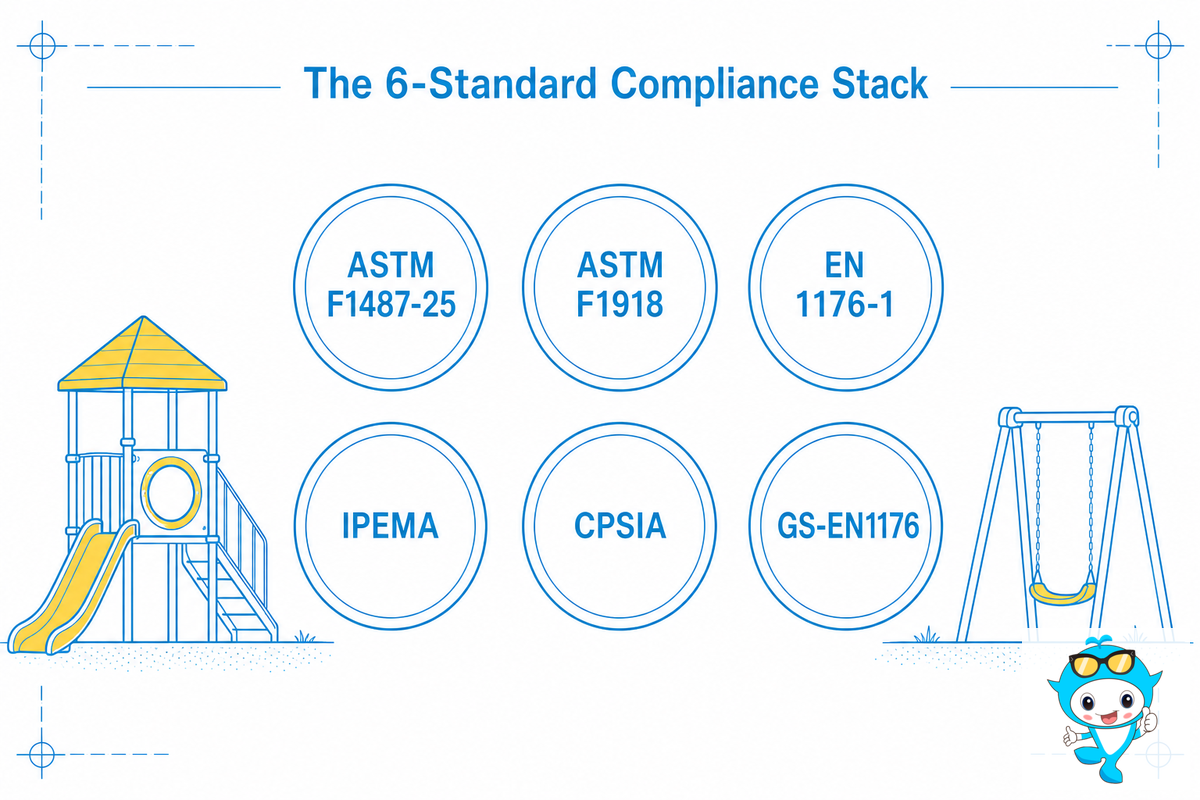
Esta distinção — utilização comercial/pública em vez de utilização privada/residencial — determina um nível diferente de certificação, requisitos de materiais e exposição do comprador a responsabilidades. Guangzhou Didi Land Amusement Equipment Co., Ltd. fabrica os seus equipamentos da categoria comercial com base num conjunto integrado de seis normas de conformidade — ASTM F1487-25, ASTM F1918, EN 1176-1, IPEMA, CPSIA e GS-EN1176 — cuja eficácia no terreno foi comprovada em 600+ instalações e 40+ países desde 2014. Este é o enquadramento que utilizámos para compreender o verdadeiro significado de «qualidade comercial» no atual mercado de exportação, o que pertence a essa categoria, o que determina essa classificação e como identificar, no futuro, fornecedores fiáveis de equipamentos de qualidade comercial.
Especificações rápidas
| Categoria | Equipamentos para recreio interior de utilização pública/comercial (âmbito da ASTM F1487-25) |
| Certificações principais | ASTM F1487, ASTM F1918, EN 1176-1, IPEMA, CPSIA 16 CFR 1307 |
| Calibre habitual do aço da estrutura | Tubos de calibre 14-18 (dados cruzados de 4 fornecedores independentes) |
| Distância livre de segurança ao teto | 10-12 ft para estruturas gerais; 14-16 ft quando incluem escorregas |
| Vida útil habitual | 15-20+ anos para estruturas de aço; inferior para soft play à base de espuma |
O que são equipamentos para parques infantis interiores para uso comercial?
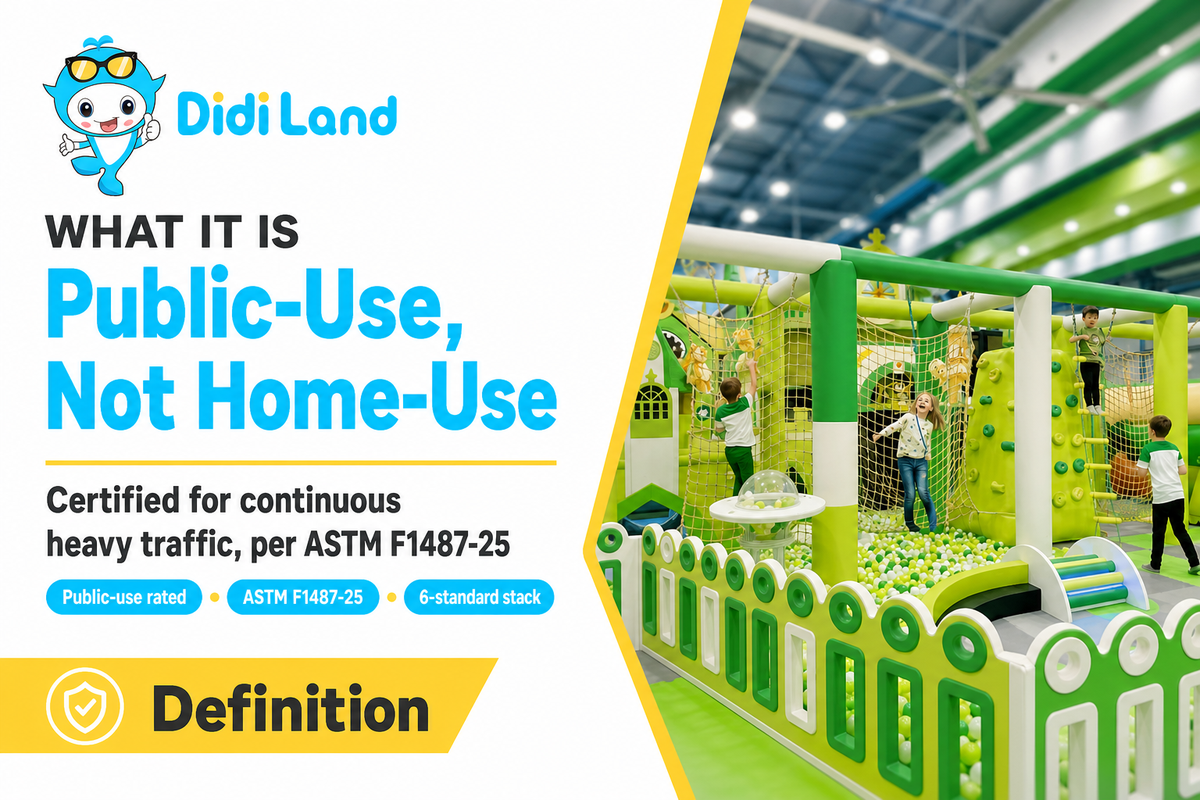
Em linguagem simples: são equipamentos lúdicos concebidos e ensaiados para receber dezenas de crianças todos os dias, ano após ano, ao abrigo de um regime de ensaios que considera a responsabilidade associada à utilização pública, e não o desempenho rápido e moderado de um conjunto doméstico. É essa a diferença entre uma estrutura comercial de soft play de mais de $20 000 e um conjunto de escalada para quintal de $300 escolhido a partir de uma fotografia.
Centros comerciais, centros de entretenimento familiar, jardins de infância, creches e hotéis enquadram-nos nesta mesma definição comercial, mesmo quando têm vários níveis e formatos. O próprio Public Playground Safety Handbook da CPSC estabelece precisamente esta distinção entre equipamentos de utilização pública e doméstica, sendo essa distinção — e não apenas o preço — o primeiro aspeto verificado por uma seguradora de responsabilidade civil.
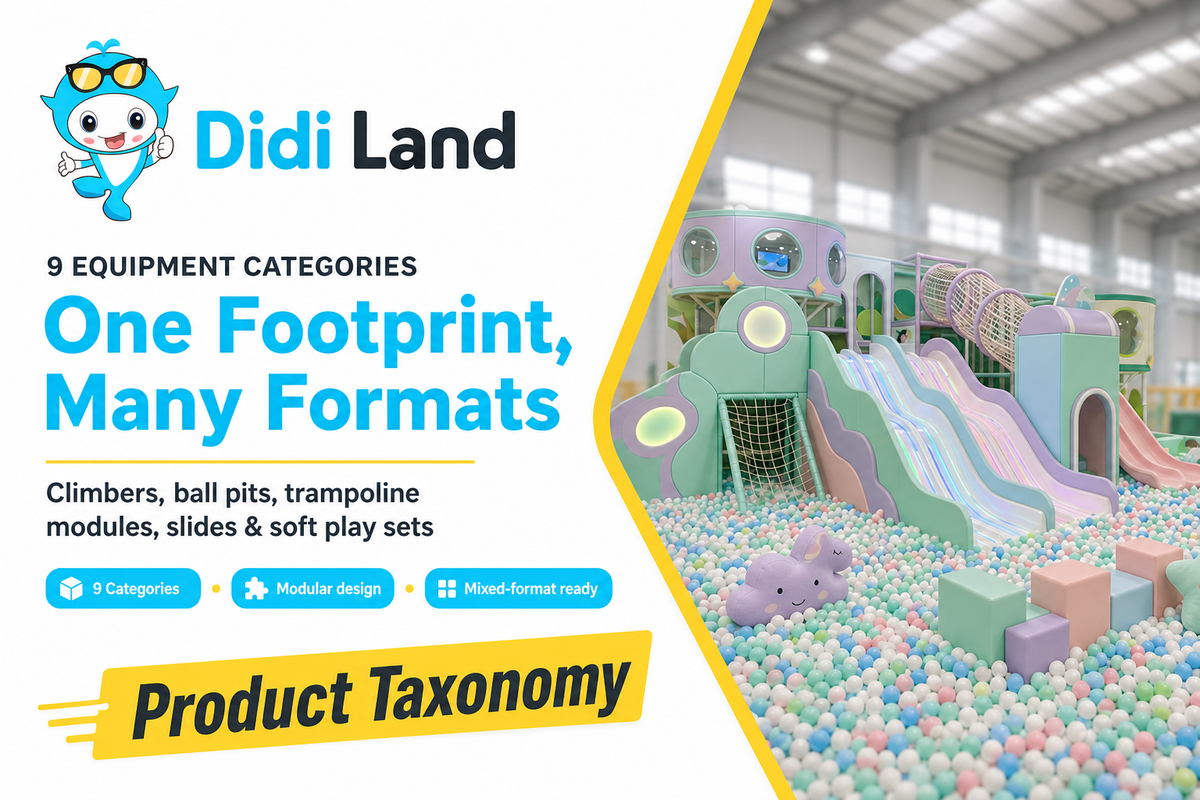
Por definição, os equipamentos comerciais constituem também uma categoria modular, e não um único produto. Uma só área de implantação interior combina frequentemente elementos de escalada, piscinas de bolas, módulos de trampolim, percursos de obstáculos, escorregas e conjuntos de módulos soft play — cada qual com os seus próprios requisitos de certificação — na mesma área de implantação, para utilizar a Secção 3 abaixo.
O risco que costuma surpreender os compradores principiantes é um orçamento do fornecedor que indica «equipamentos comerciais para áreas de recreio interior» (por vezes designados equipamentos industriais para parques infantis nos catálogos dos fornecedores) sem discriminar que certificação se aplica a cada módulo dessa área de implantação. Uma entidade exploradora que aprove uma única rubrica genérica de «certificação ASTM» e apenas descubra, durante uma vistoria da seguradora, que a piscina de bolas e a estrutura de escalada exigiam duas normas diferentes comprou o rótulo, mas não a documentação que o sustenta — trata-se de uma lacuna documental, não de uma deficiência na qualidade dos equipamentos. A engenharia da Didi Land tem em conta precisamente esta distinção porque, após 600+ instalações em 40+ países, a falta de um certificado é a ocorrência mais comum numa auditoria posterior à instalação — na prática, este é o pormenor de aplicação que distingue uma instalação em conformidade de outra que não pode ser segurada.
Equipamentos comerciais ou residenciais para parques infantis interiores: quais são as verdadeiras diferenças?
Qual é a diferença entre equipamentos domésticos e comerciais para recreio interior?
Ver resposta
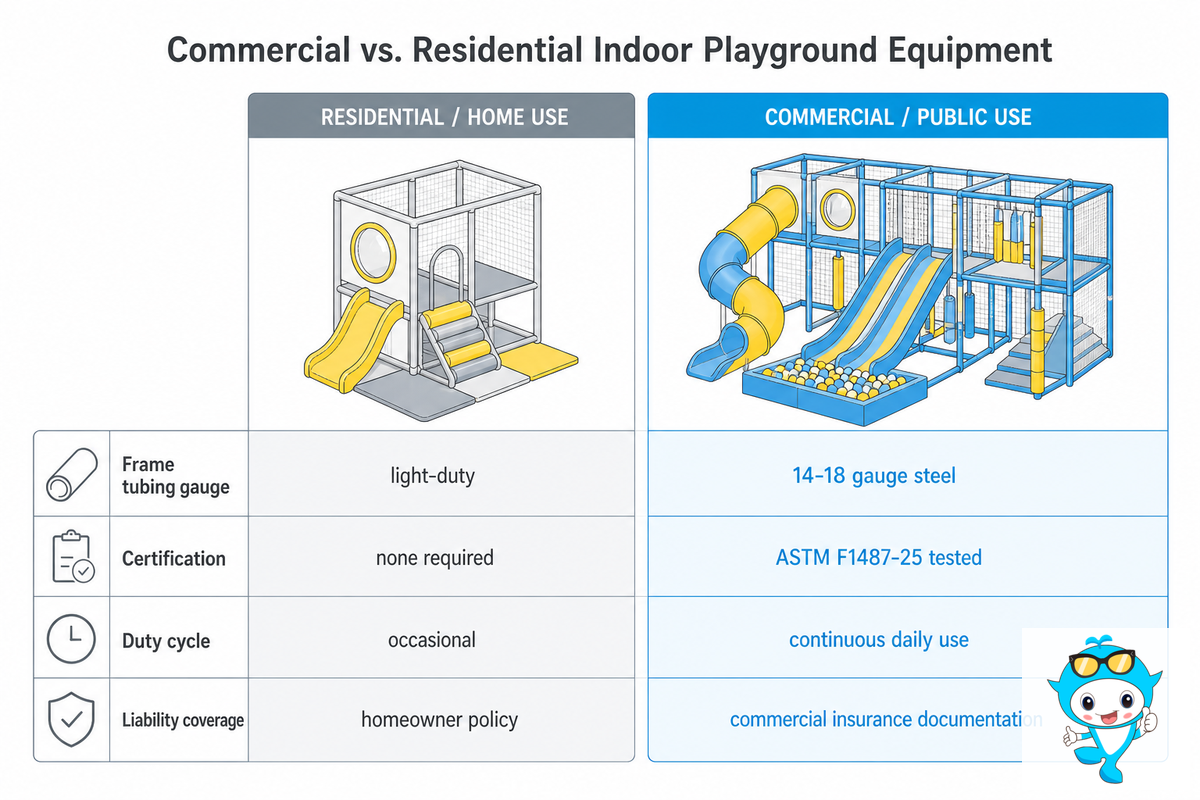
A principal diferença não está no aspeto, mas no conjunto integrado de certificações, na especificação do ciclo de utilização e na classe de qualidade dos materiais do produto. Os equipamentos domésticos para recreio interior destinam-se à utilização ocasional por uma ou duas crianças e, quando chegam a ser ensaiados, são normalmente classificados e testados segundo normas aplicáveis a brinquedos de consumo (ASTM F963), conforme a lista de normas obrigatórias da própria CPSC. Os equipamentos comerciais para parques infantis — incluindo qualquer estrutura lúdica para interior vendida para um espaço público — são concebidos e certificados (ASTM F1487, ASTM F1918, EN 1176-1, IPEMA) para utilização contínua por várias crianças, todos os dias, e dispõem de um historial documental — relatórios de ensaio, certificados de conformidade e documentos adequados para a seguradora — que simplesmente não existe nos equipamentos domésticos.
Esta diferença nos ensaios torna-se evidente através de provas concretas e verificáveis:
| Dimensão | Qualidade comercial | Qualidade doméstica/residencial |
|---|---|---|
| Certificação principal | ASTM F1487 / F1918, EN 1176-1 | Frequentemente ASTM F963 (norma para brinquedos) ou sem ensaios |
| Entidade certificadora externa | Ensaio de laboratório independente com certificação IPEMA | Raramente submetido a ensaios externos |
| Calibre do aço da estrutura | Tubos de calibre 14-18 | Calibre inferior ou estrutura sem aço |
| Distância livre de segurança ao teto para soft play | Mínimo de 8-10 ft | Variável, sem especificação mínima |
| Classificação do ciclo de utilização | Contínuo, para várias crianças, durante todo o dia | Intermitente, 1-2 crianças |
| Vida útil habitual | 15-20+ anos (estruturas de aço) | Habitualmente 2-5 anos |
| Estrutura da garantia | Garantia estrutural + condições documentadas | Limitada ou inexistente |
| Documentação de seguro/responsabilidade | Exigida pela maioria das seguradoras comerciais | Não aplicável |
| Comprador habitual | Entidade exploradora de centro comercial, FEC, jardim de infância ou hotel | Agregado familiar |
⚠️ Importante
Uma classificação de «serviço pesado» para exterior nem sempre é válida para a certificação comercial de interior. As normas comerciais para interiores abrangem a densidade da espuma, os requisitos das superfícies em matéria de higienização e a carga admissível decorrente do fluxo contínuo de visitantes no interior. A classificação de «serviço pesado» para exterior refere-se à resistência às condições meteorológicas e à exposição UV, vias de certificação completamente diferentes, e um fornecedor que apresente «serviço pesado» sem qualquer referência à ASTM F1487/F1918 ou à IPEMA nem sequer sabe ao que essa expressão se refere.
Tipos de equipamentos para parques infantis interiores para uso comercial
O que são equipamentos para recreio interior e a que faixa etária se destinam?
Mostrar resposta
Os equipamentos para recreio interior pertencem à categoria modular, e a faixa etária depende sobretudo da subcategoria: os conjuntos de módulos soft play e os elementos sensoriais destinam-se habitualmente a crianças pequenas e na primeira infância, ou dos seis meses aos seis anos; as estruturas de escalada com estrutura de aço, os percursos de obstáculos e os módulos de trampolim destinam-se geralmente a crianças dos 2 aos 12 anos. Muitos espaços interiores recebem ambas as faixas etárias na mesma área e procuram não restringir as idades através da seleção de produtos específicos.
| Tipo | Faixa etária habitual | Certificação principal |
|---|---|---|
| Conjuntos de módulos soft play | 6 meses-6 anos | ASTM F1918 |
| Piscinas de bolas | 6 meses-8 anos | ASTM F1918, CPSIA |
| Módulos de trampolim | 4-14 anos | ASTM F2970 |
| Estruturas de trepar para interior / estruturas de escalada | 2-12 anos | ASTM F1487, EN 1176-1 |
| Escorregas | 2-12 anos | ASTM F1487 (incl. cláusula F1487-25 relativa a escorregas fechados) |
| Percursos de obstáculos / ninja | 5-14 anos | ASTM F1487, F1292 (revestimento de superfície) |
| Estruturas lúdicas temáticas | 2-12 anos | ASTM F1487, F1918 (elementos mistos) |
| Elementos sensoriais / inclusivos | Todas as idades | ASTM F1487, conceção baseada na ADA |
| Atrações interativas / gamificadas | 4-14 anos | ASTM F1487 (base estrutural) |
Um erro comum nesta fase consiste em comprar primeiro com base no tema e só depois na categoria. Imagine a entidade exploradora de um átrio de hotel que se apaixona por uma torre de escalada temática, descobrindo depois que esta exige a mesma distância livre de segurança estrutural da F1487 que uma instalação completa num centro comercial e acabando por reformular a área de implantação a meio do projeto. Confirme a categoria e a respetiva certificação antes de escolher o tema, não depois. A Didi Land elimina este risco enquadrando primeiro cada construção temática numa destas 9 categorias, porque o requisito de certificação é determinado pela categoria, não pelo tema que a envolve — uma distinção confirmada pela experiência de conformidade das exportações para 40+ países.
O que confere «qualidade comercial» aos equipamentos? Engenharia de materiais e durabilidade
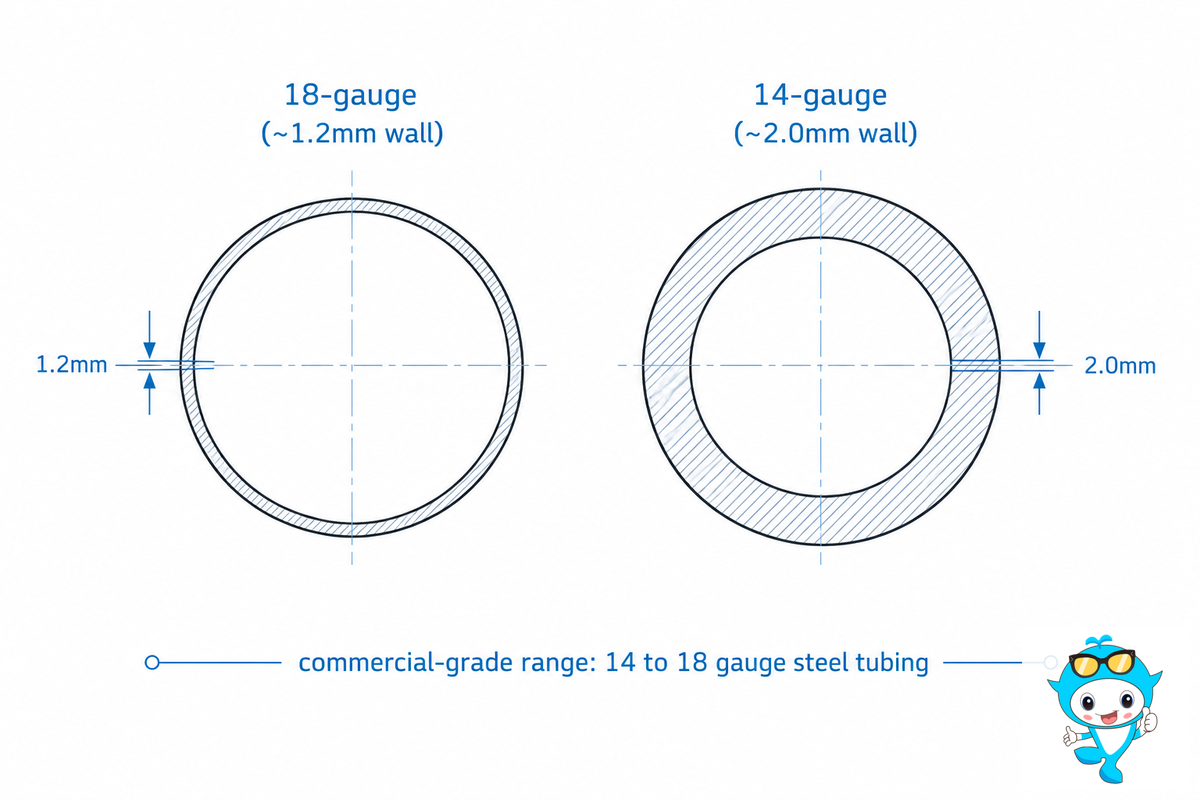
A maioria das estruturas comerciais utiliza tubos de aço com calibre entre 14 e 18, um intervalo aceite pelo setor e documentado por numerosos fabricantes de tubos e guias de aprovisionamento da indústria. Uma classificação de serviço pesado para exterior não certifica normalmente um produto ao abrigo das normas ASTM, pois são este calibre dos tubos e esta espessura da parede do tubo que permitem suportar cargas admissíveis repetidas e constantes sem que as uniões se deformem, rachem ou cedam.
O essencial é pedir ao fornecedor a especificação do calibre e da espessura da parede do tubo, e não uma alegação comercial de «serviço pesado», pois um tubo mais leve de calibre 18 (aproximadamente 1,2 mm) e um tubo mais pesado de calibre 14 (aproximadamente 2,0 mm) apresentam uma diferença de espessura da parede do tubo de quase o dobro.
📐 Nota de engenharia
Fabricantes independentes de tubos documentam tubos para estruturas comerciais de parques infantis com uma espessura da parede do tubo entre 1,2 e 2,0 mm (,047 a ,079 polegadas), com um limite de elasticidade mínimo de cerca de 50 ksi e uma resistência à tração de cerca de 55 ksi. Em alguns casos, um fabricante de tubos identificou os tubos mais pesados, com parede de ,188 polegadas (4,8 mm), aproximadamente de calibre 7, como a opção de «serviço pesado» para equipamentos de exercício e fitness, o que proporciona uma referência razoável para avaliar se o preço apresentado está acima ou abaixo do adequado.
Os componentes de soft play dependem de um sistema de materiais completamente diferente: núcleo de espuma de alta densidade em EVA ou PU, revestido com capas de vinil antibacterianas e laváveis. Ao contrário dos tubos de aço, nos quais o calibre serve para medir a aptidão para uso comercial, as especificações dos materiais de soft play utilizam a densidade da espuma e a resistência ao fogo do revestimento de vinil (que deve cumprir a NFPA 701 no próprio tecido), uma vez que o soft play exige higienização constante. Peça ao fornecedor uma ficha de especificações da densidade da espuma de soft play — «espuma de alta densidade» não é suficiente — e confirme, antes do transporte, que o revestimento de vinil cumpre os limites de chumbo e ftalatos da CPSC.
Certificações e normas de segurança que conferem aos equipamentos a classificação de «comerciais»
A simples menção de uma norma ASTM não constitui uma certificação; esta tem de ser obtida através de um laboratório de ensaios acreditado. Em junho de 2025, o subcomité F15.29 da ASTM publicou a ASTM F1487-25, que inclui, pela primeira vez, uma definição formal e requisitos adicionais para «estruturas totalmente fechadas» e escorregas tubulares totalmente fechados. Esta norma terá consequências muito mais significativas para instalações interiores do que exteriores, onde as estruturas lúdicas raramente estão completamente fechadas. Um fornecedor que continue a mencionar a ASTM F1487-21 e não refira o requisito relativo às estruturas totalmente fechadas não acompanhou a norma mais atual.
- ASTM F1487-25 — norma aplicável a equipamentos estruturais de utilização pública para espaços de jogo e recreio. Certifique-se de que o fornecedor indica a versão -25, e não uma versão anterior.
- ASTM F1918 — norma aplicável a equipamentos de soft play fechados (piscinas de bolas, estruturas lúdicas em espuma).
- EN 1176-1 — certificação exigida para os equipamentos exportados para a UE.
- Certificação externa IPEMA — significa que um laboratório externo e independente (não o fabricante) ensaiou os equipamentos e certificou a sua conformidade com a norma ASTM aplicável.
- CPSIA 16 CFR Part 1307 – regra de segurança dos consumidores dos US relativa aos limites de chumbo e ftalatos em artigos de plástico ou vinil, aplicada pela U.S. Consumer Product Safety Commission (CPSC).
- CSA Z614 — norma canadiana equivalente para equipamentos estruturais/de utilização pública, necessária para equipamentos destinados ao Canadá.
Neste artigo, limitamo-nos deliberadamente às diferenças que definem os equipamentos lúdicos de qualidade comercial por oposição aos destinados ao consumidor — e não à escolha da melhor norma de certificação para o país a que se destinam (por exemplo, AS 4685 ou EN 1176 ou ASTM F1487); já abordámos esse tema no nosso guia de comparação das normas de segurança dos espaços de jogo e recreio.
Como verificar as alegações de qualidade comercial de um fornecedor
A armadilha da aparência robusta: mesmo um produto que pareça estruturalmente sobredimensionado nas fotografias pode apresentar problemas documentais, porque as características essenciais — calibre dos tubos, densidade da espuma, data da certificação e nome do laboratório de ensaios — nunca aparecem numa fotografia. Um fornecedor do setor afirma: «Um erro comum dos novos compradores é receberem um orçamento com as normas de segurança corretas, mas sem uma certificação documentada dos equipamentos para parques infantis.»
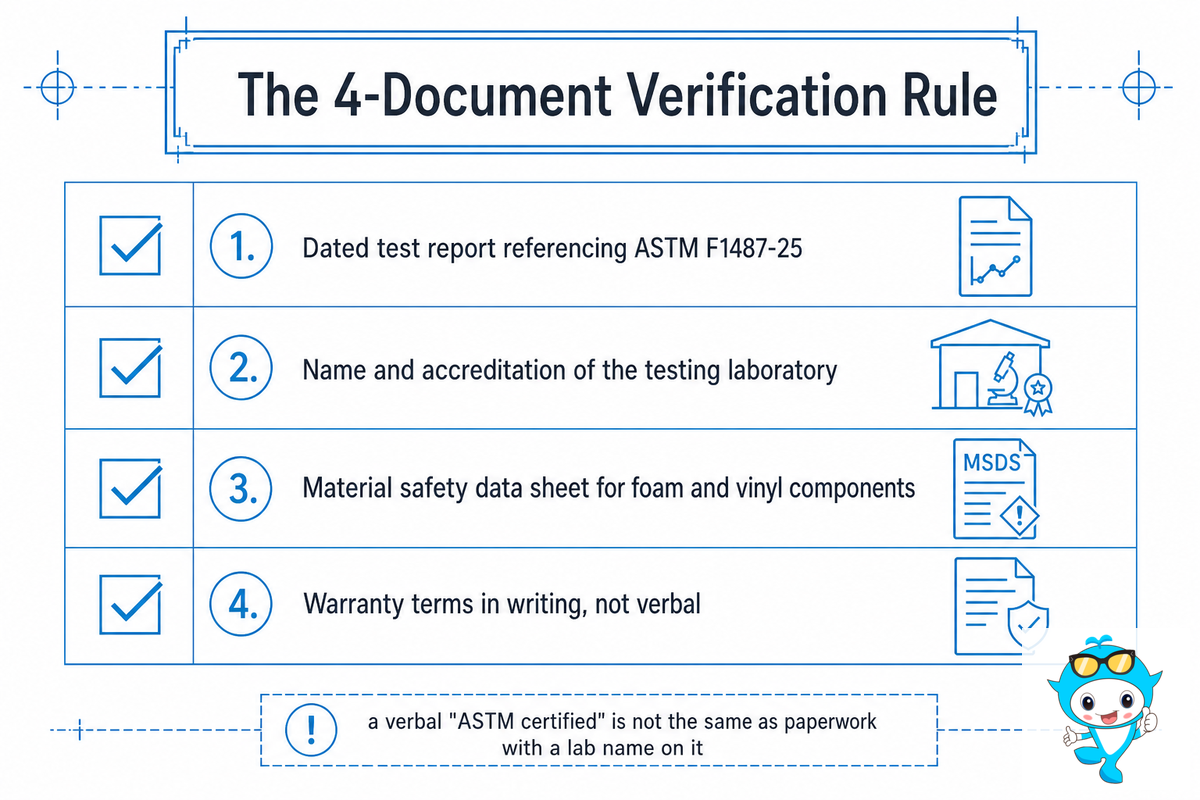
Para não cometermos este erro, seguimos aquilo a que chamamos a regra de verificação dos 4 documentos antes de aceitarmos assinar:
- Um certificado IPEMA ou de um laboratório externo que identifique a entidade certificadora (não apenas «certificação ASTM»).
- Confirmação da versão da ASTM F1487 indicada no certificado (F1487-25 em vez de uma edição anterior).
- Uma ficha de especificações que indique claramente o calibre dos tubos e a densidade da espuma — uma alegação de «serviço pesado» não é suficiente.
- Um dossier documental imediatamente aceite para efeitos de seguro e adequado ao arquivo da sua seguradora (a maioria das seguradoras comerciais exige documentação de conformidade com a ASTM F1487 e com as normas do CPSC Public Playground Safety Handbook para emitir a cobertura).
Para conhecer em profundidade o nosso processo relativo a certificados de siderurgia, custos ocultos e sinais de alerta nas fábricas, consulte o nosso guia de auditoria das especificações para compradores de equipamentos para parques infantis interiores.
«Fazemos a mesma pergunta a todos os compradores comerciais antes de apresentarmos um orçamento: o que exige realmente a sua seguradora no dossier? A maioria das entidades exploradoras descobre da pior maneira, após uma participação de sinistro, que a garantia verbal de “certificação ASTM” dada por um fornecedor não equivale a um relatório de ensaio F1487-25 datado e com o nome do laboratório. Preparamos o dossier documental antes do transporte dos equipamentos, não depois de alguém o solicitar.»
— Equipa de engenharia da Didi Land, análise de conformidade em Guangzhou
As necessidades de equipamentos comerciais variam consoante o espaço: próximos passos
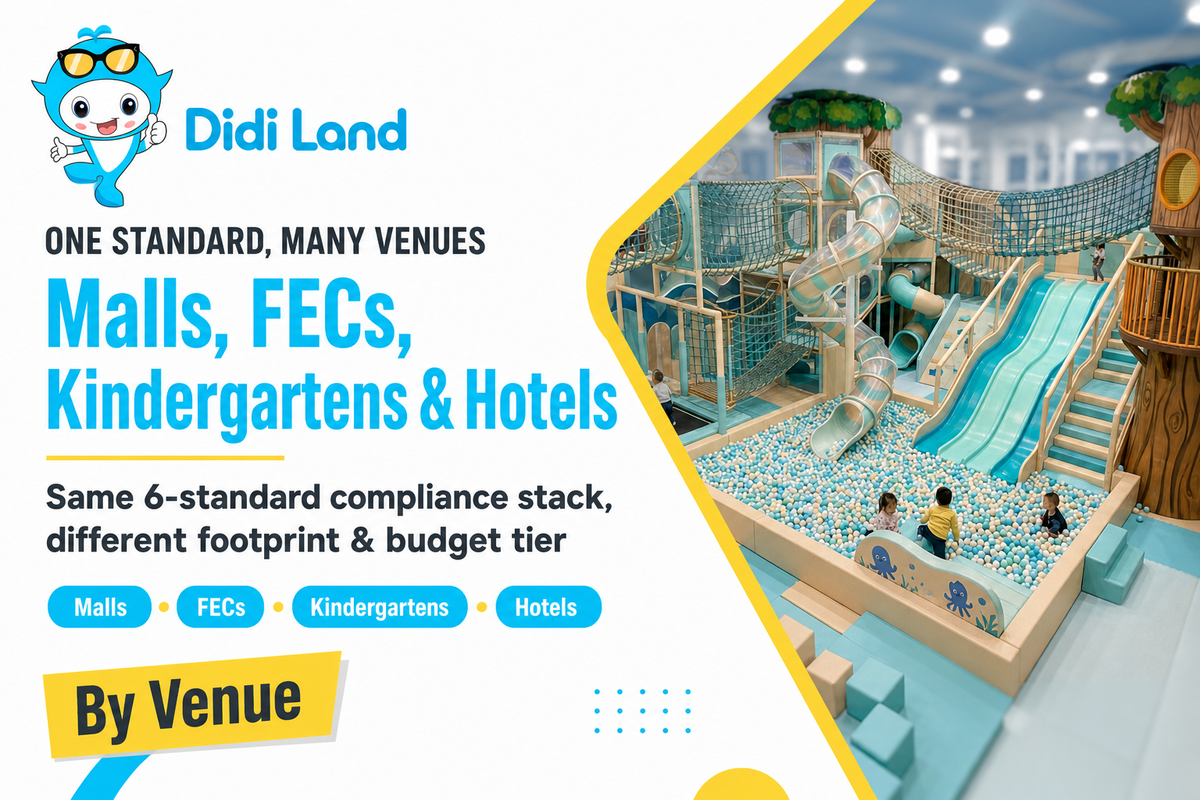
As certificações e classes de qualidade dos materiais acima indicadas aplicam-se universalmente, independentemente do espaço ou da utilização específicos (por exemplo, um centro comercial, um centro de entretenimento familiar, um estabelecimento de ensino pré-escolar ou o átrio de um hotel). Contudo, o tipo de espaço influencia os requisitos de área, o custo inicial e a prioridade atribuída à conformidade — por exemplo, um espaço com capacidade para 800 crianças num centro comercial exige considerações diferentes das de uma instalação de 30 m² numa sala de aula — e os prazos de produção e entrega de equipamentos feitos à medida podem variar entre 28 e 112 dias, consoante a complexidade. Em termos simples, um diretor de jardim de infância e um gestor de arrendamento de um centro comercial que peçam «equipamentos para parques infantis interiores para uso comercial» estão a descrever dois níveis de investimento e dossiers de conformidade muito diferentes, embora o conjunto integrado de certificações subjacente seja idêntico — uma incompatibilidade que surge sobretudo quando um comprador reutiliza, para uma instalação de 30 m² numa sala de aula, um modelo de orçamento pensado para um centro comercial e paga por uma capacidade de que nunca necessitará. A Didi Land resolve esta questão no caderno de conceção, porque o mesmo conjunto integrado de seis normas de conformidade se aplica a todas as utilizações dos espaços — na prática, a diferença reside na área de implantação e no nível de orçamento, não no risco de certificação. Saiba mais sobre requisitos de área, intervalos de custos, períodos de ROI e conjuntos regulamentares por tipo de espaço no nosso guia de equipamentos para parques infantis interiores para uso comercial por setor.
Equipamentos comerciais novos ou usados/recondicionados: o que deve saber
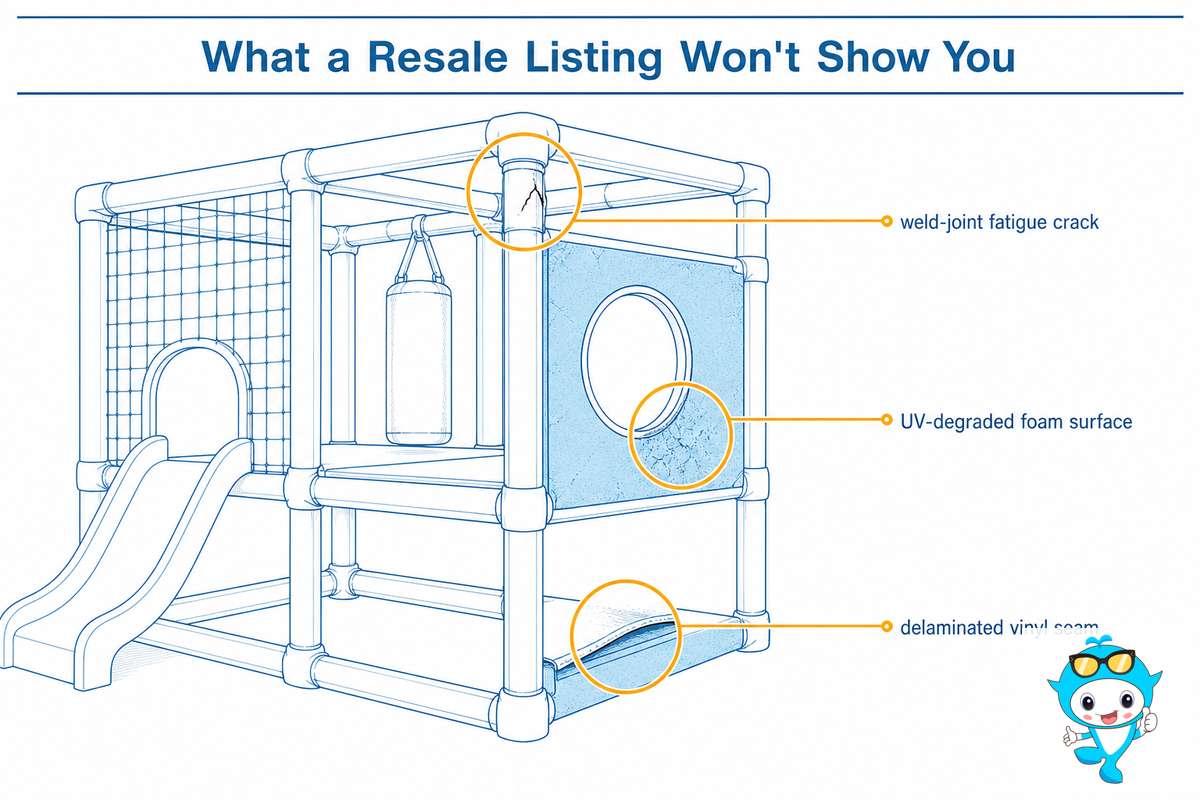
Comprar equipamentos usados ou recondicionados pode parecer uma boa forma de reduzir o valor inicial, mas o negócio inclui três problemas que não existem num orçamento para equipamentos novos: os documentos da certificação original normalmente não são transferíveis numa revenda; o desgaste que pode não ser evidente nas fotografias, como fadiga nos pontos de soldadura, espuma degradada pelos raios UV ou vinil delaminado, quase nunca é declarado; e qualquer garantia estrutural será provavelmente anulada numa segunda transação. O problema central é um equívoco demasiado comum no setor dos parques infantis para uso comercial: considerar um parque infantil uma «compra única», em vez de um «ativo permanente». Esta forma de pensar leva as pessoas a dispensarem a inspeção de recertificação recomendada pelo manual da CPSC para equipamentos usados.
Mesmo que a unidade se adapte ao seu espaço e orçamento, não espere pela entrega dos equipamentos para confirmar a data original de fabrico e os requisitos de recertificação definidos pelo fabricante. Uma unidade nova habitual dispõe de uma garantia estrutural que pode variar entre 12 meses e toda a sua vida útil, pelo que qualquer unidade usada instalada há mais de 12-24 meses já perdeu a maior parte do período de cobertura. Os compradores que consultem anúncios de equipamentos comerciais usados para parques infantis ou de equipamentos para parques infantis interiores para uso comercial à venda devem rejeitar imediatamente qualquer equipamento sem data de certificação, em vez de a utilizarem como argumento negocial; a mesma precaução aplica-se a lotes de equipamentos para parques infantis interiores vendidos por grosso, nos quais a documentação de recertificação raramente acompanha a compra do lote. A Didi Land não revende equipamentos sem uma nova via de recertificação, porque o risco de um problema estrutural não declarado após anos de utilização é precisamente a lacuna que invalida uma participação ao seguro.
Perspetivas do setor: o que está a mudar para os compradores de equipamentos comerciais para recreio interior (2026)
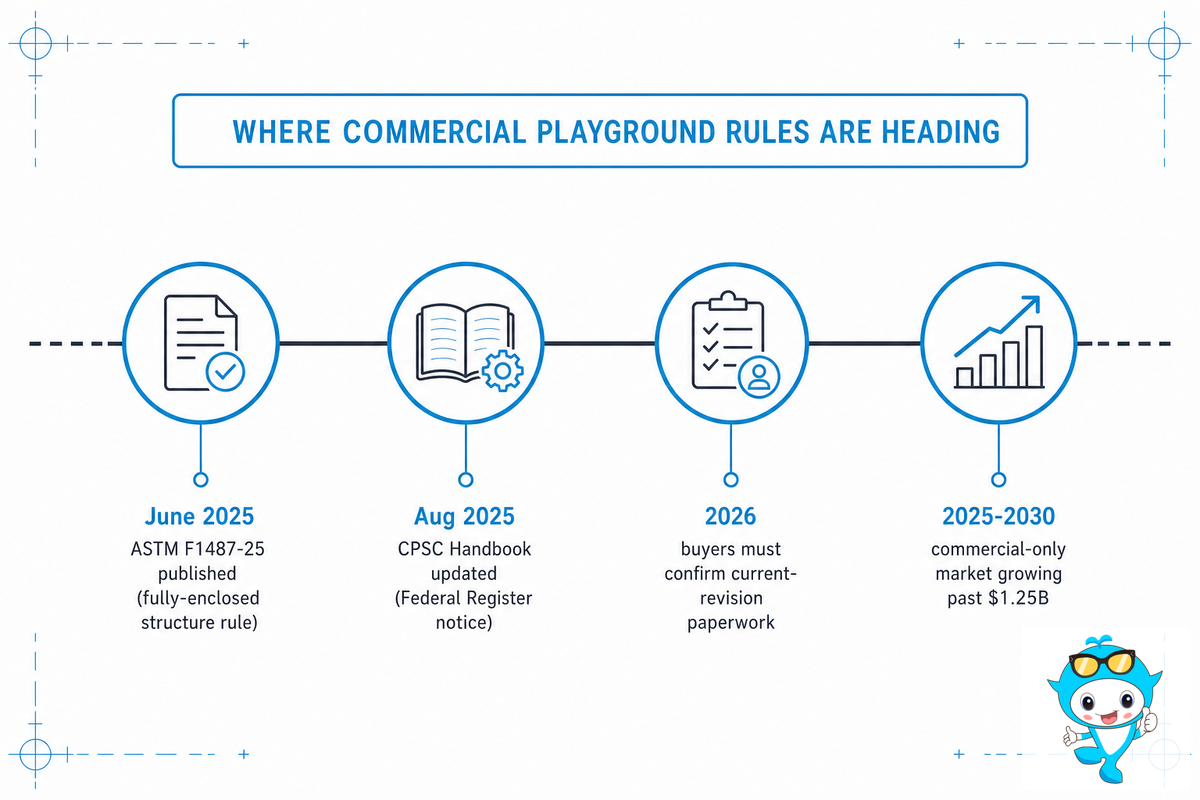
Na perspetiva de um comprador em 2026, o principal fator não é a dimensão do mercado, mas a regulamentação. A revisão da norma em junho de 2025, F1487-25, assinala a primeira vez que existem requisitos explícitos para «estruturas totalmente fechadas» e «escorregas tubulares totalmente fechados», categorias às quais pertence uma proporção maior da maioria dos equipamentos comerciais para interiores no mercado global do que dos parques infantis exteriores. Ao nível federal dos Estados Unidos, a CPSC também atualizou o seu Public Playground Safety Handbook oficial em agosto de 2025 através de um aviso no Federal Register. Para um comprador, isto significa este ano o seguinte: confirme que os equipamentos orçamentados estão especificamente certificados segundo a ASTM F1487-25, e não segundo uma versão anterior. Qualquer fornecedor que utilize documentação de uma norma anterior para estruturas totalmente fechadas deverá estar a utilizar orientações desatualizadas. Os compradores mais expostos são aqueles que repetem uma encomenda a um fornecedor utilizado há dois ou três anos sem perguntarem se a documentação da certificação foi atualizada segundo a nova revisão — esta lacuna de recertificação é precisamente o primeiro aspeto que uma seguradora assinalará numa auditoria posterior a um incidente. A Didi Land acompanha atentamente esta exposição, porque um cliente que repita uma encomenda mesmo após apenas um ano necessita do relatório de ensaio F1487-25 atualizado, e não do certificado enviado com a encomenda original.
Trata-se de um setor em expansão, como sugere uma consulta rápida dos dados de mercado — vários relatórios independentes de estudos de mercado projetam que os mercados exclusivamente comerciais de parques infantis atinjam pelo menos $1,25 billion em 2025, com uma taxa de crescimento anual composta próxima de 5%, enquanto os mercados globais já se situam num intervalo de vários milhares de milhões de dólares e continuam a crescer no início da década de 2030. Ainda assim, a dimensão do mercado não deve determinar a sua decisão; a atualização da certificação de 2025 é mais importante.
Perguntas frequentes
P: Os equipamentos para parques infantis interiores para uso comercial têm de cumprir normas de segurança nacionais ou internacionais?
Ver resposta
Pode ser. Nos espaços de uso público, os equipamentos têm de cumprir as normas estruturais aplicáveis (por exemplo, F1487-25 nos US, EN 1176-1 na Europa, CSA Z614 no Canadá), bem como diversos regulamentos de segurança relativos à composição dos materiais. A maioria das seguradoras de imóveis exige essa documentação, e não uma mera garantia de que a instalação está em conformidade, antes de aceitar incluir os equipamentos numa apólice de seguro- o risco de existir uma lacuna oculta entre o que um fornecedor afirma e o que foi efetivamente testado é precisamente aquilo que os subscritores de seguros procuram verificar.
P: Quanto custam os equipamentos para parques infantis interiores para uso comercial?
Mostrar resposta
Os preços publicados no mercado variam aproximadamente entre $15 e $35 por pé quadrado para o equipamento de base, com instalações compactas completas a partir de cerca de $6 000-$20 000 e projetos maiores, com vários elementos, a atingirem valores de seis algarismos, consoante a área de implantação e a complexidade do tema. Pode encontrar uma discriminação mais detalhada dos custos — incluindo instalação, transporte, manutenção e o próprio equipamento — no nosso guia de custos dos equipamentos para parques infantis interiores.
P: De quanto espaço preciso para equipamentos comerciais de recreio em espaços interiores?
Ver resposta
Os espaços comerciais exigem geralmente uma distância livre mínima até ao teto de 10-12 pés, ou de 14-16 pés no caso de edifícios com paredes mais altas, concebidos para acomodar escorregas. Os sistemas de soft play requerem uma altura até ao teto ligeiramente menor, de 8-10 pés, mas têm normalmente uma capacidade de carga inferior e uma vida útil mais curta do que as estruturas de aço. A própria área de implantação varia entre menos de 100 m² para uma pequena instalação destinada a crianças em idade pré-escolar e 1 000+ m² para um centro de entretenimento familiar de grande dimensão; consulte o nosso guia de plantas e configuração do espaço para obter modelos de planeamento.
P: Os equipamentos comerciais de recreio em espaços interiores podem apoiar crianças com necessidades de processamento sensorial?
Mostrar resposta
Sim. Os elementos sensoriais e inclusivos (painéis calmantes, superfícies com diferentes texturas e acessos por rampa) constituem atualmente uma categoria comercial habitual, e não um complemento instalado posteriormente.
P: Quanto tempo demora a obter um projeto ou uma planta para equipamentos de parques infantis interiores para uso comercial?
Ver resposta
Normalmente, o primeiro projeto conceptual demora entre 3-5 dias úteis após serem fornecidas a área de implantação/faixa etária e a orientação temática, seguindo-se a visualização 3D alguns dias depois — 7-10 dias úteis. Tenha em conta que os prazos de produção começam após a aprovação da fase de projeto e são geralmente de 28-42 dias para uma estrutura padrão de catálogo e de 56-112 dias para uma estrutura totalmente personalizada e feita à medida.
P: Os equipamentos usados ou recondicionados para parques infantis interiores para uso comercial são uma boa opção?
Mostrar resposta
Podem ser uma opção sensata para um comprador com orçamento limitado, desde que seja possível esclarecer 3 questões: A documentação de certificação original é transferida para si?
A garantia estrutural é transferida para si e continua em vigor?
O fabricante efetua uma inspeção para nova certificação?
Se não souber responder a qualquer uma das 3 perguntas, esse negócio aparentemente excelente nunca poderá ser segurado.
Referências e fontes
- Regulamentos, normas obrigatórias e proibições da CPSC – U.S. Consumer Product Safety Commission
- Aviso de disponibilização: atualização do manual de segurança dos parques infantis públicos – Federal Register, agosto de 2025
- ASTM publica a especificação revista de desempenho em matéria de segurança do consumidor (F1487-25) – SGS SafeGuardS, junho de 2025
- A história da IPEMA – Playground Professionals
- The Daily Dozen: lista de verificação de segurança dos parques infantis em 12 pontos – National Recreation and Park Association
A equipa responsável por este relatório
Baseado na nossa experiência de desenvolvimento do conjunto integrado da própria Didi Land, que permitiu realizar 600+ instalações comerciais em 40+ países desde 2014, e no cruzamento de informações com documentos públicos relativos a astm/CPSC, bem como com os dados de especificações técnicas publicados por 4 fabricantes distintos de tubos de aço (e não apenas com o que afirmam os respetivos materiais de marketing). Revisão técnica realizada pela equipa técnica da Didi Land.
Artigos relacionados
- O que é o soft play? – definições, equipamentos e faixas etárias
- Os 15 principais fabricantes de equipamentos para parques infantis interiores (2026) – comparação de fornecedores
![Equipamentos personalizados para parques infantis com dinossauros [Guia de design]](https://didiplayarea.com/wp-content/uploads/2026/09/custom-dinosaur-playground-equipment-r2-featured-1-768x512.png)
![Equipamentos personalizados para parques infantis com dinossauros [Guia de design]](https://didiplayarea.com/wp-content/uploads/2026/09/custom-dinosaur-playground-equipment-r2-featured-1-150x150.png)