Get in Touch with Didi Land


Updated July 2026
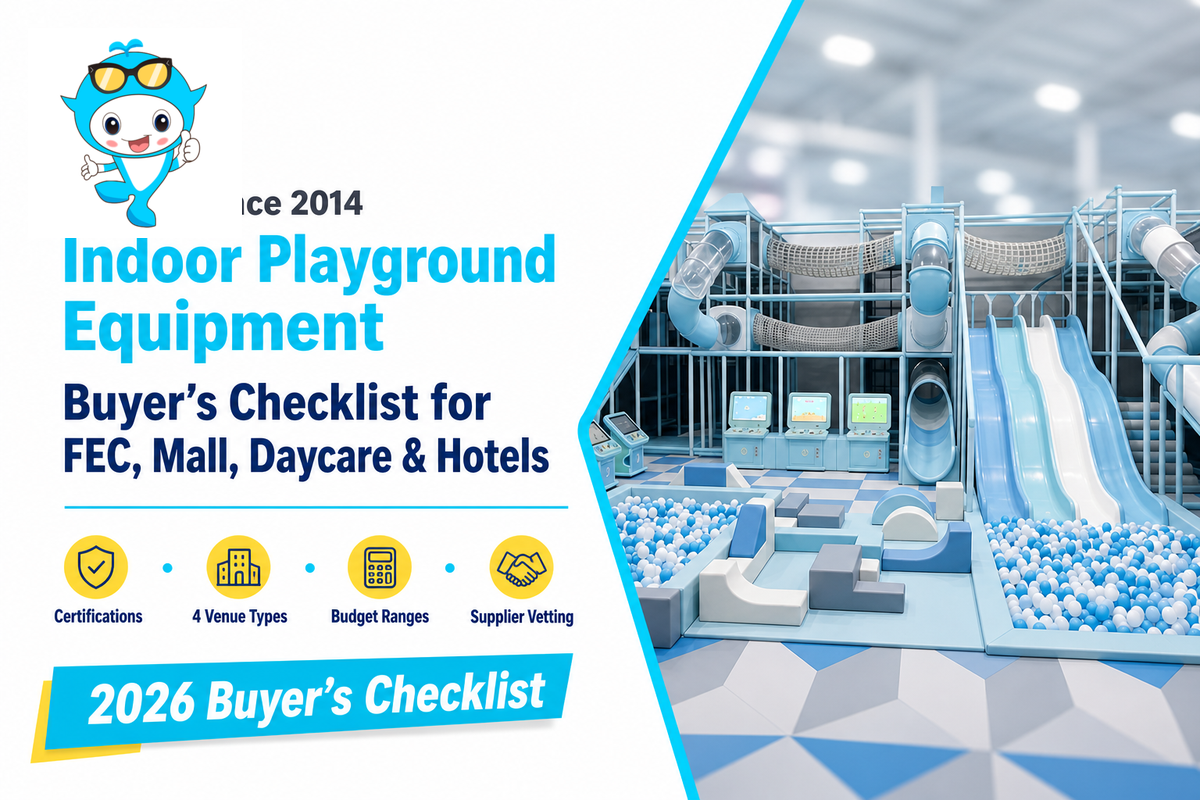
How to choose indoor playground equipment sounds like one decision. It isn’t. Indoor playground equipment refers to the play structures, soft-play modules, and safety surfacing that make up a commercial indoor play space, and the FEC operator, the mall developer, the daycare director, and the hotel kids’ zone planner are all buying it on paper, but they’re solving four very different problems, and the best playground equipment for a hotel lobby won’t look anything like the best playground equipment for a trampoline-centric family entertainment center. This checklist is built around that fundamental difference.
Quick Specs
| FEC | Throughput, liability at scale, multi-level play structures & trampolines |
| Mall & Mixed-Use | Lease-term amortization, footfall lift, atrium-scale ball pits & slides |
| Daycare | Licensing alignment, age-banded soft play modules, supervision sight-lines |
| Hospitality | Unsupervised-play design, minimal-footprint modular units, brand fit |
What This Checklist Covers
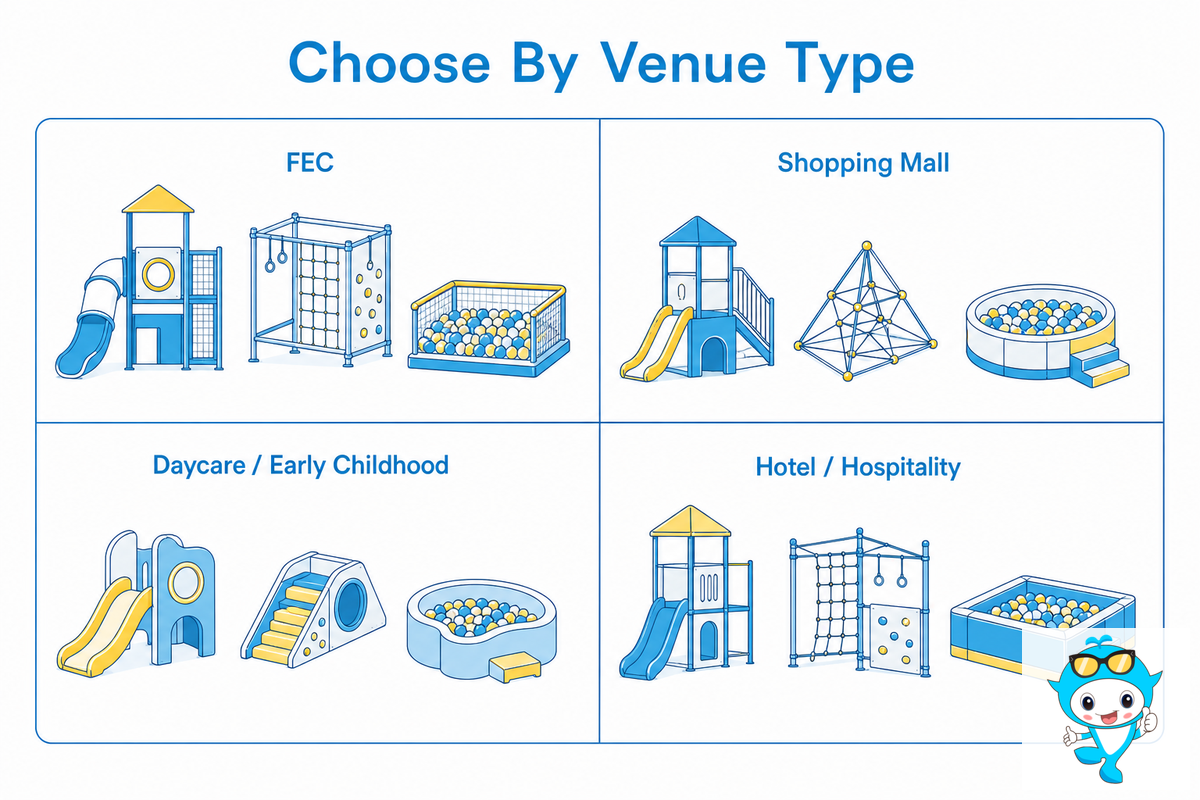
Most guides for buying indoor playground equipment cater to just one buyer and assume the rest are similar enough. That’s a false assumption. A play area built for an FEC must handle continuous peak usage of trampolines and ball pits. A play space built into a hotel lobby must function without dedicated supervision. This checklist gives every commercial buyer a baseline to check first, then breaks out what changes for each of the four venue types below.
Planning and research for a new playground should start with your venue, not a product catalog. An FEC operator, mall developer, daycare director, and hotel kids’-zone planner are all choosing a playground in a very general sense, but each is choosing the best fit for a specific play environment, designed for kids of all ages across different age groups. This checklist emphasizes that distinction and aims to help you with choosing the right product mix before diving into product comparisons or designing a playground layout. It’s here to help you discover essential tips tailored to your venue type in one place rather than having to gather information from multiple sources.
Picture two buyers requesting the same quote from the same supplier in the same week: a 300 sqm FEC in Dallas planning a trampoline zone, and a 20 sqm hotel lobby corner in Orlando planning a toddler play nook. Both received a spec sheet listing ASTM F1487 compliance and a 5-year steel warranty — identical paperwork. But the FEC needed the certification because its insurer required proof before binding a liability policy at that visitor volume, while the hotel needed it because an unsupervised toddler falling near the concierge desk is a very different risk than the same fall inside a staffed play zone. Same document, two different reasons it mattered.
The Universal Baseline, 6 Things Every Commercial Buyer Must Verify First
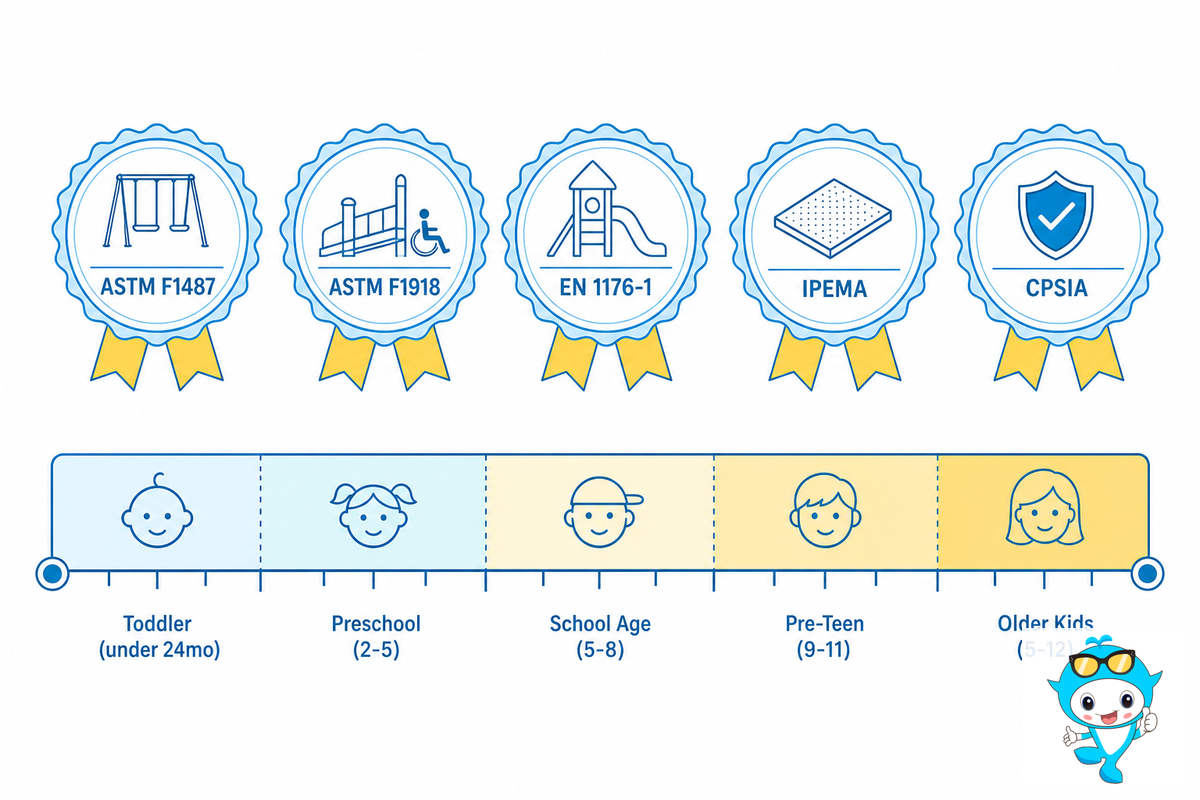
Before any venue-specific choices are made, all commercial indoor playground equipment purchases must meet a universal set of standards. The Didi Land compliance stack is built around this foundational layer, developed because of a significant quality and paperwork gap in the market:
| Standard | What It Actually Verifies | Ask For |
|---|---|---|
| ASTM F1487 | Structural playground equipment for the 2-12 age range: heights, clearances, entrapment gaps | Third-party test report, not a logo |
| ASTM F1918 | Soft contained play equipment for roughly 6 through 23 months | Age-range documentation matching your youngest visitors |
| EN 1176-1 | European general safety requirements for playground equipment | Required for EU-bound installs |
| IPEMA | Independent third-party certification service layered on top of ASTM | Certificate number you can look up, not just a badge image |
| CPSIA | US material compliance (lead, phthalates) for children’s products | Lab test report, dated within the last 2 years |
| ISO 9001:2015 | Factory-level quality management, not product-level safety | Certificate + the certifying body’s name (should be searchable) |
Beyond selecting age-appropriate items, you must ensure the equipment and materials can withstand constant commercial use. You’ll also need to choose playground components and surfaces that comply with the same certification standards as the play structures themselves. These considerations don’t eliminate the need for a personalized children’s safety assessment for your space, nor do they compensate for a surface that isn’t rated for the height of any potential fall. When you choose materials and area surfacing, cross-check both against the certification table above rather than the supplier’s marketing copy. Inclusive play design, discussed further in the hospitality section, is relevant here as well.
📐 Engineering Note
The 2025 update to the CPSC Public Playground Safety Handbook proposes an exemption for partially enclosed openings below 24 inches to align with ASTM F1487, highlighting that these standards are dynamic. Equipment certified under older editions may become non-compliant over time, so verify the edition referenced in a supplier’s test reports before you rely on it.
The 2-5 age band toddlers, 24 months and under, and the 5 to 12 older kids, all exist as their own unique age groups under baseline, having their own height, clearance and impact-surface demands – a nuance which has been discussed in full, and at a mill-certificate level, in our spec and certification audit guide. This guide assumes the baseline has been identified and explores how the equipment requirements shift when buying for a specific venue.
FEC Operators, What Changes When Throughput and Liability Drive the Decision
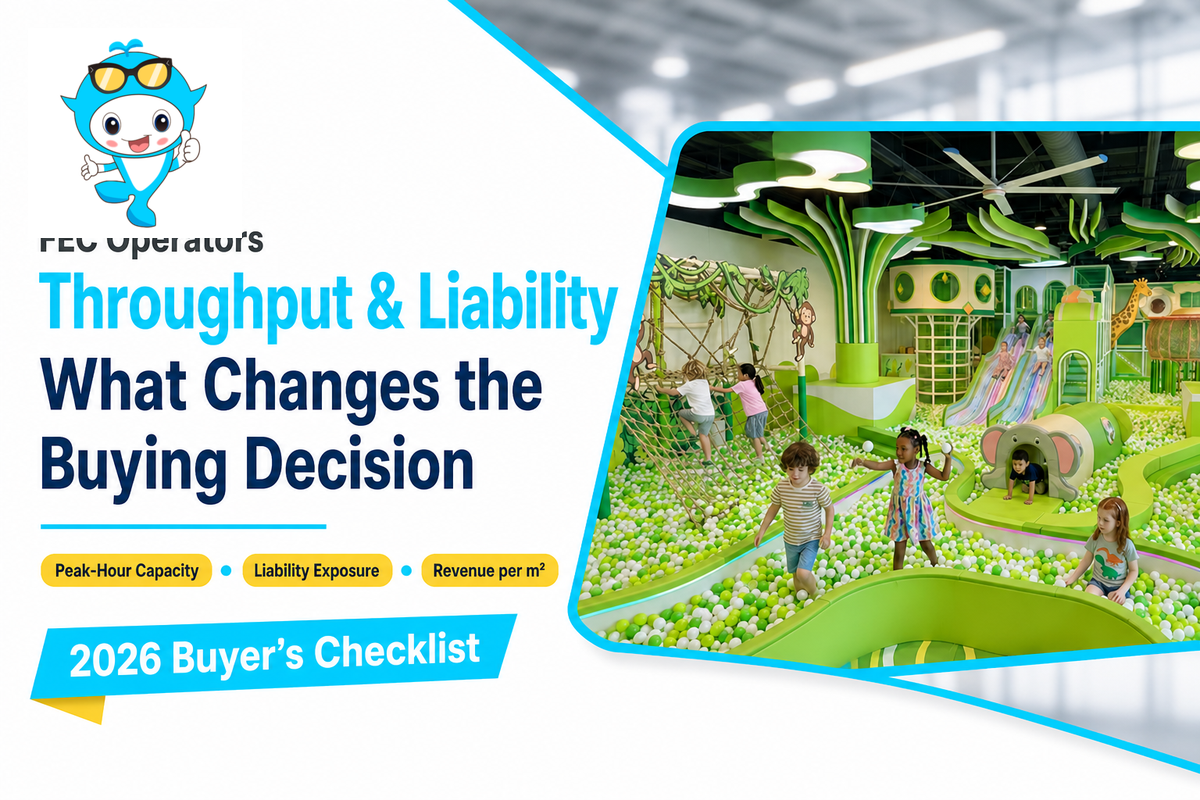
FEC is by far the most widely covered segment in this space, so we’ll briefly touch on it and point you toward more detail rather than replicate it here. Three main points of divergence from a generic FEC purchase checklist stand out: peak-hour throughput capacity (i.e. how many kids one play structure and its associated queuing space can handle before becoming a bottle-neck); the risk of liability at peak volumes of attendance (insurance underwriters frequently insist on the same CPSC-aligned paper trail before they’ll underwrite policies) and an emphasis on revenue per square meter rather than merely ensuring a safe floor. Lead times become critically important in this space as opposed to others because any delay in opening translates into an immediate revenue cost (Didi Land themselves base their factory schedule around holding a set lead-time slot for precisely this reason).
FEC staff are the ones who install the equipment, inspect the equipment on a routine schedule, and use the equipment under the heaviest footfall of any segment here. This is why durable equipment becomes a higher priority in this space compared to any other segment, as high-quality equipment and safe equipment aren’t interchangeable claims, given that a manufacturer might use genuinely durable metal which nonetheless can’t withstand a soft-surface test.
Consider an FEC operator opening a 350 sqm location with a lease-driven opening date and almost no room for a shipping delay: production windows in this category commonly run 25 to 55 days before shipping even starts, so if that window slips even a week, the venue can miss its opening weekend entirely — historically the highest-traffic weekend a new location will see. Even a conservative estimate of one weekend’s lost gate and party-room revenue can outweigh the price gap between two competing quotes many times over, which is why FEC buyers should weigh a supplier’s demonstrated lead-time reliability as heavily as its unit price.
Mall & Mixed-Use Operators, Matching Equipment to Lease Terms and Footfall Economics
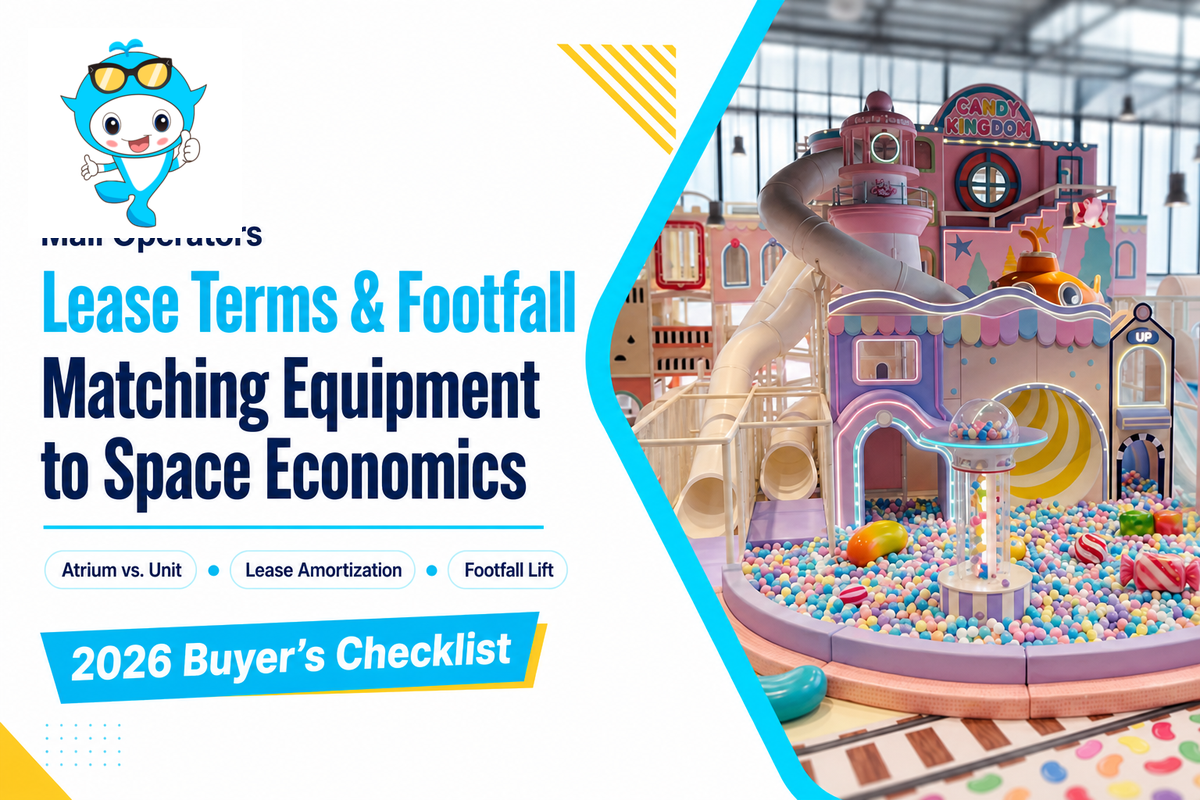
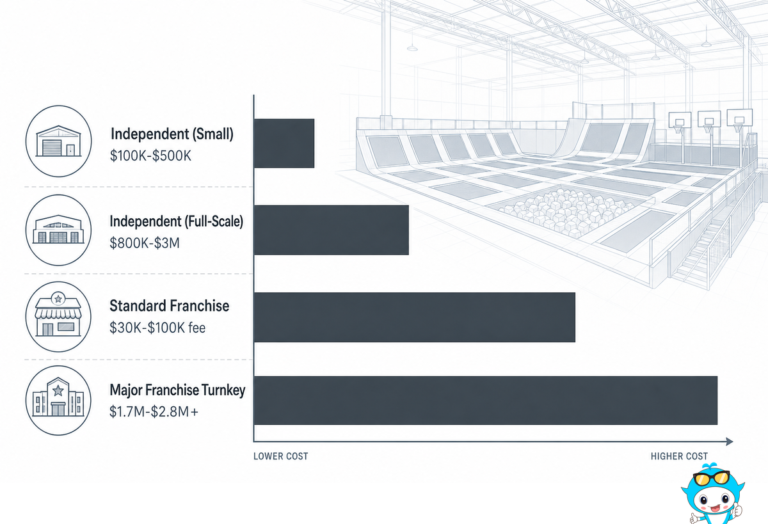
Mall and mixed-use operators are solving a different problem than an FEC; equipment needs to stand on its own two feet against a fixed lease agreement and to provide justification to the property owner via a footfall-lift, not form the basis of the entire business itself. Reported construction costs in this category vary by scope and by whom the figure is sourced. Independent figures indicate that the costs of building commercial indoor play spaces are typically between roughly $100 and $500 per square meter, a spread wide enough to make any single figure unreliable. Reported payback times are equally variable but cluster between about 18 months and 5 years, depending on the source. Instead of repeating a specific number here, our full cost guide for FEC operators breaks these figures down by scope.
Every playground project in this category need to begin with a simple question: are you purchasing playground equipment to serve a specific center, or to be an amenity at a larger destination that already draws its own crowd? The answer shape what to consider when buying and how you approach choosing the best playground format for the space, a small soft play corner tucked into a larger facility is a different playground construction project than a small playground destination built to stand alone, and treating small play as a scaled-down FEC build is the fastest way to overspend on a new play concept nobody asked for.
✔ Mall-Atrium Model
- Equipment amortized against the co-tenancy lease term, not treated as a standalone business
- Sized to draw foot traffic past anchor tenants, not to maximize dwell time alone
- Usually a shared-space install: fewer walls, more visibility requirements
⚠ Dedicated-Unit Model
- Equipment carries the full revenue case on its own, closer to the FEC model
- Higher upfront equipment density expected per square meter
- Lease negotiation dynamics shift, landlord has less incentive to subsidize build-out
Daycare & Early Childhood Centers, The Daycare Blind Spot
Daycare search for playground equipment has clear and measurable search volume-we’ve found that roughly 720 U.S. monthly searches fall under a cluster of queries such as “playground equipment for daycare” and “daycare play equipment”-with an annual bump that aligns with back-to-school in September-and yet, most of the purchase guides we surveyed during our research have nothing dedicated for daycare buyers. That oversight is precisely why this guide exists.
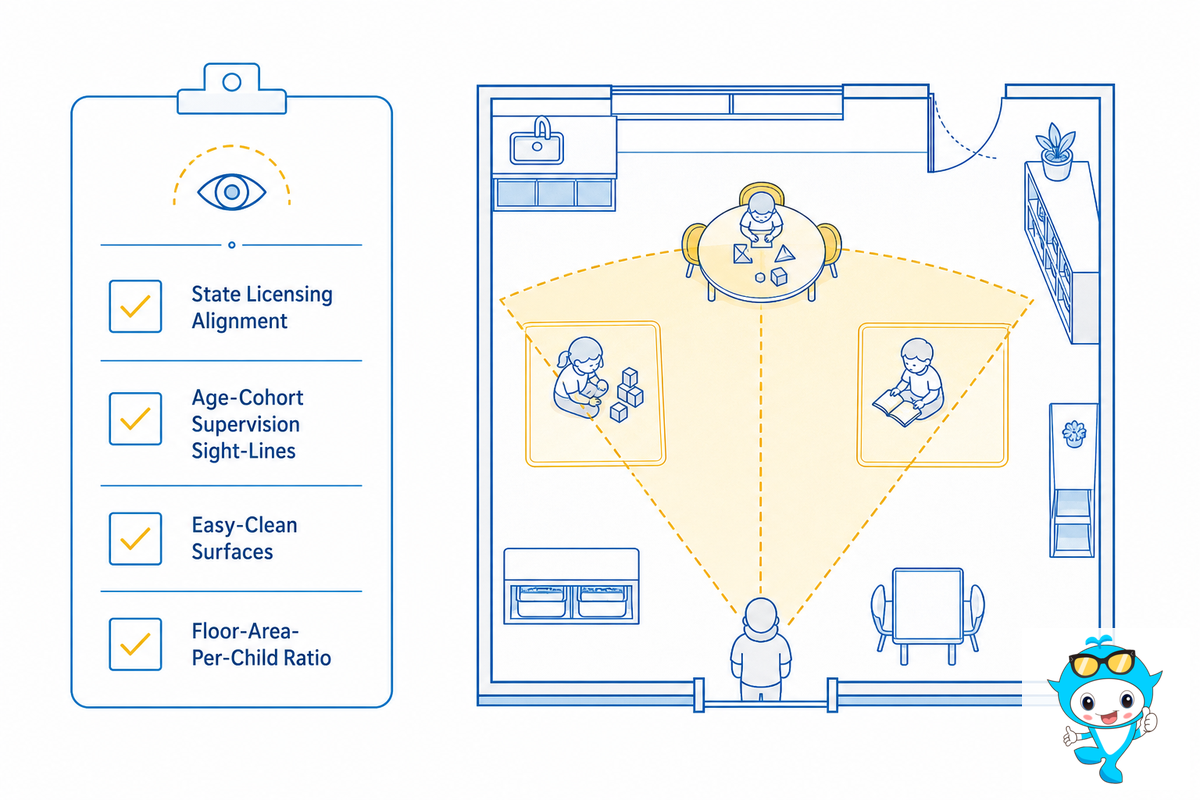
- Verify all local licensing regulations regarding play area size prior to selecting equipment, not after. For example, Michigan’s 2025 child care center licensing rules require a minimum of 600 sq ft of designated play area space before a license is even issued, and Virginia’s child day center standards limit the openings of play equipment to no larger than 3.5 inches wide by 6.25 inches tall, to avoid child entanglements.
- Implement the ASTM F1487/F1918 age banding to specific age groups within your classrooms, rather than to the entire facility. For rooms that combine toddler and preschool aged children, it’s generally best to use separate sets of age-appropriate play structures, instead of a single one.
- Examine the lines of sight for supervisors from all areas within the space, paying close attention during nap time and during transitions to and from mealtimes, because a daycare environment usually has lower adult-to-child ratios than an FEC, so equipment that obscures visibility is a structural safety risk, not just a minor inconvenience.
- In rooms located near areas designated for quiet time or sleep, prioritize soft play components and low-lying slides over static climbing structures, as noise levels and the risk of falls carry more weight in this environment than in FECs.
- Ensure all surfaces in your center are designed to be easily wiped down and sanitized daily, as daycare facilities generally have higher cleaning inspection frequencies compared to many commercial play venues.
One common pitfall for centers is using total facility square footage rather than state-mandated square footage per child when sizing equipment-these two numbers don’t always align, and state inspectors verify the latter.
Provide different, age-appropriate kids play zones for both preschoolers and older classroom children, rather than merely downsizing the play area, putting monkey bars sized for a 6-year-old in a room for younger kids is an easy way to run afoul of regulations. When purchasing surfaces, daycare buyers should look for longer-lasting play materials that withstand frequent sanitation, and for play options that let staff rotate zones so every child get a turn without kids to play in structures meant for a higher age group. This is the part of playground buying that most generic checklists skip entirely.
Consider a director opening a new toddler room in a Michigan daycare center: the state’s 2025 licensing rules require at least 600 square feet of dedicated play area before the license is even issued, and any equipment in that room has to keep openings under 3.5 by 6.25 inches under the entrapment rule that several states, including Virginia, apply to licensed centers. A director who orders equipment sized for the room’s total square footage — say, a 900 sqft classroom — without checking how much of that is actually designated play area can end up with a structure that technically doesn’t fit the license, not just the room.
Hotels & Hospitality Venues, Designing for Unsupervised Play and Brand Fit
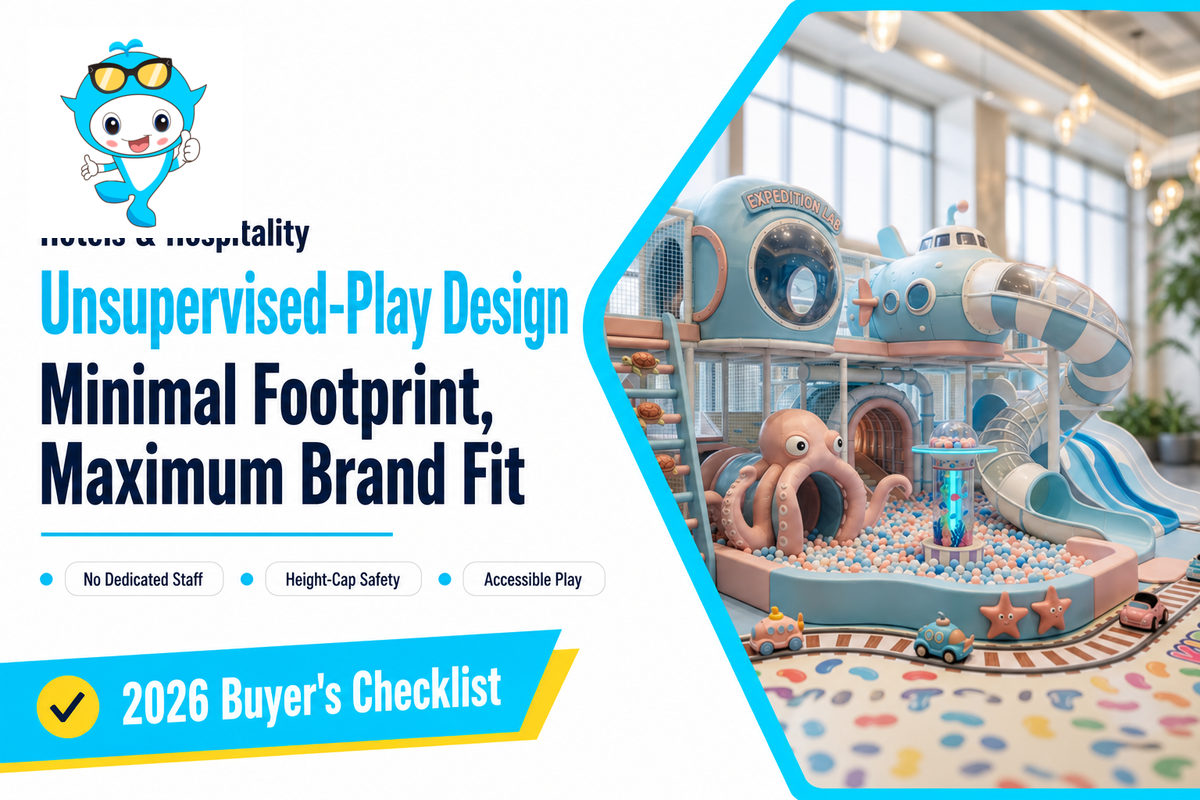
There’s a constraint nearly none of the mainstream buying guides talk about at all, to hotel and hospitality buyers: usually, there’s no dedicated playground staff watching the equipment the way there would be in an FEC or licensed daycare. There are a few specialty guides for hotel kids’-club operators that have this aspect, so we know it’s a demand. However, none of the standard guides out there actually flesh this angle out. In practical terms, that means what we call The Unsupervised-Play Design Rule: equipment should be self-limiting, not staff-limited.
💡 Pro Tip
For unsupervised or lightly-supervised hospitality installations, cap climbing height so that a fall doesn’t require an adult to catch it, and avoid any isolated, multi-level structure without a direct sightline to the lobby desk. Better yet, consider equipment in sizes that are appropriate for a 15-30 sq. meter corner, versus an FEC-sized playground installation or full-sized play structure. Accessibility elements-such as a ramp entry in addition to a climb-double up the benefit: more people can use the space and you need fewer unique equipment pieces in that limited area.
Don’t install full-sized playground sets, built for the equipment types an FEC needs, in a hotel’s indoor play area. In this space, an FEC’s play structure is overkill — the right playground equipment here is a single, self-contained modular play set built for enjoyable, fun play and staff-independence, with accessible play elements like a ramp entry alongside the climbing feature. In addition to equipment selection, customer experience is important in this market; matching the theme to your hotel’s brand creates a thoughtful, integrated design rather than the look of an add-on.
Consider a resort-style hotel renovating its lobby: it might be tempted by the same multi-level climbing structure its FEC supplier also sells to family entertainment centers, since it is the most visually impressive item in the catalog. But a front-desk agent who can only glance over every few minutes is not the same supervision model as an FEC attendant stationed at the play area full time, and a structure tall enough to need that level of watching is the wrong choice, because the root cause of most hospitality play-area incidents is a supervision gap, not a manufacturing defect. A shorter, self-limiting module the same agent can see across the whole lobby in one glance is the safer call, even if it looks less dramatic in a brochure photo.
Supplier Verification, The Pre-Deposit Paper Trail
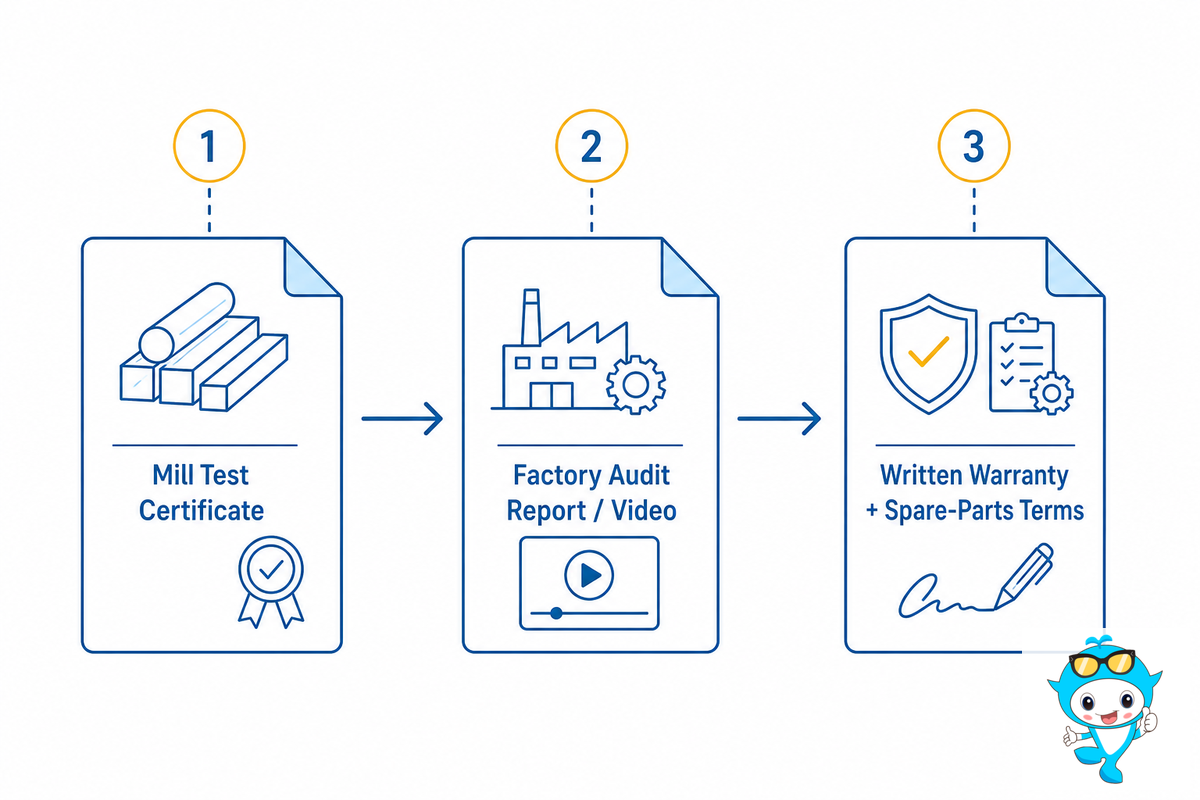
Regardless of the installation venue, it’s essential to get a quote for supplier paperwork *before* specifying equipment. Most legitimate equipment suppliers will provide the three items listed below within 48 hours; any hesitation on these is a bad sign:
Key Factors to Consider
- Third-party lab reports or mill test certificates for whatever standards your product(s) will be claiming (e.g. ASTM, EN, CSA), as opposed to product spec sheets or marketing brochures with product cert graphics on the page.
- A report from a factory audit, or a video tour of a factory tour, with live video. We found no live factory videos and very vague, unsubstantiated certificates on the products we reviewed for this article.
- A written warranty detailing regular maintenance availability and lead times, not just the length of the warranty — structural steel commonly carries 5 to 10 years, while soft-play foam and upholstery are typically 2 to 3 years.
“The market is full of playground equipment that looks fine on day one, poor quality, high prices, and slow after-sales response are the three complaints we hear most from operators who bought from the wrong supplier.”
Ms. Cherry, CEO & Co-Founder, Guangzhou Didi Land Amusement Equipment Co., Ltd.
To be extremely clear, a lower price isn’t automatically more risk. However, we’ve seen too many customers go broke because they quoted a price before a product was adequately specified, and too many weren’t properly vetted. For a document-by-document walkthrough of what a supplier’s paperwork should actually contain, see our 4-document verification guide, and for a broader manufacturer-vetting framework, our supplier comparison guide.
A few practical tips for buying playground equipment remain the same no matter the segment: identify who will install the equipment on-site, who will perform routine inspections of the equipment on an ongoing maintenance schedule following handoff, and who will train your staff on daily, safe operation. Any equipment manufacturer worth working with can answer these directly. Whether you’re setting up a brand-new indoor playground or choosing the right indoor playground equipment for an expansion, ask point blank: does this equipment meet the certification baseline mentioned in the section above? No ‘yes’s allowed; there should be documentation, regardless of whether you’re purchasing structural steel or soft play equipment for a toddler zone.
Cross-Segment Requirement & Budget Comparison
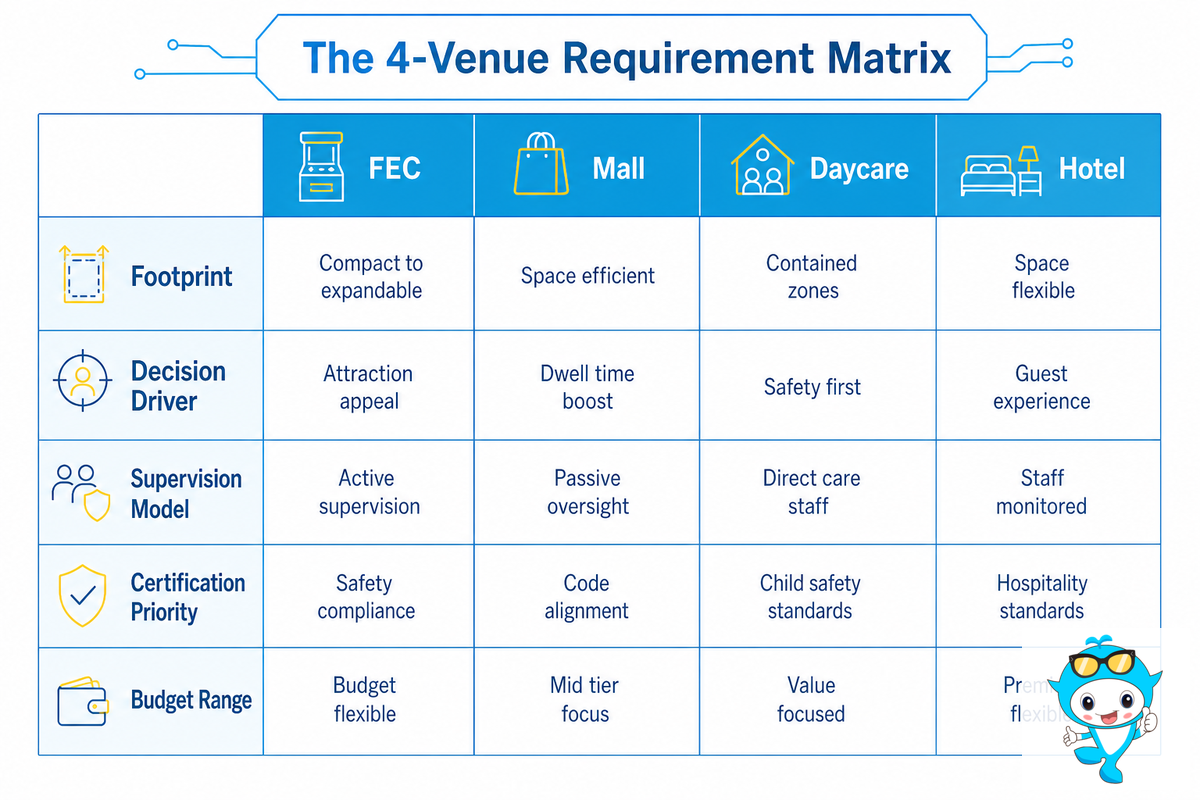
After reading your own section, here’s how it stacks up against the other three: the 4-Venue Requirement Matrix. The Certification Priority row below still traces back to the same ASTM/IPEMA baseline covered earlier, just weighted differently per venue.
| Factor | FEC | Mall & Mixed-Use | Daycare | Hospitality |
|---|---|---|---|---|
| Typical Footprint | 250-450 sqm | 80-150 sqm atrium | 30-60 sqm classroom zone | 15-30 sqm lobby corner |
| Primary Decision Driver | Throughput & liability at scale | Lease-term amortization & footfall | Licensing compliance | Unsupervised-play safety & brand fit |
| Supervision Model | Dedicated staff, high volume | Light or shared staff | Fixed ratio, licensed staff | Minimal to none |
| Certification Priority | High (insurance-driven) | Medium | Highest (licensing-tied) | Medium (liability-driven) |
| Age-Range Focus | All ages, zoned | All ages, general | Toddler-to-preschool cohorts | Toddler-to-young-child |
| Budget Range (directional) | Highest | Mid-to-high | Low-to-mid | Low |
| Payback Framing | Standalone revenue case | Amortized against lease | Not revenue-driven | Guest-retention driven, not direct revenue |
| Equipment Mix Bias | Trampolines, multi-level play structures | Ball pits, slides | Soft play modules, low-height slides | Compact modular soft play |
| Biggest Risk Factor | Peak-load structural failure | Lease-term mismatch | Licensing non-compliance | Unsupervised injury liability |
Industry Outlook, Why Buyers Are Searching Suppliers More Than Products in 2026
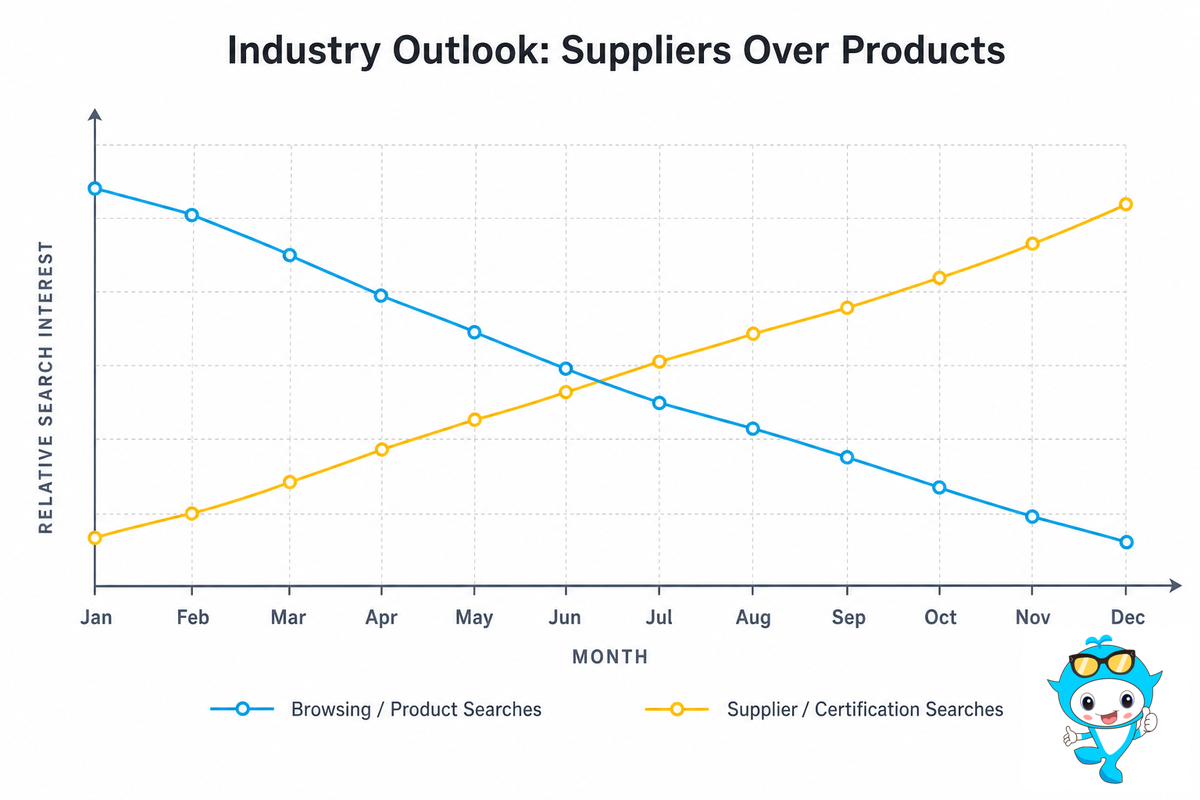
Search data reveals a distinct shift in how consumers research and approach this category. In the trailing 12 months, searches for generic terms such as “indoor playground equipment,” “commercial playground equipment,” and “…for sale” declined by an estimated 15%-55%. Meanwhile, searches focused on supplier verification and certifications, such as “playground supplier,” “playground equipment suppliers,” “ipema certified,” and “astm f1487,” grew between 10% and 33% during the same period. Taken together, this doesn’t signify waning consumer interest; instead, it suggests consumers are doing their homework earlier in the process before even comparing products. The 2025 update to the federal playground safety handbook solidifies this trend, underscoring the increasing importance of suppliers who can provide clear records on the edition of the safety standards the equipment was tested against, regardless of price. For 2026 purchases, factor in time for reviewing the paper trail prior to allocating budget for the equipment itself.
Why We Wrote This Checklist
We wrote this guide after noticing that most “how to choose indoor playground equipment” content online is built for one buyer persona, usually an FEC owner, and treats mall, daycare, and hotel buyers as an afterthought. Didi Land ships equipment into all four venue types across 40+ countries, and the daycare-licensing and hospitality-liability questions here come up in real supplier conversations more often than most guides suggest. Reviewed by the Guangzhou Didi Land Amusement Equipment Co., Ltd. technical team.
Q: How do I choose indoor playground equipment for a daycare vs. an FEC?
View Answer
Daycare buyers emphasize compliance with state licensing, ASTM F1487 age banding for classroom groups, supervision visibility, and easy-to-clean surfaces for daily sanitation cycles. An FEC operator prioritizes high traffic capacity during peak hours, minimizing liability at high visitor volumes, and maximizing revenue per square meter ROI. Equipment type also varies significantly: daycares typically favor soft play modules and low-profile slides, while FECs often opt for multi-level play structures and trampolines.
Q: What certifications should indoor playground equipment have?
View Answer
At minimum, safety and compliance require ASTM F1487 and ASTM F1918 (USA), EN 1176-1 (Europe), IPEMA certification, and CPSIA material compliance. These are not mere marketing emblems; always request actual test reports from suppliers, not just images of certificates, and independently verify the credibility of the certifying lab before accepting them as sufficient.
Q: How much does commercial indoor playground equipment cost?
View Answer
Pricing ranges enormously by footprint and equipment mix, so treat any single number with real caution. Independently reported ranges for atrium-scale installs run roughly $100 to $500 per square meter depending on scope, with payback commonly cited between 18 months and 5 years — directional, not a quote. Daycare and hospitality installs are usually smaller-footprint and lower-cost than FEC or mall builds.
Q: Is the cheapest supplier always the riskiest?
View Answer
Price 30% or more below market price with a dearth of case studies and lacking safety documentation is consistently a bright red flag.
Q: What permits are needed for an indoor playground?
View Answer
Build or fire code requirements vary depending on jurisdiction. State-mandated requirements matter most for daycare centers and school-based facilities.
References & Sources
- Public Playground Safety Handbook (2025) — U.S. Consumer Product Safety Commission
- Notice of Availability: Public Playground Safety Handbook Update — Federal Register, 2025
- Playground Safety Resources — IPA USA
- ASTM F1487-21: Playground Equipment for Public Use — ANSI Blog
- Licensing Rules for Child Care Centers — Michigan MiLEAP, 2025
- Standards for Licensed Child Day Centers — Virginia, via U.S. HHS Administration for Children and Families
- Title 22 Child Care Licensing Regulations — California Department of Social Services
- Playground Safety — Mississippi State Department of Health
![Sustainable Indoor Playground Material Certification [2026]](https://didiplayarea.com/wp-content/uploads/2026/07/sustainable-materials-certification-en1176-astm-as4685-featured-768x512.png)