Get in Touch with Didi Land


![Custom Dinosaur Playground Equipment [Design Guide]](https://didiplayarea.com/wp-content/uploads/2026/09/custom-dinosaur-playground-equipment-r2-featured-1.png)
Updated September 2026
Custom dinosaur playground equipment begins with a decision about what children will do. Before choosing the dinosaur’s shape, decide whether the brief calls for a sculpted landmark, a themed playground climber or a complete indoor venue, because the same character can appear in proposals with different activities and responsibilities.
Custom dinosaur playground equipment is created with a dinosaur theme, specified play activities and a defined project scope. Compare the proposed actions, intended users and supporting documents before selecting a concept.
Design brief at a glance
- Detailed renderings can show concepts that have never been built.
- Each theme cue needs a stated role: scenery, a play component, or both.
- The nine-action map below organizes ideas; it doesn’t score safety or child development.
- Equipment requirements and venue requirements need separate, coordinated review.
What makes dinosaur playground equipment custom?
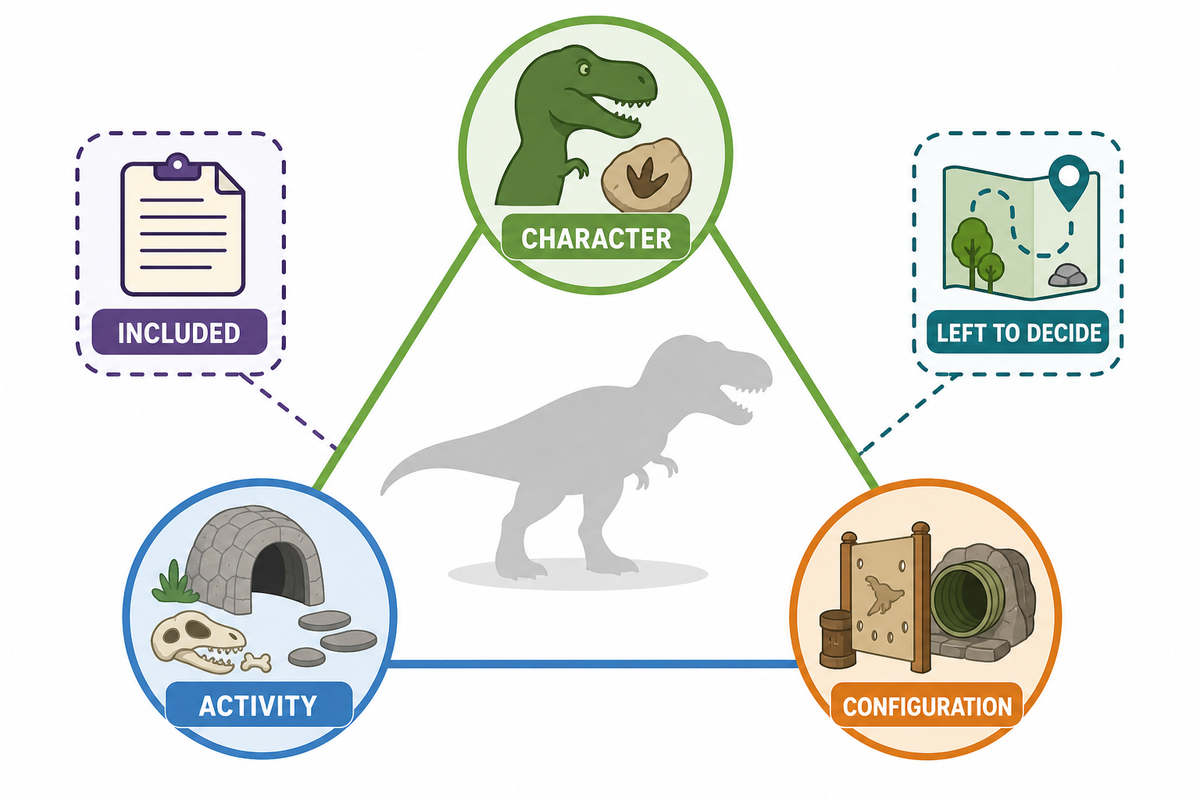
Custom dinosaur playground equipment can alter the character, the activity or the configuration of a play area. An effective starting point is a written scope that separates decoration from equipment and venue design changes. Each proposal should state what’s included and what’s left for others to decide.
Suppose one community park brief specifies a dinosaur landmark. One proposal produces a sculpted entryway installed next to current equipment. Another places a climber in the dinosaur’s middle. Both look themed, but only the second proposal designs a new climbing activity. Compare the proposals by scope and activity, not only height or color.
Online lists for custom dinosaur playground equipment for sale may specify stand-alone playground equipment or elements of a whole venue proposal. Comparing one price with another without reading the scope documentation is a mistake: the lesser quote may just include different work. Put the activities included and excluded together with the prices before choosing a proposal for further details.
The U.S. Consumer Product Safety Commission’s playground equipment guidance differentiates product types and uses. Before selecting two quotations as equivalent, compare their product descriptions and purposes, because the general appearance of the dinosaur gives no information for the purposes identified in the guidance.
For a whole venue indoors, include floor plans showing the design of the venue walls and facilities, to clarify which elements and areas are included in the scope. Mark concept images as concepts. Photographs of a different installation can’t establish the details of your product.
Didi Land’s custom dinosaur playground solution is a starting point for defining a themed indoor venue. Bring the brief elements that you want to examine to that discussion. The first visual preference should be included with the activities and the missing site information.
Turn a dinosaur themed playground into play actions
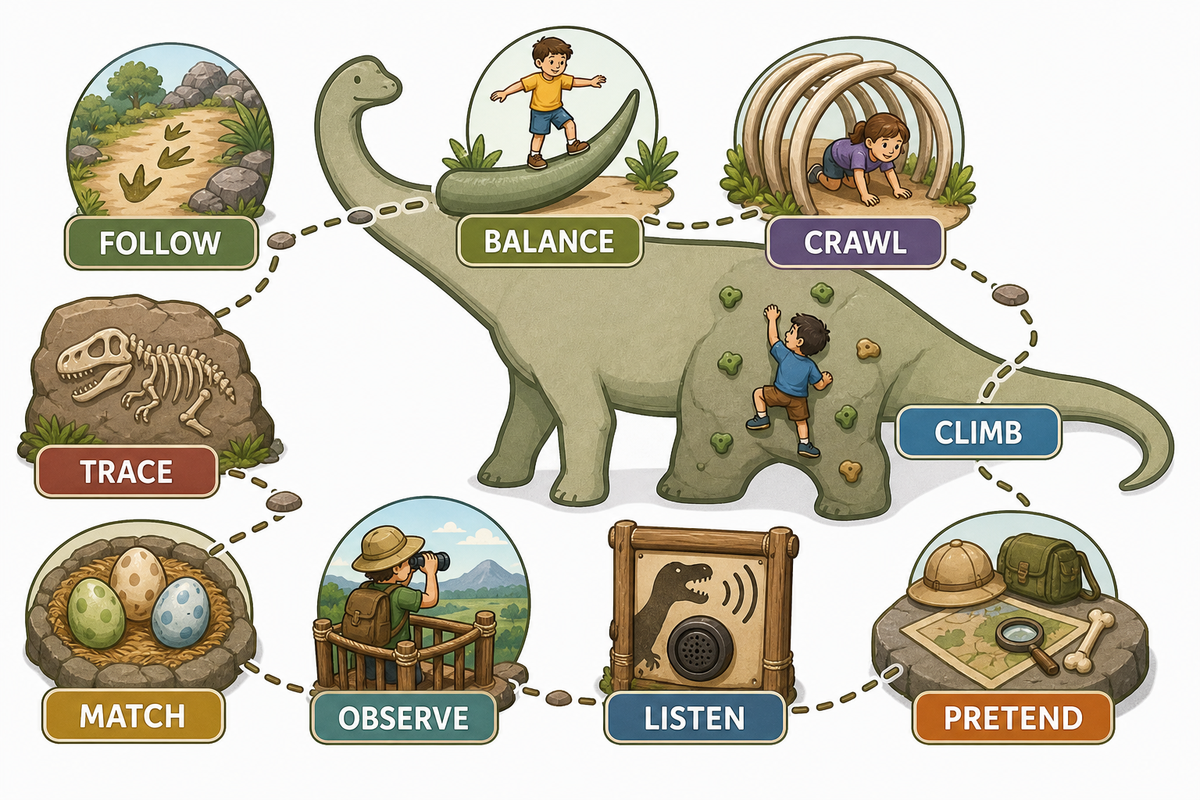
Associate each themed element of the proposed dinosaur playground climber with a defined play activity so a discussion about the drawing can define how the suggested equipment would support that activity, and which details can still be defined. The same visual theme can support different ideas; judge that variety against the experience described in the brief.
9-Action Dino Play Map
The 9-Action Dino Play Map links a theme of a dinosaur to a proposed activity and an issue to define during design.
| Scene cue | Proposed action | Design question | Limitations / Not suitable for |
|---|---|---|---|
| Footprint trail | Follow | Where does the trail lead? | Graphics alone do not define a usable route. |
| Dinosaur tail | Balance | Is the tail designed for this activity? | Decorative tails should not be assumed playable. |
| Rib-shaped passage | Crawl | How will the passage be entered and left? | The drawing alone does not establish opening suitability. |
| Dinosaur body | Climb | Which parts are intended for climbing? | Sculptures are not automatically climbers. |
| Fossil wall | Trace | Can the intended user approach and touch it? | Touch activities need their own component review. |
| Egg station | Match | What makes the matching task understandable? | Loose props introduce separate selection questions. |
| Lookout scene | Observe | What can a visitor see from the chosen position? | Lookout concepts do not establish supervision coverage. |
| Sound panel | Listen | Can the visitor choose whether to activate it? | Do not assume sound suits every visitor. |
| Expedition station | Pretend | What story can a visitor invent? | Story prompts do not guarantee participation. |
Suppose one conceptual family venue sketch places every proposed activity inside a large dinosaur body. During discussion the venue operator asks how a child who wanted to trace a fossil would decide to do that action without taking part in climbing activity, and the designer changes the sketch so that another option is included. The designer has to establish where the new option is located and how it’s built. The map has been useful to communicate the alternative; it hasn’t proven that the new setup is better.
That difference matters. A 2025 systematic review of school playground enrichment found that evidence of cognitive, psychological and social development was inconclusive. Those school studies didn’t examine this dinosaur map. Apply the map as a way to generate and compare options, without attaching developmental promises to the number of activities.
Compare a dinosaur playground climber with dinosaur soft play
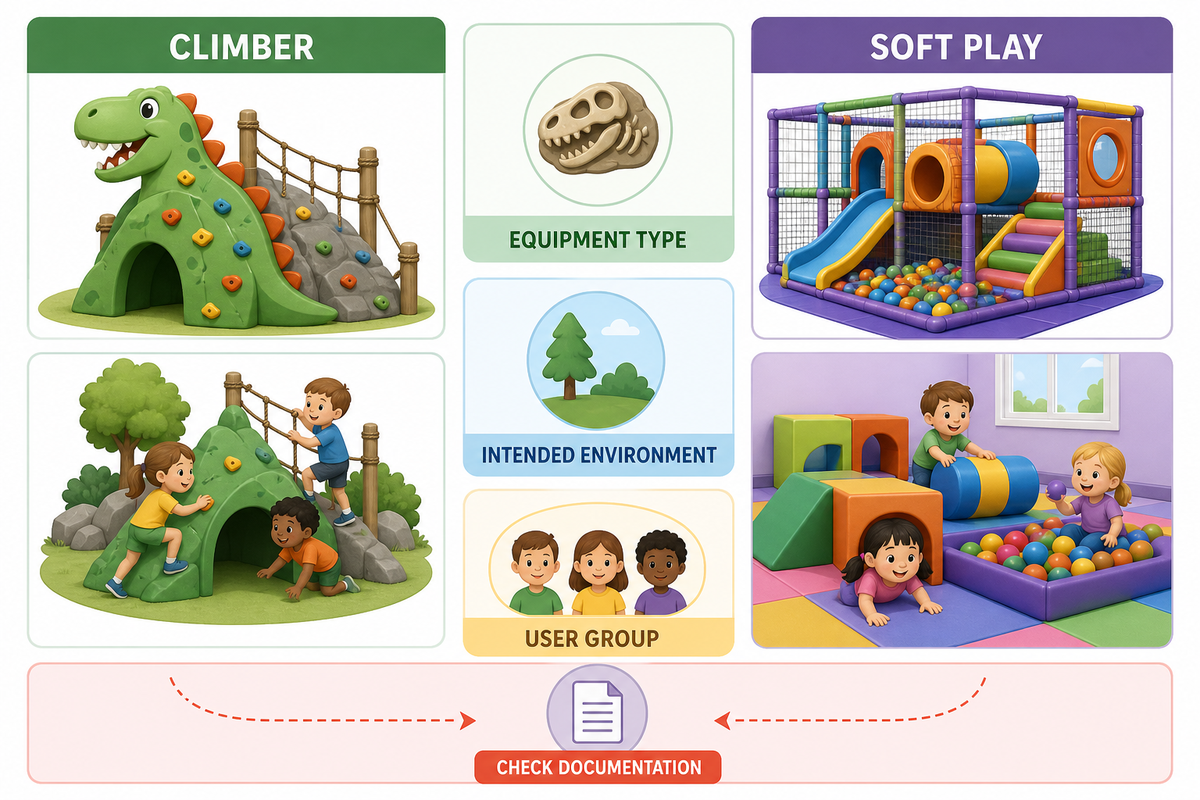
In comparing a dinosaur playground climber with a dinosaur soft play proposal, identify each product’s equipment type, intended environment and user group in the quotations, then check that each quotation addresses the setting described for that option in your brief. The theme, color and padded appearance tell you very little about suitability.
What is soft play?
Soft play is a broad commercial description for play involving padded or pliable features. Soft contained play equipment has a more specific meaning in the U.S. Access Board’s play-area guide: the user enters a fully enclosed play environment with pliable materials. Padding on an object in an open area is insufficient to establish that the product falls within that definition.
The public scope of ASTM F1918-21 for soft contained play equipment excludes several other product categories, including public playground equipment and amusement rides. Request the competent authority to clarify the scope. Our guide to what soft play includes clarifies the terms prior to a detailed project discussion.
Selecting the wrong category causes a problem before anyone compares features: the documents under review could refer to a different kind of equipment. For instance, a dinosaur-shaped ride might not be assigned to the soft contained play category on the grounds that its saddle is padded. Clarify the category with the competent authority prior to asking for standards evidence.
Can indoor dinosaur play equipment be used outdoors?
Before proposing outdoor use for indoor dinosaur play equipment, ask the manufacturer to confirm the intended outdoor use of the exact product and assembly configuration. Where a similar outdoor model is available, keep its intended use documentation separate from the indoor product information, and ask the manufacturer which materials, finishes and assembly details apply to the exact product in your proposed setting.
Imagine a potential customer comparing a themed playground climber for a local park with padded activities for a shopping-center setting. The photographs feature the same species of dinosaur, but the supplier’s documentation must specify each structure’s intended use and proposed installation conditions. Investigate a category of outdoor playground equipment rather than selecting a finish from a number of color swatches. Keep the comparison at the product level until that detail is available.
Design a prehistoric setting children can read
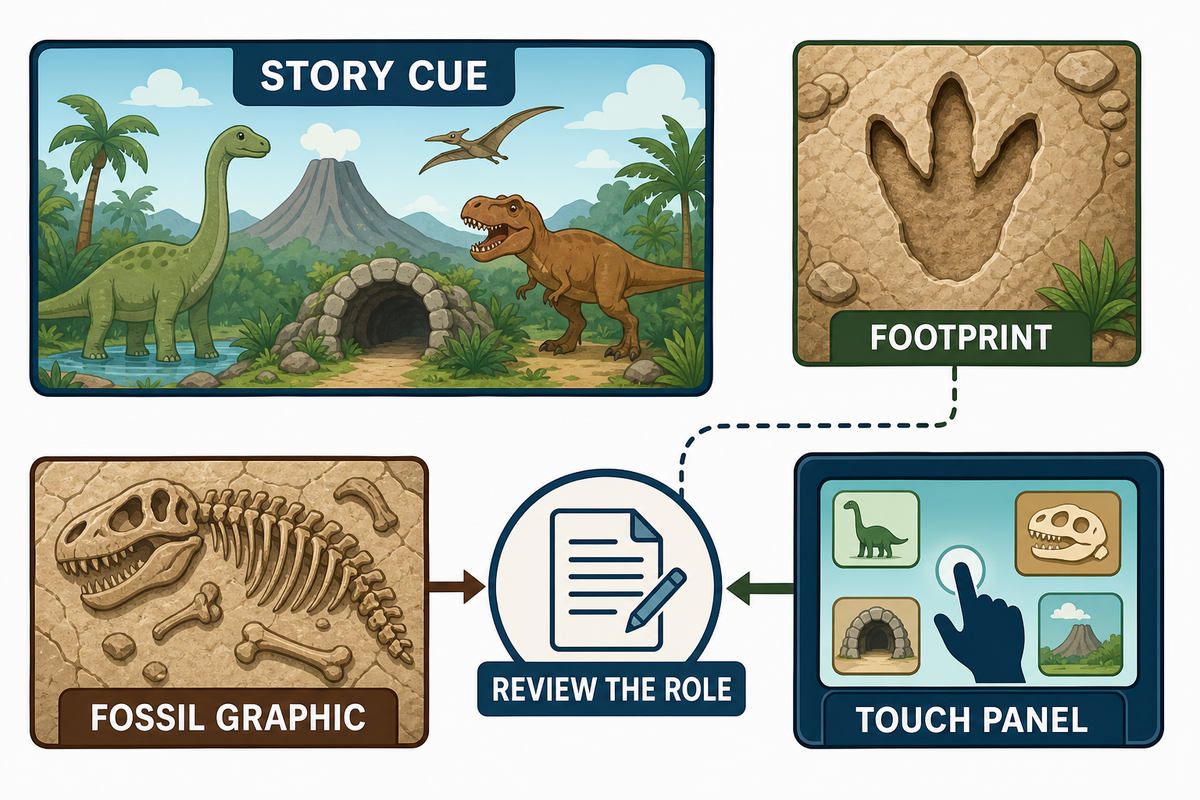
Introduce an ancient landscape to visitors by giving them a story they can relate to without a lengthy explanation, using a small group of scene cues that relate to the proposed activities and set the prehistoric details apart from the designer’s invented story. Names, signs and graphics will explain the scene, whereas a clearly fictional story about the past allows the designer to freely combine imagined elements.
For a fossil wall, the signs provide a space to clarify the facts. The Natural History Museum’s account of its Stegosaurus specimen places that animal about 150 million years ago in present-day Wyoming. Use that fact in describing the specimen. If your scene contains a tyrannosaurus rex, don’t imply that it lived alongside Stegosaurus without a source.
Labels such as “expedition through the age of dinosaurs” can refer to a fictional journey back in time, while more specific claims about a prehistoric creature will need the appropriate reference if the feature is intended to prove a fact. For inspiration, discover what you want the viewer to find out, whether it’s a footprint they can recognize, a fossil’s outline or a story hidden beside a tree.
Decorative fossil graphic
- Its proposed role is visual storytelling.
- Review the image and location.
- Keep unintended interaction in the discussion.
Fossil touch panel
- Its proposed role includes touching.
- Review the component and attachment.
- Discuss approach and cleaning information.
Where graphics and interactive touch panels feature images, the purposes of the two elements raise different design issues. To provide activity suggestions, choose sensory play activities for optional concepts. Aim to make the decision understandable, rather than implying that a particular graphical style will motivate all children or teach to a targeted learning level.
Compare material choices beyond their appearance
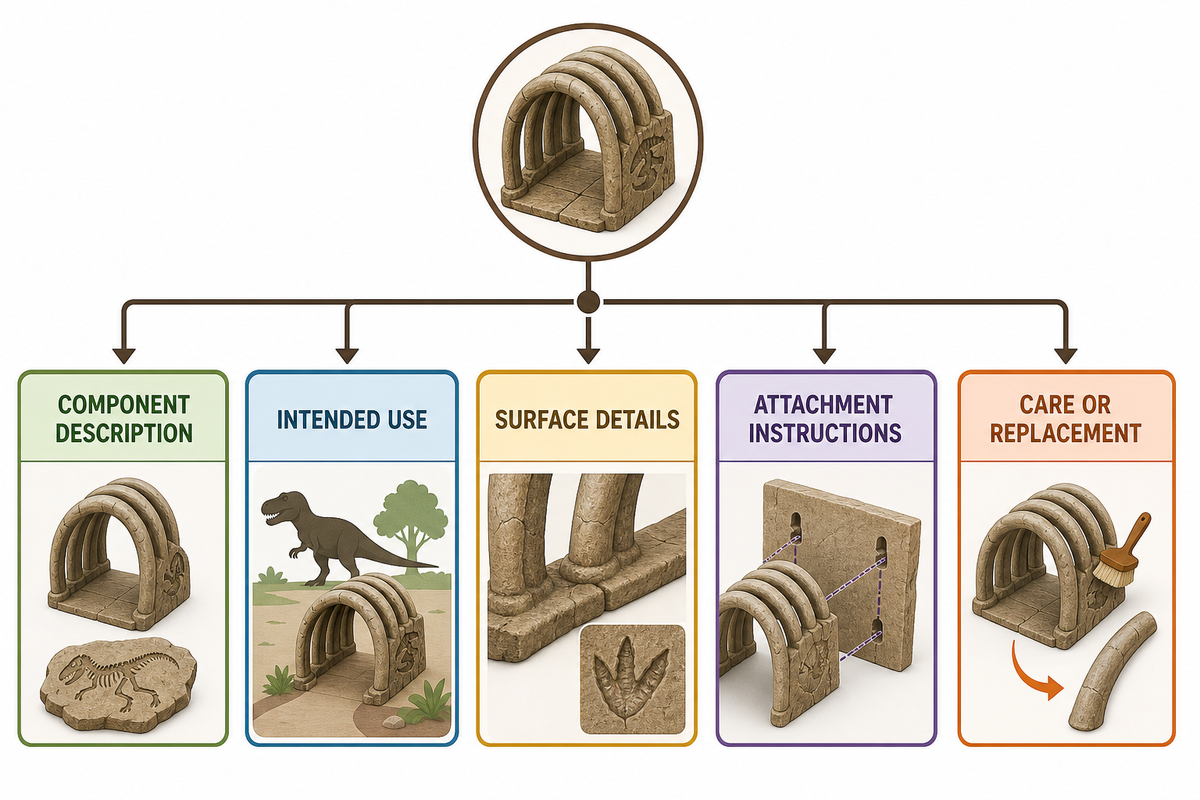
Material selections for a dinosaur-themed playground require a written component description, including intended use. While a rendering can show shape and color, confirmation of the material’s intended function requires surface details and attachment instructions, as well as information on maintenance or replacement provided by the supplier.
Logos placed by surface images don’t answer practical questions. Which of the products does the surface component document refer to? Is the intended product type made from this material? Who verifies that the surface component document matches the installed work? Keep those questions with the actual feature, rather than approving a general product range statement from the supplier.
Absence of component identifiers creates a practical problem: the customer can’t determine whether the care instructions provided with a quotation are for the panels selected. That gap becomes obvious when two samples include the same graphic but show a different surface component description. Double check the relevant identifier and instructions before selecting either sample; visual similarity won’t clarify the discrepancy.
The CPSC’s soft contained play checklist lists visible conditions to check, such as torn netting and frayed ropes. That would support a discussion of joints, seams and inspectable surfaces during a feature comparison. The checklist is aimed at parents, and doesn’t replace the equipment’s maintenance instructions or scheduled professional inspections.
Compare the proposed cover and the finished edge in a hypothetical rib passage. Ask to see the relevant surface sample and the fastening detail. If a quotation simply states “premium surface”, ask for the missing explanation before comparing that cost. The separate explanation of indoor playground cost components can help to keep material questions separate from project costs.
“The Access Board does not evaluate or certify products for compliance with the accessibility guidelines.”
Review each dinosaur scene before approving the design
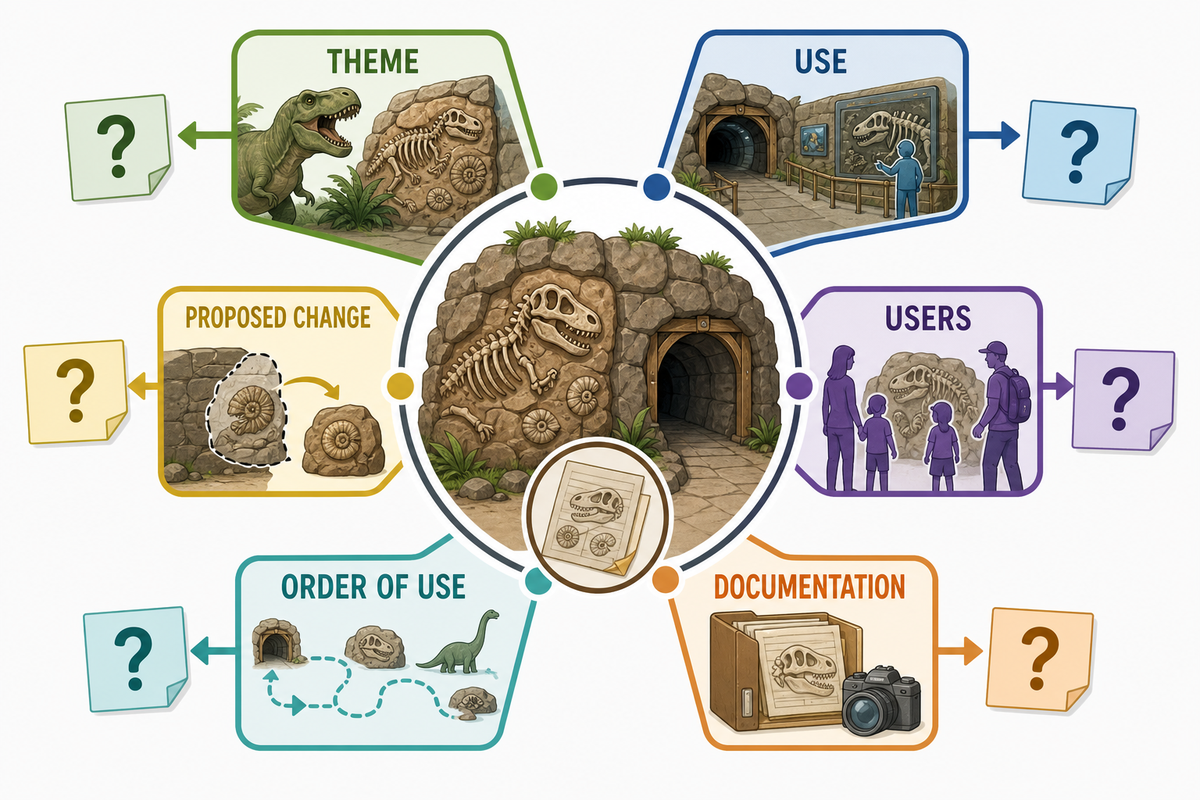
A feature-by-feature review of each dinosaur scene requires ascertaining the function of that feature, and the information used to support that function. Include a dated drawing to ensure the discussion refers to the same version. Cross reference unanswered questions to the feature, and then ask the responsible designer or service specialist to clarify before your relevant approval.
6-Question Scene Review
The 6-Question Scene Review logs the theme, use, users, documentation, order of use, and proposed change for a feature discussion with the work team.
Start with the theme cue: How does this feature contribute to the dinosaur narrative? Identify the play function. Follow with what’s known of intended users, what the visitor will see, approach and select, the attachments and documentation, the order of use, and the design revision evidence.
Consider a fictional example. Assume the last design for a fossil wall was called F-04. For Revision B, the designer has replaced a fixed graphic surface with a removable touch panel. The theme cue is still fossils; the proposed action has shifted from observe to touch. The record set by the project manager asks for the panel identifier, attachment detail and cleaning instructions. The initial sketch shows where a visitor would stand to explore the panel, but the designer hasn’t yet supplied the requested attach detail. Keep that unresolved question with Revision B. The surface is marked as removable on the drawing, but the team hasn’t received any indication whether the proposed construction supports removal. Keep Revision B and that unresolved question together.
A parent’s preference for nearby seating to rest while children explore offers a different project perspective. Can the proposed activity be understood from that location? Where would a visitor who prefers observing choose to pause? Now bring those considerations along with the larger indoor playground layout.
The review carries no pass level. Consider it as a reason to put a proposal in words and find the missing information; technical approval has a separate process. Use the Access Board’s guidance on play components as a formal reference when searching for a different way to discuss accessible routes and component types.
Plan cleaning and changeable play elements
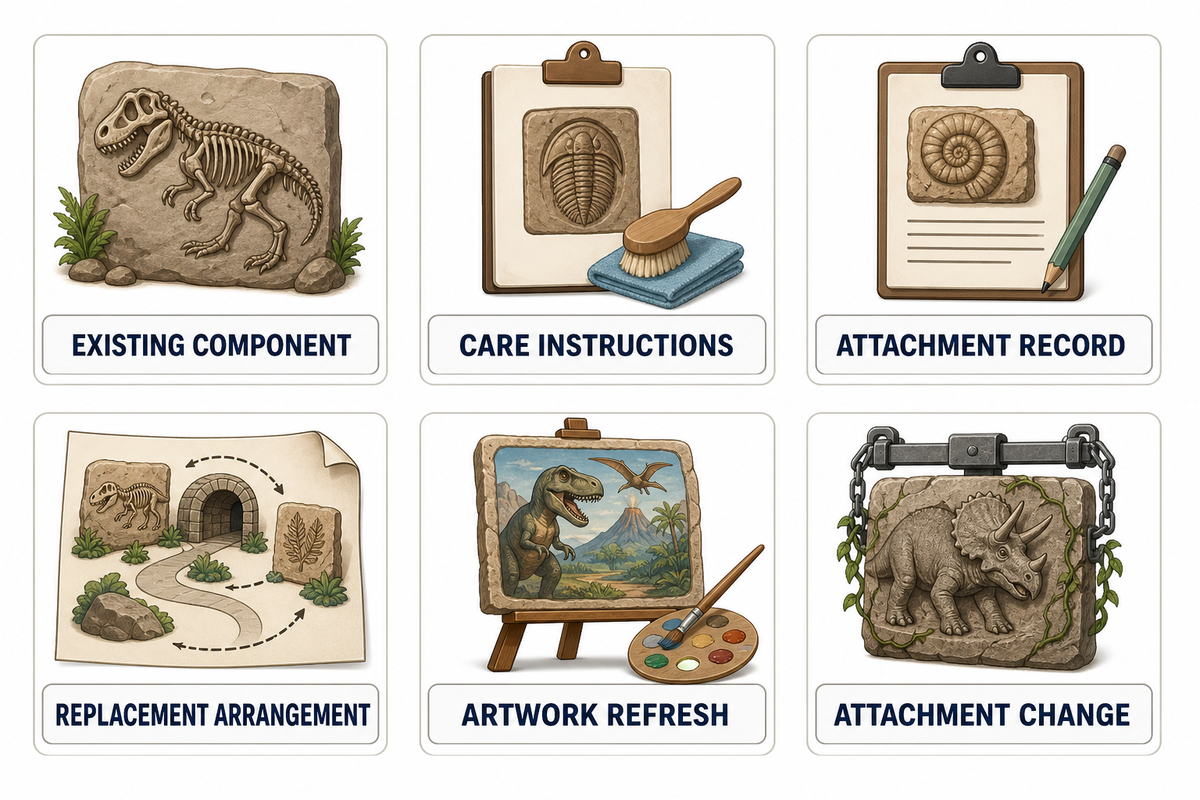
While component details are available, consider cleaning and future theme refresh proposals. Ask which elements have their own care instructions, and which are meant to be replaced. Before ordering a replacement, determine the identified existing component; ask for the instructions that apply to the proposed change, even if the panel appears simple to remove, and the artwork is the sole aspect the purchaser wishes to change.
Modular ideas have a documented history. The 2007 publication US20070078014A1 describes interchangeable panels in a playground structure. This is evidence of a design idea, not evidence that a particular provider has at present compatible parts. Ask for the actual replacement arrangement and who will supply the information needed to use it.
Use the component identifier and care instructions to support a plan discussion. In the hypothetical fossil panel example, the provider might be asked to specify the recommended cleaning method for that surface, or their preferred procedure if another panel is needed. If artwork is the only detail the buyer wishes to modify, supply the artwork details before moving to replacement discussion.
Taking a replacement request by appearance alone leaves an attachment compatibility question unanswered. If the provider can’t identify the attachment used on the original panel, matching photographic description doesn’t resolve the issue. Phrase the request in terms of the existing component and ask for the records that allow that choice before proceeding.
The Access Board guide makes clear the difference between routine maintenance, including replacing worn ropes, and modifications affecting usability. It doesn’t regard each change as identical. Have the responsible professional determine how the proposed change is classified. Without that determination, describe the intended work accurately before anyone applies a rule.
Resolve venue interfaces before concept approval
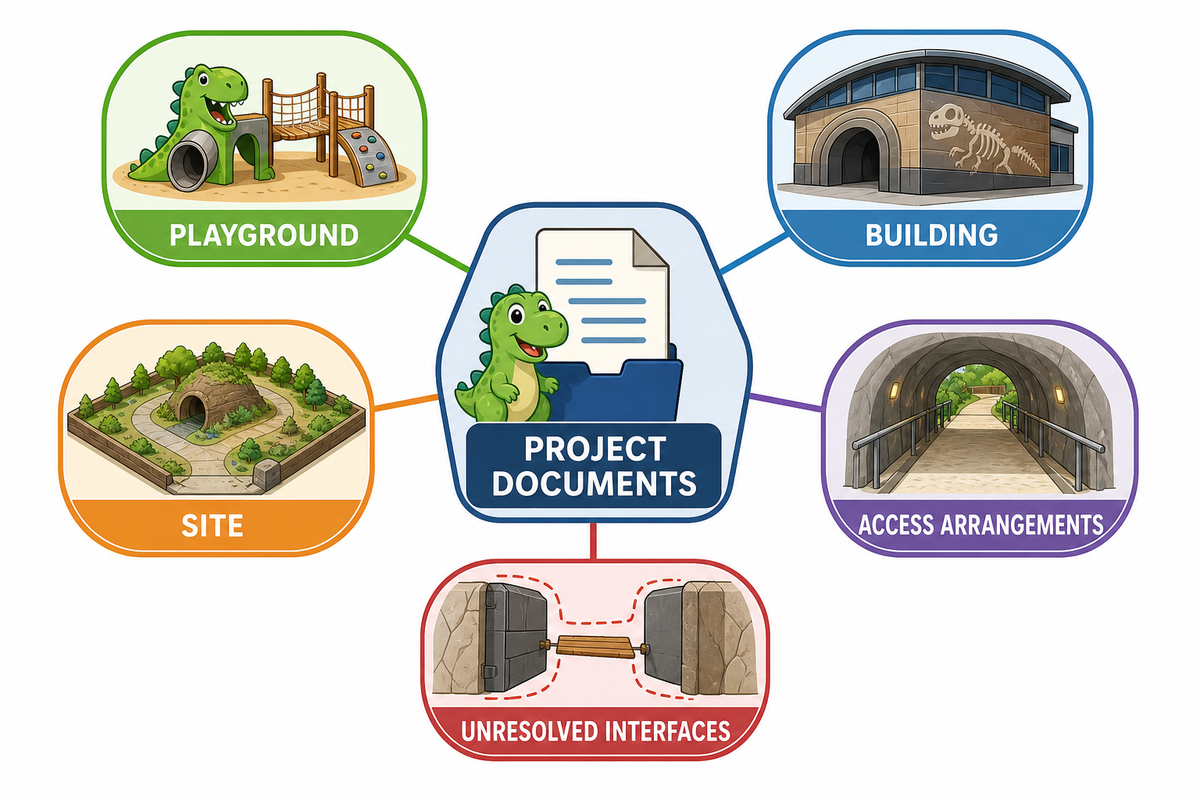
Plan a dinosaur playground theme with the installed venue in mind by identifying the persons responsible for reviewing the playground and the building and site, and how unresolved interfaces will be documented and answered. Keep the proposed activity, access arrangements and unresolved interfaces among the project documents before considering the theme concept ready for installation.
The published contents of ASTM F1918-21 include maintenance, fire safety and evacuation. Those categories demonstrate why a soft contained play theme proposal involves more than themed surfaces. They do not fulfill the actual needs for your building. The equipment standard, your venue’s responsibilities and the project’s approvals must go to the appropriate professional for review.
The CPSC playground handbook page lists its 2025 public playground handbook. Be sure which guidance applies to your component type rather than selecting a publication based on the word “playground” in the title. Indoor equipment, outdoor equipment and attractions other than playgrounds should remain distinct throughout the design process.
When should a concept remain unapproved?
Keep a concept under review when the team can’t determine the proposed use or determine the material question of how the proposed work will be implemented. Examples are a drawing that doesn’t identify the play feature, a changed attachment without additional information, or a venue proposal whose responsibilities are still unclear. Use those examples to encourage description of the missing information instead of assuming the final installation will provide answers.
Our discussion of playground safety standards will help support those project considerations. Verify with the relevant project representatives that the required standards and other rules apply to your actual project and whether the work is a new build, an alteration or a maintenance activity.
Key takeaway
The dinosaur playground brief connects each theme cue to a proposed action, identifies the intended users and keeps unresolved product and venue questions attached to the current drawing.
Frequently asked questions
What can be customized in a dinosaur playground?
View answer
Customization can involve the play activities, the dinosaur characters, the surrounding scenery and the relationship between equipment and the venue. Ask the designer to identify which changes affect the structure and which change only its finish. A new color or sculpted head doesn’t explain the intended users, available activities or installation requirements. Review those details separately before choosing a concept.
Is dinosaur soft play the same as an outdoor dinosaur climber?
View answer
No. These labels describe different features and settings, rather than interchangeable products. A dinosaur soft play proposal may include padded activities within an indoor play area, while a dinosaur climber may be a separate commercial outdoor product. Check the specific manufacturer’s intended use, user group and installation documents. The dinosaur appearance alone can’t establish suitability for either setting or demonstrate compliance with applicable requirements.
How should a team review a dinosaur playground concept?
View answer
Identify one feature on a dated drawing. Discuss its theme cue and intended play action, then check who the proposal is intended for and which attachments need documented review. Ask the team to describe the expected sequence of use and explain what changed in the latest revision. Keep unanswered questions attached to that feature. This is a discussion method, not evidence of technical approval.
Does a larger dinosaur sculpture mean more play value?
View answer
Not by itself. Compare the activities the feature supports and the space it occupies. A landmark can support the story, but its visual size isn’t a measure of usable play.
Can a dinosaur theme be refreshed without replacing everything?
View answer
Sometimes, but the answer depends on how the original equipment was designed and documented. Start by asking which scenery panels, graphics or decorative parts are intended to be replaceable. Don’t assume that a component can be removed simply because it looks decorative: its attachment, relationship to openings or role in the equipment may matter. For each proposed change, ask the responsible supplier or designer to explain what needs review and whether updated documents are needed. Keep the original component identifiers and the approved revision together. A planned refresh can begin with a small change, such as new story graphics, instead of a new structure. That’s an option to assess, not a promise that every venue can be altered cheaply. The replacement’s cleaning instructions and availability also belong in the discussion before the revised theme is ordered.
Bring the activities into the design conversation
Share your venue setting and the dinosaur scenes you want to discuss with Didi Land. Start with the proposed activities and the questions your project team needs answered. Learn about Guangzhou Didi Land Amusement Equipment Co., Ltd. before preparing the next brief.
Editorial note: This document merges using the public review with using hypothetical designs for discussion. The activity map and scene review are designed to encourage discussion, not assess a product or determine safety, or confirm actual venue approval.
References & Sources
- Playground Equipment guidance, U.S. Consumer Product Safety Commission.
- School playground enrichment systematic review, 2025, Oppici and colleagues; PubMed abstract.
- Guide to Play Areas, U.S. Access Board.
- ASTM F1918-21 public scope, ASTM International.
- Stegosaurus brought to life, Natural History Museum.
- Soft Contained Play Equipment Safety Checklist, U.S. Consumer Product Safety Commission.
- US20070078014A1, 2007 patent publication, public patent record via Google Patents.
- Public Playground Safety Handbook entry, U.S. Consumer Product Safety Commission.
![Custom Dinosaur Playground Equipment [Design Guide]](https://didiplayarea.com/wp-content/uploads/2026/09/custom-dinosaur-playground-equipment-r2-featured-1-150x150.png)