Get in Touch with Didi Land


Updated July 2026
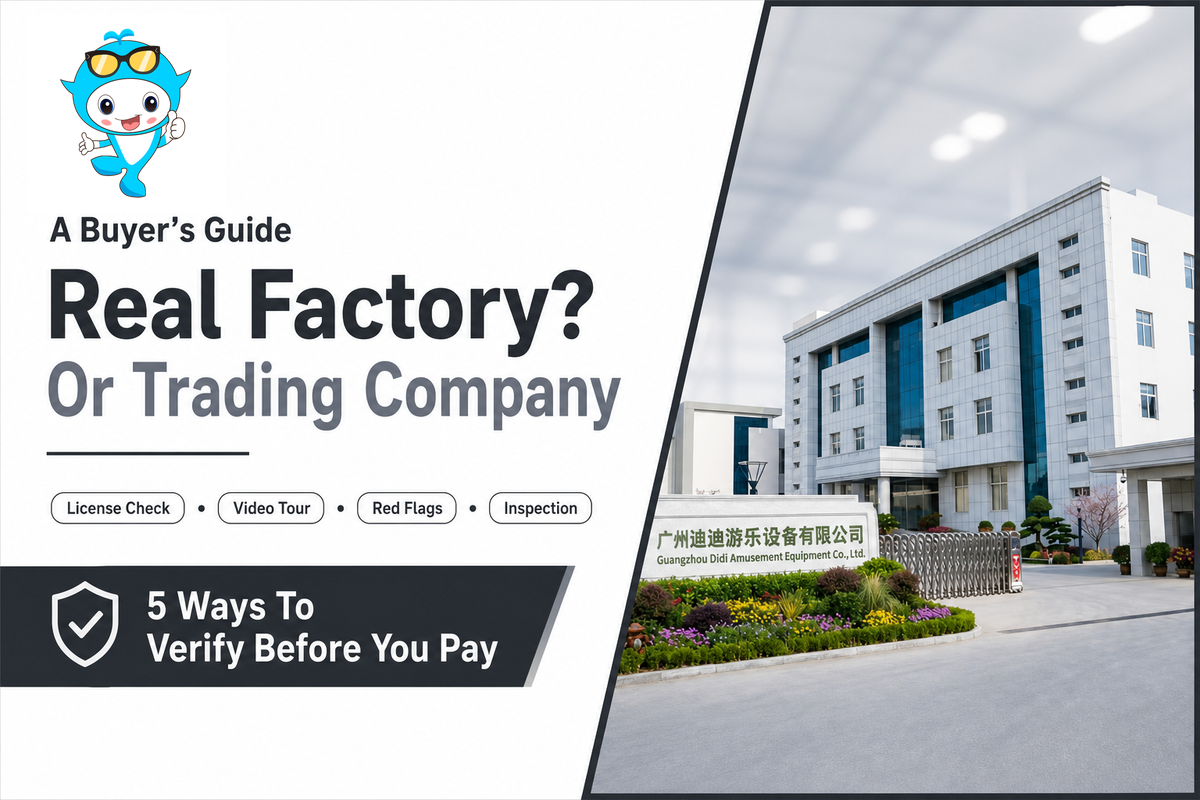
An indoor playground equipment manufacturer is the company that owns and runs the production line building your order, not a reseller passing along someone else’s output as its own. Knowing how to tell if an indoor playground equipment manufacturer is a real factory, not a trading company, comes down to one habit: never trust “Manufacturer” at face value. Shiny websites, gold supplier, and good sales teams might all belong to a trading company with no production of its own. From business license checks, limits on platform badges, free red flags, to a specialized playground video script, third-party inspection costs, and cross-checking customs records, this guide shows you the real check between a documented factory and a smooth middleman before sending a deposit. It’s for anyone comparing playground equipment suppliers, whether outfitting a commercial indoor playground, a trampoline park, a family entertainment center, a standalone play area, or adding a trampoline zone. Choosing an indoor playground manufacturer in China is one of the highest-stakes calls in the entire project, and this guide is built to help you find the best indoor playground partner for the job, not just the cheapest quote.
Direct answer: At least 3 separate indicators should confirm it: government business license registry, live and unscripted video call, and (for orders above approximately $10,000) a paid third-party inspection. No single signal guarantees factory status, since even these indicators could link to the same self-proclaimed source.
Key points
- One badge indicates legitimate registration but not necessarily production capabilities-as per Alibaba’s documentation itself.
- China’s Business Scope regulations permit listing manufacturing and trading together in a business license. Thus, the question of factory versus trader isn’t always clear-cut.
- Although becoming more popular (via platform badges), this verification method is over-relied upon.
- Video calls are a vetting tool, not definitive proof. International auditing standards clarify that remote inspections don’t replace physical on-site inspections.
Quick Specs: 5 Verification Methods at a Glance
| Method | Time | Cost | Confidence |
|---|---|---|---|
| Business license lookup | 5-15 min | Free | Medium (self-reported) |
| Platform badge check | 2 min | Free | Low-Medium |
| Free self-run red-flag checks | 10 min | Free | Medium |
| Unscripted video call | 30-60 min | Free | Medium-High (screening only) |
| Third-party inspection | 1-3 days | $200-400+/man-day | High |
Manufacturer, Factory, or Trading Company, What’s Actually the Difference?
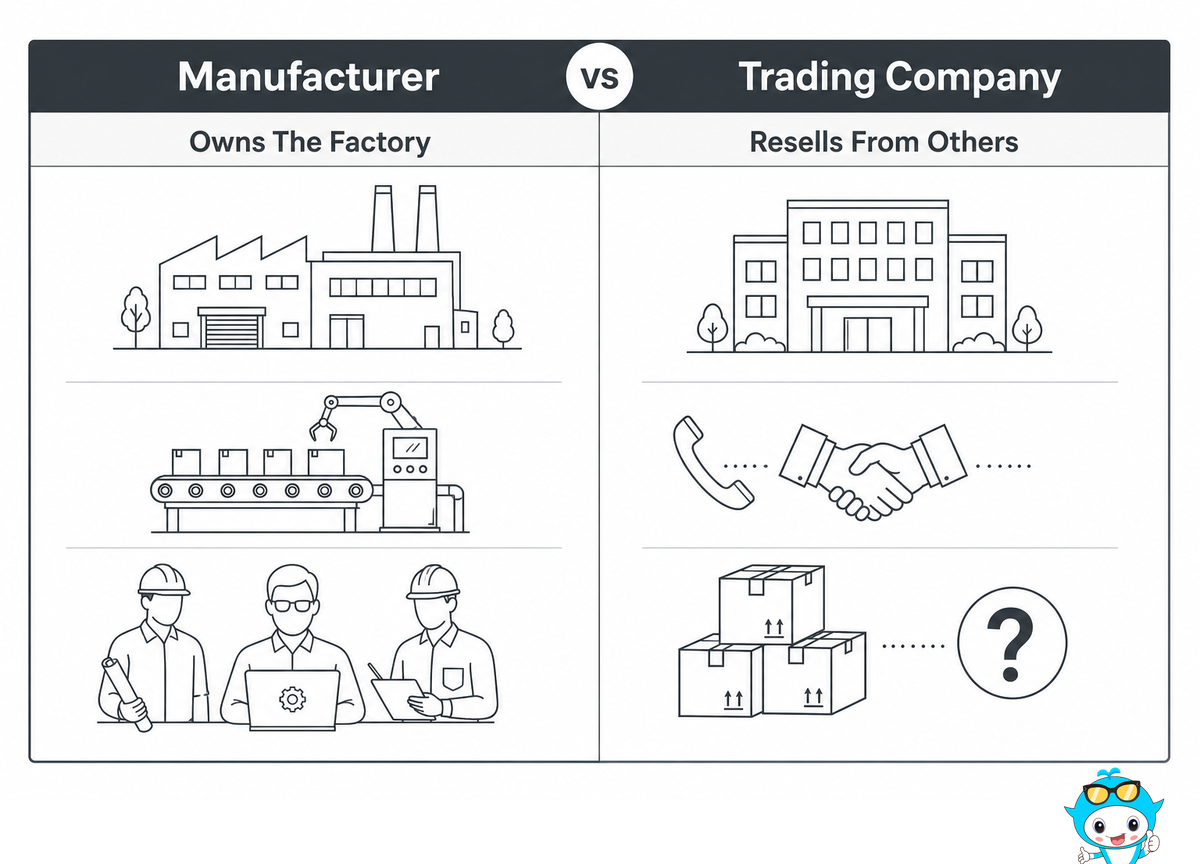
Manufacturers own their own manufacturing facilities and equipment. Trading companies, however, operate further down the supply chain, selling products made by manufacturers they don’t own. One test matters most: ask to see your specific product being made on a live video call. Beyond cost, “who made this” matters legally: in the US, the importer is responsible for compliance with safety regulations for children’s products (including playgrounds), like the Consumer Product Safety Improvement Act.
The distinction isn’t always absolute: China’s business regulations (SAMR) allow a single company to register with multiple business scope types, enabling it to manufacture, trade, or subcontract at the same time. The 3 types outlined below are for initial screening, not a rigid rule to be applied blindly — the same logic applies whether you’re vetting a Chinese factory directly or comparing several Chinese supplier quotes side by side. The distinction matters most in exactly the areas a trading company structurally can’t guarantee: real customization capability, installation support, after-sales service, and spare parts availability once the equipment is running.
Our companion piece, Indoor Playground Manufacturer: China OEM vs Distributor, offers a detailed comparison of costs, timelines, and documentation for each of the 3 types of supplier, but this article is focused solely on confirming their actual status.
Choosing the right partner also depends on what kind of buyer you are. Some are sourcing commercial indoor playground equipment for a single site and want a direct manufacturer they can call the moment a part is out of spec. Others are investors — and investors are choosing turnkey packages more often when opening a first location — bundling design, production, and installation under one contract instead of coordinating steel, foam, and flooring separately from one or more factories. That’s an important distinction, because a turnkey manufacturer and a plain equipment manufacturer aren’t the same offer: many manufacturers will happily sell you equipment from one production line, but far fewer can also hand you a floor plan, a 3D rendering of the finished space, and a realistic total project cost before a single frame gets welded. Watch the language closely — a business presenting themselves as manufacturers and trading under the same roof isn’t automatically a problem (China’s Business Scope rules allow it, see below), but a supplier offering a bundled “turnkey” package who dodges the question of whether you’re buying directly from the manufacturer or through a subcontracted partner is telling you the manufacturer is typically not who’s on the phone with you.
Business-Scope Tell: The License Check Most Buyers Skip
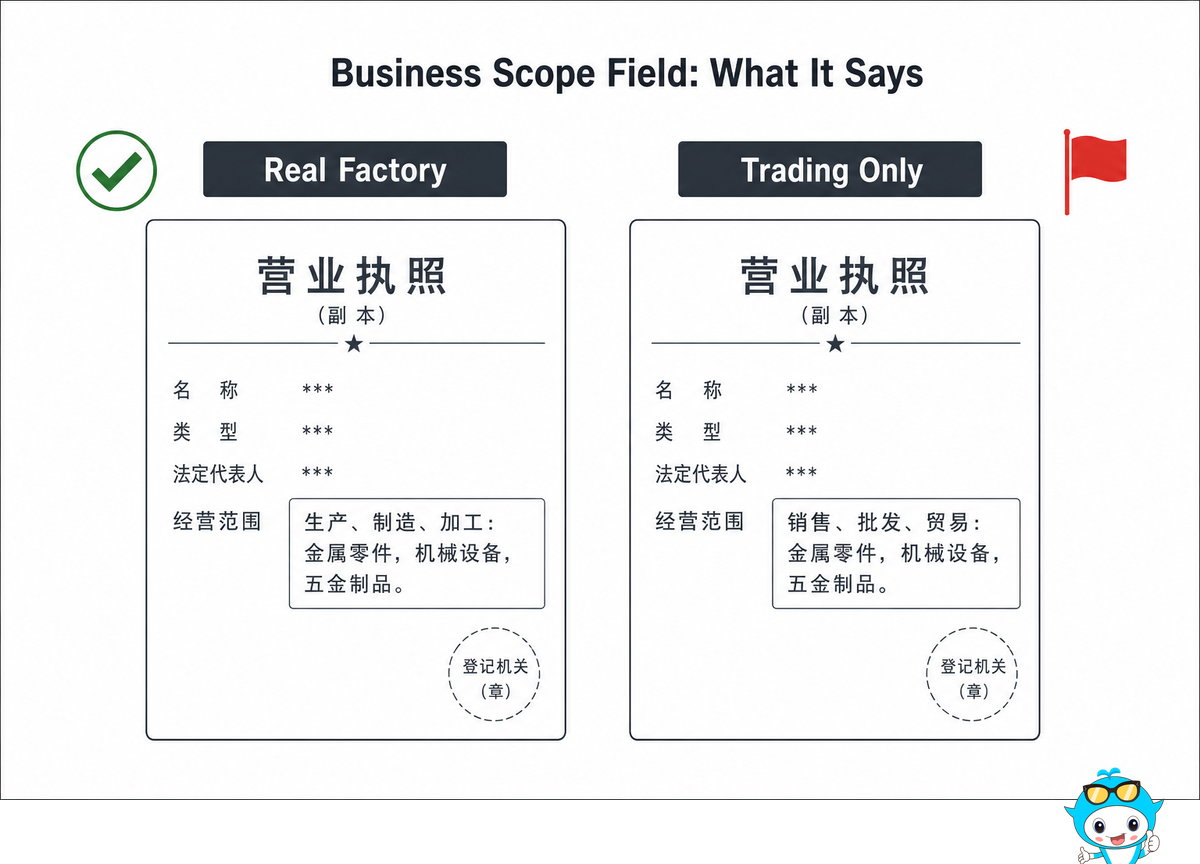
In the Chinese business license for every company, there’s a field named Business Scope (经营范围), and this is the quickest free signal to differentiate between a factory and a trading company. Real manufacturers will list production verbs, 生产 (produce), 制造 (manufacture), 加工 (process) — followed by a product category, whereas for a pure trading company it will be limited to 销售 (sales), 批发 (wholesale), or 贸易 (trade).
You can check the Business Scope for any Chinese company for free using the National Enterprise Credit Information Publicity System, China’s national market-regulation registry. Type in the Unified Social Credit Code the supplier gives you and search, and look at the Business Scope field — if it lists only trading and sales related terms, then the supplier isn’t a factory no matter what the salesperson tells you.
There’s an important and honest caveat before this can be treated as irrefutable evidence: the registry itself notes that the data displayed there originates from various regulators, government departments and the market entities themselves, with each of these entities responsible for the truthfulness of what they submitted. Practically this means the Business Scope check narrows the field effectively – a business scope limited to trading rules a company out – but a business scope that includes production doesn’t necessarily rule a company in, since the data entry is partially self-reported. Consider it your first filter, but not your last one. A Chinese supplier that resists this simple lookup, or that blames quality issues on “the original manufacturer” once something goes wrong, is telling you something about safety compliance and accountability before you’ve even placed an order.
What an Alibaba Verified Supplier Badge Actually Checks (and What It Doesn’t)
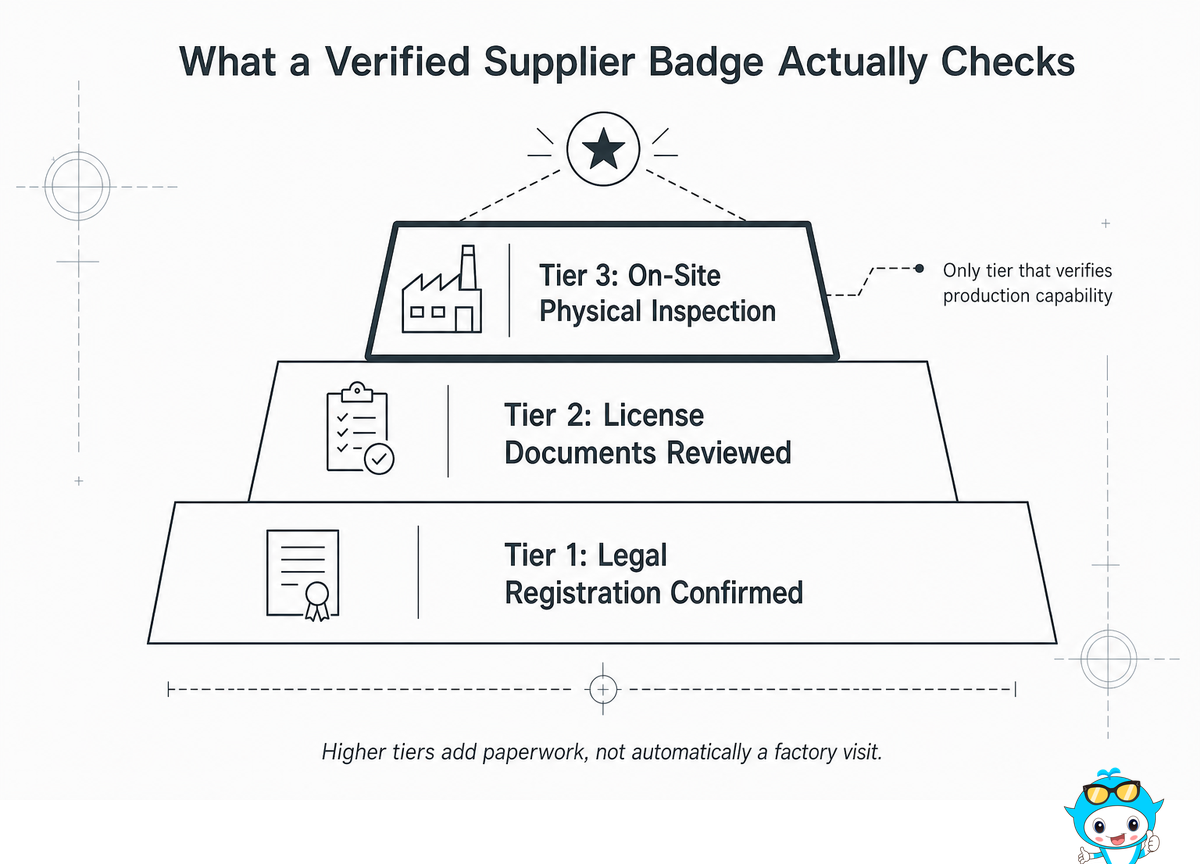
The search interest for platform verified-supplier badges has risen approximately three times in the last year as buyers use them as a first round filter, however, a badge only confirms that a company is registered and has been visited once by an auditor — it doesn’t mean that the particular factory can manufacture your particular product.
~3xrise in “verified supplier” search interest, trailing 12 months
Layeredbadge tiers — only the highest layer includes an on-site visit
Not every badge means the same thing. Alibaba’s own supplier-verification page says its most basic badge is a “minimum standard, not a quality guarantee,” confirming legal registration rather than production capability. Paying for a higher membership tier adds a license-review step, but real confirmation of factory capability, management, and quality control only comes from a physical, on-site inspection — done by Alibaba’s own team or a third-party firm. Paperwork alone never gets there.
This gap is a lesson many actual buyers learn the hard way. A user on Alibaba was duped into relying on a “Verified” badge from a factory, which still produced a batch using cheaper specifications than agreed to–the badge had cleared the company’s existence, but not the quality of the order. One sourcing consultant who has been helping startups find factories in China since 2012 put it this way: an Alibaba Verified Supplier badge will assure you the company exists, but not that it can deliver quality or the right products. The same limitation applies to any Chinese OEM manufacturer profile, verified badge or not.
10 Free Red-Flag Checks You Can Run Yourself in 10 Minutes
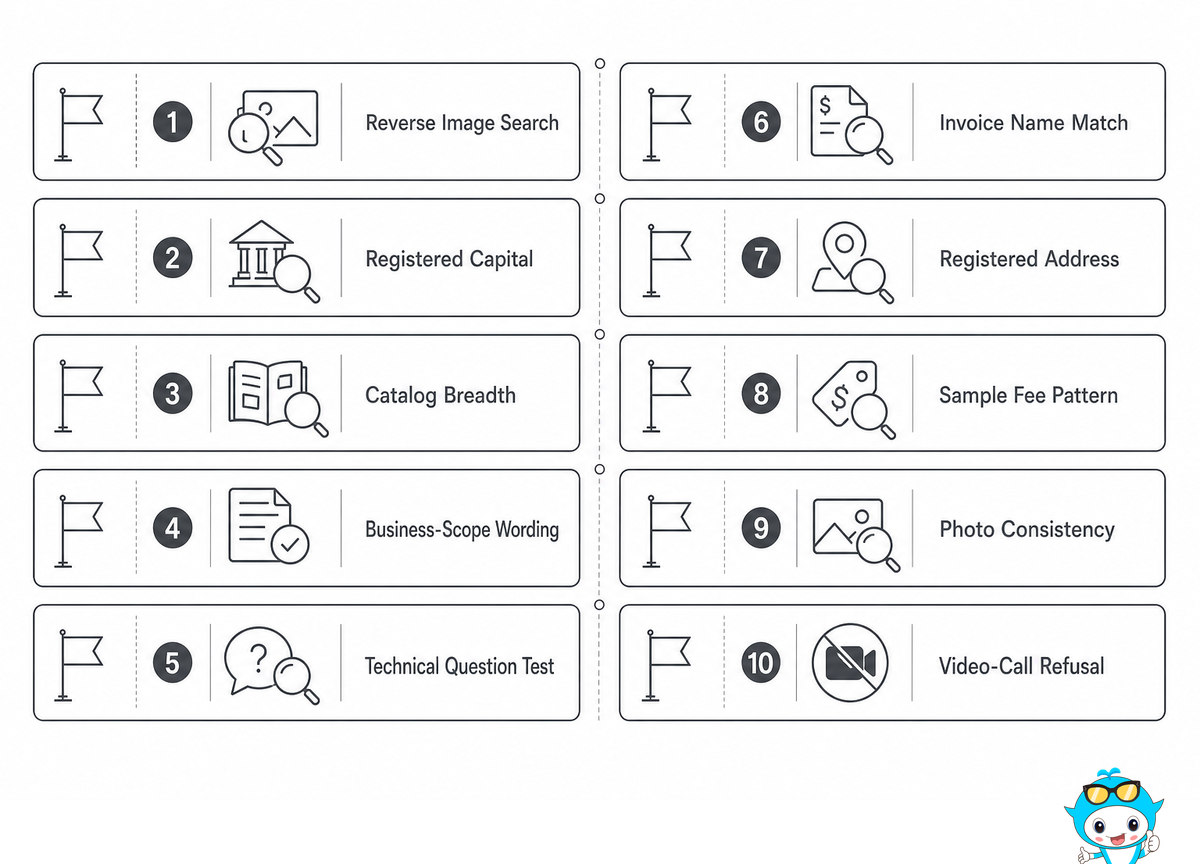
The ten free tests will filter out a good portion of trading companies pretending to be factories – reverse image search, capital size, and catalog width alone can catch a majority of the facades seen in sourcing agent cases.
| Check Category | Red flag | Limitations / not a guarantee |
|---|---|---|
| Reverse image search factory photos | Same photo appears on 3+ unrelated supplier sites | Sister factories can legitimately share images |
| Registered capital lookup | Capital far below what claimed output would require | New factories can be under-capitalized yet real |
| Product catalog breadth | Catalog spans playgrounds, furniture, and electronics | Some diversified conglomerates are genuine exceptions |
| Business-scope wording | Scope lists only 销售/贸易 (sales/trade) | Hybrid scopes are legal, see H2-1 above |
| Technical question test | Vague answer, deferred a week for a spec question | Language barriers can slow a real factory too |
| Invoice name match | Invoice entity differs from the “factory” name on the website | Export trading subsidiaries can be legitimate, ask which entity owns production |
| Registered address type | Office tower or co-working space, not an industrial zone | Some small factories rent shared industrial space |
| Sample fee pattern | Charges full price for a small catalog sample | Custom-material samples are legitimately billable |
| Photo/floor consistency | Floor color or crane structure differs between photo sets | Multi-building factories can vary shot to shot |
| Video-call refusal pattern | Repeated excuses, no live call within a week | Time zones and factory shift patterns can delay scheduling |
Run all ten checks against any playground equipment manufacturer or playground supplier before a deposit changes hands, not just the ones that feel comfortable to ask. A real factory that specializes in commercial indoor playground equipment, soft play, and trampoline park builds has nothing to hide in its registered capital, its product catalog, or its registered business scope — a trading company juggling ten unrelated categories usually does. No single one of these ten tests proves a supplier is real, and it’s supposed to be that way.
A real trading company masquerading as a factory will be able to pass any single test; independently, online sourcers say that two or three failed checks in tandem are needed before you pack it in. In one case repeated in online sourcing discussions about vetting a Chinese supplier: “Always ask are you a factory or trading company, then verify – asking alone isn’t sufficient.”
Beyond the ten checks above, a few more free signals round out the picture before you ever get on a call. Real factories in the indoor playground industry tend to show up consistently at trade shows — exhibitor lists for IAAPA, the association for the attractions industry, cover the global indoor and outdoor attractions market and are public and searchable, and a company that has exhibited under its own name for several years running is a different proposition than one that only appears on a sourcing platform. Regional clustering is another tell: Guangzhou and Wenzhou are two of China’s best-known manufacturing hubs for playground and amusement equipment, and a supplier claiming a factory address nowhere near either cluster isn’t automatically fake, but it’s worth an extra question. Product range is a softer signal but still useful — a manufacturer capable of outfitting a shopping mall, a standalone indoor entertainment center, and a small indoor play area with the same play elements catalog, from simple equipment up to full custom builds, usually has broader in-house tooling than one that only shows a single product line.
Four-Station Video Script: What to Actually Ask to See
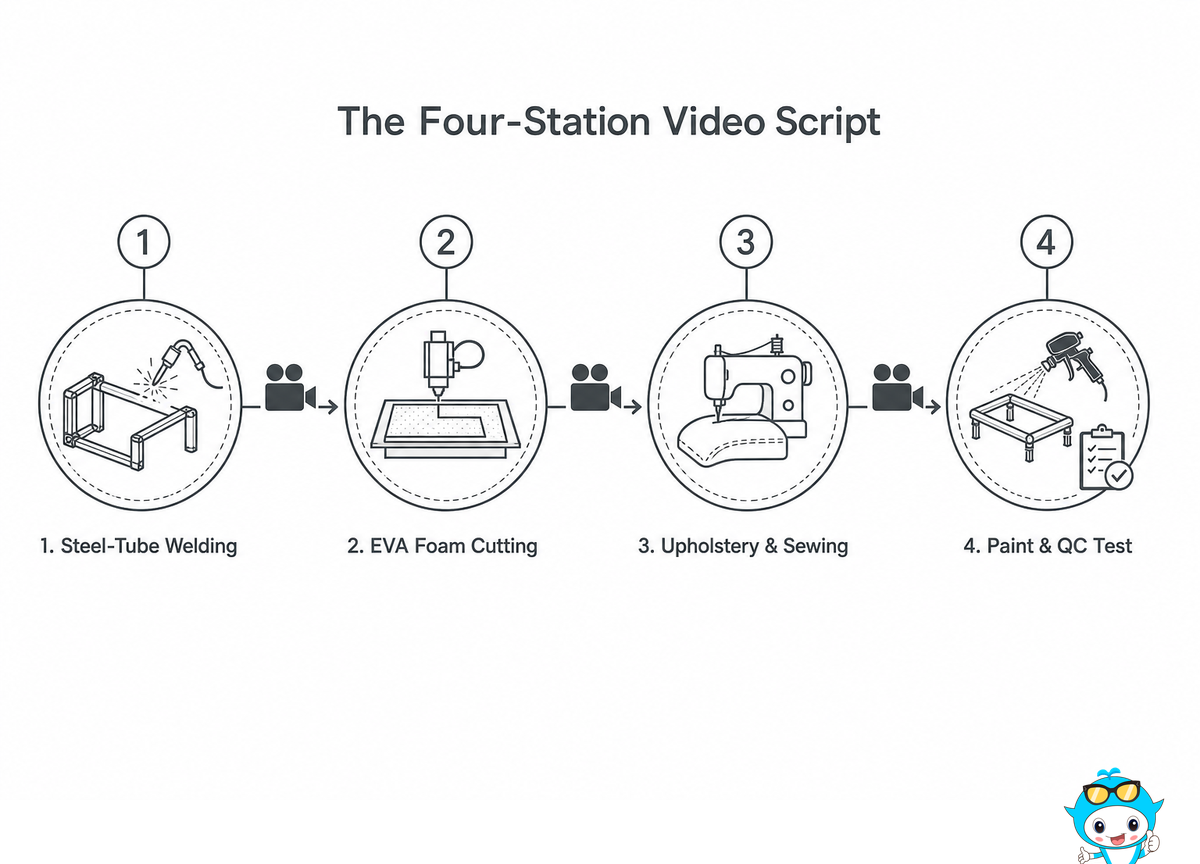
Four distinct production stations (a brief live video walk around, filmed at your request, rather than a pre-recorded tour) will distinguish a real indoor playground factory from a rented one-day set far more accurately than simply asking for “a factory tour.”
At Didi Land’s 28,000 m2 Guangzhou factory, a typical customer service call proceeds through the following four stations in sequence, which any genuine playground factory should be able to demonstrate at a moment’s notice:
- Steel-tube welding and bending station — ask to see the specific tube diameter and wall thickness being cut for an order in progress, not a finished sample; a typical commercial-grade frame runs roughly 48mm diameter with a 2.0-2.5mm wall.
- EVA foam cutting and lamination line — ask the operator to show the foam density label on the current roll being processed; commercial soft-play foam typically runs 60-80 kg/m3.
- Upholstery and sewing line — ask to see the PVC tarpaulin roll and stitch pattern on an active panel, not a display piece; commercial-grade tarpaulin typically runs around 1100 GSM.
- Paint, QC, or load-test station — ask for a live demonstration of a load or fastener-torque check being logged, not just described; Grade 8.8 fasteners are the commercial-grade baseline worth confirming on the spec sheet.
Consider this script as an early elimination step, not a trial-worthy piece of evidence. Even global standard bodies are clear that remote video calls are not an equal substitute for on-site visits (ISO/IEC TS 17012:2024) because the supplier is in control of the camera, the itinerary, and the contents you view.
The purpose of the Four-Station Script is to get rid of fake suppliers as quickly as possible; if your order is large enough that “probably real” won’t cut it, pay for a third-party inspection (see next section).
A genuine Chinese factory will also permit a follow-up call within the hour to ask for views from other parts of the floor without notice, something impossible for a rented stage set.
Paperwork proves what a tour alone can’t: a supplier is a real manufacturer, not just a distributor with a nice office, when it can back up the tour with a portfolio most trading companies never generate in-house. Ask to see a portfolio of completed projects — ideally commercial indoor playground projects at a scale close to your own, not just glossy renderings pulled from a catalog. Either a manufacturer or a trading company can claim “500+ projects,” but only the manufacturer can walk you through the actual design and production process behind a specific job: the original floor plan, the 3D design files, and the engineering changes that got made along the way. How much of this you actually need depends on project size and layout, and a factory that has handled an international project before will have detailed installation manuals ready to hand over, not written from scratch after your deposit clears. Before releasing final payment, a buyer should also ask what happens if the equipment arrives damaged or a part doesn’t match the approved floor plan — a real production line can requote and rebuild a component fast because the same production equipment that built it the first time is still on-site, where a trading company has to go back to whichever factory it originally subcontracted and start the conversation over.
Certification and Third-Party Inspection: When to Bring in an Inspector
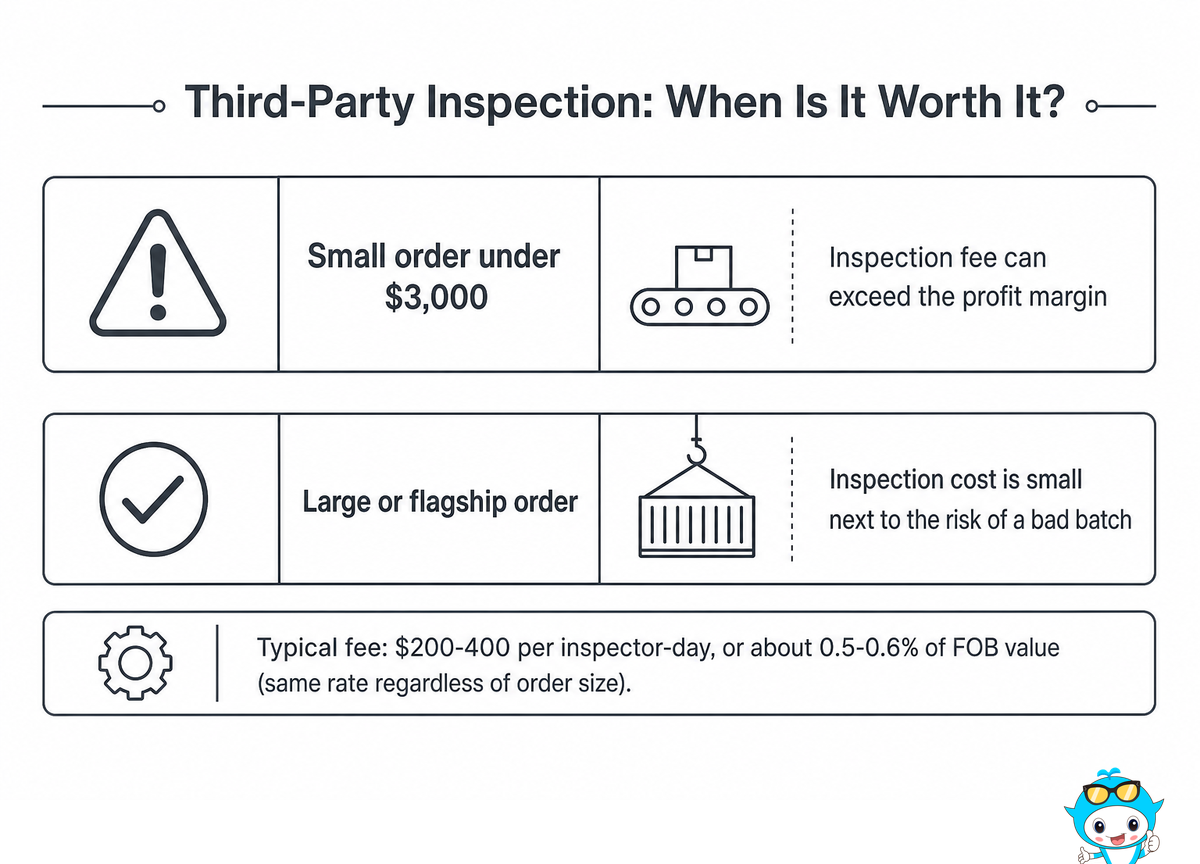
For any order that reaches or exceeds $10,000 or involves custom tooling, the cost of third-party pre-shipment inspections is justified and less than you might think for smaller orders. License checks, video calls, and the free red-flag list are often sufficient.
Fees from independent inspection companies like SGS, Bureau Veritas, Intertek, and TÜV Rheinland generally range from $200 to $400 per person per day for a single day’s visit, or approximately 0.5-0.6% of the FOB value (with a minimum fee of $350). These are rate structures documented for these same firms operating elsewhere in Asia, consistent with prices quoted by buyers on sourcing forums. Generally, an inspection is triggered once production is 100% complete and at least 80% of units are packed, where inspectors then pull samples at random for quality testing based on ISO 2859-1 (AQL) standards, rather than testing each unit — the same third-party verification layer that supports the CPSC-accepted lab testing children’s products require before import.
On a small first order under a few thousand dollars, that inspection fee can be larger than the profit on the order – but in that size range, a license check, badge check, red flag list, and video call make sense. If you’re doing a large flagship build, making a tooling investment, or any order where a defect will be expensive to ship back, then a paid inspection is relatively inexpensive compared to the cost of a bad batch. A good way for inspectors themselves to distinguish the two is: A pre-shipment inspection validates the performance of a specific batch against a specific standard at a specific point in time, versus a full factory audit validating a manufacturer’s overall systems and capability; neither type of inspection alone proves who owns or operates the factory, which is why they’re used alongside the license check, video call, and other forms of proof.
Customs and Export Records: Cross-Checking Your Source
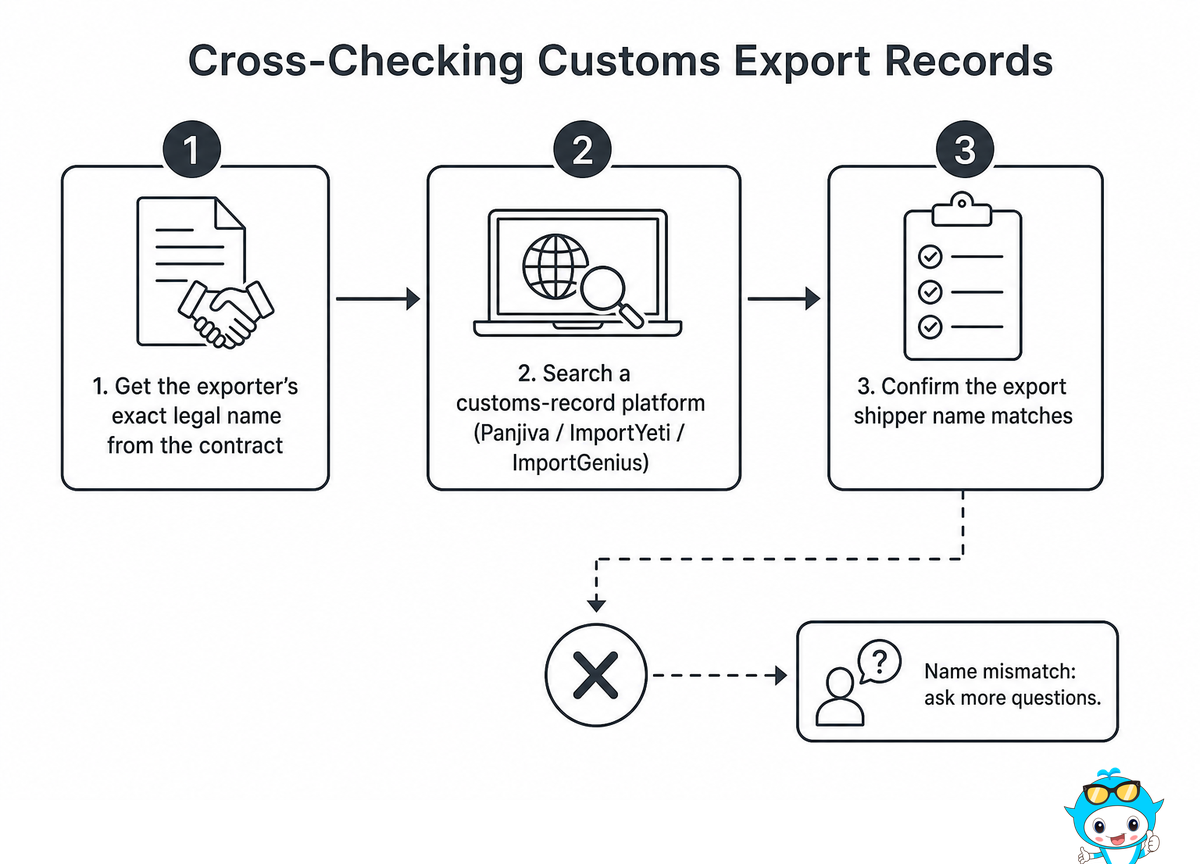
Platforms that track global shipping data like Panjiva, ImportYeti and ImportGenius allow you to verify whether a supplier’s actual export shipments match the name listed on a contract or invoice – an important step that can’t be completed by the previously mentioned check alone.
One such service, Panjiva (owned by S&P Global), maintains over 2 billion shipment records covering more than 9 million companies, and ImportYeti has a free option with roughly 70 million customs records that are updated daily. Search the supplier’s company name and confirm that genuine export shipments using that exact company name correspond with the category of product and quantity they claim to be offering.
The pain point this check catches: a buyer signs a contract with “XYZ Manufacturing Co., Ltd.,” wires a deposit, and only discovers at delivery that the actual export shipper on record is a completely different company name — a common symptom of a trading company routing the order through whichever factory happened to win the job that month. Running the exporter’s exact legal name through a customs-record platform before wiring money surfaces that mismatch for free, in minutes, well before it becomes a shipping dispute.
One limitation you need to be clear about: U.S. Customs and Border Protection’s own Import Security Filing guidelines for shipments destined for the US require listing the manufacturer (or supplier) in a single field that doesn’t separate a producing factory from a supplier that just resells their goods, and the requirement doesn’t apply to imports that aren’t sent by sea in the first place. Even some sophisticated trading companies know about this check and avoid it, often by routing shipments through Hong Kong and having them re-invoice, or by using a third-party bill-of-lading service. Take a match between your research and the customs records as an encouraging sign, and a lack of match as a signal that you need to ask additional questions – rather than an outright deal-breaker.
Walk-Away Line: A Red-Flag Scorecard That Doesn’t Double-Count
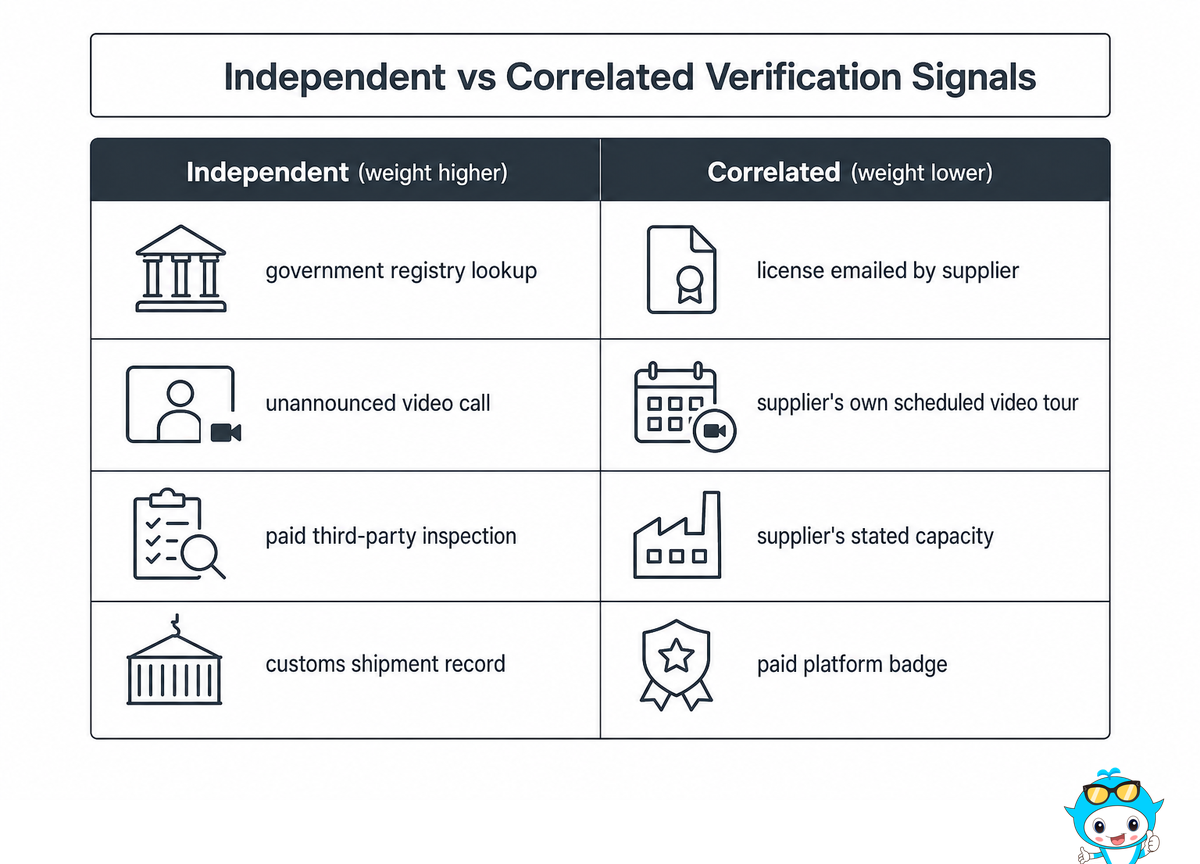
The most frequent error made in evaluating a supplier is to count every check equally, because multiple checks rely on the same underlying piece of information – that the company provided its source, either via its business license, its own video call or its customs filing. You’ll want your scorecard to give more weight to independent verification than to overlapping verification.
Independent channels (weight higher)
- Government registry lookup (GSXT/SAMR)
- Unannounced follow-up video call, different section
- Paid third-party on-site inspection
- Customs shipment record under the exact contracting entity name
Correlated channels (weight lower, don’t double-count)
- Business license the supplier emailed you directly
- Supplier’s own scheduled, pre-announced video tour
- Supplier’s stated production capacity
- Platform badge the supplier paid for
Say a supplier passes the business-license scope check (correlated signal, self-submitted), offers live video tour but doesn’t show the foam-lamination line (partial pass on an independent-adjacent check), lists playgrounds in its product catalog along with patio furniture and LED lights (a red flag from the free checks list), and its registered capital is low compared with the advertised monthly output of 8,000 units (another free-check red flag). With two red flags on genuinely independent checks and a soft pass on one correlated check, it’s not time to bail completely; rather, we proceed only after an independent third-party inspection verifies production claims before releasing the deposit.
Key takeaway
Two or more red flags on independent checks — not correlated ones — is the walk-away line; one weak pass on a self-reported channel is not enough to clear a supplier for a deposit on its own.
Frequently Asked Questions
Q: What is the difference between a supplier and a manufacturer?
Ownership of the production line is what separates a manufacturer from a supplier, a broader term that can mean the manufacturer itself or an intermediary reselling from one.
A producer’s own or affiliated line separates a Manufacturer from a supplier — a broad umbrella term that could refer to the factory or an intermediary buying from one. On a China sourcing trip, “supplier” can loosely cover either, which is precisely why the business-license and video-call procedures in this guide are critical for understanding which supplier we’re facing.
Q: Is it cheaper to buy indoor playground equipment directly from a manufacturer?
Usually, but not always, a factory-direct quote skips an intermediary’s markup, though a well-run trading company can still be competitive on small or mixed-category orders.
Typically — though not always — a factory-direct quotation cuts out an intermediary’s markup, but well-managed trading companies may still compete well on small, diverse orders where they consolidate volume across multiple clients. For a full breakdown of cost, lead time and documentation differences between factory-direct, general OEM and distributor channels, our guide on China OEM vs. Distributor pricing breaks it down.
Q: How do I verify whether an indoor playground supplier in China is a real factory?
Combine at least three independent checks, a government business-license lookup, an unscripted live video call covering specific production stations, and for larger orders a paid third-party inspection, rather than relying on any single check.
Combine three or more independent checks (a government business-license lookup, an unscripted video-call walkthrough of specific production stations, and, for larger orders, an independent third-party inspection) instead of relying on just one. This guide includes the step-by-step business-license analysis in The Business-Scope Tell, the ten free self-service checks, the Four-Station Video Script and the Walk-Away Line scorecard which integrates these elements while avoiding duplicate counts of correlated signals. Our guide to Manufacturers vs. Distributors covers channel selection, cost and lead time comparisons across all three supplier categories.
Q: Is factory trial installation necessary?
Not for most orders — it matters most for large, structurally complex builds where an installation error would be expensive and slow to fix once everything is already on-site.
Not for most orders; it becomes relevant on large, complex construction orders where installation errors can be difficult and expensive to repair in the field.
Q: Can a trading company ever be a good choice?
Yes, for a small order, a mixed-category purchase, or a buyer with no in-house sourcing team, a good trading company’s consolidation and English-language support can be worth its markup.
For smaller orders, diverse product purchases, or a company lacking its own internal sourcing capabilities, a good trading company’s aggregation capabilities and English communication skills can justify the higher price. Risk here comes from the business itself or from a trading company passing itself off as the factory; a trading partner who is transparent about this relationship poses a fundamentally different risk than one obscuring their true identity behind a “Manufacturing Co., Ltd.” designation.
Q: What safety standards should a real factory be able to show proof of?
Real indoor playground factories should hold and be able to produce current test reports for ASTM F1918 (soft-contained play equipment) or EN 1176 depending on your target market, not just a certificate PDF.
Real indoor playground manufacturers will have and can provide recent test reports for ASTM F1918 (soft-contained play equipment) or EN 1176, as appropriate for your target market, not just a pdf certificate — these standards are the real safety codes an export shipment gets checked against, not a formality. As CPSC updated their Public Playground Safety Handbook in 2025 to include recent changes to the ASTM, a certificate dated significantly earlier is a point to follow up on. Certificate validation, and standards-by-standards details (including which mark corresponds to which export market) are located in our separate playground safety standards guide. As a working example, Didi Land’s own indoor playground equipment ships with downloadable test-report PDFs for AS 4685, EN 1176, ASTM F381, CE, and ISO 9001:2015, backed by a 24-month structural warranty and 12-month electrical warranty — the same certification depth any real factory should be able to hand over on request, not just claim in a product listing.
Q: Why do large indoor playground projects often work directly with manufacturers?
Large or highly customized projects need direct access to engineering and production teams for design changes, quality accountability, and after-sales support that a trading-company intermediary structurally cannot guarantee.
Large or custom projects require a direct connection to the engineering and production departments for product design adjustments, quality assurances and post-sale support — things that an intermediary trading company, by its structure, cannot promise since a trader has limited influence over its partner factory’s schedule and engineering changes relative to the factory itself. The framework and decision process for this consideration by project size and timeline across all three channel types is detailed in the companion manufacturer vs. distributor comparison.
Q: What questions should I ask before choosing an indoor playground manufacturer?
Before you commit to any indoor playground investment, a short list of 7 questions to ask covers factory ownership, design capability, minimum requirements for playground equipment orders, and who is on the hook if equipment arrives damaged.
Whether you’re comparing a turnkey indoor playground package or sourcing equipment for a single install, these 7 questions to ask cut through most sales pitches fast: (1) Do you own the factory floor, or subcontract to one or more factories? (2) Can I see a floor plan and 3D design for a project close to my scope, not a stock rendering? (3) What are your minimum requirements for playground equipment orders, and does that change for a first-time buyer? (4) What’s included in the total project cost, and what’s billed separately? (5) Can I talk to a reference from a completed project, ideally an international project if I’m importing? (6) Who owns the equipment co. named on the invoice, and is it the same entity I’ve been emailing? (7) If part of a shipment arrives damaged, who repairs or replaces it, and how fast? For most buyers weighing an indoor playground investment above a few thousand dollars, a factory-direct option is best when the answers to all seven are specific and verifiable — a vague answer to even one or two is reason enough to run the earlier checks in this guide before signing anything.
Why We Write This
Didi Land is an indoor playground equipment factory, not a trading company, and we benefit directly whenever buyers can reliably tell the two apart — the verification steps in this guide are exactly what we expect discerning buyers to take before wiring a deposit.
The methodology for verifying businesses described herein (business registration logic, example conversation script, economics of a 3rd-party inspection) combines observations of our actual production facility, external public government records, Alibaba’s own classification scheme, and user experience from buyer forums, not based on a single company’s promotional materials. Reviewed by the Didi Land tech team.
“Buyers who ask to see the foam-lamination line specifically, not just ‘the factory,’ get a very different response from a real production floor than from a trading company that has never touched the product. That single follow-up question does more filtering than the badge ever will.”
Engineering Team, Didi Land Guangzhou Factory
References & Sources
- The Consumer Product Safety Improvement Act (CPSIA) U.S. Consumer Product Safety Commission
- Total Lead Content FAQ U.S. Consumer Product Safety Commission
- Notice of Availability: Public Playground Safety Handbook Update (2025) Federal Register / CPSC
- Business Scope Registration Rules State Administration for Market Regulation (SAMR), China
- National Enterprise Credit Information Publicity System, Data Source Explanation State Administration for Market Regulation, China
- China’s Information Enterprise Yale Law School, Paul Tsai China Center
- ISO/IEC TS 17012:2024, Conformity Assessment, Remote Audit Guidance International Organization for Standardization
- Import Security Filing Guidance U.S. Customs and Border Protection
- Supplier Verification Tiers Explained Alibaba.com
Related Articles
- Indoor Playground Manufacturer: China OEM vs Distributor full cost, lead-time, and documentation comparison across all three channels
- Indoor Playground Equipment Buyer’s Spec Audit Guide how to audit a quotation line by line
- Playground Safety Standards: AS 4685 vs EN 1176 vs F1487 certification depth by export market
- Top Indoor Playground Equipment Manufacturers shortlist of verified factories to start from
- Soft Play Equipment Manufacturers category-specific manufacturer shortlist
![Sustainable Indoor Playground Material Certification [2026]](https://didiplayarea.com/wp-content/uploads/2026/07/sustainable-materials-certification-en1176-astm-as4685-featured-768x512.png)