Get in Touch with Didi Land


![ASTM F1487-25 vs F1487-21: What Changed [2025 Update]](https://didiplayarea.com/wp-content/uploads/2026/07/astm-f1487-25-vs-f1487-21-changes-featured-1.png)
ASTM F1487-25 is the current edition of the consumer safety performance standard for public playground equipment, replacing F1487-21 as of June 2025. It introduces eight new clause-level provisions, primarily addressing fully enclosed structures, tube slides and revolving devices – product types with significant bearing on indoor playground customers. Ensure your supplier’s documents reflect F1487-25 or a date post-June 2025, otherwise review before signing.
Search results for “ASTM F1487 changes” put the 2001 standard on top – not 2025. Here’s a 24-year-old article that ranks on a question about last year’s revision: an updated summary of the eight F1487-25 changes, why standard standards are updated on schedule, and most critically for buyers: how to verify the certification your supplier provides is the current edition. We’re focused on this single standard’s version update, not its comparison with other international standards across export markets or the broader indoor playground safety standards picture.
📐 Engineering Note
F1487-25 preserves the standard’s fundamental anthropometric range. The equipment must be designed for 2-year-olds (5th percentile) through 12-year-olds (95th percentile) (ASTM F1487-25 1.2) – a demographic specification consistent across previous versions. These eight revisions are refinements within that established framework – they don’t alter the designed user of the standard.
Quick Specs
| Standard | ASTM F1487-25 |
| Supersedes | ASTM F1487-21 |
| Approved | April 15, 2025 (ASTM Subcommittee F15.29) |
| Published | June 2025 |
| Governs | Public playground equipment, ages 2–12 (5th–95th percentile) |
| Excludes | Soft-contained play equipment (ASTM F1918), impact surfacing (ASTM F1292), home equipment (F1148), toddler-specific equipment (F2373) |
| Document price | $131.00 at ASTM’s store (as of this writing) |
A quick note on access: common searches like “astm f1487 pdf,” “astm f1487 free,” “astm f1487 21 manual,” and “astm f1487 21 free download” won’t turn up an official copy of either edition — ASTM sells the current document and doesn’t publish a free version, and the same restriction applies to the older edition. Those searches mostly surface summaries and third-party paraphrases rather than the official text. This guide is written so you can make a supplier-verification decision without purchasing either edition yourself.
F1487-25 vs F1487-21 at a Glance
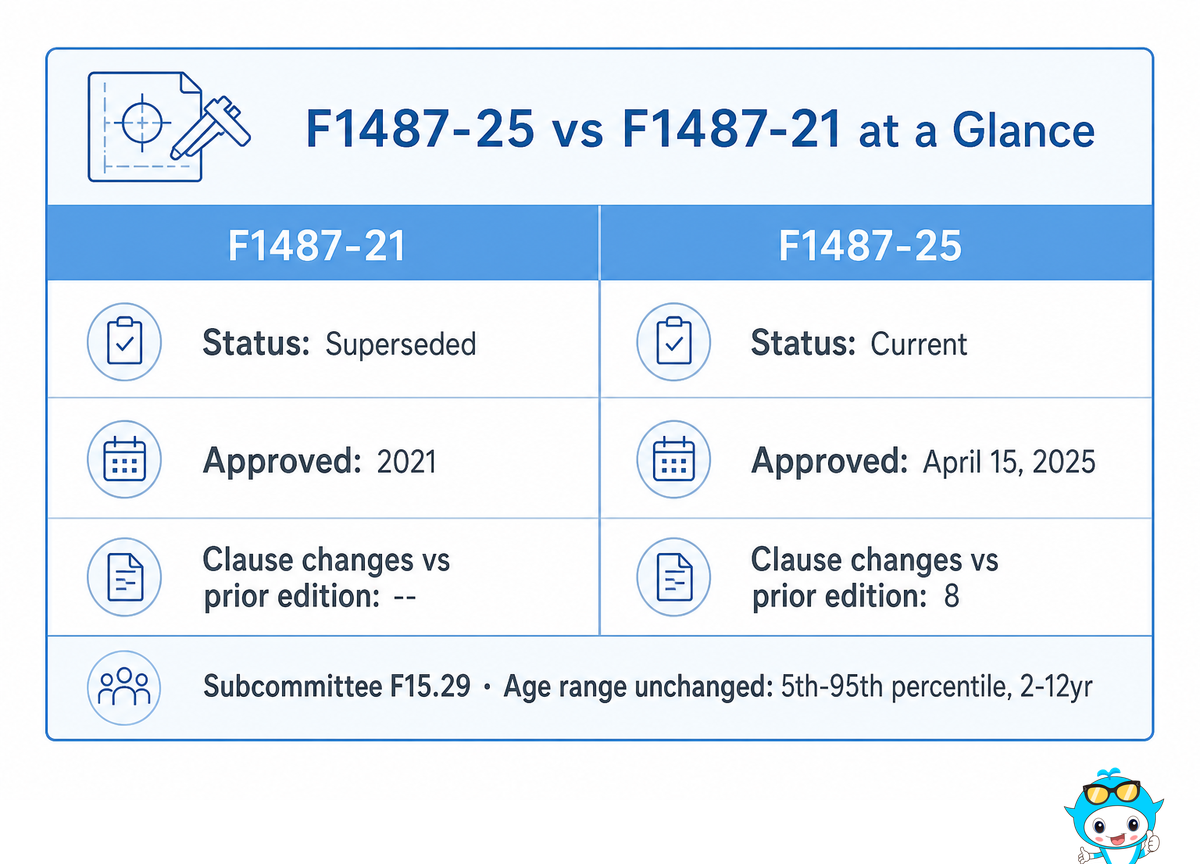
ASTM F1487-25 is the current iteration of the Standard Consumer safety performance specification for playground equipment for Public Use, approved by ASTM Subcommittee F15.29 on April 15, 2025 and published the following month. Replacing F1487-21, it introduces eight clause-level amendments while keeping the standard’s basic scope and target demographic unchanged. A document referencing F1487-21 after June 2025 warrants inquiry but is not automatically grounds for disqualification; much equipment successfully manufactured and tested pre-transition is still legitimately designed under the prior standard.
| Category | F1487-21 | F1487-25 |
|---|---|---|
| Status | Superseded | Current |
| Approved | 2021 | April 15, 2025 |
| Published | 2021 | June 2025 |
| Subcommittee | F15.29 | F15.29 |
| Clause changes vs prior edition | — | 8 (see next section) |
| Age range covered | 5th–95th percentile, 2–12yr | Unchanged |
| Excludes soft-contained play equipment | Yes (F1918 scope) | Yes (F1918 scope) |
| IPEMA certification available | Yes | Yes (with documented exclusions — see verification section) |
| Next revision expected | — | Not final — ASTM already balloting further amendments (see outlook) |
Important note: F1487-25 isn’t a static document; ASTM subcommittee records indicate plans for further modifications are already in process months after F1487-25’s release, a detail explored in our outlook. China’s trade compliance authorities issued an alert about these eight changes about a month after the U.S. published the updated standard. This highlights the pressure on export manufacturers to keep abreast of ASTM publication updates beyond simply adhering to the U.S. market.
Where the Standard Actually Changed, Clause by Clause
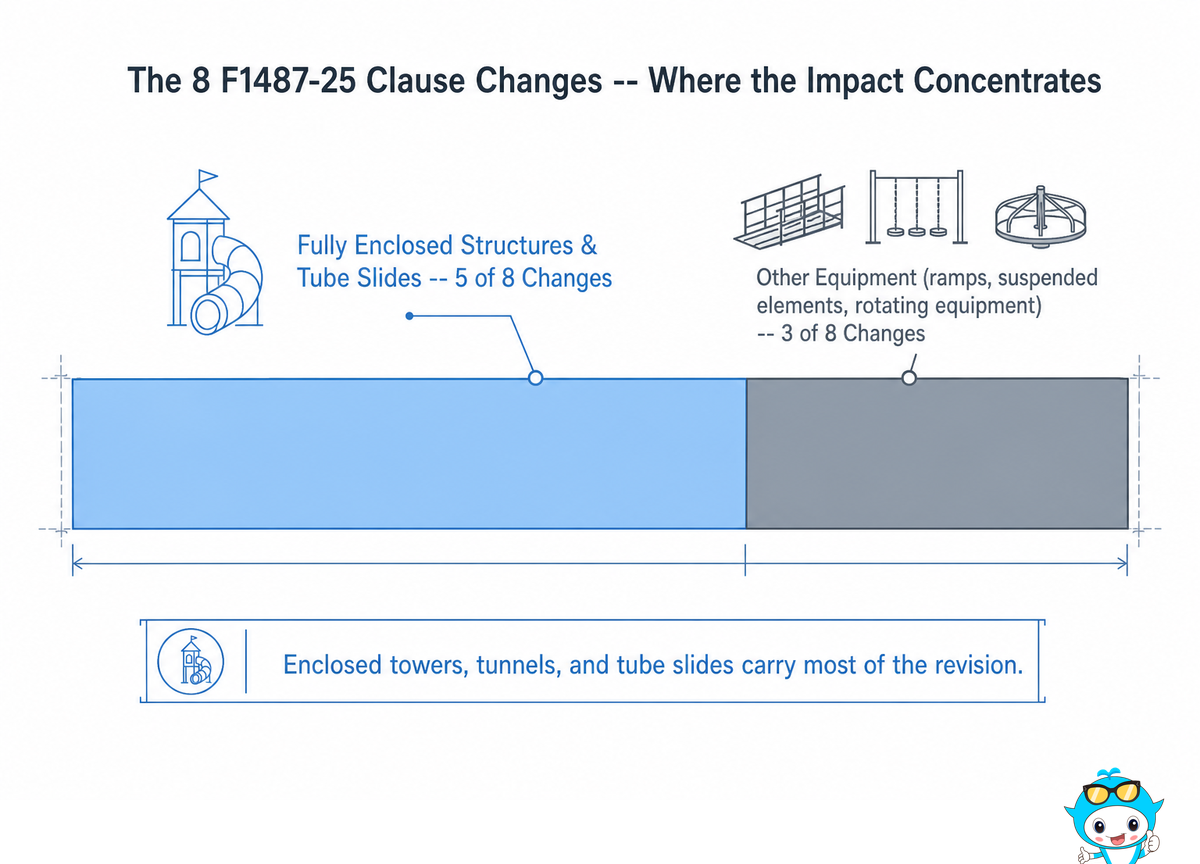
ASTM’s subcommittee approved eight specific changes to the standard, documented in SGS’s June 2025 announcement bulletin of F1487-25. None change the fundamental principles of the standard. Instead, they refine definitions and clarify regulations around types of equipment becoming more widespread since F1487-21 was created, especially fully enclosed structures and tube slides.
| Change | What it affects | Not applicable to |
|---|---|---|
| New definition: “fully enclosed structure” | Tube-style climbers, enclosed towers, tunnel systems | Open-frame climbers, standard platforms |
| Updated suspended-component exemptions | Hanging bridges, suspended climbing elements | Fixed structural members |
| Revised handrail height spec for wheelchair-accessible ramps | Accessible ramp systems | Non-accessible ramps, stairways |
| New requirements for fully enclosed tube slides | Enclosed tube/spiral slides | Open-chute slides |
| New requirements for fully enclosed structures generally | Any structure meeting the new enclosure definition | Partially open structures |
| New requirements for roofs integral to enclosed structures | Roofed enclosed towers | Standalone shade structures |
| New structural-member requirements for rotating equipment under lateral loads | Merry-go-rounds, rotating climbers | Non-rotating equipment |
| New figures A1.68 through A1.72 | Reference illustrations across the above categories | N/A — reference material only |
Equipment types that have increased in indoor playground catalogs due to their indoor orientation — that is, their higher suitability for enclosed play than open-frame, outdoor-type structures — include fully enclosed structures and tube slides, all directly hit by five of the eight modifications. If either an enclosed tower or tunnel structure or a tube slide makes your top 5, you want to specifically prompt your provider on this clause, rather than the standard designation as a whole.
Why ASTM Revised F1487 Now
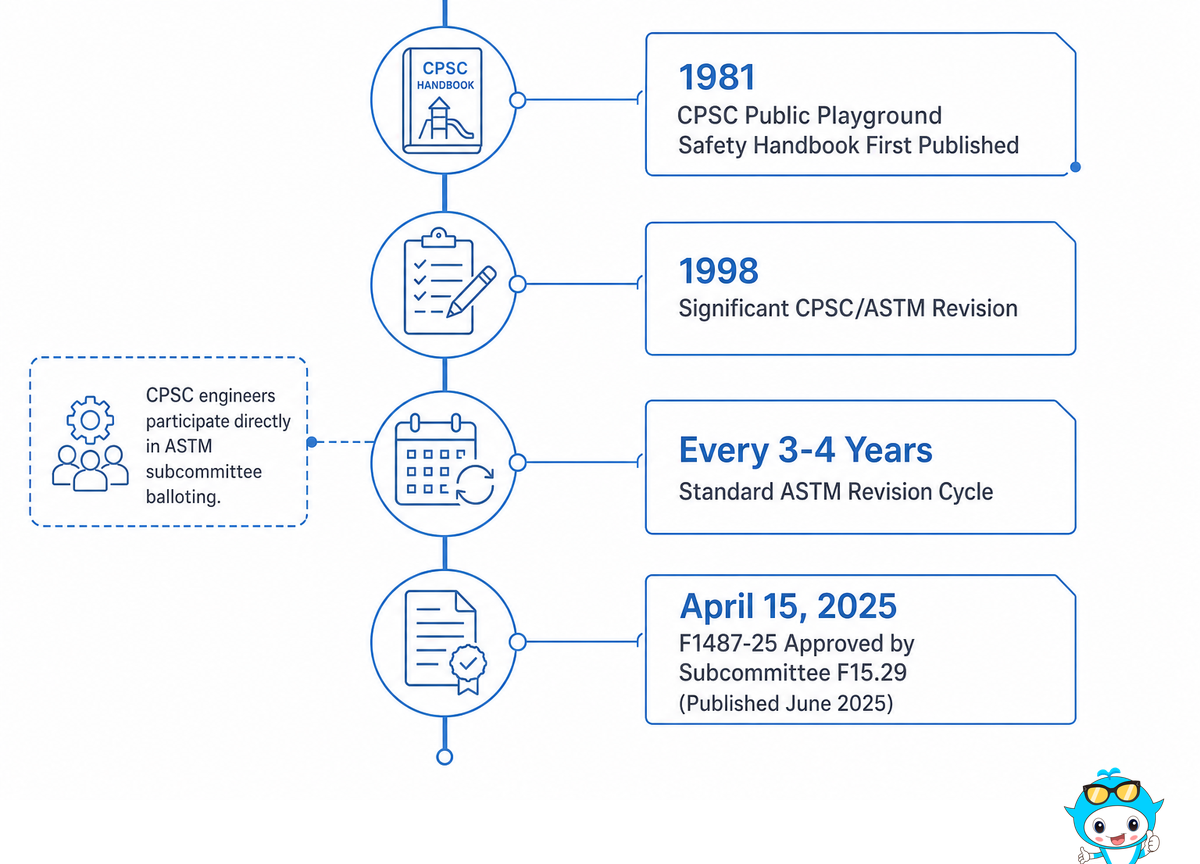
F1487 follows a three- to four-year revision cycle set by ASTM, and F1487-25 just happened to be due for its turn. Also not as commonly known: CPSC staff members participate in the vote in ASTM subcommittee rather than accepting whatever ASTM ends up putting out.
Originally known as the American Society for Testing and Materials – still the “ASTM” in the standard’s designation – ASTM International has issued this consumer safety performance specification since the concept originated back in the early 90s. The underlying framework the CPSC recommended dated even further back: the Consumer Product Safety Commission’s manual for public playground safety was first published in 1981, and both the ASTM standard and the CPSC handbook had many revisions over the years, including significant ones in the 90s and again in 1998. Every edition has kept the same mission: “to reduce the number of life-threatening and debilitating injuries from public playground equipment to the consuming public,” citing problems such as hazardous sharp edges, unsafe openings, inadequate barriers, and lack of guardrails for elevated platforms.
Per the official May 2025 F15.29 subcommittee meeting minutes: CPSC engineers voiced specific concerns during balloting – and during balloting for a different proposed amendment related to ground-level entanglement exemptions, the log notes:
“Children getting stuck can be a hazard in itself, even if it’s at ground level, and staff wants to look into this issue further.”
CPSC staff position (Andy Newens & Daniel Taxier, Engineering Sciences), F15.29 Subcommittee Meeting Log, May 2025
But that interaction tells you exactly why F1487-25 isn’t just a simple rubber-stamp revision. CPSC and ASTM aren’t synchronized processes; they’re not even joined at the hip; they’re separate, parallel, and mutually reinforcing processes. CPSC’s own Public Playground Safety Handbook was updated in July 2025, the same year F1487-25 was updated — again, no more of a coincidence than the agency update landing in the same review cycle window.
U.S. importers beware: the F1487-25 standard update is separate from the CPSC eFiling import-certification requirement scheduled to take effect in 2026.
F1487 vs F1918, Verifying You Have the Right Standard on Your Paperwork
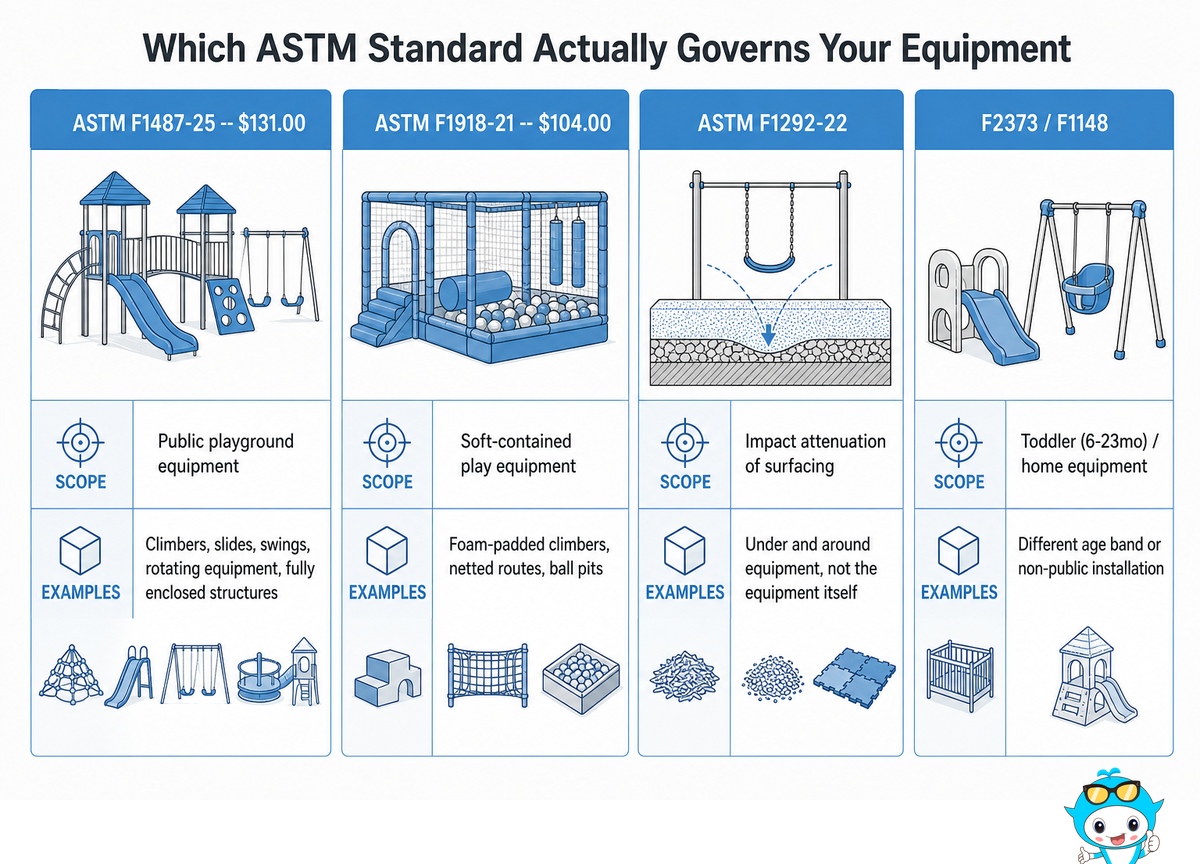
Soft-contained playground equipment such as foam-padded climbers, netted tunnel systems, and enclosed ball pits is specifically not part of ASTM F1487’s own published scope; it falls under a separate standard, ASTM F1918, not ASTM F1487. A vendor claiming their “F1487-25 certified soft contained” equipment has been certified may well be telling the truth — they just may not have the correct standard number on the documentation, and a landlord, insurer, or inspector cross-referencing the document against the actual product might raise an issue.
| Standard | Official scope | Typical equipment |
|---|---|---|
| ASTM F1487-25 | Public playground equipment for public use | Climbers, slides, swings, rotating equipment, fully enclosed structures |
| ASTM F1918 | Soft-contained play equipment | Foam-padded climbers, netted routes, enclosed ball-pit structures, tube slides that are soft-contained rather than structural |
| ASTM F1292-22 | Impact attenuation of surfacing materials | Under and around equipment, not the equipment itself |
| F2373 / F1148 | Toddler equipment (6–23mo) / home equipment | Different age band or non-public installation — not interchangeable with F1487 |
The ASTM playground standards family is spread across multiple related documents rather than one master specification that covers various types of public playground equipment. In addition to F1487 and F1918, the standard specification set covers safety and performance standards, performance standards for various types of playground equipment and surfacing alike: F1292 is specifically for protective surfacing under and around equipment (an “ASTM F1292 PDF” search turns up the same paywall situation as F1487), while separate documents address home playground equipment and products specifically for toddlers. F1487 states explicitly that it does not cover site furnishings like benches or tables installed outside the designated use zone, nor does it cover fitness equipment intended for older users. On accessibility, the updated F1487-25 wheelchair-ramp handrail clause is part of a broader inclusive-design theme in the standard to address children’s disability access on elevated play structures, while the playground-standards ecosystem also reaches across the border: this Canadian harmonization means the U.S. ASTM specification has been harmonized with Canada’s CAN/CSA-Z614 standard for children’s playspaces and equipment. Buyers operating on both sides of the U.S.-Canada border will need to consider that spec along with F1487.
Most commercial indoor playground facilities offer a mix of both (structure climbers/slides are under F1487, soft-contained and ball pits are under F1918), so it’s not unusual for a single manufacturer’s catalog to contain items certified against both standards. F1918-21 itself is a $104.00 document developed by ASTM Subcommittee F15.36 (36 pages, covering the same 5th-to-95th-percentile, 2-to-12-year-old user range as F1487) — a separate purchase from F1487-25’s $131.00. Didi Land, for instance, has its hardware-based indoor jungle gym structures certified against F1487, but soft play climbing equipment and ball pits are certified against F1918. If you need a more detailed breakdown on how to choose between these, we cover it comprehensively in our indoor jungle gym buying guide, which features a complete F1487-vs-F1918-vs-EN1176 decision tree. Key takeaway for buyers: don’t look at the “which standard” as a single binary decision across your entire purchase – assess each product line individually.
How to Verify Your Supplier’s Certification Is Actually F1487-25 (Not Stale F1487-21)
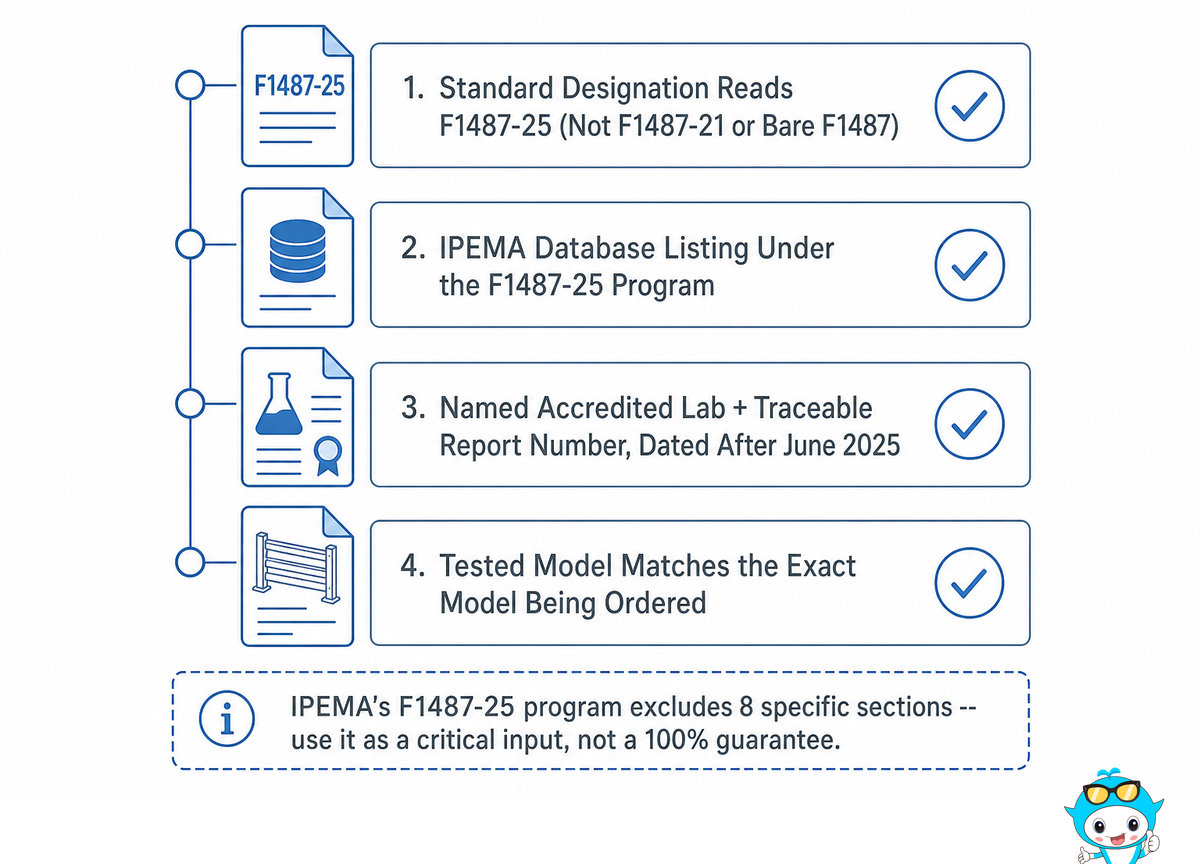
A “ASTM certified” logo on a spec sheet doesn’t mean as much as most buyers imagine. Verifying currency is actually about four documents and a handful of dates – we call this The 4-Document Currency Proof: the standard designation itself on the certification, IPEMA listing (if cited), the issuing lab report number and date, and verification that the tested product actually matches the product being shipped.
The voluntary product certification that most commercial playground buyers look to for third-party assurance is offered through IPEMA, which certifies to ASTM F1487-25, but with specific documented exclusions listed. IPEMA’s official certification program page for F1487-25 lists conformance, but explicitly states it excludes sections 7.1.1, 10, 11.2, 11.3, 13.1.1, 13.1.2, 13.2, and 13.3. What this means: an IPEMA listing verifies a particular product complies with most – not every single – aspect of F1487-25, and the listing validates that specific product, not the manufacturer’s entire line or the assembled play area as a whole. Use it as a critical input, not as a 100% guarantee of full compliance.
Supplier certification verification checklist — copy these into your RFQ or order confirmation:
| Parameter | Recommended check | Why it matters | How to verify |
|---|---|---|---|
| Standard designation on cert | Must read “F1487-25,” not “F1487-21” or bare “F1487” | Bare “F1487” with no year is the single biggest red flag — The One-Date Giveaway | Read the cert document directly, don’t rely on a marketing page summary |
| Issue/test date | After June 2025 for any F1487-25 claim | A cert can’t test against a standard that didn’t exist yet | Cross-check date against the report number’s own issue field |
| IPEMA database listing | Product model appears under the F1487-25 program | Confirms third-party validation, not just a supplier self-declaration | Search the model number in IPEMA’s public certified-products listing |
| Lab name + report number | Named accredited lab, traceable report ID | Generic “tested to ASTM standards” without a report number is unverifiable | Ask the supplier to forward the full report, not a one-line summary |
| Model match | Tested model = the exact model/configuration being ordered | One report can’t cover every custom layout or configuration in a catalog | Confirm model number, size, and configuration match the quote line by line |
Here’s a word of caution for the sake of being plain: An IPEMA listing or current report on file is good – it isn’t automatically conclusive that a piece of equipment meets local law everywhere you ship it. Some states and municipalities will incorporate a specific version by reference in their own park codes or procurement policies – and it’s no guarantee that any specific version will auto-update the moment ASTM prints a new one. If you are dealing with a school district or other public agency, make sure to confirm which edition their contract or code specifies before assuming that newer is better for everything you acquire. If you are a first-time buyer dealing with a manufacturer (and not just a specific product’s certification), make sure this checklist works in tandem with our buyer’s specification audit guide and supplier vetting framework.
What This Means If You Already Bought F1487-21-Certified Equipment
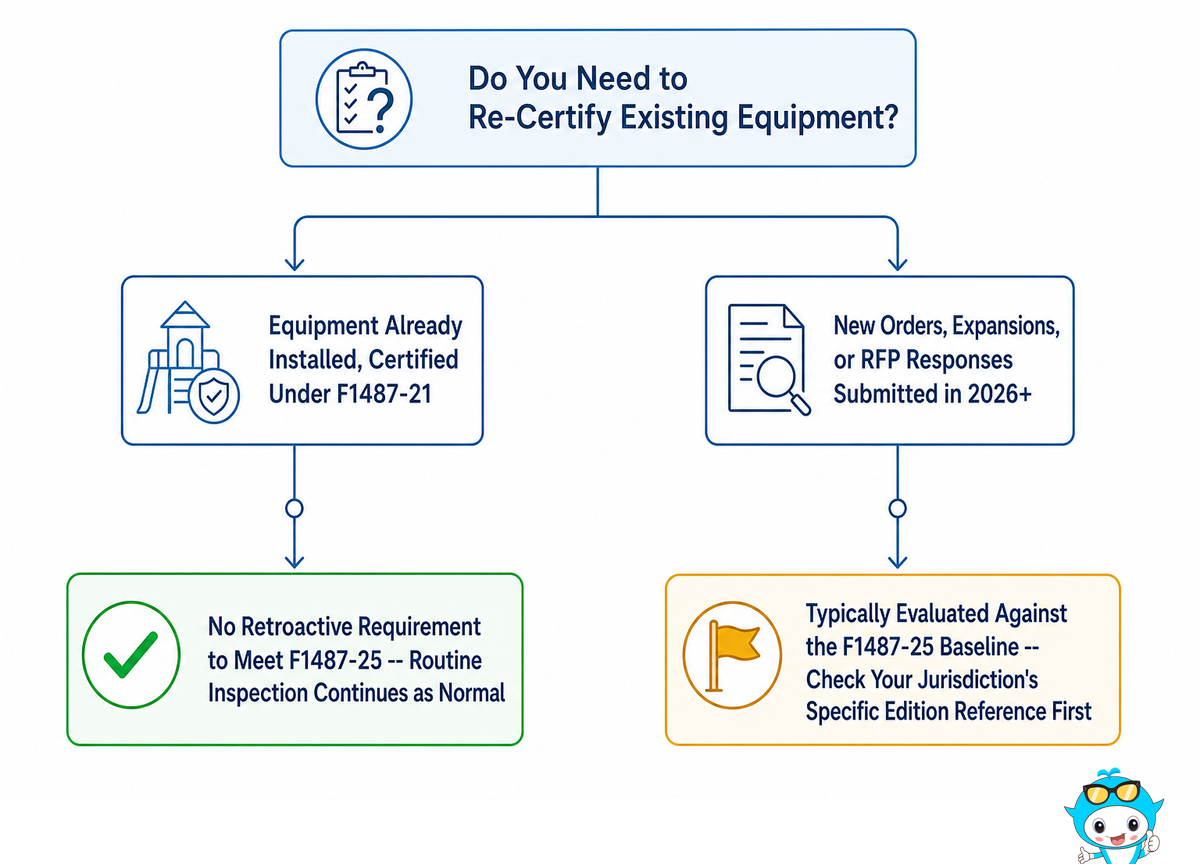
✔ Advantages of the grandfathering approach
- Equipment already installed and certified under F1487-21 is generally not retroactively required to meet F1487-25’s new clauses
- No standard revision has historically mandated immediate replacement of compliant existing installations
- Routine inspection and maintenance obligations continue unchanged regardless of which edition applied at purchase
⚠ Limitations to check before assuming you’re covered
- New orders, expansions, or RFP responses submitted in 2026 and later will typically be evaluated against the F1487-25 baseline, not the edition in effect when you first purchased
- Your specific jurisdiction or contract may reference a particular edition by name — check before assuming automatic grandfathering applies
- If equipment is modified, relocated, or has components replaced, some jurisdictions treat that as triggering re-evaluation against the current standard
In practical terms, keep your original – year of purchase – certification on file – that’s the only document needed for equipment in the ground – and to ensure that any new purchases you make reflect F1487-25 compliance on paper, if nothing else. Cross-check your own jurisdiction’s position against CPSC’s voluntary-standards guidance before assuming automatic grandfathering.
Where CPSC’s Playground Safety Handbook Fits In
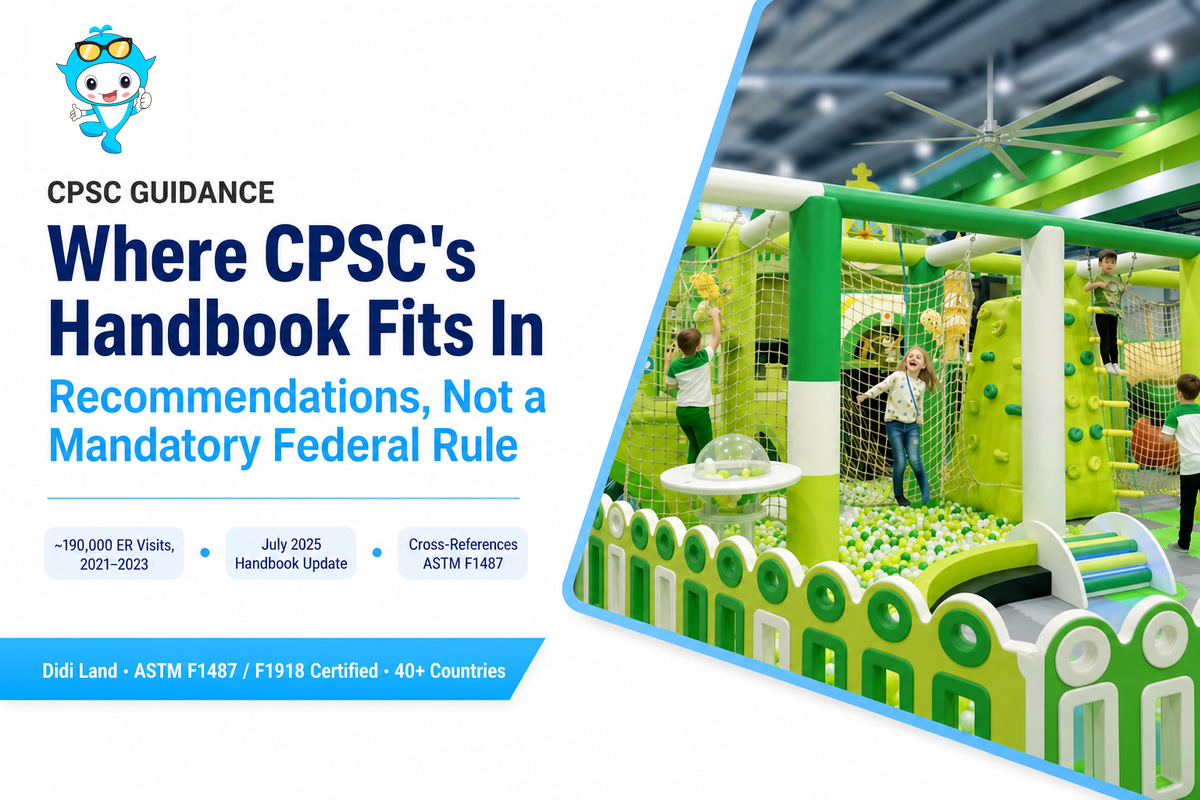
CPSC’s Public Playground Safety Handbook, updated in July 2025, provides voluntary guideline-level recommendations and cross-references ASTM F1487 without enforcing it nationwide as a mandatory federal regulation. ASTM F1487 itself is a voluntary consensus standard: CPSC does not require a specific certification for playground equipment, though it does not ban such products either. States, cities, and school districts frequently convert the voluntary standard into a mandatory requirement by writing it into contract or procurement policy language.
The Handbook also addresses installation and maintenance topics outside the scope of the equipment specification, like material choices (decay-resistant wood, noncorrosive metal hardware), how to designate fixed versus moving structures, and general regulatory principles dating back to the ADA’s 1990 accessibility standards, which F1487’s own accessibility clauses reference. That contract-language question is exactly why the jurisdiction check from the certification-verification section above matters here too.
There are real implications, not just legal niceties. CPSC’s 2025 Handbook for Public Playground Safety estimated nearly 190,000 emergency room visits related to equipment between 2021 and 2023 – explaining why such standards must be periodically revised and re-approved by CPSC and the equipment subcommittee.
Industry Outlook, Why Certification-Currency Checks Are Becoming Routine
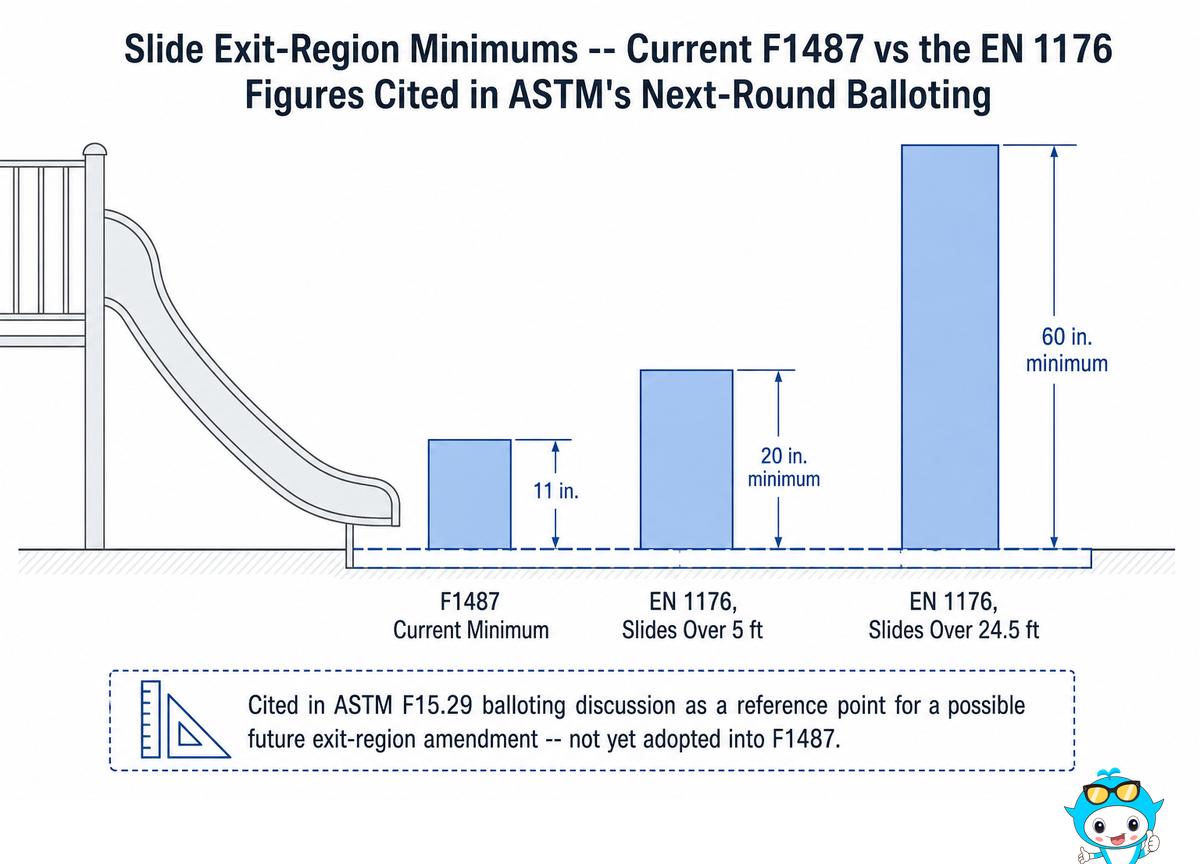
However, F1487-25 is not likely to be the final edition. In fact, meeting minutes from an ASTM subcommittee session held about a month before the final version of F1487-25 was published document proposed ballots to amend several parts of the specification, including an exit-region for slides over 5 ft tall (inspired partly by Europe’s EN 1176 specification, which requires a 20 in minimum exit region for slides over 5 ft and a 60 in minimum exit region for slides over 24.5 ft — both well beyond F1487’s current 11 in minimum), the introduction of a “Forced Movement Equipment” category with its own zone requirements, and further exceptions from the entanglement definition for equipment designed for use at ground level. An ASTM F15.29 meeting has been scheduled for November 11-12, 2025, in Atlanta, GA. In parallel, a different subcommittee of F15.36 is reviewing adding exit and evacuation provisions for soft-contained equipment, with one proposal to rename the subcommittee, as “soft-contained” no longer fully describes many such systems.
This isn’t, for all practical purposes, a one-time paper scramble to comply with F1487-25 and be done with it. This standard family is revised roughly every three to four years and the subcommittee is already hard at work on the next cycle, even while this one is still being rolled out. Those buyers who embed a recurring certification-currency check into their procurement process — rather than treating it as a single, event-driven task associated with one vendor discussion — won’t have to start this entire process from scratch next time around.
Frequently Asked Questions
Q: What is the ASTM F1487?
ASTM F1487 is the Standard Consumer Safety Performance Specification for Playground Equipment for Public Use, it sets safety and performance requirements for public playground equipment serving children from the 5th percentile 2-year-old through the 95th percentile 12-year-old.
Its scope is quite specific, encompassing fall heights, use of zones, entrapment prevention, protrusion limitations and structural requirements for equipment installed in schools, day-cares, parks and other similar public use environments. Soft-contained play equipment (which is governed by ASTM F1918), playground surfacing materials (ASTM F1292) and residential playground equipment (ASTM F1148) are specifically excluded. F1487-25, released June 2025, is the latest edition.
Q: What’s the difference between ASTM F1487-25 and F1487-21?
F1487-25 is the current edition, adding eight clause-level changes to F1487-21, primarily affecting fully enclosed structures, tube slides, wheelchair-accessible ramp handrails, and rotating equipment under lateral loads.
F1487-21 still stands for all equipment tested prior to June 2025 — existing installations manufactured in accordance with F1487-21 are not invalidated and do not require replacement. The difference going forward is the baseline against which all new certifications, RFQ submissions, and purchase requisitions will be judged starting in 2026, all of which should cite F1487-25. These eight changes are specific in nature and apply to enclosed structures, tube slides, ramp handrails in wheelchair-accessible ramps, suspended elements, and rotating equipment subjected to lateral forces. Refer to the detailed clause-by-clause table presented earlier in this guide for a complete breakdown of the changes and the types of equipment to which they apply.
Q: Is ASTM certification mandatory for playground equipment?
Not as a single federal mandate. CPSC states there is no specific federal certification requirement for playground equipment, though ASTM F1487 compliance is the near-universal market expectation and may be legally required by your specific state, municipality, or contract.
ASTM F1487 is officially a voluntary consensus standard, but most landlords, school boards, insurance companies and the majority of municipal procurement rules view it as a required baseline standard. Many cities and towns have actually incorporated a particular edition of F1487 by reference into their municipal building code, which means it’s far more important to confirm the specific version adopted in your jurisdiction than to assume there’s a single, overarching national standard.
Q: How often do playgrounds need to be inspected?
Most commercial playground programs combine routine visual inspections (weekly to monthly) with a more thorough annual audit by a Certified Playground Safety Inspector (CPSI), independent of any ASTM standard revision cycle.
A standard revision doesn’t reset your inspection clock.
Q: What’s the difference between ASTM F1487 and ASTM F1918?
F1487 covers public playground equipment generally, including climbers, slides, and swings, while F1918 specifically covers soft-contained play equipment such as foam-padded climbers, netted routes, and enclosed ball-pit structures.
Because most commercial indoor environments combine the two in a single space, it’s very common for a supplier’s offerings to have F1487 certification for hardware structures and F1918 certification for soft-contained modules in the same purchase order. Check certifications on a product-by-product basis rather than based on the order as a whole.
Q: Where can I check if a supplier’s IPEMA certification is current?
IPEMA maintains a public product certification listing on its own website where buyers can look up whether a specific model is currently certified, and to which standard edition.
When checking an IPEMA listing for F1487-25 certification, use the exact product model number, not the brand or supplier name, as certifications are issued per product. Be sure to review the section exclusions, as IPEMA’s F1487-25 certification includes specific sections with documented exclusions. While a strong indication of rigorous testing against the standard’s majority of clauses, it doesn’t guarantee compliance with every clause. Always compare the IPEMA listing date with your project timeline and cross-reference with a lab report dated June 2025 or later for the best assurance without additional testing.
References & Sources
- ASTM F1487 Standard Consumer Safety Performance Specification for Playground Equipment for Public Use — ASTM International
- SGS SafeGuardS SG090/25, ASTM Publishes Revised Consumer Safety Performance Specification — SGS
- ASTM F15.29 Public Playgrounds Subcommittee Meeting Log, May 2025 — U.S. Consumer Product Safety Commission
- Public Playground Safety Handbook, 2025 Edition — U.S. Consumer Product Safety Commission
- Public Playground Equipment, Voluntary Standards — U.S. Consumer Product Safety Commission
- IPEMA Certification Program — International Play Equipment Manufacturers Association
About This Compliance Guide
Didi Land manufactures ASTM F1918-referenced soft-contained equipment and ASTM F1487-referenced structural equipment under both of our indoor jungle gym and soft-play product ranges. Therefore, keeping up to date on which clause was altered and which standard is applicable to which equipment is something we do as part of our own procurement process, rather than just write about. This guide references that cross-referencing work as of publication, noting that standards are altered at their own discretion and so are subject to updates so always verify with ASTM or IPEMA. Reviewed by the Guangzhou Didi Land Amusement Equipment Co., Ltd. technical team.
Related Articles
- Soft Play Equipment Safety Standards — the full multi-standard picture for soft-contained equipment specifically
- Indoor Playground Equipment Buyer’s Spec Audit Guide — mill certs, red flags, and post-selection verification
![Custom Dinosaur Playground Equipment [Design Guide]](https://didiplayarea.com/wp-content/uploads/2026/09/custom-dinosaur-playground-equipment-r2-featured-1-768x512.png)

![Custom Dinosaur Playground Equipment [Design Guide]](https://didiplayarea.com/wp-content/uploads/2026/09/custom-dinosaur-playground-equipment-r2-featured-1-150x150.png)