Get in Touch with Didi Land


The CPSC 2025 Playground Safety Handbook is the Consumer Product Safety Commission’s July 30, 2025 update to its Public Playground Safety Handbook, covering guardrail height, climbing equipment, and net entrapment rules.
Quick Specs: CPSC 2025 Playground Safety Handbook at a Glance
| Handbook | Public Playground Safety Handbook, CPSC Publication 325 |
| Update published | July 30, 2025 (Federal Register Notice 2025-15374, Aug. 13, 2025) |
| Prior major revision | 2010 — first substantive update in 15 years |
| Legal status | Voluntary guideline — not a federal mandate, creates no legally enforceable requirement |
| Technical companion | ASTM F1487-25 |
| Entrapment (location-based) | Partially bounded openings below 24 in. (61 cm) from the ground — no exemption |
| Barrier trigger | Elevated platforms & stairs >48 in. (122 cm) above protective surfacing (lower for toddler/preschool equipment) |
| Handrail height (ages 2–5) | 22–26 in. (56–66 cm) |
| Net/flexible opening test | 17–28 in. (43–71 cm) perimeter (Figure 13, torso probe B7 + head probe B8) |
CPSC 2025 Playground Safety Handbook is this article’s shorthand for the updated public playground safety handbook 2025 edition, released July 30, 2025 – the first major revision since 2010. For importers or operators seeking indoor/outdoor commercial play equipment for the US market, the following three areas of the new guidelines are of paramount importance: guardrails and handrails, climbing equipment, and net or rope entrapment. This guide dissects the exact clause wording of the new handbook – not a repackaging of generic ASTM playground standards or CPSC guidelines for playground equipment already covered elsewhere – with guidance derived from the Commission’s own comment and response record.
The 2025 Handbook confirms a non-exempt 24-inch entrapment rule for partially bounded openings, requires 48-inch high barriers for elevated-platform play areas (with lower thresholds for toddler equipment), and specifies a 17-28 inch perimeter for net/rope openings (measured using head and torso probes). CPSC largely rejected industry suggestions for less stringent figures.
💡 Key Points
- Over 190,000 playground injuries requiring emergency treatment happen annually, the backdrop CPSC cites for these final updates; CPSC received 37 public comments during the process and rejected the majority of industry requests to loosen entrapment and height standards.
- CPSC’s Handbook is not a rule — it is not legally enforceable — but insurers and municipalities often treat its safety recommendations and updated guidelines as a practical benchmark.
- CPSC’s 2025 guideline recommends against the use of freestanding flexible climbers in preschool settings because they only allow one direction for exit.
- Note: ADA/Access Board accessibility requirements are a separate, legally enforceable mandate, not covered in this article.
What Changed in the CPSC’s 2025 Public Playground Safety Handbook
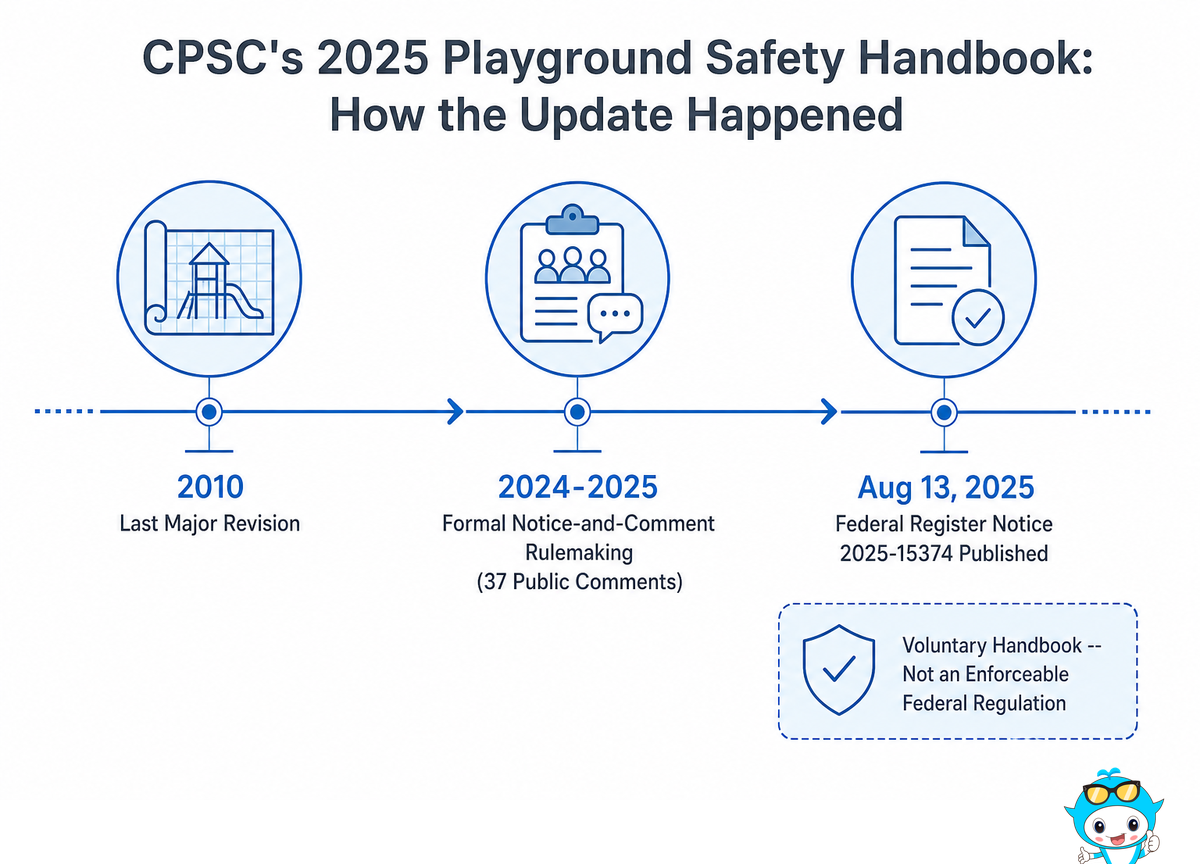
CPSC’s Handbook is a set of cpsc recommendations, not an enforceable federal regulation; CPSC states explicitly that it imposes no legal responsibilities and that manufacturers and importers should refer to its references to voluntary standards such as astm standards for detailed technical specifications.
This 2025 update marks the Commission’s first major revision since 2010, developed through a 2024-2025 formal notice-and-comment rulemaking process (Federal Register Notice 2025-15374) with references to astm that shaped the working relationship between cpsc and astm on this updated handbook.
The 2024-2025 rulemaking process attracted 37 public comments from manufacturers, certifiers, and advocates for playground safety prior to publication. Facilities that will be most impacted include childcare centers, kindergartens, and family entertainment centers due to their tendency to feature more toddler- and preschool-focused equipment that are subject to new rules in the update.
Instead of the usual bulleted-list overview of an update such as signage, surfacing, fencing, supervision, the more relevant design and purchasing decisions lie within the comment and response record of the update. We walk through that record and highlight its most impactful findings and their design implications, as the primary source, not a generalized interpretation.
⚠️ Important: Voluntary, Not Mandatory
No content in this article addresses a legally mandated standard.
cpsc’s own Handbook specifies that the guidelines are recommendations, not regulations. Additionally, US Access Board and ADA regulations establish legally enforceable standards regarding accessibility (ramps, accessible routes, transfer platforms), which are not addressed in this piece.
Guardrail and Handrail Height Rules: What Changed in Sections 5.1–5.2
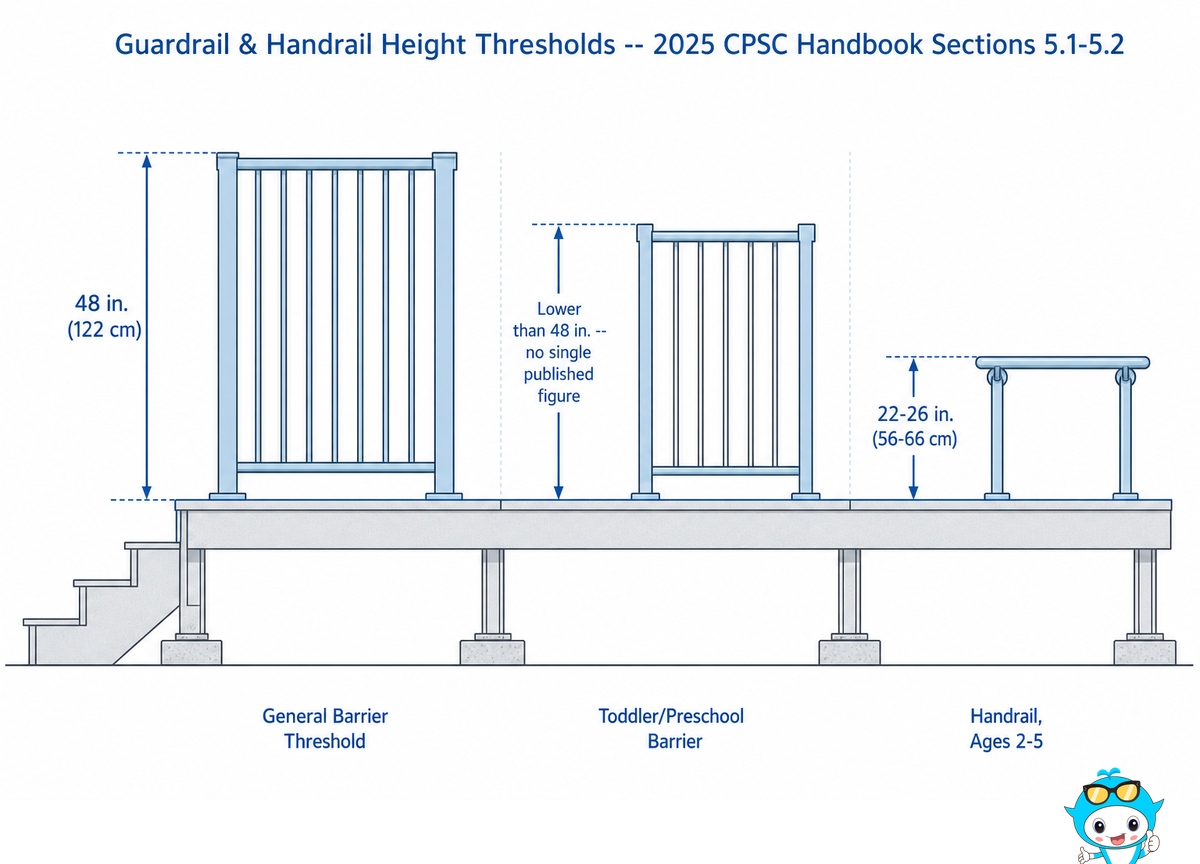
We suggest placing guards on platforms and stairs that rise more than 48 inches above protective surfacing and that for younger children a lower minimum can apply to carryover hardware from Toddler and Preschool age; 48 inches isn’t one number for every age band. In the 2025 rulemaking IPEMA urged cpsc to eliminate the requirement entirely for upper body equipment and stairway and ramp access – CPSC agreed and included this in Section 5.1.3.
What height requires a playground guardrail?
When a platform or stair run height goes beyond 48 inches above protective surfacing, we suggest guardrails. For hardware aimed at preschoolers, cpsc sets lower minimum heights in the same section. These guidelines explicitly exclude upper body equipment and stairway or ramp access – as requested by IPEMA in the 2025 rulemaking.
We also provide guidelines that clarify how to evaluate what the Handbook calls a composite structure – several play elements integrated as a unit. Section 5.3.9 assesses this type of structure as a single entity with one critical height, based on its single highest fall height, instead of evaluating each component separately. According to one reader in our online comment section, for larger composite towers this is a real price-determining issue that would require more padding to prevent injuries.
Handrails have a separate and age-specific rule set forth in Section 5.2.3: 22-26 inches for 2- to 5-year-olds. IPEMA asked for this range to be adjusted to match astm’s higher range of 22-38 inches applicable to older children, arguing that the narrower range was overly restrictive; CPSC referenced the COMSIS Human Factors Report for maintaining the lower height requirement, to better reflect younger users’ needs.
| Condition | Recommendation | Limitations / Not suitable for |
|---|---|---|
| General elevated platform/stair | Barrier if >48 in. (122 cm) above surfacing | Not applicable to upper-body equipment or stair/ramp entries (exempted) |
| Toddler/preschool equipment | Lower barrier threshold than 48 in. (122 cm) | Handbook does not publish a single universal figure in inches or centimeters for this band — verify with your equipment’s age-grade documentation |
| Handrail, ages 2–5 | 22–26 in. (56–66 cm) | Not suitable to apply the wider ASTM school-age range (22–38 in. / 56–97 cm) to this age band |
“The Commission continues to recommend a lower handrail height for 2- to 5-year-old children based on the COMSIS Human Factors report.”
U.S. Consumer Product Safety Commission, Federal Register Notice 2025-15374
For your buying decision, this means the 48 inches is a point to be used for initial evaluation; check your manufacturer’s agreement for guardrails and be sure that they also specify how they’ll meet age appropriate guidelines. Be certain that your manufacturer’s declaration for compliance states their compliance is to the appropriate age band and doesn’t simply say “48 inches” for toddler/preschool age equipment. See indoor playground equipment for kindergartens for how age-band compliance is typically documented in a preschool-grade order.
Climbing Equipment: Flexible Climber and Internal Fall Distance Rules
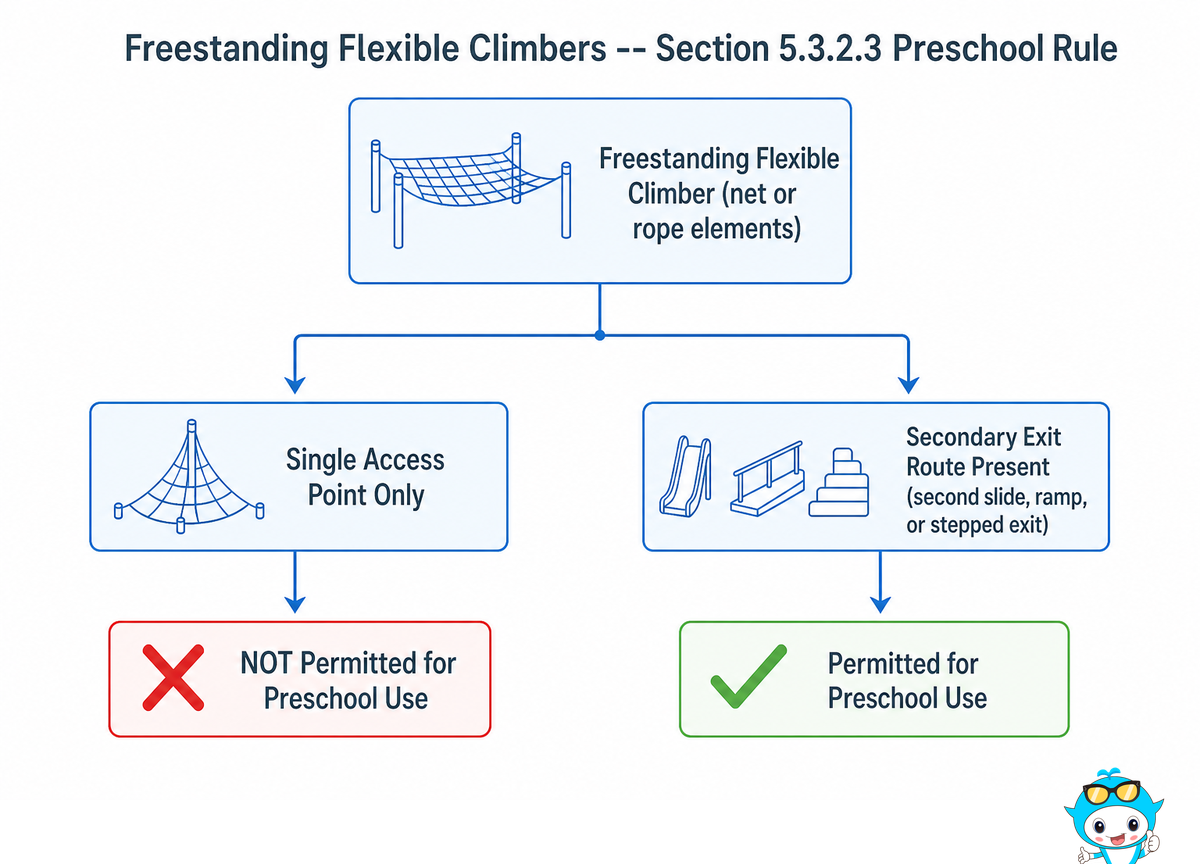
We don’t suggest freestanding flexible climbers – those with net or rope elements with no other descent route – for preschool age children per Section 5.3.2.3 of the 2025 Handbook. That’s because if a child stops or freezes near the top of a device and can’t continue upward, they’re much more likely to fall or jump from the structure because there’s nowhere to retreat from above.
IPEMA pushed back during the comment period, stating that some flexible climbers were suitable for preschoolers, and had asked cpsc to water down the suggestion. NPPAS had come in on the other side of the issue, recommending that CPSC advise parents against buying freestanding flexible climbers for that age range altogether. CPSC’s final language landed somewhere in the middle on that issue: flexible climbers continue to be permissible for preschool use only where there’s an alternate means of exit from the structure. A standalone, single-access climber won’t qualify.
📑 Engineering Note
If a climbing structure you’re sourcing for a toddler or preschool zone is freestanding with no secondary exit built in, ask your supplier to add one – a second slide, ramp, or stepped exit – before ordering; that alternate-egress feature is what qualifies the equipment for preschool use under Section 5.3.2.3.
Professional climbing structure systems, including those manufactured by Didi Land, meet astm f1487 and EN 1176 standards, and typically incorporate multiple entry-and-exit points when built for younger children (see soft play climbing equipment for more about how egress routes are specified across age categories).
Net and Rope Entrapment: The 24-Inch Rule and the Figure 13 Probe Spec
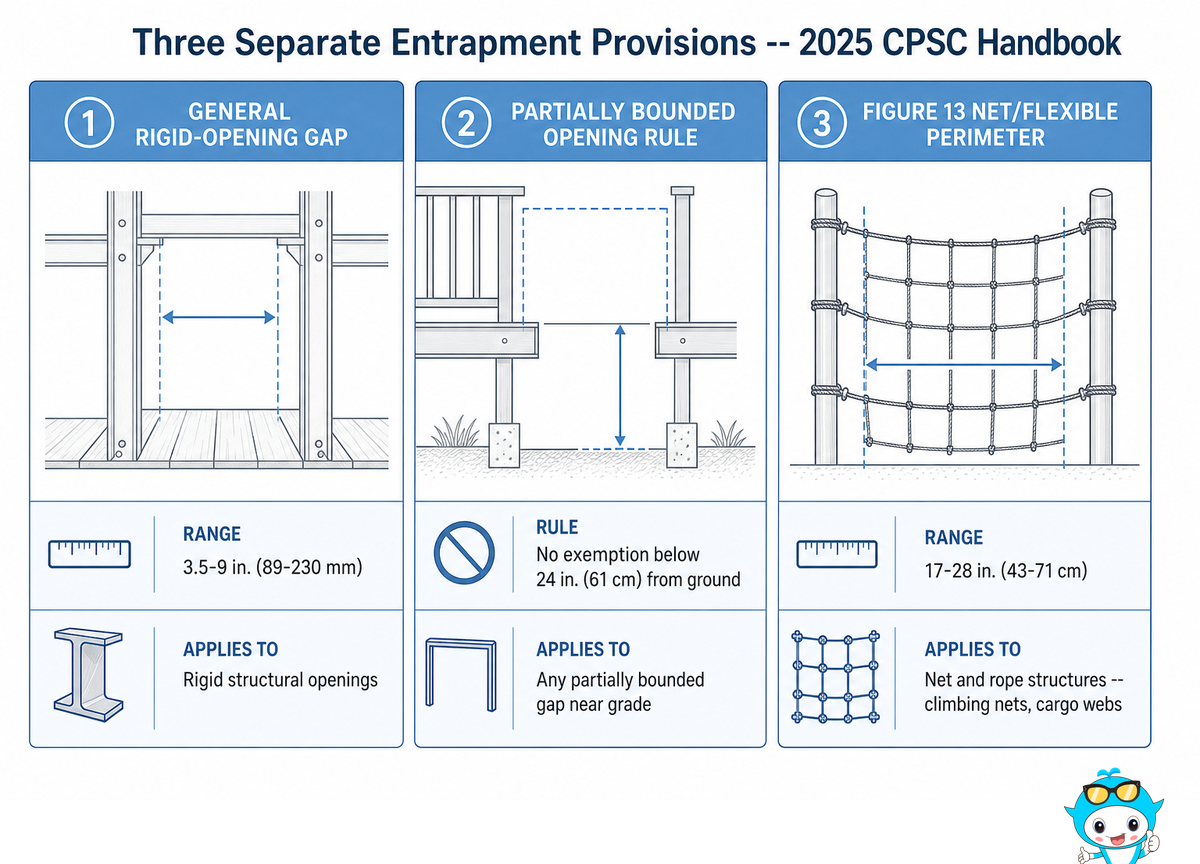
Three different standards govern the potential for entanglement in 2025-compliant play structures, and reports from competitors frequently gloss over the differences into a general ‘entrapment standard,’ but each standard applies to a different category of materials, and applying the wrong one would result in a wrong conclusion regarding compliance.
| Provision | What it tests | Applies to |
|---|---|---|
| General rigid-opening gap | 3.5–9 in. (89–230 mm) — the classic ASTM F1487 head-entrapment “no man’s land” | Rigid structural openings (decking gaps, guardrail bar spacing) |
| Partially bounded opening rule | No exemption below 24 in. (61 cm) from the ground | Any partially bounded gap between structural parts, regardless of size, if it’s within 24 in. (61 cm) of grade |
| Figure 13 net/flexible perimeter | 17–28 in. (43–71 cm) perimeter (torso probe B7 + head probe B8) | Net and rope structures — climbing nets, cargo webs, flexible climbers |
IPEMA asked CPSC to exempt equipment sections more than 84 inches (213 cm) above the play surface, and separately to exempt partially bounded openings below 24 inches (61 cm) from the ground, arguing both align with ASTM F1487, CSA Z614, and EN 1176. CPSC’s agency staff rejected both suggestions. Its stated reasoning is worth reading closely: those 84-inch and 24-inch exemptions exist in ASTM F1487 because the ASTM playground subcommittee assumed children are unlikely to reach that high or become entrapped that low – but the Handbook does not adopt that assumption as its own baseline, and continues to flag both zones for hazard review.
Figure 13’s reference range – 17 to 28 inches (43-71cm) of “opening perimeter,” applied specifically to netting structures, with parameters set by a “torso probe” (Figure B7) and “head probe” (Figure B8) – also came under attack from IPEMA and NPPAS, which claimed that the “perimeter of opening has no bearing on an opening’s tendency to pose an entrapment risk.” The agency sided against the manufacturers and instead added a description to Section 5.3.2.3 about how the two probes would be used to test netting openings for potential head-entrapment dangers.
💡 Pro Tip
The manufacturers also pointed out a potential flaw in the illustrations in Section 2.2.7 of the Handbook – that an opening in one of the pictured net climbers seemed to violate the Handbook’s definition of an “entrapment hazard.” The incident serves as a good reminder: don’t accept a supplier’s assurance that a play structure appears to comply – verify its safety with measurements based on Figure 13’s probe criteria.
Why CPSC Rejected Industry’s Push to Loosen These Rules
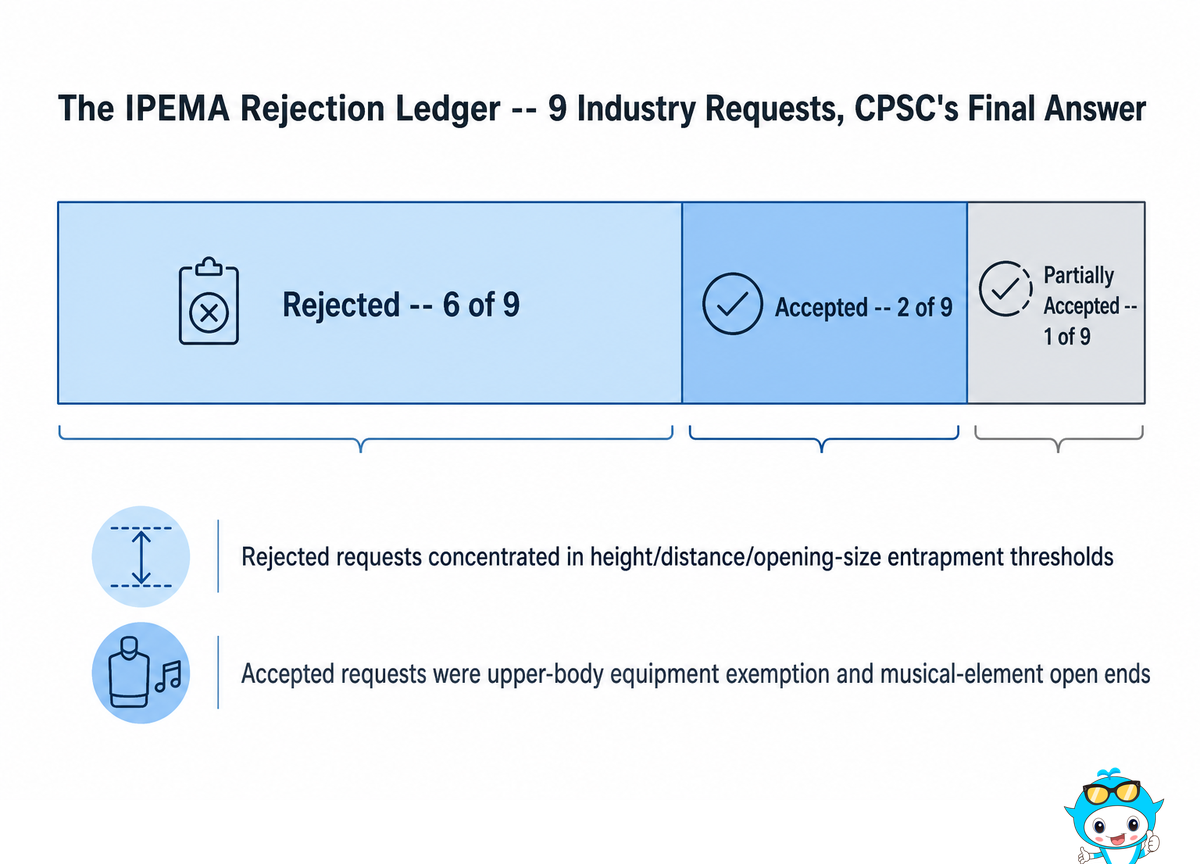
A regulator taking a tougher position than the industry-preferred technical standard is the most surprising part of this update. During the comment period IPEMA and NPPAS both submitted specific, technical requests, and cpsc’s public responses show which they accepted and which they denied, along with the reasoning.
Because no one else is collecting the whole story in one place, we are: the IPEMA Rejection Ledger below is compiled directly from the Commission’s published comment-and-response text.
| No. | Provision Type | Industry request | CPSC decision | Cited rationale |
|---|---|---|---|---|
| 1 | Height exemption | Exempt equipment >84 in. (213 cm) above play surface from Section 3 hazard review | Rejected | ASTM’s own exemption rests on an assumption about reach the Handbook does not adopt |
| 2 | Distance exemption | Exempt partially bounded openings <24 in. (61 cm) from ground | Rejected | Same reasoning — assumption-based ASTM exemption not adopted |
| 3 | Height range | Harmonize ages 2–5 handrail height to ASTM’s 22–38 in. (56–97 cm) range | Rejected | COMSIS Human Factors report supports the narrower 22–26 in. (56–66 cm) range |
| 4 | Reference/definition | Remove Figure 13 net-opening perimeter reference | Rejected | Perimeter is based on validated torso (B7) and head (B8) probe dimensions |
| 5 | Age-based restriction | Exempt freestanding flexible climbers for preschool age | Rejected | Single-egress equipment raises jump/fall risk if a child stalls near the top |
| 6 | Reference/definition | Replace crush/shear ASTM F1487 reference with a Handbook-native illustration | Rejected | Existing ASTM F1487 reference already adequate for this hazard type |
| 7 | Scope exemption | Exempt upper-body equipment and stair/ramp entries from barrier rule | Accepted | Agreed these entries don’t present the same fall-height risk profile |
| 8 | Design allowance | Allow musical elements (chimes, tubes) to have exposed open ends | Accepted | Caps/plugs would prevent the equipment from functioning; rounding + guarding required instead |
| 9 | Height threshold | Clarify that stair barriers apply differently than platform barriers | Partially accepted | Barriers apply to all elevated platforms including stairs >48 in. (122 cm), lower for toddler/preschool equipment |
Out of nine identified requests cpsc rejected six, fully accepted two, and partially accepted one. This pattern isn’t the typical ‘regulator rejects all’; rather, it’s selective, and the two requests it accepted (upper-body exemptions, musical element open ends) are practical, low-risk clarifications. Six rejections out of nine are all tied to height, distance, or opening-size thresholds for entrapment or fall risks, precisely where the Commission relies on independent human-factors or probe-based evidence, rather than relying on the industry’s default alignment with astm’s more lenient exemptions.
Other 2025 Revisions: Surfacing, Fencing, Signage, and Spinning Equipment
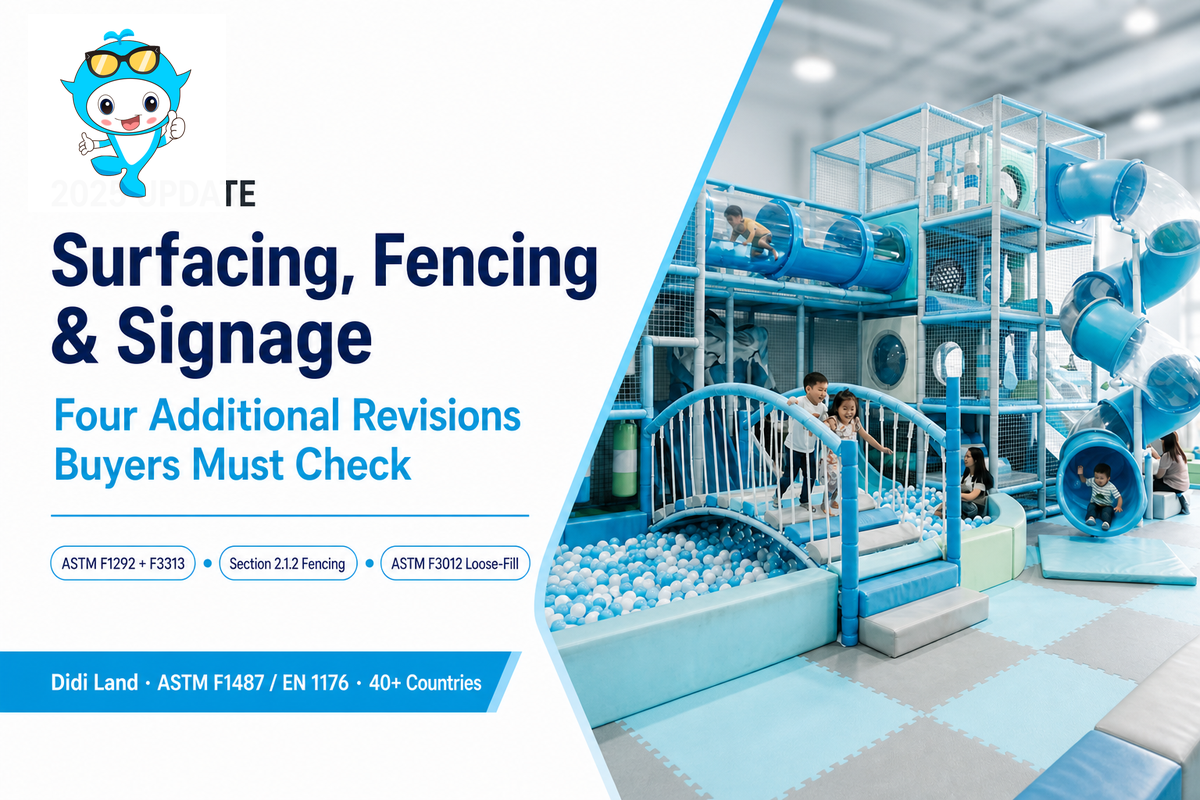
Beyond guardrails, climbers, and entrapment, four other revisions affect procurement specs under the Handbook’s broader playground standards for surfacing materials. Surfacing tests are strengthened with both astm F1292 for laboratory impact attenuation testing and ASTM F3313 for on-site surfacing installation validation, alongside expanded chemical safety guidance for surfacing materials; loose-fill rubber mulch will be tested under ASTM F3012 alongside wood fiber and other engineered surfacing materials. CPSC explicitly disagreed with one comment stating that un-tested recycled rubber poses no hazard. That provision (previously “toxic/hazardous metal testing”) remains under the “loose-fill rubber testing” designation. Together, these astm standards address many different surfacing risks since no single test will capture them all.
Fencing has a new home and added detail in Section 2.1.2. CPSC removed the“-11” year suffix from its astm F2049 standard reference for consistency with how other standards are cited, but substituted that in with explicit new recommendations for fencing and gate safety written into the new handbook, which strengthens rather than weakens requirements. Signage and labeling get increased attention regarding entanglement and strangulation hazards for drawstrings, cords, and hats to focus on caregivers supervising play rather than equipment designers alone. Musical elements like chimes and tubes can now have exposed, un-capped open ends, provided those openings are round and don’t pose a impalement risk. Merry-go-rounds and other spinning equipment retain their maximum recommended speed rating even as the Handbook omits an invalid, one-size-fits-all speed calculation formula that didn’t work across suspended elements or suspended components like trapeze bars and hanging rings (now separate for visibility). These new recommendations reflect current best practices rather than exempting partially bounded gaps the way industry commenters had requested.
| Area | Standard / section | Limitations / Not suitable for |
|---|---|---|
| Surfacing (lab) | ASTM F1292 | Lab test only — does not verify as-installed condition |
| Surfacing (field) | ASTM F3313 | Recommended, not a lab substitute — use both |
| Loose-fill rubber | ASTM F3012 | Untested recycled rubber not verified safe — do not substitute without a test report |
| Fencing | ASTM F2049, Handbook §2.1.2 | New section replaces the removed year-suffix reference — check for the specific fencing language, not just a bare standard citation |
RFQ Checklist: What to Demand From Your Equipment Supplier
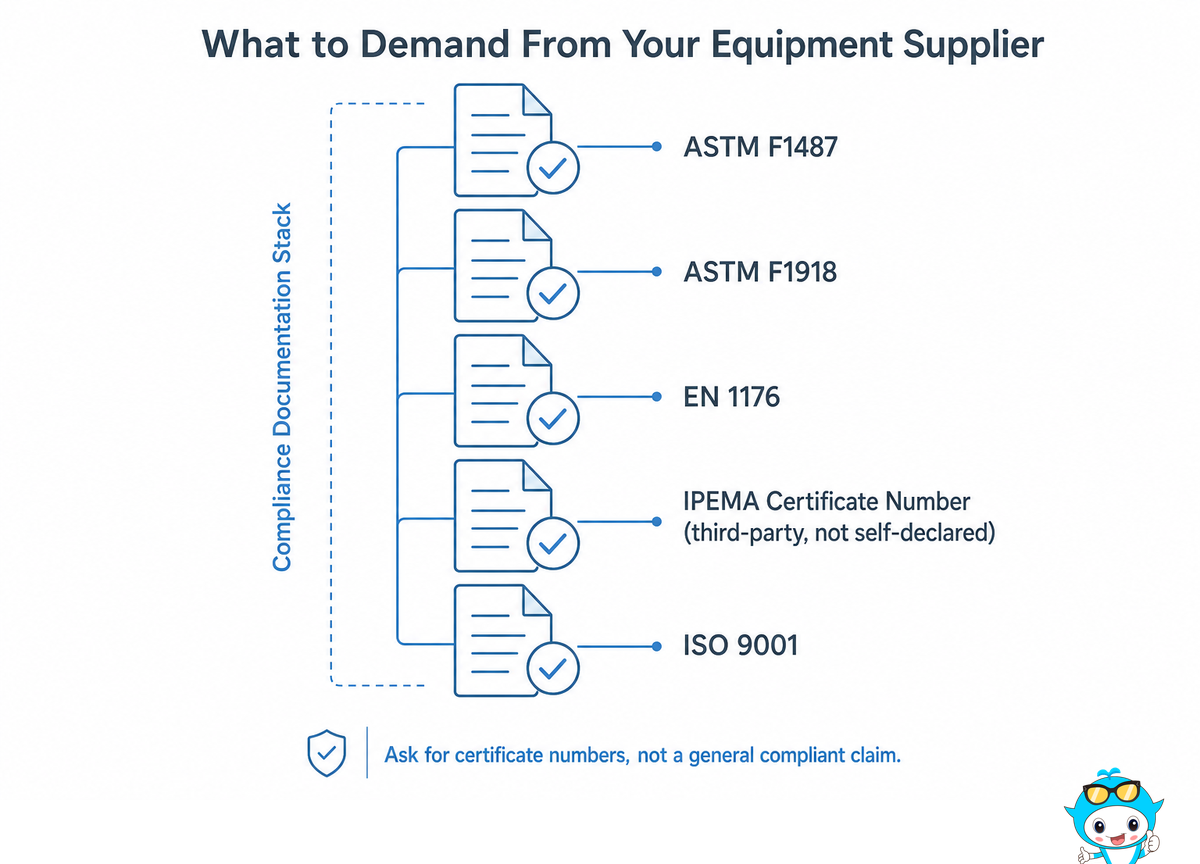
None of the changes above matter to a buyer if they don’t show up on their quote and spec sheets. Copy this table into your RFQ or purchase order to hold a supplier accountable to the specific provisions of the 2025 Handbook, rather than a general “cpsc compliant” assertion.
RFQ checklist — copy these into your quote request:
| Parameter | Recommended range | Why it matters | How to verify |
|---|---|---|---|
| Barrier height, general | >48 in. (122 cm) above surfacing triggers a barrier | Section 5.1.3 threshold | Request the specific platform-height measurement, not just a “compliant” statement |
| Barrier height, toddler/preschool | Lower than 48 in. (122 cm) | Age-specific exception, not a single number | Ask supplier to cite the age-grade documentation used |
| Handrail height, ages 2–5 | 22–26 in. (56–66 cm) | Section 5.2.3, held firm against wider ASTM range | Measure sample unit handrail height directly |
| Net/flexible opening perimeter | 17–28 in. (43–71 cm, Figure 13) | Head/torso probe-based entrapment test | Request probe test documentation or third-party inspection report |
| Freestanding flexible climber egress | ≥2 exit routes for preschool-rated units | Section 5.3.2.3 single-egress restriction | Confirm secondary exit in the equipment drawing |
| Surfacing impact test | ASTM F1292 (lab) + F3313 (field) | Lab test alone doesn’t confirm as-installed performance | Request both lab certificate and field test report post-installation |
Our own commercial and soft-play equipment at Didi Land is manufactured against a compliance stack that includes astm f1487, astm F1918, EN 1176, IPEMA, ISO 9001 and CPSIA — documents which can be obtained from buyers directly as opposed to simply asking for something “certified.” Being IPEMA certified is a third-party check, not a self-declaration, so ask for the certificate number rather than taking a supplier’s word for it. For the final walk-through, a certified playground safety inspector can confirm cpsc compliance against the exact figures in this article, not just a general “meets CPSC guidelines” claim.
What’s Next: 2026 Compliance Outlook
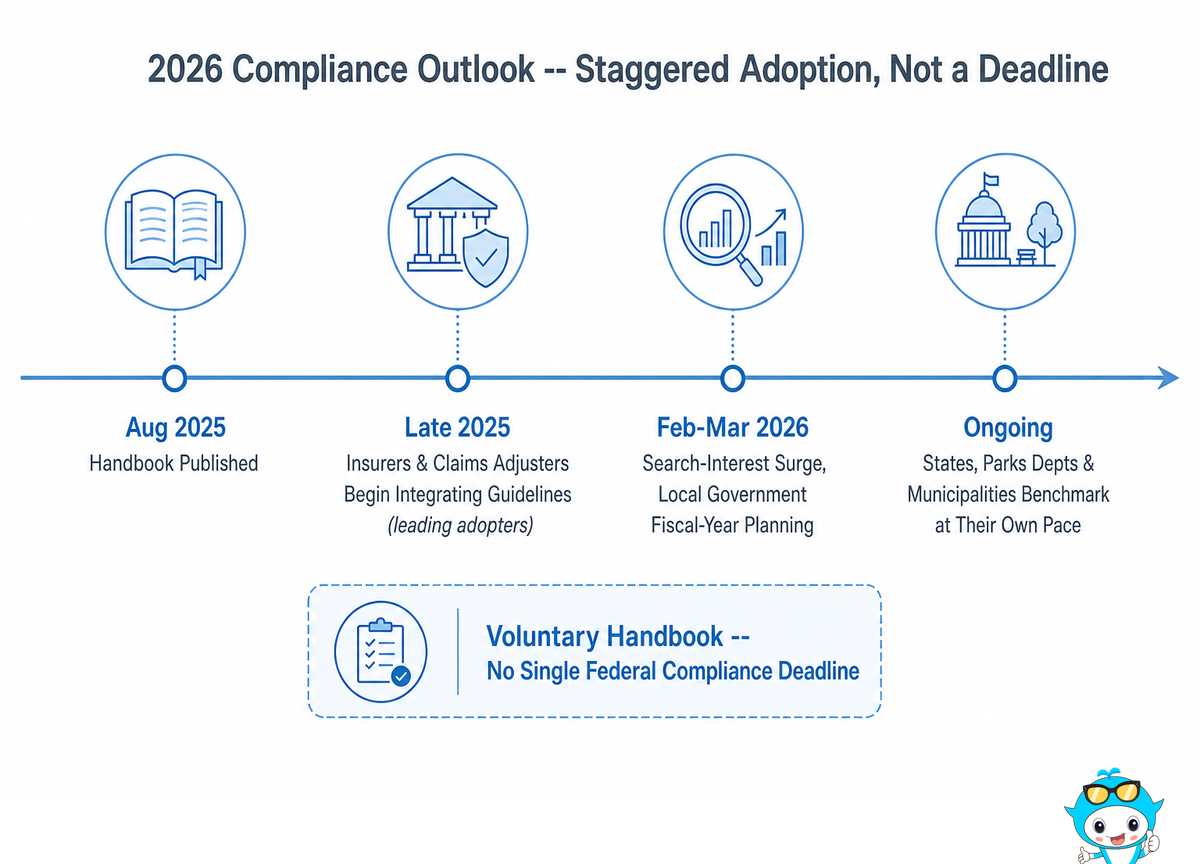
Because the Handbook is voluntary, adoption is unlikely to be an overnight event — expect a staggered rollout as various states, municipal parks and recreation departments, and insurers choose the extent to which they benchmark barriers or guardrails and other astm f1487 testing requirements against the standards. This adoption lag is the most significant variable to track between now and 2026, rather than a deadline count.
Legal and risk-management commentary following the Handbook update (per Lexology/Rimkus, Nov. 2025) has already signaled that insurers and claims adjusters are leading adopters, integrating the 2025 guidelines into their underwriting and post-incident reviews prior to any formal government requirement.
Search interest for the Handbook itself follows a similar pattern, with an initial spike during the month of publication, 2025, followed by another surge in Feb-March 2026, corresponding with fiscal year planning by local governments. If you’re planning to purchase equipment for 2026 projects, anticipate the astm f1487-25 alignment process unfolding in lock-step with IPEMA’s upcoming product re-certification cycle; you’ll want to double-check a supplier’s current astm certification to confirm it reflects the 2025 Handbook’s cross-references.
Our Perspective
As a manufacturer that builds to ASTM F1487, ASTM F1918, and EN 1176 across more than 40 export markets, we read regulatory updates like this one as a floor to design past, not a target to design toward. The 2025 Handbook’s decision to hold firmer than ASTM’s own exemption assumptions on entrapment and handrail height is a signal worth taking seriously in spec review, independent of whether a given jurisdiction has formally adopted it. Reviewed by the Guangzhou Didi Land Amusement Equipment Co., Ltd. technical team
Frequently Asked Questions
Q: What is the CPSC’s Public Playground Safety Handbook?
The Public Playground Safety Handbook (CPSC Publication 325) is a set of voluntary design and maintenance recommendations for public playground equipment, first published decades ago and most recently updated July 30, 2025.
Coverage extends to aspects like fall height, entrapment, protrusions, surfacing and equipment spacing, and it cites astm f1487 for detailed technical test methods instead of replicating the content of those methods itself. Playground designers, inspectors, insurers, and municipalities widely use the Handbook as a practical benchmark for defining “reasonably safe” playground equipment, despite it not being a federal standard. Manufacturers such as Didi Land who export to the United States, treat it as a design minimum along with astm F1487.
Q: Is the CPSC Handbook a federal law, or a voluntary guideline?
The CPSC Handbook is a voluntary guideline. CPSC states explicitly that the Handbook creates no legally enforceable requirements, though ASTM F1487 (which it references) is itself a voluntary consensus standard, not a law.
Although “voluntary,” the Handbook’s recommendations are becoming increasingly influential; insurers, courts, and municipal procurement departments often treat Handbook alignment as a de facto standard of reasonable safety, even in the absence of a legal mandate. In fact, some of the more controversial elements of the 2025 update, such as the 24-inch entrapment requirement and the 22-26 inch handrail height range, remained largely unchanged due to cpsc’s resolve to uphold the technical integrity of these measures despite industry lobbying for concessions. Please remember that ADA and U.S. Access Board requirements for playgrounds are independently enforceable and do not fall within the scope of the Handbook.
Q: What’s the difference between CPSC guidelines and ASTM F1487?
CPSC’s Handbook is a plain-language voluntary safety guide; ASTM F1487 is the detailed technical performance standard it defers to for exact test methods and dimensional tolerances.
In this way, you can view the Handbook as the “why and what to check” document, and astm f1487 as the “how and exact numbers” document behind it. This distinction matters more after the 2025 update, which leaned more heavily on ASTM F1487-25 (also revised in 2025, with a new “fully enclosed structure” definition, adjusted handrail requirements, and stricter tube-slide rules) for technical specifications like crush/shear testing and entrapment assessment methods. If a supplier says their product is merely “cpsc compliant” and does not provide an ASTM F1487-25 test report, ask for that document too.
Q: What is a head-entrapment probe test?
A head-entrapment probe test is a physical inspection method that uses standardized probe tools shaped like a small torso and a large head to check whether an opening in playground equipment could trap a child’s body or head.
Figure 13 of the Handbook uses the torso probe (Figure B7) and head probe (Figure B8) to check net and rope openings against a 17 to 28 inch perimeter range: if the torso probe passes through an opening but the head probe does not, or vice versa, that mismatch is flagged as a head-entrapment hazard requiring redesign or elimination.
Q: At what height does a playground platform need a guardrail?
Once a platform or stair run exceeds 48 inches above the protective surfacing, a barrier is recommended, with a lower threshold carried for toddler and preschool equipment.
Upper body equipment and stair/ramp entries are exempted under 2025 clarifications. Confirm which age band’s threshold applies to your specific equipment rather than assuming a single 48-inch figure covers every configuration.
Q: Are freestanding flexible climbers safe for toddlers under the new rules?
Not if the climber has only one way up and down, the 2025 Handbook does not recommend freestanding flexible climbers for preschool-age children unless a second means of egress is built in.
Here’s the specific concern: a child who freezes near the top of a single-access net or rope climber is more likely to jump or fall than to climb back down carefully. Climbers with a second exit route, such as a slide-out, ramp, or stepped descent, fall outside this restriction.
References & Sources
Full ASTM playground standards pdf documents and the CPSC Handbook itself are available directly from the primary sources below — always verify against the current edition rather than a cached copy.
- Notice of Availability: Public Playground Safety Handbook Update (2025-15374) U.S. Federal Register
- Public Playground Equipment Voluntary Standards U.S. Consumer Product Safety Commission
- ASTM F1487-25 Standard Consumer Safety Performance Specification for Playground Equipment for Public Use ASTM International
- What Just Changed? A Look at the New July 2025 CPSC Playground Safety Updates Playground Professionals
- 2025 CPSC Public Playground Safety Handbook Update: What Legal, Risk, and Municipal Professionals Need to Know Lexology / Rimkus
Related Articles
- Playground Safety Standards Comparison how AS 4685, EN 1176, and ASTM F1487 diverge by export market
- Soft Play Equipment Safety Standards the six standard families that govern soft play equipment
- CPSC eFiling Mandate (July 8, 2026) what the new import certification rule means for your equipment order
- Indoor Playground Equipment Buyer’s Spec Audit Guide verifying supplier documentation before you order

![Sustainable Indoor Playground Material Certification [2026]](https://didiplayarea.com/wp-content/uploads/2026/07/sustainable-materials-certification-en1176-astm-as4685-featured-768x512.png)