
Get in Touch with Didi Land

Indoor Play Cafe: Equipment, Floor Plan, Cleaning, and Parent Experience

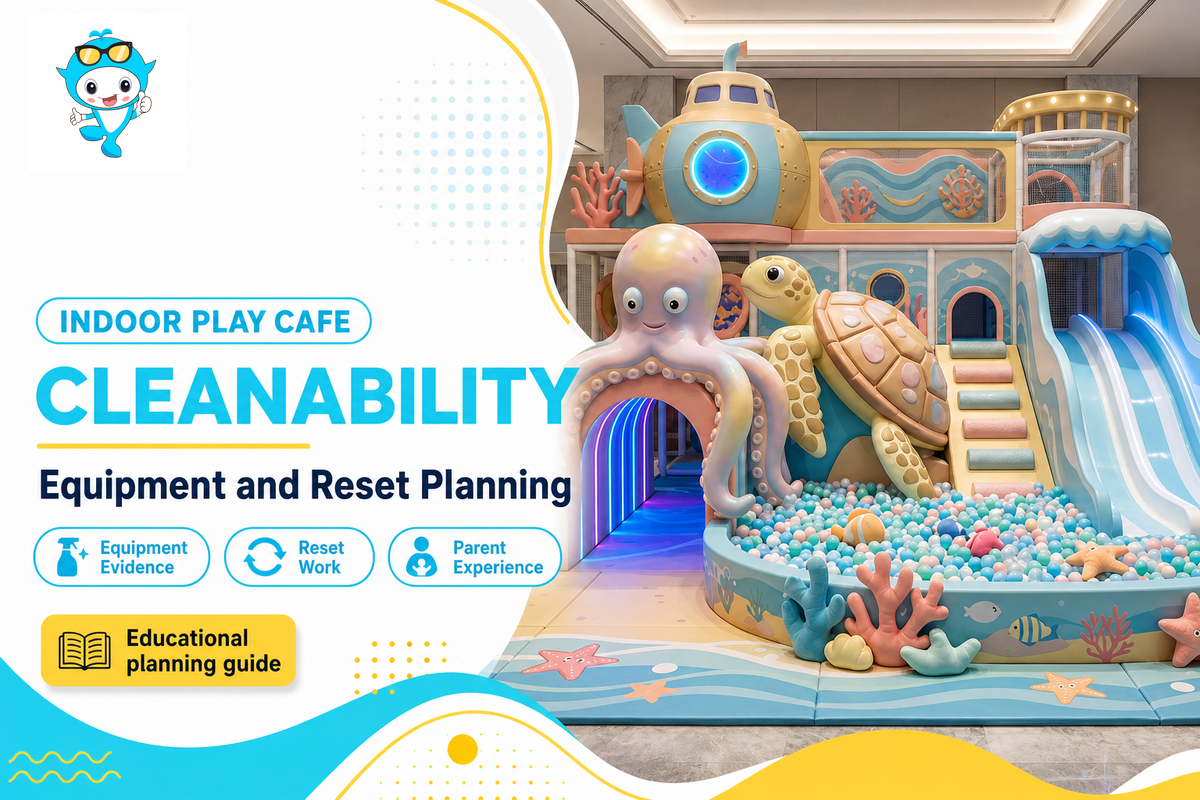
Equipment planning and operations education · By GW
An indoor play cafe is a venue where parents socialize over coffee or food while children play. When a facility owner is purchasing equipment, one of the key questions for that owner is how the venue will function after opening: who supervises, how do items get cleaned, where do items dry, and what happens if a part needs to get repaired.
Prior to approval of renderings, assess the intended users and operating tasks. A compact play space can still be hard to manage if staff can’t easily reach surfaces, store used toys separately, or keep users away from unfinished work. The planning documents below will help to identify the decisions associated with equipment.
At a glance
- Choose components by documented user limits, cleaning access and replacement needs.
- Reserve space for used items, approved treatment and any required drying.
- The selection of cleaning, sanitizing or disinfecting will be based on the item, event and applicable equipment and product instructions.
- Keep supervision, food-service rules and equipment acceptance as explicit responsibilities.
What an Indoor Play Cafe Must Deliver
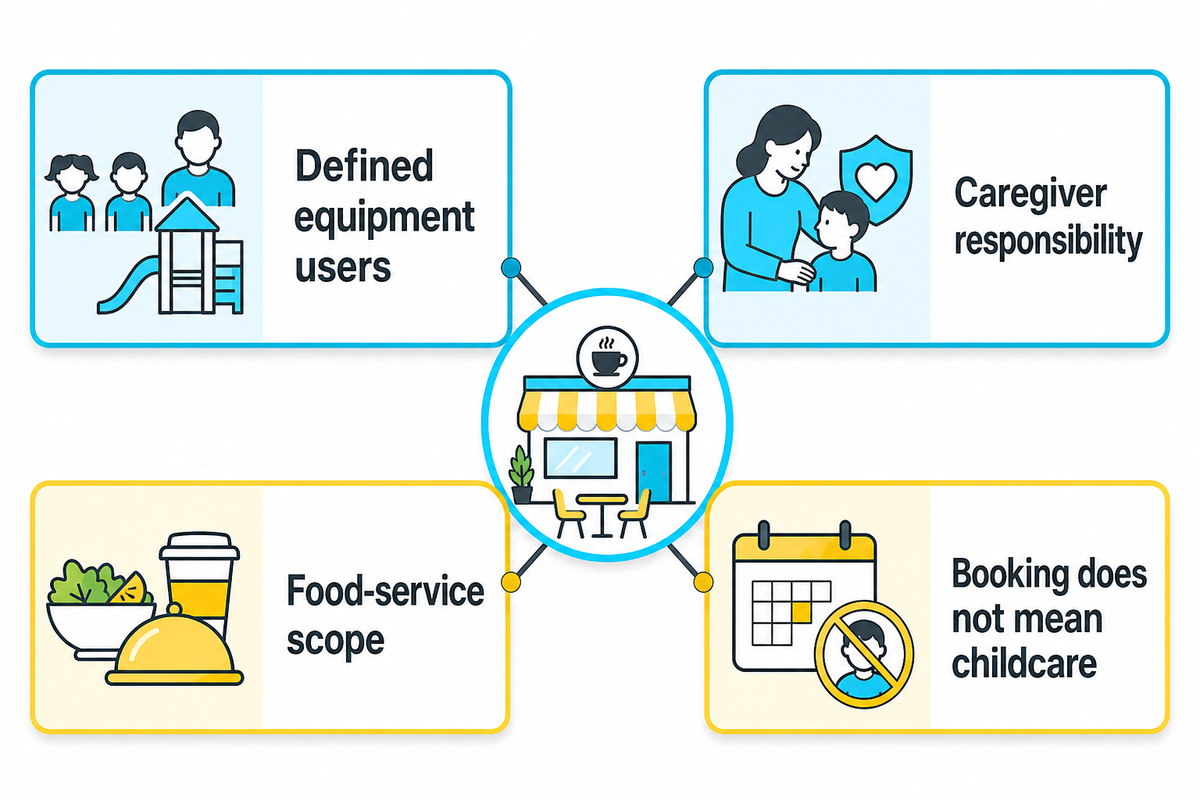
A play cafe needs a defined operating model for kids and adults: defined equipment users, caregiver responsibility, food service and how visits will be booked. The owner will need to resolve these questions prior to selecting a play structure because an infant corner, a toddler session and a private party require different staffing and space.
Open play usually means guests use the available play area during the venue’s stated open play hours. Reservations, tickets and memberships don’t indicate that the cafe provides childcare and/or that an adult can leave a child unattended. Supervision arrangements must be communicated prior to booking.
Coffee shops offering packaged snacks have a different food operation from a full-service kitchen preparing a sandwich menu. Ask the food-service designer and local authority which approvals and procedures apply. The FDA Food Code is a regulatory model; a published edition does not establish which rules a particular jurisdiction has adopted.
A proposed cafe has potential to serve mixed-age siblings while its compact equipment serves the younger child’s stated limits. The owner must determine how the older sibling can participate without entering an unsuitable zone. Adding a tall climbing unit to attract more users creates an equipment and supervision dilemma. Publish real user limits, rather than promising that every user will be able to use each feature of the equipment.
Compare cafe and playground operating models before finalizing the space allocation. Issue one operating brief covering users, food and adult responsibility to each supplier.
Choose Play Equipment for Age and Cleanability
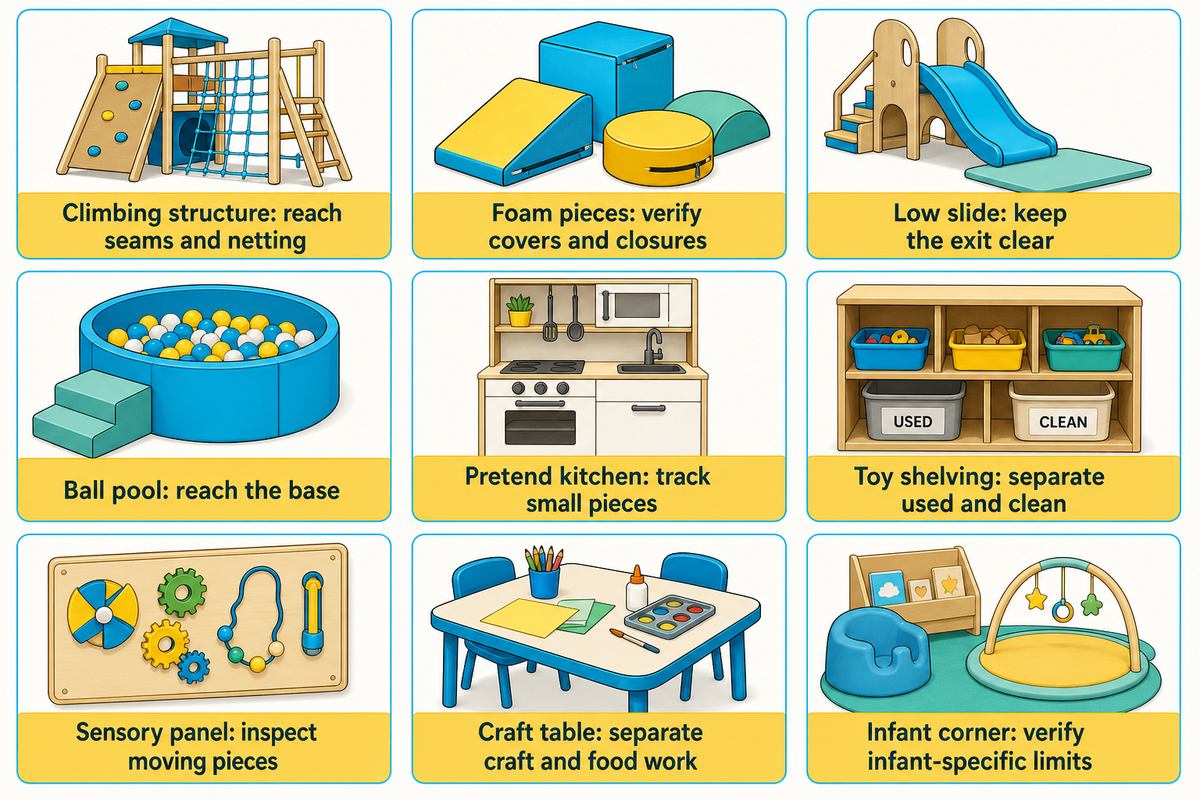
Play equipment should be considered along with documented user limits, service access and cleaning requirements to determine if it fits the operating brief of a cafe. Compare actual components and equipment rather than evaluating an indoor playground render as a complete specification. Removable covers must be supported by evidence for the material, closure and permitted treatment.
The ASTM F1918-21 public catalog contains soft-contained play equipment for the 5th percentile of 2-year-olds up to the 95th percentile of 12-year-olds. Other toys and juvenile products are not included. Simply because an item is included in the scope does not mean that an infant product is suitable, or that the installation of the product meets the full requirements of the standard.
Planning comparison: The matrix identifies questions to be verified with the manufacturer. It isn’t a material compatibility chart or an approval of any listed activity.
| Equipment family | Intended-use question | Cleaning access | Service dependency | Limitations / Not suitable for |
|---|---|---|---|---|
| Contained climbing structure | Children within the stated size and ability limits | Reach netting, seams, padding and enclosed surfaces | Replacement netting and secure fastenings | No approved user limits or unreachable damage |
| Modular foam pieces | A defined toddler play area | Inspect covers and joints; confirm approved removal | Correct replacement cover and closure | Unverified cleaner, heat or wash compatibility |
| Low slide | Users specified by its manufacturer | Reach steps, sidewalls and exit surface | Secure parts and protected service access | Slide exit doubles as a toy-storage spot |
| Ball pool | Only the documented product/user combination | Remove balls and reach the base and perimeter | A documented handling and drying method | Base cannot be reached or loose parts tracked |
| Pretend-play kitchen | Age-appropriate imaginative play | Access handles, shelves and removable accessories | Inventory of compatible replacement items | Small pieces lack user limits or reset storage |
| Toy shelving | Staff-controlled loose-item rotation | Separate returned items from ready-to-use stock | Stable mounting and clear item identification | Dirty and clean items share an unmarked bin |
| Sensory panel | The stated users and activity | Reach moving pieces without improvising disassembly | Maintenance instructions for each mechanism | Touch points or damage cannot be inspected |
| Craft table | Supervised craft and creative activity | Clear supplies and clean the appropriate surface | Washable accessories only as specified | Food handling and craft waste use the same workflow |
| Infant floor corner | Only separately approved infant products | Access mats and mouth-contact items | Product-specific infant limits and instructions | Ages 0 advertised using a 2-year-plus standard |
Minnesota Health’s indoor-play guidance for food businesses recommends selecting sanitizers and disinfectants with the equipment manufacturer’s recommendations in mind. Its routine schedule belongs to that setting and jurisdiction. Before ordering, request instructions for the exact cover, plastic part, padding or mechanism; another supplier’s general cleaning guide can’t approve the method.
When Not to Buy the Proposed Component
Hold a component if staff can’t reach its wear points or the supplier is unable to explain how it’s cleaned and repaired. Less cost doesn’t resolve an inaccessible ball-pool base. Only when the identity, method of fitting, and availability of the replacement cover are known are replacement covers useful. These are procurement conditions, not evidence that one equipment family outperforms another.
The CPSC soft-contained equipment checklist calls for checking of netting and cargo webbing, as well as floor surfacing, for damage. Ask how the staff will perform those inspections with the equipment installed. Reject a proposed method which would require an employee to improvise disassembly of the equipment or to go through an occupied section of the equipment to reach a fault. Postpone acceptance until an approved equipment-access method is provided.
Refer to play cafe equipment by space type for the broader equipment mix by space type. For supplier discussion, compare commercial venue equipment against the same user and maintenance brief.
Reserve Floor-Plan Space for Reset Work
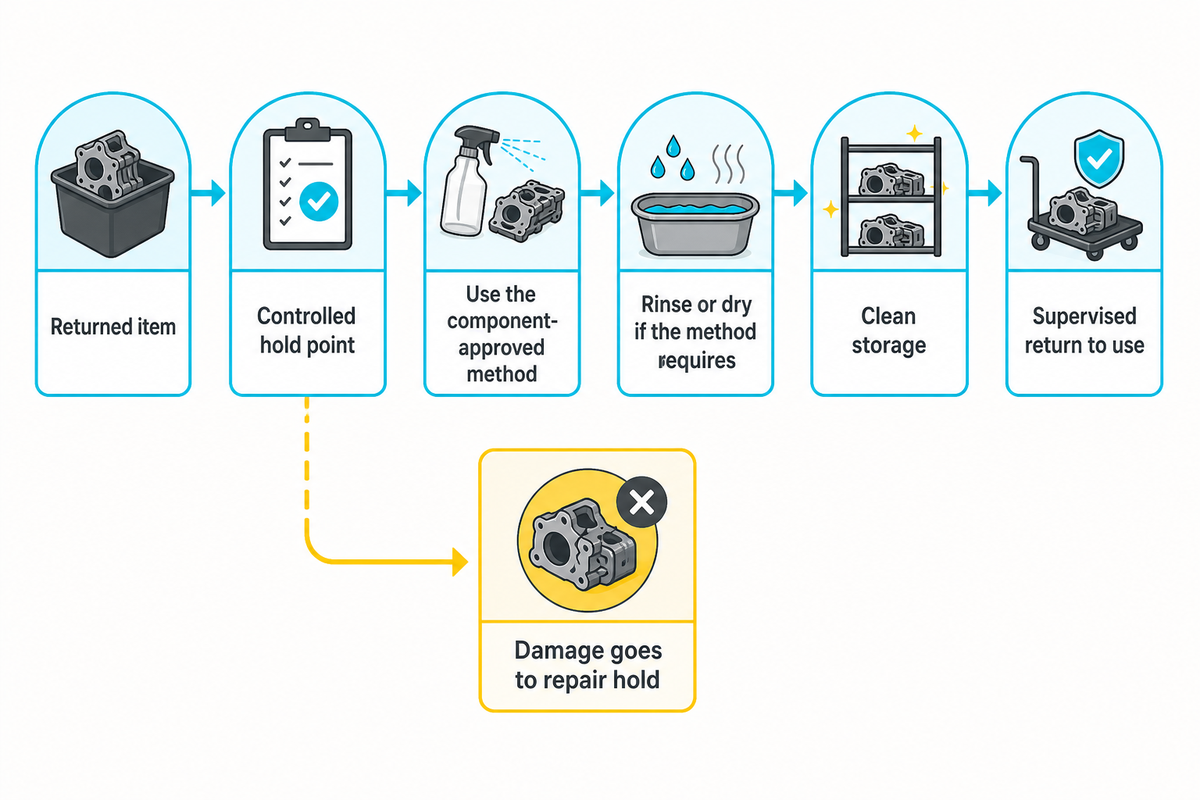
An indoor play cafe floor plan should show where staff hold returned items, perform approved treatment and store equipment ready for use. These activities need space alongside seating and guest routes. Cleaning work is especially difficult if the only work surface available is used for food preparation or craft supplies, or for incoming guests.
Mark a hold point for used items that children can’t access, then find the location where cleaning, any required drying and clean storage will take place as described in the approved method. Store chemicals under staff control. The CDC’s early-care guidance describes complete air-drying for the sanitized nonporous items that it addresses; it shouldn’t be construed as a universal protocol.
Minnesota’s food-business guidance recommends documented sanitation and monitoring procedures. Use that planning principle to prevent a spill response from sending an untreated item back into clean stock.
Reset adjacency to check
Returned item → controlled hold point → approved treatment → required rinse or drying → clean storage → supervised return to use
A damaged item branches to a repair hold. It does not rejoin clean stock simply because it was wiped.
Accessibility requires site-specific review. The U.S. Access Board play-area guide provides separate provisions for soft-contained entry points and regular elevated play components. Percentages copied from other equipment categories aren’t adequate design instructions for a cafe. Review the applicable play-area requirements and the surrounding routes as well. Check the requirements with the project designer.
Use the detailed playroom cafe layout planning for your room design. For the acceptance criteria, the question is narrower: can staff perform maintenance on a closed zone that’s physically separated from guests?
Clean, Sanitize and Disinfect With a Defined Sequence
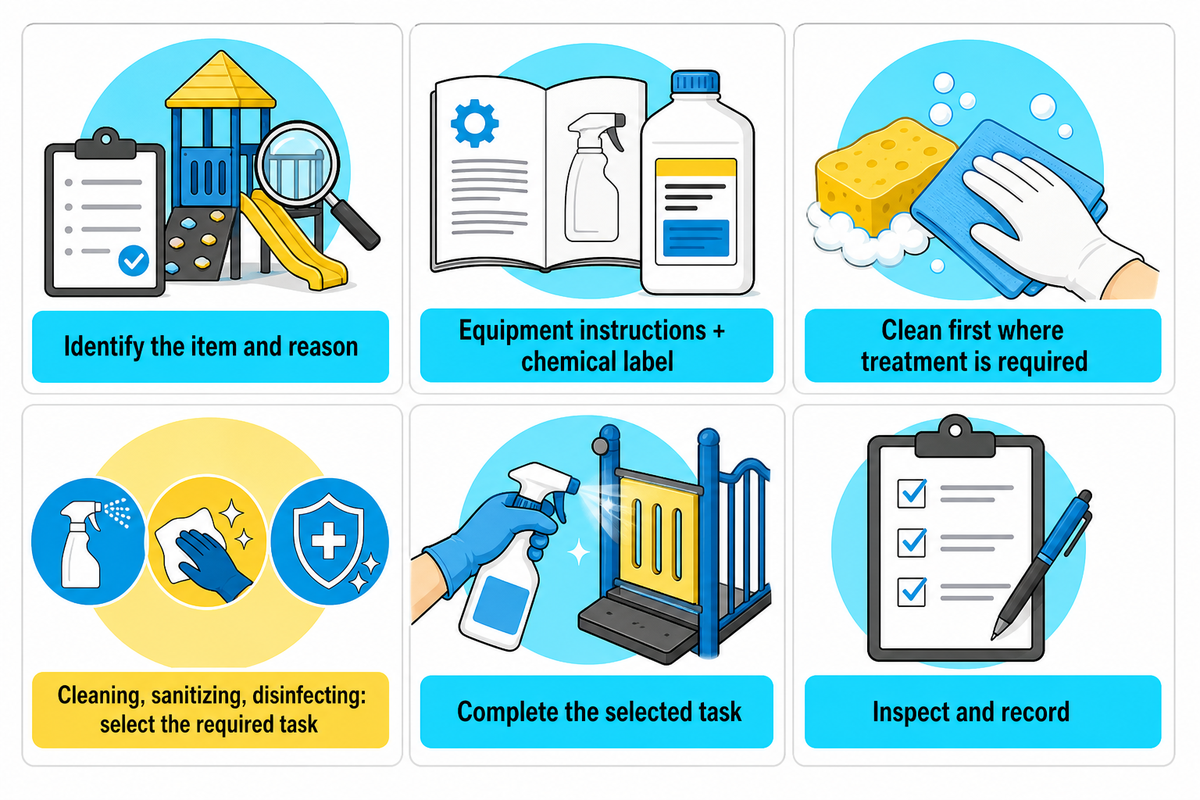
Cleaning removes dirt and debris. Sanitizing and disinfecting address germs through methods appropriate for the surface and situation. For a given item or situation, determine what task is called for, then follow the instructions. Before sanitizing or disinfecting, clean the surface using the appropriate method. Not every routine reset requires all three (cleaning, sanitizing, and disinfecting).
The difference is in CDC guidance for early care settings and Minnesota’s indoor-play recommendations. The guidance has differing scopes. Indoor-play operators are also required to meet any food and workplace laws and regulations that are applicable to them; general child care and setting guidance doesn’t replace them.
“The surface should remain visibly wet for the entire contact time.”
For a disinfectant to be effective, the EPA says that the label defines the contact time and the intended use of the disinfectant. The contact time represents the amount of time that the surface must remain visibly wet. The booking deadline or a surface appearing dry alone doesn’t demonstrate completion of the label instructions. The appearance of the surface doesn’t dictate whether the label instructions have been satisfied.
- Identify the item and reason. Separate routine soil removal from mouth-contact toys, illness-related measures and body-fluid incidents.
- Both instructions must be followed. The equipment manufacturer defines limits of the material and the method; the chemical label defines the product, use, and directions.
- Clean first where treatment is required. Remove dirt with the appropriate method before sanitizing or disinfecting.
- Complete the selected task. Follow any required dilution, wet contact, rinsing or drying directions. No single time or recipe fits every component.
- Inspect and record. Keep damaged items out of use and document the person responsible for checking unfinished work.
Staff chemical use requires special consideration. Where hazardous-chemical exposure falls within OSHA’s Hazard Communication Standard, 29 CFR 1910.1200, the employer is required to have a program, labels, accessible safety data sheets and training. The standard includes exclusions, and one of those exclusions is a conditional consumer use exclusion. Assess the actual product and the type of exposure instead of assuming that every household-style cleaner is excluded.
Keep the approved instructions at the work point. Approved instructions can’t be replaced with unapproved steam, pressure, UV, or fogging methods, even if they seem faster. Using an unapproved method may damage a surface. The damaged surface then adds a repair decision to the cleaning task.
Use the Reset-to-Reopen Log During Open Play
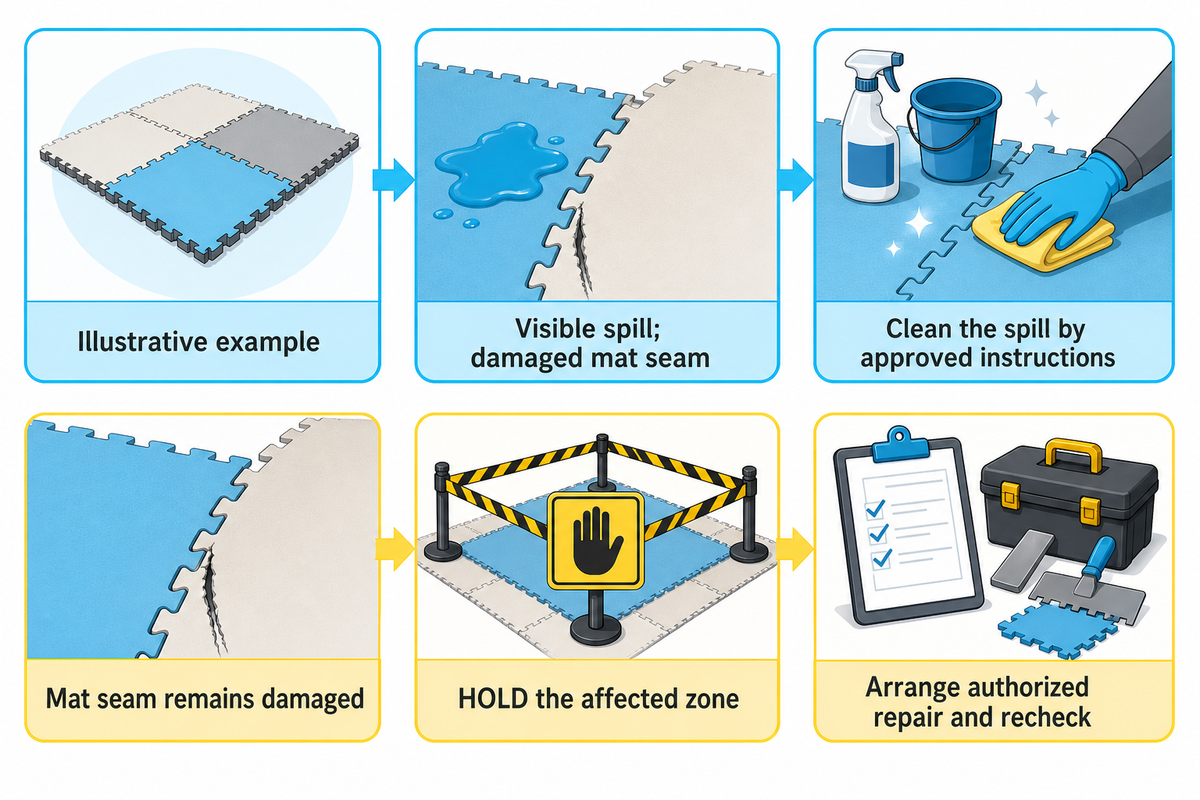
The “Reset-to-Reopen” Log is an illustrative worksheet to capture task handoffs for unfinished activities in a closed play zone. Staff choose appropriate fields based on the event, component instructions and applicable procedures. The worksheet does integrate tasks from various sources, but it hasn’t been validated by an authority as a complete reopening or safety protocol.
According to the food-business guidance from Minnesota Health, documented sanitation and maintenance, and monitoring of the situation are recommended and the affected area should be closed during a body fluid response. Routine spills and damaged mats aren’t the same. Staff should be trained to tell the shift supervisor what task is complete and what condition is preventing use.
Filled example (not a real incident record): There are tasks that remove a spill from a surface, but a damaged mat seam is still unresolved. Contact times and approval of completed repair haven’t been supplied for an actual venue.
| Record field | Illustrative entry |
|---|---|
| Item / zone | Zone A entrance handrail and adjacent mat |
| Reason for work | Illustrative visible spill; damaged mat seam found during cleanup |
| Immediate action | Keep the affected area unavailable and direct guests around it |
| Chosen task | Routine cleaning for the spill; repair assessment for the seam |
| Method record | Use the component’s approved cleaning instructions; details checked by staff |
| Chemical contact time | Not applicable unless the selected task/product label requires it |
| Rinse / drying | Complete the requirements of the chosen method before use |
| Condition check | Mat seam remains damaged; cleanliness does not resolve the fault |
| Release decision | HOLD Zone A; notify shift supervisor and arrange authorized repair |
| Record closure | Supervisor documents repair, rechecks condition and records reopening |
The owner needs to make a guest routing decision while Zone A is held. The shift supervisor needs a named repair and recheck responsibility. The procurement staff needs to determine if the mat can be repaired as specified, or if it needs to be replaced. Recording “cleaned” gives no information toward any of these questions.
Include the actual product identifier, applicable label directions and the completed contact-time record for a disinfection event. Don’t invent a contact time for a routine cleaning method that has no contact-time requirement. Recording that all surfaces were sprayed can be misleading and hide an unfinished treatment, a defective part, or a piece of equipment returned to the incorrect location.
Keep a zone unavailable while its controlling procedure or repair requirements are incomplete. The promised session start doesn’t change the procedure; let the next group know of the unavailability before admitting the next group.
Test the Parent Experience From Arrival to Departure
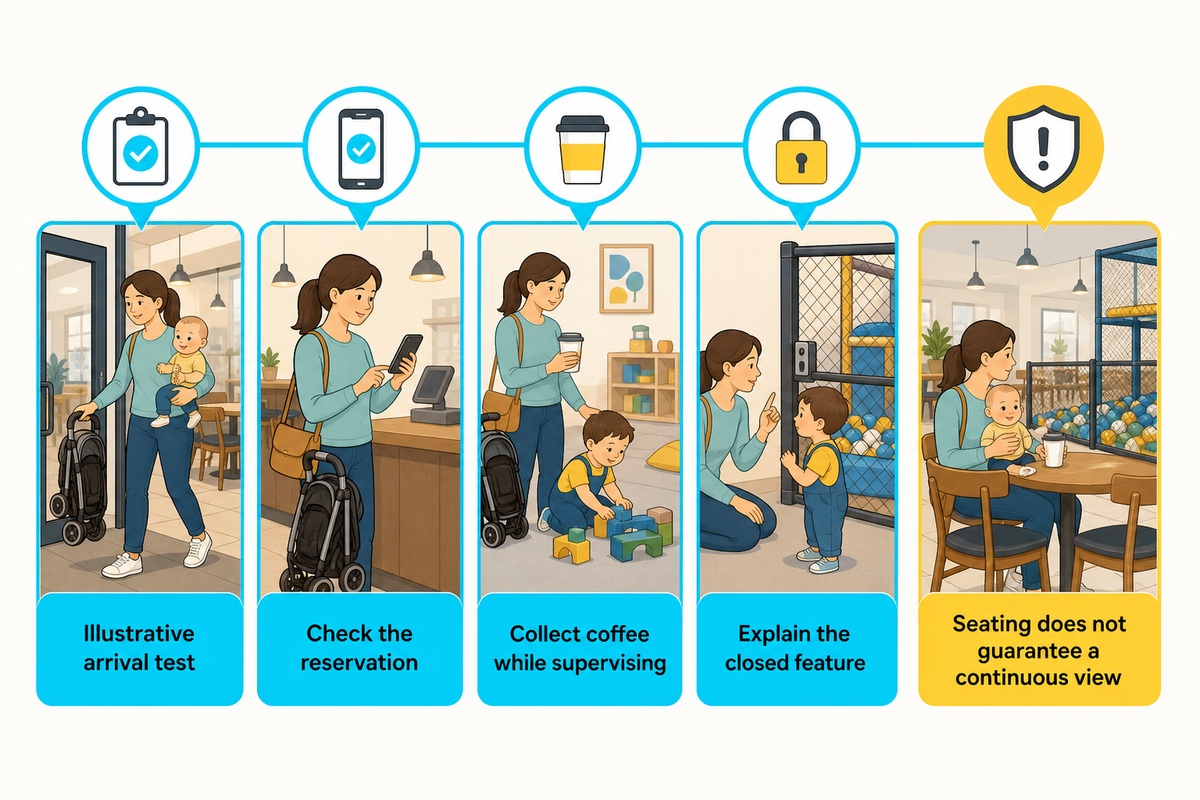
Parent experience refers to the steps a caregiver follows to supervise a child, order food, find a seat, and leave with the child’s belongings. Test this sequence using the intended ages and venue rules to assess the caregiver’s experience. Comfortable furnishings, for example, can’t show whether a caregiver can see and reach a child during the visit.
How Does an Indoor Play Cafe Work for a Visiting Family?
Walk the visit in the order a new family will encounter it: booking information, arrival, sock rules, equipment limits, menu, play and departure. Explain what the adult is still responsible for. A friendly and welcoming entrance should assist the family in locating the rules. When a private party changes venue access, rules should be easy to locate.
A possible illustration could be a caregiver arriving with an infant, a toddler and a folded stroller. The adult verifies the reservation while holding a drink and learns the toddler’s favorite feature is closed. The family, without a clear waiting spot, blocks the entrance and asks what to do. There are multiple problems. First is the lack of clear communication around what’s available. Second, the adult has too many tasks and shouldn’t have to wear too many hats. Third, there’s no clear communication on what to do and/or where to go. Test the revised arrival arrangement with the same equipment limits to see how the adult can collect coffee while still supervising. The goal of this test is to answer design questions and to bring to light limitations of the current arrangement. It doesn’t confirm the arrangement is appropriate for every family.
When playing, use the posted-use and size CPSC guidance in addition to the manufacturer’s instructions. Keep slide exits and the base of climbing equipment clear. Convenient seating doesn’t make an adult’s view continuous and doesn’t remove the need to move when a child changes zones.
Can parents understand food and drink boundaries? Are parents able to reach their belongings and leave without crossing an occupied service area? A cozy atmosphere, imaginative play, or an attractive Instagram photo can help communicate the concept, but none demonstrate supervision or cleaning access. Apply play cafe design considerations to the real-life guest journey.
Plan Birthday Party Resets and Repair Access
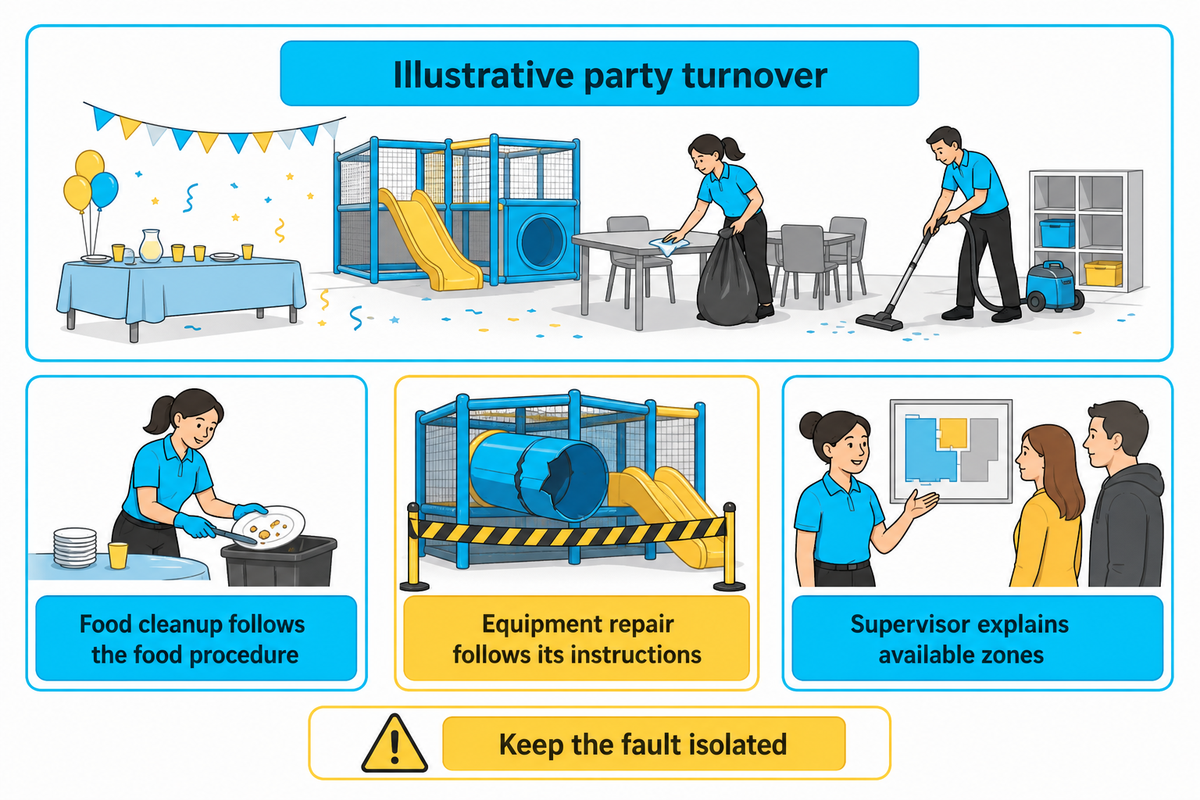
A birthday party adds food, personal belongings and event turnover to the equipment work already required during open play. Plan which staff owns which task, and which areas remain unavailable. Shared equipment can support private birthday parties only within the limits of documented use and the supervision and maintenance plan of the operators.
Picture an illustrative birthday celebration ending while another group is arriving. One employee is removing cake from a party table, while another discovers a loose or damaged play component. Guests are gathered at the door, as the advertised space isn’t ready. Asking the cleaner to release the equipment would combine unrelated responsibilities. The supervisor explains the available zones, while keeping the fault isolated and assigning a person to resolve it. Food-contact cleanup follows the cafe’s food procedure, while equipment treatment and repair follow their own instructions. The owner then is deciding whether the next booking can receive the announced service.
For parties, baby showers or holiday celebrations, confirm the actual event policy rather than assuming that a party venue can cater for every gathering. Minnesota’s repair and staff-monitoring recommendations support keeping condition checks separate from visible cleaning. A seasonal booking rush changes workload; it doesn’t shorten label directions or authorize an improvised repair.
When considering an event package, verify the location of service access and ask if a bad part can be isolated while other guests use the venue. If closure would prevent the advertised service, change the booking plan before guests arrive.
Make the Cleanability Purchase Record Part of the Quote
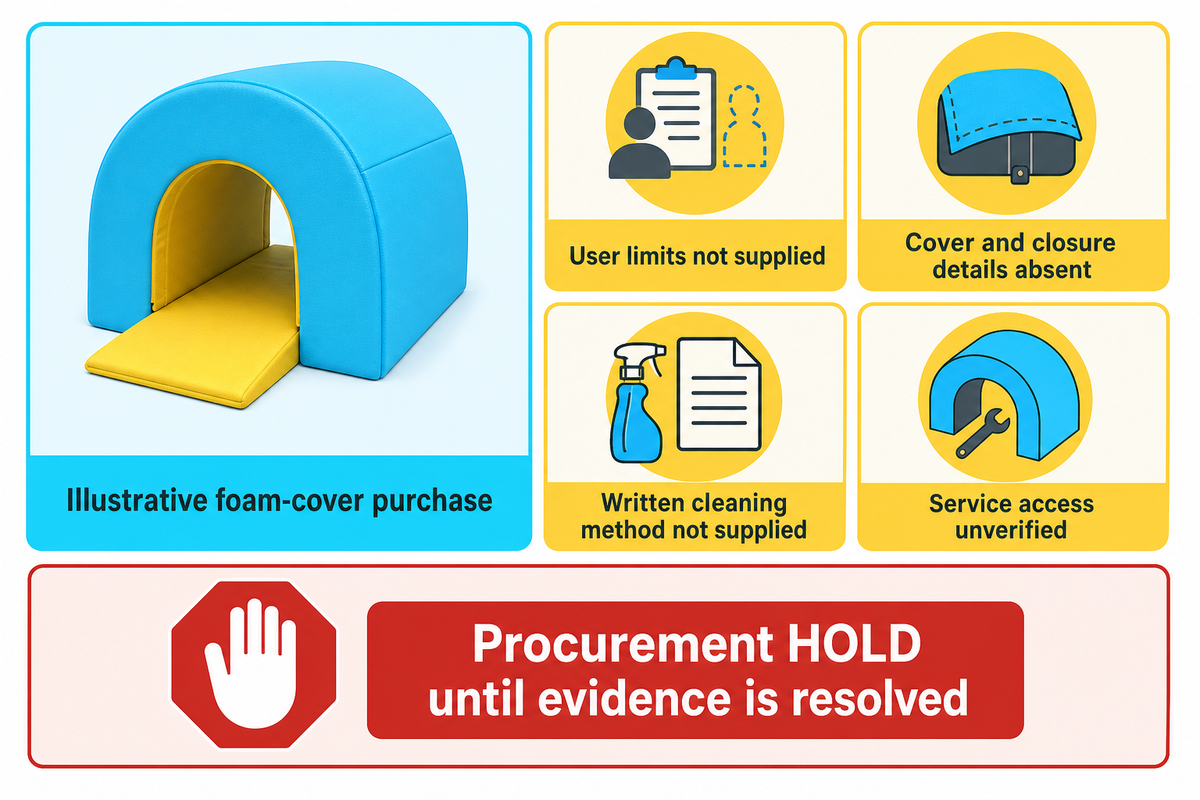
The Cleanability Purchase Record connects each proposed component to the evidence required before acceptance. User limits, materials, approved methods, access and replacements need to be recorded, with an owner assigned to missing evidence. A design image, drawing, patent, or test certification may support one requirement but not define the service or cleaning requirements of a component.
Illustrative filled record: a proposed removable foam arch cover is waiting to be accepted because the supplier response doesn’t provide component-specific evidence. “Not supplied” is a completed finding and a request for additional information. It isn’t a blank field or a claim that the product has failed testing.
| Evidence field | Illustrative supplier response | Decision / next action |
|---|---|---|
| Component | Removable foam arch cover, proposed for toddler zone | Match the exact component to the quote |
| Intended users | Toddlers; exact manufacturer size/ability limits not supplied | HOLD user-range acceptance |
| Cover and closure | Supplier describes coated fabric; composition and closure details absent | Request named material and closure specification |
| Routine method | No written component-specific method attached | HOLD cleaning-method acceptance |
| Enhanced treatment | No confirmed surface/product pairing | Do not select a disinfectant by appearance |
| Heat and washing | No laundering, steam or temperature approval | Request written limits before using those methods |
| Cleaning access | Render shows arch in a corner; removal path unverified | Ask for access drawing or demonstration |
| Replacement parts | Cover identifier, lead time and fitting instructions absent | Request a replaceable-part record |
| Disposition and owner | Procurement holds this component; shift supervisor reviews instructions | Release only after missing evidence is resolved |
Standard scope belongs in the same review. The current public F1918-21 catalog concerns soft-contained play equipment; ASTM F1487-25’s public scope explicitly excludes that category. Neither page certifies a completed cafe. Request the actual applicable test or proof of conformity, and have the project team review the building, accessibility and food service interfaces.
Quote request — copy these questions into the supplier brief:
| Parameter | Recommended range | Why it matters | How to verify |
|---|---|---|---|
| User limits | The supplier’s stated ages, sizes and abilities for each component | Mixed-age marketing does not approve every product | Obtain component instructions and applicable evidence |
| Material and method | Written component-specific limits; no generic heat or chemical range | Appearance does not establish compatibility | Match the method to the exact material and product label |
| Maintenance access | Access space specified by the manufacturer | Inspection and repair must be possible after installation | Review drawings and a service demonstration |
| Replacement supply | Named parts and quoted availability | A missing cover can hold a component out of use | Request part identifiers and fitting instructions |
| Acceptance scope | Exact standard, edition, product and test scope | A general certificate can cover a different product | Review traceable reports with the project team |
| Service responsibilities | Tasks expressly included in the quote | Design, installation and aftercare involve different handoffs | Compare the written scope and exclusions |
Didi Land’s project service scope publicly lists consultation, design, fabrication, shipping, installation and post-sale service. That sequence doesn’t establish independent evidence of a particular cafe’s compliance. Send the measured space, intended users and operating scenario, and request the component evidence that the record identifies.
What 2026 Experience-Led Design Changes for Buyers
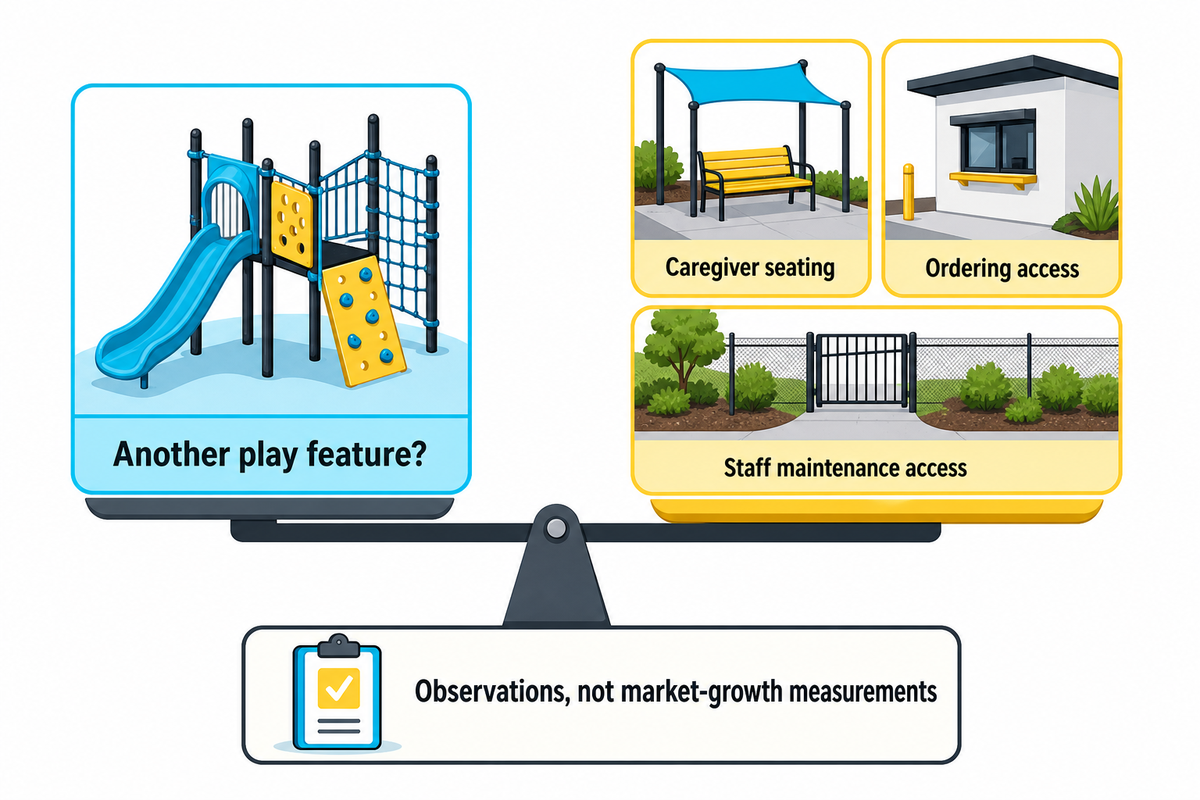
Equipment purchased for an experience should be evaluated against the work required to make a visit usable. In 2026, consideration for caregiver seating, ordering access and maintainable components should be given the same importance as the new play features. This equipment-purchasing framework is supported by observations, not measurements of expected market growth.
In her January 3, 2026 play-cafe trends article, Michele Caruana talks about sightlines, adult seating in the play area, and ways to reduce the need to leave the play area to order. Caruana has a commercial play-cafe training and consulting business and her observations provide ideas for a design review. They don’t establish that the addition of seating or an ordering system increases revenue at every cafe.
Make a concrete choice in the next supplier meeting. Explore whether another cafe play feature would be preferable to resolving awkward coffee collection points or improving access for staff to check or maintain equipment. Ask how the proposal changes caregiver movement, the items staff must reset and the parts they must maintain. No response should rest solely on the claim that kids will have so much fun.
A current food-service development also needs careful scope: FDA identifies the 2026 Food Code as its latest full model edition. Verify the rules in effect for the physical location of the venue before making any changes to the kitchen or menu. Publication alone is not evidence that a cafe must apply every provision of that edition.
Nothing in the public sources reviewed approves the use of a new cleaning technology for all soft-play materials. Procurement needs to associate any proposed method with the component instructions and label prior to use. A sensory feature or craft station adds its own item and service questions. The more appropriate next step would be to provide a written analysis of those questions, along with the missing supplier information, rather than provide a speculative statement about the size of the industry.
Indoor Play Cafe FAQ
What age should an indoor play cafe serve?
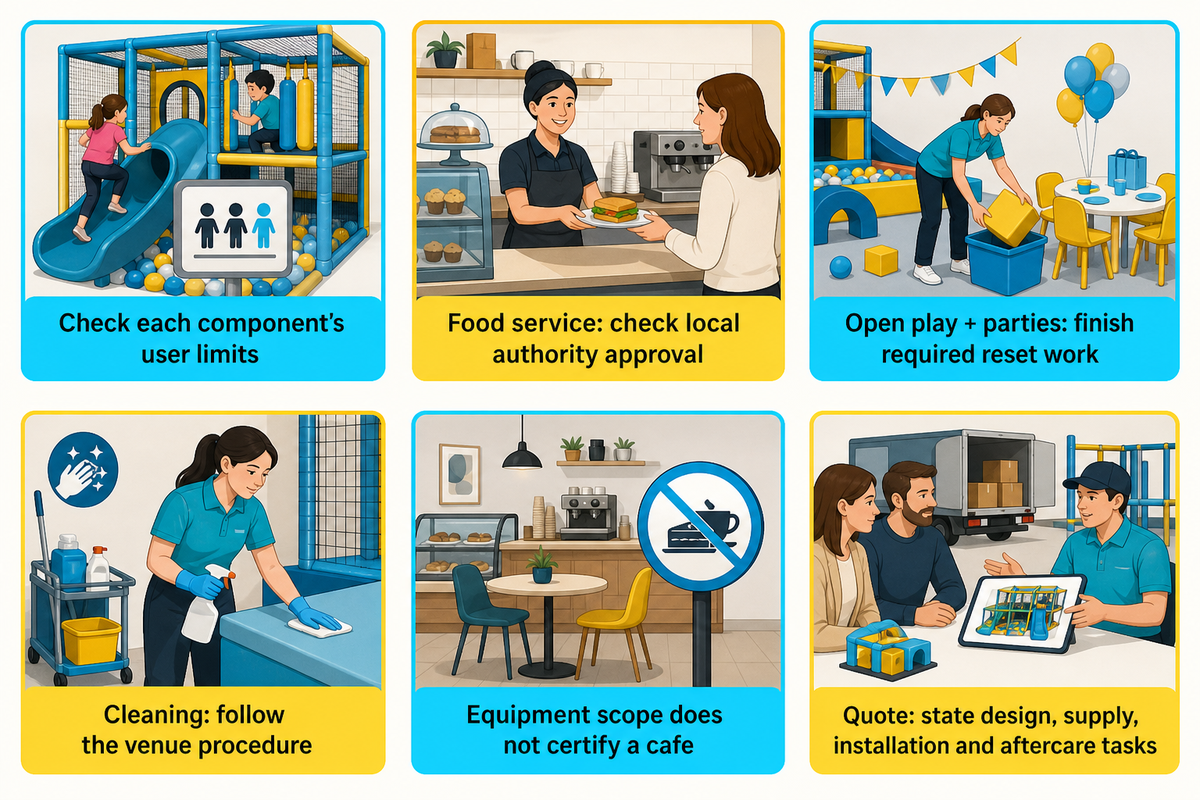
When determining what equipment to purchase, consider the intended age range of the users and check the user limits and operating model of each component. Infant and toddler soft play areas have different user needs. Age separation is just one of many considerations, and staff visibility, caregiver access and clear instructions are equally important. A venue’s marketing age range does not establish that every play structure suits every child.
Can an indoor play cafe serve food?
Yes, the concept can include a play space along with coffee, snacks or a larger offering, but the food operation would require its own local approvals and processes. Maintain separation between play-equipment cleaning, food-contact cleaning and food preparation. Consider how an adult can collect a beverage without losing track of a child, and determine where on the site drinks can be taken. The scope of the equipment supplier doesn’t replace food-service design or the responsibility of the food service operator.
Can open play and birthday parties use the same equipment?
Certain combinations of schedules, equipment, supervision and reset work allow some degree of sharing. Decide in advance which zones close for a private party, who checks toys and surfaces afterwards, and how guests move around any closed section. A reservation time isn’t a cleaning instruction. The work may not always be completed before the next booking, and in that case, the affected zone should remain closed rather than try to compress all of the steps in the work process.
How often should play cafe equipment be cleaned?
Write a protocol or procedure around actual materials, use patterns, manufacturer’s instructions and local requirements. Cleaning removes dirt, while sanitizing and disinfecting are separate tasks whose applicability depends on the surface and setting. Follow the operator’s locally approved procedure for cleaning frequency.
Visible spills, used mouth-contact toys, equipment failures and the like require an immediate response, and the calendar can’t decide when the toys and/or surfaces are ready. Knowledge of the method and product approved for sanitizing and/or disinfecting by the facility, as well as the contact time and rinse and dry steps if required, is essential to staff members.
A good log shows the item that’s affected, the time work began, the steps completed and the person who checked the release. Keep an item or zone closed while required work or repair is incomplete. The frequency and any heightened response to illness require the operator’s locally approved procedure; a supplier blog can’t set a universal interval. Never shorten label instructions to meet the next session start.
Does ASTM F1918 certify the whole cafe?
No. A standard for a specified equipment category doesn’t certify the entire venue. Check its applicable edition, actual product scope and traceable project test reports separately from local building, accessibility and food-service requirements. The public catalog describes scope, not project acceptance.
What should I send Didi Land for an equipment discussion?
Send measured space, intended child ages, your operating model (e.g. drop-in, pre-booked, mixed, etc), menu or service scope and cleaning access. Identify anything with unclear materials or maintenance instructions. Ask which design, supply, installation and aftercare work is included in the quote and compare supplier responses using the same record.
References & Sources
- Minnesota Department of Health: Indoor Play Areas, Maintenance and Sanitation: food-business recommendations; Minnesota scope.
- CDC: How to Clean and Disinfect Early Care and Education Settings: task definitions and item-specific directions; ECE scope.
- EPA: Selected EPA-Registered Disinfectants: permitted use and label-defined wet contact time.
- CPSC: Soft Contained Play Equipment Safety Checklist: equipment condition and safe-use checks.
- U.S. Access Board: Play Areas Guide: category-specific accessibility guidance.
- OSHA: 29 CFR 1910.1200, Hazard Communication: workplace chemical communication, subject to scope and exclusions.
- ASTM F1918-21 public catalog; ASTM F1487-25 public catalog: public scope/status only; full paid texts not accessed.
- FDA Food Code index: model edition and jurisdictional adoption distinction.
- Michele Caruana: 2026 Play Cafe Trends, Part 1: attributed commercial practitioner commentary, not independent market data.
Public source scopes checked October 2026. Planning tables and incidents are illustrative educational examples. Component instructions, applicable product labels and the venue’s governing procedures determine actual use and acceptance.
SYS.00 // E-E-A-T Disclosure
Why I Write This
As the CEO and Co-Founder of a specialized manufacturing facility, my objective is to provide unvarnished, factory-direct technical insights into commercial indoor playground engineering, safety compliance, and project planning. I aim to bridge the information gap for global buyers seeking reliable structural and material data, ensuring you make informed, ROI-driven decisions without the marketing fluff.
About My Business
Guangzhou Didi Land Amusement Equipment Co., Ltd. (Brand: Didi Land) is a commercial indoor playground equipment manufacturer founded in 2014. Operating from Panyu, Guangzhou, China, we engineer, produce, and export commercial-grade play structures to over 40 countries worldwide. Our production lines strictly adhere to international safety frameworks, ensuring durability and safety for high-traffic environments.
Our Services
We provide end-to-end B2B commercial solutions: from custom 3D spatial design and OEM manufacturing to worldwide export logistics and compliance testing. Our focus is on empowering Family Entertainment Centers (FECs), shopping malls, kindergartens, and hospitality venues with reliable, high-capacity play infrastructure.
DATA_MATRIX // MANUFACTURER_PROFILE
Name:
Cherry
Role:
CEO & Co-Founder
Brand Name:
Didi Land
Company:
Guangzhou Didi Land Amusement Equipment Co., Ltd.
Location:
Guangzhou, Panyu, China
Founded:
2014
Products:
Indoor Playground Equipment, Soft Play Equipment, Themed Playground Design, FEC Play Zones, Trampoline Modules, Ninja / Obstacle Course Modules
Email:
conglizhang1@gmail.com
Phone:
+86 199 2587 9517
Website:
didiplayarea.com
COMPLIANCE & STANDARDS:
ASTM F1487 · ASTM F1918 · EN 1176 · CPSIA · CE · ISO 9001 · IPEMA
Contact Factory Direct
ASTM F1487 · ASTM F1918 · EN 1176 · CPSIA · CE · ISO 9001 · IPEMA
![Custom Dinosaur Playground Equipment [Design Guide]](https://didiplayarea.com/wp-content/uploads/2026/09/custom-dinosaur-playground-equipment-r2-featured-1-150x150.png)

![Sensory Play for Infants: Safe Materials [Guide]](https://didiplayarea.com/wp-content/uploads/2026/10/sensory-play-for-infants-featured-150x150.png)