Get in Touch with Didi Land

Commercial Soft Play Climber Dimensions: Indoor Playground Sizing, Age Ranges, and Preschool Clearance Guide

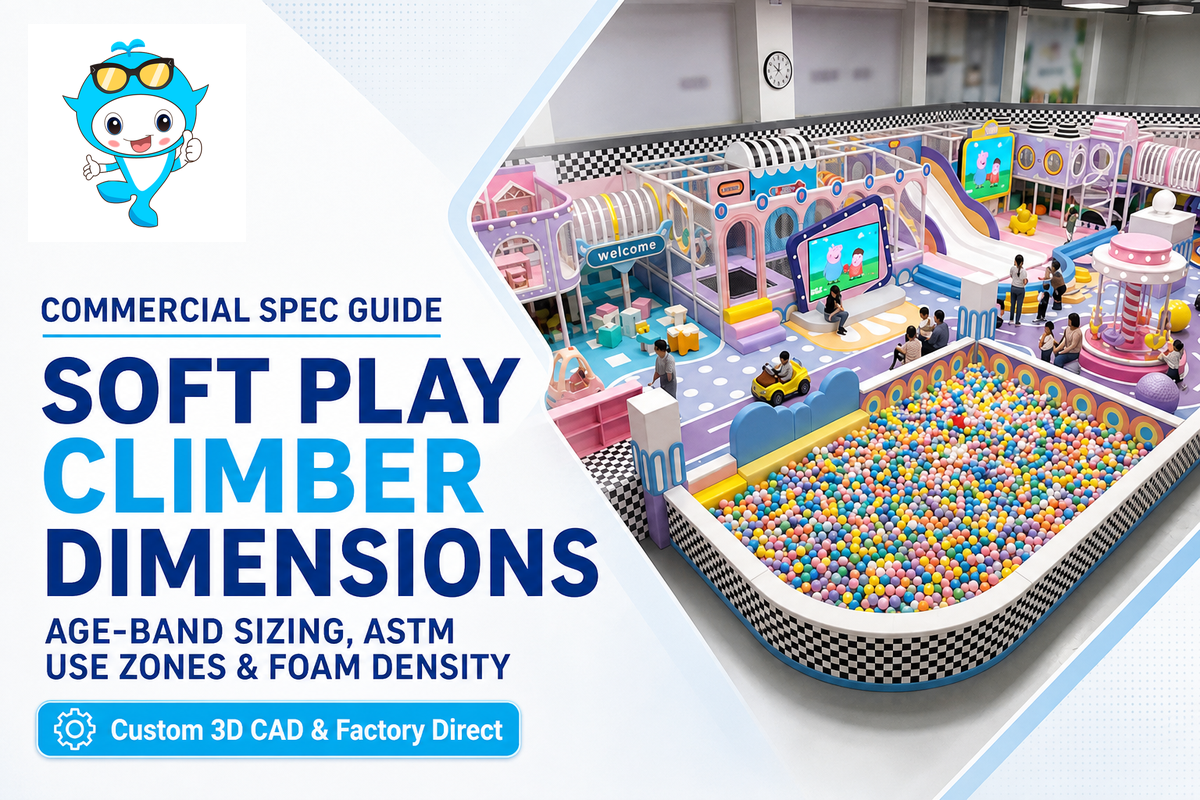
Commercial soft play climber dimensions are the assembled length, width, deck height, and step rise measurements of modular foam climbing structures, spanning 48 × 48 × 18 inches (122 × 122 × 46 cm) for compact corner sets up to 96 × 60 × 36 inches (244 × 152 × 91 cm) for multi-element toddler courses, with individual step rises of 4.0 to 6.5 inches (100 to 165 mm) engineered around ASTM F2373 and ASTM F1918 spatial envelopes. Yet physical product length, width, and height represent only the starting point when laying out a licensed daycare, boutique play center, or family entertainment center.
When playground climbing planners consider catalog hardware measurements for climbing playground equipment and indoor climbers, or when early childhood venue planners select climbing playground, they’re not thinking about hardware measurements in isolation. For soft playground, they’re thinking about balancing engaging play, climbing experiences, and other variables, against code-mandated floor clearances. Whether operators are configuring activity play corners, evaluating good climbing progressions, or designing inclusive climbing routes, buyers often underestimate installed room footprints. Under the voluntary federal safety standards published by the U.S. Consumer Product Safety Commission (CPSC) Public Playground Safety Handbook #325 (July 2025 Revision), for all freestanding climbing structure, there must be an unobstructed perimeter fall zone; verification of floor mat impact attenuation; and ADA-compliant circulation routes.
Key Engineering Takeaways for Facility Planners:
- Under The 4-Band Climber Envelope Matrix , infant crawlers (6 to 23 months) require deck heights ≤18 to 32 inches (457 to 810 mm) and step rises ≤7 inches (178 mm), whereas preschool climbers (2 to 5 years) scale up to 48 inches (4 ft / 1,220 mm) with step rises up to 9 inches (229 mm).
- Applying The Perimeter Clearance Multiplier and The Installed Envelope Rule — cross-referencing ASTM F2373 (36-in use zone), ASTM F1487 (72-in use zone), and EN 1176-1 (1,500 mm free space) against 7 commercial climber archetypes — demonstrates why physical equipment footprint must stay at 35%–45% of raw room area: a freestanding 5 × 5 ft (25 sq ft) toddler climber consumes 121 sq ft (4.84× multiplier) under a 3-ft zone or 289 sq ft (11.56× multiplier) under a 6-ft zone.
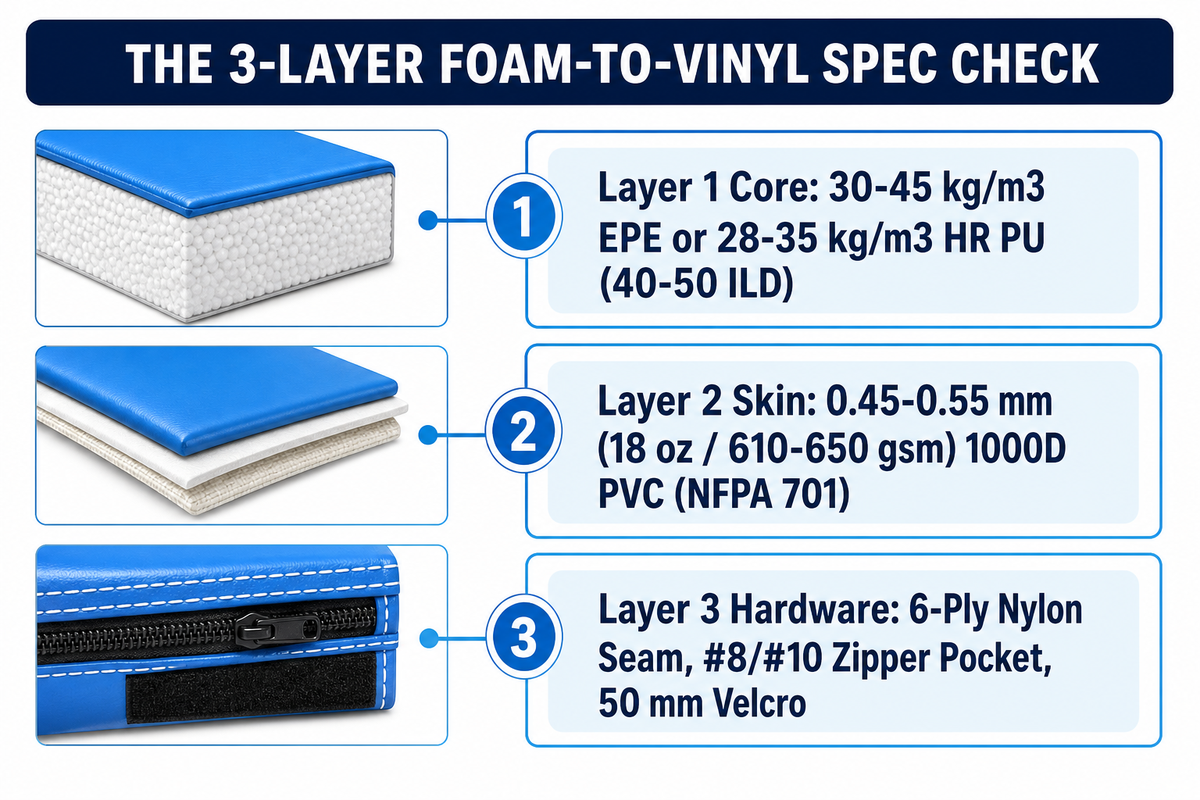
- Following The 3-Layer Foam-to-Vinyl Spec Check, commercial durability requires 30 to 45 kg/m³ cross-linked EPE or 28 to 35 kg/m³ high-resilience PU foam at 40 to 50 ILD firmness, wrapped in 0.55 mm (18 oz / 610 gsm) high-density 1000D NFPA 701 flame-retardant PVC tarpaulin with 50 mm industrial hook-and-loop base fasteners.
- Through The Container Nesting Ratio , high-density 35 to 45 kg/m³ closed-cell foam cannot be vacuum-compressed without permanent cell creasing; factory L-nesting reduces carton CBM by 18% to 24%, fitting 18 to 22 five-piece climber sets into a 20GP container (~28 CBM usable).
Standard Commercial Soft Play Climber Dimensions by Foam Climbing Module Type
During specification of commercial soft play climbing equipment, buyers must evaluate both the assembled bounding box and the geometry of each individual foam block. Unlike rigid outdoor play equipment, a modular soft play set for toddlers combines interchangeable stair wedges, wave ramps, crawl-through barrels, and half-moon bolsters joined at the base by 2-inch (50 mm) hook-and-loop fastening strips to support safe climbing for kids and structured kids play. Drawing on Didi Land commercial soft play and indoor playground module specs across 30,000 sqm Guangzhou factory production and 2,000+ projects in 80+ countries (spanning custom footprint sizing from 10 sqm toddler corners to 500+ sqm FEC centers, using 0.55 mm PVC with high-density EPE/PU foam, and 48 mm galvanized steel pipe frames), together with market data from Congruence Market Insights and federal guidelines archived by the U.S. Government Publishing Office (GPO), more than 38% of commercial early learning installations now specify modular systems that reconfigure across corner, linear, and island footprints.
What Are the Standard Footprint, Height, and Step Rise Dimensions for Infant and Toddler Soft Play Climbers?
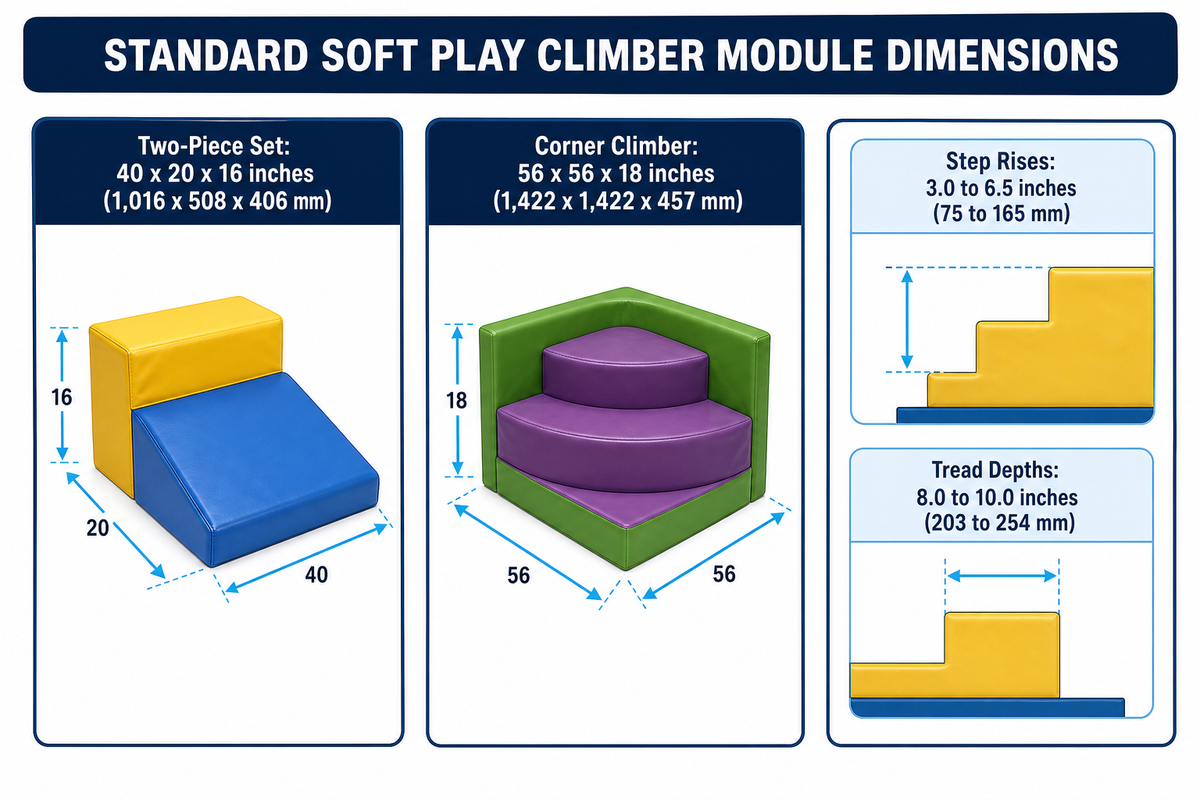
Standard infant and toddler soft play climbers measure 40 × 20 × 16 inches (1,016 × 508 × 406 mm) for two-piece step-and-slide sets, 56 × 56 × 18 inches (1,422 × 1,422 × 457 mm) for 90-degree corner climbers, and 72 to 110 inches (1,829 to 2,794 mm) for island courses, with step rises of 3.0 to 6.5 inches (75 to 165 mm).
Across these 7 commercial climber archetypes, closed-riser tread depths stay between 8.0 and 10.0 inches (203 to 254 mm) with 20-to-30-degree ramp incline angles for children aged 1-3 years old. To eliminate guess work during CAD layout planning, our engineering team created the 4-Band Climber Envelope Matrix below.
| Climber Module Type | Target Age Band | Assembled Footprint (L × W) | Peak Deck / Arch Height | Step Rise / Ramp Slope | Tread Depth / Inner Aperture | Module Weight | Packed Volume (CBM) |
|---|---|---|---|---|---|---|---|
| Micro Crawler Wedge & 2-Step Set | Infant (6–18 mos) | 40 × 20 in (1,016 × 508 mm) | 12–16 in (305–406 mm) | 3.0–4.0 in (76–102 mm) / 18° | 9.0–10.0 in (229–254 mm) tread | 14 lbs (6.4 kg) | 0.22 CBM |
| Linear 3-Step & Slide Play Climber | Infant / Toddler (9–24 mos) | 60 × 20 in (1,524 × 508 mm) | 18 in (457 mm) | 4.5 in (114 mm) / 22° | 8.5 in (216 mm) closed riser | 22 lbs (10.0 kg) | 0.36 CBM |
| 90-Degree Toddler Soft Corner Climber | Toddler (1–3 yrs) | 56 × 56 in (1,422 × 1,422 mm) | 18–24 in (457–610 mm) | 4.5–6.0 in (114–152 mm) / 25° | 8.0–9.5 in (203–241 mm) tread | 38 lbs (17.2 kg) | 0.68 CBM |
| 4-Step Quarter-Round Corner Matrix | Toddler (1–3 yrs) | 60 × 60 in (1,524 × 1,524 mm) | 24–28 in (610–711 mm) | 5.5–6.5 in (140–165 mm) / 28° | 8.5 in (216 mm) closed riser | 46 lbs (20.9 kg) | 0.85 CBM |
| Arch Crawl Tunnel & Ramp Bridge | Toddler (1–3 yrs) | 72 × 24 in (1,829 × 610 mm) | 24 in (610 mm) outer arch | 5.0 in (127 mm) / 24° | 20–26 in (508–660 mm) tunnel ID | 34 lbs (15.4 kg) | 0.62 CBM |
| Rainbow Arch & Half-Moon Balance Beam | Toddler / Preschool (1.5–4 yrs) | 78 × 30 in (1,981 × 762 mm) | 26–30 in (660–762 mm) | 5.5 in (140 mm) / 26° | 10.0 in (254 mm) beam width | 42 lbs (19.1 kg) | 0.74 CBM |
| 360-Degree Island Soft Play Set (6-Piece) | Toddler / Preschool (1–4 yrs) | 84 × 60 in (2,134 × 1,524 mm) | 24–32 in (610–813 mm) | 5.5–6.5 in (140–165 mm) / 28° | 8.5–10.0 in (216–254 mm) tread | 76 lbs (34.5 kg) | 1.35 CBM |
| Preschool Soft Climbing Pyramid & Slide | Preschool (2–5 yrs) | 96 × 72 in (2,438 × 1,829 mm) | 36–48 in (914–1,219 mm) | 6.5–8.0 in (165–203 mm) / 32° | 8.0–9.0 in (203–229 mm) tread | 115 lbs (52.2 kg) | 2.10 CBM |
| Multi-Level Framed Soft Climbing Tower | Preschool / Older Kids (3–8 yrs) | 110 × 96 in (2,794 × 2,438 mm) | 48–72 in (1,219–1,829 mm) | 7.0–9.0 in (178–229 mm) / 35° | 24 in (610 mm) portal width | 280 lbs (127.0 kg) | 3.80 CBM |
When integrating a ball pit step-in alongside foam blocks, commercial planners match the top stair landing height (16 to 20 inches / 406 to 508 mm) flush with the padded ball pit wall thickness (6 to 8 inches / 152 to 203 mm) so toddlers transition over the rim without a tripping lip.
Age-Band Sizing Rules: Infant (6-24 Months), Toddler Climbing (1-3 Years Old), and Preschool (2-5 Years)
Commercial childcare licensing boards and insurance underwriters evaluate indoor play spaces by age separation. Placing a 2 year old early walker on the same 4 ft (1,219 mm) climbing deck used by 3–4 year old preschoolers creates collision risks at slide transitions and step-down landings. Designing compliant toddler indoor playground systems requires matching step rise, tread depth, and handrail geometry to the anthropometric data in the CPSC Public Playground Safety Handbook #325 (July 2025 Revision, Section 5.2.2 Table 2 and Section 5.2.3) and the CPSC #325 Base Reference.
Facility owners should note that CPSC Publication #325 is voluntary federal safety guidance rather than a mandatory federal statute, yet state childcare licensing agencies and commercial general liability insurers routinely adopt its dimensional tables as binding inspection benchmarks. ASTM standards, on the other hand, regulate play equipment as follows:
- For the Infant & Toddler Zone (6 to 23 Months under ASTM F2373-24), public-use play equipment for children under 2 years old (excluding soft contained play equipment under Section 1.5) caps maximum elevated platform height at 32 inches (810 mm) per federal toddler safety guidance. Per CPSC #325 Table 2, toddler stairways require a slope ≤35°, single-file tread width of 12 to 21 inches (305 to 533 mm) (or ≥30 inches / 762 mm for two-abreast play), closed-riser tread depth ≥8 inches (203 mm) (open risers are not appropriate for children under 2), vertical step rise ≤7 inches (178 mm), and continuous handrail height between 15 and 20 inches (381 to 508 mm). Within commercial nurseries, soft foam climbers for 6-to-18-month crawlers stay at 12 to 18 inches (305 to 457 mm) deck height with 3 to 5 inch (76 to 127 mm) step rises.
- Within the Early Walker & Toddler Climbing Zone (1-3 Years Old Transitional Nursery spec) operators use a soft climber along with a crawl tunnel and a low balance beam, capped at 18 to 28 inches (457 to 711 mm) platform height. Stepping surfaces have 4.5 to 6.5 inch (114 to 165 mm) risers, which helps support vestibular balance, spatial awareness and sensory awareness, ensuring that the platform height doesn’t go over 32 inches.
- Across the Preschool Active Zone (2 to 5 Years under ASTM F1487-25 & ASTM F1918-21), ASTM F1487-25 governs freestanding public playground equipment for children ages 2 through 12, while ASTM F1918-21 (and European standard EN 1176-10:2023) covers enclosed soft contained play structures. Under CPSC #325 Table 2, preschool stairways permit slopes <50°, closed-riser tread depths ≥8 inches (203 mm) (or ≥7 inches / 178 mm open riser), vertical step rises ≤9 inches (229 mm), single-file tread widths of 12 to 21 inches (305 to 533 mm), and handrail heights of 22 to 26 inches (559 to 660 mm). In the August 2025 Federal Register notice for CPSC Public Playground Safety Handbook #325 (Section 5.2.3), continuous handrails on stairs and ramps serving preschool children ages 2 through 5 years are specified at a vertical height of 22 to 26 inches (559 to 660 mm) above the leading edge of each step or ramp surface. Freestanding unnetted foam climbers for preschoolers scale up to 36 to 48 inches (914 to 1,219 mm / 4 ft) in height.
Play areas for toddlers (6 to 23 months) should be separated from older children’s (2 to 5 years; 5 to 12 years) play areas to prevent injury from differences in size, mobility and physical coordination; toddler stairways must have closed risers, with a maximum rise of 7 inches and a minimum tread of 8 inches.
What Ages Are Soft Play Climbers Best For in Licensed Childcare Centers?
Commercial vinyl-covered foam climbers are appropriate for children, aged 6 months to 5 years, in licensed, commercial daycares and early learning centers, where low-impact modules help infants and preschoolers develop motor skills and gross motor skills, without rigid strike hazards.
Once children exceed age 5 (body weight above 45 lbs / 20 kg), unframed foam blocks compress too easily under jumping loads, so older kids transition to steel-framed climbing towers, rock climbing walls, and rope courses. Enforcing vertical platform spacing shows the reasoning behind the CPSC recall of commercial playground climbers, where units were recalled due to climbing platforms that were spaced too far apart, creating an elevated fall hazard.
ASTM F2373, ASTM F1487, and EN 1176 Perimeter Use Zones and Ceiling Clearance Requirements
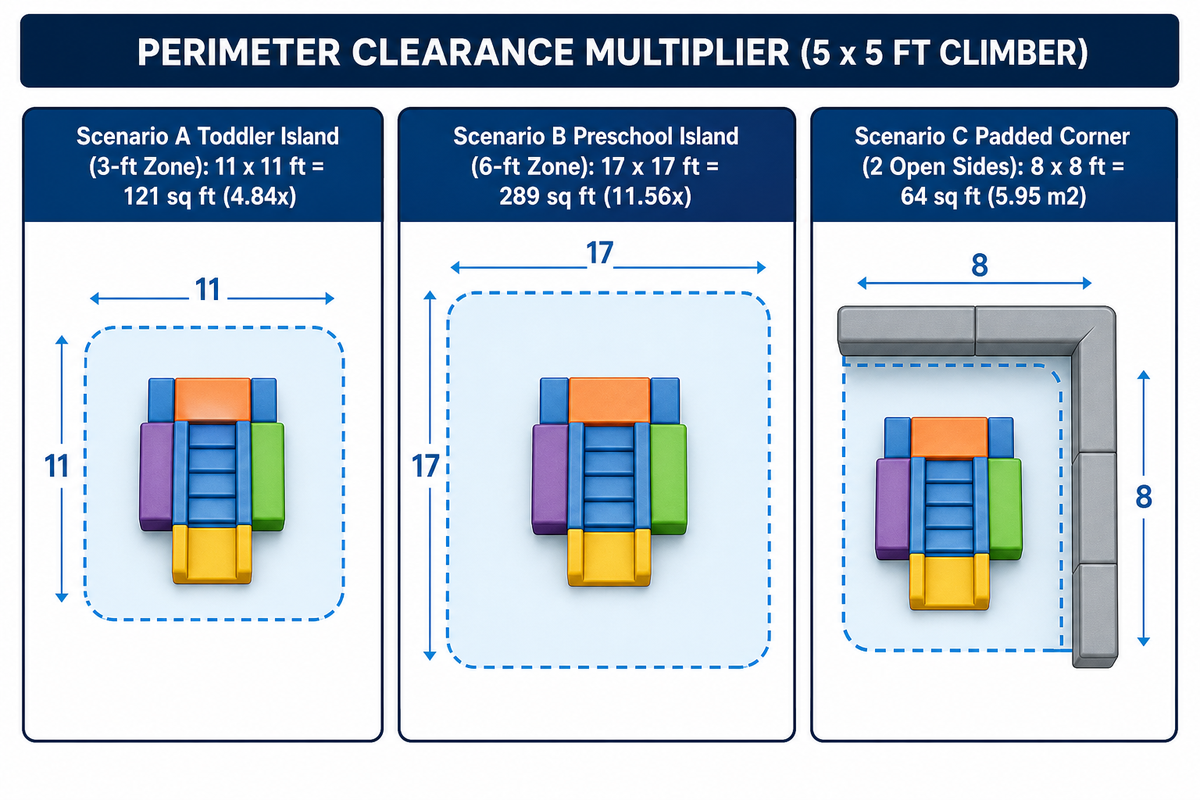
The biggest mistake with indoor play design layouts occurs when users imagine the physical footprint of a climber and equate it to the installation area. Under ASTM International Committee F15 playground safety standards and the ANSI overview of ASTM F1487 public playground equipment requirements, every freestanding play climber must be surrounded by an unobstructed impact-attenuating perimeter known as the use zone (or falling space / free space of 1,500 mm under CEN EN 1176-1:2017+A1:2023 and RoSPA Soft Play Area Standards).
To address under-sizing by play area designers and operators, we apply the Perimeter Clearance Multiplier (the basis for the Installed Envelope Rule):
Worked Calculation: The Perimeter Clearance Multiplier for a 5 × 5 ft (25 sq ft) Climber
Formula: Installed Floor Area = (Length + 2 × Perimeter Use Zone) × (Width + 2 × Perimeter Use Zone)
- In Scenario A for a Toddler Freestanding Island (ASTM F2373-24, 6–23 Months, 3-ft / 36-in / 915 mm Use Zone), Installed Envelope =
(5 ft + 3 ft + 3 ft) × (5 ft + 3 ft + 3 ft) = 11 ft × 11 ft = 121 sq ft (11.24 m²). A 25 sq ft climber consumes 121 sq ft of floor space — a 4.84× area multiplier. - In Scenario B for a Preschool Freestanding Island (ASTM F1487-25, Ages 2–5, 6-ft / 72-in / 1,830 mm Use Zone), Installed Envelope =
(5 ft + 6 ft + 6 ft) × (5 ft + 6 ft + 6 ft) = 17 ft × 17 ft = 289 sq ft (26.85 m²). The exact same 25 sq ft footprint consumes 289 sq ft under preschool freestanding rules — an 11.56× area multiplier (and CPSC #325 requires a 9-ft / 2,740 mm clearance where two pieces of equipment exceed 30 inches / 760 mm in height). - In Scenario C for a Purpose-Built Padded Corner Climber Set (2 Walls Padded, 2 Open Sides with 3-ft Toddler Use Zone), when using a purpose-built 90-degree corner soft play set equipped with integrated ≥50 to 72 mm (2.0 to 2.8 in) high-density padded wall-return panels anchored flush against two perpendicular structural walls (zero wall gap, eliminating the 3.5-to-9.0-inch head entrapment hazard), the 3-ft use zone applies to the two open room-facing sides: Installed Envelope =
(5 ft + 3 ft) × (5 ft + 3 ft) = 8 ft × 8 ft = 64 sq ft (5.95 m²). Neither ASTM F2373 nor ASTM F1487 grants a blanket exemption for pushing a standard freestanding climber against unpadded drywall; corner space savings require factory-engineered padded wall panels or enclosed ASTM F1918-21 / EN 1176-10:2023 perimeter containment.
In addition, there are two other horizontal constraints that must also be considered:
- For fall protection, the distance from the highest play surface must be a minimum of 48 to 60 inches (1220 to 1525 mm). Maintain at least 48 to 60 inches (1,220 to 1,525 mm) of standing headroom above the highest play surface so a standing child cannot strike ceiling grids, plus an additional 18 inches (457 mm) of unobstructed clearance below fire sprinkler deflectors per NFPA 13. For a 36-inch (914 mm) preschool climber, minimum safe ceiling height to the lowest overhead obstruction is 8.5 to 9.0 feet (2.6 to 2.75 m).
- Verify ADA Chapter 10 accessible route dimensions for play areas serving children ages 2 and older (Section 1008.1): the U.S.
U.S. Access Board 2010 ADA Standards require a 60-inch (1,525 mm) minimum clear width for ground-level accessible routes connecting play components (Section 1008.2.4.1, with an exception permitting a 44-inch / 1,120 mm clear width in play areas under 1,000 sq ft / 93 m² where routes exceeding 30 feet include a turning space per Section 1008.4.1), plus an 80-inch (2,030 mm) minimum vertical clearance under Section 1008.2. An exception allows a clear width of 44 inches / 1,120 mm for routes < 30 feet in play areas < 1,000 sq ft / 93 m², (Section 1008.4.1), requiring an 80 inch (2,030 mm) clearance (Section 1008.2).
How Do Climbing Structures Affect Indoor Playground Surfacing Depth and Fall Zone Clearances?
Climbing structures dictate floor mat thickness through their equipment fall height (the vertical distance from the highest designated play surface to the protective floor below), requiring surfacing whose ASTM F1292 laboratory critical fall height rating keeps G-max ≤ 200 and HIC ≤ 1000. Surfacing must be tested to certify the ASTM F1292 laboratory critical fall height rating to keep the G-max and HIC values less than 200 and 1000 respectively.
Commercial indoor play areas with climbers (components) 24 inches (610 mm) and under require 1.5-inch (40 mm) high-density EVA or cross-linked EPE interlocking floor mats, while climbers between 24 and 48 inches (610 to 1,220 mm) require 2.0-inch (50 mm) vinyl-wrapped shock mats, and elevated climbing walls above 48 inches require a 6-to-12 inch (150 to 300 mm) crash mat or foam pit.
Room Footprint Layouts: Freestanding Modular Blocks vs. Corner Climbers vs. Steel-Framed Play Structures
Deciding between movable foam blocks, wall-fitted corner climbers, and multi-tier steel-framed structures depends on your ceiling height, lease terms, and staff-to-child supervision ratio. As documented in commercial design reviews on Playground Professionals and in federal use-zone rules in CPSC Publication #325, each structure type has distinct trade-offs in spatial efficiency and maintenance, whether an operator builds stand-alone foam ramps or a multi-level climbing net enclosure.
In operator discussions across commercial play cafe communities, owners frequently report that unanchored foam blocks scatter across the room within 15 minutes of peak toddler traffic unless secured with heavy-duty perimeter Velcro flaps, whereas narrow 4-to-8-inch gaps left behind poorly fitted corner structures trap dust and prevent daily mop disinfection. Owners also report that a climbing structure (commercial soft play ball pit enclosures) prevents toddler toes from being pinched when locking the slide run-out and step-in bolsters to a continuous vinyl floor mat.
| Engineering Parameter | Freestanding Modular Foam Blocks | Wall-Fitted Padded Corner Climbers | Multi-Level Steel-Framed Structures |
|---|---|---|---|
| Assembled Equipment Footprint | 32–96 sq ft (3.0–9.0 m²) | 16–43 sq ft (1.5–4.0 m²) | 160–5,400+ sq ft (15–500+ m²) |
| Installed Room Envelope (with Use Zone) | 110–290 sq ft (10.2–27.0 m²) | 50–90 sq ft (4.6–8.4 m²) | Bounded by ASTM F1918 / EN 1176-10 netting |
| Minimum Safe Ceiling Height | 8.0 ft (2.44 m) | 8.0 ft (2.44 m) | 9.5–16.0+ ft (2.90–4.88+ m) |
| Active Child Density Rating | 1 child per 25–35 sq ft (2.3–3.2 m²) | 1 child per 18–25 sq ft (1.7–2.3 m²) | 1 child per 12–18 sq ft (1.1–1.7 m²) across decks |
| Primary Load-Bearing Core | 30–45 kg/m³ EPE or 28–35 kg/m³ HR PU foam | 30–45 kg/m³ EPE + 18 mm birch plywood wall backs | 48 mm to 85 mm (≥3.34 in) galvanized steel pipe + ≥72 mm foam wrap |
| Fastening & Primary Failure Mode | 50 mm base Velcro strips; lint buildup reduces shear hold after 24–36 mos | Concealed wall cleats + base Velcro; improper drywall anchoring causes pull-out | Cast aluminum/steel clamps + tensioned safety netting; annual net torque check required |
| Commercial Service Lifespan | 3–5 years (field observation under daycare traffic) | 4–6 years (stationary corner placement) | 5–8+ years (replaceable vinyl pads and mat skins) |
Core Foam Density (EPE vs. High-Resilience PU) and Commercial PVC Vinyl Thickness Specifications
Two soft climbers with identical exterior dimensions of 60 × 60 × 24 inches can perform completely differently after six months in a busy daycare. Residential-grade foam sets sold on retail marketplaces often use 16 to 20 kg/m³ open-cell polyurethane (PU) wrapped in thin 0.25 mm faux leather; under repeated stepping loads from 30-pound toddlers, the step edges bottom out and crease permanently. When sourcing custom EPE and PU foam play modules for a custom playground or custom indoor playground buildout, procurement managers should separate polymer density from surface firmness.
As polymer engineering guidelines from the Polyurethane Foam Association (PFA) and structural safety benchmarks in ASTM playground material standards establish, foam density (measured in kg/m³ or lb/ft³) governs load-bearing durability and compression-set resistance, whereas Indentation Force Deflection (ILD, measured in pounds of force per 50 sq in at 25% compression) independently governs how firm the step feels underfoot. Low density foams can be chemically stiffened to feel firm in a showroom, but still collapse within months of commercial use. In addition, all rigid or semi-rigid pass-through apertures (such as crawl tunnels and arch bridges) must comply with head and neck entrapment probe boundaries in CPSC Publication #325: any completely bounded opening must either reject the 3.5-inch (89 mm) torso probe or freely admit the 9.0-inch (229 mm) head probe, and eliminate V-shaped angles below 55 degrees.
The 3-Layer Foam-to-Vinyl Spec Check is a useful tool to audit quotations before final approval to move into production.
| Spec Layer & Parameter | Commercial Cross-Linked EPE Spec | Commercial High-Resilience (HR) PU Spec | Residential / Retail Grade (Avoid for B2B) |
|---|---|---|---|
| Layer 1: Core Foam Density | 30–45 kg/m³ (1.9–2.8 lb/ft³) closed-cell cross-linked EPE | 28–35 kg/m³ (1.75–2.2 lb/ft³) open-cell high-resilience PU | 16–20 kg/m³ (1.0–1.25 lb/ft³) standard open-cell PU |
| Surface Firmness & Rebound | Rigid structural edge support; laminated multi-sheet thermal bond | 40–50 ILD @ 25% deflection; rapid elastic recovery on slide landings | 22–30 ILD; bottoms out under adult knee or group toddler load |
| Moisture & Urine Resistance | Closed-cell structure (<2% water absorption); immune to liquid wicking | Open-cell core; requires liquid-tight stitched seams and zipper garage | Absorbs spills through unsealed stitch holes; harbors odor |
| Layer 2: Outer Vinyl Skin | 0.45–0.55 mm (18 oz / 610–650 gsm) 1000D knife-coated PVC tarpaulin | 0.45–0.55 mm (18 oz / 610–650 gsm) 1000D knife-coated PVC tarpaulin | 0.20–0.30 mm thin PU faux leather or non-reinforced vinyl |
| Flammability & Phthalate Compliance | NFPA 701 / CAL TB 117 / EN 71-2 flame retardant; CPSIA <0.1% phthalates | NFPA 701 / CAL TB 117 / EN 71-2 flame retardant; CPSIA lead/phthalate free | Often lacks commercial fire marshal test certificates (NFPA 701) |
| Layer 3: Seam, Zipper & Base Hardware | Double-stitched 6-ply nylon thread, concealed #8/#10 zipper pocket, 50 mm Velcro | Double-stitched 6-ply nylon thread, concealed #8/#10 zipper pocket, 50 mm Velcro | Single-stitched exposed #5 metal zipper tabs; 20–25 mm narrow Velcro |
| Observed Commercial Lifespan | 3–5+ years (field/manufacturer observation in licensed daycares) | 3–5 years (ideal for cushioned ramps, bolsters, and landing pads) | 6–12 months before step edges deform or vinyl peels under bleach wipes |
How Thick Should Plywood Backing and Foam Padding Be for an Indoor Climbing Wall?
A commercial indoor climbing wall requires 3/4-inch (18 to 19 mm) structural birch plywood backing with 3/8-inch (M10) T-nuts at 6-to-8-inch intervals, upholstered in 2.0 to 2.8 inches (50 to 72 mm) of EPE/PU foam and paired with a 2.0-to-6.0-inch (50 to 150 mm) ASTM F1292 floor crash mat.
Commercial Soft Play Climbers vs. Wooden Pikler Triangles vs. Rotomolded Plastic Climbing Equipment
Operators of facilities, particularly Montessori schools, nurseries and play centers, interested in the climber versus Pikler Triangle versus playground structures debate, usually contact us at this point. Although all three promote the development of active play, imaginative play and pretend play in young climbers, each item takes up significant space, has a different impact on head and body when impacted and, under ANSI/ASTM F1487 commercial inspection criteria and EN 1176-1 structural safety rules, poses different risks to young climbers during unsupervised free play.
Compared to traditional metal or unpadded birch dowel frames, climbers eliminate rigid strike edges when 8 toddlers (little kids) scramble to occupy a module first. Rotomolded HDPE climbers are more suited for hybrid indoor and outdoor (courtyards) where indoor stitched seams are exposed to UV and rain.
| Comparison Dimension | Commercial Vinyl Foam Climbers | Commercial Wooden Pikler Triangles & Ramps | Rotomolded HDPE Plastic Climbers |
|---|---|---|---|
| Typical Assembled Footprint | 48 × 48 in to 96 × 72 in (1.2 × 1.2 m to 2.4 × 1.8 m) | 32 × 30 in triangle + 48 in slide board (0.8 × 2.0 m combined) | 60 × 48 in to 108 × 84 in (1.5 × 1.2 m to 2.7 × 2.1 m) |
| Surface Impact & Fall Risk | Self-padded 30–45 kg/m³ foam core; lowest contact bruising risk in group play | Rigid birch/beech dowels (28–32 mm dia.); high tooth/chin strike risk if toddler slips | Rigid double-wall polyethylene; requires full ASTM F1292 floor mat perimeter |
| Head & Limb Entrapment Profile | Solid closed-riser blocks; zero ladder rung entrapment openings | Open rung spacing must be strictly <3.5 in (89 mm) or >9.0 in (229 mm) per CPSC #325 | Molded pass-through ports pre-engineered to pass 3.5-in / 9.0-in probes |
| Daily Sanitation Protocol (10-Module Zone) | 4–6 minutes; flat 18 oz PVC surfaces wipe clean with hospital-grade quat disinfectant | 12–18 minutes; dowel joints trap saliva/moisture and swell if bleached daily | 8–10 minutes; deep recessed bolt pockets and textured steps require brush scrubbing |
| Indoor vs. Outdoor Suitability | Dedicated safe indoor use (climate-controlled daycares, play cafes, FECs) | Indoor dry classrooms only; humidity shifts loosen wooden dowel glue joints | Indoor and outdoor play; UV-stabilized HDPE withstands outdoor playgrounds |
| 5-Year Commercial TCO (Total Cost) | $950–$3,200 initial + $150–$300 replacement vinyl covers at year 4 | $400–$1,100 initial, but 2–3 replacement cycles ($1,200–$2,800 total) due to finish wear | $1,800–$5,500 initial; near-zero structural maintenance over 5–8 years |
Venue-Specific Sizing Matrix for Daycares, Play Cafes, Pediatric Therapy Clinics, and FECs
Selecting the right climber package requires balancing revenue-generating play capacity against sightlines, stroller parking, and ADA accessible corridors. When configuring turnkey commercial soft play sets, facility planners allocate 25 to 35 sq ft (2.3 to 3.2 m²) per active child in freestanding foam zones, or 15 to 20 sq ft (1.4 to 1.9 m²) per child in contained multi-level layouts, while preserving compliant perimeter clearances per the CPSC Public Playground Safety Handbook #325 and RoSPA Play Safety inspection standards.
In pediatric occupational therapy clinics and inclusive playground settings, therapists combine graduated step heights (4 in, 6 in, and 8 in risers) with soft rockers and crawl barrels to offer progressive difficulty levels that develop spatial and body awareness and motor skills in children, while keeping a 60-inch (1,525 mm) clear transfer path around the mat perimeter for children using wheelchairs.
| Commercial Venue Type | Dedicated Play Zone Area | Recommended Climber Format | Assembled Climber Footprint | Max Deck Height | Simultaneous Kid Capacity | Required Mat Thickness | Limitations / Not Suitable For |
|---|---|---|---|---|---|---|---|
| Infant Nursery Classroom | 100–180 sq ft (9–17 m²) | Micro Wedge + 2-Step Corner Set | 48 × 48 in (1.22 × 1.22 m) | 12–16 in (305–406 mm) | 3–5 infants (6–18 mos) | 1.5 in (40 mm) EVA/EPE | Not suitable for walkers over 24 mos; 12-in steps lack gross-motor challenge for preschoolers. |
| Licensed Daycare Toddler Room | 180–300 sq ft (17–28 m²) | 90-Degree Padded Corner Climber + Tunnel | 60 × 60 in (1.52 × 1.52 m) | 18–24 in (457–610 mm) | 5–8 toddlers (1–3 yrs) | 1.5–2.0 in (40–50 mm) | Not suitable for freestanding center-room placement in rooms narrower than 12 ft (violates 3-ft use zone). |
| Pediatric OT & Sensory Clinic | 200–400 sq ft (19–37 m²) | Reconfigurable Linear Ramp, Step & Bolster Set | 72 × 24 in + modular blocks | 18–30 in (457–762 mm) | 2–4 children + 2 therapists | 2.0 in (50 mm) HR PU/EPE | Not suitable for unsupervised high-throughput group play; Velcro joints must be re-leveled between therapy sessions. |
| Boutique Play Cafe (Micro Lease) | 300–550 sq ft (28–51 m²) | Flush Corner Climber + Integrated Ball Pit + Fence | 96 × 72 in (2.44 × 1.83 m) | 24–32 in (610–813 mm) | 8–14 children (6 mos–4 yrs) | 2.0 in (50 mm) PVC-wrapped | Not suitable for children over 5 years; tall solid barriers above 36 in block parent sightlines from cafe tables. |
| Preschool / Church Gross Motor Room | 500–900 sq ft (46–84 m²) | 360-Degree Island Climber + Arch Bridge Course | 108 × 72 in (2.74 × 1.83 m) | 32–42 in (813–1,067 mm) | 12–18 children (2–5 yrs) | 2.0 in (50 mm) ASTM F1292 | Not suitable for multi-purpose rooms requiring daily 5-minute teardown unless rolling storage carts are provided. |
| Retail Mall / Auto Dealership Lounge | 250–450 sq ft (23–42 m²) | Anchored Low-Profile Soft Sculpted Climber Set | 84 × 60 in (2.13 × 1.52 m) | 24–30 in (610–762 mm) | 6–10 children (1.5–5 yrs) | 2.0 in (50 mm) heat-welded | Not suitable for loose unfastened blocks (theft and scatter hazard in unattended commercial waiting lounges). |
| Hybrid Indoor-Outdoor Preschool Patio | 400–800 sq ft (37–74 m²) | Rotomolded HDPE Climber + Marine-Vinyl Pads | 96 × 60 in (2.44 × 1.52 m) | 36–48 in (914–1,219 mm) | 10–15 children (2–5 yrs) | 2.0 in (50 mm) EPDM/pour-in | Standard indoor stitched EPE foam blocks are not suitable for uncovered rain/UV exposure (water ingress via seams). |
| Mid-Size Indoor Play Center Toddler Zone | 800–1,500 sq ft (74–139 m²) | Gated Soft Play Zone + Framed Toddler Tower | 180 × 144 in (4.57 × 3.66 m) | 48–60 in (1,219–1,524 mm) | 20–35 children (1–5 yrs) | 2.0 in (50 mm) + netting | Not suitable for ceilings under 9.5 ft (2.9 m) due to NFPA 13 sprinkler and standing headroom requirements. |
| Family Entertainment Center (FEC) Anchor | 1,500–5,000+ sq ft (139–465+ m²) | Age-Segregated Toddler Zone + 3-Tier Jungle Gym | Custom CAD (15–500 m²) | 32 in (toddler) / 96+ in (main) | 45–150+ children of all ages | 2.0 in (50 mm) + crash pads | Never combine under-2 crawlers and 6-to-12-year-old runners in a single unsegregated entry portal. |
If-Then Venue Selection Rules for Facility Planners
- When your available play zone is under 250 sq ft (23 m²) or room width is under 11 feet, select a 90-Degree Padded Corner Climber (48 × 48 in to 60 × 60 in) with integrated 50–72 mm padded wall returns. Avoid freestanding island climbers, which lose up to 79% of your floor space to perimeter fall zones.
- When your room is shared (such as a church fellowship hall or therapy gym) and must be cleared weekly, select a 6-to-8-piece Modular Hook-and-Loop Climber Course where no individual block exceeds 25 lbs (11.3 kg) or 36 inches in width, allowing one staff member to wheel modules through a standard 36-inch (915 mm) commercial doorway.
- If your facility is a Play Cafe or Family Entertainment Center (FEC) with children ages 6 months to 8 years and a square footage of 1,000 or greater, use a 36” padded perimeter fence to physically zone the ASTM F2373 (deck height ≤32”) climber area from the ASTM F1918 (framed) structure for older kids.
How Climber Dimensions Impact Packed Volume (CBM), Ocean Container Loads, and Custom Lead Times
When sourcing commercial playground equipment directly from a factory, freight forwarders charge Less-than-Container-Load (LCL) ocean freight shipments by cubic meters (CBM) instead of weight, as the climbing blocks have a high volume-to-weight ratio of roughly 25 to 35 kg per CBM, nested in export boxes.
Buyers who mistake retail “vacuum-rolled mattress” shipping for commercial soft play logistics face a costly surprise: 30 to 45 kg/m³ closed-cell cross-linked EPE foam cannot be vacuum-compressed without crushing its closed-cell structure and leaving permanent surface wrinkles in the 0.55 mm PVC vinyl skin. Instead, experienced factories apply The Container Nesting Ratio: pairing complementary geometric shapes (two 25-degree wedge ramps inverted face-to-face to form a rectangle, or nesting half-moon bolsters inside arch tunnel cavities) inside 5-ply corrugated cartons or woven PE bags. While safety clearances follow CPSC #325 dimensional rules and federal public playground archiving standards, ocean freight economics depend on how tightly those modules pack against multi-level indoor jungle gym structures.
Worked Calculation: The Container Nesting Ratio (Assembled vs. Packed CBM)
Example Order: One 6-piece Commercial Toddler Corner & Ramp Climber Set (Assembled footprint: 1.80 m × 1.50 m × 0.60 m = 1.62 m³ assembled bounding envelope).
- For unnested naive carton volume, packing each irregular arch and stair block in its own rectangular box adds a
1.22×packaging void factor:1.62 m³ × 1.22 = 1.98 CBM. - Through factory geometric nesting (L-step inversion plus ramp pairing), inverting the 3-step block onto the wedge ramp and nesting the cylinder bolster inside the arch tunnel reduces raw block bounding volume to
1.12 m³. Multiplying by a1.15×protective carton factor yields 1.29 CBM packed volume — a 34.8% freight volume reduction (18% to 24% vs. raw block sum).
| Project Scale & Floor Area | Typical Equipment Package | Packed Volume (CBM) | Recommended Shipping Mode | FOB Equipment Budget Range | Factory Production Lead Time |
|---|---|---|---|---|---|
| Single Classroom / Corner Set (100–250 sq ft) | 1–2 modular foam climber sets + 15 m² EVA/PVC mats | 1.5–3.8 CBM | LCL Consolidated Sea Freight | $800–$3,500 | 15–25 days (standard color palette) |
| Boutique Play Cafe Toddler Zone (500 sq ft) | Corner climber + arch course + ball pit + soft fence + 45 m² mats | 8.0–14.0 CBM | LCL Sea Freight (or 20GP if adding cafe furniture) | $5,000–$14,000 | 25–35 days (+7–10 days custom vinyl printing) |
| Preschool / Play Center (1,000 sq ft) | Toddler soft zone + compact 2-tier framed climber + 90 m² mats | 22.0–28.0 CBM | 20GP FCL Container (28 CBM usable / 33.2 CBM nominal) | $15,000–$35,000 | 30–40 days (includes 3D CAD & trial assembly) |
| Commercial Play Center (1,500 sq ft) | Multi-zone soft climbers + framed structure + interactive obstacles | 38.0–52.0 CBM | 40GP / 40HQ FCL Container | $30,000–$65,000 | 35–45 days |
| Full FEC Indoor Playground (2,000–5,000+ sq ft) | Toddler soft play village + 3-tier jungle gym + trampoline / slides | 58.0–135.0+ CBM | 1× to 2× 40HQ FCL (68 CBM usable / 76.4 CBM nominal per 40HQ) | $55,000–$300,000+ | 40–55 days (staged container loading) |
2026 Commercial Sourcing Guide: Evaluating Custom Soft Play Manufacturers, 3D Layout Design, and Compliance Docs
Between 2025 and 2026, rising retail lease rates have pushed independent play cafe and daycare operators toward compact 500-to-1,200 sq ft footprints that cannot afford wasted corner gaps or structural building columns sitting outside the play zone. As industry market analyses from Congruence Market Insights and compliance updates from ASTM International highlight, buyers increasingly require custom-sized foam climbers, tailored structural pillar wraps, and neutral Morandi or themed play color palettes with fun designs engineered for lasting indoor fun directly from architectural floor plans.
When comparing global commercial suppliers, North American catalog brands (such as Soft Play LLC and Playworld) offer established domestic distribution for standardized units, whereas direct OEM/ODM factory engineering from Guangzhou Didi Land Amusement Equipment Co., Ltd. (Didi Land) allows buyers to customize exact module dimensions with a 1-set minimum order quantity (MOQ), complimentary 3D CAD room layout design, and clause-specific compliance documentation across 80+ exported countries (covering ASTM F1918-21, ASTM F2373-24, ASTM F1487-25, ASTM F1292 HIC < 1000, EN 1176-10:2023, and AS 4685.1:2021), backed by a 24-month structural frame warranty and 12-month soft-cushion warranty.
Commercial Soft Play Climber RFQ Specification & Audit Checklist
The following 6 engineering parameters must be included in your Request for Quotation (RFQ), prior to releasing manufacturing deposit:
| RFQ Audit Item | Required Technical Specification | Verification Deliverable to Request |
|---|---|---|
| 1. Architectural Room & Obstacle CAD | Exact room L × W, ceiling height to lowest HVAC/sprinkler, column locations, and doorway widths | 2D/3D CAD floor plan showing both physical climber dimensions and 3-ft / 6-ft perimeter use zones |
| 2. Core Foam Density & ILD Tolerance | 30–45 kg/m³ cross-linked EPE or 28–35 kg/m³ HR PU (40–50 ILD); ±5 mm (±0.2 in) cut-and-sew tolerance | Raw foam batch density weigh-sheet and cross-section sample photo before vinyl upholstery |
| 3. Outer PVC Vinyl & Fire Rating | 0.55 mm (18 oz / 610–650 gsm) 1000D knife-coated PVC tarpaulin; lead/phthalate free | Third-party lab report (SGS / TÜV / Intertek) for NFPA 701, CAL TB 117, or EN 71-2 flammability |
| 4. Fastening, Seams & Zipper Concealment | 50 mm (2 in) industrial hook-and-loop base strips; double-stitched 6-ply nylon; #8/#10 zipper garages | Close-up factory QC photos of inverted zipper flaps and seam pull-test inspection |
| 5. Entrapment & Surfacing Compliance | Zero 3.5-to-9.0-in head entrapment openings; 40–50 mm floor mats rated to ASTM F1292 HIC < 1000 | Clause-referenced ASTM F2373 / F1487 / F1918 or EN 1176-10 compliance certificate + HIC drop test |
| 6. Pre-Shipment Trial Assembly & CBM List | Full factory floor trial fit of custom corner/pillar modules and nested carton packing list | Timestamped factory trial-assembly video with tape-measure verification + carton CBM manifest |
Frequently Asked Questions
1. What is the standard width of a commercial soft play slide attached to a climber?
Generally, the standard chute width for a single-lane commercial soft play foam slide attached to an infant or toddler climber is 16 to 24 inches (400 to 610 mm) with side bolsters of 4 to 6 inches (100 to 150 mm), and group play wave slides are 36 to 48 inches (915 to 1,220 mm) across.
2. Are commercial soft play climbers freestanding or do they require floor anchoring?
Under 24 inches (610 mm) in deck height , low-profile modular foam climbers operate freestanding by locking together with 2-inch (50 mm) industrial hook-and-loop base perimeter strips and non-slip PVC bottom fabric, whereas multi-level climbers exceeding 36 inches (915 mm) or wall-mounted climbing panels require concealed mechanical wall brackets or steel floor anchors.
3. How much floor space do I need for a toddler soft play climber set in a 500 sq ft room?
120 to 180 sq ft (11 to 17 m²) of dedicated floor area is required for a freestanding toddler soft play climber zone inside a 500 sq ft commercial room once the 3-foot (915 mm) ASTM F2373 perimeter fall zone is included, or 64 sq ft (5.95 m²) when installing a padded 5 × 5 ft corner unit.
4. What is the weight capacity of a commercial foam play climber?
110 to 220 lbs (50 to 100 kg) per module is the standard static load rating for 30 to 45 kg/m³ cross-linked EPE or high-resilience PU foam blocks, supporting 4 to 8 toddlers simultaneously.
5. How do I verify ASTM F1918 and EN 1176 compliance when ordering custom-sized soft play climbers?
Three clause-specific compliance documents must be verified before releasing your production deposit: third-party laboratory test reports from SGS, TÜV, or Intertek citing ASTM F1918-21 for soft contained play Systems or ASTM F2373-24 for under-2 equipment, European EN 1176-1:2017+A1:2023 and EN 1176-10:2023 structural certificates, and material flammability test reports confirming NFPA 701 or CAL TB 117 compliance for both the 0.55 mm PVC vinyl skin and inner foam core, accompanied by a dimensioned 2D/3D CAD floor plan illustrating 3.5-inch to 9.0-inch head entrapment pass zones and ASTM F1292 HIC < 1000 floor mat thickness.
6. Can commercial foam climbing blocks be sanitized daily with hospital-grade disinfectants?
Yes, 0.45 to 0.55 mm (18 oz) knife-coated PVC tarpaulin withstands daily quaternary ammonium or diluted bleach wipe-downs without peeling, unlike thin residential polyurethane faux leather skins.
7. How much does a commercial soft play climber set cost for a daycare or indoor play center?
$800 to $3,500 FOB is the typical factory price range for standalone 5-to-12-piece commercial modular foam climber sets depending on assembled footprint, cross-linked EPE vs. HR PU core density, and custom UV vinyl printing, while complete 150-to-500 sq ft toddler soft play zones with integrated ball pits, 50 mm ASTM F1292 floor mats, and padded perimeter fencing range from $5,000 to $25,000, and multi-zone commercial indoor playgrounds spanning 1,000 to 5,000+ sq ft run from $25,000 to $300,000+ with a 1-set minimum order quantity direct from Guangzhou Didi Land Amusement Equipment Co., Ltd.
References & Sources
- U.S. Consumer Product Safety Commission (CPSC) — Public Playground Safety Handbook Publication #325 (July 30, 2025 Revision)
- U.S. Consumer Product Safety Commission (CPSC) — Public Playground Safety Handbook #325 Base Technical Reference
- U.S. Government Publishing Office (GPO) — Federal Playground Equipment Safety & Use-Zone Guidance
- American National Standards Institute (ANSI) — ASTM F1487 Public Playground Equipment Standard Overview
- ASTM International Committee F15 — Playground Equipment and Surfacing (ASTM F1487 & F2373 Standards)
- European Committee for Standardization (CEN) — EN 1176-1:2017+A1:2023 Playground Equipment and Surfacing Safety Requirements
- U.S. Consumer Product Safety Commission (CPSC) — Commercial Playground Climbers Platform Spacing Fall Hazard
- Royal Society for the Prevention of Accidents (RoSPA) — Indoor Soft Play Area Inspection Standards
- Playground Professionals — Commercial Soft Play Design, Clearance and Equipment Standards
- Congruence Market Insights — Global Commercial Playground Equipment Market Size & Modular Adoption Report (2025-2033)
SYS.00 // E-E-A-T Disclosure
Why I Write This
As the CEO and Co-Founder of a specialized manufacturing facility, my objective is to provide unvarnished, factory-direct technical insights into commercial indoor playground engineering, safety compliance, and project planning. I aim to bridge the information gap for global buyers seeking reliable structural and material data, ensuring you make informed, ROI-driven decisions without the marketing fluff.
About My Business
Guangzhou Didi Land Amusement Equipment Co., Ltd. (Brand: Didi Land) is a commercial indoor playground equipment manufacturer founded in 2014. Operating from Panyu, Guangzhou, China, we engineer, produce, and export commercial-grade play structures to over 40 countries worldwide. Our production lines strictly adhere to international safety frameworks, ensuring durability and safety for high-traffic environments.
Our Services
We provide end-to-end B2B commercial solutions: from custom 3D spatial design and OEM manufacturing to worldwide export logistics and compliance testing. Our focus is on empowering Family Entertainment Centers (FECs), shopping malls, kindergartens, and hospitality venues with reliable, high-capacity play infrastructure.
DATA_MATRIX // MANUFACTURER_PROFILE
Name:
Cherry
Role:
CEO & Co-Founder
Brand Name:
Didi Land
Company:
Guangzhou Didi Land Amusement Equipment Co., Ltd.
Location:
Guangzhou, Panyu, China
Founded:
2014
Products:
Indoor Playground Equipment, Soft Play Equipment, Themed Playground Design, FEC Play Zones, Trampoline Modules, Ninja / Obstacle Course Modules
Email:
conglizhang1@gmail.com
Phone:
+86 199 2587 9517
Website:
didiplayarea.com
COMPLIANCE & STANDARDS:
ASTM F1487 · ASTM F1918 · EN 1176 · CPSIA · CE · ISO 9001 · IPEMA
Contact Factory Direct
ASTM F1487 · ASTM F1918 · EN 1176 · CPSIA · CE · ISO 9001 · IPEMA
Related Posts
Trending now