Get in Touch with Didi Land


October 2026
Cyber-tech LED-driven futuristic immersive indoor playground design demonstrates interactive lighting’s support of physical play, staff control of effects, and how the space remains accessible when a component needs maintenance.
Quick project brief
You must define the child’s action, the system’s response, the staff override, the quiet alternative, and the route to a failed component before selecting a display. All bidders must mark these on the same plan and evidence schedule. Site dimensions, the local electrical supply, the age mix, capacity and local approvals belong in the project brief, not a generic render.
For a custom indoor venue, the buying decision is harder: which part of the play experience is child-led, what happens when a controller fails, and who verifies the installed playground equipment? Sound design principles begin with the play task and operating route, not the display catalog. Didi Land’s public custom-theme page details LED constellation walls and interactive sensors. Those are supplier-described features, not evidence that every proposed installation would have the same equipment and/or be certified for that application.
Direct answer
Cyber-tech LED-driven futuristic immersive indoor playground design works best as a documented play loop and operating plan: define an action and response, map low-stimulation choices, compare display options on site, request configuration-specific evidence, then test the normal scene and the failure mode before opening.
Key decisions in brief
- A brighter scene doesn’t automatically result in better play. Describe what the child can do next.
- Keep a known route and a steady, quieter alternative available while the effects run.
- Compare LED, projection and static graphics in the actual room for the same task.
- The bid should name the entities providing drawings, tests, spare parts, software access and handover record.
Define interaction as a testable play loop
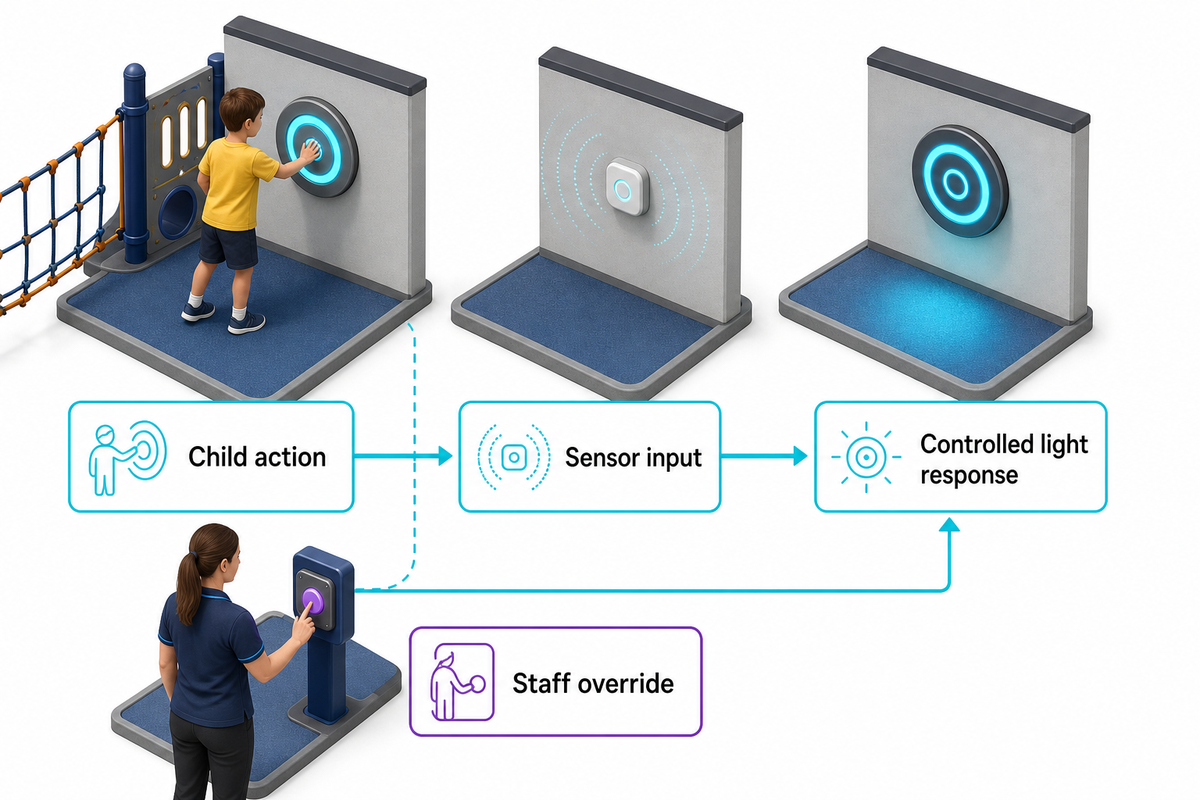
An interactive LED play zone changes its next play opportunity based on what it senses a child does. A scheduled color change can support a game theme, but it doesn’t show a child can control the game. Write down the action, sensor input, visible or audible response, next action and staff override before judging the render.
Interactivity should be accepted separately because it’s difficult to check if the responses are correct visually.
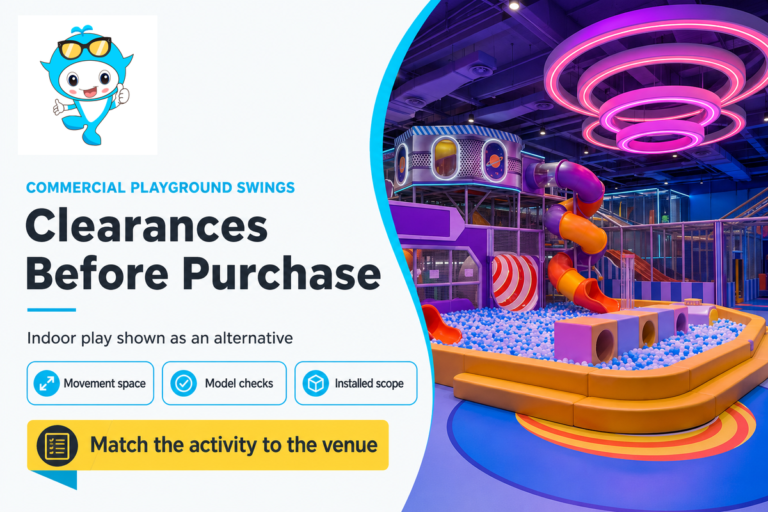
Picture a space mission wall. A child touches a launch target; a local sensor registers the touch; a planet lights up; the next target becomes available. The designer must show the entire sequence in the actual room, including showing sound on and off, while the operator watches to see if two children can find the next action without a staff member showing them, and if the staff station override is within reach. The test is about blending physical activity with visual feedback while leaving room for children to explore and move; playtime should not collapse into passive screen time. Staff member can end the game without shutting off the room’s required lighting. This is a proposed acceptance example, and isn’t describing any one Didi product.
Make the supplier show what happens when two children act at once, when a target fails, and when the venue is busy. Confirm who can customize the sequence and whether a scene can run locally if the connection to the network is lost. Augmented reality (AR) is optional and shouldn’t be a requirement for interactive play; proposing the use of a camera should have its own answer for the data path. Smart play and imaginative scenery are labels until the supplier shows us the next action of the child. Didi’s Space theme examples can start the visual brief; the response logic still needs its own specification.
“The key message for educators and families is that high-quality television can be just as beneficial for learning as interactive games and apps.”
This research focuses on early-learning media, not a commercial playground. It’s an important warning against being seduced by the interactive effect into postulating educational outcomes. A learning claim requires supporting evidence from the venue. In this case, evidence for supporting a learning claim for children and families alike must come from testing a physical play activity.
Buyer check: Request a short video or live demonstration showing the child action, response, next choice, and staff stop in one continuous sequence.
Map active, transition and quiet zones
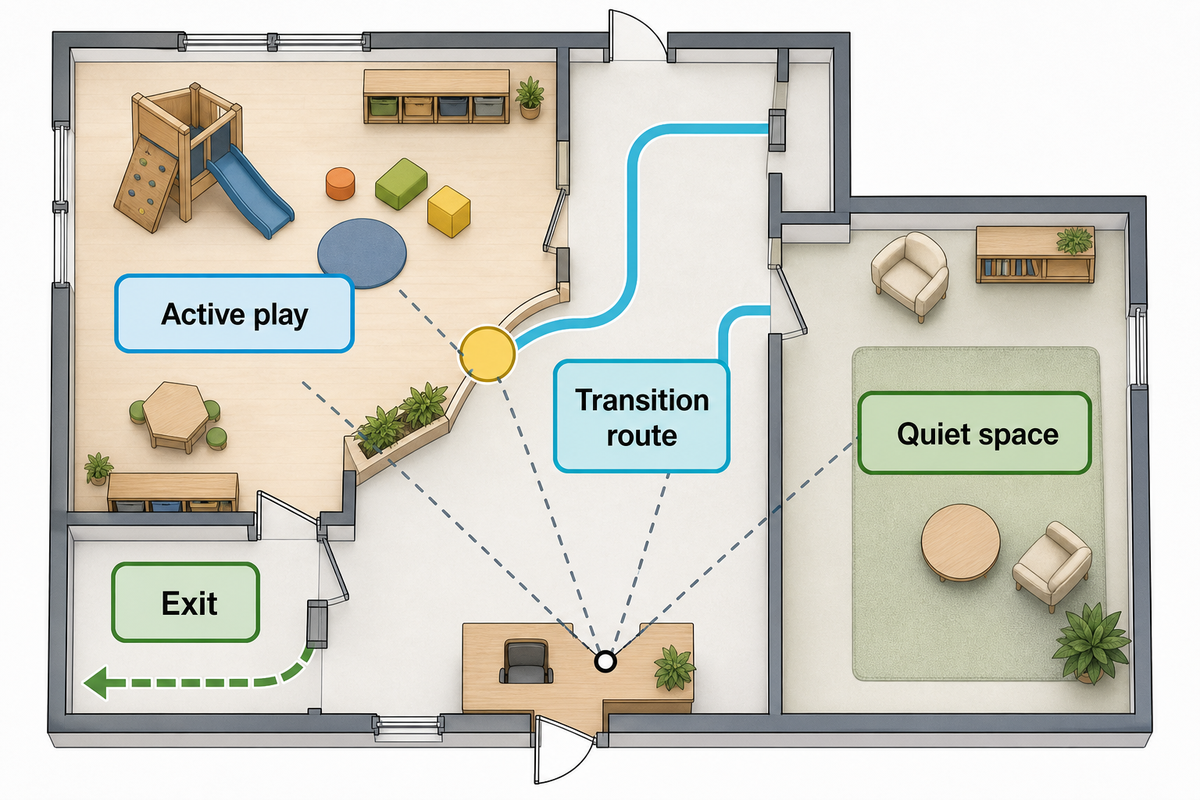
A usable LED plan shows where children play, move, wait, and step away from the effects. Keep an identifiable transition route between active play and lower stimulation activities. Inclusive themed play zones need a route that’s actually usable.
Accessibility is a site-review question and a plan. That sensory choice helps the group discuss inclusivity without promising that one scene satisfies every visitor. With the full scene active, the site team should walk from active play to the quiet space and exit, and notice what’s visible to staff from their position, and repeat the same path after the effects have been turned off.
The LED Zone Control Map below is a working document. Each row is a proposal check by the buyers, not definitions of code dimensions or complete descriptions of finished installations. The project designer and local reviewers need to complete the dimensions and applicable requirements.
| Map item | Show on plan | Acceptance question |
|---|---|---|
| 1. Active play | Interactive targets and likely queues | Can staff see both the action and the return path? |
| 2. Transition | Route from active play to quieter space | Is it recognizable during the full scene? |
| 3. Quiet option | Steady-lit place and access path | Can a child use it without crossing an effect zone? |
| 4. Staff station | Control location and sightlines | Who can stop an effect immediately? |
| 5. Parent view | Observation points and obstructions | Can caregivers find their child and the route out? |
| 6. Exit route | Required circulation and signs | Do effects obscure the route in normal operation? |
| 7. Service access | Drivers, controllers, panels | Can a technician reach them without entering occupied play? |
| 8. Cleaning path | Touch points, screens, covers | Does cleaning require moving a play structure? |
| 9. Effects-off mode | Remaining usable play and lighting | Which areas stay open after the stop? |
The whole-venue layout guide addresses more general circulation and sightlines. This page uses the map to determine control states for a proposed LED zone. Good traffic flow matters to experiences for children and families, yet a lighting effect has not been shown here to increase repeat visits. Oregon’s summary of the fire code describes special amusement areas where distractions can make egress difficult to recognize. It doesn’t classify this proposed venue. The local fire and design team need to determine if the impacts of the effects change that review.
A static-looking scene doesn’t necessarily indicate a stable physical light output. The U.S. Department of Energy distinguishes temporal light modulation from effects a viewer may perceive. The lighting vendor should document the behavior of the installed drivers, a content switch by itself doesn’t settle the issue.
Buyer check: Walk the route with the proposed effects on, with the effects off, and from the staff station. Record what differs.
Compare LED, projection and static graphics by the job they must do
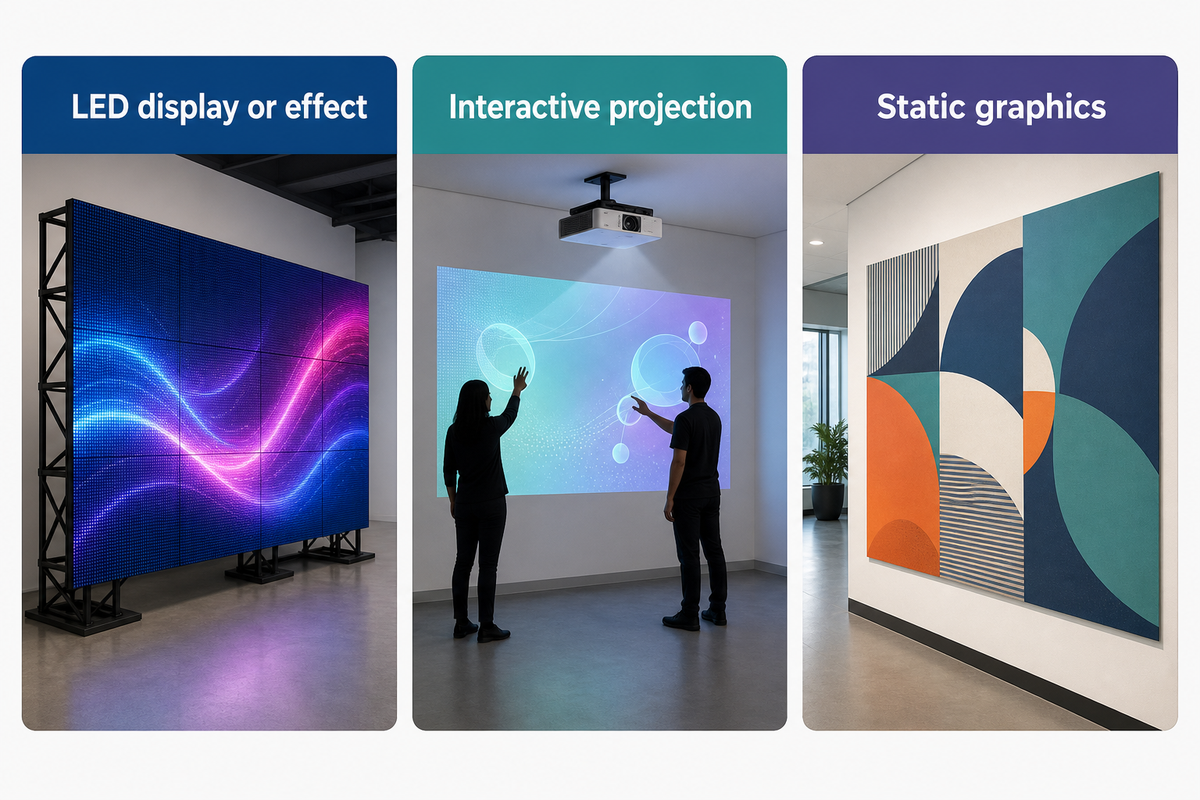
Define the play task, then choose the display medium that serves it. LED panels, interactive Projection, and Static Graphics have different control and service dependencies in modern indoor play environments. Evaluate them based on the same task and venue.
A modular assembly may ease a repair only if the actual access route and part supply work. Durable materials must be specified and examined for contact and cleaning. No public source reviewed here gives a fair, configuration-matched cost or lifecycle comparison for the three in a commercial play space.
| Option | Demonstrate on site | Request in the quote |
|---|---|---|
| LED display or effect | Visibility, physical protection, driver behavior, staff stop | Exact modules, controls, power design, access and replacement method |
| Interactive projection | Play response under actual ambient and projector settings | Projector, sensor, mounting, cleaning, calibration and service scope |
| Static graphics | Theme legibility, cleaning and replacement access | Material, fixing, surface finish and refresh terms |
Don’t assume projection necessarily fails in a well-lit space. A projection readability study found an interaction between background and projector illuminance in a young-adult test, and therefore suggests both should be considered. It wasn’t a children’s playground test. Likewise, AVIXA’s contrast-ratio standard page states performance is based on typical viewing conditions. Insist bidders show the same child task in the actual room or realistic mock up.
The supplier’s service arrangement can change the option chosen. One projector may require lens and filter cleaning. One LED wall may provide front access. Neither example provides a general rule. Technologically elaborate effects may also increase control dependencies. For broader ideas about indoor playground aesthetics, see Didi’s indoor playground design ideas; this is the procurement test for one zone.
Buyer check: Give all three options the same task, viewing positions, operating scene, and service-access question before comparing their bids.
Coordinate the applicable safety and site scope
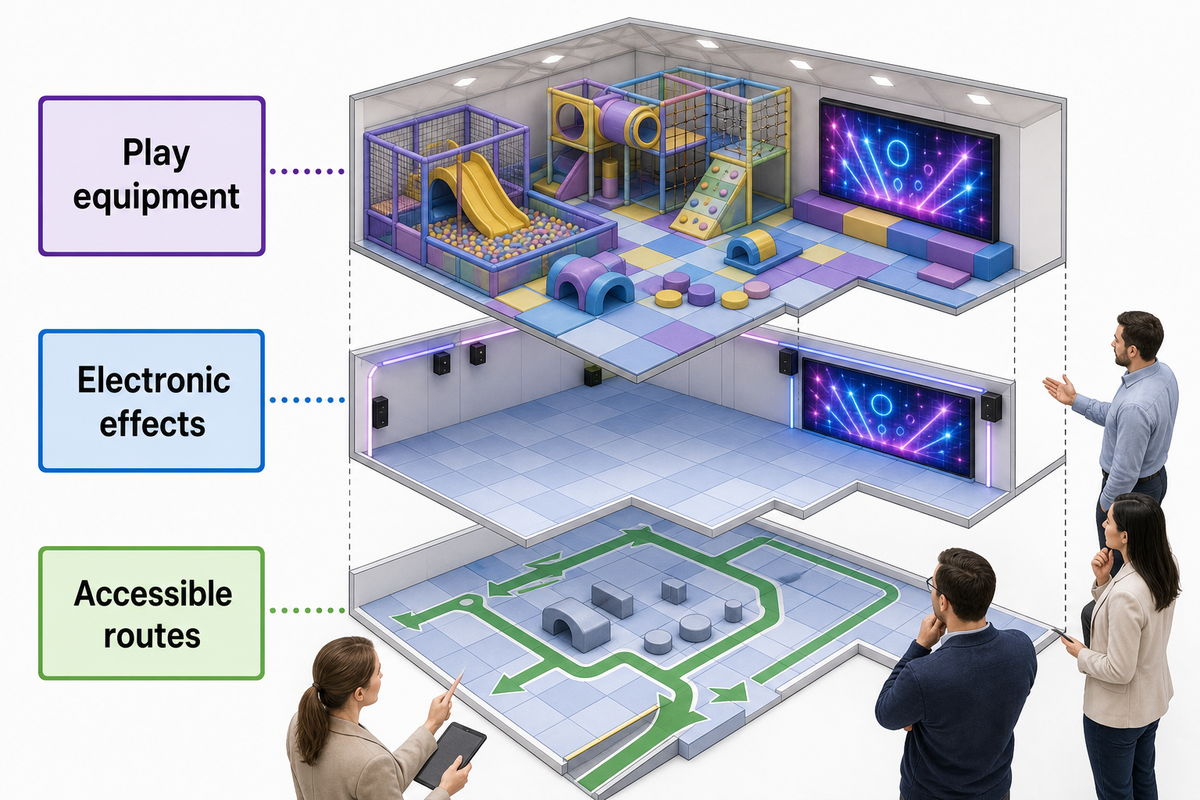
A themed indoor play zone may contain several regulated or reviewable systems. Indoor play areas require separate reviews for soft-contained-play equipment, electronic effects, site electrical work, accessible routes and egress design. Owners should ensure that their indoor project team assigns a reviewer to each installed component and its report or approval. There is no quantified risk of injuries in this article from which to infer a safe configuration.
The official ASTM F1918-21 listing describes a performance-based safety specification for soft contained play equipment. Published scope describes an age range from 2 to 12 years using stated percentile bounds and excludes other equipment categories. The public page does not certify any Didi item, LED driver, wiring design, or the overall venue. ASTM’s newer F2461-26 listing addresses aquatic play equipment; its date does not make it the standard for dry soft play.
The U.S. Access Board guide to play areas addresses accessible routes and components. The designer should confirm how the local rules and the proposed plans apply. The Epilepsy Foundation site explains that some people with epilepsy may have seizures caused by particular light patterns, and flashing lights may cause seizures. That information supports a nonflashing choice and a way to leave the effect; it does not create a safe flash setting or replace a qualified lighting review.
Use a scope schedule with 4 columns: component, applicable document, evidence issuer, and reviewer. Never accept a generic certificate image to represent the exact configuration and the latest reporting. For equipment children may touch, request hygienic surface and cleaning documentation for the equipment. If a bid includes cameras, voice recognition, or cloud accounts, include a data flow review in your scope. The Federal Trade Commission rule addresses operators of online services directed to children under 13 or operated with actual knowledge of collecting their personal information, including collection on an operator’s behalf. This would depend on the real system and the service provider. A simple, local, anonymous, sensor by itself, doesn’t prove the online collection of personal information.
Buyer check: Ask each responsible designer, installer, supplier and local reviewer to sign the scope line they own. Leave unknown classifications open until the site team resolves them.
Trace the Immersive Zone Failure Path
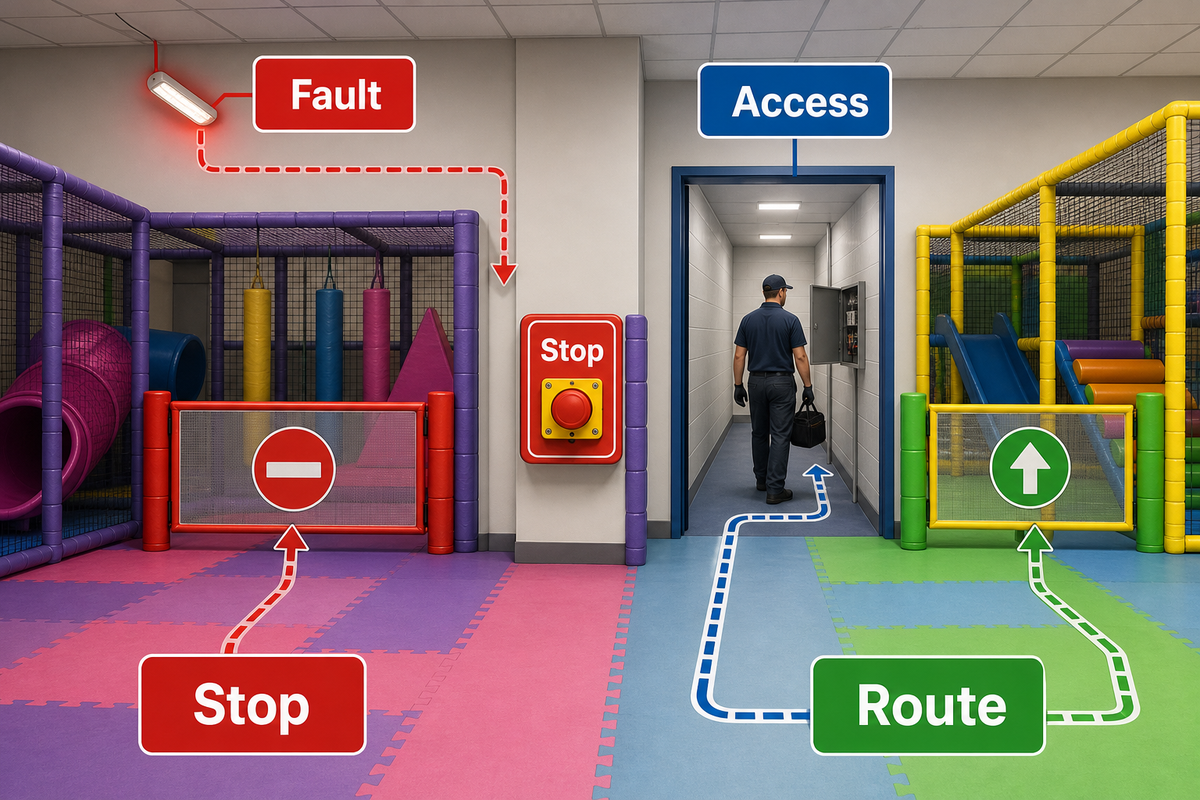
An equipment list shows what equipment an operator uses, not what the operator does once a failure occurs. The Immersive Zone Failure Path follows one hypothetical failed controller or driver from detection to reopening. It shows, for instance, whether a single, inaccessible part would result in staff closing more play space than the visual effect itself occupies.
- Fault: A wall stops responding or a light behaves unexpectedly. Record how staff recognize it.
- Stop: Staff control that ends the effect and preserves the required venue systems.
- Route: Indicate the play modules and circulation affected by the stop/repair.
- Access: Show the panel, isolation method, responsible technician, and cleaning restrictions.
- Part: Name the replacement identifier, stock location, support contact, and contractual response term.
- Reopen: Name the person that confirms the repair and the person that releases the area back to operations.
Suppose a driver sits behind a climbing route. A repair may require closing the route, even if the wall is decorative. The same driver, however, may be accessible from a service corridor, in which case the effect on operations may be less. Those are scenarios to test on the plan, not measured Didi failure rates or downtime predictions. Family entertainment centers (FECs) should estimate lost contribution only after they confirm their actual schedule and closed capacity.
ASK THE BIDDER TO DRAW THE FAULT BOUNDARY AND SUPPLY A PARTS LIST.
Define “replaceable” more strictly. Obviously the module must be replaceable, but if no one can reach it during a safe maintenance window, what good is it? A broader indoor playground maintenance guide, covers routine venue maintenance; this path covers one LED zone fault.
Buyer check: Include one controller fault and one driver fault on the drawing. Include the route that closes and the name of the person who authorizes reopening.
Send one evidence grid to every bidder
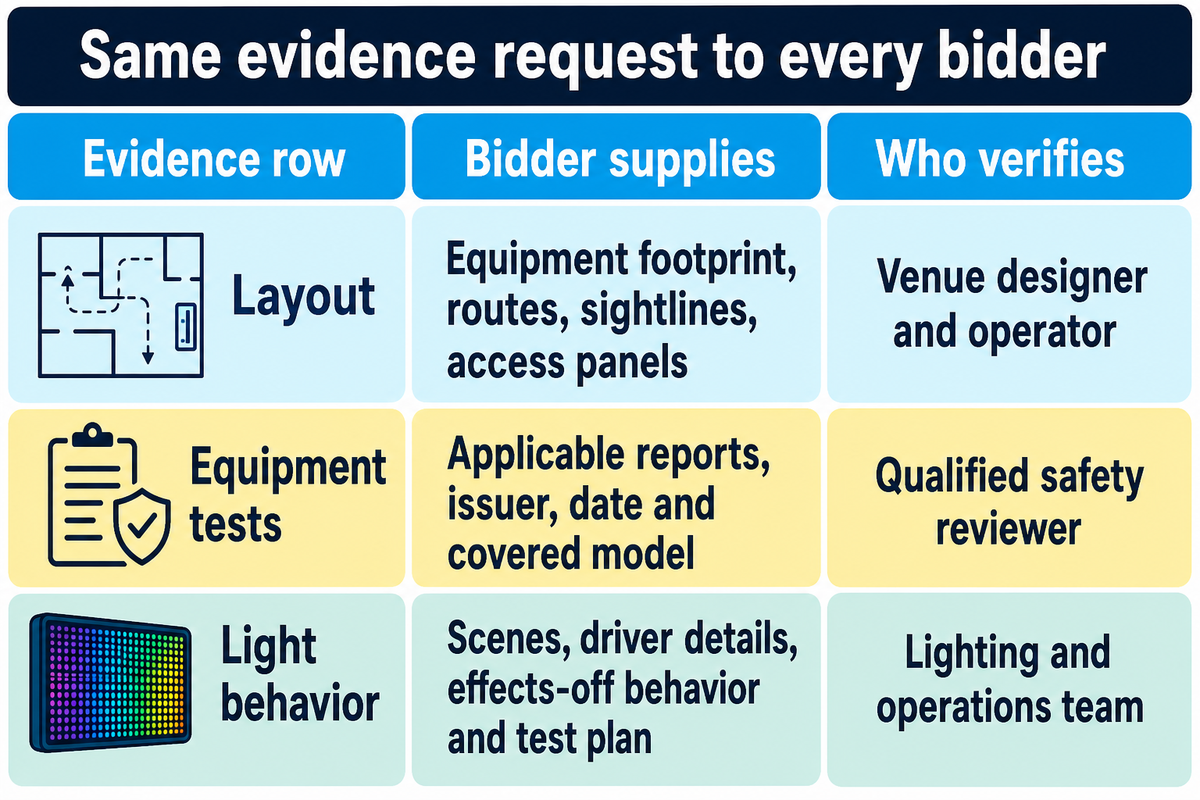
Similar bids would require the same evidence request. The Cyber-Tech RFQ Evidence Grid asks for documentation, exact configuration and reviewer behind each assurance. Provide it along with the zone plan to explain price differences due to equipment, site work, service terms and acceptance test. Customization is only useful when the supplier indicates what changes and who provides support.
| Evidence row | Bidder supplies | Who verifies |
|---|---|---|
| 1. Layout | Equipment footprint, routes, sightlines, access panels | Venue designer and operator |
| 2. Play loop | Action, sensor, response, override and fault states | Operations lead |
| 3. Components | Exact model, configuration and replaceable part IDs | Technical buyer |
| 4. Equipment tests | Applicable reports, issuer, date and covered model | Qualified safety reviewer |
| 5. Electrical scope | Power, controls, drawings and interface schedule | Local electrical designer or installer |
| 6. Light behavior | Scenes, driver details, effects-off behavior and test plan | Lighting and operations team |
| 7. Service | Access method, manuals, spares, warranty and response terms | Maintenance lead |
| 8. Data path, if used | Capture, storage, vendors, retention and deletion terms | Operator and privacy adviser |
| 9. Handover | Test script, training, credentials and signed record | Commissioning owner |
Didi Land describes its design, manufacturing, and installation and post-sale service on its About Us page. Those are company statements about its service offering. Ask Didi and every other bidder for the configuration-specific schedule above; the website’s general standards or certification references do not establish that a proposed item has a particular current report.
Request a scoped LED-zone proposal
Share the floor plan, age mix, and intended play loop, zone map and this evidence grid. Request Didi Land to identify what the proposed configuration includes and what the local project team must review.
Commission the scene and the failure mode
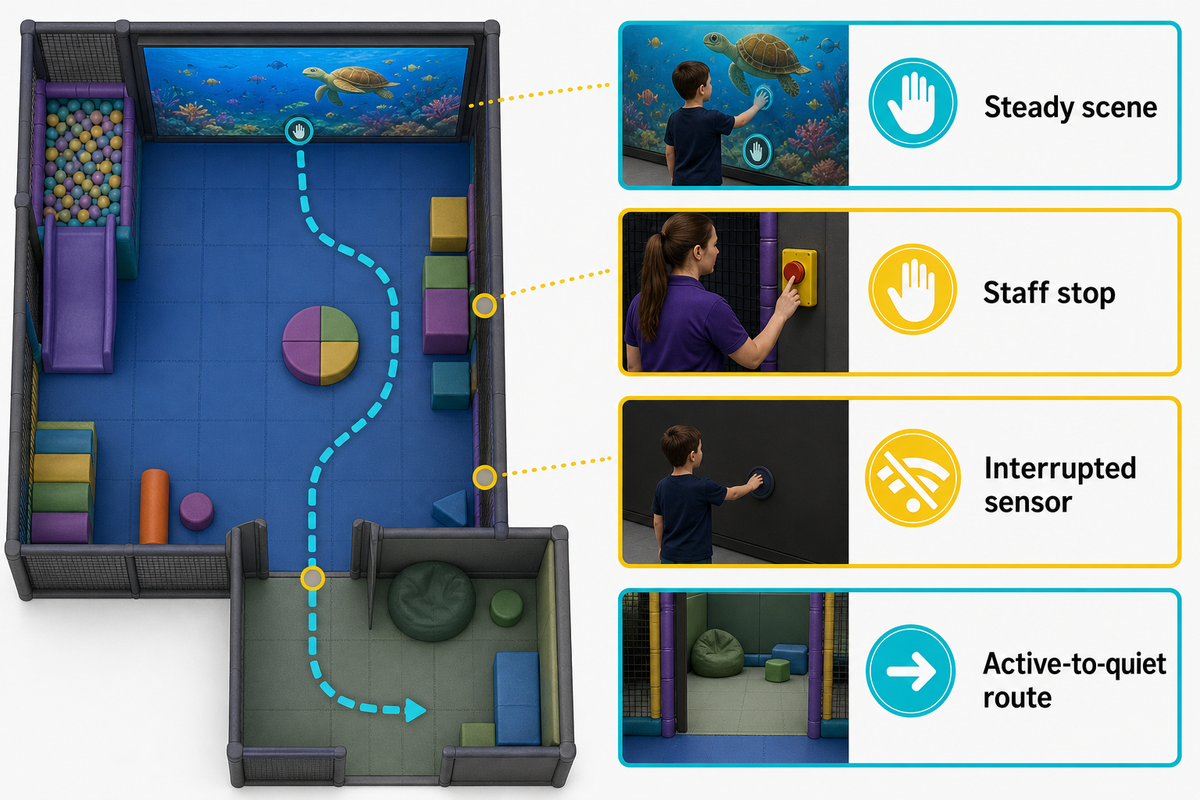
Commissioning turns bid into behavior. The ASTM F1918-21 public scope includes performance, access and egress, maintenance, fire safety and evacuation topics for soft contained play equipment; use the applicable scope when defining the site acceptance script. Agree on the test script before installation, then run it with the installed equipment, actual room light, trained staff, and the approved site plan. Once tested, note the result, identify defect owner, set a correction deadline, and retest prior to releasing the zone for use.
Start with the default steady scene. Show a child action and response, the staff stop, an interrupted sensor, and a disconnected network if one is used. Walk the active-to-quiet route while effects run. Make sure the local team demonstrates that the effects controls don’t interfere with emergency and egress control systems. Open the service panel under the agreed safe work procedure, identify the replacement part, and show how staff restore the scene.
Demonstrating a scene is steady doesn’t test fault case recovery. An opening-day visual demo can show that the scene looks correct, but it says little about fault recovery if the team has not identified who can stop the effect, reach the failed part and authorize the play route to reopen. If a sensor fails, management has to decide whether to keep the attraction open, switch to simpler mode, or close. Put management decisions in operating manual. A missing software credential or undocumented scene file can prevent a later update even if the hardware is functioning.
Buyer’s Check: Require the installer and operator to sign a record for normal play, effects-off mode, and agreed fault cases. Any cases not signed remain open. Any untested case remains open.
Plan content and hardware refresh without a trend forecast
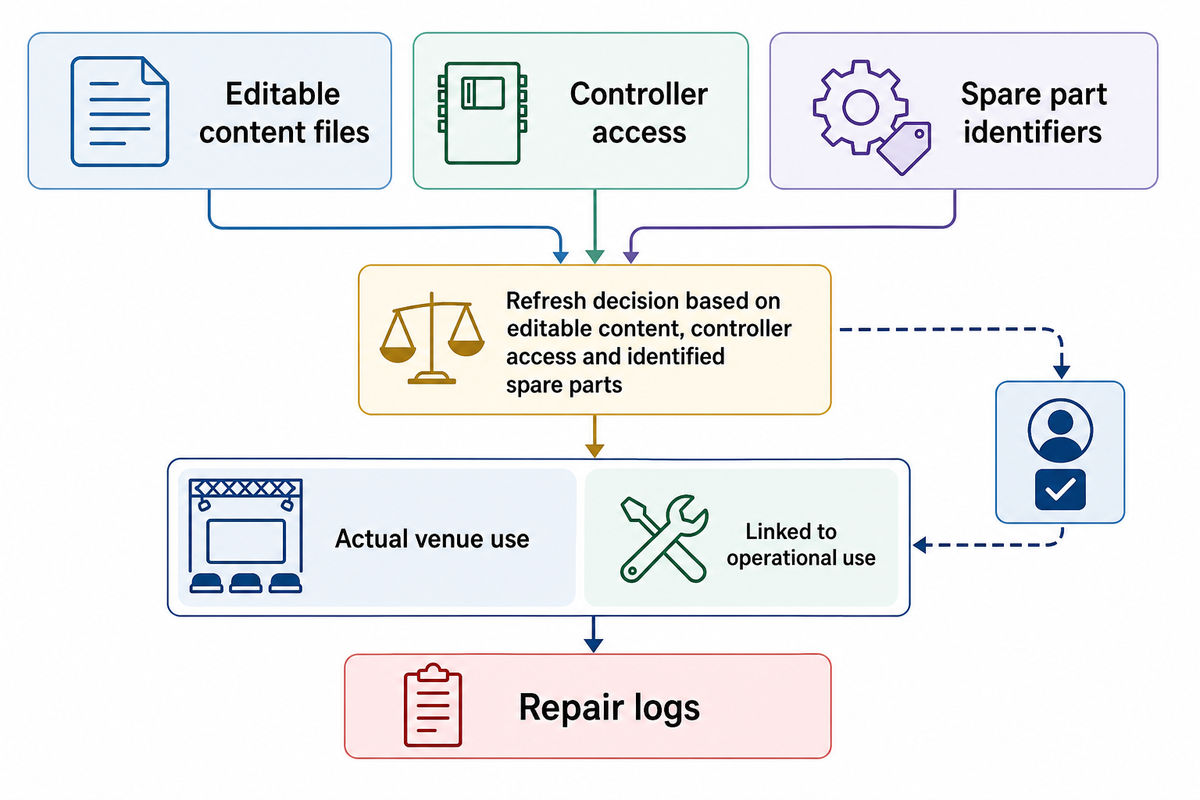
Create an update path using the venue’s own evidence and contract terms. Claims that indoor playgrounds are transforming appear in posts on trends in indoor play. Those posts name key trends shaping in the market, but usually lack comparable examples for this case. The exact search term doesn’t have dependable volume history and the assessed public pages don’t establish comparable growth for this niche. No evidence here shows that LED effects increase dwell time. The owner can still decide who may edit scenes, how parts are replaced, and what operating evidence would justify expansion. Technological advancement alone is not an expansion criterion.
Ask for editable content files, controller access, support-period terms, spare part identifiers, and a way to export the final configuration. Identify whether a future theme change requires a content edit, the addition of a new component, or a structural change to the project. Replaceable parts may support a sustainable maintenance plan, but a sustainability or energy-efficient claim needs product-specific evidence. If devices are on a network, identify who performs software updates, and what happens at the end of support. The National Institute of Standards and Technology manufacturer-documentation catalog includes questions to ask about the expected lifetime of a device, support and maintenance, but it isn’t specific to playground.
Review actual venue use and repair logs before expanding the effect area. No public source here proves a universal refresh interval or return on investment. The next design brief may be based more on service calls, content usage, and/or queues, at the venue instead of a supplier’s year stamped trend page.
Buyer check: Have the contract name a content owner and a hardware support owner. Inquire what content or hardware changes may be made without taking the structure apart.
Frequently asked questions
What is an interactive LED indoor playground?
Read answer
An interactive LED indoor playground uses a child’s action to trigger a response that changes play. The brief should identify the sensor, response, next action and staff override. A preprogrammed light show can be attractive, but the buyer shouldn’t treat it as proof of interaction without a demonstration in the intended play setting.
Are flashing LED effects safe for every child?
Read answer
No single setting can be promised safe for every child from the public evidence reviewed here. Photosensitivity varies, and content controls don’t prove that the installed light source has no output modulation. Specify a steady, lower-stimulation option, a recognizable route away from effects, staff controls and a qualified review of the actual lighting configuration.
Does ASTM F1918-21 certify the lighting system?
Read answer
No. ASTM F1918-21 is a safety performance specification for soft contained play equipment within its published scope. The catalog listing does not certify a supplier’s proposed LED electronics or the site’s wiring. Ask for reports covering the actual play equipment and separate documentation for the light, control and local electrical design.
Which costs should be compared between LED and projection?
Read answer
Compare the quoted equipment, mounting, controls, content changes, cleaning, spares and repair access for the same play task. Ask each bidder to state exclusions and site-work assumptions.
What should a supplier hand over before opening?
Read answer
Obtain as-built drawings, scene controls, manuals, part IDs, service contacts, software access and a signed acceptance record for normal and fault conditions.
Make the next design conversation specific
Bring the LED Zone Control Map and Evidence grid, along with one example of a failure to the supplier meeting. A good response will include the proposed configuration, and identify the reviewers for your location and the open decisions.
Source and method note: Didi Land product and service descriptions are attributed first-party statements. Maps, grids and the example of a failure are editorial tools for buyers and aren’t descriptions of Didi’s installations and/or universal legal checklists. Official standards and guidance are cited for the scope for which they’re written; it’s the project’s qualified team that needs to evaluate local application. No site-specific cost, uptime, seizure-risk threshold or return was available.
References & Sources
- ASTM F1918-21 public catalog and scope; ASTM F2461-26 aquatic-play scope.
- U.S. Access Board, Play Areas guide; Oregon State Fire Marshal, 2025 code summary.
- Epilepsy Foundation, Photosensitivity; U.S. Department of Energy, Flicker Basics.
- Fashina Aladé, National Association for the Education of Young Children; projection readability study; AVIXA image-system contrast information.
- Federal Trade Commission, children’s online privacy rule; National Institute of Standards and Technology, manufacturer-documentation catalog.
- Didi Land About Us and custom themes, first-party company pages.
Related articles
- Indoor playground design and layout for whole-venue circulation.
- Indoor playground design ideas for broader concepts.
- Indoor playground maintenance guide for routine operations.
- Space theme indoor playground for a first-party theme example.