Get in Touch with Didi Land


A playground spinny thing is a commercial rotating play structure that parents and park planners often call a park spinning thing. This guide compares six types of commercial rotating play structures. Catalogs group these units into merry-go-rounds, roundabouts, flush accessible whirlers, solo spinner bowls, stand-up spinner poles, and rotating climbers. Modern spinners bring a fun and exciting play experience to public parks and schools. New layouts include spinning zones because spinning stimulates the inner ear and keeps kids active. Identifying the right model requires checking rider posture, deck diameter, speed limits, and clear use zones first.
Direct Answer: In US catalogs, a multi-child rotating platform is called a merry-go-round or whirler. UK and Commonwealth buyers call the same unpowered turntable a roundabout. Single-rider models are called freestanding spinners, spinner bowls, or stand-up spinners. Under CPSC Public Playground Safety Handbook Publication 325 §5.3.4 and ASTM F1487, platforms at least 20 inches (0.51 m) across must cap rim speed at 13 ft/sec (4.0 m/s). Merry-go-rounds need at least 6 ft (1.83 m) of clearance beyond the platform perimeter; Playworld specifies a 24 ft 11 in × 24 ft 11 in space for its 6 ft 8 in × 6 ft 8 in Accessible Whirl.
Key Engineering Specifications at a Glance
- Recommendations from CPSC Publication 325 §5.3.4 regarding merry-go-rounds apply when the rotating platform is at least 20 inches (0.51 m) across (CPSC §5.3.4).
- Peripheral rotation speed must never go above 13 ft/sec (4.0 m/s) under CPSC §5.3.4 speed limitations and ASTM F1487.
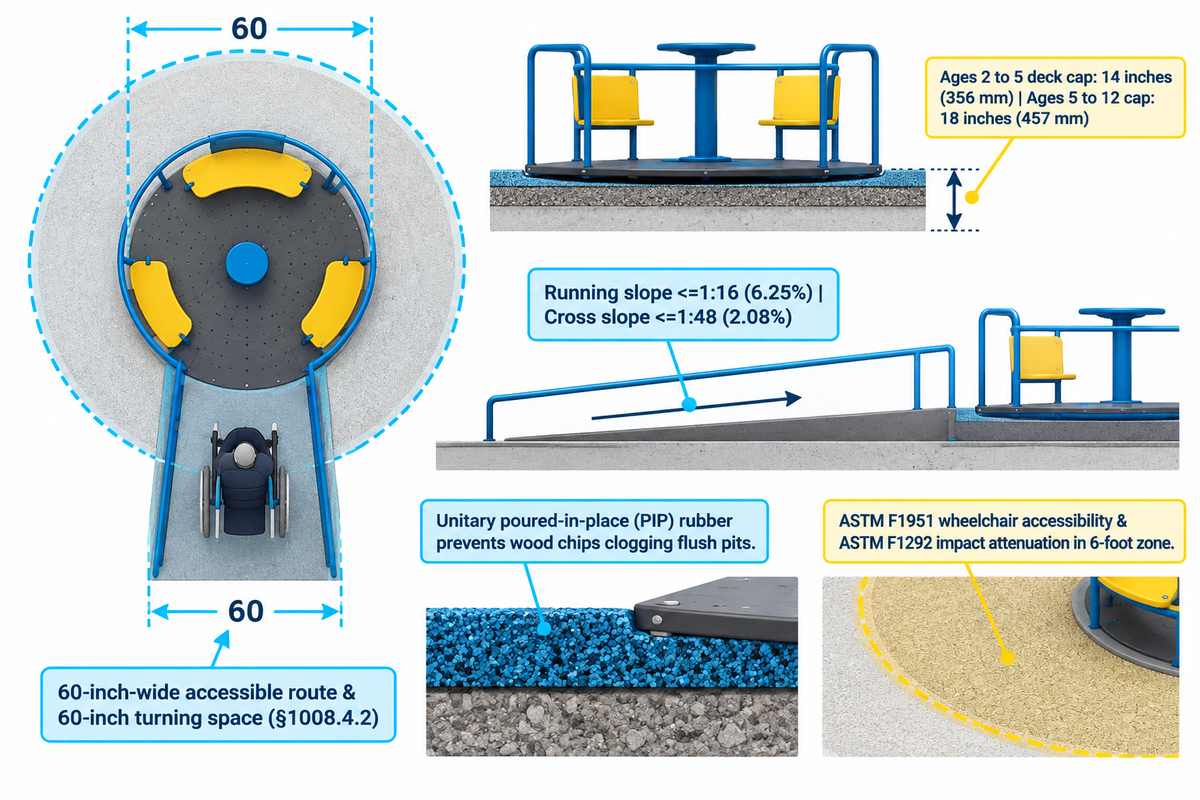
- Standing or sitting platform height caps at 14 inches (356 mm) for preschool ages 2 to 5. School-age decks for ages 5 to 12 cap at 18 inches (457 mm).
- Every rotating unit must have at least 6 feet (1.83 m) of clear impact surfacing beyond its outer perimeter (AAA State of Play use-zone guide).
- Didi Land commercial indoor soft-play carousels run at 3 to 6 RPM. Each unit sits on a drop-in steel base plate beneath 40 to 50 mm EVA foam flooring.
What Is the Spinny Thing on a Playground Called? Official Names by Region and Catalog
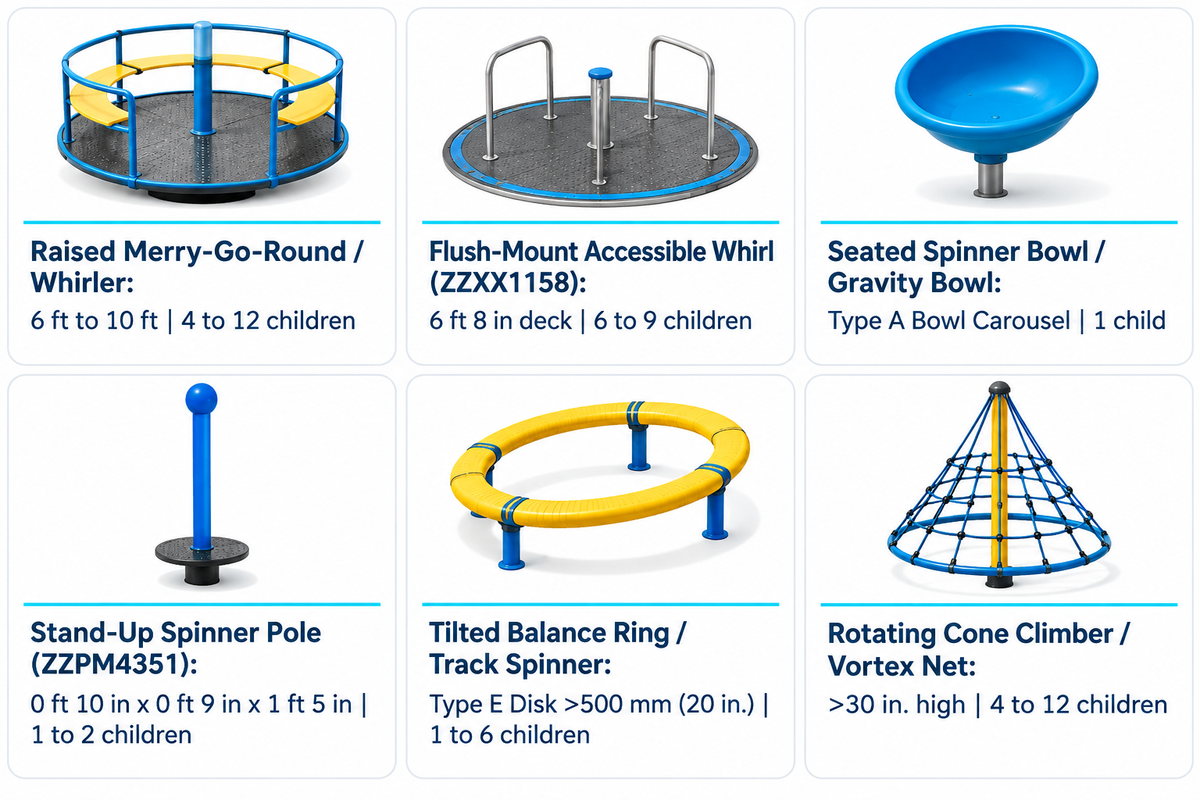
A terminology table introduces six main catalog categories. The selector below presents nine equipment configurations. Using the exact catalog name prevents mix-ups when ordering from a supplier. A school asking for a generic merry-go-round might receive a quote for a 6 ft 8 in group whirl. Well-planned units of spinning activities allow children to safely spin and provide lasting developmental benefits for children in any park.
Differences in English-speaking markets cause variances in procurement terms. As noted in cross-regional English usage discussions, American buyers say “merry-go-round” or “whirler” for hand-pushed turntables. They reserve the word “carousel” for motorized amusement rides. British and Australian buyers call the unpowered park turntable a “roundabout.” Meanwhile, European standard BS EN 1176-5:2019 classifies user-propelled rotating units over 500 mm in diameter as “carousels.”
What Is the Spinning Wheel at Playgrounds Called?
A tilted, ring-shaped playground spinner may be called a tilted balance ring and can challenge balance and spatial awareness. A ground-level ring spinner may be marketed as a track spinner. An overhead rotating disk where riders hang by their hands is an overhead spinning wheel. All of the fun pieces of rotary gear help kids develop balance during recess. In fact, using spinning equipment is crucial for balance, balance and coordination, and balance and spatial awareness.
Published catalog dimensions show how much space each piece of equipment demands. For example, Playworld’s inclusive play catalog lists the solo Disco Spinner (Model ZZPM4351) at 0 ft 10 in × 0 ft 9 in × 1 ft 5 in for 1 rider. Playworld’s multi-child Accessible Whirl (Model ZZXX1158) measures 6 ft 8 in × 6 ft 8 in × 2 ft 8 in. That larger whirl holds 9 children ages 2 to 12 and requires a 24 ft 11 in × 24 ft 11 in total space.
| Everyday Search Term | US Commercial Catalog Name | UK / EN 1176-5 Term | Verified Catalog / Standard Size | Rider Capacity |
|---|---|---|---|---|
| Flat group spinny platform | Raised Merry-Go-Round / Whirler | Roundabout / Type B Classic Carousel | ≥20 in. (0.51 m) CPSC threshold; 6 ft to 10 ft typical | 4 to 12 children |
| Ground-level wheelchair spinner | Flush-Mount Accessible Whirl (e.g., ZZXX1158) | Flush-Deck Inclusive Roundabout | 6 ft 8 in × 6 ft 8 in deck (24 ft 11 in × 24 ft 11 in space) | 6 to 9 children (including wheelchairs) |
| Spinning bucket or cup seat | Seated Spinner Bowl / Gravity Bowl | Type A Bowl Carousel | Compact solo seat (<20 in. or ≥20 in. bowl) | 1 child (solo enclosed seat) |
| Spinning pole with footrest | Stand-Up Spinner Pole / Solo Post Spinner | Type A Vertical-Axis Pole Spinner | 0 ft 10 in × 0 ft 9 in × 1 ft 5 in (Disco Spinner ZZPM4351) | 1 to 2 children |
| Slanted spinning wheel on ground | Tilted Balance Ring / Track Spinner | Type E Tilted Giant Revolving Disk | >500 mm (20 in.) inclined ring track | 1 to 6 children |
| Spinning rope pyramid or net | Rotating Cone Climber / Vortex Net | Revolving Net Cone | Elevated rotating structure (>30 in. high) | 4 to 12 children |
6 Types of Spinning Playground Equipment: From Group Platforms to Solo Bowls
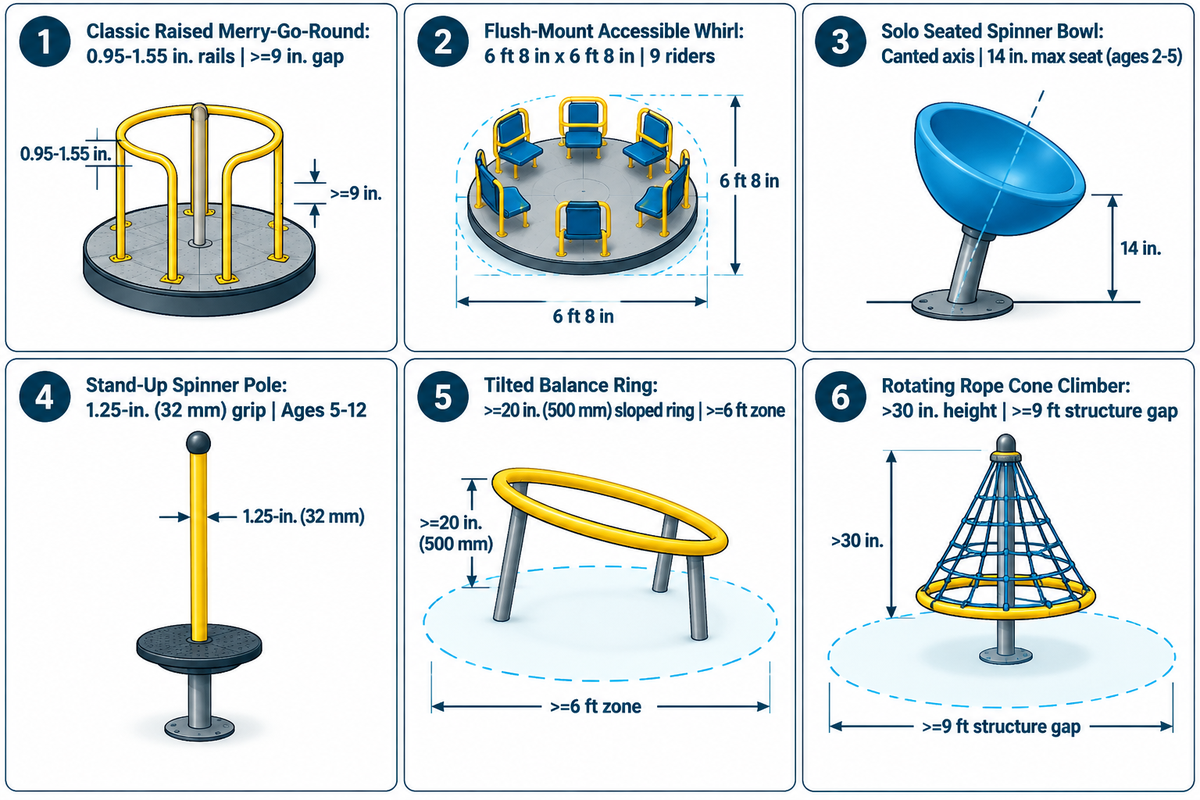
The six commercial types of merry-go-rounds are categorized based on the position of the rider and the height of the merry-go-rounds. They’re raised merry-go-rounds, flush accessible whirler merry-go-rounds, solo spinner bowls, stand-up merry-go-rounds, tilting balance rings and rotating cone climbers. Commercial merry-go-rounds are offered in distinct options from a flush turntable to a balance ring with an angle. Each type of motion challenges a child’s core muscles to stabilize and allows kids to control their speed. Specifiers can use the 6-Axis Rider-Posture Spinner Selector below to match each unit to their site.
According to CPSC Publication 325 §5.3.4, standing or sitting platforms on merry-go-rounds (20 inches or wider) must not be more than 14 inches (356 mm) for children ages 2 to 5. For children ages 5 to 12, platforms must be no more than 18 inches (457 mm) above the protective surface. Handgripping components must be between 0.95 and 1.55 inches (24 to 39 mm) in diameter as stated in CPSC §5.2.2. It’s suggested that the diameter of the grip is 1.25 inches (32 mm) to allow users to grab on to it and stay upright while turning.
6-Axis Rider-Posture Spinner Selector
Our 6-Axis Rider-Posture Spinner Selector compares nine commercial rotary options for posture, axis orientation, verified size, and perimeter use-zone extension. Changing body position on angled rings is how kids love testing their spatial awareness. As planners consider playground swing clearances and motion planning for swings, similar considerations must be made for rotary equipment.
| Spinner Type & Model Class | Axis & Platform Configuration | Rider Posture | Target Age & Deck Cap | Verified Size / Footprint | Clear Use Zone Extension Beyond Perimeter |
|---|---|---|---|---|---|
| 1. Classic Raised Merry-Go-Round | Vertical axis, raised circular platform (≥9 in. underside gap) | Standing or seated with 0.95–1.55 in. handrails | Ages 2–5 (≤14 in. deck) or 5–12 (≤18 in. deck) | ≥20 in. (0.51 m) CPSC threshold; 5 ft to 10 ft decks | ≥6 ft (1.83 m) non-overlapping beyond outer rim |
| 2. Flush-Mount Accessible Whirl (ZZXX1158) | Vertical axis, ground-flush turntable in sub-grade pit | Wheelchair roll-on, bench seated, or standing (9 riders) | Ages 2–12 inclusive group use | 6 ft 8 in × 6 ft 8 in × 2 ft 8 in | ≥6 ft beyond rim; 24 ft 11 in × 24 ft 11 in required space |
| 3. Compact 4-Rider Inclusive Spinner (Cozy Connect ZZXX1223) | Vertical axis, moulded inclusive seating pod | Seated facing inward with central stationary wheel (4 riders) | Ages 2–12 inclusive seated play | ≥20 in. (0.51 m) multi-user hub ($11,792 list) | ≥6 ft (1.83 m) non-overlapping beyond outer rim |
| 4. Solo Seated Spinner Bowl / Bucket | Canted axis, deep-cup gravity bowl | Deep-cup seated posture (1 rider) | Ages 2–5 (≤14 in. seat) and ages 5–12 | Solo bowl seat (<20 in. or ≥20 in. rim) | ≥6 ft (1.83 m) perimeter extension |
| 5. Micro Solo Saddle Spinner (Disco Spinner ZZPM4351) | Vertical axis, compact rotating post seat | Perched or seated solo posture (1 rider) | Ages 2–12 catalog rating | 0 ft 10 in × 0 ft 9 in × 1 ft 5 in | ≥6 ft (1.83 m); overlap allowed when <20 in. dia. |
| 6. Stand-Up Spinner Pole | Vertical or angled post with small foot disk | Standing on base disk while gripping 1.25-in. pole | Ages 5–12 school-age zone | Compact foot disk (<20 in. diameter) | ≥6 ft (1.83 m) perimeter extension |
| 7. Tilted Balance Ring (EN 1176-5 Type E Disk) | Inclined revolving ring track (>500 mm dia.) | Standing, walking, or sitting on sloped ring | Ages 5–12 balance challenge | ≥20 in. (500 mm) revolving ring | ≥6 ft (1.83 m) non-overlapping beyond outer rim |
| 8. Rotating Rope Cone Climber | Vertical central mast with tensioned net cone | Three-point climbing and hanging posture | Ages 5–12 (>30 in. structure height) | ≥20 in. diameter; >30 in. elevated height | ≥6 ft perimeter; ≥9 ft (2.74 m) between >30 in. structures |
| 9. Indoor Electric Soft-Play Carousel | Motorized 3–6 RPM padded turntable (0-in. slab penetration) | Seated on padded EPE/PU foam animals or bench (1–8 riders) | Toddlers & children in indoor FEC / cafe zones | 40 to 50 mm EVA foam floor mat base | Contained indoor clearance per ASTM F1918 / EN 1176 |
What Is the Difference Between a Freestanding Spinner and a Merry-Go-Round?
A merry-go-round is a rotating platform at least 20 inches (0.51 m) across for 4 to 12 riders. A freestanding spinner is a compact unit for one or two children, like a seated spinner bowl or pole. Groups propel this large platform by pushing or pulling a central wheel. In freestanding spinners (e.g. a spinner bowl), 1 or 2 kids learn cause and effect as riders use their body weight. Riders use body weight to spin without a pusher.
Why Did Classic Merry-Go-Rounds Disappear? Legacy Hazards vs. Modern Speed-Governed Engineering
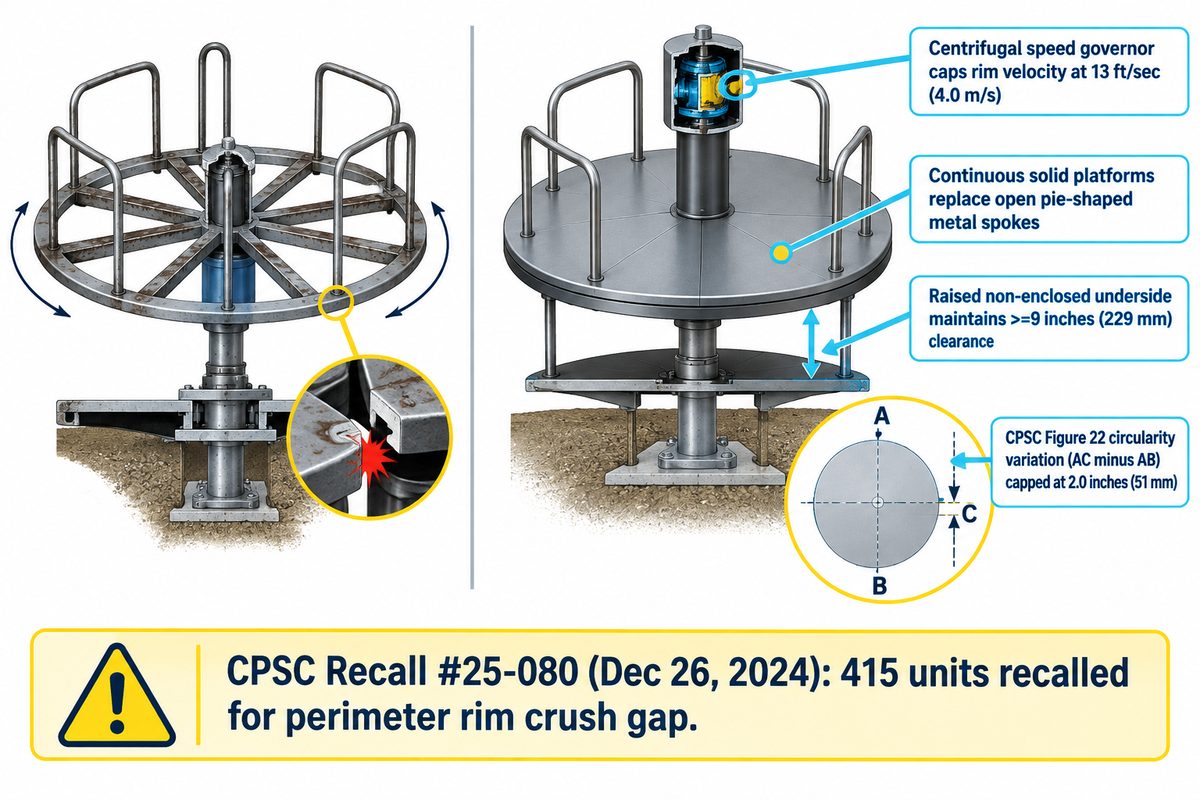
Municipal parks began replacing classic metal merry-go-rounds in the 1970s and 1980s due to four design flaws resulting in serious injuries. Neither the U.S. CPSC nor ASTM ever banned the commercial merry-go-round. Faster un-braked decks (spin) could fling riders from the unit and the under-deck structure created a potential crush injury trap. There are modern compliant designs of the merry-go-round that are legal and available for use in public parks.
Why Don’t Playgrounds Have Merry-Go-Rounds Anymore?
Older playgrounds removed vintage merry-go-rounds because unbraked steel decks spun to dangerous speeds. Open pie-shaped spokes created shear-traps between the deck and the pole. CPSC Publication 325 §5.3.4 provides safety recommendations and ASTM F1487 specifies safety requirements for merry-go-rounds, with the following four engineering controls addressing several legacy hazards:
- Centrifugal speed governors ensure peripheral rim velocity never exceeds 13 ft/sec (4.0 m/s) under CPSC §5.3.4 speed limitations. Internal brake shoes engage automatically whenever rotation approaches that speed cap.
- Continuous solid platforms take the place of open metal spokes so feet and legs cannot drop through the rotating deck.
- Raised platforms with non-enclosed undersides maintain at least 9 inches (229 mm) of underside clearance above protective surfacing. Flush-mounted models enclose the underside of the platform with a recessed skirt.
- Circularity tolerances, given in CPSC §5.3.4 Figure 22, cap the variation (AC minus AB) of radius at 2.0 inches (51 mm). Additionally, no feature can extend beyond the outer limit.
Even on modern flush-mounted units, perimeter gap tolerances remain critical during manufacturing and field inspection. On December 26, 2024, the U.S. CPSC issued Recall #25-080 for about 415 BCI Burke Inclusive Orbit merry-go-rounds (plus about 6 in Canada). The recall covered models 560-0042 and 560-0051, sold for $11,900 to $14,550. Two incidents of fingers getting trapped between the rotating platform and outer rim caused two finger-crushing injuries. Specifiers must verify that every rotating gap stays uniform before opening the play space.
ASTM F1487, CPSC, and EN 1176-5 Safety Rules: Speed Limits, Use Zones, and Clearances
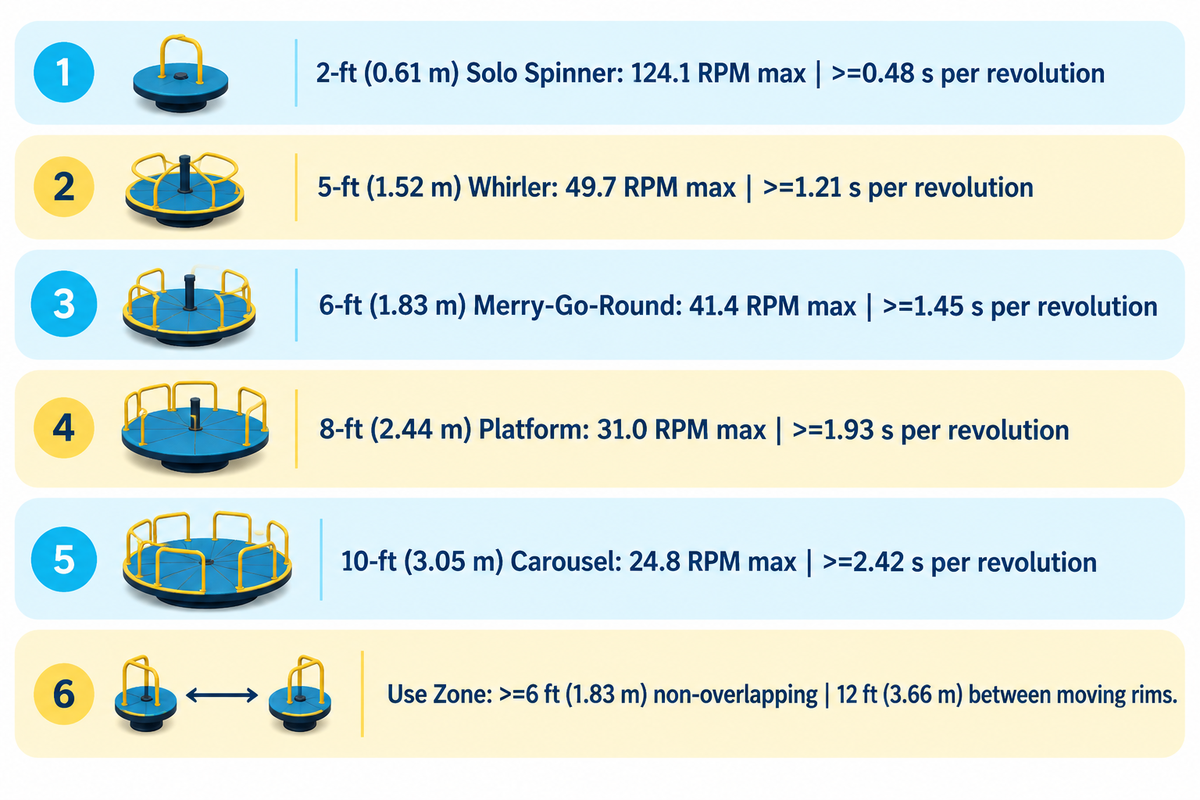
ASTM F1487 and CPSC Publication 325 §5.3.4 cap merry-go-round peripheral rim speed at 13 ft/sec (4.0 m/s). They also cap deck height at 14 inches for ages 2 to 5 and 18 inches for ages 5 to 12, with a 6-foot (1.83 m) minimum use zone. Because commercial spinner playground equipment ranks among the popular pieces in public parks, inspectors audit every clearance dimension on site. Checking spinner equipment clearances on the CAD layout prevents rework on the concrete.
Note the exact scope boundary between North American and European Standards. In the United States, ASTM F1487-25 sets mandatory safety specifications for public playground equipment. Meanwhile, CPSC Publication 325 §5.3.4 provides federal safety recommendations for merry-go-rounds with a platform at least 20 inches (0.51 m) across. In Europe, BS EN 1176-5:2019 governs user-propelled carousels over 500 mm in diameter. BS EN 1176-5 explicitly excludes motor-driven carousels, fairground carousels, and climbing drums.
13-ft/s Rim-Speed Compliance Check
Because CPSC §5.3.4 and ASTM F1487 cap linear rim speed at 13 ft/sec (4.0 m/s), maximum allowable RPM decreases as platform diameter increases. Field inspectors use our 13-ft/s Rim-Speed Compliance Check formula to validate speed governors with a stopwatch. The max RPM is (13 × 60) divided by ( π x Diameter in feet). The minimum stopwatch time for a complete revolution is (π x Diameter) divided by 13.
| Engineering Parameter / Deck Size | Published Standard / Reference Basis | Required Value / Threshold | Field Verification Method |
|---|---|---|---|
| 1. 2-ft (0.61 m) Solo Spinner Rim-Speed Cap | CPSC Pub 325 §5.3.4 (V_max = 13 ft/s) | 124.1 RPM max (≥0.48 s per revolution) | Time 10 full turns with stopwatch (≥4.8 s) |
| 2. 5-ft (1.52 m) Whirler Rim-Speed Cap | CPSC Pub 325 §5.3.4 (V_max = 13 ft/s) | 49.7 RPM max (≥1.21 s per revolution) | Verify governor brake engages at 1.21 s/rev |
| 3. 6-ft (1.83 m) Merry-Go-Round Rim-Speed Cap | CPSC Pub 325 §5.3.4 (V_max = 13 ft/s) | 41.4 RPM max (≥1.45 s per revolution) | Verify governor brake engages at 1.45 s/rev |
| 4. 8-ft (2.44 m) Platform Rim-Speed Cap | CPSC Pub 325 §5.3.4 (V_max = 13 ft/s) | 31.0 RPM max (≥1.93 s per revolution) | Verify governor brake engages at 1.93 s/rev |
| 5. 10-ft (3.05 m) Carousel Rim-Speed Cap | CPSC Pub 325 §5.3.4 (V_max = 13 ft/s) | 24.8 RPM max (≥2.42 s per revolution) | Verify governor brake engages at 2.42 s/rev |
| 6. Non-Circular Radius Variation (AC − AB) | CPSC Pub 325 §5.3.4 Figure 22 | ≤2.0 inches (51 mm) radius difference | Measure center-to-rim max vs. min radius |
| 7. Non-Enclosed Raised Deck Underside Clearance | CPSC Pub 325 §5.3.4 Platform Configuration | ≥9 inches (229 mm) above surfacing | Measure vertical gap after surfacing settles |
| 8. Rotating Equipment Use Zone (≥20 in. dia.) | CPSC §5.3.4 & AAA State of Play Use-Zone Rules | ≥6 feet (1.83 m) non-overlapping perimeter | Keep 12 ft (3.66 m) between moving pieces |
| 9. Elevated Play Structures (>30 in. high) | AAA State of Play Use-Zone Clearance Guide | ≥9 feet (2.74 m) separation between structures | Apply where adjacent play surfaces exceed 30 in. |
How Much Clearance Does Spinning Playground Equipment Need?
All rotating playground equipment requires at least a 6-foot (1.83 m) clear use zone extending outward from its perimeter under commercial playground use-zone clearance requirements. Specific models require larger total footprints, such as 24 ft 11 in × 24 ft 11 in for the Playworld Accessible Whirl ZZXX1158. Overlap rules follow three thresholds:
- Compact solo spinners less than 20 inches (0.51 m) in diameter may share an overlapping 6-foot use zone with adjacent equipment. The height of adjacent rotating parts, in this case, may not exceed 30 inches.
- Merry-go-rounds and whirlers at or above 20 inches (0.51 m) in diameter require a non-overlapping 6-foot (1.83 m) clear use zone. Two adjacent merry-go-rounds therefore need at least 12 feet (3.66 m) between their outer rims.
- Play structures next to each other with play surfaces over 30 inches (762 mm) should be separated by at least 9 feet (2.74 m).
Vestibular Development and ADA Inclusive Design: Matching Spinners to Ages 2–5 and 5–12
Rotational play stimulates the vestibular canals of the inner ear and delivers proprioceptive input to joints and muscles. Occupational therapy specialists note that inclusive spinners provide sensory stimulation that static slides can’t match.
This controlled spinning motion builds sense of balance and depth perception and gross motor skills. Because spinning helps regulate sensory input, it helps children and helps children develop postural control. As peer-reviewed research on inclusive playgrounds in Child: Care, Health and Development confirms, rotary play supports children with sensory processing differences. Shared turntables support cooperative play that builds social skills across ages and abilities during group use. Designers often pair vestibular spinners with sensory play materials and layout rules for younger children to create age-matched zones for them.
To welcome children of all abilities and children of all ages, U.S. public playgrounds combine transfer-accessible spinners with ground-flush roll-on whirlers. Under age-appropriate playground clearance guidelines, preschool platforms 20 to 30 inches high require guardrails. On a raised merry-go-round or a seated pod such as Cozy Connect, riders transfer from a mobility device onto the seat. A flush-mounted accessible whirl sets its deck at the same level as the safety surfacing. Inclusive spinners accommodate wheelchairs and provide vestibular stimulation.
As outlined in the 2010 ADA Standards for Accessible Design §1008.2 and §1008.4 and the U.S. Access Board Guide on Play Surfaces, U.S. public playground compliance requires three site-wide elements:
- Within the play area, a 60-inch-wide ground-level accessible route provides access to the spinner. It must also provide an adjacent 60-inch turning space (§1008.4.2) with running slope no steeper than 1:16 (6.25%) and cross slope no steeper than 1:48 (2.08%).
- Ground surfaces along accessible routes, clear ground spaces, and turning spaces must comply with ASTM F1951 wheelchair accessibility (§1008.2.6.1). Ground surfaces located inside the 6-foot use zone must also comply with ASTM F1292 impact attenuation (§1008.2.6.2).
- ADA §1008.2.6 establishes performance standards rather than mandating a single surfacing material. Nonetheless, park engineers prefer unitary poured-in-place (PIP) rubber around flush whirlers to avoid clogging of recessed turntable pits with loose-fill wood chips.
Outdoor Park Spinners vs. Commercial Indoor Soft-Play Carousels: Venue Selection Matrix
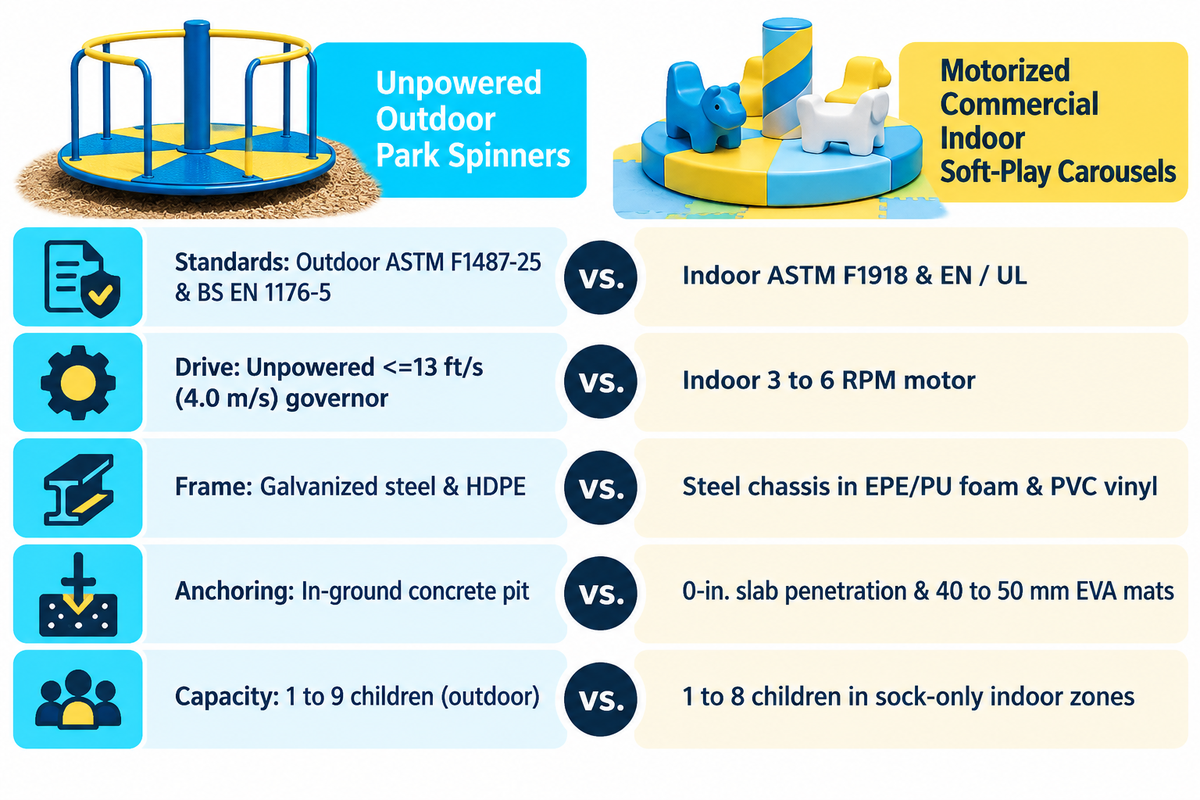
Outdoor park spinners are unpowered steel or HDPE units anchored in sub-grade concrete footings under ASTM F1487 and BS EN 1176-5. By contrast, commercial indoor soft-play carousels use low-voltage 3-to-6-RPM electric motors, foam padding and 0-inch slab-penetration floor plates. Operators planning a family entertainment center (FEC), mall play zone, or cafe cannot core-drill deep concrete pits into an upper-floor slab. They select indoor motorized soft-play carousels when choosing the right spinner for their play systems.
Outdoor park spinners rely on manual pushes or rider weight shifts, placing them under ASTM F1487 and BS EN 1176-5:2019. Commercial indoor electric soft-play carousels, such as coconut-tree spinners and padded turntables, are motor-driven rides excluded from BS EN 1176-5. As documented in Funlandia’s commercial electric soft-play specifications, indoor soft-play equipment meets ASTM F1918 and EN 1176 safety standards for commercial indoor playgrounds. Their electrical systems also comply with EN and UL certifications.
As a manufacturer-specific configuration at Guangzhou Didi Land Amusement Equipment Co. Ltd. (Didi Land), our custom soft play equipment for toddler and family venues is equipped with a 3 to 6 RPM low voltage geared motor. The drive is enclosed in PVC wrapped high-density EPE/PU foam housing for safe inclusive play. Each Didi Land carousel for children using the ride rests on a drop-in steel base plate with 0-in. slab penetration. When assessing commercial indoor soft play equipment types and venue fit, operators also review cafe indoor playground equipment mix and parent sightlines to ensure spinners never block views from parent seating.
| Specification Dimension | Outdoor Park Spinner / Merry-Go-Round | Indoor Electric Soft-Play Carousel |
|---|---|---|
| Applicable Safety Standards | ASTM F1487-25, CPSC Pub 325 §5.3.4, BS EN 1176-5:2019 (unpowered only) | ASTM F1918 and EN 1176 indoor playground standards, plus EN / UL electrical safety |
| Drive & Speed Control | Unpowered user push or body weight; mechanical governor capped at ≤13 ft/s (4.0 m/s) | Low-voltage geared electric motor (Didi Land spec: 3 to 6 RPM constant speed) |
| Structural Frame & Padding | Hot-dip galvanized steel, powder-coated rails, UV-stabilized rotomolded HDPE | Internal steel chassis wrapped in high-density EPE/PU foam and flame-retardant PVC vinyl |
| Sub-Base & Floor Anchoring | In-ground concrete pier or recessed concrete pit with sub-base drainage | 0-in. slab penetration; drop-in steel base plate beneath 40 to 50 mm EVA foam mats |
| Typical Rider Capacity | 1 child (solo spinner ZZPM4351) to 9 children (Accessible Whirl ZZXX1158) | 1 to 8 children per rotary unit in sock-only indoor zones |
Commercial Pricing, Concrete Footing, and Surfacing Budgets by Spinner Category
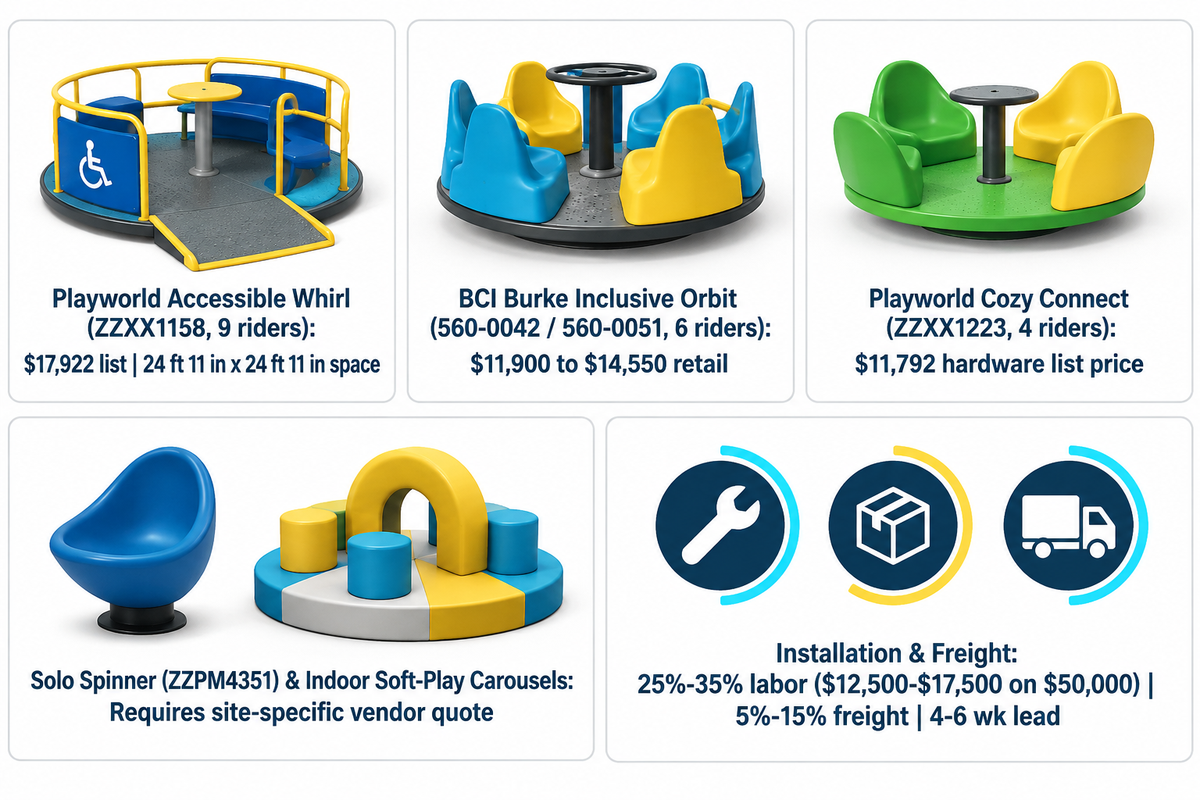
Published hardware prices for commercial playground spinners range from $11,792 for a 4-rider inclusive spinner to $17,922 for a 9-rider wheelchair-accessible flush whirl. Professional installation adds 25% to 35% of project cost, and freight adds 5% to 15%. A complete capital request must include equipment hardware, freight, excavation for footings, sub-base drainage, and impact surfacing across the use zone:
- Playworld’s Wheelchair-Accessible Flush Whirl (Model ZZXX1158) carries a published retail list price of $17,922 (Playworld inclusive catalog). The 6 ft 8 in × 6 ft 8 in × 2 ft 8 in turntable holds 9 children and requires a 24 ft 11 in × 24 ft 11 in space.
- Playworld’s Compact 4-Rider Inclusive Spinner (Cozy Connect Model ZZXX1223) has a published retail list price of $11,792 for a 4-child seated inclusive spinner (Playworld inclusive catalog).
- BCI Burke’s Inclusive Orbit merry-go-rounds (Models 560-0042 and 560-0051, capacity 6 children) sold for between $11,900 and $14,550 at retail as documented in CPSC Recall #25-080.
- According to AAA State of Play’s commercial playground installation cost breakdown, professional installation typically runs 25% to 35% of total project cost ($12,500 to $17,500 on a $50,000 project). Freight commonly adds 5% to 15%, and lead times average 4 to 6 weeks.
Solo freestanding spinners (such as Playworld Disco Spinner ZZPM4351, listed as “Contact Us for Price”) require a vendor quote. Sub-grade pit excavation, French drains, and unitary ASTM F1292 / F1951 surfacing also require a site-specific quotation based on local soil and labor conditions. Indoor FEC and cafe operators can request a tailored package quote through Didi Land’s commercial indoor playground design and turnkey equipment packages.
| Equipment / Budget Line Item | Verified Published Price / Share | Site & Foundation Scope | Published Source |
|---|---|---|---|
| Playworld Accessible Whirl (Model ZZXX1158, 9 riders) | $17,922 (hardware list price) | 6 ft 8 in deck; 24 ft 11 in × 24 ft 11 in required space | Playworld Inclusive Play Catalog |
| BCI Burke Inclusive Orbit (Models 560-0042 / 560-0051, 6 riders) | $11,900 to $14,550 (hardware retail) | Flush-mount inclusive merry-go-round assembly | U.S. CPSC Recall #25-080 |
| Playworld Cozy Connect (Model ZZXX1223, 4 riders) | $11,792 (hardware list price) | Compact 4-child inclusive seated spinner | Playworld Inclusive Play Catalog |
| Solo Spinner (Disco Spinner ZZPM4351) & Indoor Soft-Play Carousels | Requires site-specific vendor quote | Single in-ground post pier (outdoor) or 0-in. drop-in base plate (indoor) | Playworld / Didi Land Engineering |
| Commercial Installation Labor, Freight & Lead Time | 25%–35% labor ($12,500–$17,500 on $50,000); 5%–15% freight; 4–6 wk lead time | Site grading, footing excavation, drainage, and ASTM F1292/F1951 surfacing require site quote | AAA State of Play Cost Guide |
Bearing Assembly Maintenance, Sub-Base Drainage, and Quarterly Inspection Checklist
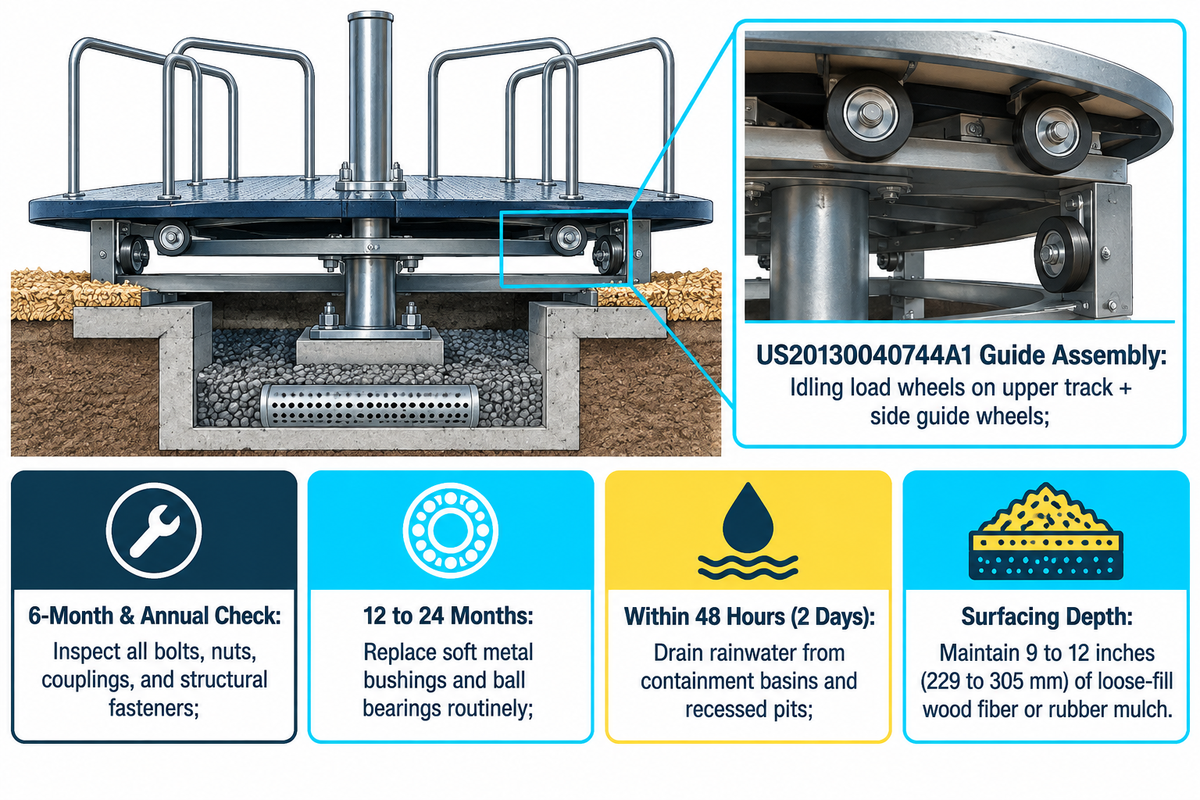
Preventive maintenance for commercial spinning equipment requires checking structural fasteners 6 months after installation and annually thereafter. Facility teams must also replace worn bearings and bushings every 12 to 24 months and drain containment basins within 2 days after rain. Most high-traffic rotary hubs can be maintained following the maintenance manual provided by the manufacturer, which usually ensures long-term performance in public service (Playground Depot maintenance guide).
Patent engineering records explain why multi-point bearing support matters on heavy turntables. U.S. Patent Application US20130040744A1 describes a carousel support system that employs multiple guide assemblies. Each guide assembly combines idling load wheels on the upper track with side guide wheels that contact the inner sidewall to resist tipping loads. During bulk buying and specification checks for commercial play equipment, facility teams should integrate routine traffic-based checks with the Playground Professionals maintenance schedule.
- Replace merry-go-round soft metal bushings and ball bearings routinely every 12 to 24 months as preventive maintenance. Irregular bearing wear will cause erratic deck wobble. Preventive maintenance replacements will help reduce unplanned maintenance.
- Inspect all bolts, nuts, couplings and structural fasteners approximately 6 months after the initial installation. Perform the same inspection annually.
- Check that surfacing containment basins and recessed spinner pits drain excess rainwater within 48 hours. Fast draining prevents fungi, metal corrosion and winter ice lock.
- Maintain a depth of 9 to 12 inches (229 to 305 mm) of loose-fill wood fiber or rubber mulch. Inspect the perimeter and seams of unitary surfacing quarterly, increasing to weekly in high-traffic areas, or more often if the manufacturer’s guidance requires it.
Buyer & Facility Director RFQ Verification Checklist
- Request merry-go-round rim-speed test reports confirming a speed of 13 ft/sec (4.0 m/s) or less under ASTM F1487 and CPSC §5.3.4. For Didi Land indoor soft-play carousels, confirm the 3 to 6 RPM motor spec.
- Bearing & Guide Assembly Architecture: Sealed bearings on the housing limit ingress of water and grit. Multi-wheel guide assemblies support loads and guide the rotating platform.
- Verify solid platforms, ≤2.0-in. (51 mm) radius variation, ≥9-in. (229 mm) non-enclosed raised underside clearance, and pinch-proof perimeter gaps.
- Specify sub-base drainage that allows containment basins to empty within 2 days (48 hours) after rain.
- Verify that the accessible routes meet ASTM F1951 wheelchair accessibility requirements of 2010 ADA §1008.2.6. Also confirm that the use zone of 6-ft (1.83 m) meets ASTM F1292 impact attenuation and ASTM F1951.
- Get part numbers for 12-24 month bushing and bearing replacement kits as well as 6 month and annual fastener torque specifications.
What Is Changing in Commercial Playground Spinners: Inclusive Flush Decks and Sealed Governors
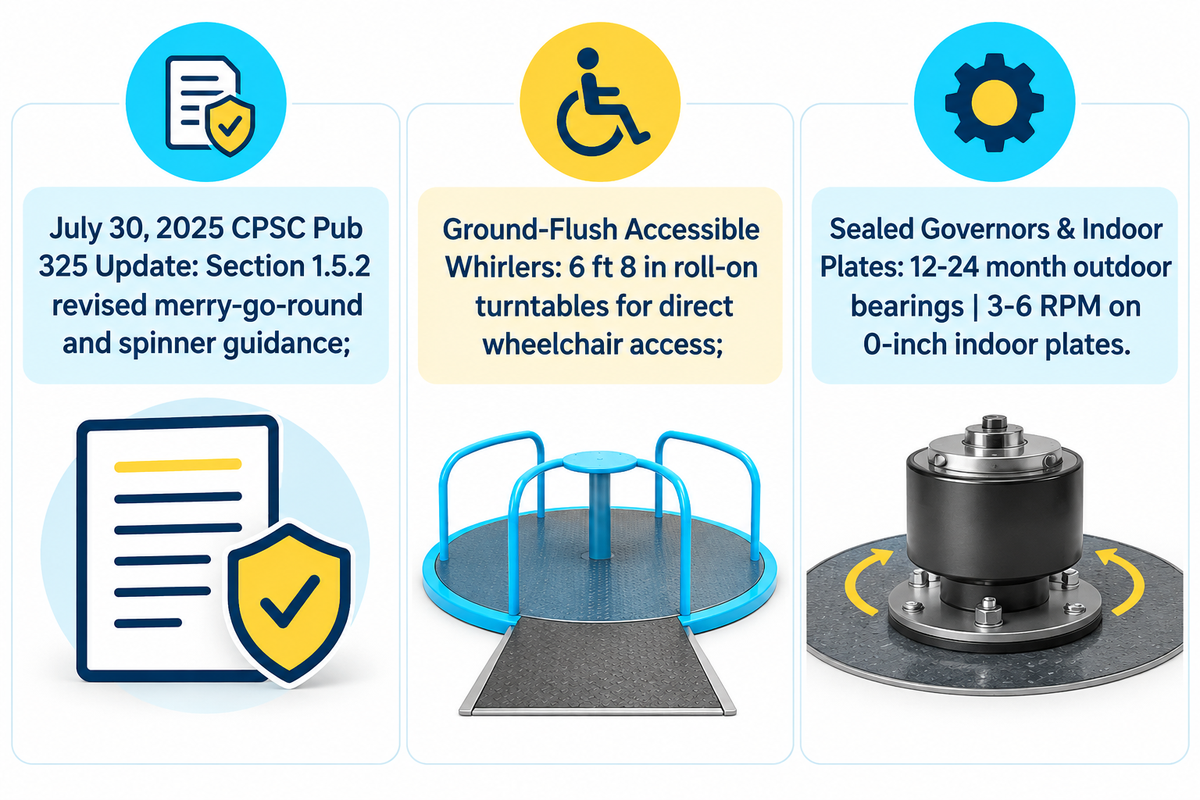
From 2025 to 2026, commercial playground spinner specifications are shifting toward compliance with July 2025 CPSC Publication 325, zero-step flush accessible whirlers, and sealed cartridge speed governors that suit different age groups across public parks, inclusive schoolyards, and indoor family play centers.
- On July 30, 2025, the U.S. CPSC released its Technical Update to CPSC Publication 325 (Public Playground Safety Handbook, §1.5.2). Section 1.5.2 revised recommendations for merry-go-rounds and spinning equipment which caused school risk managers to require the 2025-edition documentation.
- Municipal grants increasingly favor ground-flush accessible whirlers (like 6 ft 8 in roll-on turntables) as well as transfer-accessible spinners. Allowing wheelchair users to roll directly onto the rotating surface without transferring has become the benchmark for inclusive parks.
- Outdoors, cartridge speed governors mitigate and reduce unit bearing wear in 12-24 months. Indoors, FEC and cafe operators install 3-6 RPM soft play carousels on 0-inch slab penetration floor plates.
Buyer Takeaway & Scope Limitations
Match spinner posture and deck height to user age (≤14 in. for ages 2–5; ≤18 in. for ages 5–12). Verify the 13 ft/sec rim-speed cap, and reserve at least a 6-ft (1.83 m) non-overlapping use zone for platforms ≥20 inches across.
Scope Limitations: (1) Depth of sub-grade concrete footing and sizing of French drains are determined by local frost-line depth and soil percolation rates. Therefore, civil site work requires local engineering sign-off. (2) Exact turnkey prices for flush-mount pit excavation, solo spinners, indoor soft-play packages, and unitary ASTM F1292/F1951 surfacing require a site-specific vendor quote. (3) Public outdoor parks in North America follow ASTM F1487 and CPSC Publication 325, European municipal parks follow BS EN 1176-5:2019, and commercial indoor soft-play centers apply ASTM F1918.
Planning an Indoor Soft-Play Center or Commercial Playground?
Send floor plan, ceiling height and age groups to Didi Land. Didi Land will design and install soft-play carousels, sensory spinners, and complete play zones specific to your venue.
Frequently Asked Questions
What are spinning toys on a playground called in safety standards versus everyday speech?
Everyday speech uses “spinny thing” or “merry-go-round,” whereas safety standards use “revolving equipment” or “carousels.”
Merry-go-rounds are referred to by common names by the general public, including spinny thing, spinning wheel, and rotating platform. By name, this type of equipment is known as multi-user units in the commercial catalogs. Single user units are referred to as stand-up spinner poles or spinner bowls. Under ASTM F1487 and CPSC Publication 325 §5.3.4, rotating decks 20 inches or wider are regulated as revolving playground equipment.
Are playground merry-go-rounds illegal or banned in US public parks and schools?
No federal law bans commercial playground merry-go-rounds when they meet modern CPSC and ASTM engineering rules.
Banning commercial merry-go-rounds by the U.S. Consumer Product Safety Commission or ASTM International has never occurred. Older school districts replaced or removed merry-go-rounds made prior to 1990, due to limb shear injuries caused by the exposed framework. Modern commercial units are fully permitted across US parks when built with solid platforms, enclosed bases, and speed governors capped at 13 ft/sec. They also adhere to all codes, permit requirements, and requirements regulating their use in parks.
How is free-spinning equipment safer than an old-style metal merry-go-round?
Modern spinners add centrifugal speed governors, solid anti-entrapment decks, and canted gravity-limiting axes.
Traditional merry-go-rounds have an exposed and uncovered underside, as well as an open, pie-shaped-spoke design. Pushers of old merry-go-rounds could easily cause decks to turn at unsafe speeds. Modern commercial merry-go-rounds use internal centrifugal or hydraulic brakes that cap peripheral speed at 13 ft/sec (4.0 m/s). Spinner bowls, on the other hand, use a canted axis to limit the speed of the user.
Are freestanding spinners safe for younger children ages 2 to 5?
Yes, when platform height stays at or below 14 inches and deep-cup seated bowls are chosen.
Spinner bowls and whirlers are safe for children ages 2 to 5. Under CPSC §5.3.4, the standing or sitting surface of the equipment must not be more than 14 inches (356 mm) above the protective surfacing.
What foundation work is required for indoor versus outdoor spinning equipment installation?
Outdoor spinners require concrete footings and drainage pits, whereas indoor soft-play carousels use drop-in floor plates.
Outdoor park spinners are secured to sub-grade concrete piers or drained concrete vaults. Indoor park electric soft-play carousels are 0-inch slab penetrating, with a drop-in steel base plate, beneath 40 to 50 mm EVA flooring.
How do you prevent loose-fill mulch displacement and bearing wear under a commercial merry-go-round?
Pair unitary rubber surfacing or wear mats with 48-hour pit drainage and 12-to-24-month bearing maintenance.
Children pushing merry-go-rounds fling loose-fill wood chips and rubber mulch out of the perimeter track. Kick-out decreases impact attenuation and moves grit into lower bearing seals. Specifiers stop this by using unitary poured-in-place rubber, or heavy-duty rubber mats in the 6-foot use zone. Unit surface mats are also beneficial next to flush-mount accessible whirlers to prevent wood chips from clogging recessed pits. Also, maintenance teams must ensure sub-base containment basins drain within 2 days (48 hours) after a rain event. Crews should also check structural bolt torque at 6 months and annually, and replace bushings and ball bearings every 12 to 24 months.
References & Sources
- U.S. Consumer Product Safety Commission (CPSC), Public Playground Safety Handbook (Publication 325, July 30, 2025 Update) §1.5.2 and §5.3.4 Merry-Go-Rounds.
- – U.S. Government Publishing Office / CPSC Publication 325 Archival Specification, §5.3.4 Speed Limitations (13 ft/sec cap) and Figure 22 circularity rules.
- U.S. CPSC Recall #25-080: BCI Burke Recalls Playground Merry-Go-Rounds Due to Crush Hazard (December 26, 2024).
- U.S. Department of Justice, 2010 ADA Standards for Accessible Design, §1008 Play Areas and §1008.2.6 Ground Surfaces.
- U.S. Access Board, ADA Chapter 10 Guide: Ground Surfaces in Play Areas (ASTM F1951 and ASTM F1292 requirements).
- ASTM F1487-25 Standard Consumer Safety Performance Specification for Playground Equipment for Public Use and ASTM F1918-21 Soft Contained Play Equipment Scope.
- BSI Group: BS EN 1176-5:2019 Playground Equipment and Surfacing — Additional Specific Safety Requirements and Test Methods for Carousels.
- Google Patents / USPTO Application US20130040744A1: Carousel Guide Assembly and Bearing Mount Architecture.
- PubMed / Child: Care, Health and Development (2023): Inclusive Playgrounds, Vestibular Sensory Integration, and Peer Participation
- Playworld Inclusive Play Catalog (specifics and list pricing for Accessible Whirl ZZXX1158, Cozy Connect ZZXX1223, Disco Spinner ZZPM4351).
- AAA State of Play: Playground Use Zone Clearance Requirements and Commercial Playground Installation Cost Breakdown.
- Playground Professionals: Common Playground Maintenance Problems and Bearing Schedules and Inclusive Vestibular Equipment Guide.
- Funlandia Electric Soft Play Specifications (ASTM F1918, EN 1176, UL / CSA standards).
Technical review by Guangzhou Didi Land Amusement Equipment Co., Ltd. (Didi Land) engineering team, November 2026.