Get in Touch with Didi Land


Updated July 2026
Soft play equipment wholesale refers to bulk purchasing of indoor play structures, ball pits, and related equipment by operators or distributors buying across multiple sites at once, rather than a single venue placing one order. Pricing at this scale seems straightforward until a multi-site operator or distributor tries to price a five-location rollout and discovers that unit price, minimum order quantity, freight, and certification all move together in ways a single-venue buyer never has to think about. This guide breaks down the actual mechanics – volume price-break tiers, real MOQ economics, manufacturer-versus-distributor sourcing, container consolidation, cross-market certification, total landed cost, and a sequencing framework for staggering orders across locations – using published supplier data rather than generic buying-guide checklists.
Quick Specs
| Minimum Order Quantity | 1 set/project (Didi Land) vs. 50-200 units or 1x20ft FCL industry-typical |
| Lead time | 25-90 days production + 25-40 days ocean freight, by product line |
| Price range | $5K (compact toddler) to $1M+ (flagship multi-story) |
| Core certifications | ASTM F1918-21 for soft-contained play equipment (US), EN 1176 family (EU), AS 4685.1 (AU/NZ) |
| Typical payment terms | 30% deposit / 70% before dispatch; L/C available |
Who Actually Needs a Wholesale Soft Play Strategy
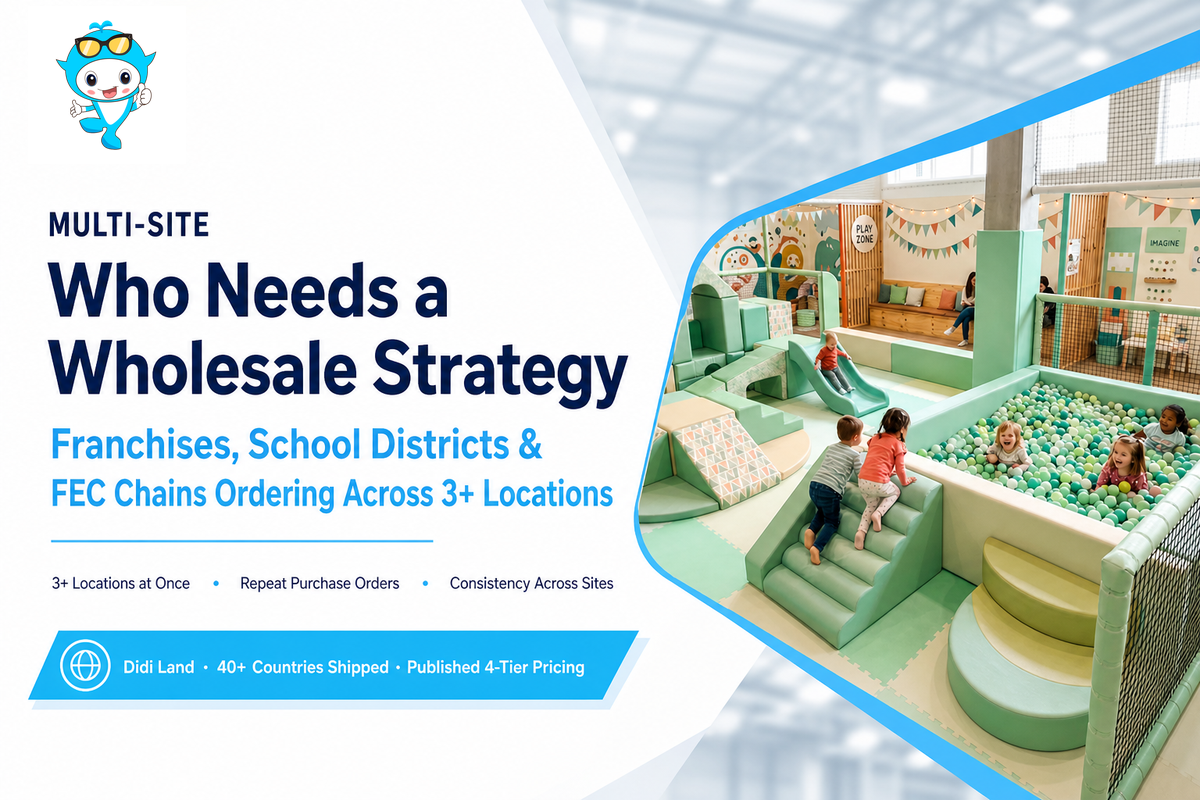
Soft play equipment wholesale buying applies to operators and distributors placing orders across three or more locations at once, not to a single indoor playground opening its doors for the first time. A single-venue buyer optimizes for one floor plan, one budget, and one delivery date – component selection and sizing questions like the ones covered in our soft play sets buying guide are the right starting point for that buyer.
A multi-site operator or distributor is instead optimizing for consistency across locations, cash-flow timing across purchase orders, and a supplier relationship that survives repeat business – an entirely different set of constraints. This distinction matters commercially. Franchise operators, school districts, child care center chains, amusement parks, and recreation providers increasingly need “consistent, scalable solutions across multiple locations,” and the indoor playground equipment market is projected to grow from roughly $4.8 billion in 2025 to about $9.2 billion by 2034, a compound annual growth rate in the 6-7.5% range . Wholesale-scale purchasing isn’t a niche edge case inside this market – it’s where a meaningful and growing share of new indoor playground and family entertainment center openings are coming from.
Whichever specific mix fills the play area – commercial soft play equipment such as ball pits, foam play structures, playground slides, play mats, foam blocks, climbers, crawl tunnels, indoor soft play equipment towers, toddler soft play corners, or fully themed indoor soft play zones designed for imaginative play – the wholesale mechanics in the sections below apply the same way once volume crosses a few units per location. Kids play environments built as a complete play solutions package, rather than assembled item by item, are exactly where these tier and MOQ mechanics matter most. Buyers simply browsing commercial soft play equipment for sale, comparing used soft play equipment wholesale as a budget option, or asking where to buy soft play equipment for one new site are asking a related but different question than the multi-site wholesale mechanics covered here.
💡 Pro Tip
If your next 12 months include two or more new locations, read this before requesting quotes location-by-location – the pricing and MOQ mechanics below change how you should structure the first purchase order.
Volume Price-Break Tiers: What Bulk Pricing Actually Looks Like
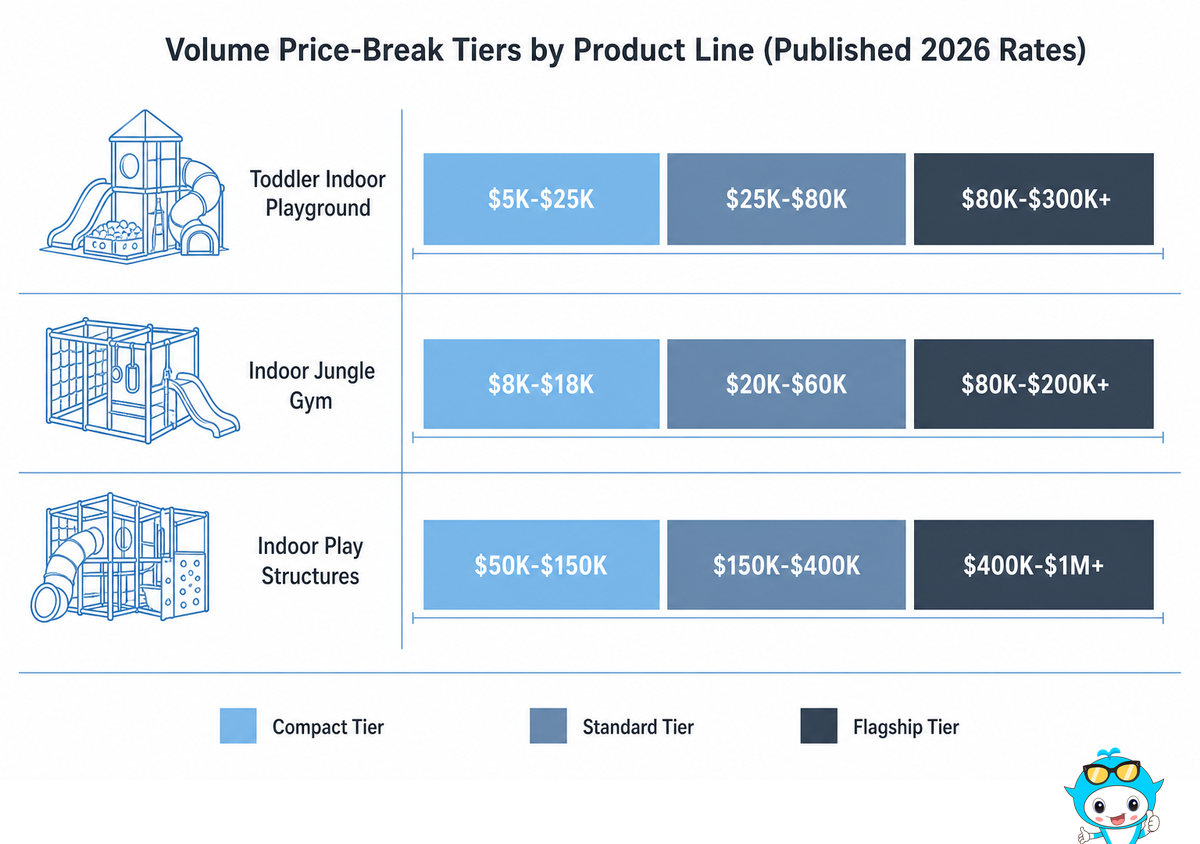
Bulk soft play equipment pricing moves in discrete tiers tied to venue size and equipment complexity, not a smooth per-unit discount curve. Didi Land’s own published pricing across three product lines shows this pattern clearly: toddler indoor playgrounds run $5K-$25K for basic daycare-scale configurations, $25K-$80K for mid-tier mall or FEC installs, and $80K-$300K+ for flagship builds; indoor jungle gyms span $8K-$18K compact, $20K-$60K standard, and $80K-$200K+ premium; indoor play structures range from $50K-$150K for a compact 2,500-5,000 sq ft tier to $400K-$1M+ for a 10,000+ sq ft flagship deployment .
| Product Line | Compact Tier | Standard Tier | Flagship Tier |
|---|---|---|---|
| Toddler Indoor Playground | $5K-$25K | $25K-$80K | $80K-$300K+ |
| Indoor Jungle Gym | $8K-$18K | $20K-$60K | $80K-$200K+ |
| Indoor Play Structures | $50K-$150K | $150K-$400K | $400K-$1M+ |
Source: Didi Land published pricing by product line, 2026. Retail-level competitor pricing for individual soft play items (e.g., ball pits) runs $480-$2,545 a useful sanity check that wholesale project pricing and retail unit pricing aren’t directly comparable. Top-cited competitor wholesale-buying content (including eparko.com’s commercial soft play wholesale guide) publishes no tier-pricing structure to compare against competitors cover buyer-type and safety checklists but not pricing mechanics.
One practical takeaway for multi-site buyers is that the tier boundary – not the raw square footage – determines which price band a location falls into. A location at 2,400 sq ft and one at 2,600 sq ft can land in different pricing tiers even though the physical difference is marginal, so it’s worth reviewing tier thresholds with a supplier before finalizing a site’s footprint.
The MOQ Reality: Why “1 Set” and “10 Sets” Aren’t the Same Negotiation
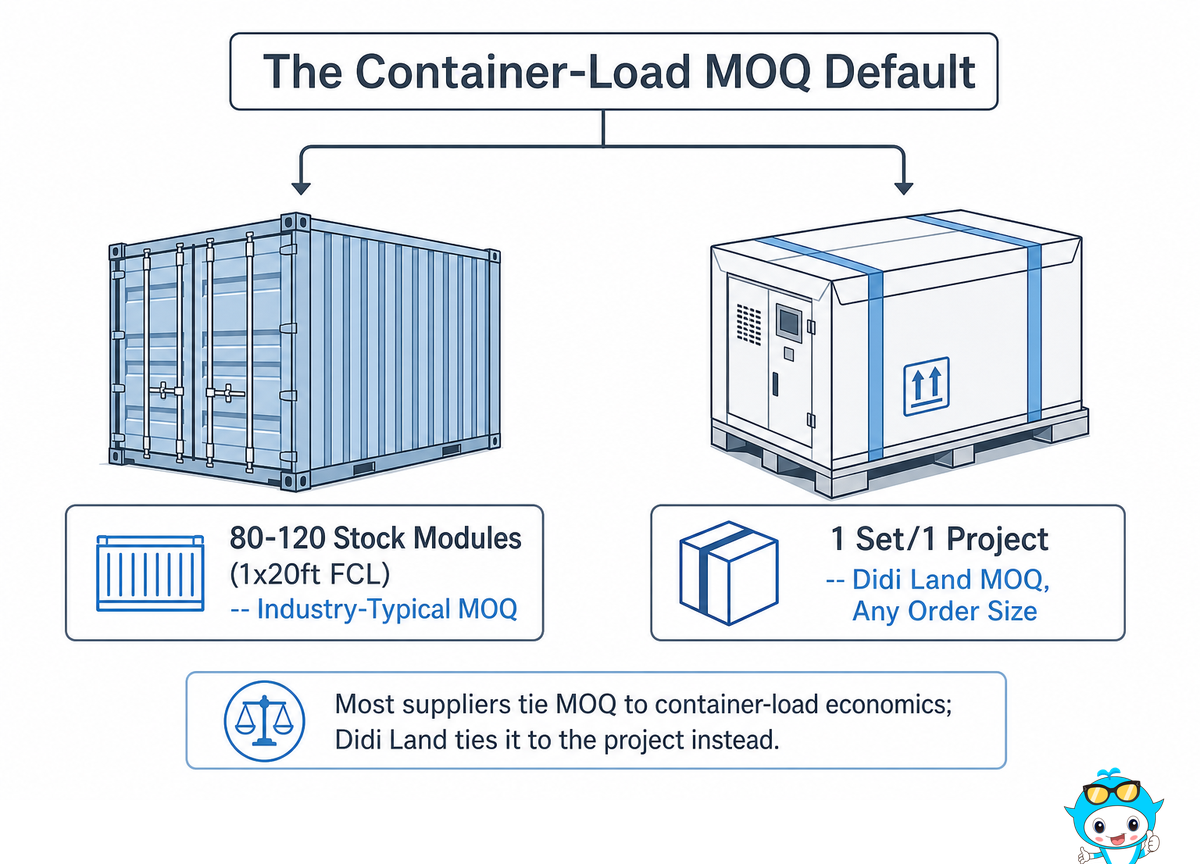
Most soft play equipment manufacturers enforce a minimum order quantity of 50-200 units for custom builds, or an equivalent volume threshold pegged to container capacity, roughly one 20-foot FCL container’s worth of stock-design modules (80-120 units) . That container-load default is the industry’s real MOQ mechanic, and it’s rarely stated up front in a first quote. Didi Land breaks from this pattern by publishing MOQ as 1 project/1 set across every product line, regardless of order size .
The Solo-vs-Fleet MOQ Gap
A common assumption among first-time bulk buyers is that MOQ gets easier to negotiate as order volume grows across sites. In practice, the more relevant gap is between suppliers whose MOQ is tied to container-load economics — where a 3-site rollout still has to clear the same 80-120-unit threshold per order as a single large venue — and suppliers whose MOQ is set per project regardless of scale, where a 3-site rollout can place three separate 1-set purchase orders on three different timelines without hitting a volume floor at all. What actually matters isn’t “order more, negotiate harder” — it’s picking a supplier whose MOQ structure already matches a staggered, multi-site cadence.
This difference becomes particularly relevant for operators opening locations sequentially rather than simultaneously. Container-load MOQ creates a frustrating catch-22: you must over-order for a location not yet open or wait for other locations to come online so your order meets the minimum threshold. When choosing between potential suppliers for a multi-site opening, make it a point to ask if the MOQ is calculated on a per-container or per-project basis; the two may sound similar but behave drastically differently over a rollout schedule. You can also learn more about our full supplier selection process (beyond just MOQ) in our supplier sourcing and RFQ guide.
Manufacturer-Direct vs. Distributor: Sourcing Channels for Repeat Bulk Orders
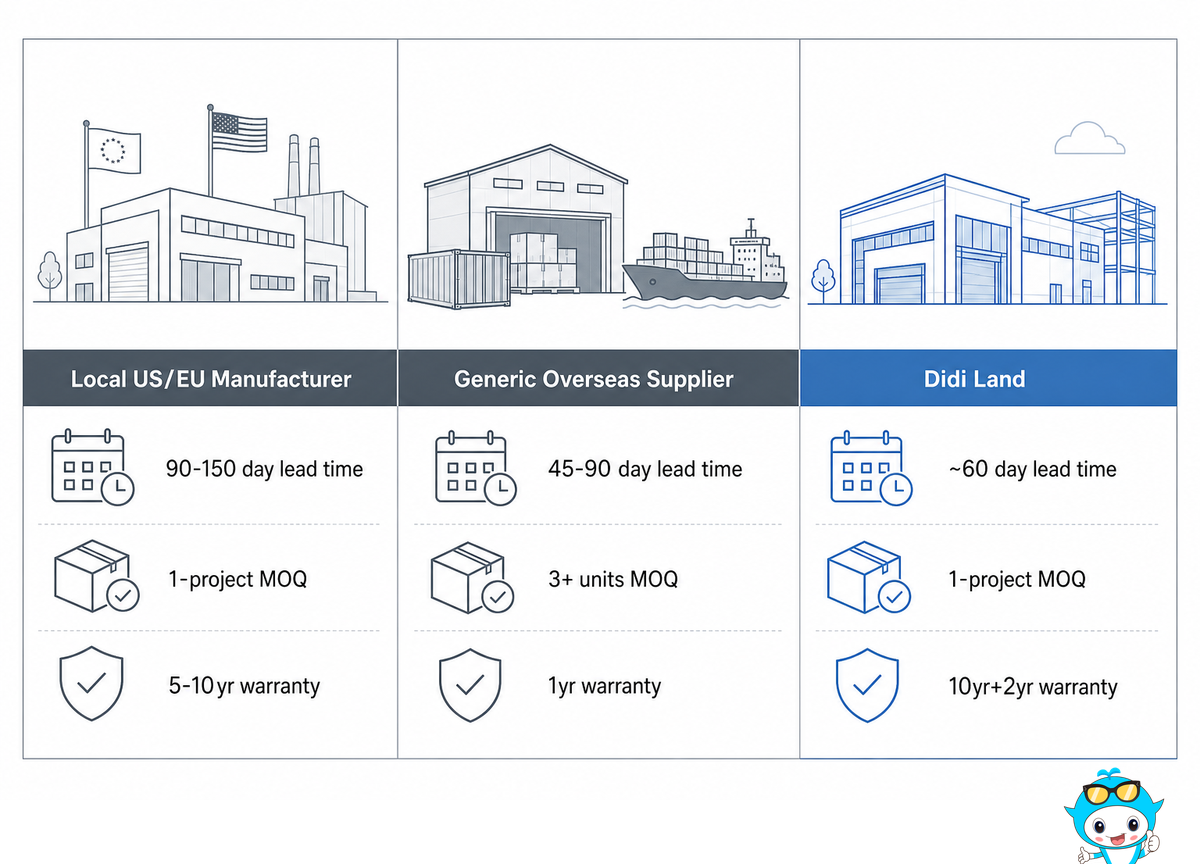
Three sourcing channels dominate soft play equipment wholesale procurement, and each trades speed, support, and paperwork differently. Expect a local US/EU manufacturer to run a 90-150 day lead time with a 1-project MOQ and a 5-10 year structural warranty, backed by home-market certification but limited published pricing transparency. A generic overseas (commonly China-based) marketplace supplier runs faster at 45-90 days but usually requires a minimum of 3+ units per order, offers a shorter 1-year warranty, and standards claims are often unverifiable without independent audit. Didi Land’s own published position sits between these: roughly 60-day lead time, 1-project MOQ, a 10-year structural plus 2-year soft-component warranty, a standards stack covering EN 1176, AS 4685, ASTM F1918 for soft-contained systems, a CE self-declaration where applicable EU harmonisation rules apply, and ISO 9001 quality management, published 4-tier pricing, 24/7 support, and shipping history to 40+ countries .
| Channel Factor Type | Local US/EU Manufacturer | Generic Overseas Supplier | Didi Land |
|---|---|---|---|
| Lead time | 90-150 days | 45-90 days (variable) | ~60 days |
| MOQ | 1 project | 3+ units typical | 1 project (Compact OK) |
| Warranty | 5-10 yr structural | 1 yr typical | 10 yr structural + 2 yr soft-component |
| Certification stack | Home-market only | Often unverifiable claims | EN1176 + AS4685 + ASTM F1918 (soft-contained) + CE declaration + ISO9001 |
| Payment terms | Often 50% deposit, custom terms | Deposit terms vary, rarely published | 30% deposit / 70% before dispatch, L/C available |
| Support hours | Home-timezone business hours | Often async-only, timezone gap | 24/7 |
| Export footprint | Primarily domestic/regional | Wide but undocumented | 40+ countries shipped |
| Pricing transparency | Rarely published | Per-unit catalog only | Published 4-tier USD |
RFQ checklist — copy these into your bulk-order quote request:
| Parameter | Recommended range | Why it matters | How to verify |
|---|---|---|---|
| MOQ basis | Per-project, not per-container | Determines staggered-rollout flexibility | Ask supplier to confirm in writing per SKU |
| Warranty term | 5+ yr structural minimum | 1-yr warranty signals lower build quality | Request written warranty terms, not verbal |
| Certification documentation | Named standard + test report | Unverifiable claims are common overseas | Request third-party test lab report copy |
| Pricing tier basis | Published by venue size, not quoted ad hoc | Ad hoc quoting makes multi-site budgeting unreliable | Ask for the full published tier table, not one line item |
Distributors inject a fourth variable: local stock and regional support in exchange for a premium over factory-direct pricing, though that premium is so inconsistent across regions and relationships that it can’t be standardized. As you begin opening multiple locations in the same region (say, 3+ in the same country), it becomes more cost-effective to source directly from manufacturers if your volume justifies building a relationship. Distributors shine when a buyer has only a single location or is testing a new market. See our manufacturer comparison guide for a break down of individual manufacturer options once you’ve decided between direct or a distributor.
“The channel decision is really a paper-trail decision. A 1-year warranty and an unverifiable cert claim aren’t necessarily a bad product, but they’re a bet you can’t easily unwind once equipment is installed across three locations.”
Didi Land Engineering Team
Container Consolidation and Multi-Site Delivery Scheduling
Ocean freight for soft play equipment moves by full container load (FCL) once a shipment exceeds roughly 12-15 cubic meters, which is typically cheaper per unit than consolidated (LCL) freight above that threshold, per Freightos’ FCL shipping guide. A 20-foot container carries up to 28 metric tons and 33 cubic meters; a 40-foot container carries up to 30 metric tons and 67 cubic meters, with 2026 base rates starting around 1,200 USD for a 20-footer and 2,000 USD for a 40-footer. FCL transit runs roughly 3-6 weeks depending on origin and destination.
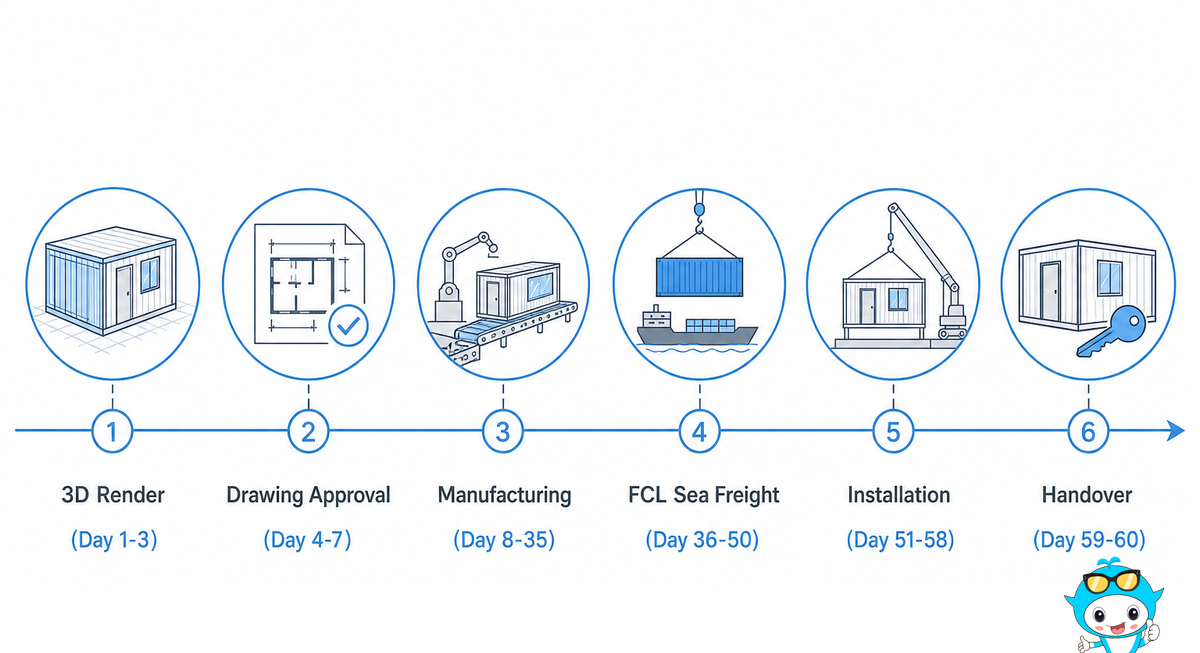
| Stage | Days |
|---|---|
| 3D render | Day 1-3 |
| Drawing approval | Day 4-7 |
| Manufacturing | Day 8-35 |
| FCL sea freight | Day 36-50 |
| Installation | Day 51-58 |
| Handover | Day 59-60 |
Source: Didi Land indoor jungle gym production timeline . Other product lines vary: toddler playgrounds 25-60 days, slides 4-8 weeks plus freight, soft play climbing equipment 30-45 days production plus 25-40 days ocean freight.
There are two particularly pronounced operational risks associated with multi-site purchasing. First, major shipping delays become the norm during the peak season for shipping goods, generally from August to November, which is influenced by demand for seasonal products in large logistics centers. You can also expect this season to add approximately two weeks of delivery time when planning store openings. Additionally, delays during customs clearance frequently occur when the actual items don’t match the descriptions on the shipping invoice — a clerical error, rather than an issue with the product — and when containers rack up daily charges (demurrage) after arriving but before being retrieved, these can quickly inflate a limited budget. If your timelines align, ordering enough from a supplier to fill one container with items for two or three different locations both helps you hit the FCL threshold sooner and reduces the number of separate customs clearances that can independently run into trouble.
Certification at Scale: Keeping Compliance Consistent Across Locations
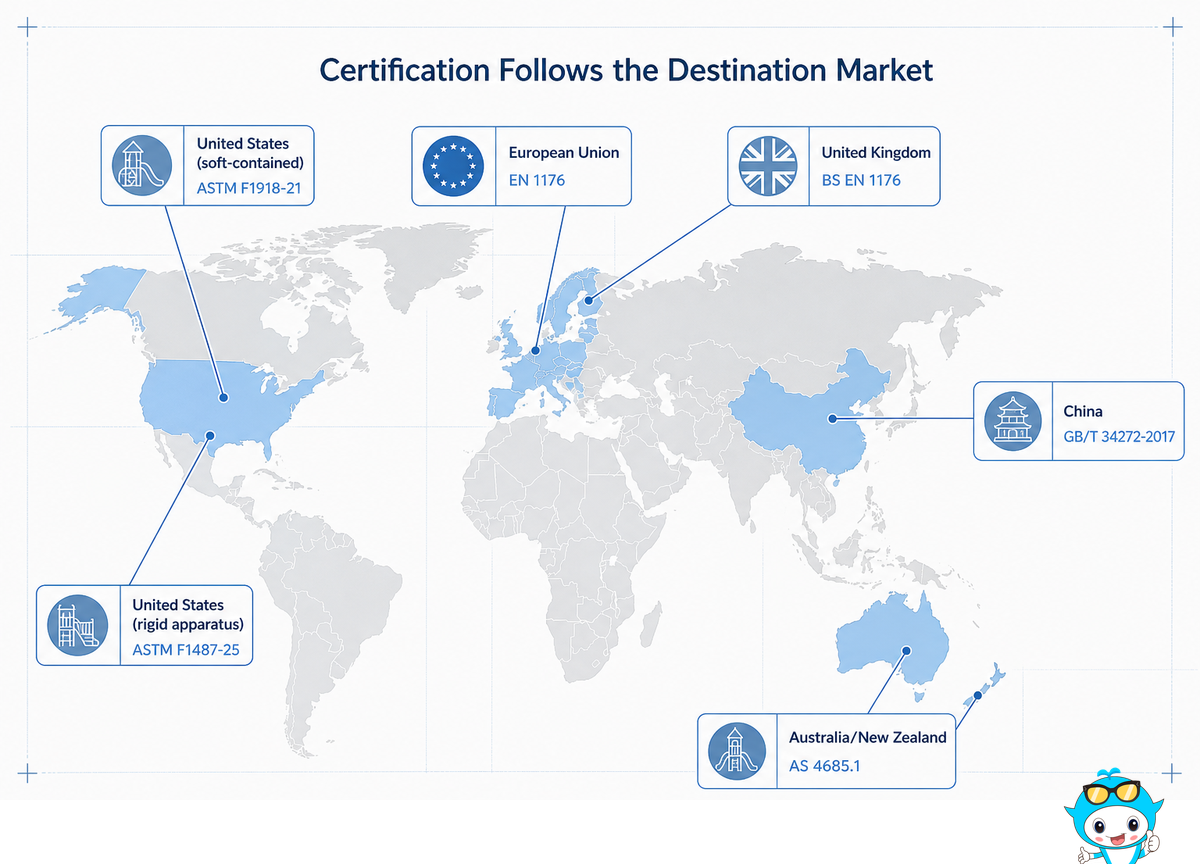
Playground equipment standards follow the destination market, not the country of manufacture or the buyer’s home country, and they’re mostly voluntary consensus standards rather than a single mandatory federal certification — CPSC itself confirms there is no single specific certification requirement for playground equipment, though other children’s-product obligations can still apply on top. For soft-contained play equipment specifically (ball pits, foam structures, enclosed soft play systems — the core of most wholesale orders in this category), the relevant US reference is ASTM F1918-21, not the broader ASTM F1487 series that governs rigid public-playground apparatus like structural climbers and slides; many suppliers and buyers use the two interchangeably, which is its own scope error worth watching for in a quote. EU venues reference EN 1176 conformity (with EN 1176-10:2023 specifically covering fully enclosed equipment), Australia and New Zealand reference AS 4685, and China references GB/T 34272-2017. Many buyers assume a certification earned for one market carries over to another; in practice, a certificate to one standard is not accepted as proof of the other — these standards differ in measurement units and testing methodology, not just paperwork. CE marking adds a further wrinkle: it is a manufacturer’s own declaration tied to specific EU harmonisation legislation, not an independently issued certificate comparable to ASTM or EN test reports, so a “CE” line item on a spec sheet is not automatically the same kind of proof as an ASTM or EN1176 test report. This finding challenges conventional assumptions about cross-market equivalency that many first-time multi-country buyers carry into their first RFQ.
| Market | Governing Standard |
|---|---|
| United States (soft-contained equipment) | ASTM F1918-21 |
| United States (rigid playground apparatus) | ASTM F1487-25 |
| European Union | EN 1176-1/-2/-3/-10 + EN 1177 |
| United Kingdom | BS EN 1176 |
| Australia / New Zealand | AS 4685.1:2021 |
| China | GB/T 34272-2017 |
For products like those used in children’s playgrounds in the US, CPSC guidance confirms there isn’t one single mandatory certification that covers every item directly — these ASTM standards are voluntary consensus standards, though many buyers, insurers, and franchise agreements treat them as a practical requirement, and other children’s-product obligations can still apply on top. For multi-site operators working across borders rather than within one country, each market’s specific standard needs to be explicitly stated in the purchase order per product type — soft-contained items against ASTM F1918 or EN 1176-10, rigid apparatus against ASTM F1487 or the equivalent EN 1176 part. Our safety standards comparison covers the AS4685/EN1176/ASTM F1487 comparison for rigid playground apparatus in more depth, and our ASTM F1487-25 vs ASTM F1487-21 guide covers the latest revision to that specific standard.
Total Landed Cost: What Bulk Buyers Miss Beyond Unit Price
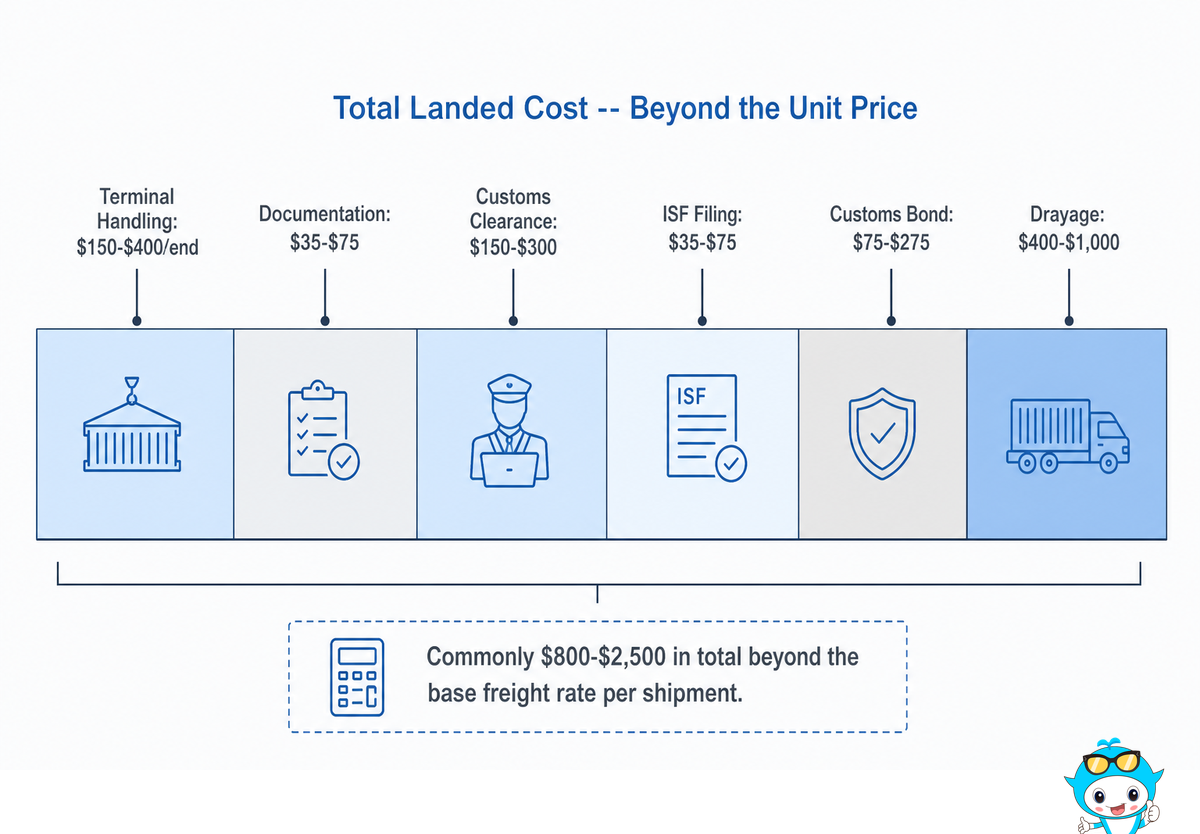
Unit price is only one line in a bulk soft play equipment order’s real cost. Beyond the base ocean freight rate, a standard shipment adds terminal handling charges ($150-$400 at each end), documentation fees ($35-$75), customs clearance ($150-$300), ISF filing ($35-$75), a customs bond ($75-$275 single-entry or $400-$1,200 annual), and drayage/inland trucking ($400-$1,000) — commonly $800-$2,500 in total beyond the base freight rate per shipment, per Freightos’ FCL shipping cost guide. Didi Land’s published payment structure is 30% deposit by T/T at order confirmation, with the remaining 70% due before dispatch; letter of credit (L/C) is available, and Sinosure-backed terms are offered to vetted buyers, with shipping available FOB Guangzhou (default), EXW, or DDP on request .
5-year total cost of ownership — illustrative, indoor jungle gym standard tier:
| Cost item | Didi Land (10yr+2yr warranty) | Generic supplier (1yr warranty) |
|---|---|---|
| Purchase price | $20K-$60K | Comparable quoted range |
| Freight + landed charges | ~$2,000-$4,500 (40ft FCL + addons) | ~$2,000-$4,500 (comparable route) |
| Installation | Included, Day 51-58 | Varies, often separately quoted |
| Structural replacement risk (5-yr) | Covered under 10-yr warranty | Out-of-warranty after year 1 — full replacement cost exposure |
Payback example: on a $40K standard-tier jungle gym, a 1-year-warranty supplier that requires a full structural component replacement in year 3 (a documented failure pattern for underrated steel framing) adds $15K-$25K in unplanned cost that a 10-year structural warranty avoids entirely — turning an apparently cheaper upfront quote into the more expensive option over a 5-year hold.
(This is an example, not an actual quote – actual landed cost will vary depending on your port of origin, destination country’s import duties, and current shipping rates.) However, the basic equation is the same: warranty term is part of the cost-of-ownership and should be considered in your comparison, not just as a warranty feature in a vacuum separate from unit price and shipping costs.
Multi-Site Rollout Playbook: Sequencing Orders Across Locations
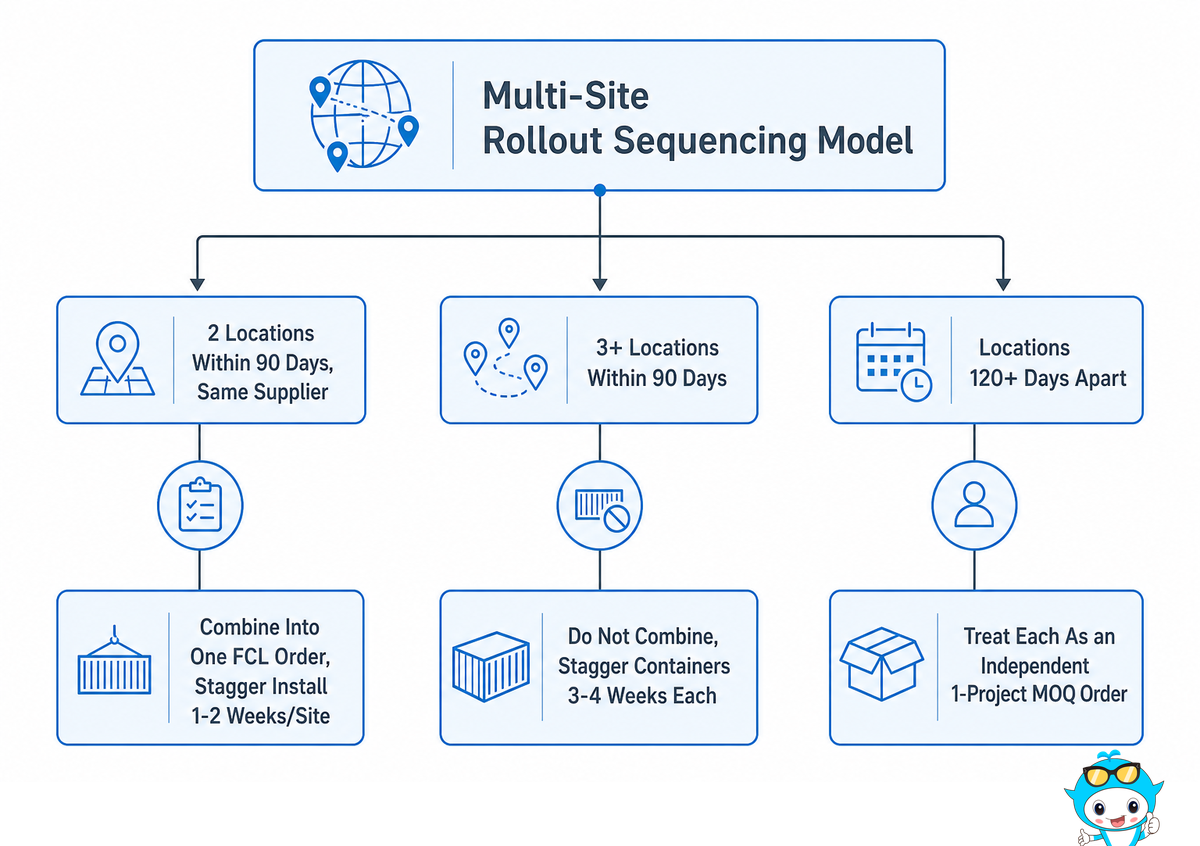
Sequencing purchase orders across locations is a cash-flow and install-crew scheduling problem as much as a procurement one. Didi Land’s installation process runs as a defined phase, installer crew arrival, on-site assembly, and operator training, with site access, equipment scheduling, and staff availability required as buyer-side inputs before that phase can start . Running three locations through that phase simultaneously multiplies crew and training-resource demand at exactly the moment a rollout is most likely to slip.
Multi-Site Rollout Sequencing Model
- If 2 locations open within a 90-day window and share a supplier — combine into one FCL order where container capacity allows, and stagger install crew dispatch by at least 1-2 weeks per site.
- If 3+ locations open within a 90-day window — do not combine into a single container order; instead stagger container departures by 3-4 weeks each to avoid a single customs or demurrage delay blocking every site at once.
- If locations open more than 120 days apart — treat each as an independent 1-project MOQ order rather than trying to force volume-tier pricing across a timeline that long; freight rates and lead times will likely have shifted between orders anyway.
The core idea behind consolidated orders is that they should only result in cost savings if site opening timelines are close enough that a single shipment to one site doesn’t hold up openings at others — a single customs or demurrage delay (see Freightos’ FCL shipping guide on the mechanics of demurrage charges) can block every site sharing that container at once. For rollouts stretched across a year or more, three to four independent orders per project-each with a per-project MOQ structure of 1 set-will typically make more sense than a single large, centralized attempt to chase volume-tier pricing. This strategy assumes a coordinated calendar that’s rarely the reality on the ground.
Where Bulk Soft Play Demand Is Headed
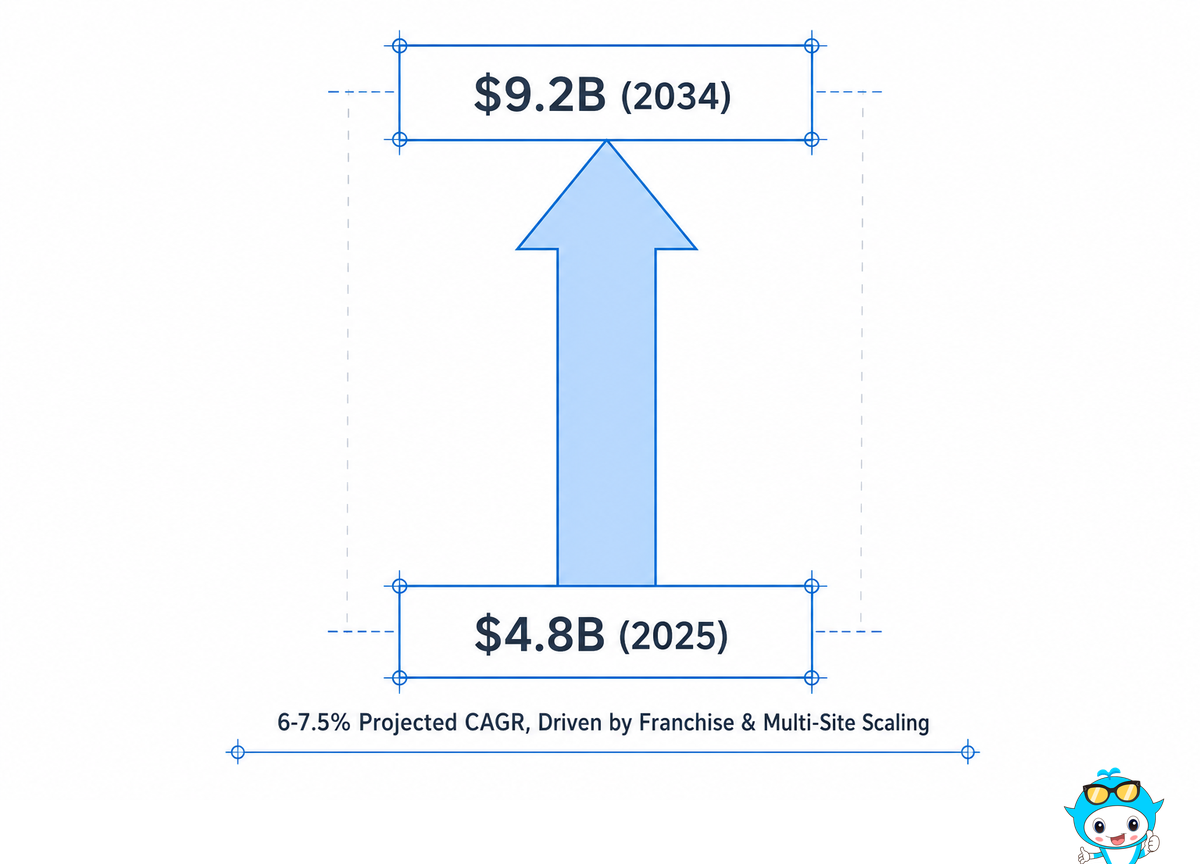
$4.8B → $9.2B
Indoor playground equipment market, 2025-2034
6-7.5%
Projected CAGR through the early 2030s
Franchisees, school districts, and youth program operators — customers who need multiple identical, repeatable installs as opposed to one custom-built setup — are the main driver behind sustained demand for bulk-purchased soft play equipment, per 2026 wholesale soft play equipment trend coverage. While these market-context statistics are useful for directional understanding and not meant as predictions for a specific customer segment, the structural trend behind them is that multi-site buyers are prioritizing standardized, scalable equipment — and those suppliers that structure their pricing and minimum order quantities around per-project needs rather than full-container volume will gain a significant competitive advantage in this growing market.
Beyond short-term trends in search volumes for these topics-which naturally fluctuate throughout the year based on capital expenditure budgets-the key, long-term signal is clear: franchises and multi-site scaling are driving the growth of equipment in this category, and you should be building your supplier relationship strategy around that trend rather than any specific quarter’s ordering volumes.
Our Perspective
The pricing, MOQ, and logistics data in this guide come from Didi Land’s own published commercial terms across our toddler, jungle gym, and indoor play structure product lines, cross-checked against publicly available freight and MOQ benchmarks from third-party logistics and toy-manufacturing sources. We deliberately didn’t cover material selection or safety-checklist basics here, that ground is already well covered by other buying guides, and focused instead on the volume-pricing and multi-site logistics mechanics that most wholesale content skips.
Frequently Asked Questions
Q: What’s a realistic MOQ for soft play equipment wholesale orders?
Industry-typical MOQ runs 50-200 units for custom configurations, or roughly one 20-foot container’s worth (80-120 modules) for stock designs, a threshold most suppliers tie directly to container-load shipping economics rather than stating it upfront in an initial quote.
Container load is the most common threshold that most suppliers default to, and it’s not always clarified during an initial conversation with a new bulk purchaser who may be surprised to see it listed in a formal quote. Some suppliers, including Didi Land, set MOQ per project at 1 set, regardless of how large your order is. This is particularly beneficial for multi-site buyers who order equipment over a staggered period of time as it means you won’t have to place a much larger order than you need just to reach a supplier’s container load minimum for a single site. Ask potential suppliers directly whether they charge per-container or per-project MOQ.
Q: How much does soft play equipment cost when buying in bulk for multiple locations?
Published pricing runs from roughly $5K for a compact toddler configuration to $1M+ for a flagship multi-story installation, in tiers set by venue size, with additional per-shipment freight and landed-cost fees on top of the unit price.
Toddler indoor playgrounds range from $5K to $300K+ across three tiers. The indoor jungle gyms start at $8K and go up to $200K+, and indoor play structures range from $50K up to over $1M depending on square footage. Beyond the unit cost and the cost of ocean freight, allow $800 to $2,500 per shipment for freight-adjacent fees like terminal handling, customs clearance, filing fees and drayage.
Q: Should a multi-site operator buy soft play equipment direct from a manufacturer or through a distributor?
Direct manufacturer sourcing usually wins once order volume across locations justifies the relationship; a distributor’s local support can offset the price difference for a single new-market entry.
In terms of manufacturing and delivery timelines, local US or EU manufacturers tend to be longer at 90 to 150 days with established local-compliance track records. Generic offshore manufacturers move quicker at 45 to 90 days but typically have higher minimum orders of three units or more and can some times be vaguer on warranty claims and certifications. It may become economical to source directly when operating three or more units in a given country.
Q: How long does it take to receive a bulk soft play equipment order across several locations?
Individual product lines run 25-90 days production plus 25-40 days ocean freight; multi-site orders should add a buffer for peak shipping season and customs variability.
At Didi Land, indoor jungle gym units have a reported lead time of 60 days from the signed quote date to handover date, and toddler playgrounds products take 25 to 60 days for production and soft play climbing structures can be ordered in 30 to 45 days of production, then 25 to 40 days of ocean transit time. Consider an additional two weeks on the delivery for shipments traversing major ports during the August-to-November shipping peak.
Q: Do soft play equipment certifications transfer across different states or countries?
No, certification follows the destination market, not the manufacturing origin, and a certificate to one standard is not accepted as proof of another — a multi-country rollout needs a separate certification check for each market on the purchase order.
For soft-contained play equipment specifically, ASTM F1918-21 is the relevant US reference (not the broader ASTM F1487 series, which covers rigid playground apparatus); EN 1176 covers Europe (EN 1176-10:2023 for fully enclosed systems); Australian/New Zealand vendors use AS 4685; Chinese vendors use GB/T 34272-2017. These are more than simply documents — the testing methods vary by standard — and will need separate certifications for each jurisdiction if a multi-national operator has sites in multiple countries.
Q: Is used or refurbished soft play equipment a viable option for multi-site expansion?
Rarely for multi-site standardization — warranty and certification paperwork almost never transfer with used equipment, and mismatched components across locations make consistent branding and safety records harder to maintain across a growing site portfolio.
New equipment is the safer default for a rollout.
References & Sources
- ASTM International, Playground Standard Revision Press Release ASTM International
- ASTM F1918-21 Standard Safety Performance Specification for Soft Contained Play Equipment ASTM International
- ASTM F1487-25 Standard Consumer Safety Performance Specification (Public Playground Equipment) ASTM International
- FCL Shipping: The Complete Guide Freightos
- Playground Equipment Business Guidance U.S. Consumer Product Safety Commission
Related Articles
- Soft Play Sets Buying Guide Component selection and sizing for single-venue buyers
- Indoor Playground Equipment Suppliers: Sourcing & RFQ Guide Supplier vetting and RFQ process
- Top 15 Soft Play Equipment Manufacturers Manufacturer comparison
- Indoor Playground Equipment Buyer’s Spec Audit Guide Technical spec verification
- 2026 CPSC eFiling Mandate & Import Certification Import compliance
- ASTM F1487-25 vs F1487-21: What Changed Standards edition comparison
Reviewed by the Didi Land technical team.
![Sustainable Indoor Playground Material Certification [2026]](https://didiplayarea.com/wp-content/uploads/2026/07/sustainable-materials-certification-en1176-astm-as4685-featured-768x512.png)