Get in Touch with Didi Land


Updated November 2026 | By CYH, Guangzhou Didi Land Amusement Equipment Co., Ltd.
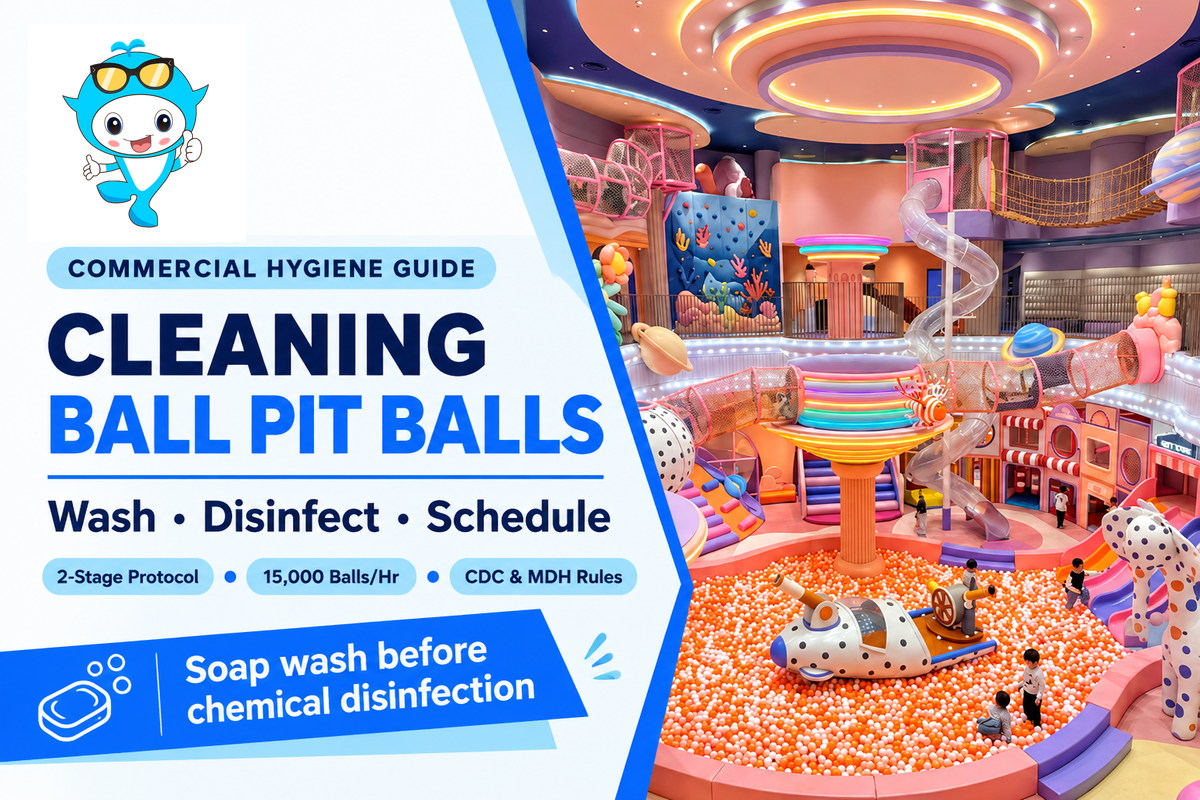
Cleaning ball pit balls involves a two-step sanitation process. First, wash any skin oils and dirt with soap or a mild detergent. Second, use an EPA-registered or BS EN 1276 / EN 14476 disinfectant and let it remain on the surface for the full contact time indicated on the label. Dwell times are 5 to 10 minutes for a 1:50 diluted bleach solution or 2 minutes for an early care soak with 1-tablespoon of disinfectant per gallon of water. In a commercial indoor playground, portable automated washers can scrub up to 15,000 plastic balls per hour and can bag 50,000 to 60,000 balls per hour. Small batches of airtight spheres can be run in half-filled mesh laundry bags in a front-load washing machine on a cold gentle cycle.
Because hundreds of children play in the same ballpit every day, regular ball pit cleaning is a core infection-control duty. Consistent regular cleaning removes skin oils. If grime is left on the plastic, it can build up and make surfaces even harder to clean, so cleaning is essential to remove soil. If dirt and other stuff is left on the plastic, it can make it even harder for sanitizing or disinfecting chemicals to reach and kill germs.
Quick Specs: Commercial & Small-Batch Ball Pit Sanitation Benchmarks
| Mandatory Cleaning Sequence | 2 stages: soap or detergent wash before chemical sanitizing or disinfection; wash hands for 20 seconds afterward (CDC Facility Guidelines) |
| Small-Batch Washing Machine Rule | Pinhole-free LDPE balls in halfway-filled mesh laundry bags, cold water gentle cycle, skip the heated dryer (Playroom Collective) |
| Commercial Ball Washer Throughput | Up to 15,000 balls per hour washing; 50,000–60,000 balls per hour bagging; 60 kg build, 130 × 65 × 115 cm, 2 kW motor, 80–100 L tank (BBW2020 / Pure-Matic) |
| Validated Disinfectant Dosing | EasyClean at 320 ml (10.8 fl oz) per 100 liters (26.4 gallons) water (BS EN 1276 / EN 14476, >95% bacterial kill, 15 washes per 5 liters) or 1:50 bleach for 5–10 minutes |
| Ball Diameter & Material Safety | ≥7 cm (70 mm / 2.75 inches) airtight BPA-free LDPE to clear the 2.25-inch CPSC test cylinder; lead ≤100 parts per million; ASTM F963 |
| Pit Enclosure Hygiene Specs | 35 kg/m³ EPE foam (tested to 100,000 cycles), 2.0–2.5 mm galvanized steel frame, ASTM F1918-21 / ASTM F1918-22 & EN 1176 (Didi Land) |
How to Clean Ball Pit Balls: The 2-Stage Cleaning Process and Sanitization Protocol
An effective ball pit cleaning process has two distinct stages. First, wash the spheres with commercial cleaners containing soap or detergent and water to strip skin oils and visible dirt. Second, a sanitizer or disinfectant is applied for the full contact time listed on the product. Skipping the pre-wash detergent leaves dirt that creates a protective barrier against the chemical’s contact with germs and makes it harder to kill germs.
Public health recommendations from the U.S. Centers for Disease Control and Prevention (CDC) make a distinction between physical cleaning and chemical disinfection. Guidance from the Minnesota Department of Health (MDH, MN Rules 4626.1520) follows the same line of reasoning. Although play area surfaces may look cleaned, bacteria and viruses may still be present. As kids climb through a ball pool, each pit ball picks up sweat, saliva, and dust. Spraying a disinfectant onto unwashed spheres only coats the outer layer of dirt. When planning new play zones, check out our commercial indoor soft play equipment layout and material guide to see how pit geometry can inform design for extraction access.
“Clean surfaces before sanitizing or disinfecting them, because dirt or other impurities on the surfaces may prevent sanitizing or disinfecting chemicals from making contact with germs and killing them.”
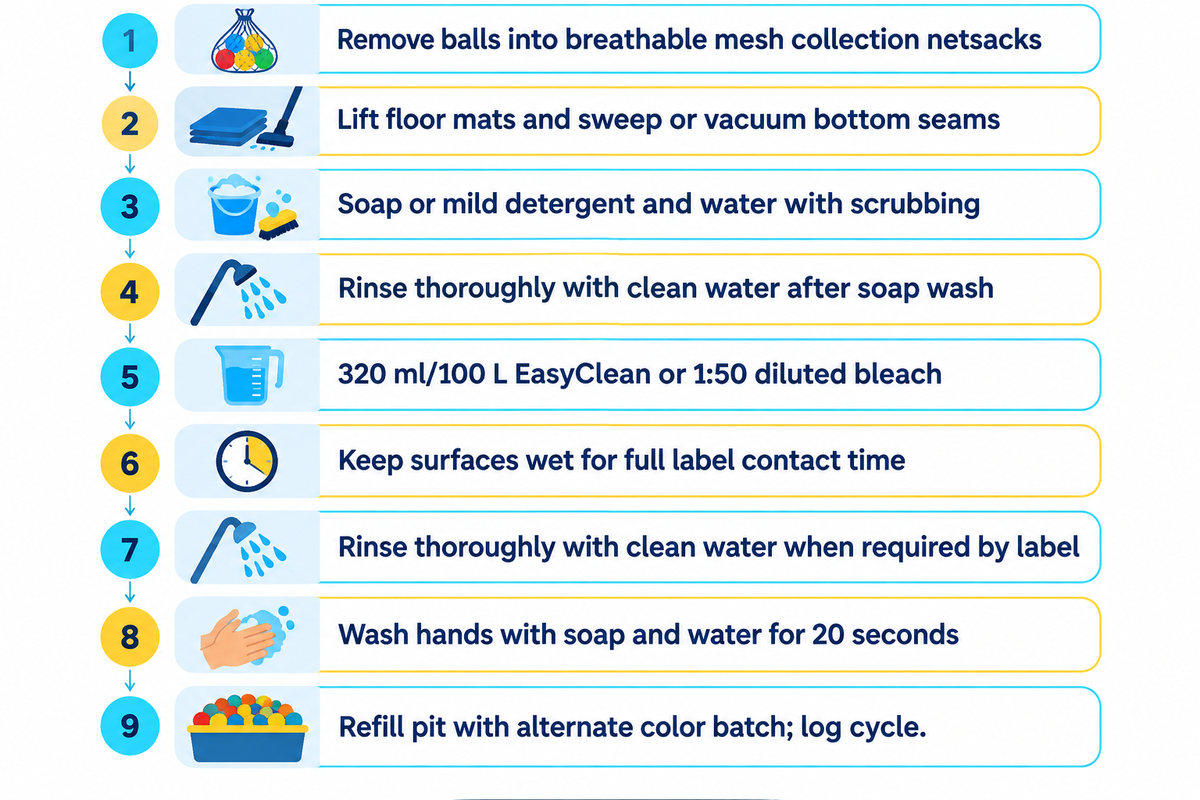
Our 2-Stage Wash-Before-Disinfect Protocol breaks routine ball cleaning into nine control points for operation. Staff may carry out the procedure using a manual soak basin, or an automated machine to clean a ball pit.
| Protocol Stage | Operating Parameter | Target Soil or Hazard | Verification Check |
|---|---|---|---|
| 1. Pit Extraction & Sorting | Remove balls into breathable mesh collection netsacks | Crushed, split, or punctured plastic spheres | Discard any ball with cracks or water inside |
| 2. Sub-Floor Vacuuming | Lift floor mats and sweep or vacuum bottom seams | Hair, sock lint, crumbs, and lost pocket items | Zero visible debris on floor padding seams |
| 3. Stage 1 Surfactant Pre-Wash | Soap or mild detergent and water with scrubbing | Skin oils, food residue, and surface grime | Rotary brush or mesh-bag agitation scrub |
| 4. Clean Water Rinse | Rinse thoroughly with clean water after soap wash | Residual detergent foam before chemical step | Runoff water clears with zero soap suds |
| 5. Stage 2 Chemical Disinfection | 320 ml/100 L EasyClean or 1:50 diluted bleach | Remaining bacteria, fungi, and viruses on plastic | Measure dosage per manufacturer instructions |
| 6. Mandatory Wet Contact Hold | Keep surfaces wet for full label contact time | Incomplete germ kill from flash drying | 5–10 minutes for 1:50 bleach; ≥2 minutes ECE soak |
| 7. Post-Disinfection Rinse Rule | Rinse thoroughly with clean water when required by label | Chemical residue from 1:50 bleach or spray cleaners | No rinse needed for EasyClean (320 ml/100 L) or 1 tbsp/gal ECE soak |
| 8. Air Drying & Handwashing | Air dry completely on clean towels, racks, or blower | Trapped moisture breeding mold in the pit | Wash hands with soap and water for 20 seconds |
| 9. Batch Rotation & Log Sign-Off | Refill pit with alternate color batch; log cycle | Skipped bottom ball layers during rotation | Operator signature, date, and disinfectant used |
Source: Synthesized from the CDC Facility Cleaning Guidelines, Minnesota Department of Health Indoor Play Area Guidance, and the Pure-Matic EasyClean Protocol.
Here are some guidelines to consider when cleaning indoor areas where there’s a known COVID outbreak.
Why Must You Wash Ball Pit Balls with Detergent Before Applying Disinfectant?
You need to wash ball pit balls with soap or detergent prior to applying disinfectant, as dirt and grease physically cover microbes on the plastic surface. Impurities also reduce the ability of sanitizing/disinfecting chemicals to reach and kill germs. Scrubbing with soap/detergent breaks down the oils on low density polyethylene (LDPE) and permits the chemical to reach the shell.
As noted in Hashtag Clean’s commercial bleach safety guide, sodium hypochlorite is less effective on porous surfaces and doesn’t remove heavy grease and grime without pre-cleaning. CDC facility guidelines also advise staff to wear gloves or goggles for skin and eye protection as recommended by Section 8 of the product’s Safety Data Sheet. Staff must wash hands with soap and water for 20 seconds immediately after disinfecting any virus or fungus.
Small-Batch Ball Pit Cleaning (<2,000 Balls): Washing Machine Rules, Mesh Bags, and Tub Soaks
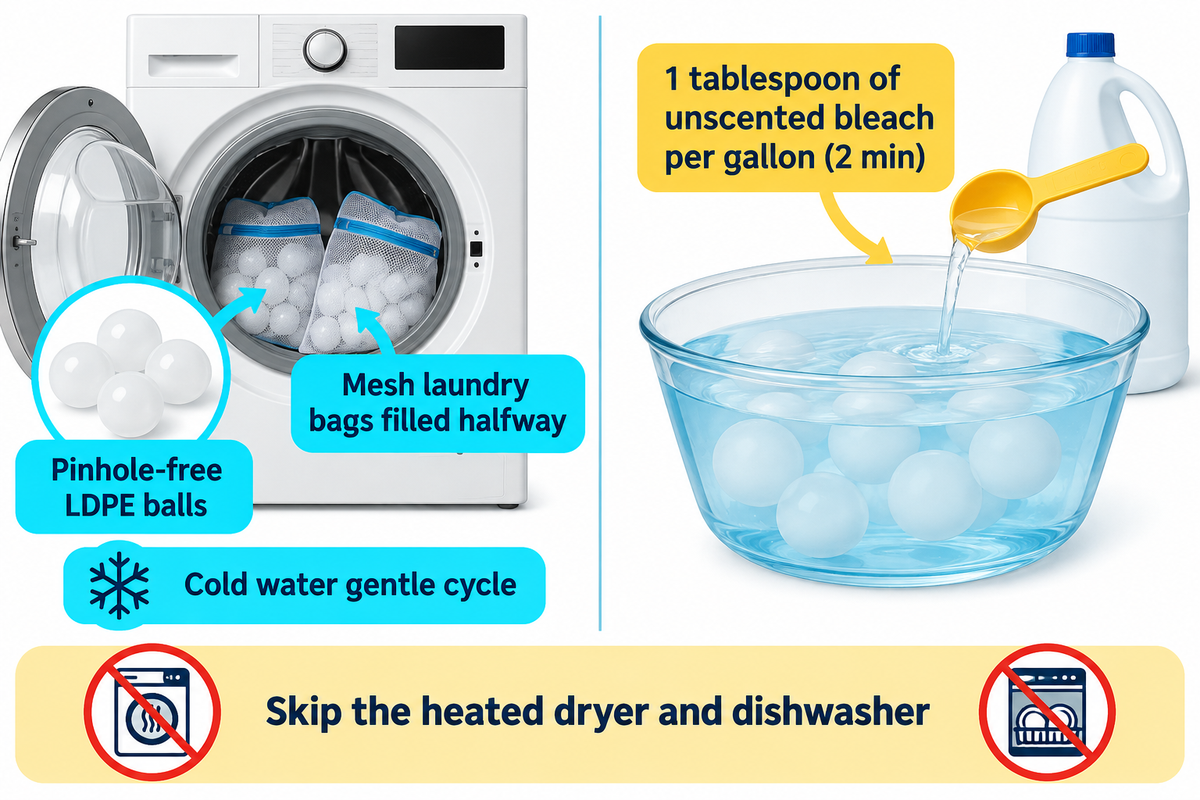
Small batches of airtight, pinhole-free LDPE balls can be washed in mesh laundry bags partially filled with laundry to allow for agitation. Run a front-load washing machine on a cold water gentle cycle using a small amount of fragrance free detergent and skip the heated dryer. For basin soaking, CDC early care and education guidance states to use 1 tablespoon of unscented bleach for every gallon (16 cups) of water and let soak for a minimum of 2 minutes.
Home playrooms, pediatric clinics, and operators operating a mobile soft play rental business regularly clean batches of 50 to 100 balls at a time or several hundred balls between bookings. Members of the r/CleaningTips subreddit suggest sanitizing balls in mesh bags in an LG HE Front Loader washing machine on a cold cycle. They allow the balls to air dry because floating balls clog the drain in a bathtub. To contain balls during the washing and rinsing process, they put them in zippered mesh laundry bags.
Are Ball Pit Balls Machine Washable Without Warping or Trapping Water?
Yes, ball pit balls are machine washable on cold water gentle cycle if they’re single-piece, pinhole-free LDPE spheres. Place the balls inside mesh laundry bags filled halfway in an agitator-free front-load washing machine, and air dry them completely on clean towels or a drying rack. Balls with cracks and small air holes will trap water.
Playroom Collective’s ball pit safety analysis describes how to perform a gentle cycle using only half of a mesh laundry bag with mild detergent. Overfilled bags restrict tumbling, and top-load center agitators can crush thin-walled plastic spheres. Always skip the heated dryer and never place LDPE play balls in a dishwasher, because high heat warps plastic and shrinks fabric covers. Inspect balls for cracks and damage before returning them to the pit.
⚠️ Common Mistake: Immersing Plastic Balls That Have Air Holes or Cracks
Plastic balls often have small air holes or cracks from manufacturing or wear. These imperfections can fill with wash water and cause mold to grow over time (Experia UK; Soft Play Toys 4 Kids). When balls have pinholes, they should be sprayed in batches of 50-100 using a clean microfiber cloth, instead of being immersed in water.
Safe Disinfectants for Ball Pit Balls: Chemical Concentrations, Dwell Times, and Material Limits
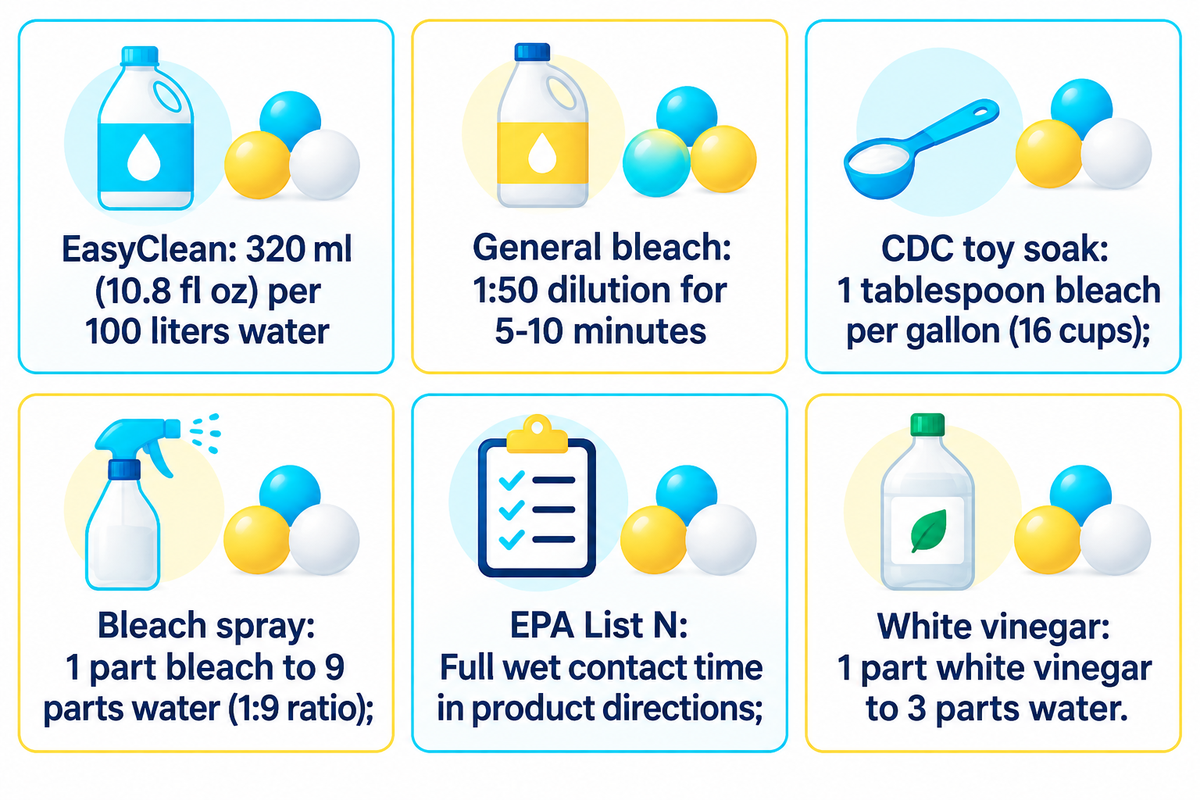
Validated disinfectants for ball pit balls include Pure-Matic EasyClean commercial detergent dosed at 320 ml (10.8 fl oz) per 100 liters (26.4 gallons) of water. Operators can also use household bleach (4%–5% sodium hypochlorite) diluted 1:50 for 5 to 10 minutes of contact time. For small-batch toy soaking, the CDC specifies 1 tablespoon of unscented bleach per gallon (16 cups) of water for at least 2 minutes.
Using an EPA-registered disinfectant that is safe for children supports safe play for toddlers who mouth plastic spheres. Skipping disinfection after detergent washing leaves residual pathogens that increase the risk of illness. According to Pure-Matic’s lab-tested EasyClean detergent data, pouring 320 ml (10.8 fl oz) of EasyClean into 100 liters (26.4 gallons) of clean water kills more than 95% of bacteria with no rinsing required. The 100% biodegradable formula complies with EU/UK biocide Product Type 1–5 categories and is certified to BS EN 1276, EN 1499, EN 1500, EN 1650, EN 13623, EN 13697, EN 14476, and EN 901. That gentle chemistry also protects custom commercial soft play equipment systems. One 5-liter (1.3-gallon) canister provides 15 full washes.
| Solution / Protocol | Documented Dilution / Dosage | Contact Time / Cycle | Certified Standard or Source | Post-Rinse Rule |
|---|---|---|---|---|
| EasyClean Ball Washer Detergent | 320 ml (10.8 fl oz) per 100 liters (26.4 gal) water | Machine wash cycle (>95% bacterial kill) | BS EN 1276, EN 14476, EN 1650, EN 13697 (Pure-Matic) | No rinsing required |
| General Disinfection Bleach (4%–5%) | Around 1:50 dilution in water | 5–10 minutes contact time | Hashtag Clean UK bleach safety guide | Rinse child-contact surfaces with clean water |
| Early Care Toy Bleach Basin Soak | 1 tablespoon unscented bleach per gallon (16 cups) water | Soak completely underwater for ≥2 minutes | CDC Early Care and Education Settings guidance | Do not rinse; air dry (bleach breaks down as it dries) |
| Concentrated Bleach Spray Solution | 1 part bleach to 9 parts water (1:9 ratio) | Spray balls thoroughly after detergent wash | Experia UK sensory & commercial ball pit guide | Wipe and dry completely before use |
| EPA List N / Child-Safe Toy Disinfectant | Per EPA-registered product label directions | Full wet contact time in product directions | CDC Facility Guidance & Playroom Collective | Rinse thoroughly with clean water for toy soaking |
| White Vinegar Surface Spray (Routine Wipe) | 1 part white vinegar to 3 parts water | Spray lightly in batches of 50–100 balls; wipe | Playroom Collective routine cleaning method | Routine cleaning only; not an EPA disinfectant |
What Disinfectants Are Safe for LDPE Ball Pit Balls and PVC Padding?
EPA-registered child-safe disinfectants, Pure-Matic EasyClean (320 ml per 100 liters of water), and properly diluted unscented bleach are safe for non-porous LDPE ball pit balls. Make sure to follow directions on the label and the product label for wet contact time and rinsing requirements for child’s play surfaces.
When using household bleach (which typically contains 4%–5% sodium hypochlorite), Hashtag Clean notes a 1:50 dilution and a 5 to 10 minute contact time for general disinfection. Never mix cleaners and disinfectants, because combining chemicals can release hazardous fumes (CDC). Keep an EN 14476 or EPA List N disinfectant on hand for viral sanitation.
Commercial Ball Pit Cleaning Machines: Brush-Wash-Dry Throughput and Sizing Specs
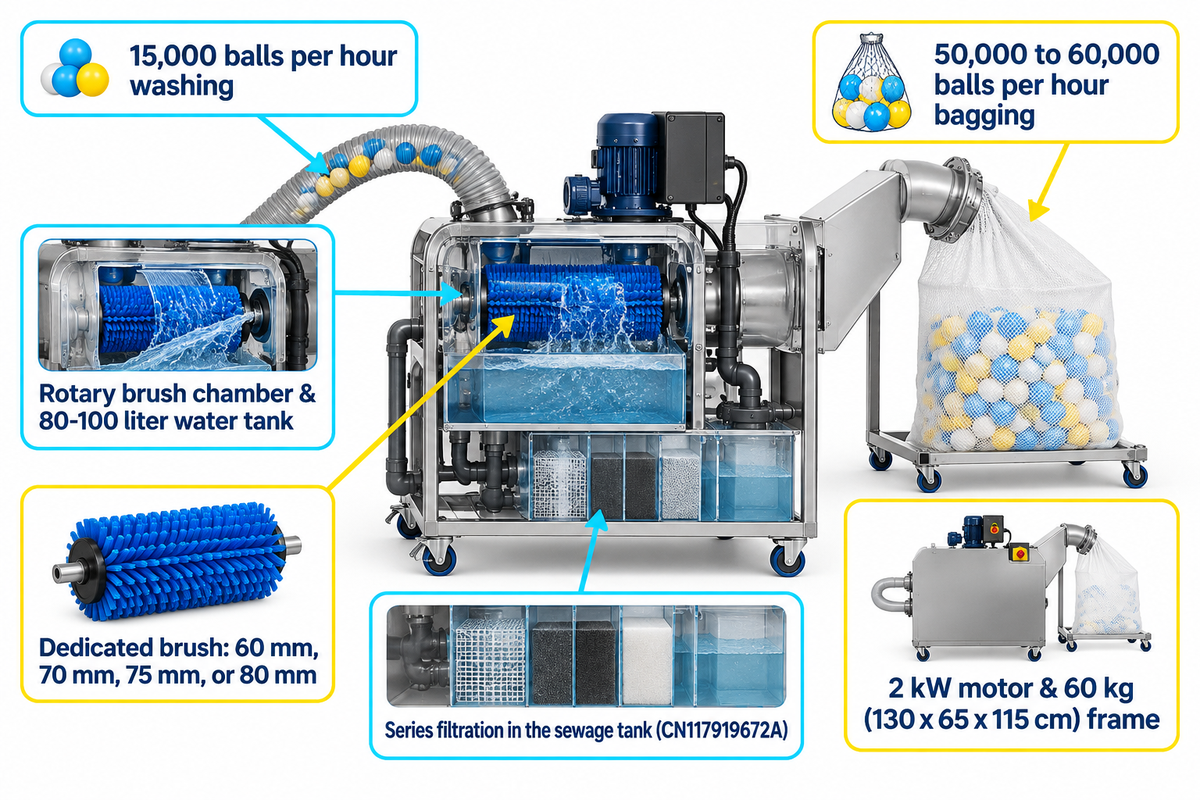
Commercial ball pit cleaning machines clean up to 15,000 balls per hour and collect or bag 50,000 to 60,000 balls per hour. Each unit contains a rotary brush chamber, an 80-100 liter water tank, a 2 kW motor, and a suction hose. The 60 kg (130 × 65 × 115 cm) frame can fit through a standard door frame.
Ball pits were invented by designers Charlotte Rude and Hjördis Olsson-Une for Ikea in 1970 and soon spread to McDonald’s PlayPlaces, Euro-Matic installations, and family entertainment centers (Core77). Portable automated washers now replace slow manual net washing. Documented commercial units include the BBW2020 Ball Cleaning Machine 240V (£6,378.68 UK package with a 5.0 m hose, 25 netsacks, and 2 towels). Another benchmark is the Pure-Matic commercial ball washer, configured for 110V/60Hz in the United States or 220–240V/50Hz in Europe with a 1-year warranty extendable to 5 years.
In a washer, mechanical scrubbing acts like a miniature car wash while water filtration keeps spheres clean. Patent CN117919672A (application CN202311827865.0A) describes a spherical surface cleaning device that has a friction disc, brush plate and a series of filtration elements in the sewage tank. Hair and other debris are filtered from the recirculating 80-100 liter tank, to ensure consistent washing performance.
A critical operational limitation is brush-to-ball diameter matching. Commercial rotary-brush ball washers require a dedicated brush set matched to each ball diameter (60 mm, 70 mm, 75 mm, or 80 mm) and can’t wash soft foam balls. On the BBW2020, the standard brush suits 75 mm and 80 mm balls, with alternative brushes available for 60 mm and 70 mm spheres. As Pure-Matic warns, using the wrong brush size causes balls to jam and damages the machine. By contrast, the K-Matic manual collector adjusts wire spacing to gather 60 mm, 70 mm, 75 mm, or 80 mm balls.
Manual Mesh-Bag Washing vs. Automated Ball Washers: Labor Hours and ROI Worked Example
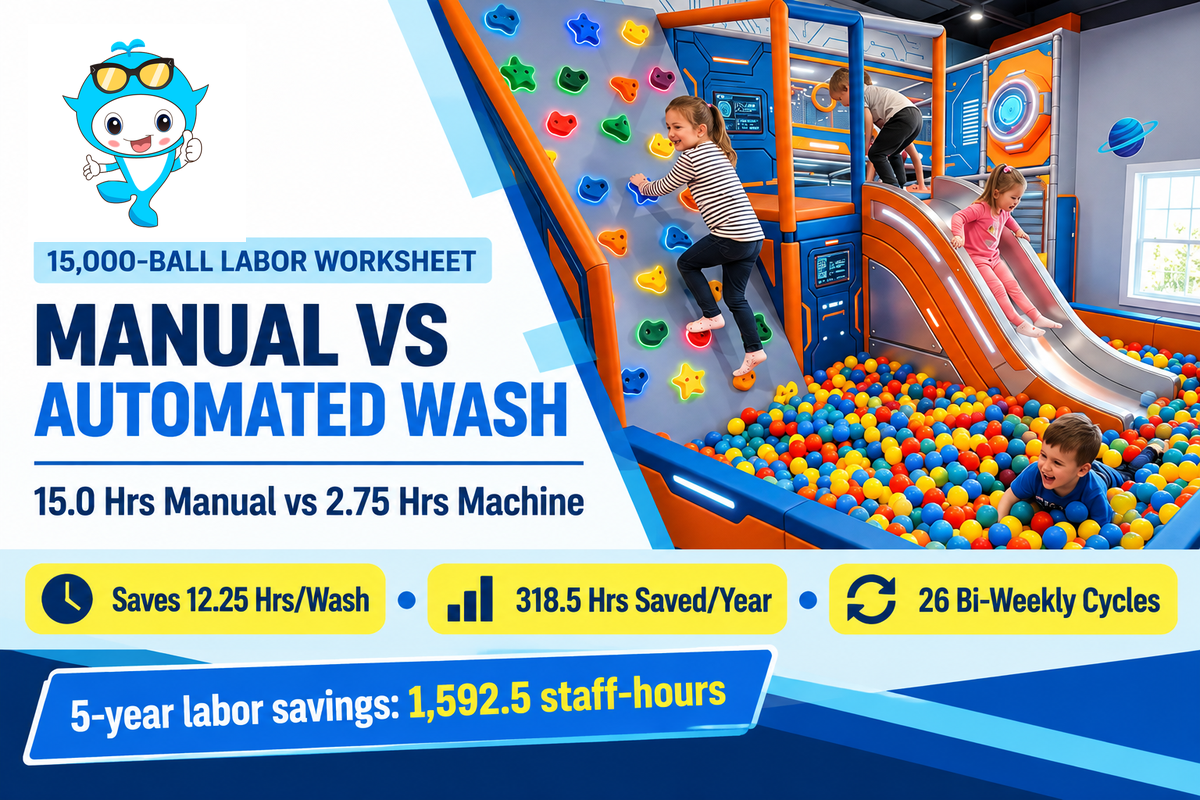
For a 15,000-ball commercial pit, manual mesh-bag soaking takes 12.0 to 18.0 staff-hours per deep-clean cycle (15.0 staff-hours midpoint). By contrast, a 15,000-ball-per-hour automated ball washer finishes active washing in 1.0 machine-hour and full pit turnaround in 2.5 to 3.0 staff-hours (2.75 staff-hours midpoint). Automation saves 12.25 staff-hours per wash, or 318.5 staff-hours per year across 26 bi-weekly cycles.
Consider a commercial indoor playground operating a 15,000-ball pool on a bi-weekly deep-cleaning schedule to prevent the multi-week microbial buildup documented in clinical ball pits (APIC). TQ Playtopia in Oklahoma City closes every Tuesday to run the washing of every ball in every pit with its commercial ball washer, which takes the crew 5 hours (Core77). Below is our 15,000-Ball Labor & Consumable Worksheet comparing manual bag soaking to a portable automated machine.
Assumed inputs for this worked calculation: The pit holds 15,000 airtight 70 mm LDPE balls washed on a 26-cycle bi-weekly annual schedule (130 cycles over 5 years). Manual soaking uses 60 mesh bags (250 balls/bag) requiring 9.0 to 12.0 staff-hours of active tub washing plus 3.0 to 6.0 staff-hours for extraction, liner wiping, and refilling (12.0 to 18.0 staff-hours total; 15.0 staff-hours midpoint). The automated washer runs at 15,000 balls per hour for washing (1.0 hour) and 50,000 to 60,000 balls per hour for bagging with 1 to 2 operators. Total machine turnaround takes 2.5 to 3.0 staff-hours per cycle (2.75 staff-hours midpoint; Pure-Matic / Capital Cleaning Supplies BBW2020, listed at £6,378.68 in the UK). Payback for the equipment, and annual labor cost savings, depend on local wages, water and electricity costs, and whether the facility washes bi-weekly or monthly.
| Operational Metric | Manual Mesh-Bag Soaking (60 Bags) | Automated Washer (BBW2020 / Pure-Matic) |
|---|---|---|
| Active Ball Washing Time | 9.0–12.0 staff-hours (basin soak + manual agitation) | 1.0 machine-hour (at 15,000 balls per hour) |
| Pit Extraction, Liner Wipe & Refill | 3.0–6.0 staff-hours (manual scooping + towel/rack dry) | 1.5–2.0 staff-hours (50,000–60,000 balls/hr collection) |
| Total Staff Labor per Cycle | 12.0–18.0 staff-hours (15.0 staff-hours midpoint) | 2.5–3.0 staff-hours (2.75 staff-hours midpoint; 1–2 staff) |
| Annual Staff Labor (26 Bi-Weekly Cycles) | 390.0 staff-hours/year (15.0 hrs × 26 cycles) | 71.5 staff-hours/year (2.75 hrs × 26 cycles; saves 318.5 hrs/yr) |
| Water & Detergent per Cycle | Multiple wash and rinse basin refills | 80–100 liters water + 320 ml (10.8 fl oz) EasyClean |
| Drying & Reopening Workflow | Air dry completely on clean towels or drying racks | Collection into 25 breathable netsacks; no rinse with EasyClean |
5-year total cost of ownership resource breakdown (15,000-ball pit across 130 bi-weekly cycles):
| Cost item | Manual Mesh-Bag Soaking | In-House Automated Ball Washer (BBW2020 / Pure-Matic) |
|---|---|---|
| Purchase price | Mesh laundry bags and wash basins (varies by local supplier; request a quote) | £6,378.68 UK retail benchmark for BBW2020 (ball pit modules range from USD 480 to USD 2,545 on selected public pages; request a quote) |
| Installation & commissioning | Manual basin setup using existing utility sink | Plug-and-play portable 110V/60Hz or 220–240V/50Hz unit with 80–100 L tank (no fixed plumbing needed) |
| Energy & water (5-yr / 130 cycles) | Warm wash and clean-water rinse refills across 130 cycles | 260 kWh motor draw (2 kW × 1.0 hr × 130 cycles) + 10,400–13,000 liters water |
| Labor & detergent (5-yr / 130 cycles) | 1,950.0 staff-hours (15.0 hrs × 130 cycles) + detergent and disinfectant | 357.5 staff-hours (2.75 hrs × 130 cycles) + nine 5-liter EasyClean canisters (15 washes per 5 L) |
| Downtime & warranty coverage | Multi-hour air drying on towels or racks after each wash | 1-year standard machine warranty (extendable up to 5 years); 25 netsacks included |
Workload summary: Automation saves 12.25 staff-hours per bi-weekly cycle, cutting 5-year cleaning labor from 1,950.0 staff-hours to 357.5 staff-hours. That equals 1,592.5 staff-hours saved across 130 washes (multiply by your local hourly wage rate to calculate cash payback).
Commercial Ball Pit Cleaning Schedule: Daily, Weekly, and Traffic-Adjusted Cadence
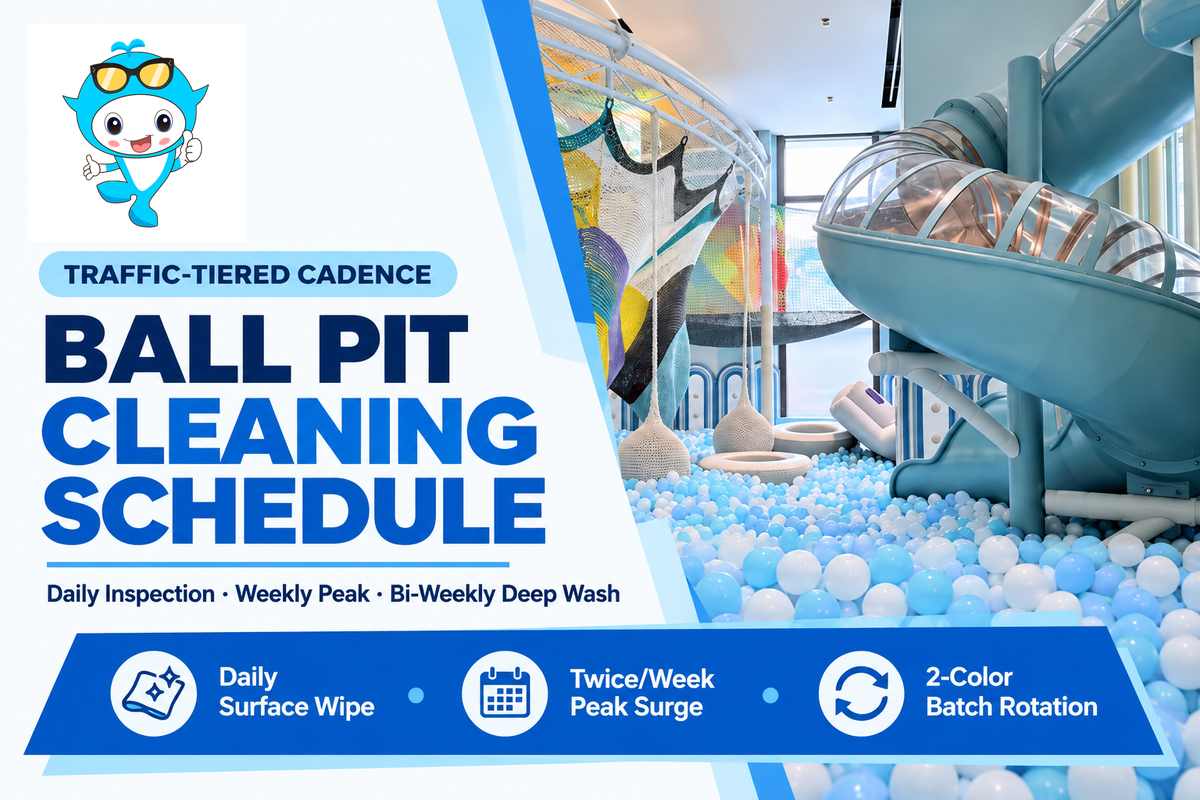
There’s no single federal mandate requiring commercial ball pit washings, thus operators combine state daily surface rules with traffic-adjusted deep washings. Inspect the pit and clean visible dirty surfaces daily, and sanitize high-volume zones at least once, and preferably twice, weekly. Conduct full pit extraction every 2 to 4 weeks, or every 3 to 6 months in low-use sensory rooms.
We have a guide to indoor playground maintenance that shows ball pit cleaning happens according to various schedules that aren’t nationally standardized. Operators combine the Minnesota Department of Health daily cleaning rule for general play surfaces (MDH MN Rules 4626.1520) with field-tested scheduling. In Aurora, Colorado, a municipal crew of one full-time worker and two seasonal workers cleans 78 playgrounds monthly. During peak season (April through October) and holidays, they may clean it twice a week and conduct daily inspections of popular areas (Playground Professionals). For sensory and home rooms, Experia UK recommends cleaning balls daily (or after 2 to 3 home uses) and thoroughly sanitizing the entire pit every 3 to 6 months.
| Facility Tier & Source Benchmark | Every Day (Opening/Closing) | Weekly / Peak Routine | Full-Pit Deep Wash & Liner Scrub |
|---|---|---|---|
| Home Playpen (Playroom Collective / Experia UK) | Clean balls after 2–3 uses; remove cracked spheres | Light 1:3 vinegar-water wipe in batches of 50–100 balls | Quarterly (45-min EPA disinfectant soak) or every 3–6 months |
| Sensory Room / Low-Traffic Clinic (Experia UK / CDC) | Daily ball surface cleaning and damaged-ball check | 4-step weekly maintenance checklist (Soft Play Toys 4 Kids) | Monthly to every 3–6 months (plus after any illness event) |
| Commercial Indoor Playground (Didi Land / Core77) | Daily inspection and high-touch vinyl cleaning (MDH rule) | Weekly Tuesday 5-hour ball washer deep clean (TQ Playtopia) | Every 2–4 weeks (bi-weekly benchmark for high weekend traffic) |
| Peak Season / Holiday Surge (Aurora Municipal Benchmark) | Daily inspection at popular sites for repair and sanitation | Twice per week or more during peak season and holidays | Immediate closure and full wash upon any body-fluid incident |
How Often Should Commercial Indoor Playgrounds Sanitize Their Ball Pits?
Generally speaking, commercial indoor playgrounds should be equipped to perform peak-season ball washes weekly, and full-pit, deep cleaning every 1 to 4 weeks. Facilities should also immediately disinfect the play zone if someone using it gets sick.
Preventing staff from washing solely the top-layer spheres can be achieved with a two-color ball rotation system combined with dated cleaning logs. Stock Batch A in blue/white and Batch B in pink/white (two of Didi Land’s 17 named ball colors). When Batch A is washed and dried, Batch B is placed in the pit. This tracks batch rotation between distinct ball colors alongside dated cleaning logs.
Biohazard Spill Response: Immediate Quarantine for Vomit, Urine, and Diaper Leaks
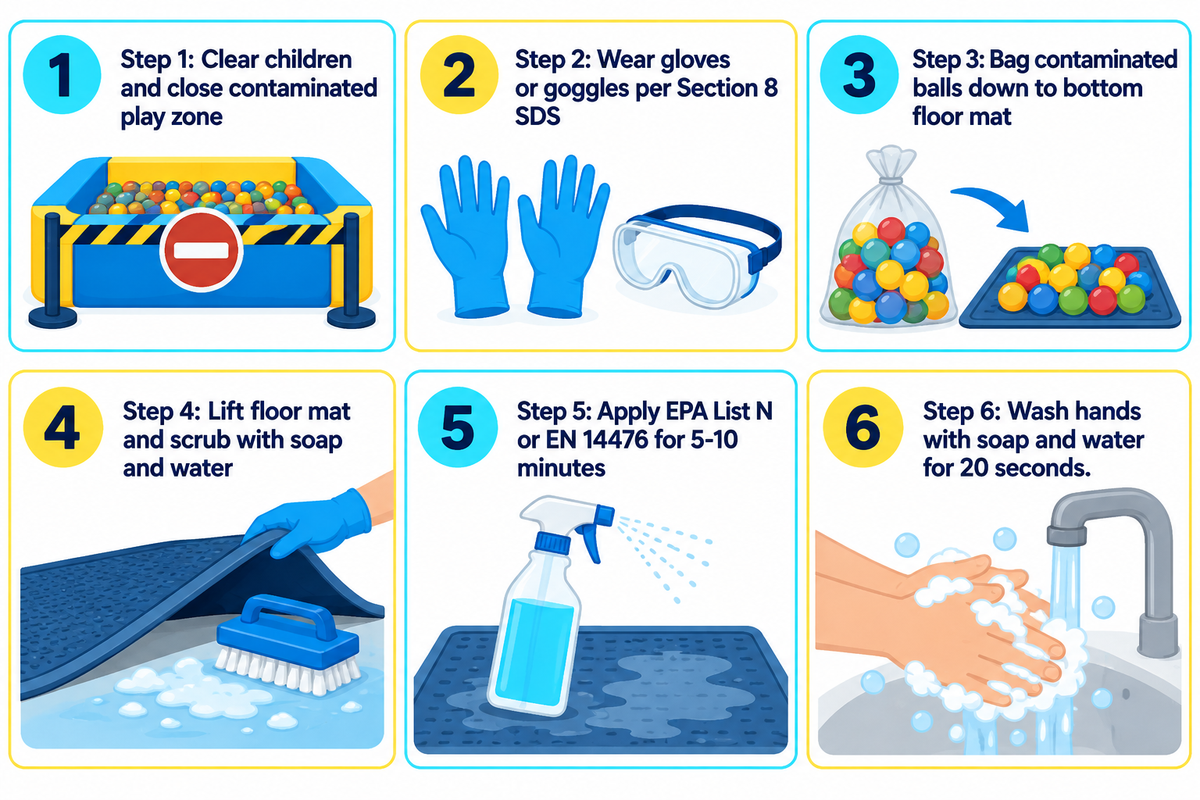
Remove the soiled balls down to the floor mat, or empty the entire pit if liquid spread across the bottom liner. Wipe all surfaces with soap and water and a disinfectant. Maintain the disinfectant contact time.
Why is surface spot-wiping insufficient? Liquid vomit, pee, or urine trickles between smooth LDPE spheres and collects on the floor pad underneath. CDC facility disinfection guidance directs staff to disinfect surfaces where people have obviously been ill. Minnesota Department of Health indoor play area guidance also requires immediate cleaning and disinfection of contaminated play surfaces. Toddler zones carry higher mouthing exposure, so review our infant sensory play area material safety rules when configuring baby ball pools.
-
✔
Step 1 (Close & Cordon Immediately): Clear children from the ball pool and close the contaminated play zone until cleaning and disinfection are complete. -
✔
Step 2 (Wear Recommended PPE): Staff wear gloves or goggles to protect skin and eyes from splashes, as recommended by Section 8 of the product’s Safety Data Sheet (CDC). -
✔
Step 3 (Extract Balls to the Floor Pad): Bag all contaminated balls down to the bottom floor mat. Empty the entire ball pit when liquid spills reach the base liner. -
✔
Step 4 (Soap-and-Water Pre-Clean): Lift the removable floor mat, blot gross soil, and scrub the cover and balls with soap or detergent and water before applying disinfectant. -
✔
Step 5 (Disinfect for Full Contact Time): Apply an EPA List N or EN 14476 disinfectant for the full contact time in the product directions (such as 5–10 minutes for diluted bleach). Rinse when required and air dry completely. -
✔
Step 6 (Wash Hands for 20 Seconds): Immediately after disinfecting, staff wash hands with soap and water for 20 seconds (CDC).
Drying, Mold Prevention, and Why Pinhole Balls Fail Commercial Sanitation
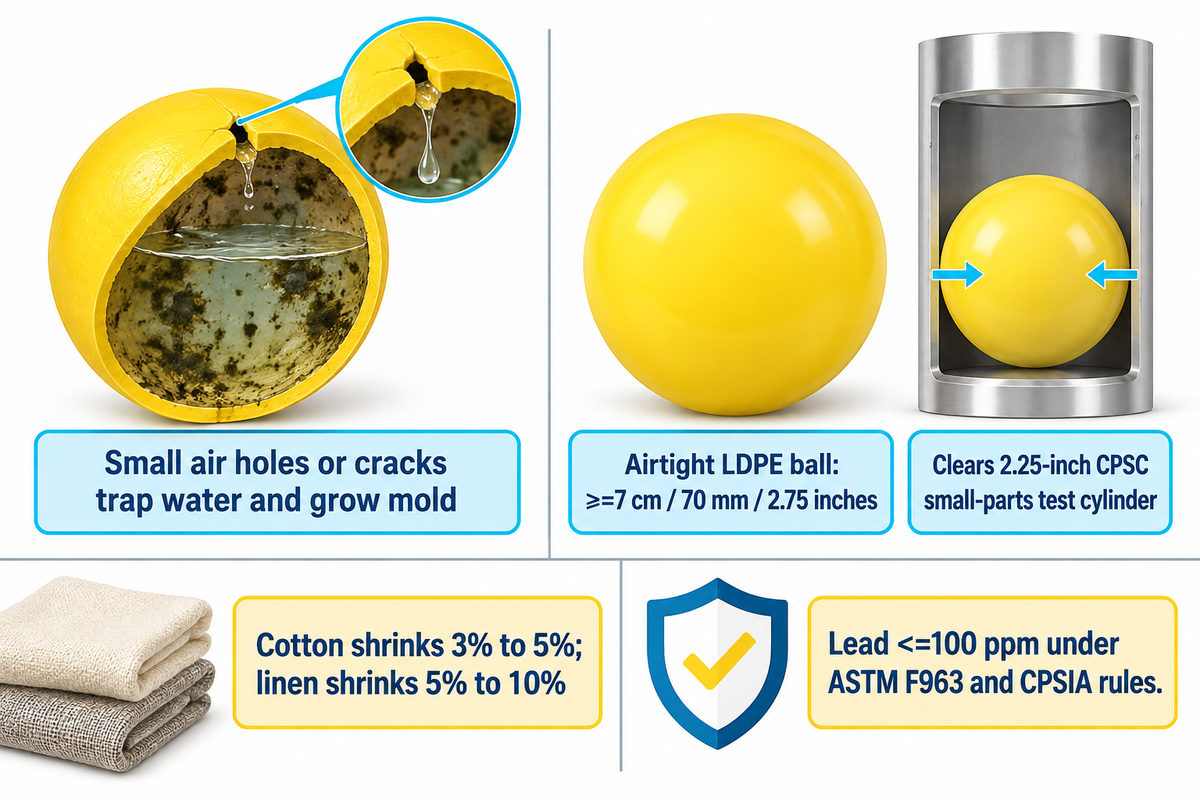
You’ll need to use airtight LDPE balls (with a diameter of at least 7 cm/ 70 mm/ 2.75 inches) for mold prevention in a ball pit. Air dry washed spheres and pit covers until 100% dry before reassembly so moisture never sits against the foam base. If moisture is still present on any of the washed parts, make sure to completely dry them before reassembling them.
Both Soft Play Toys 4 Kids and Experia UK highlight the same failure mode. Mold grows inside individual plastic balls when they’ve small air holes or cracks and are submerged in water. Once the dirty liquid gets into a hollow sphere, it cannot be thoroughly dried by external wiping. In addition, Playroom Collective warns that cotton covers shrink 3% to 5% on the first wash and take 2 to 3 times longer to dry. Linen shrinks 5% to 10%, creating damp windows for mold growth if put back before the cover is 100% dry.
When obtaining replacement spheres for daily commercial usage, make sure to check for airtightness and also check for choking safety and throw any split balls. As Playroom Collective notes, according to the CPSC, toys intended for children under 3 years cannot contain small parts that can fit completely within a 2.25-inch test cylinder. This rule, therefore, requires a minimum ball pit ball diameter of 7 centimeters (approximately 2.75 inches / 70 mm) and accessible lead content of no more than 100 parts per million under ASTM F963 and CPSIA rules. Commercial operators specify 70 mm, 75 mm or 80 mm phthalate-free polyethylene balls (available from Didi Land in 17 named shades) to clear the choke cylinder and match commercial washer brush tracks.
Cleaning the Ball Pit Structure: Vinyl Liners, Velcro Floor Mats, and Hygiene-Ready Design
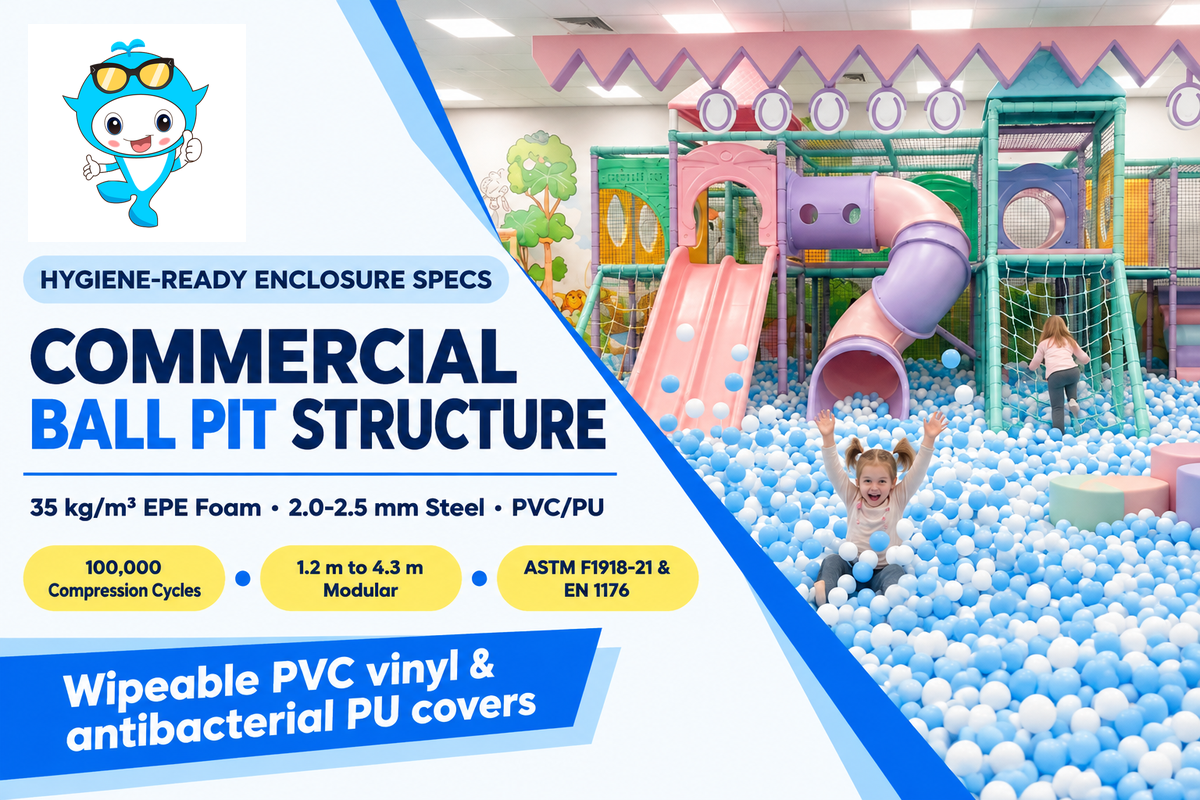
The empty ball pit structure needs to be cleaned for planned access by staff to sweep and wipe the floor liner. Walls need to remain stable during maintenance by specifying 35 kg/m³ EPE foam that’s tested to withstand 100,000 cycles of compression, and a 2.0-2.5 mm hot-dip galvanized steel frame covered with wipeable PVC or antibacterial PU.
A classic microbiology study of commercial restaurant ball pits (Davis et al., 1999, Pediatric Nursing, PMID 10532011) examined contamination across pit entrances and bottom linings. Residential foam pits with low-density sponge below 20 kg/m³ (or below 25D) flatten within months, while sewn vegan leather props trap debris in seams (Playroom Collective). By contrast, Didi Land engineers commercial soft play ball pits (round or square from 1.2 m to 4.3 m diameter) around cleaning access prior to ordering the first ball.
Every Didi Land commercial soft play set is built in our 12,000 sqm manufacturing facility with a 35 kg/m³ minimum-density EPE foam core that returns to original shape after 100,000 compression cycles. Each enclosure uses durable PVC or antibacterial PU covers and a 2.0–2.5 mm hot-dip galvanized steel frame (avoiding 1.2 mm thin tubing that buckles). Systems align with ASTM F1918-21 (Didi Land Ball Pit Specifications), ASTM F1918-22 (Go Play Systems), EN 1176, AS 4685.1, and ISO 9001:2015 (Didi Land Soft Play Equipment). Copy the RFQ checklist below into your supplier quote request:
RFQ checklist (copy these into your quote request):
| Parameter | Recommended range | Why it matters | How to verify |
|---|---|---|---|
| Ball diameter & choke safety | 70 mm, 75 mm, or 80 mm (≥7 cm / 2.75 in) | Clears the 2.25-inch CPSC small-parts test cylinder and fits dedicated commercial washer brushes | ASTM F963 / CPSC third-party test report + caliper check on sample batch |
| Ball shell construction | One-piece, pinhole-free airtight BPA-free & phthalate-free LDPE (lead ≤100 ppm) | Prevents wash water from entering hollow spheres and causing internal mold growth | Water immersion squeeze test on sample balls (zero air holes or bubbles) |
| Soft wall & mat cover material | Commercial wipeable PVC vinyl or antibacterial PU cover | Withstands routine detergent scrubbing and EPA-registered disinfectants without 3%–10% fabric shrinkage | Supplier material specification sheet and physical swatch inspection |
| Wall & floor foam core density | 35 kg/m³ commercial EPE foam (tested to 100,000 compression cycles; ≥30D) | Prevents wall collapse and permanent deformation seen in sub-20 kg/m³ residential sponge | Check foam density and compression test report on commercial quotation |
| Floor liner & cleaning access | 1.2 m to 4.3 m modular pit with planned ball extraction and floor-sweep access | Allows staff to vacuum dry hair and dust, and wipe up spilled liquids underneath without displacing adjacent play zones | Review 2D/3D CAD floor plan for removable mat access and washer hose routing |
| Structural frame & safety standard | 2.0–2.5 mm hot-dip galvanized steel; ASTM F1918-21 / F1918-22, EN 1176, AS 4685.1 | Confirms commercial indoor soft-contained play equipment structural and hygiene compliance | Request manufacturer compliance documentation package with quote |
Industry Hygiene Outlook: Documented Sanitization Logs and Automated Washing Adoption
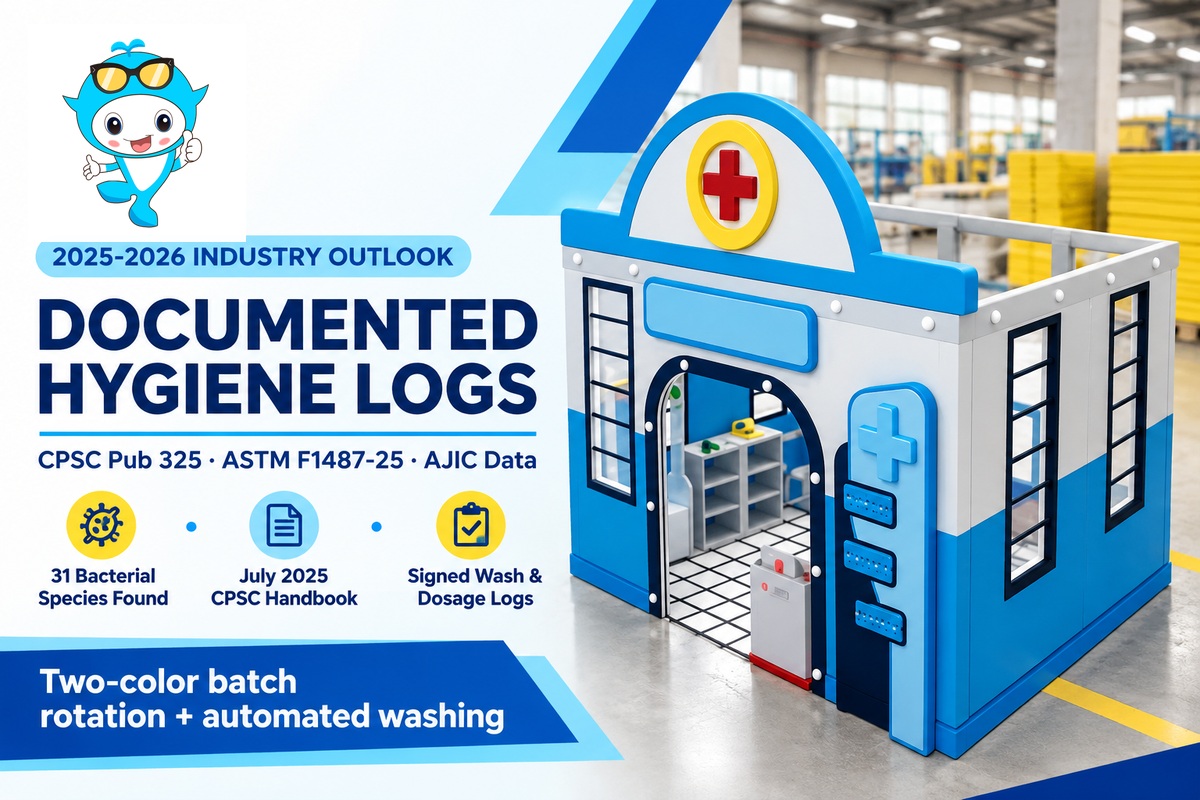
The updates to the July 2025 CPSC Public Playground Safety Handbook (Publication 325) and the 2025/2026 microbiology findings are requiring more rigor in hygiene documentations. Commercial operators are replacing informal washes with two-color ball Batch Rotation and automated ball washing machines.
What led to an emphasis on hygiene documentation? In the study published in the American Journal of Infection Control (Oesterle et al., 2019, PMID 30471972), documented by APIC, six physical therapy clinics in Georgia were assessed. Investigators from the University of North Georgia randomly selected 9 to 15 balls from various depths in each pit. Researchers identified 31 bacterial species and 1 yeast species (including 8 opportunistic pathogenic species such as Enterococcus faecalis, Staphylococcus hominis, Streptococcus oralis, and Acinetobacter lwoffii) in thousands of cells per ball. The Oesterle et al. (2019) microbial colonization counts came from six clinical physical therapy ball pits rather than commercial family entertainment centers, so contamination levels vary by venue hygiene cadence.
At the same time, inspection expectations tightened. In July 2025, the CPSC published its updated Public Playground Safety Handbook (Publication 325) alongside the revised ASTM F1487-25 standard (Playground Professionals). It marked the handbook’s first major revision since 2010 and noted over 190,000 emergency playground injuries annually (2021–2023 data). With expanded guidance on surfacing and chemical safety, venues, including teams managing high-throughput airport indoor playground hygiene planning now keep written logs recording wash dates, disinfectant dosage, and staff sign-off.
Frequently Asked Questions
Q: Can you put plastic ball pit balls in the dishwasher or heated dryer to sanitize them?
You should never put LDPE ball pit balls in a household dishwasher or a household clothes dryer.
High heat from wash heating elements and tumble dryers shrinks fabric and warps low-density polyethylene beads (Playroom Collective). Wash small batches in mesh laundry bags, half-full, on cold gentle cycles, and air dry completely on clean towels or a drying rack.
Q: Does cleaning ball pit balls with vinegar or baking soda disinfect commercial play pits?
Baking soda and white vinegar don’t disinfect commercial ball pit balls. That’s because baking soda and white vinegar don’t disinfect anything. Only EPA-registered disinfectants can disinfect.
A 1:3 solution of white vinegar and water can be sprayed lightly on batches of 50 to 100 balls and wiped with a microfiber cloth for routine home cleaning (Playroom Collective). Then, using a microfiber cloth, wipe them down. Pathogens can’t be disinfected using that method. However, killing pathogens requires washing with soap or detergent first and then applying an EPA-registered disinfectant or EN 1276 / EN 14476 solution for its full label contact time (CDC).
Q: How do you remove hair and dust buildup from the bottom of a ball pit?
Put balls in mesh net bags, lift removable floor mats, and vacuum the sub floor, then wash with detergent.
In the commercial ball washers, series filtration in the sewage tank (Patent CN117919672A) captures hair and solid debris. Meanwhile, the 80-100 liter tank clean up to 15,000 balls per hour.
Q: How do you track that every ball in a large pit was rotated during cleaning?
Use batches with no shared colors to help identify leftover balls during extraction; color identifies batches but not sanitization.
Pair color rotation with a written record of inspection, indicating the date, disinfectant used, and staff signature.
Q: How do you sanitize small batches of ball pit balls in a wash basin without a commercial machine?
Fill a mesh laundry bag half full with balls, then wash with soap and water. Thoroughly rinse. Then soak them in 1 tablespoon of unscented bleach per gallon (16 cups) of water for at least 2 minutes (CDC).
Make sure the solution thoroughly covers all parts of the balls and no air is trapped. Use clean hands or tongs to remove the mesh bags, and let the balls dry completely.
Q: When should cracked or dented ball pit balls be discarded instead of washed?
Dispose of any ball pit ball immediately if cracks, small holes, or sharp creases are present, or if liquid is trapped inside.
As Experia UK states, cracks and holes allow wash water to enter balls, and over time, mold to grow inside balls. Crushed spheres also reduce cushioning depth inside ball pool.
Design a Hygiene-Ready Commercial Ball Pit for Your Facility
Looking for a commercial ball pit engineered for fast, hygienic maintenance? Guangzhou Didi Land Amusement Equipment Co., Ltd. operates a 12,000 sqm factory exporting to 40+ countries since 2014 (selected public ball pit models range from USD 480 to USD 2,545 with 3–8 week delivery). We customize commercial ball pit systems with 35 kg/m³ EPE foam, 2.0–2.5 mm galvanized steel frames, and airtight ≥70 mm phthalate-free balls aligned with ASTM F1918-21 and EN 1176.
About This Analysis
This guide synthesizes facility and childcare disinfection recommendations from the CDC and Minnesota Department of Health alongside clinical ball pit microbiology (Oesterle et al., 2019, AJIC ). (2019) in the American Journal of Infection Control. The document also includes ball washer specifications (Pure-Matic / BBW2020) and first-party soft-play engineering specifications of Didi Land. The document has undergone review by the Guangzhou Didi Land Amusement Equipment Co., Ltd. technical team.
References & Sources
- When and How to Clean and Disinfect a Facility (U.S. Centers for Disease Control and Prevention, 2024)
- How to Clean and Disinfect Early Care and Education Settings (U.S. Centers for Disease Control and Prevention, 2024)
- Indoor Play Area Maintenance and Sanitation (Minnesota Department of Health, 2025)
- Are ball pits located in physical therapy clinical settings a source of pathogenic microorganisms? (Oesterle et al., AJIC 47(4):456-458) (PubMed / National Library of Medicine, 2019)
- Examining Ball Pits as a Playground for Pathogenic Germs (Association for Professionals in Infection Control and Epidemiology, 2019)
- Microbial Contamination of Children’s Ball Pits in Retail Food Establishments (Davis et al., Pediatric Nursing 25(2):151-7) (PubMed / National Library of Medicine, 1999)
- Patent CN117919672A: Ball Surface Cleaning Device with Multi-Stage Filtration (Google Patents, 2024)
- What Just Changed? A Look at the New July 2025 CPSC Playground Safety Updates (Playground Professionals, 2025)
- Playground Sanitation: Municipal Crew Protocols and Schedules (Playground Professionals)
- Here’s How They Clean the Balls in a Ball Pit (Core77 Industrial Design Magazine)