Get in Touch with Didi Land


Quick Specs
| Typical total investment | $100K (lean independent) to $3M+ (major franchise turnkey) |
| Minimum facility size | 18,000 sq ft, 17 ft ceiling clearance |
| Applicable safety standard | ASTM F2970 (US) / ISO 23659 (international) — not the children’s-playground ASTM F1487/F1918 |
| Vendor-published payback range | 8-36 months (varies by source and attraction mix; not independently audited) |
| Timeline to open | 4-8 months independent; add 2-4 months for franchise approval |
The cost to open a trampoline park is a wide range: roughly $100,000 for an entry-level, do-it-yourself build to upwards of $3 million for a top-tier franchise turnkey setup. Every indoor trampoline business faces this same starting question before any other planning step, and the honest answer depends on whether you franchise it or DIY it, how many zones you include, and the cost of real estate in your target market. This guide breaks down the number for four distinct buyer models, with sourced figures, walks through your realistic trampoline park startup cost model by model, then covers the franchise-vs.-DIY choice, a reasonable ROI calculation, what equipment you’ll need and how much space you require, plus the specific ASTM F2970 safety standard applicable to adult trampoline courts – it is NOT the same standard used for children’s soft play.
Key Takeaways
- The initial cost for Sky Zone, Altitude Trampoline Park and other major brands that franchise the investment (fee + royalty + build-out) tends to be between $1.5M and $3M, whereas DIY startup builders working directly with the factory and operating on smaller footprints may report costs in the range of $100K to $500K, depending on the vendor and other factors.
- FTC guidance warns against overly optimistic earnings representations for franchise enterprises, cautioning that “some franchises never break even” — take all vendor ROI claims with a grain of salt and verify any figures independently.
- Adult trampoline courts must comply with ASTM F2970 / ISO 23659, not ASTM F1487 / F1918, the standard for children’s soft-play equipment. This is perhaps the most common oversight in the sector.
- Adult jump-park incidents are far more serious than in-home trampoline settings — studies show a 45% fracture/dislocation rate in adult parks versus 17% in homes. The physical environment and staffing should address these risks, not just liability documents.
How Much Does It Cost to Open an Adult Trampoline Park?
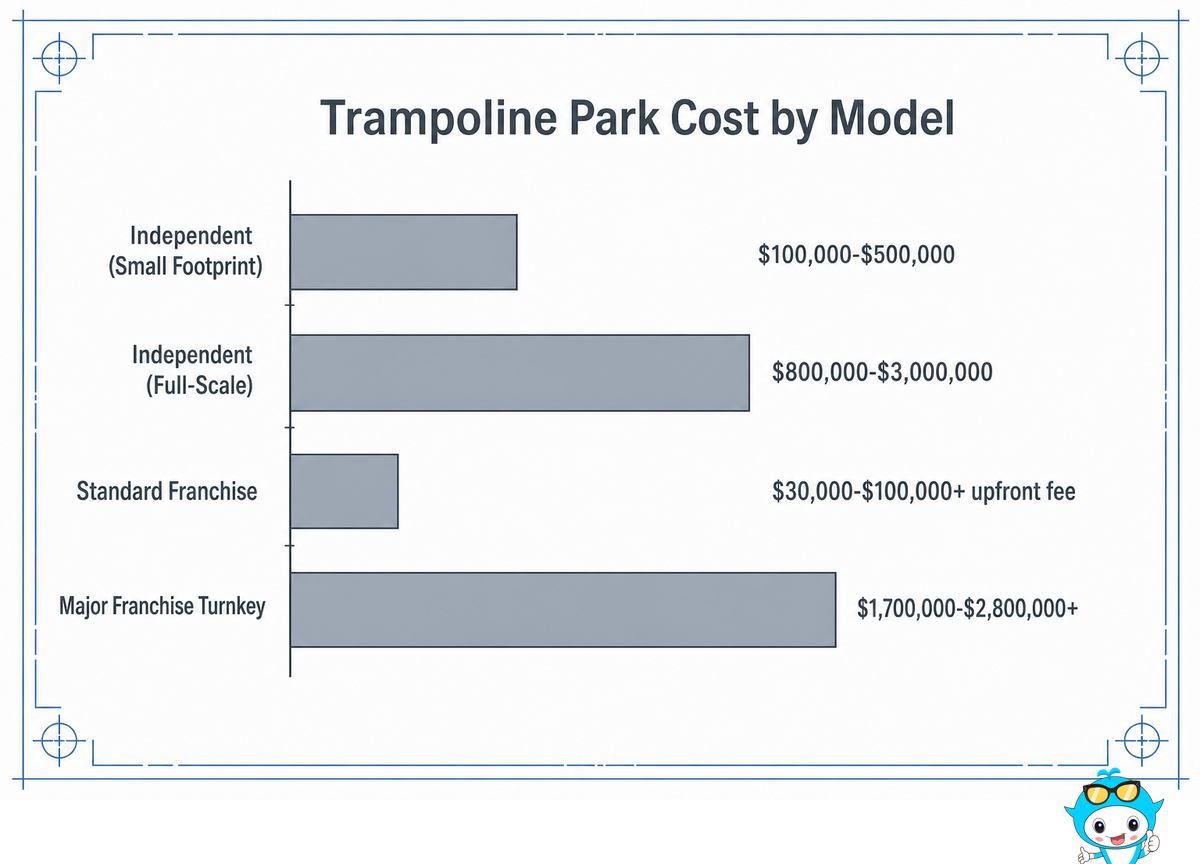
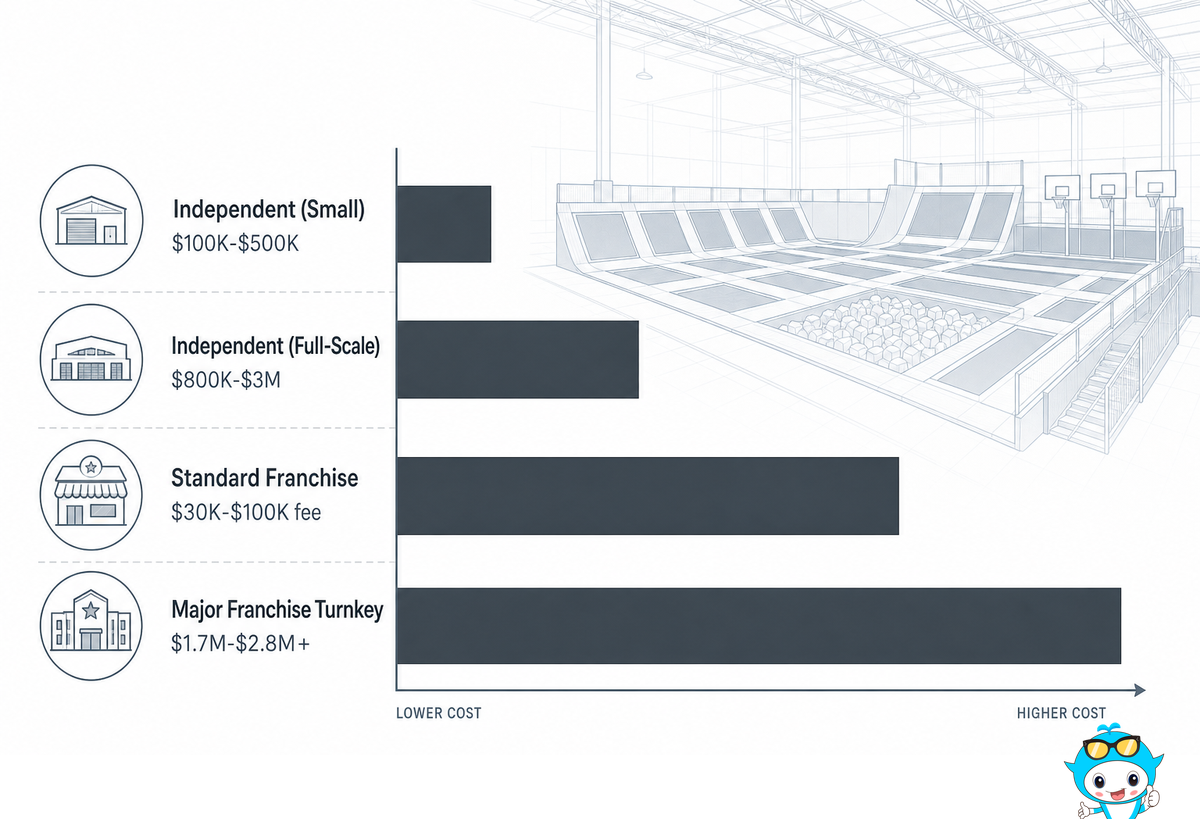
Opening a trampoline park is never about one specific price — it spans four distinct buyer models, each with its own cost structure, from lean independent builds to full franchise turnkey packages. The 4-Model Trampoline Park Cost Ladder below breaks these into actual expenses from eight manufacturer, franchisor and franchise-blog sources, so you can set your own investment range instead of anchoring to a single vendor’s marketing number.
Whichever model you choose, the equipment costs and trampoline equipment package you select will be the single largest line item, so understanding what you actually need to build a trampoline park — not just what a vendor wants to sell — matters more than chasing the lowest headline price.
The 4-Model Trampoline Park Cost Ladder
| Model / line item | Typical figure | Limitations / Not suitable for |
|---|---|---|
| 1. Major franchise turnkey — total investment | $1.7M-$2.8M+ | Not suitable for budget-limited first-time operators |
| 2. Standard franchise — upfront fee | $30,000-$100,000+ | Non-refundable in most agreements |
| 3. Standard franchise — ongoing royalty | 4-8% of gross revenue, monthly, regardless of profit | Not suitable if thin margins can’t absorb a fixed revenue tax |
| 4. Standard franchise — marketing fund | 1-3% of revenue | Often partly allocated to national ads, not your location |
| 5. Standard franchise — 10-year royalty total (worked example) | ≈$400,000-$500,000 on an $800K/yr mid-sized park at 6% | Scales up automatically as revenue grows |
| 6. Independent factory-direct — smaller footprint | $100,000-$500,000 | Not suitable for large-format (25,000+ sqft) multi-zone parks |
| 7. Independent factory-direct — full-scale build | $800,000-$3,000,000 | Requires more owner-side project management than franchise turnkey |
| 8. Acquisition of an existing park | Priced off trailing revenue, not replacement cost | Requires equipment-age vs current ASTM F2970 edition diligence (see H2-4) |
| 9. Often-missed costs (FTC-flagged, any model) | Construction, equipment install, insurance, licensing, payroll, advertising | Not included in most headline fee-only figures |
The figures used here are based on sources from franchise-blog and companies such as Altitude, Urban Air, Big Air, Weiroo Play, TicketingHub, and Koala Playground. They aren’t derived from audited financial statements. It’s critical to understand this distinction: according to the Federal Trade Commission’s Consumer’s Guide to Buying a Franchise, the true cost involved in a franchise includes construction, equipment, leasing, insurance, licensing, staffing, and marketing, in addition to fees and royalties, and “some franchises never break even.” If you’re considering a franchisor or vendor, request the specific line items that comprise their cost estimate. For a franchise opportunity, request the Franchise Disclosure Document’s Item 19 (financial performance representations), rather than relying solely on marketing materials.
Step-by-Step: How to Open a Trampoline Park
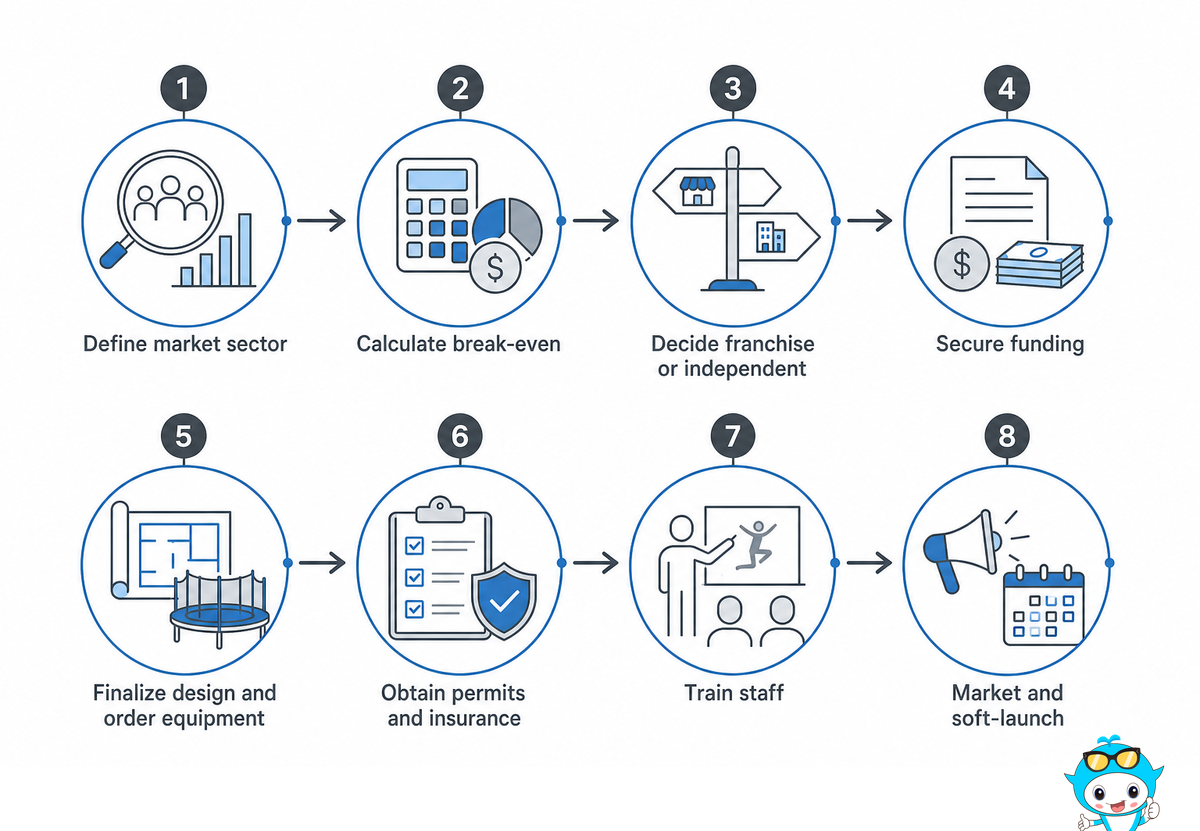
If you intend to start a trampoline park — an adult-centric indoor trampoline park, specifically — the operational pathway remains quite similar, whether you decide to franchise or opt for a direct approach; the process order seldom changes, but rather the level of your personal control over each step.
- Define your market sector — whether adult-only, a family-oriented hybrid model, or focused on fitness classes. This key decision impacts your zone allocation (see H2-6) and target audience before you move on to other aspects.
- Calculate the break-even point before you sign a lease — using your actual targeted location’s rent, rather than an industry average.
- Decide franchise or independent — see the full cost/control tradeoff in H2-4.
- Get your funding in order — popular sources are your personal cash reserves, a loan with an SBA guarantee (with limitations on the size of each SBA program, approximately $5M max), an SBA microloan ($13K on average, max $50K), or a bank loan, capital from your family or friends, or angel investment.
- Finalize design and order equipment — trampoline courts built to spec normally require 8-14 weeks plus shipping — order as soon as you know the estimated completion date.
- Obtain required permits, licenses, and insurance — business license, zoning permit, building permit, liability insurance — appropriate to your state (H2-8 breaks down a real example).
- Train staff — before you even open the doors, make sure everyone is properly trained in emergency procedures and safety, and knows how to handle a complaint from an upset customer.
- Market and soft-launch — locally-displayed signage, local social media marketing, local business partnerships, live online ticketing and waivers prior to the grand opening.
Writing a Trampoline Park Business Plan That Gets Funded
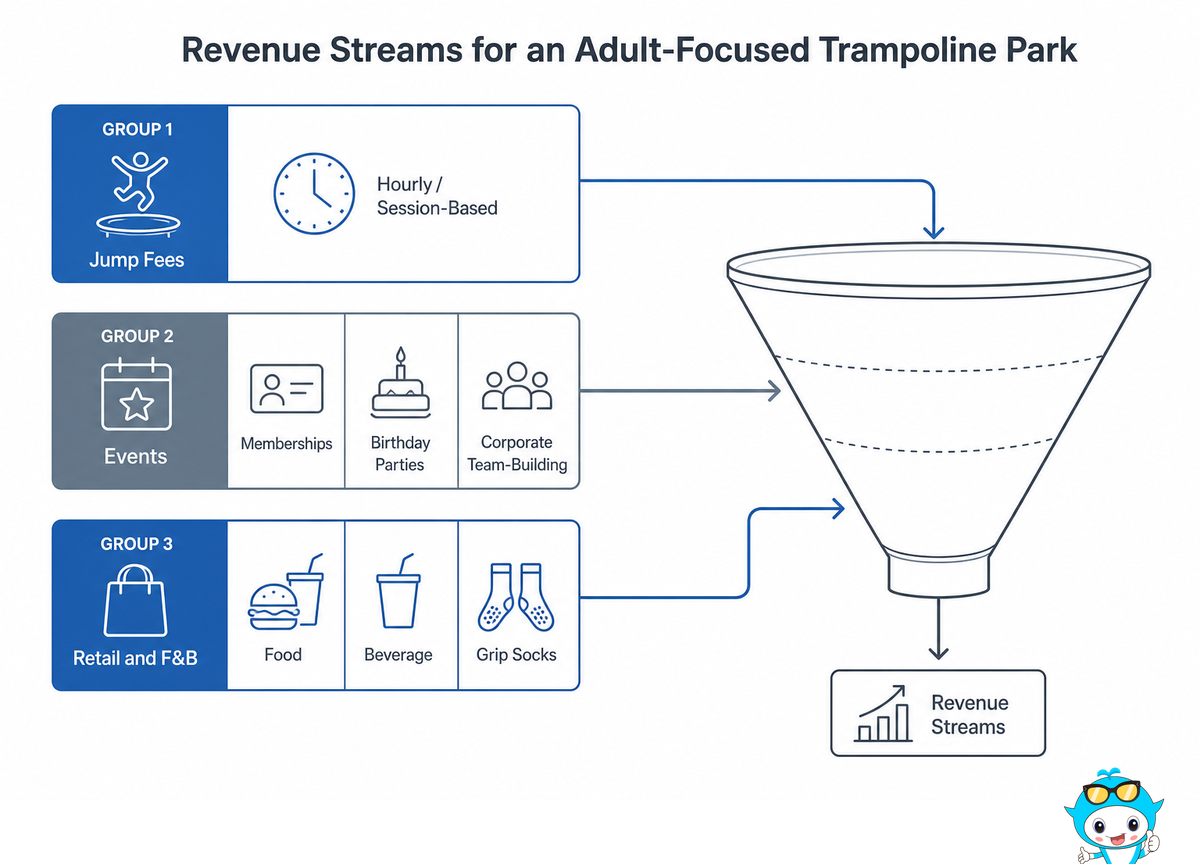
Your business plan will need to directly address three issues that a potential lender or investor is going to raise: what you’re selling, to whom you’re selling it, and where the cash is coming from. Revenue streams at an adult-focused park are often layered several deep instead of relying on one source: hourly or session-based jump fees, memberships, birthday parties and corporate team-building bookings, food and beverage, and retail items like grip socks. Corporate events are worth building into the plan explicitly for an adult-oriented facility, since they fill the off-peak weekday hours a family-entertainment competitor often leaves empty.
The U.S. Small Business Administration backs loans up to roughly $5 million for eligible small businesses — more than enough cash for most independent trampoline park projects — as well as microloans averaging around $13,000 (up to $50,000) for gap financing. Under-budgeting your first-year operating costs is one of the more common mistakes new operators make when applying for financing; a lender will flag a rushed budget as a red flag before they even get to your revenue projections. However you decide to secure your financing, the bank will require your break-even analysis (H2-5) and an honest first-year budget – not a sales forecast.
Franchise vs. Independent: Which Model Fits Your Budget and Risk Tolerance?
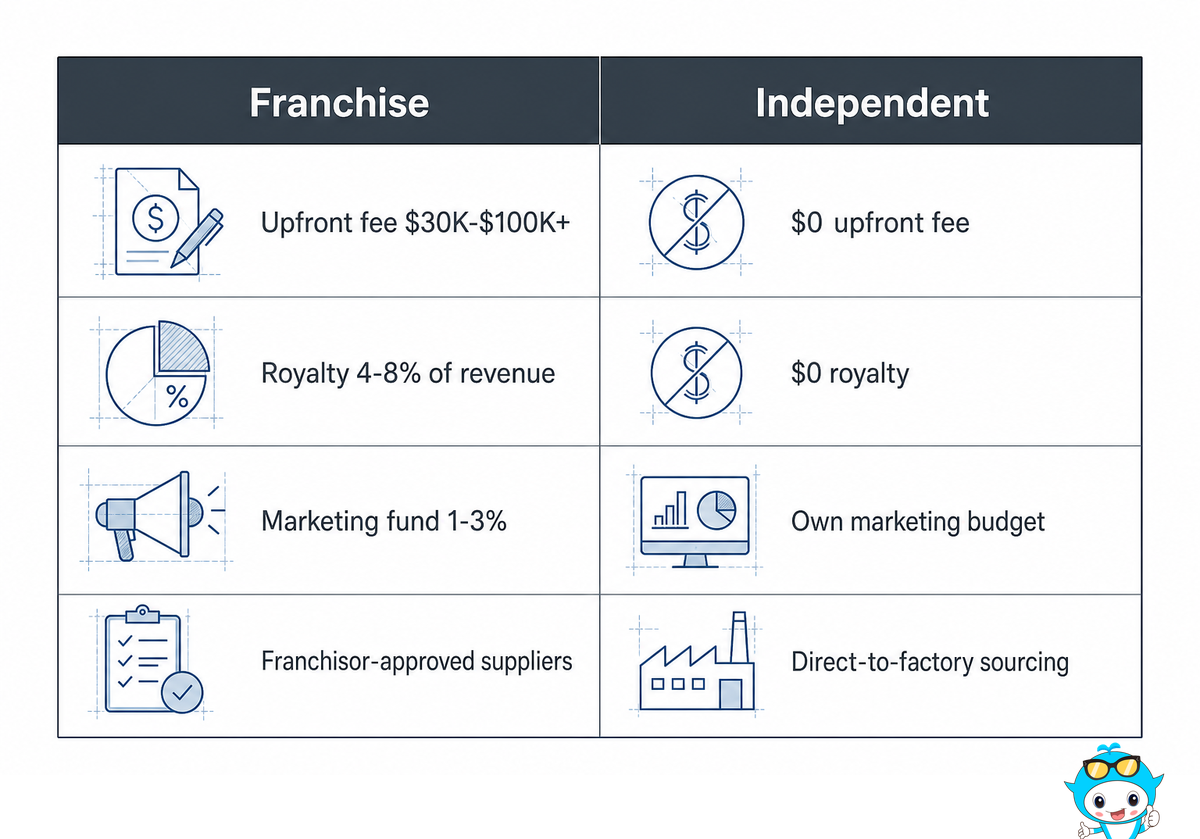
Franchising a trampoline park is neither inherently safer nor inherently riskier — the right choice depends on how much you value a known playbook versus a more sustainable, if harder to start, path to full ownership. The 7-Factor Franchise-to-Independent Break-Even Gap below quantifies that choice, and it usually runs far higher than franchise sales materials let on.
This is exactly the pattern the FTC’s franchise-buying guide warns prospective franchisees to check for. Understanding the real trampoline park franchise cost — fee, royalty, and marketing fund combined, not just the headline fee — is essential before you sign. Talk to current franchise owners directly, not just the franchisor’s sales team, about whether their trampoline franchise has actually been the business opportunity it was pitched as; if a specific brand’s franchise opportunities don’t hold up to that scrutiny, the independent path is still on the table.
The 7-Factor Franchise-to-Independent Break-Even Gap
| Factor | Franchise | Independent |
|---|---|---|
| Upfront franchise fee | $30,000-$100,000+ | $0 |
| Ongoing royalty | 4-8% of gross revenue, monthly, regardless of profit | $0 |
| Marketing fund contribution | 1-3% of revenue, often partly national | Your own budget, fully controlled |
| Equipment/supplier sourcing | Franchisor-approved list, pricing typically non-negotiable | Direct-to-factory, negotiable |
| Brand equity built | Belongs to the franchisor — restrictions typically apply if you leave the network | Belongs to you |
| Timeline to open | Independent timeline + roughly 2-4 months for franchisor approval steps | 4-8 months typical, per industry sources |
“If your park does $800,000 in revenue in year three and you’re paying a 6% royalty, that’s $48,000 per year… Over a 10-year operating period, royalties on a mid-sized park can total $400,000 to $500,000.”
That’s not an argument for franchise being a bad deal — it’s an argument for reading the math before you sign. Franchise researchers at Babson College’s Tariq Farid Franchise Institute push back on the opposite myth — that franchising is passive income. “franchises don’t run themselves — there’s no such thing as a semi-absentee owner,” said a multi-unit StretchLab franchisee in their research. A franchise buys you a tested playbook and supplier relationships, not a guarantee of profit, and it comes with a real, compounding cost. Weigh the two honestly: if you have zero prior operations experience and want a complete system to follow, the franchise fee and royalty may be worth it. If you’re budget-conscious, willing to spend a few months learning your local market, and want to build an asset you can eventually sell, the independent path keeps that royalty in your business instead.
Can I Buy an Existing Trampoline Park Instead of Building One?
Yes — buying an operating trampoline park for sale is a real third option alongside franchising and building independently, and it changes your due-diligence checklist rather than your decision framework. Its price should be set by trailing financial performance, not by what it would cost to build the same park new.
Verify the lease is transferable on acceptable terms, confirm the installed equipment complies with the current ASTM F2970 edition — older parks may still be running equipment installed under an earlier edition, so ask for inspection and compliance records, not just a verbal assurance — and request at least 12 months of real revenue and attendance data rather than relying on the seller’s summary figures.
ROI and Payback: How Long Until an Adult Trampoline Park Turns a Profit?
Vendor-published payback estimates for an adult trampoline park cluster between 8 and 36 months, but that range is directional marketing color, not audited fact — every estimate comes from an equipment manufacturer or franchise-adjacent blog with an interest in making the investment look attractive. No independent, audited payback figure exists for this niche.
One of the most common questions at this stage is how much do trampoline park owners make in a typical year, and the honest answer is that no audited figure exists there either. Soft Play cites 8-12 months as a general average; Dreamland Playground cites 12-18 months specifically for a ninja-course attraction; a third manufacturer source cites 18-36 months for a “well-run park.” The FTC’s franchise-buying guide is blunt about the pattern industry-wide: earnings claims “may use gross sales figures, but when you consider likely expenses, you may find that actual earnings will be far less.”
It’s also worth being precise about terminology, because vendor content routinely blurs it: ROI, profitability, break-even, and payback period aren’t the same measurement. Break-even is the point where revenue equals costs with zero profit or loss; payback period is how long it takes to recover your initial investment; ROI expresses total return relative to investment over a chosen period; and none of these standard figures account for your own debt service, owner compensation, depreciation, taxes, or working capital unless you build them in explicitly.
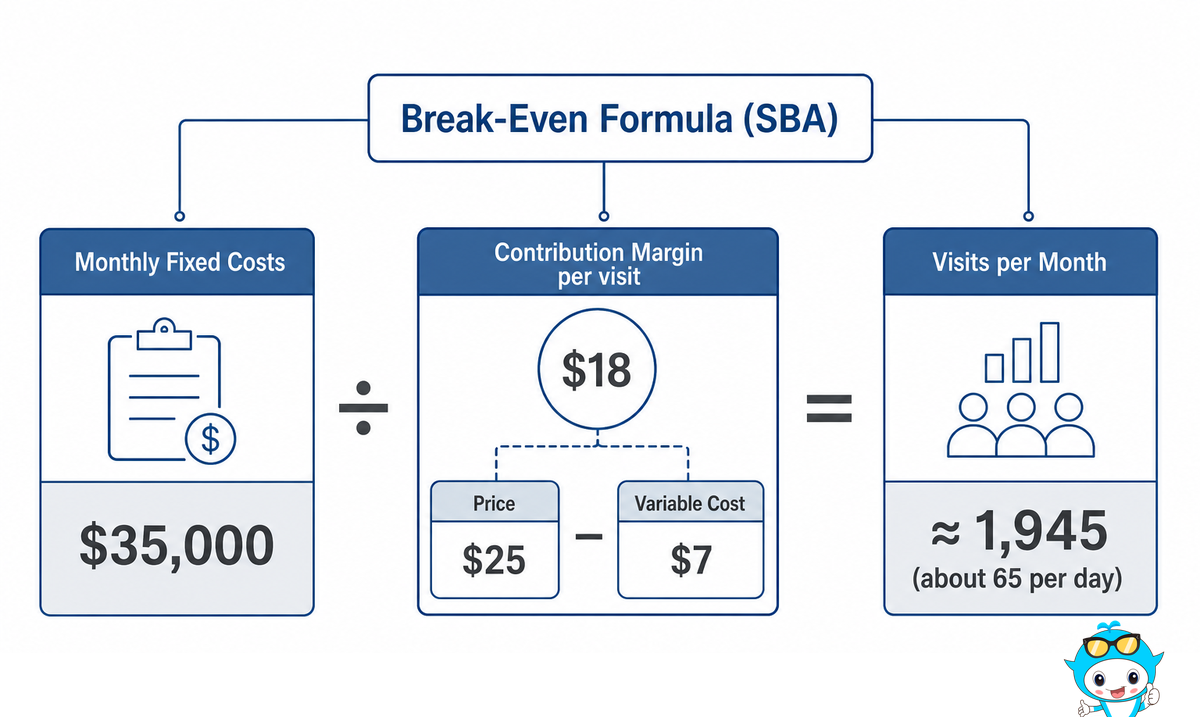
Break-even worked example (SBA formula):
| Input | Example value |
|---|---|
| Monthly fixed costs (rent, salaries, insurance, loan interest) | $35,000 |
| Average price per visit | $25 |
| Variable cost per visit (staffing hours, consumables, card fees) | $7 |
| Contribution margin per visit | $25 – $7 = $18 |
| Break-even visits per month | $35,000 ÷ $18 ≈ 1,945 visits/month (≈65/day) |
Using the U.S. Small Business Administration’s standard formula — break-even (units) = fixed costs ÷ (price − variable cost per unit) — a park with $35,000 in monthly fixed costs and an $18 contribution margin per visit needs roughly 65 paying visits a day to cover its costs. Run this with your own site’s actual rent and staffing numbers before you sign a lease; the SBA is explicit that this is an estimate for planning purposes, not a substitute for full accounting.
Is Owning a Trampoline Park Profitable?
A trampoline park can be profitable, but the outcome depends heavily on execution, location, and which cost model from H2-1 you’re running. Fixed costs — rent, insurance, staffing, and any franchise royalties — are the biggest lever on how many visits you need per month to clear break-even.
A well-located, well-run independent park with disciplined cost control has a realistically shorter path to profit than a franchise carrying a 6-8% royalty on top of the same fixed-cost base, simply because more of each dollar of revenue stays in the business. Neither path guarantees profitability; both require the break-even math in this section run against your specific site, not an industry-average number.
Equipment and Zone Design for an Adult-Focused Trampoline Park
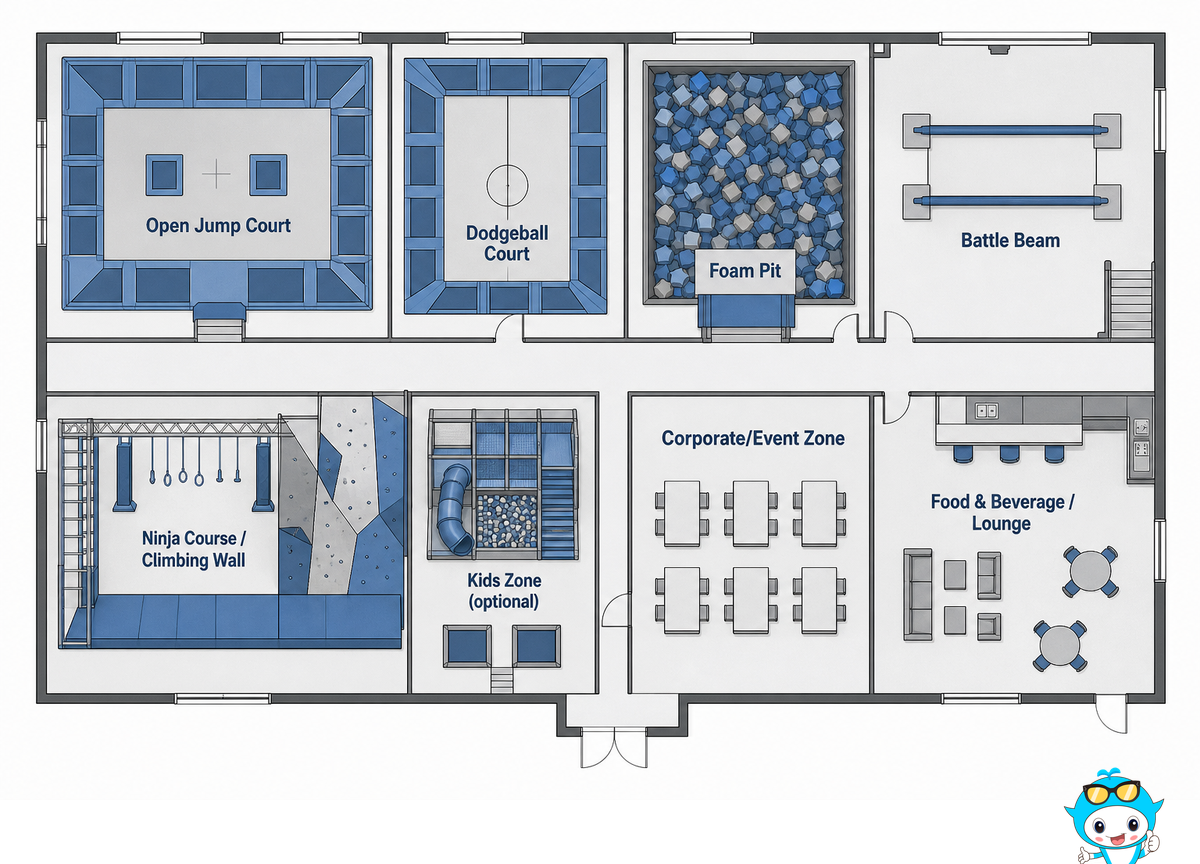
An adult-focused trampoline park needs a different equipment spec than a children’s soft-play facility, not just a different marketing angle. The 6-Zone Adult attraction Mix below reflects the zone types that appear consistently across adult-oriented parks, along with the sizing and structural implications of designing for adult body weight and force rather than a child’s. Every indoor park — whether it’s a Sky Zone location, an Urban Air trampoline park, or an independent build — assembles its play structures from the same handful of zone categories; the difference is which mix you choose and how well you maintain it.
The 6-Zone Adult Attraction Mix
| Zone type / category | What it is | Design note | Limitations / Not suitable for |
|---|---|---|---|
| 1. Open jump court | Interconnected trampoline beds, the core attraction | Highest ceiling demand (17ft+) | Not suitable under low mezzanines or existing retail ceiling heights |
| 2. Dodgeball court | Trampoline-floored competitive play area | Needs clear sightlines for staff supervision | Not suitable for unsupervised or self-service operation |
| 3. Foam pit | Landing area for jumps/tricks from trampolines or a launch platform | Requires regular foam-block sanitation and depth checks | Highest injury-severity zone per operator incident reports; needs dedicated spotting staff |
| 4. Battle beam | Padded balance beam, two competitors | Low footprint, good for smaller sites | Not a primary revenue driver on its own |
| 5. Ninja course / climbing wall | Obstacle or climbing attraction, often adult-skewing | Needs a dedicated timing/queue system at higher throughput | Not suitable without trained spotters on duty |
| 6. Kids zone (optional, hybrid parks only) | Age-appropriate soft play, separated from adult zones | Only include if targeting the family/hybrid segment | Adds children’s-standard (ASTM F1487) compliance on top of F2970 — not a simple add-on |
| 7. Corporate/event zone | Reservable space for team-building and private bookings | Fills weekday off-peak hours; a genuine adult-segment revenue lever | Not suitable as a standalone attraction without adjacent jump zones |
| 8. Food & beverage / lounge | Concessions or a bar area adjacent to the jump zones | Extends dwell time and adds a distinct revenue category | Requires separate health/food-service permitting (H2-8) |
Equipment built for adult loads is a different structural category than children’s soft-play gear, not a heavier version of the same thing. One manufacturer’s published engineering comparison lists 3.5-4.0mm Q345 steel rated above 250kg dynamic load per unit for adult-adventure equipment, versus 1.5-2.5mm steel rated to roughly 80kg for standard children’s playground equipment — that single-source figure hasn’t been independently audited, but it’s directionally consistent with why adult and children’s equipment run under separate ASTM standards (F2970 vs F1487/F1918) in the first place. If you already operate or are researching children’s indoor playground equipment, note that this is a genuinely separate product and standards category, not a scaled-up version of the same gear — see our trampoline park equipment manufacturer comparison for supplier-side sourcing once your zone mix is finalized. Get comparable quotes from more than one trampoline park manufacturer before committing, since per-unit engineering specs like steel gauge and load rating vary meaningfully between vendors. Build an equipment maintenance schedule into your park design from day one — foam-pit sanitation, netting-tension checks and bolt-torque inspections are recurring line items, not one-time setup costs, and skimping on them is a direct hit to customer experience and safety alike. This is a different product category from consumer or indoor play equipment sold for home or small commercial use, so don’t assume a residential supplier’s maintenance guidance applies.
Space, Ceiling Height and Location Requirements
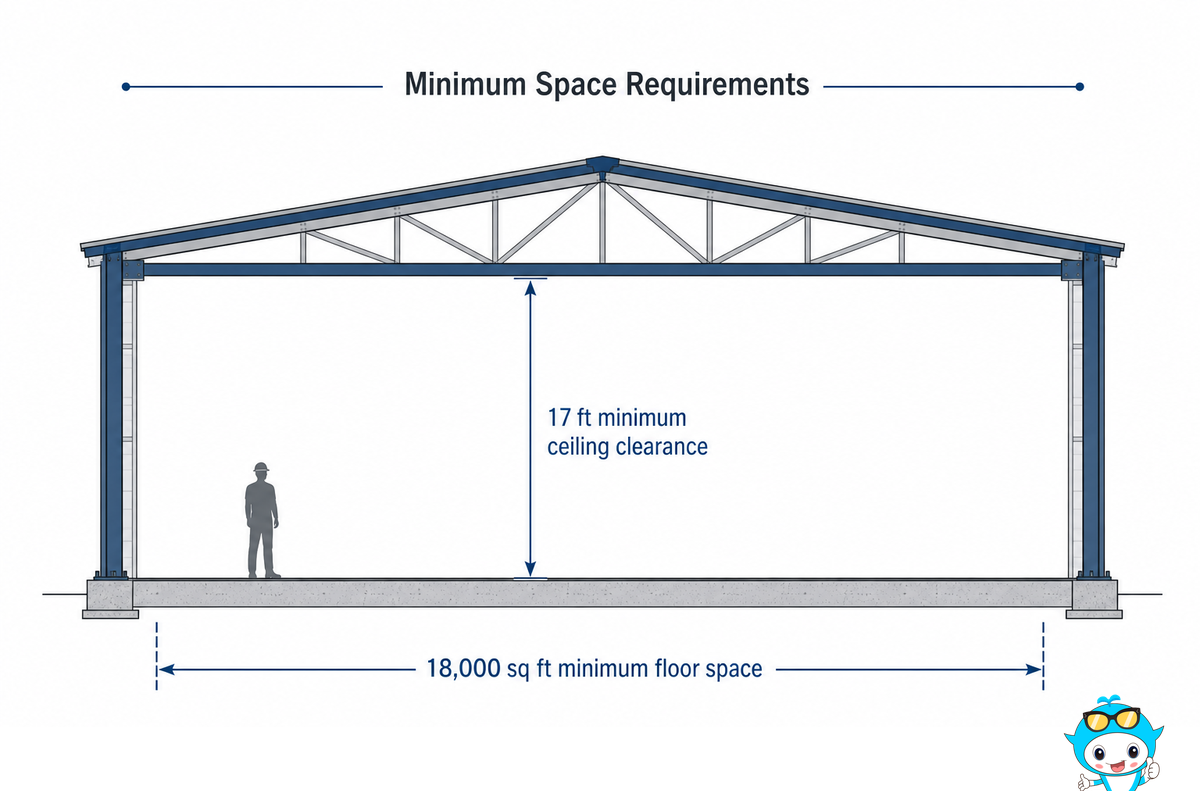
A trampoline park needs both more floor space and more ceiling height than most retail or entertainment tenants, which narrows your realistic site pool from the start and makes site selection one of the highest-stakes early decisions in park design. Industry guidance converges on a minimum 17-foot clearance from floor to the lowest roof obstruction, referenced both by the International Adventure and Trampoline Park Association’s (IATP) operational guidelines and by multiple sources tying the figure directly to ASTM F2970 compliance — some equipment vendors specify 20 feet for larger attraction formats. On floor space and square footage, industry sources commonly cite roughly 18,000 square feet as a starting-point guideline — treat it as a planning heuristic, not a regulatory floor, since actual space and clearance rules are set by your specific jurisdiction’s building and amusement-device code (some jurisdictions use a performance-based clearance requirement instead of a fixed number) and by the zone mix you choose, not a single industry-wide minimum. Most operating US parks run 25,000-35,000 sq ft and dedicate 45-50% of that footprint to the trampoline court itself; the remainder covers party rooms, food service, restrooms and check-in. Skipping this clearance check before signing a lease is one of the more expensive mistakes a first-time operator can make — discovering the shortfall after a deposit is already paid usually means an expensive renegotiation or walking away from money already spent.
How Much Area Is Required for a Trampoline Park?
Use roughly 18,000 sq ft with 17 ft of clear ceiling height as a planning-stage screening threshold for candidate sites, then size upward based on your zone mix from H2-6 — each additional attraction type such as a dodgeball court, ninja course or foam pit adds its own footprint on top of the open jump court.
Confirm your specific jurisdiction’s actual code requirement before ruling out a smaller site, since not every state or municipality codifies a fixed square-footage minimum. Former industrial buildings and warehouses are commonly cited as good candidates precisely because they clear the ceiling-height bar that standard retail space usually can’t.
Safety Standards, Compliance and Insurance (ASTM F2970)
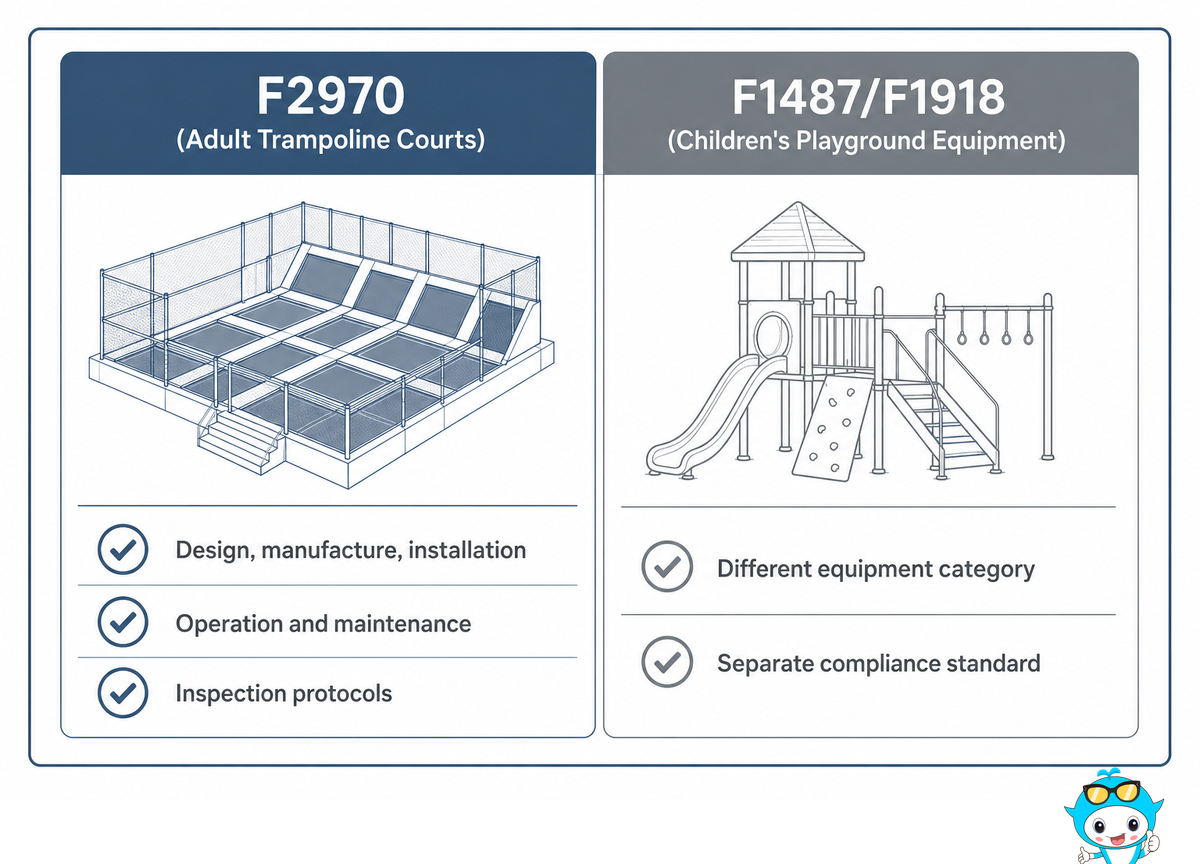
ASTM F2970 is the one that regulates actual adult trampoline courts in the United States, and confusing it with ASTM F1487/F1918, the children’s soft-play F Standards that regulate equipment of that type, is the single most common compliance mistake an operator entering this space will make. Per the current F2970-25 edition’s published scope, the standard covers the design, manufacture, installation, operation, maintenance, inspection and major modification of commercial trampoline courts used for amusement, entertainment or recreation — and it explicitly excludes consumer trampolines, water trampolines, professional exhibition trampolines, single-user trampolines under direct trainer or coach supervision, and a handful of narrower carve-outs for small standalone units below a set bed-area threshold. The American National Standards Institute’s explainer of the prior F2970-22 edition describes this same core scope and exclusion list, so the boundary has held across both editions. ISO 23659:2022 is a set of standards regulating the design, construction, inspection and maintenance of trampoline parks and their landing zones (foam pits, airbags), and it explicitly excludes building and fire codes, food service, activities like climbing or parkour, or outdoor parks.
Neither standard is a complete safety blanket: ASTM makes plain in their documentation that the standard doesn’t address every eventuality and can’t by itself prevent injuries (it establishes a design and operating baseline, not a liability shield). Remember too that the specific edition your state or insurer requires may be out of date; ASTM F2970 has advanced from the 2022 edition to a 2025 revision, with a new revision work item still underway at this writing, and not every jurisdiction updates its cited edition immediately. Make sure in your state which edition of the F2970 standard applies and confirm that with your insurer and inspector before purchasing equipment rather than assuming the latest one applies everywhere.
State regulation actually exists and is emerging, not just hypothetical. A tangible example is Utah’s trampoline park safety statute (Title 11, Chapter 63), which states that a municipal or county business license, yearly third-party inspection and certification, an on-site employee certified in CPR and first aid during all hours of operation and a functional AED, an emergency response plan and written injury-reporting procedures, and insurance of the statutory minimum of $1,000,000 in total and $500,000 per accident are mandated. Although other states including New York, California and Wisconsin have debated or passed their own trampoline-park specific laws, look to your specific jurisdiction rather than applying Utah’s numbers.
✔ What ASTM F2970 / ISO 23659 Cover
- Design, manufacture and installation of trampoline courts
- Operation, maintenance and inspection protocols
- Landing areas (foam pits, airbags) as part of ISO 23659
⚠ What They Don’t Cover
- General building, fire, or planning regulations (separate permits required)
- Non-trampoline activities: climbing, parkour, obstacle courses
- A guarantee against injury — staffing, supervision and enforcement still matter
That final point deserves to be taken seriously for an adult-oriented facility: peer-reviewed emergency-medicine research comparing jump-park injuries discovered that fractures and dislocations made up 45% of adult jump-park injuries as opposed to 17% in home-trampolines, with a 23% surgery rate in adult jump-park patients. That severity differential is a hard design and staffing issue, not an irrelevant talking point — it makes a case for the signage, supervision and activity-limitation rules we find in both the ASTM F2970 and the statutes that incorporate it, enforced in practice not ignored. Every jumper should get a real orientation briefing on court rules and one-jumper-per-trampoline etiquette before their first session, not just a liability waiver to sign at the counter. A separate 2024 Pediatrics study of 18 trampoline parks internationally found overall injury rates of 1.14 per 1,000 jumper-hours — higher in high-performance and foam-pit zones (roughly 2 per 1,000 jumper-hours) — but declining about 0.72% per month over the 2017-2019 study window, evidence that disciplined supervision and standard-compliant design measurably reduce risk over time rather than just capping it.
Industry Outlook: What’s Changing in the Trampoline Park Business
The competitive dynamic in this industry is shifting from “does your city have a trampoline park?” to “does yours look different from the other three?” and that change is more critical to a new operator’s planning than any market-size figure. Industry discussion highlights the “attraction staleness” and “unused vertical space” as key competitive threats – parks that don’t vary their attraction offering or don’t use their ceiling space (by adding aerial courses, multi-level zones or climbing walls) may see visitor growth stagnate, because repeat local visitors are the ones who notice when a park looks the same as it did a year ago. If you’re a new, adult-focused facility, factor into your planning a mix that you anticipate being able to refresh or reconfigure within 3-5 years, rather than a once-and-done build you hope will last a decade. Regulation is part of that same change curve: ASTM F2970 itself has already moved from its 2022 edition to the current 2025 revision, with committee work on a further update reportedly underway, so build a habit of re-checking your applicable edition annually rather than assuming the standard you opened under still governs five years later.
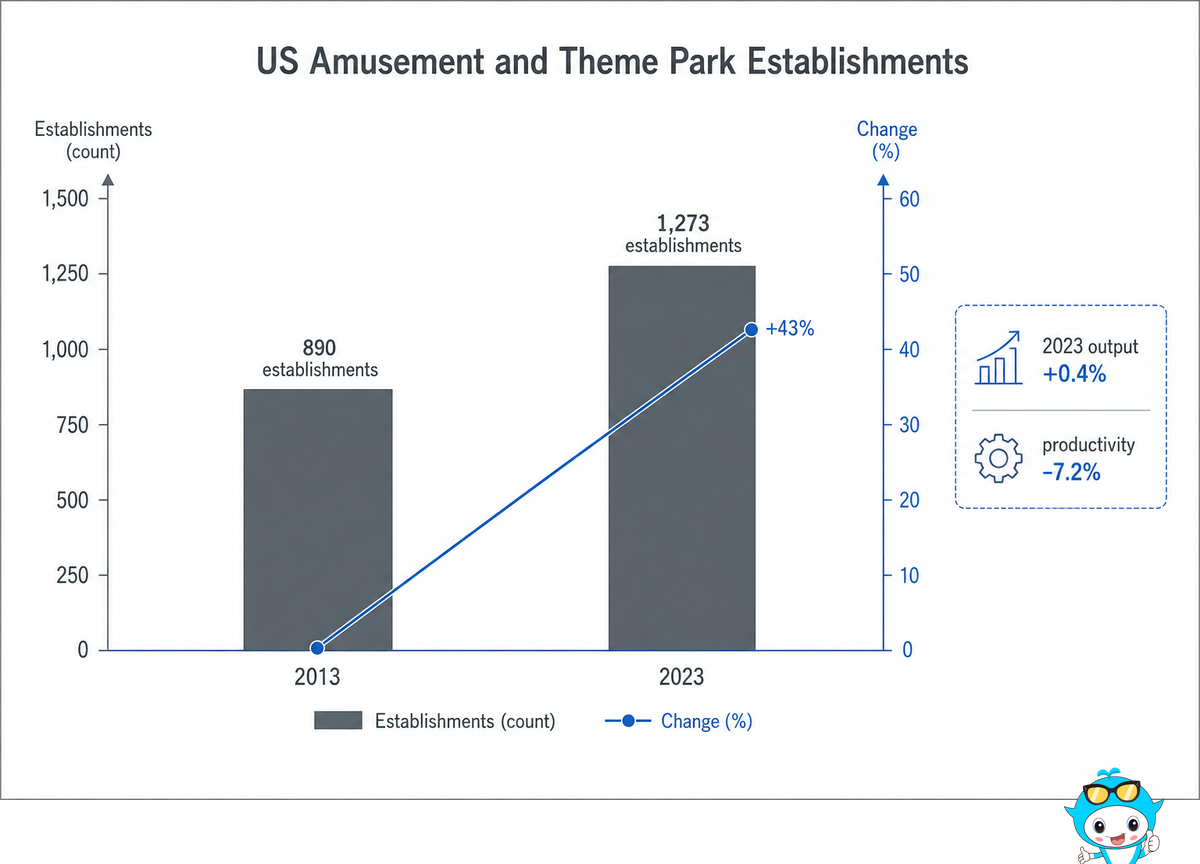
Estimates for the size of the trampoline park industry vary widely from one market research company to another: the range for the U.S. is between $750 million and $1.6 billion annually, with future growth projections ranging between “mid-teens to mid-teens plus” compound annual growth rate, depending on research firm assumptions and scope. That variation alone should be a red flag – treat any market-size number as a directionally informative gauge and not a precise predictor and lean more heavily on your own local market research to determine if another trampoline park can thrive in your area. Independent federal data on the broader amusement category tells a more measured story than the private mid-teens-CAGR forecasts suggest: the U.S. Bureau of Labor Statistics counted 1,273 amusement and theme park establishments nationwide in 2023, up 43% from 890 in 2013, yet output for the amusement-parks-and-arcades category rose only 0.4% in 2023 while labor productivity fell 7.2% — establishment growth and per-unit performance are not the same signal, and a new trampoline park’s business case should rest on its own site economics, not an industry-wide growth headline.
Frequently Asked Questions
Q: Is a trampoline a good investment?
A commercial trampoline court can be a good investment when the site’s break-even math clears, but it is not a guaranteed one — the model you choose matters as much as the market.
While a commercial trampoline court can be profitable, it is not a guaranteed revenue source. FTC franchise-buying guidance is explicit that some franchised businesses, trampoline parks included, never break even, and that vendor-published return-on-investment figures in this space are not independently audited. Before committing any capital, run the break-even calculations outlined in this guide using your own lease rates, labor costs and prices to see if this model is viable for your specific site.
Q: How much does insurance cost for a trampoline park?
Insurance cost varies by state and insurer, but Utah’s trampoline-park statute sets a concrete regulatory floor: liability coverage of at least $1,000,000 aggregate and $500,000 per incident.
While insurance costs vary widely by state, insurer, and attraction offerings, Utah has established a baseline in its trampoline-court law (Utah Code Title 11, Ch. 63), mandating a minimum liability insurance of $1,000,000 total and $500,000 per occurrence, as well as worker’s compensation and product liability coverage. Research your own state’s requirements – not all states have similar statutes, and once your operation is up and running, your premiums will also reflect your incident history and safety programs.
Q: How does a trampoline park make money?
Revenue usually stacks hourly or session jump fees, memberships, private and corporate events, food and beverage, and retail items like grip socks — most parks combine several of these rather than relying on one.
Instead of relying on a single revenue stream, most parks stack multiple revenue sources, including – hourly/session-based jump fees (most commonly charged by the hour, with the first hour at a higher rate, typically $10-$15), membership programs or multi-visit pass programs, birthday parties and private/corporate events, as well as food, beverage, and retail sales (including grip socks, which are required at most facilities). For an adult-oriented facility, focus on factoring corporate and evening social events into your business plan.
Q: Can I open a trampoline park in a market that already has one?
Yes, but differentiate deliberately rather than competing head-on with an identical attraction mix — target a different zone emphasis, price point, or customer segment than the existing park.
Yes – as long as you research the other trampoline park facility in your market, focusing on its zone offerings and demographics. A trampoline park targeting corporate events and adults can co-exist with another facility in town catering to families.
Q: Where can I find a trampoline park business plan template?
Start with the SBA’s free business plan and break-even planning tools rather than a generic downloadable template, then overlay this guide’s cost-ladder figures on top.
Begin with the SBA’s free business-plan and break-even tools — they are already formatted with what the lender expects — and then overlay the guide’s cost-ladder figures on the trampoline-park-specific numbers a template will omit.
Q: What’s the difference between an “adult indoor playground” and a trampoline park?
In everyday search and marketing use they overlap heavily; a trampoline court specifically is one attraction type within a broader “adult indoor playground” or adventure-park concept.
In everyday consumer search and marketing practice, the terms are largely overlapping, as the customer trying to locate a spot for a night out will use both search queries almost indistinguishably. Technically, “trampoline court” refers to one particular type of attraction – linked together trampoline beds governed by ASTM F2970 – and “adult indoor playground” is a more general marketing label — sometimes used interchangeably with “adventure park” — which may also apply to attractions other than trampoline courts such as bar/lounge facilities and climbing or obstacle courses, none of which are covered by ASTM F2970.
For purposes of facility development, be clear about the types of attraction you intend to install first and determine the specific standards applicable to them individually — don’t generalize from a broader “adult playground” label.
Q: What is a Franchise Disclosure Document, and do I need to read one before I start a trampoline park?
Yes — request Item 19 of the Franchise Disclosure Document before signing, since it’s the one section that may contain real financial performance data.
A Franchise Disclosure Document is the federally mandated packet every franchisor must give prospective franchisees before any money changes hands, and Item 19 is the only section that may contain actual financial performance figures — many franchisors choose not to include it at all. If you’re evaluating whether to start a trampoline park under a franchise banner, request the FDD directly from the franchisor rather than a summary from a sales rep, read Item 19 closely if it’s present, and have a franchise attorney review the royalty and territory terms before you sign anything.
About This Analysis
This guide compiles publicly available cost, standards and regulatory data from franchise disclosure guidance, peer-reviewed injury research, state statute text, and manufacturer-published figures, cross-checked against an adversarial review pass that specifically flagged vendor-sourced claims for qualified language. Didi Land manufactures commercial indoor playground and soft-play equipment for children’s segments; we don’t currently manufacture adult trampoline park equipment, and this guide is offered as an educational resource for operators evaluating the adult/trampoline-park segment specifically, not as a product pitch.
💡 Reviewed by
Reviewed by the Didi Land technical team.
References & Sources
- A Consumer’s Guide to Buying a Franchise Federal Trade Commission
- Break-Even Point U.S. Small Business Administration
- ASTM F2970-25: Standard Practice for Design, Manufacture, Installation, Operation, Maintenance, Inspection, and Major Modification of Trampoline Courts ASTM International (current edition)
- ASTM F2970-22: Trampoline Courts American National Standards Institute (prior edition explainer)
- ISO 23659:2022, Trampoline Parks Safety Requirements International Organization for Standardization
- Operational Guidelines International Adventure and Trampoline Park Association (IATP)
- Utah Code Title 11, Chapter 63, Trampoline Park Safety Utah State Legislature
- 3 Common Myths About Franchising You Need to Stop Believing Babson College, Tariq Farid Franchise Institute
- A Comparison of Injuries Sustained at Commercial Jump Parks vs Home Trampolines PubMed / peer-reviewed research (Doty et al., 2019)
Related Articles
- Top 15 Trampoline Park Equipment Manufacturers — supplier-side sourcing once your zone mix is finalized
- How to Start an Indoor Playground Business — the children’s-segment version of this business-planning guide
- Indoor Playground ROI — ROI modeling for the children’s soft-play segment
- Are Indoor Playgrounds Profitable? — quantitative profit-formula companion piece, children’s segment
- Indoor Playground Franchise vs. Independent — the same decision framework applied to children’s indoor playgrounds
- Verifying a Real Equipment Factory vs. a Trading Company — supplier due-diligence checklist
![Sustainable Indoor Playground Material Certification [2026]](https://didiplayarea.com/wp-content/uploads/2026/07/sustainable-materials-certification-en1176-astm-as4685-featured-768x512.png)