Get in Touch with Didi Land

Where Is the Biggest Indoor Playground in the World? Verified Rankings, Size Tiers, and Design Specs

Billy Beez at the Mall of Dhahran in Al Khobar, Saudi Arabia holds the Guinness World Record as the biggest indoor playground in the world for indoor soft play at 24,937.72 square feet (2,316.79 square meters). In Thailand, the Mega HarborLand flagships are dedicated dry, multi-zone centers near the 10,000 square meter (107,639 square feet) mark. The record for an enclosed indoor theme park is held by Chimelong Spaceship in Zhuhai, China at 397,064.94 square meters (4,271,783 square feet).
Online rankings disagree because writers mix padded toddler frames with ride-based theme parks and resort halls. This guide sorts global and U.S. venues by physical format. It separates gross leased floor area from climbable play structures. It also details the building codes, ceiling heights, and commercial budgets needed to build at scale.
Where Is the Biggest Indoor Playground in the World Right Now?
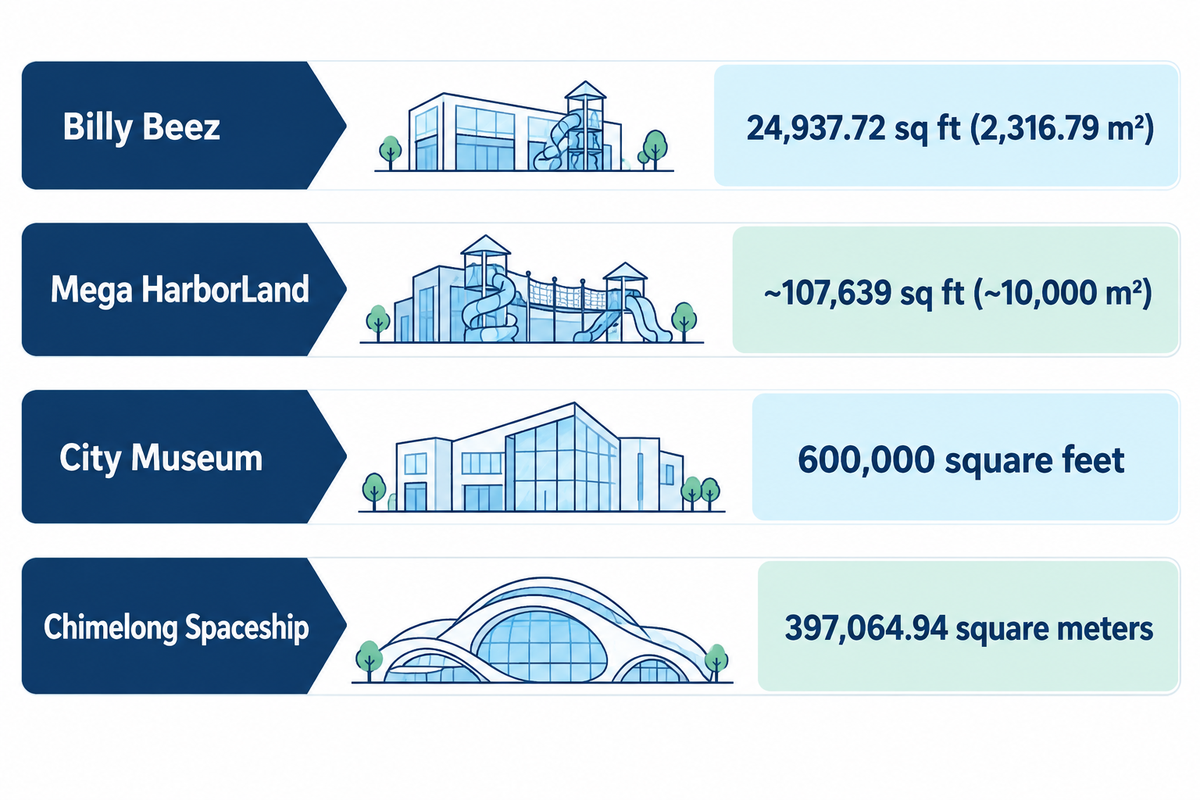
The table separates indoor play venues into four physical tiers, including two Guinness record categories. Iplayco built the Guinness soft-play record-holder at Mall of Dhahran (Al Khobar) to house up to 2,500 children at a time. Mega HarborLand leads Greater Bangkok’s dry, multi-zone halls, the City Museum in St. Louis spans 600,000 square feet of architectural play, and Chimelong Spaceship tops ride-based indoor theme parks.
These venues are classified according to the Four-Tier Indoor Play Scale Taxonomy. This classification separates self-propelled soft play parks from ride-based parks. It then compares floor space. All metric conversions below apply 1 square meter = 10.7639 square feet, unless quoting Guinness verbatim.
| Scale Tier | Category Definition | Current Benchmark Venue | Verified Area (Metric) | Verified Area (Imperial) | Primary Source |
|---|---|---|---|---|---|
| Tier 1 | Guinness Indoor Soft-Play Area | Billy Beez (Mall of Dhahran, Al Khobar, Saudi Arabia) | 2,316.79 m² (~2,300 m²) | 24,937.72 sq ft | AusLeisure / Iplayco |
| Tier 2 | Dedicated Dry Multi-Zone Indoor Playground | Mega HarborLand (Greater Bangkok, Thailand) | ~10,000 m² (Megabangna: 8,000 m²) | ~107,639 sq ft (Megabangna: 86,111 sq ft) | HarborLand Group |
| Tier 3 | Architectural Play / Mega Hybrid FEC | City Museum (St. Louis, MO) & Tom Foolerys (Kalahari, US) | ~55,742 m² / ~7,432–8,361 m² | 600,000 sq ft / 80,000–90,000 sq ft | Official Venue Specs |
| Tier 4 | Guinness Indoor Theme Park (Ride-Based) | Chimelong Spaceship (Zhuhai, China) | 397,064.94 m² | 4,271,783 ft² 50 in² | Guinness World Records |
Observe one common reporting mix-up in Thailand. HarborLand’s Mall Lifestore Bangkae advertises roughly 11,000 square meters, yet that figure includes the outdoor Harbor Island rooftop water park. Pure dry indoor zones at Seacon Bangkae and Central Westgate are approximately 10,000 square meters. Megabangna covers 8,000 square meters across eight themed zones. Separating dry play from water parks keeps every ranking of the largest indoor playground venues honest.
Where is the world’s tallest play park located?
Chimelong Spaceship in Zhuhai, China rises 59.9 meters (196.5 feet) as the tallest enclosed amusement building, with two above-ground levels and one below. For non-ride indoor climbing venues, Airzone in Singapore suspends walkable net decks across five mall atrium levels. Vertical soft-play towers inside Billy Beez and Kids Empire reach 3 floors to 4 levels under tall retail roofs.
Vertical height can multiply play area without increasing floor-plate rent. A four level indoor soft play frame doubles climbable space over the same concrete slab compared to a two level frame. Every added deck above 10 feet also introduces stricter anchoring, egress, and overhead fire-sprinkler spacing.
Gross Venue Area vs. Active Play Footprint: Why Size Rankings Conflict
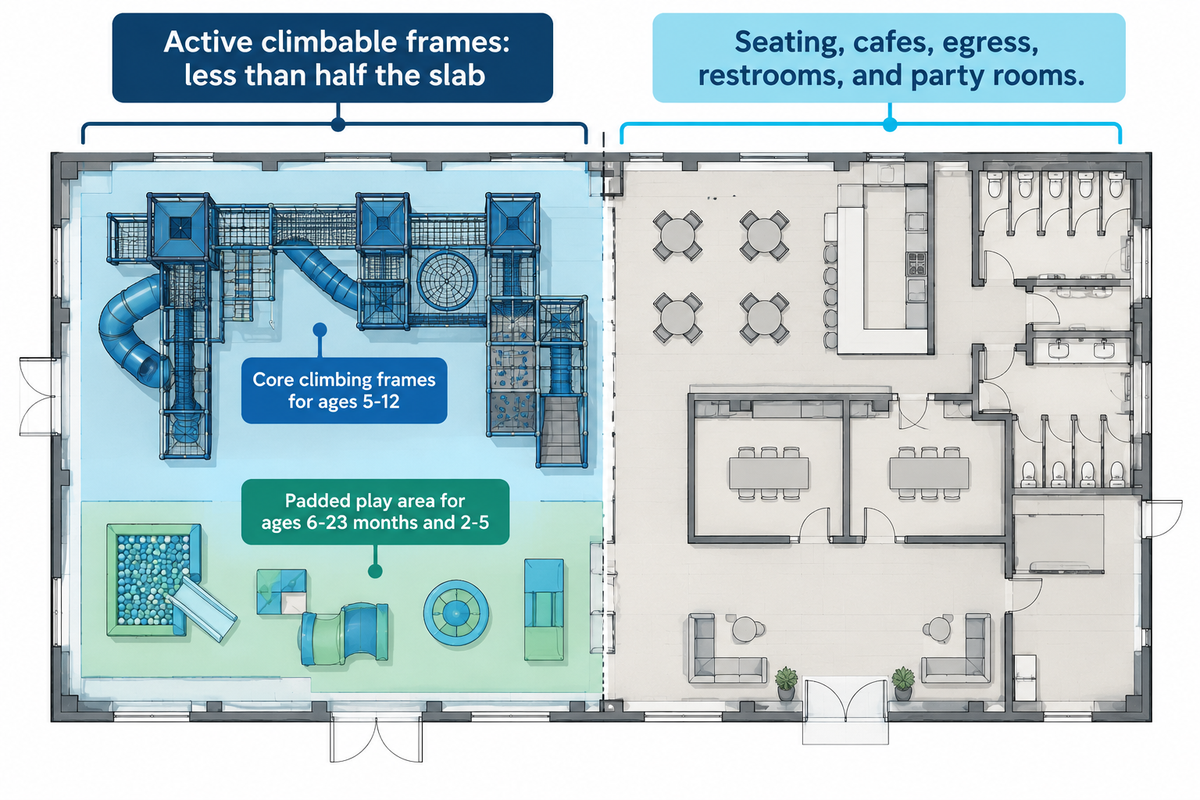
Area figures reported for the same indoor play space often vary widely, as press releases report gross leased area while equipment engineers measure only the active play structure footprint. In a commercial hall, the active climbable frames often take up less than half the slab, and the remaining space is used for seating, cafes, egress, restrooms, and party rooms.
Picture a busy restaurant. While the dining room is in focus, kitchens, hallways, restrooms, and storage still occupy about half the space. Understanding which number a venue quotes explains why two 15,000-square-foot play spaces can feel completely different on the inside.
| Floor Plan Zone | Space Allocation Role | Primary Function | Counted in Active Play Footprint? |
|---|---|---|---|
| Main Multi-Level Play Structure & Slides | Primary active anchor | Core climbing frames, bridges, ball pits, and tubes for ages 5–12 | Yes |
| Toddler Soft Play & Sensory Zone | Dedicated early-years bay | Low-height padded play area fenced off for ages 6–23 months and 2–5 | Yes |
| Parent Seating & On-Site Café | Guest comfort & F&B margin | Sightline seating, food service, and stroller parking | No |
| Private Birthday Party Rooms | High-margin group space | Reserved weekend celebration rooms and catering prep | No |
| Check-In, Shoe Lockers & Waiver Kiosks | Entry access control | Controlled entry gate, grip-sock retail, and wristband pairing | No |
| ADA Routes, Restrooms & Egress Aisles | Mandatory code circulation | 60-inch accessible pathways, family restrooms, and fire exits | No |
This ratio directly shapes startup budgets for commercial indoor playground equipment. WellnessLiving’s August 2026 cost guide places U.S. startup budgets between $75,000 and $1 million, separating a 2,500-square-foot toddler play café from a 15,000-square-foot family entertainment center with custom climbing structures, party rooms, and a full café. Splitting active play area from support zones prevents both equipment oversizing and weekend corridor bottlenecks.
Mega Indoor Playgrounds vs. Trampoline Parks vs. Indoor Theme Parks
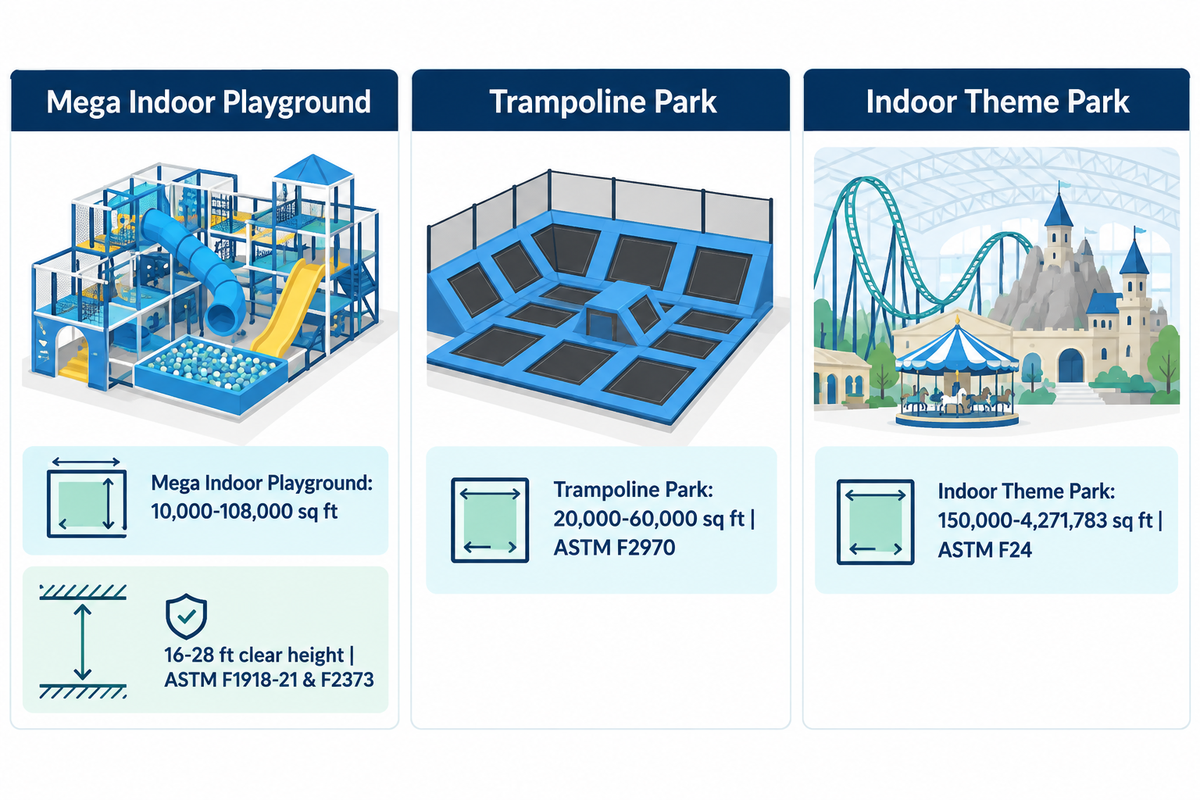
Mega indoor playgrounds, indoor trampoline parks, and indoor theme parks vary by governing standards, age fit, and ceiling height. Soft-play centers serve children from 6 months to 12 years of age with climbing frames governed by different standards according to equipment type and age group, including ASTM F2373, ASTM F1918-21, and ASTM F1487-25. Trampoline parks have courts covered by ASTM F2970 and may serve children from age 5 through their teens, while indoor theme parks have mechanical rides covered by ASTM F24 standards.
Families visiting an indoor amusement park with toddlers hit strict ride height cutoffs. Commercial operators face an equally steep insurance gap. Soft Play says in its 2026 cost guide that climbing walls, zip lines, foam pits and trampolines can push up liability, property and workers’ compensation premiums.
| Engineering / Operating Factor | Mega Indoor Playground | Indoor Trampoline / Adventure Park | Indoor Theme Park |
|---|---|---|---|
| Typical Footprint | 10,000–108,000 sq ft | 20,000–60,000 sq ft | 150,000–4,271,783 sq ft |
| Clear Ceiling Height | 16–28 ft clear below ducts | 18–25+ ft clear span | 40–196 ft (Chimelong: 59.9 m) |
| Core Age Group | 6–23 months, 2–5, and 5–12 years | Ages 5–16+ and adults | All ages with ride height cutoffs |
| Primary Attractions | Soft play mazes, slides, ball pits, pretend play | Trampoline courts, ninja runs, rope courses, dodgeball | Coasters, flat rides, carousel, aquarium shows |
| Governing Standards (US / EU) | ASTM F1918-21, F1487-25, F2373; EN 1176-10 | ASTM F2970 (trampoline courts) & ACCT ropes | ASTM F24 amusement rides & state ride permits |
| Liability Exposure | Moderate (fall & supervision controls) | Elevated (aerial rebound & collision risk) | High mechanical & ride-engineering oversight |
What is the largest indoor trampoline park in the world?
Flagship Sky Zone, Urban Air, and UK Flip Out complexes span 35,000 to 60,000+ square feet across blended trampoline, laser tag, and indoor inflatable halls. For a single structure, Guinness World Records certifies the longest permanent trampoline at APEX Adventure Plex in Winnipeg, Canada at 58.6 meters (192 feet 3 inches). For dedicated jump-arena rankings including multi-attraction UK complexes above 100,000 square feet, see our guide to the biggest trampoline park in the world.
Hybrid adventure park operators often add a fenced soft play area next to main jump courts to provide an area for younger siblings. Physical barriers remain mandatory because rebound mats create severe collision hazards for toddlers under age four.
Top 10 Largest Indoor Play Centers Globally and in the USA
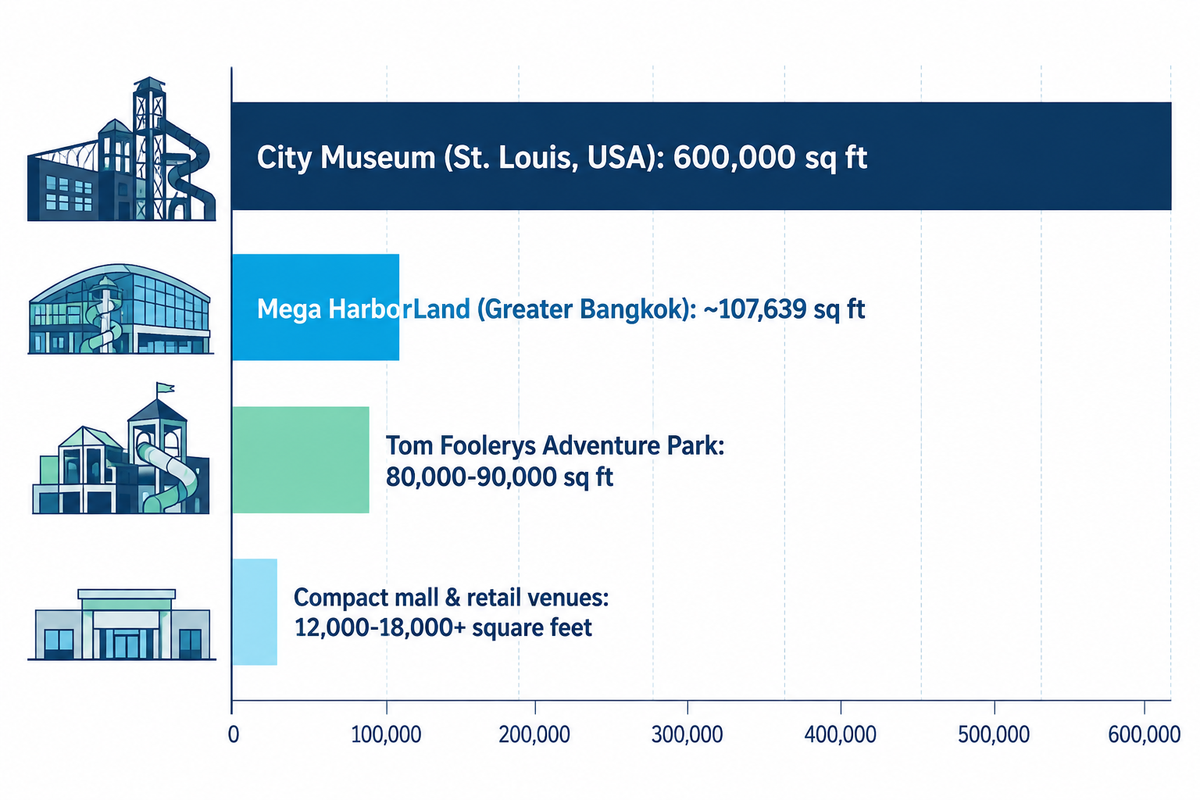
The listed indoor play centers across three continents include compact mall and retail venues of 12,000–18,000+ square feet and repurposed American industrial buildings of up to 600,000 square feet. This list doesn’t include ride-based indoor theme parks like Chimelong Spaceship. Each one features active climbing, soft play, role-play, or adventure play.
| # | Venue Name | City / Country | Verified Area | Format Tier | Anchor Attractions |
|---|---|---|---|---|---|
| 1 | City Museum | St. Louis, MO, USA | 600,000 sq ft (~55,742 m²) | Tier 3 Architectural Play | 10-story spiral slides, caves, tunnels, rooftop bus |
| 2 | Mega HarborLand (Seacon Bangkae & Central WestGate) | Greater Bangkok, Thailand | ~107,639 sq ft (~10,000 m² dry) | Tier 2 Dedicated Multi-Zone | Giant slides, toddler city, roller rink, laser tag, ropes |
| 3 | Tom Foolerys Adventure Park (Kalahari) | Spotsylvania, VA & Round Rock, TX, USA | 80,000–90,000 sq ft (~7,432–8,361 m²) | Tier 3 Hybrid FEC | Indoor ropes course, rock climbing, zip lines, bowling, 250 arcade games |
| 4 | Mega HarborLand Megabangna | Greater Bangkok (Samut Prakan), Thailand | 86,111 sq ft (8,000 m²) | Tier 2 Dedicated Multi-Zone | 8 distinct play zones, jump arena, snow town, toddler soft play |
| 5 | KidZania (Dallas / Global Flagships) | Frisco, TX & Global | ~70,000–100,000 sq ft (~6,503–9,290 m²) | Tier 2 Role-Play City | Scaled mini-city with 60–100+ career pretend play stations |
| 6 | Complete Playground | New York City, NY, USA | 45,000 sq ft (~4,181 m²) | Tier 2 Inclusive Playground | 3 floors of sensory rooms, climbing decks, creative studios |
| 7 | Edinborough Park (Adventure Peak) | Edina, MN, USA | ~43,560 sq ft (~4,047 m² atrium) | Tier 2 Civic Indoor Park | 37-ft indoor climbing tower, track, toddler playland |
| 8 | SuperPark Flagships | Helsinki, Finland / Singapore / Asia | ~30,000–43,000 sq ft (~2,787–4,000 m²) | Tier 2 Active Sports Play | Adventure area, gymnastics foam pit, pedal cars, game arena |
| 9 | Billy Beez (Mall of Dhahran) | Al Khobar, Saudi Arabia | 24,937.72 sq ft (2,316.79 m²) | Tier 1 Guinness Soft Play | Record soft-play maze, wave slides, ball blasters, toddler bay |
| 10 | Kiztopia Marina Square & Chuck E. Cheese Adventure World | Singapore / 20+ US Cities | 12,000–18,000+ sq ft (~1,115–1,672 m²) | Tier 2 Mall / Community Box | Themed play zones, giant slides, video walls, toddler zones |
What is the largest indoor playground in the USA?
The City Museum in St. Louis is the largest architectural indoor playground in the U.S. at 600,000 square feet and is housed in a former shoe factory. If we look at resort-scale hybrid family entertainment centers, Tom Foolerys Adventure Park at the Kalahari Resorts has 80,000 square feet in Round Rock, TX and 90,000 square feet in Spotsylvania, VA. Among dedicated inclusive indoor play centers, Complete Playground in New York City covers 45,000 square feet across three levels. Operator specifications published by Complete Playground describe sensory rooms, climbing decks, and creative studios across its Financial District floors.
Toddlers ages 6 to 23 months fit fenced soft-play bays. Children ages 2 to 12 fit multi-level climbing frames, while ages 5 to teen fit trampoline courts or ropes parks. The Age-Band Venue Fit Scorecard below maps each visitor profile to the best indoor playground format.
| Visitor Profile | Best-Fit Format | Top Verified Examples | Toddler Safety Fit | Older Kid Challenge | Key Trade-Off |
|---|---|---|---|---|---|
| Infants & Toddlers (6–23 months) | Fenced Soft-Play / Inclusive Center | Complete Playground NYC, Kiztopia | Recommended | Limited | Mega 80k+ sq ft halls cause walking fatigue |
| Preschoolers (2–5 years) | Tier 1–2 Soft Play & Pretend Play | Billy Beez, Mega HarborLand, Adventure World | Recommended | Moderate | Watch weekend crowds near big slides |
| School-Age Kids (5–9 years) | Tier 2 Multi-Zone & Role-Play | Mega HarborLand, KidZania, Edinborough Park | Suitable (separate bay) | Recommended | Peak queues on zip lines and drop slides |
| Tweens (10–12 years) | Tier 2–3 Active Sports / Adventure | SuperPark, Tom Foolerys, City Museum | Not Recommended | Recommended | Pure soft-play boxes feel too tame |
| Teens & Thrill-Seekers (13+) | Tier 3–4 Hybrid FEC / Theme Park | City Museum, Tom Foolerys, Chimelong | Not Recommended | Recommended | Higher per-person entry ticket cost |
| Sensory-Sensitive Children | Inclusive Play Center / Quiet Hours | Complete Playground NYC, CEC Sensory Sundays | Recommended | Suitable | Check scheduled low-noise hours |
| Mixed-Age Siblings (2 & 10) | Tier 2 Multi-Zone Center | Mega HarborLand, Billy Beez, Adventure World | Recommended | Recommended | Needs two adults or central café sightlines |
| Kids and Adults Playing Together | Architectural Play / Active Park | City Museum, SuperPark, Timezone / Arcade FEC | Suitable (select zones) | Recommended | Kneepads or athletic shoes often needed |
| Birthday Party Groups (10–25) | Tier 2 Community Box (12k–25k sq ft) | Chuck E. Cheese Adventure World, Kids Empire | Recommended | Suitable | Book private party rooms 4–6 weeks ahead |
Inside a Mega Indoor Playground: Themes, Anchor Attractions, and Age Zoning
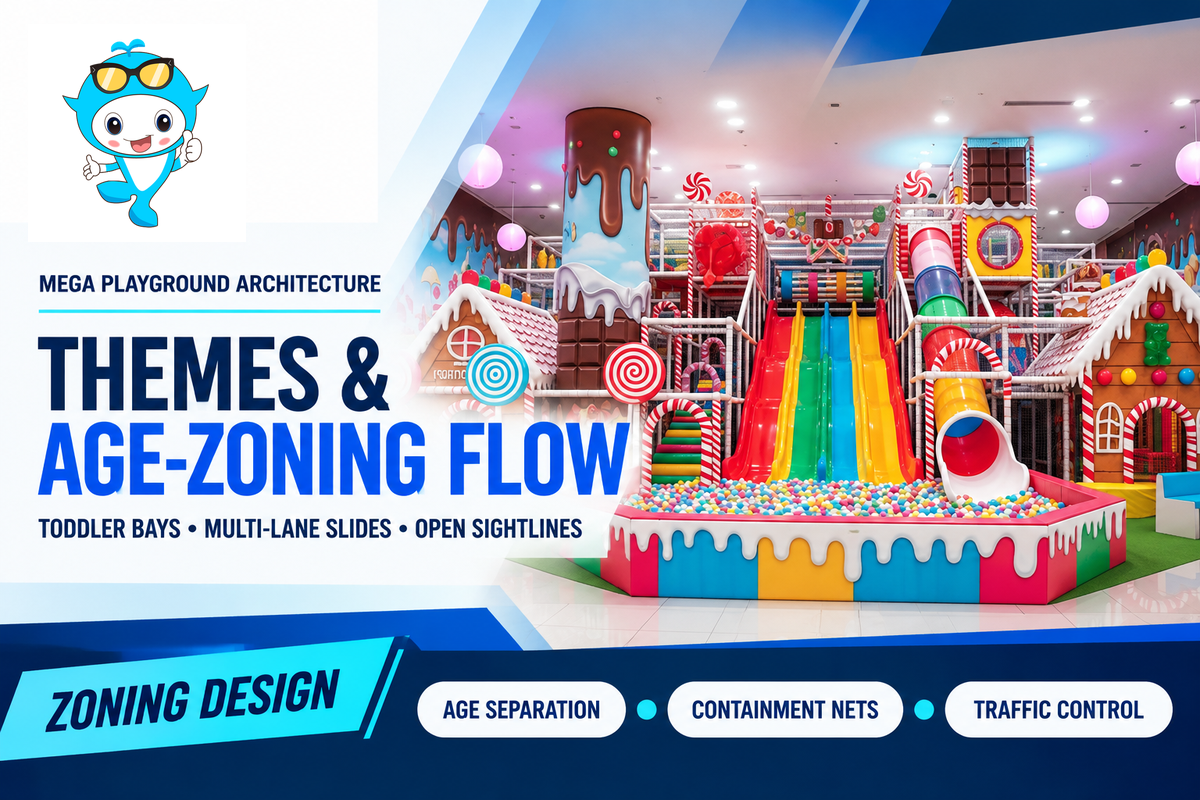
Large indoor playgrounds safely handle hundreds of children by separating traffic into three age zones: 6 to 23 months, 2 to 5 years, and 5 to 12 years. Physical gates keep older kids away from little ones. Crowd flow is managed around climbing frames and play areas.
Open sightlines are more effective than square footage for safety. Enclosed decks create visual blind spots where staff cannot spot rough play quickly. Under CPSC rules cited by The Redwoods Group, containment netting (keeping children inside decks) and climbing netting (built for ascent) are not interchangeable.
“Injuries from lack of supervision represent just one of those risks, and account for an estimated 40 percent of all playground injuries that occur.”
Attraction anchors help control crowd distribution. A steep volcano slide, twin tube slides, and vertical drop slides draw high-energy older children to upper decks. Lower decks have ball pits, a fenced toddler play area and role play villages, which help to contain younger children and provide distractions from fast slide exits.
Themes that are cohesive help drive repeat visits and weekends booked with birthday parties. Top 2025–2026 venues trade generic tubing for jungle temples, ocean reefs, space decks, or a storybook palace design that can immerse children in an immersive experience. A compact ninja obstacle course—or larger modular obstacle courses—gives 8-to-12-year-olds real physical challenge, offering something for everyone across different age groups without crowding toddlers. Staff flex-monitors cover structural blind corners to keep the multi-level tunnels that kids love under active supervision.
Building Codes and Safety Standards for Oversized Indoor Play Structures
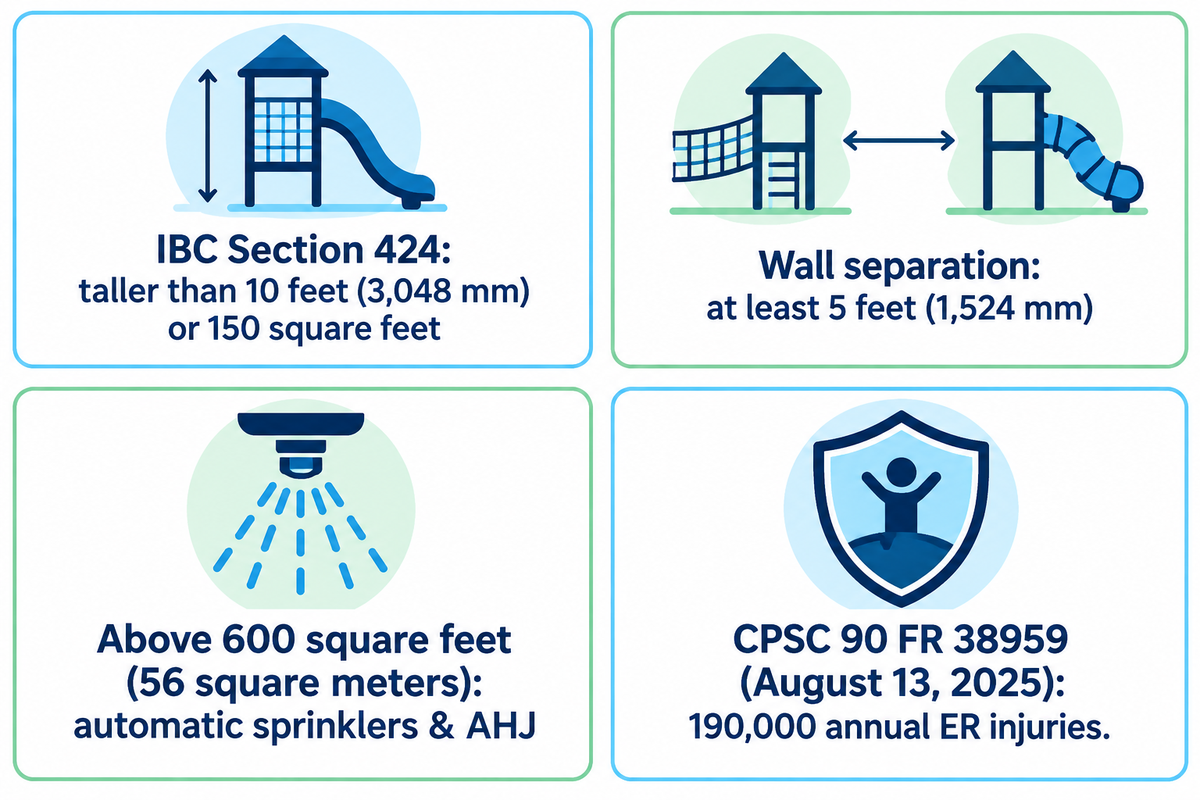
In the United States, any indoor play structure taller than 10 feet (3,048 mm) or larger than 150 square feet (14 square meters) triggers International Building Code (IBC) Section 424 rules. Structures need at least 5 feet (1,524 mm) of wall separation. Footprints above 600 square feet (56 square meters) require automatic sprinklers and approval from the local authority having jurisdiction (AHJ).
Federal safety guidance also changed in 2025. On August 13, 2025, the U.S. Consumer Product Safety Commission published final updates to its Public Playground Safety Handbook (90 FR 38959, Docket CPSC-2024-0030). The notice confirms over 190,000 estimated annual emergency-room playground injuries from 2021 to 2023 (NEISS data). It adds updated gate standards (ASTM F900, F1184, and F2200) after 13 gate fatalities between 2007 and 2024. Section 5.3.9 also assigns one single critical fall height to each composite structure based on its highest fall point.
Commercial buyers must follow two key regulatory boundaries. First, CPSC 16 CFR Part 1250 separates commercial playground equipment from residential consumer toy rules, placing enclosed commercial frames under ASTM F1918-21 (ages 2–12), ASTM F1487-25 (public use), ASTM F2373 (6–23 months), or EN 1176-10:2023 in Europe. Second, the CPSC Handbook is non-binding and deliberately takes a stricter safety approach to voluntary ASTM standards in a few instances. See our international playground safety standards comparison for regional clause tables.
| Code / Standard | Edition / Clause | Exact Verified Threshold | Commercial Design Impact |
|---|---|---|---|
| IBC Section 424 | 2021 & 2024 IBC §424.1–424.5 | >10 ft (3,048 mm) height or >150 sq ft (14 m²); 5 ft (1,524 mm) wall gap; sprinkler threshold above 600 sq ft (56 m²) | Triggers flame-spread tests and AHJ plan review; sprinkler requirements depend on footprint |
| NFPA 13 & Fire Tests | NFPA 13 / ASTM E1354 / NFPA 701 / UL 1975 | Structures >300 sq ft or decks >4 ft wide | Often triggers sub-deck sprinklers or an AMMR engineering appeal |
| CPSC Safety Handbook | 2025 Final Update (90 FR 38959) | >190,000 annual ER injuries; §5.3.9 single critical fall height | Surfacing must match highest fall point on composite structures |
| ADA Chapter 10 | U.S. Access Board Play Areas | 60-in (1,525 mm) route width, 1:16 slope, 80-in (2,030 mm) height | ≥20 elevated components need ≥25% ramp access (1:12 slope, 12-in rise) |
| ADA Surfacing & Integration | ASTM F 1951-99 & ASTM F 1292-04 | Wheelchair effort <1:14 ramp; 6-ft shock surfacing | Grouping accessible elements in one corner fails integration rules |
| Entrapment Clearances | CPSC / ASTM F1487 / Redwoods | Openings <3.5 in or >9 in | Prevents child head and torso entrapment in rails and rungs |
Accessibility rules under U.S. Access Board ADA Chapter 10 surprise many large venues. When a composite structure has 20 or more elevated play components, ramps must connect at least 25% of them. Those ramps need a 36-inch minimum width, 1:12 max slope, 12-inch max rise per run, and 60-inch landings. Ramps or transfer systems must link another 25%. Separate age zones (2–5 and 5–12) comply independently, and each surfacing product needs its own ASTM F 1951-99 test report.
Floor Space, Ceiling Height, and Capacity Math for Large Commercial Venues
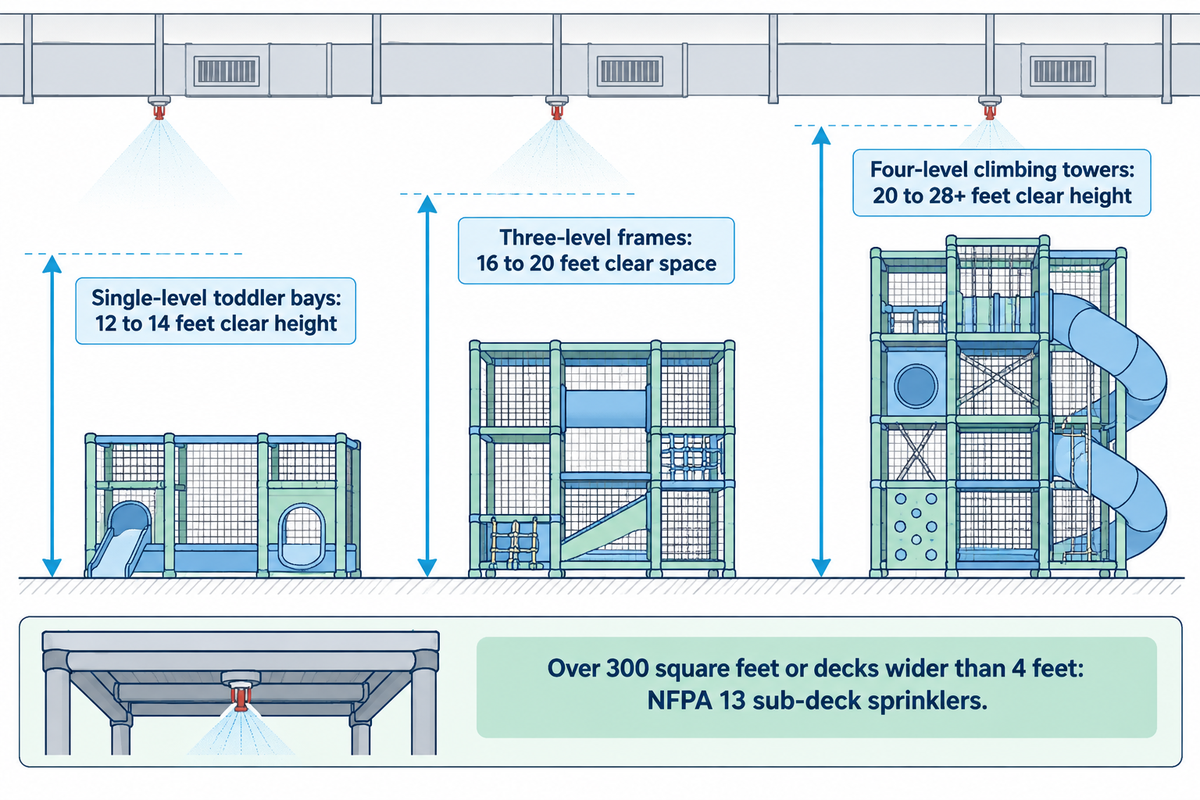
Active play structure footprint and clear ceiling height below ductwork, lighting trusses, and fire sprinkler deflectors determine safe venue capacity. Single-level toddler bays need 12 to 14 feet of clear height. Three-level frames need 16 to 20 feet of clear space. Four-level giant climbing towers with mega slides or an indoor ropes course require 20 to 28+ feet of clear height.
Fire case logs show how ceiling hardware decreases clear height. Practitioners on MeyerFire’s engineering forum document play structures over 300 square feet or decks wider than 4 feet leading to NFPA 13 sub-deck sprinklers and Fire Protection Reports (FPR). Reachable sprinklers pose a risk of child tampering, resulting in owners requesting institutional breakaway heads or submitting formal Alternative Means and Methods Reports (AMMR). Modular padded steel frames (such as patent US5772535A) interconnect decks vertically, so checking sprinkler clearances before lease signing prevents redesign delays.
Worked Example (Assumed Planning Inputs): Suppose an operator evaluates 10,000, 25,000, and 50,000 gross square feet. As an illustrative layout assumption, we assign 45% of gross floor space to active play equipment and 25 active square feet per child. The Mega-Venue Clear-Height & Capacity Calculator Table computes active area (Gross x 0.45) and simultaneous capacity (Active/25).
| Gross Leased Area | Assumed Active Play Footprint (45%) | Estimated Simultaneous Kids (25 sq ft/child) | Recommended Clear Height Below Sprinklers | Typical Play Levels & Mix |
|---|---|---|---|---|
| 10,000 sq ft (929 m²) | 4,500 sq ft (418 m²) | 180 children | 16–20 ft (4.9–6.1 m) | 3-level soft play + toddler bay + 2 party rooms |
| 25,000 sq ft (2,323 m²) | 11,250 sq ft (1,045 m²) | 450 children | 20–24 ft (6.1–7.3 m) | 3–4 levels + ninja course + pretend village + café |
| 50,000 sq ft (4,645 m²) | 22,500 sq ft (2,090 m²) | 900 children | 24–28+ ft (7.3–8.5+ m) | 4-level mega frame + ropes + climbing walls + 6+ party rooms |
On these inputs, a 25,000-square-foot shell accommodates roughly 450 children inside active play zones before counting parents. Local IBC egress width, plumbing fixture counts, and parking minimums set legal occupant loads. Consult our indoor playground floor plan and zoning guide for CAD circulation templates.
How Much Does It Cost to Build a 10,000 to 50,000 Sq Ft Indoor Playground?
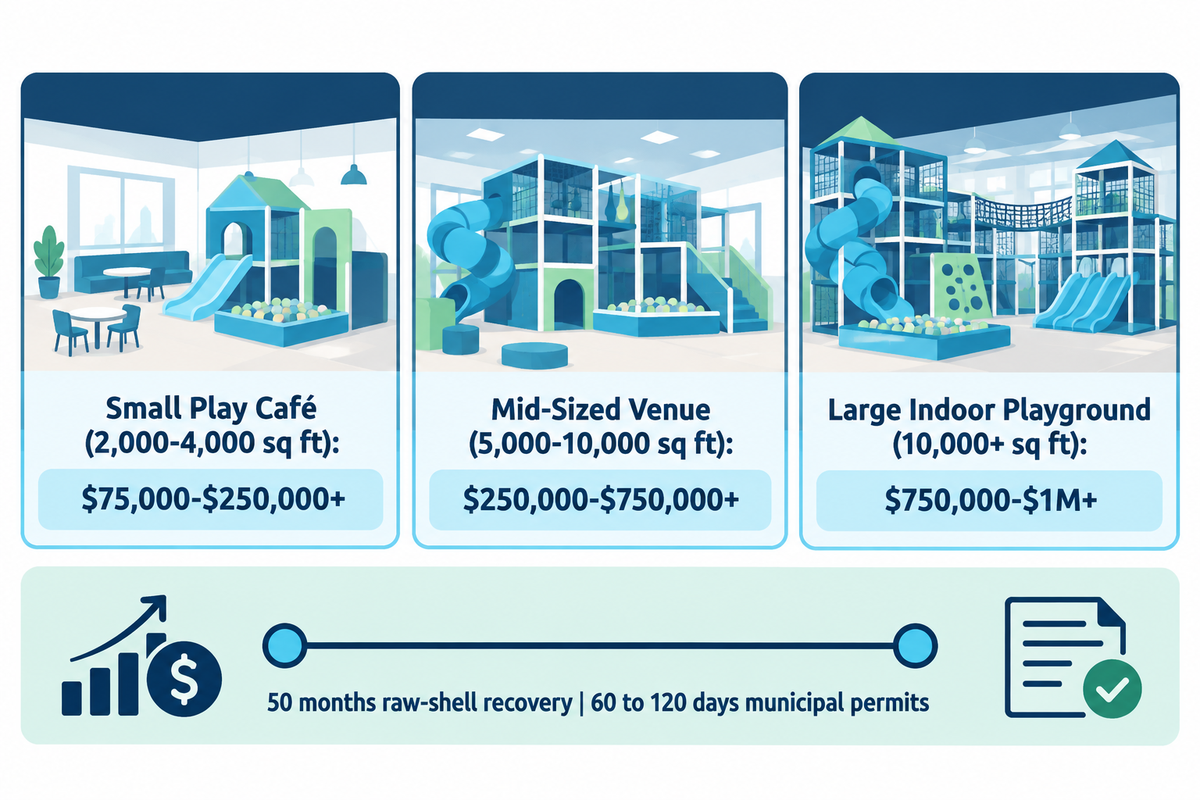
In August 2026, WellnessLiving reported U.S. startup budgets of $75,000 to $1 million+ across commercial indoor playgrounds. Equipment packages span $20,000 to $500,000+. Empty warehouse renovations alone cost $80,000 to $150,000 before equipment arrives.
WellnessLiving shows that saving $2,000 per month on a raw shell requiring $100,000 in extra HVAC, plumbing, and fire-sprinkler buildout takes 50 months (over four years) to recover. Municipal permits consume another 60 to 120 days before opening. Experienced owners therefore hold 3 to 6 months of working capital in reserve.
| Cost Component (US 2026 Benchmarks) | Published Range | Primary Cost Driver | Source |
|---|---|---|---|
| Small Play Café (2,000–4,000 sq ft) | $75,000–$250,000+ | Modular toddler soft play + light retail buildout | WellnessLiving (Aug 2026) |
| Mid-Sized Venue (5,000–10,000 sq ft) | $250,000–$750,000+ | Multi-level structure, party rooms, café prep | WellnessLiving (Aug 2026) |
| Large Indoor Playground / FEC (10,000+ sq ft) | $750,000–$1M+ | Custom themed frames, sprinklers, HVAC, party rooms | WellnessLiving (Aug 2026) |
| Equipment-Only Line Items | $20,000–$500,000+ | Scales from modular starter frames to custom themed multi-level builds | WellnessLiving (Aug 2026) |
| Raw Warehouse Buildout (Pre-Equipment) | $80,000–$150,000 | Restrooms, HVAC tonnage, electrical, ADA, fire alarms | WellnessLiving (Aug 2026) |
| Permits, Inspections & Working Capital | $1,000–$20,000+ permits; 3–6 months reserve | 60–120 day approval cycle; insurance varies by attraction risk | WellnessLiving / Soft Play |
Common Mistake: Treating an Equipment Quote as a Turnkey Budget. Equipment bids exclude MEP plans, IBC Section 424 sprinkler work, EXW or FOB customs, local install labor, NNN/CAM charges, POS software, and spare parts. Scaling to 25,000 to 50,000 square feet without strong party-room bookings inflates utility and payroll burn. We model these payback curves in our indoor playground profitability and unit economics.
Are indoor playgrounds still a thing in 2026?
Yes, there are a number of commercial indoor playgrounds expanding in 2026. Chuck E. Cheese announced on September 28, 2026 a nationwide rollout of its 12,000–18,000+ square foot Adventure World multilevel indoor playground to more than 20 U.S. communities across 2026 and 2027, while Kids Empire surpassed 100 U.S. locations.
Dated single-room ball pits without parent seating are closing. Multi-zone venues with themed climbing frames, birthday party rooms, cafés, and monthly memberships are capturing strong year-round family spending across hot-summer and cold-winter metros.
Why Mega Indoor Playgrounds Are Expanding Into Vacant Retail in 2025–2026
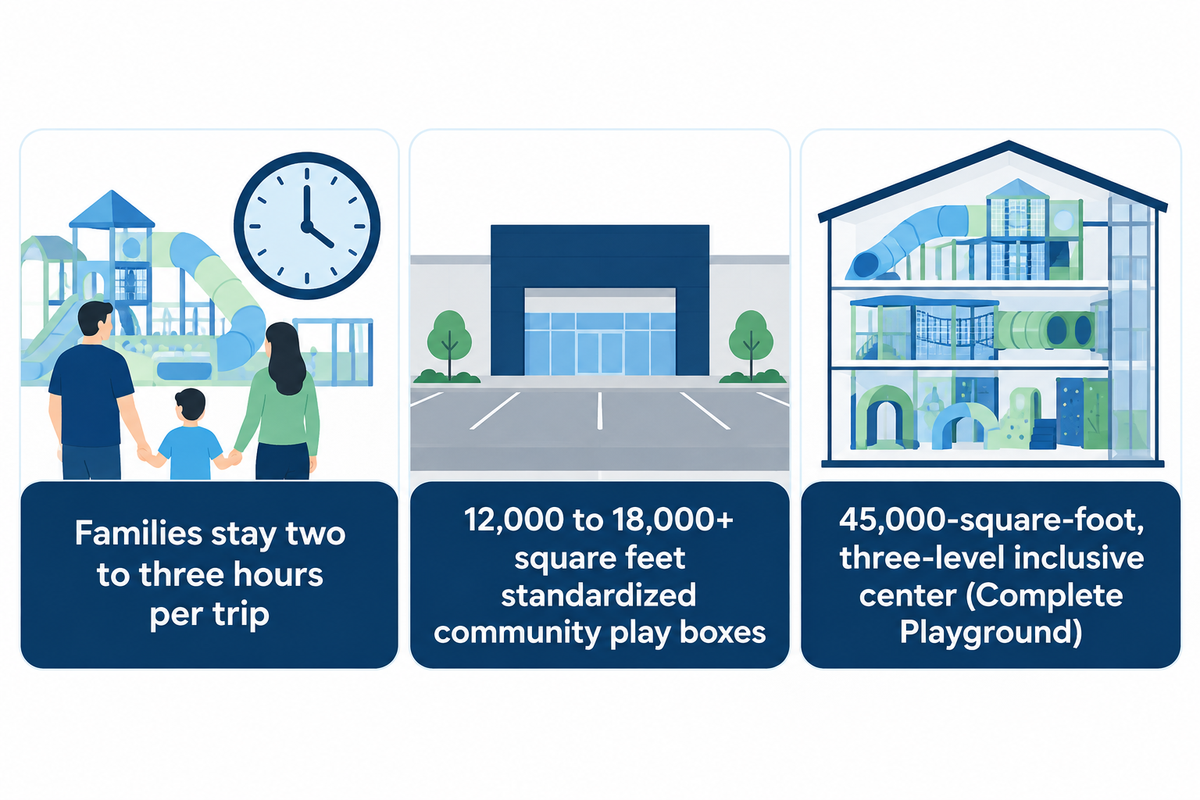
Mega indoor playgrounds are filling vacant big-box stores and mall anchors in 2025–2026 because adaptive reuse provides tall ceilings and wide parking lots. Mall landlords, faced with retail vacancies, swap tenant-improvement packages for indoor entertainment anchors. Families stay two to three hours per trip and spend extra money at adjacent restaurants.
Rollouts of national chains illustrate where the peak of unit economics occurs. After a November 2025 debut in Arlington, Texas, Chuck E. Cheese’s September 28, 2026 expansion targets Houston, Plano, Las Vegas, Chandler, Los Angeles, and three sites in Jalisco, Mexico. Rather than trying to build 50,000-square-foot megaboxes, major chains are standardizing community active-play boxes around 12,000 to 18,000+ square feet.
Funding of inclusive spaces continues. Complete Playground’s 45,000-square-foot, three-level non-profit center in New York’s Financial District and Chuck E. Cheese’s Sensory Sensitive Sundays reflect the growing need for sensory rooms and interactive video walls. Refer to our shopping mall indoor playground requirements guide to review ceilings and fire riser checklists prior to signing a mall lease.
Sourcing Turnkey Commercial Equipment for Large-Scale Indoor Play Projects
Turnkey commercial indoor playground sourcing divides into two tiers: North American and European heritage suppliers (Soft Play, iPlayCO, SPI Global Play, ELI Play) and Asia-based custom manufacturers serving global and Asian market builds. The difference is local PE stamping, theming, and ocean freight.
| Procurement Dimension | North American / European Heritage Suppliers | Asia-Based Custom Turnkey Manufacturers |
|---|---|---|
| Representative Examples | Soft Play, iPlayCO, SPI Global Play, ELI Play | Guangzhou Didi Land Amusement Equipment Co., Ltd. and peer export factories |
| Equipment Pricing & Lead Times | Quote-dependent by footprint, theming depth, and factory queue | Quote-dependent by footprint, theming depth, and ocean freight corridor |
| Strengths | Domestic PE-stamped drawings, local install crews, familiar AHJ packets | High custom theme flexibility, factory-direct pricing, integrated multi-zone packages |
| Primary Buyer Watch-Out | Higher equipment capex per square foot on custom sculpted themes | Must confirm U.S./EU fire-test certificates (ASTM E1354 / NFPA 701) and local AHJ review |
As a commercial indoor playground equipment manufacturer, Guangzhou Didi Land Amusement Equipment Co., Ltd. supplies custom CAD/3D layouts, multi-level soft play frames, and ninja courses. We configure themed indoor playground equipment with premium materials aligned with applicable ASTM and EN project requirements for family entertainment centers and malls. Compare regional suppliers with our commercial indoor playground manufacturers shortlist.
Pre-Contract Verification Checklist Before Signing a Lease or PO
Complete these five checks before releasing a lease deposit or purchase order:
- Submit 3D deck elevations to your local AHJ and fire marshal early to check IBC Section 424 separation, NFPA 13 sprinkler clearance, and any AMMR requirement.
- Collect third-party ASTM F1918-21, ASTM F1487-25, ASTM E1354, NFPA 701, and UL 1975 reports for North America, or EN 1176-10:2023 in Europe.
- Obtain SKU-specific ASTM F 1951-99 and ASTM F 1292-04 floor reports, plus 60-inch routes and ramp layouts for structures with 20 or more elevated components.
- Specify EXW or FOB freight, customs brokerage, unloading, technician travel, and local MEP exclusions in the written quotation.
- Order spare netting, vinyl padding, slide hardware and premium quality wear parts to minimize downtime during peak season.
Planning a 10,000+ Sq Ft Commercial Play Center? Send your CAD shell dimensions, clear ceiling height below sprinklers, and age-group mix to Guangzhou Didi Land Amusement Equipment Co., Ltd. for a zoned 3D layout proposal and itemized equipment specification.
Editorial Transparency Disclosure: Venue sizes cite official operator and Guinness World Records specifications verified as of November 2026.
Frequently Asked Questions
What is the biggest indoor playground in the world by Guinness World Records?
Guinness World Records recognizes Billy Beez at Mall of Dhahran (Al Khobar, Saudi Arabia) as the largest indoor soft-play structure. Iplayco built the facility at 2,316.79 square meters (24,937.72 square feet). Ride-based complexes sit in a separate Guinness indoor theme park category covered next, while Thailand’s Mega HarborLand leads dedicated multi-zone dry venues.
What is the biggest indoor theme park in the world, and why is it different from an indoor playground?
Chimelong Spaceship in Zhuhai, China set the Guinness record for largest indoor theme park on September 15, 2023 across 397,064.94 square meters (4,271,783 square feet). Indoor playgrounds center on self-propelled climbing frames, slides, and soft play governed by playground safety standards. Indoor theme parks operate mechanical rides, shows, and coasters under amusement-ride regulations.
Where is the biggest indoor playground in Singapore and Southeast Asia?
Mega HarborLand in Greater Bangkok leads Southeast Asia near 10,000 square meters (Seacon Bangkae and Central WestGate), while Kiztopia Marina Square (18,000 square feet) and Airzone’s five-level net atrium lead Singapore. Mega HarborLand Megabangna adds another 8,000-square-meter dry hall in Greater Bangkok.
What age groups are mega indoor playgrounds designed for?
Most mega indoor playgrounds serve ages 6 months to 12 years across separated toddler, preschool, and school-age zones, with ropes or adventure courses extending to age 14.
How much space and ceiling height do you need to open a large commercial indoor playground?
Standalone commercial indoor playgrounds typically lease 10,000 to 50,000 gross square feet and need 12 to 28+ feet of clear ceiling height measured below ductwork, lighting trusses, and fire sprinkler deflectors. Global multi-zone flagships can reach up to 108,000 sq. ft. Active play structures normally occupy half or less of the concrete slab, leaving room for customer check-in, parent seating, cafes, birthday party rooms, accessible restrooms, and wide egress aisles. Single-level toddler zones can work with clear heights below 12 to 14 ft., while multi-level commercial frames require 16 to 28+ ft. of clear height, as explained in the capacity table above. As explained in U.S. IBC Section 424, play structures over 10 feet tall or 150 square feet trigger flame-spread material rules, and structures exceeding 600 square feet require automatic sprinkler protection and local AHJ approval.
What safety rules and certifications should parents and operators check at giant indoor play centers?
Check regional commercial playground certifications matching the age zone—such as the North American ASTM and European EN enclosed-structure standards detailed in our code table above. Well-run venues enforce grip-sock policies, place physical barriers around toddler zones, require signed waivers, perform daily checks on equipment, and maintain clear staff sightlines across decks.
Does Kalahari Resort have both an indoor water park and a mega indoor playground?
Yes. At Kalahari Resorts & Conventions in Round Rock, Texas, the indoor water park is next to Tom Foolery’s Adventure Park. That separate 80,000-square-foot indoor family entertainment center has climbing walls, indoor ropes courses, zip lines, bowling, laser tag, and 250 arcade games. Kalahari’s Spotsylvania, Virginia resort expands Tom Foolerys to 90,000 square feet.
References & Sources
- U.S. Consumer Product Safety Commission (CPSC), Notice of Availability: Public Playground Safety Handbook Update (90 FR 38959, Docket No. CPSC-2024-0030), August 13, 2025.
- U.S. Access Board, Guide to the ADA Accessibility Standards, Chapter 10: Play Areas.
- International Code Council (ICC), International Building Code (IBC) Chapter 4, Section 424: Children’s Play Structures.
- Guinness World Records, Largest Indoor Theme Park, Chimelong Spaceship (397,064.94 m²), September 15, 2023.
- Australasian Leisure Management (AusLeisure), Billy Beez Saudi Arabian FEC Recognised as the World’s Largest Soft-Play Area.
- HarborLand Group Official Venue Specifications (Thailand)
- The Redwoods Group, Indoor Playground Supervision & Equipment Risk Control Guidance.
- MeyerFire Fire Protection Engineering Forum, Sprinklers Required Within Kids’ Play Structure (IBC §424 / NFPA 13 Field Analysis).
- WellnessLiving, How Much Does a Commercial Playground Cost? Full Startup Budget Guide, updated August 24, 2026.
- Chuck E. Cheese Corporate Press Release, Chuck E. Cheese Announces Nationwide Rollout of Adventure World, September 28, 2026.
- Complete Playground NYC, All-Inclusive 45,000 Sq Ft Family Center.
SYS.00 // E-E-A-T Disclosure
Why I Write This
As the CEO and Co-Founder of a specialized manufacturing facility, my objective is to provide unvarnished, factory-direct technical insights into commercial indoor playground engineering, safety compliance, and project planning. I aim to bridge the information gap for global buyers seeking reliable structural and material data, ensuring you make informed, ROI-driven decisions without the marketing fluff.
About My Business
Guangzhou Didi Land Amusement Equipment Co., Ltd. (Brand: Didi Land) is a commercial indoor playground equipment manufacturer founded in 2014. Operating from Panyu, Guangzhou, China, we engineer, produce, and export commercial-grade play structures to over 40 countries worldwide. Our production lines strictly adhere to international safety frameworks, ensuring durability and safety for high-traffic environments.
Our Services
We provide end-to-end B2B commercial solutions: from custom 3D spatial design and OEM manufacturing to worldwide export logistics and compliance testing. Our focus is on empowering Family Entertainment Centers (FECs), shopping malls, kindergartens, and hospitality venues with reliable, high-capacity play infrastructure.
DATA_MATRIX // MANUFACTURER_PROFILE
Name:
Cherry
Role:
CEO & Co-Founder
Brand Name:
Didi Land
Company:
Guangzhou Didi Land Amusement Equipment Co., Ltd.
Location:
Guangzhou, Panyu, China
Founded:
2014
Products:
Indoor Playground Equipment, Soft Play Equipment, Themed Playground Design, FEC Play Zones, Trampoline Modules, Ninja / Obstacle Course Modules
Email:
conglizhang1@gmail.com
Phone:
+86 199 2587 9517
Website:
didiplayarea.com
COMPLIANCE & STANDARDS:
ASTM F1487 · ASTM F1918 · EN 1176 · CPSIA · CE · ISO 9001 · IPEMA
Contact Factory Direct
Related Posts
Trending now