Get in Touch with Didi Land


Updated November 2026
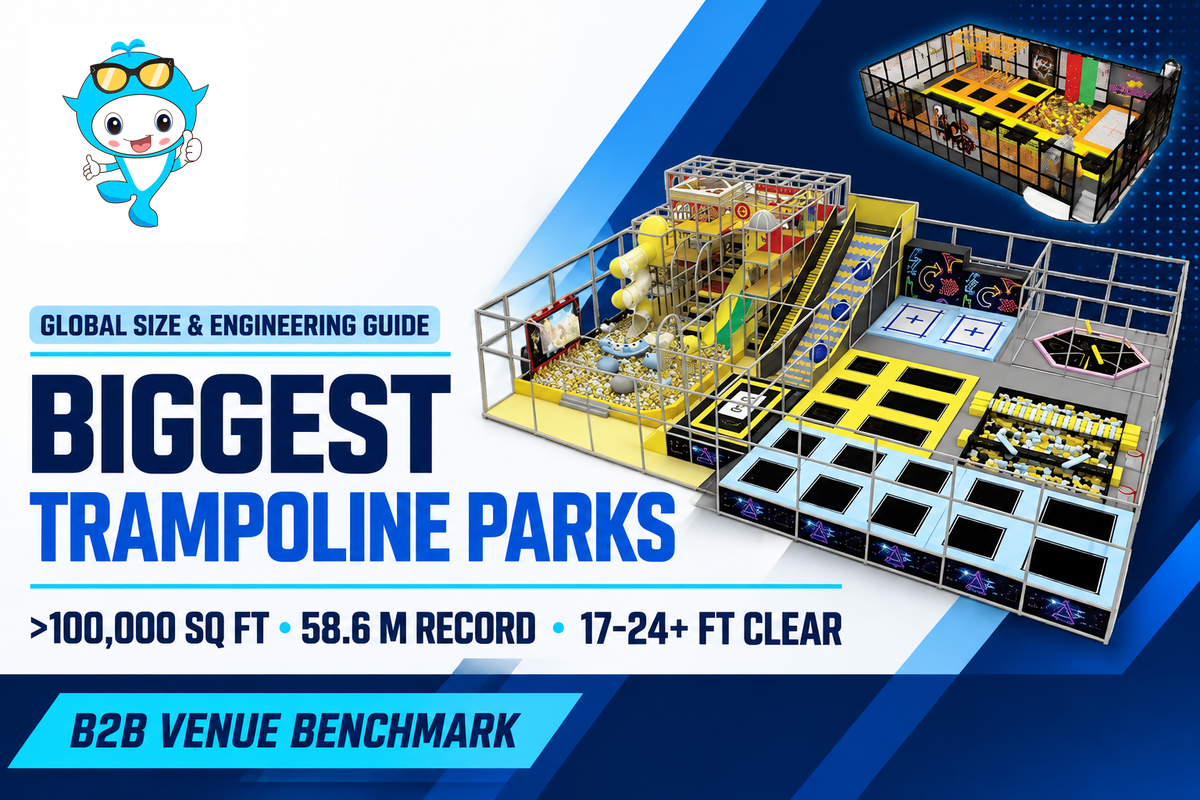
Visitors asking where is the biggest trampoline park in the world find Flip Out Leeds in Yorkshire, England, leading current English-language indoor reports at over 100,000 sq ft (~9,290 m² at 1 m² = 10.7639 sq ft). Opened in October 2025, this indoor adventure and trampoline park houses 14 attractions and over 100 interconnected trampolines (regional opening press cited 150 beds), as reported by Park World Online.
Building square footage only tells part of the story. Flip Out Glasgow in Rutherglen, Scotland, occupies an arena over 63,000 sq ft (~5,853 m²), yet its official location page currently lists 34 trampolines alongside 16 hybrid attractions. For third-party hardware certification, APEX Adventure-Plex in Winnipeg, Canada, holds the Guinness World Records title for the longest permanent trampoline at 58.6 m (192 ft 3 in), achieved on 9 April 2026. Operators have built layouts around bounce grids, dodgeball courts, and airbag zones, illustrating how a family entertainment and trampoline venue is structured inside a larger warehouse.
Quick Specs: Global Trampoline Park Size Benchmarks
| Largest Reported Indoor Hybrid Venue (English Press) | Flip Out Leeds, UK — >100,000 sq ft (~9,290 m²), >100 trampolines, 14 attractions |
| Official Guinness Hardware Record (April 2026) | APEX Adventure-Plex, Winnipeg, Canada — 58.6 m (192 ft 3 in) longest permanent trampoline |
| Largest Dedicated Trampoline Court Disclosed (EU) | Super Skypark Tallinn, Estonia — >1,500 m² (~16,146 sq ft) inside >7,000 m² (~75,347 sq ft) FEC |
| Largest Chain & Average Unit Size | Sky Zone — >300 global locations; 38,800 sq ft (~3,605 m²) US/Canada average (JLL, May 2026) |
| Minimum Commercial Clear Ceiling Height | 17 ft (5.2 m) minimum clear; 20–24+ ft (6.1–7.3+ m) for mega multi-attraction parks |
Where Is the Biggest Trampoline Park in the World Right Now?
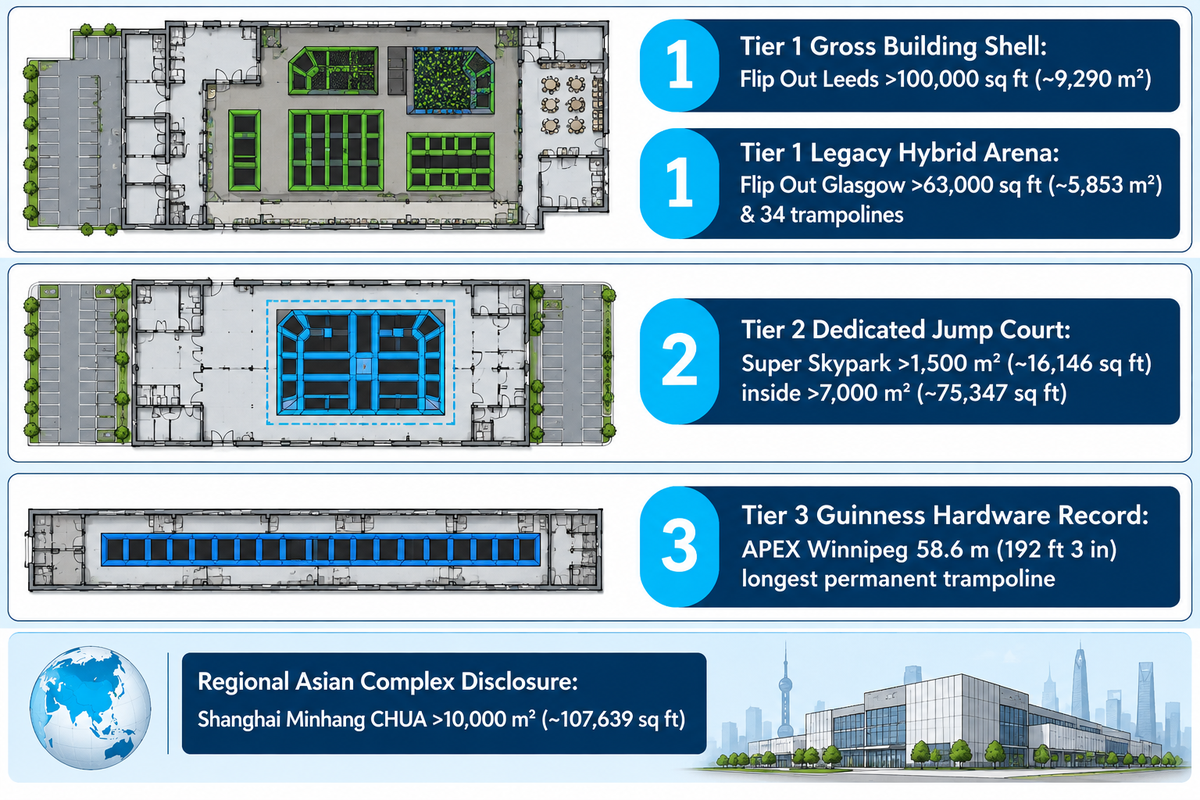
In indoor commercial facilities, Flip Out Leeds holds the largest English-language reported indoor building area. Flip Out Glasgow is a large venue, while APEX Adventure-Plex holds a Guinness record for an individual trampoline. Online lists vary because venues report either gross leased space, active jump surface, or one piece of hardware.
Regional non-English press in Asia also reports hybrid trampoline complexes exceeding 10,000 m² (~107,639 sq ft), including Shanghai Minhang’s multi-activity CHUA complex featured by Shanghai Sports in 2023. Therefore, to compare facilities fairly, we must label each published size as gross building shell, dedicated jump surface, or a single standalone structure.
Use our 3-Tier Gross-vs-Jump Area Verification Lens to determine the validity of any world’s biggest or world’s largest claim.
- Tier 1 measures the gross leased building area inside the exterior walls, including lockers, cafes, party rooms, and non-jump attractions. Both Flip Out Leeds and Flip Out Glasgow publish Tier 1 totals.
- Tier 2 separates active trampoline court surface from support zones. Super Skypark in Tallinn states it has over 7,000 m² (~75,347 sq ft) of total center area, and over 1,500 m² (~16,146 sq ft) of trampoline court.
- Tier 3 verifies a single certified structure through third-party measurement, as Guinness World Records has done for APEX Adventure-Plex in Winnipeg.
What Is the World’s Largest Indoor Trampoline Fun Park?
English-language publications place Flip Out Leeds ahead of Flying Squirrel’s flagship locations in Whitby, South Calgary and Everett. The Flying Squirrel locations, however, make the claim of “world’s largest indoor trampoline fun park” at around 37,000 sq ft (3,437 m²). By enclosed indoor shell size, Flip Out Leeds, Flip Out Glasgow and Maxx Arena Munich (5,500 m² / ~59,201 sq ft) all report larger buildings.
Reported Sizes of 12 Major Indoor Trampoline and Hybrid Parks Compared
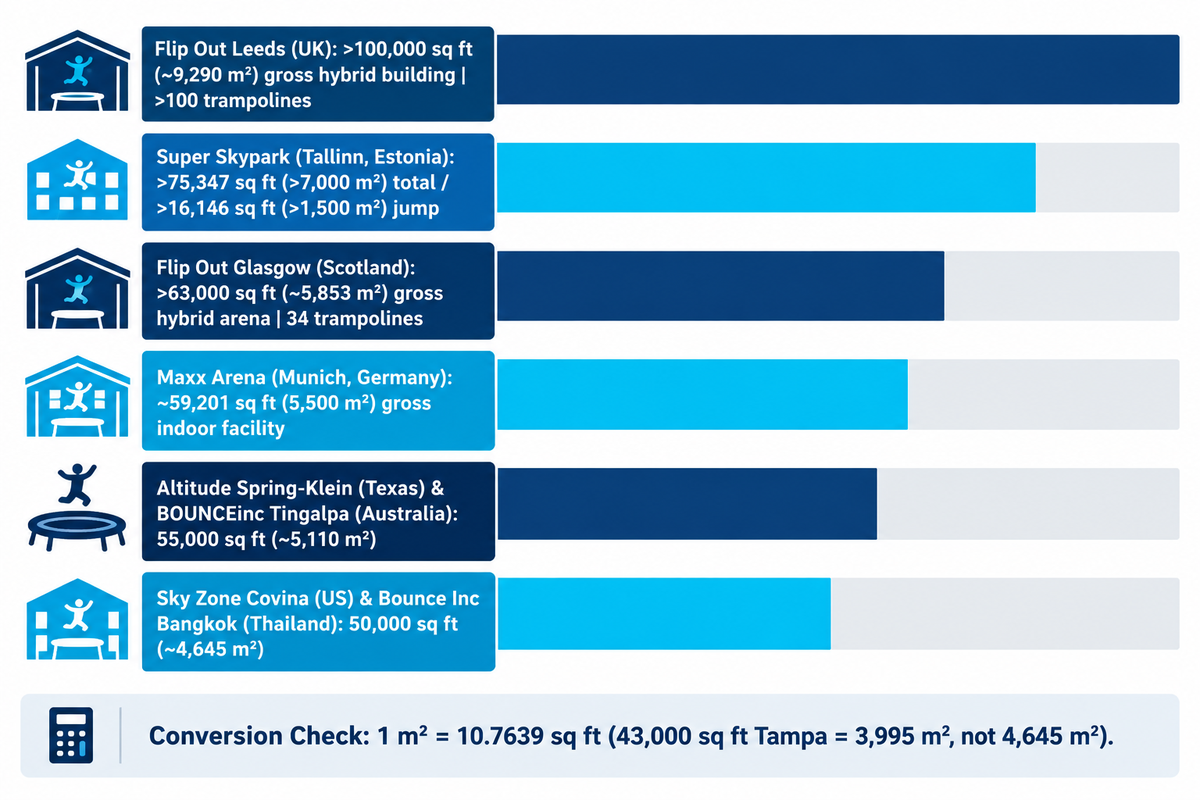
Flagship indoor trampoline parks in the world across Europe, North America, Asia, and Australia span 25,000 to over 100,000 sq ft when recalculated uniformly at 1 m² = 10.7639 sq ft. In the UK, Germany, USA, Thailand and China, multi-attraction leaders differ in reported scopes.
Many popular lists contain obsolete or incorrect conversion figures. For example, Bagjump’s global list shows Altitude Trampoline Park Tampa at 43,000 sq ft, and 4,645 m² beside it. Dividing 43,000 by 10.7639 is 3,995 m², not 4,645 m². In Asia, Bounce Inc Bangkok leads English-language lists at 50,000 sq ft, while regional Chinese press reported Shanghai Minhang’s CHUA hybrid venue above 10,000 m². Each value is shown with the reporting scope of each park in the table below.
| Park Name | Location | Reported Area (sq ft / m²) | Measurement Scope | Key Features |
|---|---|---|---|---|
| Flip Out Leeds | Leeds, UK | >100,000 sq ft (~9,290 m²) | Gross hybrid building | >100 trampolines, >18,000 sq ft inflatable course, laser tag, zip lines |
| Flip Out Glasgow | Rutherglen, Scotland | >63,000 sq ft (~5,853 m²) | Gross hybrid arena | 34 trampolines listed on site, 16 total attractions, e-karting |
| Maxx Arena Trampoline Park | Munich, Germany | ~59,201 sq ft (5,500 m²) | Gross indoor facility | Over 50 trampolines, climbing wall, ninja warrior track |
| Altitude Trampoline Park Spring-Klein | Spring-Klein, Texas, U.S. | 55,000 sq ft (~5,110 m²) | Gross indoor facility | High-performance courts, dodgeball, foam pit, rock wall |
| BOUNCEinc Tingalpa | Brisbane, Australia | 55,000 sq ft (~5,110 m²) | Gross indoor facility | Freestyle jump courts, X-Park obstacle run, slam dunk |
| Sky Zone Covina | Covina, California, U.S. | 50,000 sq ft (~4,645 m²) | Gross indoor facility | Wall-to-wall trampoline courts, warrior course, SkySlam |
| Bounce Inc Bangkok | Bangkok, Thailand | 50,000 sq ft (~4,645 m²) | Gross indoor facility | Free-jump trampoline arena, performance walls, foam pits, ninja course |
| AirHop Bristol | Bristol, UK | ~50,000 sq ft (~4,645 m²) gross indoor facility | Gross & jump split | Interconnected trampolines, battle beams, wipeout zone |
| AirHop Guildford | Guildford, UK | 45,000 sq ft (~4,181 m²) | Gross indoor facility | Freestyle jump beds, dodgeball courts, assault course |
| Altitude Trampoline Park Tampa | Tampa, Florida, U.S. | 43,000 sq ft (~3,995 m²) | Gross indoor facility | Main jump court, ninja course, gymnastics tumble tracks |
| Flying Squirrel Indoor Trampoline Park (Whitby) | Whitby, Ontario, Canada | ~37,000+ sq ft (~3,437+ m²) | Gross indoor facility | Freestyle courts, aerial silks, climbing wall, dunk hoops |
| Super Skypark | Tallinn, Estonia | >75,347 sq ft (>7,000 m²) total / >16,146 sq ft (>1,500 m²) jump | Gross & jump split | Dedicated European trampoline arena inside T1 Mall FEC |
Sources: Park World Online, Flip Out Glasgow, Super Skypark, plus equipment vendor roundups Bagjump and Akrobat. Metric values use 1 m² = 10.7639 sq ft.
There are other notable mid-sized venues worth visiting in Europe other than the mega halls. Abenteuerland Trampoline Park in Bispingen, Germany, is 1,460 m² (~15,715 sq ft), and Trixs Leiderdorp in the Netherlands is 1,330 m² (~14,316 sq ft). For those who would prefer an outdoor venue rather than bouncing in an enclosed warehouse, Upla in Mont-Saint-Grégoire, Quebec, has aerial nets suspended across the forest canopy. Prospective customers comparing the best trampoline parks around the world should check whether each park is located indoors or outdoors.
Is Flip Out Leeds the Biggest Trampoline Park in the World?
Yes, Flip Out Leeds is the biggest indoor trampoline and adventure park reported in English trade press. Its warehouse combines over 100 interconnected trampolines with an 18,000+ sq ft (~1,672 m²) inflatable obstacle course, laser tag, zip lines, and a ninja playground. Spring beds occupy only part of that floor, whereas Super Skypark in Tallinn reports over 1500 m² of dedicated trampoline jumping space alone.
Where Is the Biggest Trampoline Park in the US and North America?
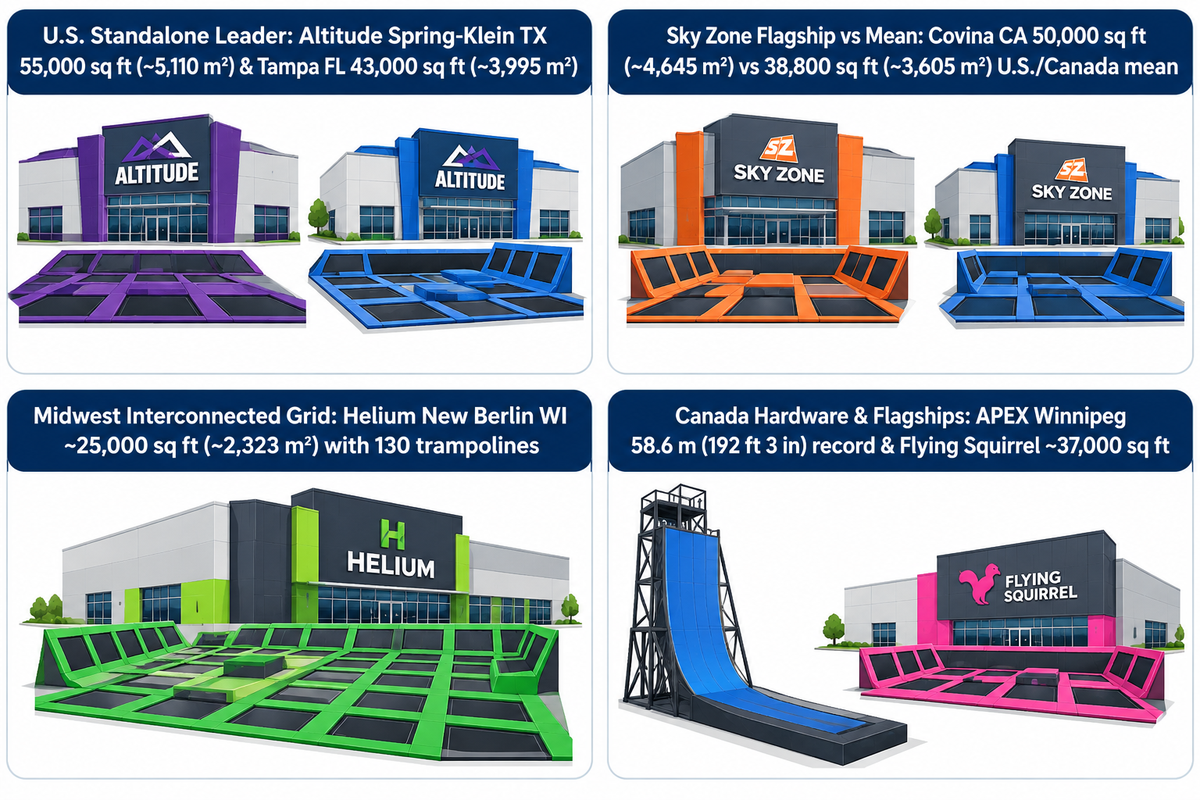
Altitude Trampoline Park Spring-Klein in Texas leads reported standalone U.S. indoor trampoline parks at 55,000 sq ft (~5,110 m²). Sky Zone Covina in California is among the U.S. flagships. In Canada, APEX Adventure-Plex in Winnipeg holds the Guinness longest permanent trampoline record, while Flying Squirrel Sports operates major flagships in Whitby and Calgary.
Founder Rick Platt opened the first indoor trampoline park in the Las Vegas Valley, Nevada, in 2004 under the original Sky Zone name. From there, the concept took off and created distinct regional standouts as franchises exploded in the U.S. and Canada.
- Some of Altitude’s noteworthy standalone U.S. facilities include its Trampoline Park Spring-Klein location in Texas and its 43,000 square foot (~3,995 m²) location in Tampa, Florida.
- Midwest venues include Helium Trampoline Park in New Berlin, Wisconsin, listed in equipment directories at ~25,000 square feet (~2,323 m²) with 130 interconnected trampolines (local press cited a higher gross-shell figure), and AirMaxx Trampoline Park in Minnesota.
- Multi-state networks such as Get Air Indoor Trampoline Parks (often called Get Air Trampoline) serve suburban metros across the U.S. and Canada. Flying Squirrel Sports runs large locations in Everett, Washington and Lutz near Tampa, Florida.
What Is the Highest Rated Trampoline Park in the US?
Pad maintenance and staff supervision outweigh raw square footage, so guest ratings vary by branch rather than by national brand. Across Reddit reviews, Sky Zone, Altitude, and Urban Air locations with separated toddler zones and active staff monitors are favored over larger, worn warehouses. Look at recent guest ratings for your city branch before going to a popular trampoline park.
Where Is the Biggest Sky Zone in the World?
Sky Zone Covina in Southern California is widely reported as the largest individual Sky Zone Trampoline Park. That California flagship sits above the chain’s North American mean: JLL’s May 2026 Location-Based Entertainment Report places U.S. and Canadian Sky Zone venues at an average of 38,800 sq ft (~3,605 m²).
Biggest Trampoline Park Companies and Global Franchise Chains
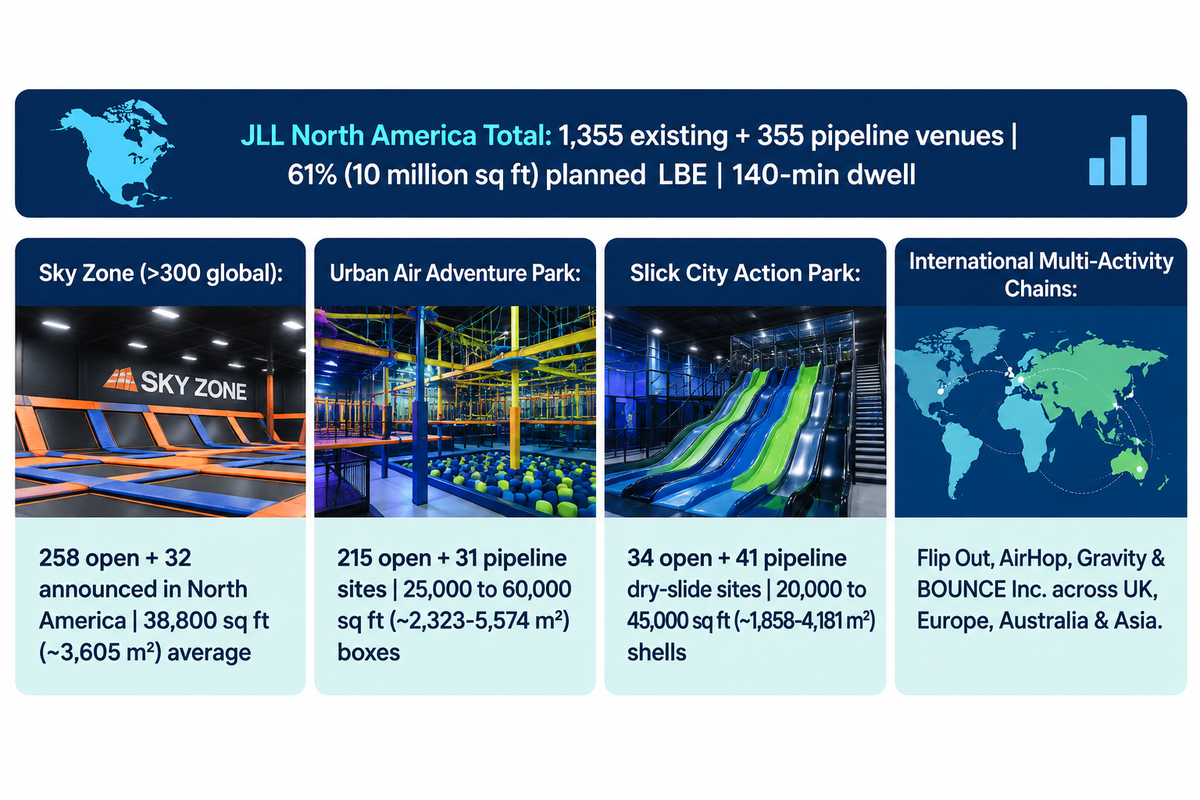
Sky Zone is the biggest trampoline park company in the world with more than 300 locations across the globe, including former CircusTrix parks consolidated under the Sky Zone brand. With a multi-brand portfolio, Sky Zone is ahead of every competing operator in total store count across North America and international franchise markets.
“Chain footprint” and “single-building record size” behave differently in active entertainment real estate. JLL counts 1,355 existing trampoline park and kid-zone venues, plus 355 in the pipeline, in the U.S. and Canada. Together, those formats account for 61% (10 million sq ft) of all planned location-based entertainment space, with sector visit dwell times averaging 140 minutes per visit. Leading operators still prefer mid-size boxes over 100,000 sq ft shells:
- Sky Zone leads North America in JLL’s dataset with 258 open and 32 announced sites averaging 38,800 sq ft (~3,605 m²).
- Urban Air Adventure Park holds 215 open and 31 pipeline sites, with JLL reporting boxes of 25,000 to 60,000 sq ft (~2,323–5,574 m²).
- Slick City Action Park has 34 open and 41 pipeline dry-slide sites, with shell sizes of 20,000 to 45,000 sq ft (~1,858–4,181 m²) according to JLL.
- Flip Out, AirHop, Gravity, and BOUNCE Inc. lead the way with hybrid multi-activity formats across the UK, Europe, Australia, and Asia with multiple mall locations.
According to JLL, the share of entertainment move-ins going to power and lifestyle centers roughly doubled from 2019 to 2025. Second-generation retail boxes between 25,000 and 50,000 sq ft supply much more lease inventory than high-bay megastructures.
What Is the Biggest Trampoline Park Company?
Sky Zone is the largest trampoline park company globally, with Urban Air leading the U.S. multi-attraction adventure segment. Regional chains like Flip Out, AirHop, and BOUNCE Inc hold leading footprints across the UK, Europe, Australia, and Asia, alongside North American challengers Altitude Trampoline Park and Get Air.
Trampoline Park vs Inflatable Park vs Adventure Park: Why Lists Mix Them Up
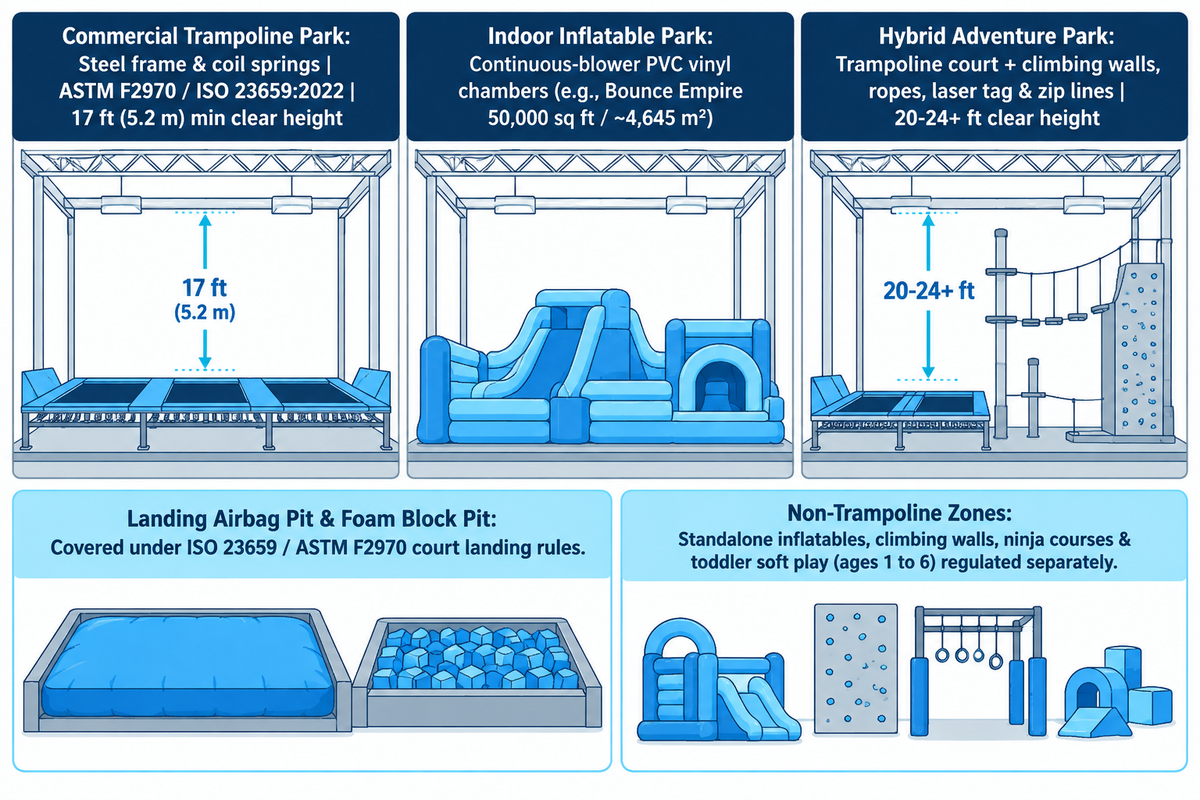
Commercial trampoline parks use steel frames and coil springs regulated under ASTM F2970 or ISO 23659. By contrast, venues like Bounce Empire in Lafayette, Colorado, operate 50,000 sq ft (~4,645 m²) continuous-blower PVC inflatable parks. Online directories often combine both formats with adventure parks because families tend to search for indoor bouncing under one broad query.
Bounce Empire’s official site describes its building between Denver and Boulder as an “indoor inflatable amusement park.” Blower-powered vinyl chambers deliver cushioned bounces without metal springs. Meanwhile, indoor adventure parks like Urban Air and Flip Out Leeds combine a trampoline arena with climbing walls, ropes courses, laser tag, and zip lines inside one family fun center. Safety standard boundaries follow attraction physics rather than facility branding. ASTM F2970-25 and ISO 23659:2022 govern commercial trampoline courts and their associated landing systems (including landing airbags and foam pits), while standalone PVC inflatables, climbing walls, ninja rigs, and municipal fire codes follow separate regulations.
| Format / Zone Type | Primary Structure | Governing Standard Focus | Core User Group | Operational Note |
|---|---|---|---|---|
| Commercial Trampoline Park | Steel frame, springs, polypropylene beds | ASTM F2970 / ISO 23659:2022 | Ages 4 to adults | Requires 17 ft (5.2 m) minimum clear height |
| Indoor Inflatable Park | Continuous-blower PVC vinyl chambers | Inflatable amusement device standards | Ages 3 to teens | Continuous blower power load; no coil springs |
| Hybrid Adventure Park | Mixed trampoline, ropes, slides, climbing | Multi-standard per attraction zone | Mixed-age families | 20–24+ ft clear height for overhead rigs |
| Main Free-Jump Court | Interconnected spring beds + angled walls | ASTM F2970 / ISO 23659:2022 | General jumpers | One-jumper-per-mat supervision rule |
| Trampoline Dodgeball Court | Enclosed netted beds + wall pads | ASTM F2970 / ISO 23659:2022 | Teens & group events | High throughput for birthday teams |
| Basketball Slam Dunk Lane | Runway trampolines + breakaway rims | ASTM F2970 / ISO 23659:2022 | Youth & adults | Monitors enforce one jumper per lane until landing area clears |
| Landing Airbag Pit | Engineered dual-chamber air cushion | Covered under ISO 23659 / ASTM F2970 | Stunt & freestyle jumpers | Faster reset and lower hygiene labor than foam cubes |
| Foam Block Pit | Recessed pit filled with foam blocks | Covered under ISO 23659 / ASTM F2970 | Youth & freestyle jumpers | Higher cube-cleaning labor and fire-code scrutiny in EU |
| Ninja Warrior Course | Overhead truss + suspended obstacles | Separate obstacle / containment rules | Ages 7 to adults | Fall protection matched to obstacle height and course type |
| Toddler Soft-Play Zone | Padded steel frame + vinyl soft blocks | Contained play equipment standards | Ages 1 to 6 | Physically separates small kids from older jumpers |
Inside a Mega Trampoline Park: Core Attractions, Zones, and Visitor Fit
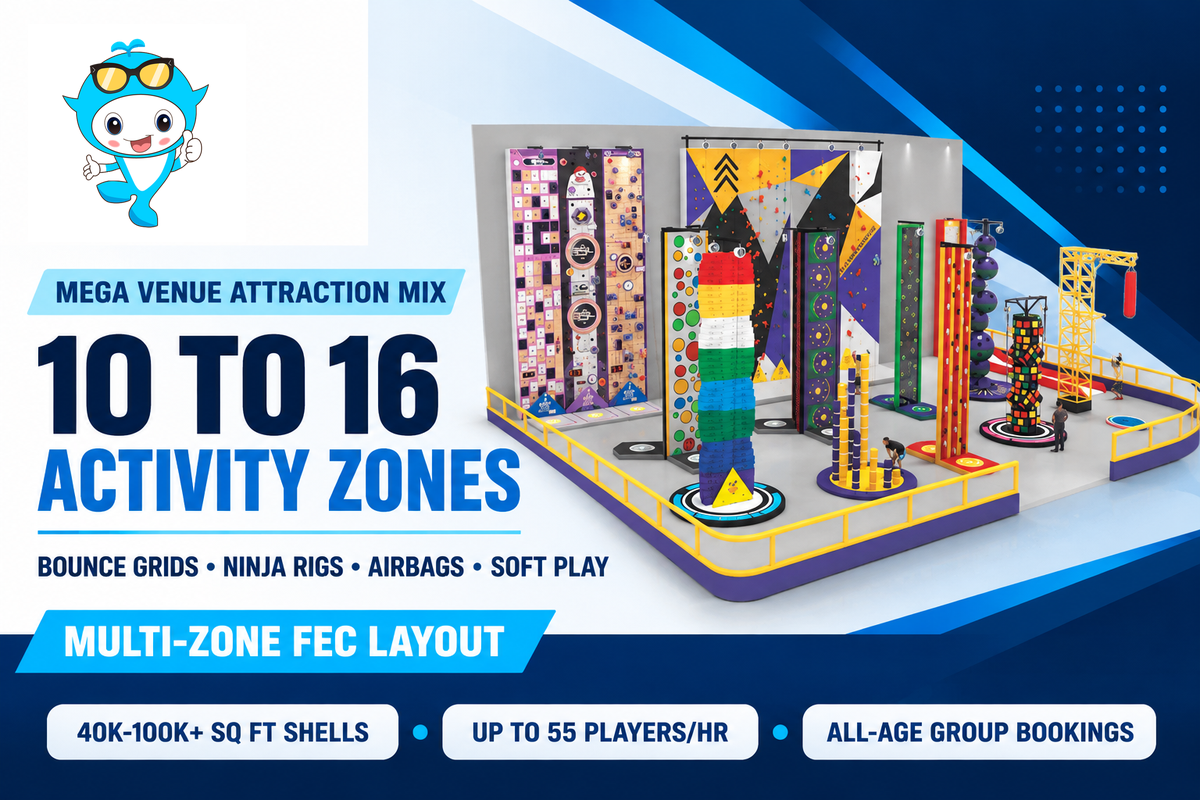
Large and mega indoor trampoline parks occupying 40,000 to over 100,000 sq. ft. divide their floor into 10 to 16 different activity zones, rather than using wall-to-wall bounce mats. To maximize engagement time, pairing interconnected trampolines with obstacle courses, climbing walls, and soft-play areas keeps people of all ages active beyond open jumping.
Operators create high-repeat layouts around structured trampoline-based zones for every jumper. Enclosed dodgeball courts host fast trampoline dodgeball matches. Runway beds drive basketball dunk and slam dunk lanes. Many locations also provide a climbing wall, zorbing tracks, fitness classes, and attractions like ninja warrior courses, giving guests numerous ways to play. Visitors can try interactive rebound games like ValoJump, which manufacturers rate for up to 55 players per hour per unit.
More recent construction has evolved rapidly across landing zones. Older builds had a pit filled with foam blocks, which captures dust and requires cubes to be replaced often. Stricter French fire rules from 2025 onward also pushed European operators toward commercial landing airbags from Bagjump and BigAirBag. Airbags can be quick to clean and can speed turnaround times between landings. Developers are now combining airbag landing zones with rigs from specialized commercial ninja warrior course manufacturers to increase teen capacity.
Parent discussions show how zone diversity drives group bookings. In a birthday planning thread on Reddit comparing Sky Zone and Urban Air, parents favored hybrid parks for groups of differing ages. Younger kids can play in the various soft play areas. Older kids can use the parks’ ninja courses and zip lines. Adults who prefer leisurely entertainment can relax in cafe lounges overlooking the arena.
A multi-zone layout can offer fun for the whole family. Birthday parties are hosted in separate rooms, with kids birthday party slots and bundled birthday party packages. Weekday mornings can accommodate school outings and summer fun camps, while evenings can host team-building and group events. Evening bookings also give friends and families active fun and attractions for all ages during the park experience.
How Commercial Trampoline Parks Are Measured: Gross Area vs Jump Surface
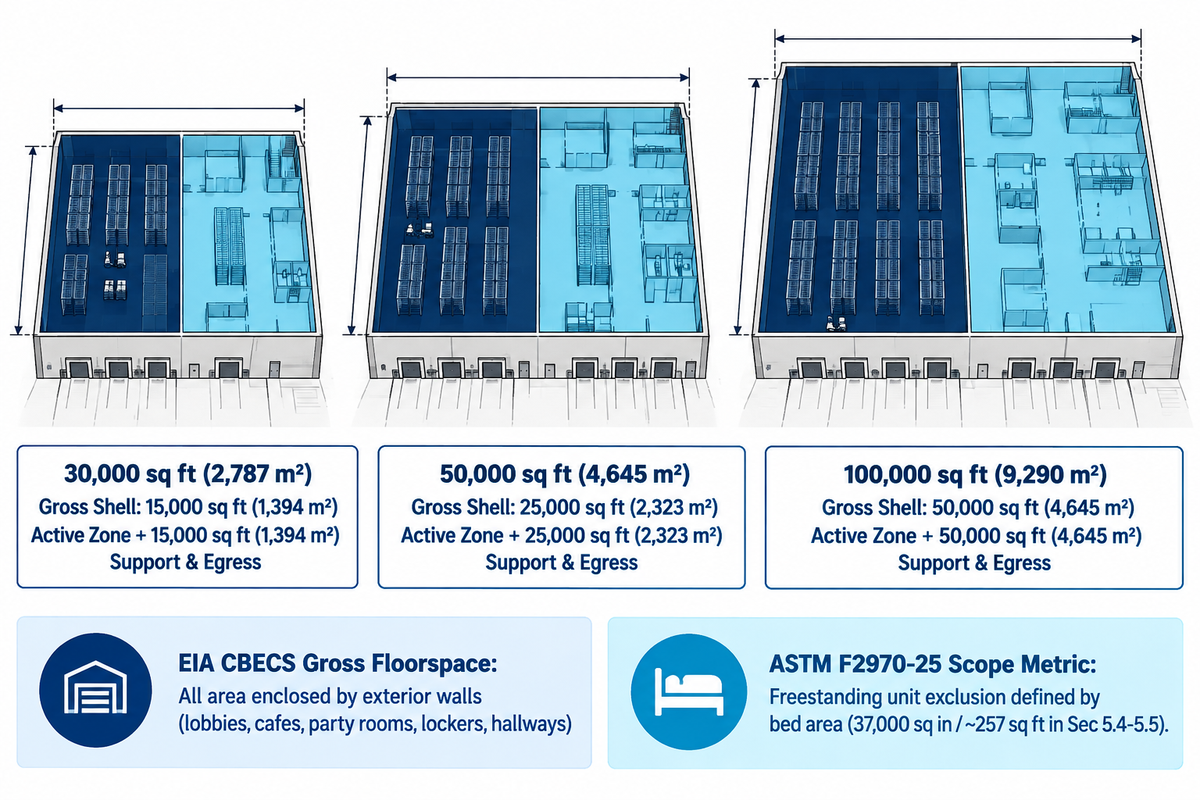
Commercial trampoline parks split leased warehouse floors between active jumping area and support zones such as check-in desks, party rooms, cafes, restrooms, lockers, and fire-exit aisles. Super Skypark in Tallinn, for example, lists over 1500 m² of jump space inside its larger gross shell.
According to the U.S. Energy Information Administration (CBECS), commercial total floorspace includes all area enclosed by exterior walls, including hallways, lobbies, basements, stairways, and elevator shafts. Other spaces may also be included. On the other hand, ASTM F2970-25 defines the scope of specific freestanding unit exclusions by trampoline bed area (37,000 square inches, or about 257 square feet, in Sections 5.4-5.5) rather than the size of the building shell. A warehouse cannot contain wall-to-wall trampoline frames after mapping perimeter padding and egress paths. Prior to engaging CAD plans, convert square feet to square meters for play areas and test zone splits with an FEC layout zone calculator.
Worked Planning Example: Imagine an operator leases a 50,000 sq ft shell, and models an assumed 50% active attraction share for preliminary planning. Dividing by 10.7639 sq ft/m² equals 4,645 m² gross. Multiplying 50,000 sq ft by 0.50 reserves 25,000 sq ft (2,323 m²) for jump beds, ninja tracks, airbags, and soft play. The remaining 25,000 sq ft (2,323 m²) covers reception, lockers, cafe seating, party rooms, restrooms, and egress aisles. Worked 50% active-zone planning calculations illustrate floor-split math, not fire-code occupant limits; local fire-egress codes, column spacing, and non-trampoline footprints set final mat counts and legal capacities.
| Gross Leased Shell | Metric Gross Area (÷ 10.7639) | Assumed 50% Active Attraction Zone | Assumed 50% Support & Egress |
|---|---|---|---|
| 30,000 sq ft | 2,787 m² | 15,000 sq ft (1,394 m²) | 15,000 sq ft (1,394 m²) |
| 50,000 sq ft | 4,645 m² | 25,000 sq ft (2,323 m²) | 25,000 sq ft (2,323 m²) |
| 100,000 sq ft | 9,290 m² | 50,000 sq ft (4,645 m²) | 50,000 sq ft (4,645 m²) |
Commercial Safety Standards and Building Requirements for Large Trampoline Parks
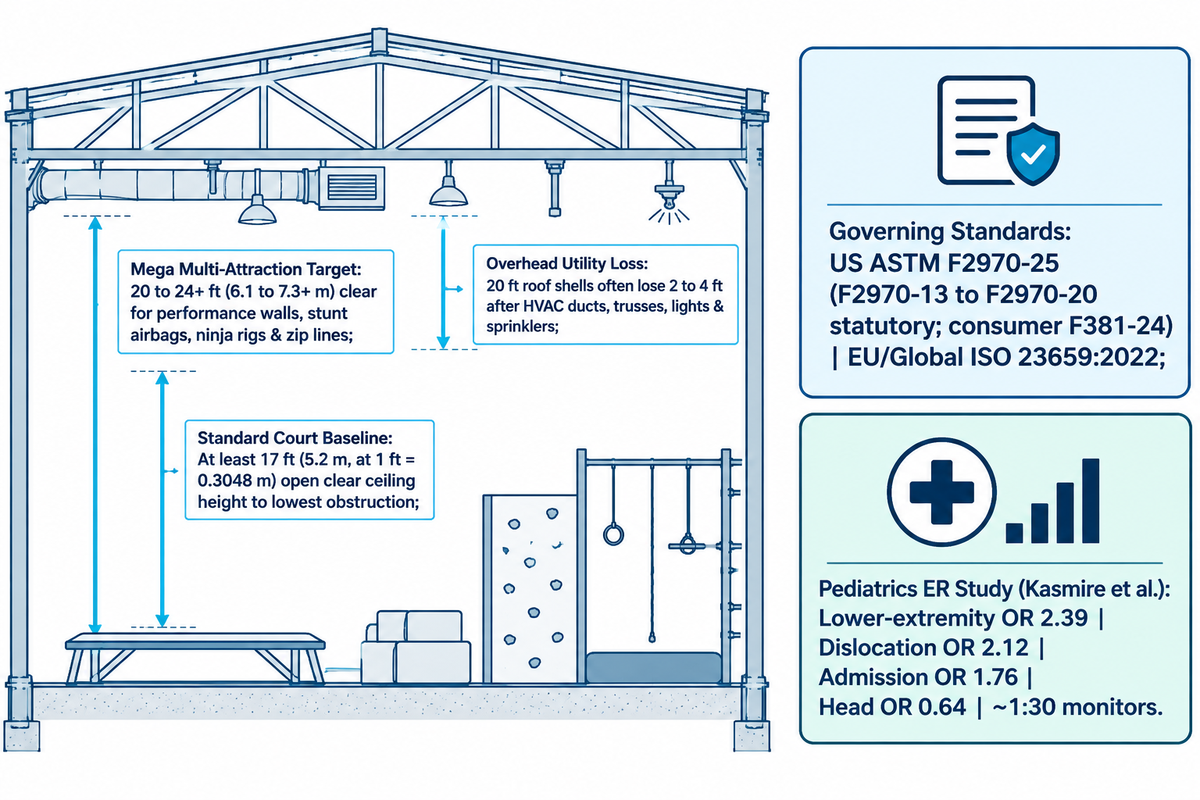
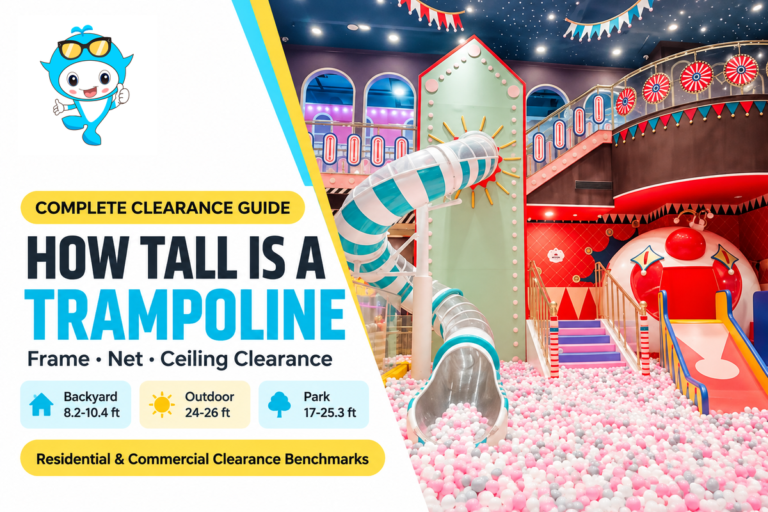
Industry buildout guides commonly cite at least 17 ft (5.2 m, at 1 ft = 0.3048 m) of open clear ceiling height as a planning baseline for commercial trampoline courts under ASTM F2970 or applicable international standards. Measure from the finished floor to the bottom of the first obstruction, HVAC duct, light fixture, or sprinkler head. Mega parks adding performance walls, stunt airbags, ninja rigs, or zip lines target 20 to 24+ ft (6.1 to 7.3+ m) clear.
Warehouses advertised as having 20 ft roof height often lose 2 to 4 ft of vertical clearance once HVAC runs and lighting bays, as well as structural steel trusses and fire-sprinkler drop pipes, are installed. Laser-measuring clear height to the lowest overhead obstruction before signing a lease prevents costly redesigns where a leased shell lacks vertical room for commercial jump beds.
📐 Engineering Note, Governing Commercial Standards by Market
- In the United States, commercial trampoline courts follow ASTM F2970 (current published edition ASTM F2970-25, with state statutes adopting versions from F2970-13 through F2970-20). Consumer backyard trampolines fall separately under ASTM F381-24. ANSI’s summary of ASTM F2970-22 states that the 2022 edition does not apply to consumer units or water play trampolines. It also excludes trampolines primarily used for professional exhibition or single-user trampolines primarily used under direct trainer or coach supervision.
- Internationally and in Europe, ISO 23659:2022 (confirmed current in October 2024) replaced UK standard BS PAS 5000:2017 for fixed indoor trampoline parks. It specifies design, construction, inspection, and maintenance requirements for trampoline areas, landing airbags, and foam pits inside multi-activity centers, while climbing walls, obstacle courses, outdoor parks, and general fire codes fall under separate standards.
- Public USPTO filings include granted patents on frame and column pad assemblies (US8911331B2) and yielding enclosure posts (US8430795B2), plus published patent application US20160107016A1 on controlled bed spacing.
Peer-reviewed emergency department data shows how commercial trampoline park injury patterns differ from home trampolines, informing how operators design padding, supervision, and lawsuit risk controls. A Pediatrics study of 2010–2014 U.S. records (Kasmire et al., NIH PubMed PMID 27482060) compared both settings. Commercial park injuries showed higher odds of lower-extremity injury (OR 2.39), dislocation (OR 2.12), and admission (OR 1.76), alongside lower odds of head injury (OR 0.64). Raw national ER visits rose from 581 in 2010 to 6,932 in 2014 (P = .045) as parks opened nationwide, while home counts stayed flat (P = .13). Exposure-adjusted tracking per jump-hour differs from raw ER counts. Insurers therefore inspect ~1:30 monitor ratios, digital waivers, grip socks, and daily maintenance of commercial trampoline park equipment and safety padding.
How Much Does It Cost to Build a Mega Commercial Trampoline Park?
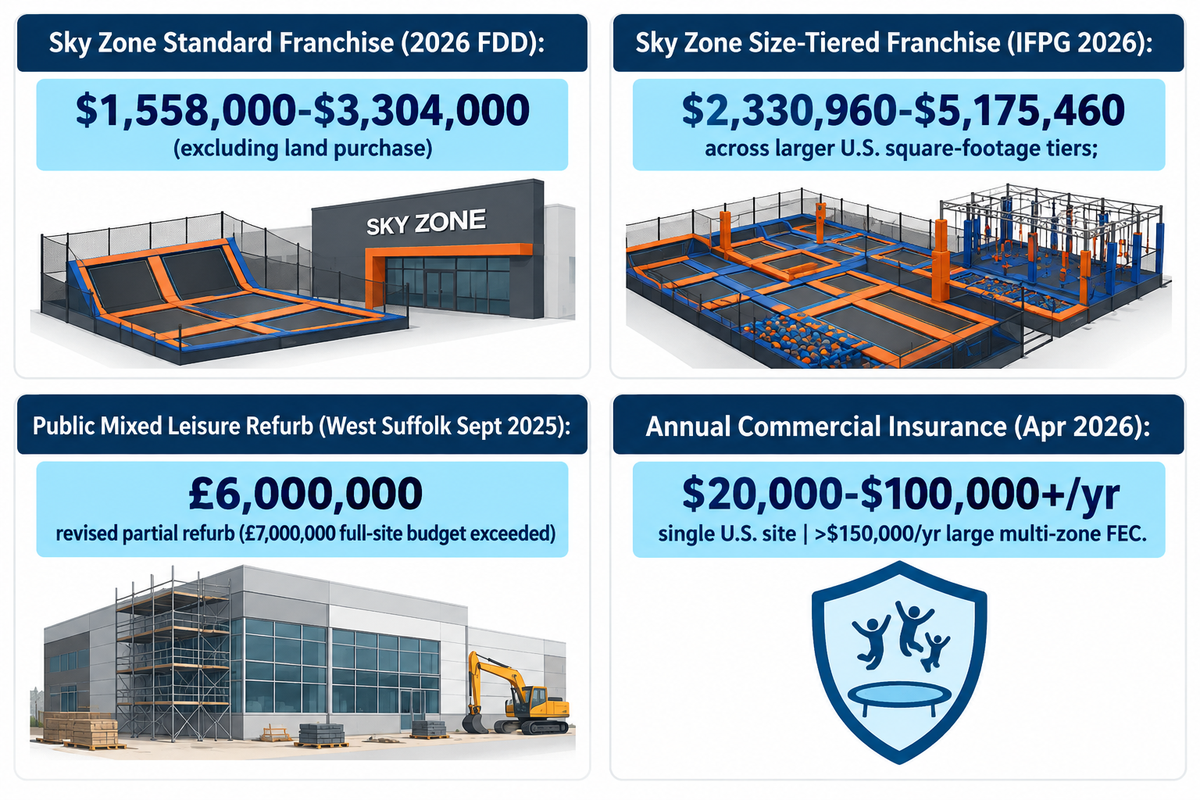
A trampoline park franchise opened in 2026 could cost $1,558,000 to $3,304,000 for a Sky Zone Standard format, according to FranchiseOverview (2026 FDD). Larger square-footage franchise tiers reach $2,330,960 to $5,175,460 (IFPG 2026 disclosure). Published 2026 franchise FDD ranges exclude land purchase and swing sharply with building shell condition, HVAC tonnage, sprinkler retrofits, and regional construction costs.
Rising capital discipline for 2026 and 2027 means operators are looking to trim costs. Oversized, low-throughput attractions are pushing up rents and staffing costs. Public-sector developments can face cost swings on seven-figure building projects. In September 2025, West Suffolk Council (UK) reported that the cost of completing essential refurbishments across the entire Olding Road depot and warehouse site would exceed its £7 million capital budget. The council approved a revised £6 million plan to refurbish the depot to house an Xtreme360 trampoline park and part of the warehouse for indoor leisure activities, while demolishing the remainder of the warehouse.
“Similarly, massive, expensive attractions with questionable throughput will face more scrutiny. Operators are increasingly focused on labor, maintenance and revenue per square foot, not simply the ‘wow’ factor.”
Operating insurance scales based on jumper volume and floor area. According to The Insurance Center (April 2026), a single-location U.S. indoor trampoline park pays $20,000 to $100,000+ annually for a full commercial insurance program. Larger, multi-zone family entertainment centers, with foam pits, ninja courses, and dodgeball arenas, can exceed $150,000 annually. General liability policies with an athletic-participant exclusion can exclude jumping injuries, and participant legal liability coverage covers participant injury claims within its stated coverage terms. Carriers often rate commercial park programs on jumper hours rather than revenue alone. New investors project multi-attraction revenue within a family entertainment center business plan or review the cost to open an adult trampoline park before signing a lease.
| Budget Category | Verified Range (2025–2026) | What Is Included | Source |
|---|---|---|---|
| Sky Zone Standard Franchise | $1,558,000–$3,304,000 | Franchise fee, leasehold buildout, equipment, working capital (excluding land purchase) | FranchiseOverview (2026 FDD) |
| Sky Zone Size-Tiered Franchise | $2,330,960–$5,175,460 | Larger square-footage franchise openings across U.S. markets (excluding land purchase) | IFPG (2026 disclosure) |
| Public Mixed Leisure Refurbishment | £6,000,000 revised partial refurb + demolition (£7,000,000 full-site budget exceeded) | Depot refurbished for Xtreme360 trampoline park + partial warehouse leisure conversion; remainder demolished | West Suffolk Council (Sept 2025) |
| Annual Full Commercial Insurance Program | $20,000–$100,000+/yr (>$150,000 large FEC) | Full commercial program including Participant Legal Liability (often rated on jumper-hours) | The Insurance Center (Apr 2026) |
How Operators Choose a Turnkey Commercial Trampoline Park Manufacturer
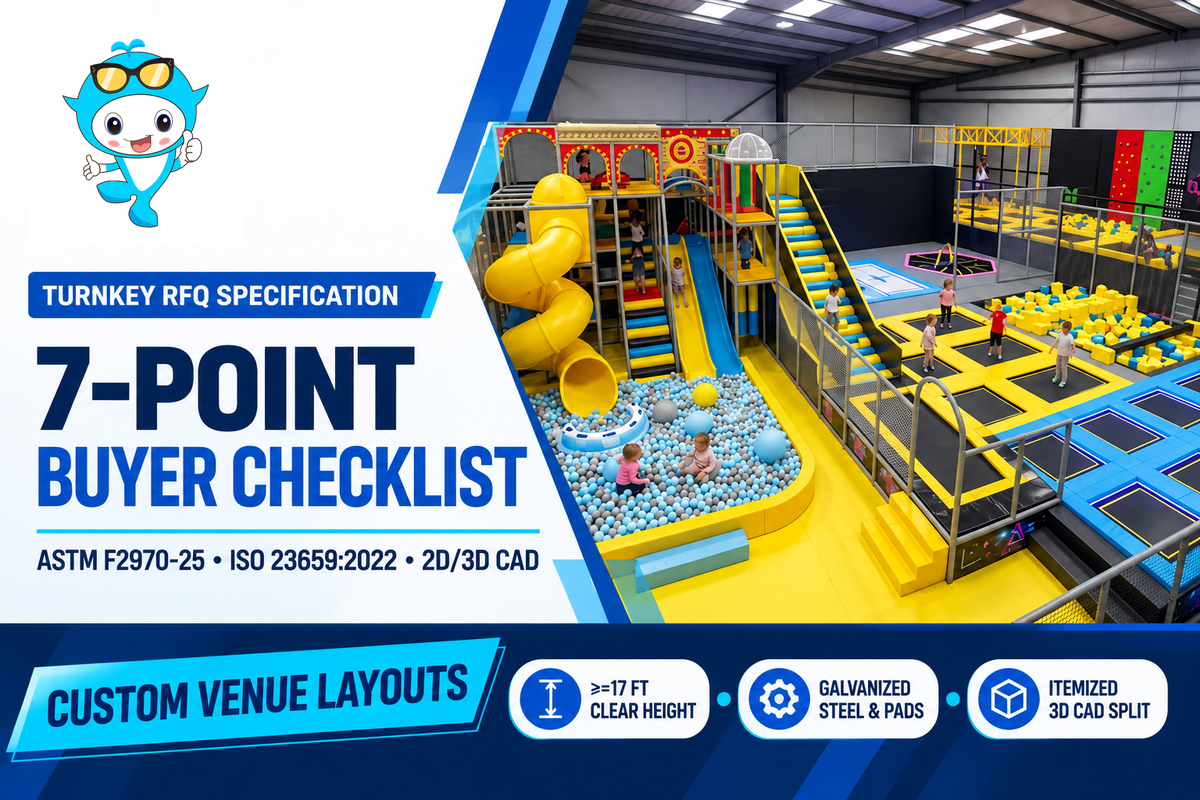
Commercial developers procure trampoline park systems from two main supplier tiers. North American and European engineering houses include Fun Spot/ELI Play, Best American Trampoline Parks, Akrobat, and Airparx. Integrated Chinese factories, like Guangzhou Didi Land Amusement Equipment Co. Ltd., deliver turnkey 3D indoor playground layouts, themed play designs, and soft play.
When comparing top commercial trampoline park manufacturers, send one standardized specification sheet to every vendor. At Didi Land, we manufacture integrated commercial indoor playground and active entertainment equipment packages built around your exact column grid and clear height. Our engineering packages combine themed indoor playground structures with climbing walls and toddler soft-play zones. Copy the 7-point specification table below directly into your RFQ before placing a deposit.
RFQ checklist — copy these 7 items into your trampoline park quote request:
| Parameter | Recommended range | Why it matters | How to verify |
|---|---|---|---|
| Target Safety Standard | ASTM F2970-25 (or state-adopted edition) / ISO 23659:2022 | Used by local authorities and insurers when reviewing site compliance | Request third-party inspection reports matched to your target jurisdiction |
| Clear Ceiling Envelope | >=17 ft (5.2 m) min; 20–24+ ft (6.1–7.3+ m) mega | Prevents overhead contact with trusses, sprinklers, and HVAC ducts | Supply laser-measured architectural CAD showing lowest overhead obstruction |
| Active vs Support Floor Split | Itemized active-court vs support layout sized to local egress codes | Balances jumper throughput with party rooms, cafe, and fire exits | Require itemized 2D/3D CAD area breakdown in both sq ft and m² |
| Landing Attenuation System | Landing airbag or foam pit sized to court design | Trampoline-court standards cover landing systems; building and fire codes apply separately | Review material flame-retardancy test reports and court compliance documents |
| Steel Frame & Padding Spec | Galvanized structural steel + high-density frame/column pads | Galvanized steel resists corrosion and pads cushion contact; member sizing, loads, and connections govern fatigue life | Inspect steel wall-thickness drawings, weld QA logs, and foam-density samples |
| Non-Trampoline Zone Compliance | Separate compliance sheets for ninja, climbing, soft play | ISO 23659 and ASTM F2970 cover trampoline courts and their associated landing systems only | Confirm individual engineering sign-off per non-trampoline attraction |
| Spares & Mat Replacement Kit | Written spare-spring, mat, and pad pricing schedule | Replacement cycles vary by mat grade and traffic; locks future maintenance pricing | Request itemized spare-part unit prices and shipping lead times in contract |
Frequently Asked Questions
Q: Does Guinness World Records recognize an official biggest trampoline park in the world?
No. Guinness World Records certifies individual trampoline structures rather than ranking entire buildings by total floor area.
Its headline hardware title recognizes APEX Adventure-Plex in Winnipeg, Canada, for building the world’s longest permanent spring-and-frame trampoline at 58.6 m (192 ft 3 in) in April 2026. Whole park size comparisons, therefore, rely on disclosures by operators or the press.
Q: How big is an average commercial trampoline park compared to a mega park?
In JLL’s North American real estate dataset, standard Sky Zone units average 38,800 sq ft (~3,605 m²), while Urban Air units range from 25,000 to 60,000 sq ft (~2,323 to 5,574 m²).
Mega venues include Altitude Spring-Klein at 55,000 sq ft and Flip Out Leeds at over 100,000 sq ft.
Q: Is Bounce Empire in Colorado a trampoline park or an inflatable park?
Bounce Empire in Lafayette, Colorado, is an indoor inflatable amusement park covering 50,000 sq ft (~4,645 m²), not a spring-bed trampoline park.
Its official website showcases blower-inflated PVC vinyl slides, obstacle courses, and bounce domes rather than steel-framed trampoline beds and metal coil springs regulated under commercial trampoline court standards ASTM F2970 or ISO 23659.
Q: What is the largest outdoor trampoline park in the world?
Upla in Mont-Saint-Grégoire, Quebec, Canada, is widely cited as the largest suspended outdoor park.
It hangs interconnected aerial bounce nets inside a forest canopy rather than an indoor warehouse.
Q: What is the minimum ceiling height needed to build a large indoor trampoline park?
Commercial trampoline courts need at least a 17 ft (5.2 m) clear ceiling height to the lowest overhead beam, duct, light, or sprinkler.
Large and mega parks of 30,000 to 100,000+ square feet often include performance walls, stunt airbags, ninja warrior courses and zip lines. Engineers may therefore target clear ceiling heights of 20 to 24+ feet (6.1 to 7.3+ meters) to keep overhead rigs below building utilities.
Q: How safe are commercial mega trampoline parks for kids and adults?
In 2010–2014 U.S. emergency records (Kasmire et al.), commercial-park injuries were associated with higher admission odds (OR 1.76) and lower head injury odds (OR 0.64) than injuries on home trampolines.
Operators manage risk through ASTM F2970 or ISO 23659:2022 padding, landing airbags, grip socks, separated toddler courts, one-jumper-per-mat rules, and ~1:30 monitor ratios.
Q: Why are modern mega trampoline parks adding ninja courses, climbing walls, and slides?
Hybrid parks keep mixed-age families engaged for longer time periods than parks with just bounce grids.
Combining trampoline courts with other attractions such as ninja warrior courses, climbing walls, dodgeball, toddler soft play, and slides keeps families of all ages engaged for longer. This has enabled park operators to broaden their revenue streams with birthday party packages, cafes, arcades, and group events. This broader attraction mix supports JLL’s reported 140-minute average dwell time for the sector instead of relying on hourly jump tickets alone.
Related Articles
- Trampoline Park First-Visit & Safety Guide — First-time visitor rules, grip socks, padding, and age zones.
- Family Entertainment Center Business Plan Financial modeling and hybrid attraction revenue streams.
Planning a Commercial Trampoline or Adventure Park?
Share your warehouse dimensions, clear ceiling height, and target attraction mix with our engineers. Guangzhou Didi Land Amusement Equipment Co., Ltd. delivers custom 3D CAD indoor playground layouts, commercial soft-play and themed equipment proposals, and itemized project quotes matched to your building dimensions.
About This Analysis
This benchmark report checks global trampoline park sizes, clear ceiling heights, and commercial safety standards (ASTM F2970-25 and ISO 23659:2022) against venue pages, Guinness World Records, JLL data, and peer-reviewed injury research. Every square-foot and square-meter figure uses 1 m² = 10.7639 sq ft to correct common list errors. Compiled by the Guangzhou Didi Land Amusement Equipment Co., Ltd. editorial team.
References & Sources
- Longest Trampoline (Permanent), APEX Adventure-Plex Winnipeg (9 April 2026) Guinness World Records.
- World’s Biggest Trampoline Park Opens in the UK (Flip Out Leeds) Park World Online.
- Flip Out Glasgow Official Arena & Attractions Page Flip Out UK.
- Super Skypark Tallinn Official Facility Specifications Super Skypark.
- Bounce Empire 50,000 sq ft Indoor Inflatable Amusement Park Bounce Empire.
- Location-Based Entertainment Report (May 2026) JLL.
- CBECS Commercial Gross Floor Area Definition U.S. Energy Information Administration.
- ASTM F2970-25 Standard Practice for Trampoline Courts ASTM International.
- ASTM F2970-22 Commercial Trampoline Courts Scope & Exclusions ANSI.
- ISO 23659:2022 Trampoline Parks Safety Requirements (Confirmed 2024) ISO.
- Trampoline Park and Home Trampoline Injuries (Kasmire et al., Pediatrics 2016) NIH PubMed.
- Olding Road Leisure Centre & Trampoline Park Refurbishment Update (Sept 2025) West Suffolk Council.
- 2027: The FEC Trends That Will Stick, and the Ones That Won’t (Barry Zelickson) IAAPA Funworld.
- Trampoline Park Insurance Cost & Participant Legal Liability Guide (April 2026) The Insurance Center.
- Sky Zone Standard Franchise Cost Summary (2026 FDD) FranchiseOverview.
- Sky Zone Trampoline Park Franchise Investment Tiers (2026) IFPG.
- US8911331B2 Commercial Trampoline Frame & Column Padding — Google Patents (USPTO).