Get in Touch with Didi Land

Commercial Foam Play Block Density: EPE/EVA Selection, Compression, Covers, and Service Life

Updated October 2026
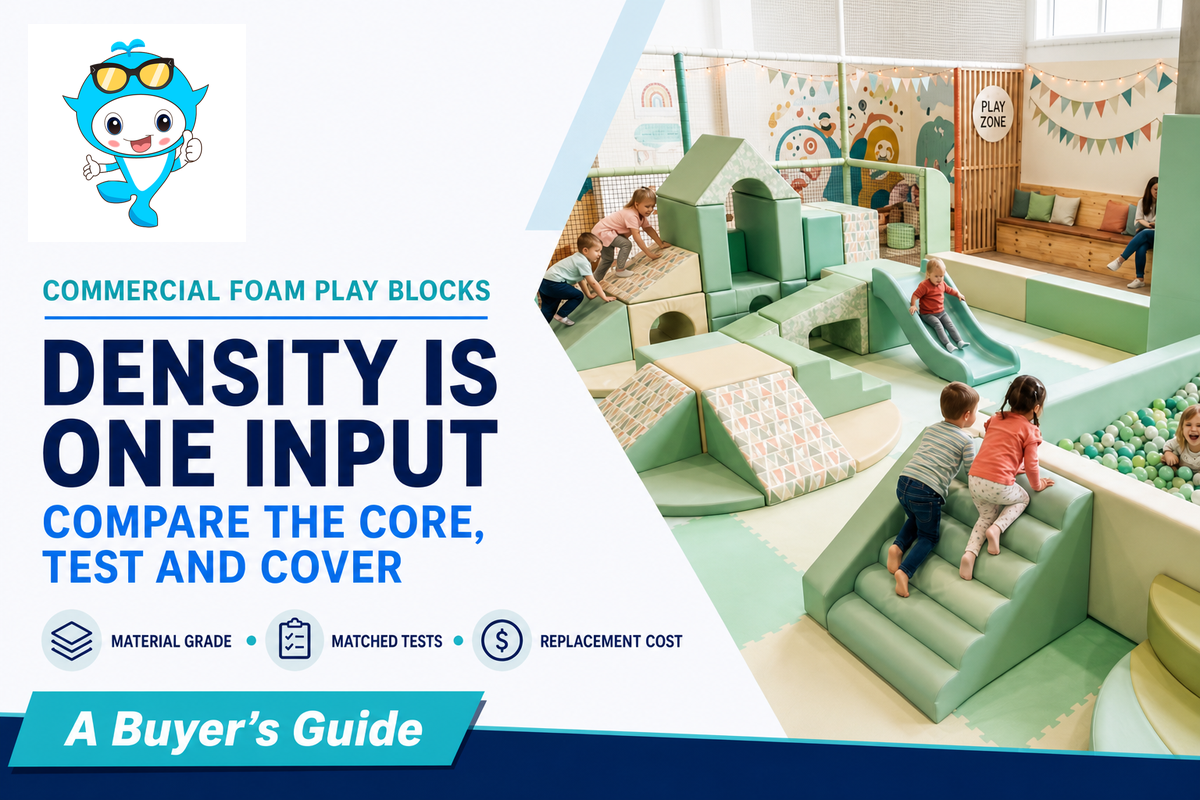
Commercial foam play block density measures the mass of foam in a given volume and is used to identify a core. Density alone cannot establish how firm a covered block feels, how much weight it can support, or how long it will last. A useful purchase specification pairs density with material grade, compression data, construction and cover care instructions.
This safe buying guide helps procurement teams compare foam climbing blocks beyond a high-density label. One supplier may describe a raw sheet; the other may describe a layered core in a tight cover. Prior to buying foam blocks, verify what was measured. Five buying checks cover the core, test conditions, assembly, replacement parts, and operating cost.
What commercial foam play block density actually measures
Foam density refers to the mass per unit volume and is expressed as kilograms per cubic meter or pounds per cubic foot. Density defines one property of a material. Firmness refers to resistance to indentation or compression. Thus, two cores of the same density can feel different and may require a different force to be deformed the same way.
“Firmness is independent of foam density”
In case of flexible polyurethane foam, ask whether total density or polymer density is being described. Filler in polyurethane foam contributes to total mass; polymer density excludes that filler. A higher total number alone doesn’t establish more polymer, better support or longer service. Equally, a filler description alone doesn’t establish that the material is unsuitable.
How can the density of foam be measured effectively?
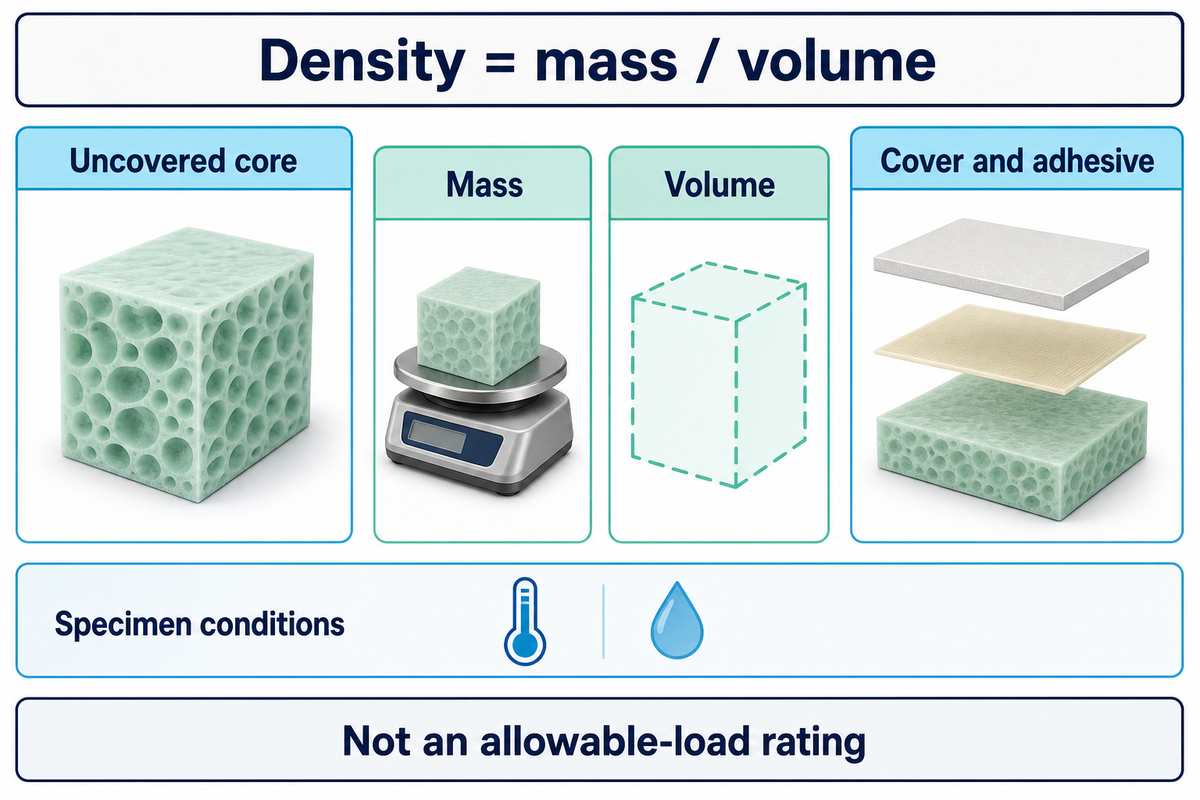
To obtain a value for density, the mass of the sample is measured, and the volume is determined. Density = mass / volume. Specimens and conditions must be specified. The procurement check can use the uncovered core or a material sample. Weighing the cover and adhesive with the core gives a different measured value and can’t validate a quoted raw-foam density.
For example, a sample in the shape of an uncovered rectangular core of 0.4m x 0.4m x 0.2m has a volume of 0.032 m³. Assuming a density of 30 kg/m³, its mass would be 0.96 kg. This example doesn’t address a permitted child weight. Rounded corners, cut-outs and different layers require an appropriate volume calculation or specimen method.
It should also be clarified if a manufacturing skin is included. The public abstract for ISO 845:2006, apparent density of cellular plastics and rubbers, distinguishes core and overall density when manufacturing skins are present. A sewn outer cover is not that manufacturing skin.
Compare EPE, EVA and polyurethane foam cores
EPE, EVA and flexible polyurethane foam should be differentiated by named grade and construction, and not by a general density. The family of materials serves to narrow the questions, and measuring its mechanical and physical properties serves to determine what a sample is able to demonstrate. Supplier values illustrate the case, and aren’t Didi Land specifications or approved play-block limits.
| Core description | What to identify | Buying implication | Limitations |
|---|---|---|---|
| Expanded polyethylene, EPE | Exact polyethylene grade, expansion process and density | Request the grade report behind the quotation | A generic EPE label does not identify crosslinking or compression performance |
| Crosslinked polyethylene | Crosslinked grade and supplied sheet construction | Keep its data separate from conventional non-crosslinked EPE | Same polymer family does not mean interchangeable grades |
| EVA foam | Grade, formulation and crosslinking | Compare measured compression response before accepting a premium | EVA is not automatically softer, firmer or longer-lasting |
| Flexible polyurethane | Density, indentation force, support factor and fatigue data | Separate initial feel from deeper support and repeated-use change | High-density polyurethane foam is not a finished-product approval |
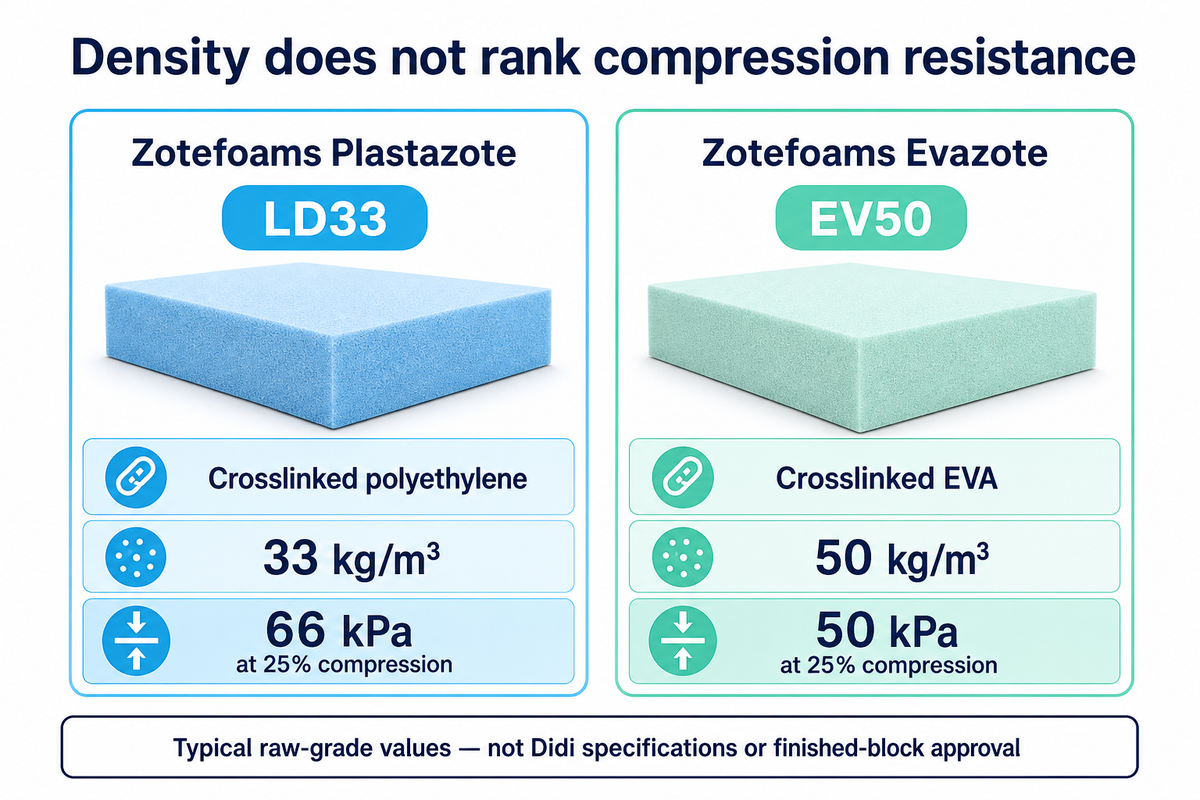
Consider two published grades: crosslinked polyethylene LD33 has a nominal density of 33 kg/m³ and a listed compression stress of 66 kPa at 25% compression. Crosslinked EVA EV50 is denser at 50 kg/m³, yet its corresponding listed stress is lower, at 50 kPa. The denser grade is therefore not the more compression-resistant of these two examples at that deformation.
Both examples cite typical or representative values; not acceptance limits for purchase. Also, they aren’t the same formulations, making this not a controlled experiment that shows one polymer family is better than the other. Request the actual grade offered for your commercial foam play equipment and assess its report to the approved sample.
A statement by the supplier “made from high-density polyurethane foam” or “shape-retaining foam” doesn’t answer the question regarding the firmness or fatigue behavior of the finished core. Likewise, the type of foam is important to the finished core response. The most helpful next step is a test record not another adjective.
Read compression and recovery results on the same basis
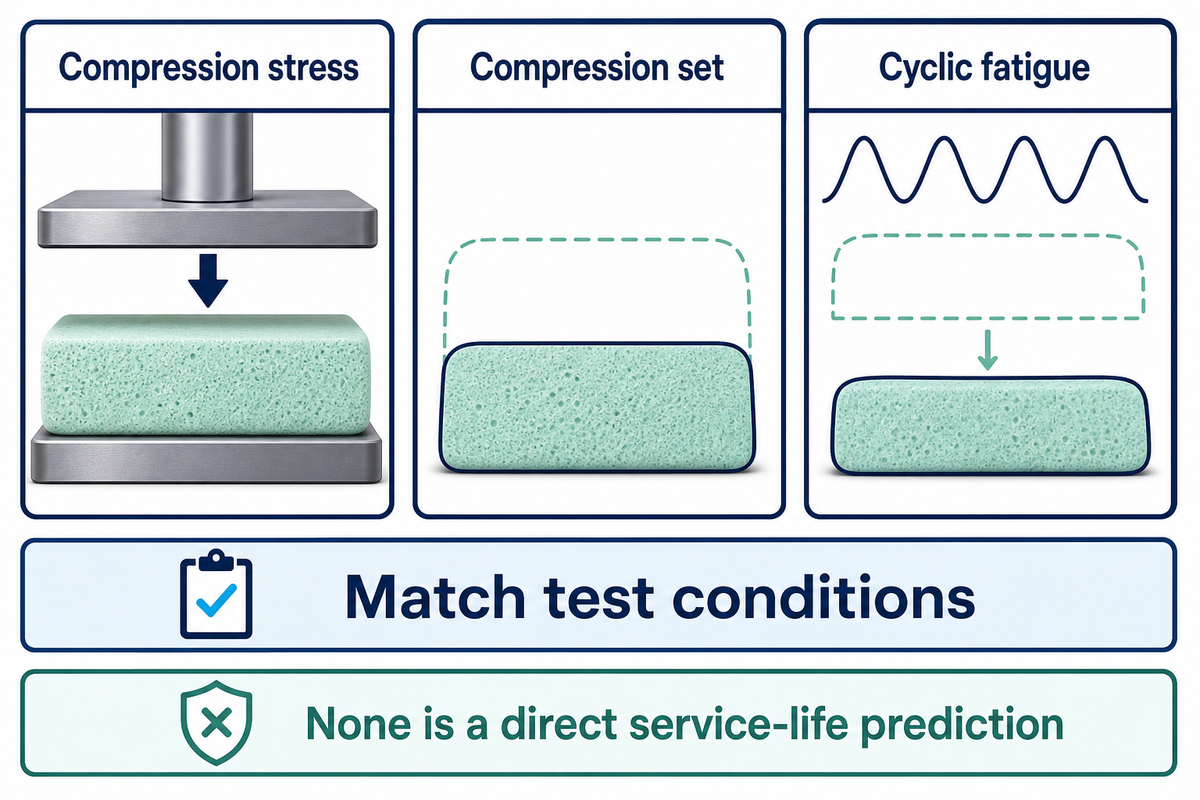
Results from compression tests are comparable only when properties, specimens, methods and conditions match. Compression stress is the resistance at a stated deformation; compression set is the residual deformation after loading and recovery; and cyclic fatigue is the change after a number of load cycles. They aren’t equivalent to the number of years of commercial use.
The ASTM D3574-25 public scope applies to flexible polyurethane foam; ASTM D3575-20 applies to flexible closed-cell olefins. Choose the proper method and edition with the supplier or lab. Older methods and editions of reports do not become automatically invalid. Their reasoning must be clear.
Foam Test Comparison Record
| Record field | LD33 example | EV50 example | Limitations / buying decision |
|---|---|---|---|
| Material | Crosslinked polyethylene | Crosslinked EVA | Neither identifies the core in your quotation |
| Nominal density | 33 kg/m³ | 50 kg/m³ | Mass per volume, not allowable load |
| Stress at 25% compression | 66 kPa | 50 kPa | Compare the same deformation and method |
| Stress at 50% compression | 134 kPa | 116 kPa | Do not interchange with the 25% result |
| Compression-set deformation | 25% | 50% | Unequal conditions prevent a direct set ranking |
| Set loading duration | 22 hours | 22 hours | Duration is not a service-life prediction |
| Set temperature | 23°C | 23°C | Other temperatures need relevant data |
| Set after 0.5-hour recovery | 9% | 9% | Same result does not remove the deformation mismatch |
| Set after 24-hour recovery | 4% | 2% | Do not interpret as twice the useful life |
| Listed compression method | ISO 7214:2012 | ISO 7214:2012 | Request the complete report and specimen details |
| Data status | Typical grade values | Typical grade values | Agree acceptance limits separately |
Examples are from Zotefoams’ public Plastazote LD33 and Evazote EV50 grade sheets, Issue 1, Revision 1, June 2026. These sheets describe raw materials and aren’t examples of tested covered climbing blocks. Keep the identifiers from the sheets and reports and include them with your comparisons.
Imagine a quality manager reviewing two quotations for an indoor play area. The purchasing sheet highlights 33 kg/m³ versus 50 kg/m³, and the second vendor asks for a premium. A quick decision would buy the bigger number. The manager instead asks which result supports the promised feel. At 25% compression, the two example grades show 66 kPa and 50 kPa, reversing the expected ranking. The manager then notices that the attractive 2% set result used a different compression level from the 4% result. The decision is to request comparable tests on the proposed cores and assess the finished samples. Neither quotation earns approval from its density number alone.
For flexible PU, the association also distinguishes 25% indentation force from deeper 65% indentation force. The ratio describes support factor. The distinction helps describe surface feel and deeper support, and isn’t a children’s load rating or a finished-product assessment.
Specify each layer in a covered foam block
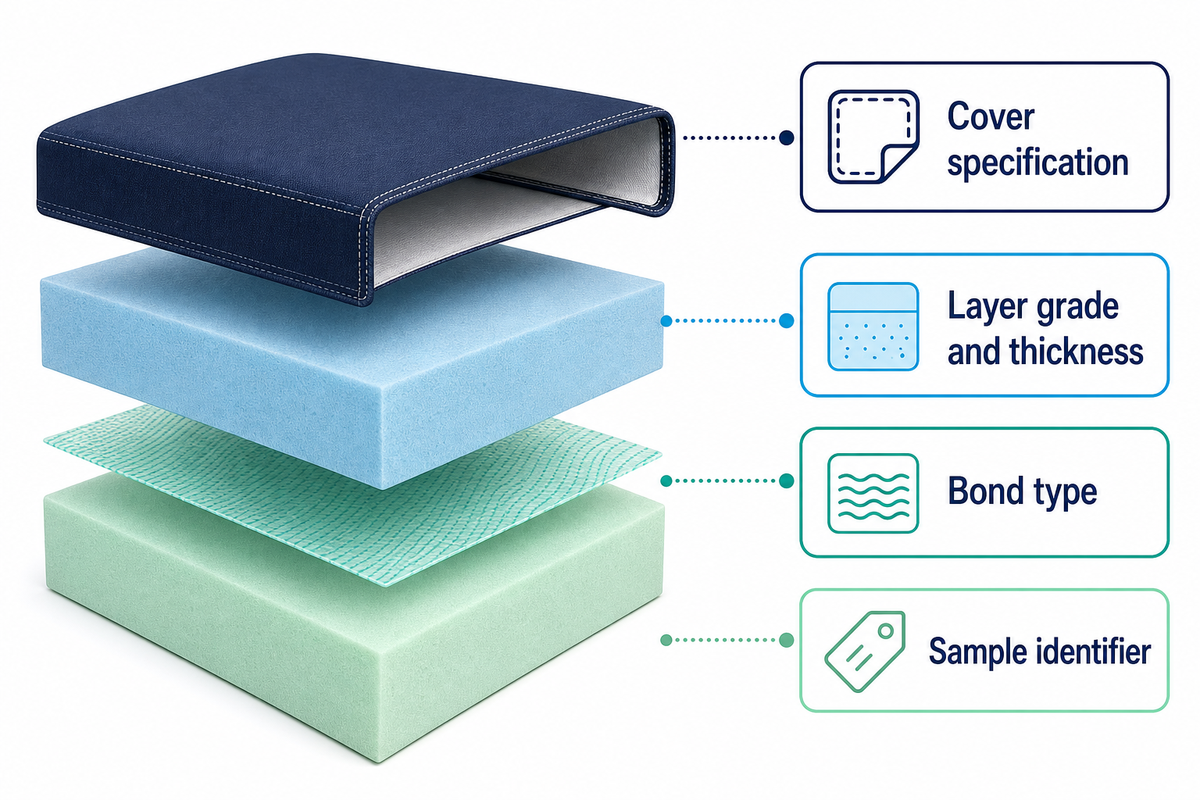
A layered foam core must be described layer by layer because one average density can mask variations in thickness and composition. Obtain the grade and thickness of each layer, the type of bond, and the cover specification. Note if the block uses one homogeneous core. There’s no standard layer stack that can be included in every order.
A soft foam can respond differently from a one-piece core when it has a firmer inner layer and a softer outer layer, despite the same finished outline. Request a section drawing tied to the sample identifier. Cover tension, seams, and closures must be shown in the drawing; average density can’t describe them. The supplier making the blocks should identify their construction in the approved record.
Distinguish the levels of evidence. For applicable US safety regulations, the CPSC component-part testing guidance allows certain chemical requirements to be assessed at the component level, while some mechanical requirements call for finished-product testing. A chemical report on a cover doesn’t establish the performance of the mechanical integrity of the block. Product classification comes first: the CPSC’s toy guidance excludes playground equipment from its toy definition.
Separate design decisions must be documented for individual blocks, support for climbing, and surrounding surfacing. For this, refer to the more detailed document on foam climbing blocks. A core density result can’t replace the site’s floor mat thickness and surfacing assessment or show that a non-slip underside will adhere to a smooth surface.
A layout that combines climbing blocks with a ball pit requires evidence for each intended use. Movable foam building blocks used for soft climbing and building aren’t automatically equivalent to fixed steps. Discuss soft play climbing equipment as a complete arrangement. Extra play value doesn’t follow from density alone.
Check block covers before committing to a core
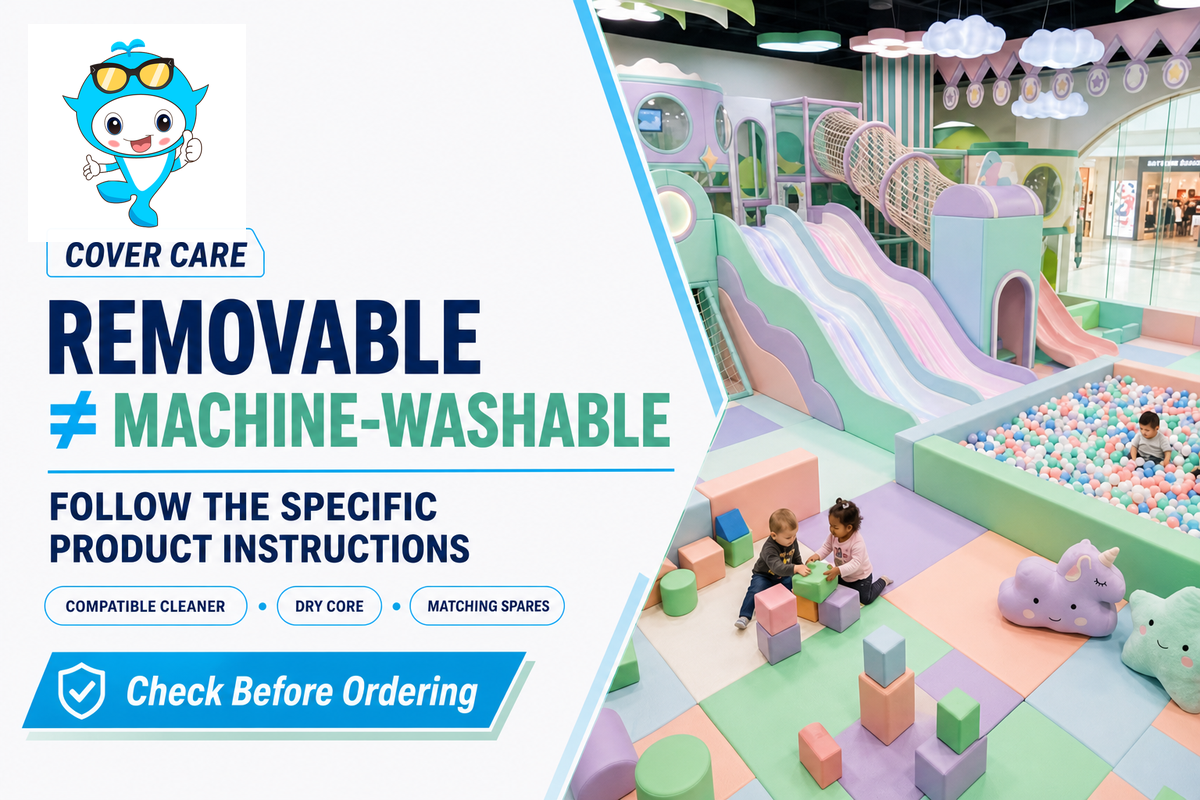
Block covers should be chosen with a documented cleaning method and confirmed replacement route. The phrase “covers are removable” describes access; washable describes a care method. Neither word proves that the core can be wetted, or a spare will be available when needed.
How do you properly clean the foam block covers?
Clean block covers as directed for that particular cover and assembled product. Use a cleaner compatible with the product, and follow required label instructions for sanitizing or disinfecting, and contact time. Keep moisture away from components that must remain dry. Machine-washable covers should be treated as such only when the manufacturer allows that method.
The CDC guidance for early care and education settings addresses cleaning before disinfection and suitability of the product for the surface. A hygienic play environment is dependent on the care method and not on the word washable. Do not transfer a chemical recipe from outdoor metal equipment or stuffed toys to a vinyl-covered block.
Consider a toddler room operator placing an order for replacement foam block sets. The team prefers washable covers as staff already run a laundry cycle after closing. The supervisor checks whether “washable” means machine laundering or wiping in place. The written instructions allow covers to be removed, but not machine washing and drying. The plan then changes: staff need to use an approved cleaning method and maintain drying or spare capacity to keep incomplete blocks out of use. A zip opening is useful, but it doesn’t make the existing laundry procedure acceptable. The operator considers the second quote before making the purchase.
When not to buy on a density claim alone
Postpone the purchase when the report identifies a different core from the sample, the supplier can’t explain the compression result quoted, or care instructions conflict with your venue’s procedure. These are unresolved buying questions, and selecting higher density doesn’t resolve them.
Reject an unsupported statement of “foam that won’t sag” as a service-life specification. Request the basis for the statement. Likewise, for “certified high-density foam” the product, test and scope and the issuing authority should be provided; density alone shouldn’t be the basis for the statement. Avoid a bad purchase by tying the paperwork to the actual block, instead of collecting miscellaneous certificates.
A replacement cover is also not the right remedy for a core that a manufacturer states should be withdrawn due to damage or contamination. A cover doesn’t restore a core. Agree on withdrawal and replacement instructions and keep a damaged or incomplete assembly out of the play area while its disposition is decided.
Turn sample approval into a repeat-order specification
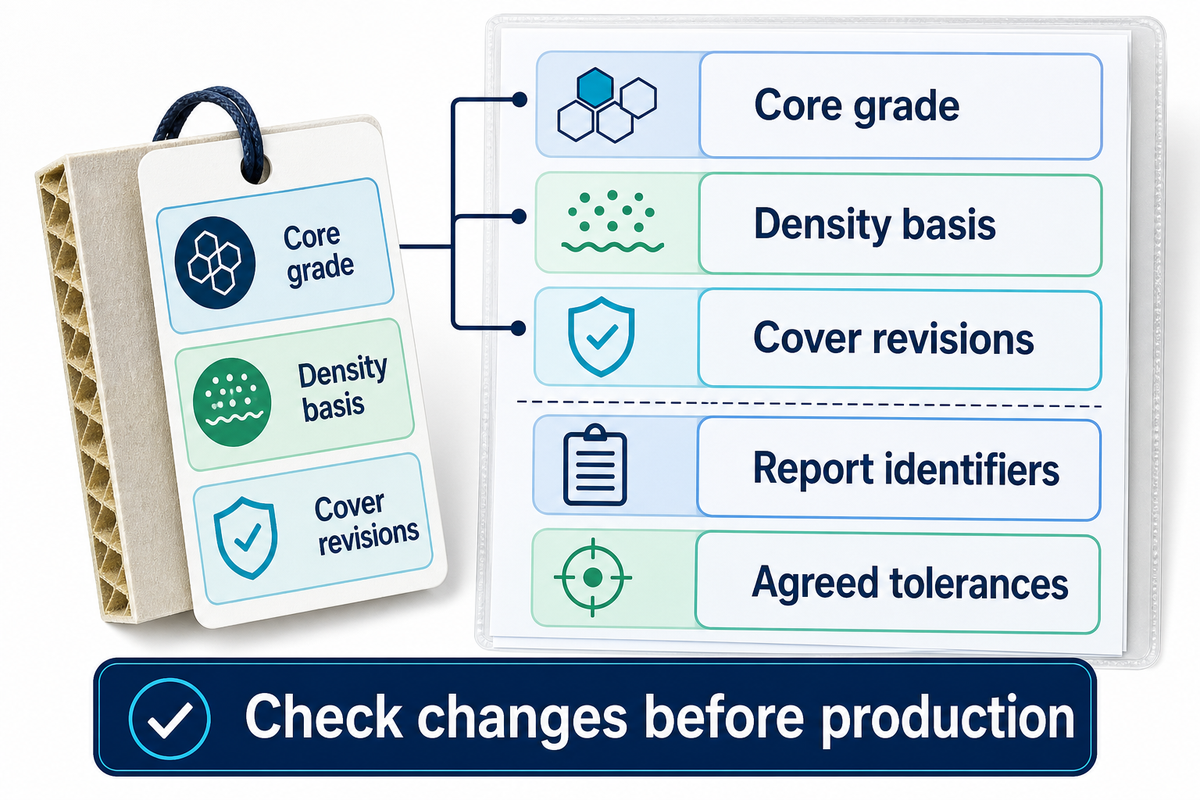
Sample approval is useful for repeat orders when the sample is attached to a written specification and a construction record. Be sure to indicate core grade and density basis, core dimensions, agreed-upon tolerances, cover revisions, and report identifiers. Keep the signed specification and sample reference, so procurement can check for a substitution rather than relying on a familiar photo in a product data sheet.
- Give the approved sample and its drawings a shared reference.
- Record the agreed specification, separating typical brochure values from acceptance limits and test conditions.
- Check changes before production and compare the delivered records with the approval.
This is a purchase method rather than a prescribed lab test. A “showroom squeeze” may help compare shape and firmness, but it won’t replace fatigue data or specify an allowable load. Keep children away from improvised load testing or drop testing.
Report continuity is also important. CPSC material-change guidance states that, for children’s products subject to testing and certification requirements, a material change that could affect compliance requires the manufacturer to retest the affected product or component at a CPSC-accepted laboratory and issue a new Children’s Product Certificate after passing results. This doesn’t mean that every batch or every like-for-like cover replacement automatically requires full retesting. You should ask the responsible supplier what reports still cover the changed product.
Compare cover, core and whole-block replacement costs
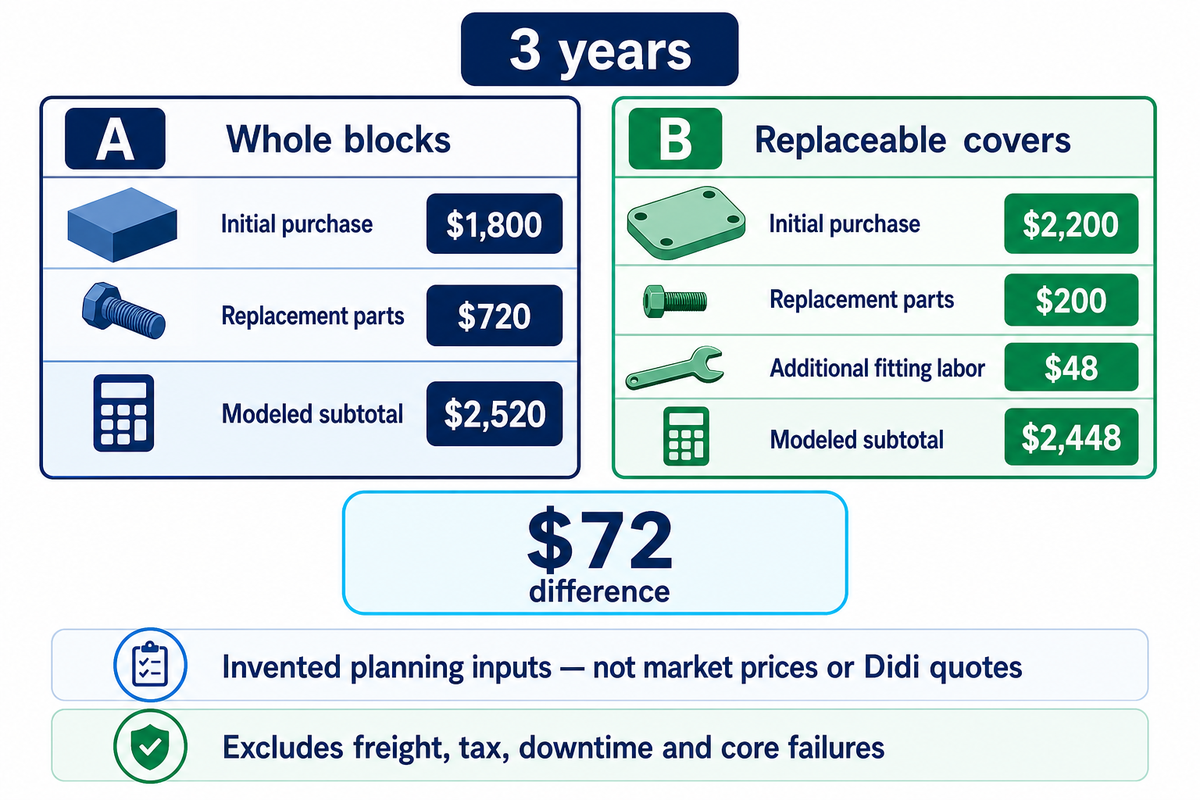
A replacement cost analysis should be based on the initial purchase, the costs for repairs and the labor for fitting, and the same time period. A block with replaceable covers that costs more may actually cost less if the cores stay in service and if covers are purchased at the right price. For the example used in this report, planning inputs are invented, and market prices and Didi quotes aren’t used.
Cover-or-Core Replacement Cost Example
| Cost input or result | Option A: whole blocks | Option B: replaceable covers | Limitations / buying decision |
|---|---|---|---|
| Planning period | 3 years | 3 years | Planning horizon, not predicted life |
| Initial quantity | 20 blocks | 20 blocks | Assumes comparable intended functions |
| Assumed price per block | $90 | $110 | Replace with written quotations |
| Initial purchase | $1,800 | $2,200 | Option B starts $400 higher |
| Assumed cover-damage events | 8 | 8 | Scenario input, not a failure forecast |
| Part replaced per event | Whole block | Cover only | Option B assumes a suitable retained core |
| Assumed replacement part price | $90 | $25 | Compatible parts must actually be available |
| Replacement parts total | $720 | $200 | Excludes delivery and disposal |
| Additional cover-fitting time | No cover-fitting operation | 8 × 0.25 hours | Common handling labor omitted from both |
| Assumed labor rate | Not applied to cover fitting | $24/hour | Use your loaded labor rate |
| Additional fitting labor | $0 | $48 | Not a claim that replacement takes no labor |
| Modeled subtotal | $2,520 | $2,448 | Excludes freight, tax, downtime and core failures |
Imagine a venue manager taking these quotes to finance. Option A costs $1,800 initially, then eight assumed whole-block replacements add $720: $2,520 in total. Option B starts at $2,200. Eight covers add $200, and fitting takes 8 × 0.25 hours × $24/hour, or $48. Its modeled total is $2,448. The apparent saving is only $72 over the three-year planning period. Finance should therefore ask about delivery charges, fitting effort and core condition before paying the premium. One unmodeled cost could reverse the result. The exercise supports a better quote comparison; it doesn’t predict which blocks will fail or promise a saving.
Cleaning costs can exceed the difference in parts costs. Assuming an additional 5 minutes per open day over 300 days at $24/hour equates to $600/year. Time the proposed care routine against your commercial soft play set before assuming a lower parts and repair bill means lower operating costs.
Plan spare parts and documentation for future orders
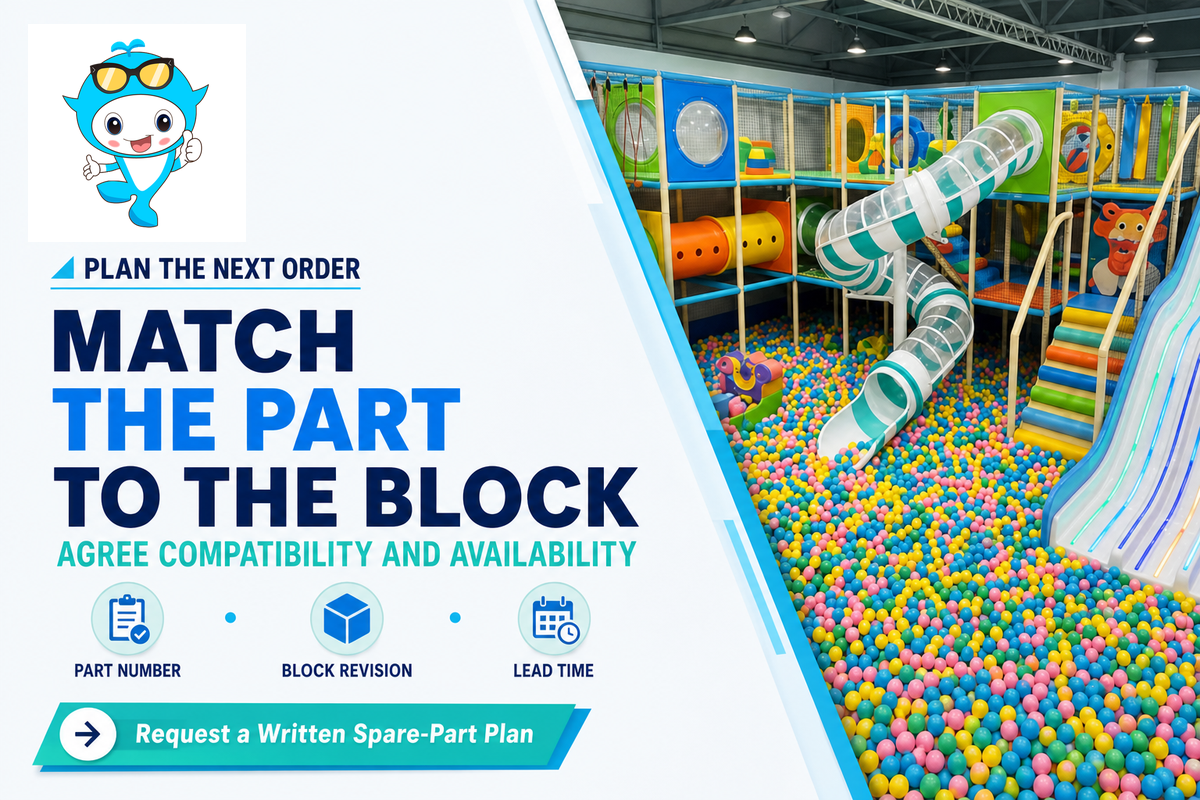
Future orders require a part identity and revision history as well as a price. Contact the supplier to find out which replacement covers fit the approved core and how revisions are identified. Get answers to what happens if the cover and/or the material are discontinued, including whether material-change testing applies to the replacement. The commercial commitment to availability is a written one, not something a density report can prove.
Do
- Request the cover part number and matching block revision.
- Ask for spare-part price, lead time and minimum order.
- Require notice of proposed material or construction changes.
Don’t
- Assume a similar-looking cover has the same fit.
- Treat an old report as proof for an unidentified new core.
- Budget cover-only repairs when core suitability is unresolved.
Didi Land’s soft play range helps with project discussions for room dimensions and colors, and age groups. Send the core/test/cover record along with input when requesting a configuration. For a climbing set alongside a ball pit, identify the individual blocks and intended uses rather than using a single material number for every element of foam.
Shortlist quotes that identify actual materials and assemblies, compare matched tests, and price care and replacement routes that your staff can perform. Safe indoor play is dependent on the use case and finished configuration, not just foam selection. Be sure to contact the responsible supplier to ask whether the proposed set is suitable for that arrangement.
Frequently asked questions
Is 1.8 lb density foam good?
A 1.8 lb/ft³ density alone cannot establish whether foam is suitable for a commercial play block.
Confirm that the supplier means pounds per cubic foot rather than the weight of one piece. Then identify the polymer, grade and firmness result. A flexible polyurethane core and a closed-cell polyethylene core should not be judged as equivalent because their density figures match. Ask for the finished block’s intended use and applicable evidence before approving it for the venue.
What is 2.0 density foam?
“2.0 density” often refers to 2.0 lb/ft³, but the supplier must confirm the unit and material.
The number describes mass per volume, not a firmness grade or permitted child weight. Check whether it refers to raw foam, a layered core or an entire covered block. For flexible polyurethane, also clarify whether the figure includes fillers. Keep the confirmed unit on the quotation and compare it with the test report, rather than interpreting the shorthand as a quality guarantee.
What age are foam climbing blocks suitable for?
Foam climbing blocks for children need model-specific age guidance; core density cannot determine an age range.
Follow the instructions for the complete product and its intended arrangement. Geometry, accessible parts, climbing height and the surrounding play space matter alongside material selection. The CPSC toy-safety guidance also distinguishes toys from excluded categories such as playground equipment. Ask the supplier to identify the appropriate product category and guidance instead of assuming every soft block is suitable for children of the same age.
How long should vacuum-packed foam blocks be left to expand?
Expansion time should follow the instructions for the specific foam block and packaging method.
Do not assume approximately 24 to 48 hours applies to every grade. Follow the supplier’s unpacking conditions and acceptance instructions before putting the assembled product into use.
Can a removable cover extend a foam block’s service life?
A replacement cover can preserve a usable block only when its core remains suitable and the replacement restores the intended assembly.
Confirm the matching part number, closure design and fitting instructions first. A new skin does not reverse core deformation, repair a failed bond or remove contamination inside the core. If the manufacturer requires the whole block to be withdrawn, cover replacement is not an alternative. For purchasing, request separate cover, core and complete-block prices where those options are offered. Keep delivery time and fitting labor in the comparison. The useful question is whether an approved repair restores that particular block, not whether removable covers guarantee a fixed number of extra years.
References & Sources
- Foam Performance — Polyurethane Foam Association.
- ISO 845:2006, determination of apparent density — International Organization for Standardization, public abstract.
- ASTM D3574-25, flexible polyurethane foam testing — ASTM International, public scope.
- ASTM D3575-20, flexible cellular olefin materials — ASTM International, public scope.
- Component Part Testing — US Consumer Product Safety Commission.
- How to Clean and Disinfect Early Care and Education Settings — US Centers for Disease Control and Prevention.
- Material Change Testing — US Consumer Product Safety Commission.
- Toy Safety Business Guidance — US Consumer Product Safety Commission.
Public pages were checked in October 2026. Full paid standards were not reproduced. Grade-sheet examples and the hypothetical cost model do not certify a Didi product or predict its service life.
SYS.00 // E-E-A-T Disclosure
Why I Write This
As the CEO and Co-Founder of a specialized manufacturing facility, my objective is to provide unvarnished, factory-direct technical insights into commercial indoor playground engineering, safety compliance, and project planning. I aim to bridge the information gap for global buyers seeking reliable structural and material data, ensuring you make informed, ROI-driven decisions without the marketing fluff.
About My Business
Guangzhou Didi Land Amusement Equipment Co., Ltd. (Brand: Didi Land) is a commercial indoor playground equipment manufacturer founded in 2014. Operating from Panyu, Guangzhou, China, we engineer, produce, and export commercial-grade play structures to over 40 countries worldwide. Our production lines strictly adhere to international safety frameworks, ensuring durability and safety for high-traffic environments.
Our Services
We provide end-to-end B2B commercial solutions: from custom 3D spatial design and OEM manufacturing to worldwide export logistics and compliance testing. Our focus is on empowering Family Entertainment Centers (FECs), shopping malls, kindergartens, and hospitality venues with reliable, high-capacity play infrastructure.
DATA_MATRIX // MANUFACTURER_PROFILE
Name:
Cherry
Role:
CEO & Co-Founder
Brand Name:
Didi Land
Company:
Guangzhou Didi Land Amusement Equipment Co., Ltd.
Location:
Guangzhou, Panyu, China
Founded:
2014
Products:
Indoor Playground Equipment, Soft Play Equipment, Themed Playground Design, FEC Play Zones, Trampoline Modules, Ninja / Obstacle Course Modules
Email:
conglizhang1@gmail.com
Phone:
+86 199 2587 9517
Website:
didiplayarea.com
COMPLIANCE & STANDARDS:
ASTM F1487 · ASTM F1918 · EN 1176 · CPSIA · CE · ISO 9001 · IPEMA
Contact Factory Direct
ASTM F1487 · ASTM F1918 · EN 1176 · CPSIA · CE · ISO 9001 · IPEMA
Related Posts
Trending now