
Get in Touch with Didi Land

MM to Inches Converter for Decimal and Fractional Results


Updated August 2026
A mm to inches converter is a calculator that divides a millimetre value by exactly 25.4. Keep the decimal result for calculations; treat a nearest fractional inch as an approximate reference. If a drawing includes limits or tolerances, convert both limits and keep the source drawing as the controlling record.
Millimetre to inch converter
Convert between millimetre and inch. The unit changes; the measured quantity does not.
Result
in
1 mm = 0.0394 in
“The international inch is defined to be equal to 25.4 millimeters.” — National Institute of Standards and Technology
How to use the mm to inches converter
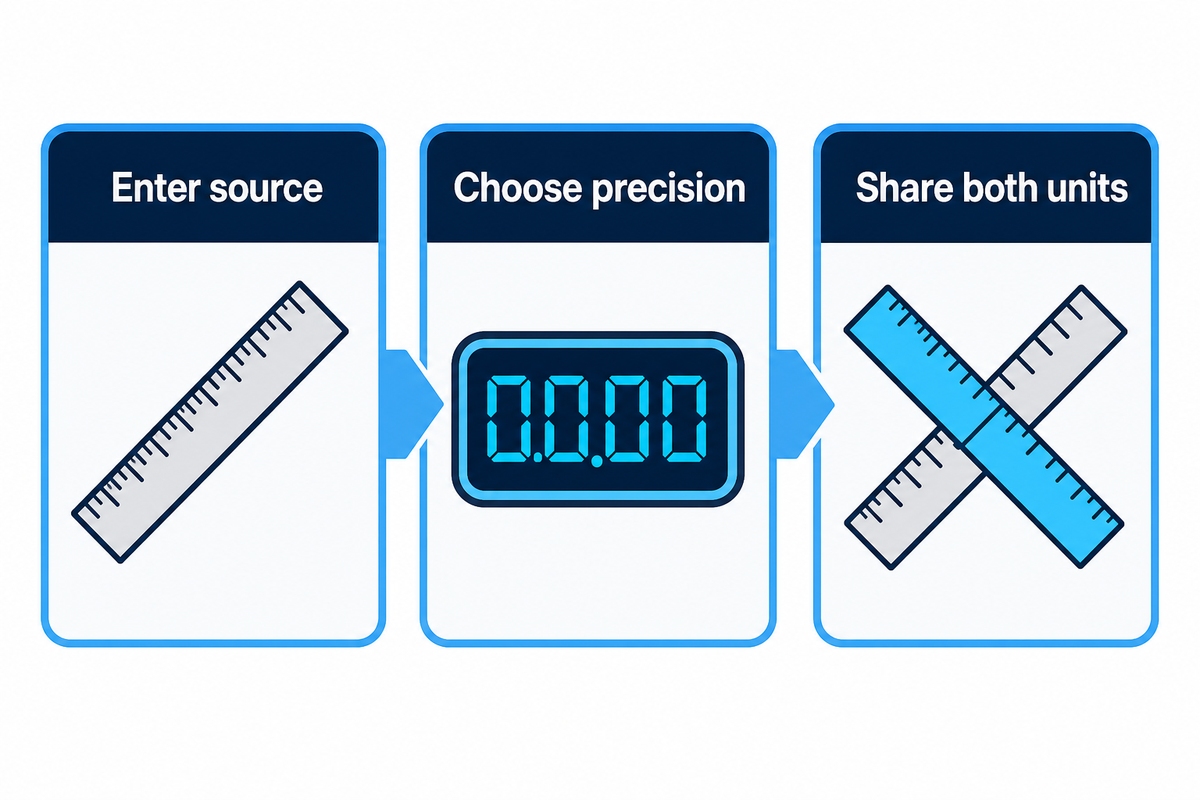
Enter the millimetre value, choose how many decimal places you need, and read the inch result. It also provides a nearest-fraction reference. Copy the decimal for further calculation, but attach the original millimetre value whenever the result will be used in a floor plan, quotation, or equipment review.
- Enter the source value. Use the number shown on the drawing rather than a previously rounded conversion.
- Choose display precision. Four decimal places are useful for checking; fewer may be suitable for a clearly labeled reference.
- Share both units. Write the source millimetres beside the converted decimal inches and state which file controls acceptance.
For a quick check, 1 mm becomes 0.0394 in when displayed to four decimal places. At larger playground dimensions, 2500 mm becomes 98.4252 in. Although the arithmetic is the same, the communication risk changes: a tiny display difference may matter when several dimensions must fit inside a fixed building envelope.
Example 1, equipment envelope: A module listed as 2500 mm wide converts to 98.4252 in. That doesn’t authorize someone to replace the source value with 98 7/16 in, because 98 7/16 in is only a rounded field reference. Keep “2500 mm controlling” on the handoff record.
If you’re still defining the venue, use the converted values alongside an indoor playground layout plan, not as a replacement for one. That converter answers the unit question; it doesn’t decide circulation, sightlines, use zones, or installation access.
The exact formula: divide millimetres by 25.4
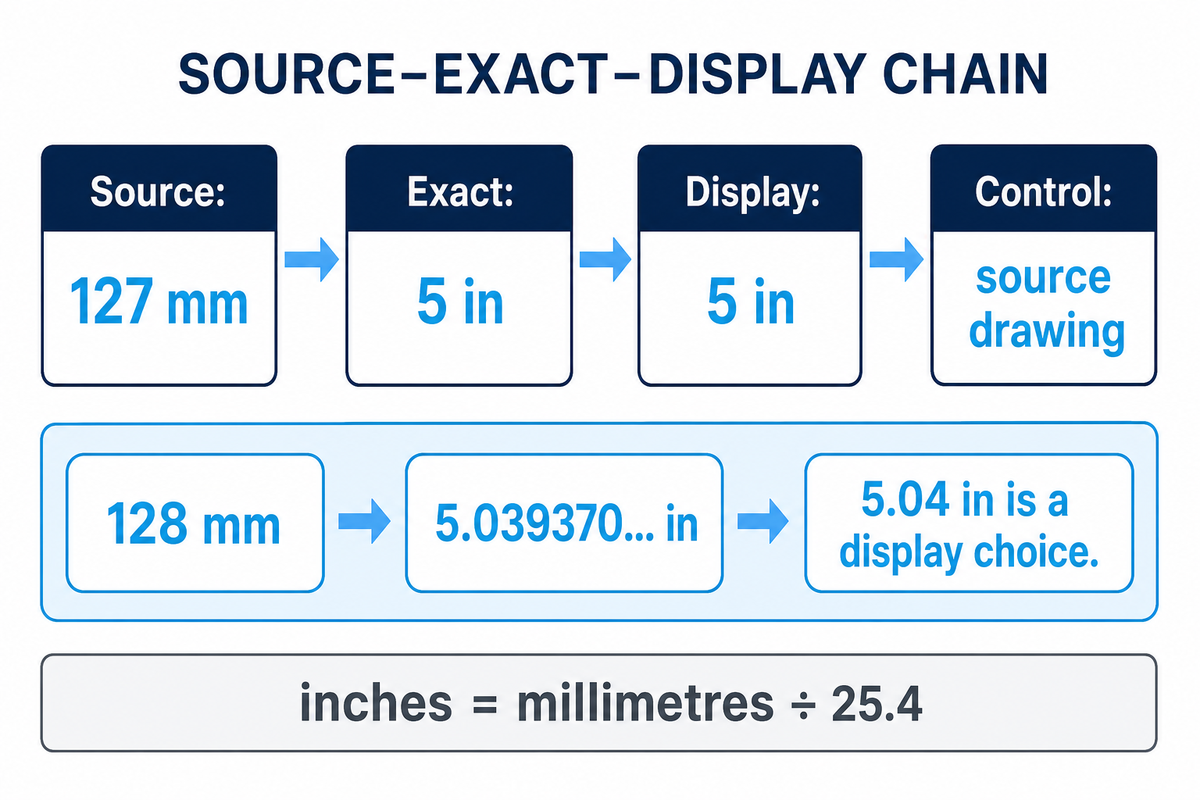
The exact formula is inches = millimetres ÷ 25.4. Because the factor is exact for the international inch, calculation error normally enters through premature rounding, transcription, or a mistaken factor such as 25 or 25.3. Preserve the source number, calculate once, and round only the displayed result.
The Source–Exact–Display Chain
The Source–Exact–Display Chain keeps the original value, exact calculation, displayed result, and acceptance context separate.
25.4exact millimetres per inch
1calculation before rounding
2units shown at handoff
Suppose the source drawing says 127 mm. The unrounded calculation is 127 ÷ 25.4 = 5 in exactly. Record it as “127 mm / 5 in,” then note which unit controls. For 128 mm, the result is 5.039370… in. Rounding that to 5.04 in is a display choice, not a new source dimension.
Distinguishing an exact definition from a short convenience factor is easy to miss. The NIST approximate conversion table lists 0.04 in per millimetre as an approximate factor. Multiplying 2500 mm by 0.04 gives 100 in, while exact division gives 98.4252 in, a 1.5748 in difference. That shortcut is unsuitable for a dimension handoff.
In unit-system terms, a millimetre is a metric system unit of length derived from the metre. The inch appears in United States customary units and imperial units. For a millimeter to inch conversion, divide by 25.4; for the reverse inches to mm conversion, multiply by 25.4. Engineering and manufacturing teams in the United States, United Kingdom, Canada, Japan, and other markets may encounter both systems of measurement, so every dimension should carry an explicit unit.
An electronic mm to inches calculator is a free online tool that can instantly convert a millimeter value. If you need to convert millimeters to inches, the instant equivalent may be accurate mathematically, but the inches conversion is not approval evidence. For high-precision engineering drawings, high precision in the display cannot exceed the source measurement or declared tolerance.
The meter is another unit of measurement in the metric system, while the inch is widely used in more than one country. That mixed-unit reality makes clear technical labeling essential: every converted value should show its source number, equivalent unit, and intended use.
Example 2, ceiling height: A 4200 mm site height converts to 165.3543 in, or 13 ft 9.3543 in before display rounding. The Didi Land concept process asks for ceiling height in millimetres, so the original 4200 mm should stay visible on the project record.
MM to inches chart for common dimensions
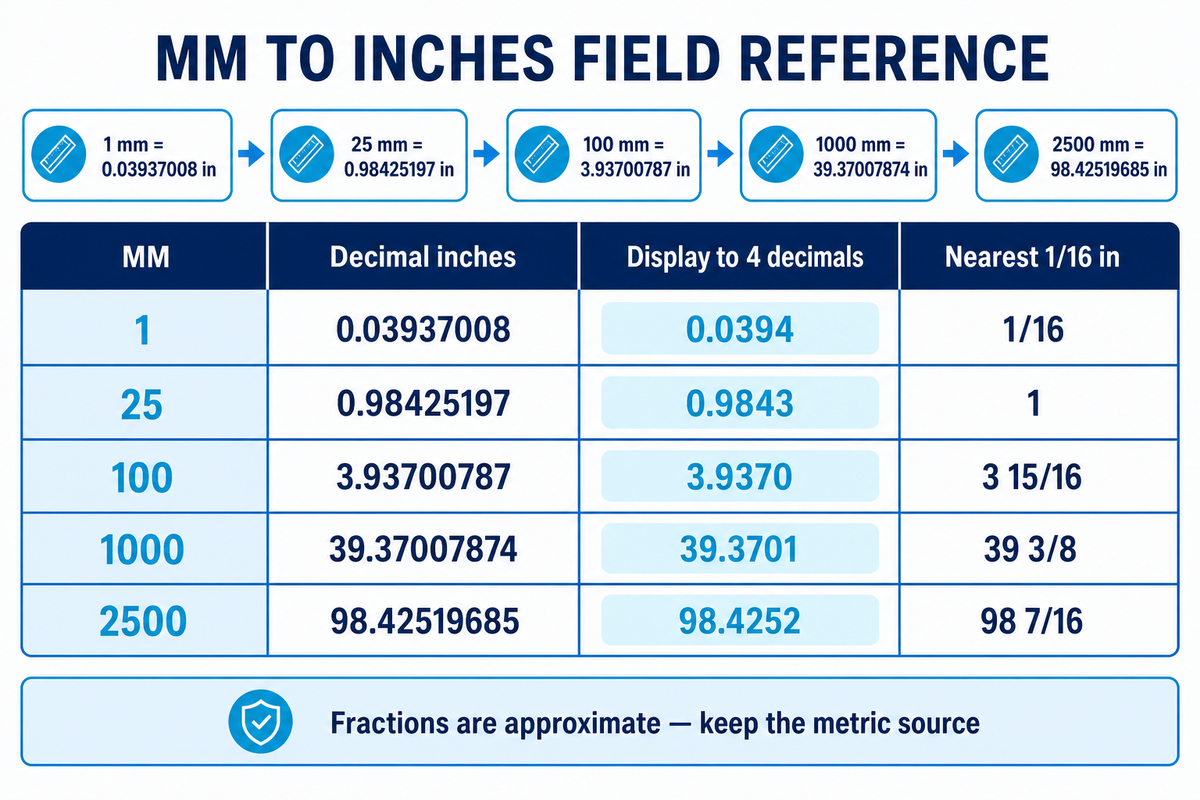
This chart converts 16 common millimetre values with the exact 25.4 relationship. The decimal column is suitable for calculation checks; the four-decimal and nearest-1/16 columns are display formats. Fractions are approximate and may differ materially from the source size, especially for small millimetre values.
The 16-Size Field Reference Atlas
The 16-Size Field Reference Atlas pairs exact decimal calculations with clearly labeled display references.
| Millimetres | Decimal inches (unrounded) | Display to 4 decimals | Nearest 1/16 in | Limitation |
|---|---|---|---|---|
| 1 | 0.03937008 | 0.0394 | 1/16 | Fraction differs substantially |
| 2 | 0.07874016 | 0.0787 | 1/16 | Fraction rounds downward |
| 3 | 0.11811024 | 0.1181 | 1/8 | Not the same as 1/8 in |
| 5 | 0.19685039 | 0.1969 | 3/16 | Approximate reference |
| 10 | 0.39370079 | 0.3937 | 3/8 | Approximate reference |
| 12 | 0.47244094 | 0.4724 | 1/2 | 1/2 in is 12.7 mm |
| 16 | 0.62992126 | 0.6299 | 5/8 | 5/8 in is 15.875 mm |
| 20 | 0.78740157 | 0.7874 | 13/16 | Approximate reference |
| 25 | 0.98425197 | 0.9843 | 1 | 1 in is 25.4 mm |
| 50 | 1.96850394 | 1.9685 | 1 15/16 | Approximate reference |
| 75 | 2.95275591 | 2.9528 | 2 15/16 | Approximate reference |
| 100 | 3.93700787 | 3.9370 | 3 15/16 | Approximate reference |
| 150 | 5.90551181 | 5.9055 | 5 7/8 | Approximate reference |
| 500 | 19.68503937 | 19.6850 | 19 11/16 | Approximate reference |
| 1000 | 39.37007874 | 39.3701 | 39 3/8 | Keep metric source |
| 2500 | 98.42519685 | 98.4252 | 98 7/16 | Do not replace source size |
That first decimal column intentionally carries more digits than most people should place on a shared drawing. It shows the calculation before display rounding. The NIST guidance on writing metric units warns against reporting more significant digits than the original data justify. Match display precision to the source and its purpose.
For equipment selection, a chart is only the first pass. Pair it with the relevant indoor playground equipment category and request the controlling dimensional document before making a fit decision.
Decimal inches versus fractional inches
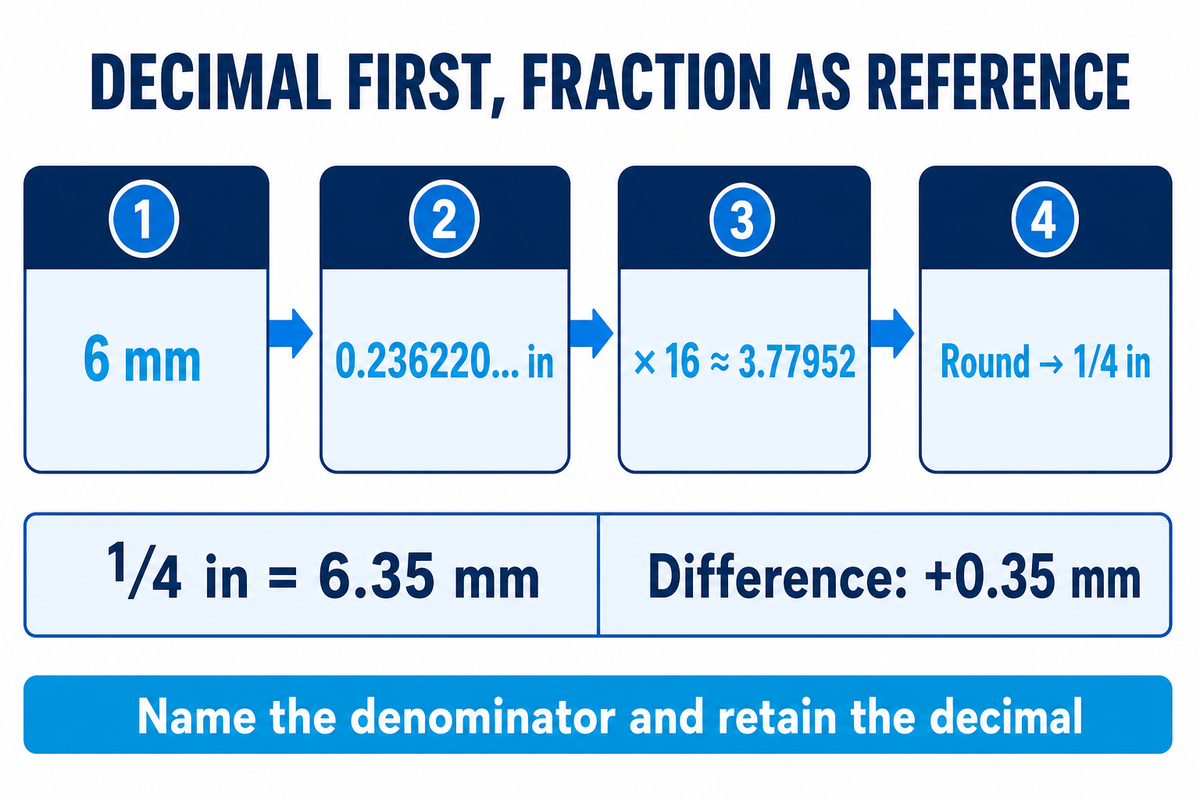
Decimal inches preserve more of the converted value and are better for calculations. Fractional inches are easier to read with common tape measures, but they introduce an approximation tied to a chosen denominator. State “nearest 1/16 in,” retain the decimal, and show the approximation error when fit or clearance matters.
To find a nearest fraction, multiply the decimal inch value by the denominator, round that result to the nearest whole numerator, and simplify. For 6 mm, the decimal result is 0.236220… in. At a denominator of 16, 0.236220 × 16 = 3.77952, which rounds to 4/16 or 1/4 in.
But 1/4 in equals 6.35 mm. Replacing 6 mm with 1/4 in changes the nominal size by 0.35 mm. The difference may be unimportant for a rough visual sketch and unacceptable for a component interface. The converter can’t make that decision without the drawing’s tolerance and acceptance owner.
Example 3, changing denominators: 16 mm is 0.629921 in. It remains 5/8 in at the nearest 1/8, 1/16, or 1/64 because 40/64 simplifies to 5/8. This fraction is 0.125 mm smaller than the 16 mm source. One useful label is “16 mm [0.6299 in; approx. 5/8 in, −0.125 mm].”
Do
Name the denominator, retain the decimal result, and state the fraction’s error or purpose.
Do not
Replace a metric nominal size with a nearby stock fraction unless the drawing owner approves the change.
When the dimension belongs to a purchased item, compare the manufacturer’s actual specification rather than a category label. Didi Land’s equipment specification audit guide provides a broader procurement context for checking what a supplier’s documents really control.
A Dimension Provenance Record for floor plans and equipment layouts
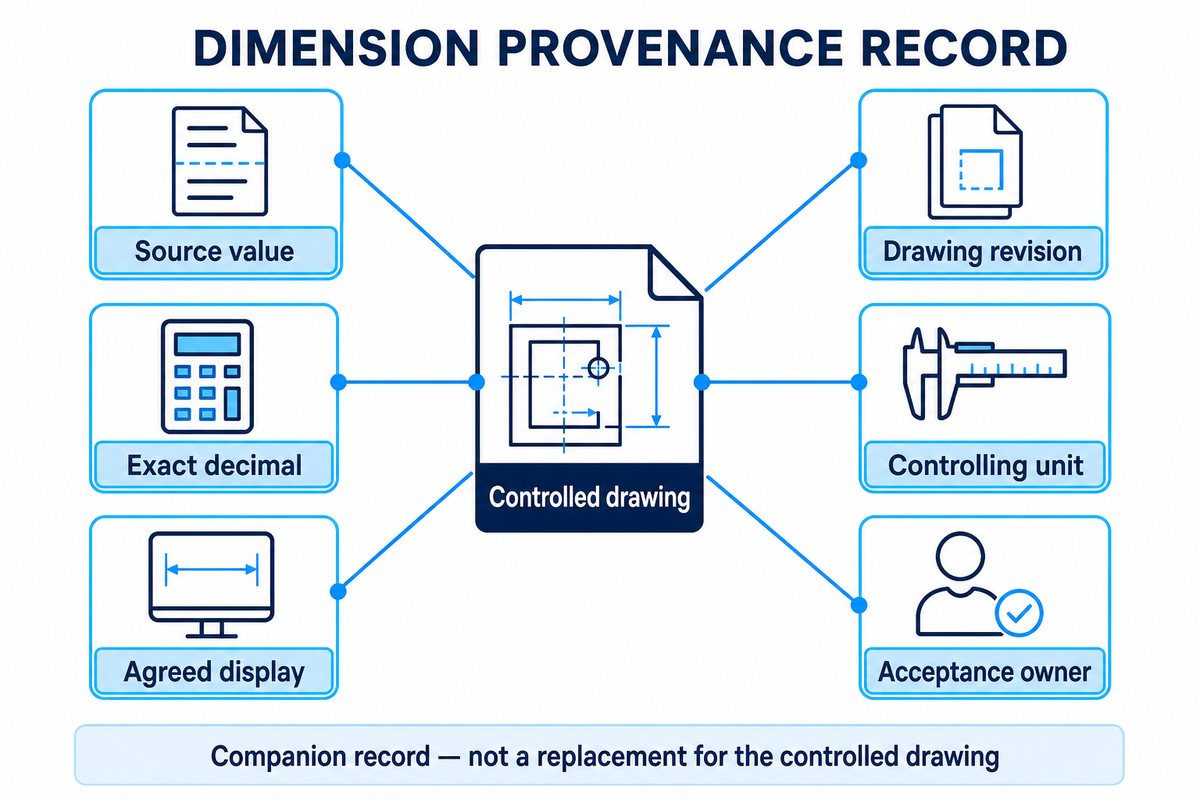
A Dimension Provenance Record is a compact companion record containing the source value, exact converted decimal, agreed display value, drawing revision, controlling unit, and acceptance owner. It helps people discuss the same dimension across unit systems, but it never replaces the controlled floor plan, model, specification, or approved revision.
Dimension Provenance Record
A Dimension Provenance Record makes each converted dimension traceable to its source file, revision, and acceptance context.
| Dimension handoff type | Example entry | Why it matters | Limitation |
|---|---|---|---|
| Project / zone | Toddler zone A | Prevents cross-zone reuse | Not a drawing identifier |
| Source file | Floor-plan PDF | Provides traceability | Link may become stale |
| Revision | Rev C, 2026-08-15 | Distinguishes superseded values | Must match controlled system |
| Dimension purpose | Clear ceiling height | Explains what was measured | Does not validate survey method |
| Source value | 4200 mm | Preserves authority | May lack limits |
| Exact calculation | 165.3543307 in | Allows verification | Too many digits for display |
| Agreed display | 165.35 in reference | Supports discussion | Not a replacement nominal |
| Controlling unit | Millimetres | Resolves conflicts | Must be owner-confirmed |
| Acceptance owner | Architect / drawing issuer | Assigns clarification path | Card grants no approval |
Didi Land’s published process requests a floor-plan PDF and ceiling height in millimetres during concept intake. That’s first-party evidence of its intake format, not an independent design standard. The card can help its project team and a buyer compare dimensions, while the actual venue documents and approvals remain outside the card.
The ASME dimensioning and tolerancing overview describes how drawing controls communicate design intent, form, fit, function, and interchangeability. The card above isn’t an ASME requirement. It’s supplemental communication that makes questions easier to trace back to the document that actually carries those controls.
Apply the card to ceiling height, platform height, route width, structural-column spacing, and the equipment envelope. For theme and concept discussions, pair it with the site’s custom indoor playground design process so unit translation remains connected to project context.
Convert limits and tolerances, not only the nominal size
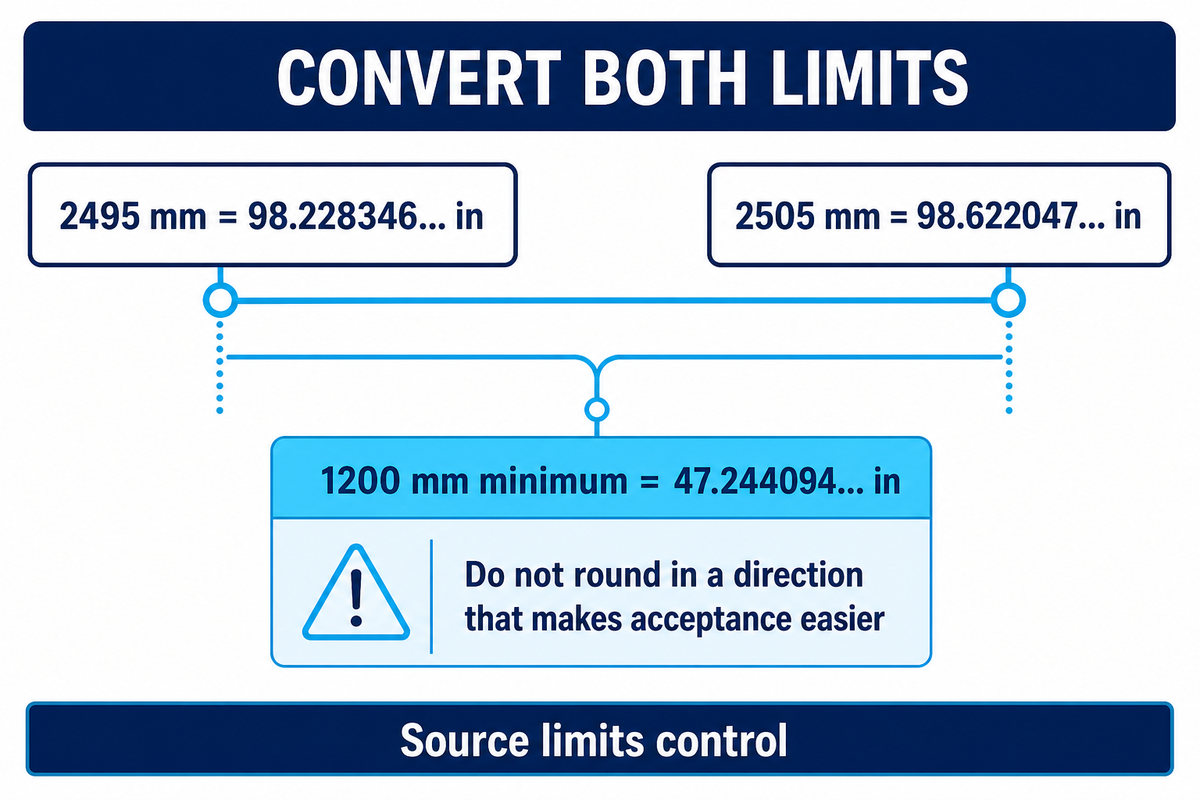
For a dimension with limits and tolerances, divide the lower and upper limits separately by 25.4. Don’t convert only the nominal value and invent a new inch tolerance by rounding. Keep engineering tolerance separate from measurement uncertainty, and never round a one-sided minimum or maximum in a direction that makes acceptance easier.
Consider a platform envelope specified as 2495–2505 mm. The converted interval is 98.228346…–98.622047… in. Writing only “98.43 in ±0.20” may look close, but it reconstructs the limits from rounded values and can shift an endpoint. The safer handoff shows both converted limits and states that 2495–2505 mm controls.
Direction matters at a one-sided limit. If 1200 mm is a minimum clearance, its exact conversion is 47.244094… in. Displaying 47.25 in rounds upward and appears to promise more clearance than the source minimum. If a rounded secondary value is necessary, choose a conservative display rule approved by the drawing owner and label it.
For a maximum equipment envelope, the risk reverses. A rounded value that moves downward can understate the space the equipment requires. The calculator can produce exact decimal conversions; it can’t select a compliance rounding rule or decide whether a contractor’s measurement supports that many digits.
Engineering tolerance expresses allowed variation in the product or design. Measurement uncertainty describes doubt in the observed value and depends on instruments, method, environment, and sampling. Unit conversion changes neither. If a site survey says 4200 mm but the measurement method is uncertain, 165.3543 in doesn’t become more certain because it has four decimals.
Handoff ruleConvert every stated boundary, preserve its direction, retain the source-unit authority, and ask the document owner how secondary values should be rounded for acceptance.
When equipment dimensions influence budget or selection, confirm the source specification before comparing price tiers. The commercial indoor playground equipment guide can help frame the wider buyer discussion, but the approved dimensional file still decides fit.
Three conversion mistakes that change a project handoff
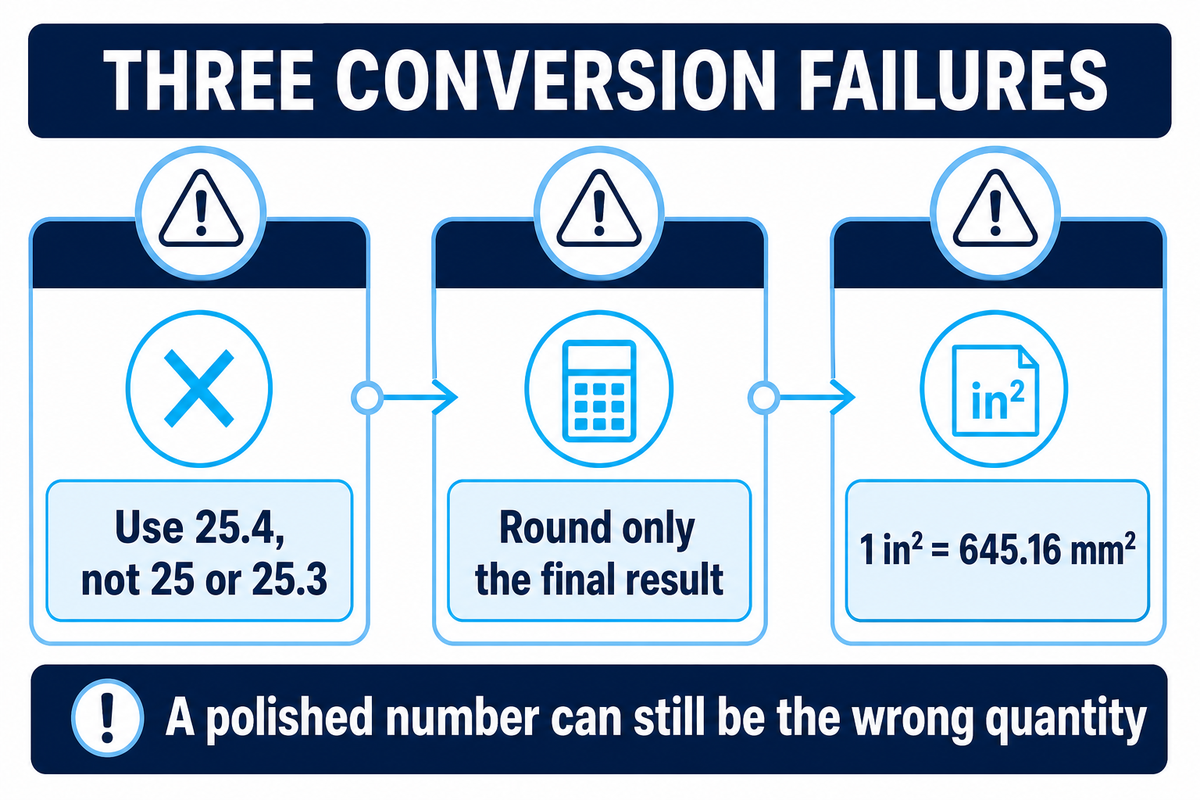
The three damaging mistakes are using 25 or 25.3 instead of the exact 25.4 factor, rounding intermediate values before later calculations, and applying a linear length factor to area. Each can produce a polished-looking number that no longer matches the source dimension or the quantity being converted.
Mistake 1: treating 1 inch as 25 mm
At 25 mm, the error seems small: exact conversion gives 0.9843 in, while the shortcut gives 1 in. Across 5000 mm, however, division by 25 gives 200 in; exact division gives 196.8504 in. The shortcut has added 3.1496 in. It’s a rough mental estimate, not a project conversion.
Mistake 2: rounding every intermediate value
Suppose a team converts several metric segment lengths to two decimals, adds those inch values, and compares the sum with an opening. Each segment can contribute rounding error. Add the millimetre values first and convert the final total once, or keep full-precision calculations until the last display step. Preserve the individual source values for traceability.
An industrial fabricator may receive steel plate thicknesses and pipe diameters in millimetres while a field team requests inches. The same exact factor applies, but the technical drawing, tolerance, and material specification still control the work.
Mistake 3: using a length factor for area
Length and area are different quantities. One square inch equals 25.4 × 25.4 = 645.16 square millimetres. For area, 1000 mm by 1000 mm is 1,000,000 mm², or about 1550.0031 in²—not 39,370.0787 in². Convert both sides and multiply, or divide area by 645.16.
This distinction matters when a venue team moves between linear dimensions and footprint calculations. Keep a separate tool such as the indoor playground return calculator within its stated business inputs; don’t feed it an area created with a linear conversion factor.
When the converted number is ready to share

A converted value is ready to share when it names the source unit, links to the controlling revision, preserves all limits, uses justified display precision, and identifies the acceptance owner. If any item is missing, mark the value “for reference” and request clarification before using it for fit, fabrication, installation, or approval.
Unit Translation Release Protocol
The Unit Translation Release Protocol decides whether a converted value is a calculation, reference, clarification request, or approval-ready handoff.
- Confirm the controlling document. Record the floor plan, model, specification, or supplier drawing and its revision.
- Keep the source unit visible. Don’t leave a bare converted number that another reader can mistake for the original.
- Carry every limit. Convert lower limits, upper limits, and directional requirements independently.
- Match display precision to evidence. Don’t imply finer source data or survey accuracy through extra decimals.
- Preserve design intent. Check that rounding hasn’t changed form, fit, function, interchangeability, clearance, or envelope meaning.
- Name the acceptance owner. Direct unresolved unit or rounding conflicts to the document issuer, architect, engineer, or responsible supplier.
Use four dispositions. Treat a value with only arithmetic complete as a calculation. A clearly labeled secondary value is an internal reference. A conflict in units, revision, limits, or precision triggers supplier clarification. Route fit, structural, access, safety, or approval decisions to the responsible architect, engineer, or drawing owner.
The calculator is ready for arithmetic as soon as you enter a valid number. The project value isn’t ready merely because the calculator returns one. If the conversion will affect an active proposal, send the source document and question through the Didi Land contact page so the project team can review the exact context.
Frequently asked questions
How many inches is 1 mm?
One millimetre equals 0.0393700787… inch, usually displayed as 0.0394 in. The value comes from dividing 1 by exactly 25.4. Keep 1 mm as the controlling source whenever fit matters, because a displayed decimal or nearby fractional inch is only a secondary representation.
What is the formula for converting mm to inches?
Divide the millimetre value by 25.4: inches = millimetres ÷ 25.4. The relationship is exact. Don’t substitute 25, 25.3, or an approximate 0.04 multiplication factor for a drawing handoff. Calculate at full precision and round only the final displayed result.
Is 25 mm the same as 1 inch?
No. Twenty-five millimetres equals about 0.9843 in, while 1 in equals exactly 25.4 mm. The difference is 0.4 mm, or about 0.0157 in. Don’t call the two sizes interchangeable unless the controlling specification and acceptance owner explicitly allow that substitution.
How do I convert mm to the nearest fraction of an inch?
First divide millimetres by 25.4. Multiply the decimal result by the chosen denominator, then round to the nearest whole numerator and simplify. Label the fraction “approximate” and retain the decimal and source millimetres because another denominator can produce another result.
Should I round mm-to-inch dimensions to two decimal places?
Only if two decimals suit the source precision and intended use. A tolerance-bearing handoff may need converted limits and a defined rounding method. Extra decimals don’t add measurement certainty. Never round a minimum upward or a maximum downward without an approved conservative rule.
Can the converter confirm that playground equipment will fit?
No. It confirms arithmetic, but fit also depends on the drawing revision, measurement basis, equipment envelope, assembly sequence, clearances, access route, structural conditions, and approval ownership. Suppliers may distinguish shipping from installed dimensions or require maintenance clearance. Attach the source file, identify the controlling unit, and have the supplier and responsible design professional confirm fit against approved documents. A scalar conversion cannot validate those conditions, so treat its result as a question-preparation aid rather than a fit certificate.
References & Sources
- SI Units, Length National Institute of Standards and Technology
- Approximate Conversions from Metric to U.S. Customary Measures National Institute of Standards and Technology
- Writing with SI Units National Institute of Standards and Technology
- Dimensioning and Tolerancing American Society of Mechanical Engineers
SYS.00 // E-E-A-T Disclosure
Why I Write This
As the CEO and Co-Founder of a specialized manufacturing facility, my objective is to provide unvarnished, factory-direct technical insights into commercial indoor playground engineering, safety compliance, and project planning. I aim to bridge the information gap for global buyers seeking reliable structural and material data, ensuring you make informed, ROI-driven decisions without the marketing fluff.
About My Business
Guangzhou Didi Land Amusement Equipment Co., Ltd. (Brand: Didi Land) is a commercial indoor playground equipment manufacturer founded in 2014. Operating from Panyu, Guangzhou, China, we engineer, produce, and export commercial-grade play structures to over 40 countries worldwide. Our production lines strictly adhere to international safety frameworks, ensuring durability and safety for high-traffic environments.
Our Services
We provide end-to-end B2B commercial solutions: from custom 3D spatial design and OEM manufacturing to worldwide export logistics and compliance testing. Our focus is on empowering Family Entertainment Centers (FECs), shopping malls, kindergartens, and hospitality venues with reliable, high-capacity play infrastructure.
DATA_MATRIX // MANUFACTURER_PROFILE
Name:
Cherry
Role:
CEO & Co-Founder
Brand Name:
Didi Land
Company:
Guangzhou Didi Land Amusement Equipment Co., Ltd.
Location:
Guangzhou, Panyu, China
Founded:
2014
Products:
Indoor Playground Equipment, Soft Play Equipment, Themed Playground Design, FEC Play Zones, Trampoline Modules, Ninja / Obstacle Course Modules
Email:
conglizhang1@gmail.com
Phone:
+86 199 2587 9517
Website:
didiplayarea.com
COMPLIANCE & STANDARDS:
ASTM F1487 · ASTM F1918 · EN 1176 · CPSIA · CE · ISO 9001 · IPEMA
Contact Factory Direct
ASTM F1487 · ASTM F1918 · EN 1176 · CPSIA · CE · ISO 9001 · IPEMA

![Custom Dinosaur Playground Equipment [Design Guide]](https://didiplayarea.com/wp-content/uploads/2026/09/custom-dinosaur-playground-equipment-r2-featured-1-768x512.png)



![Custom Dinosaur Playground Equipment [Design Guide]](https://didiplayarea.com/wp-content/uploads/2026/09/custom-dinosaur-playground-equipment-r2-featured-1-150x150.png)