Get in Touch with Didi Land



Updated October 2026
For commercial indoor soft-contained play areas
Decision at a glance
- Scope: indoor soft-contained play equipment, not a public outdoor playground.
- Choices: approved repair, component replacement, zone replacement, or hold closed.
- Comparison: one operator-selected horizon, matching capacity, closure footprint and future costs.
- Worked illustration: five years and an assumed 8% rate; all prices and demand figures are hypothetical.
Playground equipment repair vs replace decision economics is a comparison of eligible options’ full costs; a repair invoice, a replacement bid and a venue’s lost sales are different numbers. There’s a question that a low bid can’t answer: can the broken part safely be returned to service and be evaluated under an applicable product method? Once the qualified options are clear, compare their actual cash effects over the same operating period. A repair invoice, a replacement bid, and a venue’s lost sales are different numbers. This guide helps bring together those numbers to arrive at an informed decision.
Operators asking whether to repair or replace equipment need a scope-matched answer. The decision to repair or replace a contained play module starts with the part, and then the route it serves. A manager may choose to repair a cover and replace equipment elsewhere in the same structure. When deciding between repairing and replacing, approach each decision as a unique operating case; don’t consider each case as a single vote to replace playground equipment.
Playground equipment repair vs replace decision economics ranks only technically eligible options. Use the same operating horizon for repair, component replacement and zone replacement; add each option’s landed cost and actual closure loss, then add the present value of later work and subtract the present value of any realizable residual. Test the result against the venue’s own records.
Key points
- Affected-area closure is a site decision; a torn net doesn’t automatically close the whole venue.
- Illustrative base case: component replacement costs $14,313.58 in five-year present value versus $15,988.34 for approved repair; different closure assumptions reverse that order.
- A recall remedy, maker instruction or inspection finding can remove an option before finance ranks it.
- Ask suppliers to identify the part, method, timing, exclusions and acceptance evidence in writing.
The existing indoor playground maintenance guide explains regular checks and gives broad replacement heuristics; use its checks, but do not treat its age or cost ratios as automatic thresholds for this component-specific decision. Use this page when a specific finding forces an investment decision. Its financial example is a teaching case, not a Didi customer result or a market price.
Start with a safety and scope gate
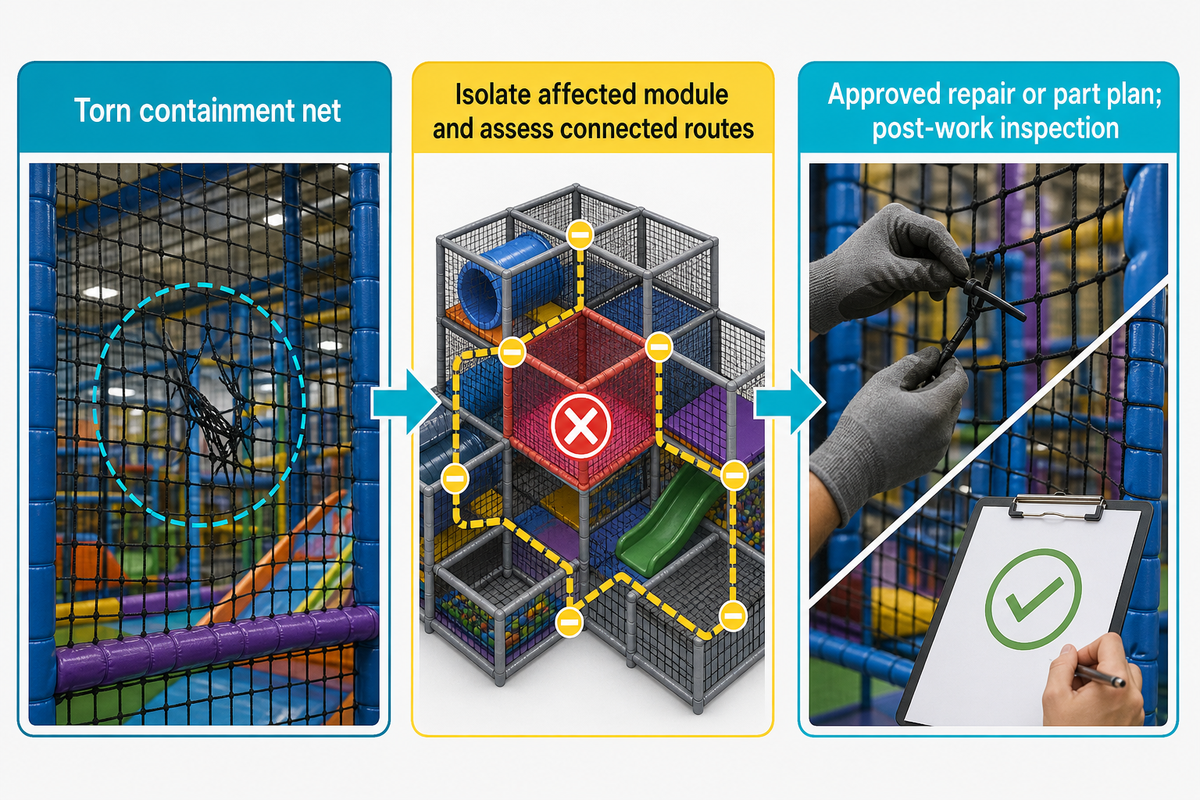
Before you compare repair cost to replacement cost, you’ll need to make safety and product-scope decisions on visible defects. Document the location and restrict access to the affected area under the operator’s risk procedure while a qualified person checks the exact component. The applicable manual, product notice, insurer and local authority may set a narrower or wider hold. A price ratio can’t clear a hazard.
The U.S. Consumer Product Safety Commission’s (CPSC) soft-contained equipment checklist cites torn or frayed netting, cargo webbing and ropes, as well as floor coverings, as conditions for further inspection. It describes possible fall, entrapment and trip mechanisms. This CPSC checklist doesn’t publish an acceptable repair percentage, endorse a patch, or mandate closing all adjacent attractions for every defect.
“Check the safety netting for tears or frays.”
| Observed condition | Possible consequence | Interim operator action | Evidence for reopening |
|---|---|---|---|
| Torn containment net | Access beyond protected boundary | Isolate affected module and assess connected routes | Approved repair or part plan; post-work inspection |
| Frayed rope or cargo webbing | Entrapment, trip or loss of containment | Hold the affected element | Part identification and qualified check |
| Torn floor covering | Trip or exposed substrate | Keep users off the damaged surface | Compatible material and finish check |
| Loose structural connection | Uncertain load path | Hold the structure pending engineering advice | Maker method and qualified sign-off |
| Altered access route | Route, supervision or access impact | Review connected capacity before reopening | Site route and accessibility check |
Look for your model and any serial or project references to check for recalls. The 2023 U.S. recall of Soft Play Sky Wheels shows one reason to do this: the named component had a specific stop-use, inspection and possible repair path. That notice names no Didi product. If there’s a notice for your component, follow its remedy before doing a generic economic comparison.
ASTM F1918-21 is described by its publisher as a safety performance specification for soft-contained play equipment. The U.S. public playground handbook specifically excludes indoor soft-contained equipment. A claim about outdoor public equipment therefore cannot by itself settle an indoor repair. Request the specific applicable edition, manual and local requirements. A standards reference is no proof that a particular Didi installation is certified.
Safety standards set product-family expectations, but the buyer still requires evidence for the installed component and the work to be performed. A replacement component should be checked against the same function and safety requirements as the existing equipment. When a supplier claims that a newer model meets current safety standards, the buyer should ask which standard, edition and product scope the claim is made against. A generic certificate shouldn’t be interpreted as a site acceptance record.
For commercial playground equipment, safety and compliance questions come from several parties. The key factors refer to the function of the affected component, the applicable product method and the reopening criteria of the site. A general safety standards and regulatory statement from a sales brochure doesn’t answer the local installation. These checks make the decision easier by removing unsupported options before money is compared.
Can the exact component be restored?
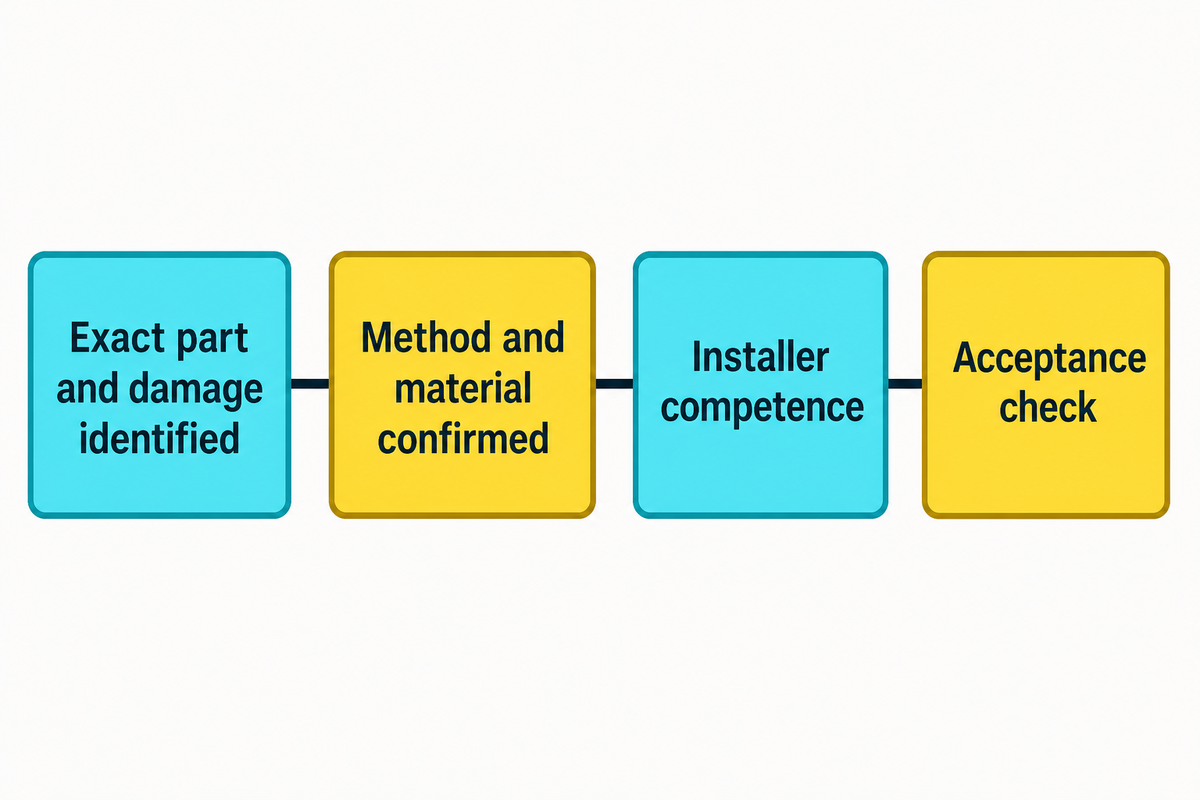
Repair is an option only when the product-specific method can restore the function of the damaged component and a qualified post-work inspection can verify the result. A cosmetic cover, containment rope and structural connection can demand different evidence. If no part identity or approved method is available, the affected element is to be kept out of service while the supplier assesses replacement options.
A cover tear may have a compatible material and attachment method. A frayed rope that contains children, or a connector whose load-bearing capability is uncertain, needs evidence to define its role. Ask the manufacturer to provide a drawing or a manual page, a revision of the part in question, a compatible material, and the instructions for attachment. A contractor’s general ability to patch fabric doesn’t mean the repair process restores containment. The cost of repair is irrelevant unless the method has cleared that technical gate.
Documented component repair
- Exact part and damage identified
- Method and material confirmed for that part
- Installer competence matches the instructions
- Acceptance check records restored function
Unsupported patch proposal
- Photo without a part or revision number
- Generic method offered for a different load path
- No named party responsible for installation
- No objective post-work check
Let’s say a shipment arrives with a damaged decorative cover and a frayed cargo rope. The manager sends separate photographs and part references. A supplier confirms a cover repair but has not approved a rope method. Sensible options differ: Cost the cover repair, and keep the rope closed until the correct replacement or assessed remedy is identified. This is a hypothetical case, not a record of a Didi customer.
Didi Land describes spare-parts and after-sales support on its own site. That first-party description is an invitation to ask for the exact part, lead time, repair method and written warranty in this order. It doesn’t promise every component is repairable.
The availability of replacement parts affects the choice: a known part with an approved method creates a credible repair option, while an unavailable part may require a module redesign. An unknown part may necessitate a module redesign. When deciding whether to repair a piece of equipment, check if the replacement part fits the current equipment revision. If the compatibility is unknown, a low cost to repair or a fast promised time to replace the equipment shouldn’t be the reason for the order.
Deciding when to repair also requires a record of equipment performance following earlier work. If examination shows the cover still performs as designed, the operator can query if it’s cost-effective to repair that defect. If a critical part is regularly losing its function, ask for a replacement scope. Repairing a part simply because its last invoice was small may mask a growing recurring cost.
Set a common comparison boundary
Approved repair, component replacement and full-zone replacement over the same period, capacity and closure assumptions should be compared. The landed quote, incremental lost contribution during the affected closure, anticipated later maintenance and any other realizable end value should be included. Cost already incurred should be excluded. A bare repair invoice and a turnkey replacement proposal describe different scopes until procurement fills the missing lines.
For the case below, the finance team picks five years and an illustrative 8% discount rate. The NIST 2025 life-cycle costing manual justifies comparing alternatives over the same period and uniformly discounting future amounts. Its assumptions for federal projects don’t establish a private indoor-play operator’s interest rate. Use your finance policy, lease term and anticipated operating life instead.
Five-Year Decision Ledger
The same cost categories and levels of usable service appear on the Five-Year Decision Ledger for every technically eligible option.
| Input | Unit or illustrative entry | Evidence owner |
|---|---|---|
| Product and affected part | Model, serial, part revision | Operator and supplier |
| Approved option | Repair, component or zone | Qualified assessor |
| Usable service horizon | 5 years in illustration | Finance and lease team |
| Immediate landed quote | $4,200 / $10,000 / $38,000 | Procurement |
| Closure duration | 6 / 2 / 8 days | Installer and operations |
| Lost contribution | $900 per actual closure day | Venue finance |
| Expected annual later cost | $1,600 / $800 / $400 per year | Service log and finance |
| Year-five realizable residual | $0 / $1,000 / $10,000 | Finance |
| Discount assumption | 8% per year | Finance policy |
| Warranty and recall remedy | Part, labor, freight, exclusions | Supplier and notice |
| Access or route alteration | Scope and local review cost | Designer and site lead |
Normalize the outcome and the invoice. If the replacement design creates fewer sellable spaces, reflect that difference, separately. If a new zone alters a route, ensure that the applicable accessibility requirements are met, and include the actual design work within the scope. The U.S. Department of Justice standards address routes into soft-contained play structures in applicable U.S. locations. The exact duty depends on the site and project scope; a small cover repair does not automatically require a full access upgrade.
Don’t grant a residual value in year five, just because an asset still exists. It must still be economically recoverable in the lease and market context. If a particular alternative would require a replacement before year five, reflect that cost. A vendor may challenge a higher replacement cost by offering a warranty part; verify who pays freight and installation before changing the ledger.
A complete cost analysis separates cash cost from accounting depreciation. For this repair versus replacement comparison, maintenance cost refers to the money expected to be spent after reopening, including another repair and its resulting closure. Total cost of ownership may be a useful label, but the model requires actual cash-flow boundaries. A quote for purchasing new equipment may include the cost of installation; for repair, the quoted price may not include the cost of disposal. Match both of these lines before estimating the cost of either option.
Cost considerations should also include replacement timing. If a component has to arrive during the peak trading weeks, ask if a safely isolated repair can fill the gap for the rest of the delivery period. Compare the cost of a new component with the approved repair for the same service window. The buyer may replace or repair only the component in question, and a full-zone bid belongs in the ledger if it restores a truly comparable or better operating result.
Build a five-year cash-flow worksheet
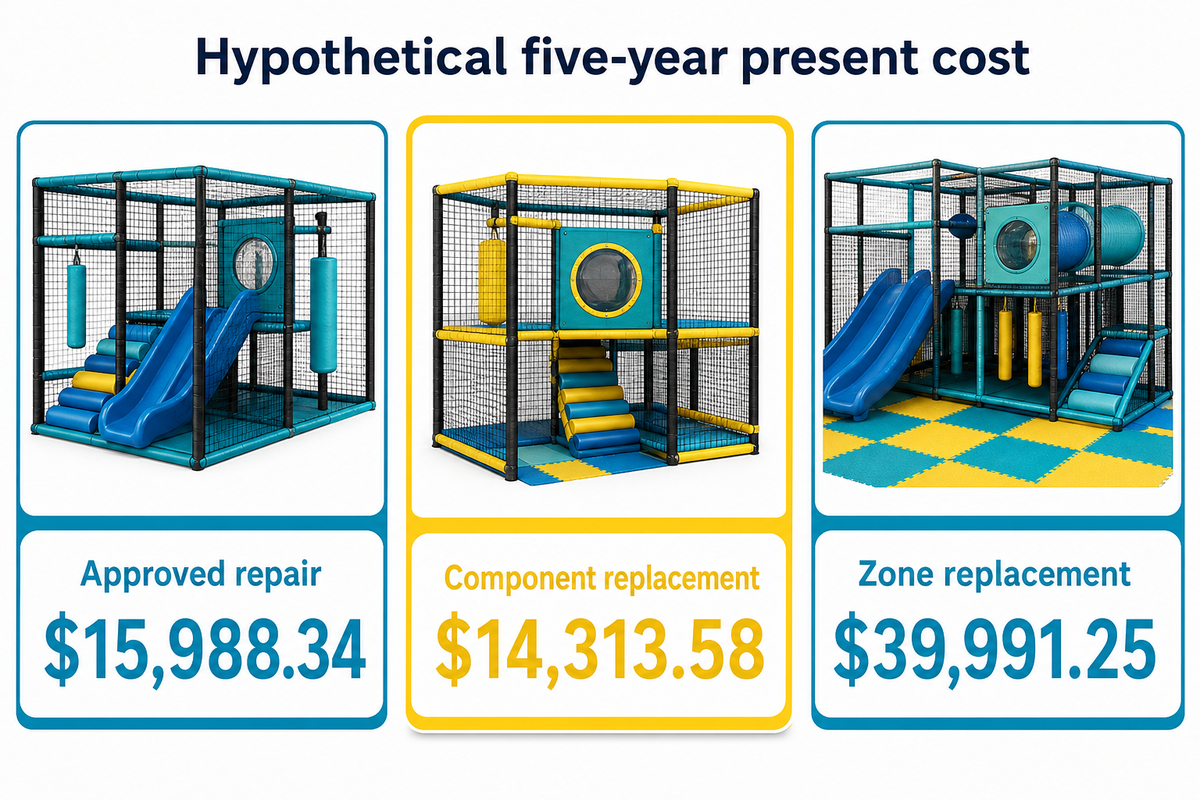
A five-year worksheet using the NIST life-cycle costing method can show an approved repair losing to component replacement, even with a lower invoice. For every eligible option, add immediate landed cost and actual closure loss, then discount each year’s expected future repair and closure cost. Take the discounted future costs each year and subtract the discounted residual value in year five. Run low, base, and high cases, because the outcome may vary with closure duration and recurring work.
Everything in the following example is invented. Suppose a venue expects 70 affected paid admissions on a full closure day but can recapture 25 through another session or zone. If each genuinely lost admission contributes $20 after its avoidable variable costs, daily lost contribution is (70 − 25) × $20 = $900. This isn’t gross ticket revenue. The refund represented in the lost admission has already been accounted for. Wages still paid aren’t a saving; extra closure labor belongs in the quote or in a separate future-cost line.
$900/dayassumed lost contribution
5 yearscommon example horizon
8%/yrassumed finance rate
The annual cost present value factor for years 1 through 5 at 8% is 3.99271. So a dollar of realizable residual value at year 5 is worth $0.68058 today. The annual entries below include expected later repairs and their associated later closures, so no second recurrence- downtime charge is made. Rounding appears only in the last digit.
Five-Year Decision Ledger: present cost, hypothetical US dollars
| Cost item | Approved repair | Component replacement | Zone replacement |
|---|---|---|---|
| Parts, installation and removal now | $4,200 | $10,000 | $38,000 |
| Immediate closure loss | 6 days × $900 = $5,400 | 2 days × $900 = $1,800 | 8 days × $900 = $7,200 |
| Annual later cost, years 1–5 | $1,600 | $800 | $400 |
| Present value of later cost | $6,388.34 | $3,194.17 | $1,597.08 |
| Year-five residual, discounted | $0 | −$680.58 | −$6,805.83 |
| Five-year present cost | $15,988.34 | $14,313.58 | $39,991.25 |
End-to-end check: approved repair = $4,200 + (6 × $900) + ($1,600 × 3.99271) − $0 = $15,988.34. Component replacement = $10,000 + (2 × $900) + ($800 × 3.99271) − ($1,000 × 0.68058) = $14,313.58. Zone replacement uses the same formula with its own $38,000 quote, 8 closure days, $400 annual later cost and $10,000 residual, producing $39,991.25.
The cheapest first invoice, $4,200, is not the cheapest five-year option in this base case. Full-zone replacement is the most expensive, assuming a healthy remainder is of no additional benefit in the model. This example doesn’t prove component replacement always wins. It proves that invoice order and comparable cash-flow order can differ when the buyer records the relevant inputs.
| Case | Repair closure | Annual later cost | Repair present cost | Lower-cost eligible option |
|---|---|---|---|---|
| Low | 2 days | $1,000/year | $9,992.71 | Repair |
| Base | 6 days | $1,600/year | $15,988.34 | Component |
| High | 10 days | $2,500/year | $23,181.78 | Component |
Holding the base annual cost at $1,600, repair and component replacement tie near 4.14 closure days for repair. At 4 days, repair is slightly lower; at 5 days, Component replacement is lower. Challenge the site operations team for a credible closure window and the site finance team for a defensible recurrence allowance. If the site lease expires in less than five years, rerun both options for that shorter, more realistic, time horizon.
This switching point is a practical way to decide whether to repair: if the site expects less than about 4.14 lost-contribution days under the base annual assumption, then repair would rank lower in this example. More expensive repairs can be rational, in particular if they protect capacity, and cheaper repairs can lose once repeated disruption is taken into account. A repair or replace worksheet should therefore show at least one change of assumption, not only its base result.
Repair may be more cost-effective under a temporary closure, while replacement can be cost-effective in the long run when the same module keeps closing. The financial result alone can’t warrant a method. An operator also needs to assess if the work being done restores the part’s function, and if the site can use any assumed residual value. Without those assessments, replacing the item may seem better on paper than in service.
Map the hidden closure cost
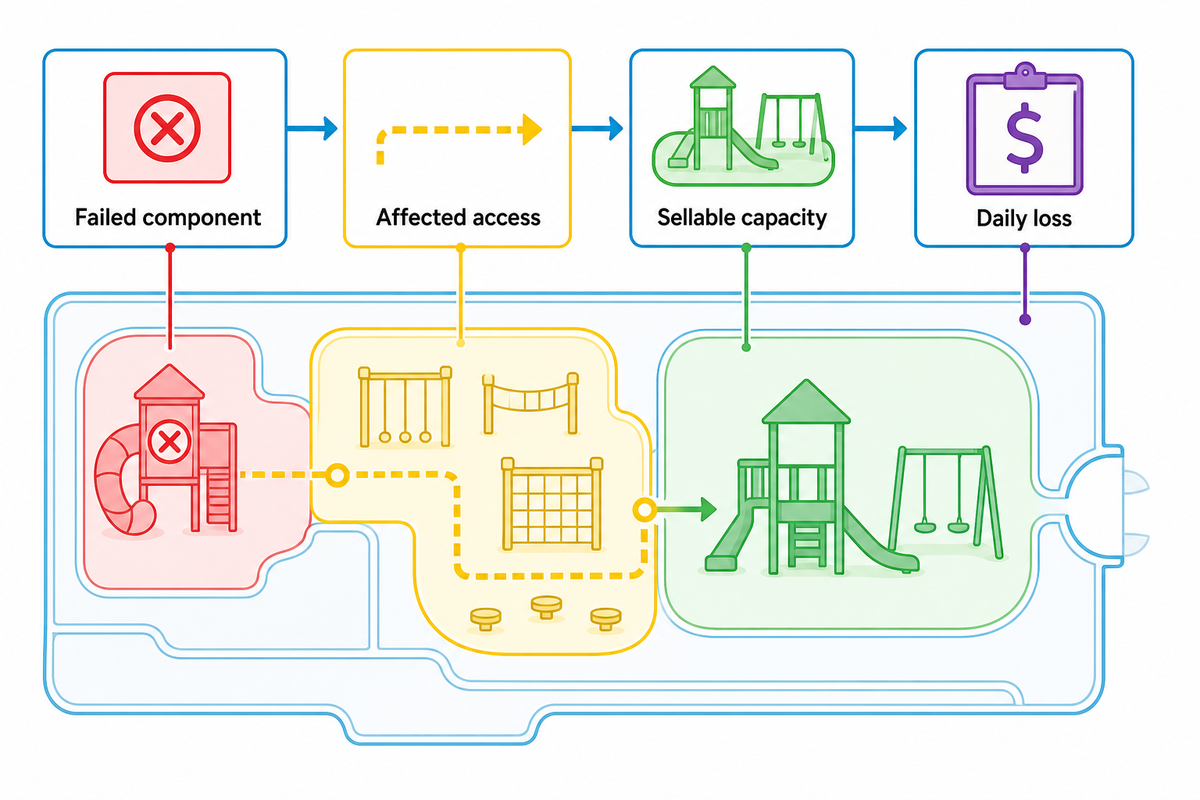
The cost of downtime follows the capacity that actually disappears rather than the physical size or purchase price of the failed part. A torn net may require closure of one module, a connected route or a larger section if separation is impossible. The safety lead should mark the actual limit on the floor plan. Finance should then count only the admissions or contribution that can’t move to an open session or zone.
Zone Closure Cost Map
The Zone Closure Cost Map links a failed component to affected access and sellable capacity before assigning a daily loss.
| Area or route | Example dependency | Possible closure | Capacity effect |
|---|---|---|---|
| Netted bridge | Damage at one edge | Bridge only if safely isolatable | Bridge activity unavailable |
| Main circulation link | Bridge is sole path | Link plus dependent destination | Count displaced sessions |
| Connected slide | Entrance across link | Conditional, not automatic | May lose slide places |
| Ball-pit entrance | Alternative entrance exists | May remain open | Check supervision and flow |
| Toddler corner | Separate supervised access | May remain open | No loss if demand retained |
| Exit path | Crosses isolated work area | Assess under local plan | Do not presume all internal play routes are legal exits |
| Accessible entry | Route altered by barrier | Review applicable access obligation | Scope may need redesign |
| Replacement work zone | Installer needs floor space | Temporary work boundary | Measure actual opening hours lost |
| Whole venue | No safe separation possible | Only if site assessment supports it | Count true unrecovered contribution |
A Soft Play discussion of indoor layout describes dead-end circulation and repair closures, but gives no loss rate of a venue. Its separate maintenance guidance explains the difference between closing the affected section and closing the entire play center. The supplier pages give the reason a map is drawn, they don’t explain which area this hypothetical net closes.
Find lost paid visits using session records. Subtract sessions moved to other time slots, and variable expenses actually avoided. Add closure costs not in the quote. The discussion provided by the Association of Chartered Certified Accountants’ relevant-cost discussion supports this incremental logic. A parent who books a later session is not necessarily a lost customer. A manager may argue that every connected component must close. The footprint is determined by the assessment, qualified by the floor plan and session times.
The cost of downtime also varies with the work window. Repairing equipment after closing hours may reduce lost admissions, provided the post-work inspection can finish before reopening. Facilities management must capture the real constraint, since a nominal two-day job may impact a different number of paid visits. A full-cost estimate that assumes every weekday looks like Saturday will misstate the decision.
Run three decision cases
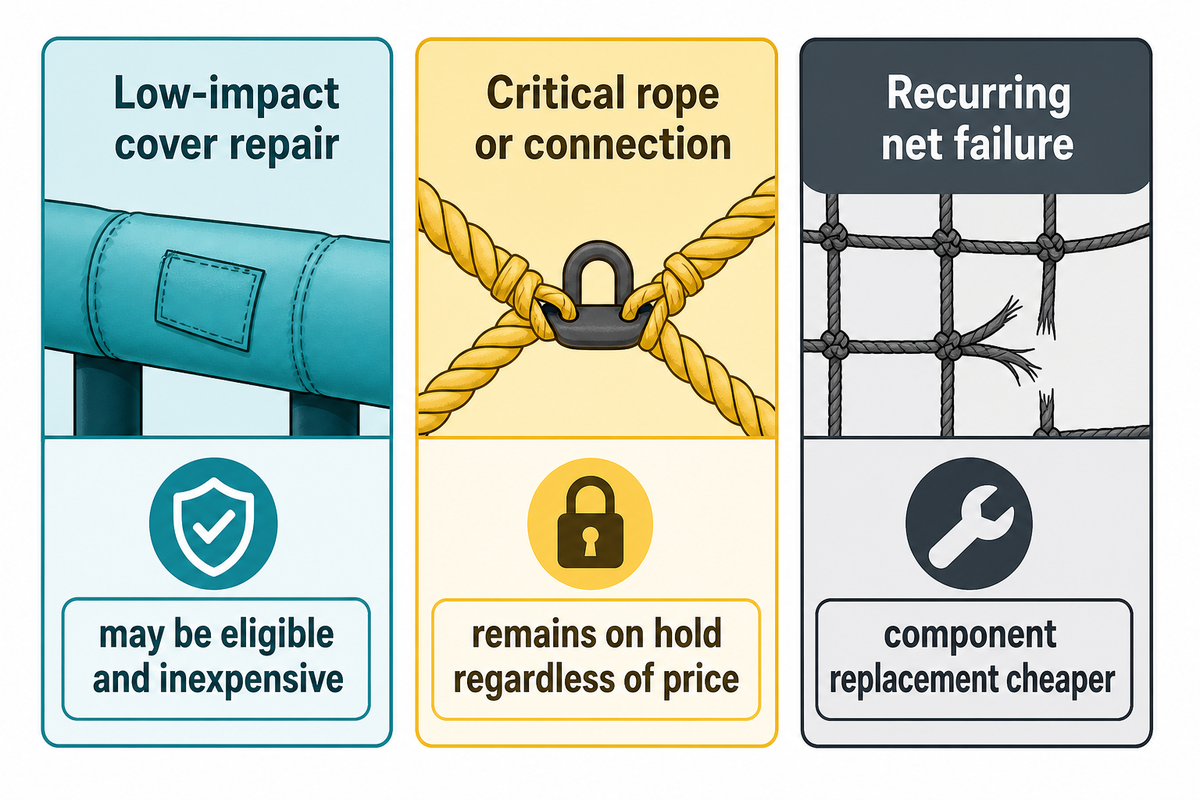
One decision option can produce three different outcomes. A low-impact cover repair, as documented, may be eligible and inexpensive. A containment or structural repair without a supported method remains on hold regardless of price. Repeated failure can make a component replacement cheaper than another approved repair once recurring work and closure are included. These are teaching cases not recorded Didi projects.
- Screen the hazard — record the defect and keep the affected element out of use while its boundary is assessed.
- Confirm eligible methods — identify the exact part, any recall, manual and qualified acceptance test.
- Match operating results — require each bid to restore the same capacity or price the difference.
- Rank comparable cash flows — use the same horizon, lost contribution, recurrence and realizable residual assumptions.
- Record the condition — approve the chosen option only with responsible parties and reopening evidence.
Cover tear: a written repair method, matching material and one-day isolated work window may make repair a valid low-cost choice. The example day is a planning assumption, not a typical time to repair. Critical rope or connection: holding the element is the correct answer in the absence of a compatible part and an approved method. Recurring net failure: costs associated to the same route closing multiple times should be included in the financial plan if the next repair is technically eligible. A component replacement can win even with a higher immediate cost.
Replacing the equipment across a zone might still be right when no supported component remedy exists or when a broader redesign has its own justified operating benefit. Compare commercial indoor play structures against the required operating scope, not against an assumed lifespan or depreciation schedule. An older piece of equipment does not become unsafe merely because it crosses an arbitrary birthday; inspection and product evidence decide eligibility.
For the cover, repair method and isolated closure may make an informed decision possible. For the critical rope, the missing method is the blocker; price comparisons come later. For repeated net failures, annual repair costs and closure history explain why continuing to repair may stop making financial sense. The decision must be made at the affected component and zone, not by treating every playground as one indivisible asset.
Ask suppliers for proof and normalize quotes
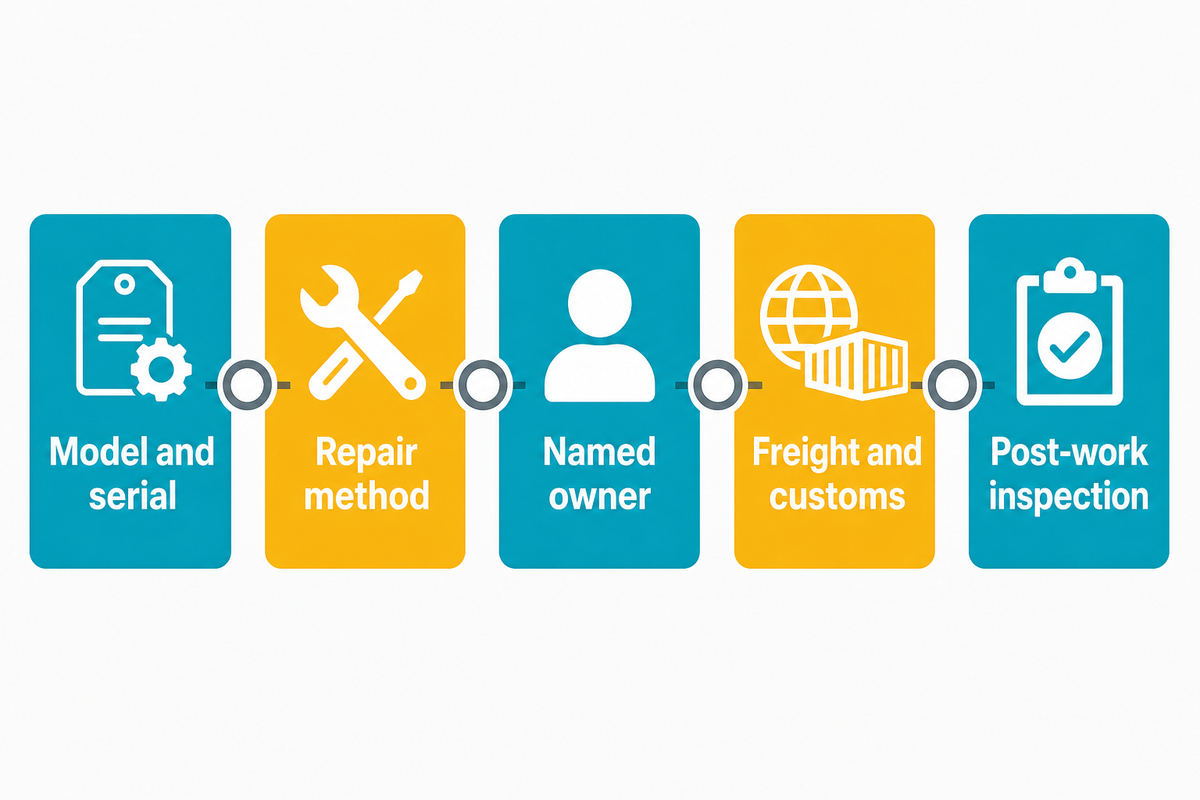
A quote that names the component, approved method, installer responsibility, delivery time, included costs, warranty exclusions and post-work acceptance owner becomes comparable. Ask the repair and replacement bidders for the same operating result and written evidence. A supplier’s general support page cannot answer what this part will cost to land, install and inspect at this site.
Part-Level Proof Packet
Procurement of the part is documented with a form: each material promise needs a document, a responsible party and a check before reopening.
| Question or cost line | Evidence to request | Named owner | Acceptance check |
|---|---|---|---|
| Model and serial | Plate photo and project drawing | Operator | Matches installed unit |
| Recall status | Current model-specific notice lookup | Supplier and safety lead | Applicable remedy addressed |
| Replacement part | Number, revision, material and fit | Maker or authorized supplier | Identity confirmed in writing |
| Repair method | Manual page or written approval for defect | Maker or qualified authority | Method covers this load or containment role |
| Installer | Qualification and method assignment | Contractor or operator | Installation record signed |
| Freight and customs | Landed delivery line | Bidder | Included or priced separately |
| Removal and disposal | Itemized work scope | Bidder | No unpriced work remains |
| Delivery and closure | Ship date and work schedule | Bidder and operations | Matches closure plan |
| Warranty | Part, labor, freight, wear exclusions | Bidder | Written terms match this order |
| Post-work inspection | Checklist, result and reopening sign-off | Qualified assessor | Defect and connected route checked |
Soft Play’s own FAQ says photographs can help identify replacement parts and states that the company does not offer maintenance services. In the warranties from Dreamland, part coverage may not include freight and/or labor. Those warranties apply to those companies, not to Didi. Maker-approved instructions also do not mean the maker must personally install every part; follow the product’s actual method and contract. If the bid’s only response was “replace netting,” without saying which net and what time and acceptance means, the buyer should reject the bid.
For a matched repair plan and a component or zone replacement scope, send Didi your part reference and site requirements. Ask these same questions of other qualified bidders before coming to a decision.
For a matched repair plan and a component or zone replacement scope, send Didi your part reference and site requirements. Ask the same questions of other qualified bidders before making your decision.
Equipment manufacturers may define different repair-process steps and warranty exclusions that shape equipment decisions. Ask the bidder to state whether the quote includes parts and equipment only, or the installer and inspection as well; these are costs to consider when deciding whether to approve the bid. These are various factors to consider when differentiating a repair and replacement order. A checklist helps make informed decisions only when its blank fields receive actual documents and named owners.
Request a documented repair and replacement quote
Turn today’s choice into a renewal plan
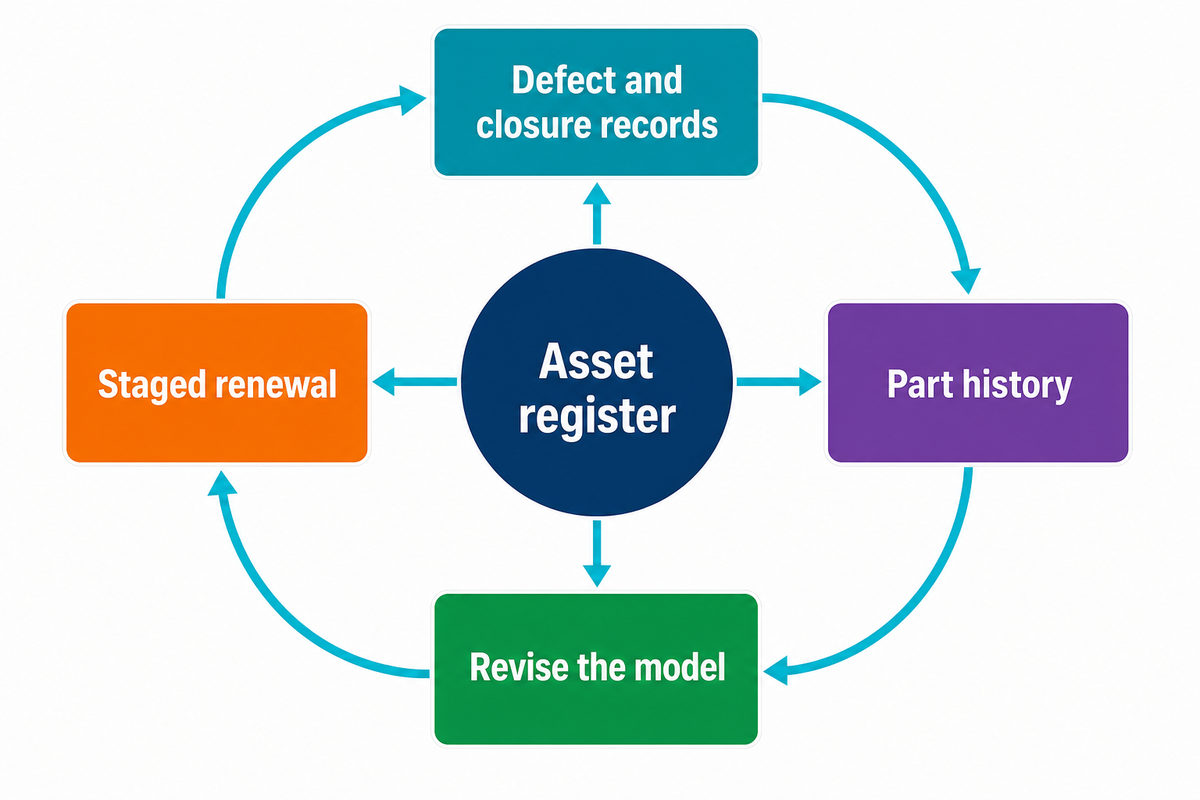
repair or replacement becomes easier to decide upon once the operator preserves actual defect, closure, and cost records. Each component of repair or replacement is to be identified, cataloged, and part history recorded, and the five-year model is to be revised with the arrival of service and invoice records. Schedule a staged renewal of a repair or replacement when a supported repair is unavailable or the economics of the site repeatedly favor replacement.
The decision becomes easier when the actual defect, closure and cost records are preserved. Put each component in an asset register, attach its manual and part history, and revise the five year model as invoices and service events occur. Schedule staged renewal when a supported repair is not available or the site’s own comparable economics repeatedly favor replacement.
Record which module failed, when it was isolated, whether connected areas remained open, the lost paid sessions, invoice lines, warranty recovery and inspection outcome. A spreadsheet or maintenance management software can be used to record the data; no software choice is required by the method. Follow the product specific routine and existing inspection guide for preventive maintenance. Review the list quarterly, or after a significant failure, not when a general web article states older equipment has reached a certain age; use the CPSC soft-contained play equipment safety checklist to prompt relevant defect checks.
Depreciation is an accounting entry, and this cash flow comparison asks what the next operating choice will cost. Newer equipment can increase or decrease capacity or operational efficiency, but value these changes only if the venue has evidence for them. No independent year-over-year trend, replacement age in the industry, or forecast of technological advancement was established for this topic. A local renewal plan is based on the history of service for current equipment, and the lease horizon of the operator.
For asset management, keep photos, inspection findings, part numbers, invoices, and reopening dates on the same module record. For a larger venue, computerized maintenance management may be able to help search your facility’s history, but a consistent spreadsheet may work just as well. This allows the next manager to differentiate outdated equipment claims from normal wear, and to compare the newer model to the actual service left in the module that is in the field. It shows whether preventive maintenance has changed the frequency of future work.
Equipment typically lasts for different periods at the part and structure level, so a single venue-wide renewal date obscures the useful service of each module. The record should keep the reason for closure for each work order and the post-work outcome. It then becomes an operational decision as to when to perform replacement timing.
Key takeaway
In the hypothetical five-year base case, the eligible component replacement is $1,674.75 below approved repair in present cost; a shorter repair closure reverses the choice. Replace those assumptions with your records before authorizing work.
Frequently asked questions
How long does playground equipment last?
Read answer
No single age decides an indoor soft-contained component’s remaining service life. Inspect condition, use, environment, maker instructions, part availability and failure history. A structure and its net, cover and connector may need different decisions. Keep the product family and local requirements clear before using a supplier’s lifespan statement. Log the condition of each part after qualified service, because usable life is observed at the site.
How much does a playground inspection cost?
Read answer
No transferable inspection fee was verified for this venue or component. Request a scope-based quote that names the inspector’s competence, inspected area, documented findings and post-work check. A qualified assessment may avoid paying for an ineligible repair or an unnecessary whole-zone replacement. Ask whether a return visit, written report, photos and connected-route assessment are included. Compare identical scopes before choosing the lowest fee.
At what point does repairing an asset stop making financial sense?
Read answer
Once an approved repair’s comparable present cost exceeds an eligible replacement across a reasonable range of closure and recurrence assumptions, replacement has the financial case. Safety eligibility still comes first. In the hypothetical example, repair changes rank near 4.14 closure days when its later annual cost stays at $1,600. Use actual site records to test that boundary, and account for any warranty remedy or lease limit before approving expenditure.
Can torn playground netting or floor covering simply be patched?
Read answer
The official soft-contained checklist flags tears and frays as hazards to assess; it does not authorize a patch. Identify the exact material and function, obtain a product-specific method and document the inspection before reopening.
Does a warranty replacement part make the repair free?
Read answer
Only the written order terms can answer that. A covered part may still carry freight, installation, removal, inspection or closure costs. Record each line once in the comparison and check whether a product-specific recall remedy changes who pays.
Method and disclosure. All prices, admissions, closure days, discount rates, residual values and cases herein are illustrative only and do not represent any Didi Land performance, market averages, legal opinion or an approval to repair a specific Unit. U.S. official sources are cited for their published scopes; site law, insurer terms and the exact maker instructions require local verification. The five-year model is a decision worksheet. Its output depends on the assumptions and inputs incorporated in the worksheet by the user.
References & Sources
- Soft Contained Play Equipment Safety Checklist U.S. Consumer Product Safety Commission
- Soft Play Sky Wheels recall U.S. Consumer Product Safety Commission
- ASTM F1918-21 scope ASTM International
- Public Playground Safety Handbook U.S. Consumer Product Safety Commission
- Life-Cycle Costing Manual, 2025 U.S. National Institute of Standards and Technology
- 2010 ADA Standards for Accessible Design U.S. Department of Justice
- Relevant costs Association of Chartered Certified Accountants