Get in Touch with Didi Land


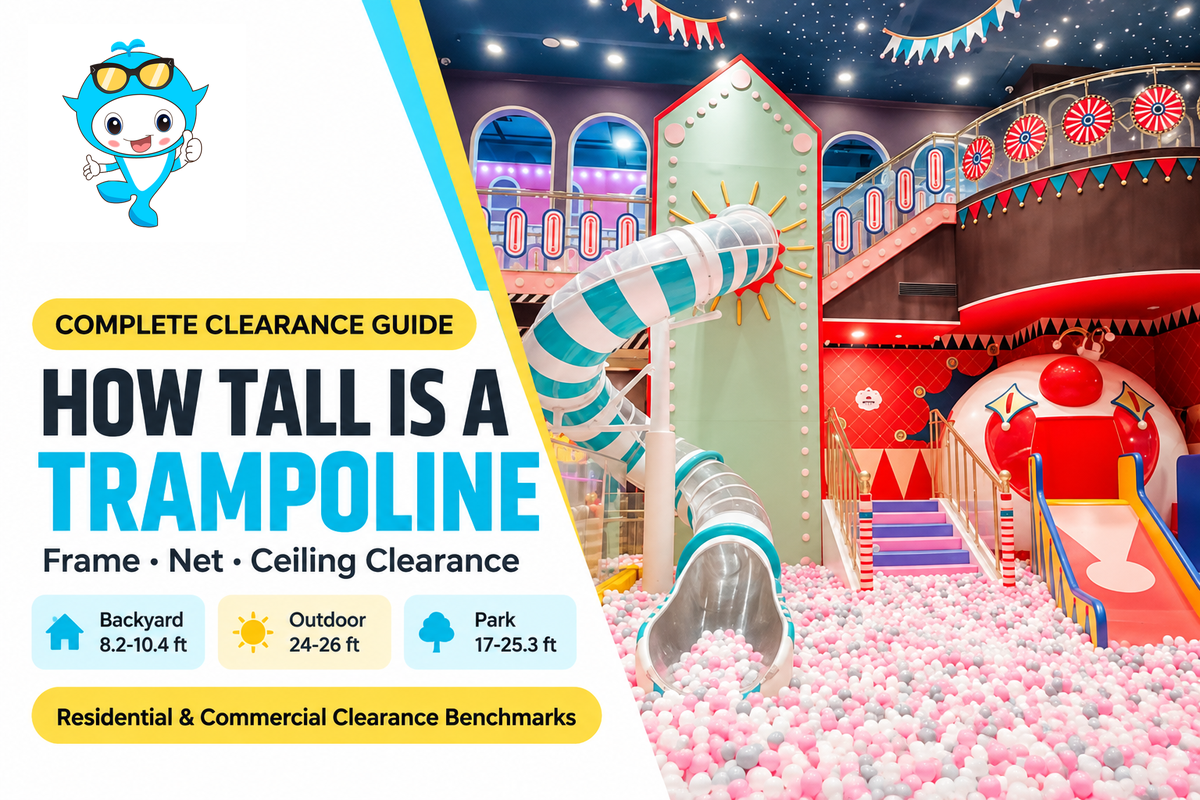
When buyers ask how tall is a trampoline, they need three separate vertical numbers. Standard backyard models from the SpaceJump and Jumpzylla lineups stand 2.3 to 4.4 feet (0.70 to 1.34 meters) off the ground at the jumping mat. Adding the safety enclosure net brings total structure height to 8.2 to 8.9 feet (2.5 to 2.7 meters) for SpaceJump models. Jumpzylla’s tall-frame 16ft unit reaches 10.4 feet with its net. Safe outdoor bouncing also requires 24 to 26 feet (7.3 to 8.0 meters) of clear overhead sky (Eco Adventure and SpaceJump).
Indoor mini-fitness rebounders and large commercial trampoline park installations have different height restrictions. A home fitness rebounder is 9 to 14 inches off the floor. Bellicon specifies a room ceiling at least 20 inches above the user’s standing height. Eco Adventure also recommends an 8 to 9-foot room ceiling for mini rebounders. For commercial indoor venues, Trampolines Unlimited (WeBounce) and Soft Play cite a 17-foot (5.2-meter) minimum ceiling height and refer to ASTM F2970. WeBounce specifies a minimum ceiling height of 20 feet for stunt airbags and foam pits.
Backyard trampoline frames stand 2.3 to 4.4 feet tall from the ground to the jumping mat. With a 5.5 to 6 foot safety enclosure net installed, overall height reaches 8.2 to 8.9 feet on SpaceJump models and up to 10.4 feet on Jumpzylla’s 4.4-foot frame. Plan for 24 to 26 feet of outdoor overhead clearance from ground level. Commercial indoor trampoline parks require 17 to 20 feet of clear ceiling height per WeBounce and Soft Play.
Quick Trampoline Height & Clearance Reference
| Backyard Mat Height (Ground to Bed) | 2.3–2.9 ft (SpaceJump 8–16 ft); 2.5–4.4 ft (Jumpzylla 8–16 ft) |
| Backyard Total Height with Safety Net | 8.2–8.9 ft (2.5–2.7 m) SpaceJump; up to 10.0–10.4 ft Jumpzylla 15–16 ft |
| Mini Fitness Rebounder Height | 9–14 in frame height; room ceiling = user height + 20 in (8–9 ft per Eco Adventure) |
| In-Ground Trampoline Profile | 0 ft flush (or 0.5–1 ft vented rim); 18–20 ft overhead clearance per Eco Adventure |
| Outdoor Overhead & Lateral Clearance | 24–26 ft (7.3–8.0 m) vertical from ground; 3–5 ft lateral buffer per Jumpzylla |
| Commercial Park Ceiling (ASTM F2970) | 17 ft (5.2 m) standard court; 20–25.3 ft (6.1–7.7 m) airbag, pit & web mat |
Key Engineering Takeaways
- Separate frame height off the ground from total enclosure height and open overhead flight clearance.
- Larger frames sit taller off the lawn so heavy jumpers don’t bottom out on the grass.
- Enclosure nets stop sideways falls, but their open tops never reduce the 24 to 26 foot vertical clearance rule.
- Commercial indoor venues must measure clear height from the floor to the lowest roof truss, sprinkler, or air duct.
How Tall Is a Trampoline? Frame Height vs Total Enclosure Height
The height of a trampoline consists of two structural layers. Standard backyard models stand 2.3 to 4.4 feet (0.70 to 1.34 meters) tall at the jumping mat frame across SpaceJump and Jumpzylla lineups. With a safety enclosure attached, total height reaches 8.2 to 8.9 feet (2.5 to 2.7 meters) on SpaceJump models. The steel base frame sits below the trampoline mat, and the vertical enclosure poles rise above it.
In SpaceJump’s published size table, ground-to-mat frame height measures 2.3 feet (27.6 inches or 0.7 meters) on smaller models. Its larger family models sit 2.9 feet (34.8 inches or 0.9 meters) off the grass. Jumpzylla’s published size guide lists frame height from the ground from 2.5 feet (0.76 meters) up to 4.4 feet (1.34 meters). Adding the perimeter safety net makes the height of the enclosure taller than backyard fences. Understanding what is a trampoline park versus a home backyard unit starts with how standards partition these vertical zones.
How tall is a trampoline with net?
A full-size backyard trampoline with a safety net is 8.2 to 8.9 feet (2.5 to 2.7 meters) tall from the ground to the top of the net poles on SpaceJump models. Their 4.0 to 4.4 foot base frames carry a 6-foot enclosure net.
Consumer home units fall under ASTM F381-24, the Standard Safety Specification for Components, Assembly, Use, and Labelling of Consumer Trampolines. Early enclosure patents such as US Patent 5,941,798 by Mark Publicover and US Patent Application US20180036570A1 explain why these dimensions lock together. Each vertical pole attaches through a lower connector to a horizontal steel frame. That joint creates one rigid stack on any sized trampoline.
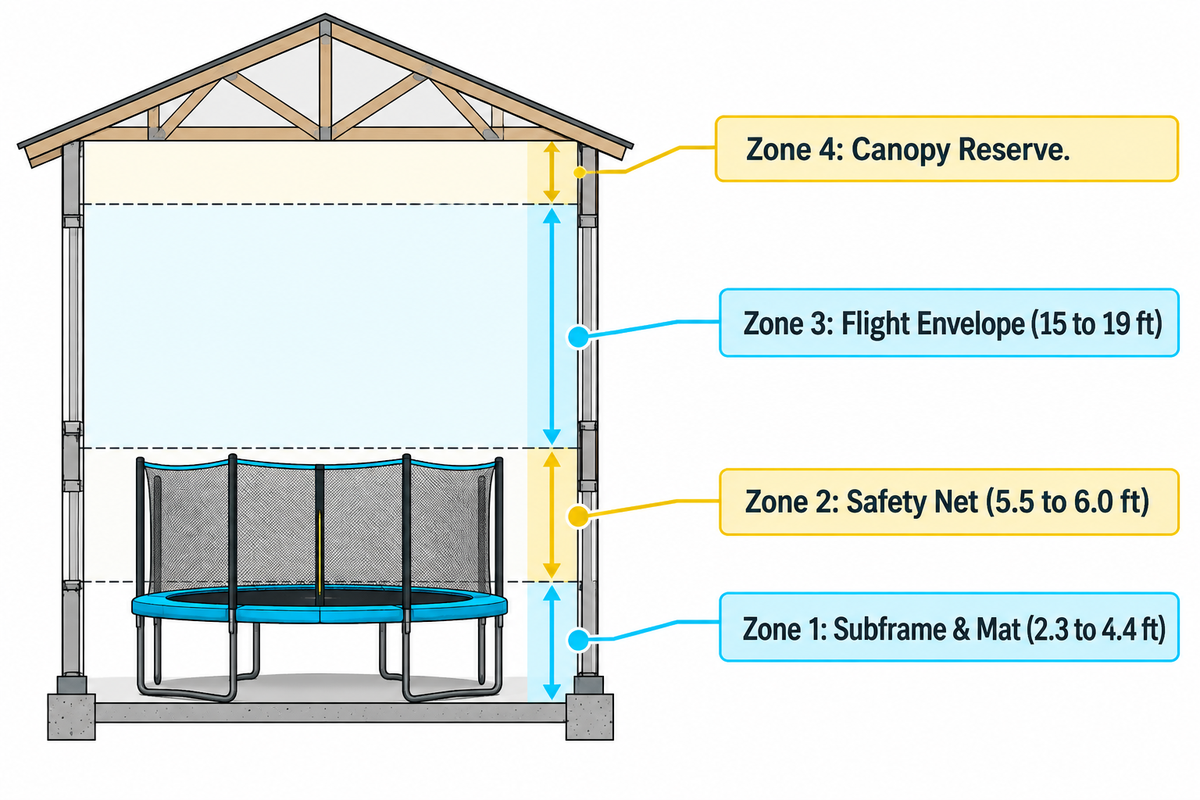
To avoid counting the same vertical dimensions more than once when creating site plans, engineers use the 4-Zone Vertical Clearance Stack. Rough estimates, however, often add the net height to the jump height, which is incorrect. Instead, the vertical space is divided into four zones from the ground to the roof or tree canopy:
- Zone 1 – Subframe and Mat Elevation (0 ft to Mat Datum): The vertical distance between the ground or floor and the static jumping mat. This zone measures 2.3 to 4.4 feet for backyard models and 3.0 to 5.9 feet for commercial decks. This lower zone absorbs the downward stretch of the mat, thus preventing the jumper from making contact with the ground.
- Zone 2 – Safety Net: The vertical net wall rises directly above the jumping surface and measures 5.5 to 6.0 feet in height. On SpaceJump models, the net wall reaches 8.2 to 8.9 feet above the lawn to contain sideways falls.
- Zone 3, Above-Net Apex Flight Envelope (Net Rim to Minimum Clear Plane): The open sky or indoor airspace above the top rim of the net. Because the top of the net is open, Eco Adventure also notes that a jumper’s head can reach 15 to 19 feet above the ground at peak rebound.
- Zone 4, Overhead Structural and Canopy Reserve (Minimum Clear Plane to Roof Deck): This is the upper zone above the clear plane, where tree limbs, utility wires, HVAC and fire protection systems, and lighting may be present.
Buyers often confuse width with height on tall trampolines. It sits 2.9 to 3.5 feet high at the mat across SpaceJump and Jumpzylla models, and reaches 8.9 to 9.5 feet at the top of the net.
Backyard Trampoline Sizes: Height From 6ft to 16ft Round and Rectangular Models
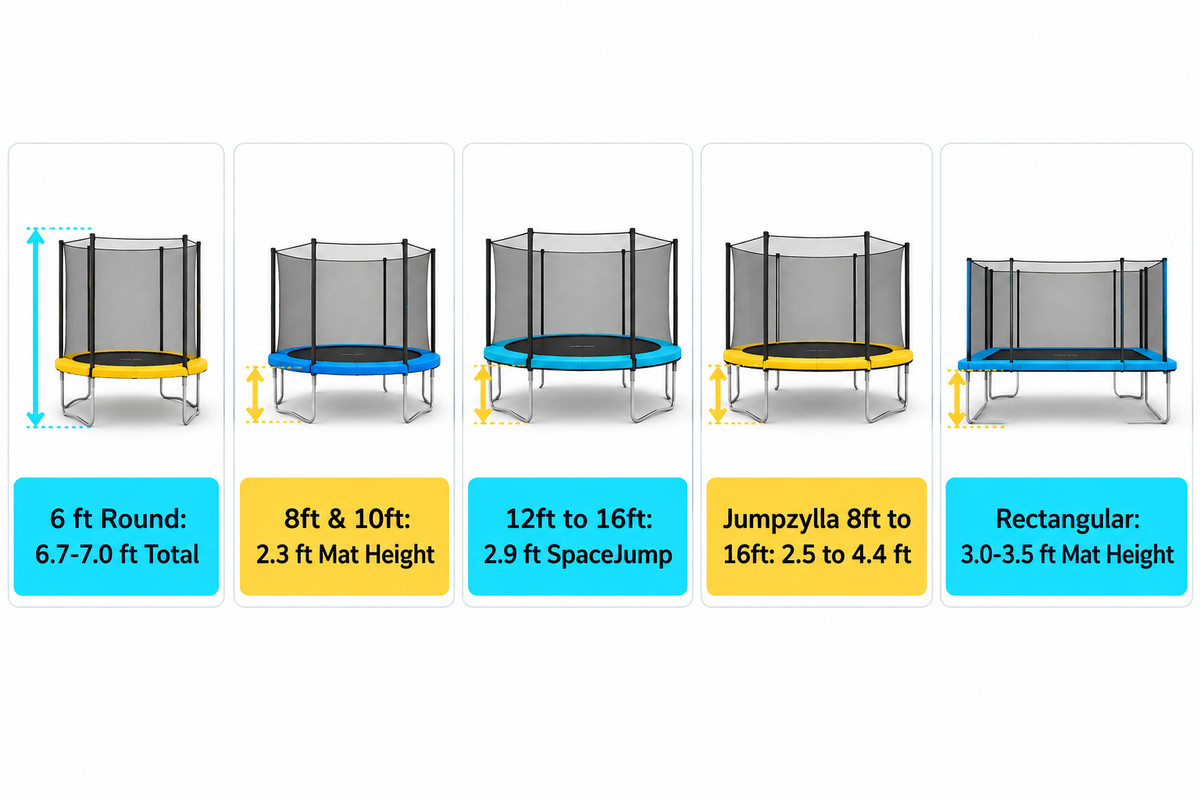
Backyard trampoline sizes step up in frame height as the outer diameter grows from compact frames to large family models. In SpaceJump’s product table, an 8ft trampoline and a 10ft trampoline both sit 2.3 feet (27.6 inches) off the ground. SpaceJump’s 12ft through 16ft models sit at 2.9 feet (34.8 inches). Jumpzylla’s size guide scales frame height from 2.5 feet on its 8ft model up to 4.4 feet (1.34 meters) on its 16ft trampoline.
Why does frame elevation increase when size matters for older jumpers? A larger jumping surface uses longer springs and supports a higher weight capacity. When a teen or adult lands in the center of a large round trampoline, the mat stretches down toward the lawn. Raising the steel frame to 2.9 to 4.4 feet accommodates that downward travel and preserves bounce quality. You can verify metric site drawings with our feet to meters converter for indoor playground planning.
| Trampoline Size / Type | Mat / Frame Height (Ground to Bed) | Enclosure Net Height Above Mat | Total Installed Height (Ground to Top) | Recommended Ground Footprint (3 ft Buffer) | Minimum Vertical Clearance from Ground |
|---|---|---|---|---|---|
| 6 ft Round Backyard (Smaller Sizes) | 1.7–2.0 ft (20–24 in / 0.5–0.6 m) | 5.0 ft (1.5 m) | 6.7–7.0 ft (2.0–2.1 m) | ~12 ft (3.7 m) diameter | 24 ft (7.3 m) outdoor |
| 8 ft Round (SpaceJump & Jumpzylla) | 2.3 ft (27.6 in) SpaceJump; 2.5 ft (0.76 m) Jumpzylla | 5.9 ft (1.8 m) | 8.2 ft (2.5 m) SpaceJump; 8.4 ft Jumpzylla | ~14 ft (4.3 m) diameter | 24–26 ft (7.3–8.0 m) |
| 10 ft Round (SpaceJump & Jumpzylla) | 2.3 ft (27.6 in) SpaceJump; 3.0 ft (0.91 m) Jumpzylla | 5.9 ft (1.8 m) | 8.2 ft (2.5 m) SpaceJump; 8.9 ft Jumpzylla | ~16 ft (4.9 m) diameter | 24–26 ft (7.3–8.0 m) |
| 12 ft Round (SpaceJump & Jumpzylla) | 2.9 ft (34.8 in) SpaceJump; 3.5 ft (1.07 m) Jumpzylla | 6.0 ft (1.83 m) | 8.9 ft (2.7 m) SpaceJump; 9.5 ft Jumpzylla | ~18 ft (5.5 m) diameter | 24–26 ft (7.3–8.0 m) |
| 14 ft Round (SpaceJump & Jumpzylla) | 2.9 ft (34.8 in) SpaceJump; 3.5 ft (1.07 m) Jumpzylla | 6.0 ft (1.83 m) | 8.9 ft (2.7 m) SpaceJump; 9.5 ft Jumpzylla | ~20 ft (6.1 m) diameter | 24–26 ft (7.3–8.0 m) |
| 15 ft Round (SpaceJump & Jumpzylla) | 2.9 ft (34.8 in) SpaceJump; 4.0 ft (1.22 m) Jumpzylla | 6.0 ft (1.83 m) | 8.9 ft (2.7 m) SpaceJump; 10.0 ft Jumpzylla | ~21 ft (6.4 m) diameter | 24–26 ft (7.3–8.0 m) |
| 16 ft Round (SpaceJump & Jumpzylla) | 2.9 ft (34.8 in) SpaceJump; 4.4 ft (1.34 m) Jumpzylla | 6.0 ft (1.83 m) | 8.9 ft (2.7 m) SpaceJump; 10.4 ft Jumpzylla | ~22 ft (6.7 m) diameter | 24–26 ft (7.3–8.0 m) |
| Rectangular Backyard (8×12 ft to 10×17 ft) | 3.0–3.5 ft (36–42 in / 0.9–1.07 m) | 6.0 ft (1.83 m) | 9.0–9.5 ft (2.75–2.9 m) | 14×18 ft to 16×23 ft zone | 24–28 ft (7.3–8.5 m) |
| In-Ground Backyard Trampoline | 0 ft flush (or 0.5–1.0 ft vented rim over 2.5–3.5 ft pit) | 0 ft (open) or 6.0 ft with net | 0–1.0 ft open; 6.0–7.0 ft with net | Frame width + 6–10 ft buffer | 18–20 ft (5.5–6.1 m) above lawn |
| Commercial Park Court (ASTM F2970) | 3.0–5.9 ft (0.9–1.8 m) steel deck / pit depth | Padded court wall & containment net | Deck + containment per venue CAD | 25,000–35,000 sq ft facility | 17 ft (5.2 m) standard; 20–25.3 ft (6.1–7.7 m) pro |
Both trampoline shape and brand engineering alter the vertical profile of large frames and medium sizes. Smaller sizes in circular frames pull jumpers toward the center. By contrast, ACON notes that rectangular trampolines provide a consistent bounce posture for gymnasts across the jumping space. Spring engagement varies less by landing spot in a rectangle than a circular ring. Comparing frame size and shape explains why a rectangular trampoline is 3.0-3.5 feet off the ground. Even with the two 14ft frames, mat height from the ground varies from 2.9 feet (34.8 inches) on SpaceJump models to 3.5 feet (1.07 m) on Jumpzylla models.
How big is a 6 foot trampoline?
A 6 foot trampoline (often listed as a 6 ft trampoline) measures 6 feet (1.83 meters) wide across the outer frame. With a 5 foot safety net attached, the total height is 6.7-7.0 feet for compact yards.
Mini Fitness Rebounders vs In-Ground Trampolines at Ground Level
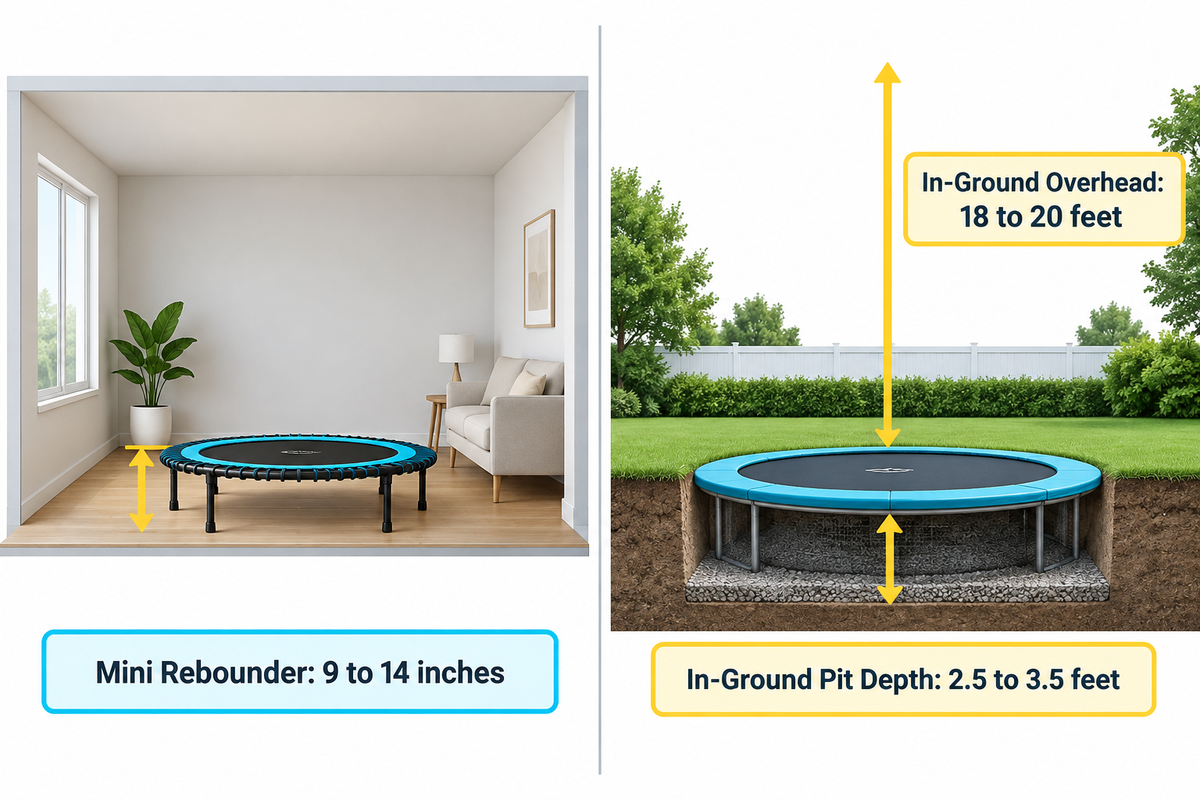
Indoor mini fitness rebounders range from 9 to 14 inches (23 to 35 centimeters) tall at the frame. The sunken in-ground trampolines sit flush (0 feet) at the ground, or rise 0.5 to 1 foot above the lawn. These low-profile trampolines come in two distinct structures for tight spaces where an 8.9-foot outdoor enclosure won’t fit. According to Eco Adventure’s clearance table and rebounding community reports, both structures maintain the jumping bed close to the floor or the grass.
How tall is a mini trampoline?
The height of an indoor mini trampoline (fitness rebounder) is 9 to 14 inches (23 to 35 centimeters) from the floor to the jumping mat. Bellicon’s official rule states your ceiling must be at least 20 inches (50 centimeters) taller than the tallest user’s body height. Eco Adventure recommends an 8 to 9 foot ceiling.
Using bellicon’s room ceiling rule gives you a good indication of your indoor headroom. For a 6-foot (72-inch) user, you would need to add at least 20 inches above their body height, giving you a baseline height of at least 92 inches (7 feet 8 inches) for frame and potential exercise bounce height. Eco Adventure suggests an 8 to 9 foot unobstructed room ceiling for a comfortable indoor jumping experience. Heavier users should choose firmer bungee tension on a 12 to 14 inch frame so they don’t hit the floor.
Lowering Zone 1 below the lawn line makes the in-ground models visually less conspicuous. Digging a 2.5 to 3.5 foot (30 to 42 inch) deep pit with a retaining wall and gravel drainage can bring the trampoline bed flush with the yard. Because the above-ground frame disappears, Eco Adventure notes that an in-ground trampoline still requires 18 to 20 feet (5.5 to 6.1 meters) of clear overhead space above ground level. Sunken trampolines offer easy step-on access, and flush trampolines provide a clean yard view. Providing a perimeter safety net for an in-ground unit still leaves a 6-foot enclosure above the grass.
Choosing the Right Trampoline Size and Overhead Clearance for Your Space
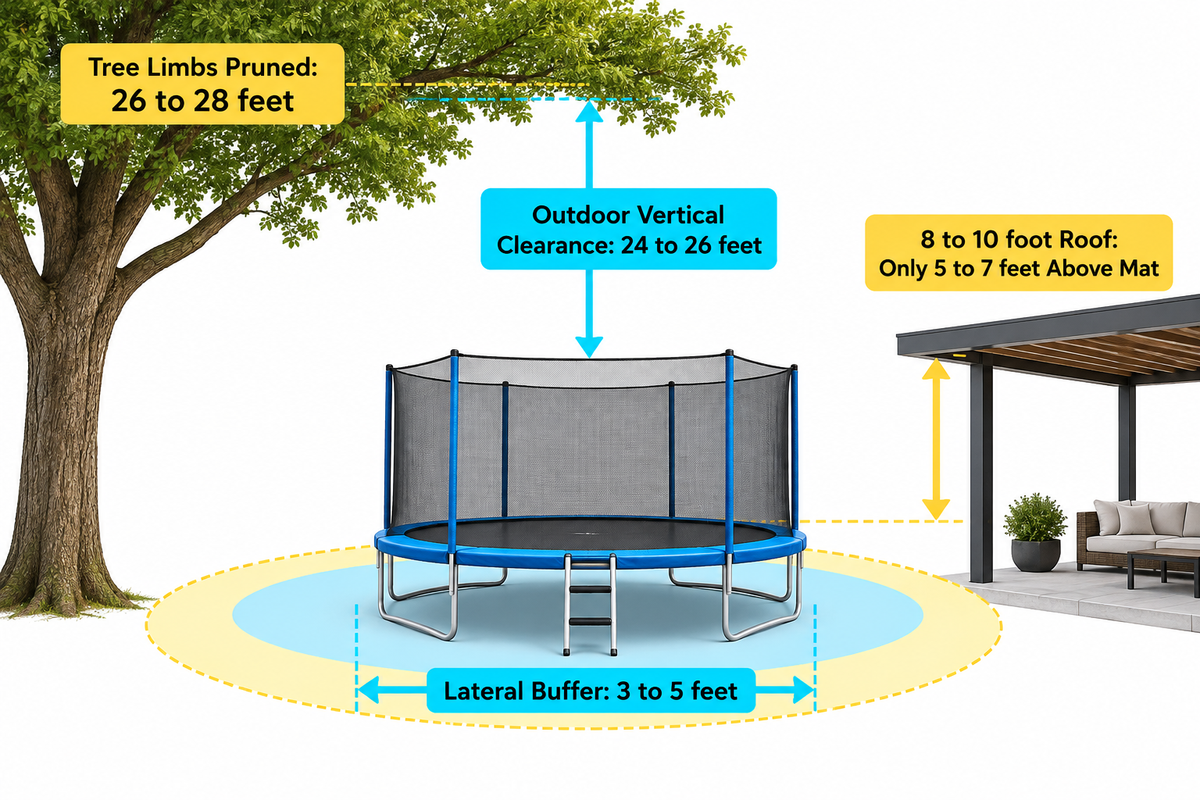
Choosing the right trampoline size for the size of your yard requires matching the frame footprint and vertical flight envelope to 24 to 26 feet (7.3 to 8.0 meters) of overhead clearance and 3 to 5 feet of perimeter ground space. Eco Adventure states 24 feet (7.3 meters) of vertical clearance from the ground. It also recommends 18 to 20 feet (5.5 to 6.1 meters) clearance directly above the jumping surface. SpaceJump’s clearance guide recommends approximately 26 feet (8 meters) of open space above the ground. Eco Adventure extends that vertical buffer to 26 to 28 feet for adults or gymnasts.
Horizontal clearance around the trampoline is just as important when you choose a trampoline. SpaceJump specifies at least 3 feet of clear ground outside the outer frame. An 8ft model needs a 14-foot circle, and a 16ft model needs a 22-foot circle. Jumpzylla’s size guide recommends 3 to 5 feet (0.9 to 1.5 meters) of lateral space around the trampoline for safety. Eco Adventure recommends 3 to 8 feet of clearance from fences, walls, and playsets.
How much overhead clearance does a trampoline need?
According to Eco Adventure and SpaceJump, an outdoor backyard trampoline needs 24 to 26 feet (7.3 to 8.0 meters) of unobstructed vertical overhead clearance measured from the ground. With a jumping mat 3 feet from the ground, the clearance from the mat to the overhead obstruction is 3 feet less than the ground-to-obstruction clearance. A room ceiling height of 8 to 9 feet is recommended for indoor mini fitness rebounders, according to Eco Adventure.
Before buying a trampoline, use this trampoline size guide to select a unit size that fits your yard while allowing clear space around and above the unit.
- Never install a backyard unit under an 8 to 10 foot patio roof or pergola — Real backyard safety comes to choosing a trampoline spot with open sky overhead. Eco Adventure notes standard residential pergolas and covered patios have roof heights between 8 to 10 feet. Placing a 3 foot frame under an 8 to 10 foot roof leaves only 5 to 7 feet above the mat.
- Enclosure nets never reduce vertical clearance. As Eco Adventure warns, enclosure nets prevent sideways falls, but their open tops do not reduce vertical clearance. A 5 to 6 foot jumper bouncing 6 to 10 feet off a 3-foot mat reaches 15 to 19 feet above the lawn.
- Measure from the outer steel frame and excavate sloped ground — When asking “what size trampoline do I need,” start by pulling a tape measure from the outer edge of the steel ring. Then add 3 to 5 feet of clearance on every side per Jumpzylla to choose the right size. In a sloped yard, Eco Adventure states you must excavate the high side, as propping legs on wood blocks is not allowed. Measure your 24 foot vertical clearance from the highest point of the ground within a 10 foot radius.
“Do not allow a child younger than 6 years old to use a trampoline.”
Finding the right size requires matching jumper age and extra play space around the yard. Using the above AAOS clinical guideline, when you consider the size for children aged 6 and older, a correct size and best trampoline size is a frame that still provides 3 to 5 feet of level grass outside the frame. Prune overhead tree limbs up to 26 to 28 feet above the ground per Eco Adventure.
Commercial Trampoline Park Ceiling Height and ASTM F2970 Clearance Rules
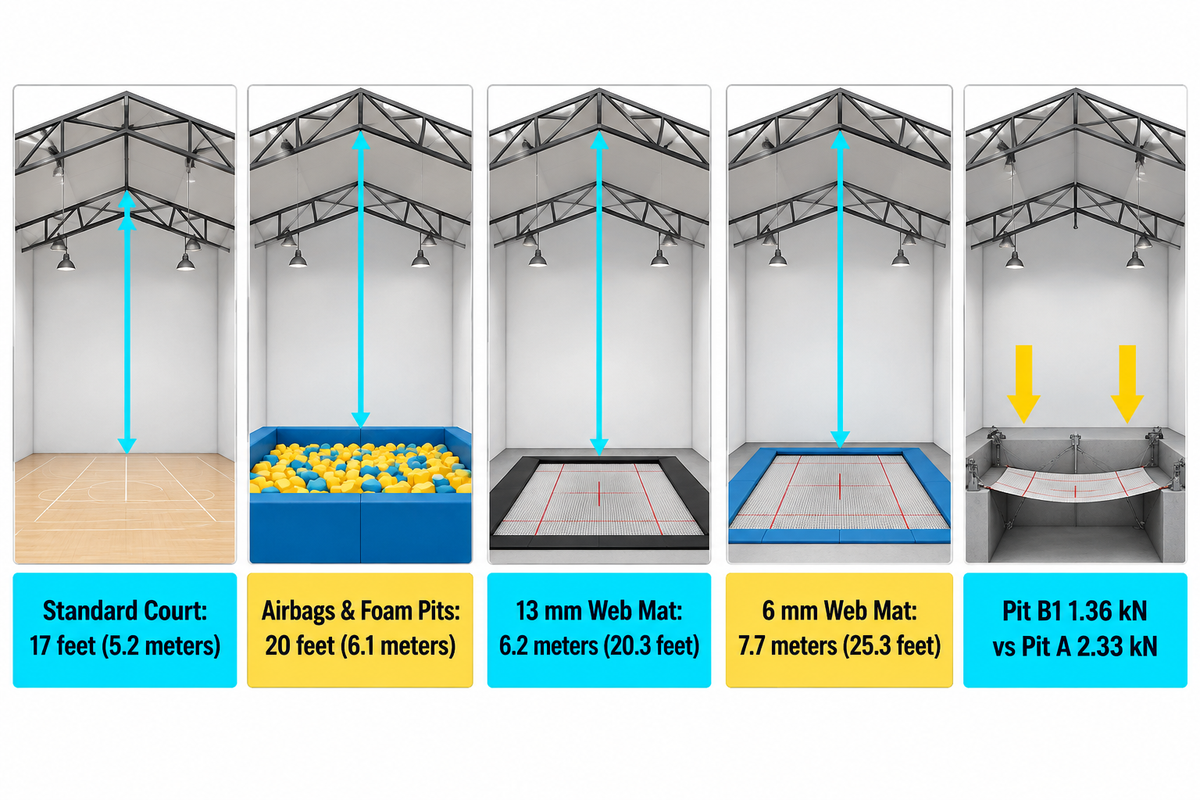
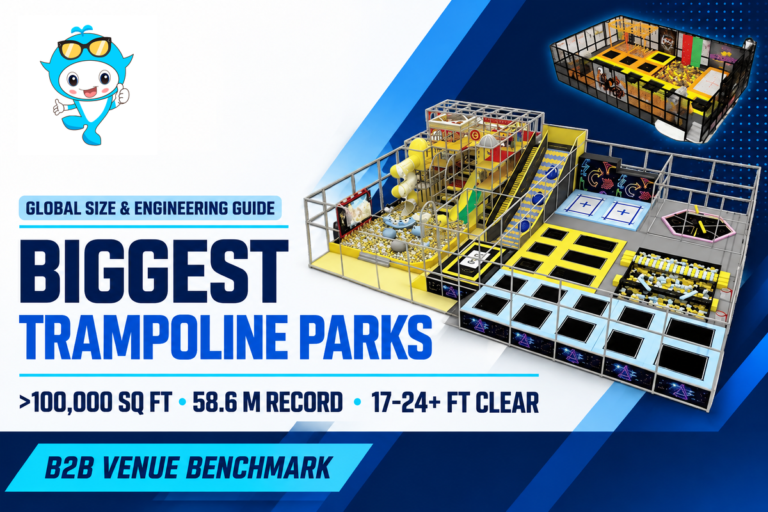
Commercial indoor trampoline parks require at least 17 feet (5.2 meters or 204 inches) of unobstructed clear height from the floor to the lowest overhead obstruction for standard courts. That benchmark comes from Trampolines Unlimited (WeBounce) and BMI Leisure’s 2026 trampoline park guide citing Soft Play and IATP guidance. Launch Entertainment cites an 18-foot minimum ceiling for its 35,000+ square foot parks. When a venue includes stunt airbags, foam pits, or performance trampolines, WeBounce states that minimum clear height rises to 20 feet (6.1 meters).
High-performance woven web mats require even taller structural bays. According to Pokiddo’s ASTM F2970 ceiling height guide, standard courts require 5.2 meters (17 feet) of clear height. High-performance zones using a 13 mm web mat require 6.2 meters (20.3 feet), and competitive zones using a 6 mm web mat require 7.7 meters (25.3 feet). Also, engineers must separate measurement datums across standards. North American facility guides citing ASTM F2970 measure from the building floor to the lowest overhead obstruction. By contrast, ISO 23659:2022 evaluates free overhead space above the horizontal jumping bed plus the elevated steel deck height. Separating younger children (younger kids) from older kids and keeping kids and teens in dedicated zones reduces collision risks when multiple kids share a venue for multiple users. Even with age zoning, trampoline injuries from falls or awkward landings can still occur. For hardware details, see our commercial trampoline park equipment guide.
| Commercial Park Zone | Zone 1: Subframe / Pit Depth (Floor to Bed) | Zone 2 & 3: Above-Bed Activity Envelope | Minimum Floor-to-Lowest-Obstruction Clear Height | Primary Overhead & Structural Constraint |
|---|---|---|---|---|
| Main Interconnected Court (Standard Poly Bed) | 3.0–3.5 ft (0.9–1.1 m) steel frame | 13.5–14.0 ft above bed | 17 ft (5.2 m) per WeBounce & Soft Play | Roof trusses, sprinkler drops, HVAC trunk ducts |
| Multi-Attraction FEC Standard Court (Launch Spec) | 3.3–3.6 ft (1.0–1.1 m) steel frame | 14.4–14.7 ft above bed | 18 ft (5.5 m) per Launch Entertainment / BMI Leisure | Continuous sightlines across 25,000–35,000 sq ft floor |
| Dodgeball & Basketball Slam-Dunk Lanes | 3.0–3.5 ft (0.9–1.1 m) frame | 13.5–15.0 ft + perimeter ball netting | 17–18 ft (5.2–5.5 m) clear under lighting rigs | Backboard support frames and top containment nets |
| Dismount Foam Pit (Suspended-Bed Design) | 4.9–5.9 ft (1.5–1.8 m) pit structure | 14.1–15.1 ft launch-to-pit arc | 20 ft (6.1 m) per WeBounce FAQ | Pit depth and podium elevation consume floor-to-truss budget |
| Stunt Airbag Dismount Zone | 4.9–5.5 ft (1.5–1.7 m) airbag & launch deck | 14.5–15.1 ft jump trajectory | 20 ft (6.1 m) per WeBounce FAQ | Blower access and overhead clearance above launch platform |
| High-Performance Court (13 mm Web Mat) | 3.9–4.6 ft (1.2–1.4 m) high-frame bed | 15.7–16.4 ft above-bed envelope | 20.3 ft (6.2 m) per Pokiddo technical spec | Requires deeper under-bed clearance to prevent bottoming out |
| Elite Performance / Wall Trampoline (6 mm Web Mat) | 4.6–5.2 ft (1.4–1.6 m) performance frame | 20.1–20.7 ft vertical flight envelope | 25.3 ft (7.7 m) per Pokiddo technical spec | High-bay warehouse shell away from low mezzanine beams |
| Dedicated Toddler Bounce & Soft Play Zone | 1.5–2.5 ft (0.45–0.75 m) low deck | 10.0–12.0 ft contained deck levels | 14.8–17 ft (4.5–5.2 m) under lower bay or mezzanine | Must be physically separated from adult high-rebound courts |
| Multi-Level Indoor Playground / Ninja Course | Modular tiered decks (1.8–2.4 m platforms) | Tiered enclosed platforms per AU2025200871B2 | 15–20 ft (4.6–6.1 m) matched to deck tier count | Top-tier enclosure poles and overhead beam clash check |
The interaction of Zone 1 and Zone 3 dimensions is further explained by biomechanical testing. The peer-reviewed research study published in the Annals of Biomedical Engineering (Whyte et al., PMC9079033) describes tests in which researchers dropped an instrumented 50th percentile adult male dummy (78 kg) head-first into three dismount foam pit constructions. Pit A had a total foam depth of 1.8 meters (a 0.4-meter base foam slab topped with 1.4 meters of foam cubes). The researchers weren’t able to achieve a 1.5-meter drop height in Pit A due to the restricted ceiling of the laboratory. From a 1.15-meter drop, Pit A generated an average peak compressive force of 2.33 kN at the neck. By comparison, 1.5-meter suspended-bed pits under 0.9 meters of foam cubes produced 1.36 kN on a trampoline bed (Pit B1) and 1.41 kN on a tight net bed (Pit B2) from a full 1.5-meter drop.
The authors stated that at least one cervical spine injury reference metric was exceeded across all tested 1.5-meter drop conditions. Even in large facilities like those covered in our guide to the biggest trampoline park in the world, loose foam depth alone is never a replacement for an engineered suspended bed. Operators must pair suspended-bed pit subframes with 20-foot clear ceiling height and strict rules prohibiting head-first diving.
Commercial Trampoline Court Cost per Square Meter and Building Height Impact
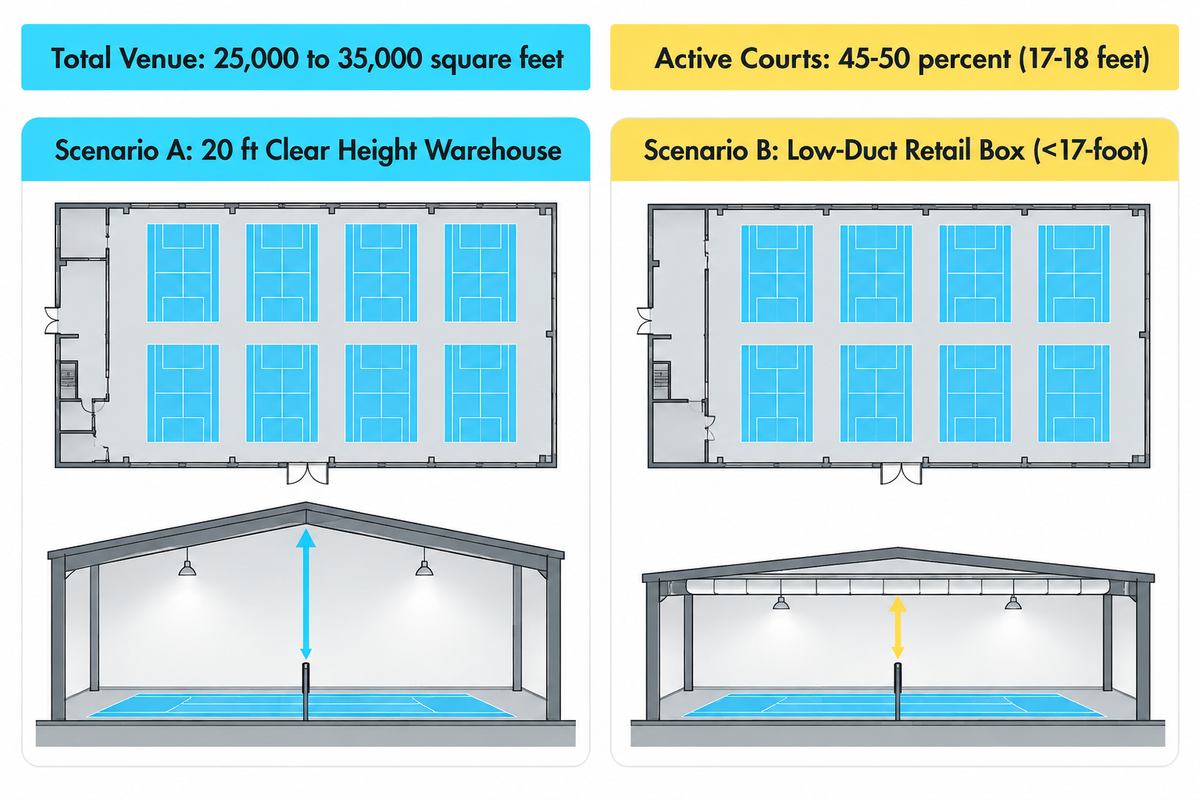
Commercial trampoline court equipment requires a custom supplier quotation based on active court area, attraction mix, and building clear height. As noted by BMI Leisure using Soft Play benchmarks, typical commercial trampoline parks range in size from 25,000 to 35,000 square feet of total floor area. Active trampoline courts take up 45-50 percent of the floor and require a minimum clear ceiling height of 17-18 feet. The remaining 50-55 percent of the building is occupied by reception, walkways, party rooms, cafes, restrooms, and mechanical rooms.
Ex-factory equipment quotes include steel subframes, springs, and pads as well as containment nets for the active court area. The quotes don’t include the cost of ocean freight, import duties, or installation crews. The quotes also don’t include the costs to modify the building to accommodate fire sprinkler systems and/or relocate HVAC ducts. Modifications to building structures, such as ductwork, to provide the 17-foot clear height (as recommended by WeBounce and Soft Play) increase the cost of the construction work.
Worked example: How does changing building clear height impact the layout of a 25,000 sq ft venue? Using BMI Leisure’s 25,000 square foot park baseline and a 50% active court ratio (12,500 square feet of active court footprint), let’s look at two candidate building shells:
- Scenario A, 20 ft Clear Height Industrial Warehouse: The building provides 20 feet of clear height under all roof trusses. That clearance meets WeBounce’s 20-foot requirement for stunt airbags, foam pits, and performance trampolines as well as the 17-foot standard court rule. The entire 12,500 square feet of active court equipment can be installed on standard above-slab steel frames without either excavating the slab or rerouting ductwork.
- Scenario B — Low-Duct Retail Box Conversion: Main HVAC trunk ducts hang below the 17-foot standard court threshold across half the floorplate. The operator has two options prior to finalizing equipment pricing. They can contract duct relocation to the perimeter bays, or re-zone the low-ceiling bay into non-trampoline soft play and toddler areas while keeping the main jumping court under the 17 to 20 foot high bay.
Compare vendor quotes or sign a lease only after a laser clear-height survey. For full startup budgets, insurance reserves, and ROI modeling, see our cost to open an adult trampoline park guide.
Custom Trampoline Court Design for Low-Ceiling Venues and Supplier Selection
Custom commercial trampoline court design adapts to height-constrained venues through 3D CAD vertical zoning. Engineers place 17 to 20 foot trampoline courts under the highest roof ridge and multi-level soft play or toddler areas under lower perimeter bays. Older industrial shells or suburban retail conversions often have a sloped roof, column grids, or mezzanines. High-performance woven web mat trampolines are designed for installation in taller structural bays. Finding a backyard trampoline that fits a narrow lawn for your family size requires the same spatial discipline. When planning a commercial trampoline for your family entertainment center, matching frame geometry to the site gives you a trampoline that will last.
Structural patents such as Patent AU2025200871B2 show how modular elevated play platforms and enclosure poles can be placed at 1.8 to 2.4 meters above the floor to align with stepped ceiling bays. Meanwhile, Playground Professionals mentions that ASTM F2970 requires field testing of impact attenuation for in-service padding materials. When commercial trampolines are built alongside commercial indoor playground equipment , every pad interface and subframe height transition must maintain tested impact attenuation.
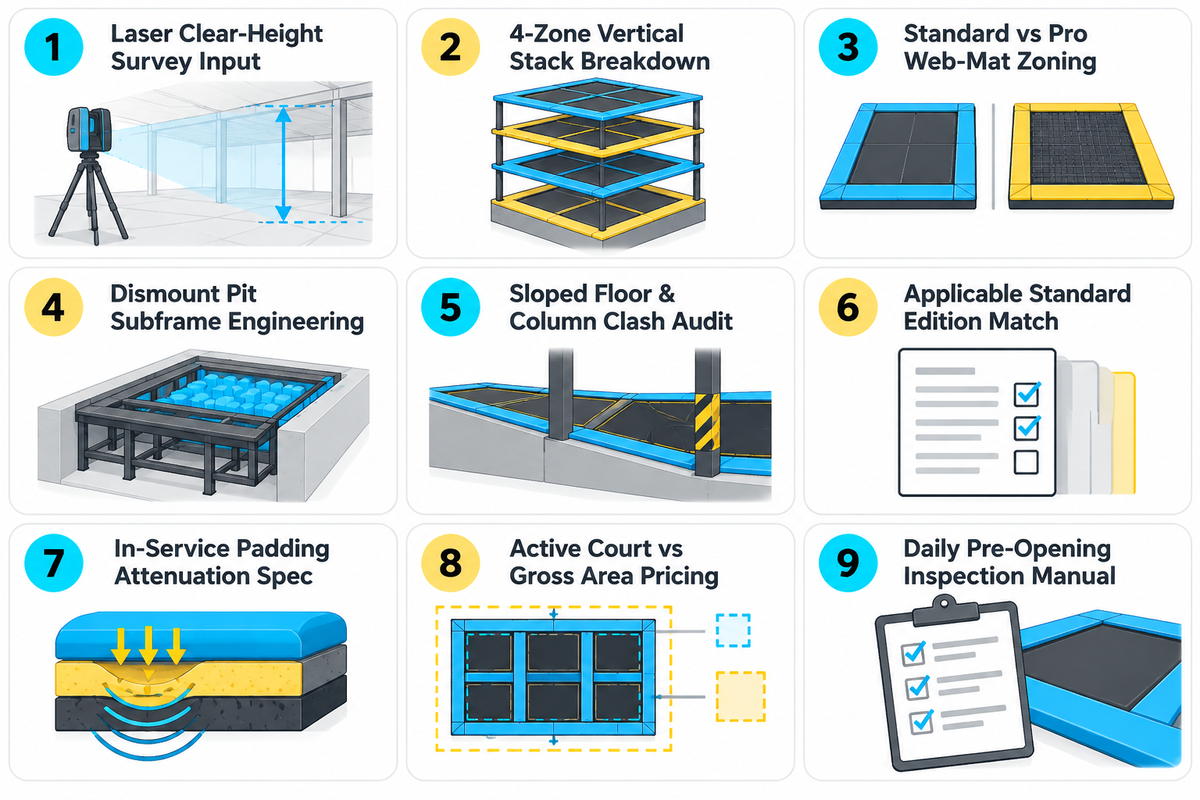
| Verification Item | Required Supplier Deliverable | Why It Protects Your Venue Budget |
|---|---|---|
| 1. Laser Clear-Height Survey Input | 3D CAD layout plotted against actual laser heights to lowest truss, duct, sprinkler, and light | Prevents ordering 20 ft attractions for a bay with low ductwork |
| 2. 4-Zone Vertical Stack Breakdown | Section drawing showing Zone 1 deck height, mat deflection space, and Zone 3 clear height | Verifies both under-mat bottoming clearance and above-bed head clearance |
| 3. Standard vs Pro Web-Mat Zoning | Separate ceiling clearance callouts for standard beds (5.2 m) vs 13 mm/6 mm web mats (6.2–7.7 m) | Stops high-rebound beds from being placed near low structural beams |
| 4. Dismount Pit Subframe Engineering | Suspended trampoline/net bed detail under foam cubes or airbag blower clearance drawing | Addresses PMC9079033 neck-load findings and avoids slab excavation surprises |
| 5. Sloped Floor & Column Clash Audit | Leveling schedule and padded column wrap clearances around structural building pillars | Ensures frame stability without unsafe shimming or exposed steel columns |
| 6. Applicable Standard Edition Match | Written compliance matrix identifying the design standard, such as ASTM F2970-25 or ISO 23659:2022, and separately identifying any state-adopted F2970 edition | Documents the design basis for regulators and insurers |
| 7. In-Service Padding Attenuation Spec | Foam density, PVC cover thickness, and ASTM F2970 field impact attenuation test reports | Confirms frame padding meets in-service impact requirements |
| 8. Active Court vs Gross Area Pricing | Itemized FOB quote separating active trampoline m² from soft play, walkways, and freight | Eliminates hidden denominator gaps when comparing multiple supplier bids |
| 9. Daily Pre-Opening Inspection Manual | Manufacturer-supplied daily and periodic inspection checklists required under ASTM F2970 | Provides the required operational checklist baseline for daily inspections |
Prior to making equipment deposits, compare your vendor shortlist to our top 15 trampoline park manufacturers list. Require every supplier to return all 9 deliverables on your measured building CAD file.
2026 Trampoline Height Standards and Hybrid Low-Ceiling Park Configurations
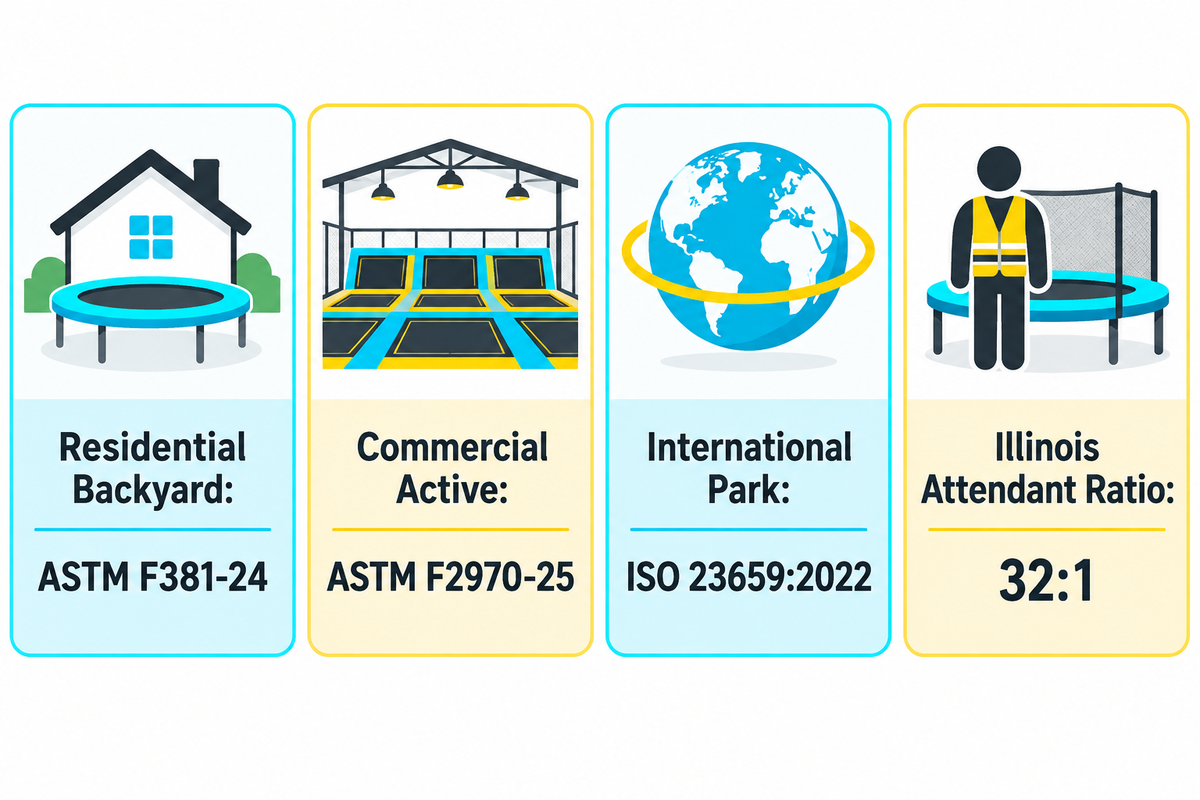
Active 2026 trampoline standards separate residential backyard units under ASTM F381-24 from commercial indoor courts under ASTM F2970-25 and ISO 23659:2022 (confirmed in 2024). Home trampolines are popular for outdoor family exercise. Round trampolines are ideal when you pick the right one and the right size for your needs under a 24 to 26 foot overhead clearance zone. To find the best trampoline or the perfect trampoline for a home lawn, verify that the frame and enclosure carry an ASTM F381-24 label.
For international commercial parks, ISO 23659:2022 was reviewed and confirmed in 2024 and remains current. For North American facilities, MaintainIQ’s ASTM F2970 compliance guide confirms that ASTM F2970-25 is the active edition. It has been revised five times since the 2013 edition, through the -15, -17, -20, -22, and -25 editions. However, MaintainIQ and Athletic Business show that US states adopting F2970 by rule each name a specific older edition. Michigan names F2970-13, Louisiana names F2970-15, Colorado names F2970-17, and Illinois and Virginia name F2970-20.
In commercial venues, trampolines are often paired with airbags from BAGJUMP and IATP member suppliers under 20-foot high bays to deliver a safe trampoline experience. MaintainIQ adds that the need for annual third-party inspections stems from state laws and insurance companies as opposed to the F2970 standard text. Daily pre-opening inspection logs document checks of courts and equipment, while Illinois mandates limit the ratio of participants to attendants and assistants to 32:1.
Frequently Asked Questions
What is the average size of a trampoline?
In SpaceJump’s family size guide, a common backyard trampoline size for families is a 12-foot or 14-foot round model. It stands 34.8 to 42 inches (2.9 to 3.5 feet) off the ground at the jumping mat and reaches 8.9 to 9.5 feet in total height with the safety net across SpaceJump and Jumpzylla models. Mini fitness rebounders measure 36 to 48 inches wide and 9 to 14 inches tall.
How high is a trampoline off the ground?
The backyard trampoline examples in this guide span 27.6 to 52.8 inches (2.3 to 4.4 feet) from ground level to the jumping mat. Smaller 8-foot frames sit closer to 27.6 to 30 inches (2.3 to 2.5 feet) high. Larger 14-foot to 16-foot frames stand 34.8 to 52.8 inches (2.9 to 4.4 feet) off the ground across SpaceJump and Jumpzylla lineups to accommodate deeper mat deflection.
Is a 15ft trampoline too big?
Using Jumpzylla’s recommended 3 to 5 feet of clearance on each side, a 15-foot trampoline occupies a clear ground diameter of 21 to 25 feet. Installation also requires level ground plus 24 feet of overhead clearance per Eco Adventure. Including its 2.9 to 4.0 foot (34.8 to 48 inch) frame and 6-foot safety enclosure, a 15-foot model stands 8.9 to 10.0 feet tall, rising above standard 6-foot privacy fences.
What age is an 8 ft trampoline good for?
An 8-foot outdoor trampoline fits children aged 6 and older who need a compact bed with a 2.3 to 2.5 foot frame height. The AAOS advises against trampoline use by children under 6 years old.
Do larger trampoline sizes bounce higher or safer than smaller ones?
In manufacturer lineups such as SpaceJump and Jumpzylla, larger 14-foot to 16-foot round trampolines and rectangular models with longer springs and wider tensioned mats can produce deeper mat deflection than compact frames under heavier jumpers. To accommodate that downward travel, manufacturers build those frames 34.8 to 52.8 inches (2.9 to 4.4 feet) above the ground. They also pair the bed with a 6-foot enclosure net to help contain sideways falls. Under-bed clearance accommodates downward mat deflection, while frame padding cushions contact with the rails.
Is a 6ft trampoline ok for a 7 year old?
A 6-foot trampoline with a 5-foot safety net fits a 7-year-old in a small yard, though SpaceJump notes many families choose a 10-foot or 12-foot model for growing room.
How much ground space does a trampoline need?
Jumpzylla recommends 3 to 5 feet of lateral clearance on every side, giving a total ground-space diameter equal to the outer frame diameter plus twice that clearance. Under that rule, a 12-foot round trampoline needs an 18-foot to 22-foot level ground zone free of fences, walls, playsets, and paving. In commercial indoor trampoline parks, layout engineers combine horizontal court buffers with a 17-foot minimum clear ceiling height for standard courts and 20 feet for stunt airbags or foam pits per WeBounce.
Need a Custom Layout for a Height-Constrained Commercial Venue?
Send your building floor plan and measured floor-to-truss ceiling heights to the Didi Land engineering team. We design custom commercial trampoline courts, soft play structures, and hybrid low-ceiling family entertainment centers tailored to ASTM F2970-25 and ISO 23659:2022 clearance zones.
Editorial & Engineering Disclosure: Written by CYH and reviewed by the Guangzhou Didi Land Amusement Equipment Co., Ltd. technical team. Referenced standard editions, biomechanical study findings (PMC9079033), and named manufacturer specifications were checked against their cited sources in November 2026. Always confirm final clearances against your specific equipment manual and local building codes, and with qualified structural engineers.
References & Sources
- ASTM International, ASTM F381-24 Standard Safety Specification for Components, Assembly, Use, and Labeling of Consumer Trampolines
- American National Standards Institute (ANSI), ASTM F2970 Institutional Trampoline Courts Overview
- International Organization for Standardization, ISO 23659:2022 Sports and Recreational Facilities: Trampoline Parks Safety Requirements (Confirmed 2024)
- American Academy of Orthopaedic Surgeons (AAOS), Trampoline Injury Prevention and Safety Guidelines
- Whyte, T. et al., Neck Loads During Head-First Entries into Trampoline Dismount Foam Pits: Considerations for Trampoline Park Safety, Annals of Biomedical Engineering (PMC9079033)
- International Adventure & Trampoline Park Association (IATP), Trampoline and Adventure Park Standards Research
- Playground Professionals, Trampoline Park Safety and ASTM F2970 Field Impact Attenuation Testing
- MaintainIQ, ASTM F2970-25 Compliance and State Edition Requirements for Trampoline Parks
- BMI Leisure, How to Start a Trampoline Park: IATP, Soft Play, and Launch Ceiling Height Benchmarks
- Eco Adventure, What Is the Minimum Height Clearance Needed Above a Trampoline?