Get in Touch with Didi Land


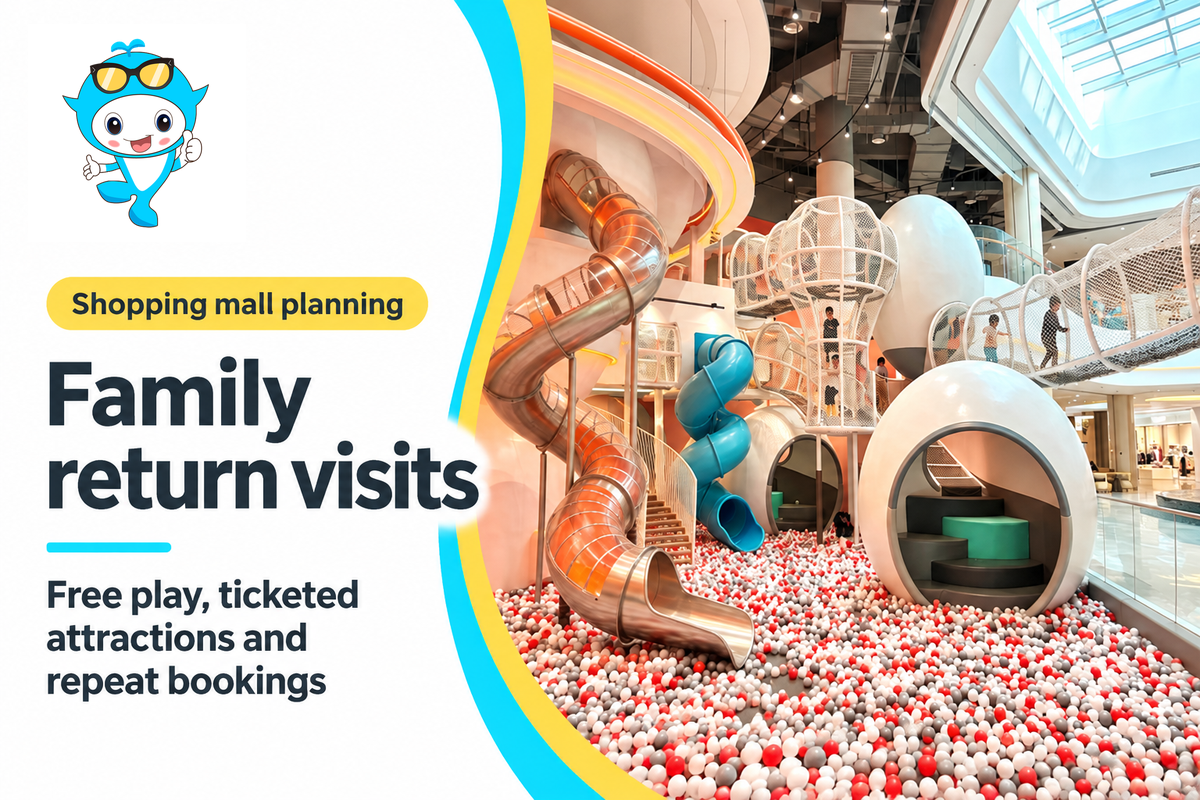
At lunchtime, a parent carrying a tray in one hand and a toddler in the other arm may appreciate ten minutes of play within sight of a table. On Saturday, they may book a birthday party and arrive before the shops open. An entertainment shopping mall’s entertaining experiences and entertainment destinations can serve both trips. Each trip may call for a different site, operator or way to count a return visit.
Start with the trip you want to serve. A ticketed venue needs an entrance and an operating plan that can support a visit of its own. If demand is uncertain, test a recurring event and count returning households before committing a unit.
Where play fits into a shopping trip
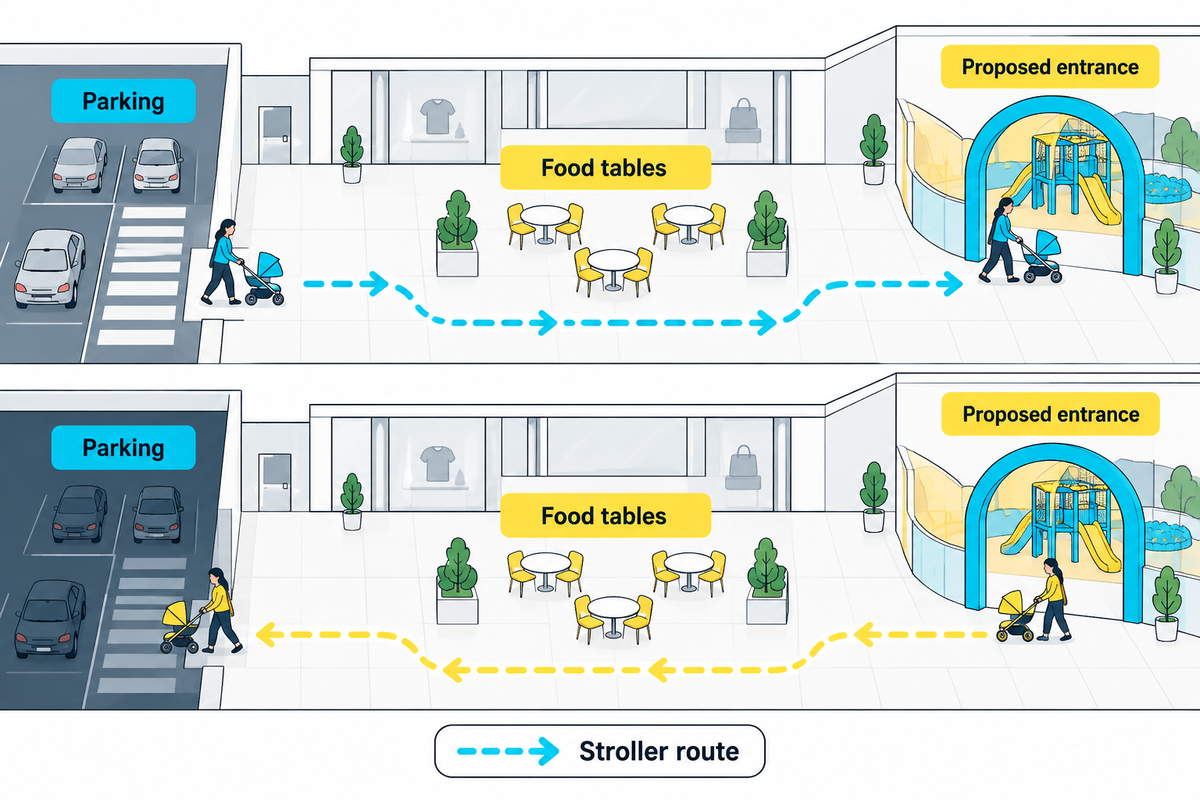
Stand at the proposed entrance at lunchtime. Where can a person carrying food see the play area? Can a second adult collect a coffee and find the group again? Walk the advertised family-friendly route to the exit with a stroller to see how well it works. The unit may look central on the leasing plan, but it could still be a detour from the lift, changing facilities and lunch tables that give a family a reason to stop there.
Families who book in advance need to know which entrance opens first, how far it is from parking and where to queue. For example, the visitor directions for SEA LIFE at Mall of America identify the East Ramp as the closest parking and point stroller users to the elevator and the east entrance on Level 1. A free activity near a shop may also draw families who had no booking. If a customer says “lunch, the chemist and the kids wanted to play,” document each reason for the trip.
Walk the route a second time in the evening. Even if an indoor shopping center features several dining options, it may have few places for a family to sit together after the shops close. If a nearby eatery or boutique draws a queue, ask its manager when the queue reaches the walkway. These observations tell the leasing team more about the shopping experience than the advertised floor area in square feet, whether the unit faces an indoor corridor or a town square.
Free food-court play or a ticketed playground?
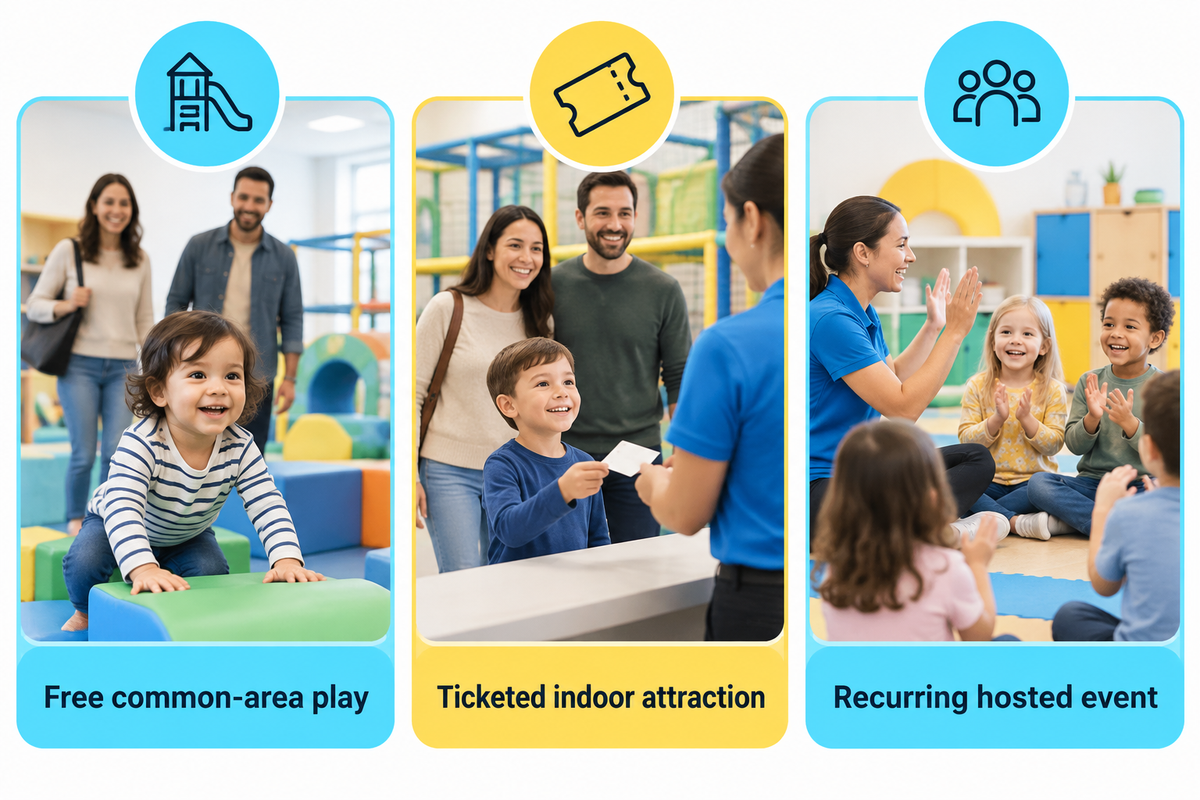
While the leasing and operations teams can still change the brief, choose free food-court play for families already visiting the mall or a ticketed playground for families who come specifically to play. In a free area, the shopping center may pay for cleaning, repairs and seats, while surrounding food tenants collect the sales revenue. At a ticketed playground, the attraction operator may hold admissions data while the landlord may have only corridor counts. Before the first trading day, agree what data each party will share.
| Format | What the family does | What the operator can observe | First site check |
|---|---|---|---|
| Free common-area play | Stops between errands or after lunch | Use by time of day, occupied seats, closures | Look from the tables toward the entry and exit |
| Ticketed indoor attraction | Books a session, buys entry or attends a party | Admissions, repeat bookings and unused slots | Trace the party queue without blocking shopfronts |
| Recurring hosted event | Returns for a specific activity on a published date | Repeat registrations, attendance and walk-ins | Test setup, pack-down and storage on a trading day |
Holding a recurring event is a decision the leasing team can reverse. Try the activity in the same spot on comparable days. Write down how many families planned a trip around the activity. Who was already shopping? If a popular event takes a large crew to set up each week, factor in that crew when comparing it to a permanent fixture.
A small town center can also test the same question as one of the largest shopping malls. Would the entire family travel here for this activity on a quiet evening? A live music event on the same day may encourage shoppers to linger. Record it separately when comparing play sessions. For a larger anchor, check the site and budget checks for a theme park before assuming that a vacant retail unit will fit. For an indoor amusement park, ask what the operator knows about families’ visits to stores and restaurants after a booked session.
Can one caregiver see both play zones?
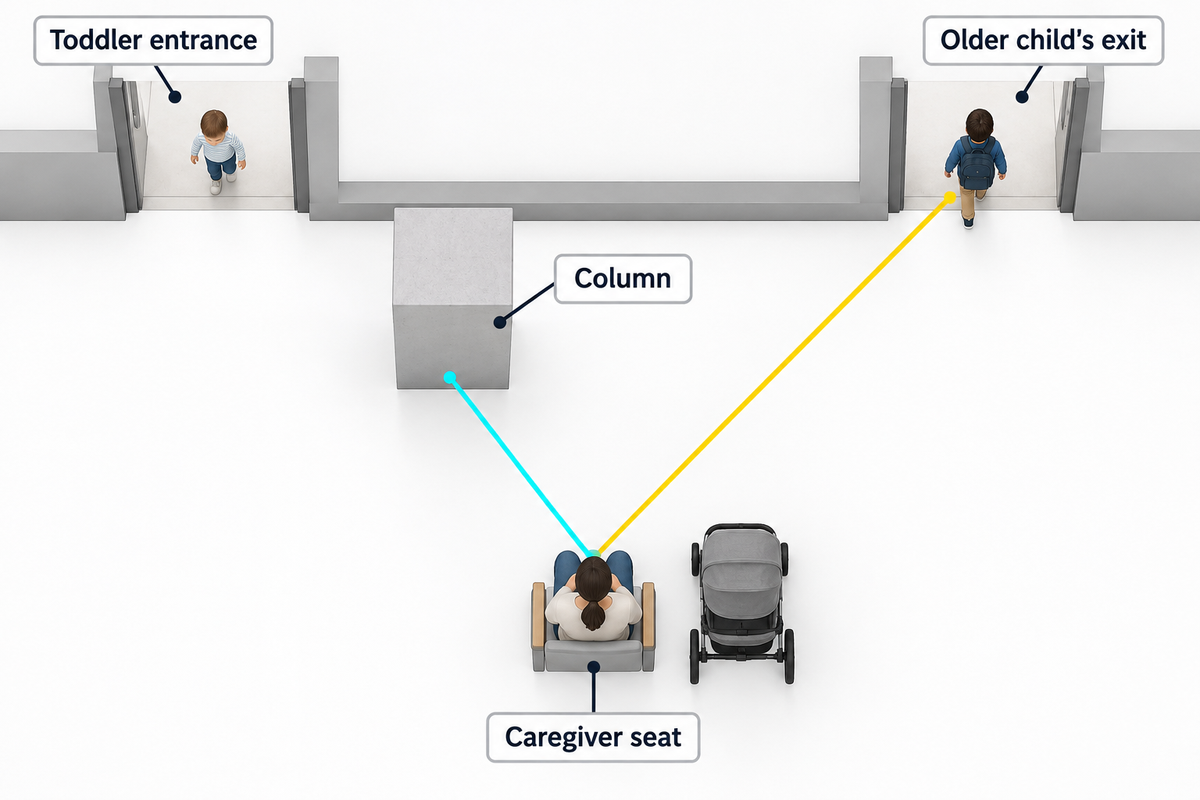
A caregiver in the proposed seat needs a clear view of both the toddler entrance and the older child’s exit, which two colleagues can test by having one sit there while the other stands at each point in turn. Mark where a column, graphic panel, or queue line obstructs the view. Repeat with the stroller parked where a guest would naturally leave it. To mark the view from each table for a seating plan with café seating, use Didi Land’s Seating Sightlines guide. A second age zone loses much of its value if an adult has to abandon the first child’s exit to reach the second.
Put a destination at the end of the accessible route. Can a child reach a play activity, and can the family regroup afterward? For a play table on an accessible route in the United States, ask the supplier to show knee clearance of at least 24 inches high, 30 inches wide and 17 inches deep on the drawing. A table designed primarily for children five and younger may instead have a parallel approach, and the rim of any accessible play table must be no more than 31 inches (785 mm) high. In the United States, the Access Board’s guide distinguishes open play components from the entry points to a soft contained play structure. Didi Land’s guide to indoor soft play equipment illustrates layouts. Give the actual layout and equipment description to the project designer for an applicability check. U.S. Access Board play-area guide.
Can the space handle queues and cleaning?
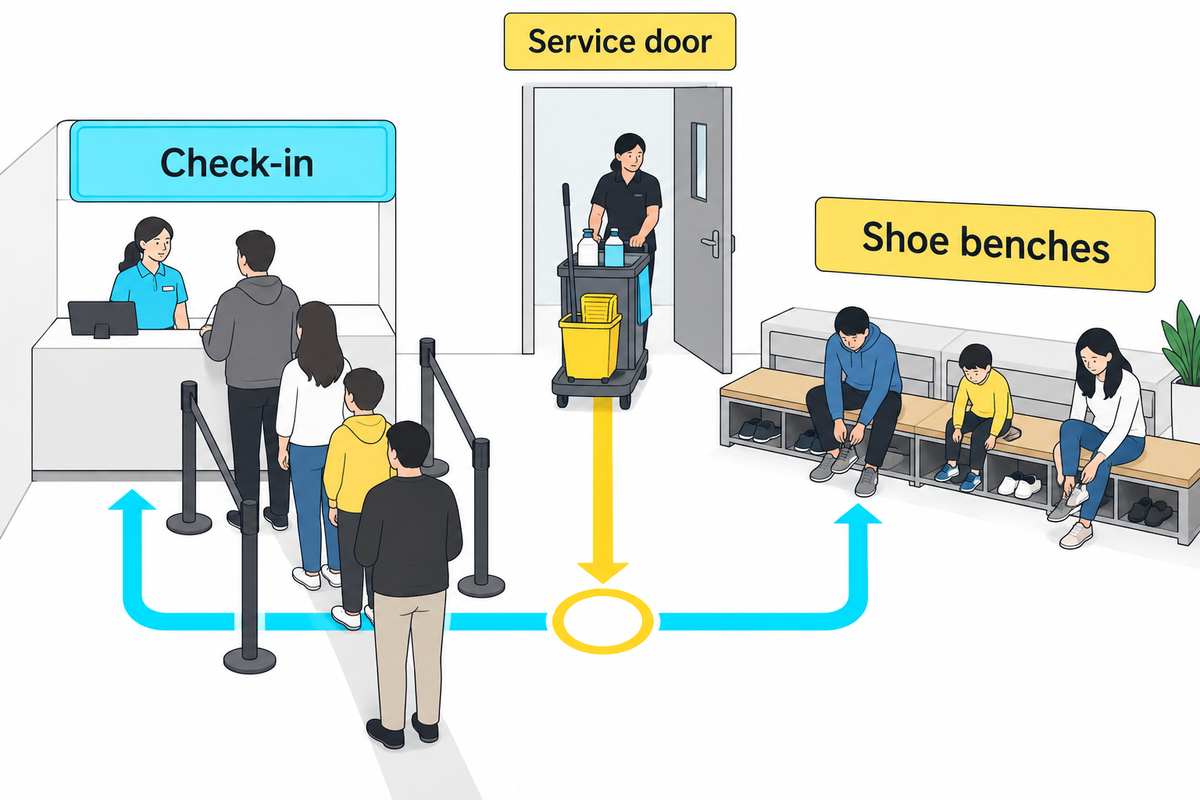
During a Saturday changeover, the cleaner needs room to get the cart through while one group checks in and the previous group uses the shoe benches. On the drawing, place an arriving birthday group at check-in, the previous group at the shoe benches and a cleaner with a cart at the service door. Show where the arriving group, the previous group and the cleaner might meet. It’s less costly to specify moving the shoe benches than it would be to redesign a fitted entrance.
Design paths so the ground-level accessible route through the play area remains clear. For a U.S. play area with a standard 60-inch ground-level accessible route, the Access Board illustrates 80 inches of vertical clearance along that route. Its guide also explains narrower routes for certain small play areas and short restrictions. In a play area under 1,000 square feet (93 m²), a ground-level route may be 44 inches (1,120 mm) wide if a compliant turning space is provided wherever the restricted route exceeds 30 feet. For a short pinch point, section 1008.2.4.1 allows a minimum width of 36 inches for up to 60 inches of travel. If there are two such pinch points, the clear segment between them must be at least 60 inches wide and 60 inches long. Have the designer determine which provisions apply to the case at hand. For a common-area installation, name who closes it after a spill and who authorizes reopening. Designate storage for barriers and replacement parts so the opening shift can find the barrier, key and contact number. For a ticketed venue, have the attraction manager plan a route that allows a technician to reach worn parts while neighboring retailers stay open.
If the tenant proposes a trampoline park, bring the operator’s maintenance schedule and review the pads and activity zones that staff will have to reach. An open-air site requires a plan for queuing during wet weather. In a renovation, the easiest route to the service lift might go through an occupied retailer’s delivery bay. Ask that retailer to walk the route before signing off. For dining and entertainment that share a lobby, show where children and adults can wait together and leave space for customers who are passing through.
Who pays to convert a vacant unit?
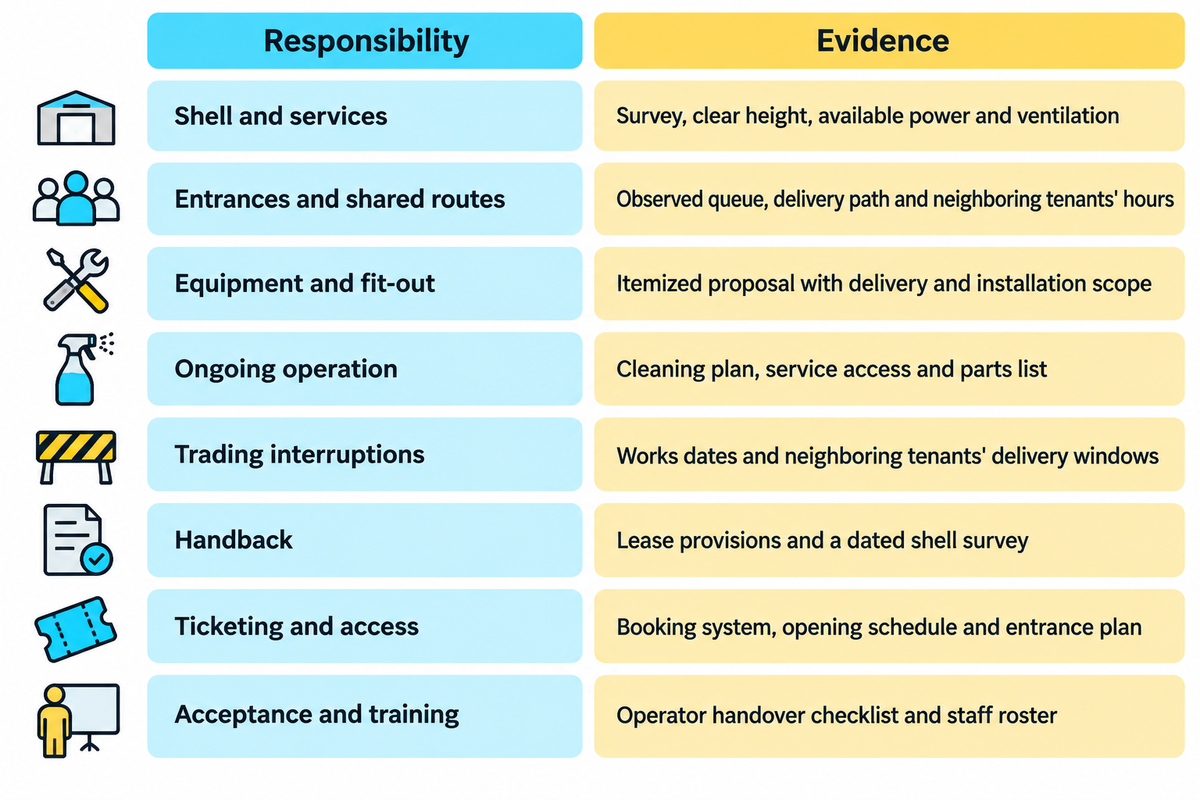
Then ask the operator what a complete, tradable venue requires. Ask the owner what they will provide at handover. For a comparison of installation and lease models, see Didi Land’s guide to indoor playgrounds in shopping malls. Write both descriptions alongside the drawings and highlight the gaps for each line. Dave & Buster’s publicly files quarterly reports that cite landlord reimbursements for tenant improvements. These arrangements exist, so check whether the specifics are described in your work letter. Dave & Buster’s quarterly filing.
| Item | Evidence to bring | Decision to record |
|---|---|---|
| Shell and services | Survey, clear height, available power and ventilation | Who designs, pays for and signs off each upgrade? |
| Entrances and shared routes | Observed queue, delivery path and neighboring tenants’ hours | Who approves changes outside the lease line? |
| Equipment and fit-out | Itemized proposal with delivery and installation scope | What is supplied, what is excluded and who accepts the work? |
| Ongoing operation | Cleaning plan, service access and parts list | Who responds to downtime and funds repairs? |
| Trading interruptions | Works dates and neighboring tenants’ delivery windows | When may the installer occupy the service corridor? |
| Handback | Lease provisions and a dated shell survey | Who removes the equipment and reinstates the floor? |
| Ticketing and access | Booking system, opening schedule and entrance plan | Who will open the mall entrance for an early party? |
| Acceptance and training | Operator handover checklist and staff roster | Who signs for the installation and trains the first shift? |
Who actually operates a mall attraction?
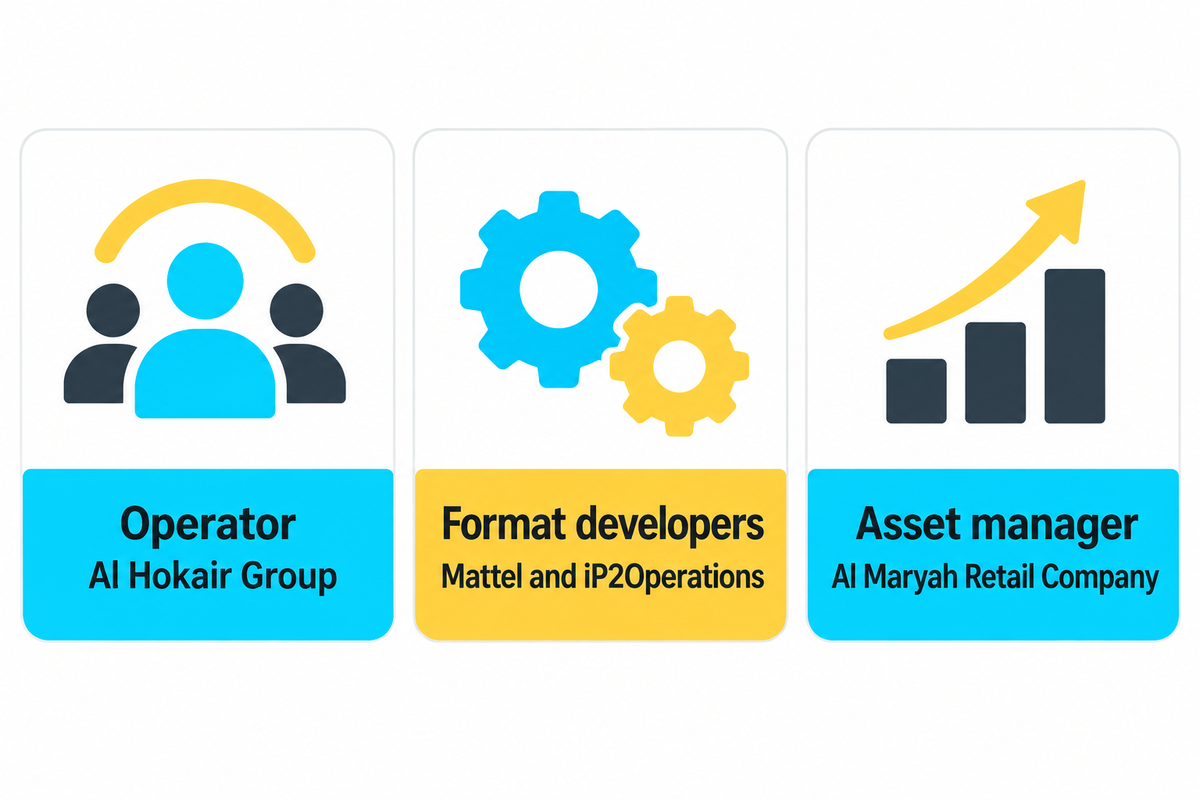
The Galleria’s May 2024 opening announcement names Al Hokair Group as the operator of Mission: Play! By Mattel. Mattel and iP2Operations developed the format. Al Hokair Group was named operator under a lease with Al Maryah Retail Company, the asset manager. The venue covers over 4,000 square meters and has space for birthday parties, a café and retail. Knowing those roles helps the leasing manager decide whom to contact about trading hours or the birthday party queue. The Galleria’s opening announcement.
A leasing team using Reem Mall as a comparable should put both dates on its chart. Agility dates Reem Mall’s soft opening to 2023 and its formal grand opening to 2024. In 2023, families could visit the mall’s indoor snow park, which covers more than 9,700 square meters. Agility’s Reem Mall history.
How can a mall measure family return visits?
Establish what you consider a return before the study starts. A second visit to the attraction by the same booking holder is recorded as a return at check-in. A return to the property is defined as an opt-in mall visit recorded on a different day. A visitor who bought two tickets for siblings on the first day has made one family trip. Placer.ai’s glossary also differentiates visits and unique visitors and explains how its device panel is used. Placer.ai metric definitions
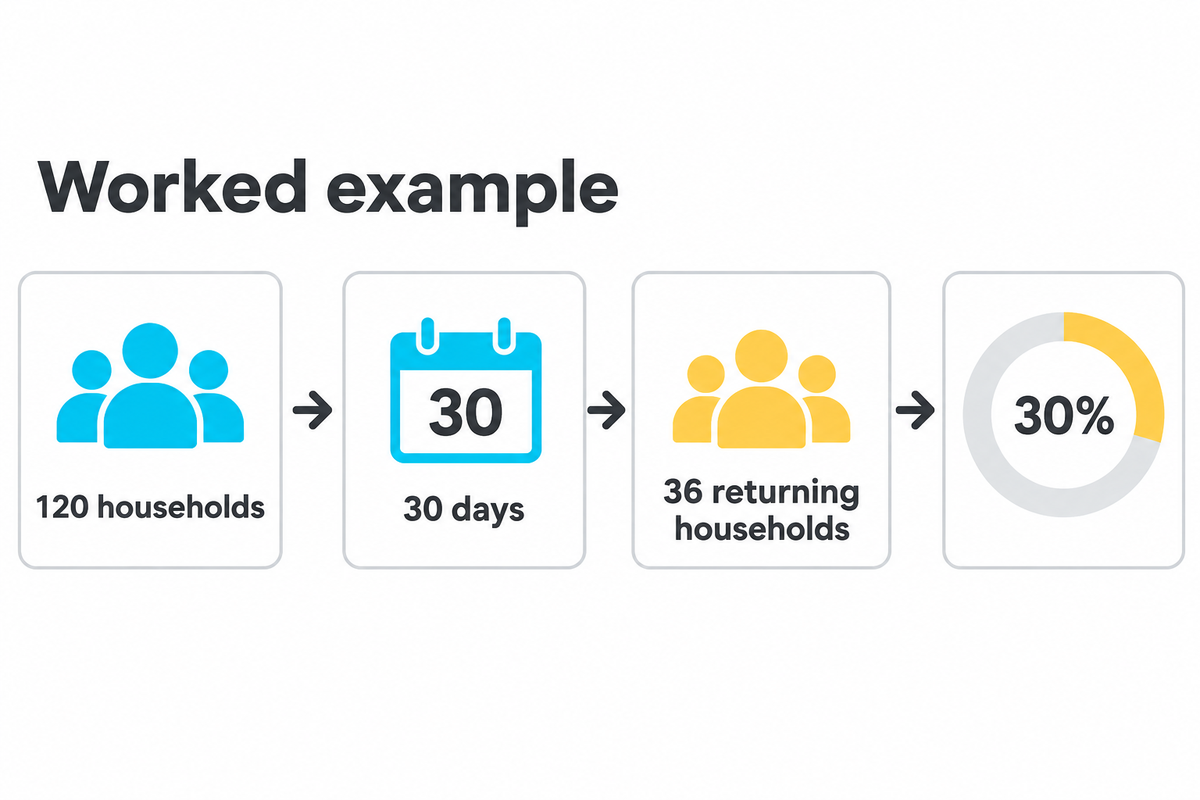
Worked example. Suppose 120 participating households make a first visit and all have 30 days in which to return. If 36 households return within the window, their share of the 120 participating households is 30%. A household that joined on the last day before the report is generated hasn’t had the same chance to return and should be put in a different time group. Keep the number of families who opted in beside the rate so staff can see how large the group was.
Consider equivalent trading periods and note school holidays, changes to opening hours and concurrent offers. The University of Iowa reports that a study of foot traffic at 25 Chinese malls in 2017 and 2018 found that malls spent too much of their marketing budgets during peak periods. The researchers measured mall traffic, which on its own cannot tell an operator which families returned to an attraction. For a new attraction, one possible approach is to repeat the study during ordinary trading weeks and ask repeat visitors what brought them back. University of Iowa study summary.
For the next leasing review, keep foot traffic, dwell time, ticket revenue and repeat bookings on separate lines. A longer stay can reflect a slower lunch service. A spike in foot traffic can occur with the opening of a new anchor. Gross leasable area describes space and can’t tell you how many people found the playground entrance. These distinctions help the leasing team ask a specific follow-up question when shopping and entertainment figures move together.
What to take to the leasing meeting
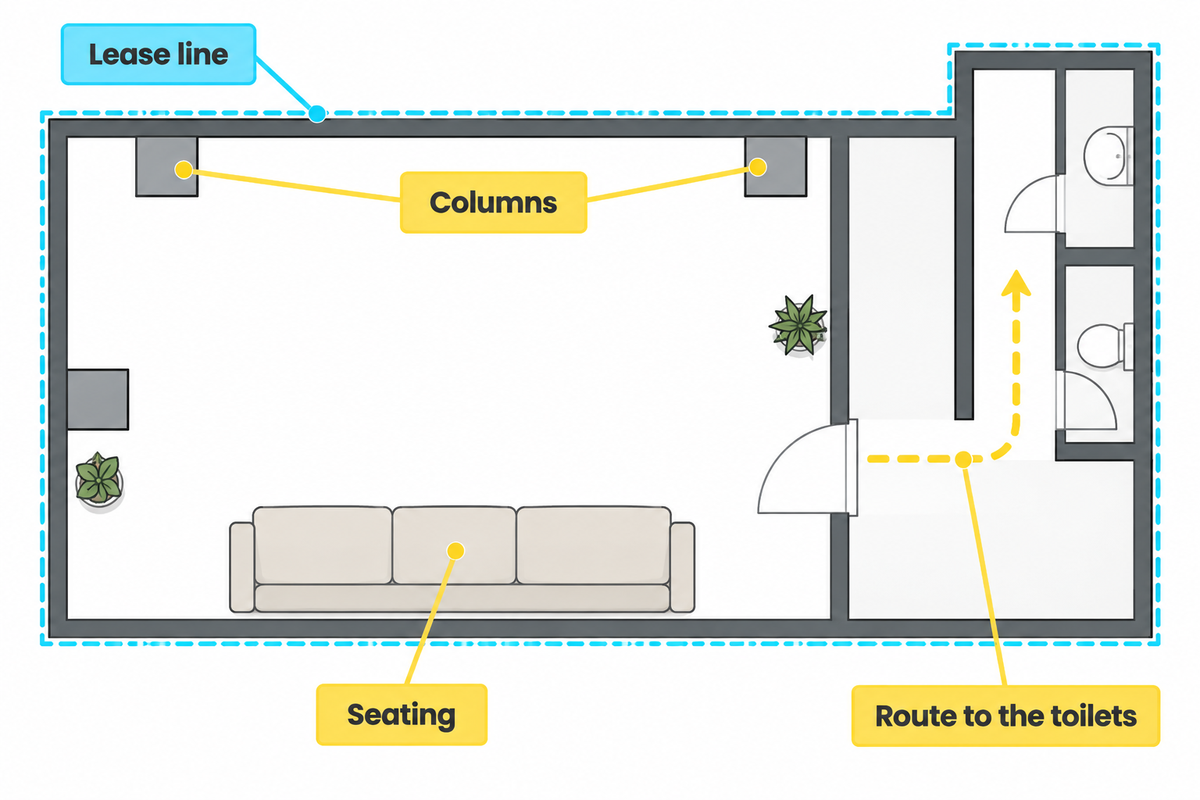
Your plan should include the lease line, columns, doors, lowest overhead obstruction, seating, and route to the toilets. Indicate observed busy hours, the age groups the venue will serve and a named operations contact. Mark up the plan together before asking a supplier to price it. Compare the two quotes line by line. Ask the supplier to add installation costs to any quote that omits them and revise any plan that shows clear floor space where a column stands.
Didi Land’s mall planning page provides an example of a food court adjacent space of 80-200 square meters with a mix of toddler, sand and sensory play. The other example, adjacent to an anchor, serves a different trip and uses a different mix. Didi Land gives an example range of 250–600 m² for an anchor-adjacent bay with climbing and obstacle play, and 500–1,500 m² for a standalone pavilion aimed at party bookings. Ask for a plan that shows how much of the leased area remains for seating, storage and circulation once the equipment is drawn. Use these examples as a starting point to have a site-specific discussion. Compare shopping mall playground configurations.
Frequently asked questions
What do people do in a mall?
Shopping and eating can share a trip with activities that take very different amounts of time. A child may stop to play while a sibling finishes lunch, or the whole family may plan an afternoon around a booked attraction. Ask arriving families what brought them in today. A door counter can record the entry, but it can’t tell you which of those trips just began.
How do you test a free play area before committing space?
Ask the operations team to mark out the proposed footprint and caregiver seats during a normal lunch shift. Observe where a family would leave a stroller and whether a queue would cross the route to the restrooms. If the space passes that test, a supervised temporary activity can help you observe use at several times of day before you commit to a permanent fit-out.
How can a mall tell whether a playground brings families back?
Choose an observation window and invite families to use the same voluntary identifier when they visit again. Include only households whose full observation window has ended. Divide the number of returning households in that group by the total number of households in the same group. Compare equivalent weeks and note changes in mall hours, school breaks and other promotions. A general entrance counter can’t answer that question.
Who should approve the drawings?
The drawing reviewers named by the landlord and attraction operator should sign off on the drawings by the agreed dates. Record outstanding questions for the relevant local reviewers before either party places an equipment order.