Get in Touch with Didi Land


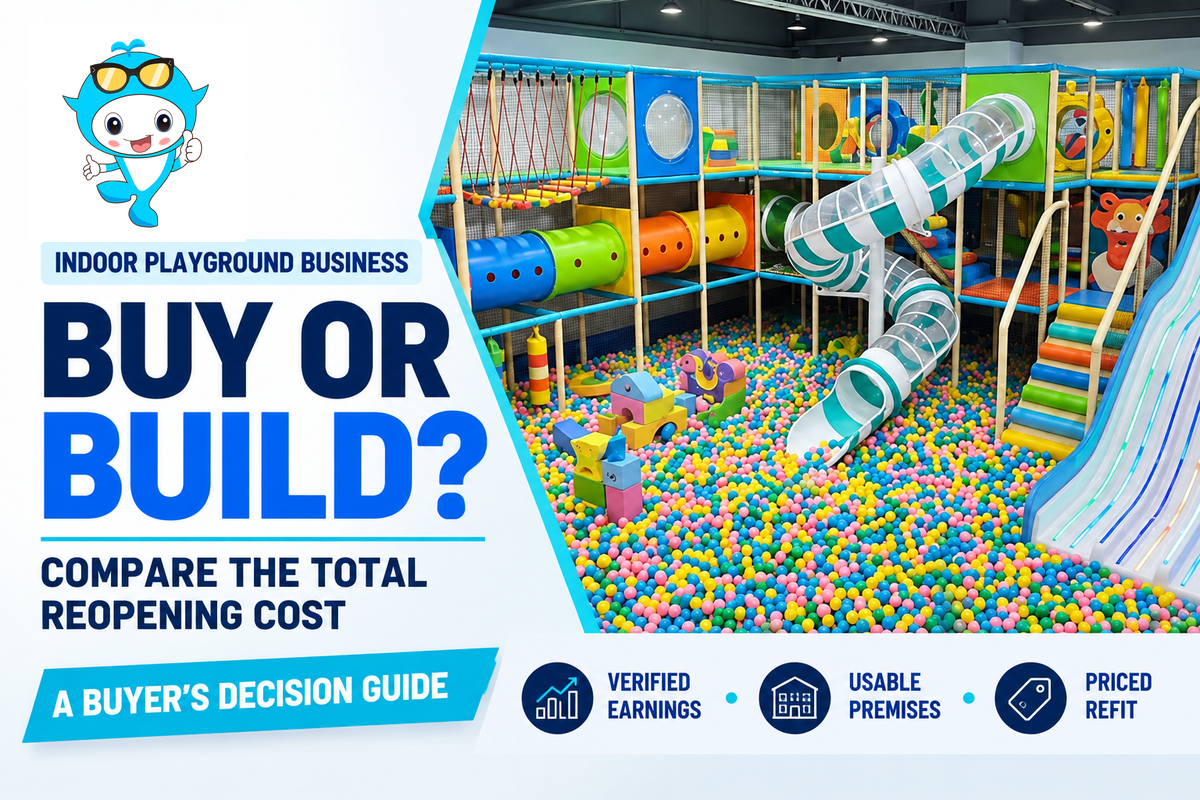
Buying an indoor playground business vs starting new is more about inheriting an operation vs creating one. An acquisition may justify a premium if the seller can verify trade results that support the total purchase and reopening cost under your ownership, the premises are usable, and the equipment has a priced repair plan. Starting over, you control the concept and indoor play area, but you still need to fund construction and attract customers for a brick-and-mortar business before you can establish a trading history.
Buying an indoor playground business vs starting new depends on verified earnings, usable premises and total reopening cash. Buy a sound operation with a defined refit; build new when the inherited layout or obligations would defeat the intended business model.
Decision essentials
- An operating play center can still require substantial work before the buyer can trade.
- Seller earnings must reflect the cost of replacing the owner’s work.
- Purchase price, equipment cost and cash needed to reopen have different boundaries.
- This comparison assumes leased premises in the United States; buying the building is a separate decision.
Buying an indoor playground business vs starting new: which risks change?
An established indoor playground provides the buyer with records, relationships and an installed layout to review. A startup offers design flexibility to create a new customer value proposition. Neither removes risk of execution. The useful comparison is how much of the existing operation will continue to work for the buyer.
The U.S. Small Business Administration’s acquisition guidance notes that an established customer base, known costs and trained employees can provide an edge. Those elements retain their value if they survive the sale. A profitable indoor playground whose owner personally runs every party presents a different business opportunity from one in which the management team is retained.
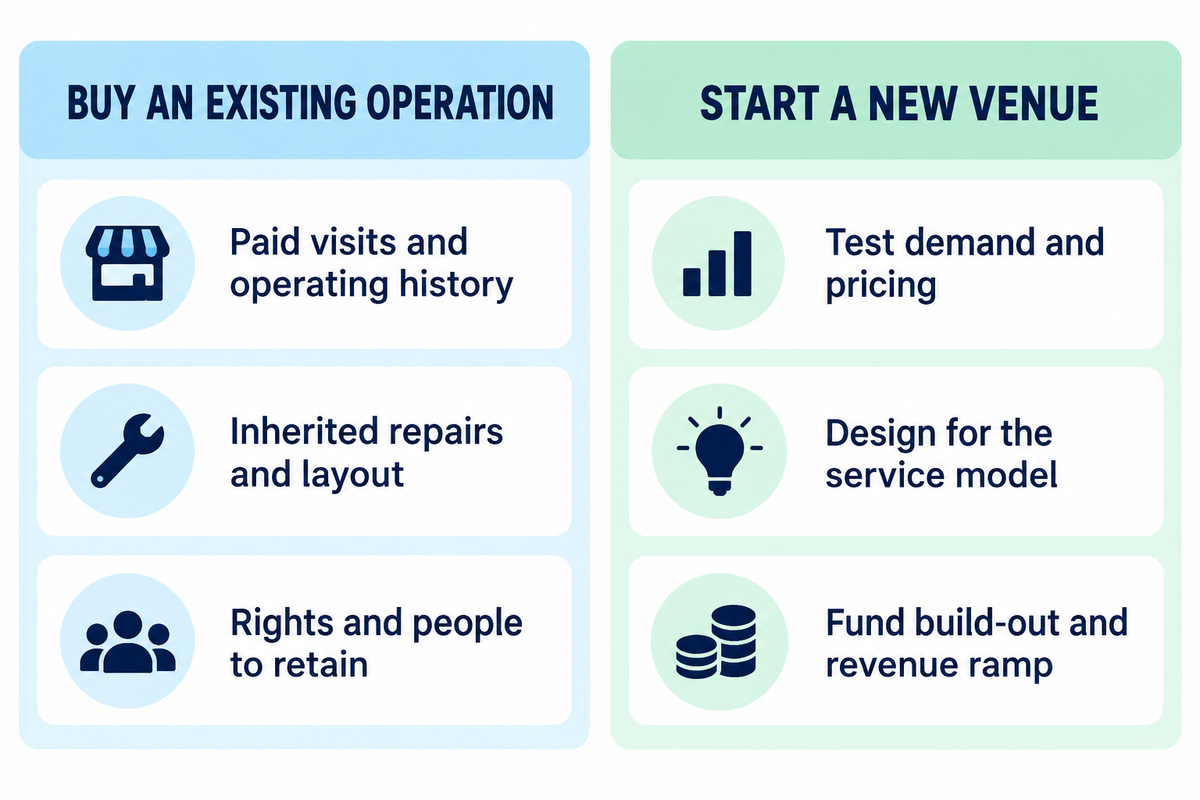
Buy an existing operation
- Examine paid visits, repeat customers and operating history.
- Price inherited repairs and changes to the layout.
- Secure the rights and people needed to keep trading.
Start an indoor playground
- Test demand and pricing before committing to a site.
- Design the play areas around the intended service model.
- Fund the build-out and the opening revenue ramp.
Existing infrastructure can save time. It can also lock the buyer into poor circulation, restricted party space or expensive building systems. In Michele Caruana’s February 2026 interview account, Kaylinn’s acquisition of Monkey Around led to operational and structural problems, closure and a rethink of the model. That individual account illustrates why a completed fit-out deserves inspection rather than an automatic premium.
Ownership model is separate: Either model can involve an acquisition or a new opening. Refer to the franchise versus independent comparison for brand fees and operating control. For this choice, consider what changes hands.
Verify the seller’s earnings before discussing a multiple
Value the trading business based on earnings that can continue to be earned under your ownership. Revenue alone doesn’t account for staffing, rent, repairs and maintenance. A seller’s summary may reflect net income, adjusted earnings, or seller’s discretionary earnings. Each of these starts with a different base. The figure advertised requires reconciliation to the accounting records.
| Record | Comparison | Decision it changes |
|---|---|---|
| Monthly income statements and tax returns | Sales, costs and adjustments across matching periods | Whether the headline profit has a consistent basis |
| Point-of-sale and payment-processor exports | Transactions, refunds, fees and bank settlements | Whether reported turnover reconciles to paid trade |
| Party bookings and membership records | Paid deposits, attendance, cancellations and unfulfilled services | What work and cash remain after closing |
| Payroll, rosters and owner’s duties | Paid staffing against work performed by the seller | Cost of replacing management and operating labour |
| Maintenance invoices and equipment history | Recurring care, deferred work and one-off repairs | Whether expenses were postponed to improve reported profit |
Does it have decent cash flow?
Good cash flow means the acquired business will be able to meet its ongoing operating requirements with your staffing and financing plan. The figure the seller calls profit is not the same as cash flow. Reconcile the records, account for replacing the departing owner’s work, and consider ongoing maintenance and capital expenditures before considering debt payments and taxes. Good sales on the weekend can occur with a cash shortfall during weekdays.
BizBuySell’s explanation of discretionary-earnings adjustments, for example, makes a market-rate salary deduction when an owner-operator is to be replaced. It also identifies true one-time costs. An expense doesn’t become an add-back just because the seller says it’s an add-back.
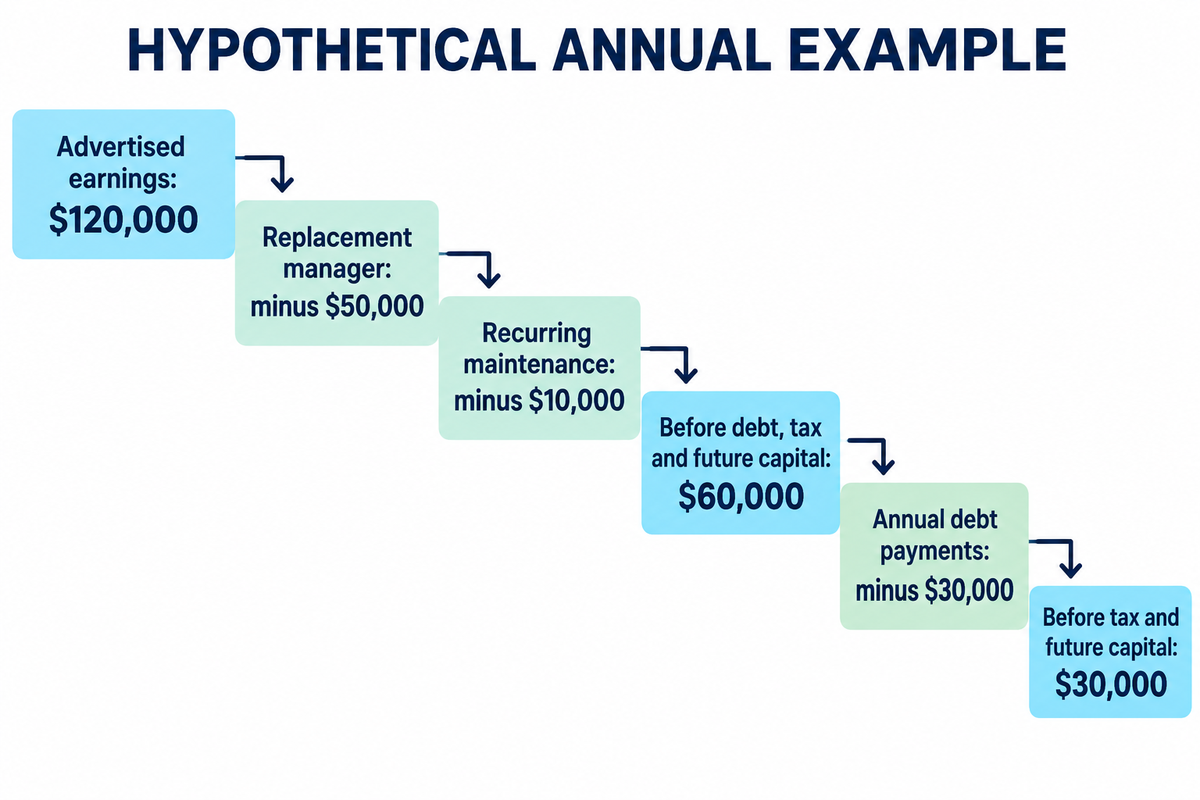
Example: advertised discretionary earnings of $120,000 per year, less $50,000 for a replacement manager and $10,000 of recurring maintenance omitted from the calculation, leave $60,000 before acquisition debt, tax and future capital expenditure. Annual debt payments of $30,000 would leave $30,000 before those remaining items. An owner-operated purchase may have a different labour arrangement, but the work still needs doing.
A valuation multiple belongs after this adjustment, along with the remaining lease term, condition of equipment, and comparable transactions. Paying twice for the seller’s unpaid labor is costly for playground owners: once in the purchase price, and a second time through replacement payroll.
Compare cash to reopening, not just the purchase price
Compare the total funded cash required to reach the same operating point. For an acquisition this includes the agreement price and work required to re-open. For a new indoor playground project this includes equipment, premises and work required to open, and an operating reserve. Both budgets also need operating reserves. For both, financing changes who supplies the cash and when repayments fall due.
6-Line Close-to-Reopen Cash Bridge
A six line budget aligns acquisition and new build cash requirements, before testing the effect of additional refurbishment and delay.
The startup-cost method of the Small Business Administration separates one-time costs from monthly costs. Extend this to an acquisition to account for undisclosed ongoing costs. Use a broader breakdown of indoor playground equipment and installation costs to identify physical work packages.
| Cash requirement | Buy and refit | Start new | What is included |
|---|---|---|---|
| 1. Business or installed base | $250,000 | $270,000 | Acquisition price after agreed closing adjustments; new route assumes $150,000 equipment plus $120,000 build-out |
| 2. Professional fees and transaction allowance | $15,000 | $15,000 | Assumed legal, accounting, permit and applicable transaction-charge allowance |
| 3. Additional refurbishment | $50,000 | $0 | Acquisition repair scope; new works already included in line 1 |
| 4. Refundable premises deposit | $20,000 | $20,000 | Cash tied up with the landlord |
| 5. Pre-opening and transition spending | $20,000 | $50,000 | Assumed rent, payroll, launch and system-transition spending before reopening |
| 6. Unspent operating reserve | $45,000 | $45,000 | Cash retained for the operating ramp, separate from spent costs |
| Base cash required | $400,000 | $400,000 | Same funding boundary; no property purchase |
| Adverse case: extra refit plus delay | +$60,000 | $0 added in this test | $50,000 extra work plus 1 month at $10,000 carrying cost |
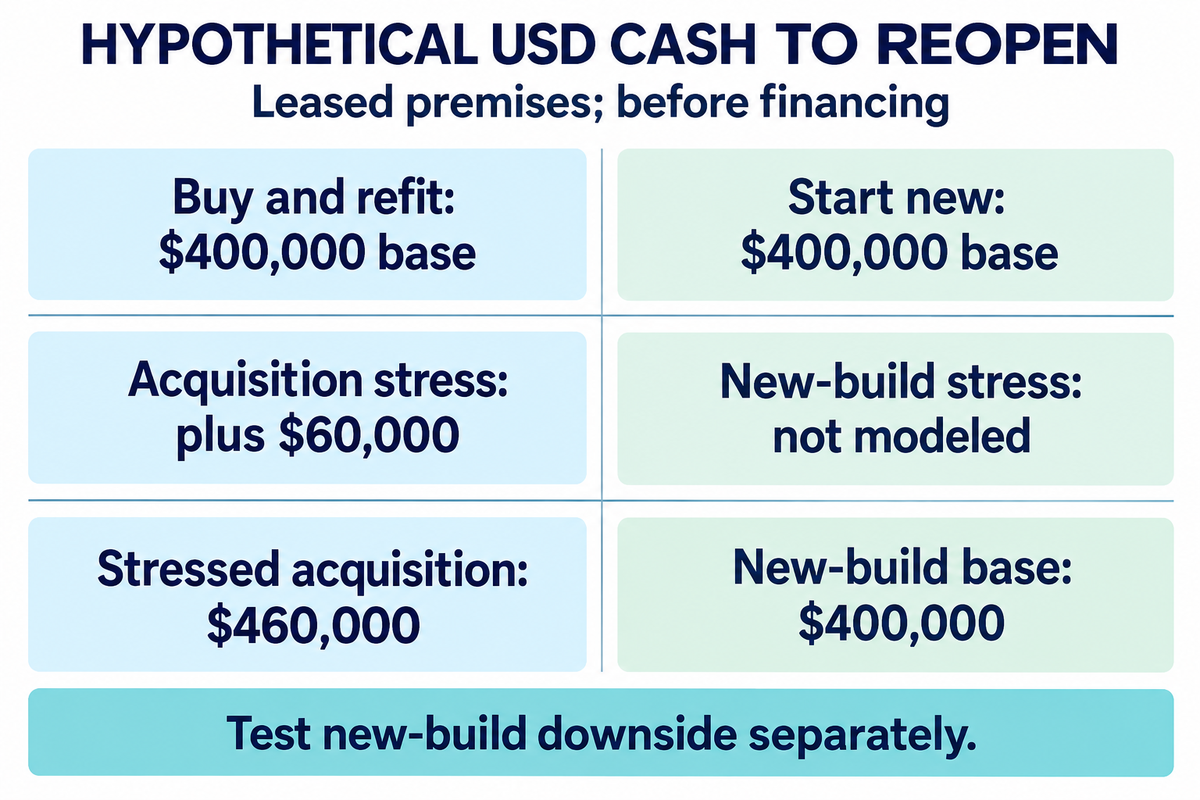
| Cash after this stress test | $460,000 | $400,000 | Acquisition rises 15%; test the new-build downside separately |
The $250,000 purchase headline initially looks cheaper than a $270,000 new installation. Equalising the other cash requirements removes that apparent advantage. One extra repair package and a month’s delay then create a $60,000 difference. If the seller reduces the price by only $20,000, the stressed acquisition still needs $440,000, which is $40,000 more than the base new-build example.
Refundable deposits and unspent reserves must not be included in any expense-based return calculation. Equipment included in the original scope must not be counted again as a replacement purchase unless the work requires replacing it. Likewise, a customer obligation prepaid must not be charged twice in the budget, once in closing cost adjustment and again in the same budget.
Equal cash totals don’t necessarily create equal tax results. IRS Form 8594 instructions address purchase-price allocations for qualifying business asset acquisitions. The accountant’s analysis on the tax-basis stands next to this funding comparison.
Check the lease, approvals and insurance before you commit
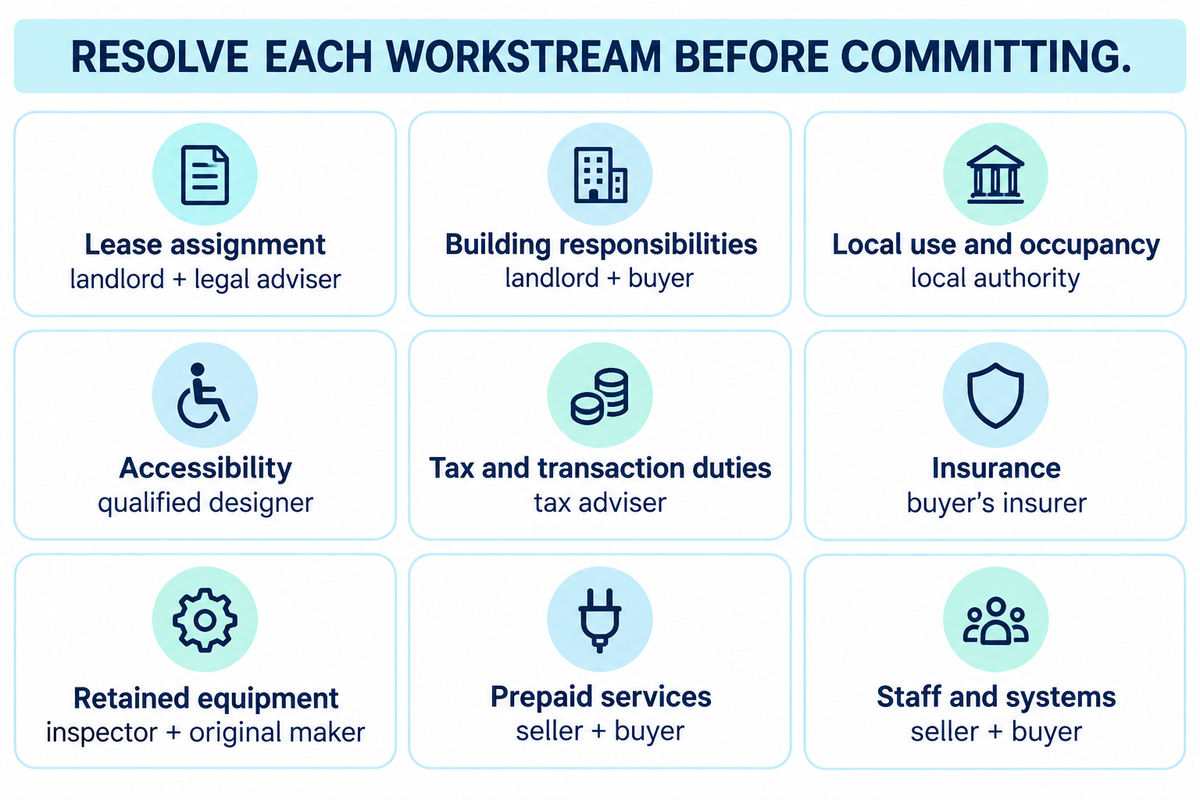
The buyer needs usable premises, the required operating approvals and appropriate insurance for the proposed activities. These are separate streams of work with different persons in charge. The sale agreement should clearly identify the transaction structure, assets and obligations being acquired, and conditions to be satisfied before money or possession is transferred. An asset purchase and a purchase of the company can also have different consequences.
Transfer-and-Refit Bottleneck Map
This shows each open transfer or refurbishment issue, its owner, the evidence required, and its impact on reopening cash.
| Workstream category | Record and responsible party | Condition to resolve | Cash or operating consequence |
|---|---|---|---|
| Lease assignment or replacement | Executed lease and consent; landlord and legal adviser | Buyer, permitted use, remaining term and guarantees | Rent changes, deposits or inability to occupy |
| Property and fixture responsibilities | Repair schedule; landlord and buyer | Who pays for HVAC, utilities and reinstatement | Building costs mistaken for equipment costs |
| Local use and occupancy | Approved use/layout; local authority | Proposed operation and works fit the approval | Redesign, permit fees or delayed opening |
| Accessibility | Site assessment and drawings; qualified designer | Applicable existing-facility and alteration obligations | Access-route, entrance or restroom work |
| State tax and transaction duties | Applicable notices/clearances; tax adviser | Buyer liability, timing and taxable assets | Escrow, tax charges or closing delay |
| Insurance | Buyer-specific binder and activity schedule; insurer | Actual attractions, food/drop-off services and exclusions | Premiums or an uninsured operating activity |
| Retained play equipment | Identity, condition and repair file; inspector and original maker | Keep, repair or replace each affected section | Unplanned equipment and closure costs |
| Prepaid parties and memberships | Outstanding-service register; seller and buyer | Who fulfils/refunds each promise and what cash transfers | Labour and supplies needed without a new full payment |
| Staff and operating systems | Rosters, training and account handover; seller and buyer | People and systems available on the agreed date | Recruitment, training or interrupted booking |
As an example, Fairfax County’s occupancy guidance addresses new locations and changes of use, with requirements that can include building, zoning, fire or health review. A buyer retaining the same use would face a different question from one adding a cafe or changing the layout. Use the procedure for the actual location rather than presuming every change of ownership requires the same permit action.
Tax timing can impact closing. For a New York bulk sale, for example, the state’s purchaser-notification procedure provides that notice must be given to the state at least 10 days prior to the purchaser paying for or taking possession of the business assets, whichever occurs first. Failing to give notice can result in the purchaser being liable for the seller’s sales or use taxes.
Which maintenance items or utilities am I responsible for?
Your responsibilities depend on various factors, including the condition of the property, equipment contracts and applicable duties. A lease for a commercial establishment can leave the tenant paying for repairs, utility consumption or the cost of restoring the property at the end of the lease. Costs associated with the premises must be separated from play equipment care. Make the relevant parties settle each responsibility before assessing the acquisition cost. A low rent can mask a high maintenance obligation.
HVAC servicing, plumbing and electrical capacity and fixed floor finishes merit separate mention from loose soft play elements. For a new venue, securing and preparing the premises contains the same questions. Existing family entertainment centers may have an installed base, but a short lease may preclude a significant refit.
Build a keep, repair and replace scope for the play equipment
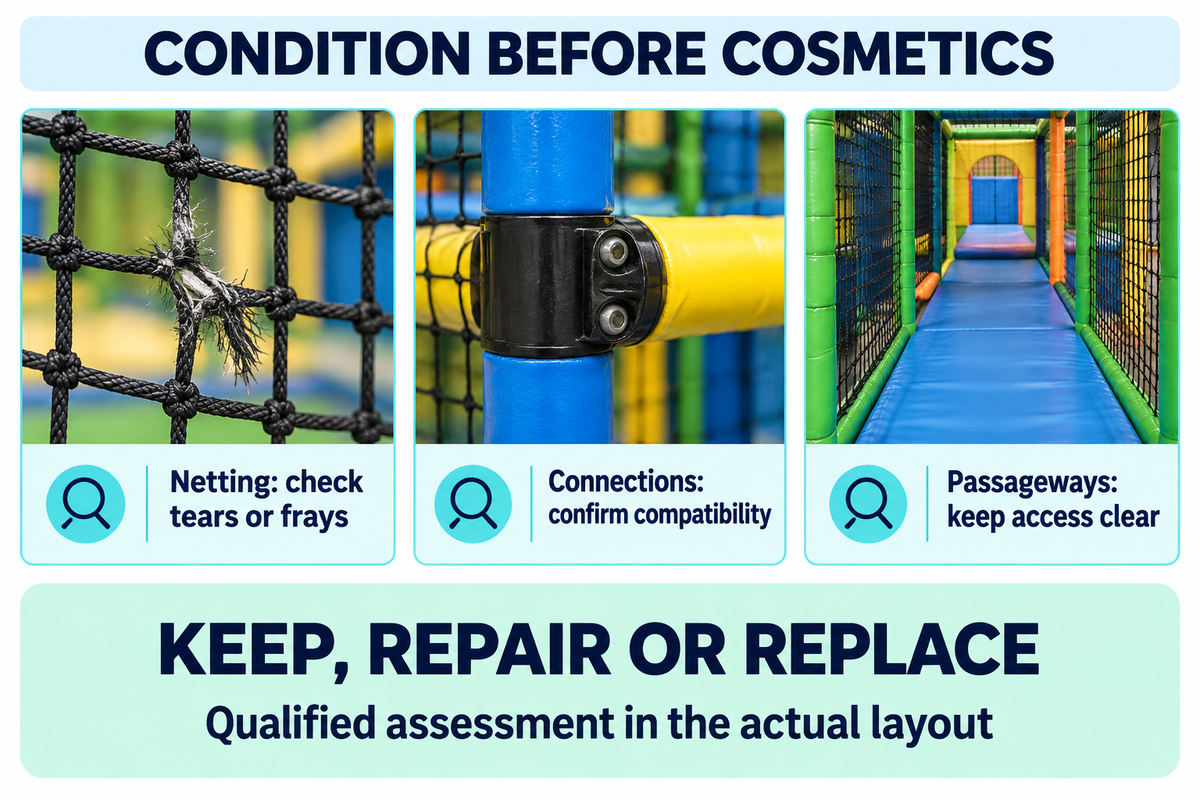
Decide what can be left in use from the equipment identified, its condition and proposed installation. Old age by itself is a poor repair specification. A new cover can’t correct an unsuitable connection, a blocked maintenance route or damaged substrate. Equipment designed for another room also requires a layout evaluation prior to relocation or reconfiguration.
“Check the safety netting for tears or frays.”
The CPSC guides also outline condition issues like damaged rope/webbing, torn floor covering, cleanliness and clear passageways. These help frame a site visit. A professional condition and compliance assessment then needs to address the existing play structures and proposed work in their full setting.
ASTM F1918-21 is an active safety-performance specification for soft-contained play equipment. Different kinds of attractions may require different standards. Record the original manufacturer, the project reference, the as-built drawings, the repair history and the specification that is applicable to the system in question. Replacement parts need compatible connections and an agreed method of installation.
Design of entry routes to soft-contained play structures for persons in wheelchairs is addressed by the 2010 ADA Standards. Under 2010 ADA Standards 206.2.17.2, a soft-contained play structure with three or fewer entries needs at least one on an accessible route; four or more entries require at least two. For an existing venue, the DOJ’s existing facility barrier removal regulations and any alteration work need to be considered. Don’t automatically assume a complete rebuild or a total exemption.
For ball pit layout and cleaning access, the removal of balls and access to the base affect sanitation. A toddler zone, for example, which uses foam play modules, requires different supervision and handling than a multi-level structure. The refit schedule should capture what work is required to reopen an area as well as who’s responsible for completing that work.
Protect bookings and staff through the handover
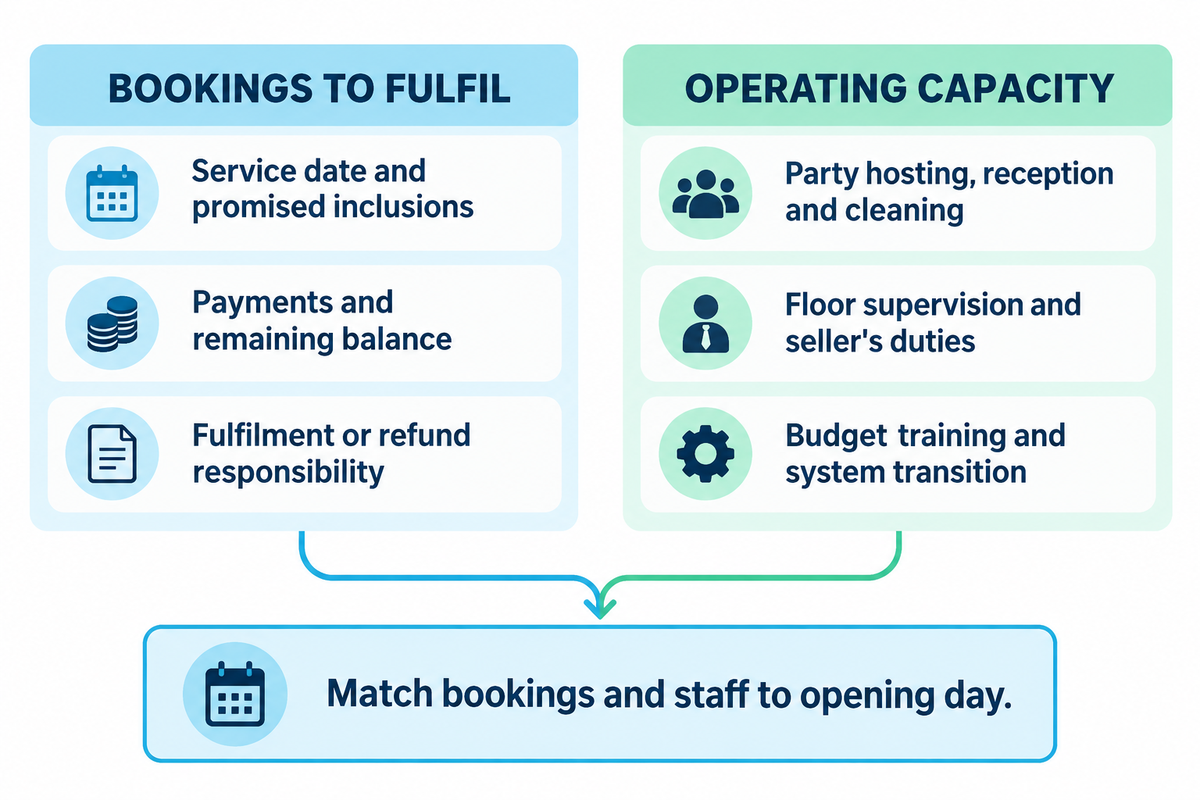
Transfer the operating detail behind the sales figures. The demand created by party bookings, memberships and open play may require different use of space and staff. A business with healthy advance sales still requires supplies, personnel and availability to provide the service. The transaction documents should settle what promises the buyer accepts and how their funding is reflected in the settlement.
Complete a dated handover register for each outstanding booking, including customer, service date, payment received, remaining balance, promised inclusions, and the agreed fulfilment or refund responsibility. Keep the transfer of customer data and recurring payment arrangements within the terms of the relevant contracts and privacy requirements. A waiver is another operating document to review with the buyer’s advisor and insurer.
Staff continuity is of importance to the customer experience. A roster should include party hosting, reception and cleaning duties as well as floor supervision, including the tasks the seller performed. Training time should be included in the transition budget. A plan to diversify into classes or drop-off services also alters the range of services and operating requirements; it shouldn’t quietly enter the acquisition forecast as effortless extra revenue.
Availability is important for service based businesses, meaning that bookings and staff must be available for the same opening day.
Choose the route your evidence can support
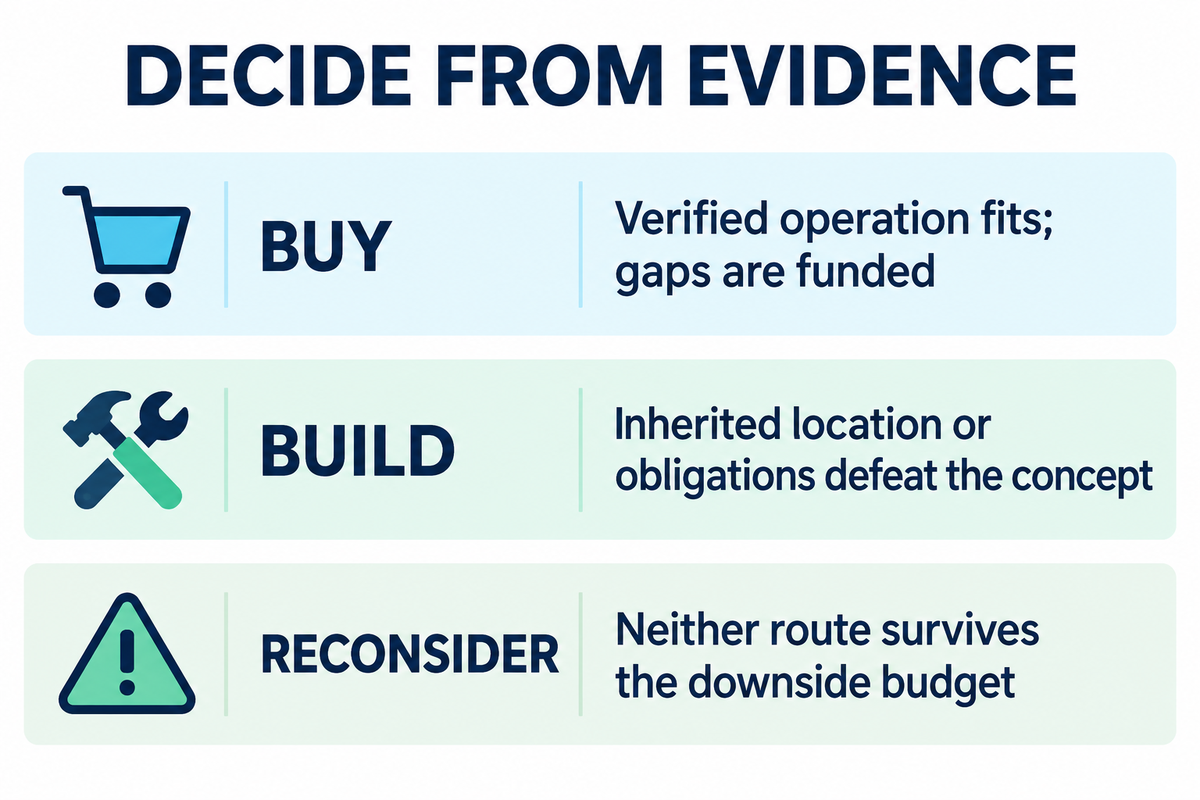
Buy when the verified operation aligns with your concept and the funded plan addresses its gaps. Build new when the inherited location and/or obligations consume the value you planned to buy. If neither survives the downside budget, a lower commitment or a new site can be a better decision than executing either transaction.
Starting a business requires market research before site selection. A seemingly attractive location near residential areas may draw enthusiasm, but demand isn’t settled until patrons part with their cash. Study the competitive landscape, complementary businesses and the prices families have already paid for comparable activities. Connect these observations to facility size, staffing and opening hours in the indoor playground business plan.
When assessing a potential acquisition, consider repeat visits and revenue mix as key factors in evaluating the customer base. For a startup, test your offer before assuming forecast attendance is a done deal. Indoor entertainment can experience uneven monthly trade. Indoor play spaces have off-peak seasons.
Key takeaway
A $250,000 acquisition and a $270,000 new installation both require $400,000 in the worked example. The route wins on verified operating value and affordable downside, not the smaller headline price.
In the indoor playground industry, business failure can’t be resolved by equipment alone. Adequate business structure, management time and local business economics must support your play environment.
What to send an equipment supplier for a useful refit quote
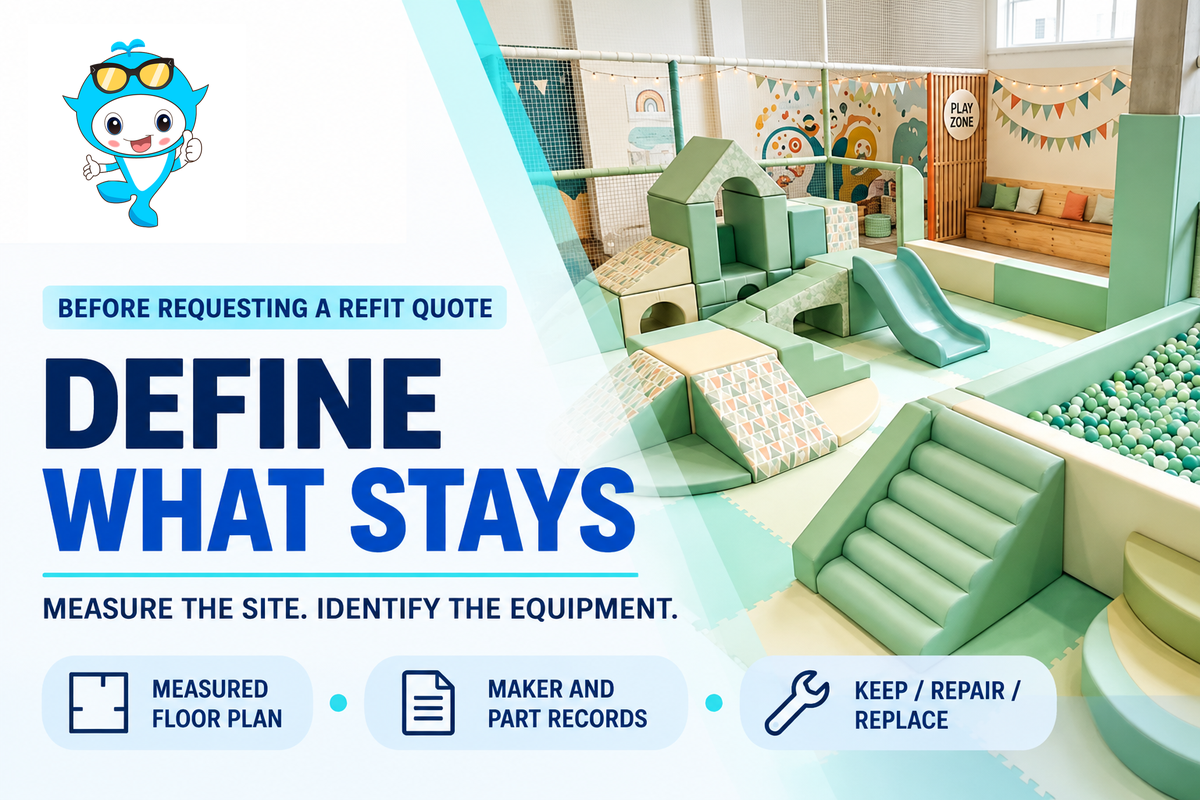
For an equipment supplier, a request for a cosmetic refresh becomes a project when the scope includes measured premises and a delineated scope of the work retained, replaced and added. Keep business valuation, lease interpretation and legal approvals with the owners of such responsibilities.
Didi Land’s commercial soft play sets use measurements taken from the venue as a basis. They also use age groups, and the intended layout. Didi also provides 2D CAD and 3D layout and visualization support. In an inherited installation, the identity of the original maker and the parts that are to be retained are part of the first discussion.
- Premises: a measured floor plan, ceiling obstructions, doors, columns, accessible circulation and service access.
- Equipment: manufacturer/project references, photographs, drawings, existing condition reports and repair records.
- Operating model: age groups, party and open-play use, proposed play zones, cleaning schedule and staffing positions.
- Quotation boundary: retained items, supplied components, removal, freight, installation, building works and exclusions.
- Acceptance and support: agreed drawings, applicable requirements, inspection responsibility, spare parts, warranty scope and the reopening sequence.
Verifications of site assessment and relevant authority requirements should be done by qualified persons before finalising an itemised quotation. Ask the original manufacturer about compatibility before mixing components. Prospective play cafe owners get better value for money from clear boundaries than from vague per-square-foot rates.
Send Didi Land your measured plan and equipment photographs to discuss new commercial indoor playground equipment and layout needs.
Frequently asked questions
Are indoor play spaces profitable?
They can be, but the specific venue’s costs and paid demand decide the outcome.
Rent, labour, maintenance and the mix of admissions, parties and other services determine whether the operation becomes a profitable play center. For an acquisition, reconcile income statements to transactions and adjust for the departing owner’s work. For a new venue, test the business plan against lower attendance and a slower opening. A busy weekend or an industry-wide margin estimate is insufficient grounds for valuing the business.
What permits are needed for an indoor playground?
Requirements depend on the address, proposed use, attractions and services.
The relevant process may involve a general business license, zoning or use approval, building permits, building codes, occupancy, fire review and health department requirements for food operations. The proposed transaction and any alterations affect the questions to resolve. Review the existing approval file against the buyer’s intended operation, including café or drop-off services. A venue that’s already trading still needs a clear explanation of which approvals remain applicable and which steps the buyer must complete.
What kind of insurance do you need for an indoor playground?
Arrange cover for the buyer’s entity, actual attractions and operating activities.
An insurer familiar with family entertainment should assess liability, property, employee-related cover and any other protection required by the operation or lease. Provide the equipment inventory, ages served, food or care services, claims history and planned alterations. Review exclusions as well as limits and price. The seller’s policy and a customer waiver shouldn’t be treated as substitutes for an effective buyer-specific insurance arrangement before operations begin.
Can I start an indoor playground with no experience?
Yes, provided the operating plan supplies the skills you lack.
To open an indoor playground, business owners need operating skills. Gaps in business experience can be addressed through experienced management, training and suitable professional advice. Budget the cost and time. Enthusiasm for children and play doesn’t replace the work of running a venue.
What is included in the build-out?
The contract scope determines the building works included in your price.
Build-out can include partitions, finishes, restrooms, electrical work, plumbing, HVAC changes and other work needed to prepare the premises. Playground equipment, safety surfacing, installation and design services may sit in separate packages. The same is true of permits, professional fees, freight, furniture and operating systems. A quote that says turnkey still needs an itemised scope and exclusions.
Compare drawings and responsibilities alongside the price. A landlord allowance may cover only approved works or reimburse expenditure later, so it can affect funding timing without reducing the cash initially required. For an acquisition, distinguish existing fixtures included in the purchase from refurbishment and replacement items priced separately. A practical budget records who supplies each package, who installs it, when payment falls due and which inspection or acceptance step permits the next stage of work. Those details make two build-out costs comparable.
About this guide: Guangzhou Didi Land Amusement Equipment Co., Ltd. supplies commercial play equipment and related layout services. Financial examples use assumed figures; site specific design and business decisions, transactions and tax matters belong to the buyer and their professional advisors. No acquisition outcome or investment return is guaranteed.
References & Sources
- Business planning and acquisition guidance U.S. Small Business Administration.
- Calculate your startup costs U.S. Small Business Administration.
- Instructions for Form 8594 Internal Revenue Service.
- Certificate of Occupancy, CO/Non-RUP Fairfax County.
- Bulk Sales, Tax Bulletin ST-70 New York State Department of Taxation and Finance.
- Soft Contained Play Equipment Safety Checklist U.S. Consumer Product Safety Commission.
- F1918-21 public specification listing ASTM International.
- ADA Accessibility Standards, section 206.2.17.2 U.S. Access Board.
- Title III Regulations, section 36.304 U.S. Department of Justice.